 Slashdot Mirror
Teaching Fractions: The Tootsie Roll Is the New Pie
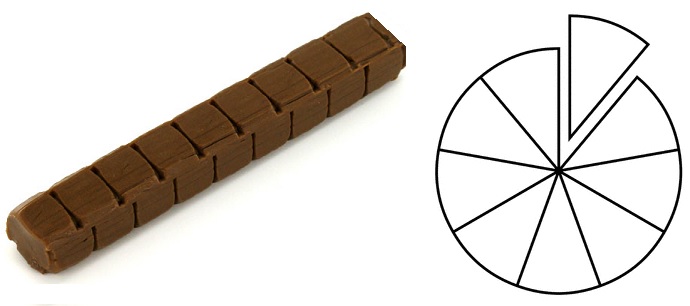
theodp writes "Following up on a WSJ story, data visualization author Stephen Few illustrates why using lines or bars may be sweeter than pie when it comes to teaching kids fractions. 'Although the metaphor is easy to grasp (the slices add up to an entire pie),' explains Few, 'we know that visual perception does a poor job of comparing the sizes of slices, which is essential for learning to compare fractions. Learning that one-fifth is larger than one-sixth, which is counter-intuitive in the beginning, becomes further complicated when the individual slices of two pies — one divided into five slices and other into six — look roughly the same. Might it make more sense to use two lines divided into sections instead, which are quite easy to compare when placed near one another?' So, is the Tootsie Roll the new pie?"
What the fuck is a tootsie roll?
The pie chart is counter intuitive? Anyone who has ever fought over pizza slices knows very well that 1/5 is larger than 1/6, even kids.
Here's a simple classroom script to teach kids about fractions:
1) Buy 2 pizzas, slice one in 8 pieces, the other in 12 pieces.
2) Take 20 students in the classroom and tell them to choose a piece from any of the pizzas.
3) Watch as war ensues
So one method is probably a small fraction better than another method of teaching fractions. This isn't how you enhance the next generation's education. This is how you make it look like you're doing something to help when you're actually just raising a fuss over the tiniest of things. This is the plastic banana slicer of education: an answer to a question nobody asked.
... and somebody read a school textbook.
Seriously. Textbooks have used multiple representations of fractions for years, one of which is linear, because the education research has indicated that different children learn better with different representations of fractions.
Well, at least we now know how long it takes for education research to trickle into the classroom: decades.
http://twinbeard.com/frog-fractions
Frog Fractions taught me enough fractions to pass my GED!
Thanks, Frog Fractions :-D
The comments on the site (as of this time) give some pretty good reasons why using slices of a circle aren't the best way to describe fractions. Most of the time it is easier for the mind to tell if two lengths are the same versus if two slices of a circle are the same. It is a much simpler calculation to determine length (line) then volume (pie piece).
Hasn't Michelle Obama already banned pies and Tootsie Rolls?
Gamingmuseum.com: Give your 3D accelerator a rest.
any candy bar that has natural sections would work for fractions
Kit Kats would work for 2 and 4 based fractions
Any person using FTFY or editing my postings agrees to a US$50.00 charge
There's 9 sections. What happens when you want to teach 1/4s, 1/2s, 16ths ?
That's why I think a bottle of Scotch is the new pie!
Now children, let me drink two shots, what fraction of the bottle did I just drink?
Now children, assume what's left is the whole and I drink another three shots, what fraction is left?
Now children, write a 1,000 word essay on why whiskey is the best math tutor whle I take a little snap.
Now Tootsie can sell a bunch of new lengths: halves, thirds, quarters, fifths, sixths, etc. Schools would just need to go out and buy a few bags.
For adults learning fractions, they could use alcohol instead, but they'd just have one fraction: fifths.
The pre-segmented Tootsie Roll is actually a poor choice. A person who sees it already divided into seven chunks won't understand all those divisions have to move in order to divide it by eight.
John
And it helped me get my insect porn business off the ground, and won me elected office!
Students will need to learn about fraction, true...
However, there is little to no need for fraction in the real world, with one exception. The US. Due to the antiquated mesurement system, you have to know fractions, else you are doomed...
However, in the rest of the world, fraction do not have a lot of use and their teaching can be pushed later in the cursus when we this learning is easier and has less need to rely on visualisation...
Cyrille
(slam!)
"Mom! Mom!!! Mr. Johnson tried to get me to touch his Tootsie Roll! He told me I just hadda touch the last third of it!"
(-1: Post disagrees with my already-settled worldview) is not a valid mod option.
It's much easier to get the concept of a whole with an entire Hershey bar than with an arbitrary number of Tootsie Rolls.
I completely Agree... I've actually had a few public disagreements with Stephen Few (on his blog - Hi Stephen) about his love of bar charts.
He's absolutely right, technically, on the visual perception -- that it's easier to compare lengths to basically anything else (like pie slices), particularly shapes that vary in more than one dimension (is a 5x5 rectangle bigger than a 6x4? If you know the dimensions you can do the math, but if you look at the boxes it's not as easy).
BUT, where I disagree (and I seem to agree with parent AC) is that people get tired of bar charts. Kids, in particular, have amazingly short attention spans, and as any teacher knows, engaging a child in a learning experience is very important, and different students will learn different ways. Your example of buying pizzas for a class is a classic example (although war is not the standard goal). Cutting a long subway sandwich or tootsie roll may not have the same effect. In fact, it's possible that the measurements Stephen Few relies on to measure visual perception could change if we took the time early on not to cater only to what our students are already good at, but to exercise spatial considerations that could improve.
Pie charts have their place, if only to break up the monotony. Certainly we should teach kids ratios based on bars, lines, squares, and other things as well -- for the most part we already do -- but we should not say that any one way is the best, even if there's one measurement that "proves" it, at the expense of variety.
From now I'll try this way to teach fractions, let see that this evening on a 9yo.
(a child who doesn't understand why a fraction is smaller with higher numbers)
I think a Hershey's bar would be a better choice if they want something that's already marked up. At least then you can break it into halves, quarters, eighths, etc (depending on which size bar you buy). Or just just a regular, unmarked tootsie roll, a ruler and something sharp enough to cut it.
They need to use both.
I agree, some things like halving halves to make a quarter are easier to show in two dimensions.
Math was taught and learned just fine for over 2000 years. Pretty damn arrogant to come along in the last 50 and think we know how to teach children math in a better manner than they've learned math all along. Pick your slogan, acronym, whatever. KISS (Keep It Simple Stupid), If it ain't broke, don't fix it... Nothing wrong with the way math has been taught all along. I have 4 kids that have all gone through Algebra in the last few years, and I had to go out and buy them Lego sets to learn Algebra. A true WTF moment for me. We didn't get Legos in school and still learned Algebra just fine. When they learned addition, subtraction, multiplication and division I'd help them with their homework only to hear "that's not how we do it" "our teacher taught us a different way" and we'd wind up taking 15 steps to solve a problem that should be done in 2 or 3. When people get paid to come up with "new and better" ways to do things, they have to come up with something or wind up losing that steady government paycheck. Doesn't matter that it's a worse solution than what's already in place, just that it's different.
They need to use neither. Give 'em the good axiomatic definition of a fraction. And them later on give the examples with pies and tootsies.
Oh, you'll loath some of the bullshit that gets added to math curricula to pad out the vocab lists...
Hey kids, because it's fucking pointless, we are going to be learning about 'proper fractions', 'improper fractions' and 'mixed numbers'! Open your copybooks now: "A proper fraction is a fraction where the numerator is smaller than the denominator. An improper fraction is a fraction where the numerator is larger than the denominator. A mixed number is a number written with a whole number component and a fractional component." All of these are basically just division problems that are being left unevaluated for reasons of convenience, or because the resulting decimal representation may not be entirely well behaved, so this shit is pointless; but it will be on the quiz.
If we divide people into identity groups, you can truly understand how to put certain groups together! 50% white 50% female ...
How would one go about converting a Flash game like this to HTML5?
First, you learn HTML2 (or 3, or 4, doesn't much matter). Then you learn CSS. Then, you learn Javascript. Then, you learn HTML5. Then, you learn Flash. Then, you learn ActionScript. And finally - You break into TwinBeard HQ, steal the source code to Frog Fractions, and begin the long process of porting it.
After all that, though, you probably already have a pretty good grasp of fractions.
This is just the latest episode in Stephen Few's war on pie charts. For anyone interested: http://www.perceptualedge.com/blog/?p=1492 http://www.perceptualedge.com/articles/08-21-07.pdf
Because I had it drilled into me as a kid. Now I sort of unconsciously can do most fractions.
Show them 1" on a ruler. Show them 1/4" increments. It's real easy to see 4 of those make up 1". Next show them 1/8" increments and 1/16" increment. They see pretty quickly how 16 can fit but the marks are smaller even though the number is bigger.
Now they've just learned how to read the crazy US Inch-standard system as well. Pretty handy for growing up in a slack-jawed yokel country who's politicians never let teachers adopt the metric system, but I digress...
Extra credit: show them a meter stick and listen to the gasp at how easy everything is because every little mark takes 10 units to get to the next larger unit of measure.
Join the Slashcott! Feb 10 thru Feb 17!
That 1/3 pie slice is no longer 1/3 of the pie in value if you only enlarge the slice and not the rest of the pie. Sure, it's still 1/3 of a circle, but it's no longer 1/3 of the pie it was originally from. That's only good for teaching fractions of a circle, which really doesn't come up all that often until you're way past the point of learning basic fractions. The whole idea is to compare the fraction to the whole (or other parts of the whole), and if you're enlarging just one part of it, then you're throwing everybody off for no good reason.
Uh, there *are* legit reasons for teaching the different classifications of fractions. For example, mixed fractions are the most intuitive representation of rational numbers. Improper fractions are the simplest way to write the number down, but not the most intuitive (for the given audience). Proper fractions are the remainder part of the mixed fraction, whereas the integers are taught in different lessons.
Math is hard, and teaching math is hard. The 'intuitive' or 'obvious' way to teach math isn't necessarily a good way.
I read TFA and all I got was this lousy cookie
The linear idea is good for comparison side by side, but if you have a tootsie roll which is 5" long and one that is 6" long, which one is a whole tootsie roll, which one is 5/6 of a tootsie roll, and which one is 6/5 of a tootsie roll. Even if you show the individual pieces, you can't tell. With a pie, there's never any question as to whether you have more or less than a whole pie.
Is it just my observation, or are there way too many stupid people in the world?
No, no, no, it should be the Tautsie Roll that replaces pie.
This isn't a problem that needs solving. I never needed a teacher or diagram to explain to me that a half of something is larger than a quarter; that's effing obvious. "Learning that one-fifth is larger than one-sixth, which is counter-intuitive in the beginning"? WHAT? And even so, this article's point is moot, since visual representations other than pies have been around for many years. Containers of liquid, pieces of chocolate bar, etc.
The only things I needed to learn about fractions were the tricks for adding/subtracting/multiplying/dividing them. And a bigger problem is that teachers nowadays focus more on teaching the procedures than the concepts. Kids may know "you cross out a number on the top and a number on the bottom when multiplying fractions" but they don't understand WHY.
They need to use both.
I agree, some things like halving halves to make a quarter are easier to show in two dimensions.
And how do you visualize 1/3-1/5 or 1/3+1/5 with pies or tootsie rolls ? Either metaphor (pies or tootsie rolls) is fundamentally flawed in that it captures only 1 property of fractions (fraction of a whole) and that's it.
In UK schools they use Unifix blocks which are essentially the same as the "tootsie roll" examples. The way these would be used would be to make several columns of 15 blocks. One would be divided into three parts and the other into five. They could then easily illustrate adding 1/3 + 1/5 by adding one of the "three part division" to one of the "five part division". Counting would show that the answer was 8/15 and comparrison to the whole 15 parts would show that it is just over half.
This would also illustrate why you have to get the fractions to have the same denominator. Subtraction is a bit harder - they would have to take away the 3 15ths from the 5 15ths but you get the idea
Math is not hard. Teaching Math is not hard. Math is conceptual and until you get the concepts, actual math is just by rote, which is how math was taught to me.
Agent K: A *person* is smart. People are dumb, stupid, panicky animals, and you know it.
we can construct rigourously the set of integer numbers, and set of rational numbers, as well as the set of real numbers and complex numbers.
Perhaps we specify the rationals in terms of the rational numbers. Also, if we are now constructing the rational numbers, does that mean they didn't exist in Newton's time? Or if they did exist then, how do we construct them now?
Perhaps GP meant to increase the radius by 50% while leaving the central angle the same.
tau is the new pi
The number line is used a lot too, and they look mighty similar to the fraction line. I could see it confusing some kids. Especially as the curriculum likes so much to teach key word vocabularies and associate particular visualizations with particular concepts in such an inflexible manner
My biggest complaint with math education is that the schools seem so inflexible in it. My 6th grader is doing OK with math so he's in the "7th grade" math class. Along with, as it turns out, most of the rest of the 6th grade students. If he had done better he would be promoted to the 8th grade class.
Basically I think they just renamed 6th grade math to call it 7th grade math probably to appease parents, and the whole "early promotion to 8th grade math" would seem to raise questions over whether the 7th grade curriculum is all that worthwhile anyway, and wouldn't this bright kid be learning at a higher rate than the average 8th grader
it's just all wrong, yet these are the only options they will consider, its as if the math teachers are unfamiliar with math or at least uncomfortable splitting the class into three or four groups and teaching each group at its own pace for each major topic
Nullius in verba
I think that the fact that quantity can be expressed in many different ways is a pretty fundimental mathematical idea and trying to hide it from children would be a mistake. 1/6 isn't the "un-evaluated" version of 0.166..., it's exactly the same thing.
No kidding!!! What do you say at this point?
You're confusing "teaching math to be intuitive" with "the method that would be most obvious to teach".
I read TFA and all I got was this lousy cookie
No, really old. My grandmother used to break apart chocolate bars to teach fractions to her 2nd or 3rd grade classes back in the 50's and 60's.
Now some self-proclaimed genius has figured out what Tufte has been saying forever: that pie charts suck?
https://app.box.com/WitthoftResume Code: https://github.com/cellocgw
This is how I learned math in the first grade, and is very much visual in how fractions work.
http://en.wikipedia.org/wiki/Cuisenaire_rods
Laughter is the Spackle of the Soul.
Basically the Tootsie Roll concept spoken of has been in use for decades, this ain't new.
Laughter is the Spackle of the Soul.
Oh, you'll loath some of the bullshit that gets added to math curricula to pad out the vocab lists...
Hey kids, because it's fucking pointless, we are going to be learning about 'proper fractions', 'improper fractions' and 'mixed numbers'!... All of these are basically just division problems that are being left unevaluated for reasons of convenience, or because the resulting decimal representation may not be entirely well behaved, so this shit is pointless; but it will be on the quiz.
Getting added? I learned that in the third grade fifty years ago, it isn't something new that they're adding now. We learned fractions before learning division; it makes division much easier to learn if you understand breaking groups into fractions of a group first. Also, back then first you learned addition and subtraction, then fractions, then multiplication and dividion, THEN decimals.
Oh, and you missed one.
2/3 proper fraction
3/2 improper fraction
1 2/3 mixed number
1 3/2 retarded number
Free Martian Whores!
What do rational numbers have to do with infinitesimals? And I should have said that we might specify the rational numbers in terms of the natural numbers.
While Leibniz used infinitesimals, Newton used nascent and evanescent quantities, which may have been one-sided limits.
Ok; Take a 1/3 pie slice. Enlarge it by 50%. It is still a 1/3 pie slice, in value and visually.
Okay, I'll bite. Take that 1/3 pie slice and move it from the front of the pie to the back. Is it still a 1/3 pie slice visually?
Now draw two Tootsie Rolls, one twice as long as the other. Does that accurately represent the values of each roll, or is the longer one one big Twinkie?
Learning to use tools lie pie charts and bar graphs is just as important to students as reading their first copy of How to Lie With Statistics.
and something sharp enough to cut it.
I don't think the school board would approve of the use of a thermal lance or diamond coated masonry saw in an elementary school classroom.
Time to offend someone
http://www.elementarymatters.com/2012/05/learning-math-facts-with-cuisenaire.html
I had these in the early 1960s (JFK presidency) at the http://www.lesleyellis.org/about/who-we-are/history which at the time was off concord street in Cambridge
at some point in my college maths I stopped seeing fractions
Must have not gotten very far in college maths then. Because in academia, fractions are the only widely accepted way of representing division (either by a horizontal line, or a slashed line, '/')
show them the math.
Worked well with my kids and every other kid I showed it to.
The Kruger Dunning explains most post on
You have it backwards. What you are thinking of as 'plain old' are actually normalised decimal fractions - one particular subset of fractional arithmetic. But decimal is no more inherently sensible than duodecimal, or octal, or binary, or even sexagesimal. A proper education in mathematics should enable one to work in whatever base and with whatever fractions are natural to a given question - instead of training you to use one particular set of variables as a procrustean bed.
=-=-=-=-=-=-=-=-=-=-=-=-=-=-
Friends don't let friends enable ecmascript.
What they don't realize is that using pies and pizzas to teach fractions is secretly preparing kids for trigonometry. Except that the whole pizza is actually 2 pi, rather than a pi.
AccountKiller
there already is a teaching tool for this. Cuisenaire Rods. Its how I learned fractions, and an assortment of other mathematical principles
I've decided to Diversify my Holdings. I've divided my cash between my left and right pockets, instead of all in one.
A different paraphrase, but this one's often attributed (though many such attributions to him are questionable) to Yogi Berra.
In SOVIET RUSSIA... erm...NSA AMERICA, the Internet logs onto YOU!
Glad I made that rational.dll for using fractions on computers. I call 'em rat for short (like int for integer.)