 Slashdot Mirror
A Math Test That's Rotten To the Common Core
theodp writes " The Common Core State Standards Initiative," explains the project's website, ""is a state-led effort that established a single set of clear educational standards for kindergarten through 12th grade in English language arts and mathematics that states voluntarily adopt." Who could argue with such an effort? Not Bill Gates, who ponied up $150 million to help git-r-done. But the devil's in the details, notes Washington Post education reporter Valerie Strauss, who offers up a ridiculous Common Core math test for first graders as Exhibit A, which also helps to explain why the initiative is facing waning support. Explaining her frustration with the intended-for-5-and-6-year-olds test from Gates Foundation partner Pearson Education, Principal Carol Burris explains, "Take a look at question No. 1, which shows students five pennies, under which it says 'part I know,' and then a full coffee cup labeled with a '6' and, under it, the word, 'Whole.' Students are asked to find 'the missing part' from a list of four numbers. My assistant principal for mathematics was not sure what the question was asking. How could pennies be a part of a cup?" The 6-year-old first-grader who took the test didn't get it either, and took home a 45% math grade to her parents. And so the I'm-bad-at-math game begins!"
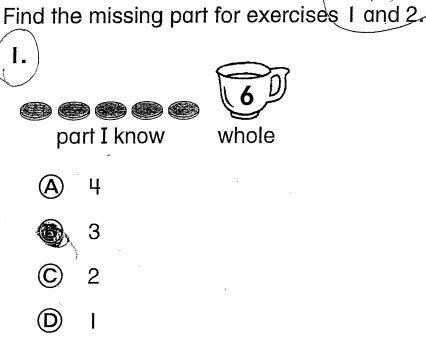
Well when there isn't an explanation of what is being asked and the test was written by the same person that puts the iconography in airport bathrooms....
Yeah, why pennies, and why a cup? I'm guessing the answer is D, 1, based on the number on the side of the cup, but that's a guess.
And what about #12? What the heck is a "subtraction sentence"? Why are there no subtractions in the answers?
Because the pennies add up to 5, and to be whole it should be 6? Or is whole milk 6% fat and 6/100 = .06 * 5 pennies = .30, or in other words 30%, which is why the genius kid picked B?
Or is it message about the deflation of the value of the dollar in international markets and the price of milk?
The question is clearly ridiculous. The problem lies there and solely there though, unlike as the article suggests. Expecting 5 or 6 year olds to be able to do basic addition and subtraction of small quantities of physical items is not a problem at all –that's exactly what I'd expect a 5 or 6 year old to be able to do. Writing crappy questions like pearson has is absolutely a problem though.
I don't see the Common Core standards as the problem, this is just a poorly written test made by people who were not the authors of Common Core. Unless I misunderstand, Common Core simply defines what skills a student should be proficient at by the end of school years. It doesn't define these test questions, Pearson Education did.
Question 1: You see 5 pennies, the total in the cup is 6, so the missing part is 1 (penny). How hard can that possibly be?
If you see five, and there are six more in the cup, then the total is eleven. If only one is missing, then which one?
An earlier edition of the "Social Studies Extended Response" stated the following (emphasis mine):
In Soviet Washington the swamp drains you.
or read reports written by sixth graders in 1900.
I'm calling bullshit on this. Part of my job a couple of years ago was handling university archives. I was exposed to a large number of essays written by college students from ~1890-1910. They were all on the level that I was expected to write freshman year of high school.
There do not appear to be any coins in the cup. It appears to be full of liquid with the internal liquid level line.
There is a number 6 under the cup, it does not say 6 coins. Why would there be coins in cap anyways? You put liquid in cup.
"Find the missing part?" is a bad question. If anything it should ask about coins, not parts.
There are no parts missing all the coins are whole so is the cup.
The whole thing is not clear and misleading.
You are assuming the question is asking about the sum of coins. That is not indicated by the question.
Having to make assumptions about a question is very very wrong when it is not a written test where one can explain the assumptions one has to add to a question.
It's a system full of good intentions, but the people that come up with the questions appear to be gearing things toward a certain way of thinking. I'm all about the system, it is designed to show the children how they think, and how they work out problems naturally, in their mind's eye as it were.
One problem that I have had with it in the past is that the way the questions allow for assumptions. For instance, I'm from Alabama. In Alabama it's generally hot and humid. When we take our kids to the park, they generally are wearing sandals or flip-flops. Any time they're playing in the sand, they're going to be bare-footed, or at the most, sandals/flip-flops. They give the kids a story to read about a kid that goes to the park. The story is basically this:
Story title: 'A day at the park' Timmy goes to the park. He plays in the park. He plays in the sand. It starts to rain, so Timmy has to leave. Timmy goes home and puts on dry socks. Timmy then takes a nap. When Timmy wakes up, the sun is out. He goes back to the park. Timmy likes the sun. Timmy smiles.
Then the questions that they ask are something like this:
1) What's another good title for this story? a) The sun b) Timmy goes to the park c) Rain and sun d) Timmy takes a nap
2) Why did Timmy put on dry socks? a) Because Timmy was home b) Because his socks were wet c) Because he was sleepy d) Because Timmy wanted to go back to the park
So question #1 is asking for an opinion, and question #2 is asking about something that's not mentioned in the story. After my kid missed both questions, I asked the teacher why, and her answer was that the questions are introducing higher learning. Higher learning? An opinion is higher learning? Asking questions that are full of assumptions not mentioned in the story, is higher learning?
So in that way it needs to be improved upon. But for math, they allow the kids to express the algorithm in any way, and as long as they get the answer correct, and the algorithm that they use is logical, then they're credited with learning. And I think that's way better than, "Here is an algorithm, learn it, and use it." Because if you don't understand how that algorithm came to be, you will not be able to use it in real life. Whereas if you came up with the algorithm yourself, you cannot explain how or why you came up with it, but you understand how to use your brain in the real world.
Politics; n. : A religion whereby man is god.
Someone at Pearson came up with a bad question.
They meant for that question to coincide with the standards which say subtraction should be taught. How the heck do you leap from "Pearson has some bad questions" to "curriculum standards are bad"? Common Core may be bad, it may be good, TFA gives no reason to believe either. They only show that Pearson's implementation has some errors.
We teach firefighting, construction safety, and other topics that have specific codes and standards students need to learn. When we realize we have a bad question we don't say "construction codes are bad and students shouldn't be expected to learn them", we say "this question is bad and we should rewrite it so it better gauges the student's understanding".
There are a couple of statistical calculations test makers can use to find and fix bad questions. It doesn't appear that Pearson used those (yet). If they run the calculation, they'll see which questions are bad and can fix or remove them.
Obviously if fewer than half of students get a question correct, it's probably a bad question. There are other calculations which are similar but more advanced. Look at a properly designed quiz covering the same subject, one with well vetted questions, and I bet it looks a lot better. Questions like "Imagine you had four cookies and gave one to your sister. How many would you have left?" also meet the common core standards, and that's probably a good question for a certain grade level.
Take a look at some of the tests from a hundred years ago and try your luck at passing them, or read reports written by sixth graders in 1900. Impressive, huh?
Part of the reason for that apparent phenomenon is that the kids who weren't actually near the top of their class in 1900 didn't go to school. Most 12-year-olds were working, either in factories or on family farms. Illiteracy and innumeracy was much much higher than it is today: Many many people not only couldn't have passed those tests, many people couldn't even read the numbers or hope to add them together. The fact of the matter is that according to even cursory study of the issue demonstrates that on average Americans are better educated now than at any time previously in the entire history of the country. The idea that there was some kind of idyllic America with great educational systems some time in the distant past is just nonsense.
I am officially gone from
Then just ask "what is 6 minus 5". Why make the question ridiculous?
now we need to go OSS in diesel cars
People, people, you need to step back and reexamine your basic assumptions about the question. They are not 'pennies', but rather 'oreos'. -folds arms in triumph
Other than that? That was the entire problem. Look, we're adults and we can say "they probably meant to have this be a problem about subtracting 5 from 6, and the fact that the 5 was in pennies and the 6 wasn't was just some boneheaded test writer." A 6 year old may very well not figure that out even if he can subtract.
There's also a question of if a poorly written problem like this slips through, how shoddy the system of test reviewing is in the first place and so how many other problems are as bad.
Part of my job a couple of years ago was handling university archives. I was exposed to a large number of essays written by college students from ~1890-1910. They were all on the level that I was expected to write freshman year of high school.
Hush. You're bringing relevant facts into a discussion of cherished golden-age mythology. You're supposed to join in the wailing and gnashing of teeth over our decline from those halcyon days (always conveniently just out of living memory) when people were upright and moral and true, before the rot set in and we declined to our present sad state of affairs. O tempora! O mores!
The correlation between ignorance of statistics and using "correlation is not causation" as an argument is close to 1.
Is this the same Pearson that designs and administers tests for IT and other professional certifications? If so, it would explain a lot. The ones I've taken seem to be designed not to test your skills in the subject matter, so much as to test your capacity to parse bad English and to solve trick questions. It's horrifying to think that we are subjecting first graders to this crap.
Loading...
But it's obvious the cup is full of liquid, therefore the answer must be 787. That being the number of degrees required to melt zinc, which is clearly what is missing.
If I have been able to see further than others, it is because I bought a pair of binoculars.
It's hard because the people writing the test have no experience writing for an audience.
When you write for an audience, you quickly come to understand that things you think are obvious aren't obvious to everyone, and that any loose or fuzzy choice of words adds ambiguity. It's the problem of self anchoring and illusion of transparency.
Specifically in the case of the test:
Test modes are introduced with only a brief explanation and no worked examples for clarity.
"Find the missing part for exercises 1 and 2" is weak, non-specific, and ambiguous. "Part" has connotations of a physical piece that completes a whole (like a puzzle piece, or the broken handle of a cup), but is used to describe a grouping. The presentation uses two disparate representations of a group: 5 pennies, versus a cup labelled "6". The captions "part I know" and "whole" seem to have nothing to do with the pictures - the 5 pennies isn't a "part", and the cup is a "whole" object, but why is it labelled 6? The cup is non-sequitur to the question, and cups hold fungible materials while the pennies are enumerated. And to drive that last part home, the cup is shown "filled" with liquid. Or is it partially filled? And is the fact that it's partially filled somehow related to the question?
Here's a reworked example that's a little better. (Could be better - I didn't give spend a lot of time.)
For the next two questions, we will show you something on the left and something on the right. Choose the answer which, when added to the thing on the left, makes it the same as the thing on the right.
Example: [left: Square containing 3 circles] [right: Square containing 4 circles]
[list of answers, with circle marked correct].
Question 1:
Show 5 smaller cups (shot-glass sized) filled with a dark liquid. Show a measuring cup with lines labelled 1-7, and filled to level 6 with a dark liquid.
Question: How much more ink is needed on the left to make the amount of ink on the right?
Well, sure, you were able to take what has to be one of the most pathetic examples of muddiness I've ever seen, and by a rather sophisticated exercise of elimination of possibilities, construe what must have been the intent of its creator. That was a much more difficult problem than the arithmetic problem that it was intended to represent, and you are no 5-year-old.
Those who would give up essential liberty to purchase a little temporary safety, deserve neither liberty nor safety.
Interestingly enough I was alive at the time of the events of 9/11/2001. And I remember that 17 of the 19 hijackers weren't Afghanis but Saudi Arabian. A full 89% were from our friend and ally in the middle east, Saudi Arabia.
Well, according to the illustration, the cup is full of milk... which lends credence to your theory.
I am very small, utmostly microscopic.
Bob has 5 apples. Bob gives 3 of his apples with Alice. How many apples are there?
How many apples are there? There are five. Bob has two, and his idiot friend Alice has three.
Actually, since you didn't specify where we're looking, there's no way to even answer that.
Ignorance is a choice
Show 5 smaller cups (shot-glass sized) filled with a dark liquid. Show a measuring cup with lines labelled 1-7, and filled to level 6 with a dark liquid.
I mean this with no disrespect, because I largely agree with your bigger point. But you've illustrated part of the problem with the original test - People designing tests for kids who don't understand how those kids perceive the world.
Until at least age 7 or 8, and usually later, kids have a very poor grasp of conservation of volumes. They will tend to linearize the problem, seeing the "full" smaller glasses as having the same volume as the marker with the same height on the larger measuring cup.
I see 5 pennies.
I see a teacup with a label 6.
Your observational skills are somewhat lacking, I'd say.
I see five stacks of two coins. (look closely)
I see a coffee cup with a label.
If I turn the coffee cup over the stack of coins, I would read 9, but there would be 10 coins under them. Thus, I need to take away one part - one coin. The answer is thus one.
Q.E.D.
What strikes me about this test is the utter alienness of its language and symbology.
Okay, it's been half a century since I took a test intended for children entering elementary school. I recognize a few of the sentence forms. Somebody has a certain number of guitar picks and gives some away, no problem. But the bizarre pennies to coffee cup equivalence, what the fuck is up with that? Who thought it was a good idea to assume that young children would know that the sentence in "number sentence" means what the rest of the world generally calls an "equation", or that a "subtraction story" conversely means a word problem? What is a "related subtraction sentence" and how does it differ from an ordinary subtraction sentence? Why are you using passive voice to ask questions of a five-year-old? Why do you think we need cubes to solve a linear equation?
What's meant by the fragmentary term "part I know"? Dude, I have no idea what you know. Try speaking in full sentences, like we're taught in school. Oh, right.
In short, this seems substantially to be a test of cultural indoctrination whose arithmetic pales in comparison to the challenge of getting inside the parochial mind of whoever developed the test. I'd be proud if my child failed this test. It's beyond absurd; I find it positively bigoted. These people need to get out and see more of the world.
Parity: What to do when the weekend comes.
Not just "friend and ally", but also a very wealthy country — whereas the text was implying, the hijackers came from an impoverished one...
In Soviet Washington the swamp drains you.
If you've listened to the instruction that goes along with the test, it would be clear what to do. My first grader has no problem with these problems. He's told me that the teacher has explained the technique and he recognizes it from the questions that are asked.... Without understanding the context in which things are taugh, you can't judge the tests that are used. This test is not ridiculous when you look at it in proper context.
when you ask a simple question in a simple way, you test a child's ability to understand concepts. When you ask a simple question in an overly convoluted and distorted way, you test a child'a ability to follow directions. The school district makes clear which kind of test this is supposed to be.
honestly people, a test for first graders that is hard to understand for many slashdot readers, including myself??? "you can't take it out of context, there are accompanying teaching segments, etc". I'm going to go out on a limb and say that you should be able to isolate a math question of "6 - 5 = ?" and be able to understand it outside of context.
Question 5 was my favorite WTF.
====
5. Find the missing part.
Write the numbers.
[9]
o o o o [ ]
___ ___ ...and got it wrong.
part I know missing part
====
(the o's are pennies, and the [ ] is a box)
(slashdot is messing up the formatting, or I'm not doing it right)
The student filled in:
_9_ _5_
Yeah, they *wanted* a different answer, but he's still right.
What part does he know? The big "9" in the box.
What part was missing? The 5, which he got right.
If this were for an older student, and if the style of questions was explained and examples provided, then I'd understand that they should listen and comprehend what is expected with certain types of questions, but this is a first grader. The expectations should be very obvious.
Before you write that off as something the student should have understood, take question 6, which is right next to it:
====
Complete the picture.
Write a subtraction sentence.
6. Jennifer has 6 guitar picks.
She gives 4 guitar picks to
her students. How many
guitar picks are left?
[6]
| o | |
| o | |
| o | |
| o | |
__ - __ = __ ... but the "6" is right under the part of the picture that has 4 dots in it (and yes, they're black circles, not triangles as a guitar pick would be... that's just one more stupid little detail that doesn't matter much, but shows the poor quality of the test).
====
The student got this one right:
_6_ - _4_ = _2_
So what is it? Do they write the number that represents the whole first, or the number that represents the dots above the answer line?
There's so much wrong with this test. Even the way it was marked by the teacher is, IMO, in bad form. Incorrect answers have their question number circled, and correct ones have a check mark in the middle of the question space. To see why that's wrong, just look at the students answer in question 8. It's a multiple choice question. He put an "X" through the three he thought were wrong, and circled the one he thought was right. "Circle" means right; "X" means wrong". They expect the child to circle correct answers, but they circle incorrect questions.
BTW, anyone know when they started referring to math problems as "number sentences" and "subtraction stories"? Mixing reading comprehension and math seems like another unnecessary complication for a first grade test.
Based on the language, another valid answer is 6 since there are still 6 guitar picks. Now if it had asked "How many picks does she have left?", then the answer would be 2, but it asks "How many are left?" Awful question. I ran into this a lot in 1980s elementary school. I would get frustrated and go up to teachers during the test and ask which way it was meant to be interpreted. Many would get frustrated with me, instead, thinking I was just causing trouble, but a few teachers were actually honorable enough to announce the proper interpretation to the class, or throw out the test and have us retake it, modified.
I don't know about that weird language, but I'd guess it's the result of too much ideological abstraction. When it comes to ideology, a lot of state organizations operate under some-is-good-therefore-more-is-better. This particular doctrine was probably started as a way to reduce fear of math in the student, and now it's been taken to ridiculous extremes. I don't even know what 'number sentence" (equation?) or "subtraction story" (?) mean.
While I agree with your overall point, I disagree with that. Whether the phrasing is easy to understand or not entirely depends upon whether you have been exposed to that phrasing before.
I agree with that. I would have no problem with a math test that exclusively featured problems in the patterns of:
6 - 5 = ?
6 - ? = 1
? - 5 = 1
Then, a DIFFERENT test with word problems. And if the school feels it necessary, a THIRD test with pictograms (or whatever).
I know adults who have no problems with basic math but who cannot figure out a word problem. Those seem to be two different mental processes. So combining then into one score and on one test isn't very helpful. And probably leads to a lot of wasted time due to stress when the student hits a word problem.
I was in 1st grade 39 years ago so my memory is a little fuzzy to say the least. I do remember being the fasted reader in the class and just burned through all the materials (I think it was SRA readers). Even so, I doubt I would get the word "guitar" -- that word is an import from Spanish and just doesn't lend itself to being sounded out using English sound characteristics. Why didn't they just use "balls" or "hats" or something about which there can be little confusion? It's a math test -- not a reading test.
What changed under Obama? Nothing Good
Common Core doesn't specify questions or tests - this is just a shitty test, that happens to meet (maybe?) Common Core.
There's a lot of misunderstanding (and hence vitriol) about CC out there; Common Core says your students need to have certain skills. How you develop them is up to you.
https://en.wikipedia.org/wiki/Common_Core_State_Standards_Initiative#Mathematics_Standards
Please help metamoderate.
That's easy:
There's 4 people in a car, 6 get out. How many have to get in before there's no one in it?
I bet Eve knows the answer, she's always nosing in.
But anyway, the question is clearly referring to all apples, so:
There were about 69 million tonnes of apples produced in 2010, at 6,666 apples per tonne that's 460 Billion apples, but they only last for a few weeks, so 460 / 26 = 17.7 Billlion
Answer: There are roughly 17.7 billion apples.
Waterfox - a Firefox fork with legacy extension support, security updates and better privacy by default.
This demonstrates why problems should be tested by real kids before being released on the masses.
One, albeit simplistic, test is to determine if particular questions are more likely to be answered "incorrectly" by kids who did well on other questions than by kids who didn't do well on other questions. If the problem is supposed to be hard, smart/more mature kids should do better on it than other kids. If the problem has been made hard by unintended ambiguity, smarter/more mature kids are sometimes more likely to get it wrong as they try to make sense out of the chaos that they are more likely to detect.
Although it may be too complicated for first graders, the "test group" might also be asked to mark each question with "how sure are you that you got the right answer (certain, somewhat sure, quite unsure)" to detect when kids feel they had to assume facts not in evidence to try to answer the question.
Sort of like politics - simplistic people come up with simplistic answers because they often fail to see the underlying and more subtle issues.
Why is there an "insightful" mod and why isn't it "-1"? If I wanted insight, I wouldn't be reading
With common core, we see the progressive's failed attempt to educate children. With "No Cretin Left Behind", or NCLB, we saw the conservative's failed attempt. (apologies to anyone born and raised on Crete) Both parties like to jack their jaws about the importance of education, but both parties have their part in the "dumbing down of America". And, THAT is why local governments should be tasked with educating children, and the federal government should maintain a hands off stance toward education.
That might not help much, either. An anecdote from my personal educational history: As a freshman in high school, I decided that math was interesting, and read the math text entirely in a few weeks. After briefly showing the teacher that I did understand it all, he handed me another textbook. Then, a month later, another. But after a few months, he apparently ran out of texts, because his reaction to my request for calculus texts was "You're not ready for that." I asked around a bit, and found to my dismay that the rest of the teachers seemed to agree with him. So this part of the "educational system" was now a brick wall that blocked my further learning.
However, I did talk to the school principal (who was to become a friend) about it; he quietly asked around, and referred me to some students at a nearby college who were willing to find books and loan them to me. His attitude seemed to be that this was part of "the system" that he couldn't fight, but the rest of the teachers and administrators didn't have to know what I was reading in my spare time. He eventually helped me get some good college scholarships.
A fun part of this was that my main source of math texts was a couple of young women at the college, who were working on degrees in math and science education. One of the first texts they loaned me was "Calculus for the Practical Man" (which is still in print). I looked at the title, and said something like "So they don't allow you to read it, either?" They grinned, and said I shouldn't tell anyone.
Anyway, note that the high school's blocking of my further education was very much a "local" action. It was carrying out local (county, state) policies, and this had little to do with "liberal" vs. "conservative" doctrines. If anything, the district had a "conservative" population. But what was more at work, with both me and my college-level female friends, was that we were challenging the school's control over our educations, and control is what most administration is all about. This has little if anything to do with political factionalism.
Those who do study history are doomed to stand helplessly by while everyone else repeats it.
Unfortunately, this is the tip of the iceberg and I've had a front row seat to this as a parent with a child in 1st grade and one in 5th grade in New York State public schools.
The first step were the high stakes tests that our kids had to take last year. Tests which showed only 30% of New York State kids passing. This helped reinforce the message that politicians have been spouting that our public school system is broken and needs to be fixed. (Where "be fixed" means by them and by big businesses like Pearson.) Of course, nobody was allowed to see these tests so we could see if they were developmentally appropriate or if they were scored right. Pearson made the tests, graded them, and then they were destroyed. They don't help the teachers improve lessons (unlike normal tests which can show that Johnny is weak in some areas and might need extra help) and they just stress out the kids.
These tests, by the way, are tied to the teachers' jobs. A teacher whose kids do poorly (like, say, one with special education students) can find themselves out of a job. So teachers have a strong incentive to make sure their kids do well on the tests. Any time teaching ANYTHING not on the test is time wasted. So whole subjects get nixed in favor of test preparation. MONTHS are spent taking practice tests (bought from Pearson) and rehearsing items that might come up on the tests. Our kids are getting very good at answering A, B, C, or D, but not much else.
The next step, in New York State at least, is that EngageNY was forced into the classrooms. Remember every good teacher you ever had. What did those teachers do? They probably made learning fun, right? Make it interesting in their own unique way. Don't you with every teacher was that good? Well, too bad. EngageNY is a series of scripts that tells teachers what to say and when and even HOW to say it. It dictates how long each section of each lesson should take and how students should respond. Teachers are NOT to go off script no matter what... even if they themselves don't understand just what the script is trying to tell them to teach.
Call me crazy, but making every teacher teach the same lesson in the same manner to every kid doesn't seem like it will help children. Last I checked, every child is different. Some may learn well one way but not another way. It's a teacher's job to find the best way to reach his/her students and teach them the material. The whole point of Common Core is to make kids ready for college, but by the time they get to college, they're going to look upon school and learning as a boring activity and won't want to proceed.
So why Common Core? Because some big businesses looked at education and said "that's an untapped market." Why have these public schools when the businesses can turn a profit off kids? Why have teachers write lesson plans when a business can make a profit selling lesson plans?
In fact, Pearson and other businesses have more to gain if kids fail. They can sell books to help the kids, lessons to make the teachers "teach better", sessions for administrators on how to better push more Pearson products into schools. If the kid passes, all those potential sales go away.
This isn't even getting into the mess that is InBloom - putting tons of confidential student information online without the consent of parents. I'm sure the security will be totally uncrackable, right? I mean kids social security numbers, dates of birth, medical conditions, home addresses, etc. all online. Totally safe.
Parents are beginning to understand just what is happening and they're fighting back. In New York State, Commissioner John King cancelled a series of forums on Common Core when he said "special interest groups" co-opted the forums. Video of the forum got out, though and it turned out that those "special interest groups" were upset parents. When backlash over the cancelled forums got too big, he reinstated them - making them at the exact time that school let out to keep parents and teach
My sci-fi novel, Ghost Thief, is now available from Amazon.com.