 Slashdot Mirror
A Math Test That's Rotten To the Common Core
theodp writes " The Common Core State Standards Initiative," explains the project's website, ""is a state-led effort that established a single set of clear educational standards for kindergarten through 12th grade in English language arts and mathematics that states voluntarily adopt." Who could argue with such an effort? Not Bill Gates, who ponied up $150 million to help git-r-done. But the devil's in the details, notes Washington Post education reporter Valerie Strauss, who offers up a ridiculous Common Core math test for first graders as Exhibit A, which also helps to explain why the initiative is facing waning support. Explaining her frustration with the intended-for-5-and-6-year-olds test from Gates Foundation partner Pearson Education, Principal Carol Burris explains, "Take a look at question No. 1, which shows students five pennies, under which it says 'part I know,' and then a full coffee cup labeled with a '6' and, under it, the word, 'Whole.' Students are asked to find 'the missing part' from a list of four numbers. My assistant principal for mathematics was not sure what the question was asking. How could pennies be a part of a cup?" The 6-year-old first-grader who took the test didn't get it either, and took home a 45% math grade to her parents. And so the I'm-bad-at-math game begins!"
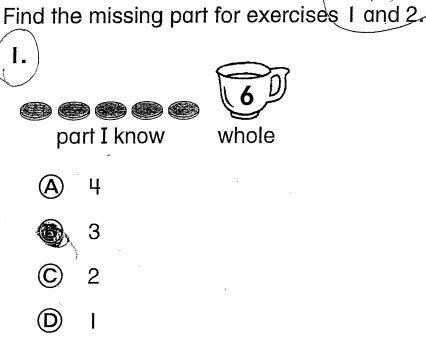
Well when there isn't an explanation of what is being asked and the test was written by the same person that puts the iconography in airport bathrooms....
Yeah, why pennies, and why a cup? I'm guessing the answer is D, 1, based on the number on the side of the cup, but that's a guess.
And what about #12? What the heck is a "subtraction sentence"? Why are there no subtractions in the answers?
Because the pennies add up to 5, and to be whole it should be 6? Or is whole milk 6% fat and 6/100 = .06 * 5 pennies = .30, or in other words 30%, which is why the genius kid picked B?
Or is it message about the deflation of the value of the dollar in international markets and the price of milk?
The question is clearly ridiculous. The problem lies there and solely there though, unlike as the article suggests. Expecting 5 or 6 year olds to be able to do basic addition and subtraction of small quantities of physical items is not a problem at all –that's exactly what I'd expect a 5 or 6 year old to be able to do. Writing crappy questions like pearson has is absolutely a problem though.
This is a test for 5 year olds just joining school FFS
I don't see the Common Core standards as the problem, this is just a poorly written test made by people who were not the authors of Common Core. Unless I misunderstand, Common Core simply defines what skills a student should be proficient at by the end of school years. It doesn't define these test questions, Pearson Education did.
Question 1: You see 5 pennies, the total in the cup is 6, so the missing part is 1 (penny). How hard can that possibly be?
If you see five, and there are six more in the cup, then the total is eleven. If only one is missing, then which one?
An earlier edition of the "Social Studies Extended Response" stated the following (emphasis mine):
In Soviet Washington the swamp drains you.
no but when 45% of the students fail and it is material they have learned and passed in other tests then the test itself is a failure.
Half the problem of word problems is English is a horrible language. I before E except after C unless your an glacier efficient ancient person.
i thought once I was found, but it was only a dream.
This is a comment that I hear frequently from my friends that are teachers; most standardized tests don't actually test the skill they're intending to evaluate.
or read reports written by sixth graders in 1900.
I'm calling bullshit on this. Part of my job a couple of years ago was handling university archives. I was exposed to a large number of essays written by college students from ~1890-1910. They were all on the level that I was expected to write freshman year of high school.
There do not appear to be any coins in the cup. It appears to be full of liquid with the internal liquid level line.
There is a number 6 under the cup, it does not say 6 coins. Why would there be coins in cap anyways? You put liquid in cup.
"Find the missing part?" is a bad question. If anything it should ask about coins, not parts.
There are no parts missing all the coins are whole so is the cup.
The whole thing is not clear and misleading.
You are assuming the question is asking about the sum of coins. That is not indicated by the question.
Having to make assumptions about a question is very very wrong when it is not a written test where one can explain the assumptions one has to add to a question.
It's a system full of good intentions, but the people that come up with the questions appear to be gearing things toward a certain way of thinking. I'm all about the system, it is designed to show the children how they think, and how they work out problems naturally, in their mind's eye as it were.
One problem that I have had with it in the past is that the way the questions allow for assumptions. For instance, I'm from Alabama. In Alabama it's generally hot and humid. When we take our kids to the park, they generally are wearing sandals or flip-flops. Any time they're playing in the sand, they're going to be bare-footed, or at the most, sandals/flip-flops. They give the kids a story to read about a kid that goes to the park. The story is basically this:
Story title: 'A day at the park' Timmy goes to the park. He plays in the park. He plays in the sand. It starts to rain, so Timmy has to leave. Timmy goes home and puts on dry socks. Timmy then takes a nap. When Timmy wakes up, the sun is out. He goes back to the park. Timmy likes the sun. Timmy smiles.
Then the questions that they ask are something like this:
1) What's another good title for this story? a) The sun b) Timmy goes to the park c) Rain and sun d) Timmy takes a nap
2) Why did Timmy put on dry socks? a) Because Timmy was home b) Because his socks were wet c) Because he was sleepy d) Because Timmy wanted to go back to the park
So question #1 is asking for an opinion, and question #2 is asking about something that's not mentioned in the story. After my kid missed both questions, I asked the teacher why, and her answer was that the questions are introducing higher learning. Higher learning? An opinion is higher learning? Asking questions that are full of assumptions not mentioned in the story, is higher learning?
So in that way it needs to be improved upon. But for math, they allow the kids to express the algorithm in any way, and as long as they get the answer correct, and the algorithm that they use is logical, then they're credited with learning. And I think that's way better than, "Here is an algorithm, learn it, and use it." Because if you don't understand how that algorithm came to be, you will not be able to use it in real life. Whereas if you came up with the algorithm yourself, you cannot explain how or why you came up with it, but you understand how to use your brain in the real world.
Politics; n. : A religion whereby man is god.
It's not quite as bizarre as Q1, but the rest of the test isn't so great. Still looks like the kid failed legitimately, the test only contributed.
Question 2 asks about jars and shows a picture depicting cubes, which seems odd, but Q3 implies they've been taught some technique involving cubes, so that might be OK.
Assuming the cube thing has been taught Q3 is fine (although "number sentence" is odd; I imagine parents would absolutely freak if someone tried to teach little Greta and Johnny the word "equation")
Q4 is fine; sorry kid, you got that wrong legitimately
Q5 demonstrates the problem of trying to teach with simplified terminology. The kid was given that the total was 9 and a picture of 4 pennies. When asked for "part I know" the kid gave 9, which is literally true in one sense, but not what they're looking for.
Q6 and Q7 are fine. (but why are they using circular counters instead of cubes as they did before?)
Q8 and Q9 are fine.
Q10 and 11 are fine, but why are they under the topic of "Additions"? It's subtraction.
Q12 is broken. Elsewhere in the test they imply that a "subtraction sentence" is an equation with a subtraction operator. Searching the web confirms this. There's no subtraction operator there. Kudos to the kid for figuring out what they meant.
Someone at Pearson came up with a bad question.
They meant for that question to coincide with the standards which say subtraction should be taught. How the heck do you leap from "Pearson has some bad questions" to "curriculum standards are bad"? Common Core may be bad, it may be good, TFA gives no reason to believe either. They only show that Pearson's implementation has some errors.
We teach firefighting, construction safety, and other topics that have specific codes and standards students need to learn. When we realize we have a bad question we don't say "construction codes are bad and students shouldn't be expected to learn them", we say "this question is bad and we should rewrite it so it better gauges the student's understanding".
There are a couple of statistical calculations test makers can use to find and fix bad questions. It doesn't appear that Pearson used those (yet). If they run the calculation, they'll see which questions are bad and can fix or remove them.
Obviously if fewer than half of students get a question correct, it's probably a bad question. There are other calculations which are similar but more advanced. Look at a properly designed quiz covering the same subject, one with well vetted questions, and I bet it looks a lot better. Questions like "Imagine you had four cookies and gave one to your sister. How many would you have left?" also meet the common core standards, and that's probably a good question for a certain grade level.
"Teachers who can't teach (even if they know their subject backwards and forwards) should be fired."
Absolutely.
"It should be possible for anyone with the proper qualifications to teach whether they have a "teaching certificate" or not; imagine a person retiring from IBM teaching a computer class or a retiree from the financial field teaching economics."
Since they don't have any experience teaching, let alone teaching a class full of people aged 18 and younger, they would probably be horrifically bad teachers.
Ridiculous. You have five out of six, so the remaining part is 1/6. That makes at least as much sense.
And what about #12? What the heck is a "subtraction sentence"? Why are there no subtractions in the answers?
It seems that since Math is described as "universal language", these clowns have "CSI'ed" this concept and talk about equations as sentences. Now, you if you want to confuse the heck out of a 5 year old, this is exactly how you'd present the situation. You might as well start throwing theorems and axioms around while you are at it!
The point of math is logical thinking. These tests show very little of it. There are some hints, but basically instead of writing "subtraction sentences" or "find numerical sentence that is true", how about simple, logical questions??
Bob has 5 apples. Bob gives 3 of his apples with Alice. How many apples are there?
Bob has 5 apples. Bob eats 2 apples and loses 1. How many apples does he have left?
Bob has 5 apples. He gives 3 applies to Mary. Mary gives 1 apple to Johnny. How many apples does Mary have?
Why would I need to start describing this as "subtraction sentences"? That ruins the entire point - it sets up the problem! It is suppose to be about logic, and they missed the point.
I've worked on programming games of chance for various states and governments, and learned that's there's a lot of problems communicating odds/ratios/differences in the ways this test is laying things out, especially for wide audiences that will validly complain about the terms used.
While they're not always fully ambiguous, you're just going to get a large percentage of test-takers answering incorrectly for things they legitimately know, just because they were thinking 'wrong' about how the information was present at that moment. Now, while this does a good job of showing where real-life problems can mislead people - it does a poor job of testing the actual skills being taught, as it's testing too many distinct things in each question to be meaningful in measuring math alone.
In order to have these kinds of questions be meaningful, you'd have to ask several variants over 100's of questions to filter understanding of each aspect of the questions - and you couldn't do that in one sitting either - which is why these are bad questions for a test of math.
If you wanted to test understanding of language context, use a question just for that - a 'what is the best sentence to describe..', then you don't have to have it as part of every question, and can even use previous questions to establish a context.
What this seems designed to do, is provide poor test results for people who haven't been given special training about 'math sentences' (which don't correspond to much), so that they can inflate their "improvement" when people improve in their tests, which are mostly just about 'math sentences'.
That doesn't sound like a math class - that sounds like a product training class.
Richard Feynman would rant much about this.
Ryan Fenton
Take a look at some of the tests from a hundred years ago and try your luck at passing them, or read reports written by sixth graders in 1900. Impressive, huh?
Part of the reason for that apparent phenomenon is that the kids who weren't actually near the top of their class in 1900 didn't go to school. Most 12-year-olds were working, either in factories or on family farms. Illiteracy and innumeracy was much much higher than it is today: Many many people not only couldn't have passed those tests, many people couldn't even read the numbers or hope to add them together. The fact of the matter is that according to even cursory study of the issue demonstrates that on average Americans are better educated now than at any time previously in the entire history of the country. The idea that there was some kind of idyllic America with great educational systems some time in the distant past is just nonsense.
I am officially gone from
Then just ask "what is 6 minus 5". Why make the question ridiculous?
now we need to go OSS in diesel cars
Buy you're wrong. The answer is 1 penny plus 1 cup. That's why you always need to be explicit with units, to avoid making the mistake of thinking it's merely just one penny.
As copyright owner of this comment, I authorize everyone to defeat any technological measure which limits access to it.
People, people, you need to step back and reexamine your basic assumptions about the question. They are not 'pennies', but rather 'oreos'. -folds arms in triumph
Why would you put pennies in a coffee cup...?
It's easy to say "teachers who can't teach shoudl be fired" without looking at that fact that in many states the annual salary for a teacher is a paltry 35K / year or under. NO ONE wants to teach because they are paid horribly, are constantly lambasted by the public, and in many inner cities it is a dangerous job to boot. Teaching is not paid at the level it should be in the united states. You aren't going to get good teachers if you don't pay them a living wage.
Other than that? That was the entire problem. Look, we're adults and we can say "they probably meant to have this be a problem about subtracting 5 from 6, and the fact that the 5 was in pennies and the 6 wasn't was just some boneheaded test writer." A 6 year old may very well not figure that out even if he can subtract.
There's also a question of if a poorly written problem like this slips through, how shoddy the system of test reviewing is in the first place and so how many other problems are as bad.
Part of my job a couple of years ago was handling university archives. I was exposed to a large number of essays written by college students from ~1890-1910. They were all on the level that I was expected to write freshman year of high school.
Hush. You're bringing relevant facts into a discussion of cherished golden-age mythology. You're supposed to join in the wailing and gnashing of teeth over our decline from those halcyon days (always conveniently just out of living memory) when people were upright and moral and true, before the rot set in and we declined to our present sad state of affairs. O tempora! O mores!
The correlation between ignorance of statistics and using "correlation is not causation" as an argument is close to 1.
Is this the same Pearson that designs and administers tests for IT and other professional certifications? If so, it would explain a lot. The ones I've taken seem to be designed not to test your skills in the subject matter, so much as to test your capacity to parse bad English and to solve trick questions. It's horrifying to think that we are subjecting first graders to this crap.
Loading...
But it's obvious the cup is full of liquid, therefore the answer must be 787. That being the number of degrees required to melt zinc, which is clearly what is missing.
If I have been able to see further than others, it is because I bought a pair of binoculars.
Exactly. Just teach kids maths. I guess it is all down to the stupid assumptions (excuses) that PC people have about the kid that can't learn (dslyx... or however you spell it) or try to make it interesting involving drink and food. Load of bollocks.
It's hard because the people writing the test have no experience writing for an audience.
When you write for an audience, you quickly come to understand that things you think are obvious aren't obvious to everyone, and that any loose or fuzzy choice of words adds ambiguity. It's the problem of self anchoring and illusion of transparency.
Specifically in the case of the test:
Test modes are introduced with only a brief explanation and no worked examples for clarity.
"Find the missing part for exercises 1 and 2" is weak, non-specific, and ambiguous. "Part" has connotations of a physical piece that completes a whole (like a puzzle piece, or the broken handle of a cup), but is used to describe a grouping. The presentation uses two disparate representations of a group: 5 pennies, versus a cup labelled "6". The captions "part I know" and "whole" seem to have nothing to do with the pictures - the 5 pennies isn't a "part", and the cup is a "whole" object, but why is it labelled 6? The cup is non-sequitur to the question, and cups hold fungible materials while the pennies are enumerated. And to drive that last part home, the cup is shown "filled" with liquid. Or is it partially filled? And is the fact that it's partially filled somehow related to the question?
Here's a reworked example that's a little better. (Could be better - I didn't give spend a lot of time.)
For the next two questions, we will show you something on the left and something on the right. Choose the answer which, when added to the thing on the left, makes it the same as the thing on the right.
Example: [left: Square containing 3 circles] [right: Square containing 4 circles]
[list of answers, with circle marked correct].
Question 1:
Show 5 smaller cups (shot-glass sized) filled with a dark liquid. Show a measuring cup with lines labelled 1-7, and filled to level 6 with a dark liquid.
Question: How much more ink is needed on the left to make the amount of ink on the right?
Well, sure, you were able to take what has to be one of the most pathetic examples of muddiness I've ever seen, and by a rather sophisticated exercise of elimination of possibilities, construe what must have been the intent of its creator. That was a much more difficult problem than the arithmetic problem that it was intended to represent, and you are no 5-year-old.
Those who would give up essential liberty to purchase a little temporary safety, deserve neither liberty nor safety.
Reading your response, I realized the formulation of the question forces the student to deal with not only icons or only numbers, but rather they have to deal with both. That is, they see five pennies, and see one cup. But, they need to reason the 1 cup can hold 6 pennies, then perform the calculation. It seems the strange part of the problem - that it mixes icons and numbers - might precisely be why it was formulated as such.
There are even more abstractions that need to be dealt with than that - they have to associate the cup that can hold 6 pennies is what is considered to be 'whole', and they need to recognize the 'missing' part will exclude 'part I know'. Whether this is a sound approach or not, I don't know - but I can understand, it being so different from traditional mathematics, it would ruffle some feathers.
Interestingly enough I was alive at the time of the events of 9/11/2001. And I remember that 17 of the 19 hijackers weren't Afghanis but Saudi Arabian. A full 89% were from our friend and ally in the middle east, Saudi Arabia.
Well, according to the illustration, the cup is full of milk... which lends credence to your theory.
I am very small, utmostly microscopic.
Because after being subject to such a curriculum they will be beggars?
I am very small, utmostly microscopic.
the only fucking way for it to make ANY sense at all is if the price of the cup is six pennies.
"you have 5 pennies and want to buy a cup that costs 6, how many pennies are you missing?"
whoever did that should be kicked in the nuts though... and forced to take elementary school again since clearly he can't write and he can't use symbols either.
it's obvious from the sizes that the cup can hold more pennies and since when does a cup become "whole" anyways. why the fuck have the cup even there, since it is not representing 6 items at all(the text is).
world was created 5 seconds before this post as it is.
The missing part is clearly several dollars if that's Starbucks coffee in the cup.
"I believe in Karma. That means I can do bad things to people all day long and I assume they deserve it." : Dogbert
Well, according to the illustration, the cup is full of milk... which lends credence to your theory.
Or coffee, which I presume the person that wrote this test had 6 cups of, and was only paid 5 cents to create the test.
I'm a good cook. I'm a fantastic eater. - Steven Brust
We know what works in education, but we apparently are unable or unwilling to do it. Take a look at some of the tests from a hundred years ago and try your luck at passing them
We're talking about mathematics, more specifically arithmetic, and you're trying to compare standards from before and after transistorization. Arithmetic "education" in 1900 at that level was drills, drills, and more drills, in an effort to develop not creative thinking but speed and accuracy through the use of arcane tricks and shortcuts. But nobody short of a mentat can compete with a 99 four-function calculator in multiplying multi-digit numbers, let alone something as iterative as calculating a square root. It literally takes more time to fiddle with logarithm tables to find an approximation of a square root than it does to find a potentially exact answer with a calculator.
About the only people today who would have practical use for most of what arithmetic education focused on in 1900 are people who are looking to optimize a compiler.
Show 5 smaller cups (shot-glass sized) filled with a dark liquid. Show a measuring cup with lines labelled 1-7, and filled to level 6 with a dark liquid.
I mean this with no disrespect, because I largely agree with your bigger point. But you've illustrated part of the problem with the original test - People designing tests for kids who don't understand how those kids perceive the world.
Until at least age 7 or 8, and usually later, kids have a very poor grasp of conservation of volumes. They will tend to linearize the problem, seeing the "full" smaller glasses as having the same volume as the marker with the same height on the larger measuring cup.
The test is being given to 6 year olds with marginal reading abilities.
And that's part of the problem. By age six, reading abilities should not be marginal. At age three, yes. But if you haven't taught your kids to read reasonably well by the time they're six, either they are stupid or you are.
And the cup is already labeled "whole", so it must be whole milk. ... So the answer is 2.
Its missing nutritious snack and a glass of water, fruit juice or low-fat milk.
(but I'd take the milk and cookies)
Let's start with the non-sentence "part I know". What the FUCK is that supposed to tell us? That I know 5 pennies? That I know what a penny is? That I know there are 5 pennies? Is that a statement or a question, does it mean I know 5 pennies, or does it mean that I want to know 5 pennies? And what the hell does a cup have to do with pennies? A cup with a 6 on it is "whole". So is "part" supposed to have a meaning in the context of "whole vs. part"? A cup of 6 is "whole" while 5 single pennies is "part I know". Why the "I know"?
I have to admit I do not know about the reading skills of the average 5 year old where this test is applied, but they learn reading in school here, i.e. after they were supposed to make that test. And yes, that includes numbers!
Now, I guess it's safe to assume that you and I come to the same, and most likely correct, conclusion that the cup is supposed to represent a "container" object that holds our "whole" universe, with the "6" being a representation of the amount of items contained within, and that the 5 coins present next to it labeled "part I know" (which still puzzles me to no end considering I'd have thought "parts" would be correct, but ... never mind) represent a subgroup of the universe with the question relating to and asking for the missing pieces, which would of course be 1.
Mind you that I and, presumably, you are not 5 year old, which means we both have a bit of life experience not to mention that during our education we had to deal with problems not unlike that one, and we both can read and write to some degree (I deduct that from your ability to express the idea you so eloquently informed us of). Two important advantages the child subject to this test does not have.
To be brutally honest, I even had to ponder for a moment what the heck they want from me. And that's with a degree in statistics and an IQ that puts me in the .1% "smartest" group. Now, the latter obviously doesn't have much to do with our education system, but the former is pretty much obviously a result thereof. A result of the education system that wants to find out whether these kids are "ready" for school. Apparently only when your mind is bent and broken enough that you can wrap it around that kind of bull you're ready for school.
We used to have a Bill of Rights. Now, with the rights gone, all we have left is the bill.
I see 5 pennies.
I see a teacup with a label 6.
Your observational skills are somewhat lacking, I'd say.
I see five stacks of two coins. (look closely)
I see a coffee cup with a label.
If I turn the coffee cup over the stack of coins, I would read 9, but there would be 10 coins under them. Thus, I need to take away one part - one coin. The answer is thus one.
Q.E.D.
What strikes me about this test is the utter alienness of its language and symbology.
Okay, it's been half a century since I took a test intended for children entering elementary school. I recognize a few of the sentence forms. Somebody has a certain number of guitar picks and gives some away, no problem. But the bizarre pennies to coffee cup equivalence, what the fuck is up with that? Who thought it was a good idea to assume that young children would know that the sentence in "number sentence" means what the rest of the world generally calls an "equation", or that a "subtraction story" conversely means a word problem? What is a "related subtraction sentence" and how does it differ from an ordinary subtraction sentence? Why are you using passive voice to ask questions of a five-year-old? Why do you think we need cubes to solve a linear equation?
What's meant by the fragmentary term "part I know"? Dude, I have no idea what you know. Try speaking in full sentences, like we're taught in school. Oh, right.
In short, this seems substantially to be a test of cultural indoctrination whose arithmetic pales in comparison to the challenge of getting inside the parochial mind of whoever developed the test. I'd be proud if my child failed this test. It's beyond absurd; I find it positively bigoted. These people need to get out and see more of the world.
Parity: What to do when the weekend comes.
The problem itself is valid, and it's very sensible to expect a 6 year old to understand it. The presentation is beyond idiotic, though.
How about writing "whole" and drawing a piggy bank (to make a connection with the coins) with a "6" on it. Then writing "taken out" and drawing 5 coins. Then writing "left?" and drawing the piggy bank again, this time with a big question mark, along with a piggy bank next to A, B, C and D with the 4 possible answer numbers on them.
Clear, simple, easy to understand. The guy who made that test was responsible for user interfaces at MS before, I betcha.
We used to have a Bill of Rights. Now, with the rights gone, all we have left is the bill.
If you've listened to the instruction that goes along with the test, it would be clear what to do. My first grader has no problem with these problems. He's told me that the teacher has explained the technique and he recognizes it from the questions that are asked.... Without understanding the context in which things are taugh, you can't judge the tests that are used. This test is not ridiculous when you look at it in proper context.
Some people want to make political hay out of this, since they feel that they are losing local control. Or they are secretly against a good public education, so they oppose real attempts to raise the standards, think outside of the box and teach the concepts that will form the foundation of a lifetime...
Then just ask "what is 6 minus 5". Why make the question ridiculous?
Because that does not test if the student understands the concept. True story: I looked at a list of shipping containers, and the volumes listed were wildly inaccurate. So I talked to the responsible guy in the warehouse. It turns out that he had measured the width, length, and height, and then ADDED them together. He was fully capable of performing multiplication, but he obviously didn't grasp the concept.
What concept is being grasped by trying to decode someone's idiot iconography? There are wholly about 5 valid interpretations in the comments I've read so far. We're talking about 5 and 6 year olds here - they're still learning how to properly grasp the English language. We're teaching them mathematics separately - they sure as hell shouldn't be tested on whether they're smart enough yet to realize whichever adult wrote the question is an idiot.
The WHOLE is 6. You see 5 from the whole. That means one is missing from the five to make a while.
This method of thinking through the problem is taught in the classroom instruction that goes along with it.
You immediately lose all credibility when you say you failed to grok RPN and call it a craze.
It is neither. You are just exposing your inadequate education.
As far as local school boards, please explain to me why other 'socialist' countries, like those in Europe beat the crap out of our school systems every year. Clue: it isn't because of Federal control. It's because of the stupid idea that local school boards made up of elected politicians with NO training in education have any place in running school systems.
While Bill Gates and others may talk about the declining state of education, there is a real movement by conservatives to use public money that funds education to enrich those who teach, by privatizing schools.
The Common Core is a strategy to standardize the curriculum across all the 50 states (which isn't a bad idea) but the people who write the standards and create the tests don't have our best interests at heart. By creating ludicrous tests, they are going to "prove" that the US students are failing terribly, especially those in public schools. Then there will be demands of reform, where they will promote pseudo public schools that use public funds ran in a for profit manner.
Once that happens, education which should not be a for profit enterprise, would be transformed into private enterprises that uses public funds to enrich companies like Pearson, Amplify, Thompson, etc.
If I had to assume that I do NOT know jack about math or life (which is pretty much the situation for 5 year olds...), the assumption could as well be that I know I have these 5 discs and somehow have to stack or otherwise assemble them to create a cup, and now the question is what is missing. The answer 3 seems valid, since it does look a bit like the handle of the cup.
Remember that to kids numbers are not simply abstract symbols but they do have a "face". Actually, I remember that as a kid the 2 looked very friendly, the 1 was stern and the 5 pretty evil and intimidating. There is a reason why many 4 year old can solve the riddle below but few adults can:
5628392 = 4
5093526 = 3
8522100 = 4
7664921 = 3
1226112 = 1
1099712 = 3
5723445 = 0
8192341 = ?
We used to have a Bill of Rights. Now, with the rights gone, all we have left is the bill.
Because it's a test for 5 year olds who have pretty much just started school. They are just learning English. They will struggle with the idea of metaphor for a long time.
Are we teaching them mathematics, i.e. basic theories about how numbers behave? Or are we teaching some other thing?
Did the curriculum include "how to determine if the question is unclear?" Because you know, later life people would see an unclear question and ask someone to clarify it. 5 year olds are yet to even have the concept that adults can ever be wrong.
What I want to know is why these people aren't hunted down and branded with a big "Useless, do not employ" on their foreheads?
No sig today...
Paula Bean...?
No sig today...
The problem is that even IF little Johnny would be good in math he will fail with this kind of test. This test does not test math. It tests whether you're able to wrap your mind around the way someone else asks questions. That's like playing a computer RPG and not playing your character but instead trying to ponder what the programmer wanted you to do to progress.
This test is not about math, it's about bending your mind to the twisted world of a teacher. I.e. a perfect preparation for the time when you work where you have to bend your mind to fit into the twisted world of a manager.
We used to have a Bill of Rights. Now, with the rights gone, all we have left is the bill.
Not just "friend and ally", but also a very wealthy country — whereas the text was implying, the hijackers came from an impoverished one...
In Soviet Washington the swamp drains you.
If you've listened to the instruction that goes along with the test, it would be clear what to do. My first grader has no problem with these problems. He's told me that the teacher has explained the technique and he recognizes it from the questions that are asked.... Without understanding the context in which things are taugh, you can't judge the tests that are used. This test is not ridiculous when you look at it in proper context.
when you ask a simple question in a simple way, you test a child's ability to understand concepts. When you ask a simple question in an overly convoluted and distorted way, you test a child'a ability to follow directions. The school district makes clear which kind of test this is supposed to be.
honestly people, a test for first graders that is hard to understand for many slashdot readers, including myself??? "you can't take it out of context, there are accompanying teaching segments, etc". I'm going to go out on a limb and say that you should be able to isolate a math question of "6 - 5 = ?" and be able to understand it outside of context.
Math with numbers? Where are the Greek letters?
You just beat some 5 year olds. You are sooo smart. On the other hand, a really (socially) smart person would not have spent their entire comment space here merely to congratulate themselves for the "achievement". Sorry if that sounds pretty negative, but come on, a test for 5 years olds and here you go telling us how great you are! And it is ALL you are telling us.
They go on tangent because the question masquerades as a valid, mathematically correct system of equations - which already confuses anyone who heard about such things because those equations are not true. Whereas in reality the question has nothing to do with math, and can be just as easily asked with flowers or animals.
Yes, and that's the whole pitfall here, and why preschool kids succeed where we fail: We abstract. We see a 3 as a representation for something that is "three". For a child it is simply two half loops stacked on top of each other. An 8? Two small loops on top of each other. They have no abstract meaning, they are taken at face value.
That's also the reason why they fail at this test.
We used to have a Bill of Rights. Now, with the rights gone, all we have left is the bill.
Question 5 was my favorite WTF.
====
5. Find the missing part.
Write the numbers.
[9]
o o o o [ ]
___ ___ ...and got it wrong.
part I know missing part
====
(the o's are pennies, and the [ ] is a box)
(slashdot is messing up the formatting, or I'm not doing it right)
The student filled in:
_9_ _5_
Yeah, they *wanted* a different answer, but he's still right.
What part does he know? The big "9" in the box.
What part was missing? The 5, which he got right.
If this were for an older student, and if the style of questions was explained and examples provided, then I'd understand that they should listen and comprehend what is expected with certain types of questions, but this is a first grader. The expectations should be very obvious.
Before you write that off as something the student should have understood, take question 6, which is right next to it:
====
Complete the picture.
Write a subtraction sentence.
6. Jennifer has 6 guitar picks.
She gives 4 guitar picks to
her students. How many
guitar picks are left?
[6]
| o | |
| o | |
| o | |
| o | |
__ - __ = __ ... but the "6" is right under the part of the picture that has 4 dots in it (and yes, they're black circles, not triangles as a guitar pick would be... that's just one more stupid little detail that doesn't matter much, but shows the poor quality of the test).
====
The student got this one right:
_6_ - _4_ = _2_
So what is it? Do they write the number that represents the whole first, or the number that represents the dots above the answer line?
There's so much wrong with this test. Even the way it was marked by the teacher is, IMO, in bad form. Incorrect answers have their question number circled, and correct ones have a check mark in the middle of the question space. To see why that's wrong, just look at the students answer in question 8. It's a multiple choice question. He put an "X" through the three he thought were wrong, and circled the one he thought was right. "Circle" means right; "X" means wrong". They expect the child to circle correct answers, but they circle incorrect questions.
BTW, anyone know when they started referring to math problems as "number sentences" and "subtraction stories"? Mixing reading comprehension and math seems like another unnecessary complication for a first grade test.
ok.. why is the cup there?
and also, I'm puzzled, how is 4+3 = 7 a subtraction sentence?
world was created 5 seconds before this post as it is.
Based on the language, another valid answer is 6 since there are still 6 guitar picks. Now if it had asked "How many picks does she have left?", then the answer would be 2, but it asks "How many are left?" Awful question. I ran into this a lot in 1980s elementary school. I would get frustrated and go up to teachers during the test and ask which way it was meant to be interpreted. Many would get frustrated with me, instead, thinking I was just causing trouble, but a few teachers were actually honorable enough to announce the proper interpretation to the class, or throw out the test and have us retake it, modified.
I don't know about that weird language, but I'd guess it's the result of too much ideological abstraction. When it comes to ideology, a lot of state organizations operate under some-is-good-therefore-more-is-better. This particular doctrine was probably started as a way to reduce fear of math in the student, and now it's been taken to ridiculous extremes. I don't even know what 'number sentence" (equation?) or "subtraction story" (?) mean.
While I agree with your overall point, I disagree with that. Whether the phrasing is easy to understand or not entirely depends upon whether you have been exposed to that phrasing before.
I agree with that. I would have no problem with a math test that exclusively featured problems in the patterns of:
6 - 5 = ?
6 - ? = 1
? - 5 = 1
Then, a DIFFERENT test with word problems. And if the school feels it necessary, a THIRD test with pictograms (or whatever).
I know adults who have no problems with basic math but who cannot figure out a word problem. Those seem to be two different mental processes. So combining then into one score and on one test isn't very helpful. And probably leads to a lot of wasted time due to stress when the student hits a word problem.
I was in 1st grade 39 years ago so my memory is a little fuzzy to say the least. I do remember being the fasted reader in the class and just burned through all the materials (I think it was SRA readers). Even so, I doubt I would get the word "guitar" -- that word is an import from Spanish and just doesn't lend itself to being sounded out using English sound characteristics. Why didn't they just use "balls" or "hats" or something about which there can be little confusion? It's a math test -- not a reading test.
What changed under Obama? Nothing Good
You keep expecting a math test to have answers that are "right" and "wrong". That's just a liberal plot.
Here in Missouri, we require our math tests to present a more balanced view of math and science questions that includes a traditional, faith-centric approach.
"If Jesus is speaking to thirty-thousand people, and he wants to feed them all but he only has two loaves and three fishes, how many pieces will he have to divide them into?
A) 30,000
B) N/A. He just kept producing magical loaves and fishes because he's divine.
C) None. Jesus told them to get a damn job so they can feed themselves and stop being takers."
You are welcome on my lawn.
Common Core doesn't specify questions or tests - this is just a shitty test, that happens to meet (maybe?) Common Core.
There's a lot of misunderstanding (and hence vitriol) about CC out there; Common Core says your students need to have certain skills. How you develop them is up to you.
https://en.wikipedia.org/wiki/Common_Core_State_Standards_Initiative#Mathematics_Standards
Please help metamoderate.
What kind of whackjob gives a six year old coffee? They're annoying enough without a caffeine kick!
What changed under Obama? Nothing Good
OK, this is ridiculous. I’ve read the linked articles and many of the comments here and elsewhere, and while there is a lot to say about the Common Core in general, I will limit myself simply to question 1 of the test. Not to put too fine a point on it, this is an atrocious test question, an abomination that should never appear on any math test, let alone a 1st grader‘s! Think that’s too strong? Well tell me, then, why is the coffee cup marked with a 6 and labeled below as “whole“ even there? Can anyone at all explain to me why 5 pennies (or what appear to be 5 pennies) have anything at all to do with a friggin’ coffee cup? Is this to do with the price of a cup of coffee? Clearly not, but the thought must occur even to 5th graders, since there are coins involved... And thus confusion creeps in right from the start, merely from looking at the pictures. One immediately wonders, are we measuring price or quantity? The possibility that it might be price-related serves only to confuse, and has no business on a test of basic math skills. I should say right here that besides pennies it also occurred to me that the disks might represent volume, 3D slices of an idealized cylindrical “cup” of liquid, and it’s not impossible that a bright 1st grader with good visual thinking skills might think the same thing, only... The cup in the picture isn’t cylindrical. So then, more entirely unnecessary potential for confusion, this time seemingly aimed directly at the gifted student. I can’t tell you how many times I messed up on tests when I was a kid because I assumed extra complexity existed on what were in actuality very simple problems. The stating of what is required on a test question should be clear and unambiguous. This example here is riddled with ambiguity, and that’s just looking at the drawing!
So then, it appears there’s no real relation between the pennies and the coffee cup, they’re just arbitrarily chosen icons used to test the understanding that a numeral (the 6 on the cup) can represent quantities of an item (the coins), and that one can do subtraction by converting the 5 coins to a number 5, which subtracted from the whole of 6 is the answer 1. Which is fine, as far as it goes, but nothing is gained from using coins and a cup, in fact it seems deliberately confusing! I’ve no background in education, but I’m pretty damn sure that trick questions should not be appearing on a 1st grade test of basic math skills, except possibly as a bonus for extra credit. So why not use units and pictures that make sense? A pie and individual slices comes to mind.
Then there’s the wording. What exactly is meant by “part I know”? Talk about ambiguity! Why not say “the part you know about”, or even better, “the portion of the whole you know about”? The wording on these kinds of problems really matters, kids shouldn’t have to guess at the meaning! By keeping the caption short and vague you add unnecessary ambiguity. This does make the answer harder to arrive at, but it does so in a way that cannot possibly be beneficial to the teacher or student. Even the title reading "find the missing part" is ambiguous... The missing part of what? Surely there are better ways to specify exactly what's being asked of the test-taker in this question. Ambiguity in all its forms should always be avoided, because by its very nature it can’t be used to test for comprehension of specific concepts, and testing the understanding of very specific concepts is the stated goal of this particular test!
Look, this is ridiculous. I know nothing at all about writing tests, or about education in general, yet I can easily and quickly pick apart the many problems with this one question. You’re telling me professionals who study this stuff for a living can’t do any better than this? There is simply no excuse for questions like this appearing on an important stand
The questions should be obvious, clear, and unambiguous in written and verbal form, period, with no conflicts between the two. There's no reason the teacher should have to prop it up. If there's anything political in this, it has to do with the test writers spending too much time huffing ideological ivory tower vacuum over the fear-of-math 'problem.' The sad part is, they've abstracted so far, it actually makes many of these math problems more ambiguous to people having trouble with it than the traditional word problem would.
Thinking out of the box is fine. However, as a student who often thought out-of-box, looking at question 6, I see immediately, based on the language, that there are at least two answers: 2 and 6. The test writer only meant for one answer to be correct, so the question is badly worded. "Part I know" also sits wrong with me. It sounds like retard-speak. As a student, knowing you're being graded on this, which would you pick? I would guess 2 and hope for the best. Learning math should not be this way.
That's easy:
There's 4 people in a car, 6 get out. How many have to get in before there's no one in it?
not rationally...not at all...those 5 discs do not look at all like they could be assembled into the cup no matter what the 6th piece looked like
those 5 things (the discs) are too small and not shaped properly to add up to form something as large as the cup (even if you added some ridiculous final 'piece') and no one would think otherwise
if what you say is true, the question would be forcing the child to **think wrongly** about the 5 coins....
the fact that some (theoretically educated) adults defend this question at all is a clue as to the source of idiotic ideas like 'Common Core'
Thank you Dave Raggett
Omitted in this “scientific text” is the existence of other scientific data and theories, for example, the cyclical nature of the planet’s climate and the impact of solar activity on Earth’s temperatures. Nor does it mention the fact that the concept of man-made global warming is most actively promoted by those politicians who have a vested interest in imposing government regulations, which would allow them a greater control over the economy and people’s lives.
That's why I don't read such sites that have an obvious agenda to push, like "The People's Cube: We cure weak liberalism with strong communism". Man-made global warming is "promoted" by scientists with hard evidence that already took the "cyclical nature" and the "solar activity" in consideration. If The People's Cube don't agree then they could publish scientific article in Nature how stupid 99% of all climatologists are.
http://www.mueller-public.de - My site http://www.anr-institute.com/ - Advanced Natural Research Institute
"mindless obedience over critical thinking"
That is exactly the charge being laid against "common core" standards. It has been phrased in so many different ways, by so many different people, but always you come back to one concept. Teachers are teaching children to pass the "common core" tests, rather than teaching skills, knowledge, facts, or "thinking". The goal is for the children to do well on these very specific target tests. Problem solving and thinking are, at best, accidental incidentals.
Our education system has become FAR to politicized. With common core, we see the progressive's failed attempt to educate children. With "No Cretin Left Behind", or NCLB, we saw the conservative's failed attempt. (apologies to anyone born and raised on Crete) Both parties like to jack their jaws about the importance of education, but both parties have their part in the "dumbing down of America". And, THAT is why local governments should be tasked with educating children, and the federal government should maintain a hands off stance toward education.
For the most part, politicians are failed human beings. As failures, they have zero idea how children should be educated.
"Windows is like the faint smell of piss in a subway: it's there, and there's nothing you can do about it." - Charlie Br
2012 is a bad movie, I liked the first part with the volcano and where the earth crust rips open, nice special effects. But the rest was just bad; and the science is laughable.
Clime change is in 100s of years, one prediction is 1.75 meter in 500 years with four time the current CO2 level. You don't have to migrate to mountains to avoid that. Or I misunderstood where you go with your beach house example.
http://www.mueller-public.de - My site http://www.anr-institute.com/ - Advanced Natural Research Institute
I would have no problem with a word problem or pictogram on the test. "Johnny had five cookies, but ate one for lunch. How many does he have left?"
But that question was absurd. It failed as a word problem. There were no complete sentences or even grammatical structure, so you couldn't interpret anything. as a pictogram it was illogical. five pennies on the left, and a teacup on the right? and it still had words in it, not to mention the responses were in words not pictures, which spoils the whole point of a pictogram being good for kids with poor reading comprehension.
overall, stupid stupid government interference into how parents should raise their kids.
With common core, we see the progressive's failed attempt to educate children. With "No Cretin Left Behind", or NCLB, we saw the conservative's failed attempt. (apologies to anyone born and raised on Crete) Both parties like to jack their jaws about the importance of education, but both parties have their part in the "dumbing down of America". And, THAT is why local governments should be tasked with educating children, and the federal government should maintain a hands off stance toward education.
That might not help much, either. An anecdote from my personal educational history: As a freshman in high school, I decided that math was interesting, and read the math text entirely in a few weeks. After briefly showing the teacher that I did understand it all, he handed me another textbook. Then, a month later, another. But after a few months, he apparently ran out of texts, because his reaction to my request for calculus texts was "You're not ready for that." I asked around a bit, and found to my dismay that the rest of the teachers seemed to agree with him. So this part of the "educational system" was now a brick wall that blocked my further learning.
However, I did talk to the school principal (who was to become a friend) about it; he quietly asked around, and referred me to some students at a nearby college who were willing to find books and loan them to me. His attitude seemed to be that this was part of "the system" that he couldn't fight, but the rest of the teachers and administrators didn't have to know what I was reading in my spare time. He eventually helped me get some good college scholarships.
A fun part of this was that my main source of math texts was a couple of young women at the college, who were working on degrees in math and science education. One of the first texts they loaned me was "Calculus for the Practical Man" (which is still in print). I looked at the title, and said something like "So they don't allow you to read it, either?" They grinned, and said I shouldn't tell anyone.
Anyway, note that the high school's blocking of my further education was very much a "local" action. It was carrying out local (county, state) policies, and this had little to do with "liberal" vs. "conservative" doctrines. If anything, the district had a "conservative" population. But what was more at work, with both me and my college-level female friends, was that we were challenging the school's control over our educations, and control is what most administration is all about. This has little if anything to do with political factionalism.
Those who do study history are doomed to stand helplessly by while everyone else repeats it.
Question 1: You see 5 pennies, the total in the cup is 6, so the missing part is 1 (penny). How hard can that possibly be?
"Nothing is missing. I have some money and a cup to piss in. That is sufficient for my needs."
How to put it to an idiot. Not all coastline is the same, some is elevated well above sea level and some like say Florida is only slightly above sea level. As sea levels rise and major storms occur, in conjunction with tides, sea levels rise at the coast line. This can be very high including waves 3 metres or more, however if your property is situated higher than that and well constructed you do not have a problem. Now, idiot, as you can see from the external view the property is in fact well and truly above sea level, in fact on the top of a hill. The colour you are looking for is of course maroon.
Chaos - everything, everywhere, everywhen
Unfortunately, this is the tip of the iceberg and I've had a front row seat to this as a parent with a child in 1st grade and one in 5th grade in New York State public schools.
The first step were the high stakes tests that our kids had to take last year. Tests which showed only 30% of New York State kids passing. This helped reinforce the message that politicians have been spouting that our public school system is broken and needs to be fixed. (Where "be fixed" means by them and by big businesses like Pearson.) Of course, nobody was allowed to see these tests so we could see if they were developmentally appropriate or if they were scored right. Pearson made the tests, graded them, and then they were destroyed. They don't help the teachers improve lessons (unlike normal tests which can show that Johnny is weak in some areas and might need extra help) and they just stress out the kids.
These tests, by the way, are tied to the teachers' jobs. A teacher whose kids do poorly (like, say, one with special education students) can find themselves out of a job. So teachers have a strong incentive to make sure their kids do well on the tests. Any time teaching ANYTHING not on the test is time wasted. So whole subjects get nixed in favor of test preparation. MONTHS are spent taking practice tests (bought from Pearson) and rehearsing items that might come up on the tests. Our kids are getting very good at answering A, B, C, or D, but not much else.
The next step, in New York State at least, is that EngageNY was forced into the classrooms. Remember every good teacher you ever had. What did those teachers do? They probably made learning fun, right? Make it interesting in their own unique way. Don't you with every teacher was that good? Well, too bad. EngageNY is a series of scripts that tells teachers what to say and when and even HOW to say it. It dictates how long each section of each lesson should take and how students should respond. Teachers are NOT to go off script no matter what... even if they themselves don't understand just what the script is trying to tell them to teach.
Call me crazy, but making every teacher teach the same lesson in the same manner to every kid doesn't seem like it will help children. Last I checked, every child is different. Some may learn well one way but not another way. It's a teacher's job to find the best way to reach his/her students and teach them the material. The whole point of Common Core is to make kids ready for college, but by the time they get to college, they're going to look upon school and learning as a boring activity and won't want to proceed.
So why Common Core? Because some big businesses looked at education and said "that's an untapped market." Why have these public schools when the businesses can turn a profit off kids? Why have teachers write lesson plans when a business can make a profit selling lesson plans?
In fact, Pearson and other businesses have more to gain if kids fail. They can sell books to help the kids, lessons to make the teachers "teach better", sessions for administrators on how to better push more Pearson products into schools. If the kid passes, all those potential sales go away.
This isn't even getting into the mess that is InBloom - putting tons of confidential student information online without the consent of parents. I'm sure the security will be totally uncrackable, right? I mean kids social security numbers, dates of birth, medical conditions, home addresses, etc. all online. Totally safe.
Parents are beginning to understand just what is happening and they're fighting back. In New York State, Commissioner John King cancelled a series of forums on Common Core when he said "special interest groups" co-opted the forums. Video of the forum got out, though and it turned out that those "special interest groups" were upset parents. When backlash over the cancelled forums got too big, he reinstated them - making them at the exact time that school let out to keep parents and teach
My sci-fi novel, Ghost Thief, is now available from Amazon.com.
In New York State, our kids were given a series of high stakes tests and only 30% of the kids passed. The 70% failure rate was spun as "well, this is just the benchmark before we implement 'higher standards'." Of course, the goal was always for the kids to fail this first round of tests so later tests will show a higher passing rate and politicians (and the businesses they are funneling money to) can pat themselves on the back about how they've fixed the broken educational system.
My sci-fi novel, Ghost Thief, is now available from Amazon.com.
This reminds me of a question I got in high school physics... Consider how much insight my teacher had. I still remember his lesson.
You have a fine barometer. Very accurate. We need to ascertain the height of this building. How should we proceed?
The first answer of course had to do with barometric pressure and elevation - and was dismissed as we studied inaccuracies of measurement.
Maybe measure the height of the barometer, hold it outside and see how long of shadow it cast, then measure the shadow of the building.... kid got a round of applause.
Another kid: call up the guy who built the building and tell him he can have a fine barometer if he will tell us how high the building is...
Another kid: Toss the barometer off the top of the building and time it until it crashes to the ground, then using the formulas for gravitation and velocity, calculate the distance...
All in all there must have been a unique way every student in that class came up with to somehow measure the height of the building with the barometer.
Only one of them had to do with the proper use of the barometer.
The rest of it had to do with THINKING.
I will always remember Dr. Horn for that.
It was teachers like Dr. Horn that got me ready for what I would see in the real world.
"Prove all things; hold fast that which is good." [KJV: I Thessalonians 5:21]
looking at question 6, I see immediately, based on the language, that there are at least two answers: 2 and 6. The test writer only meant for one answer to be correct,
Reminds me of a standardized test I hit back in the 6th (or so) grade. It was a "what's the missing number to this series?" question. One of the five options completed an arithmetic series, another a geometric series.
This was one of those that also measured speed, by throwing too many questions at you to answer them all. I recall I hung on that question long enough, trying to figure out which one they wanted, that I could have answered perhaps five more.
(That's the one where, while thinking about it afterward, I figured out that good test strategy includes abandoning a question that is taking too long.)
Bantam Dominique roosters crow a four-note song. Once you've heard it as "Happy BIRTHday" you can't NOT hear it that way
You're right, we should be fighting harder the notion that people are "illegal" merely for deciding to come to America.
This reminds me of my youngest in grade 1 in tears at his math homework.
What is 1 + 1?
He scrawled 2.
How did you arrive at this answer?
"I just added them. But that's not what the teacher wants. Waah!"
I tried for 10 minutes to tease out the mental process from him, but he was well beyond using representational systems to add numbers. At this point, he just *knew*. Furthermore, my pathologically honest child could not lie at that age, so pretending he put two items together and counted them was right out.
So I pulled out my first year math text which was mostly "God gives you zero and the successor function and 450 pages from now we prove calculus", and copied the appropriate paragraph or two.
Teacher never said anything about it, and I didn't see another quite so insane question that year.