 Slashdot Mirror
Sites Blocked By Smartfilter, Censored in Saudi Arabia


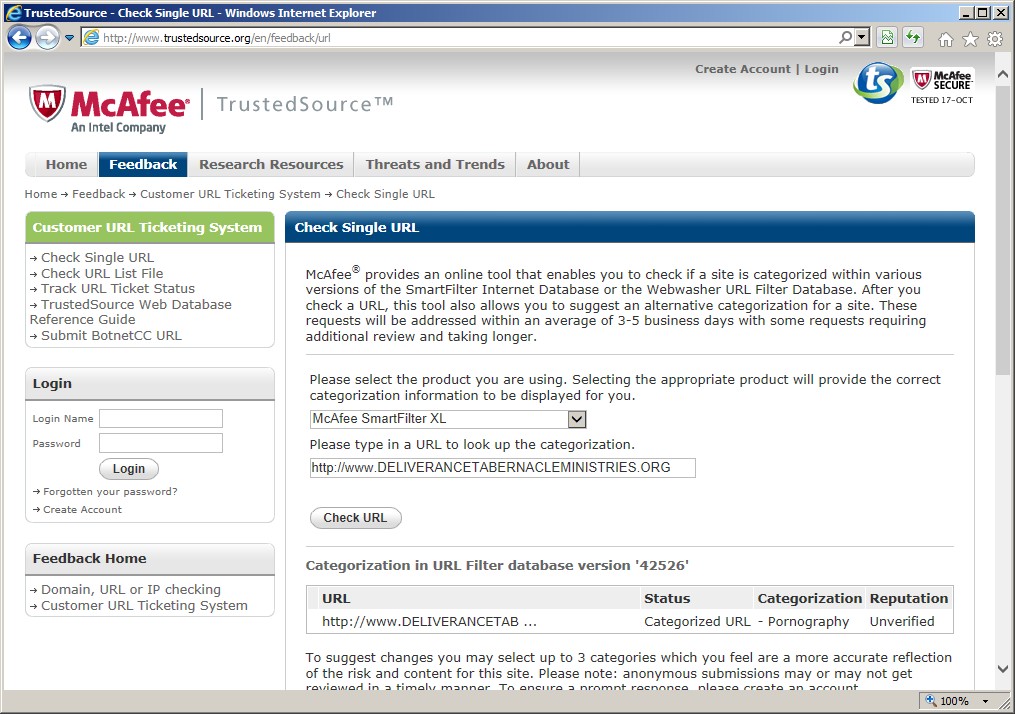
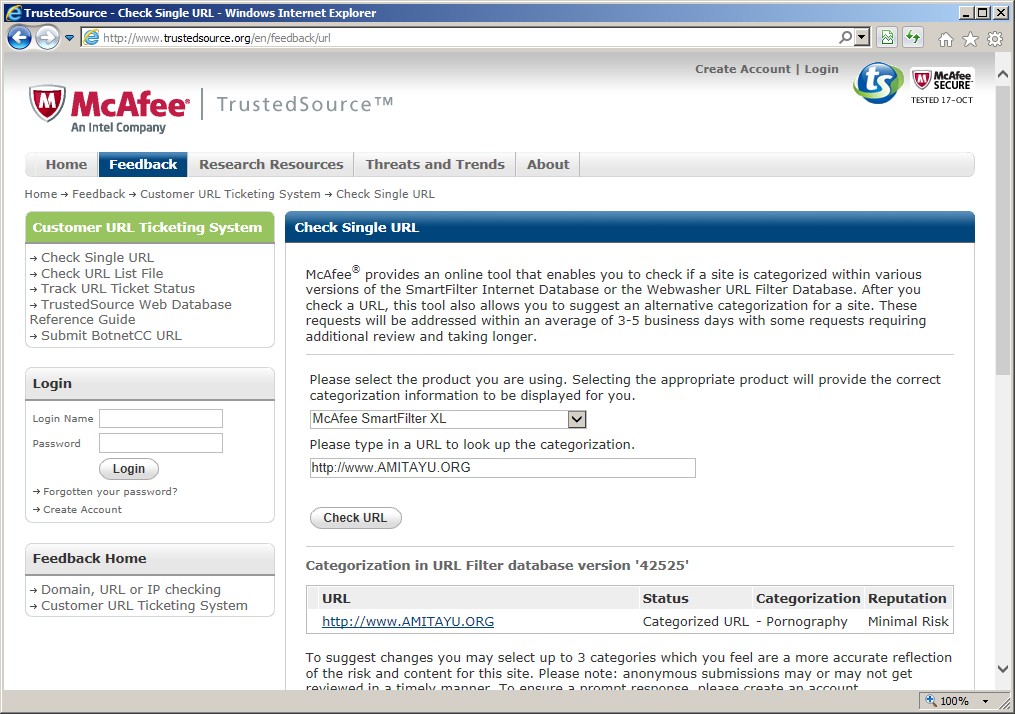
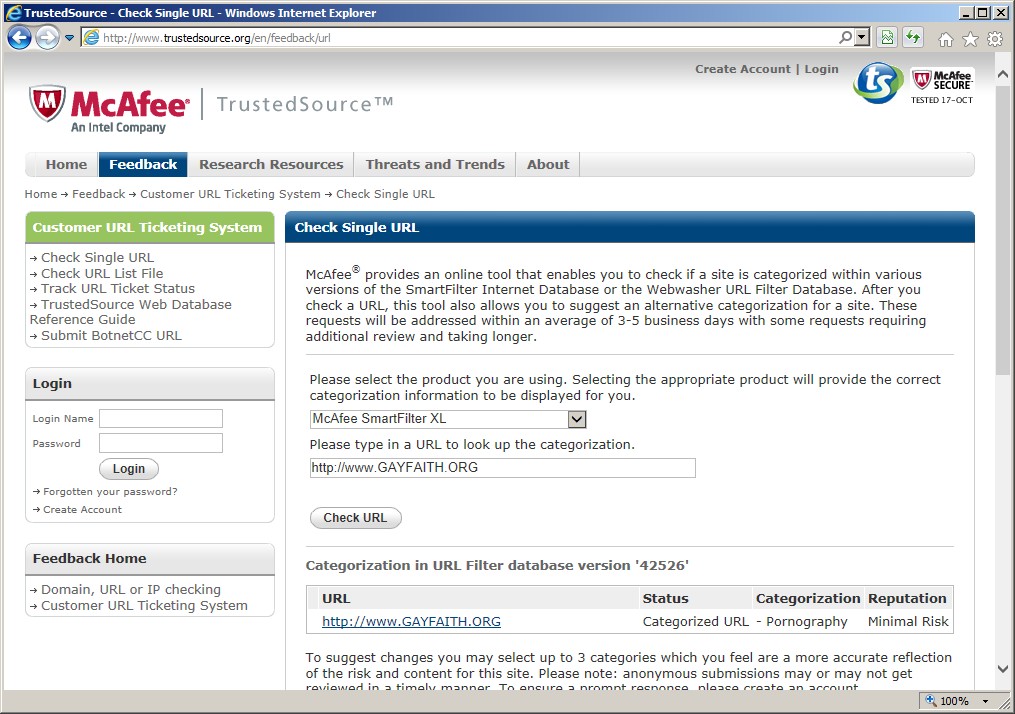
I found these blocked sites by starting with a combination of URL lists and ad hoc spidering, and running as many sites as possible through the Saudi filters to catch the ones that were blocked. Some of the sites were blocked for reasons that were easy to guess -- for example, http://www.bighornbasinsfw.org/, the home page of the Big Horn Basin, Wyoming chapter of Sportsmen for Fish & Wildlife, was almost certainly blocked because of the slang term "nsfw" in their URL. http://www.AgainstPornography.org and http://www.SearchingForMySpermDonorFather.org were presumably blocked because of the presence of the words "porn" and "sperm".
On the other hand, there appears to be no rational reason why the Filipino American Women's Network, the Tuscon Jazz Institute, or the Sacramento Police Activities League would have been blocked by Smartfilter, even by accident. A partial list of the blocked sites that I found is in the blog post I wrote for Citizen Lab, an Internet censorship research center at the University of Toronto.
Articles about sites that are erroneously blocked by Internet censorship software, have a storied history. The first widely read piece was the article "Keys to the Kingdom" written by Brock Meeks and Declan McCullagh in 1996, calling out Cyber Patrol for blocking EnviroLink.org and the University of Newcastle Computer Science Department, and CYBERsitter for blocking the National Organization for Women. I made a minor name for myself and the Peacefire.org site in the late 1990's by writing more pages about sites blocked by other products, including some (like X-Stop and SurfWatch) which no longer exist, and others that are still around, including Smartfilter. I was also one of six people comprising the Censorware Project, a loosely organized group of volunteers that published a few more reports.
By the early 2000's, however, it became clear that anyone whose mind was likely to be changed by information about what kinds of sites were blocked by blocking software, would have changed their mind already (or would, if they came across the research that had already been done up to that point). So the further reports on Internet blocking software errors, by me and other people, slowed to a trickle. I wrote a report in January 2002 on the latest list of sites blocked by Cyber Patrol, a product that most people today have forgotten. In 2006 I worked with the ACLU of Washington to publish a report on sites erroneously blocked by FortiGuard, a program used on computers in some libraries in central Washington, as part of the ACLU's suit to challenge the constitutionality of the program's use on public library terminals. (The Washington State Supreme Court rejected the lawsuit on the grounds that, regardless of what sites were blocked on the computers, it didn't matter because an adult library patron could request for the filter to be turned off.) In 2007 I wrote an article for Slashdot titled "From Bess to Worse" listing some sites that were blocked by an Internet filtering program called Bess (which was later bought out by Smartfilter and discontinued).
Most people's awareness of this debate, if they had heard about it at all, was limited to the perception that "breast cancer sites" and sites about "chicken breast recipes" were sometimes filtered by Internet blocking programs. Or they heard that "Beaver College" actually had to change its name to avoid being censored by web filters. As I tried to explain in a FAQ (written, according to the Wayback Machine, in 1999, but which still broadly holds true today), these examples are true, but they miss the point. These examples make it sound as if blocking software companies are doing the best job they can under the circumstances, and that the errors are unavoidable due to limitations on machine intelligence. In reality, any software algorithm that blocks the American Board of Vocational Experts, the Hopewell United Methodist Church, and the Patriot Guard Riders of Mississippi, as "pornography" (as Smartfilter currently does), is probably not the best algorithm the company could have come up with -- but there's no incentive for them to try harder, because few people will ever look that deep.
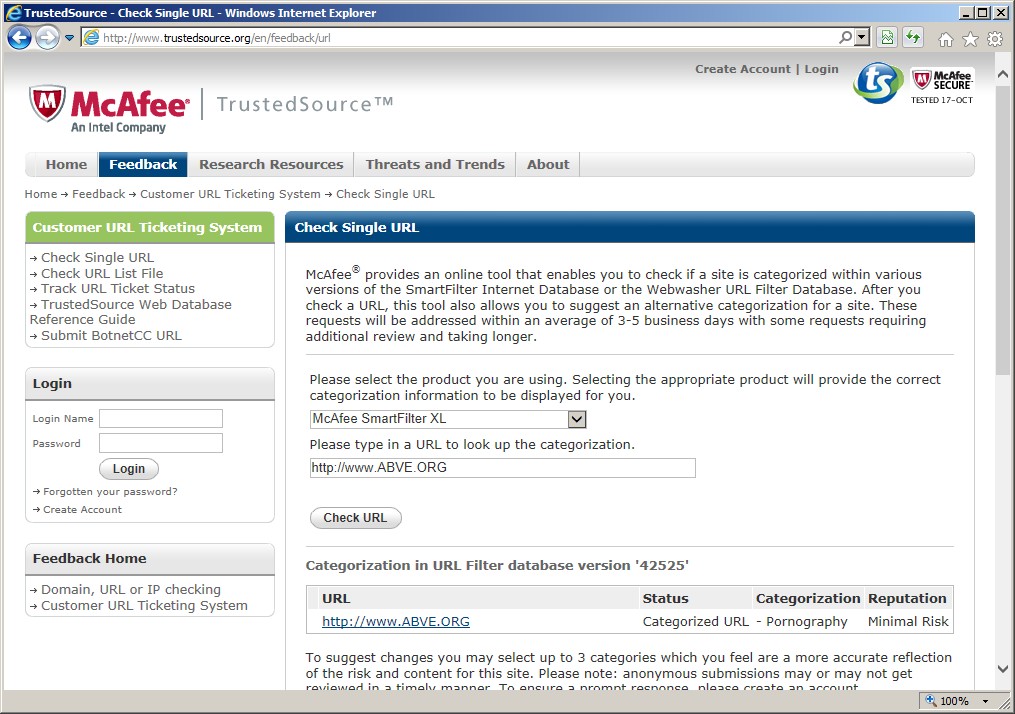
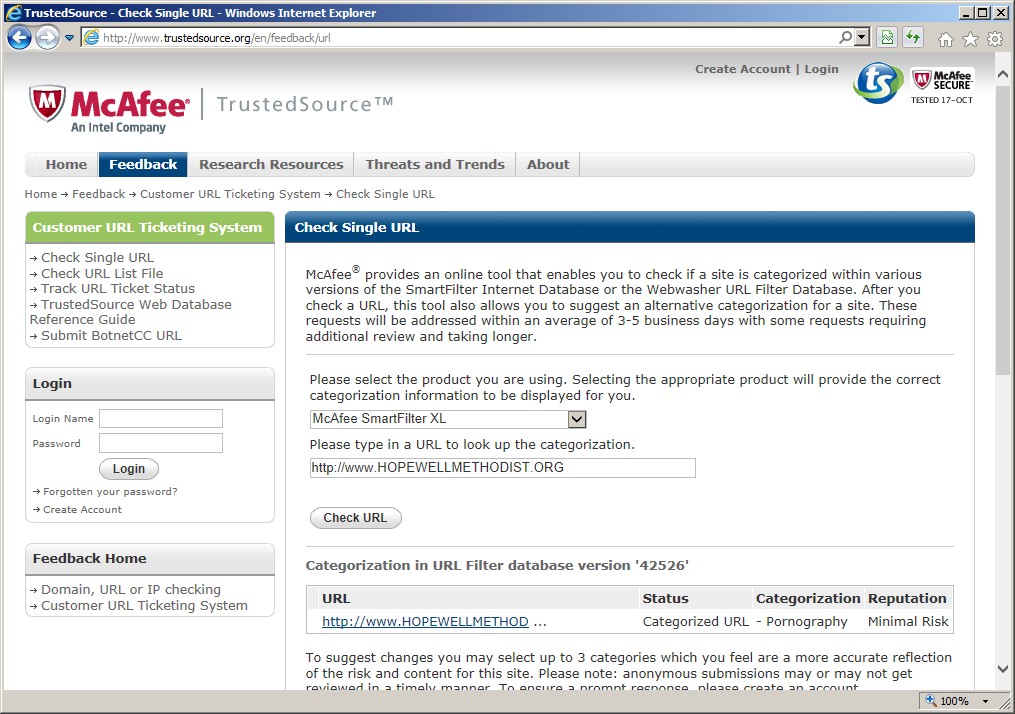
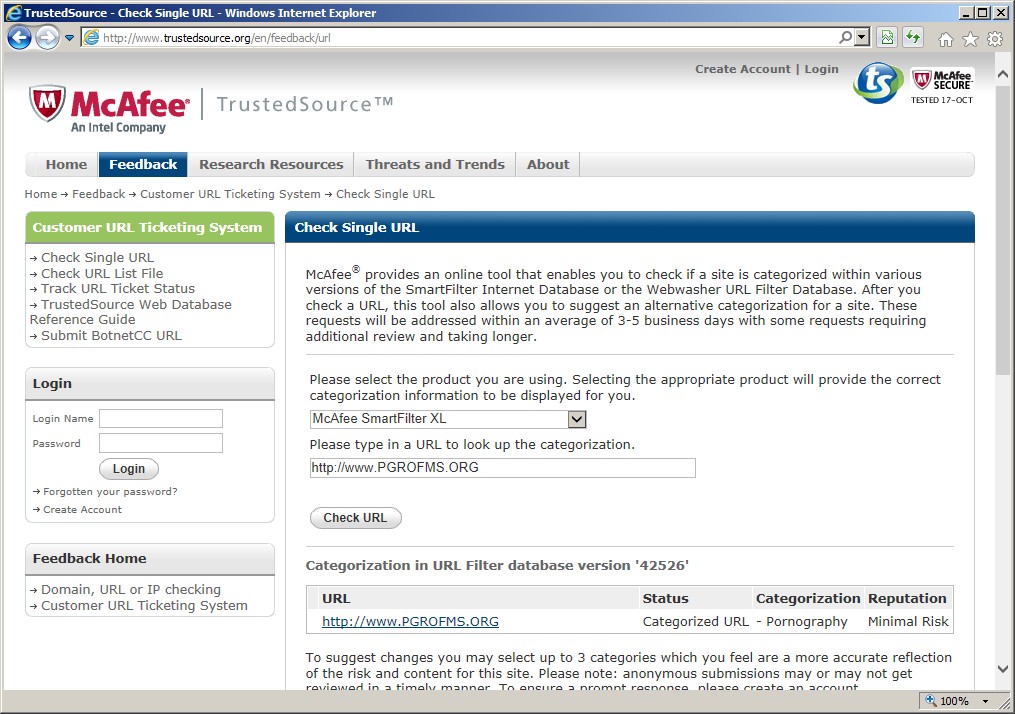
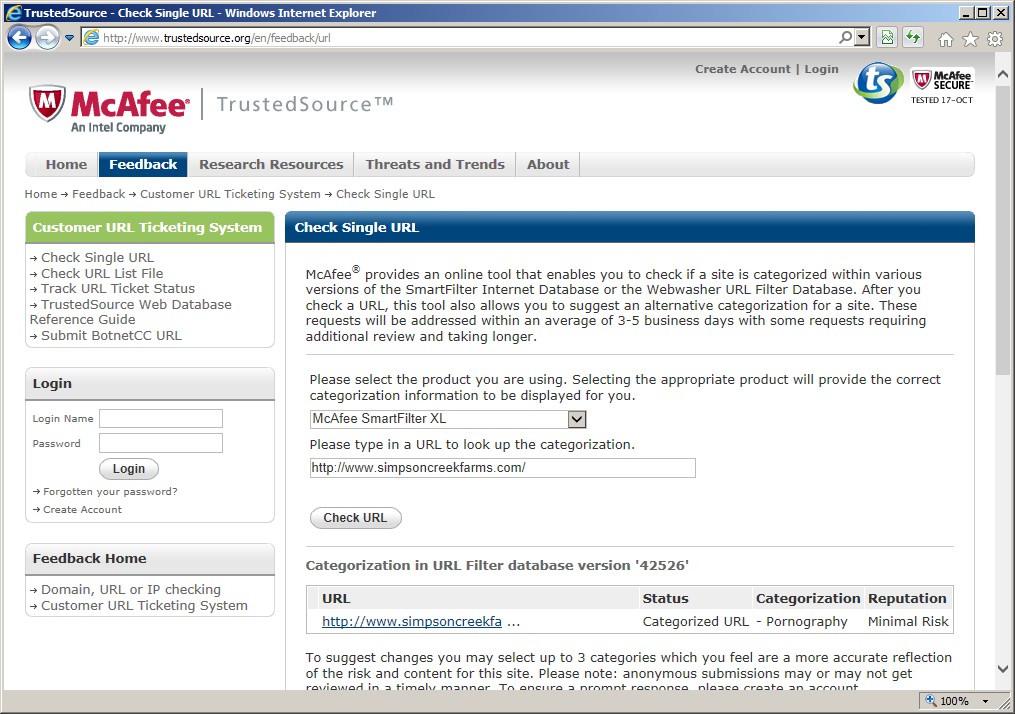
And yet, people continue to remember the "breast cancer site" examples. This sounds to me like an example of the narrative fallacy -- people remember that breast cancer sites were blocked, because there's a tidy explanation. There is no tidy explanation for most other examples of blocked sites, so the meme never spreads very far. Conveniently for the blocking companies, the blocked-site errors which make the company look most sloppy (the Kennels at Simpson Creek Farms, the St. Francis Institute of Milwaukee, etc.) are precisely the ones that, due to the narrative fallacy, most people won't remember or hear about.

One company, CYBERsitter, did manage to make a few blocking decisions in the 1990s that were egregious enough that their antics did make the news, and did finally raise some people's awareness that the controversy over private Internet filtering extended beyond "breast cancer sites". After TIME Magazine's website published an article (no longer online) that criticized CYBERsitter's blocking policies, CYBERsitter responded by blocking TIME Magazine's pathfinder.com domain. A few months earlier, CYBERsitter had blacklisted the monthly e-Zine "The Ethical Spectacle, after the Spectacle's founder, Jonathan Wallace, published an article criticizing CYBERsitter for blocking my own Peacefire.org website. And Peacefire.org had been blocked, in turn, because of a page I wrote (now very much out of date) listing some of the sites that CYBERsitter blocked, including the International Gay and Lesbian Human Rights Commission and Mother Jones. (Nowadays, of course, nobody would be surprised that filtering companies block Peacefire.org, since the site publishes ample instructions on how to get around Internet blockers. But at the time, the site's first and only article was the list of sites blocked by CYBERsitter, which is why CYBERsitter received so much criticism for blocking the domain in retaliation.) CYBERsitter also threatened to have Meeks and McCullagh criminally prosecuted for writing "Keys to the Kingdom" and threatened to sue me over the page that I had made.)
The moral, it seems, is that if you want an example of a censored web site to stick in people's minds, it either has to be a forgivable error, or an insane vindictive dick move -- because in either of those cases, people will understand why it happened. The vast swaths of censored websites on the spectrum in between, the ones for which there is no rational explanation for the blocking, go ignored.
These days, though, American and Canadian "censorware" makers have also come under fire for selling censoring software to foreign governments which use them for country-wide censorship. Most of the criticism focuses, naturally, not on the kinds of sites that are accidentally blocked by the blocking software, but on the immorality of these companies enabling statewide foreign censorship in the first place. Netsweeper, Blue Coat, and McAfee have all made the claim that "Once we sell their product to them, we have no control over what they do with it" -- which, as I wrote previously in Slashdot, is nonsense, because for the product to be effective, it has to rely on updates to the blocked-site list, which are provided at regular intervals by the manufacturer. Cut off the updates, and the product will not work, at least not as well.
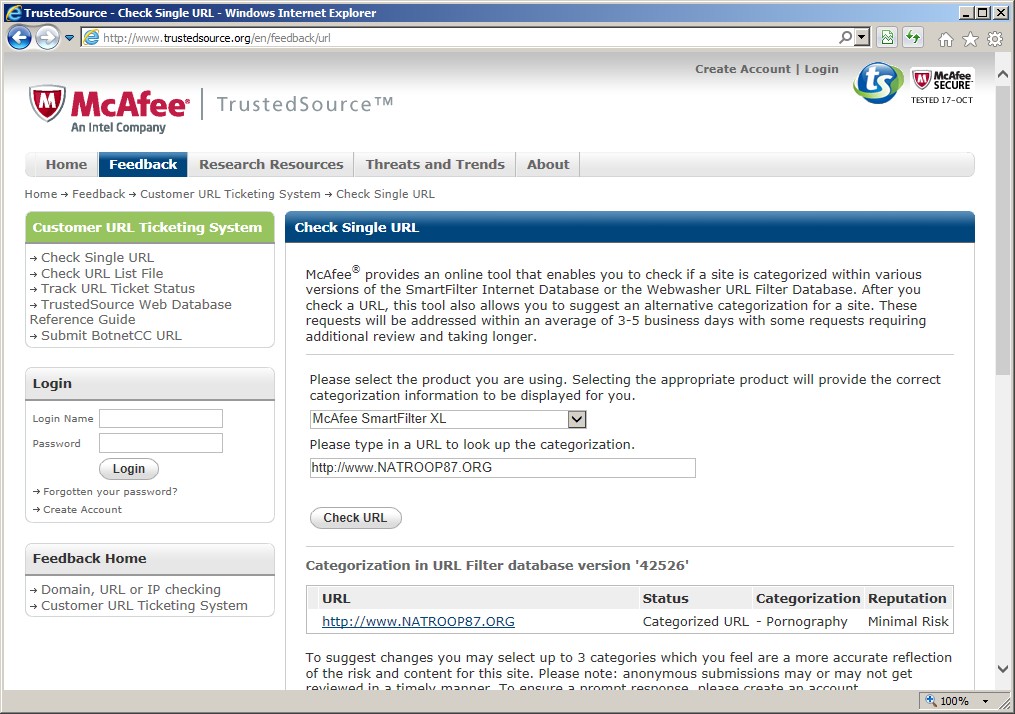
So the fact that McAfee has classified the Boy Scout Troop 87 of North Andover, the Pan-Iranist Party of Iran, and Reptile Conservation International as "Pornography" is (rightly) overshadowed by the fact that McAfee is selling to government censors in Saudi Arabia and the UAE in the first place. However, as long as the filters are installed, these blocked sites are at least part of the problem for users in those countries, just as much as they are for students or cubicle workers in the U.S. whose network administrators happen to use Smartfilter. And, of course, I sampled only a miniscule fraction of the Web to find these examples of blocked sites, so the true number of stupid blocks affecting Saudi and UAE users is likely to be much larger. For each individual example, you might reasonably ask, "Is it really a big deal if Saudis are blocked from accessing Boy Scout Troop 87 of North Andover?" But it adds up.


.... We now have a new reason for John McAfee to post a YouTube video with scantily clad women.
This is my opinion. To make sure you don't steal it, it's covered by the DMCA.
They're always going to have way too many incorrect matches to be effective, and miss way too many things as well.
A bunch of years ago the filter at my company (Blue Goat, Goat Mountain, Blue Mountain, something like that) flagged a frigging Yoga site as pornography/inappropriate.
My impression of these is the people who maintain these are incompetent, clueless, and occasionally injecting some of their own biases into it.
In other words, they're terrible, useless, and ineffective ... pretty much like we've been saying for years.
Lost at C:>. Found at C.
Better allow an occasional exposure of children to pornography — which, obviously, happens anyway — than arm oppressors world-wide with means to block people in this manner.
No, I don't think, making such programs should be banned. But we, Americans, ought to stop buying it for our homes and libraries...
In Soviet Washington the swamp drains you.
Isn't it wonderful that Western companies get to profit from the abuses of liberties in other countries. Well, as long as shareholders make money, heck why not allow companies to harvest human flesh in third world countries. After all, money is the only thing that matters.
The world's burning. Moped Jesus spotted on I50. Details at 11.
Slashdot groupthink requires any posting about censorship in a police state to be followed by an obligatory "YEAH BUT THE USA IS 100 TIMES WORST!"
This post must be made by a geek in his mum's basement, whose only travel out of the USA was a trip to Winnipeg to meet a girl he met on ICQ.
McAffee products such as antivirus and especially smartfilter, is and pretty much always has been useless.
http://www.ibtimes.co.uk/john-...
All the evidence seems to suggest that Smartfilter's classification ratings are controlled by someone with a determined but very fucked-up agenda.
So do SA residents actually use that link? What actually happens?
Nothing? Good things? Bad things? Very bad things?
.
Prisencolinensinainciusol. Ol Rait!
Yup, an internet filter once blocked me when I was trying to find a manual for a Canon check scanner. The banned category was "weapons!" Smart filters aren't.
National Organization for Women and Filipino American Women's Network probably got blocked for having the word Women. Because we all know there are no women in Saudi Arabia (outside the house).
On the other hand I could use this opportunity to show an example of how internet censorship could easily be abused:
..yeah, I know, sounds kind of thin, but in the dystopian Internet of the not-so-far-distant future that we're potentially heading towards, political abuses of the system would yield such nonsense as this. Of course that's assuming that the death of Net Neutrality is allowed to stand, reverting it back to a series of walled gardens with pay-walls separating them, or that ISPs don't all start charging us by the byte for basic connectivity ala-cellphone data plans, essentially pricing Internet service out of the reach of the masses again (which would be, in my opinion, an extinction-level event for the Internet), or that the United Nations doesn't somehow seize ultimate power over the Internet in general, imposing rediculous rules on every nation regardless of their culture or laws, or any number of other rediculous fates for the Internet, that is.
Are YOU using the TOOL, or is the TOOL using YOU? Think about it!
Hint: Islam (which is what the folks in KSA practice) doesn't read The Bible as you may know it.
They do have supplementary books to the Q'uran, such as the Tawrat (a radically copy of the Hebrew Torah), and the Injil (a highly abbreviated and bastardized version of the New Testament Gospels) - but they're not required reading, and are usually only used by Islamic scholars or the more liberal Muslims.
So no, don't expect to see, say, Song of Solomon in their scriptures.
Quo usque tandem abutere, Nimbus, patientia nostra?
Have you read the bible? Lots of fucking, gang-bangs, rape, etc. It makes 50 shades of grey seem tame. And, hey, it convinced my girlfriend to give anal sex a try. (she likes it more than I do, for the record).
Which? The Bible or 50 shades?
(And, if the Bible, chapter & verse?)
Watch this Heartland Institute video
inaccurately classifying The Internet
sheeeeeeit I could do that job in half the time and for half as much.
We've got this smart boy, Sam Lowry, down in information retrieval that could do it tout suite -- if he could bother to stop watching American westerns on department time.
the preceding comment is my own and in no way reflects the opinion of the Joint Chiefs of Staff
Here's a couple definitions that might be enlightening how this sort of thing can happen:
Pornographic:
"obscene writings, drawings, photographs, or the like, especially those having little or no artistic merit."
Obscene:
"1. offensive to morality or decency; indecent; depraved: obscene language."
I suppose I could see some government official in some Islamic country incorrectly defining a website promoting Western religion as 'pornographic', based on the above.
Are YOU using the TOOL, or is the TOOL using YOU? Think about it!
Read on for the rest of Bennett's thoughts
um.. I already know. Filters are a terrible terrible idea for adults that get worse the larger the scale you try to apply them to. A porn filter for kids is one thing. Something like this happens as a responsible parent you whitelist it and move on. But for a COUNTRY? There's no way it was ever going to work. The entire history of web filters is told in story after story of false positives.
Just another second banana
Chapter and verse - quick, I am in a hurry.
Prove anything by multiplying Huge Number times Tiny Number
We have checkpoint monitoring/filtering software here at work, and a lot of those sites are being blocked as 'Sex' as well. Not every one of them but enough of them. Even the screenshot site is blocked, possibly because it has the name of the original site in the link URL.
Very interesting, is there a common database being referenced here?
----- - The beatings will continue until morale improves
many middle eastern countries import a lot of workers form the Philippines and India. They take their passports once they arrive, pop them in a housing facility and bus them to work and back. They never make enough to get ahead of the debt they incurred for this wonderful opportunity, and cannot leave without their passport- which they will not get back until their debt is paid.
communication to places like Amnesty International or women's help groups is prevented to help keep the slaves from revolting.
http://globalpublicsquare.blog...
If you believe the requested page should not be blocked please click here
... click ...
Who is it?
The Saudi Secret Police.
If you believe the requested page should not be blocked please click here
... click ... ... knock kock ...
Who is it?
The Saudi Secret Police.
Ezekiel 23. Verse 20 gets the most attention, but read the whole thing to get the whole sex-and-violence story. Caution: Involves sexual mutilation.
Thanks, but not working. Back door still inaccessible.
Prove anything by multiplying Huge Number times Tiny Number
I tried to read it at work earlier, but our filter blocked the article.
You can mod that funny if you want, but it's true.
It surprises me that nobody has successfully sued the filter companies for blocking legitimate traffic to their site. Proving financial damage shouldn't be that hard, and there is clearly negligence is how some filters are constructed.
I think McAfee might have gone too far.
The concept of "Separation of Church and State" works (somewhat) in the United States of America because USA does not forbid people to do stuffs based on some flimsy criteria (like female aren't allowed to drive, for example)
Why only a buddhist temple and a christian church are classified as "pornography"? Why not the Islamic mosques getting the same classification?
Of is McAfee trying to tell us that he has converted into Islam ?
Muchas Gracias, Señor Edward Snowden !
Religion is, and remains a certain sort of brain-porn for the brainless, after all.
Religous speak to God. Insane are spoken to by God. When all shut up, one can finally hear Shostakovich in peace