 Slashdot Mirror
Wolfram Language Demo Impresses
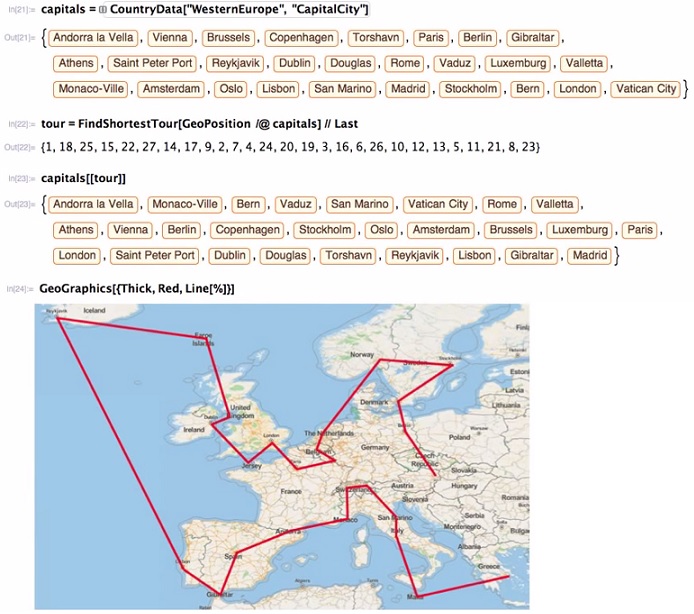
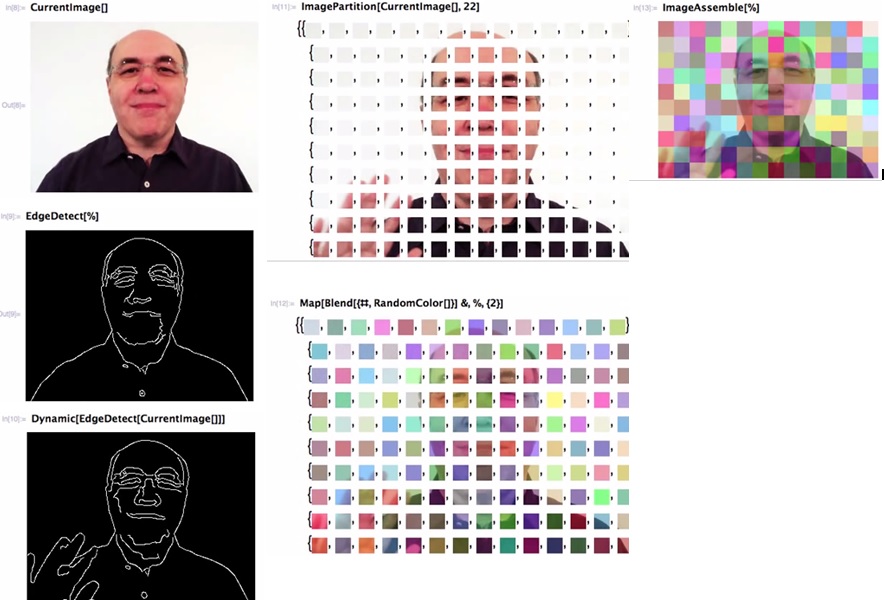
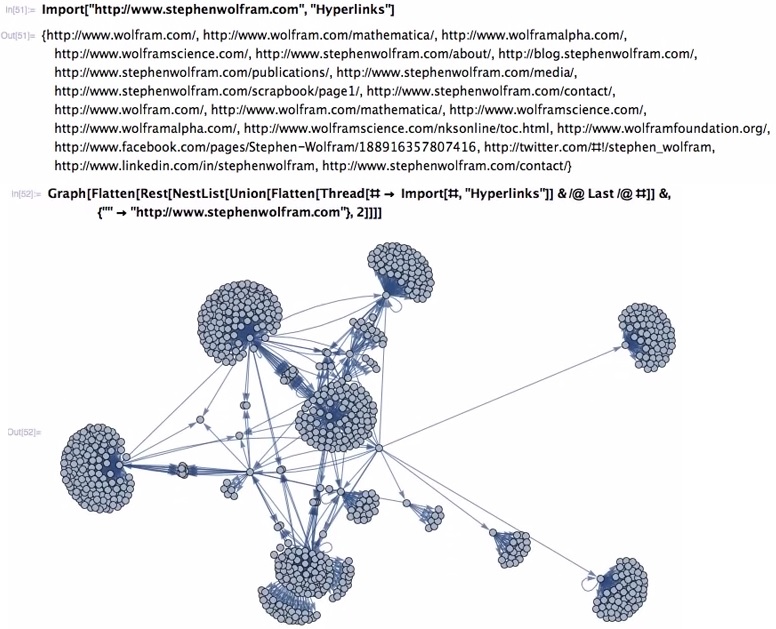
theodp writes "The devil will be in the details, but if you were stoked about last November's announcement of the Wolfram programming language, you'll be pleased to know that a just-released dry-but-insanely-great demo delivered by Stephen Wolfram does not disappoint. Even if you're not in love with the syntax or are a FOSS devotee, you'll find it hard not to be impressed by Wolfram's 4-line solution to a traveling salesman tour of the capitals of Western Europe, 6-line camera-capture-to-image-manipulation demo, or 2-line web crawling and data visualization example. And that's just for starters. So, start your Raspberry Pi engines, kids!"
A picture is worth a thousand words, but most sets of 1000 words can't be succinctly described by a single picture.
Similarly, while I'm sure that you can write a few lines of Wolfram and do amazing things, I wonder how often you can set out to do an amazing thing and end up with a few lines of Wolfram. Maybe the answer is "pretty often", which would be wonderful. But I'm waiting to hear from some outside users.
So we don't count the lines of code behind the "FindShortestTour" function?
It looks like a very nice library.
Doesn't really say very much about the power of the language at all, though.
I first looked at the examples given in the article and said "harrumph this is mathematica". But then I watched his demo and I see what he's getting at. You could say this is just a really nice library but it's way more than the sum of it's parts. I think he's using the term Language not in the sense of "programming language", but rather in the sense that every real world speaking language like english, spanish contains an intrinsic model of the world itself and every part of a spoken language can be coupled to every other part. That is speaking has no incompatible interface between ideas does it? That question would never occur to you, but of course we have that problem with every programming library API.
SO he's talking about a Language for programming as much as a programming language. His accomplishment is to make a language of programming a programming language.
One of the great tricks he accomplishes is to combine symbolic programming and functional programming. I was somewhat surprised to notice that reactive programming actually falls out of that by accident. There's been a lot of spamvertising articles on Slashdot lately about the dogs dinner versions of Reactive programming for databases. Those are toys. Wolfram gets it right by not making it just fall out accidentally of two greater programming principles.
Decades ago I toyed with mathematica. The problem I had with is it was that the symbolics were nice but they let you easily create problems with permutations so large that it became incomprehensibly slow as your problem scaled. This if course was the users fault. I'm just saying that the power of the language gave me the power to be stupid. In a similar way APL with it's outerproducts instead of loops could easily use up all your computer memory in one command line without you even appreciating what had just happened. With procedural languages you had to think about how your algorithm was going to manage its own complexity and thus oddly worked better for scaling to complex problems.
It looks like what has happened is that mathematica --- now wolfram language--- has a lot more speed and wisdom about how to manage complexity and choose more wise approaches. SO perhaps that problem is solved more. But it's hard to say from the demo.
In any case that was a staggering demo.
Some drink at the fountain of knowledge. Others just gargle.
Am I supposed to be impressed by "a 4-line solution to a traveling salesman tour" when that 4 line solution calls a library function called "FindShortestTour()"?
That might be useful if your name is Martin Gardner, but...
No sig today...
Cramming 20 commands and 8 layers of brackets into one line doesn't make your programm an 'impressive 5-liner'. It, at most, makes a neat stunt by a mathematician in a proprietary programming language he invented himself. I'd be tempted to call it shitty programming.
Nothing to see here folks, move along.
No you miss the point. It shows that two things have been accomplished
first every command has an almost universal API for input and output letting you pipeline everything you do. try that with almost any normal library. it fails. now imagine achieving that across a language that is staggeringl comprehensive, deep and wide. it's a tour de force.
then imagine someone told you that, by the way, that API was also symbolic.
and wait it's also a functional programing
and reactive.
Some drink at the fountain of knowledge. Others just gargle.
and webscale ?