 Slashdot Mirror
Wolfram Language Demo Impresses
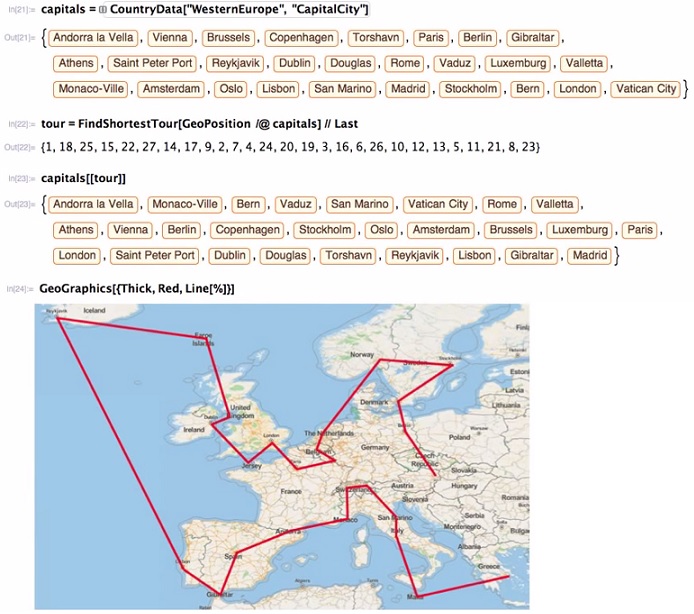
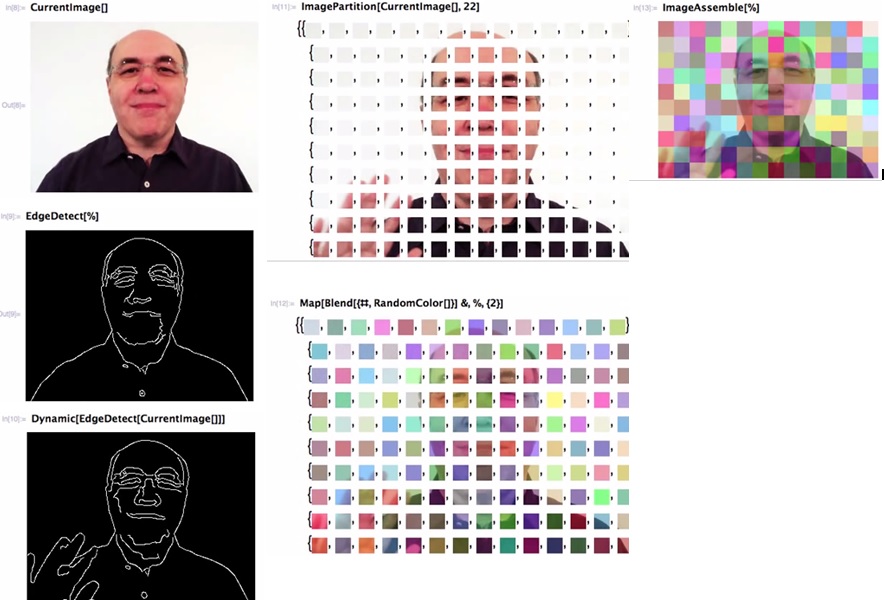
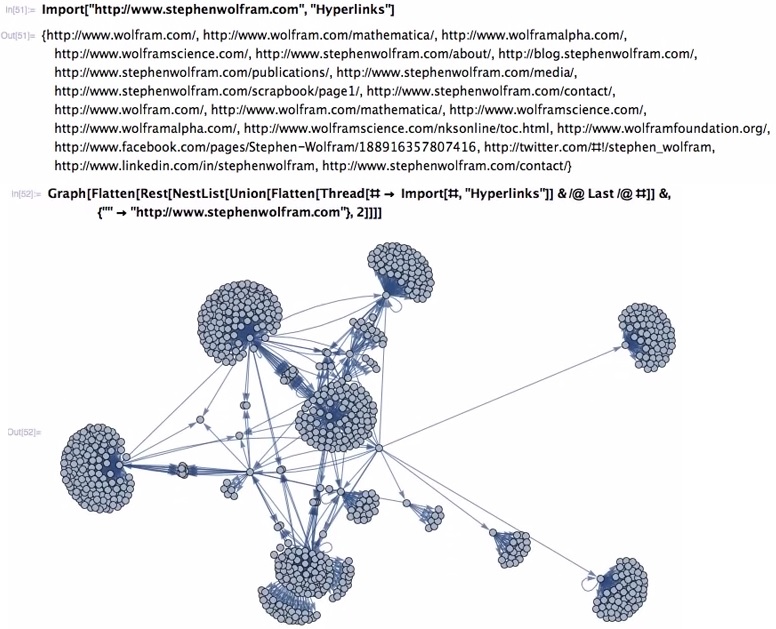
theodp writes "The devil will be in the details, but if you were stoked about last November's announcement of the Wolfram programming language, you'll be pleased to know that a just-released dry-but-insanely-great demo delivered by Stephen Wolfram does not disappoint. Even if you're not in love with the syntax or are a FOSS devotee, you'll find it hard not to be impressed by Wolfram's 4-line solution to a traveling salesman tour of the capitals of Western Europe, 6-line camera-capture-to-image-manipulation demo, or 2-line web crawling and data visualization example. And that's just for starters. So, start your Raspberry Pi engines, kids!"
This looks a lot like Mathematica. When does something become programming language? Wasn't mathematica a programming language too?
Some drink at the fountain of knowledge. Others just gargle.
A picture is worth a thousand words, but most sets of 1000 words can't be succinctly described by a single picture.
Similarly, while I'm sure that you can write a few lines of Wolfram and do amazing things, I wonder how often you can set out to do an amazing thing and end up with a few lines of Wolfram. Maybe the answer is "pretty often", which would be wonderful. But I'm waiting to hear from some outside users.
So we don't count the lines of code behind the "FindShortestTour" function?
Did you solve the secrets of the Universe? Stephen Wolfram did. All is known because of Him, even though you could not hope to grasp what He knows. Show more respect and reverence.
It looks like a very nice library.
Doesn't really say very much about the power of the language at all, though.
All I see there is calling some method to do something complicated. It's not 2 lines of code of the actual meat is hidden somewhere.
did you forget to take your meds?
As much as I would like to be impressed, what I see is quite underwhelming: a functional application language with some interface to "facts" and "databases" with a pattern matching engine might make some analysis easier but ... the principles of the language are mostly what you come to expect if you have seen lisp once or any modern functional language,e.g. haskell.
I can see it as being useful, but as another commenter pointed out, "FindShortestTour" is a library function (which might be handy), but definitely not an example of how concise the language might be; the same could be said about "EdgeDetect" or the like. The power of the language can be measured in how easily it can be extended or non trivial algorithms can be implemented ... not in how many functions are offered (even if this could be more convenient none-the-less).
Yes. Just like we don't count the lines of machine code that a perl 'one liner' gets transformed into before execution.
I can do much the same thing in the same number of lines of Perl code. I don't think there are many who would claim that makes Perl a paragon of language design.
Clickbait article is clickbait.
Cramming 20 commands and 8 layers of brackets into one line doesn't make your programm an 'impressive 5-liner'. It, at most, makes a neat stunt by a mathematician in a proprietary programming language he invented himself. I'd be tempted to call it shitty programming.
Nothing to see here folks, move along.
No you miss the point. It shows that two things have been accomplished
first every command has an almost universal API for input and output letting you pipeline everything you do. try that with almost any normal library. it fails. now imagine achieving that across a language that is staggeringl comprehensive, deep and wide. it's a tour de force.
then imagine someone told you that, by the way, that API was also symbolic.
and wait it's also a functional programing
and reactive.
Some drink at the fountain of knowledge. Others just gargle.
The traveling salesman tour - is NOT a 4 line solution. By that definition I can write "Run Linux" and have a one line operating system.
and webscale ?
The way this is setup isn't that that you code everything in natural language, rather it is just a shortcut to look up the correct formal language. Instead of searching/browsing documentation looking up the exact names of the functions you want and how to chain them, you just type what you want in natural language. If it interpreted you correctly, then great it saved you several minutes, and now you know the real syntax to use in the future. If not, well you only lost a couple seconds.
The idea of mixing natural language like this isn't so weird; the first step that most programmers would take in looking up documentation when they don't even know the name of the library the functionality is located in is to perform a natural language search on web browser, and then go from there. This just takes it one step further and streamlines the process, which is perfect for a interactive language.