 Slashdot Mirror
Wolfram Language Demo Impresses
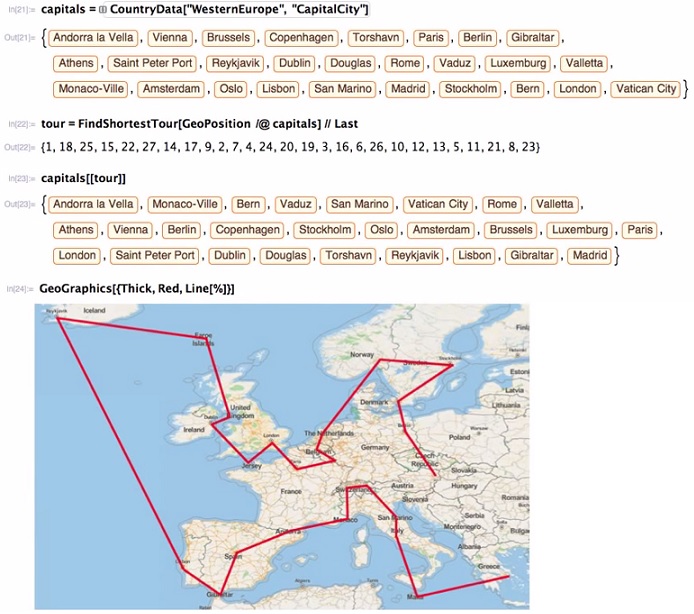
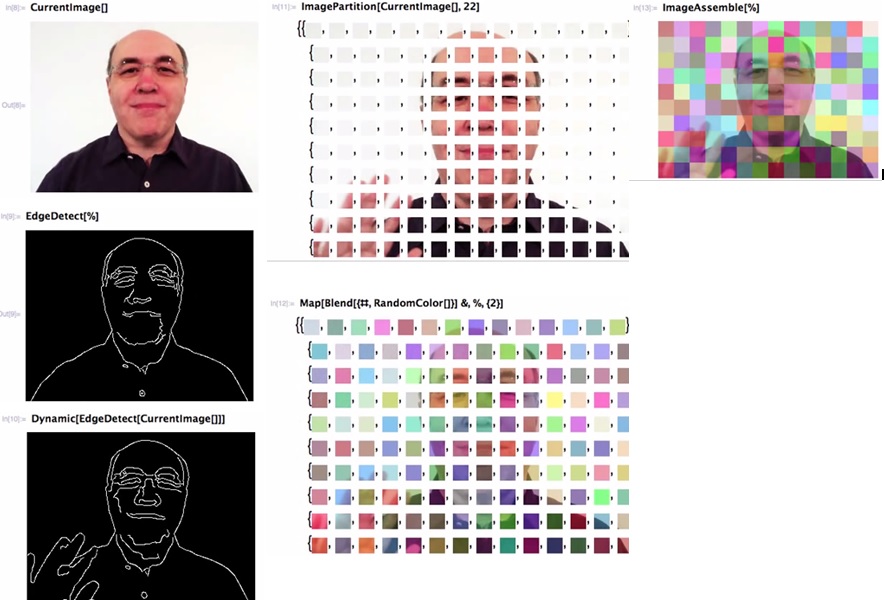
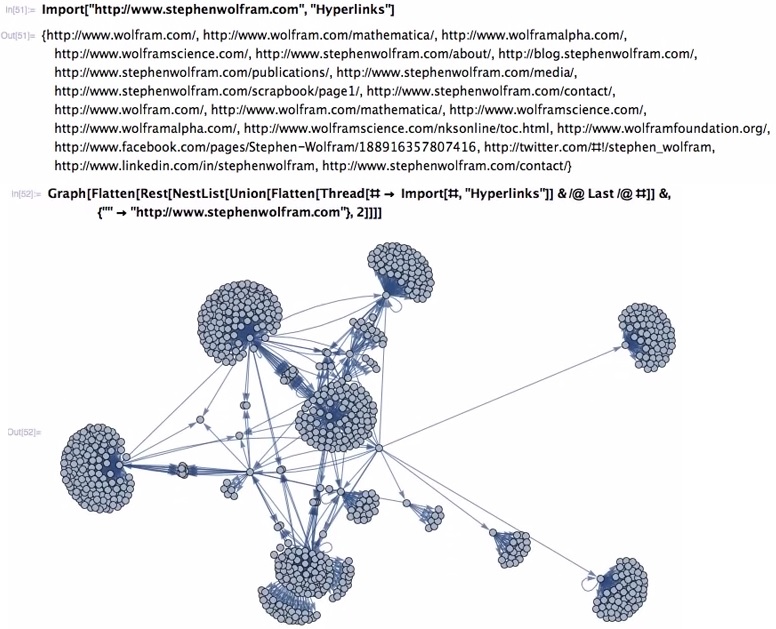
theodp writes "The devil will be in the details, but if you were stoked about last November's announcement of the Wolfram programming language, you'll be pleased to know that a just-released dry-but-insanely-great demo delivered by Stephen Wolfram does not disappoint. Even if you're not in love with the syntax or are a FOSS devotee, you'll find it hard not to be impressed by Wolfram's 4-line solution to a traveling salesman tour of the capitals of Western Europe, 6-line camera-capture-to-image-manipulation demo, or 2-line web crawling and data visualization example. And that's just for starters. So, start your Raspberry Pi engines, kids!"
This looks a lot like Mathematica. When does something become programming language? Wasn't mathematica a programming language too?
Some drink at the fountain of knowledge. Others just gargle.
A picture is worth a thousand words, but most sets of 1000 words can't be succinctly described by a single picture.
Similarly, while I'm sure that you can write a few lines of Wolfram and do amazing things, I wonder how often you can set out to do an amazing thing and end up with a few lines of Wolfram. Maybe the answer is "pretty often", which would be wonderful. But I'm waiting to hear from some outside users.
So we don't count the lines of code behind the "FindShortestTour" function?
Did you solve the secrets of the Universe? Stephen Wolfram did. All is known because of Him, even though you could not hope to grasp what He knows. Show more respect and reverence.
Cramming 20 commands and 8 layers of brackets into one line doesn't make your programm an 'impressive 5-liner'. It, at most, makes a neat stunt by a mathematician in a proprietary programming language he invented himself. I'd be tempted to call it shitty programming.
Nothing to see here folks, move along.
We suffer more in our imagination than in reality. - Seneca
It looks like a very nice library.
Doesn't really say very much about the power of the language at all, though.
All I see there is calling some method to do something complicated. It's not 2 lines of code of the actual meat is hidden somewhere.
did you forget to take your meds?
As much as I would like to be impressed, what I see is quite underwhelming: a functional application language with some interface to "facts" and "databases" with a pattern matching engine might make some analysis easier but ... the principles of the language are mostly what you come to expect if you have seen lisp once or any modern functional language,e.g. haskell.
I can see it as being useful, but as another commenter pointed out, "FindShortestTour" is a library function (which might be handy), but definitely not an example of how concise the language might be; the same could be said about "EdgeDetect" or the like. The power of the language can be measured in how easily it can be extended or non trivial algorithms can be implemented ... not in how many functions are offered (even if this could be more convenient none-the-less).
Yes. Just like we don't count the lines of machine code that a perl 'one liner' gets transformed into before execution.
I can do much the same thing in the same number of lines of Perl code. I don't think there are many who would claim that makes Perl a paragon of language design.
Clickbait article is clickbait.
Don't make me laugh -- I used to be an APL programmer.
Impressive but overwhelming. I don't look forward to learning, reading or maintaining such code. So as usual: functionality is inversely proportional to usability :)
If ego can feed you, Wolfram would be, like, really fat.
Fuck systemd. Fuck Redhat. Fuck Soylent, too. Wait, scratch the last one.
The traveling salesman tour - is NOT a 4 line solution. By that definition I can write "Run Linux" and have a one line operating system.
it's just one line in wolfram:
print UNIVERSE.revealSecrets(ALL);
Output: 42
Sorry that's life, the_universe AND everything. It's a bitwise AND, of course, so that's 101010. Life is 111011, everything is (as you might expect) 111111. Finding all possible values of the universe is an exercise left to the reader.
Got them moderator blues I blieve I walk out the do', With these mod-points I been gettin', I 'most never post no mo'
Perhaps I'm misunderstanding you here, but the Traveling Salesman problem is a closed path - the salesman has to return to his starting point in the end. Your solution is only shorter if the salesman is allowed to settle down in Reykjavik in the end. The red line in the plot is misleading because it does not draw the closing line between Athens and Vienna, but that part is included in the path. As far as I can see, the solution shown in the video is the correct one, and the path drawn is correct except for the lack of a closing line.
Wow, that's just bizarre. I don't know where you get your misinformation, but it's an elite grade of batshit.
The whole point of Boost is that it maintains a certain amount of abstraction without boxing you into a performance corner. Were it not for those conflicting goals, the devilishness of its internal machinery could not be justified.
Template metaprogramming essentially involves expressions converting themselves to a symbolic representation that doesn't resolve itself into a concrete expression—by means of purely functional transformation at a quasi-syntactic level;—until some final result is demanded, at which point the highest performance code path can be selected based on the actual parameters (more specifically, often exploiting which parameters vary and which parameters are constant or nearly constant).
The problem with Boost is similar to what Knuth said about the problem with literate programming.
Literate programming demands a high proficiency with two different skills: formal reasoning and verbal expression. This shrinks the available pool of adherents and adopters. And worse, there's a terrible opportunity cost, because the people out there who have extremely high proficiency in both of these skills are in extremely high demand to take on central roles in large projects where they don't spend their hours bent over literate code.
The kind of environment where Boost can be best exploited for both its abstraction and its performance is going to be wonk-filled boiler-rooms at high frequency trading companies where the cash, the talent, the commitment, and the project duration mesh together. Importantly, the project specification in these environments is often in continuous, long-term evolution as your firm chases whatever edge it thinks it might have in a chaotic, rapidly-shifting market environment. The month you spend pouring over low-level optimization gets deployed for a whole week. The month you spend automated your Boost framework to achieve nearly the same performance becomes a permanent code asset (and a competitive asset whenever you find yourself needing once again to run that old play).
Boost is in that category where if you have to ask, you can't cut the mustard. The natural Boost programmers already know who they are. Few of these people toil in the public eye. That's not where this elite, double-barrel skillset tends to land.
The Wolfram language is impossible to assess based on this video. If your application depends on Wolfram "knowledge" how do you know it will continue to meet rigorous specifications the day after tomorrow?
Is there a public regression suite on the contained knowledge against which to assess whether your program is erected on firm or porous soil?
What guarantee does one have that it's cleverness or performance characteristics will stay consistent when it matters most?
I suspect the killer application for WooL is prototyping the semantic web. The semantic web has been dragging its feet. Google and Facebook don't wish to become disintermediated. They have one foot on both sides of this fence and their hands cupped over their testicles. Doesn't make for rapid progress.
The Achilles heel of search is that search returns results rather than models. Google is trying to split the difference by having search return interactions. It's an excellent paving stone on the road to a lucrative future purveying OOXML.
If ten minutes of coding within the Wolfram Language embarrasses Google search, we have a winner here of WuLing mammoth proportions.
The way this is setup isn't that that you code everything in natural language, rather it is just a shortcut to look up the correct formal language. Instead of searching/browsing documentation looking up the exact names of the functions you want and how to chain them, you just type what you want in natural language. If it interpreted you correctly, then great it saved you several minutes, and now you know the real syntax to use in the future. If not, well you only lost a couple seconds.
The idea of mixing natural language like this isn't so weird; the first step that most programmers would take in looking up documentation when they don't even know the name of the library the functionality is located in is to perform a natural language search on web browser, and then go from there. This just takes it one step further and streamlines the process, which is perfect for a interactive language.