Slashdot Mirror


Think Tanks: How a Bill [Gates Agenda] Becomes a Law

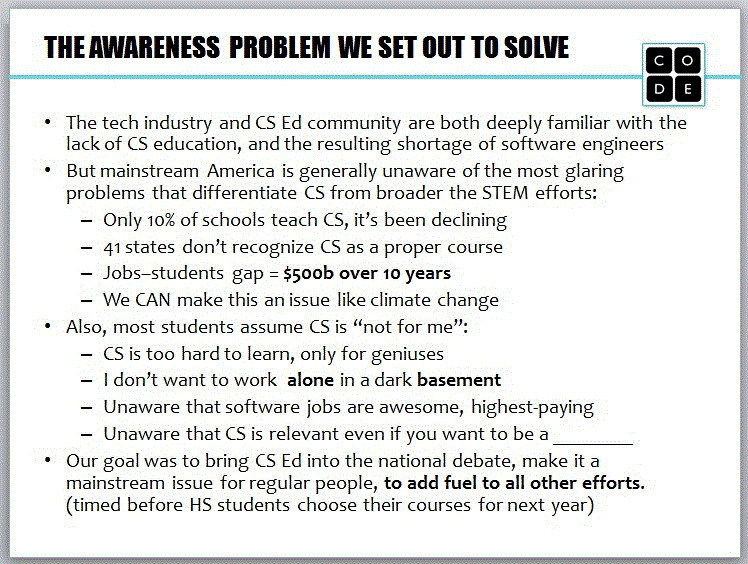
theodp writes: The NY Times' Eric Lipton was just awarded a 2015 Pulitzer Prize for investigative reporting that shed light on how foreign powers buy influence at think tanks. So, it probably bears mentioning that Microsoft's 'two-pronged' National Talent Strategy (PDF) to increase K-12 CS education and the number of H-1B visas — which is on the verge of being codified into laws — was hatched at an influential Microsoft and Gates Foundation-backed think tank mentioned in Lipton's reporting, the Brookings Institution. In 2012, the Center for Technology Innovation at Brookings hosted a forum on STEM education and immigration reforms, where fabricating a crisis was discussed as a strategy to succeed with Microsoft's agenda after earlier lobbying attempts by Bill Gates and Microsoft had failed. "So, Brad [Microsoft General Counsel Brad Smith]," asked the Brookings Institution's Darrell West at the event, "you're the only [one] who mentioned this topic of making the problem bigger. So, we galvanize action by really producing a crisis, I take it?" "Yeah," Smith replied (video). And, with the help of nonprofit organizations like Code.org and FWD.us that were founded shortly thereafter, a national K-12 CS and tech immigration crisis was indeed created.
30 of 165 comments (clear)

  1. Orwell by Livius · · Score: 4, Insightful

    Funny how little thinking goes on at think tanks.

    1. Re:Orwell by Livius · · Score: 2

      Also funny how people assume I mean only the think tanks they personally disagree with rather than all of them.

  2. Bill Gates is a benevolent philanthropist by Anonymous Coward · · Score: 4, Interesting

    He's giving 90% of his wealth away before he dies[1], feeds the hungry in Africa[2], vaccinates populations at risk who don't have access to vaccines[3][4]. How can you say anything bad about the man? He only wants the best for the next generation of Americans.

    [1] .. to buy products from the very companies he owns which increases their value and dividends
    [2] .. with GMO produce that sterilizes rats after a few generations, gives cows and pigs organ problems, etc.
    [3] .. using live polio virus (unlike what we get here), causing almost 50,000 children to be paralysed leaving the population worse off than before brushing it off as a statistic, part of keeping our society safe from disease.
    [4] .. giving only one half of the vaccine for free, requiring the governments to buy the other half from his company

    1. Re:Bill Gates is a benevolent philanthropist by JonWan · · Score: 5, Insightful

      He's buying a stairway to heaven. It's legacy thing. He isn't going to leave his kids and grand kids broke.

    2. Re:Bill Gates is a benevolent philanthropist by JustNiz · · Score: 5, Insightful

      >> He only wants the best for the next generation of Americans.

      Ahh so thats why he's trying to directly engineer mass unemployment of home-grown US engineers, and replace them with a dependency on a 3rd world country where the academic system is a complete sham that is based on widespread cheating and the sale of degrees as standard practice?

    3. Re:Bill Gates is a benevolent philanthropist by Insanity+Defense · · Score: 3, Insightful

      He SAYS he is giving away 90% of his wealth. Most of what he has "given" away so far is in his charity - which he controls. Tax free and growing. Much of what he gives away is to promote his own interests like when the Indian province had its education system going Linux till he gave them money to buy Microsoft stuff. His charity has also lobbied in support of patent laws that Microsoft likes and against those that would allow cheaper drugs for places like Africa. When you still control it and use it for your own benefit it hasn't been given away.

  3. Re:Another right-wing attack by Anonymous Coward · · Score: 2, Insightful

    Left, right, so what. Is what they are saying true? That is all that matters.

  4. Our democracy is broken by Karmashock · · Score: 4, Insightful

    We need a system less easily manipulated by people with money or hordes of mindless cultists.

    --
    I've decided to stop wasting my time responding to AC trolls/sockpuppets... so if you want a response from me... login.
    1. Re:Our democracy is broken by Anonymous Coward · · Score: 2, Interesting

      The only way to get that is to fracture the system. You will never ever eliminate the power of money and charismatic personalities. No matter how much money someone has, barring very few people, everyone always wants more. And charisma is just one of those things that you can't account for. Even highly educated people have been taken in by a charismatic person with an agenda. The only way to make the system less easy to manipulate is to fracture the system into smaller more autonomous segments. A strong shift to a more anti-federalst system would do a lot of good on this front. Don't get me wrong, I am well aware of how corruptible small-town politics can be, but it's much easier to escape and route around the damage caused by small town corruption than the same damage caused by federal corruption. Yeah, it might cost someone millions of dollars to buy off a few congressmen, but those millions only have to be spent once or twice and you buy national power as opposed to spending thousands to buy off local politicians and having to spend those thousands in every city and every state across the nation to get national control. Worst of all, those millions are spent buying someone that takes millions of dollars to replace. It's a whole lot easier to beat out and replace an incumbent city council member than it is to beat out and replace an incumbent congressman.

      We acknowledge the wisdom in reducing single points of failure in technology. Why don't we acknowledge the same in government?

    2. Re:Our democracy is broken by NicBenjamin · · Score: 4, Interesting

      The problem with that plan is that so many aspects of the way the system is designed give people with money and/or time an advantage that you'd basically have to scrap it.

      For example, we have a bicameral Legislature and an independent Executive chosen via staggered elections. The Legislators are independent actors. That means policy-making tends to the crowd-sourced-cluster-fuck when things are going well. It also means intricate stratagems of getting Rep A to trade horses with Senator B, while bribing Subcommittee Chair C, etc. become possible. And Bill Gates is the guy who has the time/money/employees do engage in such stratagems. The staggered elections mean that the people in power are looking at vastly different electorates, which in turn means that the guy whose worried about being elected in a non-Presidential year has to worry more about older, whiter, more conservative voters who tend to vote every time; whereas the guy whose next up in a Presidential year is going to be much more concerned with younger, browner, leftier voters who are much more likely to only show up once every four years. If you add in our campaign finance system, and large districts (our smallest House District is a half-million people), it just gets worse.

      Compare this to Canada. They have a lot of the same trappings we do like a Senate, but their Senate is toothless. Half the bullshit that allows the wealthy to out-manuever the rest of us is gone because nobody gives two shits what a Senator says. One of their core principles is called "Responsible Government," which means the government is designed so that it's virtually impossible for anything of note to happen without everyone knowing precisely which two to three people to blame if it turns out to be invading-Iraq-level-dumb. See the Commons choose the Executive, the Prime Minister, chooses the Cabinet. If the Commons fail to agree with a PM they will vote against the bill they don't like, forcing a new election, and the next PM will agree with the next Parliament on that particular issue. That means that the only people who can really be blamed for fuck-ups are the PM, the relevant Minister, and possibly (but extremely rarely) somebody else for bullying them. There is very little space in the system for a clever person to game it by clever maneuvers, which means that clever people can't sell access to their clever plans to game the government.

      Don't get me wrong. The wealthy will always have more influence then their numbers indicate because a) they vote, and b) many of the not-wealthy figure "a poor man never gave me a job" and out-source their policy preferences to rich-ass-mother-fuckers. But the system we got amplifies that a huge degree.

    3. Re:Our democracy is broken by Karmashock · · Score: 2

      A system that does not reward bribery or the manipulation of chanting frothing lunitics.

      A society run by either faction is not especially rational or desirable.

      On the one hand you have people that will manipulate the system using their wealth to get whatever they want. And on the other you have a system where cult leaders use their chattel as fodder to get whatever they want.

      I want a society of free people by free people for free people. A society of bribery very quickly leads to one where we are bought and sold... doesn't sound very free to me. And a society ruled by chanting cultists isn't especially free either since they require utter obedience to their dogma and cult leaders or they start throwing people onto bonfires.

      If you value freedom or human dignity... how can you support either one?

      As to money, we can do more to control and monitor the way in which public officials receive money or gifts. And of course establish stiff unconditional penalties if they break the rules.

      As to cultists, part of the problem is that our system counts us as individuals in some places and values money in others. Where it counts us as individuals we're all equal when really we shouldn't be all equal. Some laws and rules effect some people and not others. What is more many laws are about giving someone something but not someone else. That means someone profits and not everyone. That means there are conflicts of interest because the laws do not effect everyone equally.

      Something should be done to weight the votes on various things so that those the law applies to have more of a say in it then those that do not. And possibly if someone profits by a law they might have reduced influence.

      If there is a law to give money to Tim, then maybe Tim should recuse himself form the vote. And if there is a law to make Tim pay for something but not Jerry... why does Jerry get a vote? Jerry isn't paying regardless.

      Take an issue like abortion... do men deserve a vote on it? I don't see why. But if we had a vote on parental rights then obviously men and women would get a vote. So on and so forth.

      Keeping track of who does and does not have an interest in everything for 300 million people would be complicated. I don't know if that is logistically possible or if it would even be a good idea. But that would control the cultist issue where political parties say "vote for X and anyone that doesn't is EVIL". Everyone that voted would have their vote matter to the extent that it should matter. If you don't own a house, then why are you voting on property taxes? If you don't have a car, then I don't see why you're voting on gas taxes. If you don't have a child, then why are you voting on schools?

      I am to be clear a libertarian. It is just a word. I don't think I fit into any ideology perfectly. But I do feel the government especially at the federal level should be stripped of nearly all its responsibilities. The only thing I feel comfortable with them maintaining are the Federal courts, Federal law enforcement, Federal prisons, coast guard, border patrol, and the various military forces. Nothing more. I'd be happier if everything else were state based. And the states especially in the west need to be subdivided. California and Texas being the prime example of states that probably need to get broken into 5 or 6 small pieces just so the people living in them have any say in the government.

      California is very corrupt in large part because it is so large. The reigning politicians can do whatever they want so long as they keep most of the state happy. That can bend any portion of the state over a rail and fuck it raw, take pictures, and sell them as rape porn on the internet and nothing happens to them because they have a few cities that will vote for them regardless. Nothing matters so long as they keep those cities happy. And they don't even need to really keep them happy at that. Just keep everyone unwilling to vote for the opposition. And thus having a choice between the corrupt poli

      --
      I've decided to stop wasting my time responding to AC trolls/sockpuppets... so if you want a response from me... login.
    4. Re:Our democracy is broken by NicBenjamin · · Score: 2

      Ever heard of Matty Moroun and the Ambassador Bridge Company?

      They own the biggest border crossing between Detroit and Canada. Since it's about 80, and it was a bit small before NAFTA, there's a significant need for more capacity at that border crossing. They want a second bridge, owned by them, at the same location. Nobody else wants that because they're so crazy the Forbes profile of Moroun was entitled "the Troll Under the Bridge." He's got political legs because he's got a lot of money, and he's very skilled at rationalizing his behavior until it fits into whichever ideology he thinks will be most helpful in getting the particular politician he's talking to at this exact moment vote for his current scheme. One of the first signs that made me question Kwame Kilpatrick's ethics, was Kilpatrick's status as a Marounie.

      The Canadians had this figured out in the late 90s, and no Canadian pol has associated with Maroun since then. This is because it's a much more centralized system, so the PM or Provincial Premier will get asked about Maroun before an MP or MLA from the other side of the Province starts submitting Moroun-approved bills. In the US, OTOH, Michigan's State Senate voted the not-second-span idea down in Committee/a>, largely because a bunch of Senators didn't know/care that Moroun is one of the most hated figures in Detroit, and the dude has money. The Canadians out-manuevered the Senate by agreeing to pay for the entire cost themselves*, so Moroun put a Constitutional Amendment on the ballot banning publicly financed bridges...

      There's no such thing as a system that keeps the wealthiest 10% with 10% of the political power. But if you think that our system is as bad as theirs you probably haven't been much attention.

      *They'll get the money back eventually. They're the only ones allowed to charge tolls on the bridge.

    5. Re:Our democracy is broken by NicBenjamin · · Score: 2

      Dude,

      I have never said there's no way for elites to manipulate a Parliamentary system. I've said there are fewer ways then in the US. And you have presented no evidence that any method the elites of Canada use to manipulate their system are not present in the US.

      On theology: you;re still arguing theology. You hasve no examples of how the actual system works in the real world, you just repeat the theories (now raised to theological precepts in what non-Americans call our :"Civic Religion") that the Founders believed centuries ago.

      Your Latin is shaky. "Rule by Law" would be something closing to "Rex Lege" then "Republic," "Republic" is actually derived from "Res Publicus," or "Public Affairs."

      If your definition of corruption is that it's how the wealthy gain power secretly, how can Canada equal a country where we have a) secret political campaigns with unlimited donations, b) numerous elected officials who can all owe favors, etc.? Your argument is perfect theology, but has no relation to reality.

      If you think you've got my political affiliation pegged from this thread you;re remarkably dumb. OTOH, you did just claim that the well know "Res Publica" actually meant "Rule of Law" so brains clearly ain;t your forte. I listed some things that would be in the majorities best interest. Quite a few of them would win referendums, yet the government doesn't do them. Why? Because the wealthy elites have numerous veto points, an ideological predisposition to oppose all spending that is not tax breaks, and a strong material interest in thew current system.

      As for moderates, to quote you: "The issue is you want to make it hard for anyone to do anything extreme or anything quickly. If actions are kept moderate and everyone has time to respond to it then they can't really get that out of control."

      Your entire case is a defense of moderation.

  5. Re:Fabricating a Crisis? by theodp · · Score: 4, Informative

    MR. SMITH: "One of the things I've learned from all of the various anti-trust and intellectual property negotiations I've handled over the years is this, sometimes when a small problem proves intractable you have to make it bigger. You have to make the problem big enough so that the solution is exciting enough to galvanize people's attention..."

  6. FWD.us is spelled... by Anonymous Coward · · Score: 2

    FUD.us.

    These are similar in style and lack of ethics or engineering rigor to the manufactured "compatibility" that got an ISO standard published despite the shrieking of every sensible, competent, non-Microsoft funded voter at the conference. Numerous attendees and members of the IFC committees resigned in protest, and even Microsoft is incapable of following the actual spec. The result is that Microsoft continues to violate the spec they sponsored even in their own software, but bureaucrat without technical awareness or who were already buying Microsoft products can check off "standards compliant" on their checklist of software requirements.

    They fight dirty. Take a good look at what happened in Massachusetts to the CIO who demanded software have actual API's so that people would be able to read documents in the future. They did a political hatchet job on him.

              http://www.infoworld.com/artic...

  7. Re:Fabricating a Crisis? by theodp · · Score: 2

    And from the linked-to Code.org PowerPoint slide: "We CAN make this an issue like climate change." Btw, in a Reddit AMA at the time of Microsoft-backed Code.org's launch, CEO and Founder Hadi Partovi noted that his next-door-neighbor is Microsoft General Counsel and Code.org Board member Brad Smith, whose FWD.us bio notes is also responsible for Microsoft's philanthropic work.

  8. why the hell does billg want to teach these kids by swschrad · · Score: 4, Insightful

    and then hire a bunch of Tata Indians to do the work for half price, leaving all these students with new diplomas no way to pay their student loans?

    damn stupid program he's pushing. jump one way or jump the other way, but get off the barbed wire fence. that's electrified, too.

    --
    if this is supposed to be a new economy, how come they still want my old fashioned money?
  9. Re:why the hell does billg want to teach these kid by garyisabusyguy · · Score: 3, Insightful

    He has to pay lip service to the 'lack of skilled US workers', even though the H1B workers will undercut the demand that is supposed to drive people into those careers

    If you believe in free markets. then you have to let there be a vacuum in workers to create a demand for people to want to work those jobs because they will be worth more money

    Supplementing the supply with H1B workers reduces the demand, which would drive US workers to seek those jobs

    --
    Wherever You Go, There You Are
  10. Re: More like a diversion for more H-1B by garyisabusyguy · · Score: 4, Informative

    No, it is the difference between nationalistic and global free markets

    If America is constrained by their national boundaries (and citizens) for IT workers, the supply will be less than demand and wages will rise

    Id America is free to engage a global market, then there is a glut of IT workers and wages will fall

    FYI, no other country, including India, allows foreign IT workers to create a glut and reduce the value of their own workers

    --
    Wherever You Go, There You Are
  11. Re:More like a diversion for more H-1B by ranton · · Score: 2, Interesting

    There isn't an US IT shortage, there is a shortage of US IT that will work for less then they are worth. Companies game H-1Bs and treat them more poorly than they could get away with. If one pushes laws to support this corruption don't be surprised when IT unions form to fight it.

    People who complain about H-1B visas usually have a misguided view of what the real options are in this debate. They see an option where companies don't use H-1Bs and simply hire more US citizens instead. The reality, however, is that the real options for companies are:

    1. Bring in H-1B visas so corporate IT teams stay in the US
    2. Build corporate IT teams in other countries

    Option #2 is essentially outsourcing, and it is not just some boogeyman intended to scare US workers. It really happens. Entire industries have already moved overseas in the past century, and the software developer and other engineering industries are not immune to it.

    If US citizens cannot compete with foreign labor that live in the US, with a similar cost of living as US citizens, we have no hope of competing with foreign labor abroad with a much lower cost of living. There has been a push back against outsourcing software development jobs in the past decade, but if we start practicing protectionism the trend can easily start moving in the other direction again.

    --
    -- All that is necessary for the triumph of evil is that good men do nothing. -- Edmund Burke
  12. How does this get modded insightful? by rsilvergun · · Score: 3, Insightful

    Lots of thinking goes on at think tanks. It's just not the sort any decent person wants going on. You shouldn't underestimate your enemy. They are well organized, highly motivated and well funded. They're fighting the best kind of war: one where the other side doesn't know there's a war on.

    --
    Hi! I make Firefox Plug-ins. Check 'em out @ https://addons.mozilla.org/en-US/firefox/addon/youtube-mp3-podcaster/
  13. Re:More like a diversion for more H-1B by garyisabusyguy · · Score: 4, Insightful

    Welcome to business school circa 1998, where 'we'll send it all overseas and $profit$' was taught as a viable business practice.

    You manage to ignore many of the failures of outsourcing, such as language and cultural divides between customers (business and consumer) and the offshore workers, and the tendency for outsourcers to provide their A team at the beginning of the contract, then shifting their B and C teams into place as they attempt o land more contracts

    And, even if you decide that you are going to take the whole kit and kaboodle offshore, that may work for canned existing services that are fully commoditized, but it completely ignores that American tendency to innovate and create new services and companies

    As much as you seem to hate Americans, we are still fucking cool and continue to create what the rest of the world wants to buy

    --
    Wherever You Go, There You Are
  14. Re:why the hell does billg want to teach these kid by currently_awake · · Score: 2

    The way to drive down wages and benefits is to increase the supply. The education and H1B both do that.

  15. Re: More like a diversion for more H-1B by garyisabusyguy · · Score: 3, Insightful

    So, are you suggesting that either Sony or Phillips 'left' America, when they are both brands that were originally from foreign lands?

    In fact, Phillips runs Phillips Electronics out of Andover Mass, presumably for American talent, and Sony runs Sony Entertainment out of Los Angeles, again for that 'American cool'

    Thank you for buying products created by Americans

    --
    Wherever You Go, There You Are
  16. Re:More like a diversion for more H-1B by ranton · · Score: 2, Insightful

    You manage to ignore many of the failures of outsourcing, such as language and cultural divides between customers ...

    I am not ignoring anything. My post was not a detailed analysis of every pro and con of outsourcing labor and I didn't claim it was. I merely stated that outsourcing exists, and that industries can and do move overseas. Neither of these claims are false.

    There are plenty of complications that still allow massive discrepancies in pay between the developed and developing world, but no complications are impossible to overcome. My father in law travels to China a half dozen times per year to fix these kinds of problems in his company's Chinese based manufacturing plants. These problems are very expensive, but overall it is still far cheaper to manufacture overseas. Many of the problems you mention make it very difficult to offshore IT jobs as well, but there is always still a cost point where it is better to deal with those problems and offshore anyway.

    And, even if you decide that you are going to take the whole kit and kaboodle offshore, that may work for canned existing services that are fully commoditized, but it completely ignores that American tendency to innovate and create new services and companies

    Plenty of companies offshore services that are not completely commoditized, although yes they rarely offshore the core and most innovative aspects of their company. But just as there are plenty of engineering related jobs that shifted overseas when a large amount of the US manufacturing industry moved offshore, there are plenty of other STEM related jobs that are not that innovative as well. I wouldn't doubt that the US could lose half or more of its STEM related jobs without moving much of the innovative sectors of the industry offshore.

    Also, it is not a given that the US will continue to be the center of most innovative aspects of the economy. The Large Hadron Collider is one high profile example of the US dropping the ball and letting some of the most innovative physics research in the world leave the US. Many if not most of the greatest large scale engineering achievements in the last couple decades have been accomplished in Asia, not the west. China's total R&D spending has already eclipsed the EU and probably will beat out the US within a decade.

    While the US still has a lot going for it, simply assuming it will always be the world's leader in innovation is naive.

    As much as you seem to hate Americans, we are still fucking cool and continue to create what the rest of the world wants to buy

    I am a native born US citizen (with 3 native born grandparents if it matters) who works in the IT industry. I just don't have any naive ideas about American exceptionalism that make me believe my country is untouchable by the rest of the world. I want our country's economy to stay strong for my children and other future descendants and simply feel that protectionism is not a good path for the US.

    --
    -- All that is necessary for the triumph of evil is that good men do nothing. -- Edmund Burke
  17. Re: More like a diversion for more H-1B by dryeo · · Score: 2

    FYI, no other country, including India, allows foreign IT workers to create a glut and reduce the value of their own workers

    Canada does lately. MS built a campus here in Vancouver, got a lot of tax breaks and then announced that less then 20% of employees would be Canadian. Sounds like it is basically a back way in to the States for E. Indian workers.
    Shit we even bring in McDonalds workers through our equivalent of H-1B visas. Got to keep that cup of coffee at a $. Actually employers really seem to like the power of having foreign workers, they have to work at one place and can be easily deported and are happy to work weird shifts for minimum wage.

    --
    https://en.wikipedia.org/wiki/Inverted_totalitarianism
  18. Re:More like a diversion for more H-1B by garyisabusyguy · · Score: 2

    Yes, 'American Exceptionalism' is the sort of hubris that let our auto industry fall back on their heels and let their lunch get eaten by Japanese manufacturers
    And, I will even go on to agree that protectionism has had a pretty horrible track record for building aggression between nations and probably helped to lead to the first two world wars

    However, the IT industry in America forms (and will continue to grow as) a significant portion of the middle class. This middle class is expected to educate their young and continue to provide economic leadership in years to come. The way that I see it, the US can choose to 1. protect domestic IT jobs by avoiding policies that allow US workers to be undermined by foreign workers, or 2. provide a level of social and educational support to Americans that most of the European nations provide (education being number one on the list)

    I would go on to argue that protectionism of jobs it not similar to protectionism of trade such as we saw in the early 20th century. Providing some level of support to US jobs by either supporting education or supporting workers provides money to engage in trade and prevents economic sluggishness that would lead politicians to attempt to enact trade protectionism

    Right now America has an edge in risk tolerance that gives us an advantage in innovation and business creation. We need to leverage this edge while it exists, and I do not see selling out our middle class for short term quarterly profits as the right was to accomplish that. China continues to demonstrate itself as a very capable competitor and reducing our competitiveness for short term profits at this time seems foolish

    --
    Wherever You Go, There You Are
  19. Re:why the hell does billg want to teach these kid by Anonymous Coward · · Score: 4, Insightful

    He has to pay lip service to the 'lack of skilled US workers', even though the H1B workers will undercut the demand that is supposed to drive people into those careers

    Have you ever noticed only Indians seem to have all the required decades of skills and experience despite the fact those Indians are under 25 years of age?

  20. Re: he's just a bill on Capitol Hill by whistlingtony · · Score: 3, Insightful

    yeah, because presidents write law, not congress..... look, I don't like Hillary either, but let's not be stupid about criticisms, eh?

  21. And supply & demand today . . . by sgt_doom · · Score: 3, Interesting

    . . . only really works in the labor market we are told, since it is completely inoperative everywhere else!!!!!

    And taken a bit further, with a bit more modern historical research, NAFTA was about the same thing: new regs allowing for foreign ownership of Mexican banks (within one year of the passage of NAFTA, or signing by Mexico, 90% of their banks became foreign owned), when then favor Big Agra, which speedily moves in to take over the agriculture industry, while payouts go to Mexican politicians favoring the privatizing of those farmlands occupied by Mexican subsistance farmers, who are then forced off their lands, and thus journey north to America, to continue the downward trend on wages at the lower levels, etc., etc., etc.