 Slashdot Mirror
Think Tanks: How a Bill [Gates Agenda] Becomes a Law
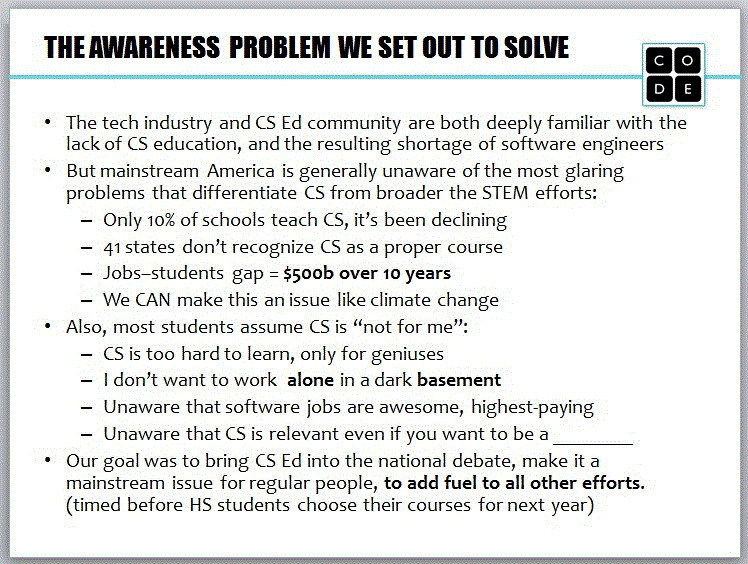
theodp writes: The NY Times' Eric Lipton was just awarded a 2015 Pulitzer Prize for investigative reporting that shed light on how foreign powers buy influence at think tanks. So, it probably bears mentioning that Microsoft's 'two-pronged' National Talent Strategy (PDF) to increase K-12 CS education and the number of H-1B visas — which is on the verge of being codified into laws — was hatched at an influential Microsoft and Gates Foundation-backed think tank mentioned in Lipton's reporting, the Brookings Institution. In 2012, the Center for Technology Innovation at Brookings hosted a forum on STEM education and immigration reforms, where fabricating a crisis was discussed as a strategy to succeed with Microsoft's agenda after earlier lobbying attempts by Bill Gates and Microsoft had failed. "So, Brad [Microsoft General Counsel Brad Smith]," asked the Brookings Institution's Darrell West at the event, "you're the only [one] who mentioned this topic of making the problem bigger. So, we galvanize action by really producing a crisis, I take it?" "Yeah," Smith replied (video). And, with the help of nonprofit organizations like Code.org and FWD.us that were founded shortly thereafter, a national K-12 CS and tech immigration crisis was indeed created.
Funny how little thinking goes on at think tanks.
He's giving 90% of his wealth away before he dies[1], feeds the hungry in Africa[2], vaccinates populations at risk who don't have access to vaccines[3][4]. How can you say anything bad about the man? He only wants the best for the next generation of Americans.
[1] .. to buy products from the very companies he owns which increases their value and dividends .. with GMO produce that sterilizes rats after a few generations, gives cows and pigs organ problems, etc. .. using live polio virus (unlike what we get here), causing almost 50,000 children to be paralysed leaving the population worse off than before brushing it off as a statistic, part of keeping our society safe from disease. .. giving only one half of the vaccine for free, requiring the governments to buy the other half from his company
[2]
[3]
[4]
We need a system less easily manipulated by people with money or hordes of mindless cultists.
I've decided to stop wasting my time responding to AC trolls/sockpuppets... so if you want a response from me... login.
MR. SMITH: "One of the things I've learned from all of the various anti-trust and intellectual property negotiations I've handled over the years is this, sometimes when a small problem proves intractable you have to make it bigger. You have to make the problem big enough so that the solution is exciting enough to galvanize people's attention..."
and then hire a bunch of Tata Indians to do the work for half price, leaving all these students with new diplomas no way to pay their student loans?
damn stupid program he's pushing. jump one way or jump the other way, but get off the barbed wire fence. that's electrified, too.
if this is supposed to be a new economy, how come they still want my old fashioned money?
No, it is the difference between nationalistic and global free markets
If America is constrained by their national boundaries (and citizens) for IT workers, the supply will be less than demand and wages will rise
Id America is free to engage a global market, then there is a glut of IT workers and wages will fall
FYI, no other country, including India, allows foreign IT workers to create a glut and reduce the value of their own workers
Wherever You Go, There You Are
Welcome to business school circa 1998, where 'we'll send it all overseas and $profit$' was taught as a viable business practice.
You manage to ignore many of the failures of outsourcing, such as language and cultural divides between customers (business and consumer) and the offshore workers, and the tendency for outsourcers to provide their A team at the beginning of the contract, then shifting their B and C teams into place as they attempt o land more contracts
And, even if you decide that you are going to take the whole kit and kaboodle offshore, that may work for canned existing services that are fully commoditized, but it completely ignores that American tendency to innovate and create new services and companies
As much as you seem to hate Americans, we are still fucking cool and continue to create what the rest of the world wants to buy
Wherever You Go, There You Are
He has to pay lip service to the 'lack of skilled US workers', even though the H1B workers will undercut the demand that is supposed to drive people into those careers
Have you ever noticed only Indians seem to have all the required decades of skills and experience despite the fact those Indians are under 25 years of age?