 Slashdot Mirror
GNOME Settings Area Getting a Refurbishment (gnome.org)
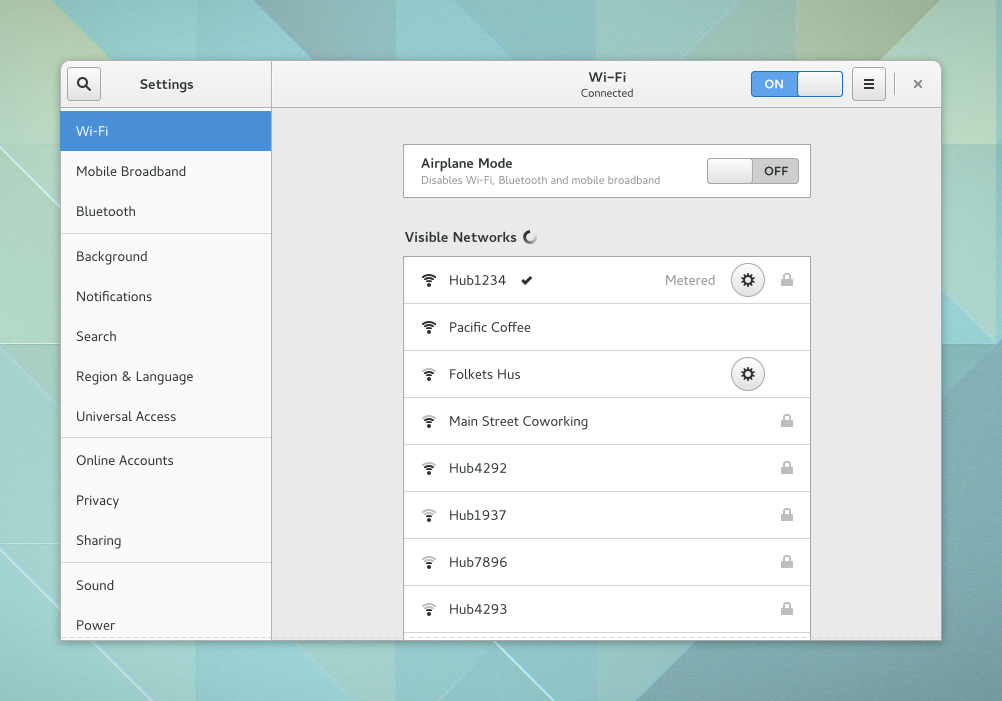
jones_supa writes: Allan Day has written a blog post today about some of the improvements that are being worked on for GNOME's settings area. The new GNOME Settings area is working toward a model that uses a list sidebar for navigation. The window is now resizable, and overall should be a nice upgrade. The new GNOME settings area certainly bears some resemblance to the Windows 10 settings app. Work is also ongoing specifically around improving GNOME's network settings, redesigned sound settings, experiments around improved display support, and various other enhancements to GNOME's settings area. For now, this work is considered experimental and all may not be completed in time for the GNOME 3.20 release in March.
So why masturbate over it?
Try listening to your users instead of implementing whatever eye candy and widgets you dreamt up after the 5th pint and 2 shots the night before. Just a thought.
Do people really care that much about them? There's really not that much of a difference between them all. There's not even that much of a difference between them and Windows in the first place.
Does it remember the new size and position when you close it?
The installation of extentions from a website is really smart... Before it used to be copy this zip, there, do that, and hope for the best.
The time from extension development to deployment of an extension with the end-users is much lower. I think that's generally good.
It's fine to download or perhaps install extensions from a website, though a built-in client would alleviate the need to depend upon Firefox with a specific Firefox extension (and that built-in client could also use a local repository rather than require the Internet be used.)
What's inanely silly is the idea you'd configure your widgets from there. Why not right click and bring up a preferences pane like everyone else? Why do I need to connect to the Internet to modify them in what's essentially a completely different environment with no intuitive connection to the widgets in the first place?
You are not alone. This is not normal. None of this is normal.
A couple of years ago, I thought it was GNOME 3 and Unity that would be most responsible for retarding the adoption of GNU/Linux on the desktop. Both are, in my opinion, fucking awful to use. I find them extraordinarily inefficient to use, I find that they look like shit, and their UIs are completely unintuitive. No normal user would want to use them, and no poweruser would want to use them either.
But then systemd was installed on my Debian GNU/Linux desktop, and GNOME 3 because the least of my problems. All of a sudden the desktop doesn't matter when the computer doesn't boot properly. I quickly became more concerned with getting access to the boot lots, which are now stored in some godawful binary format.
Long story short, I don't use Linux any longer. I now use FreeBSD, which does not come with systemd, and does not come with GNOME 3 by default. I couldn't be happier! My desktop boots properly each and every time, I can still use pretty much all of the good (that is, non-GNOME 3) software that I want to use, and I can use good desktop environments like XFCE and KDE.
Protip: Linux kernel development is highly dependent on corporations.
Yes, but ... no, but ... FLAT!
Confucius say, "Find worm in apple - bad. Find half a worm - worse."
Welcome to the Metro design philosophy:
- Make all containers as big as possible instead of based on the content.
- Assume that everybody runs just one app at a time, full screen, with no Z order support.
- Remove resizing.
- Convert any text you can to upper case. (The two gentlemen named Davis and daVis should obviously both be called DAVIS.)
- Use the same visual presentation for bread text and links.
- Remove borders, especially on clickable elements.
- Remove rollover hints.
- Avoid color shades like the plague.
FTFY.
Confucius say, "Find worm in apple - bad. Find half a worm - worse."
The window is now resizable
When this is listed as a new feature of an application, I think you might be a couple decades behind the state of the art.
Sensitive much? Who did I ridicule and what problems did I deny? Is GNOME dying? How do you know that the overwhelming majority of users hate GNOME3? Do you have any sources to back up those assertions?
I find it annoying that whenever there's a GNOME story that instead of talking about the story (in this case, a new settings dialog), there are many comments from people stating that they dislike GNOME and what they're using instead. It's irrelevant and nothing to do with the story.
To stay on-topic, it seems like a step in the right direction - the tree/selection on the left with a panel on the right is much more intuitive than the OSX-style settings panel GNOME currently has where clicking an icon loads the panel in place over the top of the available options. The existing scheme means you need an extra click to return to the available settings.
They don't use gconf anymore, they switched to dconf a couple of years ago. And a lot of settings that can't be accessed from the settings app can be accessed from the GNOME tweak tool, which is also a GUI.
Yes. This screen just looks like iPad's settings screen made uglier.
GTK isn't GNOME at all. Why is GTK ruined?
A large portion of the submitter's words were stolen verbatim from the second link without any attribution.
R.Mo
I've even tried the latest Cinnamon and I thought there were some paper cuts in there still.
Although maybe a wider monitor (to get more task bar space) and a recent graphics card or GPU would fix some of that.
Mate is predictable regardless of your hardware or whether you use a bleeding edge distro or a stable one.
No hunt for applets : too bad if you wanted an ecosystem of little applet and widget things, but the built-in ones are dependable.
Reminds me of Microsoft TweakUI which I swore by 10/15 years ago. Although it was for little things (Autorun, auto-login, make arrows on shortcuts smaller etc.) not a replacement for control panel and start menu editing and so on.
Use MATE. It's a continuation of the best linux desktop ever produced.
Unless you're a command line user who doesn't speak the lingo and has a hard time remembering all the renames to things like "caja", "engrampa", "pluma", "atril" and so on. In an OS that's based on English commands, it's not very intuitive.
> I'm sure other people like GNOME.
If that was true you would have met one IRL, at least once.
I am among some many users still on Ubuntu 14.04 and waiting for 16.04 or on Mint 17, waiting for Mint 18 so not caring much yet.
In fact, I'm more concerned about whether the driver support will get better and the applications better and less buggy.
Not sure what "evince" or "nautilus" are supposed to mean.
On the command line, try this one : gvfs-open. It's good if you simply want to open a file.
On the command line, try this one : gvfs-open. It's good if you simply want to open a file.
Unless you have a non-heterogenous environment and use X remotely.
~ $ gvfs-open .bashrc /bin/dbus-launch terminated abnormally without any error message)
GConf Error: Failed to contact configuration server; some possible causes are that you need to enable TCP/IP networking for ORBit, or you have stale NFS locks due to a system crash. See http://projects.gnome.org/gcon... for information. (Details - 1: Failed to get connection to session:
~ $ Gtk-Message: Failed to load module "pk-gtk-module"
Don't personally think GTK is ruined, but this is a story about Gnome's UI so it follows that GTK may also follow the widget styles, so GTK does seem relevant in this context.
GTK isn't GNOME at all. Why is GTK ruined?
I'm not saying I agree or disagree, but here's one take on it from a developer using gtk.
I use Gnome, but I think one of the most truly ludicrous, flipping insane ideas is you need a freaking 3rd party app (gnome tweak tool) to change basic things like color or font.
Whats even worse is the 3rd party app is some python scripted crap.
Hello, I mean Windows 3.0 let you change colors and fonts, we're living in 2016 and Gnome still won't let you do what Windows could in 1993?????
Whats so insanely hard about having a built in control panel pane that lets you configure basic things without having to download a 3rd party app.
Ah yes, makes sense.
Like that time I was trying to use xrandr not in the Xorg session context. "Can't open display". Duh.
To script xrandr, I ended up doing a setuid on xrandr and running the script in Mate's "start up programs" for what would have been Modelines in the xorg.conf, if that feature hadn't been removed.
I'm not sure what better way I should use to please the session gods and the display gods.
Why isn't there a normal standard control panel pane to change basic things like color or font, like Windows 3.0 had 20 years ago. Why do I have to find and download a frankly crap application (gnome tweak tool) to change basic settings that every user would want to change.
Windows and OS X have had this ability since the beginning, how hard could it possibly be to have built in control panel page to change color and font like Windows.
I assumed dconf is what the settings tool would replace. dconf seems to be the best or only place to find some of the settings removed from the Gnome apps but it's not installed by default (on Fedora 23). I did like the feature when I clicked dconf and it offered to install it. dconf isn't very user friendly though (org -> gnome -> ).
The trouble with Gnome is that it has left the large desktop behind and is now optimized for small touch screens. The cynic in me has concluded that this is to attract money from smartphone and tablet manufacturers because end users aren't willing to pay for Linux on their desktops.
I mostly use KDE now but prefer Windows 8.1 overall.
GTK widgets don't have any style at all, it's all done via css themes. GTK does ship with the Adwaita theme by default, early versions of gtk3 did not do that and could look very badly if a theme was not installed.
Bugs were introduced (probably not on purpose) into GTK2 after GTK3 was released, and those bugs will never be fixed. For example I periodically get bug reports for one of my applications which I’ve traced down to GtkFileChooserButton and it’s a known issue noone will fix in GTK2.
Gtk2 is still maintained and as far as I know there are no immediate plans to stop that. We had a gtk2 release just last month which fixed eight bugs.
Huge parts of GTK2 have been deprecated, for example:
The horizontal/vertical Box layout scheme, which is how you were supposed to do all layouts in GTK2, and despite the deprecation warnings from the compiler there has been no alternative layout mechanism identified in the documentation.
The entire thread API, which is at the centre of any multi-threaded application. I don’t know if this was replaced with something else or dropped completely.
The GtkVBox/GtkHBox classes are deprecated but the documentation names several alternatives, the primary one being GtkGrid which combines the functionality of both classes.
I don't know what he means by the thread API. The GThread API is not going anywhere if that's what he mean.
The new library is clearly unfinished. For example the GtkAboutDialog is simply broken in the current version of GTK3.
Not sure what he means here. As far as I know it's used by several applications.
Serious bugs in GTK3 are ignored. For example I spent a day researching why they broke the scrollbars in GTK3, found that it was probably done accidentally (the new functionality doesn’t fit even their own designs), filed a bug, and five months later – still not so much as an acknowledgement that this is a problem.
I completely agree that this is a problem. The team developing and maintaining Gtk+ is understaffed and this is an unfortunate side affect.
The article looks about right to me. The many deprecations and resulting breakage was annoying. I was losing interest in most of my projects by then, but GTK 3 and the effort needed to move to it spelled the end for me.
GTK has been ruined, so I doubt usability would ever get close
Is it GTK, or is it the built in dependence on systemd? Like I gave GNOME 3.x a try on this PC-BSD laptop, and it took ages to load, and was REALLLY slow. Ultimately, I got rid of it.
Thanks for that link - very interesting. I'm curious if the author of that blog has found a suitable replacement. He didn't seem to like any of the alternatives.
What makes you think that every user wants to change things like color or font? I don't think most users want has any need to do that. There is a universal access pane in the settings app where users can enable larger fonts and higher contrast for accessibility reasons.
Gnome Tweak Tool is not third party. It's an official GNOME app developed as part of GNOME and hosted on the GNOME git service.
Yes, but that just brings a truck load of other problems that we use Linux to avoid in the first place.
I don't want my computing infrastructure to be dependent on some corporation in a foreign country that I have no control over and only have their own self-interest in mind.
On the other hand, Gnome has no reason to exist. KDE was there before Gnome and has been working just fine since last century.
Yeah, I switched to PC-BSD after my introduction to Windows 8. I do have a different work laptop that had Windows 8 and which I've upgraded to Windows 10, but I do love the PC-BSD one and use it for most of my personal work.
I agree on GNOME. It was initially an interesting concept and project, and had they embraced a few GNUSTEP concepts to incorporate some Object oriented aspects that were so good in NEXTSTEP, it would have had something really great going for it. It could have combined those aspects of GNUSTEP w/ making a DE for the GNU project - not just Linux. Instead of some stupid things like 'Bonobo'. But they failed, while KDE did more or less a good job. In its current form, GNOME has no reason to exist.
Holy fuck! When I look at the screenshots I see huge areas of empty grey and white space. Yeah, I know some spacing is visually helpful, but in those screenshots HALF OR MORE of the goddamn window's area is this useless empty space! What the fuck! When I paid damn good money for a 28" monitor it was because I wanted the fucking screen space to be filled with useful information, not wasted with fucking idiotic amounts of totally useless empty space!
I have an 8" Winbook tablet, and it just won't take the version of Windows 10 that allows you to have 4 columns of tiles instead of 3. So I have 1" borders on either side in tablet mode. Ridiculous!!!
It'd be more useful to use that 28" w/ a Mac. If you have the budget for a 28", you'd probably do best w/ a Mac Pro.
Then why is there ZERO integration with it? Why is it some python scripted separate app instead of being a normal control panel pane, like changing color is in every other operating system on the planet. Why do you have do a separate download. Thats it just utterly crazy that it does not have the ability built in to change color.
Steam? Doesn't Slackware have any VMs or jails that could run SteamOS?
What makes you think that every user wants to change things like color or font? I don't think most users want has any need to do that. There is a universal access pane in the settings app where users can enable larger fonts and higher contrast for accessibility reasons.
This thinking is gnome in a nutshell. It's why I stopped using it, and it's why I stopped bothering to develop anything with GTK.
Its a normal standard thing to change the color, why should we thing everybody like the same color, especially with such a horrid default theme.
Windows let you change color and font since I think Windows 1.0, which was what 1990? How come Microsoft could figure out how to let users change color 25 years ago, but Gnome still can't figure it out.
What is so insanely hard about making a standard control panel pane to do this. Why does it have to be a separate download. What kind of impression do you think this gives users? Think about it, somebody's been using Windows for a while, and they try Linux/Gnome, and they want to do something insanely trivial like change a wallpaper or font, and they then need to try to figure out how to use a package manager for that???
No wonder nobody uses desktop Linux.
I'm sorry if this sounds like a rant, I'm a Gnome user, have been for a long time, I just want them to provide some basic features that users expect without having to download 3rd party add ons.
Here it is kids - the obligatory, passive aggressive, bullshit, answer a question with a question, non-answer used everywhere by apologists for bad design.
Q. - How do I change colors and fonts?
A. - Why would you want to do that?
None of them can see the clouds; The polished wings don't care.
Please link me to some solid takedowns of GNOME. GNOME 3 drove me away from Linux for quite awhile, and I'm only back on my main box now because I switched to XFCE. It may not do every single thing, but I know that I won't update one day and lose just like, every single fucking button.
Because it was produced by a bunch of deranged Gnomes Or is there some other explanation?
Sent from my ASR33 using ASCII
I spent several years looking for an alternative to GTK for C programming (not C++) and eventually found the xforms toolkit:
http://xforms-toolkit.org/
I do most all of my programming in C and mostly use ncurses but now for the occasions that I really want a gui I use the xforms toolkit.
It's similar to ncurses in that it hasn't changed significantly in many years, isn't likely to, and isn't going anywhere. It has an old-school X11/CDE look, but that suits me fine since I'm an old-school programmer.
I can recompile something that I wrote five or ten or twenty years ago with ncurses and it still works fine. Can't say the same for gtk, but now I can do that with xforms. So I'm very happy with xforms.
If you want long term stability in a gui widget toolkit, there's your answer.
If you're a zombie and you know it, bite your friend!
They actually had a settings window you *coudln't* resize??? WTF? ... This is really unbelievable.
I didn't understand all the hype & rage in the last 15 years but not having your settings window (or *any* window for that matter) resizable is abysmally retarded. I've been making fun of Windows for this shit for the last 20 years. What harebrain had the briliiant idea to make a window in Gnome non-resizable?
I'd be ashamed to brag about a window now being resizable again.
We suffer more in our imagination than in reality. - Seneca
Cathegorically, *no*. X11 forbids the application from having any say over where its windows appear. At best it can give a hint. The Window manager is totally free to ignore this hint.
I know this, because I was tasked with implementing an application on Linux once that had a user requirement that the windows should come up where the user last left them. I couldn't figure out which arcane combination of window hints and X11 calls made a window appear at those coordinates, so I asked on the internet - and had a ton of drek deposited on me for not respecting the One Unix Way, the True Unix Philosophy, and My Users' Right To Choice. Of course they had made their choice, and they wanted the windows to appear where they last left them, which the window manager did not do, but that was hardly important.
So there's your answer, as provided by the veritable gods of UNIX. It is not the application's responsibility, it is entirely up to the window manager.
Quality argument, guess you have no rebuttal over the usual "I don't use GNOME yet it makes me mad enough to spout irrational bilge". I don't need to take a UI design class as I've designed UIs professionally for 20 years. Design is subjective. Also lookup syncopates, cretin.
... and for this reason, while some users left Ubuntu due Unity, I started to use default Ubuntu exactly because they've replaced with Unity (previously, used Kubuntu).
ARG! slashdot users criticize specific aspects of yet another change that $VENDOR insists is an improvement.
Slashdot $USER has triggered me by not taking the feelings of mouthbreathing idiots into account, despite the fact there are plenty of simpleton alternatives for them.
If only more useful features were stripped out for lots of wizards that force workflow unnecessarily, and sensible layouts replaced with oversized widgets that waste screen real estate, then the bottom denominator would be happy. They're all that matters, after all. Professionals and enthusiasts are just whiny spectrum disorders who should be shunned from society anyway. I will always submit to whatever $VENDOR throws in my face as an improvement because newer is always better.
"GNOME Settings Area Getting a Refurbishment", also known as, "What Can We Fuck Up Today?"
They'll 'improve' it until it's so ruined that totally unusable, and then they'll slap a "Done" sticker on it.
Just cruising through this digital world at 33 1/3 rpm...
MATE is more customizable, and has way less useless crap.
Funny thing is that Gnome 2 was pretty good, and ever since it has gotten worse and worse.