 Slashdot Mirror
Raspberry Pi Gets Competitors (hackaday.com)
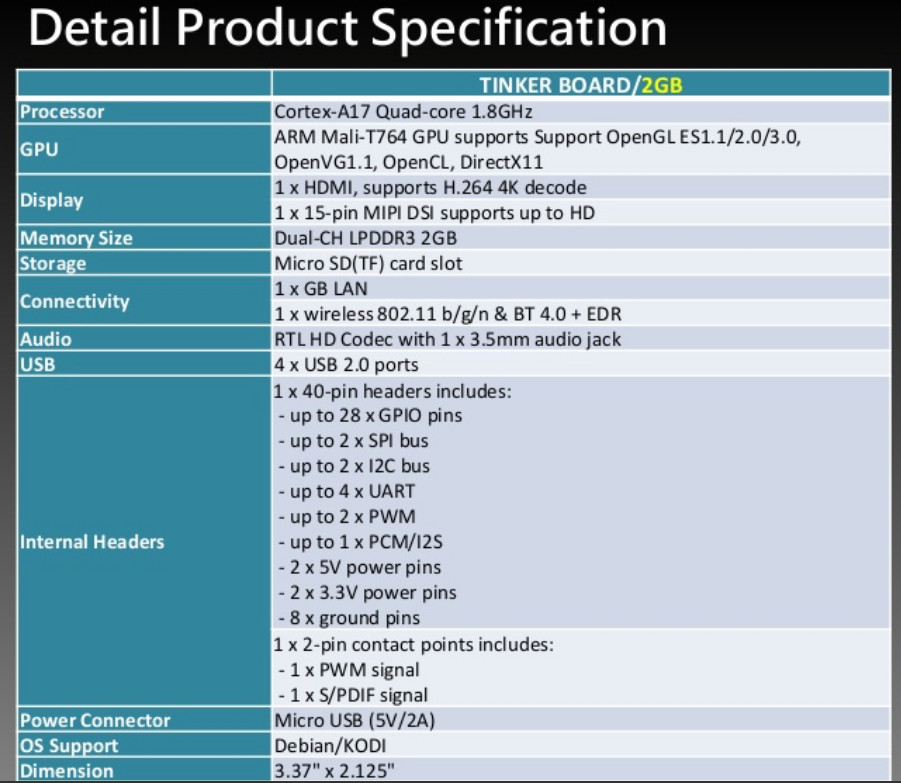
Hackaday reports that Asus has "quietly released their Tinker board that follows the Pi form factor very closely, and packs a 1.8 GHz quad-core ARM Cortes A17 alongside an impressive spec At £55 (about $68) where this is being written it's more expensive than the Pi, but Asus go to great lengths to demonstrate that it is significantly faster."
And though the Raspberry Pi foundation upgraded their Compute Module, Pine64 has just unveiled their new SOPINE A64 64-bit computing module, a smaller version of the $15 Pine64 computer. An anonymous reader quotes ComputerWorld: At $29, the SOPINE A64 roughly matches the price of the Raspberry Pi Compute Module 3, which ranges from $25 to $30. The new SOPINE will ship in February, according to the website. The SOPINE A64 can't operate as a standalone computer like the Pine64. It needs to be plugged in as a memory slot inside a computer. But if you want a full-blown computer, Pine64 also sells the $15 SOPINE Baseboard Model-A, which "complements the SOPINE A64 Compute Module and turns it into a full single board computer," according to the company...
The original Pine64 was crowdsourced and also became popular for its high-end components like a 64-bit chip and DDR3 memory... It has 2GB RAM, which is twice that of Raspberry Pi's compute module. SOPINE also has faster DDR3 memory, superior to DDR2 memory in Raspberry Pi Compute Module 3 board.
And though the Raspberry Pi foundation upgraded their Compute Module, Pine64 has just unveiled their new SOPINE A64 64-bit computing module, a smaller version of the $15 Pine64 computer. An anonymous reader quotes ComputerWorld: At $29, the SOPINE A64 roughly matches the price of the Raspberry Pi Compute Module 3, which ranges from $25 to $30. The new SOPINE will ship in February, according to the website. The SOPINE A64 can't operate as a standalone computer like the Pine64. It needs to be plugged in as a memory slot inside a computer. But if you want a full-blown computer, Pine64 also sells the $15 SOPINE Baseboard Model-A, which "complements the SOPINE A64 Compute Module and turns it into a full single board computer," according to the company...
The original Pine64 was crowdsourced and also became popular for its high-end components like a 64-bit chip and DDR3 memory... It has 2GB RAM, which is twice that of Raspberry Pi's compute module. SOPINE also has faster DDR3 memory, superior to DDR2 memory in Raspberry Pi Compute Module 3 board.
Raspberry Pi had competitors before it ever existed. Are people really this fucking dense around here?
No: there have always been other computers at different prices and different specs, but these don't compete with the RaspberryPi.
I don't understand why people don't get this. It's not about price (RPi is cheap), it's not about performance (we have desktops that are fast), it's about everything you get after you have bought the device. Which in the case of RPi is amazing, and everything else has an ancient Linux kernel, and maybe a blob of code to drive the GPU...
The Pie has FreeBSD and other Linux distro support and lots of i/O to hook up other peripherals.
http://saveie6.com/
Oh so I can pay 2x and get something 2x faster. Wow. And I could pay 2x of $60 and get a whole chromebook or used laptop that was 8x faster. Or a I could buy a cheap android phone and have my rockchip with a touch screen and battery for that $60.
they just don't understand the price point logic of $35.
Likewise going the other way you can buy a cheaper and more powerful board like a Pine or an Orange PI, save yourself $10 in parts and then pay about $300 in time and effort (assuming your time is worth $50/hour) to get a linux distro and and all the needed packages that actually works on it. the orange PI's are junk because a usabale software set only gets ported a year or more after the board has been on the market. I bought one once, and had to download several different distro's for it till I got one with drivers that would support the Key board, Blue tooth, and screen I was using. And even then it was only using just 1 of it's 4 processors and no graphics acceleration from the Mali chip. that took hours to wade through. then when I tried to install other code the libraries didn't compile. Fast forward 3 years, and it works fine now but the rasperry PI 3 eclipsed it.
The whole point of the RPI is a bomb proof little circuit that has loads of well testd software so it's not the project, it's the thing you put into the project.
Some drink at the fountain of knowledge. Others just gargle.
Geekbox w/ Landingship
Someone has already mentioned the Pine64
EXPRESSObin on kickstarter
I'm waiting for my EXPRESSObin boards. They're supposed to be fully compliant to all the uBoot and device tree standards and will run Fedora out of the box. I have a Pine64 and Geekbox, and both will only run custom Ubuntu because they don't have devicetree.
It'd be something different than all these ARM boards. An Intel Atom chip could work, but I don't know if AMD has anything of the equivalent.
I agree 100% with the parent that RasperberrryPi has no competitors. The pie is for the I/O ports for IOT devices and tinkering with something that well documented and supported with up to date and working kernel and opensource components and working hardware (not buggy).
The Raspergy Orange/zero and the more expensive Beagle miss the point. A faster chip with no or I/.O or proprietary buggy i/O incompatible with the Pie defeats the purpose. The cheaper units lack these and the more expensive units are faster but miss these or run outdated stuff that no one uses when you try to get a IOT camera hooked up.
http://saveie6.com/
then Pi should get its OpenGL display driver fixed aSAP. It's giving slow Rage 128-like results, rather relatively anachronistic to its powerful ARM.
The hardware is vastly different between the Arduino and the Pi, but in neither instance is the hardware the point. The point is all the community and everything which makes them easy to use, even for hobbyists.
At work we had a "show and tell" type event for a while. One guy brought his RPi, which he had hooked up to some triacs (think relays) to allow it to turn 120V devices on and off. I shared that I had built almost exactly the same thing with an Arduino. (I had also done the same with an old Pentium I got from the scrap pile). So same project, he used an RPi, I used an Arduino.
I'm not the only person who owns both RPi and Arduino - they attract some of the same buyers and community members. Sometimes when thinking about a project, I'm not sure at first if I want to do it with the Arduino or with the Pi. The Arduino probably *could* handle it, but there wouldn't be room left to add features later. So this Arduino I have right here and this Pi I have in this red case directly compete for my projects, even though the hardware is vastly different.
The extra processor horsepower and RAM is nice but it seems like it is not matched by I/O. is the gigabit Ethernet tied to the processor? One of the drawbacks of the Pi (not Pie, BTW) is that Ethernet is off the internal USB2 hub.You could put gigabit Ethernet on a USB2 hub and get no increase in bandwidth. The Tinker has one micro-USB connector for power. Does it support OTG? (According to the Hackaday article it does have multiple USB 2.0 ports.) Sata would be nice too.
The biggest advantage of the Raspberry Pi is the community. It's going to be hard to match that. The RPi has hit critical mass when I can go to my local Microcenter and get a Pi 3 Model B for $30 US or a Pi zero for $5.
A big draw of the Pi is its price point. More expensive devices aren't necessarily competition. Less expensive devices like the C.H.I.P. are the ones I'd expect to take a bite out of Pi.
Can take an SD card from a Raspberry Pi and plug it into this new board and have everything work, including IO pins? If so, then then this is really great news and I'll probably get one.
Who the fuck cares about the difference between DDR2 and DDR3 on an ARM thing that doesn't even have proper SATA.
I'll stick with 8bit microcontrollers for electronic projects and a common PC for my NAS
I've been using a Raspberry Pi for 3 years now and my biggest complaint is that the SD card I have gets corrupted every so often. It's a Sandisk...but I don't think that matters one way or another. When I replace it in the near future, I'll go with the ODROID C2 or whatever follow-on board they release mostly because I can use eMMC instead of SD. I know the hardware is a tad more more expensive but my time is worth something and I've spent too much of it recovering corrupted SD cards.
Complaint #2 is the slow network interface on the Raspberry Pi. That's been complained about enough by everyone else though. The ODROID C2 solves that.
Right now, I think the biggest limitation of the Raspberry Pi is probably its lack of USB 3 support; without that, it can't be used as a file server. Lack of OTG support also makes it harder to boot/configure the device.
For the next version of the Raspberry Pi, I'm hoping for USB C support, with high power mode, host mode, and device mode, as well as support for serial consoles and networking over USB.
Jesus H Fucking Christ, is it too much to ask for a goddamn microphone/line input jack?
Does this new board run a stock, off-the-shelf Linux distribution with a stock distro kernel? Is the bootloader open source and easy to use to boot any kernel and OS? If not, then it's really of little consequence.
I think these devices are neat and have a lot of potential, but sadly until we see the kind of standardization in terms of booting and hardware interfacing, these devices are way beneath their potential. Even the Pi, as popular and useful as it is, is hobbled to a degree without this standardization. I'd like to run the same distribution (whatever that is) on my Pi3 as on my Pine64. Or this board. Or some generic chinese SoC board.
Yeah, I got a Raspberry Pi because I thought I could turn it into a cheap TV recorder with my USB TV stick. Something low power that I could easily leave on all the time so I wouldn't have to remember to leave my regular computer on just to record some program while I was out of the house or asleep.
Didn't work out. Everything had to breath through that slow USB interface so, while I got recordings, they were all chopped up.
In theory, theory and practice are the same; in practice they're different. (Yogi Berra & A. Einstein)
The thing I see missing in most of the Raspberry Pi competitors is curriculum. It's all fine and well to pop out a cheap single board computer and then port an operating system or two that runs on it. The part of Raspberry Pi that is missing is the curriculum and the value for education, which is what the RPi is all about.
The Raspberry Pi was developed to be a pedagogical tool for education. The Raspberry Pi Foundation works to get acceptance of the RPi devices into schools, and they help educators come up with curriculum to take advantage of the hardware. To get the hardware into the hands of kids who can then hack on it and learn. The Pi wasn't invented so that neckbeards could use it for their Media Center.
The choice of memory slot interface is odd. Today's form factor will be deprecated within 2 years, making it a headache to use the thing on next new hardware
But I am also curious to learn how host software interfaces with such a helper computer hooked to a memory slot.
Chinese allwinners and rockchip boards always have been cheaper and faster than Pi. Odroid, beaglebkard, all these tv sticks. Like last five years Pi lagged behind these competitors in term so of performance. The only special thing about Pi is advertisement strategy.
Personal note: I have and use Odroid -U2, -U3, -C, -C1, -C2, RPI2, RPI3, and a UDOO (original backer), mostly as micro-servers. I don't require much customization and as long as that remains true, I find them to be great machines.
The Odroids are definitely better hardware, but the story gets more complicated when the question of kernels (and the binary blobs needed for media) are updated to mainline. I've heard but not verified that the original Exynos CPUs in the Odroid-Ux are supported by mainline kernels.
The Allwinner chips in the Pines, Banana Pis, Orange Pis, etc. lack complete HW docs and need critical binary blobs (At least the Allwinner H8 has long needed a DRAM controller library blob, for example). If Allwinner were to clean up their documentation and make truly complete hardware docs available, then the overall product would be better than RPi. Until then, RPi support is so much better than their competitors that it overwhelms the otherwise obvious performance advantages.
Quoting from https://www.phoronix.com/scan....
However, the support isn't complete for the Allwinner A64 and is blocked in part by lack of proper documentation. Andre commented, "Due to a lack of official documentation and hardware availability this doesn't go any further at this moment."
The Allwinner A64 is comprised of the less-powerful Cortex-A53 cores, supports H.264/H.265 video decoding, and is widely talked about as being the "$5 ARM SoC." Hopefully this mainline kernel support will get figured out in time for the Pine A64 shipping.
Isn't that some kind of Japanese fetish toy?ï
It isn't open source friendly, because it is a rockchip rk3288! If I wanted a 3288 there are dozens of other devices with it already included. All with the same shortcoming! Thanks to ARM being a dickhole about Mali (like Imagination Technologies/PowerVR) there are no actual open source drivers available for ANY Mali GPU newer than the 400 series. Meaning the Pi3 with its mostly open source driverbase is FAR further along towards providing a top to bottom open source codebase than its competitors.
I bashed on the Pi for this shortcoming when it first came out, but all the me-too developers have fallen into the same hole, despite there being three perfectly valid ARM chips available with top to bottom open source stacks (QC Snapdragon/Adreno, Tegra (K1 if not X1) and the Broadcom stuff with the VC4) The latter isn't complete, Tegra and Adreno may have other closed source shortcomings (although nothing major of which I am aware when using a chip with a kernel release for it.) and both have complete top to bottom cpu/gpu/bootloader support available. That is also excluding devices based on the Vivante GC series cores, although I am less sure of which chips are available with it since they are not a single source GPU vendor (and most of the mainstream models seem to be using PowerVR or Mali cores.)
Salamu alaikum, Thanks all for the FLOSS and Open Hardware movements. I'm a normal user of Debian GNU/Linux and GNU/Linux Mint as my main Desktop computer and Laptop, and I own a RaspberryPI3 and BeagleBoneBlack (Raspbian and Debian). Since, i'm creating CC0 educational 2d animation videos like those : https://youtu.be/4MB47oPBp9U (Created with Synfig Studio, Tupe, Libreoffice Impress, OpenShot, Audacity, LibAV, Inkscape and GIMP), And because of the world of on-line content are increasingly created by users, I was wondering if one can use them to create (especially rendering) educational 2d animation videos, and teach people (like Syrian refugees, or african people in rural areas and poor vilages) how to create educational content with FLOSS and those low cost computers ?
How about getting the price of a 7 inch display down to under $10 .. then I would be impressed. There is the raspberry pi Zero for $5 .. yay impressed. But how can it be used without a display? Even for many IoT type stuff, displays need to be cheap.
Except that you can never get the device at the prices promoted in pieces like this. Mandatory postage and handling makes the claimed prices (and wow factor) of these devices a joke. The Pi Zero at $5 comes to mind. In this case a $15 device costs an additional $11 to ship.
I get SOOOOO annoyed at these hardware announcements from micro to super computer that make no mention of the OS to be used.
If ASUS will only support Windows on this board, then what is the price point? Is Windows included?
If ASUS will be supporting Linux on this board, then why cant they support Linux on their OTHER Mobos, the desktop ones that are used for gaming, etc.
If they are not supporting ANY software then what community do they expect to step up? Martians?
softcoder
I read that the Pine64 is garbage
Is there a single (not pun intended) single-board computer with open-source hardware? The GPUs are what I'm most interested in, and 99% have blobs for the media decoders (for licensing reasons unfortunately). If there was one with an overpowered (and literally overpowered) GPGPU set-up, I'm sure a number of codecs could be programmed that way, but until we get a board where a) the kernel/bootloader is unlocked 2) the GPU is unlocked and 3) we get analog in/out at least as capable as stereo audio, I have a grim outlook on the future for hobbyist tinkering.
Then the act of recording from a tuner becomes a wget with a timeout.
The only issue becomes network and USB performance to write the data, not CPU. If you get a $20 powered USB hub and connect up normal storage with that (and power the Pi too), then it can work.
It really is that simple.
The power needed by the USB-tv tuner was probably higher than the pi would handle too.
To bad that the Allwinner SoC has so bad support for it's own hardware.
the faster it gets the less battery life availlable , yes i overclock my PI's for dev , but the goal is to eventually have everything running on a 0 , granted the PI3 compute module is out with pretty much the same dimm form factor and a much better processor then 0