 Slashdot Mirror
New MH370 Analysis Again Suggests Plane Came Down Outside Search Area (theregister.co.uk)
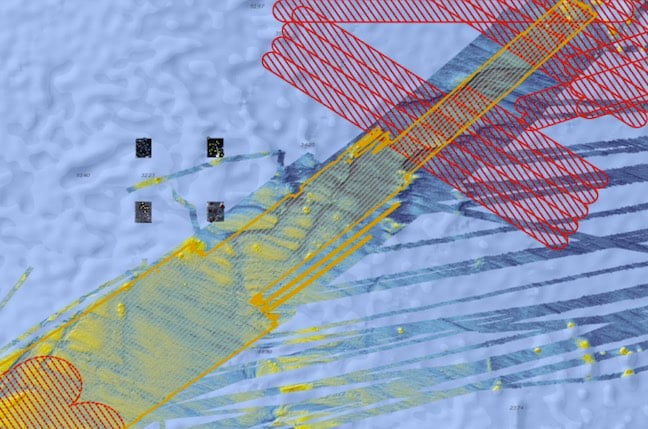
An anonymous reader shares a report: New analysis of images thought to depict wreckage from missing Malaysian Airlines flight MH 370 suggest the Boeing 777 came down to the north of the area searched during efforts to find the plane. A new document [PDF] released yesterday by Geoscience Australia (GA) detailed analysis of four images captured by the PLEIADES 1A Earth-imaging satellite on March 23rd, 2014, not long after the March 8th disappearance of the plane. The images were provided to GA by the French Ministry of Defence. The images depict an area to the north and east of the area searched by underwater survey, and in-between areas where search and rescue operations were conducted in the wake of the plane's disappearance. The image displays the areas covered by underwater survey in yellow and the search and rescue zones in red. Extensive manual analysis of the images -- there was not enough data to use machine learning -- yielded a dozen objects that researchers were happy to classify as "probably not natural." Several of those objects were clustered in the northern parts of the areas depicted in the photos. The document is at pains to point out that it is not possible to identify the objects as airplane debris. The new analysis referred back to drift pattern analysis made on debris known to have come from MH370 and released in December 2016. That analysis suggested the search area be extended by 25,000km2. More detailed drift analysis released in April 2017 also called for a new search to the north, as did a July talk by scientists from Australia's Commonwealth Scientific and Industrial Research Organisation.
It wasn't found in the search area so your conclusion is it isn't there?
Granted ocean searches are hard so it could still be there and this is more a gripe against the title, rather than the article is about images of possible airplane debris in a new location.
I find it very surprising that the black boxes in airplanes don't communicate with a satellite in this day and age. The technology has been around for 30 years at this point.
Mike @ The Geek Pub. Let's Make Stuff!
The problem isn't that they searched in the wrong place. (They searched in the areas that were most likely where the plane came down with the info they had at the time.)
The article is about how computer analysis shows the wreckage to be potentially elsewhere but the government won't fund another search
Aside from the cost it will still be difficult to find the wreckage as the black box beacons are long dead and even if they do find the wreckage after all this time there won't be much to salvage or to reconstruct what possibly happened aside from the data recorders.
It's up to private salvage teams at this point.
What has always been missing in the search for MH370 is enough specific data to feed the simulations. Human factors or mechanical failure aren't ideal inputs. It's really a number of "best guesses".
Given how long we've been sailing the seven seas, and given it hasn't exactly been historically uncommon for ships to sink - or, nowadays, for containers to fall off ships - identifying objects as "probably not natural" may very well not be the big red flag the authors try to imply it is.
#DeleteChrome
HAHAHA. You so funny msmash. Bottom of Things... HA. Like the airplane would have rushed into the sky instead of plummeting into the ocean. Bottom... HAH.
A search area was established and the plane was not found in that search area.
I don't know if I need an analysis to tell me that the plane potentially went down outside the search area.
The cruiser HMS Sydney was sunk in that same area during WWII with the loss of all hands. They didn't find it until 2008. If it took them that long to find a massive warship, it's going to take a while to find bits of a crashed plane.
They've searched the current search area and found nothing. The next step is to start looking in a different search area.
First off, nobody has really looked at the evidence. A plane goes one direction then does a 180 and goes precisely the opposite and because the transponder was switched off nobody really knows why it does this. Then you have dead zones basically where even today a plane cannot be accurately tracked? Really? who believes this? Personally I believe in two events that might have occurred. One is terrorists took over plane and someone shot it down and a cover up ensued. Two the plane was taken over by terrorists and eventually dove it nose first into the water. Most likely preventing a breech of main body and preventing a lot of debris from rising to surface. Of course you could also believe the plane entered some sort of dimensional tear in space and is somewhere other then Earth, although that does not explain the bizarre behavior of the plane shortly after take off. I doubt aliens or some portal in the atmosphere is to blame. In any case nobody is any closer to finding the plane then the day it crashed.
"Extensive manual analysis of the images -- there was not enough data to use machine learning"
This seems like the most relevant part for Slashdot.
I can't help but notice that the blackbox seams to not have evolved since the 70's. With more modern tech it can be cheaper, have better batteries, use less power, and more capabilities.
Imagine if the black box transmitted for months and the the ping consisted of not just a PING but cordinates of last known GPS.
They cost over $1000 each, whcih seams steap for whats actually in it.
The spirit of resistance to government is so valuable on certain occasions that I wish it to be always kept alive
Not finding it might be a indicator that you looked in the wrong place Sherlock.
Batteries haven't improved that much, and the efficiency gains I. Electronics have only been on the margins. Oh, and they cost a shit ton more than a outs and dollars. It's an airplane part, and it's regulated,by three agencies, so the design artifacts for the device, without integration, are on the order of ten million dollars once certified. Of course, given that the thing is tied to flight control busses, you really need to get it right.
Yeah, no new release since 0.70.1, almost 12 years ago. Abandoned before 1.0, not very good. A couple of forks made it past that milestone, though, at least that's something...
Why are aircraft not fitted with multiple impact-resistant EPIRB-like devices designed to separate from the aircraft and float to the surface? That and/or some sort of massive dye pack. Of course, a high speed impact with the water might destroy them (blackboxes can and have been destroyed by impact too), but having multiple locators on board seems like a reasonable idea. These things obviously do nothing for those who perish in an incident, but doing everything we can to obtain data on failures allows us to be better prepared in the future.
There is no XUL, only WebExtensions...
The really story here is the search pattern. If the plane turns out to be on the area shown it shows we haven't really learnt enough about how to look for things. There is no randomness what so ever, come on, every child learns from Battleship to searching for a Lost Lego piece in the grass randomness helps expand the search area and find things much quicker. Can someone please explain that science.
Looks like they expand the search area based on gliding but not some other random factor we can't necessarily predict.
that maybe, just possibly maybe, there might be one or two smart people whose sole job is to think about this stuff ? /. has already been gone thru, quantitatively ?
and that maybe everything said on
nah, I'm sure the aerospace industry is amazed at all the new, smart ideas here...
Reply to This
Maybe take your whiny religious rants to some other site.
I don't get it!
Ain't that for true?
Today's black boxes are far more advanced than the ones in the 70s. They are digital, they store far more data channels, they're solid state and can take much more abuse without compromising data. After Air France 447 was lost for so long, they changed the battery requirement to double the time the ultrasonic pinger would function, but MH370 hadn't been upgraded with the new boxes yet. And I can guarantee you, there isn't a single piece of avionics on a modern commercial aircraft that only costs $1000.
What's all the fuss about? There will be no problem finding the wreckage once global warming evaporates all the oceans.