 Slashdot Mirror
Researchers Want To Turn Your Entire House Into a Co-Processor Using the Local Wi-Fi Signal (arstechnica.com)
An anonymous reader shares an excerpt from a report via Ars Technica: Researchers are proposing an idea to make your computer bigger. They are suggesting an extreme and awesome form of co-processing. They want to turn your entire house into a co-processor using the local Wi-Fi signal. Why, you may be asking, do we even want to do this in the first place? The real answer is to see if we can. But the answer given to funding agencies is thermal management. In a modern processor, if all the transistors were working all the time, it would be impossible to keep the chip cool. Instead, portions of the chip are put to sleep, even if that might mean slowing up a computation. But if, like we do with video cards, we farm out a large portion of certain calculations to a separate device, we might be able to make better use of the available silicon.
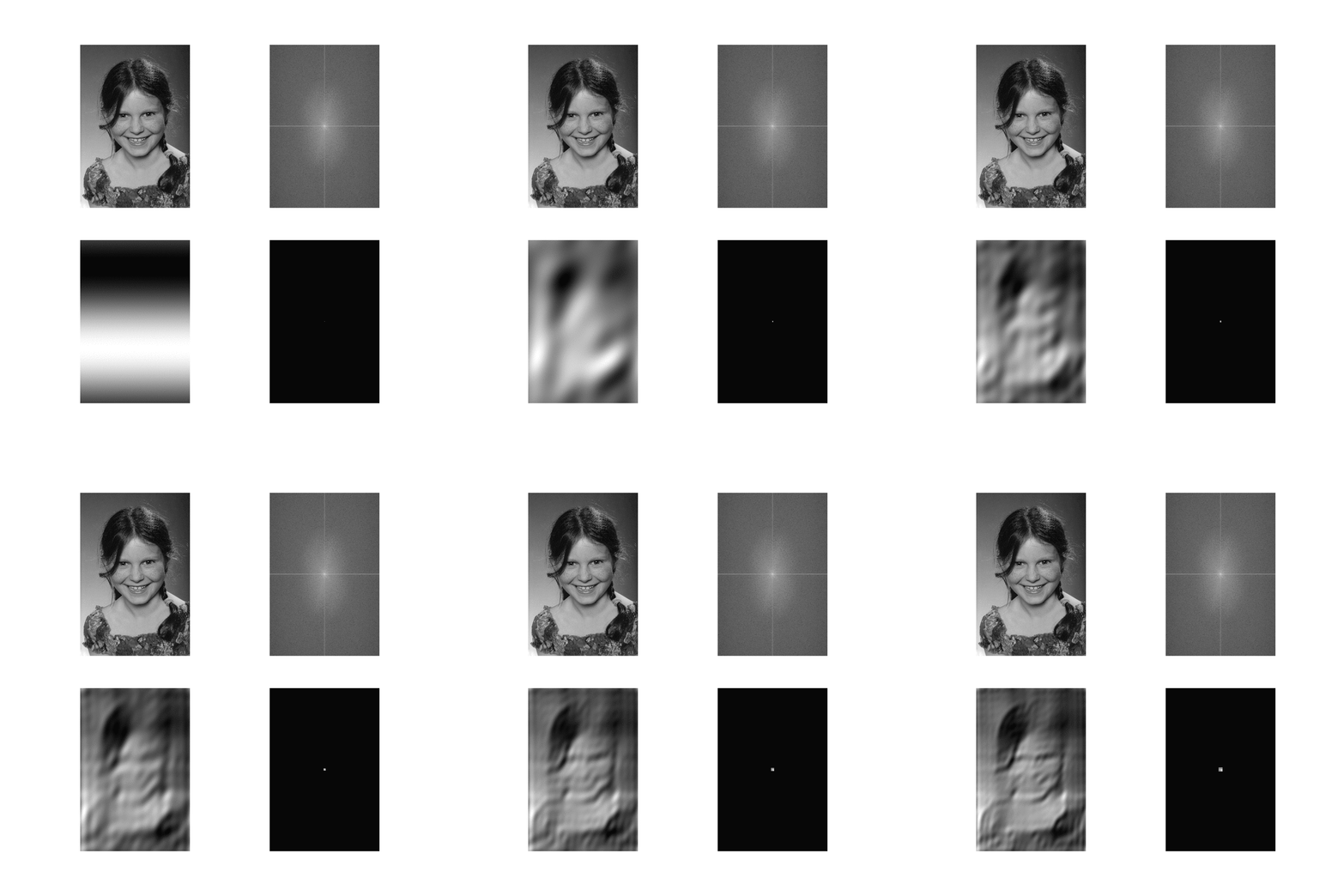
So, how do you compute with Wi-Fi in your bedroom? The basic premise is that waves already perform computations as they mix with each other, it's just that those computations are random unless we make some effort to control them. When two waves overlap, we measure the combination of the two: the amplitude of one wave is added to the amplitude of the other. Depending on the history of the two waves, one may have a negative amplitude, while the other may have a positive amplitude, allowing for simple computation. The idea here is to control the path that each wave takes so that, when they're added together, they perform the exact computation that we want them to. The classic example is the Fourier transform. A Fourier transform takes an object and breaks it down into a set of waves. If these waves are added together, the object is rebuilt. You can see an example of this in the animation here.
So, how do you compute with Wi-Fi in your bedroom? The basic premise is that waves already perform computations as they mix with each other, it's just that those computations are random unless we make some effort to control them. When two waves overlap, we measure the combination of the two: the amplitude of one wave is added to the amplitude of the other. Depending on the history of the two waves, one may have a negative amplitude, while the other may have a positive amplitude, allowing for simple computation. The idea here is to control the path that each wave takes so that, when they're added together, they perform the exact computation that we want them to. The classic example is the Fourier transform. A Fourier transform takes an object and breaks it down into a set of waves. If these waves are added together, the object is rebuilt. You can see an example of this in the animation here.
Whoever wrote this proposal is dumb as fuck
It's supposed to be April 1st. That's why they call it "April Fools". You can't run this stuff the first of every month. Only April.
So I can eat it when people are debating about the microwave screwing up their coprocessor - or not...
Browsing at +1 - no ACs, I ignore their posts. So refreshing!
The end of the first paragraph in the post states "But if, like we do with video cards, we farm out a large portion of certain calculations to a separate device, we might be able to make better use of the available silicon." What I was expecting at that point was an idea in distributed computing. Your processor idles down or else is overwhelmed by a high bandwidth task, so it offloads portions of the job to your refrigerator, cell phone, tablet, washing machine, other desktops. you car, etc. - anything that can be accessed by IoT or peer-to-peer networking or whatever. That makes sense, kind of, if you are doing supercomputing tasks or cryptocurrency mining at home.
However, this turns out to be an idea about using multiple wifi antennas to create interference patterns from which FFT's can decode the dataset - kind of a wifi holography. The problem is that anyone who moves the desk or couch, leaves their bicycle in the room, puts a metal kitchen bowl on a table, turns on a laptop, has their Aunt Tillie sitting in the wrong place, or even just wears a tinfoil hat to tune in or tune out other strange ideas will trash the computation.
It used to be that with relatively few TV channels and finite numbers of radio stations and newspapers, that news could be filtered or curated to things of genuine significance. Now, with seemingly unlimited media outlets, any idea or premature utterance can become "news". A century ago, we fantasized about going to the moon, and then it happened. Just half a century ago, we fantasized about handheld computers and wrist watch televisions, and then it happened. So, ideas can come to fruition, so we cannot be too dismissive. This one however seems to be a big "so what", and "what the hell would one use it for?"
beowulf cluster. Seriously Slashdot, you're slipping.
So basically distcc, icecc, ore any of a number of other tools?
The people who wrote this proposal got tax payers to pay their next two years expenses while they fart around with a wifi router.
The bureaucrat who approved it and the tax payers who are funding it might be dumb as fuck, however.
Magical thinking. Perhaps they could sell a skull cap for my cat? Wouldn't want any processing power going to waste.
Paul Beardsell
People want 4K. But don't have the skills to review and then buy a new GPU and CPU to support that.
So the small trendy low power computer can pass the complex math to other devices and they can push the results back.
A huge increase in real time CPU and GPU power with no lag is the result.
Modern computer math magically no longer needs the CPU and GPU to be in the same part of the house.
The networked refrigerator, toaster and air conditioner CPU will all get the complex GPU math done with no lag.
Dropping frames again with that more advanced computer game? Turn on the networked washing machine and do some laundry to add more CPU power.
don't be stupid. read this proposal again. this is way more sillier than that.
this is basically turning your house, with use of wifi signals, into a fft analysis machine or something similar, like a huge mechanical computing device except with wifi instead of levers.
100 bucks they got the idea from engineering guy demonstrating the fourier calculation mechanical machine lately on youtube.
the idea is dumb as fuck. turning your sink into a computer makes WAY MORE FUCKING SENSE than this.
world was created 5 seconds before this post as it is.
Let me know if you find such a site.
I COULD extend my old Tampermonkey script to hide all of thr annoying people, or only show comments from people in my whitelist.
I made it years ago to make that ADP or whatever guy disappear from my browser. That guy who could never understand why in 1982 the world switched from hosts files to DNS. Seen that dude lately? I vanished him with Tampermonkey about three or four years ago.
Analog computation is always faster than digital...
The problem though, is calibration. Analog computers precision always drift and requires yet more analog computing to try and compensate... The end result is about 4 digits of precision, on average...
Slightly better than a slide rule...
Um, what?
Why, you may be asking, do we even want to do this in the first place? The real answer is to see if we can. But the answer given to funding agencies is thermal management. In a modern processor, if all the transistors were working all the time, it would be impossible to keep the chip cool.
Because there is simply no way to cool a modern CPU with it's millions of active transistors!
Apparently this research was approved by people that never heard of thermal paste and cpu fans.
Ken
Honey, could you move the couch an inch to the right? I'm working on my perpetual motion machine calculations. I think I almost have it!
People have been farting around with optical processing ever since the laser was invented. In the 1980 JPL used optical correlators for image processing. Faster than any computer back in the 1980s.
These days it's used routinely to have wave pattern defined sub-cells on cellular towers. That's not the same thing as beam steering because it's relying on reflections.
Apple's homepod sounds better than one can imagine because that's what it is doing too.
And of course seeing around corners with scattered light is still an active area.
This particular application is utterly moronic for the simple reason that to do any of the above you need a lot of antennas, There just are not a lot of antennas in a house
Some drink at the fountain of knowledge. Others just gargle.