Slashdot Mirror
Domain: amazon.com
Stories and comments across the archive that link to amazon.com.
Stories · 1,405
-
An End-Run Around Region-Free DVD Players
inio writes: "Warner Home Video has devised a new regioning mechanism called RCE (Regional Coding Enhancement) to fight back against "region-free" players. The disk itself is unregioned (region 0) but contains a script which checks the player's native region instead. This protection has been added to recent and soon to be released DVDs including Close Encounters of the Third Kind, Crouching Tiger Hidden Dragon and The New Stanley Kubrick Collection, so watch out if you bought a region-free player. A list of known-compatable players can be found back on this page." "Enhancement" seems to be pretty high doublespeak in this instance. -
An End-Run Around Region-Free DVD Players
inio writes: "Warner Home Video has devised a new regioning mechanism called RCE (Regional Coding Enhancement) to fight back against "region-free" players. The disk itself is unregioned (region 0) but contains a script which checks the player's native region instead. This protection has been added to recent and soon to be released DVDs including Close Encounters of the Third Kind, Crouching Tiger Hidden Dragon and The New Stanley Kubrick Collection, so watch out if you bought a region-free player. A list of known-compatable players can be found back on this page." "Enhancement" seems to be pretty high doublespeak in this instance. -
An End-Run Around Region-Free DVD Players
inio writes: "Warner Home Video has devised a new regioning mechanism called RCE (Regional Coding Enhancement) to fight back against "region-free" players. The disk itself is unregioned (region 0) but contains a script which checks the player's native region instead. This protection has been added to recent and soon to be released DVDs including Close Encounters of the Third Kind, Crouching Tiger Hidden Dragon and The New Stanley Kubrick Collection, so watch out if you bought a region-free player. A list of known-compatable players can be found back on this page." "Enhancement" seems to be pretty high doublespeak in this instance. -
Digital Copyright
People who love sausage and respect the law should never watch either one being made. Law professor and copyright expert Jessica Litman takes a hard look at the process which makes copyright law, and most readers will likely finish her new book, Digital Copyright, with their respect for the law substantially lessened. This is the book for everyone who has ever gotten fed up with IANAL posts and wanted answers that were a bit more informed, everyone who's gotten tired of soundbite analysis of Napster and overheated mailing list discussions. If you're looking for one book to help you understand the Digital Millennium Copyright Act and the past and future of copyright law, this is it. Digital Copyright author Jessica Litman pages 208 publisher Prometheus Books rating 10/10 reviewer Michael Sims ISBN 1-57392-889-5 summary how copyright law is like sausage-makingFor a free introduction to Professor Litman's work, you may want to see her webpage, taking special note of the various articles and papers linked at the bottom. Several of her previous articles have been revised into chapters of Digital Copyright, so if you don't find them interesting, the book isn't likely to interest you (though the book is written for a slightly more general audience than the papers).
Almost every discussion of copyright on the web degenerates into name-calling between a faction that insists "copyright is property - you're STEALING!" and a faction that insists "copyright is a bargain between the public and producers, it exists solely to promote the progress of science and the arts, and the producers are trying to gouge the public within an inch of its life". Litman's book will show you the roots of those two viewpoints, the heavy propaganda effort by the copyright industry that has made that shift in law from the second to the first and is trying to make that shift in public perception, and you'll be one up on the average copyright debater.
She goes into excruciating, fascinating, absorbing detail about the process that produced current copyright law and is highly likely to produce future copyright law - the bribes to Congress, the back-room deals, the slimy public relations tactics, the elected officials who don't want to spend the time to learn about a tangential, unimportant issue like copyright. The history of copyright law shows that this is not a new issue - these same battles have been fought over each new medium of storing or transmitting information, and Litman mentions, at least briefly, each of those battles. With each new medium came an expansion of copyright law to cover that medium and a narrowing of the rights of readers/viewers/listeners, until we've reached the Digital Millennium Copyright Act, which arguably allows publishers cradle to grave control of every copyrighted work they produce.
One of the major themes expressed in the book is the disconnect between how the average layman supposes that copyright law is and how it actually works. In general, people who haven't read copyright law have many misunderstandings about it, and often refuse to accept the real law when it is presented, because it doesn't make a lot of sense and they have a fundamental belief that law should make sense. Indeed, the odds are (at least in my experience) that any individual random person asserting facts about copyright law is dead wrong.
When you have laws that have been written and revised for one hundred years with no significant input from the public, only people who want to maximize their profits from the resulting law, there's going to be a disconnect.
And that's the "sausage" aspect of this book. Most people respect the law, even copyright law, even if they don't understand it (they obey what they think the law is, or what they think it should be). But after reading this book, I think most people won't respect copyright law any more - they'll realize that copyright law is just a method for a very few companies and industries to maximize their profits at the public's expense, and they'll simply cease to respect it. I'm not at all certain this is a bad thing. A little less respect for authority would probably do American society some good. But be aware of the consequences: if you want your daughter to grow up thinking that making an MP3 from a CD you own is theft, don't use this book for bedtime reading. It will warp impressionable minds.
Chapter 1, Copyright Basics, is just as you'd expect: an overview of copyright law. It's not deep, but the rest of the book does not require in-depth knowledge of copyright law. It's a book written for a popular audience, with enough footnoted references that scholars won't be disppointed or short-changed.
Chapter 2 is available online (so is the introduction). Litman maps out where she intends to go in chapter 2, so it's really the best sales pitch for the book: read it, and you'll either be hooked or not.
Chapter 3 covers compromise - the compromise between copyright interests that creates modern copyright law. When you realize that Congress literally and explicitly (and apparently, shamelessly) rubber-stamps the law written from start to finish by corporate copyright interests, you may feel the bile rise in your throat.
Chapter 4 is a short thought experiment: if you were a lawyer representing the public, and the "bargain" of the 1976 copyright statute was presented to you, would you accept it?
Chapter 5 is an important chapter for advocacy efforts. It covers metaphors, and the important role they play in debate. We've seen this play out in recent news as perjorative terms like "pirate" are applied to organizations like 2600, which, after all, is not even accused of copying a single thing unlawfully, while the New York Times and other large publishers, which freely admit that they copied tens of thousands of articles which they had no rights to in order to sell them for a profit, are called pirates by no one (one newspaper article, in the Christian Science Monitor, mentioned that the individual writers describe this as "cyber-piracy" - that's the closest I got to an adverse characterization of the publishers' position). This "piracy gap" illustrates perfectly Litman's point - controlling the metaphor for any given debate or conflict is of utmost importance.
Chapter 6 covers the collision between copyright lawyers and computers/the internet. Imagine: a world where every single use of any piece of information involved making a copy, if only in a computer's RAM. Suddenly, the right to "make copies", which once covered only the initial production of copyrighted materials, is invoked with every single usage of a material. And instead of revising the law to have roughly the same effect as it used to, copyright interests seized on revising the law in favor of its letter, not its spirit. (Though Litman doesn't mention Lessig here, she's making exactly the same argument that Lessig is in his book Code and Other Laws of Cyberspace , and I wish it was expanded just a bit.) The chapter generally covers the efforts in the early 1990's that will lead up to the Digital Millennium Copyright Act.
Chapter 7, Creation and Incentives, examines what sort of incentives are actually needed to get people to create copyrighted works. In the face of all evidence, the copyright industry argues that massive incentives are needed. There's a great hypothetical, which I won't ruin for you here, that looks at the copyright incentives needed in two major industries today.
Chapter 8 is titled "Just Say Yes to Licensing!". I don't think I really need to discuss the subject matter here, do I? She points out that the paper which led to the DMCA recommends massive citizen re-education programs - since the law didn't fit with public perceptions, clearly the public's perceptions were at fault, not the law.
Chapter 9 covers the DMCA's passage - each little bargain hammered out by one copyright interest or another, all at the public's expense.
Chapters 10 and 11 cover Napster, DeCSS, and similar areas that regular slashdot readers will be familiar with.
The final two chapters examine the requirements for a digital copyright law that will comport with the expectations of Americans - whose expectations include items like being able to read a work they've published on a device of their own choosing without violating copyright law - and yet still provide an incentive to authors. Although there is nothing wrong with the solution Litman proposes, one gets the impression that it is a sort of pro forma exercise, that she knows there is no realistic hope of her solution being implemented.
Overall, the work is both a strong piece of scholarship (Litman has been studying this for years, and it shows in every footnote) and solid read. Readers on a budget can get the flavor and most of the arguments by reading her papers online, but the work as a coherent whole is solid addition to the library of anyone who cares about copyright issues. Highly recommended.
I'd like to also mention another book about the DMCA, one that I'm not going to do a full review on. Marcia Wilbur has a self-published book titled DMCA, which can be located through various booksellers. I received a copy from the author, and it is about as different from Digital Copyright as night is from day. DMCA draws very strongly from online debates -- it's fast-paced, rushed, very much a persuasive work rather than an informative, scholarly one, and could use some serious copy-editing. Nevertheless, it's an interesting read, and the only paper work I've seen to date that accurately captures the flavor of online discussions about the DMCA.
You can purchase Digital Copyright at Fatbrain. -
Open-Source "Ratings & Recommendations" Software?
The Llama King asks: "Our group has an interesting idea for being able to rate different items, then receiving preferences for similar items, a feature found at sites such as NetFlix and Amazon. Unfortunately, we have big ideas and a small budget. I've searched high and low for an open-source version of this kind of algorithm, with no success. Are there any out there worth compiling?" Update: 05/16 10:30PM EDT by C :As it turns out, Jamie has some words on the subject, click below for more.In an email from co-editor, Jamie:
"I researched this stuff for a possible project some years back. Not much has changed.
There isn't any open-source code out there that I know of, but, people have been writing masters' theses and dissertations about it for several years now. They can go search the literature if they're really interested. But there isn't just a perl module you can install to get this stuff...yet.
You should probably try these search terms:- 'recommender system'
- 'recommendation system'
'FireFly' is another one -- that was the name of some (fairly successful) recommendation software which was purchased by our favorite innovator, Microsoft, three years ago and repackaged as (surprise!) 'Passport.'
[And for those interested]...here's a promising link .
-
Bioinformatics
tadghin pointed out this Newsweek article on bioinformatics, and also notes: "At O'Reilly, we just published our first bioinformatics book last week, Learning Bioinformatics Computer Skills, by Cynthia Gibas and Per Jambeck, and it immediately rocketed to the top of the Amazon Computer bestseller list. This definitely appears to be a new area for the computer industry that's just starting to hit people's radar big time. I've also made the point to VCs looking at distributed computation startups that what I see on sites like slashdot is a lot of movement by hackers towards new and interesting problems. And science looks a lot more interesting than some of the business computing that's been front and center the past couple of years. And the Biological Open Source Computing Conference I spoke at last year was definitely popping with ideas and excitement. Unfortunately, this year's conference is in Copenhagen, right before the O'Reilly open source convention, but I definitely urge slashdotters to check out this area. Demand for perl expertise is especially high." -
A Host Of Star Wars Bits
BIGJIMSLATE writes: "Maybe these should be considered quickies due to the number of them, but they're all Star Wars. *Warning* There may be spoilers here for some of you, so read at your own risk. Anyways, here I go." Read on below for an interesting, eclectic (not to say, oh, I dunno, "obsessive") pile of links. Sheesh, the next one won't even be out for a while!"First off, I'm sure many of you noticed that the Official Star Wars site has been completely redesigned. In addition to the Episode II Select picture number #40 (finally) being released, there's also some new pictures of some of the characters, specifically Ewan McGregor as Obi-Wan, Hayden Christensen (as Anakin), and (yowza!) Natalie Portman (as Padme Amidala). There are also small pics for Christopher Lee (as Count Dooku) and Temuera Morrison as "a bounty hunter" (read: Jango Fett).
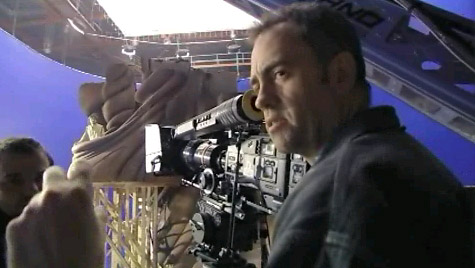
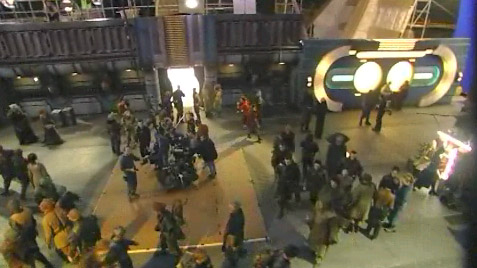
"The official site has the first (of what appars to be many) "Making of Episode II" shorts. Although it mainly shows George, Rick, and some others talking about minor stuff, as well as "the camera" and the "Courscant street set".
"TheForce.net has some nice concept pictures of what the Clone troopers look like with a doctored pic, a fan-made rendering, and painting that looks almost like one of Ralph McQuarrie's.
" Also, The Criterion Collection is releasing Akira Kurosawa's classic, The Hidden Fortress (also known as Kakushi toride no san akunin) on May 22nd, with an anamorphic 2.35:1 transfer. What does this have to do with Star Wars? This IS Star Wars. George Lucas has (admitidly) taken this film, added some touches of Flash Gordon and WWII dogfighting films, world religions, and *bam*, Star Wars: A New Hope. It also contains an interview with George Lucas (or as I like to call him, "The Plaid One") describing the influence of The Hidden Fortress on Star Wars.
"One final bit is still a rumor at this point, but its by far the best rumor, from the most reliable sources. The Episode I DVD rumors have been kicked around for a while, but we finally have unofficial confirmation from the top "spies", as well as Rick McCallum himself!. I usually wait for the official press release myself, but these rumors are coming from the best of the best, and even Rick himself implied that they've been completed. Still no word on the "classic trilogy" or Special Editions though...
"Hope that'll keep you busy until the trailer is released (estimated by November)."
-
Amazon Veteran On the Record and Off the Leash
krow writes: "Mike Daisey, an X Amazon employees has put up some really humorous stuff about the company on his website. A trailer to a film, information about a play that is being done in Seattle and more is there. This is pretty funny to anyone who has worked in the web industry for the last few years. Serves them right, hiring all of those college grads, and then laying them off." -
CVS Pocket Reference
On-the-fly organization may suffice for keeping track of scripts /bin on your local machine, but larger projects have more at stake when it comes to coordinating the effort of programmers, especially when they're not even in the same timezone, never mind in the same room. CVS has become the lifeblood of many such projects. Reader Craig Pfeifer suggests CVS Pocket Reference as a good way to help keep that lifeblood flowing. CVS Pocket Reference author Gregor N. Purdy pages 75 publisher O'Reilly & Associates rating 8 reviewer Craig Pfeifer ISBN 0596000030 summary Indispensable handbook for administrators of all but small CVS installations, and probably for the small ones as well.
The ScenarioAs a former CVS repository administrator, I wish I had this book when I started, it's much easier than pawing through the canonical documentation for quick answers. CVS is the #1 choice for open source projects. If you plan on organizing or working on an Open Source project, this is reference might be for you.
What's Good?This pocket reference is a guide to basic CVS functions (branch, merge, update) but the real strength is in the description of server and client side control files and environment variables. Gregor describes how to setup email notification when someone commits a change to the repository, how to customize the repository to treat certain files as binary (versus text), and other useful things. He even goes as far as to describe how to hack the repository to change it's structure while the project is in motion, and how to hack the sandbox (the name for a developer's work space) to change any property such as which branch or repository the files will be committed to. Of course you don't really need this because developers never make mistakes, it's always CVS' fault <wink wink>. All in all, it's a great reference for all the bits and pieces of CVS that you're supposed to mess with (and a few your aren't) and anyone who is expected to administer a moderately complex installation should own it.
Gregor also gives pointers to some great add-on modules for CVS: CVSWeb for making your source tree web-browsable, and WinCVS to make CVS look SourceSafe-esque.
What's Bad?The organization of this pocket reference could use a little help. I've seen reviews for other O'Reilly pocket references ask for an index, but that wouldn't be helpful here. It would be helpful if they added section tabs in the outside margins of the pages (a la their java nutshell series), so that you could quickly thumb to the section you're looking for. Also, organizing the content by server side and client side instead of simply adminstrator and user would help folks to find the specific information they are looking for.
My last gripe is a small, petty one. The books binding doesn't allow it lay flat when you set it down. Yes it's petty, but I hate losing my page when working. You need to keep a medium sized object with a decent bit of heft (e.g. a stapler) within arms' reach to hold it open.
So What's In It For Me?This reference will not make you a CVS guru, but it will help you remember the command line options (if I had a nickel for every time I typed 'cvs --help tag' I would be frequently mistaken for a Kennedy), figure out what all those little files are without breaking your CVS installation, and most importantly keep you from having to consult the the cannonical documentation for simple things.
If you have inheirited a CVS installation or plan to set one up for the first time, spend the US$9.95/CN$14.95, do it right the first time and save yourself some time and reap all the bennies that CVS offers.
Table of Contents- Introduction
- Installing CVS
- Administrator Reference
- User Reference
- Relata
You can purchase this book at ThinkGeek. -
Avoiding The Content Apocalypse?
ObligatoryUserName asks: "Recently, a gaggle of Amazon Honor System, and PayPal logos (or cheeky text equivalents) have been proliferating on a number of great, beloved and/or famous/infamous web sites. While still other sites are turning to membership programs. The advertising model seems to have failed (or is in the process of failing) and according to yesterday's great interview, micropayments aren't going to work out either. So, I was wondering, how can we save these sites? Is the major cost bandwidth? (Sites with bandwidth sponsors seem, so far, less likely to ask for micropayments.) Is most of the money going to the salaries of content creators? If some non-profit organization or the government (as per PBS) were to pay for bandwidth for exceptional/popular sites, how much would it help?" It's a decent question, and one that I keep bringing up because a workable solution has yet to present itself. Before, the chorus was micropayments (as the minor chord chimes in with the yet-to-be-tested Street Performer's Protocol). With micropayments in doubt, what other routes can sites follow for the funding they need to exist? -
Amazon Starts 'Tip Jar' System
BeFiend writes "Looks like Amazon is trying to develop a "micro-payment" tip jar system for Web sites. They're calling it the Amazon Honor System and looks like you can give as little as a buck, while that's not really a micropayment it is a step in the right direction. I've only seen a couple of sites BBspot and SatireWire with the pay box already, but I'm sure we'll see them popping up all over the place with banner ad revenue plummeting." Amazon says says they don't track you on sites that use this system, even though since the payment box is served from their servers, they easily could (indeed, Amazon's regular No-Privacy Policy directly conflicts with the above page - which one controls?). And Amazon takes a hefty chunk of each payment in processing fees. But perhaps this model could be useful for sites which need cash but don't want to serve advertising. -
Amazon Starts 'Tip Jar' System
BeFiend writes "Looks like Amazon is trying to develop a "micro-payment" tip jar system for Web sites. They're calling it the Amazon Honor System and looks like you can give as little as a buck, while that's not really a micropayment it is a step in the right direction. I've only seen a couple of sites BBspot and SatireWire with the pay box already, but I'm sure we'll see them popping up all over the place with banner ad revenue plummeting." Amazon says says they don't track you on sites that use this system, even though since the payment box is served from their servers, they easily could (indeed, Amazon's regular No-Privacy Policy directly conflicts with the above page - which one controls?). And Amazon takes a hefty chunk of each payment in processing fees. But perhaps this model could be useful for sites which need cash but don't want to serve advertising. -
Lord of the Rings and Hype
tenchiken writes "Lord of the Rings finished principle shooting this last week - trailer is online . It is supposed to be be shown in theatres in two weeks before Thirteen Days, which starts Jan 12th. By most reports, PJ's (Peter Jackson) direction of Tolkien's masterpiece should truly be amazing. Also, Tolkien recently won the Amazon.com's "Best of the Millennium" award. (Which I have to admit is a crock, given every single book in the top ten was writen this century). The online trailer has already blown away TPM's records for most downloads. It seems to be getting a fair amount of international press as well. USAToday recently ran a good report on it Here. ." -
Ordinary Skill In The Art
ClarkEvans writes: "Jeffrey D. Ullman, professor at Stanford University and famous contributor to the excellent Dragon Book, writes about software patents in his paper, Ordinary Skill in the Art. He has some very serious analysis here; I hope Congress reads up." It's intended for computer scientists rather than Congress, and it looks like he has some good ideas. -
Slashback: Fiction, Reprint, Browsing
Not that programmers or writers are ever a little bit competitive all by themselves, it seems that they have to be motivated with the carrot of fame (or some sort of perverse derivative) and prizes -- check the results of the two contests below and perhaps hone your ideas for next year's versions. Also, the dirt below on how to get Netscape quick (oxymoron?) and a new, old Neal Stephenson book (OK, that one was an oxymoron ...)Play with directories to find the X-rated version. Remember the Interactive Fiction Contest mentioned here a while ago? Andrew Plotkin writes with some results: "After six weeks of judging, the results of this year's text adventure competition are in. The top three places go to "Kaged", "Metamorphoses", and "Being Andrew Plotkin". But personally I'd be happy to recommend any of the top ten entries.... and not just because my entry (which was not called "Being Andrew Plotkin"!) came in tenth. Heh. Many of the lower-down placers are worth a look, too -- this is one of the best competition rosters we've ever had."
And speaking of contests ... chongo writes: "The International Obfuscated C Code Contest, the oldest Internet based contest, is not ready to go on the cart as some may had feared. With the addition of Simon Cooper as the 4th IOCCC judge and my early vacation return the IOCCC is moving forward again.
We (the judges), have been processing a near record number of entries. We have now entered the final judging out of which the IOCCC winners will be selected. We apologize for the delay and would like to assure all the contestants and the spectators that the IOCCC 2000 winners will be announced prior to the end of the true millennium. :-) Watch the IOCCC news for further development.
P.S. The rumor that some judges are considering opening up the 2001 IOCCC to C++ programs is true."
(Or try the Perry-Casteneda Library at the really big U) Thanks to xFoz you can rest easy in the knowledge that "you won't have to spend big bucks to put that long lost out of print Neal Stephenson book under the tree this year. But you will have to wait for next year for your very own less than $500 a copy of "The Big U." Preorder now and save $2.60! Amazon has the listing here" mattdm points out that "You can pre-order from Barnes and Noble," as well.
Apparently, this is not Stephenson's favorite of his works. In fact, it's also the only one of his books that I didn't read compulsively with little more than breaks for micturation and nutrition, but it's hard to complain about having some more Neal Stephenson to read! (Thanks to my brother for turning me on to The Diamond Age, too.)
Straight up, no chaser LunarOne writes "I accidentally found the real direct link to downloading Netscape 6, without using their annoying little setup app. Thought I would contribute this since I hadn't seen the link anywhere here on /. I found it while downloading the Windows version of Netscape 6. I protect my Windoze box with BlackIce Defender and this firewall-ish program reported back to me the real download site. Anyways, I had low expectations of NS6 due to some negative comments I had heard here earlier. But, I gotta say I really like it. I have been downloading Mozilla builds regularly for a very long while, and still have high hopes for Mozilla. However, right now I'm enjoying Netscape 6, despite the included commercialisms previously condemned in this forum."
-
Slashback: Election, Election, Election
Last week I came out in favor of electronic voting. Over the weekend, it turned out that its opponents' worst fears came true. Not only was some computer software buggy, but it actually threw a state election the wrong way. And though not very likely, it's even possible that this state will determine our next president! Have I changed my mind about electronic voting?No, because the punchline is: New Mexico still uses dead trees. The bug was in the software that counts paper ballots.
New Mexico was given to Gore on election night by 6,800 votes because of buggy computer software. That software "failed to read" straight-party votes (oops!), and worse, it "also chose at least one candidate from another party."
If computer flaws had thrown an electronic-vote election, you'd be reading about it on the front page of every newspaper across the country, and pundits would be telling us (sometimes in ways very funny) how foolish we were to trust our votes to those nasty computers.
How many presidential elections does our 19th-century technology have to nearly destroy before the alternatives get serious consideration?
A friend in Sweden tells me that the U.S.A. is now being referred to as the B.R.A., the Banana Republic of America. Maybe by the 21st century we can have 20th-century voting machines installed at our polling places, what do you think?
(New Mexico could decide the election if Florida's votes are thrown out, Oregon goes to Bush, and one or two more improbabilities occur.)
Voting, right here in River(side) County Riverside County, California, used touch-screen voting in this last election. This is very different from internet voting since there was no network to the outside world. I think this is an important step and certainly should be done first.
ABC News's report describes Riverside's system and shows a photo. Randall Gardner points out that the local paper has a great story with an overview of the system and reactions from voters -- glitches, yes; late tally, yes; but all in all it sounded like a positive experience.
With a capital V and that rhymes with C and that stands for Canberra Dracophile points out an article from the Fairfax IT News website, which:
reports that voters in the Australian Capital Territory (in which our nation's capital, Canberra, lies) "could be the first in the nation to trial electronic voting at next year's territory election", according to the territory's Chief Minister, Gary Humphries. They're hoping to pass legislation next month to bring this about. Sounds cool, but the article goes on to quote Humphries as saying, "You might as well be doing it from your own home." Is it just me, or does this raise the possibility of voters being coerced into a particular vote where this sort of thing can't be seen? I'd prefer to see electronic voting available only from polling booths.
No grunge typefaces please User-interface wonks should enjoy this pure-and-simple design contest. Web Memes, Inc. is asking you to design a ballot, preferably one as unconfusing as possible while still using (spit) paper. You also get to make up your own candidates and issues.
(If the competition were digital, instead of paper, it would be a tough call between Amazon.com's new user interface and AmIPresidentOrNot.)
Busily coding your next election... ...is Jason Kitcat, who says "I'm working really hard on the next release and haven't given it the PR time it deserves." Allow me.
FREE is "Free Referenda & Elections Electronically," "the first open source system for conducting electronic votes." We're now jumping from mere electronic tallying of votes in polling places to actual internet voting, so please keep your hands inside the browser at all times.
Originally an academic thesis, FREE is now GPL'd, written in Java, and its design background is available in whitepapers. I haven't tried running it. Someone let us know if the project could be useful.
See also thebell.net, which comments:
...the majority of paper punching systems used in the U.S. do not produce repeatable results when ballots are tallied more than once, which means that election officials lack the means to objectively distinguish between fraud and error under these circumstances. ...we should in fact be looking to Internet voting systems in order to try to reduce those faults and thus provide for more security than what is available today -- not less security.
The seriously skeptical view Let's end on a sobering note. Scoffing at The Bell's claim to have tackled the subject a mere six months ago, Rebecca Mercuri points out (on Dave Farber's IP list) that others have been thinking about internet voting for over a decade. She writes:
Internet systems indeed DO promise FAR LESS in the way of auditability (recounts) and anonymity (privacy) than do the paper and other manual systems presently in place. To promote the belief that Internet voting, in any way provides a SAFE VOTE, is wholly erroneous.
She has an intimidating collection of links to (mostly) academic papers on the subject on her Electronic Voting page.
And in conclusion The only viable form of government is perl-based: we need a bicamel legislature with an eclectoral college. Thank you and good night!
And now for something completely the same! A note from timothy: The next piece in our continuing Hellmouth Revisited series is online. Feel free to go read it. -
Enter The 'Stupid Patent Tricks' Contest
We've all read about some of the dumber patents issued recently by the United States Patent and Trademark Office [USPTO]. The Slashdot community is full of talent and creativity, so why not come up with our own stupid patent ideas instead of waiting for Amazon or Priceline or some other company to come up with something amusing? First prize is a $50 ThinkGeek Gift Certificate that I am paying for out of my own pocket, and will personally sign. The winner will be chosen on the basis of originality, believability, and humor value. To start things off, I will describe my own personal contribution to the Stupid Patent Pool: Zero Click Shopping.As you know, Amazon has successfully patented "One Click Shopping," Barnes & Noble is angry about the patent, and Apple has bought into the idea. Such tomfoolery! This concept is no more deserving of a patent than something as basic as, say, the hyperlink.
So I decided to go Amazon one better and invent Zero Click Shopping:
"A method of using javascript or similar technology to produce a series of Web page-displayed images that, when "rolled over" by a customer's mouse in a predetermined order, either causes a purchase to be consummated or causes a series of preselected items to be placed in a single customer-accessible data file so that the customer can purchase all selected items at the same time instead of having to perform a series of separate transactions."
Remember, you saw it here first!
If anyone tries to patent this silly, rather obvious concept from this day forward, you can point them to this article to show that is was instantly obvious to anyone familiar with the "state of the art," which means that this idea should not be patentable.
But nowadays, the head of the USPTO seems to believe that every boneheaded concept deserves patent protection, and that if you don't like a patent, you are supposed to hire a lawyer and take it to court. Gaaah!
So let's take the idea and lampoon it -- minus the legal fees, of course.
Write a patent summary. It can be for anything, as long as it sounds credible and is written in patent-talk or a reasonable parody thereof. Post it here. We'll let the Slashdot moderators decide which ideas have merit (or at least humor value) and which don't.
The Slashdot Authors, acting in all of their usual chaotic glory, will decide which of the highest-moderated pseudo-patents wins the grand prize.
Three Honorable Mention winners will each receive a Slashdot t-shirt from ThinkGeek.
You must be a registered Slashdot user to win. Entries will be accepted until 11:59 p.m. (2359) GMT on Friday, October 13. Winners will be announced on Tuesday, October 16. Judges' decisions are final. (If you don't like them, hold your own contest, okay?) The purpose of this whole thing is to laugh, not to get rule-bound, so post away, have a good time, and may the dumbest... er... best ... idea win!
-
Hackers
Hackers is probably the first book I read that made me think of computers as the substrate of a social world rather than just boxes with lights. The book came out in 1984, though, and a lot's changed since then. Read on, as topeka lets you know how well Levy's techno opus has aged. Hackers author Steven Levy pages 455 publisher Anchor Press / Doubleday rating 8.5 reviewer topeka ISBN 0-385-19195-2 summary A fast-paced, readable history of the early days of hacking, seen through the eyes of the participants.After reading a reference to Steven Levy for the nth time on Slashdot, or hearing him discussed at a LUG meeting, I decided it was time to find a copy of his book and see what it was all about. Slashdot has made a few statements over the past months in effect trying to educate those new to hacking. One way to do this is to spread the rich history of the hacker ethic. There are certain books that have made their mark among hackers over the years, and I think Steven Levy's, Hackers, is near the top of that list. For that reason, I thought it would be useful to reexamine a book that was first published 16 years ago and hopefully convince some people to go find a copy and read it.
Getting the Book
The first challenge to reviewing this book was finding a copy. It was first printed in 1984, and as far as I know it ran its final printing in 1994. Not having a used bookstore nearby, I decided the Net was the best choice. So I set out looking it up on the usual Amazon and Barnes and Noble sites. Amazon suggested checking back soon, but seeing as the last printing was six years ago I wasn't holding my breath, plus the fact that Amazon's "defensive" patents make me leery of giving them my business. Similarly, B&N did not have the book either, but they did have several copies listed in their network of rare and used book affiliates. But the cheapest version of the Hackers I could find was over $60. So, the next step was to search Yahoo, but after trying a dozen or so sites, I had no luck. All of them seemed to carry an unrelated subset of the subject I wanted: Hacking. That's when I stumbled on Abebooks.com. This site is one of my favorite discoveries of the year. This site brings together over 6,000 local bookstores and puts their catalogs online. Best yet, the site does not mark the books up any higher than they are in the local shop. And, they give you the option of buying through Abebooks, or going directly to the local site by Internet or phone to purchase. Here I happened to find several different copies of this book, many of them the same entries as I found on the B&N site. The great part though, is that the version from B&N for $60 was selling directly from the shop (through Abebooks) for $35! So, I bought it. Of course, there is always the public library.
Synopsis
Levy's narrative talks about three different generations of hackers: the Orthodox Hackers, the Hardware Hackers, and the Game Hackers. The story starts in the very late 1950's at MIT -- not at the console of a computer, but in the cave-like home of the miniature models of the Tech Model Railroad Club (TMRC). The MIT professor who shepherded the TMRC, and hence the first hackers, had connections to the phone industry (which of course had the best electronics of the day). These Hackers used them to build an incredible railroad model. Work was affected however, when the hackers discovered a punch card machine in the basement of building 9. Levy describes in intricate detail the first hackers' interaction with first the punch card machine and then, their TX-0 and to the Hacker's paradise, the PDP-6.
Along with those first hackers, Levy describes the bureaucracy that they hate, and its incarnation at MIT, the IBM "Hulking Giants."
From MIT, Levy branches out in his exploration of the early hackers to the West Coast and the Stanford AI lab. He discusses in depth how the movements in the 60's affected the hackers, and how some of them shared their populist views by taking hacking to the streets to support the ideas of free speech and access to information. Levy discusses the debate that raged over whether or not hacking for MIT was The Right Thing, considering almost all of their funding came from ARPA (which was a part of the DoD).
This eventually leads into the second generation of hackers, the Hardware Hacker s. These individuals were, unlike the MIT and Stanford Hackers, decentralized, with no academic structure to support their activities. The second generation of hackers cared less about software but instead, fought for the idea that computers should be liberated from the massive industry bureaucracies, led by IBM, the maker of the Hulking Gi ants. They formed computing clubs which eventually fostered the introduction of kit computers. Levy talks in depth about the Homebrew Computer Club and its rivals. He entitled an entire chapter, "WOZ." Levy diagrams the introduction of the Altair, to the building of the Sol, the TRS-80 and finally the Apple II.
The Apple II sets the stage for the third generation, the Game Hackers. These were anyone who could write software for the meager processors in the Apple II and the Atari 800, the vast majority of which were games. Levy tells the story of the game company Sierra On-Line and its humble beginnings. And, he tells the story of the game hackers, who were the first in large numbers to become wealthy beyond their beliefs (spurred by 30% game royalties.)
The narrative is not all happy either. Levy discusses the controversy Bill Gates caused when he found out that hackers were "stealing" his BASIC interpreter for the Altair. He also talks about the chaotic split that occurred between the original Game hackers and the game publishers as the industry matured and its new bureaucracy cut out hackers, no longer giving them authorship credit for games and slashing their royalty shares. Finally, Levy discusses the tragic split of the MIT Orthodox Hackers as the first LISP machines went into production.
The final chapter is entitled "The Last of the True Hackers" and tells the story of a young MIT hacker named Richard Stallman who liked to be referred to by his initials (RMS) because it symbolized his login name.
Though the discussion of the last 40 years worth of computers is in depth, Levy's is a story of people, and how their interaction with machines created a new kind of ethic. Levy defines and explains what exactly The Right Thing is, and why it was so important to the hackers. He discusses all of the computers in terms of the people who us ed them. From the MIT Hackers Greenblatt and Gosper to the Berkeley street Hacker Felsenstein to master of Atari 800 assembly language John Harris to Apple Computer's Steve Wozniac, Levy's narrative runs deep into the Hacker ethic within these individuals and what they did for the fledgling computer industry.
Levy's book chooses to follow the course that the Hackers made. In fact, the word "UNIX" is mentioned exactly one time in the entire book, on page 434. The invention of UNIX is not covered, and the only languages Levy mentions are: assembly, LISP and BASIC. There is also no mention of the development of ARPAnet, it just sort of appears when the hackers start to utilize it. This is truly a story of people and not simply a history of the Computer "Industry."
Conclusion
The most important reason to find a copy of this book, though, is to read with the now 15 years of hindsight. It is truly amazing to see the concepts Levy helped define take form and continue to prove themselves true. I would recommend this book to anyone who is interested "where it all came from," especially to those who have only stumbled upon hacking in the past few years. I wonder now if Levy is still around, and if so, whether he has updated his copy of Hackers to include the forth generation of hackers, the GNU/Linux Hackers.
-
Secrets & Lies: Digital Security In A Networked World
Bruce Schneier, well-known security and encryption expert, and author of Applied Cryptography has recently had his newest book published, entitled Secrets & Lies: Digital Security in a Networked World, which explores the world of security as a system. Read the entire review below. Secrets & Lies: Digital Security in a Networked World author Bruce Schneier pages 412 publisher Johy Wiley & Sons, 09/2000 rating 10 reviewer Jeff "hemos" Bates ISBN 0471253111 summary A well written, well researched exploration of digital security as a system.I've recently had the pleasure of reading Bruce Schneier's latest writing effort Secrets and Lies: Digital Security in a Networked World. A number of our readers may remember his prior book Applied Cryptography , which discussed the use of cryptography in our brave new digital world, and how the use of crytography would make things secure.
This time around, Schneier is much more cicumspect about the uses and application of cryptography. As he states in the introduction and throughout the book, when writing AC, he thought that the use of cryptography would make things more secure. He was correct - but the lesson he learned while working with companies and individuals, that we can't just add cryptography into a system and make it secure, but that systems must be designed from the bottom-up with security in mind. S&L draws upon a huge amount of experience working in the security field, making one central point: Any system, no matter how good the cryptography is, is only as strong as the weakest link. Yes, that's an old cliche, but it's one that bears repeating.
What makes it even more imperative to design system to be secure is the sheer amount of systems that aren't secure, and what the means for us. Some of the examples Schneier uses in S&L are simply frightening to consider were they to occur. And some of his ideas about what will come, and the tools we have will make you want to keep a good stash of gold kruggerands under your mattress.
Indeed, as he talks about in the introduction, part of the reason this book too so long to write was because he was depressed at the world of security around him. Looking at what companies were doing, at what people were doing, and the sheer amount of systems holes out there must be depressing - but it only drives home the point even moreso that we must design *systems* not just adding cryptography and thinking that's the magic pixie dust that can make everything better.
The book does an exceptional job of wending its way through various security measures, how they work, and how they fail. IMHO, one of the real strengths of this book is that it's something that a cryptography novice could read, as well as an expert. Certain sections of the book are dedicated to the nitty gritty behind systems, but there are also sections that are dedicated to simply laying out the process by which one should approach the systems. Indeed, the support blurb on the dust jacket is written by Jay S. Walk, the founder of priceline.com. This adds to the strength of the claim that the book can be for everyone.
Schneier is intimately involved with the security community - besides being the creater of the [Blowfish] and [Twofish] encryption algorithms and a frequent speaker at technical conferences, his company deals with this day in and day out. More to the point for a book, he can also write. It makes reading about Product Testing and Verification (Chapter 22) rather than a snooze, a treat. The book is one of those rare cross-overs - something to give your geek friends, and your [PHB], all of whom will appreciate it. The breadth of the book is revealed in the contents (Duh) and it's a good mixture of all the necessary elements. You'll learn about entropy in a system as well as Attack Trees, Threat Modeling and what all of this stuff means in day-to-day life.
I wholeheartedly recommend this book.
The Table of Contents and the preface are available on Counterpane's site; S&L's Chapter Three is on Amazon.
Purchase this book at ThinkGeek.
-
Amazon Charging Different Prices for Same Items?
Rambo writes "Amazon is apparently researching consumer's buying habits by arbitrarily changing the prices on DVDs and other products. Computerworld has a story here about it. Amazon refused to say when they would halt the practice, or what criterion they used to set the different prices." Of course I haven't spent a nickel at Amazon since that whole one-click shopping thing, but I can imagine ways that this could be good or bad. Imagine I buy a lot of Anime DVDs. They could note this, and raise the prices by a buck or something. I tend not to do real-time price shopping on items like this: I looked at a dozen online stores when I started purchasing, and I settled on the one that had the features & prices I want. But 2 months later they could jack the prices and it would be months before I noticed. Alternatively they could lower the prices, or lower prices on similiar items as an incentive to buy other things. Very odd possibilities and I'm not at all sure about how I feel about it. -
Amazon's Privacy Policy Now Allows Sale of User Info
StoryMan writes: "Amazon.com decides to revise its privacy policy and states that it considers consumer data a saleable asset. Story here at CNN." Michael notes that this only happens if Amazon.com is sold: essentially covering their butts in case they go bankrupt. Of course considering their burn rate, this doesn't make me feel better. I haven't shopped at Amazon since their one-click-shopping patent, but I'm sure they have plenty of stuff listed about me from an era when I happily shopped with them (mind you this is before Amazon diluted itself by selling so much crap, that buying books became a pain).Jamie adds:
Note the language of the new privacy policy: "of course" your private information will be "one of the transferred assets."
Did you think your information would still be private five years from now, when the dozens of companies you've shopped at have all gone bankrupt one by one? Ha ha! Foolish consumer!
The first test case in bankrupt-privacy seems to be Toysmart, and the latest word on that is that a judge refuses to forbid such "asset transfers." We'll keep you posted on the Toysmart case, but for now, it doesn't look good.
-
Programming Interviews Exposed
You want to code all day (or as long as you can stand), whether from home or in an office environment that suits you, with the right soda in the fridge, and friendly coworkers to ask questions when the going gets tough. You want a job in a field that will keep you interested for more than the first orientation meeting, and one that lets your skills be useful -- right down to your favorite programming language. Gavin Bong contributed this review of Programming Interview Exposed: Secrets to Landing Your Next Job, a book designed to lead interviewees for programming positions into the jobs they want. Programming Interview Exposed author John Mongan and Noah Suojanen pages 272 publisher John Wiley & Sons rating 8/10 reviewer Gavin Bong ISBN 0471383562 summary A book to help developers achieve success in their technical interviews.Introduction
Many people consider an interview a Kafkaesque experience, where all your skills (technical and social) come under the microscope. My toughest interview was one where I sat in a conference room faced with five hungry interviewers and "How many lines of code have you written in your career?" was considered small talk.
The promise
This book will not teach you how to handle small talk, but still may do wonders for you in your next interview. The author's promise, that reads: "If you work on learning to solve not just the specific problem we present, but the types of problems, you'll be able to handle anything they throw at you," is certainly ambitious, but they've succeeded admirably in my opinion.
General overview of book
Chapters 1 and 11 are short and sweet, but impart important lessons on how to negotiate offers, preparing for open-ended questions like "What are your career goals?" and generally convincing the employer that you can fit into their culture. Appendix A's coverage of writing technical resumes is brief but sufficient. Their bottom-line message is: craft a resume to sell your skills; don't write an autobiography.
The rest of the book comprises a review of common programming questions you may face, as well as a selection of puzzles that appear regularly in technical interviews.
The secrets summarized
The authors' secrets to technical interview success can be summarized as follows:
- Make sure you master the programming language that the job asks for.
- Practice solving problems and study heuristic methods.
- Master common data structures like linked lists, strings, trees & graphs.
- Be conversant in programming paradigms like recursion and Big O notation. And depending on the area of expertise that the interviewer is looking for, brush up on topics like concurrency, networking and database concepts.
Let's dissect these bullet points one by one
(1) The authors expect the interviewee to master every feature of the language that the job calls for, including the quirky and obscure ones. Personally, I think that knowing the core elements plus the specific features that the employer is looking for is more than enough. For example, in the Java paradigm; multithreading would be considered core, while knowing JNDI would be a speciality. But take note that an interview is not something you study for. It's not like a certification exam. You certainly need a couple of projects using that language under your belt to be absolutely prepared.
In interviews where you can choose the programming language, the authors caution against using lesser languages like Javascript or Visual Basic. But my opinion is that -- if it's used appropriately, and within the bounds of the job description -- any of these should be fine.
(2) G. Polya once said "Experience in solving problems and experience in watching other people solving problems must be the basis on which heuristic is built." The authors have kept to this spirit and included a generous number of challenging puzzles to exercise your brain. This is no coincidence, as both authors graduated from Stanford, where Polya once taught. Solutions are provided, but more importantly they've also included descriptions of the thought processes that underlies them. And by the way, the types of puzzles listed here probably wouldn't be out of place in a MENSA exam or the U.S. Computing Olympiad.
The authors also offer practical suggestions on how to solve problems, such as "Think out loud by explaining what you're doing," and "If you're stuck, consider looking at a specific/general example of the problem."
(3) The book offers one full chapter on linked lists. The author is justified in this, as linked lists can be operated upon by a multitude of operations. And each operation can usually be coded with a minimal number of lines of code. Ignore this advice at your peril.
(4) From experience, the authors have found that if you don't put down a particular skill in your resume; questions on those topics will not generally arise. So by setting the right expectations; you'll be able to get through the interview with fewer tangled nerves. But general programming knowledge questions like "What does it mean to be a 32 bit OS?" or "What is the difference between C++ and Java?" should be expected. Chapter 10 offers a healthy sample of them.
Weakness
One of the strengths of this book is that it focuses fully on the topic at hand which is "programming interviews" and never gets sidetracked. However it does have its weaknesses, in that there's very little mention of the high possibility of questions on component programming models (EJB,COM/COM+,CORBA). I think component-based software development (using off-the-shelf components) is the future of our industry (whether open or closed source) and companies are not interested in creating software from scratch. Also missing from the book is any mention of localization or internationalization of software.
Is it worth buying?
At 272 pages, this book can easily be skimmed in one sitting. But its value will not be apparent until you start solving the included problems/puzzles yourself and understanding the pattern of interview questions. This book is not a magic bullet that will guarantee you success in every technical interview, but having a rough estimate of what you will face is certainly better than being surprised.
Who is the target audience?
This book is especially relevant to recent computer science graduates who are just entering the industry. It may also be useful to technical recruiters and software managers (who assume the role of interviewers) who want to get some insights into the interview processes used by other companies. It might not be appropriate for people from other technical disciplines like system administrators or DBAs. Seasoned programmers may still get some benefit from the book although you've probably had first-hand experience with most of the questions/problems posed in the book.
Table of contents
- Chapter 1: The Job Application Process
- Chapter 2: Approaches to Programming Problems
- Chapter 3: Linked Lists
- Chapter 4: Trees and Graphs
- Chapter 5: Arrays and Strings
- Chapter 6: Recursion
- Chapter 7: Other Programming Topics
- Chapter 8: Counting, Measuring and Ordering Puzzles
- Chapter 9: Graphical and Spatial Puzzles
- Chapter 10: Knowledge Based Questions
- Chapter 11: Non-Technical Questions
- Appendix A: Resumes
-
Amiga's New SDK: A First Glance
Mike Bouma writes: "Recently it began raining news coverages about Amiga`s new OS in the mainstream press like CNN`s Digital Jam, The New York Times and Gamersdepot. The first impressions of the new SDK have been very positive. Lars Thomas Denstad has written a small article about his experiences with the new SDK so far." -
MSIE's Cookies Are Public
If you're using Microsoft Internet Explorer running on Microsoft Windows, turn off Javascript now. Your cookie file is readable by any hostile website. Or, if you'd like to see the security hole in action, leave Javascript on and check it out: "Open Cookie Jar." (read more)Peacefire webmaster Bennett Haselton is on a roll. After discovering yesterday's Hotmail hole, today he's published his discovery that MSIE's Javascript contains a bug that allows any hostile website to obtain your cookies.
Essentially the bug is that MSIE's Javascript is not very smart about determining which domain you're coming from. If the URL you're looking at has its "/" characters replaced by the hex representation "%2f", it can be fooled into thinking your path is actually a very long machine name. Because it interprets that path wrongly, a well-placed ".yahoo.com" in the URL can make Javascript think it should be using Yahoo's cookies - and Javascript can be told to deliver those cookies back to the hostile server.
Bennett and I believe the bug is confined to the Javascript code in MSIE, but we have not done extensive testing to determine this. For now, at least, we believe turning off Javascript will be sufficient to eliminate this security hole.
Or, you could migrate to another browser or operating system...
We have only tested this with IE 5, and Windows 95/98. Reports of success or failure with other versions would be welcome.
After Bennett explained to me how this works, I wrote a short CGI script to demonstrate what lurks in cookie files. Instead of silently stealing your private information and squirreling it away for later use, it echoes that information back to you (and then forgets it, of course). Updated: That script has been rewritten by and is now hosted at securityspace.com. For best results, first go log into amazon.com, type your zip code into hollywood.com, and visit playboy.com. Then go visit securityspace's general info page and click the "click here."
Newsbytes and CNET have picked up this story and have good writeups.
-
Jordan Pollack Answers AI And IP Questions
Professor Pollack put a lot of time and thought into answering your questions, and it shows. What follows is a "deeper than we expected" series of comments about Artificial Intelligence and intellectual property distribution from one of the acknowledged leaders in both fields. How do you justify your expectations? (Score:5, Interesting) by Anonymous Coward For the past 40 years, AI has just been 10 years or so away.It's still just 10 years or so away.
It's not getting any closer.
How do you justify any degree of optimism about the future of AI at this point? What makes now fundamentally different from anytime in the past 40 years?
It is funny, this is the same question I asked Marvin Minsky, the father of AI, at ALife 5 in Japan. He attacked every modern approach, including neural nets, fuzzy logic, evolutionary algorithms, and so on for over an hour, suggesting that his student's (Winston's) thesis should have been the paradigm of the field! I asked, "If AI sucks so much, why are you still in the field after 40 years?"
Hypocrite! Here I am, still in the field after 20 years! As soon as I've convinced myself one approach to AI is too slow, I find another, leaving quietly without attacking the friends I've made. AI is a big wide open field with a lot of smart people trying different things. (Savage attacks by insiders exiting are the worst thing in science, such as Bar Hillel's attack on Machine Translation in the 60's. Forty Years later, MT is "cool" again, in this month's issue of Wired.)
So I can say that, from my perspective as having worked on many different approaches to AI, writing problem space search algorithms for solving puzzles will not result in a general problem solver. Automating predicate logic won't make a computer equivalent to a philosopher. A computer can't do natural language any better than Eliza, without an internal need to communicate to survive and a large blessing of custom hardware. Neural nets are great function approximators with good mathematical results on limited kinds of learning, but we can't set 12 weights to get what we want, let alone 10 billion weights. And even though simple nonlinear systems give off chaos and fractals, Kolmogorov's law tells us simple systems are still simple. Evolution is one path to complexity, but most genetic algorithms simply search a finite search space and optimize a fixed goal.
So I'm locally pessimistic but globally optimistic! Who said AI is 10 years away? It's here now, in limited forms, yielding a lot of economic value, as your mouse clickstream is datamined so the ads which pop up are for things you might actually buy. But the SF ideal of a humanoid robot like Commander Data is centuries away.
I hold the view that any system which responds to its environment in a conditional way based on some internal state, even a thermostat, has a bit of intelligence. Immune systems, ecologies, and economies design things and solve problems. Every computer program you write has a bit of intelligence captured in it. The problem is, real AI of the sort you are alluding to is an organization which might be realizable as a 10 billion line program or a 10 billion weight dynamical neural system, and no human software engineering team can write autonomous code which is more than 10-100 million lines. Even Windows is just DOS with wallpaper, and big applications always require a human in the loop, selecting subprograms from menus or command lines.
Since 1994, we've been working on how to automatically evolve physical symbol systems which would have 10 billion unique moving parts, what we call "Biologically Complex" systems. When I say "We," it is because everything I do is in collaboration with my Ph.D students! A 10 Billion Line program is an absurd goal obviously, but it drives our research to focus in on the process of growth itself, rather than on what shortcuts we can accomplish by hand. We look at co-evolution, which involves machine learners training each other, and on questions of what kinds of substrates for computing could provide a universe of functionality while being constrained in a way which reduces the size or dimensionality of the search space. This constraint is called inductive bias. We seek minimal inductive bias systems, in which the human hints, or "gradient engineering" tricks are fully explicit. (Sevan Ficici, Richard Watson) We still work on neural nets and fractals as a substrate, and have made some progress in understanding how they work (Ofer Melnik, Simon Levy).
It's been more than five years, and while we are not even at the million line mark yet, I am still optimistic and haven't given up on co-evolution to move to a new field. I think that my lab has made progress in understanding why Hillis's sorting networks and Tesauro's Backgammon player were such breakthroughs and where they were limited. (Hugue Juille, Alan Blair). I think we have begun to understand the nature of mediocrity as an attractor in educational systems and how to change the utility functions to avoid collusion, and apply this to human learning (Elizabeth Sklar). We have become more applied, bring co-evolution to the Internet and to robotics, replicating and extending the beautiful results of Karl Sims from 1994 (Pablo Funes, Greg Hornby, Hod Lipson). All the work is available to study at the laboratory's Web site.
AI and ethics. (Score:5, Interesting) by kwsNI What do you say to the people that feel it is unethical to try to create "intelligence"?I take this as a shorter version of the longer religious question the editor thankfully didn't select. I've talked to myrabbi, perhaps one of the great theologians around today. Even though I am an atheist, he thinks I am on a spiritual quest to understand [God as] the principles of the universe which allow self-organization of life as a chemical process far from equilibrium which dissipates energy and creates structure that exploits emergent properties of physics. Can a spiritual quest be unethical? I suggest that people with this question read Three Scientists and Their God, by Robert Wright, or watch the Morris documentary "Fast, Cheap and Out of Control".
A second ethical question, besides usurping God's rights, is how can you take funding from national and military agencies like NSF, Darpa and ONR? For the past 50 years at least, they have been the seed capital for the science behind most of the technological progress I know about. With the venture capital economy, that curiosity-based seed function may be privatized, if some of the big VC funds dedicate 10% for long range science, and the ethical question of whether you are doing something for public good or private gain begins to dominate over the religious and military questions. That is the same question many scientists and Linux hackers ask themselves daily: Can I do good and make money without a conflict of interest?
Turing award. (Score:5, Funny) by V. Do we win something if we can fool him into answering a computer-generated question? ;)It has always been the case that limiting the range of dialog leads to more successful masquerading. In our CEL online educational game, for example, the only interactions between players are the actual plays, which enables artificial agents to be accepted as game partners.
BTW, the Turing Award is an annual lifetime achievement award in computer science, which has gone to people like John Backus for his eloquent apology for Fortran when he should have given us APL and LISP. The Turing Test is the name given to Alan Turing's proposal for testing for successful AI. Given that we don't deny airplanes fly, I think if AI ever flies, we won't question it. So I propose using the Louis Armstrong Test, his answer to the question "What is jazz?"
How should an amateur get started working on AI? (Score:5,Interesting) by Henry House It seems to me that a significant problem holding back the development of AI is that few non-professionals grok AI well enough to offer any contribution to the AI and open-source communities. What do you suggest that I, as a person interested in both AI and open source, do about this? What are the professionals in the AI field doing about this?Reading is fundamental.
Frankenstein (Score:5, Interesting) by Borealis For a long time there has been a fear of a Frankenstein being incarnated with AI. Movies like The Matrix and the recent essay by Bill Joy both express worries that AI (in the form of self replicating robots with some AI agenda) can possibly overcome us if we are not careful. Personally I have always considered the idea rather outlandish, but I'm wondering what an actual expert thinks about the idea.Do you believe that there is any foundation for worry? If so, what areas should we concentrate on to be sure to avoid any problems? If not, what are the limiting factors that prevent an "evil" AI?
AI doesn't kill People. AI might make guns smart enough to sense the weight or handsize of the user, preventing children from killing each other. Everything ever invented is capable of good or evil. Evil arises most often when masses of humans are denied fundamental rights. The Evil Rate and Unemployment Rate are closely linked.
I read Bill Joy's article in Wired last month. And I loved the Unabomber's excerpt because it is based on some of the best Philip Dick paranoid Science Fiction, like: Vulcan's Hammer, We Can Build You, and the Simulacrum. There is a lot of SF on the Golem question and one of my favorites is Marge Piercy's He, She, and It , which proposes a moratorium on AI inside humanoid robots. You can have smart software on the Web, and human looking idiobots, but you can't put real AI inside human looking robots, or you have to pay the price.
My lab is indeed working on self-replicating robotics and were worried for a split second about getting the fetal brain tissue reaction when our paper comes out shortly. We can now envision the "third bootstrap", after precision manufacturing and computation, where machines make the machines which make themselves, just as machine tools are used to make more machine tools, and computers compile their own programs. But the replication loop is quite a sophisticated automatic manufacturing process, which requires a large industrial infrastructure, and a lot of liability insurance. So far, no VC's, Saudi Princes, or government agencies have offered the necessary $500M first round of financing for fullyautomateddesign.com.
It would be wrong of me to say leave my frankenbots alone, and go after frankenfoods and frankenano. I think Joe Weizenbaum's book should be required reading, because every few years somebody else comes up with the idea of inserting computers inside animal bodies, so that the first act of any war will be to exterminate all nonhuman life forms. But I do think we have to worry more about large scale industrial and agricultural processes which are allowed to externalize their by-products affecting the environment, than we need worry about robotic ice-9. We will die quicker from e-mail spam caused by viral marketing customer acquisition schemes or from global warming and ozone depletion triggering major climactic change, red tide or another pollutant taking out fish from the food chain, or even from people throwing away old EGA screens and 386 motherboards in landfills, poisoning the aquifers. I promise that for every robot we build, there will be another robot to recycle it when its job is complete.
Anyhow, IMO Joy's angst must reflect the Sun setting on any instruction set architecture besides x86, but that's a different discussion. Talk to me about the ethics, when your very own open source movement leads to the inevitability of an Intel instruction set monopoly by providing a useful alternative to Microsoft :)
Questions based on your academic path (Score:5, Interesting) by Anonymous Coward The way to the field of AI isn't always extremely clear. What type of background do they expect? Is it mostly a researching position or is it treated like a normal job with normal goals? Are there any classes or subjects or schools you recommend to make it into the AI field? Also, how exactly did you get into the field? How did AI intrigue you into what you do now, despite all the controversy to create an intelligence that could possibly be considered a "god" compared to the human existence? Very interesting to say the least, and something I'm interested in.There is no AI business field to speak of which is differentiated from the general software business. Most companies which were "AI companies" in an earlier generation of university spin-offs for Lisp Machines, and Expert Systems Shells, failed miserably. Venture Capitalists won't fall into the same sinkhole twice. There are industrial process control companies which use refined bits of AI, e.g. in visual inspection of manufacturing processes, and Neural Network companies, like HNC, who have changed business plans and are now "pattern-recognition e-commerce security." companies. The Speech recognition industry has condensed into one company. Web- based AI means search engines and Language Engines. Ask Jeeves and Google and Direct Hit and many others may use bits of AI and adaptive technologies in their system.
Jobs in AI are just like software jobs everywhere: chain you to a workstation and make you work out boring details in exchange for salary and very little equity. But find a great graduate program in computer science, and you will likely find fun and exciting work for no salary and no equity! And you have to be great at both real and discrete mathematics as well as a natural born programming genius.
As for me, I started programming computers in APL as a freshman in college, and because it was such a high level language and I didn't sleep much, I wrote an awful lot of code in a few years. I was naturally drawn to building heuristic puzzle solvers, game players, and logical theorem provers. Before I met my wife, friends thought I was in love with computers. After working at IBM, I went to graduate school in Urbana and worked with David Waltz on LISP hacking, natural language processing, and reinvented neural networks, which were censored from the AI curriculum of the early 80's. I came to the limit of what could be done with neural networks for intelligence by 1988, and at Ohio State University, started looking at fractals and chaos as a source for generativity. Unfortunately, interesting behavior requires lots of levels and lots of parameters, which is why we started looking at evolution for selecting and adjusting lots of parameters, a focus since I've been at Brandeis.
While there is a lot of detailed work and dead ends, the search for mechanical intelligence is one of the great unsolved problems, which is in some way deeply equivalent to questions on the origin of life, human language, morphogenesis, child development, and human cultural and economic change. John Casti's book is a great place to start reading about these big problems.
Human brain - AI connection - is there? (Score:5, Interesting) Do you think that a greater understanding of the human brain and how intelligence has emerged in us is crucial to the creation of AI, or do you think that the two are unconnected? Will a greater understanding of memory and thought aid in development, or will AI be different enough so that such knowledge isn't required?
Also, what do you think about the potential of the models used today to attempt to achieve a working AI? Do you think that the models themselves (e.g. the neural net model) are correct and have the potential to produce an AI given enough power and configuration, or do you think that our current models are just a stepping stone along the way to a better model which is required for success?
Obviously there are clear medicinal benefits to brain research. And the study of any real biological system leads to interesting metaphors which can be the basis for a novel computational model. But I think it is unlikely that research into the biology of the brain is crucial to understanding cognition or replicating intelligence. It's like studying the width of wires in integrated circuits of a computer. Even if you get the whole wiring diagram for a computer, it still tells you little about the programs running on it. I think understanding the brain is a problem which is underestimated. I heard 25,000 scientists attend the annual Neurosciences meeting, three times the largest ever interested in AI. It could be called the Mandelsciences meeting, and different labs compete to describe what they find in those little windows on the Mandelbrot set! But I have a lot of friends who are neuroscientists, and I can be just as facetious about linguistics.
Seriously, I believe we have to understand and replicate the processes which lead to the development of the brain and its behavior, not replicate the mammalian brain itself.
The second part of your question "how intelligence has emerged in us" can be interpreted as a more interesting direction. Here, there is a lot of opportunity to relate human intelligence as animal intelligence plus a little more. The fields of evolutionary epistemology, adaptive behavior, and computational neuroethology are quite interesting. It is a great question to understand cognition as it appears in other animals, insects, worms, and even bacterial colonies. The basic principles of multicellular cooperation are more important than the millions of specific adaptations of the human brain.
As for models question, it is sort of like asking whether a chair is built out of metal, wood, plastic, rubber, or cardboard. It doesn't matter, as long as it are strong enough. The organization of molecules has to provide a surface and a normal force at the right height for sitting. As for the organization of 10 billion things which might make an AI? Doesn't matter if it is c, java, lisp, neurons, or tightly coupled markovian 2nd order polynomial fuzzy sets. Will it stand, or collapse under its own weight?
most likely path? (Score:5, Interesting) by Anonymous Coward Dr Jordan:Do you think that AI is more likely to arise as the result of explicit efforts to create an intelligent system by programmers, or by evolution of artificial life entities? Or on the third hand, do you think efforts like Cog (training the machine like a child, with a long, human aided learning process) will be the first to create a thinking machine?
We are taking the second path, seeking the principles for self-organization so we can harness them to create and invent forms of organization.. There is a 4th path you don't mention, which is the terminator/Truenames hypothesis, that AI will simply arise among the powerful router machines of the internet. How would we recognize coherent behavior arising in telecom infrastructure if it didn't wake up talking English? I think a SETI for coherent intentional behavior emerging out of the infrastructure would be a fun project to do for the people worrying about risks to the information infrastructure.
Software Market & Open Source (Score:5, Insightful) by Breace In your 'hyperbook' about your idea of a software market I noticed that you say that Open Source evangelists should support your movement because it will be (quote) A way for your next team to be rewarded for their creative work if it turns into Sendmail, Apache, or Linux.I assume (from reading other parts) that you are talking about a monetary reward. My question is (and this is not meant as a flame by any means), do you really think that that's what the Open Source community is after, after all? Do you think that people like Torvalds or RMS are unhappy for not being rewarded enough?
If the OS community doesn't care about monetary rewards, is there an other benefit in having your proposed Software Market?
According to economic theory, utility is what motivates you to make decisions in your own self interest. Simple games, like the prisoner's dilemma, rationalize utility with numeric values to illustrate the concept, but it isn't money at all. If someone behaves in an unpredictable way, we must have our definition of their utility wrong.
There are plenty of motivations for writing open source code, including the challenge and the feeling of altruism, both of which have utility. A lot of people may write open source for credit in the community, which also has utility. If RMS was a radical advocate of anonymity who wrote the GPL so you couldn't put your name on the source code because it promoted the glorification of the individual, participating might provide less utility.
Why not Write a Screensaver? (Score:5, Interesting) by peteshaw First of all, it is indeed an honor to pester a big name scientist with my puny little questions! Hopefully I will not arouse angst with the simplicity of my perceptions. Aha! I toss my Wheaties on Mount Olympus and hope to see golden flakes drift down from the sky!I have always thought that distributed computing naturally lends itself to large scale AI problems, specifically your Neural Networks and Dynamical Systems work. I am thinking specifically of the SETI@home project, and the distributed.net projects. Have you thought about, or to your knowledge has anyone thought about harnessing the power of collective geekdom for sort of a brute force approach to neural networks. I don't know how NN normally work, but it seems that you could write a very small, lightweight client, and embed it into a screen saver a'la SETI@home. This SS would really be really a simple client 'node'. You could then add some cute graphics like a picture of a human brain and some brightly colored synapses or what have you.
Once the /.ers got their hands on such a geek toy I have no doubt you'd have the equivalent of several hundred thousand hours or more of free computer time, and who knows, maybe we could all make a brain together! I would love to think of my computer as a small cog in some vast neural network, or at least I would until Arnold Schwarzenegger got sent back in time to kill my mom. Whaddayathink, Jordan? Is this a good idea, or am I an idiot?
No, its very imaginative. You could be one of my AI grad students. But rather than focusing on neural networks, which, because of matrix multiplication, do not distribute well, people are looking at such systems for evolutionary computation. You can evolve individuals on networked workstations and collect them, or evolve populations which interact occasionally and pass dna around. Look at Tom Ray's Net Tierra project to see how it is going. My colleague Hod Lipson is developing a screensaver for our evolutionary robotics project, but release 1 will be Windows rather than Linux compatible (./sorry)
Actually, one of my early business plans for the Internet, circa the first working java browsers, was to show naughty pictures while harvesting cycles from your computer and reselling them to people needing computer time. All was needed was an assembly language interpreter in java and some interfacing. The problem is that most computationally intense problems people want to solve have large data flow requirements which conflict with the download of the naughty pictures! When I recently tried to corner the market in pig latin domain names for my new "incubator", panies.com panies.com, I didn't secure putation.com because it sounded bad. One week later I realized it was a pretty good name for a distributed computation service, but somebody else had grabbed the URL!
However, there is a critical piece missing from all these visions. intelligence is a property of an organization of computation, it is not computation itself. The problem of robotics is not the limited power of microcomputers, since we could drive any robot from a supercomputer if we knew what to write! We can get infinite cycles already, but nobody can write a coherent program bigger than 10M lines. We have figure out to use cycles towards discovery of a process of self-organization, rather than on a known software organization itself.
AI Metrics (Score:5, Interesting) by john_many_jars I have read several coffee table science books on the subject and often find myself asking for a way to measure AI. As has been noted, AI is always elusive and is just around the corner. My question is how do you gauge how far AI has come and what is AI?For instance, what's the difference between your TRON demonstration and a highly advanced system of solving a (very specific) non-linear differential equation to find relative and (hopefully absolute) extrema in the wildly complicated space of TRON strategies? Or, is that the definition of intelligence?
This is a very hard question which I won't be able to joke my way out of. I think that system performance in specific domains can be measured, like a rating system for a game likeTRON. I think we might be able to get a measure of the generative capacity of a system in all possible environments, by capturing strings of symbols representing different actions, and looking at the grammar of behavior. In general, however, observers have an effect on their observations of computational capacity. I usually think of intelligence as a measurement, not the thing being measured, sort of like the difference between temperature and heat, or weight and mass. It could be a measurement of operational knowledge (programmed, not static in a database), or of efficient use of knowledge resources. This measurement is applied to an organization. So committees of very smart people can operate idiotically, and groups of dumb insects can be very intelligent.
My current best working definition is that intelligence is the ratio of the amount of problem-solving accomplished to the number of cycles wasted. When I say we need 10B lines of code, it is not to say that raw program size is a measure of intelligence, but to express the idea that inside that code are enough different heuristics and gizmos to solve lots of problems effectively.
And what about Freedom? (Score:5, Insightful) by Hobbex Mr. Pollack,I read your article about "information property" and was surprised to find you dealt with the matter completely from the point of view of advancing the market. Their are those of us who would argue that the wellbeing of the market is, at most, a second order concern, and that the important issues that Information age gives rise regarding the perceived ownership of information are really about Freedom and integrity.
These issues range from the simple desire to have the right to do whatever one wants with data that one has access to, to the simple futility and danger of trying to limit to paying individuals something that by nature, mathematics, and now technology is Free. They concern the fact that our machines are now so integral in our lives that they have become a part of our identity, with our computers as the extension of ourselves into "cyberspace", and that any proposal which aims to keep the total right to control over everything in the computer away from the user is thus an invasion into our integrity, personality, and freedom.
Do you consider the economics of the market to be a greater concern than individual freedom?
This is a beautiful question, thank you. My book is exactly about freedom and rights: The freedom to sell a copy of a book you are done reading. The freedom to share in the rewards when something you design or write is in demand by millions of people. The right to own what you buy.
I see an inexorable movement towards dispossessionism, both coming from the "right," with UCITA, secured digital rights, anti-crypto-tampering in the DMCA, and ASP subscription models, and coming from the "left", with ideas that we should give our writing up into free collectivist projects.
The Internet is the beginning of Goldstein's "celestial jukebox," the encyclopedia of everything anyone has ever written, every episode of every TV show, and every song by every band. It sounds wonderful until you realize that you will have to pay per view! Bill Gates now has the money to deploy satellites which will force you to rent his word processor for $1/hour, the same rate for renting a movie. The laws on theft of satellite programs, unfortunately, as legal doctrine goes, considers decoding satellite broadcasts as theft of cable services, rather than as protected first amendment rights to receive radio broadcasts. Once secure distribution of programs on a rental basis is established, all content publishing will move inexorably into that mode to maximize profits. No more books, no more records. No more ownership. Dispossession.
The Free software movement, League for Programming Freedom, Open Source Software, on the other hand, talk idealistic young individuals out of their writing. "Contribute it towards a greater good." Be rewarded by occasional e-mails of thanks from your peers. The Free Music movement, or "let's RIP our CD's and trade MP3s through Napster" isn't as politically as economically motivated, but is also making musicians contribute their work for the greater good, at least of dormitories! Dispossession.
Fascism and Communism, while they have philosophical appeal for their mimetic simplicity, have proven themselves consistently the enemies of freedom, enterprise and creativity. Ordinary people are "dispossessed" of their property, which ends up, not surprisingly, in the pockets of the promoters of the simple philosophy.
My purpose in writing License to Bill is to begin a discussion not only on a societal remedy to the microsoft problem, but to secure, as a human right, the right to own information properties I buy, rather than just being able to rent them. I especially want the right to own and sell copies of my own creations, and to own a library of other's creations, reasonably priced based on supply and demand, without fear that a change in technology will render my investments worthless..
A market is just a mechanism which humanity uses to allocate resources fairly. It is neither good nor evil.
To which I would add... (Score:5, Interesting) by joss I also read your IP proposal, and agree with the points mentioned above.However, I also have a problem with your proposal from an economic perspective:
Property laws developed as a mechanism for optimal utilization of scarce resources. The laws and ethics for standard property make little sense when the cost of replication is $0. The market is the best mechanism for distributing scarce resources, so you propose we make all IP resources scarce so that IP behaves like other commodities and all the laws of the market apply.
We are rapidly entering a world where most wealth is held as a form of IP. Free replication of IP increases the net wealth of the planet. If everybody on earth had access to all the IP on earth, then everybody would be far richer - it's not a zero sum game. Of course, we're several decades at least from this being a viable option since we've reached a local minima. (Need equivalent to starship replicators first - nanotech...)
Artificially pretending that IP is a scarce resource will keep the lawyers, accountants, politicians in work, and will also allow some money to flow back to the creatives, but at the cost of impoverishing humanity.
I could actually see your proposal being adopted, and I can see how it will maintain capitalism as the dominant model, but I also believe that it is the most damaging economic suggestion in human history
Could you tell me why I'm wrong.
Wow! "I also believe that it is the most damaging economic suggestion in human history" Surely this is a wonderful compliment.
The history and future of money is very interesting, and one you can read about in various books, including one byMilton Friedman, and one from the Cato Institute. I think today's software houses who force upgrades on their customers are like the wildcat banks of the nineteenth century, printing up banknotes, and then declaring bankruptcy, vanishing with the deposits and setting up shop in another town.
Before money, there was simply trade in raw and polished goods. Then there was weighing and coinage. Lots of people thought coins were the real value and heartily resisted paper money. The gold and silver standards gave way, and eventually the idea that there was gold for every dollar bill was revealed as a hoax, and now "money" is simply a record in your bank's computer that there is a certain amount you are entitled to withdraw based on the amounts other banks have deposited for you. The only essential different between a rich and poor person is what the bank computers and the registrar of deeds say it is, backed by military force. And the money supply and international exchanges now somehow represents our national wealth with respect to other nations, and other nation's confidence that our banking system isn't duplicating dollars. Instead of objects of trade, money is information about potential trade.
While you might not like the idea that money is abstract and in limited supply, and you have more or less than you want, it is the soft underbelly of "Starship Economics" that Gene Roddenberry died before coming up with the backstory for how to have a non-mediocre society with unlimited replication for all.
I once invented a transporter machine for paper using public key crypto and fax technology. It would hold the source paper in a metal box, verify the copy was printed, and then destroy the original and legitimize the copy. With this system, you could fax a dollar bill to a friend! Now: is a dollar bill is just the likeness of a dollar bill on a crinkly piece of thermal paper, or the actual piece of green stuff? If Paypal can figure out how you can beam money from your palmpilot to mine, but a bug lets you keep a copy of the money, I bet their valuation would go way down.
I am simply saying that permanent use and resale licenses to changeable information (software, art, literature, music, movies) which can be traded securely, without loss or duplication, in a public market, is a form of currency.
Unlimited replication of currency just doesn't work, any more than two copies of William Shatner.
I stake the middle ground. Both the "right" copyright publishers who make currency loss through expiring keys and forced upgrades, and the "left" copyright violators who duplicate currency, will be welcome at my table when they see the light.
----------
Thanks for your interesting questions. My comments do not reflect the official position of my employer Brandeis University, the sponsors of my laboratory's research, or the companies i am involved with, Abuzz, Xilicon, or Thinmail.
Humbly yours,
Jordan Pollack
Bigname@scientist.com
P.S. you too can be a scientist thanks to mail.com:) -
Tech Patents on Science Friday
lyonsj writes "NPR's Science Friday show is discussing technology patents today; it sounds like this one is going to be well worth a listen. They'll be discussing Jeff Bezos' letter about patent reform, and the bar's reaction to that letter (which everyone should read). Call in and talk about tech patents with a law professor, a guy from the USPTO, and the chairman of Aurigin Systems. " Check out NPR's website for radio stations, and you can grab the archive of the show later on. -
Jeff Bezos' Open Letter On Patents
Several people, including Tim O'Reilly, the progenitor of this Amazon Letter Patent Discussion wrote to point out that Jeff Bezos has written an open letter on patents. It's a pretty cogent and intelligent letter which gives a defense of their patents, but also calls for software patent reform. Tim has written a follow-up letter already. -
Phantom Menace Pre-Orders Available
Geckoman writes "Amazon.com has The Phantom Menace available for presales in both widescreen and pan-and-scan. If you're boycotting Amazon, then you can also find it at Reel.com among other places." -
Sacrifice of Fools
Our science fiction reviewer in residence, Duncan Lawie has reviewed Ian McDonald's Sacrifice of Fools. This book balances an incisive look at human nature to a backdrop of alien settlement. Click below to learn more. Sacrifice of Fools author Ian McDonald pages 280 publisher Gollancz, 1996 rating 9/10 reviewer Duncan Lawie ISBN summary A strongly written novel balancing an excellent understanding of humannature with a well-paced investigation of alien settlers. Ian McDonald was born in England but has lived in Northern Ireland since he was a small child. His first short story was published in the early 1980s and he has been a full time writer for over a decade. He has published eight novels, a graphic novel, a novella and numerous short stories. His work has tended to be dark, sincere material, gripping in it's complexity and understanding of the world, even when his characters seem to be wholly alien.His work has often been so lyrical and remote that it is interesting to see him tackle a near future subject set in his home territory. It is even more interesting that he succeeds in doing this without the barest usage of the devices of cyberpunk though there is no shortage of violence in this projected vision of Northern Ireland. The Joint Authority, which was entering the news as Sacrifice of Fools was being written, has become a reality. The arrival of aliens has seemed more likely at times than reaching this political settlement in the Province. Of course, in this novel, the aliens have arrived, migrating across 80 light years to find our planet as inhabited as it is habitable. The governments of Earth have come to an agreement with the Shian, making a place for their communities around the planet, including a large group in Northern Ireland. In a society polarised from birth the appearance of this new third force is seen as a threat by both Protestants and Catholics manoeuvring for political power in the new peacetime.
Andy Gillespie, a former protestant enforcer who has learned the alien's language in prison, is an immediate suspect when a group of Shian is brutally murdered. Historical tensions feeding into the new politics place the police under immense pressure to resolve the crime. Their investigation suggests that the method is impossible for aliens but that the weapon is alien technology. Gillespie's reaction to being tailed by the police is an attempt to find his own answers. His initial efforts are baffled by the Shian and put him in increasing danger from his own kind. The police investigation is hampered by their inability to accept the Shian as being truly alien, whilst Gillespie finds himself going deep into the Shian mindset.
The strength of characterisation underpins the credibility of the novel. The humans are ordinary people who have lived lives under the shadow of the troubles in Northern Ireland. The Shian seem almost human at first and the increasing development of their different nature is underscored by the surface similarities, giving them an almost palpable reality. Gillespie is a magnificently developed primary character and the surrounding cast of police and paramilitary also shine through as real people, genuine individuals, unpleasant as they often are. It is also creditable that the police investigation maintains momentum despite the potential for this to trail away amidst the continued revelations. It is a driving force throughout the novel, paralleling Gillespie's own travails.
Central themes of this book include self worth and the need for acceptance. Sometimes it seems that the two are virtually incompatible which can place intense pressures on the individual. This is displayed in the Northern Irish setting without the need for recourse to the third force. However, when aliens are stirred into the mix some find their allegiance wholly transferred and this process is beautifully realised. The working out of Shian society is just as thorough, reflecting humanity's desire to think it understands the other and demonstrating how futile this belief often is. Sacrifice of Fools is a book of deep truths worked through a mature plot.
Ian McDonald: http://www.sfsite.com/lists/ianmc.htm
It's an import from zShops.
-
Jeff Bezos Named Time Person of the Year
doomy writes "A pretty stunning story hit Associated Press's wire today. Apparently Jeff "king of cybercommerce" Bezos of Amazon.com fame would be named the Time Magazines's person of the year. The same wire states that Amazon was loosing millions of dollars while this award was given." I've stopped shopping at Amazon personally. Until they drop their lame patent stuff, I figure they don't want my business. -
Programming Pearls (Second Edition)
SEGV has continued his tradition of excellent reviews with an examination of Jon L. Bentley's Programming Pearls (Second Edition), recently released by Addison-Welsey. One of the classics of programming, the new version continues the first edition's heritage of excellence. Click below to read more. Programming Pearls (Second Edition) author Jon L. Bentley pages 239 publisher Addison-Wesley, 10/1999 rating 10/10 reviewer SEGV ISBN 0-201-65788-0 summary A classic revised.Choice and Precious
One definition of pearl is something "very choice or precious." Like the programming pearls it describes, Bentley's collection of essays has itself transcended the ordinary to achieve pearl status.
Originally published in Bentley's "Programming Pearls" column in Communications of the ACM, these fascinating essays were collected and revised in book form in 1986. Now revised 14 years later, this material has definitely stood the test of time. The first edition remains #2 on McConnell's Code Complete Reading List, and is listed favourably in an article on Great Books in Computer Science.
A Sense of Wonder
It was directly because of McConnell's Code Complete reading list that I, a few years ago, purchased and read Programming Pearls and its sequel, More Programming Pearls. Despite McConnell's effusive praise and corroboration from a colleague, I was not fully prepared for the experience.
I say experience, because that's what it was. It reminded me of reading Alice's Adventures in Wonderland [1] or Godel, Escher, Bach [2] (perhaps not coincidentally, also on the above list of great books in computer science). It filled me with a sense of wonder that is difficult to describe. It confirmed my love for computer science.
I believe that I am not alone in this regard.
What's New?
Twelve of the thirteen columns in the first edition have been edited substantially for this edition, and three new columns have been added. The new columns are on the topics of testing & debugging & timing, set representations, and string problems. This new edition is about 25 percent longer.
Although the first edition had been getting a little long in the tooth, the revisions once again place the essays in the modern world. Discussions of performance take into account modern hardware, caches, and instruction-level parallelism. Modern languages (C++, Java) are compared and contrasted where appropriate. Modern books (such as McConnell's Code Complete and Musser & Saini's STL Tutorial and Reference Guide [3]) are referenced and recommended.
Like Meeting an Old Friend
Re-reading this book was like meeting an old friend. Notwithstanding the major revisions, it has changed in subtle ways. Some anecdotes have been updated, some material reorganized. But it's still the same book. All of the energy and fun remains, youthful as ever.
I'm pleased to see that Bentley is still happy working at Bell Labs / AT&T / Lucent. Perhaps that's why this book is so great. There's a lot of intelligent people working there, and they put out some fine books. Bentley produces a Markov text generator in column 15, and compares it favourably to his colleagues' (Kernighan and Pike) version in the recent book The Practice of Programming [4].
Supporting Material
I must say that the supporting web site for this book (URL below) is excellent. It has all the information on why this book was updated, along with exactly what was revised. There the curious reader will find excerpts from columns, some problems and their solutions, and many other parts of the book available online.
All of the source code is available and free for use. Relevant web sites are linked and annotated. I love the Java applet that demonstrates sorting algorithms (source available!). Bentley even provides some overhead transparencies for use in teaching.
Recommendation
This is a no-brainer. I've always recommended reading this classic, and even re-reading it. The second edition is merely an excuse to purchase and (re-)read a revised copy. The time spent is well worth it. (Remember, only one column per sitting!)
I also recommend scrounging a copy of the sequel, which is out of print [5].
Purchase this book at fatbrain.
Links
Programming Pearls (Second Edition) Official Site
Programming Pearls (Second Edition) at Addison-Wesley
Programming Pearls (First Edition) at Addison-Wesley
More Programming Pearls: Confessions of a Coder at Addison-Wesley
Table of Contents
Part I: Preliminaries
1. Cracking the Oyster
2. Aha! Algorithms
3. Data Structures Programs
4. Writing Correct Programs
5. A Small Matter of Programming
Part II: Performance
6. Perspective on Performance
7. The Back of the Envelope
8. Algorithm Design Techniques
9. Code Tuning
10. Squeezing Space
Part III: The Product
11. Sorting
12. A Sample Problem
13. Searching
14. Heaps
15. Strings of Pearls
Epilog to the First Edition
Epilog to the Second Edition
Appendix 1: A Catalog of Algorithms
Appendix 2: An Estimation Quiz
Appendix 3: Cost Models for Time and Space
Appendix 4: Rules for Code Tuning
Appendix 5: C++ Classes for Searching
Hints for Selected Problems
Solutions for Selected Problems
IndexNotes
[1] Why do people (book sellers, web sites, bibliographies, etc.) insist on incorrectly calling this book Alice in Wonderland? It's not just for kids; Lewis Carroll was a mathematician, and it abounds in metaphor, puzzles, hidden treats. Read it. Accept only the John Tenniel illustrations!
[2] Godel, Escher, Bach: An Eternal Golden Braid is subtitled A Metaphorical Fugue on Minds and Machines in the Spirit of Lewis Carroll. It was reviewed on Slashdot: Godel, Escher, Bach (Review).
[3] However, use this book instead: Austern's Generic Programming and the STL.
[4] I reviewed this book for Slashdot: The Practice of Programming (Review).
[5] Why? I don't understand why some classics go out of print. I'm still trying to find copies of Artificial Life II, On Numbers and Games, Computation: Finite and Infinite Machines, and a host of others.
-
Free Books Online
Matt Braithwaite writes "Answering RMS's call for free documentation, Karl Fogel has written a book on CVS that is free (GPLed) and available online. (The paper version has additional non-free material.) " Also, edinator wrote to say that ORA has put the Using Samba text online. Some old news there, but, hey, some light figure for after eating turkey. -
NSA has Patented New Eavesdropping Technology
Julian Assange writes "According to an article by Suelette Drefyus in the British paper The Independent, the US National Security Agency has designed and patented a new technology that could aid it in spying on international telephone calls. (continued)"The NSA patent, granted on 10 August, is for a system of automatic topic spotting and labelling of data. The patent officially confirms for the first time that the NSA has been working on ways of automatically analysing human speech. The NSA's invention is intended automatically to sift through human speech transcripts in any language. The patent document specifically mentions "machine-transcribed speech" as a potential source.
Bruce Schneier, author of Applied Cryptography, a textbook on the science of keeping information secret, believes the NSA currently has the ability to use computers to transcribe voice conversations. 'One of the holy grails of the NSA is the ability automatically to search through voice traffic. They would have expended considerable effort on this capability, and this indicates it has been fruitful,' he said." You can find more details here.
-
Fisher-Price Children's game for Linux
Isaac-Lew noticed a bit from LinuxToday about a Fisher Price Childrens Game that actually has a Linux version. Then again it also has a DOS, a Windows 3.x version, an OS/2 version, and a PDA version, so they've either really go their bases covered, or there is a mistake. Regardless, its interesting to see such a name brand releasing a Linux port of childrens software: there sure isn't much of it right now, thats for sure. Unless you count Emacs (insert rimshot here). -
Amazon.com switches to Apache
This week's ApacheWeek has the news that Amazon.com has switched from using Netscape's server to C2Net's Stronghold, an Apache-based commercial server (Stronghold is mostly known for it's SSL capability). Check out the Netcraft poke to see the setup Amazon is running. -
e-Business: Roadmap for Success
Stern has returned to us with a review of Ravi Kalakota and Marcia Robinson's book e-Business: Roadmap for Success. The book purports to help map the way your business can be succesful using technology. Read more to find out if they actually can explain it. e-Business: Roadmap for Success author Ravi Kalakota and Marcia Robinson pages 378 publisher Addison Wesley Longman, Inc., 1999 rating 6/10 reviewer Stern ISBN 0201604809 summary Make your big company nimble with technology.Stern is the president of Information Markets Corp..
Register; answer questions; get paid.
The Scenario"e-Business" is one of those terms, like "campaign finance reform", that seems to have a different meaning every time you hear it. For some, Amazon.com is the archetype e-Business, representing a new breed on online commerce. Others would point to Yahoo, which ships nothing but bits. Kalakota and Robinson do not address either of these crowds; their challenge is the transformation of large existing organizations with the introduction of superior technology in decision-making, sales, procurement, and other aspects of their businesses.
Both authors are consultants to large companies looking to improve their use of technology. In this book, Kalakota and Robinson's technique is to define the terms of art in each area, explain the advantages to installing a modern computerized solution, mention some of the leading providers, and provide examples of firms which have successfully implemented such a system. They close each chapter with a "memo to the CEO" which summarizes the material discussed and might serve as a template for documents to be created by the reader.
The presumed audience for the book seems to be lower- or middle- management at large organizations, people who have (or want to have) responsibility for technology plans, and who need to catch up with the whirlwind of acronyms which populate the pages of Infoworld. This book is for those who have heard the acronym ERP, aren't sure what it means, but suspect that their jobs depend on it. It would do equally well for readers responsible for technology at a companies with legacy systems, who want to justify increases in their budgets by arguing that the competition has adopted superior software and practices.
These practises include the obvious chapters on the use of customer relationship management software to acquire new customers and increase the value of existing customers, the use supply chain management software to coordinate the delivery of the money and factors necessary to make products. They also discuss less obvious, but perhaps even more important issues. For example, they cover the Cluetrain-like need to build products and services in response to customer demand. They discuss e-Business employee retention policy, and suggest that employees should get paid more if they perform better. That's not a bad idea at any business.
The use of case studies generally strengthens the book. One of their most powerful techniques is to contrast successful companies with unsuccessful ones, and to draw out the differences between them. Why is it that you can order a minutely customized computer online, but can't do the same with a Xerox copier? However, some of the examples do seem trite (another puffy biography of Michael Dell adds little to my life).
What's Bad?Given the book's corporate focus and the credentials of its authors, it was surprisingly sloppy in its details. I found several errors or typos (SAP's R/1 released in 1993? Please) and some mixed metaphors (such as the reference to the "Lemmings in the Pied Piper story").
The book is not for people who want to do something new or innovative. It drives the reader to adopt the solutions which others in the industry have already adopted, both in practices and often in particular products. To a typical Slashdot reader, who probably identifies with the underdog, this may grow bothersome. The authors definitely espouse a "me too" strategy.
The "Memo to the CEO" section at the end of each chapter grew tiresome. It was a cute idea but they overused it.
Alexander Pope once said "A little learning is a dangerous thing." Many people will read a book and think this makes them into experts. God help anybody whose boss reads this thing and decides to run with it. It does not reach anywhere near the depth necessary to allow you to oversee the implementation of the systems it discusses.
What's Good?To the credit of its authors, "e-Business: Roadmap for Success" provides a balanced view, talks about failed implementations as well as successes, and does not try to sell technology as a "magic bullet."
Ultimately, I have to judge any book of this type on the basis of whether or not I learn anything from it. In this case, I did. It's a somewhat voyeuristic understanding, since "e-Business" teaches of practices at companies both different from and larger than my own. However, if my company should grow by a couple orders of magnitude, having read this book will leave me better prepared to implement systems for continued success.
So What's In It For Me?A useful review of the best e-Business techniques employed at the end of the century by large companies. The right reader can use this book to design proposals that might lead to improved efficiency, quality, and customer relations.
You can accquire this book at Amazon.
Table of Contents- From e-Commerce to e-Business
- e-Business Trend Spotting
- Think e-Business Design, not Just Technology
- Constructing the e-Business Architecture
- Customer Relationship Management: Integrating Processes to Build Relationships
- Selling Chain Management: Transforming Sales into Interactive Order Acquisition
- Enterprise Resource Planning: The e-Business Backbone
- Supply-Chain Management: Interenterprise Fusion
- E-Procurement: The Next Wave of Cost Reduction
- Knowledge-Tone Applications: The Next Generation of Decision Support Systems
- Developing the e-Business Design
- Translating the e-Busines Strategy into Action
-
Nanosystems
Chris Worth has come to me (surprise!) with a review of one of the most definitive books on nanotechnology, Nanosystems. K. Eric Drexler's response to the technical issues raised by critics to nanotechnology, the book is a technical treatise Nanosystems author K Eric Drexler pages 556 publisher John Wiley & Sons rating 10/10 reviewer Chris Worth ISBN 0471575186 summary Dr Nano answers his critics with a technical treatise on nanotech.
About the reviewerChris Worth is a web creative director and nanotech junkie based in Paris. You'll find other ramblings on technology, literature, and red hot asian babes at chrisworth.com. He's looking for geeks to build a subversive website for fun and profit, supported by some of the world's top creatives and assorted rich bastards; email him at chris@chrisworth.com if you're interested.
The Scenario: bringing researchers togetherSo you think you know what nanotech is, huh? Maybe you read a book by Neal or Greg or William and dreamed of custom-built computing molecules blanketing cities a billion deep, of patterned flesh singing a song of networked biosentience, of hundred-storey polycarbon structures reaching skywards into the electric neon night. Maybe the concept seduced you into Unbounding the Future and its Lilliputian expeditions across molecular landscapes, or you notched up to Engines of Creation and its talk of assemblers and replicators in pages nude of math. I read them too. And they're good, believe me. But to really know nanotech, to bite through the soft pop-sci underbelly and champ down on its hard skeleton of applied physics, you've got to read Nanosystems .
Nanosystems: the first technical treatise on nanotechnologyNanosystems, by K Eric Drexler, is the real deal: the first textbook on molecular nanotechnology. It's full of greek equations and exponential graphs and globular diagrams that'd scare your chemistry professor, walled in by dense paragraphs of dry prose that'll make your teeth itch. But somehow it's readable - because the book has a broader purpose that goes beyond Potential Energy Surfaces or spatial Fourier transforms or Born-Oppenheimer approximations. That purpose is to bring together researchers from different fields, to show them how their expertise fits into the broad patchwork of nanotechnology. And that means it's readable for any motivated geek, because Drexler assumes no in-depth knowledge of any one field; concepts are explained from first principles and many equations are derived step-by-step. In a nutshell: if you get C, you can get Nanosystems.
So that's the purpose of Nanosystems: to bring disparate researchers into a single conceptual framework and make nanotech a collaborative effort. But just what is nanotech? First, let's define what it isn't - because nanotech discussions often give out more heat than light. Like transgenic crops and human cloning, vast swaths of the argument would disappear if everyone understood the principles.
Nanotech: so what the hell is it?First, it's not necessarily about small things; the nano prefix refers to precision at the molecular scale, not the size of the finished article. A rocket motor built bottom up from component atoms one by one is molecular nanotechnology; a train of tiny gears built top-down by hewing away at a silicon surface is not. Second, nanotechnology won't turn lead into gold; elements are defined by atomic nucleii, and nanotech isn't interested in the nuclear forces. Third, it isn't a cure for all the world's problems; hatred and bigotry are separate issues no technology can solve. Fourth, there won't be any day when sci.nanotech explodes with cries of "it's here!"; since it'll be the result of research across multiple disciplines, nanotech will arrive in fits and starts.
And finally, on the biggest misunderstanding of all: no, nanotech isn't impossible. The laws of physics don't prevent nanotech happening; in fact, they emphatically make it possible. (Mr Heisenberg isn't half the troublemaker you think he is.) Yes, there's a tad too much hero worship and holy rollerism surrounding the good-natured and approachable Dr Drexler. And that's given rise to some negative column inches by Scientific American's Gary Stix and Nature's David Jones (neither of whom backed up their assertions). But catcalls and hype don't change basic physical principles; nature doesn't give a damn how loud we shout. And since Nanosystems's first printing in 1992, even Drexler's most loudmouthed critics haven't found any showstopping fault with it.
But back to what matters: what is nanotech? Fundamentally, it's about that bottom-up capability: getting every atom where you want it. Once you can get every atom where you want it, you can build machine systems from the bottom up with atomic precision. Once you can build bottom up, you can build machine systems capable of making perfect copies of themselves, as ribosomes do with DNA. And once your machine's made a perfect copy of itself, you can tell those two to build another, and those four to build four more, and so on, meaning that in a day or two you've got enough to start doing serious work. That bottom up capability of "molecular manufacturing" - which Drexler defines as "the construction of objects to complex atomic specifications using sequences of chemical reactions directed by nonbiological molecular machinery" - would lead to a new world of wealth and abundance. And Nanosystems is about reaching it.
The book's structureInside the blue-white cover with tantalising schematics of a molecular sorting rotor, atomic-scale bearing, and a robot arm with the 50 nanometer legend, the book's 556 pages split into three parts: "Physical principles", "Components and systems", and "Implementation strategies". What it does, what to do it with, and how to get there, backed up by 450 equations. Resist the urge to skip chapters until you've skimmed the whole book once; it has a developing structure that rewards a bit of linearity. The preface - with its famous first line "Manufactured products are made from atoms, and their properties depend on how those atoms are arranged" - sets the scene, with notes on why it's reasonable to predict tomorrow's technology with today's. ("Our ability to model molecular machines has far outrun our ability to make them...") But the meat starts with the intro:
"The following devices and capabilities appear to be both physically possible and practically realizable:
Programmable positioning of reactive molecules with ~0.1nm precision
Mechanosynthesis at >10^6 operations/device.second
Mechanosynthetic assembly of 1kg objects in <10^4 s
Nanomechanical systems operating at ~10^9 Hz
Logic gates that occupy ~10^-26m (~10^8 micro^3)
Logic gates that switch in ~0.1ns and dissipate <10^-21J
Computers that perform 10^16 instructions per second per watt
Cooling of cubic-centimeter, ~10^5W systems at 300K
Compact 10^15 MIPS parallel computing systems
Mechanochemical power conversion at >10^9W/m^3
Electromechanical power conversion at >10^15W/m^3
Macroscopic components with tensile strengths >5*10^10GPa
Production systems that can double capital stocks in <10^4s"Yeah, I was drooling too. And just a few pages further in Drexler whacks us with a nanomechanical product: a bearing with shaft and sleeve in 6- and 14-fold prime symmetry to keep it turning. It's made of carbon with the odd silicon and oxygen atom to round it out, dangling bonds capped with hydrogen, and is made of just 206 atoms. Of course it can't be built yet, but the mind boggles anyway. As it should: this diagram is a teaser for the whole book.
The rest of the intro is comparisons: how conventional solution-phase chemistry and mechanosynthetic chemistry are different, how characteristics of different approaches differ at the nanoscale, how the carbon structures described in Nanosystems are just a subset of all covalently-bonded structures, and the scope of the book. Read this: there's no sci-fi here, no what-ifs, no assuming-thats. Nanosystems is about what's possible given today's understanding of how molecules behave - as such, it's more conservative than many papers you'll see in Nature.
Chapter by chapterPart I - Physical Principles - is the hardest, squashing a physics course into 230 pages. Ride the hump, guys; no pain, no gain. Chapter 1 takes you down into the molecular world, exploring where classical physics scales down and where it doesn't; chapters 2 and 3 get down and dirty with how molecules are shaped and how they behave when pushed. Chapter 5 is for Heisenberg fans, explaining how thermal uncertainty's a far bigger problem than quantum uncertainty at these scales, while 6 and 7 explore how nanomachine designs will be debugged, going into problems of error-checking and heat death. So far, so painful. Work with it.
It's not until chapter 8 that Drexler starts talking about "real" nanotech: mechanosynthesis. This is 1AM stuff when you know you should be putting the book down for the night but can't. You'll be reaching for the Jolt without caring about work tomorrow. There's still plenty of alkenes and alkynes and tensile bond cleavage and Pi-bond torsion talk here, but the graphs stop for a moment as Drexler deals with what later got called "fat finger" and "sticky finger" problems - how to make your reactive tool molecule slim enough to cause one reaction with a target molecule without it getting the wrong one, and how to make sure the reaction happens when you want it to. And this chapter introduces carbon, everyone's favourite element.
Carbon is one seriously cool atom. Tetrahedral covalent carbon - diamond - is a hundred or so times stronger than steel, and its components atoms are everywhere. They do have to be joined together in a precise pattern; that's why diamond is rare today, and why p.241 includes a diagram of adding two ethyne molecules to another hydrocarbon to model a step in diamondoid formation. Peppered with other common elements like oxygen, fluorine, chlorine, hydrogen, silicon, sulfur, phosphorus, and nitrogen, carbon can be assembled into tough, stiff structures with almost any mechanical or electronic property we want. And carbon molecules are surprisingly easy to model accurately on a computer. That's why Nanosystems devotes itself principally to carbon structures.
On to part II, Components and Systems. Chapter 9 kicks off with the difference between housings and moving parts, and answers one criticism levelled at Drexler: you can't extrapolate to the nanoscale from the macroscale. With a grab-bag of molecular rods and strained-shell carbon bearings, Drexler shows where we can and where we can't. Chapter 10 does the same for moving parts, salting in what happens when two structures start interacting with each other: there are some tasty diagrams of molecular gears, rollers, belts and cams here, but watch out for the graphs and equations.
By chapter 11 the components start coming together as complete systems instead of odd toys, worm gears inserted between tube sections and drive rings threaded onto toroidal housings. Some of the drawings look clunky and Victorian to our silicon-bred eyes, until you realise the transistors we know and love are huge rough-hewn logs at this scale and gravity and friction aren't problems in the same way. Nanosystems is about mechanics, not electronics, but a funky electrostatic motor on p.337 blurs the line: at these sizes both approaches are elegant.
It's at chapter 12 that Drexler gets around to computers. Shapes reminiscent of Babbage engines and Jacquard looms parade across the pages in diagrams of rod-logic gate and register apparatus. (Yes, this is the chapter that inspired a scene in The Diamond Age.) Neal Stephenson got it wrong: this is unlikely to be how we'll build tomorrow's PCs, because Nanosystems is an exploration of engineering techniques, not a recommendation to Intel. The chapter pivots on a finite-state machine built with nanomolecular AND/OR rod logic, with text stating a million-transistor CPU would fit inside a 400nm cube, run at 1GHz, and perform at 10^16 instructions per second. Nanoelectronic designs will be many orders of magnitude faster, but they're outside the scope of this book.
Chapter 13 starts the segue into part III, chunking up to how all these nanomachines can be linked into a complete machine system. A sorting rotor extracts the right molecules from a mix with precisely-shaped reactants attached to a cam; a set of them washes a mix progressively cleaner and cleaner (more feedstock for Neal Stephenson's Diamond Age.) Molecular conveyor belts grab molecules from a toothed gear and take them elsewhere. But the chapter's wow-factor (wow being a relative term in Nanosystems) is the nanomanipulator, a squat robot arm of four million atoms, over a hundred moving parts yet just a hundred nanometers tall. It can pitch, roll and yaw in all six degrees of freedom, snaking up and down and round and round with a train of drives and clutches spliced together with worm gears and intersegment bearings. Imagine this arm reaching out and bonding to a single atom with a reactive tip, rotating that atom away from its surface and depositing it elsewhere. Remember that image, because it's at the core of what nanotech is.
Building on this, chapter 14 describes an exemplar molecular manufacturing system: the holy grail. Another chunk up, it gloms together all the machines described already, into a complete factory for building nanomachines. From single atoms to different parts to convergent assembly to parallel construction, the factory masses less than a kilogram. With a few simple instructions, millions of interacting nanomachines will build products in minutes, blocks of molecular sorting rotors, conveyor belts, and assemblers individually unaware of the big picture but working in parallel like any anthill or beehive. Open another can of Jolt, because you're on the home stretch now.
Part III - on Implementation Strategies - tacks away from what we can build and talks about how to build the things that build them. It turns out there's more than one way to do it. In chapters 15 and 16 Drexler discusses a range of cool STM and AFM scopes for pushing and shoving atoms around, and suggests ways reactive tips on the scanning needle could play with them; since Nanosystem's publication this has started happening in several labs. Biomolecular selfassembly and protein folding are other possible paths to those first primitive tools that can bootstrap us up to covalent-carbon nanotech. Talk of cyclic backbones, crosslinking and rigidity will answer a lot of critics' questions, with a forward- and backward-chaining analysis (a la computer science) "indicates that feasible developmental pathways link our present technology base to the technology base described in Part II." And there, save for a couple of appendices on methodology and related research, the book ends.
So drop the Jolt and fall asleep, because then you can dream - dream of nanotech's infinity of possibilities. And then we can start talking about it. Talking about it the way we talk about Linux, informed by sound technical issues instead of hype and soundbites. Because Nanosystems is a subversive book, subversive the way strong crypto and open source are subversive: developing thanks to the hacker ethic, developing to liberate the masses instead of control them. Published anywhere else, this review'd probably scare people off. But to you, it probably sounds like a challenge. So read Nanosystems. Imagine how ten thousand hyperlinked Slashdotters with a strong understanding of nanotech could influence this technology... and have so much damn fun doing it.
So go on, geek: read Nanosystems . I dare you.
FOOTNOTE: About the Foresight Institute
After first reading Nanosystems in 1996 I became a member of the Foresight Institute, which Eric Drexler and Chris Peterson founded to spread information about nanotech. Foresight works quietly and cost-effectively to influence public policy towards safe, informed development of molecular nanotechnology. (As Gayle Pergamit, Drexler and Peterson's technical writing collaborator, says, it's amazing what two people and a letter to the right office can achieve.) At the conferences it runs for its members you can rub shoulders with writers like Greg Bear, David Brin and Gregory Benford, Valley legends like Doug Engelbart, hackers the stature of Raymond and Gilmore, Old Media types from the New York Times and San Jose Mercury, real nanotechies like Ralph Merkle of Zyvex and Josh Hall of IMM, and of course Drexler and Peterson themselves. And this would take you through one bagel at breakfast. Thanks to Foresight I've learned a lot, made some excellent contacts, and several strong friends. You can learn more at www.foresight.org.
Table of Contents1. Introduction and Overview
- 1.1 Why molecular manufacturing?
- 1.2 What is molecular manufacturing?
- 1.3 Comparisons
- 1.4 The approach in this volume
- 1.5 Objectives of following chapters
- 2.1 Overview
- 2.2 Approximation and classical continuum models
- 2.3 Scaling of classical mechanical systems
- 2.4 Scaling of electromagnetic systems
- 2.5 Scaling of classical thermal systems
- 2.6 Beyond classical continuum models
- 2.7 Conclusions
- 3.1 Overview
- 3.2 Quantum theory and approximations
- 3.3 Molecular Mechanics
- 3.4 Potentials for chemical reactions
- 3.5 Continuum representations of surfaces
- 3.6 Conclusions
- 3.7 Further readings
- 4.1 Overview
- 4.2 Nonstatistical mechanics
- 4.3 Statistical mechanics
- 4.4 PES revisited: accuracy requirements
- 4.5 Conclusions
- 4.6 Further Reading
- 5.1 Overview
- 5.2 Positional uncertainty in engineering
- 5.3 Thermally excited harmonic oscillators
- 5.4 Elastic extension of thermally excited rods
- 5.5 Elastic bending of thermally excited rods
- 5.6 Piston displacement in a gas-filled cylinder
- 5.7 Longitudinal variance from transverse deformation
- 5.8 Elasticity, entropy, and vibrational modes
- 5.9 Conclusions
- 6.1 Overview
- 6.2 Transitions between potential wells
- 6.3 Placement errors
- 6.4 Thermomechanical damage
- 6.5 Photochemical damage
- 6.6 Radiation damage
- 6.7 Component and system lifetimes
- 6.8 Conclusions
- 7.1 Overview
- 7.2 Radiation from forced oscillations
- 7.3 Phonons and phonon scattering
- 7.4 Thermoelastic damping and phonon viscosity
- 7.5 Compression of potential wells
- 7.6 Transitions among time-dependent wells
- 7.7 Conclusions
- 8.1 Overview
- 8.2 Perspectives on solution-phase organic synthesis
- 8.3 Solution-phase synthesis and mechanosynthesis
- 8.4 Reactive species
- 8.5 Forcible mechanochemical processes
- 8.6 Mechanosynthesis of diamondoid structures
- 8.7 Conclusions
- 9.1 Overview
- 9.2 Components in context
- 9.3 Materials and models for nanoscale components
- 9.4 Surface effects on component properties
- 9.5 Shape control in irregular structures
- 9.6 Components of high rotational symmetry
- 9.7 Adhesive interfaces
- 9.8 Conclusions
- 10.1 Overview
- 10.2 Spatial Fourier transforms of nonbonded potentials
- 10.3 Sliding of irregular objects over regular surfaces
- 10.4 Symmetrical sleeve bearings
- 10.5 Further applications of sliding-interface bearings
- 10.6 Atomic-axle bearings
- 10.7 Gears, rollers, belts, and cams
- 10.8 Barriers in extended systems
- 10.9 Dampers, detents, clutches, and ratchets
- 10.10 Perspective: nanomachines and macromachines
- 10.11 Bounded continuum models revisited
- 10.12 Conclusions
- 11.1 Overview
- 11.2 Mechanical measurment devices
- 11.3 Stiff, high gear-ratio mechanisms
- 11.4 Fluids, seals, and pumps
- 11.5 Convective cooling systems
- 11.6 Electromechanical devices
- 11.7 DC motors and generators
- 11.8 Conclusions
- 12.1 Overview
- 12.2 Digital signal transmission with mechanical rods
- 12.3 Gates and logic rods
- 12.4 Registers
- 12.5 Combinational logic and finite-state machines
- 12.6 Survey of other devices and subsystems
- 12.7 CPU-scale systems: clocking and power supply
- 12.8 Cooling and computational capacity
- 12.9 Conclusion
- 13.1 Overview
- 13.2 Sorting and ordering molecules
- 13.3 Transformation and assembly with molecular mills
- 13.4 Assembly operations using molecular manipulators
- 13.5 Conclusions
- 14.1 Overview
- 14.2 Assembly operations at intermediate scales
- 14.3 Architectural issues
- 14.4 An examplar manufacturing-system architecture
- 14.5 Comparisons to conventional manufacturing
- 14.6 Design and complexity
- 14.7 Conclusions
- 15.1 Overview
- 15.2 Macromolecular objects via biotechnology
- 15.3 Macromolecular objects via solution synthesis
- 15.4 Macromolecular objects via mechanosynthesis
- 15.5 Conclusions
- 16.1 Overview
- 16.2 Backward chaining to identify strategies
- 16.3 Smaller, simpler systems (stages 3-4)
- 16.4 Softer, smaller, solution-phase systems (stages 2-3)
- 16.5 Development time: some considerations
- 16.6 Conclusions
- A.1 The role of theoretical applied science
- A.2 Basic issues
- A.3 Science, engineering, and theoretical applied science
- A.4 Issues in theoretical applied science
- A.5 A sketch of some epistemological issues
- A.6 Theoretical applied science as intellectual scaffolding
- A.7 Conclusions
- B.1 Overview
- B.2 How related fields have been divided
- B.3 Mechanical engineering and microtechnology
- B.4 Chemistry
- B.5 Molecular biology
- B.6 Protein engineering
- B.7 Proximal probe technologies
- B.8 Feynman's 1959 talk
- B.9 Conclusions
-
The New, New, Thing
Michael Lewis' "The New, New Thing" focuses on mythic Silicon Valley entrepreneur (and Netscape founder) Jim Clark to explain how Silicon Valley really works. It's a great read, but the author perhaps admires his ego-maniacal subject a bit too much. The New, New, Thing: A Silicon Valley Story author Michael Lewis pages 267 publisher Norton rating 7/10 reviewer Jon Katz ISBN 0-393-04813-6 summary How Jim Clark and his big boat typify the new economyThe East Coast - especially the business and media elites clustered in New York City - may never get over the rise of Silicon Valley.
Justified or not, there is a sense of incredulity about the wealthy and powerful headquarters of Computing. Their wonder is very evident in Michael Lewis's entertaining but flawed new book.
The awe is understandable. Unlike other trends and social movements that emanate in California, the major players in the computer industry aren't moving East, nor is it being gobbled up by Eastern money. New Yorkers can't quite grasp how computers, the Net and the Web moved to the forefront of commerce, culture and communications so rapidly.
They can hardly believe they no longer inhabit the center of the universe - they sure don't like it -- and they're increasingly desperate to learn more about the people who do.
Day by day, Silicon Valley only seems to grow wealthier and more important. In some ways, the valley south of San Francisco has become one of the world's most powerful communities, eclipsing traditional banking and cultural centers.
It's left institutions like Wall Street and journalism confused and unnerved, and prompted a parade of journalists, scholars and authors to head for Silicon Valley in an effort to explain to the country exactly what the hell is going on out there.
Michael Lewis's "The New, New Thing: A Silicon Valley Story" is the latest effort in that genre. Lewis wrote "Liar's Poker," a terrific account of the corruption, greed and madness that swept Wall Street in the late 80's.
The vehicle Lewis has chosen to explain what he calls the "paradigm shift" that Silicon Valley represents is the legendary technology entrepeneur Jim Clark -- the broody, impulsive, technology and toy-obsessed creator of Silicon Graphics and Netscape and, more recently, Healtheon, a much-hyped startup that claims it will revolutionize America's gazillion-dollar health care industry.
Silicon Valley, as Lewis makes clear but outsiders have troubling grasping, is nothing like Wall Street. Despite frequent comparisons to the money, Valley techno-entrepeneurs are not like Wall Street's bond-trading buccaneers, a number of whom ended the 80's in jail or in ruins. Silicon Valley was built by engineers and the people who run it tend to be inward, brutally hard-working and a bit dull.
Clark is a distinctive, almost spectacular exception.
Lewis somewhat breathlessly describes this savvy eccentric and his amazing ability to convince the world and the Valley venture capitalists that he has a bead on the next big thing over the horizon. His success at doing this, and enriching his loyalists in the bargain, even though his creations haven't always been as visionary or profitable as the public's perception of them, is one of the more remarkable parts of the story.
One of Lewis's problems in this book is that although he continuously portrays Clark as a radical new kind of economic visionary, his hero reeks a bit of the old-fashioned mogul - temperamental, smart, egomaniacal, lucky and arrogant. Clark appears to go at least as far on balls as he does on brains.
A significant chunk of the book is spent aboard Clark's yacht The Hyperion, which features not only the world's largest single-mast, but claims to be the first fully computer-operated sailboat and a prototype of computer systems that will control homes in the future - perhaps, Lewis thinks, Clark's next "new, new thing."
Lewis is a talented writer, and his book is compulsively readable and entertaining. Sketches like the portrayal of the impoverished Indian engineer-geeks who make their way across the world to become millionaire jackpot winners in Clark's start-ups are wondrous.
But Lewis's flair papers over some substantial cracks. Much of Clark's behavior - his indifference to people, his reclusiveness, his sometimes reckless penchant for thrill toys like helicopters and giant boats, his habit of destroying people who get in his way or differ in style - are more disturbing and obnoxious than they are visionary.
Lewis is sometimes over-generous to Clark, crediting him with launching the entire Information Age, sometimes also confusing vicious and erratic behavior with far-sightedness. Clark's genius for playing mind-games with venture capitalists who are terrified of being left out isn't millenial economic thinking; it's old-fashioned poker bluffing.
Another nagging problem: for all the money Clark has proudly amassed - his ability to manipulate, even stampede Silicon Valley money his way yields some of the most compelling sections of the book - there's this difficulty: few of his "new, new things" have really worked out all that well. Silicon Graphics is successful, but Netscape (which Clark grasped the importance of, but didn't invent) was eaten for lunch by Microsoft and sold to AOL. In fact, for all of his bluster, Clark appears terrified of Bill Gates in this recounting of his life - he flees or gives in to Microsoft at every turn, even though he helped initiate the government's anti-trust suit against the company.
Healtheon is, so far, mostly a figment of Clark's and the media's imagination. Part of Clark's notion of the "new, new thing" is that even though he comes up with blockbuster ideas for the future, he doesn't deign to actually run any of them or take responsibility for how - and if - they work out. Though he's dismissed in this book as a reactionary blockhead, Gates, one of Clarke's many arch-foes, has been markedly more steady, purposeful and successful.
Clark is portrayed here as a beyond-brilliant thinker whose ability to think outside the box puts dull-witted bankers and corporate types to shame. But it's hard to find the qualities that distinguish him from lots of other brilliant, eccentric, stupendously successful moguls - from Hearst and Carnegie to Turner, Eisner, Murdoch and Gates. All are savvy, instinctive, arrogant, sometimes cruel rule-breakers who spot moments and seize them. And almost all, unlike Clark, eventually grew up.
Whether he's learning to pilot a helicopter or stranding a crew without a working engine in the middle of the ocean, Clark is often beyond reckless. He seems willing to risk lives other than his own for kicks, a trait Lewis finds oddly alluring.
Lewis's use of The Hyperion through the book - Clark retreats to the boat repeatedly to conjure up the next "new thing" from remote spots around the globe - suggests the worst, not the best, thinking about new technologies.
In fact, the 157-foot-long yacht, built by wary Dutch craftsmen is, as Lewis describes it, a fine example of wasteful techno-hubris. The computers on board never perform as well as the sailors they supplant, and after reading this book, one would be loathe to entrust one's life or family to any such system. Lewis also brushes aside troubling and obvious questions: Do sailboats really need to be computerized? Did the Hyperion need such a giant mast?
Are deranged billionaires like Clark really so admirable for wreaking pointless digital havoc with even the most pristine and traditional of pursuits? Why not use computers to direct hikes in the woods? Engineers aren't always so reckless about the things they make, and their consequences. Clark's lack of introspection and sense of moral responsibility are sometimes shocking.
Michael Lewis is a great story-teller, and Clark a juicy character. But what Lewis knows best is how money moves through the modern American economy. And the way Clark financially anticipates, out-negotiates and outmaneuvers the growing number of sharks attracted to Silicon Valley are the very best parts of "The New, New Thing."
The book has other lapses. We learn nothing of Clark's personal or family life, other than a perfunctory, patched-on visit by Lewis to Clarke's hometown of Plainview, Texas, and bold "new things" like Healtheon are never explained or described. Even after reading the book and spending 15 minutes on the company's website [http://www.myhealtheon.com], I have no idea what the company does or how it works.
Clark's next big billion-dollar ideas? A company called My C.F.O whose software will help rich people keep track of their finances (think of it, Clark enthuses, one company managing all that wealth!) And a sailboat half again the size of the enormous Hyperion, or longer than 250 feet.
Maybe this is a case where the author finds his subject a bit too admirable.
-
Darwin's Radio
Greg Bear is rightly recognized as a master of hard science ficiton. James Scott has written a review of Bear's novel Darwin's Radio, an incredible story concerning the human race's next leap ahead. Click below to find out more - or discuss the book, if you've read it. Darwin's Radio author Greg Bear pages 430 publisher Del Rey rating 8/10 reviewer James Scott ISBN 0-345-42333-X summary Bear spins a plausible yet incredible tale of mankind's next giant leap.Greg Bear is indisputably one of the preeminent "hard" science fiction writers working today. His past writings have taken ideas from many areas of contemporary scientific research and spun them into fantastic universes. Blood Music and Queen of Angels, aside from being absolutely engrossing tales, helped nanotechnology enter the mainstream vocabulary. In addition to his excellent treatment of science, the development of his characters seldom suffers at the hands of his concepts, and it is always the characters that make the story rewarding. His latest effort is no exception. Darwin's Radio sets complex and believable characters in a story that puts forth a convincing theory of punctuated equilibrium in evolution.
Darwin's Radio is set just after the (not-even-slightly apocalyptic) turn of the millenium in a universe that is recognizably our own. The story revolves around Kaye Lang, a brilliant molecular biologist who specializes in the study of retroviruses. Specifically, she studies endogenous retroviruses - RNA-based viruses that integrate their genetic material into the host's DNA, becoming part of the host's genome. As the book opens, Lang is on a trip to the former Soviet republic of Georgia, trying to win the cooperation of local scientists in a business venture. On a side trip to investigate a recently discovered mass grave filled with the bodies of pregnant women, she meets Christopher Dicken, a virus hunter for the Centers for Disease Control. Dicken is on the trail of a peculiar illness (eventually known as "Herod's Flu") that seems only to strike young pregnant women and cause miscarriages. Soon after her return to the United States, Kaye finds a media spotlight as other researchers discover that Herod's Flu is actually a Scattered Human Endogenous retroVirus Activation - SHEVA - which she predicted. SHEVA soon reaches epidemic levels around the world, causing virtually every pregnant woman to miscarry.
Meanwhile, two fortune-seeking mountaineers lead anthropologist Mitch Rafelson to a startling discovery in the Austrian Alps - a mummified Neanderthal man and woman with a human baby. Mitch sees the Neandertal family as direct evidence of the speciation of Homo sapiens and soon intuits a connection among his discovery, the Georgian mass grave and SHEVA. Already discredited by a previous fiasco with Native American remains, and held in suspicion for the company he kept in the Alps, Mitch is unable to influence the scientific inquiry into his discovery. However, he does eventually connect with Christopher and Kaye, who are working to explain and control SHEVA amid increasingly panicked reactions from the general population. Lang initially assists the federal government's efforts, but never really supports the view that SHEVA is a disease. Like Mitch, she's convinced that the virus is an agent of change for humanity.
I don't think I'm spoiling the book by stating that the story concerns human evolution. If the title doesn't give it away, a cursory glance at the dust jacket reveals comments like Anne McCaffery's: "WOW!...a human upgrade..." In the first 150 pages or so, through Mitch and Kaye's eyes, Bear gives the reader enough evidence to draw the conclusion that SHEVA is responsible for the human baby born to the Neanderthals and will soon create the next evolution of humans. However, he doesn't grace Christopher Dicken and his fellows in the CDC with the same insight. The government continues to treat SHEVA as a pathogen that threatens humanity's existence (which is not an altogether incorrect viewpoint). The CDC can't prevent the miscarriages, and Bear provides a vivid depiction of the violence that results from the government's inability to accept the truth and communicate it to the people.
This novel provides an excellent story as well as some new concepts to ponder. The evolutionary ideas Bear puts forth, aside from sounding extremely plausible (to this non-microbiologist), provoke some very entertaining thoughts. Humans have spent the last hundred years or so modifying nature to suit ourselves. We're used to dealing with problems that we inflict on ourselves. How do we react when nature modifies us? This conflict forms a vibrant backdrop for the human story - the political ambitions that blind Christopher to the true nature of SHEVA, Kaye's brilliance in research and naivete in practically ever other pursuit, Mitch's frustration as his past prevents him from persuading other scientists to his point of view. Bear renders the romance (yes, there's romance) between two major characters compellingly without being lurid, with a bit of unrequited love as garnish. The plot motors along, but gives the reader some time to consider the implications of evolving humans as the government's efforts to "cure" SHEVA patients goes nowhere. Even then, the author entertains us with nonviolent protests, outright riots, and pagan fertility rites. Bear's prose is crisp, if not quite up to the stratospherically high standards he set in Queen of Angels. The ending, while not totally unsatisfying, leaves several questions unanswered and is wide open for a sequel. This is not necessarily a Bad Thing, since Darwin's Radio presents a world that will certainly bear further exploration.
Pick this book up at Amazon
-
Practical Software Requirements
Jason Bennett has returned after a long hiatus, bringing with him a review of Benjamin L. Kovitz' Practical Software Requirements. Jason's theme has been software engineering, and this review does not disappoint, drawing on themes of what you actually need to accomplish your job. Practical Software Requirements author Benjamin L. Kovitz pages 426 publisher Manning rating 9/10 reviewer Jason Bennett ISBN 1884777597 summary A different perspective on how to gather requirements
BackgroundGreetings, all. I apologize for my long review layoff, but between June and now, I've managed to acquire a job where I actually have something better to do than write book reviews! Bonus! :-) Regardless, in the course of designing a new system for my company, I needed to write a good requirements document. I thought I knew how to do this, and set about creating the most anal, unreadable piece of technical gobbledygook you've ever seen. Needless to say, this document didn't fly. In desperation, I fished around Amazon.com for some decent requirements books. I already had the IEEE specification for requirements, but I didn't have a book that explained how to use the specification (this should tell you something). My search finally turned up this work, which had some good reviews posted, and the rest is history....
What's the book about?Kovitz presents a very different view of requirements engineering from the prevailing view. Most approaches to requirements focus on breaking a problem into parts, and with these parts filling in predefined sections of a requirements template. Kovitz disagrees with this approach to requirements, and offers his own. In short, he says that decomposing a problem correctly is hard to impossible without some idea of what the solution is before you begin. Thus, when presented with a problem, you should try and find out what type of problem it is, so that you can relate the problem to ones already solved. From here, Kovitz describes how best to frame problems, and gives some sample problem frames.
Of course, once a problem has been placed in its proper frame, it still must be broken out into its constituent parts so that the requirements can be enumerated. Kovitz describes a process for doing this whereby the denizens of the problem domain are enumerated, along with their relationships. Once these denizens ("sets") are enumerated, along with their individual attributes and relationships, they make up the description of the problem domain. The requirements, then, are the effects the machine is to produce on the previously-described problem domain. Kovitz also advocates a separate interface document, which describes how the machine interacts with the problem domain. The book then ends with a series of chapters on style and structure, and a comprehensive example.
What's Good?Overall, I found the book to be quite excellent. Kovitz tries to break down the legalistic view of requirements engineering as a top-down fill-in-the-blank exercise, and instead advocates a more flexible system whereby the design is kept separate, but each project has the process attuned to its distinct needs. This is quite a refreshing view, but one that still mandates good software engineering practices that can get any project off to an excellent start. In addition, the author has an online discussion forum where readers can ask questions, and receive direct help from the author. I found this to be an excellent resource, and the author is to be commended for such participation and dedication.
What's Bad?I have to admit, I had a little trouble applying the ideas in the book. Specifically, I had difficulty deciding what exactly were "sets" in my problem domain, and what their attributes were. It was a simple issue of translating the concepts to the reality of my project. In the end, I don't think my requirements document quite met the standard set in PSR, but it certainly benefitted a great deal from it.
So What's In It For Me?I haven't been able to give a good software engineering lecture in a while, so I'll jump back on my high horse. All project, especially open source ones, need the solid foundation that can only come from good requirements. If you don't know what you are going to build, you have no chance of building it. Open source projects especially need a paper trail for new participants so that they can quickly come up to speed and understand the direction that the project is headed. Artifacts such as requirements speed this process and give everyone a common framework to draw from. Kovitz's approach provides for readable, coherent documents that allow people to understand what domain they are working in, and what they are trying to accomplish.
Purchase this book at Amazon.
- Table of Contents
- Introduction
- Acknowledgements
- Author Online
- Part I: Groundwork
- Problem Solving
- Problem Defining
- Two Worlds and Three Designs
- Problem Framing
- Five Problem Frames
- Multi-frame Problems
- Part II: Content
- Software Development
- Two Documents
- Classes and Relations
- Sequences and Events
- Causation and Control
- Special Topics
- Part III: Style
- Documentation
- Organization
- Small Details
- Part IV: Examples
- Bug Log Requirements
- Bug Log User Interface
- Glossary
- Bibliography
- Index
-
New Sandman Book and Signing
Neil Gaiman writes "It occurred to me that the /. folk might be interested in the new Sandman book that's coming out - the first new Sandman work in about 4 years. It's an 136 page hardback -- and it celebrates The Sandman 10th anniversary. The art's by Yoshitaka Amano, and the story, set in ancient Japan, tells of a fox spirit and a monk, and their encounter with the King of All Night's Dreaming. (It's illustrated prose, not a comic.) We'll be doing a signing for the book next Friday, the 29th of October, at the Virgin Megastore Union Square, New York. It starts at 7:00pm, but get there early. We'll also do a signing November 20th at DreamHaven books in Minneapolis - and they will also be taking phone or internet orders for signed copies. It's $29.95 ($20.97 through Amazon). " I've got my order in. And I'd just like to state for the record that Good Omens is one of the funniest books ever written. -
Pasquale's Angel
Do you enjoy the notion of alternative history, and the question of "What if?" Pasquale's Angel is a deftly written book by Paul J. McAuley, with a setting of renaissance Italy. Character development is strong, and the story is well told - both the reviewer, D.C. Lawie and I agree on this. Click below to learn more about the book. Pasquale's Angel author Paul J. McAuley pages 374 publisher AvoNova rating 7.5/10 reviewer D.C. Lawie ISBN 0380778203 summary Pasquale's Angel could be slipped into the lists of "steam punk" butit easily surpasses many alternate histories with its free flowing plot andeasy humour. Paul J. McAuley apparently made his first short story sale in the mid seventies to a magazine which immediately folded. He has been writing published science fiction for the last fifteen years, including many short stories and eight novels alongside regular reviews for magazines such as Interzone and Foundation. His success, including awards for three of his novels, has allowed him to switch from an academic career to full time writing. The scope and strength of his writing has been displayed through variation in subject matter and tone across his work.In Pasquale's Angel, his fifth novel, McAuley's ability is such that he can carry off an alternate history of renaissance Italy with a light, sure touch. Like most "counterfactuals" he makes use of historical figures - Machiavelli is an investigative journalist, Lisa Giocondo is the lover of the painter Raphael. These are fully realised characters rather than the cheap name checks too common in alternate history. In fact, closer study of the historical period shows how well the author used the characters available and how accurately they have been drawn. Another distinction from many attempts at alternate history is the strength of the plotting, which has no reliance on comparison with our own history. Descriptive passages make no assumptions of the reader's knowledge either. It is made clear Michelangelo and Raphael are great artists and great rivals. In the course of the story, the reader learns about the mechanisms of renaissance art as well as achronic newspaper production.
The catalyst which leads to a changed reality is Leonardo da Vinci's decision to dedicate himself to engineering rather than art. The result is industrial revolution being folded into the already rich mixture of politics and machinations in the city state of Florence. This produces an environment where tossing a spent match leads naturally to a discussion on the fall of Lucifer and the possibility of Man's redemption, an environment which has room enough for action and for moments of contemplation.
The great Raphael is of Venice and arrives in Florence shortly before the Pope is due to resolve Rome's differences with the city. Pasquale is a country boy and a painter's apprentice, desirous of getting close to the famous painter when he is caught up in murder and intrigue. It is almost impossible to avoid describing the plot as Machiavellian, involving magicians, priests, riots and philosophy but the story also includes gunfights, stakeouts and chases in steam powered vehicles. At times there is a danger of losing track of who is doing what to whom and why but the ride is always enjoyable and the tangles mostly untie themselves.
Pasquale's Angel avoids the usual traps in alternate histories - pointlessly mixing periods and easy moralising by implicit or explicit comparison with our world. The premise leads plausibly to the technology available within the story. The characters, historically, were born into the dawn of a new age, so it seems reasonable that they should cope with change even on the scale presented. They are, generally, more interested in money and politics, in turning the new technology to their own advantage, than in the technology for itself. There may be a moral in this, but it is applicable to all human nature.
The storyline developed may seem thoroughly over the top but it is a large part of what makes the book work. McAuley makes excellent use of historical sources (from the age when the modern biography was invented) and mercilessly plunders technology from every page of da Vinci. This is a novel where entertainment is built up in layers of provocative ideas.
Purchase this book at Amazon.
-
Hackers: Heroes of the Computer Revolution
jamie dyer wrote of Hackers: Heroes of the Computer Revolution, a book that I can remember reading years ago. The book does an excellent job of getting to the roots of said computer revolution, but also shows the human side to things. Read more about it below. Hackers: Heroes of the Computer Revolution author Steven Levy pages Delt publisher 448 rating 9/10 reviewer jamiedyer ISBN 0385312105 summary Learn the roots of the revolution The Book A disclaimer. I love this book. It has its flaws, but it's an important piece of storytelling and history. It came out in 1984, back before the word "hacker" could start a flame war, and was re-issued in 1994. The people in the book are brilliant; some are dreamy-eyed utopians, some are pragmatic robber barons and some just want to hack. If nothing else, it illustrates that the current dramas being played out on slashdot, linuxtoday.com, USENET, etc. are not new ones. They go back to the beginnings of the computer industry, with many of the same personalities still involved.A warning. I'm going to use the word "hacker" as it was originally used, i.e. NOT as the picture of a greasy haired little dope smoker trying to break into Spacely's Sprockets web server. It's a word that's sadly fallen out of favor, mostly due to lack of clue in the media.
"Hackers: Heroes of the Computer Revolution" is broken into four parts. It starts with The Tech Model Railroad Club at MIT in the late 50's and chronicles Samson, Gosper, Deutsch, Greenblatt and company as they discover the IBM 704, the TX-0 and the PDP-*, moves to Northern California in the early 70's and the rise of Apple, zeroes in on Sierra On-Line and the increasing market share of game software in the third part and ends with a view of RMS in the epilogue. But all the parts are woven together to give a cogent overview of not only the building of the computer industry, but also demonstrates that the personalities and philosophies of the hackers involved are inextricably tied to their programs and the companies they founded and/or worked for. This book also chronicles something that's important and often lost in the shuffle as of late, The Hacker Ethic. It's defined thusly in the Jargon Dictionary:
Hacker Ethic, the n. 1. The belief that information-sharing is a powerful positive good, and that it is an ethical duty of hackers to share their expertise by writing free software and facilitating access to information and to computing resources wherever possible.
And laid out as such the in the book:
- Access to computers should be unlimited and total.
Always yield to the Hands-On Imperative
All information should be free.
Mistrust authority--promote decentralization.
Hackers should be judged by their hacking.
You can create art and beauty on a computer.
Computers can change your life for the better.
The beginning of the Greek melodrama that is now the Open/Closed Source debate is detailed quite well in this book. Some of the people in it have become more rich and famous, and some have become future Trivial Pursuit answers. But every single one helped shaped the modern computing experience to some extent.
Two little pieces of trivia from the book:
1. The original Ultima (for the Apple) was written by Lord British, real name Richard Garriot, whose father was Owen Garriot, one of the Skylab astronauts.
2. It's rumored that Gates and Allen wrote their first moneymaker, Altair BASIC, on a government funded computer ( and according to Bill Gates' Open Letter to Computer Hobbyists, it cost $40K. Wonder if they ever paid us back?:) ).
Why Should You Read This Book? Those that don't learn from history are condemned to repeat it, and each other.I think Bob Young, Bill Gates, Larry Ellison, Linus Torvalds and YOU should read this book for one very good reason. Software and hardware make up a major part of many of our lives nowadays, and to just blunder along with no sense of the past is not only foolish, it's not very graceful. Those that have made the history need to remember it, and those that are just now coming up need to learn it. If the names Ted Nelson, Adam Osborne, LISP, Greenblatt, Gosper or Slug Russell mean anything to you, you'll dig this book. Hell, even if the names mean nothing to you, and you hang out on this website, you'd probably dig it anyway. This book details the beginnings of the coder/hacker culture that is coming to fruition now. The Linux community, and the Open Source/Free Software/Whatever The Hell It's Called This Week Movement can learn a lot from it.
Also, it's just a hell of a fun read.
Purchase this book at Amazon.
-
Contemporary Logic Design
Contemporary Logic Design, written by Randy H. Katz, is reviewed by Deepak Saxena. The tome is a thorough introduction to the world of digital logic design. Click below to learn more about whether the book is for you or not. Contemporary Logic Design author Randy H. Katz pages 699 publisher Addison-Wesley rating 9/10 reviewer Deepak Saxena ISBN 0-8053-2703-7 summary A good, thorough introduction to the world of digital logic design. The Scenario You can code perl in your sleep, answer computer questions for all your non-geek friends, and create robust database-backed web sites for a living. The best description for you is that of software artist: You weave patterns of 1's and 0's that bring life to what would otherwise just be a hunk of silicon. However, you've always wondered how those 1's and 0's you create actually work. How does the flow of electrons through the silicon's microscopic pathways turn into the addition of two numbers? How does writing "*foo = 3;" actually put "3" into memory location foo? If you've ever asked any of these questions, you're ready to delve into the world of digital logic and computer architecture, and this book was written with you in mind.
What's Good? Contemporary Logic Design provides a thorough introduction to the world of digital logic design. The author does an excellent job of not only presenting the concepts behind hardware design, but also covers some of the common pitfalls such as timing issues and dealing with the fact that hardware is not perfect. The book is logically divided into three groups of chapters that build on each other towards the final goal: Design of a simple 16-bit processor.The first five chapters of the book cover the concept of combinational logic. This is the creation of simple circuits that take a given input and provide a given output in which there is no feedback between output and input (for example 1 AND 0 = 0). First, the author covers the basic building blocks of digital logic: AND, OR, and NOT gates. >From here, the subject matter expands into more advanced circuits that are built from combinations of the above gates. The fifth chapter completes the first section with excellent information on the representation of numbers in hardware and implementation of basic add, subtract, and multiply circuits.
Chapters six through ten teach the reader about the world of sequential logic design. Sequential logic is that in which the previous state of the system affects the next given output. Sequential operation is at the heart of computer systems, and this is where the book excels. The basic theory of sequential logic is covered, and several useful examples such as binary counters, a simple DRAM chip, and a vending machine controller are used to demonstrate the principles.
The final two chapters provide and introduction to computer architecture and implementation. An excellent overview of computer organization is provided, and a 16 bit CPU is used as a case study of implementation issues.
While the book covers hardware, the author does an excellent job of keeping from getting too low level by delving into issues such as resistance, capacitance, and transistors. In a few places, the circuit design issues are brought up, but the are generally explained in enough detail that someone with no experience in electronics can understand. For those that are interested in the lowest level details, an appendix provides information on how digital gates are built up from basic analog components.
What to Watch Out For? This is not a book that you can causally read. While the information covered is well presented, it is difficult material and you will often need to re-read a section several times before you clearly understand it, so plan to spend a few months with this book.In addition, many of concepts that are in the book cannot really be completely understood without seeing them in action. For this reason, I suggest that if you are interested in this material and get this book, you should do one of the following: a) Go to your local Radio Shack or your local electronics store and pick up one of those "101 digital logic projects" kits or b) pick up some digital logic simulation software (see this page on Freshmeat for a list of Linux offerings). Either option will allow you to actually build the circuits that are described and see how changing certain aspects will change their behavior.
In Summary If you want to learn about computer hardware design, this is the book for you. It provides a thorough introduction to the subject without requiring much previous knowledge of electronics. The only warning is that you should have plenty of time in which to digest the information contained within this tome and that you should get some real digital hardware with which to experiment as you learn the material.Pick this book up at Amazon.
Table of Contents- Introduction
- Two-Level Combinational Logic
- Multilevel Combinational Logic
- Programmable and Steering Logic
- Arithmetic Circuits
- Sequential Logic Design
- Sequential Logic Case Studies
- Finite State Machine Design
- Finite State Machine Optimization
- Finite State Machine Implementation
- Computer Organization
- Computer Implementation
- Appendix A: Number Systems
- Appendix B: Basic Electronic Components
-
Snow Crash
chromatic has continued our trend of reviewing ever Neal Stephenson book ever written, with this weeks subject being Snow Crash. A book that has Sumeria, the USS Enterprise, and the Metaverse - what more could you ask for? Follow the link (white rabbit) below to read more. Snow Crash author Neal Stephenson pages 468 publisher Bantam Spectra rating 9.5/10 reviewer chromatic ISBN 0553562614 summary Highly recommended
The Rundown.Snow Crash is a well-crafted, tongue-in-cheek romp through a near-future America so familar, one expects to see its characters chasing each other down the street.
Set mostly in geographic California with arterial highways delivering consumers to the fast food, faster shopping, and even small country franchises, a very modern, ancient Sumerian virus is turning hackers and non-hackers alike into tongue-speaking refugees.
Throw in the Metaverse, Stephenson's version of the global information structure. A three-dimensional audio and visual hallucination built around the mystical powers-of-two, cartoon physics rule the day. Rent a cheap avatar for a stroll down the main street. Ride your motorcycle at 300 km/h and bounce harmlessly off of a 20-mile square building. Just don't read the scroll held by the Bland Angel of Judgment.
Further complicating matters is a slew of divergent and entertaining characters. Your guide through this journey is the unlikely Hiro Protagonist (no, really!), a once and future hacker wonderboy who took off before the IPO and now delivers pizza for the Mafia (thirty minutes or less or you're fired). Joining him is the ever resourceful Y.T., a teenaged Kourier skateboarding her way through traffic by harpooning cars.
Want more? How about the surprisingly boyish Uncle Enzo, head of aformentioned Mafia, or L. Bob Rife, fantastically wealthy crank, founding funder of Rife Bible College and current owner of the USS Enterprise aircraft carrier. Perhaps you'd like to meet Mr. Lee, proprietor of Mr. Lee's Greater Hong Kong Franchise, or stop to pet Rat Thing, a supersonic isotope-powered cybernetic pit bull. Pushing forward the plot is a Metaverse librarian and Raven, a one-man killing machine and nuclear power.
Sounds serious? Perhaps. Complicated? Enjoyably so.
What's good? The writing is crystal clear and very descriptive. Stephenson never gets lost in the details, and is as comfortable relating various myths about Babel as technical descriptions of the Graveyard Daemons cleaning up unfortunate Metaverse corpses. They fit together into an interesting, if complicated puzzle. He's also highly creative and well-researched, much like Neil Gaiman. It would take a serious student of a particular field to spot an error in his work (except for the strange 'Built-In Operating System' acronym).
What's not so good? There's one piece of the backstory (concerning the parentage of a couple of characters) which is a little too convenient... it makes the story more effective, but it was an obvious dramatic advice. The ending might leave some readers a cold. Frankly, it's quick. Very quick. All of the pieces had been in place for a hundred pages (no MacGuffin here), but it's still a surprise. Stephenson is better at creating a believable yet outrageous world and populating it with appropriate characters than he is at telling an airtight story. Don't be fooled -- he's no slouch in the story department, but the draw of "Snow Crash" is Stephenson's fertile imagination. All things considered, these are very small nitpicks.
What's to think about when you finish? This is a story about dualities. There's a reason for the 'powers of two' lecture early on. The obvious schism is the organized technocracy of the Metaverse contrasted with the hyperinflationary franchised real world.Pit Hiro against Raven. One reluctantly saves the world he helped create, the other seeks to destroy the world that created him. How about Uncle Enzo versus Rife? Ng and Rat Thing? YT and ... well, everybody else.
The Conclusion. Given the quality and density of Snow Crash, it's easy to recommend this work as a defining piece of SF. If you consider yourself a serious cyberpunk fan, hacker, or geek, you ought to feel guilty until you read it.Note: as with most cyberpunk pieces, Snow Crash contains quite a bit of harsh language, some violence, and one sexual encounter. Don't say I didn't warn you.
Thanks to Chilli for additional insights during this review.
Pick this book at Amazon.
-
Amazon.com Hosting Crypto-Contest
vic20 pointed us over to Amazon's crypto contest/promotional item. Crack the message, and you can get signed editions of books like Cryptonomicon, Applied Cryptography, The Code Book, and Between Silk and Cyanide as well as LEGO Mindstorms. They'll be giving more hints as the contest goes on, with a deadline of 11:59 PM PST Oct. 29. -
Major Star Wars Character To Die in Next Books
Brandon Phillips wrote to us about a recent USAToday story concerning the next set of Lucas-approved post-TRJ books. R.A Salvatore is writing the new books (great author) and one of the major characters dies. Warning: by clicking through you will know who dies. Or just buy the book. -
A History of Modern Computing
cmalek has sent us a review of Paul E. Cerruzi's A History Of Moderning Computing, which delves into the past of the machines we use today. To read more about your computer's ancestors, click below. A History of Modern Computing author Paul E. Cerruzi pages 398 publisher MIT Press, 1998 rating 8/10 reviewer Chris Malek ISBN 0-262-03255-4 summary A thorough treatment of the history of computing in the US; a must read book for any computer enthusiast. In 1951, the Eckert-Mauchly Computer Corporation brought into the world the UNIVAC, an event which marks the real beginning of our computer and information age. This was not the first "computer" of course; the ENIAC (which Eckert and Mauchly had built during the Second World War) was the first stored program electronic computer. As well, such electro-mechanical calculators as the Mark I, the Zuse Z machines, the ABC had all preceeded it. UNIVAC, however, was created in a fundamentally different spirit than its predecessors, which were used exclusively by government funded military agencies and scientists: it was meant to be sold as a commodity.In 1948, hearing of Eckert and Mauchly's plans, Howard Aiken (builder of Harvard's Mark I) said that computers would never be a marketable product, since in the U.S., only a handful of them would find use. He was wrong: by 1953, businesses (who could afford one) as well as government agencies were lining up for them, and when they got them, the machines changed the way they processed data. IBM, seeing early in UNIVAC a threat to their punched card tabulator business, responded by announcing the IBM 701 in 1952, and the modern computer age and computer industry had taken its first tentative steps.
In A History of Modern Computing, Paul E. Ceruzzi, Curator of the Department of Space History at the National Air and Space Museum, weaves the fascinating tale of computing in the United States between 1945 and 1995, and "woven" is an appropriate adjective for this book. He takes the standpoint that a technology cannot be viewed in isolation: it must be taken as one participant in a complex system. He calls this philosophy "social construction:" technology evolves as the result of pressures from many interacting forces in society, and in turn causes the society itself to evolve, thus changing the evolutionary pressures on the technology.
It is the evolution of this system, not merely the technology in it, that Ceruzzi is concerned with in A History of Modern Computing. As we watch the computer change from scientific instrument to commercial product, see the emergence of first mainframes, then minicomputers, and finally the personal computer, Cerruzi shows how this development was affected by many forces, of which the following are but a few: IBM, Digital, GE and the Seven Dwarves; NASA, the military and other government agencies; the Cold War, the space race, and the 60's counterculture. We also see how these are all, in turn, affected by computers.
The influence of NASA's Manned Space Program in the 1960's is illustrative of this interaction at work. At the time, computing was done exclusively by batch processing -- a series of jobs run in succession, without human intervention. Computers were simply too costly to run for most sites to allow users direct interactive access -- a typical system rented for $20,000 - $40,000 per month, with a purchase price in the millions. The Manned Space Program, with its essentially unlimited budgets, and its 1970 deadline to put a man on the Moon, was one place at which such real-time computing was not only cost feasible, but necessary (in order to quickly determine whether the orbit resulting from a launch would be stable, or whether the mission should be aborted, for example).
Working with several generations of IBM mainframes, and with the help of IBM engineers, NASA evolved their own software, a real-time system called Mercury Monitor, into a powerful real-time extension of the IBM/360 operating system, which was soon adopted by other commercial installations. By the early 1970's, this modified OS became a fully supported IBM product. Most importantly,
"These modifications of [the IBM/360 OS] could not have happened without the unique nature of the Apollo mission .... Such modifications were not even permitted by IBM for most other customers, who typically leased and did not own equipment. NASA's modifications did show that a large commercial mainframe could operate in other than batch mode." (p 124)
The book is well illustrated, with many images of computers and people, and these illustrations add much to text. It is aimed at a general audience, and the prose reads well and easily. At 312 pages of text, Ceruzzi manages to pack in a satisfying level of detail without overwhelming the reader. It is not a highly technical book; those seeking to know details about how each computer worked will be disappointed. Ceruzzi does not shirk the technical aspects: he is simply more interested in the impact of a technology rather than its workings. For those so inclined, it is well footnoted, and the footnotes are well worth reading. It also has an extensive bibliography.
One drawback that some may see is that this is a history of computing in the United States, and even though there was work being done in other countries, notably England and Japan, this is only touched upon briefly. He does warn you that he's going to do this, however. And because I know it's going to come up, no, there is no mention of Linux, or Linus Torvalds, or Richard Stallman, or free software. He does have a whole chapter on UNIX and networked computers, however.
Ceruzzi also emphasizes real-world practical applications of ideas, and the role of university-based computer science research is largely left out. He is also a bit brief and somewhat vague about the years leading up to the creation of UNIVAC. For example, while he does mention the Mark I, and Howard Aiken, he fails to mention that it was in fact IBM who constructed the machine under Aiken's direction, and that the idea of the computer was not new to them with the 701. Finally, for a book published in 1998, the fact that only 8 pages are spent on the Internet and its implications is a bit odd.
In total, however, A History of Modern Computing serves as a worthy companion to other books published already (such as A History of Computing Technology, Williams, 1985 and The Computer From Pascal to Von Neumann, Goldstine, 1972), and will be enjoyed by anyone interested in learning how computing in the United States arrived in its current state.
Pick this book at at Amazon.
Table of Contents
Introduction: Defining "Computer"
1. The Advent of Commercial Computing, 1945-1956
2. Computing Comes of Age, 1956-1964
3. The Early History of Software, 1952-1968
4. From Mainframe to Minicomputer, 1959-1969
5. The Go-Go Years and the System/360, 1961-1975
6. The Chip and Its Impact, 1965-1975
7. The Personal Computer, 1972-1977
8. Augmenting Human Intellect, 1975-1985
9. Workstations, UNIX, and the Net, 1981-1995
Conclusion: The Digitization of the World Picture
Notes
Bibliography
IndexAt Amazon.com:
-
A History of Modern Computing
cmalek has sent us a review of Paul E. Cerruzi's A History Of Moderning Computing, which delves into the past of the machines we use today. To read more about your computer's ancestors, click below. A History of Modern Computing author Paul E. Cerruzi pages 398 publisher MIT Press, 1998 rating 8/10 reviewer Chris Malek ISBN 0-262-03255-4 summary A thorough treatment of the history of computing in the US; a must read book for any computer enthusiast. In 1951, the Eckert-Mauchly Computer Corporation brought into the world the UNIVAC, an event which marks the real beginning of our computer and information age. This was not the first "computer" of course; the ENIAC (which Eckert and Mauchly had built during the Second World War) was the first stored program electronic computer. As well, such electro-mechanical calculators as the Mark I, the Zuse Z machines, the ABC had all preceeded it. UNIVAC, however, was created in a fundamentally different spirit than its predecessors, which were used exclusively by government funded military agencies and scientists: it was meant to be sold as a commodity.In 1948, hearing of Eckert and Mauchly's plans, Howard Aiken (builder of Harvard's Mark I) said that computers would never be a marketable product, since in the U.S., only a handful of them would find use. He was wrong: by 1953, businesses (who could afford one) as well as government agencies were lining up for them, and when they got them, the machines changed the way they processed data. IBM, seeing early in UNIVAC a threat to their punched card tabulator business, responded by announcing the IBM 701 in 1952, and the modern computer age and computer industry had taken its first tentative steps.
In A History of Modern Computing, Paul E. Ceruzzi, Curator of the Department of Space History at the National Air and Space Museum, weaves the fascinating tale of computing in the United States between 1945 and 1995, and "woven" is an appropriate adjective for this book. He takes the standpoint that a technology cannot be viewed in isolation: it must be taken as one participant in a complex system. He calls this philosophy "social construction:" technology evolves as the result of pressures from many interacting forces in society, and in turn causes the society itself to evolve, thus changing the evolutionary pressures on the technology.
It is the evolution of this system, not merely the technology in it, that Ceruzzi is concerned with in A History of Modern Computing. As we watch the computer change from scientific instrument to commercial product, see the emergence of first mainframes, then minicomputers, and finally the personal computer, Cerruzi shows how this development was affected by many forces, of which the following are but a few: IBM, Digital, GE and the Seven Dwarves; NASA, the military and other government agencies; the Cold War, the space race, and the 60's counterculture. We also see how these are all, in turn, affected by computers.
The influence of NASA's Manned Space Program in the 1960's is illustrative of this interaction at work. At the time, computing was done exclusively by batch processing -- a series of jobs run in succession, without human intervention. Computers were simply too costly to run for most sites to allow users direct interactive access -- a typical system rented for $20,000 - $40,000 per month, with a purchase price in the millions. The Manned Space Program, with its essentially unlimited budgets, and its 1970 deadline to put a man on the Moon, was one place at which such real-time computing was not only cost feasible, but necessary (in order to quickly determine whether the orbit resulting from a launch would be stable, or whether the mission should be aborted, for example).
Working with several generations of IBM mainframes, and with the help of IBM engineers, NASA evolved their own software, a real-time system called Mercury Monitor, into a powerful real-time extension of the IBM/360 operating system, which was soon adopted by other commercial installations. By the early 1970's, this modified OS became a fully supported IBM product. Most importantly,
"These modifications of [the IBM/360 OS] could not have happened without the unique nature of the Apollo mission .... Such modifications were not even permitted by IBM for most other customers, who typically leased and did not own equipment. NASA's modifications did show that a large commercial mainframe could operate in other than batch mode." (p 124)
The book is well illustrated, with many images of computers and people, and these illustrations add much to text. It is aimed at a general audience, and the prose reads well and easily. At 312 pages of text, Ceruzzi manages to pack in a satisfying level of detail without overwhelming the reader. It is not a highly technical book; those seeking to know details about how each computer worked will be disappointed. Ceruzzi does not shirk the technical aspects: he is simply more interested in the impact of a technology rather than its workings. For those so inclined, it is well footnoted, and the footnotes are well worth reading. It also has an extensive bibliography.
One drawback that some may see is that this is a history of computing in the United States, and even though there was work being done in other countries, notably England and Japan, this is only touched upon briefly. He does warn you that he's going to do this, however. And because I know it's going to come up, no, there is no mention of Linux, or Linus Torvalds, or Richard Stallman, or free software. He does have a whole chapter on UNIX and networked computers, however.
Ceruzzi also emphasizes real-world practical applications of ideas, and the role of university-based computer science research is largely left out. He is also a bit brief and somewhat vague about the years leading up to the creation of UNIVAC. For example, while he does mention the Mark I, and Howard Aiken, he fails to mention that it was in fact IBM who constructed the machine under Aiken's direction, and that the idea of the computer was not new to them with the 701. Finally, for a book published in 1998, the fact that only 8 pages are spent on the Internet and its implications is a bit odd.
In total, however, A History of Modern Computing serves as a worthy companion to other books published already (such as A History of Computing Technology, Williams, 1985 and The Computer From Pascal to Von Neumann, Goldstine, 1972), and will be enjoyed by anyone interested in learning how computing in the United States arrived in its current state.
Pick this book at at Amazon.
Table of Contents
Introduction: Defining "Computer"
1. The Advent of Commercial Computing, 1945-1956
2. Computing Comes of Age, 1956-1964
3. The Early History of Software, 1952-1968
4. From Mainframe to Minicomputer, 1959-1969
5. The Go-Go Years and the System/360, 1961-1975
6. The Chip and Its Impact, 1965-1975
7. The Personal Computer, 1972-1977
8. Augmenting Human Intellect, 1975-1985
9. Workstations, UNIX, and the Net, 1981-1995
Conclusion: The Digitization of the World Picture
Notes
Bibliography
IndexAt Amazon.com:
-
A History of Modern Computing
cmalek has sent us a review of Paul E. Cerruzi's A History Of Moderning Computing, which delves into the past of the machines we use today. To read more about your computer's ancestors, click below. A History of Modern Computing author Paul E. Cerruzi pages 398 publisher MIT Press, 1998 rating 8/10 reviewer Chris Malek ISBN 0-262-03255-4 summary A thorough treatment of the history of computing in the US; a must read book for any computer enthusiast. In 1951, the Eckert-Mauchly Computer Corporation brought into the world the UNIVAC, an event which marks the real beginning of our computer and information age. This was not the first "computer" of course; the ENIAC (which Eckert and Mauchly had built during the Second World War) was the first stored program electronic computer. As well, such electro-mechanical calculators as the Mark I, the Zuse Z machines, the ABC had all preceeded it. UNIVAC, however, was created in a fundamentally different spirit than its predecessors, which were used exclusively by government funded military agencies and scientists: it was meant to be sold as a commodity.In 1948, hearing of Eckert and Mauchly's plans, Howard Aiken (builder of Harvard's Mark I) said that computers would never be a marketable product, since in the U.S., only a handful of them would find use. He was wrong: by 1953, businesses (who could afford one) as well as government agencies were lining up for them, and when they got them, the machines changed the way they processed data. IBM, seeing early in UNIVAC a threat to their punched card tabulator business, responded by announcing the IBM 701 in 1952, and the modern computer age and computer industry had taken its first tentative steps.
In A History of Modern Computing, Paul E. Ceruzzi, Curator of the Department of Space History at the National Air and Space Museum, weaves the fascinating tale of computing in the United States between 1945 and 1995, and "woven" is an appropriate adjective for this book. He takes the standpoint that a technology cannot be viewed in isolation: it must be taken as one participant in a complex system. He calls this philosophy "social construction:" technology evolves as the result of pressures from many interacting forces in society, and in turn causes the society itself to evolve, thus changing the evolutionary pressures on the technology.
It is the evolution of this system, not merely the technology in it, that Ceruzzi is concerned with in A History of Modern Computing. As we watch the computer change from scientific instrument to commercial product, see the emergence of first mainframes, then minicomputers, and finally the personal computer, Cerruzi shows how this development was affected by many forces, of which the following are but a few: IBM, Digital, GE and the Seven Dwarves; NASA, the military and other government agencies; the Cold War, the space race, and the 60's counterculture. We also see how these are all, in turn, affected by computers.
The influence of NASA's Manned Space Program in the 1960's is illustrative of this interaction at work. At the time, computing was done exclusively by batch processing -- a series of jobs run in succession, without human intervention. Computers were simply too costly to run for most sites to allow users direct interactive access -- a typical system rented for $20,000 - $40,000 per month, with a purchase price in the millions. The Manned Space Program, with its essentially unlimited budgets, and its 1970 deadline to put a man on the Moon, was one place at which such real-time computing was not only cost feasible, but necessary (in order to quickly determine whether the orbit resulting from a launch would be stable, or whether the mission should be aborted, for example).
Working with several generations of IBM mainframes, and with the help of IBM engineers, NASA evolved their own software, a real-time system called Mercury Monitor, into a powerful real-time extension of the IBM/360 operating system, which was soon adopted by other commercial installations. By the early 1970's, this modified OS became a fully supported IBM product. Most importantly,
"These modifications of [the IBM/360 OS] could not have happened without the unique nature of the Apollo mission .... Such modifications were not even permitted by IBM for most other customers, who typically leased and did not own equipment. NASA's modifications did show that a large commercial mainframe could operate in other than batch mode." (p 124)
The book is well illustrated, with many images of computers and people, and these illustrations add much to text. It is aimed at a general audience, and the prose reads well and easily. At 312 pages of text, Ceruzzi manages to pack in a satisfying level of detail without overwhelming the reader. It is not a highly technical book; those seeking to know details about how each computer worked will be disappointed. Ceruzzi does not shirk the technical aspects: he is simply more interested in the impact of a technology rather than its workings. For those so inclined, it is well footnoted, and the footnotes are well worth reading. It also has an extensive bibliography.
One drawback that some may see is that this is a history of computing in the United States, and even though there was work being done in other countries, notably England and Japan, this is only touched upon briefly. He does warn you that he's going to do this, however. And because I know it's going to come up, no, there is no mention of Linux, or Linus Torvalds, or Richard Stallman, or free software. He does have a whole chapter on UNIX and networked computers, however.
Ceruzzi also emphasizes real-world practical applications of ideas, and the role of university-based computer science research is largely left out. He is also a bit brief and somewhat vague about the years leading up to the creation of UNIVAC. For example, while he does mention the Mark I, and Howard Aiken, he fails to mention that it was in fact IBM who constructed the machine under Aiken's direction, and that the idea of the computer was not new to them with the 701. Finally, for a book published in 1998, the fact that only 8 pages are spent on the Internet and its implications is a bit odd.
In total, however, A History of Modern Computing serves as a worthy companion to other books published already (such as A History of Computing Technology, Williams, 1985 and The Computer From Pascal to Von Neumann, Goldstine, 1972), and will be enjoyed by anyone interested in learning how computing in the United States arrived in its current state.
Pick this book at at Amazon.
Table of Contents
Introduction: Defining "Computer"
1. The Advent of Commercial Computing, 1945-1956
2. Computing Comes of Age, 1956-1964
3. The Early History of Software, 1952-1968
4. From Mainframe to Minicomputer, 1959-1969
5. The Go-Go Years and the System/360, 1961-1975
6. The Chip and Its Impact, 1965-1975
7. The Personal Computer, 1972-1977
8. Augmenting Human Intellect, 1975-1985
9. Workstations, UNIX, and the Net, 1981-1995
Conclusion: The Digitization of the World Picture
Notes
Bibliography
IndexAt Amazon.com: