Slashdot Mirror
Domain: anandtech.com
Stories and comments across the archive that link to anandtech.com.
Comments · 3,318
-
Re:Zenbook.
Yeah, because the hard plastics that have been traditionally used are so much better. And you of course don't mention WHY Aluminum is the WORST (not just a bad, but the WORST) material to use in a laptop.
Actually, the heat transference rate basically makes Aluminum laptops a toaster under medium load. The answer is advanced polycarbonates, magnesium-alloy shells, and other materials such as carbon fiber. At least they don't dent when you drop a feather on them.
And I don't know what you call "better build quality". Unibody Apple laptops are pretty much universally accepted as having the best build quality in the industry.
And ASUS having better build quality that Apple?!? That's a laugh riot!
No, Apple laptops are lauded by amateur review sites as having "good build quality" because these sites and journalists measure build quality by how much something flexes when you squeeze it.
Asus is well known for making high-quality hardware.From what I can tell, it's a Macbook Air ripoff through and through, but with a shitty TN panel (except for the one that costs as much, or MORE THAN an Air), and a dodgy trackpad, for not a whole lot less than an Air, and in the case of the one with an IPS panel, MORE. And as far as build quality goes, ask anyone who has owned an Asus laptop. By the way, if not Aluminum, what exactly is the Zenbook made of? Asus seems to think it's made of... wait for it...
ALUMINUM Which they explicitly say was the best material out of the many that they tried.
As I said, Asus usually makes great, quality products.
Re-read my damn comment; I recommended one of the magnesium-alloy notebooks, while detracting the deluded manufacturers who use it in their products. The only reason it's used in that way is because Apple, in their infinite margin-building exercise, was able to convince the world that abundant, shiny materials are 'high-end". They realized that they didn't really need to put good components in the box, because that's not what people look at. That's not what gets shown off in a coffee shop.
But unlike Apple, who MILLS the case out of a SOLID BLOCK of aluminum (a quite time-consuming and expensive process compared with stamping a body out of SHEET aluminum like Asus does), the Zenbook uses only enough aluminum to make it LOOK like a Macbook; but without the structural integrity of a one-piece chassis.
Is the Zenbook's aluminum any thinner or thicker than the Macbook's?
Idiot. Try not to LIE so badly next time.
Typical macfag.
-
Re:Zenbook.
Get the Asus Zenbook. Better specs than a Macbook Air, at the same price and with a bit better build quality, to boot. Otherwise, ThinkPad ultrabook. Aluminum's the worst material to use in a laptop, anyway.
Yeah, because the hard plastics that have been traditionally used are so much better. And you of course don't mention WHY Aluminum is the WORST (not just a bad, but the WORST) material to use in a laptop.
And I don't know what you call "better build quality". Unibody Apple laptops are pretty much universally accepted as having the best build quality in the industry.
And ASUS having better build quality that Apple?!? That's a laugh riot!
From what I can tell, it's a Macbook Air ripoff through and through, but with a shitty TN panel (except for the one that costs as much, or MORE THAN an Air), and a dodgy trackpad, for not a whole lot less than an Air, and in the case of the one with an IPS panel, MORE. And as far as build quality goes, ask anyone who has owned an Asus laptop. By the way, if not Aluminum, what exactly is the Zenbook made of? Asus seems to think it's made of... wait for it...
ALUMINUM Which they explicitly say was the best material out of the many that they tried.
But unlike Apple, who MILLS the case out of a SOLID BLOCK of aluminum (a quite time-consuming and expensive process compared with stamping a body out of SHEET aluminum like Asus does), the Zenbook uses only enough aluminum to make it LOOK like a Macbook; but without the structural integrity of a one-piece chassis.
Idiot. Try not to LIE so badly next time. -
Re:14-15" windows tablet
Such a device has already been announced.
-
Re:Unfortunately for Seagate?
BTW if anybody has an article on these 'small caching SSDs for desktops" I'd sure like to read it. I've heard of small drives being used for servers, where it is basically just being used to bootstrap the OS into RAM, but I haven't seen anything about using small SSDs as caching drives on desktops. hell does Win 7 even properly support something like that, or is it just being used like Readyboost? Like i said if you have a link I'd sure like to read it, I've still got 3 SATA II slots free on my PC, wouldn't mind a cheap speed boost.
Google; still a useful tool.
http://www.pcworld.com/article/248828/how_to_set_up_intel_smart_response_ssd_caching_technology.html
http://www.legitreviews.com/article/1587/1/
http://www.anandtech.com/show/4329/intel-z68-chipset-smart-response-technology-ssd-caching-review/3
but I had a few free seconds to help ya out there.
-AI
-
Re:Unfortunately for Seagate?
Yeah. The problem I see is even in 2012 the reasons for getting a hybrid drive are few! A lot of laptop users no longer need that much directly-attached space, when they're at home/office they have stuff like NAS/fileservers.
IF seagate's hybrid drive performed better then it would make more sense. There's no technical reason why seagate's hybrid drive should perform worse than SSDs. But instead they take the easy crappy way out:
http://www.anandtech.com/show/5160/seagate-2nd-generation-momentus-xt-750gb-hybrid-hdd-review/1By acting solely as a read cache (only read requests to the drive are pulled into the cache), Seagate skirted the complicated issue of effectively building an on-board SSD by only caching reads from the hard drive and not writes to it.
And because of that in too many cases it doesn't even perform much better than a normal hard drive. I wouldn't pay a premium for such a product. Whereas the SSDs are tempting - I am more convinced that they would speed things up for my workloads.
For slashdot geeks I'd think a 120-250GB SSD + always-on Linux fileserver covers most use cases - I have more confidence in the Linux caching algorithms than Seagate's. 4-8GB of Linux read/write cache RAM should beat Seagate's 4-8GB of SLC NAND read-only cache. Many of us will have reasons to have a home Linux machine running 24/7 anyway (if you're don't go crazy it won't use that much power). And even if you don't leave it on, booting up a server-based Linux distro doesn't take long (assuming it's not doing an fsck).
-
Re:Unfortunately for Seagate?
It's nice to talk about having one SSD for caching and then platters for big storage of everything else, but the point of the hybrid drives is that you don't have to split up your partitions and manually allocate data between the two.
caching: You keep using that word. I do not think it means what you think it means.
If you have an SSD set up as a caching drive, there is no need to split anything up, it works just like the Momentus (though a particular chipset like the Intel Z68 or another solution might be required to make it work). Perhaps you are thinking of using an SSD for a boot drive + critical performance apps (for some definition of critical, I am sure WoW counts as critical, sure), plus a spinning platter for bulk data + lower performance apps?
Personally, I like having a 240 GB SSD with ~20 GB allocated to caching my 2 TB data drive (the Z68 chipset makes this possible, I don't know if other methods allow it), and the remaining ~220 GB allocated as my boot drive. But I do this on a desktop, not a notebook. I am fortunate to not have any performance oriented requirements related to disk access on my notebook at this time.
-
Re:Games?
It's been documented on anandtech before - http://www.anandtech.com/show/5770/lava-xolo-x900-review-the-first-intel-medfield-phone - results were simply middle of the pack and down to "if the hardware is updated then whatever it is will do better".
The thing is, do we want/need intel on smartphones? I say please no. Let ARM compete and grow and remain a fairly new viable competitor.
-
Re:Speed versus complexity
BTW, last I read, a 2GHz Cortex A9 CPU based on a 40 nm process drew about 250 mW max, not 2W, though those numbers could easily be wrong.
The answers are really all at the site the GP linked.
Performance optimized: 1.9W
Power optimized: 0.5W (250 mW/core)Anyway, Anandtech has a pretty good overview of actual phones. If you look at the normalized hours/watthour figures Medfield (the Xolo X900) is decidedly middle of the pack. It's not better than the ARM phones, but it's not terrible either. Of course newer ARM designs will beat it, but then again Intel isn't going to stand still either.
-
Re:Speed versus complexity
You and the other poster seem to be forgetting ONE thing, which is nobody gives a shit how low the power draw is if it can't do what they want and what people WANT is MOAR, MOAR HD, MOAR games with MOAR graphics, MOAR MOAR MOAR.
We must have a LOT of puppies using AC accounts here now, because they sure don't remember their history. this is the EXACT SAME THING we went through on X86, with people happy for years with weak ass chips and then suddenly everybody wanted sound, then they wanted games, then video, then HD video, just one after another. people now want to be able to do a hell of a lot more than just email with their mobile devices, they want to watch videos, play the latest games, use it as a PMP, and ALL of that takes MOAR POWER.
ARM isn't "magical" and its been needing more and more extras like HD decoder chips to share the load because it simply can't get enough IPC to do the job on its own. That problem is only gonna get worse, as screens get bigger and HD, games get more complex and have better graphics, and the same fact is when it comes to doing all those tasks Intel can simply stomp ARM when it comes to IPC.
So i have NO doubt ARM is gonna run into a wall, just as X86 ran into the heat barrier at 4GHz only with ARM it'll probably be the "too many cores" problem. We are already seeing 4 and 5 core ARM chips, trying to squeeze more performance out of the chip, but you can only go so far that way. The simple fact is the amount of IPC one gets on even the lowest end Atom now is truly insane compared to ARM. Look at the benches and you'll see the Atom for smartphones does a hell of a lot more for equal or less power than ARM. And remember this is just their first try, imagine what they will have after a couple of shrinks and a refresh?
-
Re:Christ...
Interesting stuff, although your statement "they even went to the trouble of" is perhaps casting unnecessary aspersions. What we can say is that the SSD performance on the new laptops is pretty good: http://www.anandtech.com/show/6005/apples-new-ssd-its-fast
We don't know if Apple's proprietary solution is better than mSATA. The fact it's different is a negative for some customers, neutral to others (such as me).
-
Re:Good news for AAPL investors
Heh. I don't see how being a single core and using as much juice (and getting as much performance) as a dual core, is an advantage.
I guess it depends on the app and on how you measure performance.
But what helps Atom compete is the 32nm. You might be comparing to a Cortex A9 or somesuch like the guys at Anandtech do.
http://www.anandtech.com/show/5365/intels-medfield-atom-z2460-arrive-for-smartphones
That's comparing a 32nm chip to a 45nm one (formerly 65), and a design that dates back to 2007(!)
Unsurprisingly the newer, smaller, chip is more power efficient.The Cortex A15 is going to hit the market in a couple of months and double ARM's performance.
Then there's 20nm next year.
http://www.tomshardware.com/news/arm-20nm-soc-processor,15893.htmlIntel's only option is to keep shrinking the chip, but so far it doesn't seem to be doing it fast enough.
-
Re:2880×1800? More like 1440x900.
I was reading about the display on AnandTech, but one thing I don't get is what the actual resolution of the retina display is. From what I can tell, the images are rendered at 2880x1800, but can't actually be displayed at that size with pixel-perfect accuracy. Text cannot be read on higher resolutions without increasing the font size, which I thought was the whole point of having a higher resolution.
It seems to make sense, they will either have an option where you can get the display to act like it's 2880x1800 (and everything will be super fucking small like you are saying) or you can have the display scaled to a slighly more normal 1900x1200 aka 1080p-like but at the cost of having the GPU do some upscaling so that all the apps still pump out a lower number of pixels, but the screen gets all the pixels it needs thanks to what is probably a pretty well thought out smoothing algorithm. And as the screenshot suggests, this is probably what murders the performance and/or battery life on the unit since you basically need to have a high power GPU running all the time to keep up with that process.
-
2880×1800? More like 1440x900.
I was reading about the display on AnandTech, but one thing I don't get is what the actual resolution of the retina display is. From what I can tell, the images are rendered at 2880x1800, but can't actually be displayed at that size with pixel-perfect accuracy. Text cannot be read on higher resolutions without increasing the font size, which I thought was the whole point of having a higher resolution.
-
Re:Too complex
You mean like this :
Seems it is used to implement "Trusted Computing".
-
Re:Good news for AAPL investors
since Windows for x86 is apparently cheaper, simply cut a bloody swath through ARM devices and lead Intel to sell a bunch of Atoms...
Especially considering Intel now has their Medfield Atom processor going head-to-head with ARM smartphones. This single-core chip is faster than a lot of dual-core ARM SoCs, if not most, and sips just as much juice.
Intel's Medfield & Atom Z2460 Arrive for Smartphones: It's Finally Here
Lava Xolo X900 Review - The First Intel Medfield Phone - Performance -
Re:Good news for AAPL investors
since Windows for x86 is apparently cheaper, simply cut a bloody swath through ARM devices and lead Intel to sell a bunch of Atoms...
Especially considering Intel now has their Medfield Atom processor going head-to-head with ARM smartphones. This single-core chip is faster than a lot of dual-core ARM SoCs, if not most, and sips just as much juice.
Intel's Medfield & Atom Z2460 Arrive for Smartphones: It's Finally Here
Lava Xolo X900 Review - The First Intel Medfield Phone - Performance -
I find the Nikishi concept...
with transparent touch pad better.
-
Re:Don't forget laptops!
ASUS Zenbook Prime may interest you.
-
ATI problems and alternatives
Performance wise, the HD 6670 is not exactly a high end GPU. I have one myself and it is OK for most games, but then I don't expect to run my games at maximum graphics settings. If you expect high quality graphics with decent FPS, a 6850 would be the minimum. Or maybe a HD 7770.
Second, I can confirm some funny artifacts under Windows (windows switched to the background are not fully overwritten). This happens both with the HD 6670 @home and the HD 5770 @work, so I suspect a driver problem that is common to the 5xxx and the 6xxx series.
This begs the question: what is a good stable video card that can give modern games under Windows an enjoyable experience and also provides a solid experience under Linux with preferably an open source driver?
Right now, there is no perfect solution, only tradeoffs:
- If you have plenty of money and are willing to live with a closed source (but having a good rep) driver under Linux, the Nvidia GTX 670 looks good. But their midrange Kepler stuff is not released yet. The older Fermi "Thermi" models get clobbered on performance per watt by AMD.
- If you insist on open source drivers under Linux, you are stuck with AMD for serious graphics cards. But the open source AMD drivers under Linux suck at performance.
- For those who don't have big GPU performance expectations, Intel is becoming interesting with the HD 4000 integrated graphics. But it still gets clobbered by the HD 5570, see http://www.anandtech.com/show/5771/the-intel-ivy-bridge-core-i7-3770k-review. So even Intel's best integrated GPU still loses to a discrete lowish-end card -
Re:I'd consider buying Nvidia but
As NotSoHeavy3D wrote, there is the GT640 (Desktop, OEM). See http://www.anandtech.com/show/5784/nvidia-updates-geforce-600-oem-desktop-lineup-adds-gt-645-gt-640-gt-630.
Three versions under the same model number, and with significant differences in power consumption and performance. Good luck getting the one you wanted with your OEM PC. I guess the catalog will just say "Nvidia GT 640" and you'll get whatever the assembly guys have lying around at the moment
So I guess that's a reason not to buy OEM with a Nvidia GT 640 aboard.
-
Re:Bias much?
The article at Anandtech is less ominous and explains why this is actually a good thing with video chips and drivers as complicated as they are today.
What the summary and article from the submitter are missing is the term WHQL. AMD has and always will be releasing beta drivers to fix games as needed just as Nvidia does. What they are stopping with this announcement is halting the monthly WHQL releases. To get WHQL certification from Microsoft the driver needs to be validated by MS for a week or two. By the time the drivers get certified they're already out of date. Cutting edge gamers almost never use the WHQL drivers and will use the "beta" drivers anyway.
The main people concerned with WHQL releases(OEMs) are ok with new releases every 3-6 months like Nvidia does it. The OEMs are only going to support whatever drivers they want to anyway so this really is a non-story.
-
Instead of having to buy a $300 game console
The only problem I have with this is the statement that "Intel graphics downright stink." For gaming? Mostly.
Agreed. Gaming is important, however, to those who want to save money by plugging the laptop's HDMI out into a TV instead of having to buy a $300 game console.
The HD3000 that came with SandyBridge (and the new IvyBridge GPU... HD4000?) is good enough to play Diablo 3 pretty well
Ivy Bridge runs Skyrim, a PS3-class game, at playable framerates.
-
Re:New solid state storage
You may want to check your math... at $0.01/GB, a 1TB drive would be $10... and I'm still not seeing them cheaper than $70 on sale.
You're right, meant less than 10 cent/GB.
I really don't see the cost of SSD's dropping to 1/10th of their current price (the price point at which they're comparable to hard disks) in 7 months. 7 years is much more likely when you consider hard drives are also getting larger and cheaper at the same time.
Very few people need 4TB, the current largest hard drive. I'd argue most people are happy with 500gb. With SSDs less than $1/gb now, down from $4/gb just 2 years ago, 500gb SSDs will be somewhere south of $200 by the end of 2012 or early 2013. You can already buy a 240gb SSD for $190.
Oh, there's also the fact that cheaper SSDs still seem to have a relatively poor MTBF and don't deliver the performance gains that most people associate with SSDs... have to pay a bit more for a *good* SSD
That's not really a fact though, that "cheap PC hardware price = poor performance and poor MTBF", that's your opinion.
-
Re:New solid state storage
Most articles I've seen indicate that rotational storage (and existing flash-based SSDs) will be replaced within 2 years by memristor-based storage or similar non-rotational, non-flash storage. It makes no sense for hard drive manufacturers to "race to the bottom" when they've already consolidated into 2 major manufacturers and sales have such a short term outlook.
This. Hard drives are dead. SSDs are less than $1 a gigabyte. Down from $4 a gigabyte just 2 years ago. At the rate SSDs are dropping in price why even consider a hard drive when you can buy now for $1/gb or wait a few months until it's 50 cents/gb or another year until it's 10 cents/gb? Few hundred gigabytes is more than enough for the average user.
Good-bye rotational media, I will not miss your slow access times. -
Re:there's more to it..."And the guy talking about PirateBoxes and Thunderbolt drives isn't extrapolating recent trends into the future?"
Thanks for not doing the research before you shot your mouth off, as actually I'm talking about the PRESENT.
PirateBox: http://wiki.daviddarts.com/PirateBox
Thunderbolt Drive Adaptor: http://www.anandtech.com/show/5499/seagate-goflex-thunderbolt-adapter-now-available
The cloud is only effective as long as YOU PAY YOUR BILL. Oh, and your government (which is a jointly owned subsidiary of the media conglomerates and the military hardware companies) thinks your files are kosher.
The internet is basically dead, but it's really big, so it will take a long time for the parts to decay.
-
Re:No, not really...
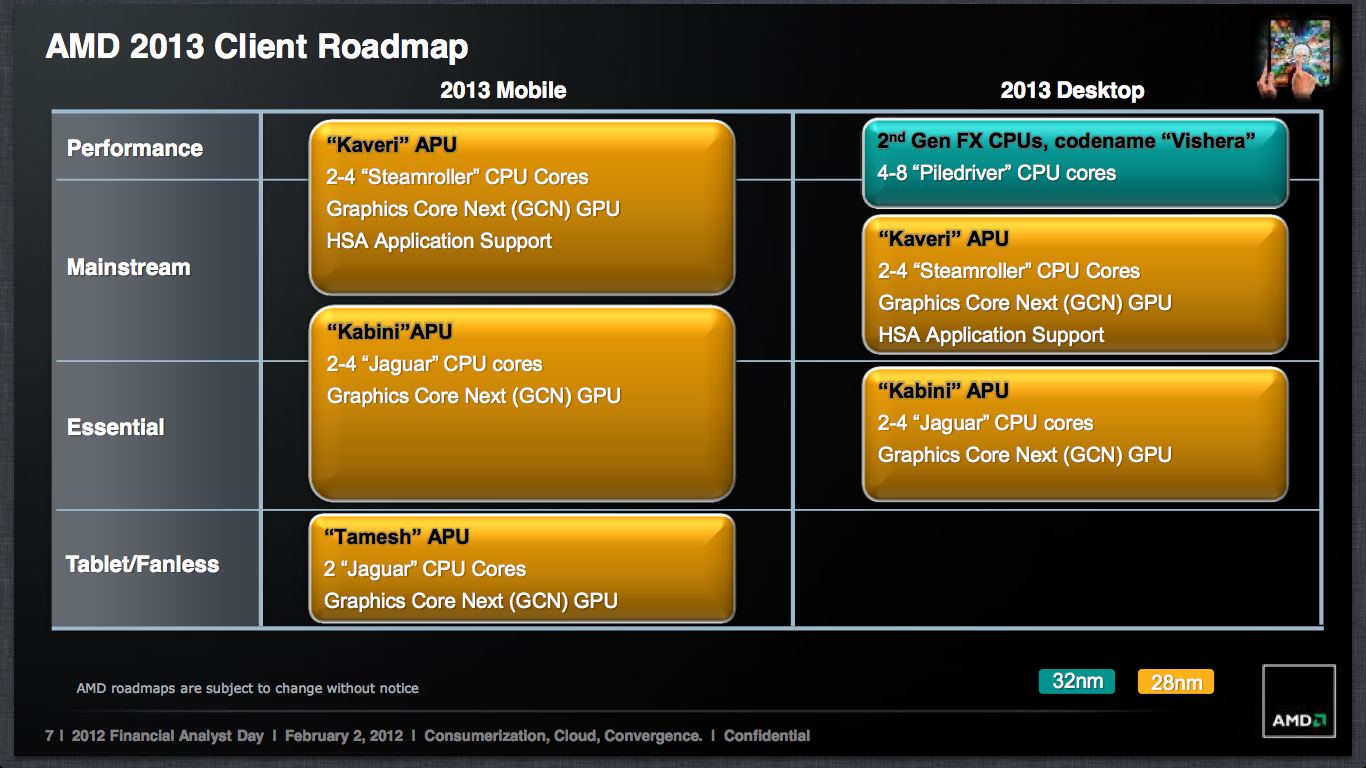
Look at AMDs client roadmap for 2012 and 2013. Did you see the recent Trinity benchmarks? Sucky CPU, decent GPU. Well look at the roadmap, those Piledriver cores are all you're going to get in AMDs "high-end" all the way through 2013. I'm sure you'll get more power in a cell phone or tablet format, but if you just want CPU power and don't care that it burns 100W because it's plugged to the wall then the future is mostly depressing. To use a car analogy, lower MPGs are great but it's not exactly what's going to get cheers from the Top Gear crowd. Sure a good soccer mom car sells and it's the same for CPUs, but they don't excite anybody.
You write like a clueless shill. More and more consumer software will be leveraging the design of once Bulldozer, now replaced by Piledriver which is much improved. Even the FOSS world has a lead on the Windows world when it comes to Concurreny Development. LLVM/Clang/Libc++/Compiler-RT/LLDB/Libclc and more are being optimized with target hardware from AMD, ARM, Nvidia, Intel and much more to take advantage of their various design tradeoffs. AMD bit the bullet and in the next 12 months it will heavily pay off. More and more of those tests are useless as applications work to task both the multicore CPUs and the Streams/Cores on GPGPUs from AMD, Nvidia and ImgTec. GCN architecture from AMD will be releasing it's 8000 series shortly and once again leap frog Nvidia, but will come with OpenCL 2.0 support and fully optimized. It's just up to user space apps to work with AMD ala Adobe, GIMP, Blender and Handbrake to leverage it all.
-
Re:No, not really...
Look at AMDs client roadmap for 2012 and 2013. Did you see the recent Trinity benchmarks? Sucky CPU, decent GPU. Well look at the roadmap, those Piledriver cores are all you're going to get in AMDs "high-end" all the way through 2013. I'm sure you'll get more power in a cell phone or tablet format, but if you just want CPU power and don't care that it burns 100W because it's plugged to the wall then the future is mostly depressing. To use a car analogy, lower MPGs are great but it's not exactly what's going to get cheers from the Top Gear crowd. Sure a good soccer mom car sells and it's the same for CPUs, but they don't excite anybody.
You write like a clueless shill. More and more consumer software will be leveraging the design of once Bulldozer, now replaced by Piledriver which is much improved. Even the FOSS world has a lead on the Windows world when it comes to Concurreny Development. LLVM/Clang/Libc++/Compiler-RT/LLDB/Libclc and more are being optimized with target hardware from AMD, ARM, Nvidia, Intel and much more to take advantage of their various design tradeoffs. AMD bit the bullet and in the next 12 months it will heavily pay off. More and more of those tests are useless as applications work to task both the multicore CPUs and the Streams/Cores on GPGPUs from AMD, Nvidia and ImgTec. GCN architecture from AMD will be releasing it's 8000 series shortly and once again leap frog Nvidia, but will come with OpenCL 2.0 support and fully optimized. It's just up to user space apps to work with AMD ala Adobe, GIMP, Blender and Handbrake to leverage it all.
-
No, not really...
Look at AMDs client roadmap for 2012 and 2013. Did you see the recent Trinity benchmarks? Sucky CPU, decent GPU. Well look at the roadmap, those Piledriver cores are all you're going to get in AMDs "high-end" all the way through 2013. I'm sure you'll get more power in a cell phone or tablet format, but if you just want CPU power and don't care that it burns 100W because it's plugged to the wall then the future is mostly depressing. To use a car analogy, lower MPGs are great but it's not exactly what's going to get cheers from the Top Gear crowd. Sure a good soccer mom car sells and it's the same for CPUs, but they don't excite anybody.
-
No, not really...
Look at AMDs client roadmap for 2012 and 2013. Did you see the recent Trinity benchmarks? Sucky CPU, decent GPU. Well look at the roadmap, those Piledriver cores are all you're going to get in AMDs "high-end" all the way through 2013. I'm sure you'll get more power in a cell phone or tablet format, but if you just want CPU power and don't care that it burns 100W because it's plugged to the wall then the future is mostly depressing. To use a car analogy, lower MPGs are great but it's not exactly what's going to get cheers from the Top Gear crowd. Sure a good soccer mom car sells and it's the same for CPUs, but they don't excite anybody.
-
Re:AMD is done and gone...
Whoops, you lose ten points for lack of foresight.
http://www.anandtech.com/show/5831/amd-trinity-review-a10-4600m-a-new-hope
That's the reason they are adding GPUs to CPUs.
Roll on the day when compilers automatically spit out OpenCL code when useful.
Then x86 performance will mean bugger all.
-
Re:But will it stand up against Intel?
Sorry but the 8 core FX kicks the crud out of the quad core i7 that is the same clock speed. I actually USE a pc for video editing rendering and 3d rendering and the new 8 core machine with one FX processor is kicking the arse of the i7 machine.
Mind telling us what applications you use? Because the 3.6 GHz FX-8150 loses to the 3.5 GHz i7-3770K in all of these (or 4.2 GHz vs 3.9 GHz if you want to compare turbo speeds), sometimes massively:
SYSMark 2012 - Video Creation
SYSMark 2012 - 3D Modeling
DivX encode
x264 encode - first and second pass
Windows Media Encoder 9
3dsmax (7/7 benchmarks)
CineBench R10 (single and multithreaded)
POV-ray SMP benchmark
Blender Character RenderOf course if you take the slower FX-8120 and compare it to the same clockspeed i5-3450 then maybe you'll score a few wins since it doesn't have hyperthreading, but that's only because Intel sells it with the handbrake on...
-
Re:AMD is done and gone...
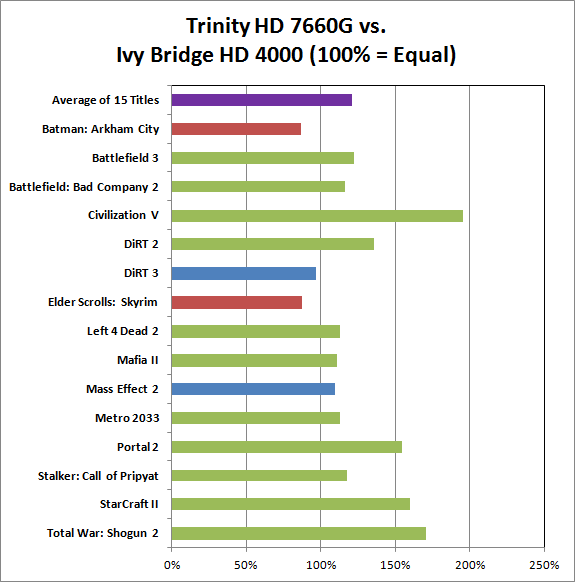
Well, the benchmarks disagree with you. The HD4000 IGP in the Ivy Bridge processors are DX11 that can run recent games at low to medium settings quite well. The Anandtech review for example shows that on some games like Batman Arkham City, Dirt 3 and Skyrim, the HD4000 even outperforms this new AMD APU. It loses on the other 4 games tested but it's still competitive. I'm only talking about gaming performance here, not video decoding where Intel wins by a large margin. Since Sandy Bridge, Intel GPUs have stopped sucking as bad as they used to IMO. They're at least now comparable to the integrated AMD GPUs.
-
Re:"outpaces Intel's Ivy Bridge for gaming"?
> AMD has the lead on average FPS, but it's now small enough that Intel wins in a few cases
Not really, Intel does win on a couple cases and is close for some cases.. Most of those are older CPU bound games. For Civ 5, AMD is close to 100% faster. A lot of the games that I looked at were ~ 40% faster (e.g. starcraft 2). e.g.
http://www.pcper.com/reviews/Mobile/AMD-Trinity-Mobile-Review-Trying-Cut-Ivy/Performance-Synthetic-3D-Real-World-Gaming
http://images.anandtech.com/doci/5831/trinity-vs-ivybridge-gaming-new.pngSo better gaming perf at a cheaper price.. AMD has a better single chip solution for games. If you want a discrete graphics card for games, better to go with Intel.
-
Re:"outpaces Intel's Ivy Bridge for gaming"?
> So, AMD has the lead on average FPS, but it's now small enough that Intel wins in a few cases. AMD's integrated GPU is still a little better normally, but it's not a slam dunk any more.
It's curious, that this is the case for mobile, but on the desktop the HD4000 is beaten by the Llano by a large margin:
http://www.anandtech.com/show/5771/the-intel-ivy-bridge-core-i7-3770k-review/15
-
Re:Or
My XOOM has been a 12 hour tablet for a long time.
And the iPad 2 always had a better battery-time than the Xoom http://www.anandtech.com/show/4225/the-ipad-2-review/6
-
Re:Slashvertisement
Actually high performance computing has created more demand. Nvidia GPU's are being used in massive supercomputers using OpenCL and CUDA. "AMD GPU's support OpenCL." There are a many more people who are interested in the latest and greatest GPU than you may think, specifically on a news for nerds site. So yeah, sweat article and thanks for the heads up about the new benches MojoKid.
They did not focus on the general purpose computing circuitry so that power and heat could be reduced. The main focus was on gaming. Seperate cards will be created specifically for computing.
-
This baby is s-l-o-w !!
According to the chart at http://www.anandtech.com/show/5805/nvidia-geforce-gtx-690-review-ultra-expensive-ultra-rare-ultra-fast/15
AMD Radeon HD 7970 CF wipes the floor with this baby from Nvidia
-
Re:Too bad their 22nm 3D failed
What you are seeing now is that Intel (probably extremely wisely for the market they are chasing most heavily) has tuned in their process node for stock voltages, but this is resulting in very leaky transistors at high voltages.
Actually, that's not quite what's going on. It's more like the new tech in Intel 22nm dramatically reduces the performance penalty of running at stock and lower voltages. Look at the graphs in figure #2 here:
http://www.realworldtech.com/page.cfm?ArticleID=RWT050511195446
The right hand graph is what I'm talking about. Less gate delay leads to higher clock frequencies, so the 2 curves show that for both 32nm and 22nm, as voltage increases, so does performance. (From seeing this in other contexts, apparently the gray curve between 32nm and 22nm shows a hypothetical 22nm with the same basic transistor design as 32nm rather than the new 3D "trigate" transistors.)
Note that while 22nm is always faster, the slope of the curve is closer to horizontal at every point. This means Intel 22nm performance is relatively insensitive to changes in voltage. That's actually a good thing -- it means you can reduce power (by reducing voltage) without hurting performance nearly as much. But it also means that a favorite overclocker knob is no longer very effective.
Additionally, while the current packaging has the ability to remove heat just fine at stock voltages, when you start leaking too much the heat builds up too quickly- which certainly is a 22nm node issue
Increasing the voltage does not reduce the ability of the packaging to conduct heat away. It just generates more heat to conduct away. And there is nothing inherent to Intel 22nm which causes heat to be trapped or "build up too quickly". The heat flow from active circuits to the heatsink is pretty much the same as it ever was -- circuits to die body to IHS to heatsink.
IMO, the main reason for higher temperatures is the increase in power density (power per unit area). Even though the TDP has gone down, die area has gone down more, and higher W/mm^2 = higher temperature. That's a truism which is independent of process (you can come up with ways to consume lots of watts in very little area in any process), so it's greatly influenced by a particular chip's design tradeoffs (how much power do you try to pack in per area?). But when you shrink an existing design (and IVB is mostly a shrink of SB, plus an improved GPU) you can pretty much count on increased power density by definition -- you're fitting the same design into a smaller area.
Also, overclockers are too accustomed to using the voltage knob to improve performance, and they're probably trying to push IVB voltages far above what they really should aim for. It's never going to give them as much benefit as before, and like all process node advances, 22nm shifts maximum safe voltages down somewhat.
-
Re:WTF
They seem to have merely omitted the games which favor AMD more strongly. Compare, for example, the Metro 2033 benchmarks (or BF3, or Skyrim) and you can see that they are relatively similar. THG did not test Crysis or Total War: Shogun 2, which the AMD cards perform better on.
-
Re:WTF--- compute on linux...
well it depends on what you want things for
basically I don't really see much difference in the graphics openGL/DX11 side of things but this was very interesting to me :
regards
John Jones
-
Re:Too bad their 22nm 3D failed
The shrink from 22 to 32nm is a staggering size change - 33% finer lithography - and it uses their much-hyped 3D transistor technology on top of things. Yet, Ivy Bridge, being just a shrink of the older Sandy Bridge die, shows no improvements over the 32nm version. Traditionally, Intel has always been able to show lower power consumption and more than a tangible performance improvement when just doing a process shrink, but the Ivy Bridge does nothing extra in terms of performance and consumes not lower power than its older 32nm sibling - and let's not mention the inefficient heat packaging causing temperatures hotter than the 32nm Sandy Bridge. There's a problem here, Intel.
While I will accept you reversed some numbers (the shrink was from 32 to 22, not the other way around) and Intel is using tri-gate transistors, most everything else you describe is just flat out wrong. Ivy Bridge DOES show lower power consumption at stock voltages (TDPs of 77W vs 95W are a testament to that), and it is higher performance at the lower power consumption (though not by huge amounts, nor was it intended to be). Since it is lower power than Sandy Bridge at the same frequency, it is not having any issues related to thermals and packaging.
Now, if you want to rant about the fact that it doesn't handle overvoltage well for overclocking purposes, that is fine, but it is a separate discussion compared to stock. What you are seeing now is that Intel (probably extremely wisely for the market they are chasing most heavily) has tuned in their process node for stock voltages, but this is resulting in very leaky transistors at high voltages. Additionally, while the current packaging has the ability to remove heat just fine at stock voltages, when you start leaking too much the heat builds up too quickly- which certainly is a 22nm node issue and not actually a packaging issue. Quite possibly, though how far in the future I can't begin to guess, they will probably tweak the process for the Extreme Edition CPUS to make them handle an overclock without leaking so much, but that will take some time learning how they can play with the various knobs to get what they want without destroying what they need.
This leaves me with the feeling that the only problem here is your expectations of a CPU that was manufactured with the intent of taking the mobile market by storm (and they have tuned the process properly for that) when what you want is an overclocking king. Let's see how they tune the process technology for the Extreme Edition (and hopefully copy into other desktop-bound CPUS) before any decisions are made that they have screwed the pooch on being able to overclock.
-
Re:Too bad their 22nm 3D failed
Traditionally, Intel has always been able to show lower power consumption and more than a tangible performance improvement when just doing a process shrink, but the Ivy Bridge does nothing extra in terms of performance and consumes not lower power than its older 32nm sibling
Is there any reason the parent is at +4, Interesting and not -1, Troll? Are the AMD fanbois really so desperate that they have to mod up blatant lies? Ivy Bridge uses 25-30W lower power at stock speed to deliver marginally better than SB CPU performance and considerably better (but still crappy) GPU performance. The only people that whine are those who want a 4.5+ GHz overclock. Anandtech called it quite possibly the strongest tick [Intel] has ever put forth, but I guess if you don't like reality you can invent your own.
-
Re:CUDA Double Precision?
They are. However, their relative FP64 performance has dropped compared to the previous generation. If I remember correctly, there is now separate silicon to do FP64, rather than just a modified path in the FP32 cores. In the previous architecture, we were down to 1/12 of FP32 performance, only a third of some of the Fermi chip cores could do FP64, and at half speed. In the new chip, the FP64 cores can do full-speed calculations, but there are only 8 such cores, versus 192 conventional cores, giving a 1/24 performance ration.
However, Ryan Smith at Anandtech speculated that the existence of dedicated FP64 cores means that a future Fermi based on Kepler will be a mean beast, if they do a tape-out with exclusively FP64 cores. The only thing holding back double-precision then will be memory bandwidth (which would be a large enough deterrent in many cases).
-
Engineering Samples, or Actual CPUs?
TFAs don't make this clear. I read around mid-March that the same problem showed up in the engineering samples. I'm curious: with over a month between the discovery and now, wouldn't have it been possible for the engineers to figure out some sort of solution? Or, is that just not possible, with the potential of chip production occurring at the same time as the engineering sample testing?
Certainly, I understand that the problem appears to appear only during overclocking. It's still interesting.
-
3d tri-gate not as good as promised
Remember a year ago Intel was bragging about their new 3d tri-gate process would be 50% more power efficient: http://www.intel.com/content/www/us/en/silicon-innovations/standards-22nm-3d-tri-gate-transistors-presentation.html.
Comparing the i7 3770K against the 2600K, which is clocked at the same frequency it's only 17% more power efficient: http://www.anandtech.com/show/5771/the-intel-ivy-bridge-core-i7-3770k-review/20
Also you have to bare in mind some of the power saving is due to the DDR controller power gating -
Re:Let me get this straight...
It offers a significant power reduction (~22%), plus a slight boost in IPC, same clock rates, and a notable boost in IGP performance (~30%). For instance, i7 3770K (77W TDP, and HD 4000) vs i7 2700K (95W TDP and HD 3000). Both are quad core, 8 thread, 3.5GHz with max turbo of 3.9GHz, and 8MB L3 cache. On the mobile CPU side, a new i7 3612QM, 35W quad core, 8 thread, 6MB L3 cache, and HD 4000 graphics, compared to at least 45W TDP on all prior quad core mobile i7 CPUs (with slower IGP).
-
Re:Still behind iOS and Android
It's not a technical limitation...but they'll fix that non limitation in WP8? Am I reading you right?
It is *absolutely* a technical limitation. Microsoft used iOS as the baseline that they emulated, only once they got where iOS was, it had moved long down the road (now supporting Android-like multitasking).
Further it is a bit humorous seeing WP boosters constantly using Android as the punching bag to elevate WP features. Only the Lumia 900 has rather terrible battery life.
http://www.anandtech.com/show/5724/nokia-lumia-900-review-supersized-with-lte/3
I'm not really feeling the advantages. But if we just wait until the next version...
-
Re:Other than the obvious
Huh? The benchmarks make no sense, and it's from March. Try this.
-
Re:Other than the obvious
http://www.anandtech.com/show/5626/ivy-bridge-preview-core-i7-3770k/12
You mean these benchmarks???
"What Ivy Bridge does not appear to do is catch up to AMD's A8-series Llano APU. It narrows the gap, but for systems whose primary purpose is gaming AMD will still likely hold a significant advantage with Trinity. The fact that Ivy Bridge hasn't progressed enough to challenge AMD on the GPU side is good news. The last thing we need is for a single company to dominate on both fronts."
-
Re:Let me get this straight...
A 50% GPU improvement over Sandy Bridge is VERY significant.
Compared to other Intel. But compared to AMD and NVidia it still sucks major donkey poo.