Slashdot Mirror
Domain: anandtech.com
Stories and comments across the archive that link to anandtech.com.
Comments · 3,318
-
Re:...Or an arms race
No need for an arms race... right now they coexist quite well. Get a small SSD just big enough for your boot drive and a large HD for your data drive. It's the best of both worlds. They are already offering laptops with hybrids and the new SSD's have the potential to be very small so they could easily fit in most laptops with a second normal HD if they introduce a smaller SATA format.
-
Re:Nikon F6 and FM10
Anand paints is a little bit differently, he implies that (good) ssds should absolutely last 5 years, not just make it there:
http://www.anandtech.com/cpuchipsets/intel/showdoc.aspx?i=3403&p=4
And that's writing 20 GB per day to the drive.
So you might still be on that first SSD after all.
-
Re:In 5 years
The point of the shift to 4k sectors (e.g. the WD "Advanced Format" drives) is that the amount of space needed for error correction at ever increasing densities was entering into the bounds of diminishing returns. Larger blocks mean less error correction is needed and thus more storage space for a given platter density. Anand has a pretty good writeup on it here: http://www.anandtech.com/printarticle.aspx?i=3691
-
Re:It has got silly
Geforce 8800 is equivalent to the GT240, they're practically the same chip. No such thing as an ATI 9250 however.
Again, if you go to my link, look at the chart there, it provides a great point of reference for modern GPUs.
If you're curious about comparing CPUs, take a look at the Anandtech Bench.
http://www.anandtech.com/bench/default.aspx?b=2&c=1
Pick the processors you want to compare and you make the decision. There are plenty of tools and resources available for the process of choosing your own components. Probably one of the best is to join a forum of avid enthusiast PC builders (No not PC gaming forums or slashdot, they're morons when it comes to choosing hardware) and ask for their input.
-
And If You Can Narrow It Down to Two ...
Those are great lists, also if you can narrow it down to two processors, check out Anandtech's comparison tool that helped me out a lot when I was trying to decide how far to upgrade recently. Because what I was looking for was frames per second in an MMO, not what it scored on a benchmarking tool.
-
More GPU bound than CPU bound nowadays
Any CPU with more than 2 cores, should be able to handle most of what you want... I've been testing a dual core Atom 330 at work, and it's actually easy to forget it's not a "real" CPU (unless some FPU-intensive screensaver comes on).
For mid-to-low-end systems, GPUs are really the discriminator
http://www.videocardbenchmark.net/ - a good comprehensive list that boils down and ranks just about every card out there into a single (artificial) benchmark number.
Wikipedia also has surprisingly good coverage of every family of chip, and what products are based off of them and tables of supported features - crucial for system building. So I use it primarily to figure out things like: which nVidia Geforce is equivalent to which Quadro FX branded model, what is the fastest memory my "Barton" core Athlon would support, what the hell is the difference between a 2.2Ghz "Williamette" vs. a 2.2Ghz "Prescott", etc.
I've also taken a liking to checking with http://www.phoronix.com/ for Linux benchmarks and support for new hardware features and drivers... such as nVidia vs. ATi vs. Intel, which distribution has better VPDAU or audio support, etc.
And definitely once in a while read up on http://anandtech.com/ and http://tomshardware.com/ if it's been a while and you need a comprehensive explanation of new tech, such as SSDs or long-term price vs. performance investment strategies... those can really help you plan ahead (Intel & nVidia's tick-tock release cycle, finding the best value, and just generally knowing which buzzwords are important and which are just marketing rubbish.
-
Just buy a complete machine
Just find a reputable computer seller and order a machine that fits your budget. It'll probably run whatever you need it to run. If Oblivion is the heaviest game you're going to run, you can be done for about $500 probably.
If you don't want the same boring standard machine that everybody else has, then you'll have to do some research. I did that 2 years ago. My main resource was Silent PC Review because I was tired of my old jet-engine-soundalike. AnandTech is also a good source, as is Tweakers, if you happen to be Dutch. Lots of articles on those sites will refer to Tom's Hardware, which does benchmark graphs, but really, just get what everybody's recommending.
Two years ago, I went with:
- Intel Core 2 Duo E8400 (brand new at the time, very fast, very low power usage, therefore little heat) with a passive Scythe Ninja cooler,
- ATI HD3850 (new, powerful, not overly expensive, good for all games expect Crysis, low power usage when not doing 3D stuff) from Peak (cheaper than other HD3850s because they had a badly fitted cooler which I was going to replace anyway) with passive Accelero S1 cooler (very effective passive cooler, and very cheap).
- Seasonic S12II-380 power supply (SeaSonic has the quietest PSUs, and 380 W is more than enough for a modern PC that doesn't try to waste as much power as possible),
- Antec Solo case (Antec makes the quietest cases, but stay away from their power supplies)
- Some new Samsung harddisk that everybody else was using too.
- Some Gigabyte motherboard with P35 chipset, which was what you needed two years ago
All of this cost me about EUR 1000. Very happy with it. Dead quiet, too. Mind you, this is from 2 years ago. There's probably better, cheaper, quieter, faster stuff around now, but I'm not keeping up.
As for the dual core/quad core stuff: how many heavy CPU-using applications will you be running at the same time? Will your heaviest applications be able to make efficient use of multiple cores? If you don't know, go with dual core. One for the main app, one for everything else. No need to have to extra cores that are only idling all the time.
-
Re:They wish they'd thought of it first
Uhhh...dude? When was the last time you used ATI, 1998? I have been building a LOT of AMD based systems since Phenom came out and the "bang for the buck" got so crazy, and you know how many problems me and my customers have been having with the ATI chips? Zero. Zipola. Zilcha, nada, squat.
Frankly since being bought out by AMD their drivers and hardware have been nothing but good from what I've seen, and I've been building everything from single core semprons (great for ultra quiet HTPCs) to Phenom II quads, all with ATI GPUs, both onboard and discrete, and so far not a single lick of trouble. For users that only casual game and watch video the new onboards accelerate just about every format and will even play games like Bioshock at an acceptable framerate, and the 4xxx and 5xxx chips are cheap, fast, and can crank out the pretty.
Considering that Nvidia has pretty much been rehashing the same chips since 07, and from what I've been reading Fermi is gonna be a GP-GPU first and foremost with P4 era space heating capability, maybe it is time to try one of the new ATIs, hmmm?
-
Re:Indeed.
I've heard that nearing the end of large worlds, gaming is CPU-bound (at least during end-of-turn events). So, you might want to look for a small CULV (Core Ultra Low Voltage) laptop...
http://www.anandtech.com/mobile/showdoc.aspx?i=3735
Typically you'll have 11" displays with 768 lines on a CULV, and probably 1024by600 on a typical netbook. However, you'll pay more for a CULV, the CULV is bigger and has (usually) a lower battery life. -
Re:Dropship?
They have three warehouses. Here you can see a tour.. it's pretty neat:
-
Re:no way newegg's fault
Not only that, I remember seeing an article on neweggs setup in one of their warehouses. http://www.anandtech.com/IT/showdoc.aspx?i=2694&p=1 Let's just say that between the surveillance and the other security measures I can almost guarantee this wasn't a Newegg employee. I would guess that this happened at either the Costa Rican Intel sites or in the distribution chain. D & H actually has a pretty high rep, so I would guess that this was not a corporate issue even there, but an employee.
My guess is that NewEgg is going to have to do item audits in which they open random samples from their distributors to ensure this doesn't happen again.
I would guess that D&H is more pi$$ed than NewEgg is about this, since this kind of thing will definitely affect stock ratings if it comes to light as their own issue. Props to Newegg for NOT going ballistic publicly.
-
Re:Little Flawed study.
$/GB is crap, $/IOPS is amazing.
Quoted for truth. For applications where GB are not needed but IOPS is, IOPS is the only thing that matters. Booting and applications usually need less than 40GB. We are already at that point where the total cost is more than worth it from a total system cost perspective. Games are there, or nearly there. I highly doubt that someone is going to have more than 160GB of games they play regularly, in which case, SSD are a logical choice for games. Low minimum FPS is what destroys a gaming experience, not so much the average. And SSD shine there. http://www.anandtech.com/cpuchipsets/intel/showdoc.aspx?i=3403&p=14
For terabyte sized applications, there is only media (not talking enterprise here), and HDD does an excellent job there. And really, there are two use cases - putting the files on there/copying them off in the first case, and reading them off slowly. It seems like HDD would benefit from having two spin speeds - a fast speed for copying data to and from the drive, and a very slow speed for streaming that would lower the power use and probably increase longevity of the drive. One benefits from 5000rpm plus, the other really only needs 500rpm. It could possibly be adaptive too - surely you can algorithmically sense when the HDD is only getting small chunks of data every so often, and arrange for the drive to slow down - perhaps pre-fetching it even. HDD makers need to accept the fact that their drives really only make sense as media drives (or will very shortly), but are not yet optimum for that purpose.
-
Re:Little Flawed study.
A fair number of the desktop stuff can take sustained writes for quite a long while- e.g. the entire disk or more.
If that's not enough, some of the desktop benchmarks/tests, involve writing to the entire disk first, and then seeing how far the performance drops.
e.g.
http://www.anandtech.com/printarticle.aspx?i=3702See: "New vs. Used Performance - Hardly an Issue"
They're not cheap, but they sure are cheaper than USD100K.
-
Re:Decent performance, strong sequential writes
Anandtech has become the only source I trust on SSDs: http://www.anandtech.com/storage/showdoc.aspx?i=3757&p=5
Decent performance, certainly better than hard drives, but nowhere near Intel and top shelf OCZ. -
Price / Perfomance Question
Here is a link to the review of the disk over at anandtech. Interestingly, it seems this drive will not be using one of the higher performance SSD controllers (Sandforce / Indilinx), so the performance should be worse than other competitors. If the price is as predicted (128 GB @ $529), then this drive wont make much sense compared to faster drives from OCZ etc
-
Re:At some point, the GPU goes on the CPU chip
At some point, the GPU goes on the CPU chip
Actually, that point was back in January when Intel started shipping the Clarkdale Core i3 and i5 processors
Clarkdale uses a dual-core Westmere and sticks it next to a 45nm Intel GMA die. That's right, meet the first (er, second) Intel CPU with on-chip graphics. Next year we'll see Sandy Bridge bring the graphics on-die, but until then we have Intel's tried and true multi-chip-package to tide us over.
-
Re:Too much hyperbole...
The intial Larrabee product was canceled. Intel had to re-trench on the graphics plans. Again. They are a smart company, but they have struggled to get off the ground in the graphics area. Im assuming they will someday be successful. But today isnt that day.
-Foredecker
-
And for an overview that knows how to do math...
Anandtech has a much better write up on this technology, complete with correct conversions from bits to bytes, knowledge of the difference between 4096 bytes and 4096 kilobytes, and no in-text ads.
-
One step closer to holodeck
It's the goal of Carrell Killebrew from ATI to make a holodeck.
His desire to do this wasn’t born out of pure lunacy, Carrell does have a goal in mind. Within the next 6 years he wants to have a first generation holodeck operational. A first generation holodeck would be composed of a 180 degree hemispherical display with both positionally and phase accurate sound. We’ll also need the pixel pushing power to make it all seem lifelike. That amounts to at least 100 million pixels (7 million pixels for what’s directly in front of you, and the rest for everything else in the scene), or almost 25 times the number of pixels on a single 30” display.
From: Anandtech (4th paragraph)
-
Re:Wow great job
Well, the iPhone 3GS sure outperforms the older PowerVR MBX-Lite use in all previous iPhones. The MBX-Lite used in the older iPhones does about 1Mpolys/second at the iPhone's 50-60MHz GPU clock speed.
Some real benchmarks: Tap Tap (a big iPhone developer) found the 3GS about 4x faster in 3D applications:
http://www.taptaptap.com/blog/iphone-3gs-blows-away-iphone-3g-in-3d/There is a THEORY that the GPU is an underclocked PowerVR SGX 535 (Intel calls this the GMA500), largely based on some #defines in the Apple SDK. And also because they include the VXD370 media accelerator, which has usually been coupled with higher-end SGXs. Of course, TI didn't need this, they have had their own media acceleration technology going back to before the DaVinci SOCs (what you find in most higher-end PMPs going back some years). This is a chip custom-made for Apple by Samsung, so in truth, unless Apple's talking, we may not know. The Anandtech article also postulates the SGX 520, but again, any number of core + clock speed combinations lead to the same answer.
http://www.anandtech.com/gadgets/showdoc.aspx?i=3579But a full SGX 535 runs at 200MHz and does 28 MPolys/s. Pretty good chance that's not what the iPhone 3GS is running -- there are no benchmarks showing even half of that performance. Most benchmarks show the 3GS running 3x to 7x faster at 3D, an assuming the faster CPU isn't part of that, you could get with an SGX 535 at 50MHz, an SGX 530 at 100MHz, or an SGX 520 at 200MHz. The real answer might be known to developers: the SGX 520 has a single Universal Scalable Shader Engine (USSE) pipeline, the others add multiple pipelines for additional performance. Not that you'd necessarily have this exposed in OpenGL.
It is not debatable about the DROID/Milestone.. it contains OMAP 3430, which contains the PowerVR SGX 530 GPU core. TI quotes a peak of 10Mpolys/sec. which this chip at normal clock speeds; it's programmable, typically run in the 100-160MHz range (14Mpolys/sec is the peak you can expect with 200MHz clock). Of course, there are all sorts of folks boosting their DROID to much higher clock speeds, but this what you'd expect in stock performance. And it's quite possible there are still optimization issues in Android that no longer apply to the slightly more mature iPhoneOS.
-
Not impressed
I'm not impressed. Epic had Unreal Engine 3 running on the iPhone back in december last year: http://www.anandtech.com/gadgets/showdoc.aspx?i=3695 Granted, it's a modified version and I don't think there's a working game available yet that uses it, but the engine is several generations newer than the Quake 3 one... Still, nice job. It's weird to see 'big' games appearing on tiny devices. Didn't think the mobile technology would be this advanced so soon, tbh.
-
Anandtech 'Bench' compares ALL recent CPUs...
And its constantly growing. check it out: http://www.anandtech.com/bench/default.aspx?b=2&c=1
-
Re:She just love my big 10 inch
Some ION systems have struggled slightly with 1080p decoding. If ION 2 is all it's billed to be (harder, better, faster, stronger) while keeping smaller energy footprint with seamless switching between integrated and discrete graphics (as Anand seems to think it does well: http://www.anandtech.com/mobile/showdoc.aspx?i=3737), then I'm all for it.
Of course, the ION 2 platform isn't going to be limited to netbooks. The market for small HTPCs (Zotac MAG or Acer Revo and their ilk, I think they're called "nettops" or something) seems to be slowly but steadily gaining steam. Those platforms need to be able to smoothly drive 1920x1080 displays, and ION 2 seems to be something of a match made in heaven for this sort of purpose.
-
Re:It's all about content
The problem is that the iPad will have, realistically, a 5 hour battery life in normal usage
So you're telling me that the iPad, with a small screen and an ARM SOC that consumes a miniscule amount of power, no spinning hard drive, and a GPU specifically designed for long battery life and cool operation...will have a shorter battery life than my 15" MacBook Pro, which lasts 7 hours in normal usage?
No, not the fabrications of a fanboy:
http://anandtech.com/mac/showdoc.aspx?i=3580&p=1The iPad will have a 10 hour battery life just as my MacBook Pro has a 7 hour one, with wifi and Bluetooth active and the screen at about 2/3 brightness.
-
Re:Are most programmes multi-processor?
Can most programmes really be written to take advantage of so many cores? I am not sure I want to have a 6-core processor, of which 5 spend most of the time idling as I am only running a single-core-aware programme. OK, one more core can be used by the OS to make everything snappy, but the question stands.
Intel agrees with you, and that is why their first 32nm release was their mainstream processor codenamed Clarksdale:
2 processing cores
4 threads
4MB cache to make multitasking smooth.It has all the fancy features of it's bigger bother (including encryption acceleration), but with 1/3 the real cores. You get much better IPC than the Core 2 Duo line, and a great multitasking experience.
The 6-core behemoth to be released later this year is just to make server and workstation owners happy.
-
Re:Nightmare
How come the GPU vendors do not have a freaking portion of their hardware always work the same way, with same driver code - it just does mode setting and sets up the GPU for decent level of 2D acceleration.
Because it doesn't have a 2D engine anymore, it's all treated like a special case of 3D where z is always 0. That is just one example, there's a lot of rewiring going on inside the pipeline. Try for example reading this page on how nVidia is changing their fixed function pipeline and see if you manage not to get a headache. The drivers have to work the new way even just to achieve the old ways, it's not like CPUs where you slightly extend the x86 interface.
-
Re:Double patterning has limits.
The practice of optically shrinking an existing die without redesign/relayout is known as half-node stepping. If you read the analysis of these 25 nm parts over at Anandtech you will see that this is clearly not a half-node step. These parts are running charge trap memory cells whereas the previous generation used floating gate cells. Personally, I'll take the increased storage density any way I can get it.
-
Re:Great News
I think more troubling in the SSD market has been poor design at the low end (see http://www.anandtech.com/printarticle.aspx?i=3531 for more detail). 150 dollars for a 64 GB SSD is fine, but when random write speed is an order of magnitude slower than a standard hard drive that costs an order of magnitude less, something is severely wrong.
Early adopters such as myself got pretty screwed over. Until consumers can trust the technology, I don't think price matters. Manufacturers need to put effort into building a high quality product first - they need to design good controllers and firmware.
-
Re:This is really starting to stretch it.
The concept of Flash is awesome, but it is a CPU hog and often abused in places it ought not be implemented. Good news however. Starting with Flash 10.1, it will be GPU accelerated for Windows, Mac, and Linux. So far the benchmarks have been very promising. Check out the following links for more info.
http://www.anandtech.com/video/showdoc.aspx?i=3678
http://www.engadget.com/2009/11/17/adobes-flash-player-10-1-beta-gpu-acceleration-tested-document/
-
Re:Oh noes!
- seeing a computer which can run Crysis?
-
Re:Costs more
Apparently, 256-bit GDDR5 is enough.
(figures from http://www.anandtech.com/video/showdoc.aspx?i=3721&p=2)
GF100 has a 384-bit memory bus, likely with a 4000MHz+ data rate. HD5870 has a 4800MHz data rate, so let's assume the same.
The GTX285 had a 512-bit memory bus, with a 2484MHz data rate
So the bandwidth is (384/512) * 4800 / 2484 = 1.45x higher.
-
Anandtech
Anandtech also has an article up about the GF100. They generally have very well written, in-depth articles: http://www.anandtech.com/video/showdoc.aspx?i=3721
-
Re:Look I don't mean to be a cynical bastard but,.
5850, no, 5870? Maybe and even then in 99.9% of games it's basically "here we see 90fps in 1920x1200 on the 4890 and we see 145 on the 5870!" Thing is I'm hitting 90fps already at 1920x1200, I (and very few) people have a 30" Apple display.
Not to say faster isn't better in the long run of couse but on a $ / speed ratio right now, the 5xxx series just isn't cutting it, far too overpriced - and to think it was ATI who saved us from Nvidia doing the exact thing when the GT series came out 18 months ago. One manufacturer is behind, jack the prices
The cheapest 5850 is about 280$ the cheapest 4890 is about 190$
http://www.anandtech.com/video/showdoc.aspx?i=3650&p=12
http://techreport.com/articles.x/17652/4I'm just not seeing 90$ extra worth of value here for the 5850, let alone the 5870.
Within literally 8 weeks of the first review of the next nvidia card, you'll see these prices 30% less across the board, it's not a smart time to buy right now. -
Re:Lies. Slander.
Your wish is granted. Anandtech tested the battery life with x264 720P video and they got about 6 hours out of it.
http://www.anandtech.com/mobile/showdoc.aspx?i=3689&p=7 -
Re:How good/bad is their acpi implementation?Anandtech has a review of this and they seems to be pretty impressed with it. They proclaimed it their favorite laptop.
http://www.anandtech.com/mobile/showdoc.aspx?i=3689
Here is the opening sentence of their conclusion:
"Right now, the ASUS UL80Vt is the high water mark for a do-everything laptop: office, gaming, and mobility are all handled with aplomb." -
Re:How good/bad is their acpi implementation?
I wish they would list battery life under "Heavy Use".
I remember reading a Netbook review where it pointed out how bogus the 10 hour claims are. Can't find the exact one, but this one is similar.
10 hours? No. 6 hours if you're doing something. Listening to an MP3 while you work in Office and browse the web? That's CPU, speakers, Wifi, possibly Flash(GPU/CPU), and the HDD. 6 hours is expected under fairly normal use for anyone that visits slashdot.
And yet devices like the Pandora handheld make real heavy use claims. Why must it be a small insignificant company to avoid being lied to?
-
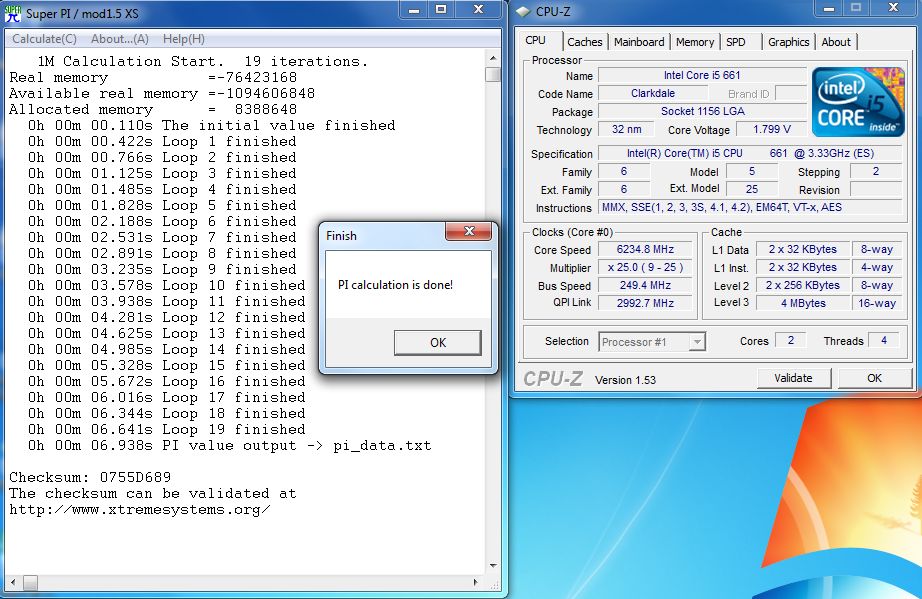
In others news, SuperPi 1M in less than 7 seconds
Intel's new CPUs can calculate SuperPi 1M in less than 7 seconds when clocked at 6234.8MHz
-
Reviews online at anandtech.com and techreport.com
DESKTOP PROCESSORS
http://techreport.com/articles.x/18216/1
"As a CPU technology, Clarkdale is excellent. I can't get over how the Core i5-661 kept nearly matching the Core 2 Quad Q9400 in things like video encoding and rendering with just two cores. We've known for a while how potent the Nehalem microarchitecture can be, but seeing a dual-core processor take on a quad-core from the immediately preceding generation is, as I said, pretty mind-blowing. Clarkdale's power consumption is admirably low at peak
(...)
The integrated graphics processor on Clarkdale has, to some extent, managed to exceed my rather low expectations."http://anandtech.com/cpuchipsets/showdoc.aspx?i=3704
"For a HTPC there's simply none better than these new Clarkies. The on-package GPU keeps power consumption nice and low, enabling some pretty cool mini-ITX designs that we'll see this year. Then there's the feature holy-grail: Dolby TrueHD and DTS HD-MA bitstreaming over HDMI. If you're serious about building an HTPC in 2010, you'll want one of Intel's new Core i3s or i5s."NOTEBOOK PROCESSORS
http://anandtech.com/mobile/showdoc.aspx?i=3705
"From the balanced notebook perspective, Arrandale is awesome. Battery life doesn't improve, but performance goes up tremendously. The end result is better performance for hopefully the same power consumption. If you're stuck with an aging laptop it's worth the wait. If you can wait even longer we expect to see a second rev of Arrandale silicon towards the middle of the year with better power characteristics. Let's look at some other mobile markets, though.
(...)
If what you're after is raw, unadulterated performance, there are still faster options.
(...)
We are also missing something to replace the ultra-long battery life offered by the Core 2 Ultra Low Voltage (CULV) parts. " -
Reviews online at anandtech.com and techreport.com
DESKTOP PROCESSORS
http://techreport.com/articles.x/18216/1
"As a CPU technology, Clarkdale is excellent. I can't get over how the Core i5-661 kept nearly matching the Core 2 Quad Q9400 in things like video encoding and rendering with just two cores. We've known for a while how potent the Nehalem microarchitecture can be, but seeing a dual-core processor take on a quad-core from the immediately preceding generation is, as I said, pretty mind-blowing. Clarkdale's power consumption is admirably low at peak
(...)
The integrated graphics processor on Clarkdale has, to some extent, managed to exceed my rather low expectations."http://anandtech.com/cpuchipsets/showdoc.aspx?i=3704
"For a HTPC there's simply none better than these new Clarkies. The on-package GPU keeps power consumption nice and low, enabling some pretty cool mini-ITX designs that we'll see this year. Then there's the feature holy-grail: Dolby TrueHD and DTS HD-MA bitstreaming over HDMI. If you're serious about building an HTPC in 2010, you'll want one of Intel's new Core i3s or i5s."NOTEBOOK PROCESSORS
http://anandtech.com/mobile/showdoc.aspx?i=3705
"From the balanced notebook perspective, Arrandale is awesome. Battery life doesn't improve, but performance goes up tremendously. The end result is better performance for hopefully the same power consumption. If you're stuck with an aging laptop it's worth the wait. If you can wait even longer we expect to see a second rev of Arrandale silicon towards the middle of the year with better power characteristics. Let's look at some other mobile markets, though.
(...)
If what you're after is raw, unadulterated performance, there are still faster options.
(...)
We are also missing something to replace the ultra-long battery life offered by the Core 2 Ultra Low Voltage (CULV) parts. " -
Re:So only XP is out of luck?
ECC is more efficient for 4k blocks. Apparently, 100 bytes of ECC for a single 4k block are as reliable as 320 bytes of ECC for eight 512 byte blocks. See http://www.anandtech.com/storage/showdoc.aspx?i=3691
-
Re:Looks like 512
Those are "logical" sectors, which can be different from the physical sector size. According to the Anandtech article the Western Digital hard drive model numbers that end with "EARS" use the larger, 4KB physical sector size, while presenting a 512 byte logical sector size to the operating system for compatibility reasons.
Please note, of course, that the logical sector size is a drive interface level concept distinct from the filesystem cluster or block size. Filesystem block sizes have generally been larger than the logical or physical sector size for quite some time.
-
Re:So only XP is out of luck?
"WinXP is end-of-life? You'd best tell that to all the millions of users (including big businesses) out there."
Couldn't agree more. Hopefully I don't have to rehash how horrible Vista was, and Windows 7 came out a few months ago so it's a bit early to proclaim XP is dead when it's hopeful replacement just showed up.
I think 4096-byte sectors are Very Bad News. I have no experience with these drives but XP doesn't like them which is reason enough for me to avoid them. I hope hard drive manufactures come out with a standard naming scheme for these new drives so they're easy to identify online, like IDE, SATA, PATA, etc. Maybe AFD for Advanced Format Drive? -
Re:Robots
but useless when even the most basic decision-making is required.
So don't let them make any decisions. Stick a bar code on everything as it comes in and weigh it. Let the robots do the multi-mile treks around the factory, and all they have to be smart enough to do is scan a bar code and double-check the weight.
Robots are used at Newegg, for instance. It's just that sizing the costly capital equipment for the peaks probably would increase the payback period by quite a bit! Better to use seasonal workers.
I have to wonder what Amazon was thinking, building such a labor-intensive operation four hours from the nearest major labor pool.
It looks like they took over a former Golden Books warehouse. I have no insight, but a glance at the map shows that it is smack in the middle of a bunch of area population centers - kind of the center of mass of Wichita, Kansas City, Oklahoma City, Tulsa, and Springfield.
-
More reviews at techreport.com and anandtech.com
The main benefit of the new Atom platform is its improved efficiency.
More info at:
Intel's next-gen Atom arrives in Asus' Eee PC 1005PE netbook
http://techreport.com/articles.x/18167
"Pine Trail's pseudo-system-on-chip architecture is quite a departure from the first Atom platform and an impressive achievement for Intel. Not only has the company managed to drop the number of chips and dramatically reduce the platform's footprint, but it has also lowered power consumption by a healthy margin. Those improvements should make it easier for manufacturers to churn out slimmer and lighter netbooks with better battery life than ever before."Intel Atom D510: Pine Trail Boosts Performance, Cuts Power
http://anandtech.com/cpuchipsets/showdoc.aspx?i=3692
"First, new vs. old Atom. With a real world performance improvement approaching 10% on the desktop, I'm happy with the performance of Pine Trail. Short of Intel introducing a brand new architecture, Atom isn't going to get much better, so the fact that we're getting anything is worth being happy about.
The impact of the on-die memory controller is noticeable on overall system performance. As I said earlier, my Pine Trail testbed was snappier and more responsive than my older Atom machines. It's by no means fast, but it's noticeably faster than before.
Power consumption is also much improved thanks to Intel ditching the archaic 945 chipset. Although the impact on battery life in netbooks is going to be more exciting than drawing less power at the wall. Pine Trail is worth waiting for."ASUS Eee PC 1005PE: Pineview Arrives
http://anandtech.com/mobile/showdoc.aspx?i=3693
"The latest release of Atom brings quite a few changes, but the net result isn't quite as impressive as we were hoping. We have an integrated memory controller in the CPU along with a GPU on package. Those are cost saving measures that also provide some benefits in terms of power requirements. What they apparently don't provide is a significant improvement in performance. Anand saw around a 10% improvement in performance relative to Diamondville on the desktop, but the real problem is what we didn't get.
Specifically, Pineview needed a lot more than GMA 3150 to make it attractive. Given a choice between N280 ION and N450 Pineview, ION will offer a better overall experience for the vast majority of users. If you want to do a silent HTPC, Pineview is going to need some form of external graphics, making the GMA 3150 a waste of space. We would have been much happier if Intel had included GMA 4500 instead, and even then it would be underpowered compared to ION." -
More reviews at techreport.com and anandtech.com
The main benefit of the new Atom platform is its improved efficiency.
More info at:
Intel's next-gen Atom arrives in Asus' Eee PC 1005PE netbook
http://techreport.com/articles.x/18167
"Pine Trail's pseudo-system-on-chip architecture is quite a departure from the first Atom platform and an impressive achievement for Intel. Not only has the company managed to drop the number of chips and dramatically reduce the platform's footprint, but it has also lowered power consumption by a healthy margin. Those improvements should make it easier for manufacturers to churn out slimmer and lighter netbooks with better battery life than ever before."Intel Atom D510: Pine Trail Boosts Performance, Cuts Power
http://anandtech.com/cpuchipsets/showdoc.aspx?i=3692
"First, new vs. old Atom. With a real world performance improvement approaching 10% on the desktop, I'm happy with the performance of Pine Trail. Short of Intel introducing a brand new architecture, Atom isn't going to get much better, so the fact that we're getting anything is worth being happy about.
The impact of the on-die memory controller is noticeable on overall system performance. As I said earlier, my Pine Trail testbed was snappier and more responsive than my older Atom machines. It's by no means fast, but it's noticeably faster than before.
Power consumption is also much improved thanks to Intel ditching the archaic 945 chipset. Although the impact on battery life in netbooks is going to be more exciting than drawing less power at the wall. Pine Trail is worth waiting for."ASUS Eee PC 1005PE: Pineview Arrives
http://anandtech.com/mobile/showdoc.aspx?i=3693
"The latest release of Atom brings quite a few changes, but the net result isn't quite as impressive as we were hoping. We have an integrated memory controller in the CPU along with a GPU on package. Those are cost saving measures that also provide some benefits in terms of power requirements. What they apparently don't provide is a significant improvement in performance. Anand saw around a 10% improvement in performance relative to Diamondville on the desktop, but the real problem is what we didn't get.
Specifically, Pineview needed a lot more than GMA 3150 to make it attractive. Given a choice between N280 ION and N450 Pineview, ION will offer a better overall experience for the vast majority of users. If you want to do a silent HTPC, Pineview is going to need some form of external graphics, making the GMA 3150 a waste of space. We would have been much happier if Intel had included GMA 4500 instead, and even then it would be underpowered compared to ION." -
Re:Cut a deal
Good response time is easy.
Yes, it's simply a matter of lying about it on the specification list. 5ms my ass.
-
Re:Oh rats
I don't know about that. Intel's offerings that are slated to come out 1Q - 1H of 2010 could give AMD some problems. Right now AMD has the performance advantage in the server space, but Gulftown will likely trump their offerings. Arrandale also looks quite impressive, especially the quad core i7 with an 18 watt TDP. The cores only run at 1.2 GHz, but with their Turbo boost the chip can clock up to 2.2 GHz. That will offer some amazing battery life for laptops and still provide good performance. I do believe some of the Arrandale processors will have a GPU on die as well. Granted it's an Intel GPU, but it offers some great power and cost savings over having to include a discrete card.
AMD doesn't look to have anything great coming out until late 2010 or early 2011 based on their roadmap. It helps that ATI is kicking ass in the graphics space. Right now they're winning on price and power. If they can get more of their 5800 series out in the market and release the mobile versions of those cards sooner rather than later, they'll be able to push a lot of hardware that way. However, they're not a real threat to Intel until they can get their SOC products out the door and offer a really compelling reason to go with their products.
Settling their legal issues with Intel will also help them a lot in the long run, but they're not out of the woods yet. They're still having financial problems, but if they can get through the next 18 months they'll be in great shape. The fact that they've been ahead of schedule on a lot of their new chips in the last year has probably helped substantially as well. AMD is in good position for the long term, but they need to decent sales in the coming quarters, which may be difficult to do with Intel releasing a lot of great new chips, especially in the mobile market where AMD hasn't been particularly strong recently. -
Re:Oh rats
Intel delivered the first sub-40nm flash memory and has delivered two generations of top-flight solid state drives. Intel has always been strong in flash memory.
-
Re:Random write speed?
That's my plan. I've got the cheap, big disk... I just have to buy the small, fast SSD.
You have heard about Kingston's 40GB SSD that uses Intel's X25-M G2 controller, right?
It's supposed to be $115 ($130 with 3.5" adapter kit), but it's hard to find in stock now.
-
Random write speed?
I thought it was pretty clear that what matters for most desktop users is the random small write speed. See, for example, Anandtech's SSD anthology and later followups.
So, where are the 4 KiB random write benchmarks? They are conspicuously absent from this review. We can see the effect, I think, in the IOMeter results -- the X-25M outperforms the OCZ drive across the board on those, despite the OCZ win in the throughput tests. But, personally, I'd like to see the raw numbers on 4 KiB random writes. Have this many reviewers really learned so little about benchmarking SSDs since they came out?