Slashdot Mirror
Domain: apple.com
Stories and comments across the archive that link to apple.com.
Comments · 27,593
-
Re:BYOD in the NAVY???
Are they insane? that BYOD better not be any where near any nuke launcher systems
No, I don't think Apple can sue.
The iTunes app store terms and conditions only says:
You also agree that you will not use these products for any purposes prohibited by United States law, including, without limitation, the development, design, manufacture or production of nuclear, missiles, or chemical or biological weapons.
No development, no design, no manufacture, no production.
But no where does it say "launching". Launching should be fine.
-
Re:Mac/Linux support removed... mildly surprised
-
Re:I know that happened to me.
You might have heard of this product.
While it has no wireless, less space than a Nomad, and come consider it lame, the kids seem to like it.
-
Re:On iOS platforms.
Depends on the language binding, does it not?
What is
UnsafeMutablePointer<SomeClass>
in Swift is
SomeClass *
in C.https://developer.apple.com/li...
That was easy to google btw.
-
Re:Manual Quantization
Orly.
https://developer.apple.com/li...
Strange. Seems their official app guidelines are to supply icons in multiple raster sizes and it picks the best one to use...
"Capable" and "Actually Utilises" are very different things.
P.S. Display PDFs natively just means it has a library to do so. It says nothing about the underlying system. I can display PDF's "natively" on Windows, it's called the Reader app.
-
Re:On iOS platforms.
Sorry, you are pretty mistaken.
You only need to marshal relevant types if there is something to marshal.
Not when there is a one to one relationship. And to not have a one to one relationship you deliberately need to break it.
I suggest to read something like this: https://developer.apple.com/li...
And then go back to compiler construction, especially code generation classes. You seem to be fond about those but seem to have missed something.
You need to marshal the pointer to an appropriate type And why is that so, that you actually don't need to do that in C/C++/Java/Pascal?
-
Re:Unlikely
What interests me is how far up shit creek will a developer be if he/she realises that they need a C/C++/ObjC library for his Swift application?
Not far up at all. Swift and Objective-C can easily call each other (Using Swift with Cocoa and Objective-C). This isn't particularly difficult, as in Objective-C you can use very easy reflection against classes to do fancy things like key-value coding, grab methods by name, etc.
Swift also has full C access support, with specialized types to map to standard C types. I'm not sure about C++, however it should be easy to add an Objective-C++ wrapper around it if there isn't some other way to do it (hopefully someone who has worked in Swift can jump in here -- I'm just looking at Swift right now, and haven't done any actual work in it yet).
Yaz
-
Re:Unlikely
What interests me is how far up shit creek will a developer be if he/she realises that they need a C/C++/ObjC library for his Swift application?
Not far up at all. Swift and Objective-C can easily call each other (Using Swift with Cocoa and Objective-C). This isn't particularly difficult, as in Objective-C you can use very easy reflection against classes to do fancy things like key-value coding, grab methods by name, etc.
Swift also has full C access support, with specialized types to map to standard C types. I'm not sure about C++, however it should be easy to add an Objective-C++ wrapper around it if there isn't some other way to do it (hopefully someone who has worked in Swift can jump in here -- I'm just looking at Swift right now, and haven't done any actual work in it yet).
Yaz
-
Re:On iOS platforms.
Knowing that malware authors likely submit to both platforms at the same rate
Ah, but do they? Both platforms are probably not equally easy to exploit, and both platforms probably do not provide equal returns. (Obligatory apple users easier to deceive yet wealthier comment here)
Why would you think that Apple users are "Easier to deceive"? (Or "Wealthier", for that matter. I've been an Apple user since 1976; and I assure you, at NO time was in any danger of being "wealthy").
But let's get back to the "Easier to Deceive" bit: Since iOS has MUCH finer-grained Permissions that Android, and Alerts the User when many things are attempted to be accessed, I would say that Apple Users (on iOS at least) are actually much LESS likely to be Deceived.
And if you are talking about OS X Users, not only does GateKeeper and XProtect stop a lot of malware before it can execute, there are a metric buttload of other technologies built into the OS to inform and protect the User. So, I would say that Apple Users are among the least easy to Deceive, thanks to good OS Design in both the Desktop and Mobile arenas.
And their nearly spotless track-record regarding malware on both OS X and iOS tends to support that conclusion.
Period. -
Re:Swift is not ready to replace ObjC
Swift Blog July 11th 2014 entry.
you can target back to OS X Mavericks or iOS 7 with that same app. This is possible because Xcode embeds a small Swift runtime library within your app’s bundle. Because the library is embedded, your app uses a consistent version of Swift that runs on past, present, and future OS releases.
The embedded part is actually quite small and it's only there because the language is still evolving (and to allow apps to target the previous versions of OS X and iOS). The main reason it is necessary to do it like this is that the Swift ABI is not yet stable. When the ABI stabilises, Apple plans to incorporate the runtime into the OS (where it should be).
-
Re:Some good data...
A very quick Google search turns up plenty of reports of data being reported back to "the mothership" on iOS just as much or maybe more than Windows or Android.
Oh, Really?
Because, the holiest-of-holies, the EFF, awarded Apple 6 out of 6 "stars" for the "Who has your back?" Report.
Also, a quick Googling of the search term "apple ios data reports back" really only turned up articles on how Apple does not collect user data, save one lonely Slashdot article to the contrary, and another article about how the CIA is trying to break into iPhones (which doesn't sound like Apple is cooperating, either). But I guess everyone else is just in Tim Cook's back pocket, right?
And as far as your "It's a Public Company..." meme: Even Publicly-Traded Companies have Corporate Policies and Mission Statements, and violating them will make you a loser in a lawsuit; so, most Corporations don't make a habit of violating their own Policies and Mission Statements as a matter of course. -
Re:Waitasecondhere...
-
Re:Waitasecondhere...
Um, actually they did.
https://support.apple.com/en-u...
Bullshit! ACTUALLY they edited the page April 29th to add the tattoo part. The cached page from April 27th doesn't have anything about it.
-
hiptards
I heard it doesn't work through bandaids either.
from apple's website:
What else affects your reading?
Many factors can affect the performance of the Apple Watch heart rate sensor. Skin perfusion is one. A fancy way of describing how much blood flows through your skin, skin perfusion varies significantly from person to person and can also be impacted by the environment. If you’re exercising in the cold, for example, the skin perfusion in your wrist may be too low for the heart rate sensor to get a reading.
Motion is another factor that can affect the heart rate sensor. Rhythmic movements, such as running or cycling, give better results compared to irregular movements, like tennis or boxing.
Permanent or temporary changes to your skin, such as some tattoos, can also impact heart rate sensor performance. The ink, pattern, and saturation of some tattoos can block light from the sensor, making it difficult to get reliable readings.
If you’re not able to get a consistent reading because of any of these factors, you can connect your Apple Watch wirelessly to external heart rate monitors such as Bluetooth chest straps.
Heart rate is just one of many factors that Apple Watch uses to measure your activity and exercise. Depending on your workout, it selects the most appropriate inputs for that activity. For example, when you’re running indoors, it also uses the accelerometer. When you’re cycling outdoors, it uses the GPS in your iPhone. And even when you’re not in a dedicated workout, it tracks how much you move each day. So Apple Watch can give you the information — and the motivation — to improve your fitness and your health. -
Re:Straitlaced Engineers
Apple provides a link on the very front product page labeled "Learn about the Apple Watch heart rate sensor, its accuracy and limitations", which then points to a page that specifically mentions the tattoo issue. NatasRevol pointed this page out, but I noticed it was a support page, and wondered how prominently it was displayed. As it turns out, it's very easy to find that page and information.
Permanent or temporary changes to your skin, such as some tattoos, can also impact heart rate sensor performance. The ink, pattern, and saturation of some tattoos can block light from the sensor, making it difficult to get reliable readings.
A legitimate question is, of course, how long that link and information has been there. If it just recently went up, then it's bad on Apple. If it's been like that since before preorders were taken, then maybe people should have actually read about what they were purchasing.
-
Re:Straitlaced Engineers
Apple provides a link on the very front product page labeled "Learn about the Apple Watch heart rate sensor, its accuracy and limitations", which then points to a page that specifically mentions the tattoo issue. NatasRevol pointed this page out, but I noticed it was a support page, and wondered how prominently it was displayed. As it turns out, it's very easy to find that page and information.
Permanent or temporary changes to your skin, such as some tattoos, can also impact heart rate sensor performance. The ink, pattern, and saturation of some tattoos can block light from the sensor, making it difficult to get reliable readings.
A legitimate question is, of course, how long that link and information has been there. If it just recently went up, then it's bad on Apple. If it's been like that since before preorders were taken, then maybe people should have actually read about what they were purchasing.
-
Re:Straitlaced Engineers
As noted by others (just copying the link);
https://support.apple.com/en-u...
Just a case of uninformed, self-entitled hipsters (is there any other kind of hipster?). -
Re:Waitasecondhere...
or C) neither of the above
-
Re:Waitasecondhere...
Um, actually they did.
-
Re:One filter = no tier
It's called CallerID.
And I don't need to look at my phone to know whether someone important is calling, because that's what distinctive ring/vibration is for.
Since you didn't say why, True wins.
I said why in the parent post, and in the post I made before that too.
loolololol since it's not tied to iTunes in any way, invalid.
https://itunes.apple.com/us/ap...
"lololololol" right back at you. What's the domain called? Maybe you thought I meant the itunes application? If so your retort is understandable, but you still misunderstood.
I could use only third party apps and no Apple services
How do you get third party apps without using Apple services (for example without using itunes.apple.com) smart ass?
Apple watch is vastly less reliant on Apple than Android Wear is on Google.
If only there was some way of getting apps for it without relying on apple, that might actually be true. But there is not, so its not.
Android wear might completely dependent on google than I thought; I really don't know. I speculate that if you can run it cyanogenmod you don't need google services to use it... but perhaps not. It doesn't really matter... I'm not advocating an android wear anyway.
Without Google Now it's a paperweight.
Without Apple so is your apple watch. Because without itunes (itunes the service not itunes the app), there are no 3rd party apps for it.
-
Re:Solar rarely enough for the whole house
And 48kWh, which is cited above as "about average", means, no home-servers running 24x7 (about 200Watts*24h=4.8kWh — or 10% more than the estimate — per server), no super-duper Christmas lights [komar.org], and other limitations...
My home server runs 24x7. It draws 11W when idling, or about 264 watt-hours per day, and the current versions draw barely half that. Compared with heating and cooling, the server is lost in the noise. Unless you're serving a site that absolutely requires staggering amounts of computing power or desktop-sized hard drives, might I suggest you consider more power-efficient server hardware?
If I were still using such an ancient 200W horror, replacing it with a 6W server would save me almost $650 annually at my current PG&E rate. In other words, the new hardware would be basically free after the first year or so.
-
Re:Good enough to criticize the mechanisms
Sorry for replying to my own post.
When I mentioned running PPC apps under OS X Server 10.6, an alarm went off in my head about the Server install not including Rosetta. Seems I was right. But there is an easy solution. Rosetta can be installed from the 10.6 Server DVD by executing a Command Line in Terminal.
Also, while searching for the above, I ran into an Apple Support Forum thread that talked about installing the 10.6.8 OS X client under Parallels. However, the method for that unauthorized virtualization is left as an exercise for the reader... -
Re: #2I don't care about Apple's applications, I've never used them and I probably never will. I do, however, care about their OS, the stability and performance of which has been degrading steadily since the loss of Jobs. I'm willing to bet most Mac users care about the OS, and that it is stable, even if most don't necessarily need to eek every possible bit of performance out of their machine. Issues like the keyboard and trackpad freezing (external inputs still work; Apple's "fix" is to sleep the computer for a couple minutes, which works about 10% of the time), Messages (which is now part of the OS) using over 2GB of RAM for its own process while making use of another kernel-level process that manages to eat 5GB (watching kernel_task go from over 6GB of RAM to 1.1GB just by closing Messages is freaking silly), that's one hell of a memory leak and there are apparently no plans to fix it. Since Lion, most of the time my mouse cursor disappears after playing a fullscreen video, until I CMD+TAB a few times and I'm not the only one. Still an issue as of Yosemite.
I experienced none of these issues in any version of OS X released while Jobs was active within the company. Lion was released while he was still alive, but his condition had become such that he was no more than a figurehead at that point.
You're absolutely right, though, that Apple's current momentum is coming from Cook. As I said, we're seeing the loss of the last of Jobs' momentum right now. My Jobs-era 17" MBP is absolutely brilliant, despite the GPU defect I had to repair (yes, I work on these machines at that level, so I literally know them inside and out) which is the result of AMD supplying a faulty part. It was even better running Snow Leopard, because if was fast and stable. It has since been replaced as my primary machine, by a 15" MBP Retina, but it's still very much in active use and, upgraded to 16GB or RAM and an SSD, still quite a performant machine. I wish Apple still offered a 17" line, screen real-estate is king for developers and graphic artists. That machine still has better battery life than most mid to mid-high end PC laptops today.
Care to give any examples of what was un-balanced about Apple's machines under Jobs?
As for the iPhone beating Android... 2nd or 3rd in every category isn't beating Android. The players are iPhone, Android, Windows Phone, and Blackberry. Blackberry isn't winning in any of those categories, so placing 3rd means placing behind Android and Windows. Windows isn't pacing ahead of Android anywhere, so placing 2nd means placing behind Android. As for screen quality, Apple hasn't lead that metric for the past 3 years. Yeah, they're winning in thinness (bendability) and weight, for those who like having to check their pocket every couple minutes to make sure they didn't lose their phone; personally, I've switched from lighter prones to heavier ones for that reason. If a weight difference of less than 2 ounces is making your arm tire out any faster, you should go get checked out. Also, really, the extra
The point I'd really like to drive home, though, is this:The most important reason people buy Apple is the culture of customer base their demand for high quality experiences leads to better applications.
Of course! That's why the OS is rapidly becoming slow and unstable, and major apps that exist on both platforms (like Adobe's suite) are routinely found to perform better on Windows. Wait, no, that's a problem for the kind of user who buys Apple products for what we both agree is the most important reason.
This is what Jobs did for Apple and what Cook is throwing away. As I said earlier, we're losing the all-around experience that people buy Apple for and seeing it replaced with "ooh look, shiiiiiiiiiiiiiny"! We disagree on why that's a good thing; I think it's great that I'll have another chance to buy cheap Apple stock in a few years, since I missed -
Re: Figures
Macs that can run Yosemite date back to 2010 or so.
Even earlier: Yosemite runs on iMacs and MacBook Pros from as far back as 2007.
-
Have to wonder if this has something to do with...
Have to wonder if this has something to do with the interposing https phased rollout by Comcast for their CloudFlare based CDN that they use for web acceleration to reduce their peering overhead. It was preventing me from getting to e.g. LinkedIn and Amazon.com for a couple of days, until they had the kinks worked out. I'm told that I was in one of the "early rollout areas".
Obviously, no one complaining about this gives ISP or other useful diagnostic information in their postings, so it's impossible to give them a good technical answer for their problems, since the problem statements are all lacking in technical information.
This may help; I'd suggest a rename, rather than a delete on the cache stuff, though - in case that's not it:
-
Re:Connectivity issues?
(ducks)
-
Re: #2
Is... is that what you're talking about? $1300 for at best a 1.3 GHZ dual-core Intel M (I don't care about "turbo" freq)? Dell has a comparable one for $200 and that gets you a 2.5 GHz dual-core Celeron at worst. The Dell is what fills options 1,2, and 3 above. The Mac breaks 1 & 3. 4 & 5 can most likely be fixed for another $100-400 to pay someone to either rip out 8.1 or skin it to look like XP. You're right in that Apple is Targeting the basic need user. But they're not targeting the basic need user with a limited budget ( the kind of Customer jbolden is talking about above), they're targeting people with more money than sense and a distinct need for "New Shiny"...as they've always done.
And to your last point... Do you really honestly believe that OSX is even CLOSE to XP's interface? The Closest Windows UI that anyone says OSX replicates best is Windows 7, and even then...there's no Start Menu. I've worked with computer illiterate people that had to migrate from XP for one reason or another. The Start Menu has always been critical to the flow they've been comfortable with for 20 years and you wouldn't believe how much teeth pulling was involved to get them to understand the concept of the Aero Taskbar. I mean seriously, have you ever worked with a Windows 9x+ box? Ever? The only MS created interface that even remotely looked or behaved like Mac OS and later OSX was Progman of 3.x fame.
-
Re:So more of the same then?
There are NO places where you can buy legal digital copies of movies without DRM.
I think I said that, actually.
That said, there currently exist no DRM-free legitimate sources for movies,
I then continued to clarify:
though there are many that work on all platforms, including Linux (and Android), which can not be said for iTunes.
Did you not read the sentence immediately preceding the one you quoted? Hmm?
So what you're saying is "people should pirate, or not have digital copies of movies"
Where did I say anything about piracy?
iTunes isn't any worse than any other mechanism
Except for the whole "doesn't work on Android" part.
The only other one I'm even aware of is Ultraviolet
How about Amazon? Or Google Play? In addition to Google's native support on Android (obviously), they both work in-browser and both have iOS apps available: Amazon Instant Video for iOS Google Play Movies & TV for iOS.
Platform support alone makes both of those better options than iTunes. I'm not sure if you missed my point or if you were simply ignoring it. -
Re:So more of the same then?
There are NO places where you can buy legal digital copies of movies without DRM.
I think I said that, actually.
That said, there currently exist no DRM-free legitimate sources for movies,
I then continued to clarify:
though there are many that work on all platforms, including Linux (and Android), which can not be said for iTunes.
Did you not read the sentence immediately preceding the one you quoted? Hmm?
So what you're saying is "people should pirate, or not have digital copies of movies"
Where did I say anything about piracy?
iTunes isn't any worse than any other mechanism
Except for the whole "doesn't work on Android" part.
The only other one I'm even aware of is Ultraviolet
How about Amazon? Or Google Play? In addition to Google's native support on Android (obviously), they both work in-browser and both have iOS apps available: Amazon Instant Video for iOS Google Play Movies & TV for iOS.
Platform support alone makes both of those better options than iTunes. I'm not sure if you missed my point or if you were simply ignoring it. -
Re:Connectivity issues?
Funnily enough, the iPod which did not work as a removable HD is the thing that made me switch away from apple, some 12 years ago.
Funnily enough the iPod has had disk mode for about 12 years. They must have enabled it right after you switched away...
-
Re:shocker
They also Pearson to make the software. (i.e. they weren't just buying existing software). They could have commisioned software to be made on any platform, or even for it to have been cross platform.
True. The Pearson was mostly static, though some would be interactive. As far as I understand almost all of the Pearson software was designed for multiple districts it wasn't custom to LAUSD. Pearson was targeting iPad because most tablet using students in the USA have iPad and for districts that weren't buying that would matter.
Certainly for what they were paying they could have built the Pearson stuff for Android had they been inclined and likely have ported a few dozen titles as well. Once they were willing to manage a development project rather than just be a customer Android opens up, I won't disagree with you there.
They have video game level graphics. This is also why I pointed out unity as an example of a popular framework that targets all the platforms I mentioned (that you seemed doubtful of). Unity is marketed as a game engine, but you can make whatever apps you want that require performant graphics.
Unity is definitely fast enough. Titanium, Phonegap, Xamarin... would also likely go fast enough. I was disagreeing with HTML5 by itself. Those aren't really designed for authors though. Apple has: https://www.apple.com/ibooks-a... which doesn't have the full on game but does work well. Again you could easily build something like this for Android but today it doesn't exist and products using it don't exist.
Developers actually prefer android for development, but prefer iOS for profit potential.
Likely true regarding developers, iOS is pretty terrible to develop for. Hopefully Swift makes it better though Swift still has a lot of leaky abstractions from objective-C. However textbook authors I think prefer iOS. BTW the profit potential is exactly my point regarding software.
While you may feel subjectively that phones and tablets are very different, the people developing the apps that run on them are targeting both platforms simultaneously.
No they aren't especially on iOS / Apple. Take a look at how many iOS applications have tablet specific versions. See Facebook, Filemaker Go, Office, those interactive books I was talking about (different if they exist at all for phone). I work closely with developers for mobile all the time including MicroStrategy (largest mobile development house) and IBM. They share some code but users demand that tablet apps do things that phone apps don't and make use of the addition screen real estate.
Developers don't like writing different software for phone, tablet, and desktop, windows, mac, linux, and all combinations, and now with modern tools, they really don't have to.
They never had to. JavaScript porting languages always existed. The problem is that users notice cross platform's lowest common denominator and don't like it. Just for example between iOS 6 and 7 there was an upgrade. iOS 6 applications that didn't have the new iOS 7 interface started getting graded
roperly designed software can easily abstract the functionality from the presentation, like in a MVC (model view controller) design.
Of course the engine can be shared. But that still means 2 interfaces (at least).
-
Re:Real fight
What use is an "arbitrary file" on its own? Is your phone's precious built-in storage worth using more than an everyday flash drive?
Are you able to download MP3 files into another phone OS's storage and play it back with its native player? Do you actually do it?
For the last, have you read about iOS8 Extensions, which get you to the same endpoint without flinging copies of data around willy nilly? https://developer.apple.com/ap...
-
Re:Microkernal Boner
That explains why Windows NT and OS X never got anywhere, considering that one was based on Mach and the other actually uses Mach.
Now, in Windows NT and OS X all the modules ran in the same address space. But they didn't call each other directly. They used the same generic messaging API that modules would from user space, there's just wasn't less overhead in passing the messages. But those examples are ancient history.
Not sure what "modules" you're referring to, but if you're referring to "modules" such as network protocols and file systems in OS X, they most definitely are called directly from the system call layer. Go take a look at the kern , net , and vfs directories of XNU, as well as the netinet directory of XNU and the source to the FAT file system kernel module for examples of code that plugs into the BSD-flavored socket layer and VFS mechanism.
As for the drivers they sit atop, those are called by Boring Old Procedure Calls (and method calls, given that IOKit uses a restricted flavor of C++), not by Mach message passing.
As far as I know, network protocols, file systems, and network and storage device drivers work similarly in NT.
-
Re:Microkernal Boner
That explains why Windows NT and OS X never got anywhere, considering that one was based on Mach and the other actually uses Mach.
Now, in Windows NT and OS X all the modules ran in the same address space. But they didn't call each other directly. They used the same generic messaging API that modules would from user space, there's just wasn't less overhead in passing the messages. But those examples are ancient history.
Not sure what "modules" you're referring to, but if you're referring to "modules" such as network protocols and file systems in OS X, they most definitely are called directly from the system call layer. Go take a look at the kern , net , and vfs directories of XNU, as well as the netinet directory of XNU and the source to the FAT file system kernel module for examples of code that plugs into the BSD-flavored socket layer and VFS mechanism.
As for the drivers they sit atop, those are called by Boring Old Procedure Calls (and method calls, given that IOKit uses a restricted flavor of C++), not by Mach message passing.
As far as I know, network protocols, file systems, and network and storage device drivers work similarly in NT.
-
Re:Microkernal Boner
That explains why Windows NT and OS X never got anywhere, considering that one was based on Mach and the other actually uses Mach.
Now, in Windows NT and OS X all the modules ran in the same address space. But they didn't call each other directly. They used the same generic messaging API that modules would from user space, there's just wasn't less overhead in passing the messages. But those examples are ancient history.
Not sure what "modules" you're referring to, but if you're referring to "modules" such as network protocols and file systems in OS X, they most definitely are called directly from the system call layer. Go take a look at the kern , net , and vfs directories of XNU, as well as the netinet directory of XNU and the source to the FAT file system kernel module for examples of code that plugs into the BSD-flavored socket layer and VFS mechanism.
As for the drivers they sit atop, those are called by Boring Old Procedure Calls (and method calls, given that IOKit uses a restricted flavor of C++), not by Mach message passing.
As far as I know, network protocols, file systems, and network and storage device drivers work similarly in NT.
-
Re:Microkernal Boner
That explains why Windows NT and OS X never got anywhere, considering that one was based on Mach and the other actually uses Mach.
Now, in Windows NT and OS X all the modules ran in the same address space. But they didn't call each other directly. They used the same generic messaging API that modules would from user space, there's just wasn't less overhead in passing the messages. But those examples are ancient history.
Not sure what "modules" you're referring to, but if you're referring to "modules" such as network protocols and file systems in OS X, they most definitely are called directly from the system call layer. Go take a look at the kern , net , and vfs directories of XNU, as well as the netinet directory of XNU and the source to the FAT file system kernel module for examples of code that plugs into the BSD-flavored socket layer and VFS mechanism.
As for the drivers they sit atop, those are called by Boring Old Procedure Calls (and method calls, given that IOKit uses a restricted flavor of C++), not by Mach message passing.
As far as I know, network protocols, file systems, and network and storage device drivers work similarly in NT.
-
Re:Microkernal Boner
That explains why Windows NT and OS X never got anywhere, considering that one was based on Mach and the other actually uses Mach.
Now, in Windows NT and OS X all the modules ran in the same address space. But they didn't call each other directly. They used the same generic messaging API that modules would from user space, there's just wasn't less overhead in passing the messages. But those examples are ancient history.
Not sure what "modules" you're referring to, but if you're referring to "modules" such as network protocols and file systems in OS X, they most definitely are called directly from the system call layer. Go take a look at the kern , net , and vfs directories of XNU, as well as the netinet directory of XNU and the source to the FAT file system kernel module for examples of code that plugs into the BSD-flavored socket layer and VFS mechanism.
As for the drivers they sit atop, those are called by Boring Old Procedure Calls (and method calls, given that IOKit uses a restricted flavor of C++), not by Mach message passing.
As far as I know, network protocols, file systems, and network and storage device drivers work similarly in NT.
-
Re:Pearson
The contract was $768 / iPAD (I assume this includes warranty) + $200 / content & software license for 3 years.
The firewall-like software (the one that the school district is complaining about because it was bypassed by students) seems to be sold through Apple (here is the pricing sheet, but it's a pdf). Also, Pearson is a formal ConnectED educational partner of Apple (I'm not sure if that means Apple gets a cut of that contract, but I would think it does).
On an unrelated note: I actually don't know how Sphero actually made that list of Educational Partners. I suppose that by Apple's definition, any toy that can connect to iOS automatically makes it worthy enough to be considered educational.
-
Re:Pearson
The contract was $768 / iPAD (I assume this includes warranty) + $200 / content & software license for 3 years.
The firewall-like software (the one that the school district is complaining about because it was bypassed by students) seems to be sold through Apple (here is the pricing sheet, but it's a pdf). Also, Pearson is a formal ConnectED educational partner of Apple (I'm not sure if that means Apple gets a cut of that contract, but I would think it does).
On an unrelated note: I actually don't know how Sphero actually made that list of Educational Partners. I suppose that by Apple's definition, any toy that can connect to iOS automatically makes it worthy enough to be considered educational.
-
Re:Nokia
iOS is only sold by a single manufacturer and there are competing manufacturers. As long as high end Android exists there is no monopoly.
As for the rest...
I don't know what you mean by Apps competing with Apple removed. There are music apps competing with Garage Band. There are presentation apps competing with Keynote. There are word processing apps competing with Pages.... I'd say Apple demonstratively does allow competing applications.As for inability to install 3rd party firmware... Apple allows you to install 3rd party firmware it just completely voids the warranty and makes you unable to use the rest of the services.
You most certainly can have a competing app store. Apple even sells the server solution: https://developer.apple.com/pr...
-
Property of Dark Matter
Contrary to the summary, this is one of the expected properties of Dark Matter. The leading candidate that answers the dark matter observation problem (which is already well-described by buchner.johannes above) is a new kind of particle, known as a WIMP, for Weakly Interacting Massive Particle. "Weakly" doesn't just mean "not strongly", it means "through the weak force". It's postulated that this new kind of particle, predicted by various extensions to the Standard Model of particle physics, interacts with itself through the weak nuclear force.
What we don't know very well is how efficiently this interaction takes place. Ways to measure this (and hence detect WIMP dark matter) include:
1) Direct detection: Wait for a stray WIMP to hit a block of stuff and detect a flash/vibration/decay product/whatever. Many experiments. Status: ongoing.
2) Production: Make some WIMPs in a particle collider. Status: check with LHC in a few months.
3) Indirect: The weak nuclear interaction produces some by-products, like neutrinos and gamma rays. Thus if you look at a spot where there ought to be lots of dark matter (like the center of the galaxy), you might see some extra gamma rays. The Fermi-LAT satellite is doing exactly this. Status: ongoing.
4) Behavior: The interaction will "slow down" the movement of WIMPs by introducing a little bit of drag. This would be a much much weaker version of what happens to normal matter when clouds of gas run into each other. Using gravitational lensing we can probe the mass distribution and look for such drag effects. That's what this article is addressing.
Whoever is the first to confirm the existence of dark matter (whether WIMP or otherwise) is pretty much guaranteed a Nobel, so the race is on.
If we still don't find anything in ~10 years, then we probably need to go back to the whiteboard and figure out something else.
Shameless self-plug: I'm going to discuss this more in an upcoming episode of my podcast.
-
Yosemite Server for $19.99
Yeah, let me know when OS X runs on server hardware
It took me about five seconds to search the web for os x server, which pointed me to Yosemite Server for $19.99. If you're insinuating that a Mac mini is not "server hardware", I'd be interested in your reasoning.
-
Re:Removing this CA from your macbook
Why does Apple get to decide what certs are trusted or untrusted? They should send out a security notice advising customers about the situation and then let individuals deal with it from there. Also, all certs should be shipped as "untrusted" so that the user can selectively enable what he wants to be trusted.
Have you looked at the root CA list in any of the major browsers/OSs? Why are we required to implicitly trust every single one of these entities to sign anything they want? If those lists illustrate how broken the CA system is, I don't know what will.
-
Nothing learned?
On the contrary, mobile devices and hardware are awash in security features. Hardware based chain-of-trust, encrypted storage, signed applications, detailed permissions... these are all lessons learned from their big brother operating systems. Modern mobile OSes are actually far more difficult to maliciously subvert than PC systems, but of course, many of those features mean they're also closed systems, and aren't nearly as flexible. It's definitely a trade off. We see that pretty clearly with Android vs iOS, where iOS has a miniscule amount of malware simply by virtue of being a closed system.
In terms of game development, I think the focus is more on hacking the client than hacking the OS. As a former MMO dev, the rule was that you really can't trust *anything* the client gives you. Simple as that. It makes development a hell of a lot harder, but time and time again we see new MMOs or multiplayer games (presumably created by inexperienced developers) that break this cardinal rule and get hacked all to hell and back.
-
Re:Start Scratch
You want this instead:
https://itunes.apple.com/us/ap... -
Re: Trademark, not patent
You appear to have either misunderstood the article linked to, or read a mistranslation.
The article is quite clear (although inconsistent in one place) - this is a *trademark* and not a *patent*. Trademarks can be extended by 10 years when they expire. The inconsistency is in that they say the trademark was last extended on 15 June 2005 so it expires in 2025.If the trademark has not been used for 5 years, it expires.
Apparently Apple (Switzerland) is already advertising their new product which would indicate that they are confident of being able to sell it there. -
Re:I lost it...
Apple mouses do not have a scroll wheel. So for them it is revolutionary
No. Apple Mice recognize a scroll GESTURE instead. N And it works both in both the "vertical" and "horizontal" directions.
No need for a blister-inducing, noisy, single-axis scrollwheel... -
Re:Yawn
I'll bite.
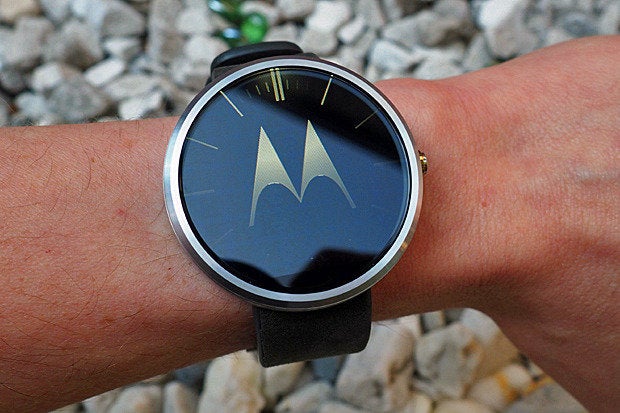
Yawn- so looking through the info, it doesn't really do much more than my Moto 360 can do, yet the Moto 360:
1) Has been available already for 7 months.
First doesn't mean best: just like with the original iPod.
2) Has inductive charging and the Apple watch doesn't.
This makes me question whether you're just a troll. In case you're being serious: The Apple Watch DOES in fact charge via inductive charging: https://www.apple.com/watch/te... (look down at "Charge it overnight. Wear it all day.")
3) Is far less expensive.
I don't know about "far" less. Quick glance shows it to be $100 to $150 cheaper than the entry level Apple Watch. That's a good difference... but it's not like the Moto 360 is $50 or something. For something you will probably replace every couple of years that difference isn't much amortized over the lifetime of the device.
4) Is arguably much better looking (for those who want round).
Firstly, I'm not sure why "round" is so desirable. Many high end watches are square/rectangular (for instance: http://www.hublot.com/en/colle... ) and all computing devices and even traditional writing devices (paper!) are rectangular for a reason: it's easy to display and read data that way.
Secondly: if we're going to be subjective I'll say that I don't want an enormous watch like the Moto 360 ( http://core0.staticworld.net/i... ). The Apple Watch fits far better: http://www.wired.com/wp-conten...
5) Works with many different phones, not just a few iPhone models.
I'll take perfect integration with a few phones over buggy connections with a bunch of phones...
So what is so innovative and impressive? A button on the side? The 360 has a button. It is not a scroll wheel, but despite what Apple's video claims, I have absolutely no problems using the touchscreen to pinch zoom, swipe, or scroll and it doesn't hurt my experience and is far more intuitive.
I suppose that it is easy to pinch to zoom on your enormous, tablet sized watch
The ONLY two things I saw of interest were variable touch sensitivity... which is certainly not a new technology, but it novel on a watch. And having a speaker, which I certainly have not missed. I mean, it looks like a great device, but I fail to understand why people think it is some brilliant new idea or super fantastic breakthrough.
Only Apple themselves think it's some "super fantastic breakthrough": but many of us see it as being a really solid offering that is going to enhance our daily activities.
If you own an iPhone then this should be pretty interesting to you. It's going to have great integration and tons of really useful features. Definitely enough features to justify its price.
Not everything has to be "revolutionary"... it can just be "really good" for the price its offered at... and people will buy it.
-
Here's a direct link to the videos
Since there will be more videos over the next week than the article links to, here's the direct link where you can see the full set without a page of ads (well, OK the whole page is one big ad, but you know what I mean):
The one I'm really interested in seeing is Maps, the other functions I feel like have already been covered to some extent.
-
Re:Great article.
I buy a new phone about every 3 years, when my previous one is worn out. Most people do this every year or two. What a waste...This article shows what you're missing when you sign that lease, or buy that new iPhone.
I replace mine with about the same frequency. Not to toot Apple's horn but they have trade in programs which reduce the cost of the new phone and they refurbish or recycle the old one. Many people will hand their phones down, too. Often the only thing that the handsets really need is a battery.
The motors and battery (which needs to be replaced every X years) for your new Prius are not so great for the environment. Sure, it makes you feel good to not fill up at the gas pump, but what is the true environmental cost of that car?
One argument that can be made is efficiency, is it more efficient to tap the grid vs generating energy at home? Is less fuel consumption beneficial? Here's a Forbes article about Prius, having a battery replaced with a refurbished one from a 3rd party.
The reality is that there are 28 separate cells in the hybrid battery pack. When the unit starts to fail, only a handful of the individual cells are bad. What Prius Battery Repair of Houston does, and Toyota could do if it wanted to, is replace the bad hybrid battery pack with a reconditioned one to get the customer back on the road. Then, determine which cells are bad, and simply replace the bad battery cells, recondition the battery, and sell it to the next customer.
Same goes for windmills, etc. Are they really better for the environment than, say, nuclear power?
Better is so subjective. Replace windmills with $anyitem (minifridge, dams, coal power plants). Does it make it more or less profound?
I'm glad someone out there is forcing us to look at the downside of all of the technology we use. Kudos to them for doing it.
Forcing? Hardly. This is the byproduct of cheap.
I'd say this article just focuses on an admittedly bad area where stuff is done cheaply because that's what many people want world wide. A rare earth mine is ramping up production in California. Compare how it's done. It lowered capacity because of cost, a re-occuring theme with a lot of American industry.