Slashdot Mirror
Domain: arizona.edu
Stories and comments across the archive that link to arizona.edu.
Stories · 100
-
University of Arizona Tracks Student ID Card Swipes To Detect Who Might Drop Out (theverge.com)
An anonymous reader quotes a report from The Verge: The University of Arizona is tracking freshman students' ID card swipes to anticipate which students are more likely to drop out. University researchers hope to use the data to lower dropout rates. (Dropping out refers to those who have left higher-education entirely and those who transfer to other colleges.) The card data tells researchers how frequently a student has entered a residence hall, library, and the student recreation center, which includes a salon, convenience store, mail room, and movie theater. The cards are also used for buying vending machine snacks and more, putting the total number of locations near 700. There's a sensor embedded in the CatCard student IDs, which are given to every student attending the university. Researchers have gathered freshman data over a three-year time frame so far, and they found that their predictions for who is more likely to drop out are 73 percent accurate. They also have plans to give academic advisers an online dashboard to look at student data in real time. "By getting their digital traces, you can explore their patterns of movement, behavior and interactions, and that tells you a great deal about them," Sudha Ram, a professor of management information systems who directs the initiative, said in a press release. -
Study Finds That Athletes Perform Better When Reminded of Their Impending Death (arstechnica.com)
An anonymous reader quotes a report from Ars Technica: Basketball players that were grimly reminded of their own inevitable demise before playing took more shots and scored more points in a study published in an upcoming issue of Journal of Sport and Exercise Psychology. The researchers behind the experiments hypothesize that the pep-talk tactic fits with the established "terror management theory," which proposes that humans are motivated to seek self-esteem, meaning, and symbolic immortality -- in this case becoming a famous athlete -- in order to manage their fear of death. For the study, Helm and colleagues first recruited basketball players to play two back-to-back, one-on-one games with lead researcher Colin Zestcott, another psychologist at the University of Arizona. (The players didn't know that Zestcott was a researcher; they thought he was another study participant.) After the first game, half of the participants were randomly assigned to take a questionnaire on how they felt about basketball. The other half took one about their thoughts on their own death. Those that took the spooky survey saw a 40-percent boost in their individual performance during the second game as compared with their first. Those that took the non-macabre survey saw no change. In a second experiment, participants were given a basket-shooting challenge, which a researcher described to them in a 30-second tutorial. Based on a coin-toss, half the participants got the tutorial while the researcher was wearing a plain jacket. The other half saw the researcher in a T-shirt with a skull-shaped word-cloud made entirely of the word 'death.' The participants' performance on the shooting challenge was then scored by another researcher who didn't know which players saw the death shirt. In the end, players who did see the shirt took more shots, and outperformed by 30 percent, those that just saw the jacket. "We've known from many studies that reminders of death arouse a need for terror management and therefore increase self-esteem striving through performance on relatively simple laboratory tasks," Peter Helm, a study co-author and psychologist at the University of Arizona, said in a news release. "However, these experiments are the first to show that activating this motivation can influence performance on complex, real-world behaviors." -
Empirical Study On How C Devs Use Goto In Practice Says "Not Harmful"
Edsger Dijkstra famously opined in 1968 on the danger of Goto statements. New submitter Mei Nagappan writes with a mellower view, nearly 50 years later: By qualitatively and quantitatively analyzing a statistically valid random sample from almost 2 million C files and 11K+ projects, we find that developers limit themselves to using goto appropriately in most cases, and not in an unrestricted manner like Dijkstra feared, thus suggesting that goto does not appear to be harmful in practice. (Here's the preprint linked from above abstract.) -
Be True To Your CS School: LinkedIn Ranks US Schools For Job-Seeking Programmers
theodp writes "The Motley Fool reports that the Data Scientists at LinkedIn have been playing with their Big Data, ranking schools based on how successful recent grads have been at landing desirable software development jobs. Here's their Top 25: CMU, Caltech, Cornell, MIT, Princeton, Berkeley, Univ. of Washington, Duke, Michigan, Stanford, UCLA, Illinois, UT Austin, Brown, UCSD, Harvard, Rice, Penn, Univ. of Arizona, Harvey Mudd, UT Dallas, San Jose State, USC, Washington University, RIT. There's also a shorter list for the best schools for software developers at startups, which draws a dozen schools from the previously mentioned schools, and adds Columbia, Univ. of Virginia, and Univ. of Maryland College Park. If you're in a position to actually hire new graduates, how much do you care about applicants' alma maters? -
Mars Orbiter Spies Comet ISON
astroengine writes "Scientists managing the High-Resolution Imaging Science Experiment (HiRISE) camera aboard NASA's Mars Reconnaissance Orbiter (MRO) have released their first observations of the incoming Comet ISON. The MRO was commanded to turn away its perpetual Mars-ward gaze and point into deep space to capture its own snapshot of the famous comet. ISON is currently making its closest approach to the red planet, passing just 7 million miles from its surface. The first raw images were snapped on Sept. 29 when the object was 8 million miles from the planet and more images (taken on Oct. 1 and Oct. 2) are currently being processed." -
Magellan II's Adaptive Optics Top Hubble's Resolution
muon-catalyzed writes "The incredible 'first light' images captured by the new adaptive optics system called Magellan|AO for "Magellan Adaptive Optics" in the Magellan II 6.5-meter telescope are at least twice as sharp in the visible light spectrum as those from the NASA's Hubble Space Telescope. 'We can, for the first time, make long-exposure images that resolve objects just 0.02 arcseconds across — the equivalent of a dime viewed from more than a hundred miles away,' said Laird Close (University of Arizona), the project's principal scientist. The 6.5-meter Magellan telescopes in the high desert of Chile were widely considered to be the best natural imaging telescopes in the world and this new technology upgraded them to the whole new level. With its 21-foot diameter mirror, the Magellan telescope is much larger than Hubble with its 8-foot mirror. Until now, Hubble always produced the best visible light images, since even large ground-based telescope with complex adaptive optics imaging cameras could only make blurry images in visible light. The core of the new optics system, the so-called Adaptive Secondary Mirror (ASM) that can change its shape at 585 points on its surface 1,000 times each second, counteracts the blurring effects of the atmosphere." -
Watch the Crab Nebula Expand Over a 13 Year Period
The Bad Astronomer writes "A thousand years ago, the light from the explosion of a massive star reached the Earth. We now call this supernova remnant the Crab Nebula, and a new image of the Crab taken by astronomer Adam Block shows the physical expansion of the debris, made obvious in a short video comparing his 2012 observations with some taken in 1999. The outward motion of filaments and knots in the material can be easily traced even over this relatively short time baseline." -
Weird Geological Features Spied On Mars
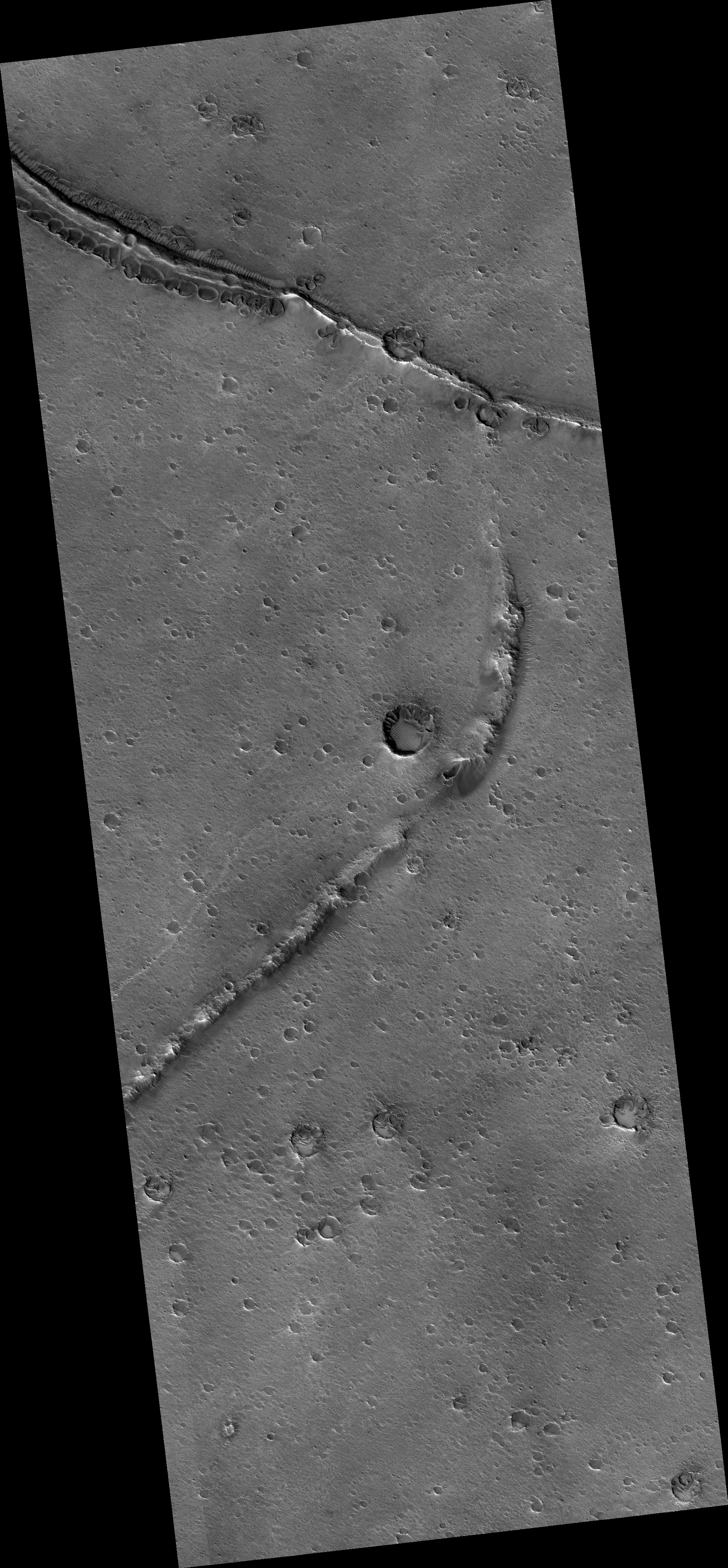
astroengine writes "The High-Resolution Imaging Science Experiment (HiRISE) camera carried by NASA's Mars Reconnaissance Orbiter has spotted a strange geological feature that, for now, defies an obvious explanation. Found at the southern edge of Acidalia Planitia, small pits with raised edges appear to hug a long ridge. So far, mission scientists have ruled out impact craters and wind as formation processes, but have pegged the most likely cause to be glacial in nature." -
Weird Geological Features Spied On Mars
astroengine writes "The High-Resolution Imaging Science Experiment (HiRISE) camera carried by NASA's Mars Reconnaissance Orbiter has spotted a strange geological feature that, for now, defies an obvious explanation. Found at the southern edge of Acidalia Planitia, small pits with raised edges appear to hug a long ridge. So far, mission scientists have ruled out impact craters and wind as formation processes, but have pegged the most likely cause to be glacial in nature." -
Hubble Accuracy Surpassed By Earthbound Telescope
randuev writes "A high-speed adaptive optics system helped the Large Binocular Telescope (on Earth) to beat the accuracy of the Hubble Space Telescope's observations. 'A special sensor detects atmospheric distortions in real time and controls the mirror to adjust its position to compensate, effectively canceling out the blurring. The mirror can make adjustments every one-thousandth of a second, with accuracy to better than ten nanometers.' Now, that's what I call real-time. This nifty trick multiplied the Strehl ratio (optical quality) of the LBT by about 80 times. The new system was tested in May and June, so hopefully we'll soon see more space around us in higher resolution on Google Sky." -
Aphid's Color Comes From a Fungus Gene
Iron Nose writes with an account from Byte Size Biology of horizontal gene transfer from a fungus to an insect. The author suspects that we will see lots more of this as we sequence more genomes. "The pea aphid is known for having two different colors, green and red, but until now it was not clear how the aphids got their color. Aphids feed on sap, and sap does not contain carotenoids, a common pigment synthesized by plants, fungi, and microbes, but not by animals. Carotenoids in the diet gives many animals, from insects to flamingos, their exterior color after they ingest it, but aphids do not seem to eat carotenoid-containing food. Nancy Moran and Tyler Jarvik from the University of Arizona looked at the recently sequenced genome of the pea aphid. They were surprised to find genes for synthesizing carotenoids; this is the first time carotenoid synthesizing genes have been found in animals. When the researchers looked for the most similar genes to the aphid carotenoid synthesizing genes, they found that they came from fungi, which means they somehow jumped between fungi and aphids, in a process known as horizontal gene transfer." -
"Definitive Evidence" For Ancient Lake On Mars
TheSync writes "Eurekalert reports on 'definitive evidence' for an ancient water lake on Mars. A UC Boulder research team has discovered evidence of a shoreline on Mars of a 3 billion year-old lake 80 square miles in area and 1,500 feet deep (roughly the equivalent of Lake Champlain). Images came from the HiRISE instrument on NASA's Mars Reconnaissance Orbiter. Water carved a 30-mile-long canyon that opened up into a valley and forming a large delta during a time when Mars is generally believed to have been cold and dry. The lack of additional, lower shorelines, shows that the lake dried up very quickly. Of particular interest are the deltas adjacent to the lake. On Earth, deltas rapidly bury organic carbon and other biomarkers of life, making the Martian lake bed and delta a prime target for future searches for past life on the planet." -
Orbiter Reveals Rock Fracture Plumbing On Mars
Riding with Robots writes "Mars researchers report that a robotic spacecraft orbiting the Red Planet has revealed hundreds of small fractures exposed on the Martian surface that once directed flows of water through underground Martian sandstone. 'This study provides a picture of not just surface water erosion, but true groundwater effects widely distributed over the planet,' said one of the mission scientists for the Mars Reconnaissance Orbiter, which has been regularly returning terabytes of high-resolution images and other kinds of data from Mars." -
Mars Soil Frustrates Phoenix Again
Tablizer writes "The Phoenix Mars lander has been frustrated yet again by Mars's odd soil. The wet nature of the soil they are targeting appears to have made it get stuck in the scoop rather than drop into the oven. Past problems with similarly clumpy soil may have damaged the lander because the vibrator had to be used longer than it was designed for, resulting in a short circuit." -
Mars Soil Frustrates Phoenix Again
Tablizer writes "The Phoenix Mars lander has been frustrated yet again by Mars's odd soil. The wet nature of the soil they are targeting appears to have made it get stuck in the scoop rather than drop into the oven. Past problems with similarly clumpy soil may have damaged the lander because the vibrator had to be used longer than it was designed for, resulting in a short circuit." -
Package Managers As Achilles Heel
An anonymous reader writes "Researchers from the University of Arizona have released a study that takes a look at the security of ten popular package managers. They were able to show all ten were vulnerable to attacks from a mirror or man-in-the-middle that allow an attacker to (along with other things) crash the system or obtain root access. Furthermore, the researchers created a fictitious administrator and company name and were able to lease a server and get it listed as an official mirror for all the distributions they tried (Ubuntu, Debian, Fedora, CentOS, and OpenSUSE). This raised the question: What keeps you up at night, the thought of attacks on your package manager or previously discussed and patched vulnerability in DNS?" justin samuel (one of the Arizona researchers) also points out a synopsis on CERT's blog. -
Package Managers As Achilles Heel
An anonymous reader writes "Researchers from the University of Arizona have released a study that takes a look at the security of ten popular package managers. They were able to show all ten were vulnerable to attacks from a mirror or man-in-the-middle that allow an attacker to (along with other things) crash the system or obtain root access. Furthermore, the researchers created a fictitious administrator and company name and were able to lease a server and get it listed as an official mirror for all the distributions they tried (Ubuntu, Debian, Fedora, CentOS, and OpenSUSE). This raised the question: What keeps you up at night, the thought of attacks on your package manager or previously discussed and patched vulnerability in DNS?" justin samuel (one of the Arizona researchers) also points out a synopsis on CERT's blog. -
Your Mashup Is Probably Legal
TV Barn writes "We've been conditioned to think that if you pull something off the web and use it, you're committing some sort of copyright infringement. But increasingly, the law is moving in the opposite direction. Provided you are making a truly new use of the content, you are free to make money off those copyrighted images and video and sound. On Monday the Center for Social Media released 'Code of Best Practices for Fair Use in Online Video,' which reflects the latest changes in copyright law that has expanded the understanding of fair use to include 'transformational effect.' Already Miro has endorsed the guidelines, as have several public broadcasters. The Center has a good track record, having issued guidelines for documentary filmmakers that have greatly reduced copyright claims in that area. The website has plenty of resources for mashers and mixers; I interviewed the Center's director in this podcast that summarizes the most important findings of the report." On the other hand, says reader kaliphonia, your guitar tablature sites may not fare so well. -
Probable Water Ice Sighted On Mars
CraftyJack writes "Bright white chunks in the trenches dug by the Phoenix Lander have disappeared, leading Peter Smith & co. to believe that the chunks were ice that has since sublimated." -
Probable Water Ice Sighted On Mars
CraftyJack writes "Bright white chunks in the trenches dug by the Phoenix Lander have disappeared, leading Peter Smith & co. to believe that the chunks were ice that has since sublimated." -
Phoenix Mars Lander Deploys Robotic Arm, Possibly Finds Ice
The Phoenix Mars Lander has successfully deployed its robotic arm and tested other instruments including a laser designed to detect dust, clouds, and fog. The arm will be used to dig up samples of the Martian surface, which will be analyzed as a possible habitat for life. A camera on the arm will allow pictures to be taken of the ground directly beneath the lander. The camera has already seen what may be ice, which was exposed when the soil was disturbed by the landing. The data collected by the arm will be compared to recent findings which suggest that water on Mars may have been too salty for most known forms of life. -
Mars Probe Brings the "Weather Rock" New Respect
radioweather writes "What looked to casual observers like a malfunction, a dangling wire with something on the end, seen in the first photo of the meteorological mast on NASA's Phoenix Mars Lander, actually turned out to be the real instrument. Surprisingly, it is much like the novelty 'weather rock' seen as a novelty gag around the world. The instrument called the 'Telltale' is described as a 'passive wind indicator' and uses an extremely lightweight Kapton tube hanging in Kevlar fiber. Images taken of the instrument will show the deflection of the Telltale due to the Martian wind." -
Mars Probe Brings the "Weather Rock" New Respect
radioweather writes "What looked to casual observers like a malfunction, a dangling wire with something on the end, seen in the first photo of the meteorological mast on NASA's Phoenix Mars Lander, actually turned out to be the real instrument. Surprisingly, it is much like the novelty 'weather rock' seen as a novelty gag around the world. The instrument called the 'Telltale' is described as a 'passive wind indicator' and uses an extremely lightweight Kapton tube hanging in Kevlar fiber. Images taken of the instrument will show the deflection of the Telltale due to the Martian wind." -
The Phoenix Has Landed
Iddo Genuth writes "Precisely at 7:53PM EST, the "Phoenix Mars Lander" touched-down on the desert-like surface of Mars. Since its launch on August 4th, 2007, the spacecraft has covered more than 680,752,512 kilometers, traveling at average speeds of around 120,000 km/hr. Upon arriving at its destination, the Phoenix will begin its exploration of our intriguing neighbor planet, in a mission to help astronomers resolve at least some of the many questions regarding Mars. The key question remains: can the Red Planet support some form of life?" Hella grats to our nerd brethren — you looked great on the Science channel. Yes I'm watching this live. Can't wait to see what happens next.
Update: 05/26 03:0 GMT by KD : zof sends a link to the first pictures from Phoenix. -
Phoenix Mars Lander To Touch Down In 2 Hours
AFP has a good summary of the pre-touchdown jitters the Phoenix Mars Lander crew is living through. The spacecraft has been under way for 10 months. If the landing goes according to plan — and only about half of the three dozen such attempts have — mission controllers at the University of Arizona will receive radio signals from the Martian surface at 23:53 GMT. Here's the Mars mission home. You can (in theory) track the lander here, but at the moment the JPL Solar System Simulator is "experiencing technical difficulties." -
Phoenix Mars Lander To Touch Down In 2 Hours
AFP has a good summary of the pre-touchdown jitters the Phoenix Mars Lander crew is living through. The spacecraft has been under way for 10 months. If the landing goes according to plan — and only about half of the three dozen such attempts have — mission controllers at the University of Arizona will receive radio signals from the Martian surface at 23:53 GMT. Here's the Mars mission home. You can (in theory) track the lander here, but at the moment the JPL Solar System Simulator is "experiencing technical difficulties." -
New Cave Entrances Seen on Mars
Riding with Robots writes "The Mars Odyssey orbiter has come across what look to be openings to cavernous spaces under the surface of Mars. NASA reports the find is fueling interest in potential underground habitats and sparking searches for caves elsewhere on the Red Planet. These latest images follow other recent discoveries of intriguing places to explore. From the article: 'The find has led some to wonder if these or other caves on the planet may provide shelter to life or former life on the Red Planet. "Somewhere on Mars, caves might provide a protected niche for past or current life, or shelter for humans in the future," said Tim Titus of the U.S. Geological Survey in Flagstaff. These caves, however, likely never hosted life due to the extreme altitude of their location. "Even if life has ever existed on Mars, it may not have migrated to this height," said Cushing.'" -
Massive Cave Found on Mars
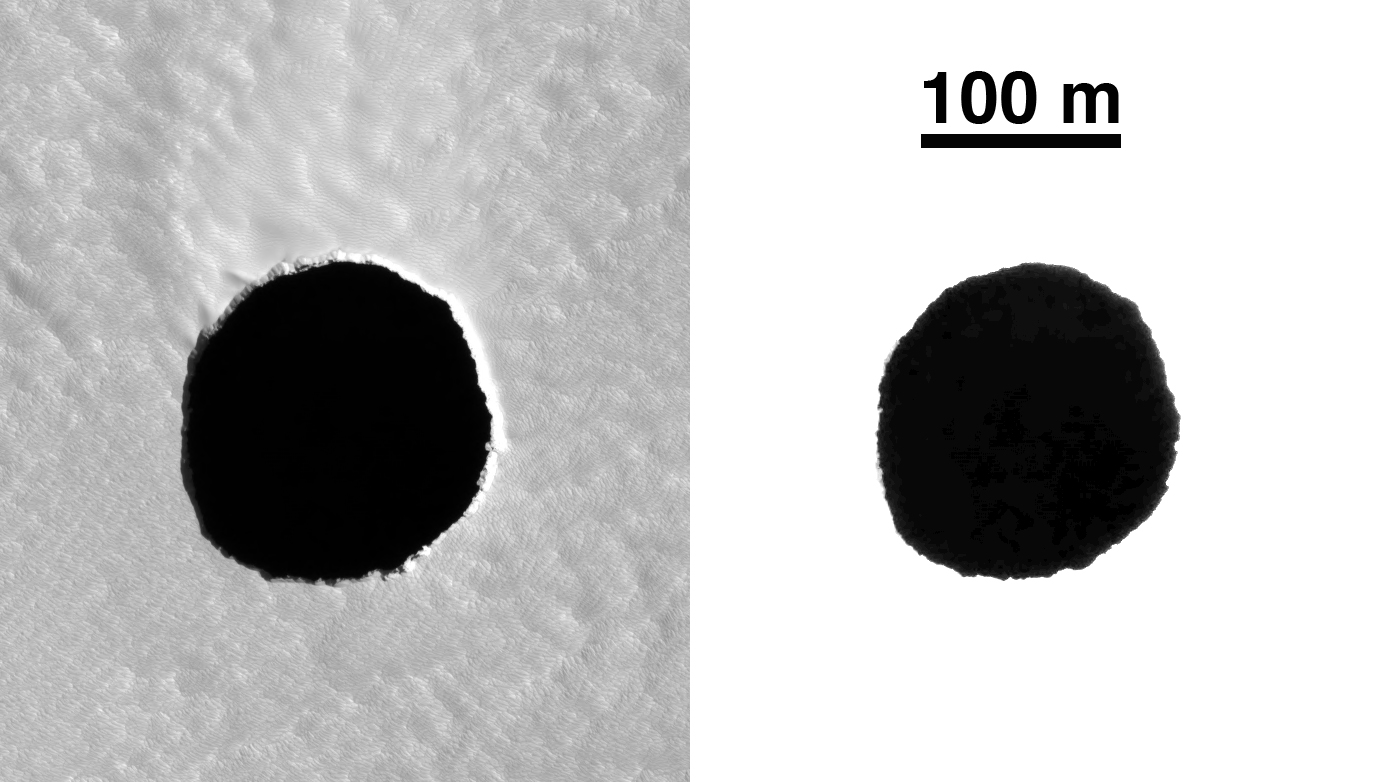
mrcgran writes "Space.com is reporting a very deep hole found on Mars: 'The geological oddity measures some 330 feet (100 meters) across and is located on an otherwise bright dusty lava plain to the northeast of Arsia Mons, one of the four giant Tharsis volcanoes on the red planet. The Mars Reconnaissance Orbiter (MRO) used its High Resolution Imaging Science Experiment (HiRISE) instrument to draw a bead on the apparent deep hole — a feature that may cause more scientists to ponder about potential subsurface biology on Mars. Because the spot lacks a raised rim or tossed out material called ejecta, researchers have ruled out the pit being an impact crater. No walls or other details can be seen inside the hole, and so any possible walls might be perfectly vertical and extremely dark or — more likely — overhanging.' The original image and its cutout at full resolution can be found in the HiRISE site." -
Massive Cave Found on Mars
mrcgran writes "Space.com is reporting a very deep hole found on Mars: 'The geological oddity measures some 330 feet (100 meters) across and is located on an otherwise bright dusty lava plain to the northeast of Arsia Mons, one of the four giant Tharsis volcanoes on the red planet. The Mars Reconnaissance Orbiter (MRO) used its High Resolution Imaging Science Experiment (HiRISE) instrument to draw a bead on the apparent deep hole — a feature that may cause more scientists to ponder about potential subsurface biology on Mars. Because the spot lacks a raised rim or tossed out material called ejecta, researchers have ruled out the pit being an impact crater. No walls or other details can be seen inside the hole, and so any possible walls might be perfectly vertical and extremely dark or — more likely — overhanging.' The original image and its cutout at full resolution can be found in the HiRISE site." -
Massive Cave Found on Mars
mrcgran writes "Space.com is reporting a very deep hole found on Mars: 'The geological oddity measures some 330 feet (100 meters) across and is located on an otherwise bright dusty lava plain to the northeast of Arsia Mons, one of the four giant Tharsis volcanoes on the red planet. The Mars Reconnaissance Orbiter (MRO) used its High Resolution Imaging Science Experiment (HiRISE) instrument to draw a bead on the apparent deep hole — a feature that may cause more scientists to ponder about potential subsurface biology on Mars. Because the spot lacks a raised rim or tossed out material called ejecta, researchers have ruled out the pit being an impact crater. No walls or other details can be seen inside the hole, and so any possible walls might be perfectly vertical and extremely dark or — more likely — overhanging.' The original image and its cutout at full resolution can be found in the HiRISE site." -
Terabytes of Mars Pictures Released to Public
Riding with Robots writes "The team that runs the high-rez camera on NASA's Mars Reconnaissance Orbiter has just released more than 1,200 Mars images to the Planetary Data System, NASA's mission data archive. The team has also released 1.7 Terabytes of data to a user-friendly site that allows users to quickly home in on each image, most of which are a gigabyte-sized files measuring 20,000 by 50,000 pixels. Not all the images have been thoroughly studied yet: in the announcement, the camera's lead scientist said, 'These images must contain hundreds of important discoveries about Mars. We just need time to realize what they are.'" -
First Super Close-Up Pictures of Mars
Alien54 writes "The most powerful camera ever to orbit Mars will get its first close look at the Red Planet on Friday. The High-Resolution Imaging Science Experiment (HiRISE) camera flying aboard NASA's Mars Reconnaissance Orbiter (MRO) will relay its first low-altitude images to scientists at The University of Arizona beginning September 29. User-friendly web tools will be available to both the science community and the public to view/analyze HiRISE images and to submit observation requests. Processed images will be released soon after acquisition to allow everyone to share in the scientific discovery process. By combining very high resolution and signal-to-noise ratio with a large swath width, it is possible to for images to be collected on scales down to 1 meter." -
First Super Close-Up Pictures of Mars
Alien54 writes "The most powerful camera ever to orbit Mars will get its first close look at the Red Planet on Friday. The High-Resolution Imaging Science Experiment (HiRISE) camera flying aboard NASA's Mars Reconnaissance Orbiter (MRO) will relay its first low-altitude images to scientists at The University of Arizona beginning September 29. User-friendly web tools will be available to both the science community and the public to view/analyze HiRISE images and to submit observation requests. Processed images will be released soon after acquisition to allow everyone to share in the scientific discovery process. By combining very high resolution and signal-to-noise ratio with a large swath width, it is possible to for images to be collected on scales down to 1 meter." -
One Year Until Phoenix Mars Mission Launch
pipcorona writes "The principal investigator of the Phoenix Mars Lander Mission released an article yesterday describing how the mission is progressing, talking about landing sites and informing the public that they are officially one year away from launch." From the article: "In parallel with the assembly of the spacecraft, our Payload Interoperability Testbed (PIT) in the Tucson Science Operations Center has been integrating engineering models of all the science instruments. Besides validating the integration procedures for the instruments, this facility will be used to verify that all our instruments work as a team-important since they were developed individually. In particular, the digging of soils and delivery of samples to instruments will be thoroughly tested." -
New Huygens Titan descent video available
pamaru writes "Scientists from the Cassini/Huygens mission Descent Imager/Spectral Radiometer (DISR) team have released new Huygens video footage. "This descent animation lasting about 1 minute starts at an altitude of 300 km and moves eastward along the trajectory that the Huygens probe traveled on its journey to Titan's surface. The Cassini orbiter ISS, RADAR & VIMS images of this area are displayed in quick succession followed by DISR mosaics from increasingly lower altitudes. The surface color is approximately what a human observer riding along with the probe would see, if she or he could see the surface through Titan's atmospheric haze." This is cool stuff... grab it from the DISR homepage or from Coral Cache" -
LBT Publishes "First Light" Image
FarmKing writes "The Large Binocular Telescope has achieved "first light" and published it's first image of NGC891. The image was taken with one of it's two 8.4 Meter (~655 ft^2) mirrors. When fully operational, LBT will be one of the largest optical telescopes in the world." -
Titan Moon's Bright Hot Spot
An anonymous reader writes "Saturn's largest moon, Titan, has been the target of great interest because of its unusual pre-biotic chemistry and thick atmosphere. The Colorado-Boulder Space Science Institute announced a new mystery today involving a persistently bright spot, perhaps one of four possibilities. The spot could be a surface coloration, a mountain range, a cloud, or a hot spot." -
Sensor Webs Unwire Ecology
jonbrewer writes "Pioneered by CENS, Sensor Networks are rapidly becoming a mainstream environmental monitoring tool. The NY Times has an article today with a quick tech overview and info on RiverNet, EarthScope, NEON, and Neptune. The Times reports 'scientists want to deploy millions of these kinds of devices over large tracts for long periods, opening new windows on nature.'" -
Stars Have a Weight Limit
Mike writes "Using NASA's Hubble Space Telescope, astronomers made the first direct measurement within our Milky Way Galaxy, and concluded stars cannot get any larger than about 150 times the mass of our sun. The astronomers used the Hubble to probe the Arches cluster, the densest in our galaxy. This finding takes astronomers closer to understanding the complex star formation process. It also gives the strongest backing yet to the notion stars have a weight limit." -
Stereoscopic images of Titan's surface constructed
CozmsBrpng writes "If you can successfully view stereoscopic images then you can behold the surface of Titan in all its grainy 3D glory. And, in case you missed it, you can also listen to a human ear-friendly version of the descent radar and the winds in Titan's atmosphere courtesy of the DISR team at The University of Arizona." -
Stereoscopic images of Titan's surface constructed
CozmsBrpng writes "If you can successfully view stereoscopic images then you can behold the surface of Titan in all its grainy 3D glory. And, in case you missed it, you can also listen to a human ear-friendly version of the descent radar and the winds in Titan's atmosphere courtesy of the DISR team at The University of Arizona." -
Stereoscopic images of Titan's surface constructed
CozmsBrpng writes "If you can successfully view stereoscopic images then you can behold the surface of Titan in all its grainy 3D glory. And, in case you missed it, you can also listen to a human ear-friendly version of the descent radar and the winds in Titan's atmosphere courtesy of the DISR team at The University of Arizona." -
Stereoscopic images of Titan's surface constructed
CozmsBrpng writes "If you can successfully view stereoscopic images then you can behold the surface of Titan in all its grainy 3D glory. And, in case you missed it, you can also listen to a human ear-friendly version of the descent radar and the winds in Titan's atmosphere courtesy of the DISR team at The University of Arizona." -
Stereoscopic images of Titan's surface constructed
CozmsBrpng writes "If you can successfully view stereoscopic images then you can behold the surface of Titan in all its grainy 3D glory. And, in case you missed it, you can also listen to a human ear-friendly version of the descent radar and the winds in Titan's atmosphere courtesy of the DISR team at The University of Arizona." -
Stereoscopic images of Titan's surface constructed
CozmsBrpng writes "If you can successfully view stereoscopic images then you can behold the surface of Titan in all its grainy 3D glory. And, in case you missed it, you can also listen to a human ear-friendly version of the descent radar and the winds in Titan's atmosphere courtesy of the DISR team at The University of Arizona." -
Stereoscopic images of Titan's surface constructed
CozmsBrpng writes "If you can successfully view stereoscopic images then you can behold the surface of Titan in all its grainy 3D glory. And, in case you missed it, you can also listen to a human ear-friendly version of the descent radar and the winds in Titan's atmosphere courtesy of the DISR team at The University of Arizona." -
Stereoscopic images of Titan's surface constructed
CozmsBrpng writes "If you can successfully view stereoscopic images then you can behold the surface of Titan in all its grainy 3D glory. And, in case you missed it, you can also listen to a human ear-friendly version of the descent radar and the winds in Titan's atmosphere courtesy of the DISR team at The University of Arizona." -
Phoenix Mars Polar Lander Website Launched
ciph3r writes "The Phoenix Mars Polar Lander mission has just launched their public website. '[The] mission is to land in the northern polar region of Mars (about 70 N latitude) in May 2008 and to expose the upper few feet of surface material using a robotic arm to find the ice that was discovered by the Odyssey mission in 2002. The history of this ice and its interaction with the martian atmosphere will be studied throughout the 3-month primary mission. This ice-rich soil may be one of the few habitable environments on Mars where a biological system can survive.'" -
Spider Silk Genetically Engineered
An anonymous reader writes "Commercial silk comes not from spiders, but from the silk moth (spiders are hard to coral). But spider silk is stronger, so engineers, including in the Army, would like to use it for armor, tethers, and clothing. Scientists at Nexia Biotechnologies bioengineered some in 2002, but in a two-step process not ready for prime time. According to a LiveScience article, a separate team has now created self-spinning spider-web fiber. More work is still needed to produce anything useful, but the researchers say it might happen within a decade." -
Cassini Probe Does Titan Flyby
EccentricAnomaly writes "Today, Cassini had its first close encounter with Titan around 8:30AM PDT. Data from the flyby will start coming down around 6:30PM PDT, and you can watch the pictures live on NASA TV. If you want higher resolution or just to stare at one picture for a while, the raw images will be put on the web right away, with pretty press images to follow the next day. And if you want to know about the observations planned for the flyby, you can read this PDF or watch this animation."