Slashdot Mirror
Domain: arizona.edu
Stories and comments across the archive that link to arizona.edu.
Comments · 896
-
They might be Kettle Holes
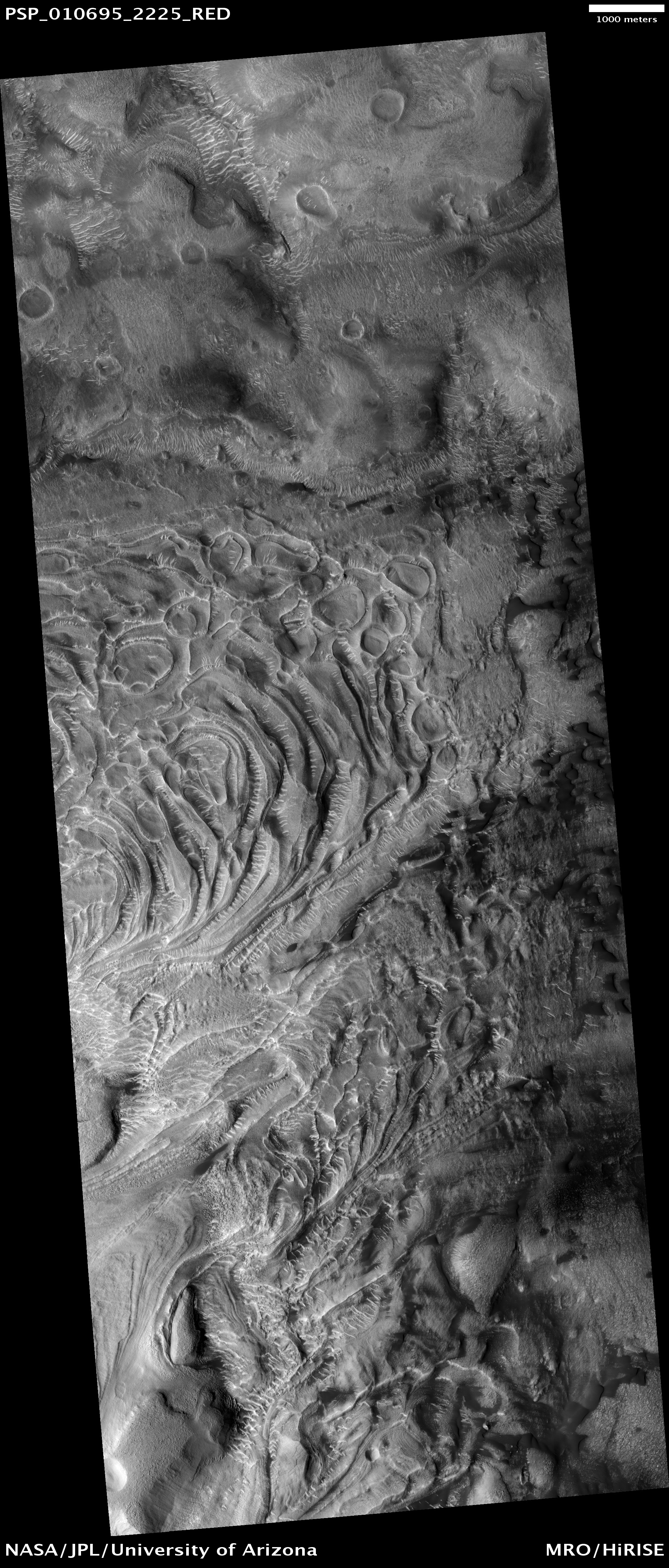
There are quite similar to the depressions in Moreux Crater (image PSP_010695_2225 ; 42 degrees N / 44.6 degrees E). They might be Kettle Holes, formed when a retreating ice sheet or glacial flood leaves behind huge chunks of debris rich ice that later melts (or sublimates) creating distinctive hollows in glacial sediment.
-
Thanks! I looked this up and found similar humor
-
Re:oh no
Got to love those politicians. Unwitting, often clueless but trying their best. God bless em, cause blessings are probably in short order from elsewhere.
-
Intricacies of time
Specifically temporal consistency. A guy by the name of Snodgrass wrote a book on it and I urge everyone to al least skim through it. See his website: http://www.cs.arizona.edu/~rts/
-
Re:You shouldn't have to mandate thisB.S.
"On The Origin of Species" by Charles Darwin was banned and probably burnt in Germany on orders from the Nazi leadership by being included in the category of "All writings that ridicule, belittle or besmirch the Christian religion and its institution, faith in God, or other things that are holy to the healthy sentiments of the Volk." http://www.library.arizona.edu/exhibits/burnedbooks/documents.htm#guidelines
-
Re:Subtlety
No, it's a perfectly good word to use. There's no reason to expect the sun to flicker like a candle. In fact, it couldn't. It's too big for that
Technically, I wouldn't call the sun's variation flicker. What's commonly referred to as "flicker noise" by people who characterize low-frequency noisy processes is noise that has spectral density proportional to 1/frequency. The sun isn't quite like that. It has dominant 1/f^2 (Brown noise) and 1/f^1/2 characteristics as explained in this paper:
http://geomorphology.geo.arizona.edu/PAPERS/pelletier_96.pdf
Over much longer time scales, it might have quite a different character, but this encompasses the timescales measured by Kepler.
-
Re:My sources on the inside say
That carbon dating has always been as accurate as you can afford. You decide the date that you need in order to confirm your thesis, send your sample to as many labs or as many times as your budget allows, then pick the closest answer from the essentially random set of results.
Anyone on the inside of the inside care to confirm or refute that?
I'm not on the inside, but I've read some of the papers.
Every few years there is an International Radiocarbon Intercomparison, where a batch of different types of samples are sent to most of the world's labs (~100) to date. The results are then compared. Overall stats are published anonymously, and individual labs can publish their results if they want.
The most accurate method (AMS) shows error rates of ~1%, while older methods give error rates of up to 10%.
Of course there are some classes of samples which present special problems; the study samples are ones which don't present major contamination issues.
The full study from 2003 is open access: here -
Pencil and paper first
First off, pencil and paper. Teach them how to make and play wirh Turing machines and finite state automata. Enjoy the awe when you tell them about the Universal Turing Machine.
Low-level:
The HP15C User's Manual and an HP15C, or HP's 15C iApp.High-level:
David Touretzky's Gentle Introduction.My personal favourite language of all time: Icon.
S.
-
Eclipses viewed from MER
Every location on Mars gets an eclipse by both Phobos and Deimos twice a year.
It's nice that Curiosity is looking into the sky, but it's worth pointing out that this is by no means the first time we've watched eclipses from the surface of Mars-- we've caught both Phobos and Deimos transiting the sun, from both of the the MER rovers:
Spirit http://www.lpl.arizona.edu/~lemmon/mer/phobos_transit_104a.gif
and Opportunity http://www.lpl.arizona.edu/~lemmon/mer/Phobos_Sol45B.gifA nice page from 2006 is here: http://www.bibalex.org/eclipse2006/MarsEclipses.htm
-
Eclipses viewed from MER
Every location on Mars gets an eclipse by both Phobos and Deimos twice a year.
It's nice that Curiosity is looking into the sky, but it's worth pointing out that this is by no means the first time we've watched eclipses from the surface of Mars-- we've caught both Phobos and Deimos transiting the sun, from both of the the MER rovers:
Spirit http://www.lpl.arizona.edu/~lemmon/mer/phobos_transit_104a.gif
and Opportunity http://www.lpl.arizona.edu/~lemmon/mer/Phobos_Sol45B.gifA nice page from 2006 is here: http://www.bibalex.org/eclipse2006/MarsEclipses.htm
-
If you liked that then you'll like this
The DISR movies made from data from the Huygens probe landing on Titan:
http://www.esa.int/esaMI/Cassini-Huygens/SEMKVQOFGLE_0.html
http://www.lpl.arizona.edu/DISR/Multimedia/Titan_Movies.htm -
Paper far from disproving wet Mars
While the researchers claim to have some interesting insights, there is other overwhelming evidence that Mars did in fact have lots of water concentrated in lakes and rivers in the past. How do we know that? How about the fact that we can see them from orbit? Or that we see river deltas.
-
NASA photo gallary leaves room for improvement
The photo gallery thingi on NASAs web site is painful to use and not suitable for displaying a large catalogue of images.
For an example of a mars image site that does not suck: http://hirise.lpl.arizona.edu/
-
I don't quite get
why http://hirise.lpl.arizona.edu/ didn't release a sequence of pictures? It'd be so awesome! Perhaps the other ones are blurry
-
Re:Nice -- a bespoke neuron.
I've always wondered why they haven't studied insect brains. Flies do way more complex things than any robot so far invented, and would surely be easier to understand than the workings of a mammal brain.
Um, they kinda do. Really, really hard, in fact.
-
More photos of Baikonur
My gallery on my university/work machine has a great collection of albums documenting a trip to Baikonur and the Cosmodrome. They were taken by Chuck, a friend of mine and retired engineer, during his trip there for the launch of ECHO. This was an AmSat (amateur radio) relay satellite. He took a great deal of photos covering the flights, the locations, the integration and launch of the satellite, and some other interesting places in Baikonur.
I also had a satellite launched from the Cosmodrome. I worked on the University of Arizona's Cubesat Project and wrote all of the onboard code controlling the satellite. In the end we built four satellites, three of which were completely functional. There was RinconSat 1 and 2, AlcatelSat, and an engineering model. The cubesats are small 10cm cubic satellites with a control/computer board, power board, radio board, an array of 24 sensors, and an array of solar panels on the outside frame.
The hardware was quite simple, but we didn't need anything super fancy. The computer board had a PIC microcontroller and using the I2C bus could communicate with two 32 kB FRAM (ferromagnetic RAM) storage chips, a clock chip (which kept time in binary coded decimal), and the sensors. Unfortunately, at the time there were no FOSS PIC compilers so we had to use a Windows/DOS/command line compiler which was really lousy, but we managed to work around the bugs as we found them.
I was very happy with our final results. We did a great deal of testing on the ground and did radio testing by taking the satellite up to the top of a nearby mountain and then communicating with it from our groundstation. The onboard code supported one- and two-way communication and had several modes of operation. It had a default mode in case communication could not be established, a real-time mode that would broadcast a constant stream of sensor readings for a period of time while the satellite was overhead, and a regular mode that would collect readings based on a schedule and store them in the FRAM storage which you could then later command the satellite to transmit to you.
After many delays, we finally got a launch opportunity. We sent RinconSat 2 and AlcatelSat to CalPoly where they were integrated with other cubesats into the launch mechanism. They then sent them to the Baikonur Cosmodrome for the launch. At first, everything seemed to be going well, but we soon found out that it was far from well. The first stage of the rocket failed to separate and the rocket crashed 70 km downrange in a flaming crater, destroying all of the cubesats as well as the far more expensive primary payload (some sort of communications satellite). Sigh...
We don't have any sort of web site, sadly, but one of these days I need to gather up all the photos, documents, source code, and other random stuff I still have access to and make a nice web page for our late satellites.
-
Re:Connection Multiplexing
Connection multiplexing is great. I use it all the time when I connect to my machine at work from home since I'm very likely to scp files to/from that machine at the same time. The page you linked to gives simple and good instructions at the beginning on how to configure it.
I created a simple shell script to help automate the process. The advantage of the script is that it will take care of checking to see if the shared connection is already open, create a new connection if one does not exist, and then connect to the remote host.
The script includes a large comment block at the beginning which includes detailed instructions on how to configure SSH and how to use the script. After you have configured your ~/.ssh/config file for the server(s) in question and to create the multiplexing socket, you can use this script to connect to the machine. Put it in your user bin directory (~/bin) and then create a symlink to the script with the same name as the host alias you put in ~/.ssh/config. For example, if you have a "Host foo" line in your SSH config, name the symlink "foo". This way the script will automatically use the correct options from the config file.
I also have an alias to close the connection (for Bash):
alias ssh-exit='ssh -O exit'
Now, a session will look like this:
$ foo
--SSH session starts/ends--
$ ssh-exit foo -
Stuart Hameroff
Stuart Hameroff is an organizer of this conference, which I'm sure this research was timed for release just before. Stuart has long been an advocate of a theory he developed with Roger Penrose in which the microtubules are the brain's interface with the quantum.
-
Re:Time is tricky
Time oriented applications can be tricky. Proper constraints in a DB for time oriented transaction are hard to get right. This guy basically wrote the book on it
-
Hydroponics
One simple way to use less water in agriculture is to employ hydroponics. These systems can use up to 90% less water than traditional farming. Another point is that the development of better (cheaper/more efficient led lighting) is beginning to tip the balance in terms of economics since produce can now be grown indoors 24/7.
-
Re:Be a Bee! Add polarized contact lenses!
A young adult scifi book I read long ago took advantage of the fact bees can see into the UV spectrum as a plot device to navigate through a forcefield that was invisible to humans, but was "bee purple". Here's a little more information on bees:
"Honey bees and people do not see eye to eye. Humans see the colors of the rainbow; red, orange, yellow, green, blue, indigo, violet (otherwise known as ROY-G-BIV). Although honey bees have a fairly broad color range, they do not see red and can only differentiate between six major categories of color, including yellow, blue-green, blue, violet, and ultraviolet. They also see a color known as "bee's purple," a mixture of yellow and ultraviolet. Differentiation is not equally good throughout the range and is best in the blue-green, violet and bee's purple colors."
-
signing packages is bad
I thought most people had realized by now that signing packages is far from being a useful security feature, unless you have some way of revoking the signature on a package-by-package basis. What you want is a signature on the repo (preferably with an expiry date, so a malicious mirror can't just keep a vulnerable repo state around forever).
A package signature protects against trojans, but gives false credibility to official packages with vulnerabilities. A hostile mirror (possibly using a MITM attack) can simply keep a vulnerable package around indefinitely. A repo signature means that the vulnerable version of the package is tied to every other package in the repo, and the only way to keep the package around is to not update any packages, which is a whole lot more obvious than not updating just one package. See Attacks on Package Managers for details.
Basically, a repo signature offers all the security of a package signature and then some. If you want any sort of package security, you need repo signatures, and if you have repo signatures, package signatures offer no extra benefit.
-
FLWO in Ariziona, not Cambridge, MA
Another nit, FLWO is on Mount Hopkins in Arizona, not in Cambridge, MA. They wouldn't find the damn full moon if they were in Cambridge. http://www.sao.arizona.edu/FLWO/whipple.html
-
Re:Not all religions are bad
Hey now, leave Native American religions out of this!
Why is that? Native American societies were among the most violent on earth. See for example http://www.uapress.arizona.edu/Books/bid1872.htm
-
Re:We could learn a thing or two....
>>And that part of the reason Canada is pulling out is that the world's biggest CO2 outputting nations (US and China) weren't reducing their output?
Are you aware that the only countries that significantly reduced their output... didn't? That it was only a statistical artifact from the badly-chosen start date of 1990? And that 1990 was deliberately chosen because it would give these fake savings to the UK, Germany, and Eastern Europe?
The UK "reduced" its emissions by choosing 1990 as a start date, which was right before they switched from coal to NG as a way of fighting the coal miners' unions.
Germany "reduced" its emissions by absorbing Eastern Germany. Eastern Germany reduced its emissions via the mechanism below.
Eastern Europe "reduced" its emissions by having the USSR implode, which subsequently killed its industry and thus CO2 emissions.
Australia also liked a 1990 start date, due to unusually high emissions during that year.Read Liverman's discussion of the process here: http://www.environment.arizona.edu/files/env/profiles/liverman/liverman-2009-jhg.pdf
She makes a very good point that the date was set so that business could continue as usual, with certain countries winning "free" carbon reductions via a shady political process. Well worth the read.
-
Re:#0
No person will be, but there will be plenty of satellites. (if they happen to be in the right place at the right time)
-
Re:Bah! Pretenders!
You seem to fail to graps the difference between an low level assembly JMP instruction and GOTOs in high level languages. Your complete posting makes no sense. Why don't you read the relevant Essay or look at some old Fortran or Basic code to get at least a remote idea about what you are bragging? Hint: http://www.u.arizona.edu/~rubinson/copyright_violations/Go_To_Considered_Harmful.html
-
I almost don't use it
I spent about 15 years in the boy-scout movement, and I learned pretty well how to walk in the world using maps, compass, sun and stars for finding my way to home. Furthermore, it is about 35 years I practice mountain hiking and climbing, often alone, and never got into troubles when I had to find my path. This experience has been fruitful also when it comes to driving: it is quite surprising how easy it is to find your road, when you have the ability to think in terms of cardinal points, notable references and you have in your mind a rough image of the territory you are crossing. So I never use a GPS in my daily activities, but I rescued twice people in the mountains who were into deep troubles, because they had neither map nor compass, but only a GPS with all the waypoints loaded in the memory, and a empty battery.
However I do have a small GPS tracker, and I use it when I go around in the woods picking up mushrooms and truffles: if you combine your findings with coordinates using geostatistics you get very interesting maps. And no, I am not going to publish them on the web! -
Re:If your town gets its water from a river...
I don't know about him, but where I live, they instituted the same sort of price scheme two years ago and our monthly water bill jumped from $25/month to nearly $100/month during the winter months when we're not even watering the lawn.
I've done some measuring and the only way we could get under the extortion-level pricing tier would be to somehow reuse the same bathwater for each of us, or else institute every-third-day bathing for the whole family.
I would LOVE to institute a greywater system and use it for my watering in the summers, but our jurisdiction won't allow it. The local HOA would pitch a fucking fit if we tried to replace our front lawn with a drought-tolerant landscape and desert plants too, they did it to one of our neighbors already and took them to court to force them to re-sod.
But don't worry. Republicans have your "best interest" at heart. They're all about getting rid of those "criminal" brown-skinned people from the area... wait a second, I have brown skin too most of the year!
-
Re:Teach Yourself ECON 200
I'll do you one better: I'll link you to the course site of a great economics professor: http://www.u.arizona.edu/~swansong/. You can read his notes/assignments online, and the syllabus recommends further reading.
I have not mentioned bitcoins to anywhere I shop because, as is obvious, I deeply mistrust them. I do not believe they are a good idea so I would not recommend people use them.
-
Re:How long?
The medium-term stuff is what comes into play when considering new vs old rods - the more the rod has been used, the more medium-term stuff is there (up till it reaches steady state - it's being produced as fast as it decays)
... which would be of the order of the half-life of the product involved.
So, if iodine-131 (? on the isotope mass) with a half-life of 30-odd days were the main producer of heat, you'd anticipate thermal equilibrium after a month or two, but if it's caesium-137 that's the problem, it'll take around 50 years to equilibrate.
Same maths, different chemistry : uranium thorium dating. http://www.geo.arizona.edu/Antevs/ecol438/uthdating.html
Useful tool.
-
Re:Wow
1) These images are not photoshopped (at least not the ones on uahirise.org). If you knew anything about remote sensing, CCD sensors, image processing, or science, you'd know that.
http://www.uahirise.org/pdf/color-products.pdf [uahirise.org]
Have you actually read that PDF?
(My emphasis)
"PSP_005000_1000_RGB.NOMAP.JP2 3-color image consisting of RED, BG, and synthetic blue images. The BG image has been warped to line up with the RED.NOMAP image. The BG (blue-green) bandpass primarily accepts green light. The synthetic blue image digital numbers (DNs) consist of the BG image DN multiplied by 2 minus 30% of the RED image DN for each pixel. This is not unique data, but provides a more
appealing way to display the color variations present in just two bandpasses, RED and BG.""For the Extras products, each color band is individually stretched to maximize contrast, so the colors are enhanced differently for each image based on the color and brightness of each scene. Scenes with dark shadows and bright sunlit slopes or with both bright and dark materials are stretched less, so the colors are less enhanced than is the case over bland scenes."
Whether one uses Photoshop or other software to enhance images to become more pleasing or effectful, it's generally called photoshopping.
Mars may look rather dull compared to Earth, and there's not much light there. But I'd much rather see things as they are, and the IR imagery displayed separately (preferably as black/white, as is traditional as it doesn't give any false impressions that it's visible light). That would be much more impressing than artificial colour "enhancements" and contrast stretching individual colour bands to make the images appear more colourful.
In many ways, exaggerating space images that are already impressive because they are from space to make more of an impact on the public isn't much different from photoshopping people to make their eyes bluer, lips redder, teeth whiter, and wrinkles less visible.
You CANNOT "see things as they are" with the HiRISE images.
1) Does your monitor display Infrared?
2) Does your monitor display "red" with the same bandpass that the HiRISE detectors are sensitive to?
3) Does your monitor display the bluegreen that HiRISE is sensitive to?
4) Are your eyes sensitive, in the same way as the HiRISE detectors, to the same bandpasses as the HiRISE detectors?No.
5) It simply isn't "traditional" to show IR or other non-visible wavelength data as a separate grayscale image. Take a look at Hubble images.
6) The difference between photoshopping and processing these images is: a) there's documentation on exactly how it's done, and why, b) the "original--whatever that means" images are available to anyone who actually has an interest in the imagery rather than complaining about scientists.
7) Mars doesn't look dull compared with Earth. The bandpasses were chosen for science. The public images are just that, to excite the public. If you want to do science, then go to the original source. If you want to look at pretty pictures, then look at the pretty pictures.What, precisely, would you like to see?
Would you like to see the raw numbers that come out of the detectors? Those won't do you much good since you clearly don't know anything about Mars science or remote sensing. Some amount of the "signal" is actually generated by the instrument. In addition, some amount of the "signal" is due to heat generated by the spacecraft, other instruments, etc. If you would like to see the raw data, go here:
http://hirise-pds.lpl.arizona.edu/PDS/EDR/PSP/ORB_001500_001599/PSP_001552_1410/
Those raw data
-
Re:EXTRA! EXTRA! Read all about it.
or we he decided to continue the very war he claimed to be against...However, wasn't the Messiah supposed to have ended this war that he's continuing to fight?
You should have used the word Messiah earlier in your post. That way I would have know you were trolling before I got all the way to the end. WTF war are you talking about us continuing to fight? Afghanistan? He's ALWAYS said he supported that war and believed we needed to scale it up. Iraq? Well, as unfortunate as it is, we cannot safely just pack our bags and leave. We need to slowly back our way out of the mess. The troop level in Iraq is now under 50,000. That's about one third of the 140,000 troops that were there when he took office.
Obama said it was necessary to give billions of dollars to GM and Chrysler
Give? You might want to learn about exactly how a loan works. There's quite a difference between giving and lending.
Correct me if I'm wrong, but when did the Bush administration take a report written by non-government people, do a cut and paste job to make it say what they want, then get caught and say "Oh, well we didn't do it on purpose"?
Well, I'm pretty sure there's more than one example of this, but I'll give you one:
http://www.lpl.arizona.edu/resources/globalwarming/documents/political-interference.pdfHere's a choice quote:
The White House systematically minimized the significance of climate change by editing
government climate change reports. Documents obtained by the Committee show that
CEQ Chief of Staff Philip Cooney and other CEQ officials made at least 181 edits to the
Administration’s Strategic Plan of the Climate Change Science Program to exaggerate or
emphasize scientific uncertainties. They also made at least 113 additional edits to the
plan to deemphasize or diminish the importance of the human role in global warming.
Other Administration documents that were heavily edited by the White House include
EPA’s Report on the Environment, the annual report to Congress entitled Our Changing
Planet, and EPA’s Latest Findings on National Air Quality: 2002 Status and Trends. -
Re:No mention of color holograms...
-
No mention of color holograms...
in the Nature abstract, but there certainly is on their group's website!
Also, it's rad that they mentioned Star Wars in a Nature article; although it would have been better if they'd actually referenced A New Hope.
-
Re:WOAH WOAH WOAH
This is so ridiculous I am undoing moderation to reply.
Congratulation. You wasted your mod points so you could expose your own ignorance.
You are also forgetting the burden illegal immigrants put on our welfare system. Since they often work for low wages and live below the poverty line they qualify for all sorts of benefits. In Wisconsin they get excellent health care (better than my current employment benefits and they pay nothing for it), housing assistance, heating assistance, food stamps, etc... all on the American taxpayer's dime.
Bullshit. With the exception of maybe the children of immigrants, illegal immigrants genreally do not qualify for any type of welfare, food stamps, or housing assistance. Regarding health care, studies have shown that illegal immigrants place a lower burden on our health care system than citizens of the same socioeconomic class. Here is a second study which came to the same conclusion. Here is a third. A fourth.
Interestingly it seems that these programs were tailored for illegal immigrants as you do not need a social security number to qualify--meaning you don't have to be paying taxes to get the benefits.
I've never heard of a state giving illegals welfare-type benefits. I'd love a link to these programs in Wisconsin you speak of. Got one?
-
They'd be like nukes were they to hit
Assuming the smaller asteroid is 6m in diameter and made of somewhat dense rock and moving at 17 km/s (typical for asteroids), the impact would have an explosive yield of approximately 12 kilotons, just a little less than the yield of the Little Boy bomb dropped on Hiroshima. The bigger one, assuming it to be 20m in diameter and also made of dense rock and moving at 17 km/s would have an explosive yield of 434 kilotons, roughly equivalent to a warhead of a modern Minuteman or Trident missile (see this site for the calculations). While they're no planet-killers, they could still cause some serious damage were they to smash into some populated region of the earth.
-
Re:Le sigh
And let's not forget: the cocaine nigger sure is hard to kill (aka the I CAN HAZ MOAR GUNZ? speech)
-
Re:Wait till the religion fanatics hear this.
You quote something that when searched for is revealed to be a quote popular with young-earth creationists and utterly irrelevant everywhere else, you ignorantly and without evidence spout off about the alleged unreliability of radiocarbon dating, attempt to insinuate that "evolutionists" don't believe it's accurate when in fact radiocarbon dating is accurate which is why it lines up so nicely with dendrochronology, ice cores, varves, and other nonradiometric dating systems, insinuate that the actual experts who do radiocarbon dating either are so incompetent they don't understand the limits of the technique and how to identify contaminants or are liars despite again having no evidence, and finally when spoon-fed relevant links to correct your misunderstandings you refuse to read. There is one conclusion to this: not only are you willfully ignorant, you are also amoral enough to slander the entire membership of multiple professions without cause. I do not suffer fools and as you clearly are such you are unworthy of any more of my time or anyone else's.
-
Re:dumb question...
I am not sure enough effort will be saved by making the initial figure in this way vs. the traditional methods of preparing a surface for polishing to justify the spinning.
You have to heat and cool less glass, meaning easier heat management and lower strains.
The University of Arizona's Steward Observatory Mirror Lab has been spin casting big (6 meter) blanks for quite a while now for an impressive array of customers. -
Re:dumb question...
They already do this for many lenses and mirrors, except that the freezing process occurs well above room temperature. It's called spin casting. If you wear soft contacts, there's a good chance they were produced through spin casting. The hexagonal mirrors of telescopes referenced in the article are also produced through spin casting, followed by polishing. I can only assume that keeping the mirrors in liquid form offers some benefit, otherwise there would be no point.
-
Always curious about where the water went
So I finally looked it up. Interesting. http://phoenix.lpl.arizona.edu/mars151.php
-
Re:Easy fix...
Or you could just go to this handy site that explains how to write a Linux virus in 5 easy steps (virus, trojan, worm, whatever, its a bug) and if you need a way to deploy it here is a PDF from researchers telling how they believe they can take over a repo without needing the private key. The simple fact is NOTHING is secure, short of using the "cut all the lines and bury it in a safe" method, which is why the military uses air gaps on important machines.
As for TFA, they'll probably have folks lined up to buy this crap. You don't know how many spouses want to spy on each other, it is just nuts! I actually had a state trooper come into my shop one time wanting me to have his wife's government email account to see if she was cheating. He actually thought him saying "I give you authorization" to hack a federal account would make it "okay". How sad that I had to explain to a state trooper that a state official can't give someone authorization to break into federal property.
-
Re:step-by-step guide for Americans
Dude, you're using GOTOs?
It's pattern matching and guards.
-
Re:step-by-step guide for Americans
Dude, you're using GOTOs?
-
Re:Is this piece of junk costing NASA millions?
(They may change their design after watching the video...)
Indeed -- and I thought we had a hard landing on the test flight!
-
Re:massive miscalculation
while i don't launch balloons - if that is the way you wanted to do it.. would it not make it easier and safer to secure it to a flatbed truck and drive it under the balloon then release then having a crane hold it??
The "crane" is needed to hold the payload still until the balloon ascends to pull the flight train and the gondola payload vertical. The tension in the flight train at balloon release pulls the payload horizontally, fairly hard. The flight train is typically 1000 feet long! While you could secure the payload to a truck, gondolas aren't generally designed to handle transverse loads at the load point. You really don't want them to, either; there's often (comparatively delicate) momentum transfer units at the load point that allow accurate pointing of telescopes once at float altitude (~125,000 feet, or ~35 km). And once you build a structure to take the pressure off the gondola load point, you're generally back to a crane design again.
You can see pictures and movies of our experiment's launch last year from Fort Sumner, NM. The StratoCat site has some additional details about this flight and many others, including ours.
Catastrophic launches like this are really rare -- the CSBF team really do a fantastic job. It's really had to tell exactly what happened here, though fairly high winds were a complicating factor. It's very lucky for everyone involved that no one got hurt.
Condolences to the science team, and best wishes that they can pick up the pieces and fly again...
-
Why include Deep Web?
Darknets are a concern. What is the link with the Deep Web? The only connection seems to be that they're both unindexed by search engines.
I thought the article might get to the point by the last page, but it was still talking about child protection and terrorism (in company databases???) I had wondered whether this confusion was down to an incautious academic, but the doesn't seem to suggest it: http://ai.arizona.edu/research/terror/ -
Re:Dumb Government Abuse of Power
If everyone moves out into the county, then you just have sprawl, a long commute, and the commensurate environmental degradation. The solution is not to make things worse -- the solution is to face reality and recognize that certain practices aren't reasonable or sustainable from both environmental and economic perspectives. The fact is, the southwest is coming out of a century long wet period, a period during which all the water rights were divvied up based on water level presumptions that are not likely to hold out. There was an interesting National Geographic article examining tree rings and water in the southwest, the text is here sans photos: http://www.ltrr.arizona.edu/~tswetnam/tws-pdf/NewsArticles/NGM2008Kunzig.pdf
What do you think property values are going to look like when there is no water, and all those lawns turn to dirt lots? Are you really that interested in importing water from Canada at incredible expense merely so you can mow grass? On the other hand, if climate appropriate landscaping was introduced and perfected over the next few decades, perhaps property values can hold out through time periods when you'll be lucky to have drinking water, let alone lawn water. As someone else pointed out above -- arid landscaping can be very attractive. Best get some practice in. -
Re:Won't matter
It's not about the texts. Archaeologists learn a lot from trash :
"The unusable or unwanted remnants of everyday life end up in the garbage. By studying what people have thrown away, archaeologists can learn a great deal about a culture. This is true not only of prehistoric peoples who left no written record about their lives, but also of people today. Archaeologist Bill Rathje studies the garbage of Americans. He has learned many things about the relationships of human behavior and trash disposal, information useful in studying people of the past and the present. Rathje has found that people will often tell an interviewer what they believe is appropriate behavior, but their garbage tells another story. For instance, people frequently say they eat lots of fruits and vegetables, yet their garbage shows they do not. Another example is that people say they recycle more than they actually do (Rathje 1984, p. 27)."