Slashdot Mirror
Domain: arrl.org
Stories and comments across the archive that link to arrl.org.
Comments · 765
-
Re:It's dead either way, why not try this?
Um, actually, Jared A. Bruegman, ex-KC0IQN, of Bolivar, Missouri, was given a $10,000 Notice of Apparent Liability (NAL, FCC-speak for "you've been a bad boy, pay up") just a couple of months ago.
Info here.
-
Re:packet radio?
Because, one of the longstanding implicit quid pro quo behaviors of Amateur radio is that it is 'harmless'. Amateur radio operators are given the freedom to use a significant swath of radio frequency for non commercial use. Amateur radio is designed to be self policing. If somebody starts sending commercial / illegal / inappropriate transmissions, other radio ops are supposed to help figure out where the transmission is coming from and cooperate with the FCC in finding the miscreant.
So, if you obfuscate the transmission, all of that goes out the window. Then the feeling is that the FCC will decide that amateur radio isn't worth the bother (and we can be a real PITA) and shut the whole thing down.
It's a slippery slope that no one wants to peer down.
Not EVERYTHING on the planet needs to be attached to the Internet....
-
Re:Opening up HR to https will save it
The worse threat to ham radio is not cussing and https, but to simple lack of amateurs
Actually, the number of US amateur radio licenses reached an all-time high last year.
http://www.arrl.org/news/2012-marks-all-time-high-for-amateur-radio-licenses
kc8mmu -
National Traffic System
If you're interested in an amateur, as opposed to a commercial, version of a radiotelegraph network, have a look at the National Traffic System. This system, created in the 1940s, has many features that predate modern digital networks, including a Request To Send / Clear To Send (RTS/CTS) system, and separate logical channels for network control and data.
-
My Favorite Magazine
QST http://www.arrl.org/qst The original geek favorite.
-
Re:I've used Wifi Analizer
Most ham radio clubs have fox hunting events now and then, where they see who can be the first to find a hidden transmitter. I know you mentioned possibly contacting the local ham radio club. I have never participated in a fox hunt, and don't know much about doing that, but presumably they would each use a held directional antenna to see which direction the signal is strongest from.
I wonder which wireless monitoring applications on a laptop or cell phone would show more than just the nearby wireless routers? The old laptop that I occasionally use, only shows the nearby wireless routers.
Since he is an advanced Wi-Fi leach, he is probably has a high gain directional antenna, and is likely to be somewhat further away from the wireless router than is typical for Wi-Fi. I am not sure how far away he could be with such an antenna.
-
Have you talked to an Amateur Radio Operator?
Your local ham radio (or Amateur Radio if you prefer) operator's club will quickly be able to decifer this bogus patent & provide any lawyer you may choose with valuable ammunition in fighting these trolls. This may include prior art for patent invalidation, expert testimony for hearings, & might even contain a lawyer or two. As a bonus, you may also find additional users &/or developers. For more information on finding a club or events near you, check out http://www.arrl.org/ for more information.
-
APRS for aircraft
Radio amateurs (hams) have been doing something like this for years with APRS. Aircraft (and ground vehicles, boats, etc.) contain a VHF transmitter (and other equipment) to transmit GPS information to a network of ground stations. The data makes its way to some networked servers on the Internet and a feed can be taken by anyone. A raw feed won't let you visualize but numerous mapping applications are available.
Here's an example of the track of one specific airplane for the past 60 days.
If that site is slashdotted (quite possible) this site will also provide the track of KA1GJU-6 (and all other APRS stations) although visualization and useability for aircraft stations suffers.
-
Ideas for Your Summer Camp
Hi.
I think it is great that you have a camp that is well rounded in the arts and soon to be technology. I studied both music and physics in college, so I really appreciate that balance. Also, I ran a Technology Center at a Boy Scout Camp for 6 years, and am still involved in it today.
My personal philosophy was to introduce campers to aspects of technology that they probably wouldn't see at home or at school. My specialty is ham radio, so my center had was heavily bent toward that. Ham radio gave me a way to provide a hands on activity to scouts while teaching the basics of electronics, communications, history, ionospheric and space physics, just to name a few.
Other classes focused on electronics and soldering, astronomy, weather, nuclear science, space exploration, and computers. I'm pretty sure that many of the scouts walking through the door did not have the opportunity to use soldering irons, telescopes, and build and launch rockets at home or school. Many young people don't understand computers much beyond word processing and e-mail, so by providing any introduction into hardware fundamentals, operating systems, programming, and servers is also useful and interesting.
This is mostly a laundry list of different technology subjects, but maybe it will give you some good ideas as to what you might want to focus on.
Also, scouting makes building a curriculum easy... they have pre-defined requirements for all of their merit badges, along with very nice "pamphlets" which provide an excellent guide for completing the requirements and introducing the new topic. You can read the BSA requirements here: http://meritbadge.org/wiki/index.php/Merit_Badges. That and the pamphlets may be a useful resource.
One nice thing about technology is that there are often hobby organizations for each of the different subjects with people who are both skilled and willing to share time. For ham radio, visit http://www.arrl.org/ to find local clubs. Amateur astronomers and rocketeers also have similar clubs which can provide support. At my summer camp, I was able to bring in outside volunteers to provide ham radio license exams on a weekly basis, host star parties with large telescopes, and launch 6 to 8 ft tall rockets that required FAA clearance.
You may want to focus on one or two subjects to start off with. Hire the best person you can to serve as the main teacher. Hopefully this person is an excellent teacher and an expert in at least one of the subjects you are trying to focus on. Then, have them coordinate with local volunteers to enhance the program.
I hope that helps... best of luck with your camp!!!
-
Yes, there is...
-
Book
Look for the ARRL Antenna Book. Its a good reference for DIY hobby type projects.
Based on the commercial offerings, I'd look at building a log periodic Yagi. That should give you decent gain plus directionality over a wide frequency range. If the gain from one beam isn't enough, you could build several in an array. Its all in the above book.
Most of the skill you will need will be in metal/plastic working. At the frequencies in question, a few millimeters will affect the antenna pattern and gain, so attention to detail is important.
-
If you'd like this service for free....
Just add an easement to your city's antenna tower permits that will allow people to put in ham radio repeaters with autopatches.
Individuals will pay for their own transceivers for free (as they have for about a century) and hams will move traffic that can be done simplex to other frequencies.
There are a dozen repeaters in reach of my commute to work. There are naturally in places that don't flood and hams generally have great battery backups connected to them. Further, they don't require the phone systems to work at all. I can reach any ham in the city with mine, no phone line involved.
Folks that are good at this may in fact be near you already:
http://www.qsl.net/races/links.html
And these folk can get you started:
-
Re:The FCC heavily regulates SDRs
Thank you for your posts, they have been useful. Changing the receiving laws has been discussed before such as at http://www.arrl.org/forum/topics/view/112 Physically, there have to be rules on transmitting, since bandwidth is limited. (For example, the entire available radio bandwidth between the maximum usable frequency and the lowest usable frequency between say, South America and Europe is less than a single gigabit Ethernet connection.) I am not sure how the rules should operate in with SDR's.
-
Re:Eh?
Recent story to back up what OverlordQ said:
http://www.arrl.org/news/california-ham-cited-for-operating-unlicensed-radio-station -
Re:Get an amateur radio license
But you DO need FCC approval on a per-device level to transmit in the cellular spectrum. And unlike in ham radio in which all you get for unlicensed transmissions is a stern lecture from a cranky old man (the reality is that the FCC only acts on the very worst transgressions in the ham band), if you transmit on cellular frequencies without an approved device, the FCC will be all over your ass. Because of the potential for serious harmful disruption; you might even end up on the DHS radar and discover first-hand how paper-thin the veneer of "civil rights" actually is. Disabling a portion of a city's phone infrastructure is just the kind of thing that Really Bad People would love to do.
Cellular spectrum isn't Citizen's Band. Homebrew will land your ass in front of a judge.
Also, there are serious restrictions on what you can and cannot do and say on the ham bands. You cannot engage in work-related topics (that's what commercial bands are for). You are not allowed anonymity; your callsign has to be given, and it's in a publicly searchable database. You are forbidden to encrypt your traffic (digital or otherwise), or even engage in coded speech. You're not supposed to swear. You MUST get out of the way of emergency traffic. And nobody needs a warrant to listen in or record your conversations.
Ham radio is great fun and is useful in regional emergencies like Hurricane Katrina, but is in no way a substitute for a telephone (socially, technologically, or legally).
Now, if someone came up with a user-configurable platform with an approved radio and approved locked-down radio driver code (which is separate from OS code, as people who write jailbreaking software know), there might be a very small niche market for that. But it's only a niche; don't fool yourselves otherwise. Slashdotters are not the center of the world, do not drive social or legal policy, and for that we should all count ourselves lucky.
-
Re:$25 Raspberry Pi + $27 GPS reciever?
Something like this, with a proper run down to the receiver. With a RF Amplifier if needed.
-
Re:Sad
2012 Continues to Show Growth in Amateur Radio Licensing
http://www.arrl.org/news/2012-continues-to-show-growth-in-amateur-radio-licensingLooking at new license applications, there were 21112 in 2006, 26728 in 2007, 28066 in 2008, 30144 in 2009, 27528 in 2010, 24,072 in 2011 and 7532 in Q1 of this year. That doesn't look like a dying hobby to me.
However, I don't think it has the DIY element as much as it used to have. But I have only had my license since 2008, so I don't know for sure. I just get that sense looking at the equipment from the silent key acquisitions that I have been involved with as part of my local radio club.
-
Re:Restricted
If you're worried about privacy, with packet you can encrypt the data payload itself so long as the headers are not obfuscated and the transmission is properly identified.
Incorrect. Any use of ciphers or codes to obscure the meaning is prohibited, with the limited exception of control signals for space stations (47CFR97.113(a)(4)). That includes the bodies of packets sent via packet radio. That's the US law, perhaps you are referring to a different country?
Current software in common use compresses the bodies of email messages sent via packet and pactor systems, but software can be used to decompress the messages and is thus not considered encryption.
-
Re:Like BBSes - the range is too short
I quit BBSes because they only had a range of ~100 miles (the local area code). I was involved in HAM for a while but quit for the same reason. Nowadays with the internet my voice or text can reach the whole world.
Well your voice or text can reach the whole world that's not blocked by their country's (or your own) firewall.
But, living in earthquake country, I became a ham so my voice can be heard even if local communications infrastructure has been destroyed. And through ARES, I can help others.
-
Re:WAY over the ... limit
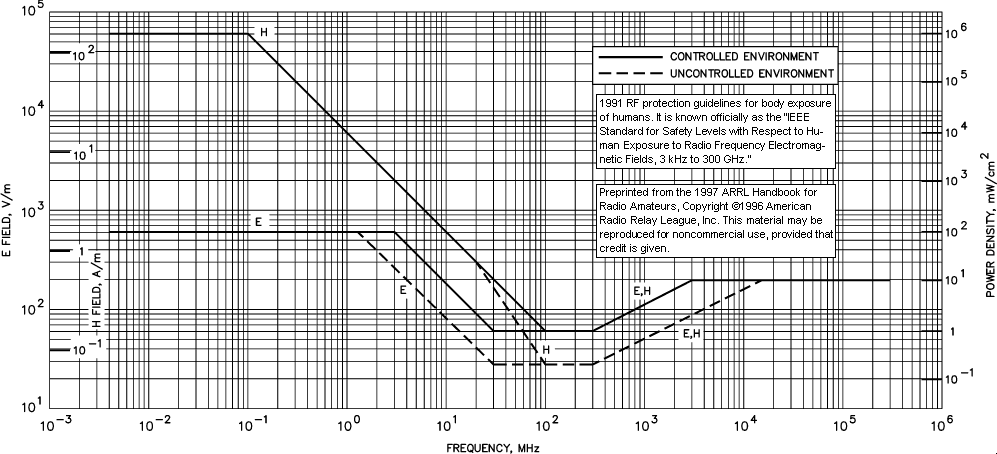
Nope, just an amateur radio geek. We're required by law to evaluate our stations for MPE (Maximum Permissible Exposure). Here's an article about it, and here's the FCC page where you can download Bulletin 65 and its supplements. There are lots of calculators online - these rules apply to most every transmitter, so if you know a few details you can discover the MPE exclusion zone(s) for it.
Thanks for the kudos!
-
So what if the FCC turns off cell phones...
-
Re:What are the chances
Not according to the NOAA/Space Weather Prediction Center. Close, though. Solar flux has been terrible lately - 10m was wide open back in late October with flux values of 140 or higher. We're barely above 100 right now with a massive contest on for this weekend. Durn it!
-
Re:Mine now!
Ask and you shall receive: Statistics.
Recall that licenses expire after 10 years, so dead/uninterested people do fall out of the numbers with at most a 10 year latency.
-
Re:Mine now!
You only need a license for licensed bands. I'm sure you can do anything you want on CB.
Also, dying hobby? Didn't we have a news article on slashdot just a few months ago saying there are more hams now than ever before?
-
Re:TFS, it sucks
The unused spectrum now assigned to television broadcast has been made available for public use by the FCC.
No. It hasn't. It's been made available for commercial use, following the long standing tradition at the FCC of giving the public nothing or next to nothing, and corporations everything.
Are you kidding me? You're honestly complaining about the lack of spectrum that is available for public use?
http://www.arrl.org/files/file/Hambands_color.pdf -
Re:It's not the last
The FCC could try to take away some of the amateur radio spectrum. Every now again they try to take some away. In so far they have not been successful. It is only a matter of time though. What with the number of new hams decreasing every year.
You might want to check your facts. The number of licensees in the U.S. is actually at an all-time high. It's been climbing since 2007, when the FCC dropped an outdated Morse Code proficiency requirement. See graphs and some additional stats for the details.
-
Re:It's not the last
Actually, see here. Also, amateur radio bands exist in almost all parts of the spectrum from HF up to UHF but taken collectively it doesn't amount to much when compared to the whole spectrum.
-
Re:states?
The Kingdom of the Netherlands is considered to be composed of four "countries": The Netherlands, Aruba, Sint Maarten, and Curaçao.
Cool! A recursive kingdom definition.
BTW, Things changed recently wrt to Amateur Radio and SM, Curacao, Saba, etc. They recently got broken out into their own 'countries' as far as DXCC goes.
PJ2(50) Curacao SA 11 09 517
PJ4(51) Bonaire SA 11 09 520
PJ5,6(52) Saba & St. Eustatius NA 11 08 519
PJ7(53) St Maarten NA 11 08 518 -
Re:This could go horribly wrong.
Actually, the real concern was interference from Amateur Radio signals. The frequency range that these devices plan to use is in the 440 - 450 MHz range... which is right where a bunch of the little hand held ham radio units operate. The ARRL (National Amateur Radio Association) was the biggest group against the proposed usage, and the FCC only permitted the use with the prevision that it was Secondary to the existing licensees (HAMs). In other words, the medical devices cannot interfere with the radios, and they have to be able to live with any signals produced by radios. Here is an in depth article regarding the FCC grant.
-
Re:survivalists
> Living your life on the basis of preparing for the collapse of civilization makes as much sense as building a nuclear bunker in your garden in case an asteroid hits.
That's true.
Lucky it's not what I was talking about.
Making some modest preparations to ride out a temporary infrastructure collapse bears resemblance to weirdos preparing for the permanent collapse of civilization only in that the two groups share some of the same supplies.
It could be something as simple as a natural disaster that takes out power for a few weeks. Tell me that's never happened. In such a scenario, it might be a good idea to have enough food and power to get through it. (Don't forget pet food.) In areas where power is questionable, like in a hurricane zone, it might be a good idea to have an alternate source of power for your food storage (fridge and freezer). My solar array is somewhat portable; two people can carry it inside during a storm, carry it back out afterwards, and then I have power for radio and food storage. Light is provided by hurricane lanterns (decorative when not in use) and cooking by wood stove (which is economical when power is going, essential when power is not). This is not crazy redneck stuff but practical, renewable and cost effective.
Realistically, preparing for a permanent collapse is more difficult than people realize. You are essentially back to pioneer level, where the only tools you have, after the cool high tech stuff wears out, are the tools you can make with your own hands. Obviously, no amount of stockpiling will get you through that.
But there are a lot of scenarios having absolutely nothing to do with the collapse of civilization, ranging to inconvenient to mildly dangerous, where a few goods laid by and a few hundred watts of alternate energy and a method of communication that doesn't use land lines or cell towers (or 2 meter repeaters! hams sometimes forget this) might come in handy. It's not a paranoid fantasy any more than carrying flares and a first aid kit in your car speaks of a paranoid fantasy that you're going to have a horrible accident.
Speaking of cars, in my youth, my wife and I once spent the night in a parking lot in the car when the pass was closed by unusual snowfall. It got a mite hungry. Now I have a small emergency kit in each car that besides modest medical supplies and a maglight, containes water and concentrated rations for three days. I assure you, I do not have a paranoid fantasy about being stuck in the snow again.
In summary, it's not about going horribly wrong. It's about going recoverably wrong for some relatively short period of time. Back on topic, if you don't think amateur radio is useful in natural disasters, there are a lot of references. Start with http://www.arrl.org/emergency-radio-org.
-
Re:What's the attraction?
With a license and that same radio you can talk to the astronauts. How cool is _that_?
-
Not true -- techs have phone in 10m band
Keep in mind that technician class is limited to CW transmissions below 30MHz, so morse code is still somewhat required for shortwave.
Well, that's not true. From this chart, technician licensees have phone (SSB) privileges in the 10-meter band at 28.3-28.5 MHz.
-
Re:Easier Entry
Don't suppose this has anything to do with the removal of the Morse Code requirement in 2007
Perhaps, but that was only for General class - Technician was always (?) code free. But General class gives you access to the lower frequencies with longer range capability so perhaps that's it.
I think it's more likely that Amateur Radio is now the Boy Scouts of the 21st Century. It's big 'repurposing' has been in the field of Emergency Communications. They've had some good publicity with recent major disasters, offer a 'function' for the hobby ('Honey, I need to buy that radio to help in the event of a natural disaster' - worth a try anyway), allows you to get involved in something besides talking to someone at the end of the world.
They even have cool reflective jackets and donuts.
Or perhaps a combination of the two and other things.
-
Radio licenses are easier to get
It's neat that amateur radio still has a niche in today's world, even though these figures are less impressive when you consider (1) population growth in the US over the last four decades and (2) getting a radio license now is much easier than it used to be.
These days, no Morse code knowledge is required for Tech level, and many clubs offer a "get your license in one day" class for cramming on the published question pool and then doing a brain dump into the exam before you forget everything.
Really, if you have a free Saturday and you've ever thought for more than 10 seconds about getting your radio license, there's no reason not to do it.
-
That's what radio is for.
If you want reliable backup comms in the wilderness you use radio.
The reliance on phones and internet is convenient, but if you can afford those you can afford radio gear and spend some time learning how to use it.
Amateur radio operators were the original nerds long before computers existed.
-
Re:Nothing from Hams?
Nobody uses omnidirectional antennas for ham operation in 2.4Ghz. Almost all operation is with satellites or point-to-point, and 10- to 20-element yagi beams are standard equipment. It's because of simple physics and the distance involved, plus there are way more sources of noise on S-band than your little directional router. With the beam pointed straight up, they probably won't even hear your signal, nor you theirs. Funny thing about radio waves, they propagate (or not) the same in both directions. Plus, the actual power limit is 1500W , provided safety constraints are met, and 50W S-band amplifiers are pretty common--try beating that.
-
Re:cars equipped with short-range radio
Yes, you have to have an FCC Amateur license. It's free to have the actual license, and the test costs a whopping $15. Your license lasts for 10 years and can be renewed (for free) indefinitely (with a 2-year grace - renew within 12 years of getting it and you just have to fill out a form, no test).
As far as I'm aware your allowed to listen to just about anything, of course taking privacy laws and any local ordinances etc.
-
Internet over mains....... Ham radio
Have you thought of using internet over mains wiring?
"It's as if millions of Radio Hams suddenly cried out in terror and were suddenly silenced."
Broadband over power line wipes out short wave radio.
http://www.arrl.org/broadband-over-powerline-bpl
. -
Re:Bluetooth Headset Radiation
According to the ARRL Bluetooth is slightly lower risk for the same power. Since max Bluetooth power is only 100mW the risk should be lower. The full paper from the ARRL can be found at http://www.arrl.org/rf-radiation-and-electromagnetic-field-safety
-
Re:Bluetooth Headset Radiation
According to the ARRL Bluetooth is slightly lower risk for the same power. Since max Bluetooth power is only 100mW the risk should be lower. The full paper from the ARRL can be found at http://www.arrl.org/rf-radiation-and-electromagnetic-field-safety
-
BPL is a failure
BPL (Broadband over Power Line) turns power lines into giant transmitting antennas. What could possibly go wrong? http://www.arrl.org/broadband-over-powerline-bpl http://www.arrl.org/news/city-of-manassas-to-end-bpl-service http://www.arrl.org/news/arrl-shows-ibec-bpl-systems-are-interfering-violating-fcc-rules Yes, these are are Ham Radio references because we are the ones using the spectrum that BPL interferes (sometimes on a shared basis with other services).
-
BPL is a failure
BPL (Broadband over Power Line) turns power lines into giant transmitting antennas. What could possibly go wrong? http://www.arrl.org/broadband-over-powerline-bpl http://www.arrl.org/news/city-of-manassas-to-end-bpl-service http://www.arrl.org/news/arrl-shows-ibec-bpl-systems-are-interfering-violating-fcc-rules Yes, these are are Ham Radio references because we are the ones using the spectrum that BPL interferes (sometimes on a shared basis with other services).
-
BPL is a failure
BPL (Broadband over Power Line) turns power lines into giant transmitting antennas. What could possibly go wrong? http://www.arrl.org/broadband-over-powerline-bpl http://www.arrl.org/news/city-of-manassas-to-end-bpl-service http://www.arrl.org/news/arrl-shows-ibec-bpl-systems-are-interfering-violating-fcc-rules Yes, these are are Ham Radio references because we are the ones using the spectrum that BPL interferes (sometimes on a shared basis with other services).
-
Re:You'll miss them in a disaster
Voice-mode message passing is indeed a slow fallback (I think 5wpm was the number given at a recent RACES drill locally), which is why various digital/packet modes are coming into use.
Granted, it's still probably a good idea to have those skills in case your TNC fails, and voice is the only mode you have available.
Gotta do better than that. What do you do if the radio equipment is damaged and all you can do is create a bare carrier wave?
Morse, baby!
Morse Code has surprising data rates with skilled operators. For decades an FCC Amateur Radio Novice Class license required the ability to receive and transmit Continuous-Wave Morse Code at 5 wpm (words per minute), the General Class required 13 wpm, and Extra Class required 20 wpm. For Novices, CW was the *only* mode allowed!
http://en.wikipedia.org/wiki/Amateur_radio_licensing_in_the_United_States
Heck, back "in the day" I, myself, casually conversed daily with over-the-air chat buddies in multiple countries/regions using Morse code on the H.F. ham bands at around 30-35 wpm. Sadly, I'd probably fail a 5 wpm test these days without serious practice to bring back old skills.
Under weak or bad radio signal conditions where the signal-to-noise ratio sucks, Morse code/CW is the most readable/reliable form of radio communication. This was the argument used for many decades to retain Morse code requirements for Amateur Radio Service licensing in the US.
Many people are unaware that a relatively low-powered CW transmitter with only a handful of watts on one of the H.F./shortwave Ham bands like 40 meters (~7 mHz) or 20 meters (~14 mHz) is able to communicate many thousands of miles depending on conditions in the ionosphere. Experienced operators compare their message's desired destination to ionospheric/signal-bounce conditions and choose the band with the best conditions to reach that region.
Often conditions were unsuitable for direct station-to-station contact, so an organized system for passing messages was devised and implemented. This is the original reason for the creation of one of the foundational organizations of Amateur Radio, the A.R.R.L. ( Amateur Radio Relay League).
They publish The Amateur Radio Handbook and many other publications, along with providing many other resources, information, and benefits for Hams.
Strat
-
Who says they are 'old'?
Hams are not all 'old'. (I would submit that your paradigm is old.)
-
Re:But will we?
"Think of hams as radio hackers. Some are heroes, others are hobbyiests, some are both."
They were the first large group of "geeks". Long before PCs existed, the ARRL was active and strong.
-
ARRL
The ARRL has a page set up against HR-607 as well as sample letters. Apparently, if you send them to Chwat & Co (info on previous link(s)), they will hand-deliver it to Congressional office.
-
ARRL
The ARRL has a page set up against HR-607 as well as sample letters. Apparently, if you send them to Chwat & Co (info on previous link(s)), they will hand-deliver it to Congressional office.
-
Re:HAM
Little do you know.
If you've got a dish/directional antenna, and some kit, you can hook it up to your computer, and decode loads of satellite images. You know the pics they show on the weather forecasts? They're just beamed down from space.
More. Did you know Hams "own" 44/8" too btw? -
Re:I know it's usually thought of as old, but...
For a variety of reasons, Hams are generally speaking not "joiners", and the old-timers that form the core of most Amateur Radio Clubs have been a tight-knit community of amateur engineers and friends for decades, supporting and sharing the tech knowledge, but there are WAY more Hams out there who do not even belong to a club. Many clubs struggle to get newly-licensed hams to join them! However, the number of new licenses issued by the FCC has been increasing every year for many years. Here is a quote from the ARRL web site: "In 2009, a total of 30,144 new licenses were granted, an increase of almost 7.5 percent from 2008. In 2005, 16,368 new hams joined Amateur Radio’s ranks -- just five years later, that number had increased by almost 14,000, a whopping 84 percent!" So, to paraphrase Mark Twain, the news of Amateur Radio's death has been greatly exaggerated! (From an article linked here.)