Slashdot Mirror
Domain: arstechnica.com
Stories and comments across the archive that link to arstechnica.com.
Comments · 9,494
-
Re:Tango DropBox
Same thing happened to Samsung. Here's a digital picture frame they made in 2005 and sold in 2006. Long before Apple even came out with the iPhone much less the iPad. (Yes the back doesn't look like a tablet - that's beside the point since it wasn't a tablet.) After you've seen the picture frame you realize Samsung didn't copy the iPad's appearance when they made the Galaxy Tab 10.1. They just took their old digital picture frame design (black face, silver/white trim, and yes rounded corners) and repurposed it as a tablet. Even their name/logo is in the same location.
But because almost nobody saw/bought their digital picture frame, they just assume the iPad was first and anything that looked like it must be a copy. I'm of the opinion that with minimalist designs like this, pretty much everyone will come up with the same design. But if you insist there was copying, it's far more likely that it was Apple who lifted Samsung's digital picture frame design when they were settling on the iPad's appearance. -
Re:Wait, what?
The list of exception is rather significant: the missing apps are also the foundations of the API other apps uses. So you are not just missing out on the Google App Store and a few standalone apps, but all the API related to those apps too - which a very exhaustive list.
When people say "Android is open-source" that is not what they have in mind. In practice Android is open source like OSX is open source (Darwin), sure you get the foundations of a great system, but none of the shiny bits. So rather than a walled garden, you have a fenced garden. If you want freedom you need to look at Firefox and Ubuntu.
Have a look at the following doc for detailled discussion: http://arstechnica.com/informa...
-
Re:Actually, it IS that easy
Directly speaking, that's true. Indirectly speaking, a phone vendor effectively must forgo any revenue potential for providers of services that compete with Google, given Google's restrictictions around prominence of their apps, and the defaults they enforce around search and location. Coincidentally, there is another Ars article on the topic.
-
Re:Actually, it IS that easy
As Google moves more of its functionality from ASOP to Google Play store apps, it is becoming less free (as in beer and freedom).
-
Re:Bad Analogy
What is a spectacular crash in software?
Wut.
Oh yes it does. If you don't realise that Internet security is already a catastrophe then I just don't... you really really need to get out more.
We're living through the biggest security and privacy disaster in the Internet's short history. We don't yet understand the full dimensions of the damage, but we understand this: it was almost entirely preventable. Inexcusably shoddy software workmanship, defended with exactly the argument you're making, is what caused this.
We won't progress as an industry until we learn the meaning of "first do no harm". First, deploy no root exploits to your customers. Then we can talk about efficiency, productivity, market forces, and what colour the fifth pixel from the left on the splash screen should be.
-
Re:States Rights
If I were to claim "My state will teach Newtonian theory of gravity is not fact" would you have issues with it? How about Einstein's theory of gravity? I would be correct in teaching them that those two theories were/are not factual, and showing where the gaps are. This is how we make progress in science and improve theories.
It is important to understand that all we have are observations (with noise) and we make theories/models to explain them in order to predict future behavior. Newton's mechanics worked great for the observations available at that time, while relativity theory is needed under other circumstances such that when matter travel at speeds close to the speed of light. Getting students to understand this and to realize that there are likely cases when even Einstein's theories do not explain observations is of course very valuable. However, this does not mean that any theory of mechanics is equally useful/plausible. We have for instance no reason to look back to Aristotle or some other ancient theory as an alternative as they do not offer any predictability.
Would teaching where these theories seem to fail mean that "I refuse to teach about gravity" and all of my students are idiots because I taught them to question what someone else want's them taught as "fact" (this matches the straw man TFA erects and you seem to believe)?
I'm not sure what article you are referring to but I don't see anyone claiming "not teach their children what is accepted in the scientific community". I read "argued against teaching natural selection as fact, " and "teach them the controversy".
Evolution and Natural selection surely have some gaps, which is why there is still some controversy. You may not like the other side, so choose to ignore the gaps which makes you biased. Just like the other side is biased, but of course that is difficult to come to grips with our own shortcomings.
Of course there are controversies within the fine details in the field of biology as in any research field, but they are just not the controversies Sen. Mike Fair has in mind. The term "teach the controversy" is used to propose that intelligent design/creationism are valuable alternative ideas to natural selection (http://en.wikipedia.org/wiki/Teach_the_controversy). There is simply no such controversy among scientist, the people who believe in creationism do so primarily on religious grounds. Here's an interesting article explaining some actual controversies in evolution: http://arstechnica.com/science.... One among them apparently being the relationship between the three main cell types Bacteria, Archaea, and Eukaryotes and how they exactly evolved in the beginning.
A big part of science used to be not accepting what someone gives you and following the scientific methods. Teaching people to question what they are told surely has benefits. Are you so biased that questions are only valid about someone else' belief?
I agree that it would be great to teach high school students some theory of science and give them the tools to separate good science from bad science and pseudo science such as astrology, creationism and "young earth theories". I have a hard time believing this is what the senator in SC is proposing though.
-
Dick Cheney's heart is secured.
Oddly enough, for the very fear of this, Dick Cheney had wifi access to his pacemaker disabled.
His heart is closed to attackers. Just like it is to empathy and humanity. -
Actually, this is how peering agreements work
"Throttling" between autonomous systems is common.
Think of it as series of tubes, and between some places, the tubes are thinner. Usually wherever AS POP meet and the exchange arrangement is not settlement-free, but capped to some numbers in (either) direction. Or the port is simply running red-hot.
When two big ISPs refuse to reach a compromise on peering terms, it's usually the users who suffer. Think of the Sprint vs. cogent drama.
Commercial internet worked like that since uh
Net neutrality term is a bit of oxymoron in the light of this, as there was never one to begin with. The problem is simply lack of last-mile competition in the US, as those operators are not pressed by competition to provide quality bandwidth to end users from relevant places as needed.
Refusing to peer with competing service, and offering local service of their own is entirely legit as well. As long the consumer is given choice of different ISP to flee to.... -
Re:Net Neutrality
The classification is the main issue:
In the court case, the FCC said its rules aren't common carrier regulations because "Verizon is free to offer or decline to sell broadband Internet access service to any end user. Verizon need not hold itself out to offer service indifferently to anyone.
Re-classifying them as common carrier would open up a whole different can of worms. The FCC is waiting for Congress to change the rules.
Somehow that is OK, but god forbid any innovator in their own home makes a profit
They are only prohibiting commercial use of consumer grade contracts. There is no prohibition for the innovator getting a business line contract and making money at home.
-
Re:Whoops!
Sorry, I missed the link in the original post and someone added the wrong link. Here is the correct article - http://arstechnica.com/science...
-
Re:I'm switching to Lynx.
There are NO "beta addicts"
The community has universally spoken against the new look. I have not seen one post that has been in favor of it. In over twenty years of being on the Internet, that is a first for me.
The only people who seem interested in the beta seem to be the people at Dice pushing it down at us. There are numerous speculations as to why this is (an earnest belief it improves the site, somebody's reputation on the line, or an attempt to orient the brand at a new demographic). Dice's continued silence on the matter is quite telling, however; it is obvious they are not concerned with what the community thinks about the matter.
At the moment, I am still coming back to Slashdot because the circus and uproar about the beta is just too much fun to miss out on, but like many here I expect that - barring a reversal of intent on Dice's behalf - I eventually will migrate to some other website.
Already some suggestions have been made:
Ars Technica
Alt Slashdot (currently in development)
Subreddit
kuro5hinI am on the lookout for more.
-
Re:Dice have already written off Slashdot
Ars Technica generally covers a lot of the same material that Slashdot does, except with proper editing and writing. News-wise they're quite a lot better than Slashdot, IMO (I only really come here for the comments, since Slashdot's moderation system and sheer quantity of comments means you can often find some real gems).
-
Re:Verizon is denying it:
This is kind of old news. There are a series of articles from last year that suggest that the issue is a peering arrangement.
The articles that I've read seem to suggest that: Cogent is one of Netflix's primary ISP's. The ports used for peering between Verizon and Cogent have become saturated due to Netflix traffic to Netflix/Verizon residential customers. Since the flow of traffic is overwhelmingly to Verizon customers, Cogent feels that the peering arrangement is significantly asymmetrical that the onus is on Verizon to purchase additional ports (one article claims that each 10G port costs Verizon about $10k each). For various reasons, Verizon is not willing to do this - and it is widely speculated that Verizon is disincentivized from doing this due to their competing services. Further, Verizon could purchase relatively inexpensive 4u "Open Connect" boxes from Netflix, which will deliver content directly within their network - significantly reducing the bandwidth costs of delivering content over multiple networks. However, it is speculated that Verizon does not do this for the same reason that they don't add additional ports to their peers (such as Cogent).
-
Re:Campaign Contributions
Yep
Bought out for just $250. I guess that is what integrity costs nowdays.
Instead of ranting like we do on tech forums like slashdot I am wondering something instead? Is it possible to run with no campaign contributions at all? How stupid are American voters who buy things based on TV ads?
I am dead serious too. Perhaps if less people really vote based on flashy ads on TV we can get some R's and D's on pledge to not take any corporate donations? Ya ya both parties are the same I am about to get, but here is the truth. THEY ARE NOT THE SAME. Only same in being corrupt.
A true R is a libertarian and a true D is a green party person. With no influence they can push their ideologies.
-
Re:Did anyone notice?
What the sock puppets seem to have missed was the complexity of:
"Anonymous unmasked: hacker ringleader turned FBI informant"
http://www.csmonitor.com/USA/J...
"Jeremy Hammond: FBI directed my attacks on foreign government sites"
http://www.theguardian.com/wor...
http://arstechnica.com/tech-po... -
Re:good riddance
More recently then, Amazon took purchased digital copies of A Christmas Story offline during the holidays. The only difference here is they removed it from a tablet in your possession in one case vs from your purchased, watch and stream anytime library in the other. In both cases you LOST access to something paid for because of someone else's douchebaggery, even if temporarily.
As for should have never been available, that is an oversight on Amazon's part for allowing it to be posted without validating resell rights. You're argument is basically, it's ok for books a million (or barnes and noble or walmart or...) to come in your house and take a book you purchased, at their store, if it 's later determined that didn't have permission to sell it. Just as long as they refund the cost of the book, never mind any damage done to your life, education (I remember reading a few papers being written about the book and the people losing all of their notes as well as the book), privacy, or peace of mind. Honestly, even amazon admitted they fucked up
-
Re:IE on Windows easiest to compromise ..
'IE is the most prevalent browser on the systems that attackers want to compromise' IE on Windows is the easiest system for attackers to compromise
For a number of years Safari on OSX has been the easiest system for hackers to compromise in Pwn2Own.
http://www.zdnet.com/blog/secu...
http://arstechnica.com/apple/2... -
Re:Such documents trove
http://arstechnica.com/tech-po...
Apparently this guy thinks there are only a couple copies and they need to be physically returned to the NSA so they can be certain that no copies exist anywhere else. Or he's just being more obvious in deliberately implying things that are false than is normal even for someone in his position.
-
Re:OPERA!?
IE remains what? Not on Linux. This story was about Opera on Linux. When you think about it - a small company with a nearly unused browser (Opera - 1.7% market share) shouldn't bother to write their software for a marginal market (Linux, buried in "other" at 1.87%). The number of users who want both Linux and Opera would therefore be vanishingly small. Think of the Venn diagram for that. Less than worth developing for, that's for sure. Numbers are from http://arstechnica.com/informa....
-
Re:Freedom!
Ars is reporting that the bill was written by John Federico on behalf of the Kansas Cable Telecommunications Association, of which he is president.
-
Re:it went exactly as planned
The best analysis of this seems to be ArsTechnica, which looks into the conflict with Samsung. Even in the beginning of the deal, people were furrowing brows on how Google can be competing on hardware with the rest of Android.
I live in Chicago. I have a relative in Motorola. Google spent a lot of cash to get people to move to the Merchandise Mart downtown, spending a huge wad of cash to lease out an entire floor of the Mart. This was very disruptive for the teams, and only would pay longer term benefits. This doesn't seem to me to be a strip-and-dump purchase by Google, but the Samsung-Tizen thing kind of forced their hand. People were worrying about Android fragmentation, and the sale of Motorola was the pound of flesh that Google needed to give up to stop a huge split with Samsung.
That's not correct. Tizen is not an Android fork (it's actually a Linux fork) so it will not fragment Android. The sale of Motorola Mobile will not affect Samsung plans for lunching Tizen powered phones. In the two years that Google owned Motorola Mobile they didn't show any interest in running the company. The fact that Motorola Mobile waited almost two years to release new Android phones shows a lack of interest from Google. At the time that Google bought Motorola Mobile many of the posters on
-
Re:More reprsentative stats please
Main domain: 650k "visits" (Google Analytics definition) this month. 31% Chrome, 26% IE, 18% Safari, 17% Firefox, 3% Android.
60% Windows, 19% iOS, 13% Mac, 6% Android, 1% Linux.Another domain of no interest to visitors, only scientists (and hobbyists, probably): 52k visits, 33% Chrome, 33% Firefox, 24% IE, 7% Safari, 2% Opera(!), 1% Android
85% Windows, 10% Mac, 2% iOS, 1% Linux (the site isn't very nice on a mobile, we don't think many people want to look at tables of data on a tiny screen).The interesting thing is, or rather, something wrong, is that Android's marketshare is around 80% of smart devices, iOS around 20%. And yet in all your stats, iOS still comes out ahead of Android.
Even Ars Technica, a site for technical enthusiasts still records just over 50% IE usage. And on mobile, iOS takes 50% of the traffic, while Android is around 35% (Android+Chrome).
So the question is - why is iOS so over-represented? We know there are at least 4 times as many Android devices out there.
-
Re:it went exactly as planned
The best analysis of this seems to be ArsTechnica, which looks into the conflict with Samsung. Even in the beginning of the deal, people were furrowing brows on how Google can be competing on hardware with the rest of Android.
I live in Chicago. I have a relative in Motorola. Google spent a lot of cash to get people to move to the Merchandise Mart downtown, spending a huge wad of cash to lease out an entire floor of the Mart. This was very disruptive for the teams, and only would pay longer term benefits. This doesn't seem to me to be a strip-and-dump purchase by Google, but the Samsung-Tizen thing kind of forced their hand. People were worrying about Android fragmentation, and the sale of Motorola was the pound of flesh that Google needed to give up to stop a huge split with Samsung.
-
These are NOT Dirac Monopoles
But how many slashdot stories about fusion reactors, methanol fuel cells, or flying cars has actually been more than investor fleecing vaporware?
These are not actually Dirac monopoles. These are magnetic quasiparticles that behave in a way that simulates Dirac monopoles.
The Ars Technicha article has the best explanation:
http://arstechnica.com/science...
Emphasis mine:
"Since we can't seem to find one, though, some researchers decided to emulate monopole behavior using an analogous quantum system. They used a Bose-Einstein condensate: a collection of very cold atoms that behaves like a single quantum system." -
Re:Apache 2 License? o.o
Actually, most (all?) Microsoft open source projects these days are released under Apache License 2.0, and even the stuff that was previously under MS-PL or other custom licenses has been relicensed to AL (in particular, ASP.NET MVC made a doing so a few years ago).
All Azure SDKs (.NET, Java, PHP, Python, Ruby, node.js) are also under AL and on GitHub. So is TypeScript (the open sourced parts - i.e. the compiler, not the IDE support). So are Python and Node.js Tools for Visual Studio.
I can't actually think of any actively developed open source MS project that is not under AL.
-
Re:Asus
What about Asus and others? If the deal is against Apple then it should be between everyone not just Samsung and Google.
Alas, Samsung's the only big player in the Android space, with roughly 90% of Android marketshare. (Though, most of that is NOT of the high end devices - which make up around 10% of Android sales as a whole.). Samsung makes dozens of phones, practically releasing a new variant or other daily.
And you can bet that it's also a pre-emptive move by Google to prevent Samsung from releasing non-Google phones. Samsung is the only manufacturer who has a whole suite of apps that rival Google's (even if methods to get apps in its store were a bit questionable).
And they're big enough to quite possibly challenge Google and win - remember, OHA members are not allowed to release anything that's "Android compatible (see what happened to Aliyun and Acer). But Samsung could with their Linux based OS and all that - if Google kicks them out, they're at the ready with AOSP and their own apps.
Samsung is a bigger threat to Google's control of Android than anything. Google released Android as open-source to counter being locked out of iOS. Now it fears being locked out of Android because of it (on two fronts - the Kindle, and Samsung).
Samsung gains a lot of early Android access, and cheap patents. Google gains reassurance that Samsung won't go it alone and screw them on Android.
-
Re:Also blocks startups.
They haven't done it directly as far as I'm aware, but they've essentially done so by proxy. I think they're the only company that's figured out that they won't make any money even if they do successfully sue someone as the lawyers will eat away most of whatever award they would receive and the case would still be tied up in appeals for years and years to eat away whatever's left.
-
ArsTechnica Coverage
Scientists detect "spoiled onions" trying to sabotage Tor privacy network
Rogue Tor volunteers perform attacks that try to degrade encrypted connections.
-
Spoiled Onions: Exposing Malicious Tor Exit Relays
-- Spoiled Onions: Exposing Malicious Tor Exit Relays
(PDF) http://cryptome.org/2014/01/sp...
http://www.cs.kau.se/philwint/...&
-- What the "Spoiled Onions" paper means for Tor users
https://blog.torproject.org/bl...&
-- Scientists detect "spoiled onions" trying to sabotage Tor privacy network
Rogue Tor volunteers perform attacks that try to degrade encrypted connections. -
Spoiled Onions: Exposing Malicious Tor Exit Relays
-- Spoiled Onions: Exposing Malicious Tor Exit Relays
(PDF) http://cryptome.org/2014/01/sp...
http://www.cs.kau.se/philwint/...&
-- What the "Spoiled Onions" paper means for Tor users
https://blog.torproject.org/bl...&
-- Scientists detect âoespoiled onionsâ trying to sabotage Tor privacy network
Rogue Tor volunteers perform attacks that try to degrade encrypted connections. -
If it makes you feel better, go for it.
That reads almost too much like a sales pitch/shill post.
Ars Technica posted a pitch-perfect headline demonstrating how a Slashdot geek responds to good news from Microsoft:
Beleaguered Microsoft posts record revenue for Q2 2014
Calling the poster a shill is the easy way out. Personally, I'd like to see more clear-headed --- hard-headed thinking --- around here.
-
Google already has a noose on manufacturers
I found this Ars Technica article about how hard core Google is kind of interesting. Kind of made me sympathetic for all the work that Amazon has to do to get the Kindle Fire working.
Also, for those who don't know, KitKat has Google Now taking over your home screen, meaning Google now listens on your microphone 24/7 (as if it hasn't already).
Is Apple now the white knight, saving us from Android domination? No of course not, but interesting to see how quickly the idea of Google owning the world has switched. I mean, I can turn off the microphone for certain apps in iOS, but can't in Android.
-
Google already has a noose on manufacturers
I found this Ars Technica article about how hard core Google is kind of interesting. Kind of made me sympathetic for all the work that Amazon has to do to get the Kindle Fire working.
Also, for those who don't know, KitKat has Google Now taking over your home screen, meaning Google now listens on your microphone 24/7 (as if it hasn't already).
Is Apple now the white knight, saving us from Android domination? No of course not, but interesting to see how quickly the idea of Google owning the world has switched. I mean, I can turn off the microphone for certain apps in iOS, but can't in Android.
-
Re:And nothing will change ...
Because, I'm pretty sure I've seen stories about how the spy agencies have been briefing law enforcement in how to cover up the involvement of the three-letter-agencies.
-
Re:One and the same
Re What will change with any of this?
Life can go both ways in the USA as it enters its East German phase.
People may select to play into the system and attend meetings, courses and make all the right political and work place moves to ensure they are never noticed.
The problem with that is the state based "Fusion" centers and a vast illegal domestic surveillance network is kind of hard to out pace the domestic dragnet.
http://en.wikipedia.org/wiki/F...
Sooner or later the deeper internal border checkpoints, other internal federally funded checkpoints, been seen near a protest, parking near a protest, been asked to show ID near a protest will catch up with many people.
The other option is to use your remaining Constitutional rights - support the press, write to the press, support 3rd parties, blog, speak out at community events.
The Stasi paperwork 'fail' is the real lesson from history. At a point even with all the NSA database power and local Fusion centers help real people have to read "digital" files.
All that work to support the press, write to the press, support 3rd parties, blog, speak out at community events starts to expand a digital file that has to be understood by a bureaucrat or contractor over years.
Thanks to Snowden all the sockpuppets no longer have the benefit of the doubt as to data tracking, storage, usage in domestic courts, global tracking, weak codes, junk hardware, junk software, tame political leaders and unaware corporate legal teams...
http://arstechnica.com/tech-po...
So yes it will get worse but now people around the world can see the new digital Berlin wall and understand just how how trapped all data is for decades. -
ARS's Lee Hutchinson lived on it for a week...
Over 6 months ago. I followed it but didn't see it changing my diet anytime soon.
Before: http://arstechnica.com/gadgets...
After: http://arstechnica.com/gadgets... -
ARS's Lee Hutchinson lived on it for a week...
Over 6 months ago. I followed it but didn't see it changing my diet anytime soon.
Before: http://arstechnica.com/gadgets...
After: http://arstechnica.com/gadgets... -
Re:just a thousand exit nodes
Sorry, botched the link... http://arstechnica.com/tech-po...
-
Re:Questionable claims
According to Dan Goodin (Arstechnica), who wrote "Is your refrigerator really part of a massive spam-sending botnet?", there are all sorts of problems with Proofpoint's statement. The last paragraph sums it up pretty well:
"Knight said he would check to see if missing evidence—including a malware sample, documentation of a command-and-control server, and samples of the spam and phishing messages—are available for publication. Again, I'm open to the possibility the botnet reported by Proofpoint exists. But until these smoking guns are produced, I'm maintaining a healthy amount of skepticism."
That brings a whole new level of funny to this affair. What if the spammers were randomly inserting false info into the return path (or something) like "Maytag Model 360XYZ" or such?
-
Not backed by facts, read this article
The articles are not backed by any facts, and leave out all technical details. Read this article for more info
-
Re:I'm not for driver's "rights"
Walking is also a privilege, not a right. You will comply when gov't requires you to wear a GPS device around your neck at all times to track your location. It is for a safe and efficient society.
You mean a cellphone?
Pardon my 2 year old stats...
http://arstechnica.com/business/2012/06/prepaid-mobile-phone-users-in-america-hit-record-high/ says most US phones are run by contract (75% users as of that article posting)
IIRC, contracts normally come with carrot-stick: you actually want those hmmm-tasty subsidies to knock half off that phone's MSRP, so you must pass a credit check. But that credit check is tied to your social security number, which gives the government your identity. And my retort isn't off: http://arstechnica.com/business/2012/06/prepaid-mobile-phone-users-in-america-hit-record-high/ 80+% of Americans owned a cellphone back 2 years ago. -
Re:I'm not for driver's "rights"
Walking is also a privilege, not a right. You will comply when gov't requires you to wear a GPS device around your neck at all times to track your location. It is for a safe and efficient society.
You mean a cellphone?
Pardon my 2 year old stats...
http://arstechnica.com/business/2012/06/prepaid-mobile-phone-users-in-america-hit-record-high/ says most US phones are run by contract (75% users as of that article posting)
IIRC, contracts normally come with carrot-stick: you actually want those hmmm-tasty subsidies to knock half off that phone's MSRP, so you must pass a credit check. But that credit check is tied to your social security number, which gives the government your identity. And my retort isn't off: http://arstechnica.com/business/2012/06/prepaid-mobile-phone-users-in-america-hit-record-high/ 80+% of Americans owned a cellphone back 2 years ago. -
Re:You can't win, Darth Blanchfield
Also Adware vendors buy Chrome Extensions to send ad- and malware-filled updates http://arstechnica.com/security/2014/01/malware-vendors-buy-chrome-extensions-to-send-adware-filled-updates/
-
Re:But why 3D printing?
Actually the article was about finding ways to build weapons because we already use 3d printing to build medical devices cheaply.
http://3dprintingindustry.com/medical/
http://arstechnica.com/information-technology/2013/02/robohand-how-cheap-3d-printers-built-a-replacement-hand-for-a-five-year-old-boy/ -
Re: Price?
From what i know, it's more like FAT licensing, features on the phones, not linux,
According to the arstechnica article here, one of the supposed patents had to do with storing or organizing contacts. That doesn't have anything to do with Linux per se, that's just a feature unique to phones. FAT licensing does affect the kernel level, but it only applies because Android phones have to be able to access FAT filesystems on SD cards since that's the de-facto standard for those, all because of the Windows desktop monopoly. Apple probably has to license that same patent for their Macs if they want to be able to read SD cards with FAT filesystems.
-
Re: Price?
Meanwhile less big companies like TomTom get sued for infringement.
http://en.wikipedia.org/wiki/Microsoft_Corp._v._TomTom_Inc.
And HTC pay Microsoft a $5 license for every Android device
Actually I'm surprised that Google doesn't have a formal license fee for Android. They could charge for a license that they'd guarantee would cover all patents. Some would go on the patents they know the rest would go to fighting patent lawsuits in the future.
E.g. suppose Google knows that most licensees for Android pay $5 in license fees. They set up Android Licensing Inc which offers a patent indemnity license for say $10 per device. If you pay the license Android Licensing Inc will fight patent violation lawsuits for you. They could build in a patent pooling clause too.
You'd also be free to take your chances. Of course it's debatable how many Android OEMS would actually go for this. The big ones - Samsung, HTC, Sony etc have already negotiated their own arrangements and would presumably not want to patent pool. The small ones probably take their chances and negotiate licenses as they need to.
Probably they missed their chance to do this back when Android was announced. If they set it up as an industry consortium with patent pooling and a board of directors that governed the standard they could have done this. Android doesn't actually work like that - Google license the base OS for free but Google Apps are licensed.
http://source.android.com/faqs.html#how-can-i-get-access-to-the-google-apps-for-android-such-as-maps
Someone discussed this here
http://pando.com/2012/01/28/how-google-can-save-android-close-it-license-it-swim-in-the-profits/
By licensing Android, Google could begin to extract even more money from smartphones--which, I thought, was the whole point of being in business.
Won't licensing Android turn phone makers away from Google's OS? That may have been a worry a few years ago, before manufacturers had committed to the OS. But now Google and major handset makers are stuck on the Android train. They've built their entire businesses around the OS, and many of their customers love it. And, anyway, phone makers know that Android isn't really free in the first place--not to Google and not to handset makers. In addition to the cost of developing the OS, Google has lately been spending billions on patents to protect it. Nearly every handset maker, meanwhile, has signed licensing agreements with Microsoft to settle patent suits. Estimates suggest that each copy of Android costs phone makers $10 to $15 in licensing fees to Microsoft. That's still a bargain--Windows Phone 7 costs $20 to $30 per copy.
So here's Google's opportunity: It could charge phone makers $10 per Android license, raising the total per-copy cost of Android to between $20 and $25. Sure, Samsung, HTC and others may balk, but what are they going to do about the added cost? Going to Windows would be more expensive and confusing to their businesses. As an inducement, Google could also begin settlement negotiations with Microsoft and other patent litigants to reduce Android's licensing costs. Given all this, phone manufacturers would stick with Android--and Google would make a killing.
The reason I think they won't do this is that Samsung sell most Android phones. There have always been hints that Samsung would fork Android for its own ends and I think if Google tried to make them
-
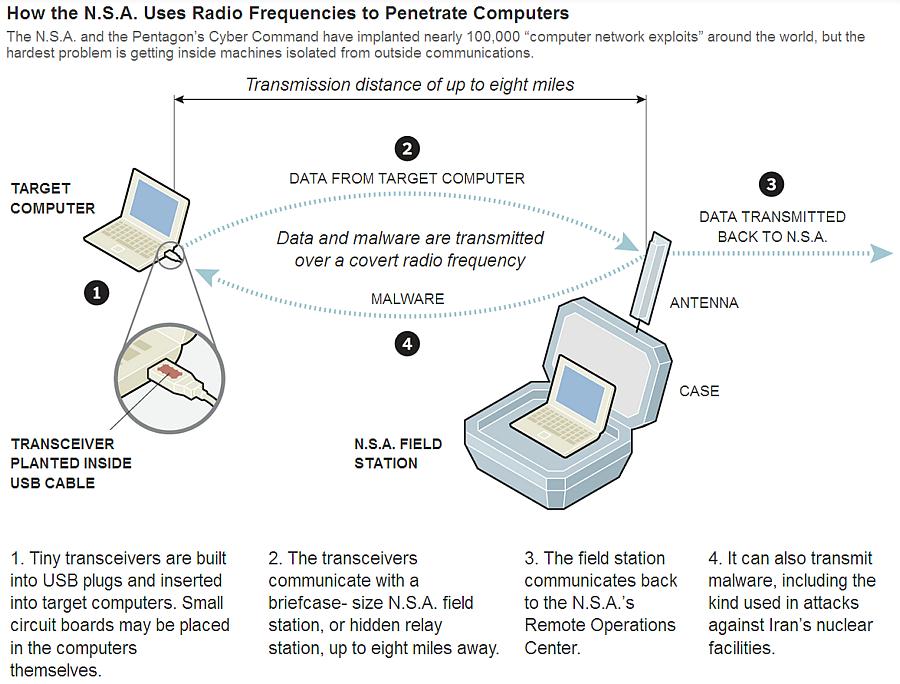
N.S.A. Devises Radio Pathway Into Computers
By david e. sanger and thom shanker = jan. 14, 2014
= URL: http://www.nytimes.com/2014/01/15/us/nsa-effort-pries-open-computers-not-connected-to-internet.html
= Image: http://cryptome.org/2014/01/nsa-quantum-radio.jpg
== Coverage #1: http://news.slashdot.org/story/14/01/15/1324216/nyt-nsa-put-100000-radio-pathway-backdoors-in-pcs
== Coverage #2: http://cryptome.org/2014/01/nsa-quantum-radio.htm
== Coverage #3: http://rt.com/usa/nsa-radio-wave-cyberattack-607/
== Coverage #4: http://arstechnica.com/security/2014/01/nsa-uses-covert-radio-transmissions-to-monitor-100000-bugged-computers/
=== Archive: http://web.archive.org/web/20140116010210/http://www.nytimes.com/2014/01/15/us/nsa-effort-pries-open-computers-not-connected-to-internet.html"WASHINGTON - The National Security Agency has implanted software in nearly 100,000 computers around the world that allows the United States to conduct surveillance on those machines and can also create a digital highway for launching cyberattacks.
While most of the software is inserted by gaining access to computer networks, the N.S.A. has increasingly made use of a secret technology that enables it to enter and alter data in computers even if they are not connected to the Internet, according to N.S.A. documents, computer experts and American officials.
The technology, which the agency has used since at least 2008, relies on a covert channel of radio waves that can be transmitted from tiny circuit boards and USB cards inserted surreptitiously into the computers. In some cases, they are sent to a briefcase-size relay station that intelligence agencies can set up miles away from the target.
The radio frequency technology has helped solve one of the biggest problems facing American intelligence agencies for years: getting into computers that adversaries, and some American partners, have tried to make impervious to spying or cyberattack. In most cases, the radio frequency hardware must be physically inserted by a spy, a manufacturer or an unwitting user.
The N.S.A. calls its efforts more an act of "active defense" against foreign cyberattacks than a tool to go on the offensive. But when Chinese attackers place similar software on the computer systems of American companies or government agencies, American officials have protested, often at the presidential level.
Among the most frequent targets of the N.S.A. and its Pentagon partner, United States Cyber Command, have been units of the Chinese Army, which the United States has accused of launching regular digital probes and attacks on American industrial and military targets, usually to steal secrets or intellectual property. But the program, code-named Quantum, has also been successful in inserting software into Russian military networks and systems used by the Mexican police and drug cartels, trade institutions inside the European Union, and sometime partners against terrorism like Saudi Arabia, India and Pakistan, according to officials and an N.S.A. map that indicates sites of what the agency calls "computer network exploitation."
"What's new here is the scale and the sophistication of the intelligence agency's ability to get into computers and networks to which no one has ever had access before," said James Andrew Lewis, the cybersecurity expert at the Center for Strategic and Interna
-
N.S.A. Devises Radio Pathway Into Computers
N.S.A. Devises Radio Pathway Into Computers
By david e. sanger and thom shanker = jan. 14, 2014
= URL: http://www.nytimes.com/2014/01/15/us/nsa-effort-pries-open-computers-not-connected-to-internet.html
= Image: http://cryptome.org/2014/01/nsa-quantum-radio.jpg
== Coverage #1: http://news.slashdot.org/story/14/01/15/1324216/nyt-nsa-put-100000-radio-pathway-backdoors-in-pcs
== Coverage #2: http://cryptome.org/2014/01/nsa-quantum-radio.htm
== Coverage #3: http://rt.com/usa/nsa-radio-wave-cyberattack-607/
== Coverage #4: http://arstechnica.com/security/2014/01/nsa-uses-covert-radio-transmissions-to-monitor-100000-bugged-computers/
=== Archive: http://web.archive.org/web/20140116010210/http://www.nytimes.com/2014/01/15/us/nsa-effort-pries-open-computers-not-connected-to-internet.html"WASHINGTON - The National Security Agency has implanted software in nearly 100,000 computers around the world that allows the United States to conduct surveillance on those machines and can also create a digital highway for launching cyberattacks.
While most of the software is inserted by gaining access to computer networks, the N.S.A. has increasingly made use of a secret technology that enables it to enter and alter data in computers even if they are not connected to the Internet, according to N.S.A. documents, computer experts and American officials.
The technology, which the agency has used since at least 2008, relies on a covert channel of radio waves that can be transmitted from tiny circuit boards and USB cards inserted surreptitiously into the computers. In some cases, they are sent to a briefcase-size relay station that intelligence agencies can set up miles away from the target.
The radio frequency technology has helped solve one of the biggest problems facing American intelligence agencies for years: getting into computers that adversaries, and some American partners, have tried to make impervious to spying or cyberattack. In most cases, the radio frequency hardware must be physically inserted by a spy, a manufacturer or an unwitting user.
The N.S.A. calls its efforts more an act of "active defense" against foreign cyberattacks than a tool to go on the offensive. But when Chinese attackers place similar software on the computer systems of American companies or government agencies, American officials have protested, often at the presidential level.
Among the most frequent targets of the N.S.A. and its Pentagon partner, United States Cyber Command, have been units of the Chinese Army, which the United States has accused of launching regular digital probes and attacks on American industrial and military targets, usually to steal secrets or intellectual property. But the program, code-named Quantum, has also been successful in inserting software into Russian military networks and systems used by the Mexican police and drug cartels, trade institutions inside the European Union, and sometime partners against terrorism like Saudi Arabia, India and Pakistan, according to officials and an N.S.A. map that indicates sites of what the agency calls "computer network exploitation."
"What's new here is the scale and the sophistication of the intelligence agency's ability to get into computers and networks to which no one has ever had access before," said James Andrew Lewis, the cybersecur
-
#BADBIOS IS FUCKING YOU AND STILL YOU DISBELIEVE
N.S.A. Devises Radio Pathway Into Computers
By david e. sanger and thom shanker = jan. 14, 2014
= URL: http://www.nytimes.com/2014/01/15/us/nsa-effort-pries-open-computers-not-connected-to-internet.html
= Image: http://cryptome.org/2014/01/nsa-quantum-radio.jpg
== Coverage #1: http://news.slashdot.org/story/14/01/15/1324216/nyt-nsa-put-100000-radio-pathway-backdoors-in-pcs
== Coverage #2: http://cryptome.org/2014/01/nsa-quantum-radio.htm
== Coverage #3: http://rt.com/usa/nsa-radio-wave-cyberattack-607/
== Coverage #4: http://arstechnica.com/security/2014/01/nsa-uses-covert-radio-transmissions-to-monitor-100000-bugged-computers/
=== Archive: http://web.archive.org/web/20140116010210/http://www.nytimes.com/2014/01/15/us/nsa-effort-pries-open-computers-not-connected-to-internet.html"WASHINGTON - The National Security Agency has implanted software in nearly 100,000 computers around the world that allows the United States to conduct surveillance on those machines and can also create a digital highway for launching cyberattacks.
While most of the software is inserted by gaining access to computer networks, the N.S.A. has increasingly made use of a secret technology that enables it to enter and alter data in computers even if they are not connected to the Internet, according to N.S.A. documents, computer experts and American officials.
The technology, which the agency has used since at least 2008, relies on a covert channel of radio waves that can be transmitted from tiny circuit boards and USB cards inserted surreptitiously into the computers. In some cases, they are sent to a briefcase-size relay station that intelligence agencies can set up miles away from the target.
The radio frequency technology has helped solve one of the biggest problems facing American intelligence agencies for years: getting into computers that adversaries, and some American partners, have tried to make impervious to spying or cyberattack. In most cases, the radio frequency hardware must be physically inserted by a spy, a manufacturer or an unwitting user.
The N.S.A. calls its efforts more an act of "active defense" against foreign cyberattacks than a tool to go on the offensive. But when Chinese attackers place similar software on the computer systems of American companies or government agencies, American officials have protested, often at the presidential level.
Among the most frequent targets of the N.S.A. and its Pentagon partner, United States Cyber Command, have been units of the Chinese Army, which the United States has accused of launching regular digital probes and attacks on American industrial and military targets, usually to steal secrets or intellectual property. But the program, code-named Quantum, has also been successful in inserting software into Russian military networks and systems used by the Mexican police and drug cartels, trade institutions inside the European Union, and sometime partners against terrorism like Saudi Arabia, India and Pakistan, according to officials and an N.S.A. map that indicates sites of what the agency calls "computer network exploitation."
"What's new here is the scale and the sophistication of the intelligence agency's ability to get into computers and networks to which no one has ever had access before," said James Andrew Lewis, the cybersecur
-
Re:Where are they?
This is speculation, but I bet this is some variant on the Cottonmouth model bug we saw a couple of weeks ago. How many people - even organizations like the Chinese military - are going to disassemble their USB cables and ports? If you're going to go to that far, you might as well build the device yourself out of off the shelf parts.
Except... don't the Chinese make all that type of shit anyways? How did the NSA get the stuff in there in the first place if it's all already made in China anyways?