Slashdot Mirror
Domain: astronautix.com
Stories and comments across the archive that link to astronautix.com.
Comments · 776
-
Re:Why Not Start With The Orion?A first glance I thought this refered to "old boom boom";
http://www.astronautix.com/lvfam/orion.htmNow where's the best place to launch it from.
-
Soviet's running Farscape?
Actually, the design in the upper lefthand corner is actually a ripoff of the BOR-4, a Soviet era-launch developed in the 1970s. NASA's Vehicle Analysis Branch thought the design (which maximizes lift) looked promising, and began studying it in the 1980s. NASA engineers now working at Orbital are pushing for its construction as a shuttle alternative.
-
Re:No Good
Hate to break it to you, but 'get by with out the shuttle' is excatly what this is supposed to do.
Todays shuttle is a halfway house between very different requirements; It was to carry people, it was to carry cargo, it was to be reusable and it was to be cheap. Managing one, two or possible even four of these is possible, but all four at the same time is very, very difficult to do. This new generation spacecraft removes one of the original requirements - as it's not supposed to be a cargocarrier - and thus makes it much easier to make a reuseable personellcarreing spacecraft thats reasonable cheap to operate (cheaper than the shuttle at any rate).
And as long as the US goverment has decided that a permanent base in space is needed - even if I think the ISS is a far cry from what it should have been - then some way of launcing and recovering the astronauts are needed. Yes, there is the russian Soyuz, but while arguable the most successfull spacecraft of all time with more than 230 missions flown, it's also the oldest spacecraft in operation (the design streach back to the late fifties) and it's not reusable. Or you can try to hitch a ride with the chinese, allthought I have doubts they'll let americans ride with them... all those little differences you know. And the ESA are playing with manned spacecraft too, allthought only on the drawingboards right now. So, all in all, grounding the shuttle and not replacing it with a better, more up to date manned spacecraft will leave the US in the mercy of others as far as manned access to space goes.
-
Re:No Good
Hate to break it to you, but 'get by with out the shuttle' is excatly what this is supposed to do.
Todays shuttle is a halfway house between very different requirements; It was to carry people, it was to carry cargo, it was to be reusable and it was to be cheap. Managing one, two or possible even four of these is possible, but all four at the same time is very, very difficult to do. This new generation spacecraft removes one of the original requirements - as it's not supposed to be a cargocarrier - and thus makes it much easier to make a reuseable personellcarreing spacecraft thats reasonable cheap to operate (cheaper than the shuttle at any rate).
And as long as the US goverment has decided that a permanent base in space is needed - even if I think the ISS is a far cry from what it should have been - then some way of launcing and recovering the astronauts are needed. Yes, there is the russian Soyuz, but while arguable the most successfull spacecraft of all time with more than 230 missions flown, it's also the oldest spacecraft in operation (the design streach back to the late fifties) and it's not reusable. Or you can try to hitch a ride with the chinese, allthought I have doubts they'll let americans ride with them... all those little differences you know. And the ESA are playing with manned spacecraft too, allthought only on the drawingboards right now. So, all in all, grounding the shuttle and not replacing it with a better, more up to date manned spacecraft will leave the US in the mercy of others as far as manned access to space goes.
-
367kg isn't that light, really
The article mentions that it is lightweight, only 367kg but NASA's first lunar orbiter weighted 386kg. So 40 years later we have a 19kg savings and it takes 15 months to get there. I love progress...
-
Re:Gemini?!
This is from astronautix (the best site on spaceflight i've ever seen):
In many ways the Gemini design was ahead of that of the Apollo, since the project began two years later . The crew station layout was similar to that of the latest military fighters; the capsule was equipped with ejection seats, inertial navigation, the pilot's traditional 8-ball attitude display, and radar. The escape tower used for Mercury was deleted; the propellants used in the Titan II launch vehicle, while toxic, corrosive, poisonous, and self-igniting, did not explode in the manner of the Atlas or Saturn LOX/Kerosene combination. The ejection seats served as the crew escape method in the lower atmosphere, just as in a high-performance aircraft. The seats were also needed for the original landing mode, which involved deployment of a huge inflated Rogallo wing (ancestor of today's hang gliders) with a piloted landing on skids at Edwards Dry Lake. In the event, the wing could not be made to deploy reliably before flights began, so the capsule made a parachute-borne water landing, much to the astronauts' chagrin.
All around the Gemini was considered the ultimate 'pilot's spacecraft', and it was also popular with engineers because of its extremely light weight. The capsule allowed the recovery of a crew of two for only 50% more than the Mercury capsule weight, and half of the weight per crew member of the Apollo design. The penalty was obvious - it was christened the 'Gusmobile' since diminutive Gus Grissom was the only astronaut who was said to be able to fit into it. -
Re:Why I dislike space elevators
Apollo was lame. Gemini was the real space capsule, with real pilot control, and - once docked to an Agena target vehicle - serious orbital maneuvering ability. Gemini could have gone to the moon, carried up to twelve passengers, and - with stubby wings - made gliding landings on runways.
-
DoD influence on Shuttle
Of course, the shuttle never has flown a polar orbit, and SLC-6 at Vandenberg has it's own little hard-luck story (don't build your launch site on Indian burial grounds). The short of it is, the military got spooked about the reliability of the shuttle after Challenger blew up, decided it wasn't worth it to fix the problems at Slick-6, and have used Titans ever since. For the shuttle, that was a lot of very lucrative business lost.
Were it not for Challenger, the shuttle might have operated out of Vandenberg. What would public perception of the program be like if that were the case?
Here's a listing of all military launches using the shuttle. -
Let's talk retro, let's talk what might have been
Here is one of my favorite web sites, which this article reminded me of, and which I thought some of you might enjoy: http://www.astronautix.com.
The place is filled with tons of mad info about programs that are, were, and never got out of blueprint stage. I am sure this will satisy those readers for whom the two paltry links in the story are far from satisfying. Lotsa cool pictures and thingies. -
Re:Project Orion anyone???
I saw a Horizon documentary about this on BBC Four a while back during a bout of insomnia. It was absolutely riveting. The whole idea was so bonkers, and completely the opposite of normal engineering thinking. "Well, we're going to blast this thing into space using a series of nuclear explosions, so to take the impact it's going to have to be really big and strong. Let's build a spaceship the size of an ocean liner, then". Gotta love that sort of thinking.
Check it. -
Re:And overlooking the incredibly obvious!
That's been studied to death.
The problem is that you'd most likely want different engines. Because the SSME's are very reusable, they are also very expensive.
It probably wouldn't be particularly hard to do, except that nobody wants it badly enough to pay for the startup costs. Most of the projects it would be useful for (launching missions to mars, large space stations, solar power sats, etc.) haven't been getting especially large amounts of funding.
The closest we came was the Space Station C proposal, which would have been interesting, but there were some very good reasons why it was not chosen. -
Re:And overlooking the incredibly obvious!
That's been studied to death.
The problem is that you'd most likely want different engines. Because the SSME's are very reusable, they are also very expensive.
It probably wouldn't be particularly hard to do, except that nobody wants it badly enough to pay for the startup costs. Most of the projects it would be useful for (launching missions to mars, large space stations, solar power sats, etc.) haven't been getting especially large amounts of funding.
The closest we came was the Space Station C proposal, which would have been interesting, but there were some very good reasons why it was not chosen. -
Re:And overlooking the incredibly obvious!
That's been studied to death.
The problem is that you'd most likely want different engines. Because the SSME's are very reusable, they are also very expensive.
It probably wouldn't be particularly hard to do, except that nobody wants it badly enough to pay for the startup costs. Most of the projects it would be useful for (launching missions to mars, large space stations, solar power sats, etc.) haven't been getting especially large amounts of funding.
The closest we came was the Space Station C proposal, which would have been interesting, but there were some very good reasons why it was not chosen. -
Re:And overlooking the incredibly obvious!
That's been studied to death.
The problem is that you'd most likely want different engines. Because the SSME's are very reusable, they are also very expensive.
It probably wouldn't be particularly hard to do, except that nobody wants it badly enough to pay for the startup costs. Most of the projects it would be useful for (launching missions to mars, large space stations, solar power sats, etc.) haven't been getting especially large amounts of funding.
The closest we came was the Space Station C proposal, which would have been interesting, but there were some very good reasons why it was not chosen. -
Re:Solution = Common Sense (yet again)
Not just lawn ornaments.... Some of them had the joy of proper preservation, and the ignomy of being cut up as museum pieces, too.
I will admit that them doing that was dumb then and now. Except they figured that:
a) they'd have the shuttle to reboost Skylab I
b) they'd have the new station that was better up soon enough anyway.
The larger problem is that they needed to keep around one last Apollo for rescue purposes, just in case. So they needed an Apollo capsule and a Saturn IB handy, just in case.
I mean, they were just *screwed* in general. Von Braun wanted to take the route that would give us pre-exsting infrastructure for future projects but the Apollo way of doing things was slightly faster and more likely to succeed. Then NASA gets told that it's either a limited number of future Apollo shots or the space transportation system because we already beat the damn commies to the moon.
The problem was that NASA couldn't make the shuttle happen cheap enough. So the Space Transportation System lost the space-tug portion, the military got involved and changed a bunch of the requirements.
And the one thing that NASA should have really done, they didn't. -
Re:Interesting article at SpaceDailyI read that article back when it came out, and it made perfect sense to me. Then by chance I stumbled across the entry for the cancelled Big Gemini project on astronautix.com.
Seeing that kind of pissed me off. Way back in 1967 McDonnell Douglas had created a dirt cheap space taxi solution for up to 10 crew just by sticking an extension on a standard Gemini capsule. However, the focus on the Apollo missions and later the Space Shuttle pushed aside any non-glamorous low cost solutions such as this one. Now our government is planning to spend countless billions to build from scratch a new space system that will probably have less capability than what Big Gemini could have provided 35 years ago.
-
And thats only the U.S. hardware
Lets not forget the Ariane 5V system in service since 2001 which can launch a 5.4m wide 80,000kg payload to GTO
Then there's always talk of foreign investment breathing life back into the dormant Russian Energia lauch system which was designed to inject up to 200,000Kg of payload into LEO which has already been tested in a 110,000Kg payload configuration for launching the cancelled Buran Orbiter
It makes the shuttle's maximum payload to LEO of 28,803Kg look rather small. -
And thats only the U.S. hardware
Lets not forget the Ariane 5V system in service since 2001 which can launch a 5.4m wide 80,000kg payload to GTO
Then there's always talk of foreign investment breathing life back into the dormant Russian Energia lauch system which was designed to inject up to 200,000Kg of payload into LEO which has already been tested in a 110,000Kg payload configuration for launching the cancelled Buran Orbiter
It makes the shuttle's maximum payload to LEO of 28,803Kg look rather small. -
Re:Rockets? Ummm, no
You haven't been keeping up. The Delta IV Large, which is the current largest available production booster, has a 5 m diamater fairing and can lift 25,800 kg to LEO. The Hubble Space Telescope is a mere 10,863 kg. At that rate, even the Delta IV Medium could lift it.
-
Re:Rockets? Ummm, no
You haven't been keeping up. The Delta IV Large, which is the current largest available production booster, has a 5 m diamater fairing and can lift 25,800 kg to LEO. The Hubble Space Telescope is a mere 10,863 kg. At that rate, even the Delta IV Medium could lift it.
-
Re:Rockets? Ummm, no
You haven't been keeping up. The Delta IV Large, which is the current largest available production booster, has a 5 m diamater fairing and can lift 25,800 kg to LEO. The Hubble Space Telescope is a mere 10,863 kg. At that rate, even the Delta IV Medium could lift it.
-
Re:sharpest ground-based images of Mars to dateWould it even be feasible to send probes to Venus, or is it just too hot?
Several probes have been sent to Venus by the Russians. At least one lander managed to stay operating long enough to send back a lot of data from the surface.
-
Re:stop making space planes, dammit
Point is that with capsules you don't need to optimize the reentry angle, capsules stabilize themselves. The KISS principle at work.
That's a load of manure. If you head over to Encyclopedia Astronautica and read up, you'll find that every single caspule that has flown, from Vostok and Mercury to Shenzhou (the spanking new chinese capsule) had / has to hit the atmosphere at exact atmosphere for a number of reasons, among others the need to minimize the heatpulse and limit the amount of Gs (come in to shallow, and you burn to death, come in to steep and you're crushed).
So, my cowardly friend, capsules do need to optimise their re-entry angle, even thought they are more or less selfstabelising once they have entered the atmosphere (ie, keeping the right side down).
-
Re:I'll fix it for you; Parent's link is to:
http://www.astronautix.com/lvfam/orion.htm
Seri ously, this is very interesting. It reminds me of the spacecraft that Larry Niven and Jerry Pournelle used as the saviour of the human race in "Footfall," which used a similar series of controlled atom bomb explosions underneath a spaceship, in order to propel it.
The mechanism proposed for the supposed 'Aurora' aircraft bears little if any resemblance to the Orion spacecraft design (more information here and here). -
Cheap Transistor Radios
-
Craftmanship versus sofistication?
This is not the first time something craftmanslike can beat something sofisticated. Even thought the following examples are strictly hardware, the general idea is the same.
Take, for instace the T34 vs the Tiger. The Tiger was one of the most sofisticated - if not the most sofisticated - tanks in production at the time, but were drowned by hordes of the more craftmanlike and easily manufactured T34.The battle between a simple, craftmanlike approach and sofistication was once again seen in the early sixties, in the race to get a man into space. The russians fielded the Vostok, a design born more out of solid craftmanship than anything else. It's very simplicity was a strenght, allowing it to undertake missions up to five days long, while the american attemt at a longdurationflight in the highly sofisicated Mercury lasted just under a day and a half, leaving Gordon Cooper in a virtualy dead capsule (having to eyeball his attitude thru the windown and manualy fire the retros). Granted, one reason the US had to go for sofisication is that their rockets simply couldn't lift as much as russian rockets... but whereas derivatives of the Vostok still flies (as unmanned recoverable satelites), the line that breed the Mercury is dead.
Sofistication is well and good, but many times a less sofisticated but better crafted designs / programs can outperform it. Sofistication for it's own sake is usually not worth the tradeoffs.
-
Craftmanship versus sofistication?
This is not the first time something craftmanslike can beat something sofisticated. Even thought the following examples are strictly hardware, the general idea is the same.
Take, for instace the T34 vs the Tiger. The Tiger was one of the most sofisticated - if not the most sofisticated - tanks in production at the time, but were drowned by hordes of the more craftmanlike and easily manufactured T34.The battle between a simple, craftmanlike approach and sofistication was once again seen in the early sixties, in the race to get a man into space. The russians fielded the Vostok, a design born more out of solid craftmanship than anything else. It's very simplicity was a strenght, allowing it to undertake missions up to five days long, while the american attemt at a longdurationflight in the highly sofisicated Mercury lasted just under a day and a half, leaving Gordon Cooper in a virtualy dead capsule (having to eyeball his attitude thru the windown and manualy fire the retros). Granted, one reason the US had to go for sofisication is that their rockets simply couldn't lift as much as russian rockets... but whereas derivatives of the Vostok still flies (as unmanned recoverable satelites), the line that breed the Mercury is dead.
Sofistication is well and good, but many times a less sofisticated but better crafted designs / programs can outperform it. Sofistication for it's own sake is usually not worth the tradeoffs.
-
Re:Escape Podthe problem is that the escape pod for seven people would be huge and would not leave much to the rest of the shuttle.
That's why it would be better to pack 7 of these in the carry-on baggage:
MOOSE was perhaps the most celebrated bail-out from orbit system of the early 1960's. The suited astronaut would strap the MOOSE to his back, and jump out of the spacecraft or station into free space. The MOOSE consisted of a chest-mounted parachute, a flexible, folded 1.8 m diameter elastomeric heat shield, and a canister of polyurethane foam. Pulling the deployment cord would fill the shield into shape and encase the back of the astronaut in perfectly form-fitting polyurethane. The astronaut would use a small hand-held gas get device to orient himself for retro-fire, and then fire a solid rocket motor mounted in the device. After aligning himself for re-entry and putting the MOOSE into a slow roll, he would throw the gas gun away. After a ballistic re-entry, the astronaut would pull the ripcord of the chest-parachute, which would pull him away from the heat shield for a parachute landing.
-
Re:So What Now?
And we're too cheap to give our astronauts some real protection, like thier own escapable lifepod, built into the shuttle's design.
Funny as it might seem, the problem of 'bail out' in space was studied closely in the fifties and early sixties. As usuall, the Encyclopedia Astronautica has more info, of which I have taken some samples from below.
Back in the early days of spaceflight it was envisioned that flying in space would be like flying any other kind of high-performance aircraft. Thought was therefor given to ejecting from a damaged craft, just as you can fom most military jets. They studied a one crew balistic capsule with a weight per crew of 327 kilograms and a six crew balistic capsule, mass per crew 548 kilograms. Breaking away from the ideas of capsules, you had MOOSE; a inflatable heatshield and parachute combination with a weight of 215 kilogram. Paracone was a simular idea, but with an all up weight of 227 kilograms. An derivative of the existing systems for the B-58 lead to EGRESS, with a weight per crew of 370 kilograms.
Despite this promising start, what did NASA come up with for the shuttle when it was designed? Yes, the infamous Rescue Ball!
As you can see, there really is technical reason why NASA shouldn't be able to equip the shuttle with 'lifepods', but another, very real reason. The lightest of the systems I've picked weights just under a quarter of a ton for each astronaut in question. FOr the seven man crew on Colombia, thats just over two tons to haul into space and back again - two tons less cargo. See why the shuttle don't have liferafts? They simply eats too much of the payload. It makes more sence to add more reservefuel to each mission, in order to make sure any shuttle could, if needed, rendevous with the ISS and stay there until a rescueshuttle / several Souyz caspules could be launched to pick them up.
-
Re:So What Now?
And we're too cheap to give our astronauts some real protection, like thier own escapable lifepod, built into the shuttle's design.
Funny as it might seem, the problem of 'bail out' in space was studied closely in the fifties and early sixties. As usuall, the Encyclopedia Astronautica has more info, of which I have taken some samples from below.
Back in the early days of spaceflight it was envisioned that flying in space would be like flying any other kind of high-performance aircraft. Thought was therefor given to ejecting from a damaged craft, just as you can fom most military jets. They studied a one crew balistic capsule with a weight per crew of 327 kilograms and a six crew balistic capsule, mass per crew 548 kilograms. Breaking away from the ideas of capsules, you had MOOSE; a inflatable heatshield and parachute combination with a weight of 215 kilogram. Paracone was a simular idea, but with an all up weight of 227 kilograms. An derivative of the existing systems for the B-58 lead to EGRESS, with a weight per crew of 370 kilograms.
Despite this promising start, what did NASA come up with for the shuttle when it was designed? Yes, the infamous Rescue Ball!
As you can see, there really is technical reason why NASA shouldn't be able to equip the shuttle with 'lifepods', but another, very real reason. The lightest of the systems I've picked weights just under a quarter of a ton for each astronaut in question. FOr the seven man crew on Colombia, thats just over two tons to haul into space and back again - two tons less cargo. See why the shuttle don't have liferafts? They simply eats too much of the payload. It makes more sence to add more reservefuel to each mission, in order to make sure any shuttle could, if needed, rendevous with the ISS and stay there until a rescueshuttle / several Souyz caspules could be launched to pick them up.
-
Re:So What Now?
And we're too cheap to give our astronauts some real protection, like thier own escapable lifepod, built into the shuttle's design.
Funny as it might seem, the problem of 'bail out' in space was studied closely in the fifties and early sixties. As usuall, the Encyclopedia Astronautica has more info, of which I have taken some samples from below.
Back in the early days of spaceflight it was envisioned that flying in space would be like flying any other kind of high-performance aircraft. Thought was therefor given to ejecting from a damaged craft, just as you can fom most military jets. They studied a one crew balistic capsule with a weight per crew of 327 kilograms and a six crew balistic capsule, mass per crew 548 kilograms. Breaking away from the ideas of capsules, you had MOOSE; a inflatable heatshield and parachute combination with a weight of 215 kilogram. Paracone was a simular idea, but with an all up weight of 227 kilograms. An derivative of the existing systems for the B-58 lead to EGRESS, with a weight per crew of 370 kilograms.
Despite this promising start, what did NASA come up with for the shuttle when it was designed? Yes, the infamous Rescue Ball!
As you can see, there really is technical reason why NASA shouldn't be able to equip the shuttle with 'lifepods', but another, very real reason. The lightest of the systems I've picked weights just under a quarter of a ton for each astronaut in question. FOr the seven man crew on Colombia, thats just over two tons to haul into space and back again - two tons less cargo. See why the shuttle don't have liferafts? They simply eats too much of the payload. It makes more sence to add more reservefuel to each mission, in order to make sure any shuttle could, if needed, rendevous with the ISS and stay there until a rescueshuttle / several Souyz caspules could be launched to pick them up.
-
Re:So What Now?
And we're too cheap to give our astronauts some real protection, like thier own escapable lifepod, built into the shuttle's design.
Funny as it might seem, the problem of 'bail out' in space was studied closely in the fifties and early sixties. As usuall, the Encyclopedia Astronautica has more info, of which I have taken some samples from below.
Back in the early days of spaceflight it was envisioned that flying in space would be like flying any other kind of high-performance aircraft. Thought was therefor given to ejecting from a damaged craft, just as you can fom most military jets. They studied a one crew balistic capsule with a weight per crew of 327 kilograms and a six crew balistic capsule, mass per crew 548 kilograms. Breaking away from the ideas of capsules, you had MOOSE; a inflatable heatshield and parachute combination with a weight of 215 kilogram. Paracone was a simular idea, but with an all up weight of 227 kilograms. An derivative of the existing systems for the B-58 lead to EGRESS, with a weight per crew of 370 kilograms.
Despite this promising start, what did NASA come up with for the shuttle when it was designed? Yes, the infamous Rescue Ball!
As you can see, there really is technical reason why NASA shouldn't be able to equip the shuttle with 'lifepods', but another, very real reason. The lightest of the systems I've picked weights just under a quarter of a ton for each astronaut in question. FOr the seven man crew on Colombia, thats just over two tons to haul into space and back again - two tons less cargo. See why the shuttle don't have liferafts? They simply eats too much of the payload. It makes more sence to add more reservefuel to each mission, in order to make sure any shuttle could, if needed, rendevous with the ISS and stay there until a rescueshuttle / several Souyz caspules could be launched to pick them up.
-
Re:So What Now?
And we're too cheap to give our astronauts some real protection, like thier own escapable lifepod, built into the shuttle's design.
Funny as it might seem, the problem of 'bail out' in space was studied closely in the fifties and early sixties. As usuall, the Encyclopedia Astronautica has more info, of which I have taken some samples from below.
Back in the early days of spaceflight it was envisioned that flying in space would be like flying any other kind of high-performance aircraft. Thought was therefor given to ejecting from a damaged craft, just as you can fom most military jets. They studied a one crew balistic capsule with a weight per crew of 327 kilograms and a six crew balistic capsule, mass per crew 548 kilograms. Breaking away from the ideas of capsules, you had MOOSE; a inflatable heatshield and parachute combination with a weight of 215 kilogram. Paracone was a simular idea, but with an all up weight of 227 kilograms. An derivative of the existing systems for the B-58 lead to EGRESS, with a weight per crew of 370 kilograms.
Despite this promising start, what did NASA come up with for the shuttle when it was designed? Yes, the infamous Rescue Ball!
As you can see, there really is technical reason why NASA shouldn't be able to equip the shuttle with 'lifepods', but another, very real reason. The lightest of the systems I've picked weights just under a quarter of a ton for each astronaut in question. FOr the seven man crew on Colombia, thats just over two tons to haul into space and back again - two tons less cargo. See why the shuttle don't have liferafts? They simply eats too much of the payload. It makes more sence to add more reservefuel to each mission, in order to make sure any shuttle could, if needed, rendevous with the ISS and stay there until a rescueshuttle / several Souyz caspules could be launched to pick them up.
-
Re:So What Now?
And we're too cheap to give our astronauts some real protection, like thier own escapable lifepod, built into the shuttle's design.
Funny as it might seem, the problem of 'bail out' in space was studied closely in the fifties and early sixties. As usuall, the Encyclopedia Astronautica has more info, of which I have taken some samples from below.
Back in the early days of spaceflight it was envisioned that flying in space would be like flying any other kind of high-performance aircraft. Thought was therefor given to ejecting from a damaged craft, just as you can fom most military jets. They studied a one crew balistic capsule with a weight per crew of 327 kilograms and a six crew balistic capsule, mass per crew 548 kilograms. Breaking away from the ideas of capsules, you had MOOSE; a inflatable heatshield and parachute combination with a weight of 215 kilogram. Paracone was a simular idea, but with an all up weight of 227 kilograms. An derivative of the existing systems for the B-58 lead to EGRESS, with a weight per crew of 370 kilograms.
Despite this promising start, what did NASA come up with for the shuttle when it was designed? Yes, the infamous Rescue Ball!
As you can see, there really is technical reason why NASA shouldn't be able to equip the shuttle with 'lifepods', but another, very real reason. The lightest of the systems I've picked weights just under a quarter of a ton for each astronaut in question. FOr the seven man crew on Colombia, thats just over two tons to haul into space and back again - two tons less cargo. See why the shuttle don't have liferafts? They simply eats too much of the payload. It makes more sence to add more reservefuel to each mission, in order to make sure any shuttle could, if needed, rendevous with the ISS and stay there until a rescueshuttle / several Souyz caspules could be launched to pick them up.
-
Re:So What Now?
And we're too cheap to give our astronauts some real protection, like thier own escapable lifepod, built into the shuttle's design.
Funny as it might seem, the problem of 'bail out' in space was studied closely in the fifties and early sixties. As usuall, the Encyclopedia Astronautica has more info, of which I have taken some samples from below.
Back in the early days of spaceflight it was envisioned that flying in space would be like flying any other kind of high-performance aircraft. Thought was therefor given to ejecting from a damaged craft, just as you can fom most military jets. They studied a one crew balistic capsule with a weight per crew of 327 kilograms and a six crew balistic capsule, mass per crew 548 kilograms. Breaking away from the ideas of capsules, you had MOOSE; a inflatable heatshield and parachute combination with a weight of 215 kilogram. Paracone was a simular idea, but with an all up weight of 227 kilograms. An derivative of the existing systems for the B-58 lead to EGRESS, with a weight per crew of 370 kilograms.
Despite this promising start, what did NASA come up with for the shuttle when it was designed? Yes, the infamous Rescue Ball!
As you can see, there really is technical reason why NASA shouldn't be able to equip the shuttle with 'lifepods', but another, very real reason. The lightest of the systems I've picked weights just under a quarter of a ton for each astronaut in question. FOr the seven man crew on Colombia, thats just over two tons to haul into space and back again - two tons less cargo. See why the shuttle don't have liferafts? They simply eats too much of the payload. It makes more sence to add more reservefuel to each mission, in order to make sure any shuttle could, if needed, rendevous with the ISS and stay there until a rescueshuttle / several Souyz caspules could be launched to pick them up.
-
Reinventing the wheel?
You may not be aware of it, but most of this 'new' capabilities was avilable to the US in the late fifties, in the form of the Navaho intercontinental cruisemissile. True, it was a one way weapon on operational missions, but test missions were flown with retn to base.
It's funny... the US developed the Navaho based on the idea the germans had in the A4b / A9, which was contrived as a way to lenghten the range of the A4 (V2), only to cancel it and develop the Atlas ICBM wich offered the potential for longer range and shorter reactiontime... History seems to run in circles, just like a wheel...
-
Reinventing the wheel?
You may not be aware of it, but most of this 'new' capabilities was avilable to the US in the late fifties, in the form of the Navaho intercontinental cruisemissile. True, it was a one way weapon on operational missions, but test missions were flown with retn to base.
It's funny... the US developed the Navaho based on the idea the germans had in the A4b / A9, which was contrived as a way to lenghten the range of the A4 (V2), only to cancel it and develop the Atlas ICBM wich offered the potential for longer range and shorter reactiontime... History seems to run in circles, just like a wheel...
-
Reinventing the wheel?
You may not be aware of it, but most of this 'new' capabilities was avilable to the US in the late fifties, in the form of the Navaho intercontinental cruisemissile. True, it was a one way weapon on operational missions, but test missions were flown with retn to base.
It's funny... the US developed the Navaho based on the idea the germans had in the A4b / A9, which was contrived as a way to lenghten the range of the A4 (V2), only to cancel it and develop the Atlas ICBM wich offered the potential for longer range and shorter reactiontime... History seems to run in circles, just like a wheel...
-
Reinventing the wheel?
You may not be aware of it, but most of this 'new' capabilities was avilable to the US in the late fifties, in the form of the Navaho intercontinental cruisemissile. True, it was a one way weapon on operational missions, but test missions were flown with retn to base.
It's funny... the US developed the Navaho based on the idea the germans had in the A4b / A9, which was contrived as a way to lenghten the range of the A4 (V2), only to cancel it and develop the Atlas ICBM wich offered the potential for longer range and shorter reactiontime... History seems to run in circles, just like a wheel...
-
Reinventing the wheel?
You may not be aware of it, but most of this 'new' capabilities was avilable to the US in the late fifties, in the form of the Navaho intercontinental cruisemissile. True, it was a one way weapon on operational missions, but test missions were flown with retn to base.
It's funny... the US developed the Navaho based on the idea the germans had in the A4b / A9, which was contrived as a way to lenghten the range of the A4 (V2), only to cancel it and develop the Atlas ICBM wich offered the potential for longer range and shorter reactiontime... History seems to run in circles, just like a wheel...
-
Re:Umm, don't we already have that?I think the point with hypersonic bombers as opposed to ICBMs is...
Well, true hypersonic bombers are also almost 50 years old. Still very futuristic looking, too.
-
Re:In a (vain) attempt at disscussion...
Ah, but the Russians had some designs....
I would have loved to have seen the UR-700 (4,823,000 kg) fly. It was 58% larger, with 67% more liftoff thrust than the Saturn V.
But I think we've drifted a bit from amateur rockets -
Re:In a (vain) attempt at disscussion...Anyone know what the largest anywhere was?
I believe it's the Saturn V at 3,038,500 kg (I'm not sure how the mass is derived here perhaps with maximum payload and fuel?). The Energia is smaller (2,524,600 kg) with a slightly greater thrust at launch. This meant that the Saturn could lift somewhat more to orbit than the Energia. In comparison, the Shuttle is 2,029,633 kg.
-
Re:In a (vain) attempt at disscussion...Anyone know what the largest anywhere was?
I believe it's the Saturn V at 3,038,500 kg (I'm not sure how the mass is derived here perhaps with maximum payload and fuel?). The Energia is smaller (2,524,600 kg) with a slightly greater thrust at launch. This meant that the Saturn could lift somewhat more to orbit than the Energia. In comparison, the Shuttle is 2,029,633 kg.
-
Re:In a (vain) attempt at disscussion...Anyone know what the largest anywhere was?
I believe it's the Saturn V at 3,038,500 kg (I'm not sure how the mass is derived here perhaps with maximum payload and fuel?). The Energia is smaller (2,524,600 kg) with a slightly greater thrust at launch. This meant that the Saturn could lift somewhat more to orbit than the Energia. In comparison, the Shuttle is 2,029,633 kg.
-
A bitter truthI am completely in favor of space exploration. But this article find some very true words on what pushes space exploration forward and what doesn't.
Human presence in space is a very good thing if the task can only be accomplished by humans - like closely exploring a moons or planets surface (Apollo), or repairing an otherwise unmanned but very valuable vehicle (Hubble repair missions). But most kind of science done on shuttle or ISS missions could better and cheaper be done on unmanned platforms - and in other places it already is done on remotely controlled unmanned vessels.Just imagine how the american space program could have developed without the shuttle, but continuing to use Apollo and Saturn for useful manned missions - heck, there could already be orbiters around all outer planets, and missions like the Interstellar Probe or Terrestrial Planet finder could be well on their way. In contrast to the dull shuttle, extended Apollo journeys could have even sent humans to some near-earth asteroids...
-
Re:Space is big
No one ever saw the old USSR and US really cooperating in space, of all places.
Apart from the Apollo-Soyuz Test Project you mean?
-
Re:Race may not be a good thing
-
Re:Isn't this a Soyuz?
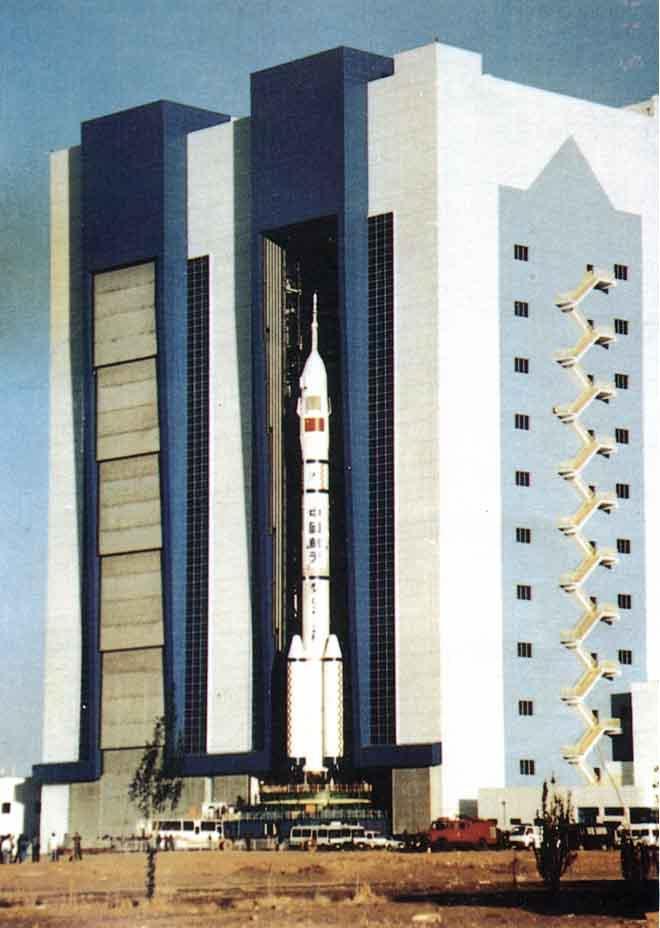
You're right. It it pretty much an updated Soyuz. And where have you seen a building like this?
-
MoonIf you are trying to figure out where the Chinese are headed, all you have to do is look at this picture of a Shenzhou rollout, then compare with this picture of a certain NASA rollout. Creepy, huh?
I wish them the best of luck.