Slashdot Mirror
Domain: atomicinsights.com
Stories and comments across the archive that link to atomicinsights.com.
Comments · 78
-
Re:Third, not first
The "cost" is also highly skewed by misinformed policy, with heavy subsidies and incentives not available to nuclear, which are the main reason it is struggling in the market. Unlike changing the laws of physics, this is a situation that can be corrected, and reactor cost can be decreased with experience and new technologies.
With that addressed, we should be mindful of the material inputs of various sources. These also impose direct environmental costs in terms of mining and refining, and increase cost of decommissioning and recycling. Not only is the land area for nuclear minimal, it is also tens of times more resource efficient at producing energy. Using less resources can also be leveraged into a more rapid scaling of installation, which could help greatly.
-
Re:That's almost enough time
Nuclear is already competitive in the absence of (renewable) subsidies. No, it can't compete when renewables are mandated and so heavily subsidized that they can pay utilities to take their (often worthless) energy and still make money. Californians will learn that the subsidies don't scale, and become reliant on imported dirty energy.
-
Re:makes sense why they could not explain
Regulations are the foundation of hysteria surrounding nuclear, that enabled opponents to ratchet costs to overwhelming levels. The "no safe dose" based regulations are not supported by science or evidence, and the environmentally-conscious should read about the sordid tale of how they came to be. TL;DR: the Rockefeller Foundation is largely responsible.
Very powerful fossil interests founded the campaign of fear, and are still funding it through the large "green" groups, which have accepted hundreds of millions of dollars to fight nuclear on their behalf. Calling these organizations "environmental" groups is farce; they are anti-nuclear groups, and they successfully derailed our most effective low-carbon technology for over half a century. They are the very cause of the explosion in fossil energy use poisoning the world today, and now threatening the climate.
-
Re:Also, ya know, physics
Here you go. Nuclear is objectively cheaper, but that doesn't matter with renewable mandates and subsidies that allow them to pay people to waste electricity and still make money.
Advocates love to point at LCOE as "proof", but that is not an accurate reflection of the real costs, and the EIA even warns that it should not be used to compare variable with reliable sources.
-
Re:Well sort of, but you're missing a key point
Why can’t existing nuclear plants make money in today’s electricity markets? Hint: it has nothing to do with cost of nuclear electricity.
-
Re:Well yeah!
His initial point is either wrong (or to be generous to him, unproven). See for example how low level radiation may even prevent cancer. Our bodies evolved to thrive in th presence of low-level radiation, and if you want to talk about dangerous substances, Oxygen causes a much heavier wear on our bodies than background radiation.
-
In a way, the EPA invited this...
The EPA has left harmful regulations in place for decades, which caused 1600 unnecessary deaths at Fukushima, and countless more by helping suppress the most effective source of clean energy. While renewables may capture the limelight, the leading source of new energy worldwide is coal, and it is growing far faster.
Present radiation regulations are based on bad science. The linear no threshold hypothesis is provably false today, and counter evidence already existed even at the time of its adoption. Since then, a growing body of evidence and scientific understanding show that low levels of radiation are harmless and potentially beneficial. Aside from providing a basis for fear-mongering, misinformed regulations also prevent promising research into the use of low level radiation for medical applications.
Scientists for Accurate Radiation Information have recently petitioned the EPA for scientific/risk-based radiation regulations. There are also other areas where the EPA adopts the ALARA (as low as reasonably achievable) principle for regulation, which is fundamentally misguided. Such regulation carries an opportunity cost, and the extensive effort to eliminate infinitesimal perceived damage is wasted when it could achieve a much greater positive effect if applied to other more serious risks.
-
Re:100 years?
On the other hand, there's the famous "I will eat as much plutonium as you eat caffeine" offer. Since caffeine doesn't have a mcg/kg LD50 and presumably Bernard Cohen didn't have a death wish, "otherwise getting into your system" isn't enough for plutonium to kill you. Not in mcg doses.
-
Re:That's not even all
What about the cost of replacing their entire nuclear fleet with imported fossil fuels and new coal plants? Japan is not a resource rich nation, and abandoning nuclear is tantamount to euthanizing their economy. The tsunami was a tragic disaster which killed tens of thousands of people and leveled a large area, yet the media and "green" movement has focussed the attention Fukushima, to stoke fear and push their own agendas. The radiation released has harmed no one yet, and never will because at low exposures it is harmless.
The Fukushima "disaster" is a tragedy of another sort, almost 100% man-made by an extreme overreaction fueled by hysteria over radiation. All of the deaths in the subsequent evacuation could have been avoided, and rest squarely on the shoulders of those who have encouraged this hysteria over the decades. The cost of the "cleanup" is absurd because the land is being remediated to levels far below what is necessary to ensure the safety of the population.
Please take the time to learn more about radiation, and how fear of nuclear power is hurting the environment. For a historical perspective on the origins of our utterly absurd regulations today, see the following:
EPA has ignored science since 40 CFR 190, Jan '77
Muller influenced the BEAR to adopt the Linear No Threshold (LNT) assumption in 1956
Biologist explains why LNT is just plain wrong
Berkeley’s institutional fear of low dose radiation traced to a suffocated rat -
Re:That's not even all
What about the cost of replacing their entire nuclear fleet with imported fossil fuels and new coal plants? Japan is not a resource rich nation, and abandoning nuclear is tantamount to euthanizing their economy. The tsunami was a tragic disaster which killed tens of thousands of people and leveled a large area, yet the media and "green" movement has focussed the attention Fukushima, to stoke fear and push their own agendas. The radiation released has harmed no one yet, and never will because at low exposures it is harmless.
The Fukushima "disaster" is a tragedy of another sort, almost 100% man-made by an extreme overreaction fueled by hysteria over radiation. All of the deaths in the subsequent evacuation could have been avoided, and rest squarely on the shoulders of those who have encouraged this hysteria over the decades. The cost of the "cleanup" is absurd because the land is being remediated to levels far below what is necessary to ensure the safety of the population.
Please take the time to learn more about radiation, and how fear of nuclear power is hurting the environment. For a historical perspective on the origins of our utterly absurd regulations today, see the following:
EPA has ignored science since 40 CFR 190, Jan '77
Muller influenced the BEAR to adopt the Linear No Threshold (LNT) assumption in 1956
Biologist explains why LNT is just plain wrong
Berkeley’s institutional fear of low dose radiation traced to a suffocated rat -
Re:That's not even all
What about the cost of replacing their entire nuclear fleet with imported fossil fuels and new coal plants? Japan is not a resource rich nation, and abandoning nuclear is tantamount to euthanizing their economy. The tsunami was a tragic disaster which killed tens of thousands of people and leveled a large area, yet the media and "green" movement has focussed the attention Fukushima, to stoke fear and push their own agendas. The radiation released has harmed no one yet, and never will because at low exposures it is harmless.
The Fukushima "disaster" is a tragedy of another sort, almost 100% man-made by an extreme overreaction fueled by hysteria over radiation. All of the deaths in the subsequent evacuation could have been avoided, and rest squarely on the shoulders of those who have encouraged this hysteria over the decades. The cost of the "cleanup" is absurd because the land is being remediated to levels far below what is necessary to ensure the safety of the population.
Please take the time to learn more about radiation, and how fear of nuclear power is hurting the environment. For a historical perspective on the origins of our utterly absurd regulations today, see the following:
EPA has ignored science since 40 CFR 190, Jan '77
Muller influenced the BEAR to adopt the Linear No Threshold (LNT) assumption in 1956
Biologist explains why LNT is just plain wrong
Berkeley’s institutional fear of low dose radiation traced to a suffocated rat -
Re:That's not even all
What about the cost of replacing their entire nuclear fleet with imported fossil fuels and new coal plants? Japan is not a resource rich nation, and abandoning nuclear is tantamount to euthanizing their economy. The tsunami was a tragic disaster which killed tens of thousands of people and leveled a large area, yet the media and "green" movement has focussed the attention Fukushima, to stoke fear and push their own agendas. The radiation released has harmed no one yet, and never will because at low exposures it is harmless.
The Fukushima "disaster" is a tragedy of another sort, almost 100% man-made by an extreme overreaction fueled by hysteria over radiation. All of the deaths in the subsequent evacuation could have been avoided, and rest squarely on the shoulders of those who have encouraged this hysteria over the decades. The cost of the "cleanup" is absurd because the land is being remediated to levels far below what is necessary to ensure the safety of the population.
Please take the time to learn more about radiation, and how fear of nuclear power is hurting the environment. For a historical perspective on the origins of our utterly absurd regulations today, see the following:
EPA has ignored science since 40 CFR 190, Jan '77
Muller influenced the BEAR to adopt the Linear No Threshold (LNT) assumption in 1956
Biologist explains why LNT is just plain wrong
Berkeley’s institutional fear of low dose radiation traced to a suffocated rat -
Re:Not just Southern Spain
Taking matters into our own hands is a nice thought, but solar+battery are not happening on any meaningful scale. Such installations rely heavily on subsidies and absent far better battery technology than we have, will always depend on the grid. However, the grid can't support more than a small fraction of solar, as California is learning now.
The problem we face is that most "greens" have lost sight of the goal, which should be maximizing reduction of emissions. Instead, they are busy waging a war on nuclear, on behalf of fossil fuel interests. They measure success by "capacity" and renewable installation rate, while ignoring emissions, which are steady or increasing. Prematurely closing nuclear plants in places like Germany and California has essentially wiped away any potential benefit of their renewables, because they are inevitably replaced by fossil fuels. Every time. The only real change is substantially increased retail electricity rates.
The recent lawsuit against zero emission credits in New York is quite telling. ZEC are an attempt to recognize the value of clean energy from nuclear, which is unfairly disadvantaged by generous renewable incentives which exclude nuclear, and temporarily low gas prices thanks to the glut of supply. The ZEC hedges against the inevitable rebound in gas pricing and its volatility, ultimately saving consumers money and ensuring that retail electricity prices will not skyrocket.
This lawsuit demonstrates their real intention. Note that renewable-only incentives have encountered no resistance, because they lock in gas and coal backup indefinitely. With nuclear out of the way it will allow them to make the most of their renewable partnership and drive up fossil energy prices. That would be acceptable if the hybrid fossil/renewable system could economically reduce emissions, but that has yet to happen even once.
-
So what? Radiophobia is the problem, not radiation
Radiation killed about 50 at Chernobyl, and none at Fukushima and Three Mile Island. Meanwhile, pollution from burning fossil fuels causes millions of premature deaths every year. Even with a meltdown every year, nuclear would be a vast improvement if it replaced burning of fossil fuels, and incidents are increasingly unlikely with modern reactors, should people let us build them. (If one is objective, nuclear would even reduce loss of life over installation and maintenance of wind and solar generators, and at far less cost.)
The truth is, radiation is typically harmless, and can even be used to improve health. The body has repair mechanisms which routinely deal with an enormously greater amount of chemical damage from oxygen and such. It takes a whole lot of radiation to have any negative health effects, and current regulatory limits are based on bad science funded by fossil fuel interests.
People have been deceived for more than half a century, and mainstream “environmental” organizations such as Greenpeace, Friends of Earth, Sierra Club, NRDC, etc. continue the effort, often funded by those same interests. If you are genuinely concerned about the environment and climate change, look to ecological conservation groups and leading climate scientists, which uniformly support nuclear. It is the only option which is scalable to global needs and also has the smallest environmental footprint.
Learn more about radiation from Scientists for Accurate Radiation Information, or see the articles tagged LNT and Health Effects.
-
So what? Radiophobia is the problem, not radiation
Radiation killed about 50 at Chernobyl, and none at Fukushima and Three Mile Island. Meanwhile, pollution from burning fossil fuels causes millions of premature deaths every year. Even with a meltdown every year, nuclear would be a vast improvement if it replaced burning of fossil fuels, and incidents are increasingly unlikely with modern reactors, should people let us build them. (If one is objective, nuclear would even reduce loss of life over installation and maintenance of wind and solar generators, and at far less cost.)
The truth is, radiation is typically harmless, and can even be used to improve health. The body has repair mechanisms which routinely deal with an enormously greater amount of chemical damage from oxygen and such. It takes a whole lot of radiation to have any negative health effects, and current regulatory limits are based on bad science funded by fossil fuel interests.
People have been deceived for more than half a century, and mainstream “environmental” organizations such as Greenpeace, Friends of Earth, Sierra Club, NRDC, etc. continue the effort, often funded by those same interests. If you are genuinely concerned about the environment and climate change, look to ecological conservation groups and leading climate scientists, which uniformly support nuclear. It is the only option which is scalable to global needs and also has the smallest environmental footprint.
Learn more about radiation from Scientists for Accurate Radiation Information, or see the articles tagged LNT and Health Effects.
-
So what? Radiophobia is the problem, not radiation
Radiation killed about 50 at Chernobyl, and none at Fukushima and Three Mile Island. Meanwhile, pollution from burning fossil fuels causes millions of premature deaths every year. Even with a meltdown every year, nuclear would be a vast improvement if it replaced burning of fossil fuels, and incidents are increasingly unlikely with modern reactors, should people let us build them. (If one is objective, nuclear would even reduce loss of life over installation and maintenance of wind and solar generators, and at far less cost.)
The truth is, radiation is typically harmless, and can even be used to improve health. The body has repair mechanisms which routinely deal with an enormously greater amount of chemical damage from oxygen and such. It takes a whole lot of radiation to have any negative health effects, and current regulatory limits are based on bad science funded by fossil fuel interests.
People have been deceived for more than half a century, and mainstream “environmental” organizations such as Greenpeace, Friends of Earth, Sierra Club, NRDC, etc. continue the effort, often funded by those same interests. If you are genuinely concerned about the environment and climate change, look to ecological conservation groups and leading climate scientists, which uniformly support nuclear. It is the only option which is scalable to global needs and also has the smallest environmental footprint.
Learn more about radiation from Scientists for Accurate Radiation Information, or see the articles tagged LNT and Health Effects.
-
So what? Radiophobia is the problem, not radiation
Radiation killed about 50 at Chernobyl, and none at Fukushima and Three Mile Island. Meanwhile, pollution from burning fossil fuels causes millions of premature deaths every year. Even with a meltdown every year, nuclear would be a vast improvement if it replaced burning of fossil fuels, and incidents are increasingly unlikely with modern reactors, should people let us build them. (If one is objective, nuclear would even reduce loss of life over installation and maintenance of wind and solar generators, and at far less cost.)
The truth is, radiation is typically harmless, and can even be used to improve health. The body has repair mechanisms which routinely deal with an enormously greater amount of chemical damage from oxygen and such. It takes a whole lot of radiation to have any negative health effects, and current regulatory limits are based on bad science funded by fossil fuel interests.
People have been deceived for more than half a century, and mainstream “environmental” organizations such as Greenpeace, Friends of Earth, Sierra Club, NRDC, etc. continue the effort, often funded by those same interests. If you are genuinely concerned about the environment and climate change, look to ecological conservation groups and leading climate scientists, which uniformly support nuclear. It is the only option which is scalable to global needs and also has the smallest environmental footprint.
Learn more about radiation from Scientists for Accurate Radiation Information, or see the articles tagged LNT and Health Effects.
-
Re:Harm to the environment
The nuclear bird kill number is bogus. No one really knows how many birds are killed in uranium mining and milling operations.
-
Re:Replace nuclear power with unclear power?
The greatest advantage that the French nuclear program has enjoyed is lack of organized opposition and the endless delaying tactics that you activists use in other countries to increase costs through endless legal delays. Any targeted energy program can be made to cost too much by imposing delay after delay.
Some illumination on the fossil industry's ownership of the antinuclear movement:
http://atomicinsights.com/esso...
http://ansnuclearcafe.org/2013...
In contrast, the French oil giant Elf-Aquitaine (now Total) has always been a refiner and distributor, rather than owning the production it takes to be a sponsor against competing forms of energySome choice general commentary from a leading environmentalist on your endless stream of lies:
http://www.theguardian.com/com...I predict that one of the more interesting byproducts of today's low oil prices will be the antinuclear movement running out of money.
-
No reason to stop development
Anyone who has ever been frustrated with an automated telephone call support helpline, an alarm clock mistakenly set to 'p.m.' instead of 'a.m.,' or any of the countless frustrations that come with interacting with computers, has experienced the problem of 'brittleness' that plagues automated systems,
While true, I can also recount numerous frustrations originating from human interventions that lead to disaster such as initiating an emergency procedure ultimately leading to a nuclear reactor explosion, failed controlled burns or environmental disasters. Even in everyday life, trying to reason with a customer rep from bank A or government department B, can be as frustrating an unhelpful as trying to figure out which number I should push. As such, the existence of issues in automated system is hardly a justification disregard issues that keeping humans in the loop introduces, with the inconvenience that humans cannot be patched easily: they will keep making the same mistakes. I'd be interested in having statistics about the number of errors over a certain number of years between a fully automated system and human-included system to fully appreciate the benefits of one or the other.
While I'm all for overview and proper design, automation will become inevitable because of the advantages it can provide in certain type of conflicts - namely with technologically advanced adversaries. While some militaries may afford to have large amount of man-power and resources to maintain all these systems, countries with lower GDPs, large territories to defend, growing ambitions and lower ethical concern about consequences of potential errors will likely have automated defense systems to offset the support costs of human operators. In turn these systems will have a faster decision-making loop, providing an advantage over non-fully automated systems.
Of course the introduction of automated systems introduces the risk of hacking and thus the cost-saving of implementing automated systems will somehow go into stronger network defenses. However keep in mind that while totally possible to hack these system to actually leverage them against the users, this is not a trivial task either and requires skilled hackers, not your typical certification-hunting pen tester. However, network defenses are being automated as well, for the better or worst. A large chunk of network defense can be done by civilians (and probably will have to be given the competitive salary of the industry).
In any case, yes, we do need to careful with these systems and yes they have a lethal power, but so does many other systems, including systems with humans "in the loop". This should not prevent the development of automated systems, much like I don't believe it will stop the development of automated cars, planes and trains, much like it didn't stop the automation of the stock market despite glitches, which can also have tragic consequences. It needs constant testing, updating and training to new, unexpected issues.
-
Why Joe Romm is wrong...
-
Re:Study?
http://atomicinsights.com/pick...
I'm not exactly sure what you refer to, but I found it interesting that Jimmy Carter never actually worked on a nuclear submarine.
I see below that you linked an article about a nuclear accident that he helped clean up, but I find it interesting that it indicates he was a nuclear engineer (which is untrue, he never even finished nuclear operator school when he had to drop out to take care of the family farm).
https://en.wikipedia.org/wiki/...
It doesn't say there either that he actually completed the nuclear program, which is interesting.
I would say that Jimmy Carter is a damn good example of the lack of effect of nuclear radiation, he has lived 63 years after helping in that cleanup, and he was one of the group apparently who was lowered into a melted down reactor to effect its shutdown, how much more exposure could you get?
-
Re:Nuclear Generating Station Shuts Down Safely
Actually in identifying some solar/wind promoters as anti-nuclear --- just a few but boy are they shrill --- I think I've hit the nail on the head.
Let's take a look at nuclear power in Japan, shall we. Japan is a small, energy-resource-poor country which has leveraged its technology to become a financial and industrial giant, in many areas out-producing the United States even before we outsourced to China. Some ~50 nuclear reactors were supplying ~30% of the nation's electricity in 2011. But that 30% is a misleadingly small figure in terms of estimable value, for even as rural Japan was finally being electrified those nuclear plants had been powering the factories and steel mills that put it on the world map. From being the first victim of nuclear war to putting its first reactor on-line in 1966, Japan is one of the world's greatest success stories and owes a great deal of its meteoric rise as a world power to those nuclear plants.
The Japanese are aware of this. It is why they responsibly reprocess their spent fuel, it is why they continued to expand their nuclear base even after the US Three Mile Island mishap, even after a pseudo-environmentalist sect (coal barons by proxy) in the United States began to suppress the advancement and innovation of this technology. The Fukushima Daiichi plant went on-line in 1971 and not one person in this part of the world seems to find it appropriate to recognize the many gigawatt-years of service it has contributed. We will honor a retired warship for its years of service, but if a nuclear power plant has fallen on hard times we will kick it like a dying dog and stamp the life out of it. Perhaps my allusion shocks you.
I go even further to describe as twisted and sick the way world press marginalized the unfolding tragedy of ~15,000 deaths to dwell on the minutiae of radiation release, and (worse yet) gathered anti-nuclear celebrities to continually supply worst-case scenarios, most of them absurd, scientifically deceptive and some outright dishonest. It represents a tabloid moment of which the entire human race should be ashamed. And yet? Even in the immediate aftermath of the disaster when all were in shock, merely 70% of Japanese believed that Japan should reduce its reliance on nuclear energy. There is reason to believe that this percentage is falling as the years pass, as they have re-elected a Prime Minister who vows to restore nuclear power to its previous levels. Perhaps the Japanese, for all this tragedy, are possessed of a certain clarity that is slipping away in the United States.
The second issue is nuclear weapons. One reason that the government wants nuclear power is so that it can build weapons at short notice.
Dissing conventional nuclear power on the grounds that it supports weapons manufacture is complicated. Suggesting that it is 'easy' or 'quick' or even 'feasible' (as opposed to refinement of natural uranium) is disingenuous. Rod Adams attempts to dispel this pervasive myth here and more recently here, and it is an uphill battle because politicians take their talking points from anti-nuke celebrities, not scientists or nuclear engineers. When the claim that terrorists could produce true fission weapons from nuclear plants breaks down, many seek refuge in the idea of a so-called 'dirty
-
Re:Nuclear Generating Station Shuts Down Safely
Actually in identifying some solar/wind promoters as anti-nuclear --- just a few but boy are they shrill --- I think I've hit the nail on the head.
Let's take a look at nuclear power in Japan, shall we. Japan is a small, energy-resource-poor country which has leveraged its technology to become a financial and industrial giant, in many areas out-producing the United States even before we outsourced to China. Some ~50 nuclear reactors were supplying ~30% of the nation's electricity in 2011. But that 30% is a misleadingly small figure in terms of estimable value, for even as rural Japan was finally being electrified those nuclear plants had been powering the factories and steel mills that put it on the world map. From being the first victim of nuclear war to putting its first reactor on-line in 1966, Japan is one of the world's greatest success stories and owes a great deal of its meteoric rise as a world power to those nuclear plants.
The Japanese are aware of this. It is why they responsibly reprocess their spent fuel, it is why they continued to expand their nuclear base even after the US Three Mile Island mishap, even after a pseudo-environmentalist sect (coal barons by proxy) in the United States began to suppress the advancement and innovation of this technology. The Fukushima Daiichi plant went on-line in 1971 and not one person in this part of the world seems to find it appropriate to recognize the many gigawatt-years of service it has contributed. We will honor a retired warship for its years of service, but if a nuclear power plant has fallen on hard times we will kick it like a dying dog and stamp the life out of it. Perhaps my allusion shocks you.
I go even further to describe as twisted and sick the way world press marginalized the unfolding tragedy of ~15,000 deaths to dwell on the minutiae of radiation release, and (worse yet) gathered anti-nuclear celebrities to continually supply worst-case scenarios, most of them absurd, scientifically deceptive and some outright dishonest. It represents a tabloid moment of which the entire human race should be ashamed. And yet? Even in the immediate aftermath of the disaster when all were in shock, merely 70% of Japanese believed that Japan should reduce its reliance on nuclear energy. There is reason to believe that this percentage is falling as the years pass, as they have re-elected a Prime Minister who vows to restore nuclear power to its previous levels. Perhaps the Japanese, for all this tragedy, are possessed of a certain clarity that is slipping away in the United States.
The second issue is nuclear weapons. One reason that the government wants nuclear power is so that it can build weapons at short notice.
Dissing conventional nuclear power on the grounds that it supports weapons manufacture is complicated. Suggesting that it is 'easy' or 'quick' or even 'feasible' (as opposed to refinement of natural uranium) is disingenuous. Rod Adams attempts to dispel this pervasive myth here and more recently here, and it is an uphill battle because politicians take their talking points from anti-nuke celebrities, not scientists or nuclear engineers. When the claim that terrorists could produce true fission weapons from nuclear plants breaks down, many seek refuge in the idea of a so-called 'dirty
-
Re:Who has a financial interest in this one then?
The problem is that no insurer will insure a nuclear plant, so governments have to take the liability on themselves. Essentially nuclear operators get subsidised free insurance, so where are normally a commercial insurer would require high standards the government has to and the government is vulnerable to lobbying (bribes) and other shenanigans.
First two results on "nuclear insurance"
https://www.nmlneil.com/
http://www.nuclearinsurance.co...And here's somebody directly addressing this one:
http://atomicinsights.com/real...
http://www-siepr.stanford.edu/... -
Re:They should all be fired!
So, in order to avoid the biggest health risks associated with this sample, I recommend that you not eat it.
A few micrograms? Harmless to eat. Famously compared to caffeine.
You'd need to inhale it to begin worrying.In fact there is some evidence that ingesting plutonium extends life. http://atomicinsights.com/how-...
(no mutant powers though) -
SERIOUS problems in Russia and the United States60 Minutes has been an extremely valuable news program. In recent years the program has still been valuable, but has tended to fail in 3 ways, in my opinion:
1) Editorial management of the show has not been as good. (It is really, really difficult to find someone who can manage reporters.)
2) CBS, the parent organization, has not been as devoted to the enormous good will that comes from many of the 60 Minutes shows. CBS does not support the show sufficiently, in my opinion.
3) There is no one associated with 60 Minutes, apparently, who has significant understanding of technology, even though the show often tries to cover stories about technology. Here is a quote from the transcript of the show about Chernobyl, showing that Bob Simon has no understanding of the dosimeter he is wearing:When Caille took us on a tour of the site, we were fitted with dosimeters to tell us how much we were being exposed to. Suddenly, a sound we didn't want to hear. Bob Simon: Hey, there's beepers going off. Nicolas Caille: No, no. It's not. It's normal. Bob Simon: You're sure? Nicolas Caille: Yes, yes, yes. I'm definitively sure. Bob Simon: I don't like a beeper in Chernobyl. I don't like that sound.
However, although Bob Simon twice shows he has no depth of understanding, there is no technical error in the transcript of that 60 Minutes show. Aside from the ooh-wow reactions of Bob Simon, it is exactly correct. (I haven't watched the video. I can imagine there is more ooh-wow in the video editing.) The main idea of the story is illustrated by this quote: "There's still so much radiation coming from the reactor that workers have to construct the arch nearly a thousand feet away, shielded by a massive concrete wall. When finished, the arch will be slid into place around the Sarcophagus, then sealed up."
In fact, the expense of covering the extremely dangerous parts of the area is enormous. That is a very serious issue, an issue of concern to everyone in the world. After many years, the work of reducing the danger is still not finished.
There is a nuclear disaster area in the United States, the Hanford nuclear site. I've heard about the some of the problems over many years from a manager of one of the departments of the U.S. Department of Energy. The Wikipedia article mentions some of the problems. Here is one quote: "Citing the 2014 Hanford Lifecycle Scope Schedule and Cost report, the 2014 estimated cost of the remaining Hanford clean up is $113.6 billion..." [my emphasis] Retrieved Dec. 3, 2014.
Here is another quote from the Hanford Wikipedia article: "From 1944 to 1971, pump systems drew cooling water from the river and, after treating this water for use by the reactors, returned it to the river. Before being released back into the river, the used water was held in large tanks known as retention basin for up to six hours. Longer-lived isotopes were not affected by this retention, and several terabecquerels entered the river every day. These releases were kept secret by the federal government."
What is called cleaning Hanford has now taken more than 50 years. The Wikipedia article is not, at present, completely clear about that fact, apparently because, as the quote above says, the U.S. government managed the information so that it did not get into the news, although much of the information was not actually a secret.
The problem is not in what is said in the transcript of 60 Minutes show, but in what is communicated. The average viewer has no understanding of nuclear radiation. The author of the Atomic Insights story is annoyed by the fact that the 60 Min -
Re:What else can they do?
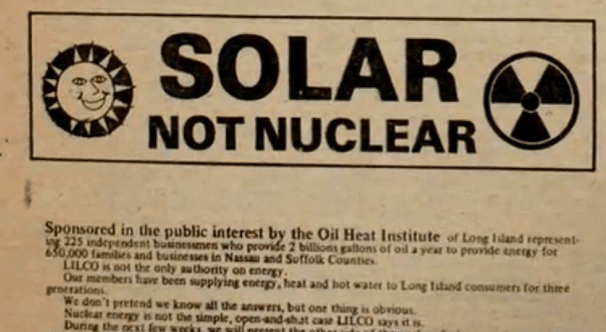
I admit I was oversimplifying a bit when I said the environmentalists caused nuclear R&D in this country to get all but killed outright. Of course it's a bit more complicated and you need to follow the money to find out who's really behind the push. Environmental organizations such as the Sierra Club and campaigns like Solar not nuclear have often been financed by fossil fuel industries, the reason being that these industries knew damn well that while solar & wind might pose a threat down the line but at present still require fossil fuel backup (thus cementing their position in the grid), nuclear posed an imminent threat should the US go and pull a French on them, kicking them off the grid in one or two decades. Nuclear development projects such as the IFR got caught in political cross fire and for some reason got labeled as being "Republican", so Democratic congresspeople like Kerry led a massive push against it in the early 90s to get it defunded, which they ultimately succeeded in doing in 1994. After the Republicans took office following the Clinton administration, their oil buddies sure as hell didn't want to see the project resurrected, so it was left alone. Ultimately, the IFR project was killed by a lack of political allies, the Democrats being backed by powerful environmental groups (who are often, but not always backed by Big Gas and friends, though they've also got strong grassroots movements) and the Republicans being a wholly-owned subsidiary of the fossil fuel industry.
Now if you look at counties who are less susceptible to industry lobbying with more centrally planned economies, like China and Russian, they are moving towards nuclear in a big way and are bringing it online both on-time and on-budget. -
Re:central storage or n^x security guard costs / s
Obama appointed Gregory Jaczko as the chairman of the NRC in 2009, and Ernest Moniz as the Secretary of Energy in 2013. Jackzo bypassed his four fellow commissioners and released highly irresponsible and inaccurate statements sowing unfounded fears during the Fukushima incident, and has since come out as strongly anti-nuclear. Moniz is unduly conservative about the value of nuclear energy and both are strong advocates of natural gas. Moniz also hired Kevin Knobloch, the head of a prominent anti-nuclear organization (UCS) as his Chief of Staff.
Obama may pay it lip service, but does not support nuclear in any meaningful way.
-
Re:central storage or n^x security guard costs / s
Obama appointed Gregory Jaczko as the chairman of the NRC in 2009, and Ernest Moniz as the Secretary of Energy in 2013. Jackzo bypassed his four fellow commissioners and released highly irresponsible and inaccurate statements sowing unfounded fears during the Fukushima incident, and has since come out as strongly anti-nuclear. Moniz is unduly conservative about the value of nuclear energy and both are strong advocates of natural gas. Moniz also hired Kevin Knobloch, the head of a prominent anti-nuclear organization (UCS) as his Chief of Staff.
Obama may pay it lip service, but does not support nuclear in any meaningful way.
-
Re:Huge bird and fish kills
For perspective on this nonsense, Nukes kill more birds than wind?
-
Re:The question should be, what is causing delays?
True, but the idea behind the combined operation license was to allow construction and operation to continue while license issues are litigated. The delays in plant Vogtle and in SC are from the challenges with actually building the plant since much of the equipment has never been built before so they must building, testing, and constructing while they are trying to create a commercial plant on a tight schedule.
While there are very real concerns about the lack of construction experience as well as longer term engineering and operational support, these delays seem to be self inflicted, from issues with concrete pours to assuming brand new designs can be built on a very tight schedule where many of the components have never been built or used before.
Read more about the the Vogtle rebar issue. It is not fair to dismiss it as self-inflicted, when the regulator insists upon perfection and is unresponsive to circumstances. The rebar was installed to current building standards, rather than those in place when the design was approved. It was a small deviation and eventually the NRC allowed it with minor modifications. The problem is that such a minor issue can introduce a 6+ month delay when interaction with the NRC are required.
While all I know about the bear issue is from the news I'd still lay most of the responsibility on the licensee and architect engineer. The regulator is not insisting on perfection but rather on the licensee complying with the COL. The COL was intended to limit delays through litigation so it is important to ensure you meet all the requirements to the letter lest you get sued later on the grounds you are not compliant with the COL. While many deviations truly are trivial, the NRC still must ensure it follows the law to avoid problems later. As a result, engineering analysis is needed to ensure the design provides the same level of safety as the original. Since the licensee failed to meet the COL or take actions to amend it prior to pouring concrete then it is pretty much, IMHO, a self inflicted wound.
Regulations should be focused on safe designs, not on libraries of paperwork certifying safety. It is silly to require an N-stamp on every last nut and bolt (even in non-safety related systems) rather than using off the shelf parts where suitable. Certificates can be forged, and even if they are genuine, nothing is perfect. Safe designs make allowances for imperfect materials. Such a “cost is no object” approach is not useful in the real world, The oppressive regulatory regime only mires any progress and ensure that we are burdened with ancient, yet "approved" designs.
The question then becomes, what is a safety related system and at what level of defense in depth do you switch to commercial grade components? I can see an argument being made for systems on the secondary loop but not on the primary side. Of course, many secondary systems do not need an N-stamp anyway under current regulations.
Concurrent with that is what level of testing is sufficient to ensure a safety system will respond when needed?You can test so much the testing degrades reliability and drives up maintenance costs as a result. Since AP-1000 is designed for passive cooling in the event of an accident are annual DG tests appropriate, for example.
-
Re:The question should be, what is causing delays?
True, but the idea behind the combined operation license was to allow construction and operation to continue while license issues are litigated. The delays in plant Vogtle and in SC are from the challenges with actually building the plant since much of the equipment has never been built before so they must building, testing, and constructing while they are trying to create a commercial plant on a tight schedule.
While there are very real concerns about the lack of construction experience as well as longer term engineering and operational support, these delays seem to be self inflicted, from issues with concrete pours to assuming brand new designs can be built on a very tight schedule where many of the components have never been built or used before.
Read more about the the Vogtle rebar issue. It is not fair to dismiss it as self-inflicted, when the regulator insists upon perfection and is unresponsive to circumstances. The rebar was installed to current building standards, rather than those in place when the design was approved. It was a small deviation and eventually the NRC allowed it with minor modifications. The problem is that such a minor issue can introduce a 6+ month delay when interaction with the NRC are required.
Regulations should be focused on safe designs, not on libraries of paperwork certifying safety. It is silly to require an N-stamp on every last nut and bolt (even in non-safety related systems) rather than using off the shelf parts where suitable. Certificates can be forged, and even if they are genuine, nothing is perfect. Safe designs make allowances for imperfect materials. Such a “cost is no object” approach is not useful in the real world, The oppressive regulatory regime only mires any progress and ensure that we are burdened with ancient, yet "approved" designs.
-
The question should be, what is causing delays?
Typically the endless lawsuits and anti-nuclear activism are the source of delays for nuclear construction. Even if not directly, then by proxy of the NRC, which is ineffective thanks to regulations based on ALARA and pseudo-science (LNT). If the NRC regulated based on solid science and legitimate safely concerns, it would be tremendously less expensive to meet nuclear safety standards. Unfortunately, our presidents have had a habit of appointing unqualified and nuclear-hostile people like Gregory Jackzo to lead the NRC, so the result is no surprise.
Another source of delay, is the lack of nuclear construction for decades, leaving the construction industry and supply chains to languish. Neither cost is inherent in nuclear construction, and both can be corrected. Delays of any large construction project are very expensive, and this is the primary means employed by anti-nuclear ideologues to drive up the cost. The submitter (mdsolar) may or may not have participated, but clearly has an axe to grind and the willingness to exploit the situation to peddle his ideology
-
Re:headed in the wrong direction
According to scientist, the common view is that the linear no-threshold model is actually the flawed viewpoint. See this article for a pro-radiation view that is not commonly reported. Although most people will scoff, there is actual evidence that a little ionizing radiation is good for you.
Yes, I would participate in the study that installs a radioactive source in your house (at reasonably low levels) because I believe the data that I have been able to find in the past.
-
Re:But I thought nuclear power was cheap
What a waste – Vermont Yankee is in beautiful condition
The NRC recently extended the operating license for 20 more years, so apparently any issues were minor or have been addressed. It sounds like your claims are significantly exaggerated, and that there is no safety concern.
Most of Vermont's electricity came from that plant, and closing it is only going to result in burning more fossil fuels and increased prices.
-
Re:Fukushima information sources -- correction
Atomic Power Review is written by a guy named Will Davis. It says so on the right sidebar. Who is Rod Adams?
Oops, clipboard snafu, it ate a whole paragraph and a link. There were supposed to be two links,
Rod Adams hosts Atomic Insights blog and The Atomic Show podcast. He has some very good coverage of Fukushima and its aftermath and lately he has been taking fear-mongers Robert Alvarez and Arnie Gundersen to task.
Will Davis' Atomic Power Review has scaled down its Fukushima coverage as of late, but in the archives you will find some detailed articles with week-by-week coverage.
-
Re:Fukushima information sources -- correction
Atomic Power Review is written by a guy named Will Davis. It says so on the right sidebar. Who is Rod Adams?
Oops, clipboard snafu, it ate a whole paragraph and a link. There were supposed to be two links,
Rod Adams hosts Atomic Insights blog and The Atomic Show podcast. He has some very good coverage of Fukushima and its aftermath and lately he has been taking fear-mongers Robert Alvarez and Arnie Gundersen to task.
Will Davis' Atomic Power Review has scaled down its Fukushima coverage as of late, but in the archives you will find some detailed articles with week-by-week coverage.
-
Re:Fukushima information sources -- correction
Atomic Power Review is written by a guy named Will Davis. It says so on the right sidebar. Who is Rod Adams?
Oops, clipboard snafu, it ate a whole paragraph and a link. There were supposed to be two links,
Rod Adams hosts Atomic Insights blog and The Atomic Show podcast. He has some very good coverage of Fukushima and its aftermath and lately he has been taking fear-mongers Robert Alvarez and Arnie Gundersen to task.
Will Davis' Atomic Power Review has scaled down its Fukushima coverage as of late, but in the archives you will find some detailed articles with week-by-week coverage.
-
Has anyone considered...
...the idea that the guys in the west might just be being more open and being honest when it comes to reporting incidents? Or maybe the guys in the east are having just as many, but aren't reporting them, thinking "hell, it's only a tiny spill, no need to report it and get everyone riled up about it!". Why do I get the feeling that this article is just another piece of FUD? http://atomicinsights.com/accidents/
-
Re:cold fusion fraud again?
I believe you are correct. Here are some references to facts to help this discussion a little:
http://atomicinsights.com/2009/10/quick-graph-of-us-electricity-generation-showing-the-breakdown-of-the-wind-solar-biomass-geothermal-portion.html
http://2ndgreenrevolution.com/2010/05/29/graphic-worth-a-thousand-words-u-s-energy-breakdown/I'm no expert in this field, but I have a buddy that buys energy at PG&E that tell me that we care most about cost and reliability (coal) and less about sources that introduce inpredictability and power fluctuation into a grid that needs to maintain a very stable flow of electrons. Buffers, such as batteries and diesel, exist to help stabilize the infrastructure. These companies employ heartless economists that are trying to get the most-per-dollar they can get, which factors in quite a few substantial government subsidies for renewable energy (federal and state).
In the US, our grid is set up such that anybody is free to push electrons into the grid and roll the meter that tracks his/her usage in the opposite direction. Lots of people do this with solar power - feeding it into the grid to reduce coal usage a little and then pulling from the grid at night when there is no sunlight. The technology we use to manage our grid is very flexible and can be as diverse as economics and politics allow it to be.
-
"Chernobyl: Consequences. . ." is Junk Science
Seriously, nobody should be referring to the Yablakov book, "Chernobyl: Consequences of the Catastrophe for People and the Envirnoment". It has been reviewed by a number of scientific experts, and found to be complete junk science.
(Someone might note that the link I've provided is to a pro-nuclear blog and say the conclusion is biased, but the pro-nuclear blogger in question is simply citing someone else's review).
What I really mean to say is: Don't get all your numbers from anti-nuclear zealots and realize that the picture is not even close to as ambiguous as you portrayed here. There's science, and then there's bullshit, and you need to sort one from the other.
-
Re:Well well
The article that you link to has quite a few shortcomings. Some of them are outlined here
The end-game of a majority of people putting solar on their homes is higher utility rates for everyone. Utilities buy back the electricity that the solar panels overproduce at a high price. The production from the solar panels is intermittent and so the utilities cannot rely on them. This creates even greater swing in the demand that utilities see, yet they still have to to be able to produce enough to cover everyone if the sun isn't shining.
Although the installed cost of solar may be less than the cost of nuclear, if we tried relying on solar we would find the the low capacity factor of solar, combined with the cost of grid storage would quickly move the price well beyond affordable. -
Re:Forget it
However when ingested, if comes close to cells and becomes the most deadly substance known to mankind.
Only if you keep ingesting it...
Otherwise, it's no worse for you than an equal dose of caffeine. -
Taxes can't make something "cost effective"
A technology either is, or isn't, cost effective. Using government subsidies might lower the cost to the end-user, but doesn't actually reduce the cost per kWh. It just makes the rest of us pay for someone else's over-priced power.
The only argument I can see possibly being in favor of energy subsidies for solar or wind is the argument that it's essentially government spending on R&D to help get the technology and economies of scale advanced to the point where it can pay for itself.
Unfortunately, people just see a lower price tag and dumbly say, "See! Solar power is cheaper than other sources!"
-
Re:oblig
This link had a typo which made it non functional. Here is the correct link:
-
Re:oblig
On the other hand, Bernard Cohen considered plutonium less dangerous than caffeine, at least in terms of ingestion.
-
Re:Recycle Nukes?
Do you know anything about Plutonium?
Some tidbits about the most toxic metal on the planet.
I would suspect that Polonium (you know, what the Russians used to kill Litvinenko) is a mite more toxic.
As far as ingestion in particular is concerned, there is also the caffeine challenge. Granted, caffeine is not a metal, but one wouldn't usually consider it very toxic. -
Re:Bad idea
I was referring to this:
http://www.atomicinsights.com/may95/plutonium_eff.html -
Re:Cairo
The dust is heavy and will likely fall to the ground. You aren't particularly screwed if you breathe in a bit of dust. The deaths from lung cancer will increase, but city air is full of things which cause lung cancer anyway. We don't evacuate them because of that.
See also: "How Deadly is Plutonium? or just the wikipedia article.
The only weapons of mass destruction which actually deserve their name are real nuclear weapons. Possibly some weapons based on high explosives or fuel-air-bombs could be included too, but those are apparently not scary.