Slashdot Mirror
Domain: berkeley.edu
Stories and comments across the archive that link to berkeley.edu.
Comments · 3,539
-
Distributed Internet Backup System
-
GCC Benchmark on Dual 2GHz G5Running this code: http://www.ocf.berkeley.edu/~cowell/research/benc
h mark/code/Benchmark.c
Compiler flags based on Apple TN2086: http://developer.apple.com/technotes/tn/tn2086.htm l
Removed machine & username from command prompt only.$ g++ --version
g++ (GCC) 3.3 20030304 (Apple Computer, Inc. build 1495)
Copyright (C) 2002 Free Software Foundation, Inc.
This is free software; see the source for copying conditions. There is NO
warranty; not even for MERCHANTABILITY or FITNESS FOR A PARTICULAR PURPOSE.
$ g++ -O3 -mcpu=G5 -mtune=G5 -mpowerpc64 -mpowerpc-gpopt Benchmark.c
$
Start C benchmark
Int arithmetic elapsed time: 5640 ms with intMax of 1000000000
i: 1000000001
intResult: 1
Double arithmetic elapsed time: 10280 ms with doubleMin 10000000000.000000, doubleMax 11000000000.000000
i: 11000000000.000000
doubleResult: 10011632717.495501
Long arithmetic elapsed time: 9880 ms with longMin I64d, longMax I64d
i: I64d
longResult: I64d
Trig elapsed time: 3530 ms with max of 10000000
i: 10000000.000000
sine: 0.990665
cosine: -0.136322
tangent: -7.267119
logarithm: 7.000000
squareRoot: 3162.277502
I/O elapsed time: 1090 ms with max of 1000000
last line: abcdefghijklmnopqrstuvwxyz1234567890abcdefghijklmn opqrstuvwxyz1234567890abcdefgh
Total elapsed time: 30420 ms
Stop C benchmark -
Re:Benchmarks? Who cares?
There never has, nor will there ever be, an all encompasing benchmark.
Not only that, but it helps to have a benchmark that actually tests the things that are claimed at being tested.
It's a Good Thing (tm) this didn't make the front page.
The author states "I am by no means an expert in benchmarking; I launched this project largely as a learning experience" and it shows. The man has an associates degree in computer science, and a Ph.D. in psychology. His list of publications are his dissertation, a single published paper, and excerpts within a 15-year-old travel guide.
Just a cursory glance at the first page of his article shows that he has no clue as to how things work. He states "I first tried to eliminate the CLR from the Visual C++ benchmark by turning off the language's "managed" features with the #pragma unmanaged directive, but I was surprised to see that this didn't lead to any performance gains." If he cannot understand why something that generates a few thousand CPU instructions of initial overhead doesn't change the speed of an I/O- and loop limited program, he isn't skilled enough to interpret his own results.
His benchmarks never actually test his first, second, third, or fifth question. His fourth question is actually addressed better when his contrived test is compared on relative measure with his two Java tests.
Look at his benchmark programs (found here). Some of those test can, should, and will have compiler-specific optimizations, having nothing to do with the language. General 'counting loops', which is the only thing he is using, have long been known to produce bad benchmarks. He claims to be testing 64-bit floating point math, but in fact, many of his examples use 80-bit floating point.
Just for fun, look at his VC and Java 1.4 floating point tests. Now look at his compiler options. It is painfully obvious that the compiler saw "He explicitly said this is a Pentium 4, I can use parallel floating point instructions!" where the other compilers could not. Saying that those languages are inherently faster than the other compiled languages is lunacy.
This is hardly news. This is a BAD example of benchmarking, and would be given a poor grade in a graduate level CS class.
-
Re:Benchmarks? Who cares?
There never has, nor will there ever be, an all encompasing benchmark.
Not only that, but it helps to have a benchmark that actually tests the things that are claimed at being tested.
It's a Good Thing (tm) this didn't make the front page.
The author states "I am by no means an expert in benchmarking; I launched this project largely as a learning experience" and it shows. The man has an associates degree in computer science, and a Ph.D. in psychology. His list of publications are his dissertation, a single published paper, and excerpts within a 15-year-old travel guide.
Just a cursory glance at the first page of his article shows that he has no clue as to how things work. He states "I first tried to eliminate the CLR from the Visual C++ benchmark by turning off the language's "managed" features with the #pragma unmanaged directive, but I was surprised to see that this didn't lead to any performance gains." If he cannot understand why something that generates a few thousand CPU instructions of initial overhead doesn't change the speed of an I/O- and loop limited program, he isn't skilled enough to interpret his own results.
His benchmarks never actually test his first, second, third, or fifth question. His fourth question is actually addressed better when his contrived test is compared on relative measure with his two Java tests.
Look at his benchmark programs (found here). Some of those test can, should, and will have compiler-specific optimizations, having nothing to do with the language. General 'counting loops', which is the only thing he is using, have long been known to produce bad benchmarks. He claims to be testing 64-bit floating point math, but in fact, many of his examples use 80-bit floating point.
Just for fun, look at his VC and Java 1.4 floating point tests. Now look at his compiler options. It is painfully obvious that the compiler saw "He explicitly said this is a Pentium 4, I can use parallel floating point instructions!" where the other compilers could not. Saying that those languages are inherently faster than the other compiled languages is lunacy.
This is hardly news. This is a BAD example of benchmarking, and would be given a poor grade in a graduate level CS class.
-
Re:Of course
My only hope is that you are purposefully trying to spread misinformation at this point. The only way that the distance is going to grow in either direction is *if* the coin is biased
I'm not trying to spread misinformation, I'm dead serious. As the sample size increases, the standard deviation about the mean grows as SQRT(N)/2. Have a look at the Java applet on this page at the UCB's statistics department; it demonstrates how the difference between the number of heads and the expected number of heads (N/2) increases as N increases. The accompanying text helps explain this. You are clearly the one in the wrong.
-
Re:Trig functions...Yes, this is to comply with IEEE p754, which deals with floating-point computing accross different platforms. Considering that java wants to be portable, this is very important. It also makes java a little more reliable programming language in this context.
Java is almost ready for intensive numerical computations, what it is lacking is decent speed. This issue is being constantly addressed, thus the future looks promising for it.
-
Re: Yet another nail into Big Bang's heart...
> Well, the BB story has gone along for so much time... some new data whacks it, ok... small nudge and it's consistent.
Can you give an example?
*laugh* I'll bite
* The "flat universe" case gives a Hubble constant of 65 km/s/Mpc (megaparsec). This amounts to an age of the universe of ~10 billion years. This is one of the "age paradoxes" that have led to some of the more interesting revisions and proposed revisions.
* The temperature of the cosmic background radiation was a retrodiction, not a prediction. Alpher and Herman got the closest, with a prediction of 5 Kelvins, but what you don't often hear is that the prediction was later adjusted to 28 Kelvins.
* Inflation theory was introduced by Linde in the mid 80's to help solve the "bubble" problem by having a massive FTL expansion in space for 10^-30 s, and co-opted to help squeeze in some extra universe age. The theory, as it got refined, placed more constraints on the universe (e.g. it has to be flat, not open or closed, for inflation theory to work), and gives us our "refined" universe age of 13.7 billion years
* The age problem, in light of recent Hubble observations, has caused a few new proposals to sprout. The "cosmological constant" as a repulsive force has sprouted up on a few a occasions. It has been proposed in the past year that the universe may have decelerated in the past and is now accelerating.
There's a lot more, and I can get you sources
The Big Bang model makes no predictions whatsoever about the existence of any hypothetical particles, let alone a "nasty slew."
I think what he's referring to is the tack a number of scientists have gone off on in the search for enough dark energy to make the universe "flat" or "closed", and they have invoked a nasty number of theoretical particles. He might also be referring to the slew of theoretical particles some scientists are hypothesizing to explain how galaxies managed to form so soon after the big bang (with quotes like "The majority, perhaps a sea of "non-baryonic," exotic particles, is likely to have played the key role in assembling the first galaxy-sized masses." from NASA's Origins page).
I love quantum physics, myself. It makes some pretty interesting (and good!) predictions, but (as you say), the Big Bang Theory doesn't 'predict' them per se.
Personally, I find it strange that the particles from quantum physics and its forces have been been apportioned a timeline in Big Bang Theory for times of creation and symmetry-breaking. I've seen some folks imply that the two line up well, and by implication that the successes of quantum physics should prop up the Big Bang Theory as well. However, Big Bang Theory just apportions particles a time closer to t=0, the more MeV they require to manufacture in a cyclotron, so it's a lot more 'arbitrary' than would be implied. What it means for me is that quantum physics cannot 'falsify' BBT, by definition.
H, He, and Li concentrations
These are also numbers that have "floated" with time, and the baryonic numbers have been kept consistent with observations. Observed deuterium levels are ten times below BBT predictions, and distant young stars have proved out to have much too much boron and beryllium (which are not in BBT nucleosynthesis as a general rule) in them.
Hubble expansion
Most cosmologists selectively quote Hubble from around 1929. If you read some of his later work, you'll find more of an emphasis on the "apparent velocities" from the redshift not being actual velocities. He had a graph from one of his presentations in the early 1940s showing how luminosities would have to decl
-
Wrong link...
here. Sorry, I need more caffeine!
-
Re:some forms of XOR are not weakIf what you XOR against is generated in a cryptographically sound way, then the cyphertext is also cryptographically sound.
I'm not usre whether you're trolling, or just being serious, but in some circumstances, XORing can weaken a cipher. Take as an example WEP, which is based on RC4 encryption, but rather than encrypting the transmitted data itself with RC4, it XORs its data with an RC4-generated repeating stream of data. RC4 by itself would be sound, but the way of applying it makes the setup weak.
The attack against WEP does not attempt to crack RC4 (i.e. find out the WEP keys programmed into the access point), but it merely tries to find out portions of the blocks XORed against the data.
-
White HolesWell, there's are a few problem with this idea:
- Gravistar theory replaces black holes and the concept of a singularity which white holes depend on.
- White holes probably don't exist even if black holes do. They are predicted by the math of general relativity but probably are not physically possibleas they are a singularity with no mass.
- Wormholes don't exist either.
- Gravistar theory replaces black holes and the concept of a singularity which white holes depend on.
-
Re:This figuresJust remember, science cannot and does not prove or disprove the existence of God. If it did, there wouldn't be a debate.
Just remember, the existence of The Bible cannot and does not prove nor disprove the existence of God. If it did there wouldn't be a debate.
As for Evolution, I incorrectly referred to it as a Theory. As this link refers to it, Evolution is a Theory in much the same way as Gravity is a Theory.
-
The best college radio station in the US.
Mine is too.
Funny how the second you get away from payola stations, things start improving. -
See this paper for more...
This is an idea that's been toyed with by a few people, but it seems tough. They've outlined an approach using some standard peer-to-peer systems - see this paper for a list of the challenges and some numbers. Unfortunately, without some sort of sacrifices in search quality (or number of documents), it's probably not feasible yet, at least by their figures.
-
Re:Choose *where your school is* carefully...
What are you talking about? California tuition is $3k per semester. Where did you get this notion of a minimum $25k cost?
-
Re:At some point.... (karma whoring here)
See here
-
Re:Dangerous Snake OilI see your point here.
The proposed solution is a long term solution for large aircraft capable of causing damage to high value targets such as nuclear power plants etc.
It is feasible to eventually equip all large aircraft with a suitable set of navigation systems.
I smell a scam on the Department of Homeland Insecurity money pile.
BTW - The proposal predates 9/11, see Peter Huber, Cleared To Land, Forbes Magazine, March 18, 1991, pg 130
I work for Professor Lee, who independently came up with the idea of Soft Walls on the night of 9/11/01 and gave a lecture about the idea to the UC Berkeley EECS 20 Signals and Systems undergraduate class.
One Masters student, Adam Cataldo, might have received some funding from NASA or someone to do research in this area. Adam finished up in December 2003. Currently, the Soft Walls research is not directly funded, though the Center for Hybrid and Embedded Software Systems funds work on the Ptolemy Project which has been used as a software laboratory to simulate the Soft Walls.
I just don't see the Snake Oil here.
What I do find really interesting is that most software engineers have a real gut level reaction to this proposal. I'm a very sceptical person by nature and have raised many points concerning Soft Walls with Professor Lee and seen many other people raise similar points. I think the The Soft Walls FAQ (PDF) has done a reasonable job answering these questions.
The Soft Walls proposal is a long term proposal that is not something to be done lightly. Like many research ideas, it may seem far fetched at first, but the process of analyzing the proposal yields many interesting avenues of thought and future research in software verification and reliability. A better solution would be to simply require transponders to be enabled which would allow the ground to see what is happening.
Interesting idea,
So, when the plane entered restricted airspace, I guess jet fighters would be scrambled and if they caught up to the plane it might be blown up? Should every high value target (nuke plant, oil refinery, small city) have an air base or anti-air craft missile batteries near by?
During 9/11, my understanding is that the transponders were disabled so it was harder to find the planes, so the transponders would need to always be on (not a big problem).
Having uninterruptible transponders brings up some of the same issues that remote control from the ground has. The The Soft Walls FAQ (PDF) says:
13. Wouldn't control from the ground be preferable?
It is technically possible to control aircraft from the ground. Northrop Grumann's Global Hawk aircraft is an unoccupied air vehicle (UAV) that is controlled from the ground. It flies without a pilot, and played a significant role in the recent Afghan and Iraq wars. Northrop Grumann has argued that the control system of Global Hawk could be adapted to permit controllers on the ground to take over an airplane and fly it safely to landing.
While technically feasible, this approach is probably more complex than Soft Walls, and it opens new vulnerabilities. For one, it creates the possibility of a hijacking from the ground, which suggests that sites equipped to take over aircraft would require serious protection, and personnel with access would be have to be severely vetted. Moreover, it creates a truly scary prospect of a wholesale hijacking of an entire fleet.
A second problem is that communication delays and lack of visibility into conditi
-
Re:Dangerous Snake OilI see your point here.
The proposed solution is a long term solution for large aircraft capable of causing damage to high value targets such as nuclear power plants etc.
It is feasible to eventually equip all large aircraft with a suitable set of navigation systems.
I smell a scam on the Department of Homeland Insecurity money pile.
BTW - The proposal predates 9/11, see Peter Huber, Cleared To Land, Forbes Magazine, March 18, 1991, pg 130
I work for Professor Lee, who independently came up with the idea of Soft Walls on the night of 9/11/01 and gave a lecture about the idea to the UC Berkeley EECS 20 Signals and Systems undergraduate class.
One Masters student, Adam Cataldo, might have received some funding from NASA or someone to do research in this area. Adam finished up in December 2003. Currently, the Soft Walls research is not directly funded, though the Center for Hybrid and Embedded Software Systems funds work on the Ptolemy Project which has been used as a software laboratory to simulate the Soft Walls.
I just don't see the Snake Oil here.
What I do find really interesting is that most software engineers have a real gut level reaction to this proposal. I'm a very sceptical person by nature and have raised many points concerning Soft Walls with Professor Lee and seen many other people raise similar points. I think the The Soft Walls FAQ (PDF) has done a reasonable job answering these questions.
The Soft Walls proposal is a long term proposal that is not something to be done lightly. Like many research ideas, it may seem far fetched at first, but the process of analyzing the proposal yields many interesting avenues of thought and future research in software verification and reliability. A better solution would be to simply require transponders to be enabled which would allow the ground to see what is happening.
Interesting idea,
So, when the plane entered restricted airspace, I guess jet fighters would be scrambled and if they caught up to the plane it might be blown up? Should every high value target (nuke plant, oil refinery, small city) have an air base or anti-air craft missile batteries near by?
During 9/11, my understanding is that the transponders were disabled so it was harder to find the planes, so the transponders would need to always be on (not a big problem).
Having uninterruptible transponders brings up some of the same issues that remote control from the ground has. The The Soft Walls FAQ (PDF) says:
13. Wouldn't control from the ground be preferable?
It is technically possible to control aircraft from the ground. Northrop Grumann's Global Hawk aircraft is an unoccupied air vehicle (UAV) that is controlled from the ground. It flies without a pilot, and played a significant role in the recent Afghan and Iraq wars. Northrop Grumann has argued that the control system of Global Hawk could be adapted to permit controllers on the ground to take over an airplane and fly it safely to landing.
While technically feasible, this approach is probably more complex than Soft Walls, and it opens new vulnerabilities. For one, it creates the possibility of a hijacking from the ground, which suggests that sites equipped to take over aircraft would require serious protection, and personnel with access would be have to be severely vetted. Moreover, it creates a truly scary prospect of a wholesale hijacking of an entire fleet.
A second problem is that communication delays and lack of visibility into conditi
-
Re:Dangerous Snake OilI see your point here.
The proposed solution is a long term solution for large aircraft capable of causing damage to high value targets such as nuclear power plants etc.
It is feasible to eventually equip all large aircraft with a suitable set of navigation systems.
I smell a scam on the Department of Homeland Insecurity money pile.
BTW - The proposal predates 9/11, see Peter Huber, Cleared To Land, Forbes Magazine, March 18, 1991, pg 130
I work for Professor Lee, who independently came up with the idea of Soft Walls on the night of 9/11/01 and gave a lecture about the idea to the UC Berkeley EECS 20 Signals and Systems undergraduate class.
One Masters student, Adam Cataldo, might have received some funding from NASA or someone to do research in this area. Adam finished up in December 2003. Currently, the Soft Walls research is not directly funded, though the Center for Hybrid and Embedded Software Systems funds work on the Ptolemy Project which has been used as a software laboratory to simulate the Soft Walls.
I just don't see the Snake Oil here.
What I do find really interesting is that most software engineers have a real gut level reaction to this proposal. I'm a very sceptical person by nature and have raised many points concerning Soft Walls with Professor Lee and seen many other people raise similar points. I think the The Soft Walls FAQ (PDF) has done a reasonable job answering these questions.
The Soft Walls proposal is a long term proposal that is not something to be done lightly. Like many research ideas, it may seem far fetched at first, but the process of analyzing the proposal yields many interesting avenues of thought and future research in software verification and reliability. A better solution would be to simply require transponders to be enabled which would allow the ground to see what is happening.
Interesting idea,
So, when the plane entered restricted airspace, I guess jet fighters would be scrambled and if they caught up to the plane it might be blown up? Should every high value target (nuke plant, oil refinery, small city) have an air base or anti-air craft missile batteries near by?
During 9/11, my understanding is that the transponders were disabled so it was harder to find the planes, so the transponders would need to always be on (not a big problem).
Having uninterruptible transponders brings up some of the same issues that remote control from the ground has. The The Soft Walls FAQ (PDF) says:
13. Wouldn't control from the ground be preferable?
It is technically possible to control aircraft from the ground. Northrop Grumann's Global Hawk aircraft is an unoccupied air vehicle (UAV) that is controlled from the ground. It flies without a pilot, and played a significant role in the recent Afghan and Iraq wars. Northrop Grumann has argued that the control system of Global Hawk could be adapted to permit controllers on the ground to take over an airplane and fly it safely to landing.
While technically feasible, this approach is probably more complex than Soft Walls, and it opens new vulnerabilities. For one, it creates the possibility of a hijacking from the ground, which suggests that sites equipped to take over aircraft would require serious protection, and personnel with access would be have to be severely vetted. Moreover, it creates a truly scary prospect of a wholesale hijacking of an entire fleet.
A second problem is that communication delays and lack of visibility into conditi
-
Re:Dangerous Snake OilI see your point here.
The proposed solution is a long term solution for large aircraft capable of causing damage to high value targets such as nuclear power plants etc.
It is feasible to eventually equip all large aircraft with a suitable set of navigation systems.
I smell a scam on the Department of Homeland Insecurity money pile.
BTW - The proposal predates 9/11, see Peter Huber, Cleared To Land, Forbes Magazine, March 18, 1991, pg 130
I work for Professor Lee, who independently came up with the idea of Soft Walls on the night of 9/11/01 and gave a lecture about the idea to the UC Berkeley EECS 20 Signals and Systems undergraduate class.
One Masters student, Adam Cataldo, might have received some funding from NASA or someone to do research in this area. Adam finished up in December 2003. Currently, the Soft Walls research is not directly funded, though the Center for Hybrid and Embedded Software Systems funds work on the Ptolemy Project which has been used as a software laboratory to simulate the Soft Walls.
I just don't see the Snake Oil here.
What I do find really interesting is that most software engineers have a real gut level reaction to this proposal. I'm a very sceptical person by nature and have raised many points concerning Soft Walls with Professor Lee and seen many other people raise similar points. I think the The Soft Walls FAQ (PDF) has done a reasonable job answering these questions.
The Soft Walls proposal is a long term proposal that is not something to be done lightly. Like many research ideas, it may seem far fetched at first, but the process of analyzing the proposal yields many interesting avenues of thought and future research in software verification and reliability. A better solution would be to simply require transponders to be enabled which would allow the ground to see what is happening.
Interesting idea,
So, when the plane entered restricted airspace, I guess jet fighters would be scrambled and if they caught up to the plane it might be blown up? Should every high value target (nuke plant, oil refinery, small city) have an air base or anti-air craft missile batteries near by?
During 9/11, my understanding is that the transponders were disabled so it was harder to find the planes, so the transponders would need to always be on (not a big problem).
Having uninterruptible transponders brings up some of the same issues that remote control from the ground has. The The Soft Walls FAQ (PDF) says:
13. Wouldn't control from the ground be preferable?
It is technically possible to control aircraft from the ground. Northrop Grumann's Global Hawk aircraft is an unoccupied air vehicle (UAV) that is controlled from the ground. It flies without a pilot, and played a significant role in the recent Afghan and Iraq wars. Northrop Grumann has argued that the control system of Global Hawk could be adapted to permit controllers on the ground to take over an airplane and fly it safely to landing.
While technically feasible, this approach is probably more complex than Soft Walls, and it opens new vulnerabilities. For one, it creates the possibility of a hijacking from the ground, which suggests that sites equipped to take over aircraft would require serious protection, and personnel with access would be have to be severely vetted. Moreover, it creates a truly scary prospect of a wholesale hijacking of an entire fleet.
A second problem is that communication delays and lack of visibility into conditi
-
Re:Dangerous Snake OilI see your point here.
The proposed solution is a long term solution for large aircraft capable of causing damage to high value targets such as nuclear power plants etc.
It is feasible to eventually equip all large aircraft with a suitable set of navigation systems.
I smell a scam on the Department of Homeland Insecurity money pile.
BTW - The proposal predates 9/11, see Peter Huber, Cleared To Land, Forbes Magazine, March 18, 1991, pg 130
I work for Professor Lee, who independently came up with the idea of Soft Walls on the night of 9/11/01 and gave a lecture about the idea to the UC Berkeley EECS 20 Signals and Systems undergraduate class.
One Masters student, Adam Cataldo, might have received some funding from NASA or someone to do research in this area. Adam finished up in December 2003. Currently, the Soft Walls research is not directly funded, though the Center for Hybrid and Embedded Software Systems funds work on the Ptolemy Project which has been used as a software laboratory to simulate the Soft Walls.
I just don't see the Snake Oil here.
What I do find really interesting is that most software engineers have a real gut level reaction to this proposal. I'm a very sceptical person by nature and have raised many points concerning Soft Walls with Professor Lee and seen many other people raise similar points. I think the The Soft Walls FAQ (PDF) has done a reasonable job answering these questions.
The Soft Walls proposal is a long term proposal that is not something to be done lightly. Like many research ideas, it may seem far fetched at first, but the process of analyzing the proposal yields many interesting avenues of thought and future research in software verification and reliability. A better solution would be to simply require transponders to be enabled which would allow the ground to see what is happening.
Interesting idea,
So, when the plane entered restricted airspace, I guess jet fighters would be scrambled and if they caught up to the plane it might be blown up? Should every high value target (nuke plant, oil refinery, small city) have an air base or anti-air craft missile batteries near by?
During 9/11, my understanding is that the transponders were disabled so it was harder to find the planes, so the transponders would need to always be on (not a big problem).
Having uninterruptible transponders brings up some of the same issues that remote control from the ground has. The The Soft Walls FAQ (PDF) says:
13. Wouldn't control from the ground be preferable?
It is technically possible to control aircraft from the ground. Northrop Grumann's Global Hawk aircraft is an unoccupied air vehicle (UAV) that is controlled from the ground. It flies without a pilot, and played a significant role in the recent Afghan and Iraq wars. Northrop Grumann has argued that the control system of Global Hawk could be adapted to permit controllers on the ground to take over an airplane and fly it safely to landing.
While technically feasible, this approach is probably more complex than Soft Walls, and it opens new vulnerabilities. For one, it creates the possibility of a hijacking from the ground, which suggests that sites equipped to take over aircraft would require serious protection, and personnel with access would be have to be severely vetted. Moreover, it creates a truly scary prospect of a wholesale hijacking of an entire fleet.
A second problem is that communication delays and lack of visibility into conditi
-
Re:Traditional Boeing vs. Airbus debate[Disclaimer: I work for Professor Edward A. Lee, who came up with the Soft Walls Project in response to 9/11. I'm a very sceptical person, and many of the questions here have been raised by myself and others.]
The Soft Walls FAQ (PDF) says:
6. How does Soft Walls relate to flight envelope protection?
As explained above, fly-by-wire aircraft have efficiency advantages over more conventional mechanical and hydraulic control systems. But because control is mediated by computer, such systems can also be made more intelligent. Airbus systems impose flight envelope protection schemes, where the computers ensure that the pilot does not force the aircraft beyond its safe performance parameters. For example, the computers can prevent the pilot from stalling the aircraft.
Flight envelope protection works very synergistically with Soft Walls. In particular, Soft Walls works by introducing a bias into the commands issued by the pilot when the aircraft approaches too close to a no-fly zone. To ensure that the aircraft does not enter the no-fly zone, the bias needs to increase as the craft gets closer until the bias overwhelms the commands that the pilot can issue. For instance, when the aircraft has penetrated the boundary sufficiently to be very close to the no-fly zone, the pilot may be commanding a hard turn to the right, but the bias will nonetheless force the aircraft to turn to the left, away from the nofly zone.
In aircraft with flight envelope protection, as for example most Airbus planes, the limits on pilot induced maneuvers are known (because they are imposed by the on-board computers).
Thus, the extent of the bias that must be applied is known.
Not all fly-by-wire aircraft have flight envelope protection. The Boeing 777, in particular, does not. The computers will permit the pilot to make maneuvers that exceed the safety specifications of the aircraft. Boeing argues that this is safer than flight envelope protection because these safety specifications conservative anyway, so allowing the pilot to exceed them gives the pilot the authority to consider and compare the risks in responding to an emergency.
Both approaches have their merits, but Boeing's approach requires that a Soft Walls system be more aggressive. In particular, for example, since there is no fixed limit on bank angle, there is no single amount of bias on bank angle that is guaranteed to exceed the pilot command. This complicates the design of the Soft Walls system, which must ensure that the bias it introduces does not take the aircraft outside the safety specifications.
To some degree, a Soft Walls system must realize some flight envelope protection. For example, if an aircraft is flying above a no-fly zone, then the Soft Walls system must prevent the pilot from stalling the aircraft. If it does not, then it cannot ensure that the aircraft will not enter the no-fly zone (because the stall could lead to loss of control).
Yep, some of the researchers are in the Airbus camp, where the software limits pilot maneuvers.
A case can be made that the pilot could save the plan by executing a loop or roll that was outside the specs of the plane that would be prohibited by the software.
Is Is it possible to loop or roll a 747 jet?
22Mb MPEG of a 707 barrel roll - seems to be corrupt?
However, the point of Soft Walls is to prevent disasters that harm more than a plane load of people (large plane crashes in to nuclear powerplant etc.)
I looked a little in to some of the Airbus fly by wire crashes and if I remember correctly, it seemed like some of the errors were UI problems, especially when a display or control had multiple purposes (modes). I'm not sure if I remember the above correctly, b
-
Re:The real question is ...[Disclaimer: I work for Professor Edward A. Lee, who came up with the Soft Walls Project in response to 9/11. In general, I'm a very skeptical person and I and other have asked similar questions. In this context, I'm speaking for myself, not for Professor Lee.]
Good point.
Small planes crash in to buildings without a huge effect. In 1945, a B-25 crashed in to the Empire State Building and did not destroy it.
In January, 2002, a small plane crashed into a building in Florida and did not destroy the building.
The initial rollout of Soft Walls would be in large new fly by wire planes. Older, large non-fly by wire planes present various problems.
Small general aviation planes would probably not be required to ever have Soft Walls retrofitted, though perhaps someday new general aviation fly by wire planes would?
The Soft Walls FAQ (PDF) says:
7. Can Soft Walls be deployed on non-fly-by-wire aircraft?
BTW, the next question is "8. Can Soft Walls be realized as part of the autopilot system?"In fly-by-wire aircraft, Soft Walls is "just" a software change. However, only a fraction of the fleet today is fly-by-wire. From the New York Times, April 2002 [9]:
"In November, the F.A.A. counted about 2,300 fly-by-wire planes among Boeing and Airbus models, the two most popular among big jets; another 8,700 planes in those fleets had conventional mechanical systems. Herman A. Rediess, director of the Office of Aviation Research at the F.A.A., said in a paper representing his own views: ''For the near future, no airline will have the financial resources to even modify the F.B.W. aircraft. It's not clear that they would even have sufficient funds to retrofit the non-F.B.W. aircraft.''
Converting older aircraft to fly-by-wire is clearly out of the question. However, there is an alternative, which is to modify the autopilot systems in older aircraft to implement fly-bywire. The effectiveness of this strategy is still an open question (see the next question).Adding fly-by-wire ability to older planes would be wildly expensive. George K. Muellner, an Air Force veteran and president of Boeing's research and development arm, called the Phantom Works, recalled that the Air Force had taken some of its oldest F-4's and converted them into pilotless drones, for use as target practice. The conversion, he said, cost more than the plane did new."
-
Re:What happens to the planes when GPS is dis-ableI copied some text from the Soft Walls FAQ (PDF) about this to another Soft Walls Thread
Basically, one uses Inertial Navigation.
-
Re:sounds neat but...[Disclosure: I work for Professor Edward A. Lee, who came up with the Soft Walls in response to 9/11. I'm a very skeptical person by nature, and have asked similar questions, or been around when others have asked these good questions.]
The Soft Walls FAQ says:
17. Isn't GPS vulnerable to attacks?
The Soft Walls system relies on localization information. The aircraft computers have to reliably know where the aircraft is. Avionics systems today already include localization systems, which are required for navigation (and for more advanced safety systems, like ground proximity warning systems).
The principle source of localization information today is the global positioning system (GPS), which uses signals emitted by a suite of 24 satellites. A GPS receiver performs a simple triangulation calculation to determine the location of the receiver. However, most aircraft have at least two backup systems. First, an inertial navigation system (INS) measures acceleration to determine when the aircraft is turning, ascending, or descending, and continually calculates the new location based on its knowledge of the previous location.
Second, a variety of radio beacons are also used to triangulate the aircraft location. Radio beacons are particularly common around airports, and automatic landing systems rely on them.
Most radio signals can be jammed. This means that a malicious party transmits a radio signal that swamps the one of interest, making it impossible to receive reliably. GPS signals are vulnerable to jamming. During the second Iraq war, Russian-made GPS jamming devices were sold to the Iraquis to use against smart munitions, many of which rely on GPS.
Some radio signals can also be spoofed. This means that a malicious party transmits a radio signal that masquerades as the radio signal of interest, hoping that it will be picked up instead of the legitimate signal. Spoofing can be prevented by encryption techniques if the encryption key can be kept private. That is, it can be made extremely difficult (in today's technology, essentially impossible) to construct a legitimate signal without having knowledge of a key that can be very closely guarded.
GPS signals currently contain encrypted channels that make spoofing by synthesizing a signal extremely difficult. Radio beacons can be both spoofed and jammed, and hence probably cannot be relied upon in a hostile environment. INS systems cannot be either spoofed or jammed, since they do not use communications of any kind.
If a radio signal cannot be spoofed, then jamming can be reliably detected. Hence, if the GPS system is being jammed, then the Soft Walls system will know that it is being jammed, and instead of begin confused by random data, would switch to backup systems, primarily INS.
Without knowledge of the encryption key, GPS cannot be spoofed by constructing an artificial GPS signal. However, it may be technically feasible to pick up a GPS signal at one location and rebroadcast it to another location in such a fashion as to confuse a GPS receiver at the second location into thinking it is actually at the first. However, this technique would be difficult to use in a hijacking scenario. To go undetected, it would require that a second aircraft start at the same place and at the same time as the aircraft to be hijacked, and then slowly diverge so that over time it is at a different location. That second aircraft would have to rebroadcast what it receives from the GPS satellites at high enough power that the first aircraft picks up its signals rather than the ones coming directly from the satellites. Even if this highly unlikely scenario could be pulled off, the transponders of the two aircraft would report the same locations to air traffic control, which will certainly raise suspicion. Air traffic control would determine that the aircraft had collided, but were still flying.
A real vulnerability lies in the p
-
Re:The lower Manhattan nightmare scenerioComplete Disclaimer: I work for Professor Edward A. Lee, who came up with the Soft Walls idea on 9/11/01. It turns out that other people have had similar ideas at other times.
I don't speak for Professor Lee, but I'll sprinkle some comments around. In general, I'm a very skeptical person, and I and others have asked many of the same questions that I see in this article.
A good resource is the Soft Walls FAQ (PDF).
The Soft Walls FAQ discusses the slightly different case of a forced landing on 5th Avenue, which would never be ok.
15. Can pilots tolerate a reduction of navigable airspace?
Among the more extreme ideas circulating include restricting aircraft to narrowly defined air lanes, making, in effect, tunnels in the sky. This greatly reduces flexibility in the system, making it much more difficult to adapt to unusual weather or traffic conditions, for example. If Soft Walls is deployed, the regulatory bodies that define the no-fly zones will have to exercise restraint to not unnecessarily reduce the navigable airspace. Ideally, Soft Walls does not reduce legally navigable airspace at all, since regulatory bodies already restrict the airspace around inhabited areas. As such, Soft Walls only reduces navigable airspace by removing the space where flying is unacceptable anyway.
But there is a significant difference between regulatory no-fly zones (what we have now) and regions into which an aircraft will not fly (what Soft Walls will impose). Some pilots argue that there are emergencies on an aircraft that would justify flying through regions of airspace where flight is forbidden. However, the pilot who does this is choosing to override the regulatory bodies, putting people on the ground at risk in an effort to protect the people in the craft. Should the pilot have a right to make that decision? Soft Walls means that the decision is made by the regulatory bodies. There is no aircraft emergency grave enough to justify an attempt to land on Fifth Avenue, and no pilot should have the right to choose to take that risk. Soft Walls can enforce that policy. Of course, it is not new that there are regions into which aircraft will not fly. No aircraft, for example, can fly through a mountain, no matter how grave the on-board emergency that makes the pilot want to be on the other side of the mountain. Soft Walls creates no-fly zones where enforcement is gentler than that defined by mountains, but the constraint is equally strong. The aircraft simply cannot fly there.
-
Re:The real question is ...Why wasn't this been implemented before?
Because the implementation is new and safety-critical.
RTFA. There are still several open issues and this technology is hardly ready for production use. The FAQ gives up a lot of the more interesting and controversial issues:
Doesn't the crew need an override? (Currently there is no way for the crew to override this system once it becomes active!)
Isn't GPS vulnerable to attacks?
Can't the database [specifying no-fly zones] be hacked?
For the same reason that airbags should never have been mandated by the government until all safety implications were fully understood by their manufacturers. Now manufacturers are developing new airbags with variable inflation forces (depending on occupancy sensors) that hopefully won't blow grandma's head off because she sits "too close" to the steering wheel.
Such a question, "Why hasn't this been in use for a decade? After all, the technology is a decade old!" is foolish.
-
Bad idead
Air disasters secondary to software features are well documented.
I guess, as always, someone is trying to make some dough off this silly scheme, hoping to prey on our "terrorism" fears.
And yes, I know the linked article ultimatley states that the end result of human error, it illustrates a very important point: Either have only the highly trained pilot fly the craft, or have a very thoroughly tested computer fly the craft.
I don't think the 2 mix very well at this point in time.
-- -
shot down?
From the FAQ (warning, PDF).
A New York Times article in April of 2002 examined this issue [9]:
"A Boeing 737 pilot for a major airline recalled approaching Reagan National Airport from the south a few years ago and facing a microburst, a rainstorm that includes sudden changes in wind direction. Such a condition can lead to a crash if a plane is at low altitude and low air speed, as it is on approach. He broke off the approach and turned east. ''It was the only way to go,'' he said.
However, if he had been a little deeper into the approach, he said, ''I'd be flying right toward the protected area,'' the forbidden zone that includes the White House. A system that prevented him from turning that way would be unsafe, said the pilot, whose airline, like most, has been reluctant to discuss security changes."
Today, that plane would be shot down. So this pilot was wrong. The absence of the system is far more unsafe. No microburst is as dangerous as a modern surface-to-air missile. With Soft Walls, this pilot would have maximum maneuverability, and there would be no need to shoot down the plane (assuming that the military has confidence in the system).
I hate cutting and pasting from PDF files.
Anyway, the statement Today, that plane would be shot down. to me is a bit absolute... is this really true? IF a pilot had problems, called in said problems to the tower and acted according instructions or his own judgement, would he really get shot down? Additionally, I have a problem accepting that jets would scramble fast enough to be able to do so...
-
Re:Meanwhile on the cheap side...I noticed in the main article that Jerry Nelson is regarded as ex-faculty of UCSC, any idea why, what impact this could be?
The article is incorrect; Jerry's still at UCSC, where in fact he's the director of the Center for Adaptive Optics and project scientist for the Thirty Meter Telescope. He's working pretty much full time on extremely large telescope design and adaptive optics these days.
As for the telescope array, I haven't heard anything about a radio telescope array under development by Santa Cruz. The original poster is more likely thinking of the Allen Telescope Array under construction by UC Berkeley (where I am an astronomer) and the SETI Institute. The ATA will consist of some 350 3 meter dishes located in northern California, and will be used both for the search for extraterrestrial intelligence and for more "traditional" radio astronomy observations.
-
cyberlaw syllabus of prof. pam samuelson
There are many important cases in the syllabus to a cyberlaw class taught at Boalt by Pamela Samuelson, a professor at UC Berkeley and one of the few undisputed cyberlaw luminaries. She is less well-known to the general public than, say, Lessig, but at least as well known within the field. The syllabus is here: http://www.sims.berkeley.edu/~pam/courses/cyberla
w 02/. That should keep you busy for a semester or so -
Re:Mac OS 9.2.2 seems to be OK
I just had OS X barf yesterday and significantly affect the PRAM to the point that I couldn't log-in!!! Anyway, reset the PRAM + clock and everythings peachy... link.
-
Re:DVD-R & DVD+R technology
Thanks, that's interesting. I don't know enough to make really intelligent comments, but it would seem to me that the materials (dye's or what not) used to make the different types of disc's would have different durability properties.
But ignoring the supposed better compatibility of DVD-R, I have your vote that DVD+R is better all around. That's more info than I had before.
Given what we've recently learned about CD & DVD longevity, (it's not as long as we thought, there was also a
-
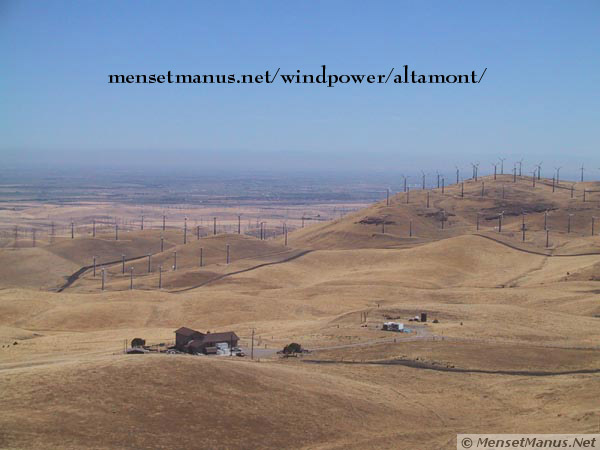
Re:Altamont windfarm photo
It's really neat to drive by this area. Here are some more photo links to give you an idea what it's like, if you've never been.
From here: pic1 pic2 pic3 pic4
another pic
some pics from the car driving by
pic with sun low in sky with long shadows
And finally here's a link describing all the wind power resources in California. -
Re:Altamont windfarm photo
It's really neat to drive by this area. Here are some more photo links to give you an idea what it's like, if you've never been.
From here: pic1 pic2 pic3 pic4
another pic
some pics from the car driving by
pic with sun low in sky with long shadows
And finally here's a link describing all the wind power resources in California. -
Re:Altamont windfarm photo
It's really neat to drive by this area. Here are some more photo links to give you an idea what it's like, if you've never been.
From here: pic1 pic2 pic3 pic4
another pic
some pics from the car driving by
pic with sun low in sky with long shadows
And finally here's a link describing all the wind power resources in California. -
Re:Altamont windfarm photo
It's really neat to drive by this area. Here are some more photo links to give you an idea what it's like, if you've never been.
From here: pic1 pic2 pic3 pic4
another pic
some pics from the car driving by
pic with sun low in sky with long shadows
And finally here's a link describing all the wind power resources in California. -
Re:Altamont windfarm photo
It's really neat to drive by this area. Here are some more photo links to give you an idea what it's like, if you've never been.
From here: pic1 pic2 pic3 pic4
another pic
some pics from the car driving by
pic with sun low in sky with long shadows
And finally here's a link describing all the wind power resources in California. -
Altamont windfarm photo...from a kite (no, not a bird).
It's a bit Pythonesque, really. "The residents pass along here, through the rotating knives..."
-
Kite photo gallery
Check out Charles C. Benton's Site for collections from years of kite photography.
-
Re:Someone didn't proofread their press release...I remember running some falavor of Solaris on a 386 at Wolfram Research over 13 years ago, so Sun has been making x86 for quite some time. Like most other OS's, it can be ported to other architectures.
from: Solaris 2.6
Supported Hardware Platforms: SPARC: sun4c, sun4m, sun4d, sun4u Intel 486, Pentium, Pentium Pro
-
Re:Why has this taken so long?
[threading] is a simplistic view towards a conversation, which more often than not is not linear and between multiple persons
For handling the interconnectedness of online conversations (mailing list, usenet, etc.), this conversation map looks rather interesting, at least conceptually. It's nothing I've really played with, but it's been on my "list of things to look at more closely, eventually".
--Phil (I still like Lurker's approach to threading.) -
90nm Soft Error RateTo quote Intel's own engineers: "As semiconductor technology advancing to 90nm feature sizes, radiation induced soft errors have become a major reliability concern." C.Dai Presentation
I wonder how many software errors will be caused by neutrons hitting the processor and upseting logic gates? I have not seen any test results from Los Alamos for 90nm processors using EIA JESD 57, (1996) JEDEC Standard - Test procedures for the measurement of Single Event effects in Semiconductor Devices from Heavy Ion Irradiation. Unfortunately the Radhard server at NASA is down right now so I can't check the server for the latest test results.
Some people think Failures in Time (FIT) rates will get better at 90nm than 130nm. Some think the opposite. Xilinx and Actel are arguing over it. Caches are epecially vulnerable. In a critical software application, this is unacceptable, and sometimes the cache needs to be disabled altogether.
One method of addressing this is built in checksumming on the cache, and triple redundancy on certain registers like program counter, etc... This does induce a performance hit.
-
Re:give me a break
Any database that's ever updated during use needs transaction support (and indeed even MySQL has it to a degree, as inserts or updates to single tables are atomic). It's not using transactions but avoiding them that requires experience--until you understand a great deal about consistency and isolation in database implementations, you're going to see all sorts of bizzare behavior.
-
Re:What about licensing?
BOINC was initially distributed under the Mozilla Public License. The reason for the (temporary) change to the BOINC public license is described here.
-
What about licensing?
This is the BOINC Public License. IANAL, but at first read this looks very far from the GPL or LGPL... Anyone care to provide a better perspective on the legal issue?
-
Re:Contrast with Java/C# Virtual Machine???
BOINC is primarily a client API library and server side task scheduler. The API should be callable from any language (eventually). Communication with clients is done through a web server (apache).
-
SETI@home source is available.A meta-app that exists to download yet more closed-source code without telling me... nope, that's over the line.
The SETI@home (under boinc) source code is available under the GPL. The AstroPulse code should be available shortly. Yes, now you can see how bad my code really is.
What you won't get with the code is our code signing key (which is under lock and key on an isolated machine) or the ability to distribe your version from our servers, but you are welcome to compile versions for use on your machines and/or distribute your own versions. We won't guarantee to anyone that your version doesn't erase harddrives or distribute child porn, though.
-
Re:I'm afraid this will be the end of my SETI year
What about this: Seti_boinc source. boinc source.
-
Re:I'm afraid this will be the end of my SETI year
What about this: Seti_boinc source. boinc source.
-
Re:seti@home wasnt the first distributed process
According to their site the first release was on 6/8/98. Not sure if distributed.net was before that, but you weren't running it "more then a year before seti".
They were way off on the user stats by nearly an order of magnitude. The statistics page shows over 4,800,000 users.