Slashdot Mirror
Domain: bl.uk
Stories and comments across the archive that link to bl.uk.
Comments · 82
-
Re:Literate?
What is important about this discovery is more than anything else that it constitutes proof of the fact that women, presumably nuns, as well as monks were involved in the production of the most splendid manuscripts of the time because nobody except a first rate illustrator would have something as obscenely expensive as lapis lazuli in their dental plaque.
Which is already a well known fact since sometime they signed their works.
-
British Library UK Web Archive
UK websites are covered by the British Library
-
Re:how do we know this knowledge....
I know that only a portion of the streets in London make any sense at all, pretty much just the parts of the city that burned down in the great fire.
This is incorrect - after the Great Fire many plans were put in place to reorganise the City, but land owners relented and everything was rebuilt along exactly the same boundaries as before.
The City of London, compared to the whole of the region we consider to be London today, is a small area defined by the original City Wall; Ludgate in the west, Moorgate in the north and Aldgate in the east, bounded by the Thames to the south. These names and others reflect them being gates through the original City Wall. It was the bulk of this area (and just west along Fleet Street) that burnt down during the Great Fire.
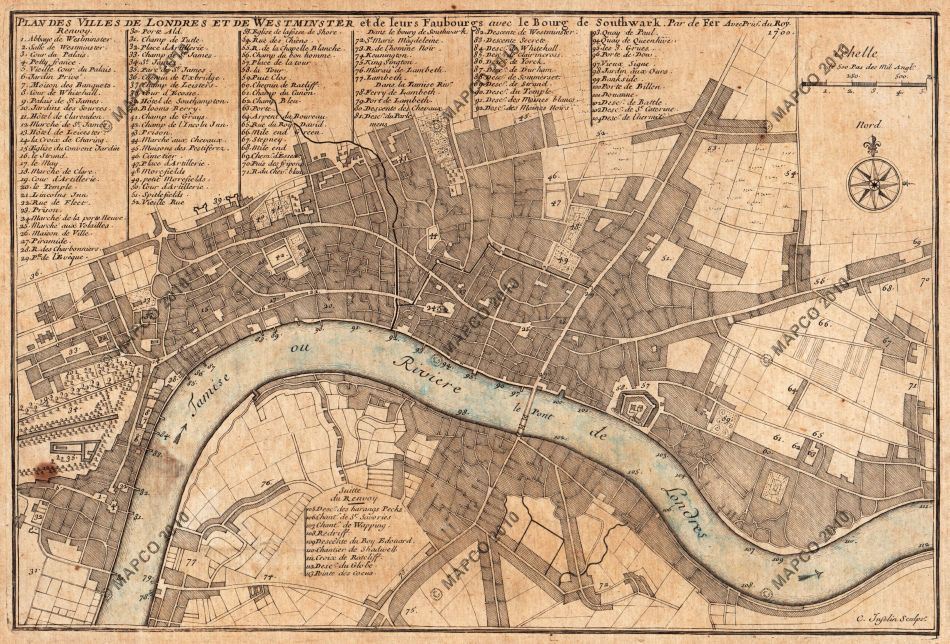
You can see a map before the Great Fire here - compared to a modern map you'll find remarkably little change, the same roads are still present today (here's a map from 1700). The rest of the city grew up around this area after the Great Fire, but the core remained unchanged.
It would be interesting to compare the City of London to the rapidly growing founding US colonies, like say Boston or Plymouth MA around the same time - anyone have a map?
-
Re:Shame it doesn't mention the engineers name
-
Re:Shame it doesn't mention the engineers name
-
sounds like my PhD work from 10+ years ago
I wrote a PhD on this technique as a way to support collaborative learning by allowing third-party annotation sharing: http://ethos.bl.uk/OrderDetails.do?uin=uk.bl.ethos.431525
In essence, the only way to do this without storing a copy of the original page (which has merit, but is challenging legally and in terms of disk space), is to store the annotations, pull in the page and then merge the annotations and send the output to the viewer. So it is basically acting as a proxy, but means that there are potential issues with orphaned annotations - the more dynamic nature of the web today would cause real problems in getting any kind of consistent output for two different people, or even for the same person at different times. I have to admit, I was looking at the educational side of things and so the security issues were less of a consideration, but things like the injection of malicious code, invisible amendments (e.g. censorship) to the underlying text, etc. were all pretty obvious.
Anyway, the technique itself was far from novel when I started working on my PhD, but given the continued citations to papers that I published back (https://scholar.google.co.uk/citations?user=KK_EFSUAAAAJ&hl=en) then it seems to still be an area of active research. -
Re: Torn
spot on. Magna Carta, the Bill of Rights 1689 and the US Constitution don't *grant* rights, they *guarantee* them against State interference. As opposed the Human Rights Act in England and Wales, which ONLY guarantees that the State won't infringe on rights *granted you by the State at its own sufferance* unless it *feels the need to* - and you have NO RIGHT TO EFFECTIVE REMEDY under the Human Rights Act! Don't believe me, go read it for yourself: compare the ECHR which the HRA is based on, next to the HRA - you'll see that under the Articles in hte HRA, #13 is absent. This is because the UK Government is under the criminally erroneous impression that Art. 6 covers it. IT DOESN'T, which is WHY IT'S IN THE ECHR IN THE FIRST PLACE!
Just FYI: there is a clause in the Serious Organised Crime and Police Act 2005 (linked here) which immunises State actors from ANY civil or criminal prosecution WHATSOEVER on the single proviso that they turn evidence in ANY OTHER PROCEEDING. Cliffnote: you can't sue the State!
http://www.echr.coe.int/Docume... (ECHR)
http://www.legislation.gov.uk/... (Human Rights Act (HRA))
http://www.bl.uk/magna-carta/a... (Magna Carta 1215, Modern English translation at the British Library)
http://www.legislation.gov.uk/... (Bill of Rights 1689 (the dates are different because this is the year the calendar changed))
http://www.senate.gov/civics/c... (The Constitution of the United States, including Amendments I-XXVII) -
Panspermia
Some real science has been done on DNA data storage as relates to evidence of panspermia. The theory goes that if intelligent life deliberately seeded the universe it may have used DNA or RNA sequences that could be decoded into a message. So far science's tendency toward conservatism has prevented anyone from coming out and saying it but I think available evidence is more than sufficient reason for optimism and intense study.
-
Lexicographer: a harmless drudge
Dr Johnson sneaked some humor into his dictionary - http://www.bl.uk/learning/lang...
-
Legal Deposit
Natural extension of Legal Deposit which has existed in English law since 1662.
It ensure that the UKâ(TM)s published materials are systematically collected and preserved for future generations.
-
Re:Ban when you are done testing?
http://www.bl.uk/world-war-one... http://en.wikipedia.org/wiki/Y... http://en.wikipedia.org/wiki/P... Does that mean "forever ignorant"?
-
The limited revelations so far...
The limited revelations so far have focused on the technical scheme and said little about the regulatory scheme, how it was used operationally. Leaving out that sort of data is like noting that almost everybody has in their house or on their person a device which has a microphone and transmits all it hears to remote listeners, that is a telephone, but leaving out the fact that it is off until you pick it up or turn it on. The existence of this technology and program says very little about if it is legal and if it has been used appropriately.
Turning off telephone service is inconvenient. Turning off the intelligence services ability to gather timely intelligence can perilous.
Bali death toll set at 202
London 7/7 terrorist attacks
Madrid train attacks
9-11 attacksWhat has MI-5 had to say?
U.K. tracking 30 terror plots, 1,600 suspects - updated 11/10/2006
British authorities are tracking almost 30 high-priority terrorist plots involving 200 networks and 1,600 suspects, the head of Britain’s domestic spy agency said, adding that many of those under surveillance are homegrown terrorists plotting suicide attacks and other mass-casualty bombings.
What did the next head of MI-5 say a year later?
New MI5 chief says terror suspects in Britain have doubled in the last year - November 6, 2007
The new chief of Britain's intelligence service MI5 painted a troubling picture of growing terrorist threat in Britain, saying the number of suspects in the country has more than doubled in the past year – and that many of the new recruits are teenagers....
and more:
At Least 4,000 Suspected of Terrorism-Related Activity in Britain, MI5 Director Says - November 6, 2007
LONDON, Nov. 5 -- British security officials suspect that at least 4,000 people are involved in terrorism-related activities in Britain and that al-Qaeda's "deliberate campaign" against Britain poses the "most immediate and acute peacetime threat" to the nation in a century, the head of Britain's domestic spy agency said Monday.
And in 2012?
MI5 warns al-Qaida regaining UK toehold after Arab spring
You cripple the security services at your peril. Unlike the IRA, al Qaida doesn't tend to phone in warnings before a blast.
-
Re:Definitions.
that's quite possibly the honest truth since neither that "war" nor "terrorism" has been defined to any degree.
For it is the doom of men that they forget. -- Merlin, Excalibur
SEC. 2. AUTHORIZATION FOR USE OF UNITED STATES ARMED FORCES.
(a) In General.--That the President is authorized to use all necessary and appropriate force against those nations, organizations, or persons he determines planned, authorized, committed, or aided the terrorist attacks that occurred on September 11, 2001, or harbored such organizations or persons, in order to prevent any future acts of international terrorism against the United States by such nations, organizations or persons.
By their deeds you shall know them.
1996 Bin Laden's Fatwa - The following text is a fatwa, or declaration of war, by Osama bin Laden first published in Al Quds Al Arabi
1998 Bombing of US embassies in Tanzania and Kenya
2000 Photo: USS Cole - Video: 2000: USS Cole Attack in Yemen
2001 9-11
2002 Bali terror attack
2004 Madrid train attacks
2005 London 7/7 Terrorist Attacks
2009 Now classified as "workplace violence" - Nidal Hasan Admitted Jihadist Motive, Ft. Hood Victims’ Attorneys Say
Note that this is only a snapshot of attacks, and doesn't include the many attacks that occurred in the Middle East (except the Cole). It also doesn't include the many plots disrupted by the security services, or cancelled by the terrorists planning them. It doesn't include the many arrests for terrorism related activity, but snapshot of that over a short period of time is below:
FBI’s Top Ten News Stories for the Week Ending January 27, 2012
Denver: Man Arrested for Providing Material Support to a Designated Foreign Terrorist Organization
Jamshid Muhtorov was arrested by members of the FBI’s Denver and Chicago Joint Terrorism Task Forces on a charge of providing and attempting to provide material support to the Islamic Jihad Union, a Pakistan-based designated foreign terrorist organization.
Baltimore: Man Pleads Guilty to Attempted Use of a Weapon of Mass Destruction in Plot to Attack Armed Forces Recruiting Center
U.S. citizen Antonio Martinez, aka Muhammad Hussain, pled guilty to attempted use of a weapon of mass destruction against federal property in connection with a scheme to attack an armed forces recruiting station in Catonsville, Maryland.
Washington Field: Man Pleads Guilty to Shootings at Pentagon, Other Military Buildings
Yonathan Melaku, of Alexandria, Virginia, pled guilty to damaging property and to firearms violations involving five separate shootings at military installations in northern Virginia betwe
-
Clarification for posterity
I'm pretty late to this story, but let me clear up some misunderstandings for posterity's sake:
Disclosure: I've been involved in this effort for at least ten years, I'm head of ICT for one of the UK Copyright Libraries (National Library of Wales), and this story goes way back to the Primary Legislation passed by the UK in 2003, and we've been working on the practicalities of this since before that legislation was passed.
* Yes, Internet Archive and others have been archiving web sites for many years. We're using their software for capturing.
* We've been collecting and archiving web sites by agreement with the web publishers for years via the UK Web archive project.
* What's different here is that the secondary legislation has been passed (in March) that has given the UK copyright libraries the mechanism (agreed with publishers) to extend legal deposit to digital publications, which includes websites.
* This gives the legal deposit libraries the right to add to the national legal deposit collections (the collection of all published material for the UK) digital publications, including ebooks, ejournals and websites.
* Until the 6th of April 2013, we did not have the right (under normal copyright law) to take a copy of websites without permission. Previously we had to request a written agreement from each website we archived to take a copy - obviously this does not scale very far.
* Under the new legislation, we will be taking periodic copies of the entire
* The difference between us and the Internet Archive is intended to be that given the status as a national collection, the material that we collect is intended to be available in perpetuity. Our print collections go back centuries, and the intention is that the digital material we collect now will also be available in centuries to come. You can read about the distributed redundant storage here.
TL;DR : this is a legal thing, not a technical thing, and it's about a lot more than websites.
-
Re:Assumptions and questions
"BL has a legal responsibility to preserve it's archive, including this content essentially forever; which is a significant technology challenge. "
In truth, the BL has a legal responsibility to preserve its archive only as long as they can afford to stay open. Quite rightly, therefore, it plays the game, resulting in news articles like this one that are transparently based on press releases originating with pressandpolicy.bl.uk in which the egos of MPs and senior managers are massaged and complications like 'archive.org have been archiving lots of UK sites for ages' are glossed over. That's fine, or if it isn't fine it is understandable, but it can be confusing. The original press release (most likely this one) isn't actually that bad since at least it focuses on legal deposit, but like most press releases it fails to preempt, acknowledge or answer the obvious questions like how exactly does this differ from archive.org? and aren't you just reinventing the wheel?As for the challenges, meh and pshaw. It's all good stuff but how much of that is unique to this project?
-
Awesome
There have been a number of other notable manuscript digitization projects of late:
British Libraries Digitised Manuscripts
http://www.bl.uk/manuscripts/"Homer Multitext" - several manuscripts including Venetus A
http://www.homermultitext.org/The Archimedes Palimpsest
http://www.archimedespalimpsest.org/Personally I think such projects are absolutely vital to the long term preservation of these manuscripts. Modern technology makes possible the duplication of these source documents in high fidelity facsimile (Taschen in particular has published a number of fascinating editions, including Blaeu's Atlas Maior - another example would be The Book of Michael of Rhodes from MIT Press). So often works survive only as a copy of a copy of a copy, and we are left to peer through the murky glass of multiple interpertations at the far distant original author's intent. (The current definitive edition of Euclid, for example, is available to us only because of a single surviving early copy in the Vatican's library (which so far as I know has not been digitized, unfortunately, except for a couple images here: http://www.loc.gov/exhibits/vatican/math.html).)
We should be scanning and then printing many copies of these early works and depositing them in libraries around the world in order to help these early glimpses into our history survive (at least in SOME form, even if the originals are lost). Of course, multiple copies of the digital data is also very important, but we have no way of knowing how well digital data will survive on thousand-year time scales. Fingers crossed that we will see multiple volume facsimilie copies of Newton's notebooks (one volume for the facsimile, one for a modern translation ) on Amazon in the next few years...
-
The article is mostly a hyperbolic rantand this quote says it all:
(This link goes to a good museum presentation of the Gutenberg, but don't bother unless you read Latin written in fancy script; the graphics in it contribute nothing.)
No modern has tried to suppress the Dead Sea Scrolls, as the summary might have one believe. Hell, many of these and like texts have been on Ph.D. comprehensive or qualifying exams for years (my own exam had the Nag Hammadi corpus on it which, far from being subject on modern day oppression, is available in multiple translations).
It is certainly true that for part of the past few decades, the scrolls have been in the hands of a few specialists. This is not for the purposes of power in some grand sense, however, but for the sake of publications for those who have control over them. The information wasn't being hoarded so much as disseminated slowly for the benefit of those scholars who work on them. On this note, I might be tempted to join in the rant of the article but that points to a deeper lack of open culture in higher education. Even so, the fact remains that they have been published.
Indeed, they have been subject of more than normal publication (see postscript). The gentleman who wrote this article complains, "why has it taken nearly 50 years for the contents of this material to be made fully public?" He fails to understand the simplest reason: the public doesn't really care enough. That is to say, some members of the public might care enough to read parts of a translation. A few might even now some languages from the period. But how many of the public are going to read it in the original in scanned versions rather than critical editions when even academics like myself only undertake paleography when we are trying to produce something for publication? I cannot therefore fathom a man who is daunted by a little Latin (see quote above) in type complaining that he cannot have the opportunity to practice his Aramaic paleography skills. Yet, in spite of the fact that the general public will not make much use of it, and the fellow who wrote this article certainly won't, Google and the Israel Museum have made high quality scans of them public. I, for one, and more inspired to speak of how great a thing this is; how much the internet has changed things (it takes decades in my field for a scholar to produce a critical edition of a text); and finally how the optimism and kindness (and probably interest in good publicity) of the people involved in this project have made this possible.
p.s.--I say "more than normal publication" because in most pre-modern fields it is extremely rare to find copies of relevant manuscripts online. The only hope typically is a) to use critical editions, b) to order microfilm, though many places will not provide this, or c) to go to the archives which, for an American, generally means thousands of dollars in travel costs. There have, however, been some efforts to make more manuscripts available online and they deserve some praise. The British Library should have a special note in this regard. Quite a few others may be found here. Mr. Fogarty need not visit these sites however. The open access of many of them will spoil his fun and, besides, he shouldn't bother unless he can read Latin and Greek written in a fancy script.
-
A few more they could go after
http://www.theholybook.org/ (I would be very surprised if they did, as it would give the "religion of peace" an opportunity to show their own method of objection again)
http://flushaholybook.com/
http://www.domesdaybook.co.uk/
http://www.chooseandbook.nhs.uk/
http://www.hotelbook.com/
http://www.thegoodbook.co.uk/
http://adoptabook.bl.uk/
http://www.easytobook.com/
http://www.bid4abook.co.uk/
http://www.nielsenbook.co.uk/
That's just a few of them. -
Re:For the patent FUDsters sure to follow....
Without patents, we will have essentially no technological or scientific development at all, except where funded by the government (and, in case you didn't know, the US government profits handsomely from patents they fund). The current US Federal budget is woefully inadequate to take on that role.
Really? No technological or scientific development at all save for the government? Heh- I guess the following are figments of our collecitve imagination then:
The Steam Engine
Archimedes' Screw
Stirling Engine
Fresnel Lens
The humble, lowly screw
The submarine
The diving suitThese are just a mere smattering of the vast number of things that were developed with nothing along the lines of what you speak of- there's tons more where that came from. In the end, the remark that we'd have no development at all has not been proven out- and there's very, very strong evidence to the contrary all throughout our history. Patents were conceived to encourage the process in question to hopefully speed up the rate of invention to our benefit.
Patents, the way we're seeing them used and implemented do nothing of the sort and really don't do what YOU claim of them either. They're being more of a HINDRANCE on things and don't really protect R&D unless you're someone like IBM. A Patent is only worth the amount you're able to litigate it for- no more and no less.
-
Re:A tribute?
For trademarks one of the claims people can make is that you are "passing off" i.e. pretending to be that company or in some how related to that company. Hence you should make it very clear that you are not that company/organisation. There is information on trademarks etc at the British Library IP Centre http://www.bl.uk/bipc/
-
British Library
Go see the British Library. It's free, and they have a great collection of illuminated manuscripts, Da Vinci sketches, etc. My wife and I really enjoyed it, as it's a well-hidden gem. Really enjoyed seeing a copy of the Magna Carta.
-
Re:Doh!
We could use the British Library, but I personally prefer to use the Cambridge University Library. Doing a degree at Cambridge was worth it just to be allowed in there
-
Re:Not surprising
He cut the F22 but is pushing the F35 instead, a far more versitile aircraft with lower operating costs. And don't forget, the F22 can be brought down by a simple HAM radio (reference Brittish Library Direct). As for carriers, the issue is not that we are killing off air capability on the sea, it is that we've built 4 since the fall of the Soviet Union, and have plans to build 3 more over the next 15 years. The original plan was to build 5 during the same time. He is simply shifting to a more practical standing, 5 years between launches rather than 3.
-
Re:unbelievable. uk is practically a fascist countBut you are wrong.
The Magna Carta only applied to Noblemen, not peasants. It was a power grab by rich and titled men over a weak monarch. There was no thought of human rights, only of power to control their own (the noblemen) feudal power and riches.
It is not taught as a constitutional document for that very reason. It is a historical account of power struggles in early English history, not an ideal to live by. And I was taught ABOUT it in a state school, but in history not politics or sociology.
From the British LibraryMagna Carta is one of the most celebrated documents in English history but later interpretations have tended to obscure its real significance in 1215. This iconic document was not intended to be a lasting declaration of legal principle. It was a practical solution to a political crisis which primarily served the interests of the highest ranks of feudal society by reasserting the power of custom to limit despotic behaviour by the king.
The majority of the clauses in Magna Carta dealt with the regulation of feudal customs and the operation of the justice system, not with legal theory and rights. It was King John's extortionate exploitation of his feudal rights and his ruthless administration of justice that were at the core of the barons' grievances.
All but three of Magna Carta's clauses have now become obsolete and been repealed, but the flexible way in which the charter has been reinterpreted through the centuries has guaranteed its status and longevity.
Legacy
Only three of the original clauses in Magna Carta are still law. One defends the freedom and rights of the English church, another confirms the liberties and customs of London and other towns, but the third is the most famous:
No free man shall be seized or imprisoned, or stripped of his rights or possessions, or outlawed or exiled . nor will we proceed with force against him . except by the lawful judgement of his equals or by the law of the land. To no one will we sell, to no one deny or delay right or justice.
This statement of principle, buried deep in Magna Carta, was given no particular prominence in 1215, but its intrinsic adaptability has allowed succeeding generations to reinterpret it for their own purposes and this has ensured its longevity. In the fourteenth century Parliament saw it as guaranteeing trial by jury. Sir Edward Coke interpreted it as a declaration of individual liberty in his conflict with the early Stuart kings and it has resonant echoes in the American Bill of Rights and the Universal Declaration of Human Rights.
But the real legacy of Magna Carta as a whole is that it limited the king's authority by establishing the crucial principle that the law was a power in its own right to which the king was subject.
-
Re:I'm Sorry, but Good Riddance
Paper's going nowhere fast. We'll still use it for archival purposes, will your RSS feeds, PDAs and Kindles last a thousand years? Paper originals of the Magna Carta still exist today. If it had been written in an early
-
Re:And the point of these laws is?
"Arguably, banning the drawing of such things, and dissemination of such cartoons discourages sickos from watching the cartoons and being encouraged."
There is no evidence for the argument that viewing child porn cartoons increases the risk of a person molesting a child. There is evidence to the contrary, however. Hall, et al. (1995) found that "arousal to pedophilic stimuli does not necessarily correspond with pedophilic behavior", Freel (2003) found that "if someone is fully inhibited from sexually abusing children, no amount of emotional congruence, sexual arousal, or blockage will lead them to abuse children", while Sheldon & Howitt (2008) found that "fantasy deficit may be involved in contact offending against children."
-
Turning the Pages
The British Library's Turning the Pages is not just religious text, but includes wide range of old books including; The Diamond Sutra, probably the worlds oldest printed 'BOOK', Sketches by Leonardo, FIRST ATLAS OF EUROPE and others.
-
Turning the Pages
The British Library's Turning the Pages is not just religious text, but includes wide range of old books including; The Diamond Sutra, probably the worlds oldest printed 'BOOK', Sketches by Leonardo, FIRST ATLAS OF EUROPE and others.
-
Re:libraries
A library should include the Internet, and books, but also staff who teach, providing some means of focusing people on the knowledge that they have become however fleetingly interested in. Without that you're unlikely to have a library that does anything but collect dust and books.
The "staff who teach" bit is especially important. The common belief is that "kids these days search all the time, of course they know how to do it." But when I've taught lessons on using Google, I've found that very few of them were aware of the existence of advanced search operators like "inurl:" or "site:" for narrowing the scope of your search. Many of them typed in natural language queries like "How many drunk driving accidents were there in Austin Texas last year?" When the results were bad, they'd type in another version of the same query, but still phrase it as a question (e.g. "What's the drunk driving rate in Austin Texas?"). In one case, a student actually exclaimed in surprise when I demonstrated that you can search for an exact phrase by putting it in quote marks, which is fairly basic.
And once they find results, they rarely spend much time evaluating the credibility of the site. It's not practical, given a large number of students, for the teacher to check every single reference. But when I've been grading I try to follow up at least one citation per paper, and some of the stuff my students have selected is just plain bad. In one case, a student who had written a paper comparing drinking habits in Europe and the US cited a web site written by a sophomore at a high school reporting a conversation about drinking with an unnamed European exchange student. Quite aside from the dubious source, the site wasn't even nicely designed. It's harder to look past a shiny surface; but in this case the pink text on a gray background in MS Comic Sans was kind of a giveaway that maybe this site isn't the most trustworthy one in the world.
And in fact the original report [PDF] found exactly this:
... the speed of young people's web searching indicates that little time is spent in evaluating information, either for relevance, accuracy or authority and children have been observed printing-off and using Internet pages with no more than a perfunctory glance at them.
Comfort with searching and effective searching are two different things. This is one area where libraries are actively developing. I'm enrolled in library school at the moment, and I've been following job postings. There are a lot of library jobs these days for "instructional librarians" who teach information skills exactly like these, usually by visiting other teachers' classes, and also by holding their own mini-classes. We're not really doing enough, though. An awful lot of librarians, particularly the older ones who are comfortably set in their ways, still expect that people will come to the library when they need information, which is simply no longer the case.
I overheard two undergraduates talking in the lobby of the library on my campus - one of them said "Let's get out of here. I don't like the library." The other one said "Yeah, it's not home." I've been thinking a lot about that ever since. How can the library compete with "home"? The answer I've come up with is that it can't. Since we can't expect most people to come to us, we've got to go to them. Some of that can definitely be digital - Ask-a-librarian services over IM are rapidly proliferating, for example. I've already mentioned the instructional librarians visiting other teachers' classes. But the mini-classes on searching that my campus library offers are usually held at the library. It would be better to schedule them in the computer labs at the dorms. Heck, it'd be neat to have a reference librarian actually hold office hours in the dorms, probably in the afternoon,
-
Re:And a hot date who reads...
It's the same here in the UK, indeed I can request an ILL from local public libraries as well as academic libraries, both can request items from each other as well as the British library who have a copy of anything ever published in the UK.
Additionally, there is a scheme that allows me to search the national libraries of most Europian countries called The Europian Library I don't know if there's procedure for getting an ILL from another country yet.
In case it wasn't obvious, I work in a library. -
Bright people don't make tech decisionsThe idea that an institution like the British Library, which is run by people bright enough to make you look like a dead match, would accept such a preposterous idea is insulting.
Unfortunately, those bright people don't get to make technical decisions.
The British Library recently introduced SED, an electronic document delivery system. With SED, you can order electronic copies of journal papers and articles from their archives. Great idea! Previously, you had to wait for the documents to come through the post, and that would take a week or so. Now you get them by email in a couple of working days.
Except that the documents are crippled by Adobe DRM, which imposes the following restrictions:- You can only view them using certain specific versions of Acrobat Reader (6 or 7) - the latest version is not recommended.
- The software only works on Windows 2000 or XP. No Linux support, no Mac support. Vista might work, but again, it's not recommended.
- You can only look at each document for a limited time, and you can only print it once.
If Adobe managed to convince the British Library to put up with this ridiculous system, I am sure that Microsoft will have no difficulty convincing them about their archive "solution". If SED is anything to go by, it'll be another awful implementation of a great idea. -
Bright people don't make tech decisionsThe idea that an institution like the British Library, which is run by people bright enough to make you look like a dead match, would accept such a preposterous idea is insulting.
Unfortunately, those bright people don't get to make technical decisions.
The British Library recently introduced SED, an electronic document delivery system. With SED, you can order electronic copies of journal papers and articles from their archives. Great idea! Previously, you had to wait for the documents to come through the post, and that would take a week or so. Now you get them by email in a couple of working days.
Except that the documents are crippled by Adobe DRM, which imposes the following restrictions:- You can only view them using certain specific versions of Acrobat Reader (6 or 7) - the latest version is not recommended.
- The software only works on Windows 2000 or XP. No Linux support, no Mac support. Vista might work, but again, it's not recommended.
- You can only look at each document for a limited time, and you can only print it once.
If Adobe managed to convince the British Library to put up with this ridiculous system, I am sure that Microsoft will have no difficulty convincing them about their archive "solution". If SED is anything to go by, it'll be another awful implementation of a great idea. -
Update existing lawsWorks don't necessarily need to just go away and Google, Project Guttenburg, and others don't necessarily need to be the only avenue for preserving works.
Surely we can speed up this process by simply asking the publishers to make available the original digital Latex or SGML files for all books printed since the late 70s right? Why invest hundreds of hours on scan/ocr/qa for texts which already exist in a digital format?
Legal deposit and mandatory deposit LAWS already in effect might be updated to ensure that copyright holders place works in an electronic format on deposit with national libraries... http://www.copyright.gov/help/faq/mandatory_deposi t.html http://www.bl.uk/about/policies/legaldeposit.html -
British Library "Manifesto" On DRM
In my opinion, the "manifesto" (*PDF) published recently by the British Libarary, and called to my attention by this GrokLaw story, on the subject of DRM, best explains how DRM is harmful to our culture, and inconsistent with our tradition of creativity, from which tradition we may distill the adage nihil sub solum novum.
-
British Library "Manifesto" On DRM
In my opinion, the "manifesto" (*PDF) published recently by the British Libarary, and called to my attention by this GrokLaw story, on the subject of DRM, best explains how DRM is harmful to our culture, and inconsistent with our tradition of creativity, from which tradition we may distill the adage nihil sub solum novum.
-
Copyright on reproductions of old images
What I'd like to see institutions like the British Library the British Museum and other public museums changing is their policy on reproductions of out-of-copyright images.
Currently, they claim copyright on reproductions of such images (ie, they claim that the act of scanning an old painting is a creative work, and that the photograph is protected by copyright, even if the original painting is long out of copyright). They use this copyright claim to place extortionate costs on publication of images of their collection.
This is somewhat suspect legally, but who has the lawyers to challenge them? Only creative works are meant to be covered by copyright. Where's the creative act in putting a painting into a reproduction system and pressing a button? The National Gallery even prides itself on how accurate a reproduction the copied images you can purchase from their website are, showing that there's no creative step here.
For example, according to http://www.bl.uk/imaging/pdf/permissionsfees20067. pdf it would cost me 102 pounds to buy a license to put a copy of a single one of their digital images on a website for 6 months, even if that website were a non-commercial website supplying, say, educational resources and lesson plan ideas for schools. The digital image they've made should not be covered by copyright, and should be able to be used without restriction. (It would be fair enough to charge a small fee to go towards the initial bandwidth cost and scanning cost, but don't forget that this is a public organisation which should be using some of its funding from the tax payers to allow British citizens who don't happen to live in London as much access to their collection as possible.) Once you have a copy of the digital image of an out-of-copyright painting, you should be able to do whatever you like with it.
While I welcome the copyright statement the British Library has made here, it should stop trying to abuse copyright in this manner before we salute it as a guardian of our rights. -
BL is reinforcing it's "custodian" role
At the end of the day, the BL isn't going to stand up for the interests of consumers. They themselves are heavy users of DRM, and anybody who's ever read in the BL (and paid the exorbitant photocopying fees!) will know how zealously they police copyright laws.
As a legal deposit library, what's important to the BL is that they're seen as the custodians of our intellectual heritagenot the publishers. Quite right too: the points about archiving and library priviledge are meant to ensure that copies of works survive--possibly giving the BL the right to reverse-engineer DRM, as we've seen happen in numerous other National Libraries accross the world. I don't think that it means they'll stop policing fair dealing, looking over your shouler to make sure you don't copy any more than 10% of a work or one chapter (whichever is the smallest)!
As an example of the BLs DRM usage, take a look at their Secure Electronic Delivery service. Not much room for fair dealing there. My partner (a librarian) was working for a big government department that regularly requested heaps of documents from the British Library. They could have saved a bit of public money using electronic delivery, but the Adobe DRM that the British Library uses was a bitch to get working through the departement's web cache. They would have had to pursuade an intransigent IT department to support a different version of Adobe Reader--people have just carried on using good old hard-copies, delivered by van from the BL's Document Supply Centre in Boston Spa.
-
How about the British Library?
http://www.bl.uk/
Always found it very good -
Re:Big surprise
Are they independent labels, or are they "independent" labels which are simply shell companies owned by the big 5 labels. You cannot assume that Sony, EMI, etc. don't own the label just because it doesn't say Sony, EMI, Capitol, BMG, etc. on the label.
http://www.bl.uk/collections/sound-archive/record. html
And:
http://www.arancidamoeba.com/mrr/whoownswho2.html
This one is THE best single not-so-independent "independent" label family tree I have seen. There are yet more "independent" labels owned by the big guys that are not in this diagram, but from this you can't assume that an "independent" label is independent.
Another page on that site ( http://www.arancidamoeba.com/mrr/ - "Some of your friends are already this fucked" ) is a great read.
If you want to get into music, you're best off fronting the cash yourself to record, produce, and master your record, and then find a good independent PROMOTER and work out a contract on that basis. That way, you go into it making money (not an advance, another word for "loan") right away and the record company cannot charge you inflated costs for recording, engineering, and mastering your music - and this is also the best and sometimes ONLY way to retain full ownership of your work.
Queen didn't set up Queen Music, Ltd. for no reason. Pink Floyd didn't set up Pink Floyd Music Publishers, Ltd. on a whim. They got fucked over at first, then got smart about how they dealt with the record companies. Acts like MC Hammer, Vanilla Ice weren't so savvy - especially Vanilla Ice. Because he was in hock to the record companies, they called the shots, and when they made up the whole "gangsta" bit he had no choice but to go with it. A lot of artists who hit it big on the charts are getting f'd over royally in the process, and generally only the ones who produce hit after hit become savvy enough to know how to deal with the record companies. Heck, Prince was in so bad with the record companies (on the creative control aspect, not so much financial in his case) he changed his name and pulled a lot of other crap in order to try to get his label to drop him so he could work out a better deal with a different label. -
Re:England invented democracy?A sobering thought, then, that this Bill has been pushed through by the elected House of Commons, when the unelected, archaic, undemocratic, etc. House of Lords, constitutionally unable to kill it outright, attempted to amend it into toothlessness and mire it in feasibility studies?
I'm waiting for a particularly odious Bill not to receive Royal Assent. Elizabeth II is probably too apolitical to refuse, but Charles looks as if he knows what happened at Runneymede
-
Re:Hmm...
You are clearly using the word "theological" in a different, significantly more general, sense that the original poster, and I am quite sure you realise this..
I certainly do realize this.Good
The abstract concept of "2", or of "gravity", or of "abstract concept" have no relation to religion whatsoever.
Actually they all do. 2 is related to the mathematical philosopher Pythagoreas, whose search for perfect numbers was a big time religion in ancient greece (more so the concepts of PI and the theorem that is named after him, but yes, mathematics was once a religion is the point).
The conecept of two and "twoness" was developed way before the pythagorean school. In fact, before the pythagorean school was even formed, the greek language had three numbers: singular, plural and dual, the third one being used when nouns and their accidents have two referrents; by the time the Iliad and the Odyssey were created, this third grammatical number had become less used, and only appears in those works fromtime to time. One can immediately deduce from a widely used language having a dual number, that the people speaking that language had a well developed concept of twoness.
Of course, very many other civilizations developed the concept of "twoness" independently of the greeks.
You are confusing the development of the concepty of two with the ulterior process of mystification of that concept. Yes: the pythagoreans loved to mystify numbers and such, and built a religion of sorts on them. Yet numbers, rectangular triangles, and what not existed as concepts before Pythagoras and his friends.
Let me be a little speculative here: "oneness" and "twoness" are probably among the abstract concepts that are indissolubly linked to intelligence, and it'd be hard to argue that a being with no grasp of those concepts can be described as intelligent.
Gravity was discovered as a part of Newton's philosophical musings about the mind of God. All abstract concepts discovered before 1800 or so are similar;
The fact that he may have stumbled upon the concept of gravity as part of his musings on God does not imply that the concept of gravity is in any way religious or based upon religion. The fact that I find a two dollar bill on my way to church in no way implies that that money is god-goven or based upon god or anything.
it's only after the American Revolution that we got the separation of Church and State, followed quickly by the separation of Church and Science.
Hmm. You might want to brush up your history! The separation of church and state as a concept, as an ideal, and as a implementation (imperfect as all are: look at the current USian implementation for an example...) predates not only the American Revolution, but the discovery of the American continent itself! Google for "magna carta" and/or behold it in its beautiful calligraphy.
The world is larger and older than the USA! Anyone claiming to be a marxist (whatever the variant) should know that
To some more than others, that was a loss, not a gain. A significant sign of this loss is that you did NOT know that mathematics was once a religion. But don't take MY word for it- look it up for yourself.
It is certainly true that mathematics was taken up by quite a few cults, and developed significantly by them, too. Anything can be mystified. You can mistify the rain if you want, and it certainly has been; that does not make the rain religion-based, of religious nature or anything barely similar.
Your "think for yourself, little grasshopper" style fails not to amuse me.
-
Re:Needs Shockwave
"As in all business models trying to sort out the final 10% of a probelm is always dispraportinatly expensive."
The British Library is a (largely) publicly funded national resource, not a commercial entertainment and media company.
"Afterall they did not have to do anything other then show the books once every 20 years under glass in the British Library."
Yes - if the governing board decided that such a policy would count as fulfilling the purpose of the Library and its legal obligations under the British Library Act: http://www.bl.uk/about/blact.html - but I doubt most interested parties would agree and I doubt Parliament would put up with it for very long.
That they use proprietary and/or less than optimally accessible formats unnecessarily liberally may seem a trivial complaint to you, but I disagree and it is certainly not unreasonable or close-minded to suggest that they haven't done quite as well for the public as they might have done this time:
http://www.pixelwit.com/flip/PageFlip.html
http://welcome.hp.com/country/us/en/msg/corp/flash dreamworks.html -
Re:Needs Shockwave
There's a shockwave-free link for at least some of them.
-
Re:Needs Shockwave
from their site:
There are also alternative non-Shockwave versions of three of the volumes. More will be added soon. -
European Union has human rights constitution toomosb1000: specifically enumerated individual rights
You are wrong. See also:
In the UK, it is a common occurance for an Act of Parliament (a law) to be overturned by the European Court of Human Rights on the grounds that it infringes those rights. This is much the same process as a US law being found unconstitutional.
I've no reason to believe the EU and US are alone in having constitutions which grant rights to their individual citizens. In the UK, the concept dates back to the Magna Carta of 1215 AD and I doubt that was the first example in the world, either (although most historical examples, including the original US constitution, had exemptions for various untermensch such as females, slaves etc.).
That said... IMHO the Internet is America's ball. It invented it. It owns it [1]. It can do with it as it pleases. I'm grateful that they let us foreigners on it. But that has nothing to do with any superiority of constitutions.
[1] Actually NATO invented it, but seeing as NATO funding was provided in the vast majority by the USA, as a fellow NATO-member Brit, I'm not complaining. -
easy
perhaps the same way I would read a wax cylinder today
visit a specialist
a good place to start would be here :
http://www.bl.uk/collections/sound-archive/wtmcyli nder.html -
Re:The main issue
Can I, as a license paying Brit, download episodes which have already been broadcast without fear of legal action?
The last time I checked the BBC faq... there was a question similar to yours, but it was more along the lines of asking the BBC for a copy of something someone missed. The answer was unless you were a contribuiter they couldn't provide copies due to copyright restrictions, but a contribuiter and their family could get one under the Contributor Access Scheme [contact info] for a copy duplication fee. This leads me to believe that the BBC can not grant you license to get a copy from equipment not under your domain.
Whether they the BBC or the copyright holders who license to the BBC would send out their teenage mutent ninga lawyers after you is unknown.
-
Europeans Always Fail IT
Europeans need to stop reacting to every thing and innovation coming from the USA; they need to use whatever little imagination they have left to originate initiatives like this, otherwise they will be constantly cobbliing projects together defensively instead of creatively.
They are not asking the right questions, and when they do and they get the answers, they are doing nothing about these answers - like this digitization project. For years everyone has been saying that the new British Library was a waste of money, and that the whole collection should be scanned and moved to a giant warehouse somewhere, but no one listened, one of the biggest brick buildings ever was built to house the collection (which is off limits to the public, being open only to 'researchers, innovators and entrepreneurs') and now they have a pathetic website that boasts about their 'treasures' 15 of which you can 'get close to'.
That simply is not good enough.
Google is going to scan millions of books, and make them available to all for free. By doing this, the books and knowledge, and the Google service itself, become a TRUE treasure, one that everyone can use to enhance their lives. What the British Library is doing is hoarding information, it is the modern equivalent of a chained library, of the type that used to exist when books were expensive; where literaly, volumes were chained to walls, and only the rich could access them.
What a shameful place that is, and what a total waste of a nearly unique resource! -
Re:second only to the Library of Congress. . .
According to the British Library's website, it contains 150 million items and gains a futher 3 million each year (but it doesn't distinguish between items and volumes - they collect any published item, and receive a copy of EVERY published item in the UK and Ireland).
The Bodelian has only 7 million volumes.
I would suspect that the Brish Library is substantially larger than Stanfords, but the Library Of Congress is recognised as the largest library in the world.
Steve. -
Already being done by the British LibraryThe British Library have a pilot project online already: http://www.uk.olivesoftware.com/Default/Client.as
p ?Enter=true&skin=BL/.However, it looks like it might (somehow) eventually be limited to education users only: http://www.bl.uk/collections/britishnewspapers180
0 to1900.html/ which would be crazy.