Slashdot Mirror
Domain: blogspot.com
Stories and comments across the archive that link to blogspot.com.
Stories · 3,021
-
Capitol Records Flooded Internet With MP3s, Says MP3Tunes CEO
NewYorkCountryLawyer writes "In court papers filed in New York in Capitol Records v. MP3Tunes, the CEO of MP3Tunes, Michael Robertson, has accused the plaintiffs EMI, Capitol Records, and other EMI record labels of flooding the internet with free MP3s of their songs for promotional purposes, 'free to everyone (except, apparently, MP3tunes).' His 10-page declaration (PDF) provides exact details of specific song files, including the URLs from which they are being distributed free of charge, both by paid content distributors, and by EMI itself from its own web sites." -
Capitol Records Flooded Internet With MP3s, Says MP3Tunes CEO
NewYorkCountryLawyer writes "In court papers filed in New York in Capitol Records v. MP3Tunes, the CEO of MP3Tunes, Michael Robertson, has accused the plaintiffs EMI, Capitol Records, and other EMI record labels of flooding the internet with free MP3s of their songs for promotional purposes, 'free to everyone (except, apparently, MP3tunes).' His 10-page declaration (PDF) provides exact details of specific song files, including the URLs from which they are being distributed free of charge, both by paid content distributors, and by EMI itself from its own web sites." -
Entire Transcript of RIAA's Only Trial Now Online
NewYorkCountryLawyer writes "The entire transcript of the RIAA's 'perfect storm,' its first and only trial, which resulted in a $222,000 verdict in a case involving 24 MP3's having a retail value of $23.76, is now available online. After over a year of trying, we have finally obtained the transcript of the Duluth, Minnesota, jury trial which took place October 2, 2007, to October 4, 2007, in Capitol Records v. Thomas. Its 643 pages represent a treasure trove for (a) lawyers representing defendants in other RIAA cases, (b) technologists anxious to see how a MediaSentry investigator and the RIAA's expert witness combined to convince the jurors that the RIAA had proved its case, and (c) anybody interested in finding out about such things as the early-morning October 4th argument in which the RIAA lawyer convinced the judge to make the mistake which forced him to eventually vacate the jury's verdict, and the testimony of SONY BMG's Jennifer Pariser in which she 'misspoke' according to the RIAA's Cary Sherman when she testified under oath that making a copy from one's CD to one's computer is 'stealing.' The transcript was a gift from the 'Joel Fights Back Against RIAA' team defending SONY BMG Music Entertainment v. Tenenbaum, in Boston, Massachusetts. I have the transcript in 3 segments: October 2nd (278 pages(PDF), October 3rd (263 pages)(PDF), and October 4th (100 pages)(PDF)." -
Entire Transcript of RIAA's Only Trial Now Online
NewYorkCountryLawyer writes "The entire transcript of the RIAA's 'perfect storm,' its first and only trial, which resulted in a $222,000 verdict in a case involving 24 MP3's having a retail value of $23.76, is now available online. After over a year of trying, we have finally obtained the transcript of the Duluth, Minnesota, jury trial which took place October 2, 2007, to October 4, 2007, in Capitol Records v. Thomas. Its 643 pages represent a treasure trove for (a) lawyers representing defendants in other RIAA cases, (b) technologists anxious to see how a MediaSentry investigator and the RIAA's expert witness combined to convince the jurors that the RIAA had proved its case, and (c) anybody interested in finding out about such things as the early-morning October 4th argument in which the RIAA lawyer convinced the judge to make the mistake which forced him to eventually vacate the jury's verdict, and the testimony of SONY BMG's Jennifer Pariser in which she 'misspoke' according to the RIAA's Cary Sherman when she testified under oath that making a copy from one's CD to one's computer is 'stealing.' The transcript was a gift from the 'Joel Fights Back Against RIAA' team defending SONY BMG Music Entertainment v. Tenenbaum, in Boston, Massachusetts. I have the transcript in 3 segments: October 2nd (278 pages(PDF), October 3rd (263 pages)(PDF), and October 4th (100 pages)(PDF)." -
Entire Transcript of RIAA's Only Trial Now Online
NewYorkCountryLawyer writes "The entire transcript of the RIAA's 'perfect storm,' its first and only trial, which resulted in a $222,000 verdict in a case involving 24 MP3's having a retail value of $23.76, is now available online. After over a year of trying, we have finally obtained the transcript of the Duluth, Minnesota, jury trial which took place October 2, 2007, to October 4, 2007, in Capitol Records v. Thomas. Its 643 pages represent a treasure trove for (a) lawyers representing defendants in other RIAA cases, (b) technologists anxious to see how a MediaSentry investigator and the RIAA's expert witness combined to convince the jurors that the RIAA had proved its case, and (c) anybody interested in finding out about such things as the early-morning October 4th argument in which the RIAA lawyer convinced the judge to make the mistake which forced him to eventually vacate the jury's verdict, and the testimony of SONY BMG's Jennifer Pariser in which she 'misspoke' according to the RIAA's Cary Sherman when she testified under oath that making a copy from one's CD to one's computer is 'stealing.' The transcript was a gift from the 'Joel Fights Back Against RIAA' team defending SONY BMG Music Entertainment v. Tenenbaum, in Boston, Massachusetts. I have the transcript in 3 segments: October 2nd (278 pages(PDF), October 3rd (263 pages)(PDF), and October 4th (100 pages)(PDF)." -
Entire Transcript of RIAA's Only Trial Now Online
NewYorkCountryLawyer writes "The entire transcript of the RIAA's 'perfect storm,' its first and only trial, which resulted in a $222,000 verdict in a case involving 24 MP3's having a retail value of $23.76, is now available online. After over a year of trying, we have finally obtained the transcript of the Duluth, Minnesota, jury trial which took place October 2, 2007, to October 4, 2007, in Capitol Records v. Thomas. Its 643 pages represent a treasure trove for (a) lawyers representing defendants in other RIAA cases, (b) technologists anxious to see how a MediaSentry investigator and the RIAA's expert witness combined to convince the jurors that the RIAA had proved its case, and (c) anybody interested in finding out about such things as the early-morning October 4th argument in which the RIAA lawyer convinced the judge to make the mistake which forced him to eventually vacate the jury's verdict, and the testimony of SONY BMG's Jennifer Pariser in which she 'misspoke' according to the RIAA's Cary Sherman when she testified under oath that making a copy from one's CD to one's computer is 'stealing.' The transcript was a gift from the 'Joel Fights Back Against RIAA' team defending SONY BMG Music Entertainment v. Tenenbaum, in Boston, Massachusetts. I have the transcript in 3 segments: October 2nd (278 pages(PDF), October 3rd (263 pages)(PDF), and October 4th (100 pages)(PDF)." -
Entire Transcript of RIAA's Only Trial Now Online
NewYorkCountryLawyer writes "The entire transcript of the RIAA's 'perfect storm,' its first and only trial, which resulted in a $222,000 verdict in a case involving 24 MP3's having a retail value of $23.76, is now available online. After over a year of trying, we have finally obtained the transcript of the Duluth, Minnesota, jury trial which took place October 2, 2007, to October 4, 2007, in Capitol Records v. Thomas. Its 643 pages represent a treasure trove for (a) lawyers representing defendants in other RIAA cases, (b) technologists anxious to see how a MediaSentry investigator and the RIAA's expert witness combined to convince the jurors that the RIAA had proved its case, and (c) anybody interested in finding out about such things as the early-morning October 4th argument in which the RIAA lawyer convinced the judge to make the mistake which forced him to eventually vacate the jury's verdict, and the testimony of SONY BMG's Jennifer Pariser in which she 'misspoke' according to the RIAA's Cary Sherman when she testified under oath that making a copy from one's CD to one's computer is 'stealing.' The transcript was a gift from the 'Joel Fights Back Against RIAA' team defending SONY BMG Music Entertainment v. Tenenbaum, in Boston, Massachusetts. I have the transcript in 3 segments: October 2nd (278 pages(PDF), October 3rd (263 pages)(PDF), and October 4th (100 pages)(PDF)." -
Entire Transcript of RIAA's Only Trial Now Online
NewYorkCountryLawyer writes "The entire transcript of the RIAA's 'perfect storm,' its first and only trial, which resulted in a $222,000 verdict in a case involving 24 MP3's having a retail value of $23.76, is now available online. After over a year of trying, we have finally obtained the transcript of the Duluth, Minnesota, jury trial which took place October 2, 2007, to October 4, 2007, in Capitol Records v. Thomas. Its 643 pages represent a treasure trove for (a) lawyers representing defendants in other RIAA cases, (b) technologists anxious to see how a MediaSentry investigator and the RIAA's expert witness combined to convince the jurors that the RIAA had proved its case, and (c) anybody interested in finding out about such things as the early-morning October 4th argument in which the RIAA lawyer convinced the judge to make the mistake which forced him to eventually vacate the jury's verdict, and the testimony of SONY BMG's Jennifer Pariser in which she 'misspoke' according to the RIAA's Cary Sherman when she testified under oath that making a copy from one's CD to one's computer is 'stealing.' The transcript was a gift from the 'Joel Fights Back Against RIAA' team defending SONY BMG Music Entertainment v. Tenenbaum, in Boston, Massachusetts. I have the transcript in 3 segments: October 2nd (278 pages(PDF), October 3rd (263 pages)(PDF), and October 4th (100 pages)(PDF)." -
RIAA's Request For Appeal Denied In Thomas Case
NewYorkCountryLawyer writes "The RIAA's request for permission to appeal from the decision setting aside its $222,000 jury verdict has been denied by District Court Judge Michael J. Davis. In a brief, 6-page decision (PDF) the Judge dismissed the RIAA's arguments that there is a 'substantial ground for a difference of opinion' on the question of law presented, whether the Judge had erred in accepting the RIAA's proposed jury instruction that merely 'making files available' could constitute an infringement of the plaintiffs' distribution rights. He likewise dismissed their argument that granting permission for the appeal would 'materially advance the ultimate termination of the litigation,' since (a) depending on the outcome of the trial, plaintiffs might not wish to appeal from the judgment, and (b) no matter how the appeals court rules on the 'making available' issue, the case will still have to continue in the lower court, since even if the RIAA wins on the 'making available' issue, the Court will still have to address the constitutionality of the large jury verdict, which may result in a new trial." -
RIAA's Request For Appeal Denied In Thomas Case
NewYorkCountryLawyer writes "The RIAA's request for permission to appeal from the decision setting aside its $222,000 jury verdict has been denied by District Court Judge Michael J. Davis. In a brief, 6-page decision (PDF) the Judge dismissed the RIAA's arguments that there is a 'substantial ground for a difference of opinion' on the question of law presented, whether the Judge had erred in accepting the RIAA's proposed jury instruction that merely 'making files available' could constitute an infringement of the plaintiffs' distribution rights. He likewise dismissed their argument that granting permission for the appeal would 'materially advance the ultimate termination of the litigation,' since (a) depending on the outcome of the trial, plaintiffs might not wish to appeal from the judgment, and (b) no matter how the appeals court rules on the 'making available' issue, the case will still have to continue in the lower court, since even if the RIAA wins on the 'making available' issue, the Court will still have to address the constitutionality of the large jury verdict, which may result in a new trial." -
RIAA's Request For Appeal Denied In Thomas Case
NewYorkCountryLawyer writes "The RIAA's request for permission to appeal from the decision setting aside its $222,000 jury verdict has been denied by District Court Judge Michael J. Davis. In a brief, 6-page decision (PDF) the Judge dismissed the RIAA's arguments that there is a 'substantial ground for a difference of opinion' on the question of law presented, whether the Judge had erred in accepting the RIAA's proposed jury instruction that merely 'making files available' could constitute an infringement of the plaintiffs' distribution rights. He likewise dismissed their argument that granting permission for the appeal would 'materially advance the ultimate termination of the litigation,' since (a) depending on the outcome of the trial, plaintiffs might not wish to appeal from the judgment, and (b) no matter how the appeals court rules on the 'making available' issue, the case will still have to continue in the lower court, since even if the RIAA wins on the 'making available' issue, the Court will still have to address the constitutionality of the large jury verdict, which may result in a new trial." -
RIAA Case May Be Televised On Internet
NewYorkCountryLawyer writes "In SONY BMG Music Entertainment v. Tenenbaum, the Boston case in which the defendant is represented by Prof. Charles Nesson and his CyberLaw class at Harvard Law School, the defendant has requested that audio-visual coverage of the court proceedings be made available to the public via the internet. Taking the RIAA at its word — that the reason for its litigation program is to 'educate the public' — the defendant's motion (PDF) queries why the RIAA would oppose public access: 'Net access to this litigation will allow an interested and growingly sophisticated public to understand the RIAA's education campaign. Surely education is the purpose of the Digital Deterrence Act of 1999, the constitutionality of which we are challenging. How can RIAA object? Yet they do, fear of sunlight shone upon them.'" -
RIAA Case May Be Televised On Internet
NewYorkCountryLawyer writes "In SONY BMG Music Entertainment v. Tenenbaum, the Boston case in which the defendant is represented by Prof. Charles Nesson and his CyberLaw class at Harvard Law School, the defendant has requested that audio-visual coverage of the court proceedings be made available to the public via the internet. Taking the RIAA at its word — that the reason for its litigation program is to 'educate the public' — the defendant's motion (PDF) queries why the RIAA would oppose public access: 'Net access to this litigation will allow an interested and growingly sophisticated public to understand the RIAA's education campaign. Surely education is the purpose of the Digital Deterrence Act of 1999, the constitutionality of which we are challenging. How can RIAA object? Yet they do, fear of sunlight shone upon them.'" -
RIAA Case May Be Televised On Internet
NewYorkCountryLawyer writes "In SONY BMG Music Entertainment v. Tenenbaum, the Boston case in which the defendant is represented by Prof. Charles Nesson and his CyberLaw class at Harvard Law School, the defendant has requested that audio-visual coverage of the court proceedings be made available to the public via the internet. Taking the RIAA at its word — that the reason for its litigation program is to 'educate the public' — the defendant's motion (PDF) queries why the RIAA would oppose public access: 'Net access to this litigation will allow an interested and growingly sophisticated public to understand the RIAA's education campaign. Surely education is the purpose of the Digital Deterrence Act of 1999, the constitutionality of which we are challenging. How can RIAA object? Yet they do, fear of sunlight shone upon them.'" -
The Slow Bruteforce Botnet(s) May Be Learning
badger.foo writes "We've seen stories about the slow bruteforcers — we've discussed it here — and based on the data, my colleague Egil Möller was the first to suggest that since we know the attempts are coordinated, it is not too far-fetched to assume that the controlling system measures the rates of success for each of the chosen targets and allocates resources accordingly. (The probes of my systems have slowed in the last month.) If Egil's assumption is right, we are seeing the bad guys adapting. And they're avoiding OpenBSD machines." For fans of raw data, here are all the log entries (3MB) that badger.foo has collected since noticing the slow bruteforce attacks. -
RIAA Claim of Stopping Suits "Months" Ago Is False
NewYorkCountryLawyer writes "According to a report on Wired.com, the RIAA spokesman claimed that the RIAA has not filed any new lawsuits 'for months,' and according to the Wall Street Journal report discussed here yesterday, the RIAA stopped filing mass lawsuits 'early this fall.' Knowing that the RIAA has a problem with telling the truth, I did a little investigating, and found out that the RIAA had, in fact, commenced a wave of lawsuits just last week. Why would anyone believe anything their spokesperson says? This is an organization that has a tendency to misspeak a lot, if you know what I mean, even when under oath." CNet has a copy of the RIAA's new form letter that it will ask ISPs to pass on to alleged copyright-infringing users. It says, in part, "This letter does not constitute a waiver of our members' rights to recover or claim relief for damages incurred by this illegal activity, nor does it waive the right to bring legal action against the user at issue for engaging in music theft." -
RIAA Claim of Stopping Suits "Months" Ago Is False
NewYorkCountryLawyer writes "According to a report on Wired.com, the RIAA spokesman claimed that the RIAA has not filed any new lawsuits 'for months,' and according to the Wall Street Journal report discussed here yesterday, the RIAA stopped filing mass lawsuits 'early this fall.' Knowing that the RIAA has a problem with telling the truth, I did a little investigating, and found out that the RIAA had, in fact, commenced a wave of lawsuits just last week. Why would anyone believe anything their spokesperson says? This is an organization that has a tendency to misspeak a lot, if you know what I mean, even when under oath." CNet has a copy of the RIAA's new form letter that it will ask ISPs to pass on to alleged copyright-infringing users. It says, in part, "This letter does not constitute a waiver of our members' rights to recover or claim relief for damages incurred by this illegal activity, nor does it waive the right to bring legal action against the user at issue for engaging in music theft." -
RIAA May Be Violating a Court Order In California
NewYorkCountryLawyer writes "In one of its 'ex parte' cases seeking the names and addresses of 'John Does,' this one targeting students at the University of Southern California, the RIAA obtained an order granting discovery — but with a wrinkle. The judge's order (PDF) specified that the information obtained could not be used for any purpose other than obtaining injunctions against the students. Apparently the RIAA lawyers have ignored, or failed to understand, that limitation, as an LA lawyer has reported that the RIAA is busy calling up the USC students and their families and demanding monetary settlements." -
RIAA May Be Violating a Court Order In California
NewYorkCountryLawyer writes "In one of its 'ex parte' cases seeking the names and addresses of 'John Does,' this one targeting students at the University of Southern California, the RIAA obtained an order granting discovery — but with a wrinkle. The judge's order (PDF) specified that the information obtained could not be used for any purpose other than obtaining injunctions against the students. Apparently the RIAA lawyers have ignored, or failed to understand, that limitation, as an LA lawyer has reported that the RIAA is busy calling up the USC students and their families and demanding monetary settlements." -
Network Neutrality Defenders Quietly Backing Off?
SteveOHT writes "Google Inc. has approached major cable and phone companies that carry Internet traffic with a proposal to create a fast lane for its own content, according to documents reviewed by The Wall Street Journal. Google has traditionally been one of the loudest advocates of equal network access for all content providers. The story claims that Microsoft, Yahoo, and Amazon have quietly withdrawn from a coalition of companies and groups backing network neutrality (the coalition is not named), though Amazon's name is reportedly once again listed on the coalition's Web site. Google has already responded, calling the WSJ story "confused" and explaining that they're only talking about edge caching, and remain as committed as ever to network neutrality. The blogosphere is alight with the debate. -
Open Source Program Reveals Diebold Bug
Mitch Trachtenberg writes "Ballot Browser, an open source Python program developed by Mitch Trachtenberg (yours truly) as part of the all-volunteer Humboldt County Election Transparency Project, was instrumental in revealing that Diebold counting software had dropped 197 ballots from Humboldt County, California's official election results. Despite a top-to-bottom review by the California Secretary of State's office, it appears that Diebold had not informed that office of the four-year-old bug. The Transparency Project has sites at humetp.org and http://www.humtp.com." Trachtenberg also points to his blog for the Transparency Project, and his own essay about the discovery and the process that led to it. -
Web Content Accessibility Guidelines 2.0 Now Final
beetle496 writes "It has been going on nine years now, but finally there are formal standards for Web accessibility for technologies other than HTML. They ask that you start with the press release (lots of links), but regulars might be more entertained by the last time WCAG made the front page here. Many folks here will point out that web accessibility is old hat, and by implication this is hardly news, but if you do Web development for any government organization, you should expect that accessibility is a base requirement. The Section 508 standards are to be updated (relatively) soon too." -
Followup To "When Teachers Are Obstacles To Linux"
An couple of anonymous readers wrote in to let us know about a followup to last Wednesday's story of the teacher who didn't believe in free software. The Linux advocate who posted the original piece has cooled off and graciously apologized for going off half-cocked (even though the teacher had done the same), and provided a little more background which, while not excusing the teacher's ignorance, does make her actions somewhat more understandable. Ken Starks has talked with the teacher, who has received a crash education in technology over the last few days — Starks is installing Linux on her computer tomorrow. He retracts his insinuations about Microsoft money and the NEA. All in all he demonstrates what a little honest communication can do, a lesson that all of us who advocate for free software can take to heart. "The student did get his Linux disks back after the class. The lad was being disruptive, but that wasn't mentioned. Neither was the obvious fact that when she saw a gaggle of giggling 8th grade boys gathered around a laptop, the last thing she expected to see on that screen was a spinning cube. She didn't know what was on those disks he was handing out. It could have been porn, viral .exe's...any number of things for all she knew. When she heard that an adult had given him some of the disks to hand out, her spidey-senses started tingling. Coupled with the fact that she truly was ignorant of honest-to-goodness free software, and you have some fairly impressive conclusion-jumping. In a couple of ways, I am guilty of it too." -
Google Chrome Is Out of Beta
BitZtream writes "This morning Google announced that Chrome is out of Beta, and showing improvements for plugin support, most notably video speed improvements. It also contains an updated javascript engine, claiming that it operates 1.4 times faster than the beta version, and work has begun on an extensions platform to allow easier integration with the browser by third parties." -
When Teachers Are Obstacles To Linux In Education
jamie found this blog post up on the HeliOS Project, which brings Linux to school kids in Austin, TX. It makes very clear some of the obstacles that free software faces in the classroom. It seems a teacher came upon a student demonstrating Linux to other kids and handing out LiveCDs. The teacher confiscated the CDs and wrote an angry email to HeliOS's founder, Ken Starks: "Mr. Starks, I am sure you strongly believe in what you are doing but I cannot either support your efforts or allow them to happen in my classroom. At this point, I am not sure what you are doing is legal. No software is free and spreading that misconception is harmful. ... This is a world where Windows runs on virtually every computer and putting on a carnival show for an operating system is not helping these children at all. I am sure if you contacted Microsoft, they would be more than happy to supply you with copies of an older version of Windows and that way, your computers would actually be of service to those receiving them..." Starks pens an eloquent reply, which contains a factoid I have not seen mentioned before: "The fact that you seem to believe that Microsoft is the end all and be-all is actually funny in a sad sort of way. Then again, being a good NEA member, you would spout the Union line. Microsoft has pumped tens of millions of dollars into your union. Of course you are going to 'recommend' Microsoft Windows." -
Google Native Client Puts x86 On the Web
t3rmin4t0r writes "Google has announced its Google native client, which enables x86 native code to be run securely inside a browser. With Java applets already dead and buried, this could mean the end of the new war between browsers and the various JavaScript engines (V8, Squirrelfish, Tracemonkey). The only question remains whether it can be secured (ala ActiveX) and whether the advantages carry over onto non-x86 platforms. The package is available for download from its Google code site. Hopefully, I can finally write my web apps in asm." Note: the Google code page description points out that this is not ready for production use: "We've released this project at an early, research stage to get feedback from the security and broader open-source communities." Reader eldavojohn links to a technical paper linked from that Google code page [PDF] titled "Native Client: A Sandbox for Portable, Untrusted x86 Native Code," and suggests this in-browser Quake demo, which requires the Native Code plug-in. -
RIAA Sues 19-Year-Old Transplant Patient
NewYorkCountryLawyer writes "Just when you think they've reached rock bottom, it seems the RIAA always finds room to sink a little lower. This time they've sued an innocent, 19-year-old transplant patient, hospitalized with pancreatitis and needing islet cell transplants. Although the young Pittsburgh lady claims that she did not infringe any copyrights, she failed to answer the complaint in time, and a default judgment was taken against her. A Pittsburgh area lawyer has stated that he will represent her pro bono and make a motion to open up the default." -
RIAA Sues 19-Year-Old Transplant Patient
NewYorkCountryLawyer writes "Just when you think they've reached rock bottom, it seems the RIAA always finds room to sink a little lower. This time they've sued an innocent, 19-year-old transplant patient, hospitalized with pancreatitis and needing islet cell transplants. Although the young Pittsburgh lady claims that she did not infringe any copyrights, she failed to answer the complaint in time, and a default judgment was taken against her. A Pittsburgh area lawyer has stated that he will represent her pro bono and make a motion to open up the default." -
Net Neutrality Opponent Calls Google a "Bandwidth Hog"
Adrian Lopez writes "According to PC World, an analyst with ties to the telecom industry — in a baseless attack on the concept of Net Neutrality — has accused Google Inc. of being a bandwidth hog. Quoting: '"Internet connections could be more affordable for everyone, if Google paid its fair share of the Internet's cost," wrote Cleland in the report. "It is ironic that Google, the largest user of Internet capacity pays the least relatively to fund the Internet's cost; it is even more ironic that the company poised to profit more than any other from more broadband deployment, expects the American taxpayer to pick up its skyrocketing bandwidth tab."' Google responded on their public policy blog, citing 'significant methodological and factual errors that undermine his report's conclusions.' Ars Technica highlighted some of Cleland's faulty reasoning as well." -
RIAA's Oppenheim Tries To Protect MediaSentry
NewYorkCountryLawyer writes "The RIAA's 'Prince of Darkness,' Washington DC lawyer Matthew Jan Oppenheim of The Oppenheim Group, who controls and supervises all of the RIAA litigations against ordinary folks, has requested permission to intervene in the 'probable cause' hearing scheduled next week in Raleigh, North Carolina, against MediaSentry. The hearing was convened by North Carolina's Private Protective Services Board, after complaints were filed by a law firm representing a number of North Carolina State University students who had been targeted by the RIAA based on the unlicensed 'investigation' conducted by SafeNet (the new name for MediaSentry). I guess the RIAA is worried. They should be." -
RIAA's Oppenheim Tries To Protect MediaSentry
NewYorkCountryLawyer writes "The RIAA's 'Prince of Darkness,' Washington DC lawyer Matthew Jan Oppenheim of The Oppenheim Group, who controls and supervises all of the RIAA litigations against ordinary folks, has requested permission to intervene in the 'probable cause' hearing scheduled next week in Raleigh, North Carolina, against MediaSentry. The hearing was convened by North Carolina's Private Protective Services Board, after complaints were filed by a law firm representing a number of North Carolina State University students who had been targeted by the RIAA based on the unlicensed 'investigation' conducted by SafeNet (the new name for MediaSentry). I guess the RIAA is worried. They should be." -
RIAA's Oppenheim Tries To Protect MediaSentry
NewYorkCountryLawyer writes "The RIAA's 'Prince of Darkness,' Washington DC lawyer Matthew Jan Oppenheim of The Oppenheim Group, who controls and supervises all of the RIAA litigations against ordinary folks, has requested permission to intervene in the 'probable cause' hearing scheduled next week in Raleigh, North Carolina, against MediaSentry. The hearing was convened by North Carolina's Private Protective Services Board, after complaints were filed by a law firm representing a number of North Carolina State University students who had been targeted by the RIAA based on the unlicensed 'investigation' conducted by SafeNet (the new name for MediaSentry). I guess the RIAA is worried. They should be." -
RIAA Vs. Web 2.0? Social Media and Litigation
NewYorkCountryLawyer writes "After learning that Professor Nesson's CyberLaw class at Harvard Law School has set up a Facebook page to assist in its defense of Joel Tenenbaum in an RIAA case, SONY BMG Music v. Tenenbaum, Wendy Davis of the Online Daily Examiner opines that 'Web 2.0,' and more particularly, the 'social media,' are playing an increasingly important role in RIAA litigation. We at Slashdot have already learned that principle, and have made good use of it, as have our friends at Groklaw." -
RIAA Vs. Web 2.0? Social Media and Litigation
NewYorkCountryLawyer writes "After learning that Professor Nesson's CyberLaw class at Harvard Law School has set up a Facebook page to assist in its defense of Joel Tenenbaum in an RIAA case, SONY BMG Music v. Tenenbaum, Wendy Davis of the Online Daily Examiner opines that 'Web 2.0,' and more particularly, the 'social media,' are playing an increasingly important role in RIAA litigation. We at Slashdot have already learned that principle, and have made good use of it, as have our friends at Groklaw." -
New Hampshire Law Students Take On RIAA
NewYorkCountryLawyer writes "We have recently learned that another law school legal aid clinic has joined the fight against the RIAA. Student attorneys from the Consumer and Commercial Law Clinic of the Franklin Pierce Law Center in Concord, New Hampshire, working under law school faculty supervision, are representing a lady targeted by the RIAA in UMG Recording v. Roy in New Hampshire. The case is scheduled for trial next Fall. That makes at least 4 law schools providing anti-RIAA defense services: University of Maine, University of San Francisco, Franklin Pierce, and, most recently, Harvard. Hopefully many more will follow. One commentator theorizes that this news 'will ... [encourage] professors and students at other law schools to take on hitherto defenseless people being pilloried by the corporate music industry.'" -
New Hampshire Law Students Take On RIAA
NewYorkCountryLawyer writes "We have recently learned that another law school legal aid clinic has joined the fight against the RIAA. Student attorneys from the Consumer and Commercial Law Clinic of the Franklin Pierce Law Center in Concord, New Hampshire, working under law school faculty supervision, are representing a lady targeted by the RIAA in UMG Recording v. Roy in New Hampshire. The case is scheduled for trial next Fall. That makes at least 4 law schools providing anti-RIAA defense services: University of Maine, University of San Francisco, Franklin Pierce, and, most recently, Harvard. Hopefully many more will follow. One commentator theorizes that this news 'will ... [encourage] professors and students at other law schools to take on hitherto defenseless people being pilloried by the corporate music industry.'" -
Distributed, Low-Intensity Botnets
badger.foo writes "We have seen the future of botnets, and it is distributed and low-key. Are sites running free software finally becoming malware targets? It all started with a higher-than-usual number of failed ssh logins at a low-volume site. I think we are seeing the shape of botnets to come, with malware authors doing their early public beta testing during the last few weeks." -
MySQL 5.1 Released, Not Quite Up To Par
Mad Merlin writes "It's no secret that MySQL 5.1 has been a long time in the making, with the first beta release being in Nov 2005, but MySQL 5.1.30 has finally been released as GA. MySQL users can expect new features such as table/index partitioning, row based replication, a new plugin architecture, an event scheduler and a host of performance improvements from 5.1." Monty also had a blog post outlining some of the challenges faced in 5.1, including crashing bugs and a beta quality to most new features. -
Ninth Anniversary of Amazon 1-Click Injunction
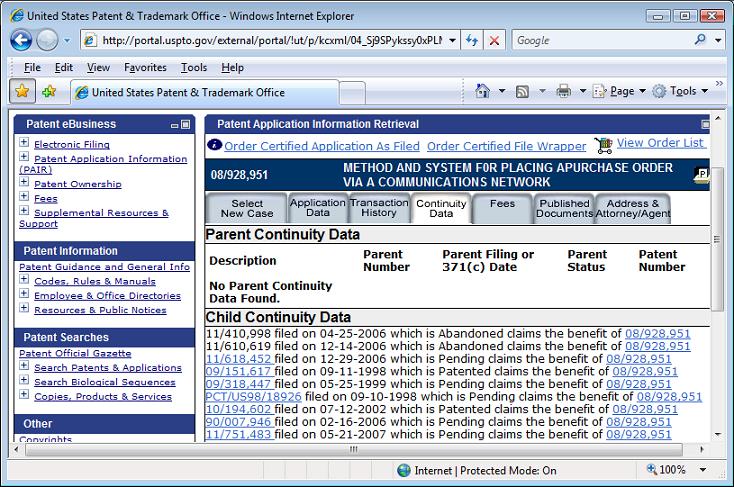
theodp writes "Nine years ago Monday, Amazon kicked off the Holiday Season by slapping Barnes and Noble with a court injunction barring BN from using a checkout feature that Amazon said represented illegal copying of its patented 1-Click technology. 'We're pleased that Judge Pechman recognized the innovation underlying our 1-Click feature,' said Jeff Bezos in a press release. But an Appellate Court wasn't quite as impressed with Amazon's innovation. Nor were USPTO Examiners who were asked to take another look at the merits of Amazon's 1-Click patent claims. Still, 1-Click lives on, although Amazon's lawyers are currently fighting two separate rejections by USPTO Examiners, burying USPTO Examiners in paper, and employing canceling-and-refiling tactics that some may find reminiscent of Eddie Haskell's chess end-game strategy. So much for Amazon-led patent reform." -
Linux Kernel Booting On the iPhone
mhm was one of many readers to note that the Linux 2.6 kernel has been ported to the iPhone. "Planetbeing, one of the iPhone devteam members, has been working on porting Linux to the iPhone (along with a custom bootloader called OpeniBoot). Today they managed to boot the kernel! Video showing the boot process has been posted. Instructions and binaries are available on the project blog." -
Linux Kernel Booting On the iPhone
mhm was one of many readers to note that the Linux 2.6 kernel has been ported to the iPhone. "Planetbeing, one of the iPhone devteam members, has been working on porting Linux to the iPhone (along with a custom bootloader called OpeniBoot). Today they managed to boot the kernel! Video showing the boot process has been posted. Instructions and binaries are available on the project blog." -
Judge Excludes 3 "John Does" From RIAA Subpoena
NewYorkCountryLawyer writes "In one of the RIAA's 'John Doe' cases targeting Boston University students, after the University wrote to the Court saying that it could not identify three of the John Does 'to a reasonable degree of technical certainty,' Judge Nancy Gertner deemed the University's letter a 'motion to quash,' and granted it, quashing the subpoena as to those defendants. In the very brief docket entry (PDF) containing her decision, she noted that 'compliance with the subpoena as to the IP addresses represented by these Defendants would expose innocent parties to intrusive discovery.' There is an important lesson to be learned from this ruling: if the IT departments of the colleges and universities targeted by the RIAA would be honest, and explain to the Courts the problems with the identification and other technical issues, there is a good chance the subpoenas will be vacated. Certainly, there is now a judicial precedent for that principle. One commentator asks whether this holding 'represents the death knell to some, if not all, of the RIAA's efforts to use American university staff as copyright cops.'" -
Judge Excludes 3 "John Does" From RIAA Subpoena
NewYorkCountryLawyer writes "In one of the RIAA's 'John Doe' cases targeting Boston University students, after the University wrote to the Court saying that it could not identify three of the John Does 'to a reasonable degree of technical certainty,' Judge Nancy Gertner deemed the University's letter a 'motion to quash,' and granted it, quashing the subpoena as to those defendants. In the very brief docket entry (PDF) containing her decision, she noted that 'compliance with the subpoena as to the IP addresses represented by these Defendants would expose innocent parties to intrusive discovery.' There is an important lesson to be learned from this ruling: if the IT departments of the colleges and universities targeted by the RIAA would be honest, and explain to the Courts the problems with the identification and other technical issues, there is a good chance the subpoenas will be vacated. Certainly, there is now a judicial precedent for that principle. One commentator asks whether this holding 'represents the death knell to some, if not all, of the RIAA's efforts to use American university staff as copyright cops.'" -
EU Strikes Down French "3 Strikes" Copyright Infringement Law
Erris writes "Opendotdotdot has good news about laws in the EU: 'EU culture ministers yesterday (20 November) rejected French proposals to curb online piracy through compulsory measures against free downloading ... [and instead pushed] for "a fair balance between the various fundamental rights" while fighting online piracy, first listing "the right to personal data protection," then "the freedom of information" and only lastly "the protection of intellectual property." [This] indicates that the culture ministers and their advisers are beginning to understand the dynamics of the Net, that throttling its use through crude instruments like the "three strikes and you're out" is exactly the wrong thing to do.'" -
Google Sorts 1 Petabyte In 6 Hours
krewemaynard writes "Google has announced that they were able to sort one petabyte of data in 6 hours and 2 minutes across 4,000 computers. According to the Google Blog, '... to put this amount in perspective, it is 12 times the amount of archived web data in the US Library of Congress as of May 2008. In comparison, consider that the aggregate size of data processed by all instances of MapReduce at Google was on average 20PB per day in January 2008.' The technology making this possible is MapReduce 'a programming model and an associated implementation for processing and generating large data sets.' We discussed it a few months ago. Google has also posted a video from their Technology RoundTable discussing MapReduce." -
Solar Wind Rips Up Martian Atmosphere
IHateEverybody writes "Scientists have found evidence that the solar wind is ripping off chunks of the Martian atmosphere, which could possibly explain why Mars has such a thin atmosphere today. The chunks are being ripped up along 'magnetic umbrellas,' which are bubbles of magnetic fields which rise from the ground and extend above the Martian atmosphere. This is surprising because scientists previously thought that these magnetic umbrellas protected the Martian atmosphere. Now it looks like exactly the opposite might be true." -
Taking a Look at Nexenta's Blend of Solaris and Ubuntu
Ahmed Kamal writes "What happens when you take a solid system such as Ubuntu Hardy, unplug its Linux kernel, and plug in a replacement OpenSolaris kernel? Then you marry Debian's apt-get to Solaris' zfs file-system? What you get is Nexenta Core Platform OS. Let's take Nexenta for a quick spin, installing and configuring this young but promising system." -
Taking a Look at Nexenta's Blend of Solaris and Ubuntu
Ahmed Kamal writes "What happens when you take a solid system such as Ubuntu Hardy, unplug its Linux kernel, and plug in a replacement OpenSolaris kernel? Then you marry Debian's apt-get to Solaris' zfs file-system? What you get is Nexenta Core Platform OS. Let's take Nexenta for a quick spin, installing and configuring this young but promising system." -
RICO Class Action Against RIAA In Missouri
NewYorkCountryLawyer writes "In Atlantic Recording v. Raleigh, an RIAA case pending in St. Louis, Missouri, the defendant has asserted detailed counterclaims against the RIAA for federal RICO violations, fraud, violation of the Computer Fraud and Abuse Act, prima facie tort, trespass, and conspiracy. The claims focus on the RIAA's 'driftnet' tactic of suing innocent people, and of demanding extortionate settlements. The RICO 'predicate acts' alleged in the 42-page pleading (PDF) are extortion, mail fraud, and wire fraud. The proposed class includes all people residing in the US 'who were falsely accused ... of downloading copyrighted sound recordings owned by the counterclaim Defendants and making them available for distribution or mass distribution over a P2P network and who incurred costs and damages including legal fees in defense of such false claims' or 'whose computers used in interstate commerce and/or communication were accessed ... without permission or authority.' This is the second class action of which we are aware against the RIAA and the Big 4 recording companies, the first being the Oregon class action brought by Tanya Andersen, which is presently in the discovery phase." -
RICO Class Action Against RIAA In Missouri
NewYorkCountryLawyer writes "In Atlantic Recording v. Raleigh, an RIAA case pending in St. Louis, Missouri, the defendant has asserted detailed counterclaims against the RIAA for federal RICO violations, fraud, violation of the Computer Fraud and Abuse Act, prima facie tort, trespass, and conspiracy. The claims focus on the RIAA's 'driftnet' tactic of suing innocent people, and of demanding extortionate settlements. The RICO 'predicate acts' alleged in the 42-page pleading (PDF) are extortion, mail fraud, and wire fraud. The proposed class includes all people residing in the US 'who were falsely accused ... of downloading copyrighted sound recordings owned by the counterclaim Defendants and making them available for distribution or mass distribution over a P2P network and who incurred costs and damages including legal fees in defense of such false claims' or 'whose computers used in interstate commerce and/or communication were accessed ... without permission or authority.' This is the second class action of which we are aware against the RIAA and the Big 4 recording companies, the first being the Oregon class action brought by Tanya Andersen, which is presently in the discovery phase."