Slashdot Mirror
Domain: blogspot.com
Stories and comments across the archive that link to blogspot.com.
Stories · 3,021
-
Google to Acquire Postini
Dynamoo writes "Google has announced that it is to acquire Postini, company best known for its corporate spam filtering and security service, but also active in Instant Messaging and compliance area. The deal is to purchase Postini for $625m in cash. The acquisition is slated to enhance Google's application portfolio, and Google will also acquire several very large Blue Chip customers that have previously eluded it." -
Mars Rovers Threatened By Dust Storms
mrcgran writes "Space.com is reporting a new potentially deadly weather condition threatening the Mars rovers: 'The first and largest dusty squall has reduced direct sunlight to Mars' surface by nearly 99 percent, an unprecedented threat for the solar-powered rovers. If the storm keeps up and thickens with even more dust, officials fear the rovers' batteries may empty and silence the robotic explorers forever. "This thing has been breaking records the past few days. The sun is 100 times fainter than normal. We're hoping for a big break in the storm soon, but that's just a hope." '" -
A Simple Plan To Defeat Dumb Patents
Steve Jones writes "With the EU being rumored to look at software patents again I thought I'd have a look at the root of the problem — the US Patent Office — and work out if there is a simple way to defeat dumb patents. The big thing that defeats a patent is prior art. At the Patent Office they have the definition of Prior Art that includes the phrase: 'known or used by others in this country, or was patented or described in a printed publication in this or a foreign country.' Now suppose that every time we have an idea that we think is 'obvious' but that hasn't been done before, or something we think would be interesting but don't have the money to create — that we blogged about that idea, tagging it as 'prior art' via Technorati. This would give people an RSS feed of prior art." Read on for more details of Steve's proposal.
My argument is that by doing this we can, rightly, claim that the ideas have been described in the 21st-century version of a printed publication. Even if that is challenged, it is undeniable that by using the RSS feed it can be proven that people in a given country could have "known" about it.
I'm fed up thinking "Bloody hell I did that ten years ago," or "I thought about doing that, its a bit obvious" — when companies with as little intention as I had in developing the idea start putting the squeeze on businesses and developers. What I've always lacked is the visible proof to submit against a claim. This is a simple suggestion about using the power of the Web to create a massive prior art database. IANAL, but could it be this simple? -
A Simple Plan To Defeat Dumb Patents
Steve Jones writes "With the EU being rumored to look at software patents again I thought I'd have a look at the root of the problem — the US Patent Office — and work out if there is a simple way to defeat dumb patents. The big thing that defeats a patent is prior art. At the Patent Office they have the definition of Prior Art that includes the phrase: 'known or used by others in this country, or was patented or described in a printed publication in this or a foreign country.' Now suppose that every time we have an idea that we think is 'obvious' but that hasn't been done before, or something we think would be interesting but don't have the money to create — that we blogged about that idea, tagging it as 'prior art' via Technorati. This would give people an RSS feed of prior art." Read on for more details of Steve's proposal.
My argument is that by doing this we can, rightly, claim that the ideas have been described in the 21st-century version of a printed publication. Even if that is challenged, it is undeniable that by using the RSS feed it can be proven that people in a given country could have "known" about it.
I'm fed up thinking "Bloody hell I did that ten years ago," or "I thought about doing that, its a bit obvious" — when companies with as little intention as I had in developing the idea start putting the squeeze on businesses and developers. What I've always lacked is the visible proof to submit against a claim. This is a simple suggestion about using the power of the Web to create a massive prior art database. IANAL, but could it be this simple? -
Granny Sues RIAA Over Unlicensed Investigator
NewYorkCountryLawyer writes "An elderly, non-file-sharing grandmother from East Texas, who had been sued by the RIAA after being displaced by Hurricane Rita, has sought leave to file counterclaims against the RIAA record companies for using unlicensed investigators. In her counterclaims (PDF) Ms. Crain claims that the record companies 'entered into an agreement with a private investigations company to provide investigative services which led to the production of evidence to be used in court against counterclaim plaintiff, including the identification of an IP address on the basis of which counterclaim defendants filed their suit... [They] were at the time of this agreement aware that the aforementioned private investigations company was unlicensed to conduct investigations in the State of Texas specifically, and in other states as well... [T]hey agreed between themselves and understood that unlicensed and unlawful investigations would take place in order to provide evidence for this lawsuit, as well as thousands of others as part of a mass litigation campaign... [T]he private investigations company hired by plaintiffs engaged in one or more overt acts of unlawful private investigation... Such actions constitute civil conspiracy under Texas common law.'" -
Granny Sues RIAA Over Unlicensed Investigator
NewYorkCountryLawyer writes "An elderly, non-file-sharing grandmother from East Texas, who had been sued by the RIAA after being displaced by Hurricane Rita, has sought leave to file counterclaims against the RIAA record companies for using unlicensed investigators. In her counterclaims (PDF) Ms. Crain claims that the record companies 'entered into an agreement with a private investigations company to provide investigative services which led to the production of evidence to be used in court against counterclaim plaintiff, including the identification of an IP address on the basis of which counterclaim defendants filed their suit... [They] were at the time of this agreement aware that the aforementioned private investigations company was unlicensed to conduct investigations in the State of Texas specifically, and in other states as well... [T]hey agreed between themselves and understood that unlicensed and unlawful investigations would take place in order to provide evidence for this lawsuit, as well as thousands of others as part of a mass litigation campaign... [T]he private investigations company hired by plaintiffs engaged in one or more overt acts of unlawful private investigation... Such actions constitute civil conspiracy under Texas common law.'" -
Is RIAA's Linares Affidavit Technically Valid?
NewYorkCountryLawyer writes "In support of its ex parte, 'John Doe,' discovery applications against college students, the RIAA has been using a declaration by its 'Anti-Piracy' Vice President Carlos Linares (PDF) to show the judge that it has a good copyright infringement case against the 'John Does.' A Boston University student has challenged the validity of Mr. Linares's declaration, and the RIAA is fighting back. Would appreciate the Slashdot community's take on the validity of Mr. Linares's 'science.'" -
Is RIAA's Linares Affidavit Technically Valid?
NewYorkCountryLawyer writes "In support of its ex parte, 'John Doe,' discovery applications against college students, the RIAA has been using a declaration by its 'Anti-Piracy' Vice President Carlos Linares (PDF) to show the judge that it has a good copyright infringement case against the 'John Does.' A Boston University student has challenged the validity of Mr. Linares's declaration, and the RIAA is fighting back. Would appreciate the Slashdot community's take on the validity of Mr. Linares's 'science.'" -
Is RIAA's Linares Affidavit Technically Valid?
NewYorkCountryLawyer writes "In support of its ex parte, 'John Doe,' discovery applications against college students, the RIAA has been using a declaration by its 'Anti-Piracy' Vice President Carlos Linares (PDF) to show the judge that it has a good copyright infringement case against the 'John Does.' A Boston University student has challenged the validity of Mr. Linares's declaration, and the RIAA is fighting back. Would appreciate the Slashdot community's take on the validity of Mr. Linares's 'science.'" -
Slackware 12.0 Released
Matt writes "Straight from our good friend and colleague in the fight for quality distributions, Mr. Patrick Volkerding, comes a brand-new and eagerly-awaited release of Slackware, version 12. HAL automount, KDE 3.5.7 and XFCE 4.4.1, Xorg 7.2, 2.6 kernels as far as the eye can see, oodles of updated applications and utilities, and hardware support for just about anything under the sun. Get it here. Enjoy! I know I will." -
iPhone Interest Still Going Strong
Even though the iPhone has already been released into the wild, the amount of excitement surrounding this device doesn't seem to be subsiding by any measurable degree. Many readers have submitted their favorite reactions to the shiny new gizmo including a BusinessWeek report that suggests the iPhone only costs around $220 to make, a user review from MacScoop, one user's top 10 interface mistakes, a roundup of early security concerns, and details on the hardware behind the phone. Read on for more details.Only $220 to Make an iPhone. Bomarc writes to tell us BuinessWeek is reporting that according to a recent analysis the new iPhone only costs Apple in the neighborhood of $200 ($220 for the 8-gigabyte model) to manufacture.
iPhone User Review. Alexandros Roussos writes "It has been an unforgettable week-end for the first iPhone buyers and MacScoop will now put the focus on one of them who provided to a complete review of Apple's very anticipated gizmo."
Mistakes in the iPhone Interface. Rakesh writes "I love the iPhone. It 's here to stay as my primary cell phone. But I've come across a bunch of things that make me think Apple rushed at the end to get this thing out there. Here's my list of the top 10 mistakes Apple made with the iPhone interface."
iPhone Security Roundup. An anonymous reader writes "Although some security researchers noted problems getting their iPhone activated, others wasted no time tearing the new device apart. Seth Fogie, from Airscanner, reported passwords can be found for the device from running strings obtained from the backup images through a password cracker. Robert Graham, from Errata Security, writes about Safari and Bluetooth bugs on their blog."
iPhone Hardware Details. abdulzis writes "Engadget has the scoop on the iPhone's hardware specs through a leaked firmware. 'Sascha at Gear Log seems to think given the recently discovered Samsung chip in the iPhone, perhaps the processor in question is a Samsung S3C6400, a recently-produced 667MHz ARM1176JZF-based CPU that seems to fit the bill.'"
-
Google Protects Healthcare From Michael Moore
An anonymous reader suggests we stop over to ZDNet for a case where Google may be stepping on the wrong side of that famous Don't Be Evil line. A Google staffer is offering to help the healthcare industry contain the damage that Michael Moore's film is about to do. (Here is the original Google Health Advertisement blog post by Lauren Turner; in case it disappears, it is reproduced in full in the ZDNet post.) Quoting from the Google post: "Many of our clients face these issues; companies come to us hoping we can help them better manage their reputations through 'Get the Facts' or issue management campaigns. Your brand or corporate site may already have these informational assets, but can users easily find them? We can place text ads, video ads, and rich media ads in paid search results or in relevant websites within our ever-expanding content network. Whatever the problem, Google can act as a platform for educating the public and promoting your message. We help you connect your company's assets while helping users find the information they seek." -
RIAA Wants Agreements to Stay Secret
NewYorkCountryLawyer writes "The RIAA is opposing Ms. Lindor's request for discovery into the agreements among the record company competitors by which they have agreed to settle and prosecute their cases together, by which she seeks to support her Fourth Affirmative Defense (pdf) alleging that 'The plaintiffs, who are competitors, are a cartel acting collusively in violation of the antitrust laws and of public policy, by tying their copyrights to each other, collusively litigating and settling all cases together, and by entering into an unlawful agreement among themselves to prosecute and to dispose of all cases in accordance with a uniform agreement, and through common lawyers, thus overreaching the bounds and scope of whatever copyrights they might have. ...As such, they are guilty of misuse of their copyrights.'" -
RIAA Wants Agreements to Stay Secret
NewYorkCountryLawyer writes "The RIAA is opposing Ms. Lindor's request for discovery into the agreements among the record company competitors by which they have agreed to settle and prosecute their cases together, by which she seeks to support her Fourth Affirmative Defense (pdf) alleging that 'The plaintiffs, who are competitors, are a cartel acting collusively in violation of the antitrust laws and of public policy, by tying their copyrights to each other, collusively litigating and settling all cases together, and by entering into an unlawful agreement among themselves to prosecute and to dispose of all cases in accordance with a uniform agreement, and through common lawyers, thus overreaching the bounds and scope of whatever copyrights they might have. ...As such, they are guilty of misuse of their copyrights.'" -
RIAA Wants Agreements to Stay Secret
NewYorkCountryLawyer writes "The RIAA is opposing Ms. Lindor's request for discovery into the agreements among the record company competitors by which they have agreed to settle and prosecute their cases together, by which she seeks to support her Fourth Affirmative Defense (pdf) alleging that 'The plaintiffs, who are competitors, are a cartel acting collusively in violation of the antitrust laws and of public policy, by tying their copyrights to each other, collusively litigating and settling all cases together, and by entering into an unlawful agreement among themselves to prosecute and to dispose of all cases in accordance with a uniform agreement, and through common lawyers, thus overreaching the bounds and scope of whatever copyrights they might have. ...As such, they are guilty of misuse of their copyrights.'" -
Google Maps Now Does Interactive Re-Routing
An anonymous reader writes "Remember how cool it was the first time you used MapQuest or Google Maps or Google Earth? You'll feel like it's the first time again, when you use interactive dragging of routes on Google Maps. Some of the folks from the development team have even whipped up a handy video to explain the concept." -
Lunar Lens Takes A Step Forward
palewook writes "A recent breakthrough increased NASA's interest in a lunar-based space telescope. Researchers combined an ionic liquid surface and a layer of silver which produced a favorably reflective mirror." -
Washington Woman Sues RIAA for Attorneys Fees
NewYorkCountryLawyer writes "A Washington woman sued by the RIAA has asked the Court to award her attorneys fees, after the record company plaintiffs (Interscope Records, Capitol Records, SONY BMG, Atlantic Recording, BMG Music, and Virgin Records) dropped their case against her after two years of litigation, in Interscope v. Leadbetter. The brief submitted by her attorneys (pdf) pointed out the similarity between Ms. Leadbetter's case and Capitol v. Foster. In the Leadbetter case, as well as Foster case, the RIAA sued the woman solely because she had paid for an internet access account, and then later in the case attempted to plead 'secondary liability' against her without any factual basis for doing so. This tactic had been repudiated by Judge Lee R. West in Capitol v. Foster as 'marginal' and 'untested' in his initial decision awarding attorneys fees, and in his later decision denying the RIAA's motion for reconsideration." -
Washington Woman Sues RIAA for Attorneys Fees
NewYorkCountryLawyer writes "A Washington woman sued by the RIAA has asked the Court to award her attorneys fees, after the record company plaintiffs (Interscope Records, Capitol Records, SONY BMG, Atlantic Recording, BMG Music, and Virgin Records) dropped their case against her after two years of litigation, in Interscope v. Leadbetter. The brief submitted by her attorneys (pdf) pointed out the similarity between Ms. Leadbetter's case and Capitol v. Foster. In the Leadbetter case, as well as Foster case, the RIAA sued the woman solely because she had paid for an internet access account, and then later in the case attempted to plead 'secondary liability' against her without any factual basis for doing so. This tactic had been repudiated by Judge Lee R. West in Capitol v. Foster as 'marginal' and 'untested' in his initial decision awarding attorneys fees, and in his later decision denying the RIAA's motion for reconsideration." -
Washington Woman Sues RIAA for Attorneys Fees
NewYorkCountryLawyer writes "A Washington woman sued by the RIAA has asked the Court to award her attorneys fees, after the record company plaintiffs (Interscope Records, Capitol Records, SONY BMG, Atlantic Recording, BMG Music, and Virgin Records) dropped their case against her after two years of litigation, in Interscope v. Leadbetter. The brief submitted by her attorneys (pdf) pointed out the similarity between Ms. Leadbetter's case and Capitol v. Foster. In the Leadbetter case, as well as Foster case, the RIAA sued the woman solely because she had paid for an internet access account, and then later in the case attempted to plead 'secondary liability' against her without any factual basis for doing so. This tactic had been repudiated by Judge Lee R. West in Capitol v. Foster as 'marginal' and 'untested' in his initial decision awarding attorneys fees, and in his later decision denying the RIAA's motion for reconsideration." -
Washington Woman Sues RIAA for Attorneys Fees
NewYorkCountryLawyer writes "A Washington woman sued by the RIAA has asked the Court to award her attorneys fees, after the record company plaintiffs (Interscope Records, Capitol Records, SONY BMG, Atlantic Recording, BMG Music, and Virgin Records) dropped their case against her after two years of litigation, in Interscope v. Leadbetter. The brief submitted by her attorneys (pdf) pointed out the similarity between Ms. Leadbetter's case and Capitol v. Foster. In the Leadbetter case, as well as Foster case, the RIAA sued the woman solely because she had paid for an internet access account, and then later in the case attempted to plead 'secondary liability' against her without any factual basis for doing so. This tactic had been repudiated by Judge Lee R. West in Capitol v. Foster as 'marginal' and 'untested' in his initial decision awarding attorneys fees, and in his later decision denying the RIAA's motion for reconsideration." -
Washington Woman Sues RIAA for Attorneys Fees
NewYorkCountryLawyer writes "A Washington woman sued by the RIAA has asked the Court to award her attorneys fees, after the record company plaintiffs (Interscope Records, Capitol Records, SONY BMG, Atlantic Recording, BMG Music, and Virgin Records) dropped their case against her after two years of litigation, in Interscope v. Leadbetter. The brief submitted by her attorneys (pdf) pointed out the similarity between Ms. Leadbetter's case and Capitol v. Foster. In the Leadbetter case, as well as Foster case, the RIAA sued the woman solely because she had paid for an internet access account, and then later in the case attempted to plead 'secondary liability' against her without any factual basis for doing so. This tactic had been repudiated by Judge Lee R. West in Capitol v. Foster as 'marginal' and 'untested' in his initial decision awarding attorneys fees, and in his later decision denying the RIAA's motion for reconsideration." -
Lawyer Asks RIAA To Investigate Bush Twins
tanman writes "After reading an article in the Miami Herald that said "[President] Bush's twin daughters gave him a CD they had made for him to listen to while exercising," a Florida lawyer calculated statutory damages of $1.8 million and has sent a letter to the RIAA asking that they 'display the same vigor in prosecuting this matter and protecting the rights of your rights-holders that it has displayed in enforcing those rights against other alleged violators.' From the letter: 'This is a serious violation of copyright. As you know, whichever of your member organizations that are right[s]-holders for the copied musical works may be entitled to statutory damages of $150,000.00 per musical work copied.'" Update: 06/22 18:55 GMT by KD : The lawyer in question has retracted his analysis and now says no laws were broken, probably. -
Lawyer Asks RIAA To Investigate Bush Twins
tanman writes "After reading an article in the Miami Herald that said "[President] Bush's twin daughters gave him a CD they had made for him to listen to while exercising," a Florida lawyer calculated statutory damages of $1.8 million and has sent a letter to the RIAA asking that they 'display the same vigor in prosecuting this matter and protecting the rights of your rights-holders that it has displayed in enforcing those rights against other alleged violators.' From the letter: 'This is a serious violation of copyright. As you know, whichever of your member organizations that are right[s]-holders for the copied musical works may be entitled to statutory damages of $150,000.00 per musical work copied.'" Update: 06/22 18:55 GMT by KD : The lawyer in question has retracted his analysis and now says no laws were broken, probably. -
ZFS On Linux - It's Alive!
lymeca writes "LinuxWorld reports that Sun Microsystem's ZFS filesystem has been converted from its incarnation in OpenSolaris to a module capable of running in the Linux user-space filsystem project, FUSE. Because of the license incompatibilities with the Linux kernel, it has not yet been integrated for distribution within the kernel itself. This project, called ZFS on FUSE, aims to enable GNU/Linux users to use ZFS as a process in userspace, bypassing the legal barrier inherent in having the filesystem coded into the Linux kernel itself. Booting from a ZFS partition has been confirmed to work. The performance currently clocks in at about half as fast as XFS, but with all the success the NTFS-3g project has had creating a high performance FUSE implementation of the NTFS filesystem, there's hope that performance tweaking could yield a practical elimination of barriers for GNU/Linux users to make use of all that ZFS has to offer." -
Internet Defamation Suit Tests Online Anonymity
The Xoxo Reader writes "Reuters reports that two women at Yale Law School have filed suit for defamation and infliction of emotional distress against an administrator and 28 anonymous posters on AutoAdmit (a.k.a. Xoxohth), a popular law student discussion site. Experts are watching to see if the suit will unmask the posters, who are identified in the complaint only by their pseudonyms. Since AutoAdmit's administrators have previously said that they do not retain IP logs of posters, identifying the defendants may test the limits of the legal system and anonymity on the Internet. So far, one method tried was to post the summons on the message board itself and ask the defendants to step forward. The controversy leading to this lawsuit was previously discussed on Slashdot." -
IFPI Threatens UK Academic For Linking To Article
NewYorkCountryLawyer writes "Apparently the RIAA is getting sensitive about counterclaims. When a British blog author linked to a recent article about a defendant's counterclaims for extortion and conspiracy by the RIAA in a Florida case, UMG v. Del Cid, a record company executive who sits on the board of the RIAA's UK counterpart, the IFPI, threatened the author if he did not take his link down." -
IFPI Threatens UK Academic For Linking To Article
NewYorkCountryLawyer writes "Apparently the RIAA is getting sensitive about counterclaims. When a British blog author linked to a recent article about a defendant's counterclaims for extortion and conspiracy by the RIAA in a Florida case, UMG v. Del Cid, a record company executive who sits on the board of the RIAA's UK counterpart, the IFPI, threatened the author if he did not take his link down." -
The Fallacy of Hard Tests
Al Feldzamen writes in with a blog post on the fallacious math behind many specialist examinations. "'The test was very hard,' the medical specialist said. 'Only 35 percent passed.' 'How did they grade it?' I asked. 'Multiple choice,' he said. 'They count the number right.' As a former mathematician, I immediately knew the test results were meaningless. It was typical of the very hard test, like bar exams or medical license exams, where very often the well-qualified and knowledgeable fail the exam. But that's because the exam itself is a fraud." -
Student Blogger Loses Defamation Case
An anonymous reader writes to tell us about Yaman Salahi, a UC Berkeley student and blogger, who lost a lawsuit brought against him by Lee Kaplan, a journalist for FrontPageMag.com. Kaplan had sued Salahi in California small claims court for tortious business interference and libel, in response to a blog Salahi had set up about him called "Lee Kaplan Watch." Salahi lost in small claims court and then lost an "appeal" — which is essentially a retrial by another small-claims judge. No written opinion was offered with either decision, though all other court filings are available. From Salahi's update on his blog: "...because [Kaplan] sued me in small claims court, I did not have the protections of the anti-SLAPP [Strategic Lawsuits Against Public Policy] statute... I will never know why I lost the initial hearing, or why I lost the appeal, because small claims judges are not obligated to release written opinions with their rulings.... I will never have the opportunity to take this to a real appellate court where my first amendment rights might be protected." -
Student Blogger Loses Defamation Case
An anonymous reader writes to tell us about Yaman Salahi, a UC Berkeley student and blogger, who lost a lawsuit brought against him by Lee Kaplan, a journalist for FrontPageMag.com. Kaplan had sued Salahi in California small claims court for tortious business interference and libel, in response to a blog Salahi had set up about him called "Lee Kaplan Watch." Salahi lost in small claims court and then lost an "appeal" — which is essentially a retrial by another small-claims judge. No written opinion was offered with either decision, though all other court filings are available. From Salahi's update on his blog: "...because [Kaplan] sued me in small claims court, I did not have the protections of the anti-SLAPP [Strategic Lawsuits Against Public Policy] statute... I will never know why I lost the initial hearing, or why I lost the appeal, because small claims judges are not obligated to release written opinions with their rulings.... I will never have the opportunity to take this to a real appellate court where my first amendment rights might be protected." -
Yahoo! XSS Flaw Endangers its Users
Rarely Greys writes "A major Yahoo XSS flaw makes it possible to take over any Yahoo user's account, including their mail, instant messaging, photos, etc. This is not a rare occurrence. So why aren't web sites doing more to protect their users? It's looking like most web developers don't even know or care about XSS." -
Yahoo! XSS Flaw Endangers its Users
Rarely Greys writes "A major Yahoo XSS flaw makes it possible to take over any Yahoo user's account, including their mail, instant messaging, photos, etc. This is not a rare occurrence. So why aren't web sites doing more to protect their users? It's looking like most web developers don't even know or care about XSS." -
Boston University Student Challenges RIAA
NewYorkCountryLawyer writes "A Boston University student identified only as one of the 21 'John Does' in Arista v. Does 1-21 has challenged the RIAA's alleged right to get his or her identity from the school, bringing a motion to vacate the ex parte discovery order obtained by the RIAA, and to quash the subpoena served on the university. John Doe's court papers (PDF) argue, among other things, that the RIAA's papers are 'based on a flawed theory that having copyrighted music files on an individual's computer or on an assigned folder on Boston University's server is a "distribution" of such copyrighted music files, where such folder is merely accessible by others.'" -
Boston University Student Challenges RIAA
NewYorkCountryLawyer writes "A Boston University student identified only as one of the 21 'John Does' in Arista v. Does 1-21 has challenged the RIAA's alleged right to get his or her identity from the school, bringing a motion to vacate the ex parte discovery order obtained by the RIAA, and to quash the subpoena served on the university. John Doe's court papers (PDF) argue, among other things, that the RIAA's papers are 'based on a flawed theory that having copyrighted music files on an individual's computer or on an assigned folder on Boston University's server is a "distribution" of such copyrighted music files, where such folder is merely accessible by others.'" -
Linux Programmer's Toolbox
Ravi writes "What does it take to start writing programs for Linux? Most people will guess a text editor, knowledge of a programming language, the compiler and libraries of that language. Ask a professional programmer and he will differ with you. Insisting that while those things can help get you started, other things come into play in writing efficient programs such as, a debugger, memory profiler tools and above all a good understanding of the inner working of the Linux kernel and its processes." Read below for the rest of Ravi's review. Linux Programmer's Toolbox author John Fusco pages 622 publisher Prentice Hall rating 9 reviewer Ravi ISBN 0132198576 summary Teaches you the use of tools which help you become a better Linux programmer
The book The Linux Programmer's Toolbox by John Fusco is a storehouse of knowledge, which aims to make the average Linux/Windows programmer aware of the tools at his disposal, that can help him write better programs for Linux. The book is divided into 10 distinct chapters with the first 4 chapters describing various ways of boosting ones productivity while writing code.
In the very first chapter titled "Downloading and Installing Opensource tools", he talks about the different archive formats commonly used in Linux, various package managers such as Debian's own apt-get, Red Hat's Yum and how to properly authenticate the packages you download to ensure that they are not tampered with.
The second chapter deals with building tools from source. Here apart from describing the actual steps involved in compiling the sources, the author also delves into explaining the concept behind the MakeFile, the common variables used in implicit rules and so on. In this chapter one also gets to acquire an understanding of the tools used to create projects as well as examine how these tools work together in the build process.
The book has a chapter exclusively devoted to explaining ways of ambulating through the myriad of documents; tools such as man, info, as well as some of the not so obvious ones. One thing I like about this particular chapter is how the author has provided tables which list a number of recommended manual pages with a short description of each of them.
Linux doesn't have a comprehensive IDE on the lines of Microsoft Visual Studio to develop programs — at least not yet. Most Linux programming gurus are perfectly at home with coding using their favorite text editor. Any book of this stature would be incomplete without a mention of the different editors available for coding in Linux and their pros and cons. The 4th chapter of this book introduces the different editors including Vim and Emacs. There are numerous tips in this chapter to make writing code more efficient, productive and a pleasant experience for the average Linux programmer. As a Vi enthusiast, I couldn't help but admire how one can convert Vim editor to work as a code browser with the help of Ctags which is explained in detail.
The fifth chapter titled "What every developer should know about the kernel" is a turning point in the book and gives a comprehensive understanding of the working of the Linux kernel. It is by far the largest chapter — with nearly 100 pages devoted to this topic. In this chapter the author talks in lucid detail about the different modes in Linux, the process scheduler, device drivers, the I/O scheduler and the memory management in user space, understanding all of which is instrumental in writing better programs for Linux.
The next two chapters deal with Linux processes and the communication between processes. Here one gets to know more about the technical vagaries related to processes such as forking, cloning, process synchronization and the basics of inter process communication. The author has introduced several APIs and basic examples of each.
In the 8th chapter, the author introduces many tools that are installed by default in most Linux distributions which aid in debugging communication between processes. The tools include (but are not limited to) lsof, fuser, stat, hexdump, strace and so on. Each tool is accompanied by its usage and its output with a short discussion of the output.
In the 9th chapter titled "Performance Tuning", one gets to know more about fine tuning a Linux program. Here the author explains the factors affecting system performance as well as the tools for finding system performance issues.
Finally, the last chapter of the book explores some of the most common debugging tools and techniques for Linux. More specifically, I found the discussion on the use of GNU debugger quite informative.
At the end of each of the 10 chapters in the book, the author has provided a short synopsis of the tools that are used. Also many additional online resources have been listed where one can acquire more knowledge about the topic being covered. Throughout the book, noteworthy sections have been highlighted in dark background which makes it quite eye catching and also easy for quick reference.
The book is written with a slant towards the C language especially when depicting the examples in the latter half of the book, which can be understood considering that the bulk of the Linux kernel has been written using C.
Most programmers with a Windows background will be forced to make a paradigm shift while embarking to program for Linux. While the Windows programmers are used to taking deceptive comfort within the cozy confines of a Visual IDE, when they make the shift to write Linux programs, they are suddenly faced with the hard facts of programming as it really is. This book could be an ideal companion for this set of programmers who wish to lessen their learning curve and make programming for Linux a much more pleasurable experience.
I found this book to be an excellent resource for programmers (not necessarily only those with a Windows background) who wish to develop programs for Linux.
Ravi Kumar is a Linux enthusiast who maintains a blog related to Linux, Open Source and Free Software at linuxhelp.blogspot.com.
You can purchase Linux Programmer's Toolbox from amazon.com. Slashdot welcomes readers' book reviews -- to see your own review here, read the book review guidelines, then visit the submission page. -
Linux Programmer's Toolbox
Ravi writes "What does it take to start writing programs for Linux? Most people will guess a text editor, knowledge of a programming language, the compiler and libraries of that language. Ask a professional programmer and he will differ with you. Insisting that while those things can help get you started, other things come into play in writing efficient programs such as, a debugger, memory profiler tools and above all a good understanding of the inner working of the Linux kernel and its processes." Read below for the rest of Ravi's review. Linux Programmer's Toolbox author John Fusco pages 622 publisher Prentice Hall rating 9 reviewer Ravi ISBN 0132198576 summary Teaches you the use of tools which help you become a better Linux programmer
The book The Linux Programmer's Toolbox by John Fusco is a storehouse of knowledge, which aims to make the average Linux/Windows programmer aware of the tools at his disposal, that can help him write better programs for Linux. The book is divided into 10 distinct chapters with the first 4 chapters describing various ways of boosting ones productivity while writing code.
In the very first chapter titled "Downloading and Installing Opensource tools", he talks about the different archive formats commonly used in Linux, various package managers such as Debian's own apt-get, Red Hat's Yum and how to properly authenticate the packages you download to ensure that they are not tampered with.
The second chapter deals with building tools from source. Here apart from describing the actual steps involved in compiling the sources, the author also delves into explaining the concept behind the MakeFile, the common variables used in implicit rules and so on. In this chapter one also gets to acquire an understanding of the tools used to create projects as well as examine how these tools work together in the build process.
The book has a chapter exclusively devoted to explaining ways of ambulating through the myriad of documents; tools such as man, info, as well as some of the not so obvious ones. One thing I like about this particular chapter is how the author has provided tables which list a number of recommended manual pages with a short description of each of them.
Linux doesn't have a comprehensive IDE on the lines of Microsoft Visual Studio to develop programs — at least not yet. Most Linux programming gurus are perfectly at home with coding using their favorite text editor. Any book of this stature would be incomplete without a mention of the different editors available for coding in Linux and their pros and cons. The 4th chapter of this book introduces the different editors including Vim and Emacs. There are numerous tips in this chapter to make writing code more efficient, productive and a pleasant experience for the average Linux programmer. As a Vi enthusiast, I couldn't help but admire how one can convert Vim editor to work as a code browser with the help of Ctags which is explained in detail.
The fifth chapter titled "What every developer should know about the kernel" is a turning point in the book and gives a comprehensive understanding of the working of the Linux kernel. It is by far the largest chapter — with nearly 100 pages devoted to this topic. In this chapter the author talks in lucid detail about the different modes in Linux, the process scheduler, device drivers, the I/O scheduler and the memory management in user space, understanding all of which is instrumental in writing better programs for Linux.
The next two chapters deal with Linux processes and the communication between processes. Here one gets to know more about the technical vagaries related to processes such as forking, cloning, process synchronization and the basics of inter process communication. The author has introduced several APIs and basic examples of each.
In the 8th chapter, the author introduces many tools that are installed by default in most Linux distributions which aid in debugging communication between processes. The tools include (but are not limited to) lsof, fuser, stat, hexdump, strace and so on. Each tool is accompanied by its usage and its output with a short discussion of the output.
In the 9th chapter titled "Performance Tuning", one gets to know more about fine tuning a Linux program. Here the author explains the factors affecting system performance as well as the tools for finding system performance issues.
Finally, the last chapter of the book explores some of the most common debugging tools and techniques for Linux. More specifically, I found the discussion on the use of GNU debugger quite informative.
At the end of each of the 10 chapters in the book, the author has provided a short synopsis of the tools that are used. Also many additional online resources have been listed where one can acquire more knowledge about the topic being covered. Throughout the book, noteworthy sections have been highlighted in dark background which makes it quite eye catching and also easy for quick reference.
The book is written with a slant towards the C language especially when depicting the examples in the latter half of the book, which can be understood considering that the bulk of the Linux kernel has been written using C.
Most programmers with a Windows background will be forced to make a paradigm shift while embarking to program for Linux. While the Windows programmers are used to taking deceptive comfort within the cozy confines of a Visual IDE, when they make the shift to write Linux programs, they are suddenly faced with the hard facts of programming as it really is. This book could be an ideal companion for this set of programmers who wish to lessen their learning curve and make programming for Linux a much more pleasurable experience.
I found this book to be an excellent resource for programmers (not necessarily only those with a Windows background) who wish to develop programs for Linux.
Ravi Kumar is a Linux enthusiast who maintains a blog related to Linux, Open Source and Free Software at linuxhelp.blogspot.com.
You can purchase Linux Programmer's Toolbox from amazon.com. Slashdot welcomes readers' book reviews -- to see your own review here, read the book review guidelines, then visit the submission page. -
Yahoo Confirms Beijing Blocking Flickr
slashthedot writes "In another instance of censorship against websites about anything anti-establishment in China, Flickr, popular among a growing class of digital photo enthusiasts in the world's second-largest Internet market, has not shown photos to users in mainland China since last week, amid rumors Beijing took action after images of the Tiananmen massacre in early June 1989 were posted. "It is our understanding that Flickr users in China are not able to see images on Flickr, and we have confirmed that this is not a technical issue on our end," a spokeswoman for Yahoo Hong Kong said in an email in response to a Reuters inquiry." -
Apple Safari On Windows Broken On First Day
An anonymous reader writes "David Maynor, infamous for the Apple Wi-Fi hack, has discovered bugs in the Windows version of Safari mere hours after it was released. He notes in the blog that his company does not report vulnerabilities to Apple. His claimed catch for 'an afternoon of idle futzing': 4 DoS bugs and 2 remote execution vulnerabilities." Separately, within 2 hours Thor Larholm found a URL protocol handler command injection vulnerability that allows remote command execution. -
The SoundExchange Billion Dollar Administrative Fee
palewook writes "On June 7th, Yahoo, RealNetworks, Pandora, and Live365 sent letters to US lawmakers emphasizing they owe SoundExchange 'administrative fees' of more than $1 billion dollars a year. These fees would be paid for the 'privilege' of collecting the increased CRB royalties effective July 15th, unless the Internet Radio Equality Act passes Congress. SoundExchange, the non-profit music industry entity, admits the levied charge of $500 per 'channel' is supposed to only cover their administrative costs. Last year, SoundExchange collected a total of $20 million dollars from the Internet radio industry. Under the new 'administrative fee' RealNetworks, which hosted 400,000 unique subscribed channels in 2006, would owe an annual administrative charge of 200 million dollars in addition to the retroactive 2006 rate hike per song played." -
Second Life Arbitration Clause Unenforceable
NewYorkCountryLawyer writes "In a decision that could have far-reaching implications, a federal court in Pennsylvania has held that the California arbitration clause in the 'take it or leave it' clickwrap agreement on the Second Life website is unconscionable, and therefore unenforceable. In its decision (pdf) in Bragg v. Linden Research, Inc., No. 06-4925 (E.D. Pa. May 30, 2007), the Court concluded that the Second Life 'terms of service' seek to impose a one-sided dispute resolution scheme that tilts unfairly, 'in almost all situations,' in Second Life's favor. As a result, the case will stay in Pennsylvania federal court, instead of being transferred to an arbitration forum in California." -
Massive Cave Found on Mars
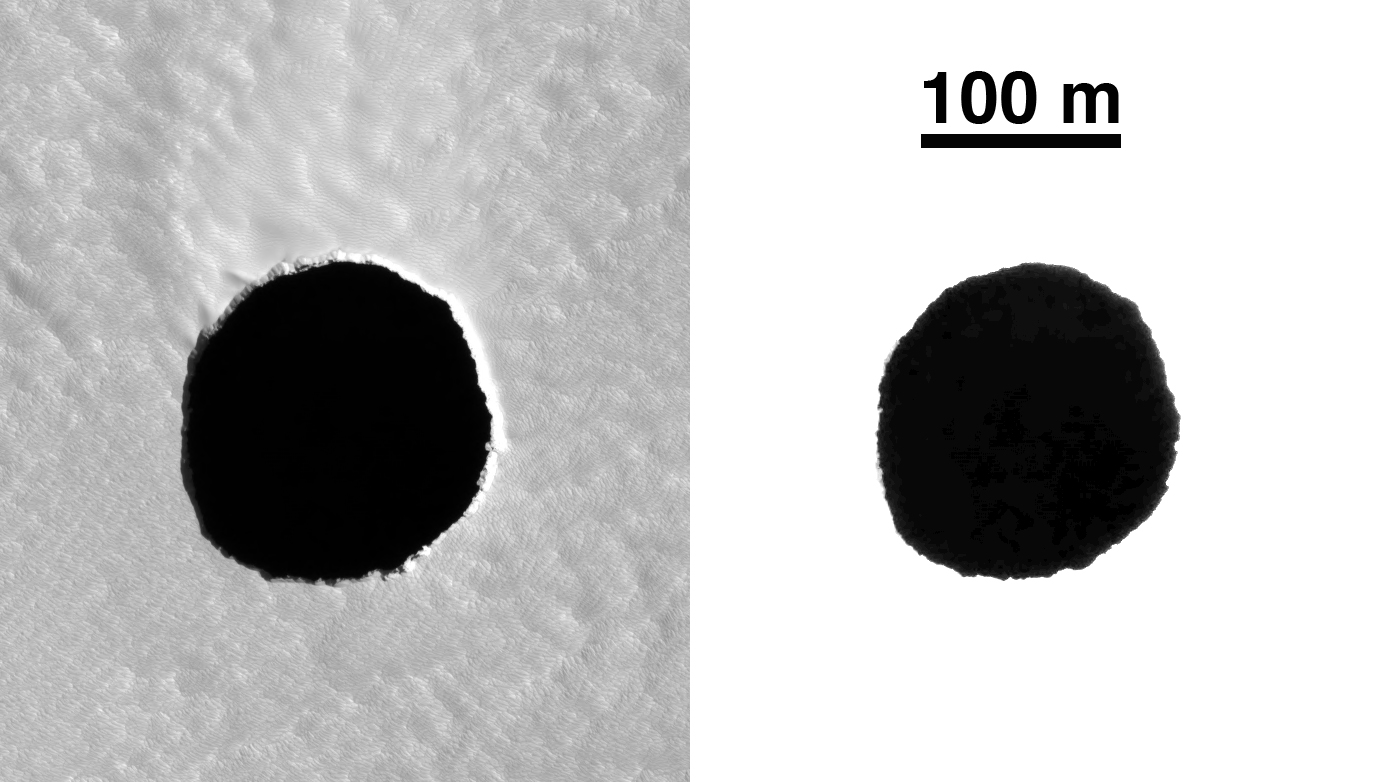
mrcgran writes "Space.com is reporting a very deep hole found on Mars: 'The geological oddity measures some 330 feet (100 meters) across and is located on an otherwise bright dusty lava plain to the northeast of Arsia Mons, one of the four giant Tharsis volcanoes on the red planet. The Mars Reconnaissance Orbiter (MRO) used its High Resolution Imaging Science Experiment (HiRISE) instrument to draw a bead on the apparent deep hole — a feature that may cause more scientists to ponder about potential subsurface biology on Mars. Because the spot lacks a raised rim or tossed out material called ejecta, researchers have ruled out the pit being an impact crater. No walls or other details can be seen inside the hole, and so any possible walls might be perfectly vertical and extremely dark or — more likely — overhanging.' The original image and its cutout at full resolution can be found in the HiRISE site." -
How Big Will the iPhone Become?
palewook writes "Combine the best elements of an iPod with a BlackBerry's addictive usefulness, and you may just get Apple's Next Big Thing. Around 2009, when the lower cost version of iPhone appears, Business Week believes the yearly market for iPhones could be over 10 billion dollars a year. Its an interesting prediction; if those numbers come to pass, iPhone could become a bigger source of revenue than the traditional iPod. 'The answer may not come until 2009. By then, Apple should have begun creating lower-cost iPhone variants to reach consumers scared off by the introductory $499 price. It also will probably have moved into overseas markets and cut deals with more carriers to utilize higher-speed wireless networks. So while most analysts look for Apple to sell around 3 million units this year and 10 to 12 million in 2008, many figure that 20 million will move in 2009.'" -
Safemedia's CEO Tells Congress He Can Stop P2P
palewook writes "Yesterday, Safwat Fahmy appeared in front of the House Science and Technology Committee. During Fahmy's testimony [PDF], he claimed Safemedia's "P2P Disaggregator" technology uses traffic-shaping systems and network-filtering systems that can destroy contaminated P2P networks. And their Clouseau product will make it impossible to send or receive any illegal P2P transmission on any installed network. However, Clouseau allows tunneling and SSH and never opens packets to determine file legality." -
After Ubuntu, Windows Looks Increasingly Bad
mrcgran writes "Sys-Con has a look at some advantages of using Ubuntu over Windows. 'My recent switch to a single-boot Ubuntu setup on my Thinkpad T60 simply floors me on a regular basis. Most recently it's had to do with the experience of maintaining the software. Fresh from a very long Windows 2000 experience and a four-month Windows XP experience along with a long-time Linux sys admin role puts me in a great position to assess Ubuntu. Three prior attempts over the years at using Linux as my daily desktop OS had me primed for failure. Well, Ubuntu takes Linux where I've long hoped it would go — easy to use, reliable, dependable, great applications too but more on that later. It has some elegance to it — bet you never heard that about a Linux desktop before.'" -
RIAA Accused of Extortion & Conspiracy
NewYorkCountryLawyer writes "The defendant in a Tampa, Florida, case, UMG v. Del Cid, has filed counterclaims accusing the RIAA record labels of conspiracy and extortion. The counterclaims (pdf) are for Trespass, Computer Fraud and Abuse (18 USC 1030), Deceptive and Unfair Trade Practices (Fla. Stat. 501.201), Civil Extortion (CA Penal Code 519 & 523), and Civil Conspiracy involving (a) use of private investigators without license in violation of Fla. Stat. Chapter 493; (b) unauthorized access to a protected computer system, in interstate commerce, for the purpose of obtaining information in violation of 18 U.S.C. 1030 (a)(2)(C); (c) extortion in violation of Ca. Penal Code 519 and 523; and (d) knowingly collecting an unlawful consumer debt, and using abus[ive] means to do so, in violation of the Fair Debt Collection Practices Act, 15 U.S.C. 1692a et seq. and Fla. Stat. 559.72 et seq." -
RIAA Drops Tanya Andersen Case
NewYorkCountryLawyer writes "After 2 years, the RIAA has finally dropped its longstanding case against disabled single mother Tanya Andersen in Oregon, Atlantic v. Andersen. The dismissal (pdf) relates merely to the RIAA's claims against Ms. Andersen, and does not relate to her (a) claim for attorneys fees or (b) counterclaims against the RIAA, which are presently before the Court on a motion to dismiss. The counterclaims were first interposed in December 2005. This is the same case in which the RIAA insisted on taking a face to face deposition of a 10 year old girl. Prior to the case, neither the mother nor the child had ever even heard of file sharing." -
RIAA Drops Tanya Andersen Case
NewYorkCountryLawyer writes "After 2 years, the RIAA has finally dropped its longstanding case against disabled single mother Tanya Andersen in Oregon, Atlantic v. Andersen. The dismissal (pdf) relates merely to the RIAA's claims against Ms. Andersen, and does not relate to her (a) claim for attorneys fees or (b) counterclaims against the RIAA, which are presently before the Court on a motion to dismiss. The counterclaims were first interposed in December 2005. This is the same case in which the RIAA insisted on taking a face to face deposition of a 10 year old girl. Prior to the case, neither the mother nor the child had ever even heard of file sharing." -
Putin Threatens US Missile Bases In Europe
Melugo writes to let us know that Russian president Vladimir Putin has warned that US plans to build a missile defense system in Eastern Europe would force Moscow to target its weapons against Europe. This reader notes: "It feels like the Cold War all over again." "'If the American nuclear potential grows in European territory, we have to give ourselves new targets in Europe,' Putin said... 'It is up to our military to define these targets, in addition to defining the choice between ballistic and cruise missiles.'" -
Linus on GIT and SCM
An anonymous reader sends us to a blog posting (with the YouTube video embedded) about Linus Torvalds' talk at Google a few weeks back. Linus talked about developing GIT, the source control system used by the Linux kernel developers, and exhibited his characteristic strong opinions on subjects around SCM, by which he means "Source Code Management." SCM is a subject that coders are either passionate about or bored by. Linus appears to be in the former camp. Here is his take on Subversion: "Subversion has been the most pointless project ever started... Subversion used to say, 'CVS done right.' With that slogan there is nowhere you can go. There is no way to do CVS right."