Slashdot Mirror
Domain: brown.edu
Stories and comments across the archive that link to brown.edu.
Comments · 272
-
I have played it....
(a marketing rep lent Techhouse at Brown University an XBox so I got a chance on the system)
Halo is basically a pc game on a console, but the controls were quite good, despite it being a FPS.
The 1 player mode was short. I am not sure how many hours it took, but it was easily completed in a day.
Multiplay is cool. Its kinda fun to jump into a jeep and roll over your opponent, or even better, hitting his jeep just before he manages to get in, making his jeep roll him over (which counts as a suicide).
Anyhow, the graphics were damned nice - which is a good sign for microsoft - that a first gen game looked so good. Maybe most impressive is how smooth the game ran with so many explotions, and moving characfters, and such. Of course, our 65" HDTV helped the experience a bit.
I really wish I could get some nice pc net action on the game, though. I suppose the xbox wouldn't sell if halo came out for the pc. Oh well. -
I have played it....
(a marketing rep lent Techhouse at Brown University an XBox so I got a chance on the system)
Halo is basically a pc game on a console, but the controls were quite good, despite it being a FPS.
The 1 player mode was short. I am not sure how many hours it took, but it was easily completed in a day.
Multiplay is cool. Its kinda fun to jump into a jeep and roll over your opponent, or even better, hitting his jeep just before he manages to get in, making his jeep roll him over (which counts as a suicide).
Anyhow, the graphics were damned nice - which is a good sign for microsoft - that a first gen game looked so good. Maybe most impressive is how smooth the game ran with so many explotions, and moving characfters, and such. Of course, our 65" HDTV helped the experience a bit.
I really wish I could get some nice pc net action on the game, though. I suppose the xbox wouldn't sell if halo came out for the pc. Oh well. -
Re:Why VM is bad
> Its not "uninformed garbage", its quite insightful.
No, it's uninformed garbage. Animat might have had a point if he was advocating doing away with paging to backing store. Indeed, most modern operating systems treat situations that heavily use the backing store as pathological; they only care that they work, not that they work well or fast.
But, virtual memory is still a boon, even in these days of cheap RAM. I've even written an instructional operating system that uses virtual memory, but doesn't page to backing store. Why? So you don't need to relocate executables when loading them; for shared libraries; to demand-paged executables; to make integration with the buffer cache easier; to support the mmap(2) system call in all its richness; etc. Animat is ignorant of these advantages ("uninformed"); he might also be willfully ignoring them in order to make a more bold-sounding, moderation-friendly post ("garbage"). -
Re:see myth, undying
-
Re:Scheme in CS
I can't speak for other places, since I'm still an undergraduate, but here, we give them a choice (specifically look at the contrast between 15 and 17 on that page).
A few years ago, some people were fed up with the then-only introductory CS course sequence and decided to make a totally new one, based on functional languages (Scheme and ML in the first semester) and more heavily focused on theory. It started pretty small, but it's been steadily growing in popularity every year. At present, it's about half the size of the "traditional" intro course (which focuses entirely on OO and design in Java), which I think says a lot about what students will do if you give them a choice. -
Re:Scheme in CS
I can't speak for other places, since I'm still an undergraduate, but here, we give them a choice (specifically look at the contrast between 15 and 17 on that page).
A few years ago, some people were fed up with the then-only introductory CS course sequence and decided to make a totally new one, based on functional languages (Scheme and ML in the first semester) and more heavily focused on theory. It started pretty small, but it's been steadily growing in popularity every year. At present, it's about half the size of the "traditional" intro course (which focuses entirely on OO and design in Java), which I think says a lot about what students will do if you give them a choice. -
Re:Biometrics are coming....
I agree that inhaled anthrax is a serious concern, and is very lethal. Check out BW History and note in particular on the The Sverdlovsk Incident: April 2, 1979 "...The discovery was also made that the incubation period for inhalation anthrax was two to forty-five days. This finding was in vast contrast to the animal studies that indicated that the incubation period was between two to six days. These findings imply that antibiotics might be administered." Mortality in that incident was 80%, and could have been lower if treated properly. Another useful link is Homeland Security with tons of great information on all forms of threats to the US. If you want something else to worry about, check out the info here on TOPOFF, where a civil defense preparedness simulation in May 2000 failed to contain an attack using plague in Denver. It is good to worry about, and I hope we get our civil defense preparedness in better order. Russ
-
Re:I'm a little confused...Young's DS experiment does work at extremely low light intensities which is why it is one of the classic examples demonstrating the wave/particle duality and/or uncertainty principle in QM. The wave-like interference is seen in the double slit experiment even if you turn the light intensity all the way down so that you are emitting single photons. I (or anyone else) can't explain it any better than Richard Feynman in his classic Feynman Lectures, but I can point you to the results of the DS experiment for very low intensities here.
By the way, diffraction gratings are completely explained within the particle/wave nature of matter, which is why confirmation of the Kapitza-Dirac effect is scientifically interesting but not unexpected. QM doesn't explain everything as waves, the wave/particle duality arises from the fact that all matter has an associated wavelength, the DeBroglie wavelength. Wavelike behavior becomes evident when matter is subjected to dimensions that are on the order of this wavelength (for instance, you won't see a diffraction pattern from light if the slit is too large, and in the case of the Kapitza-Dirac effect, standing waves from the laser create an appropriately spaced diffraction grating to act on the DeBroglie wavelength of the electrons they used).
-
What I know I learned from:I second the practically network site. Especially good are the product reviews. Start here.
On the strength of a Practically Networked review, I had good luck with an SMC Barricade router with 4 ports and a built-in firewall a year ago, but things may have changed a lot since then. It took me only about 15 minutes to install (not counting network setup on the computer) and cost ~$100.
I learned about related topics from
How to set up a network at home: MIT guide with Linux focus.
World of Windows Networking: If Windows networking is screwing up (as it often does), go here.
homePCnetwork forum: Configuration questions answered, mostly by guy who runs the forum.
Technocopia: Overview articles on home networking.
Grant's Closet: Home LAN wiring.
Steve DeRose's guide: CAT5 wiring.
Telecom wiring: links to HOWTO and info articles on wiring.
-
Over at Brown U...
from the people that brought Tetris on the Science Library, comes Technology-Assited TPing trees and flying pikachus thanks to the (small scale) trebuchet we built last year. Yay, we got a couple of the frats jealous (and a few deans...interested) and I got pegged by a tennis ball flying out of it, but all in all, trebs kick some sweet ass =).
-
Over at Brown U...
from the people that brought Tetris on the Science Library, comes Technology-Assited TPing trees and flying pikachus thanks to the (small scale) trebuchet we built last year. Yay, we got a couple of the frats jealous (and a few deans...interested) and I got pegged by a tennis ball flying out of it, but all in all, trebs kick some sweet ass =).
-
Over at Brown U...
from the people that brought Tetris on the Science Library, comes Technology-Assited TPing trees and flying pikachus thanks to the (small scale) trebuchet we built last year. Yay, we got a couple of the frats jealous (and a few deans...interested) and I got pegged by a tennis ball flying out of it, but all in all, trebs kick some sweet ass =).
-
Over at Brown U...
from the people that brought Tetris on the Science Library, comes Technology-Assited TPing trees and flying pikachus thanks to the (small scale) trebuchet we built last year. Yay, we got a couple of the frats jealous (and a few deans...interested) and I got pegged by a tennis ball flying out of it, but all in all, trebs kick some sweet ass =).
-
Re:No "morality play" potential.
Funny, I think that if someone is the id, this one is Kirk.
Good point...I just re-read something here on the id, superego and ego. I had a degenerate definition of the three in my mind, where Id represented emotion, Superego represented logic, and Ego represented the self, but clearly that's not the case.
But in non-Freudian terms, that breakdown makes sense; McCoy is the right half of the brain (creativity and emotion), Spock is the left half (logic, reason), and Kirk is the one who has to listen to both sides of the brain argue back and forth and figure out what the hell he's going to do. -
Re:Hmm - comparison
Read some books about the lifestyle of the average person in the middle ages and then compare that to the wage slaves of the Industrial Revoloution. Were they better off? You bet.
Nothing so clearly contradicts your statement than the condition of child labour in 19th century England, which was at the forefront of the Industrial Revolution. It was only after the recommendation of a Royal Commission in 1833 that children age 9 to 11 were limited to working a mere 8 hours a day in the textile industry. In mining, where there was no regulation, children began work at five years old and were typically dead by 25.
The purpose of this example is to show that the improvement in the lives of ordinary people did not come about as a result of the Industrial Revolution, but from legislation and trade unions that mitigated the depredations of industrialization.
It is also important to remember that at the same time as the Industrial Revolution another tremendous accumulation of wealth was going on that involved simply conquering weaker countries, dispossesing the natives and keeping their land and resources. A large part of the wealth from the Industrial Revolution didn't come from the factories, it was stolen from abroad with as much brutality as necessary.
The pendulumn swings and over time things balance out.
Is this pronouncement your alternative to "regurgitated historical pablum"?
-
Almost all SIGGRAPH papers online
BTW, almost all of the SIGGRAPH papers are available on-line.
The following is a list of links to the various papers:
http://www.cs.brown.edu/~tor/sig2001.html -
Re:My "siggraph experience"
The online siggraph experience is the papers, everything else there is fluff.
-
Chess in the Olympics
It seems to me that this is kind of an affirmative action for the unathletic. Then again, curling is a part of the Olympics so I guess its an evolution of games to include chess. Who knows, maybe in 2012 we'll get Quake 6.
-
Re:A more insteresting use: cars
This also creates a problem in that:
Energy can only be changed into another sort of energy. It cannot be created nor can it be destroyed.
See this paper from MIT. Its a short history of the first two laws of thermodynamics. -
Two obvious choices:Here, at techhouse, at Brown University, we always have a use for old machines.
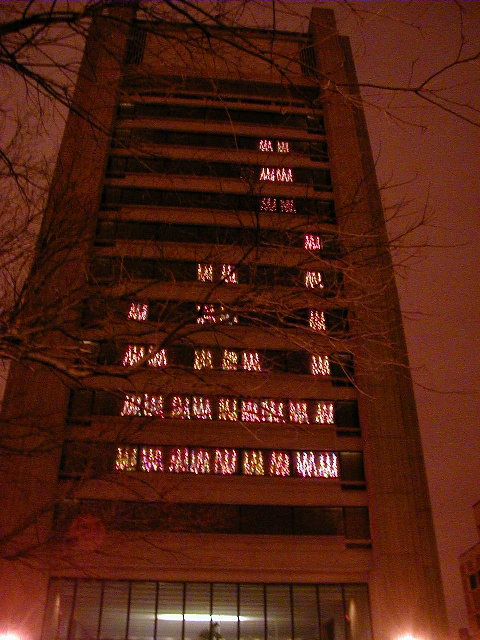
Whether it is using a 486 to play Tetris on the Science Library or set up a doom cluster or if we are really bored, dropping it at drop night. No matter what speed it is, we have a use for it. I mean, for a place where our server was only just upgraded from a p133 to a p233 3 days ago, and just cause we could, we do quite well with what we get.
Donate. It will go to good use. I promise. One of our next projects is a nice little developement linux cluster so that 4 or 5 people can sit down together and work on a project. We could use any donations you can give up.
(In all seriousness, if you are in the RI area, email me at j_hasbani @ (no spam) yahoo.com, and we would be glad to take what you got. One of our members is the head of BRUMUG, Brown Univ Mac Users Group, and she would happily take as many macs as you've got too.)
And btw, I am VERY willing to bet you will
-
Two obvious choices:Here, at techhouse, at Brown University, we always have a use for old machines.
Whether it is using a 486 to play Tetris on the Science Library or set up a doom cluster or if we are really bored, dropping it at drop night. No matter what speed it is, we have a use for it. I mean, for a place where our server was only just upgraded from a p133 to a p233 3 days ago, and just cause we could, we do quite well with what we get.
Donate. It will go to good use. I promise. One of our next projects is a nice little developement linux cluster so that 4 or 5 people can sit down together and work on a project. We could use any donations you can give up.
(In all seriousness, if you are in the RI area, email me at j_hasbani @ (no spam) yahoo.com, and we would be glad to take what you got. One of our members is the head of BRUMUG, Brown Univ Mac Users Group, and she would happily take as many macs as you've got too.)
And btw, I am VERY willing to bet you will
-
Re:This has been around since day one of Photograp
From what I recall, and from what I can find on the web, it was the physicist James Clerk Maxwell who created the first color photograph in 1861. See, e.g. http://landow.stg.brown.edu/victorian/photos/chro
n -
HAL and PolyphemusWell, HAL, with his single eye, knocking off the crew one by one, makes a pretty good Polyphemus.
The problem is that anything where you've got a long voyage with people being killed looks like the the Odessey. Greg Egan's The Plank Dive has an offhand comment about these sort of myths being strange attractors for pre-literate stories.
-
First cyborg? Not hardly....
Of course, it depends on whose definition you use. By many technical standards cyborgs are already here:
A cyborg is a cybernetic mechanism, a hybrid of machine and organism
Or this one...
(1) an organism with a machine built into it with consequent modification of function; (2) an organism which is part animal and part machine.
By this definition, approximately 10% of the U.S. population (I don't have figures for other countries, sorry...) are already cybernetic. Take my own situation, for example. A motorcycle accident two years ago left me with a right proximal humerus made of chromium steel and titanium. In other words, I have a cybernetic shoulder. You can tell to look at it, and it functions completely normally, but it's there.
And yes, I set off the metal detectors in airports...
-drin -
Re:No.
I take it back. I said elsewhere you were possibly ignorant or naive; but clearly you are just a troll. No one could be so ignorant of their own history to not know of indentured servitude or slavery on their own soil. Slavery was not abolished in England until 1833 Link. You get a 30 year lead there- which, on the grand scale of history, isn't much. And there was a great deal of fuss about it... sure, no civil war, but only because the numbers were smaller and the economy less dependent on them.
White women in Britain couldn't vote until 1918 and for 10 years after that only women who owned property or were married to men of property were allowed to vote. Universal female suffrage happened here in 1920. Either we are two years worse or eight years better- take your pick.
And, of course, you have to know whose idea property based suffrage was. It's not like British settlers arrived from enlightened England, bumped into classist Native Americans, and said "gee, how silly it was of us to give suffrage to everyone back in the old country. Here, only those with property will vote." Like many of our other good and bad ideas, the Brits had it first, and had had it for a lot longer than we did. As late as 1884, if you worked on a farm, you couldn't vote in the UK. True general suffrage was not granted until 1928. Legally speaking, the US wins by 59 years here (though obviously blacks were practically barred for another 100 years.)
As far as the reasons for revolt... sure, taxes were a huge reason. But if the British Government had actually given the Colonies seats in Parliament instead of opening fire on protesters, maybe we might have stuck around. Maybe India might have done the same if you hadn't tortured and arrested people who wanted the right to make their own salt. And let's not get into South Africa.
Look, America has a pretty dreadful history. But it is clear that you are just trolling when you are so willfully ignorant of your own history. Go back in your hole.
~luge -
Doug's DemoTrue. The Xerox-style GUI was well known for a decade before the Lisa used it. Its creator, Douglas Engelbart, demoed it in 1968.
It really sucks that he doesn't get more mention when people talk about the whole Xerox-Apple story.
-
Photogenics looks like my class projectNot to knock--Paul Nolan's got a nice application there. If you're interested in how to achieve these kinds of effects, I've open sourced a platform-independent Java library that can produce similar effects.
My project attempts to evolve these effects using genetic algorithms, but you could use the code without the genetic algorithm. Project page at http://www.cs.brown.edu/people/morgan/evolver/ind
e x.html.-m
-
Photogenics looks like my class projectNot to knock--Paul Nolan's got a nice application there. If you're interested in how to achieve these kinds of effects, I've open sourced a platform-independent Java library that can produce similar effects.
My project attempts to evolve these effects using genetic algorithms, but you could use the code without the genetic algorithm. Project page at http://www.cs.brown.edu/people/morgan/evolver/ind
e x.html.-m
-
Re:Um...
As you know, Islam prohibits the depictions of the human form in photographs, in statues or in paintings.
You shouldn't believe everything that you read in the press. The Taliban, with their interpretation of Islam, believe it to "prohibi[t] the depictions of the human form in photographs, in statues or in paintings." Apparently they haven't read The Quran carefully enough.
Praise be to Allah
Indeed. Glory be To HIM.
-
Re:Conspiracy theories> hint: defibrilation paddles are AC based
Actually, modern defibs are DC-based. The original ones were AC, but they needed to be plugged in and were generally awkward to use. Modern defib units use pulses of DC, which means they can be easily powered from a portable battery pack. Some info here.
-
Re:.NET might be very good to us
A few months, ago, I heard a research presentation at my school from someone from Microsoft who worked on part of the
The presenter said that MS has plans to port -
Re:Brown University
At Brown the students write their own kernel on top of a simulator after being given some minimal framework (a buffer cache, a loader and lots of header files). Then those that take the optional lab component of the course implement processes and kernel threads (including a simple scheduler), a VFS subsystem (without permissions among other things), Virtual Memory (without paging to backing store), and a simplified System V filesystem. Once it all works they get to run the shell they wrote as the first assignment on their own kernel. Its a ton of work to do in one semester (and the drop out rate is usually very high) but those that finish come away with a uniquely deep understanding of UNIX flavored OSes for an undergraduate course. (sorry for the blatant plug but I owe my current job to this course).
-
Re:Brown University
At Brown the students write their own kernel on top of a simulator after being given some minimal framework (a buffer cache, a loader and lots of header files). Then those that take the optional lab component of the course implement processes and kernel threads (including a simple scheduler), a VFS subsystem (without permissions among other things), Virtual Memory (without paging to backing store), and a simplified System V filesystem. Once it all works they get to run the shell they wrote as the first assignment on their own kernel. Its a ton of work to do in one semester (and the drop out rate is usually very high) but those that finish come away with a uniquely deep understanding of UNIX flavored OSes for an undergraduate course. (sorry for the blatant plug but I owe my current job to this course).
-
Re:Brown University
At Brown the students write their own kernel on top of a simulator after being given some minimal framework (a buffer cache, a loader and lots of header files). Then those that take the optional lab component of the course implement processes and kernel threads (including a simple scheduler), a VFS subsystem (without permissions among other things), Virtual Memory (without paging to backing store), and a simplified System V filesystem. Once it all works they get to run the shell they wrote as the first assignment on their own kernel. Its a ton of work to do in one semester (and the drop out rate is usually very high) but those that finish come away with a uniquely deep understanding of UNIX flavored OSes for an undergraduate course. (sorry for the blatant plug but I owe my current job to this course).
-
Re:Brown University
At Brown the students write their own kernel on top of a simulator after being given some minimal framework (a buffer cache, a loader and lots of header files). Then those that take the optional lab component of the course implement processes and kernel threads (including a simple scheduler), a VFS subsystem (without permissions among other things), Virtual Memory (without paging to backing store), and a simplified System V filesystem. Once it all works they get to run the shell they wrote as the first assignment on their own kernel. Its a ton of work to do in one semester (and the drop out rate is usually very high) but those that finish come away with a uniquely deep understanding of UNIX flavored OSes for an undergraduate course. (sorry for the blatant plug but I owe my current job to this course).
-
Re:Brown University
At Brown the students write their own kernel on top of a simulator after being given some minimal framework (a buffer cache, a loader and lots of header files). Then those that take the optional lab component of the course implement processes and kernel threads (including a simple scheduler), a VFS subsystem (without permissions among other things), Virtual Memory (without paging to backing store), and a simplified System V filesystem. Once it all works they get to run the shell they wrote as the first assignment on their own kernel. Its a ton of work to do in one semester (and the drop out rate is usually very high) but those that finish come away with a uniquely deep understanding of UNIX flavored OSes for an undergraduate course. (sorry for the blatant plug but I owe my current job to this course).
-
Re:Brown University
At Brown the students write their own kernel on top of a simulator after being given some minimal framework (a buffer cache, a loader and lots of header files). Then those that take the optional lab component of the course implement processes and kernel threads (including a simple scheduler), a VFS subsystem (without permissions among other things), Virtual Memory (without paging to backing store), and a simplified System V filesystem. Once it all works they get to run the shell they wrote as the first assignment on their own kernel. Its a ton of work to do in one semester (and the drop out rate is usually very high) but those that finish come away with a uniquely deep understanding of UNIX flavored OSes for an undergraduate course. (sorry for the blatant plug but I owe my current job to this course).
-
Re:Brown University
At Brown the students write their own kernel on top of a simulator after being given some minimal framework (a buffer cache, a loader and lots of header files). Then those that take the optional lab component of the course implement processes and kernel threads (including a simple scheduler), a VFS subsystem (without permissions among other things), Virtual Memory (without paging to backing store), and a simplified System V filesystem. Once it all works they get to run the shell they wrote as the first assignment on their own kernel. Its a ton of work to do in one semester (and the drop out rate is usually very high) but those that finish come away with a uniquely deep understanding of UNIX flavored OSes for an undergraduate course. (sorry for the blatant plug but I owe my current job to this course).
-
Oceans on Mars? Looking to better Nasa's ratings!
This might just be me, but haven't they already established that there was indeed water on Mars in the past, leading to certain patterns of erosion and valleys and such. Stories like this and this and this (all from about a year ago) make me less impressed by this "announcement."
I think Nasa is just trying to do ANYTHING to get rid of their bad rap from the "faster, cheaper, more crashes" approach that led to the Mars debacles.
-
How a tetrachromat can see additional colorsThe observation that a tetrachromat has the ability to differentiate between colors that, to us, seem matching is well taken.
Specifically, "color" is simply a mapping of a spectral power distribution (SPD) of all the continuous wavelengths across the visible spectrum range. Since there are an infinite number of SPDs, it follows that there are colors which have different SPDs which appear to our trichromatic eyes to have identical colors when they're not. These colors are known as "metamers". The tetrachromatic person would be able to distinguish some metamers -- she would see that they are indeed different.
Mathematically, the color that we (trichromats) perceive can be described with threee values: the integral of the SPD multipled by three different weighing functions to describe the three different types of cones/rods in our eyes. Each is most sensitive at some particular wavelength int he vis. light spectrum.
As an analogy, someone with monochromatic vision can only see luminance -- mathematically speaking, the integral of the SPD (multiplied by some appropriate weighing function), which is just a single scalar value. They wouldn't be able to tell whether say, a color was bright blue (on the upper end of the wavelength spectrum) or darker yellow, since they're all the same "value".
More information can be found here: http://www.cs.brown.edu/exploratory/research/appl
e ts/appletDescriptions/metamers/home.html -
Latency, Aliasing, and BlurAs others have noted, "mouse trails" are not motion blur, even faded. The temporal aliasing of the mouse cursor is due to sampling - in theory, high enough sampling goes above the Nyquist frequency (the frequency at which humans stop perceiving a series of discrete events as discrete and start perceiving the series as continuous). While the Nyquist frequency is often cited as around 10Hz, it varies for different applications. Clearly, for motion video, it's closer to 100Hz than 10 (that's why TVs run at 60Hz, for example (that's fields, not frames)).
Now, I don't know of any studies off-hand about rapid objects moving across the screen (though it seems like a good one for someone to do - hmmmm), but it seems reasonable that the Nyquist freq for things like mouse cursor movement is at least correlated to speed. Which means, the bigger the screen, the faster the acceleration, the more you would need to sample. If you've got a 1000 pixel screen, and acceleration is set to get the mouse from one side to the other in one second, then a sampling rate of 100Hz produces 10 pixel jumps. As mouse cursors are often smaller than 10 pixels (e.g., the I beam), I would not be surprised if people perceived discrete jumps.
This is why you need real motion blur. Real motion blur would treat the samples as points on a presumed-continuous curve. Once you've reconstructed the curve, then go back and take the section of the curve covered by the time interval you are drawing, and draw a polygon covering the entire range of motion. Enhancements would include fades along the length, beyond the range covered by the sample interview. This is computationally a pain in the ass.
The problem is complicated by latency - the more time you spend computing this stuff, the older the mouse position is when you finally draw it. Get too far behind (typically 100 milliseconds) and the user no longer feels in control.
For some related stuff in 3D, focusing on how these problems get even uglier in a distributed environment, see m y paper on using blur and transparency to give the user added information about latency and such like.
-
Designing Curricula - a TightropeWhen I was still at Brown's Computer Science department, I spent a lot of time working on designing the early stages of the curriculum. The tension between teaching the students the science as opposed to the programming was a frequent and recurring topic of debate.
Most members of the department were in favor of the science-oriented approach (algorithms, language doesn't matter, etc.). However, the founder of the department (and the "power behind the chair"), despite being in favor of the science, pointed out that the department survived on enrollments. More enrollments == more money from the university. So the students have to want to take the early courses. And the most frequently cited motivation?
"I want to learn to program so I can get a k3wl summer job."
So you have to teach coding, or your enrollments go down, and the department withers. Hopefully, you can throw in enough of the science to keep the people that want the science, and enough entertainment to keep any of the coders scared away by the science (the founder, Andy van Dam, always taught the first semester programming course, and the class ran pretty much like a circus - Halloween saw Andy dressed up as a witch).
So it's a delicate balance.
-
Bleargh! More gushy techno-spiritualism!
Oh, my, so much fluff, so little time
Cyber-"space" isn't. The point should be obvious, and it worries me that it isn't, and needs to be explained. All of us, every last one of us, live in what gets referred to disparagingly in cyberpunk novels as "meatspace," the real solid physical world. OK, so some of us spend more and more time staring at computer screens. That no more means that we "live" in "cyberspace" than the fact that I spent a lot of time one year reading Lord of the Rings meant that I lived in Middle-Earth.
Tools don't provide meaning. Again, I would hope this should be obvious. It is right to look for a moral and spiritual foundation for society (Jon is on the right track here), but the things we build and use can never provide that foundation. The technical theological term for this is idolatry, and it is the thing warned against most strongly in the Judeo-Christian religious tradition. This is not new with the Internet; it goes back at least as far as Babel.
Try some non-techophile authors. In particular, Jacques Ellul's The Meaning of the City (Amazon, my review) is relevant to a discussion of technology and any supposed "New Jerusalem."
The real New Jerusalem doesn't have a monthly access charge. In Revelation, New Jerusalem is the symbol of eternal shalom, of God's justice and mercy for all who will enter and be citizens. There is no poll tax -- in fact, the global poor are probably in a better position than the global rich (which includes anyone with a computer and Internet access). It strikes me as
-
CAVE info @ Brown
Here's some info on the CAVE project at Brown (I believe where it started):
http://www.cs. bro wn.edu/research/graphics/research/cave/home.html
http://www.brown.edu/Administration/George_Street_ Journal/vol23/23GSJ28e.html-Chris
-
CAVE info @ Brown
Here's some info on the CAVE project at Brown (I believe where it started):
http://www.cs. bro wn.edu/research/graphics/research/cave/home.html
http://www.brown.edu/Administration/George_Street_ Journal/vol23/23GSJ28e.html-Chris
-
Other people& schools working on this project
The demo that has been mentioned happened at UNC in May 2000. However, do not forget that other schools and sites also took part in it.
The authors of the 3D real time acquisition system are researchers from GRASP lab, University of Pennsylvania, Philadelphia ( http://www.cis.upenn.edu/~sequence/teleim1.html), and while Brown University did not have active role in the system we presented in May, they are very much part of the Initiative ( http://www.cs.brown.edu/~lsh/telei.html). They are now "responsible" for providing user interactions and having synthetic objects mixed with 3D acquisition data of real objects, so you may want to ckeck project web page soon to hear more about those developments (http://www.advanced.org/teleimmersion
best
Ami -
a little blurb I foundI tried to find more info about his work online, but there doesn't seem to be much. The best I came up with was a short press release about his work and its appearance in a journal article.
Mindpixel - help the Digital Mind Modeling Project.
-
The papers...
For those of you gagging to get your hands on the papers (I know I was), there is a list of links to them on: http://www.cs.brown.edu/~tor/sig2000.html
-
We Have X Because Sun Wanted to Keep Da Goodies!
About fifteen years ago, Sun pulled a classic move akin to the blunder Apple made in not licensing the MacOS. Sun had a beautiful system called "NeWS" (for "Networked Windowing System"). It used PostScript for the basic rendering model, but added interaction, threads (!), object-oriented programming, and networking. Windows were defined by PostScript clipping paths, which meant you could have a window shaped like a text string if you wanted (years before X added the Shape extension). It was more powerful than Display PostScript (which, I think, came along a little later), and like the Berlin Project, widgets could be run server-side. You'd send PostScript code (which could contain objects, threads, etc.) down a socket, and the server would execute it. Like eXene, which runs under Concurrent ML, you could, conceptually, at least, make an object in its own thread that was a widget. No callbacks - just a while (1) loop (well, a tail-recursvie function in eXene - CML is functional).
But Sun wanted to keep full control of NeWS to itself (just like with Java nowadays). It pissed off so many people in the community that everybody else got together behind X, knowing full well that X was much worse. As it was once explained to me by Andy van Dam, the industry settled on a steam locomotive because Sun didn't want to share their bullet train.
NeWS of course died a slow and lingering death. For a while, it was included as an extension to Sun's Openwin X server. It was fun - you could scribble all over the root window with PostScript with a couple of lines of code. Eventually, I think Sun dropped NeWS entirely because no one used it.
An old story.....
-
I AM DONATING THE PROCEEDS!As I have said repeatedly in multiple fora--including AnimeOnDVD's openforums, the Nausicaa mailing list, rec.arts.anime.misc, alt.video.dvd, et cetera, I am donating everything I make from the article to Nausicaa.net to help them recover from the costs of a very expensive hardware failure a while back.. Last time I checked (while Themestream was up--honest, it was up when I submitted the article!), I had gotten almost $40 worth of hits.
Don't believe me? Click h ere for the Nausicaa.net listserv message in which I first announced the donation (and challenged others to match it or do likewise...sadly, nobody has come forward to do that yet), or here for the AnimeOnDVD article. Of course, you still have to believe I will actually send the money once I get it--but if I don't, I'll completely screw up my good reputation online, and that is a thing I value and cherish, as I've been around since 1992, help moderate a newsgroup, and so on.
I'm proud to be able to do this to give back to a site I so respect and cherish. Would you care to match the funds I donate, palo0019? Or perhaps write a similar article and donate the proceeds similarly? Anyone else?
When the article is available, I hope you'll click on it and help out Nausicaa.net by a dime. It might also be nice if you'd look at some of the other articles I wrote, including one on Jon Katz, that I will be keeping the money for, but that's entirely up to you.
--