Slashdot Mirror
Domain: businessdictionary.com
Stories and comments across the archive that link to businessdictionary.com.
Comments · 26
-
Re:Believing in meritocracy is bad for you
Nepotism is favoring family members, typically in matters of business. Neither the above nor affirmative action are examples of nepotism...
https://www.merriam-webster.co...
https://dictionary.cambridge.o...
http://www.businessdictionary.... -
Re:Google is a monopolist in advertisingDefinition of monopoly:
Market situation where one producer (or a group of producers acting in concert) controls supply of a good or service, and where the entry of new producers is prevented or highly restricted. Monopolist firms (in their attempt to maximize profits) keep the price high and restrict the output, and show little or no responsiveness to the needs of their customers.
I'm not seeing the overlap between what you said and this definition.
-
Slow, but real [Re: Runaway effect? Nope.]
Look, stop waving your hands and read the literature. The "basic physics" model is described by Manabe and Wetherald (1967), a widely accepted and respected paper. It models both water and carbon dioxide and calculates that every doubling of carbon in the atmosphere leads to a 2C increase in global average temperatures, i.e., a logarithmic dependence.
Right. That logarithmic dependence is what the earlier comments in this thread labelled "saturation". The effect doesn't actually saturate, but additional increases have very much less effect per amount added (2.4 degrees C per doubling, for the constant-humidity model of Manabe and Wetherald, turns out to be within the error bars of the current IPCC "best estimate" of 3 plus or minus 1.5 degrees C per doubling. Remarkably good job by Manabe and Wetherald over fifty years ago!)
It's consistent with measurements so far. When you extrapolate that to 1000 ppm, that means a temperature increase of about 2.6C. Of course, 1000 ppm is not realistically achievable even if we wanted to reach it. I believe there is 3x10^12 t of CO2 in the atmosphere
Looks about right.
and about 1x10^12 t of known fossil fuel reserves (not all of them recoverable;
Right on the number, wrong on the "not all of them recoverable". That number is the "proven reserves" of coal. Proven reserves are by definition extractable with today's technology; if they weren't believed to be extractable, they wouldn't be counted as reserves. (oil and natural gas add some to that, but not all that much-- there's a lot more coal known than oil and natural gas. Here's a link. https://knoema.com/smsfgud/bp-...)
The wild card, however, is that proven reserves refers to coal that's already been found and geologically mapped. (That's the "proven" part).
Here's a start, though, for an estimate of how much fossil fuel there is that we haven't found and mapped, if you like basic physics. According to what we know about planetary atmospheres, all of the oxygen in the Earth's atmosphere was produce by reduction of carbon dioxide. So, somewhere below the surface or sequestered in biomass, there's enough carbon to convert all of the oxygen in the atmosphere back into carbon dioxide.
I leave it to you to convert carbon to CO2).
multiply by 44/12. Carbon dioxide is 27% carbon by mass.
So, that's what basic physics tells us: if we even could burn all of our fossil fuels, global average temperatures would go up maybe 2.6C,
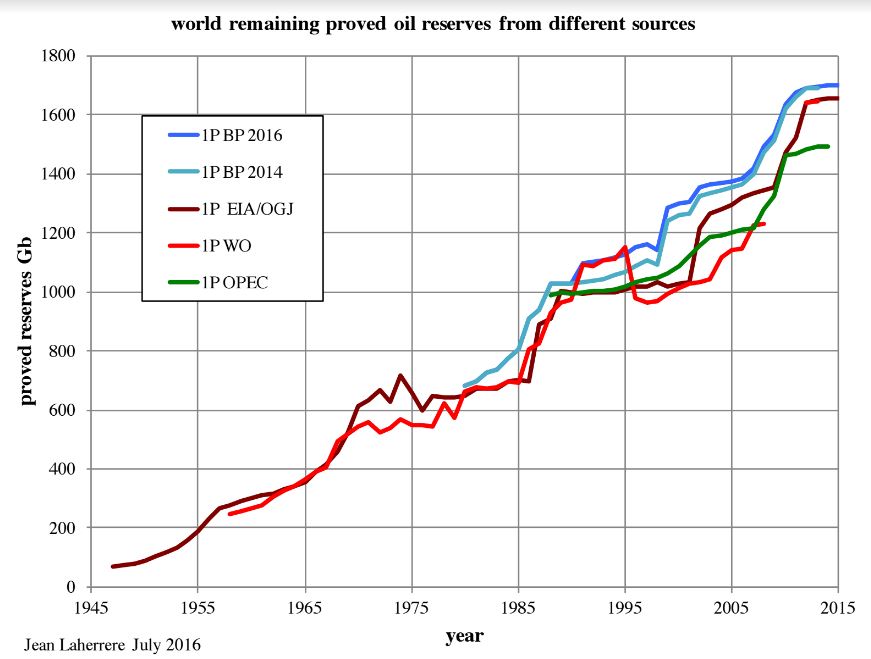
Again: all of the proven reserves. The amount of proven reserves increases as more geological prospecting is done. (Here's a nice graph of how the proven oil reserves changs with time: http://peakoilbarrel.com/wp-co... . Coal has a much shallower slope, though, since coal is less valuable than oil.)
and most of that increase occurs at high latitudes.
Careful there. That number is average over the surface. What you mean to say is "with more increase at high latitudes".
Pardon me for not panicking.
Panicking is unnecessary. It is nice, however, to understand the basic science.
You're welcome to propose more complex models, but if you assert that people should believe those more complex models because they are "basic physics", you are misrepresenting them.
No, more complex models give you some error bars, but the basic constant-humidity model is pretty close to the current best guess.
You're misattributing decreases in carbon emission growth to governmen
-
Inigo says...
With Tuesday's announcement, those costs are sunk costs now.
You keep using that word. I do not think it means what you think it means.
Sunk costs are costs that are already spent. The $800 million was a sunk cost long before this announcement. What you mean is those costs are now a write off due to obsolescence.
-
Inigo says...
With Tuesday's announcement, those costs are sunk costs now.
You keep using that word. I do not think it means what you think it means.
Sunk costs are costs that are already spent. The $800 million was a sunk cost long before this announcement. What you mean is those costs are now a write off due to obsolescence.
-
Inigo says...
With Tuesday's announcement, those costs are sunk costs now.
You keep using that word. I do not think it means what you think it means.
Sunk costs are costs that are already spent. The $800 million was a sunk cost long before this announcement. What you mean is those costs are now a write off due to obsolescence.
-
Definition of socialism and state socialism
These definitions do correctly and clearly state that socialism is about ownership of the means of production.
Definitions 1 and 2 are actually defining state socialism , which is indeed a subset of socialism (and, to be fair, is the type of socialism most people think of).
Here's the business dictionary, which says something similar but with the slightly wider definition "cooperative and/or government ownership": http://www.businessdictionary....
Definition three merely says where socialism lies in Marxist theory, but doesn't actually say what it is. (I'm no great fan of Marxist theory. It tends to degenerate into jargon that ends up being self-referential and not terribly enlightening; and in any case I think it's very clear that Marx has been proven wrong in his understanding of how societies actually work.)
-
Re:I like the idea
What's a "thought-leader"?
Influencer.
Individuals who have the power to affect purchase decisions of others because of their (real or perceived) authority, knowledge, position, or relationship. In consumer spending, members of a peer group or reference group act as influencers. In business to business (organizational) buying, internal employees (engineers, managers, purchasers) or external consultants act as influencers.
http://www.businessdictionary.com/definition/influencers.html
-
Windows 10 probably will be the last version
Windows 10 probably will be the last version of Windows, but not the way Microsoft imagines it.
By continuing to nag, snoop, spam and lock-down its users, Microsoft is transforming its core offering - its OS - into the opposite of what it should be: an agent of the owner that compels the computer to obey the owner's intent.
Its the age-old agency problem. An agent with a large amount of power (network effects in Microsoft's case) tends to abuse it to the detriment of the principal (Microsoft users). Its same problem when powerful executives persuade their company to reward them richly without commensurate effort. Left uncorrected, the situation worsens (customers quit in disgust, company implodes, etc).
Another company may eventually do to the Microsoft desktop what Apple and Android did to them in mobile. Or Microsoft may wisen up and curb their worst excesses (as they did in the XBox One phone-home fiasco). But it'd be a hard sell to the MS board and would take a lot of imagination on their part to act more directly in favor of consumers, versus short-term shareholder rewards.
-
Re:How much are they worth?
Here's one economic definition of intrinsic value:
http://www.investopedia.com/te...
1. The actual value of a company or an asset based on an underlying perception of its true value including all aspects of the business, in terms of both tangible and intangible factors. This value may or may not be the same as the current market value.
This says something very different from cost of production + cost of distribution, and the fact that it includes "intangible factors" and "perception" belies the notion that it can be precisely calculated.
http://www.businessdictionary....
3. Economics: No intrinsic value exists for any good or service except its price (see use value) which is reflection of its demand and supply position and not of any inherent quality.
This one is explicitly refuting the idea that value and price have a disconnect at all. This is basically a "subjective theory of value" being defined here -- "everything is worth what its purchaser will pay for it". The same cite has the investopedia definition as definition 7.
Here's the problem: there are multiple "intrinsic theories of value", and there is also the subjective theory of value. You are promoting the "Cost-of-production theory of value" as if it was the universally-accepted "economic definition" of intrinsic value:
http://en.wikipedia.org/wiki/V...
http://en.wikipedia.org/wiki/T...
http://en.wikipedia.org/wiki/C...Note the other theories of intrinsic value linked in wikipedia. Even restricting yourself to intrinsic value theory, I don't think "cost-of-production" is considered the slam-dunk winner of all things. More like an aspect of valuation.
-
Re:So, cue up..
try searching for "auction ring".
The definition I found contains a subsequent reselling of thus-purchased items to in a "knock out" action" — at the higher price. That may be illegal, but it is not, what TFA is alleging.
BTW, "try searching" is not an argument — you want to present evidence, you search for it and present whatever link(s), that best support your case...
-
Re: Bill Gates' response:
5% is not a minority share holder.
OK, you're right. 5% is not a minority sharholder. %5 is a percentage.
Someone who holds 5% of the stock in a company however IS a minority shareholder. That's going by any definition. I can find, anyway.
-
Re:Resource
To be doubly clear labor also includes AI, Software and Robots.
No it doesn't.
http://www.tutor2u.net/economics/gcse/revision_notes/basics_factors_of_production.htm
http://www.businessdictionary.com/definition/labor.html
They're tools/machinery, i.e. they fall under capital.
-
Re:Study, create, have a lazy Australian steal it
-
Re:What happened to the days of hitmen?
If you want to quibble about the source then go to the original sources:
http://www.youtube.com/watch?v=lOGoZFzHkhs
http://www.iam-magazine.com/blog/detail.aspx?g=cff2afd3-c24e-42e5-aa68-a4b4e7524177Or more than one dictionary:
http://encyclopedia2.thefreedictionary.com/patent+troll
http://www.businessdictionary.com/definition/patent-troll.html
http://www.techopedia.com/definition/28564/patent-troll
http://onlineslangdictionary.com/meaning-definition-of/patent-troll
http://www.urbandictionary.com/define.php?term=patent+trollAnyway, the dictionary.com definition doesn't describe Apple either.
-
Re:You're a company
Then it would be easy for you, I, or Madoff to start a corporation and get away with any crime. Our corporation would die, but we could start another.
Not necessarily. I suppose you've never heard of "disqualification"?
-
Re:Libertarians?
70% of small businesses are sole proprietorships, not LLCs. There is no limited liability in a sole proprietorship. The next Google or Apple would happen because the guy working in his garage doesn't create an LLC, they create sole proprietorships and partnerships(and occasionally limited partnerships where the investor is protected). You know, kind of like Jobs, Woz, and Wayne(Apple was established as a partnership before incorporating).
-
Re:government interference in the markets
I asked what was making the U.S. cellular market fail and you claimed a government granted monopoly was the cause.
So, either you have no idea what a monopoly is or you are, in fact, claiming that there is only one cell provider.
It's you who has no idea what a monopoly is. Let's correct that now.
- something that only one person or group of people has
- What Does Monopoly Mean?
A situation in which a single company or group owns all or nearly all of the market for a given type of product or service. By definition, monopoly is characterized by an absence of competition, which often results in high prices and inferior products. - Legal Dictionary
1 : exclusive control of a particular market that is marked by the power to control prices and exclude competition and that esp. is developed willfully rather than as the result of superior products or skill —see also ANTITRUST Sherman Antitrust Act in the IMPORTANT LAWS section - Monopoly
Market situation where one producer (or a group of producers acting in concert) controls supply of a good or service, and where the entry of new producers is prevented or highly restricted.
A monopoly does not necessarily mean only one entity controlling a market. For instance though MS Windows and MS Office both have dominate but not exclusive monopolies of Operating Systems and Office suites, MS is a monopoly. Let's also make it clear, being a monopoly is not necessarily bad or illegal, how the monopoly is used determines that. For instance MS forcing OEM computer manufacturers not to sell PCs with operating systems other than MS OSes such as BeOS and Linux, and not allowing them to install Netscape as the browser or WordPerfect or other office suites instead of MS Office is what was illegal.
Meanwhile, power companies have nothing to do with the discussion at hand.
You asked about monopolies and power companies are monopolies.
I'm thinking you're trolling so I'm not going to reply again.
Falcon
-
Re:Serious Problems With Central Claim
No, I didn't. I came back to the thread several days later to find several inane responses, none of which needed to be refuted because they were all ridiculous on their faces.
Copyright infringement is theft. Get over it.
-
Re:Wow.Why don't you look it up yourself instead of demonstrating to the world that you're a moron?
http://www.businessdictionary.com/definition/forensic-evidence.html
Evidence usable in a court, specially the one obtained by scientific methods such as ballistics, blood test, and DNA test.
A letter from BT is NOT "forensic evidence". http://legal-dictionary.thefreedictionary.com/Forensic+analysis
The application of scientific knowledge and methodology to legal problems and criminal investigations.
Sometimes called simply forensics, forensic science encompasses many different fields of science, including anthropology, biology, chemistry, engineering, genetics, medicine, pathology, phonetics, psychiatry, and toxicology.
The related term criminalistics refers more specifically to the scientific collection and analysis of physical evidence in criminal cases. This includes the analysis of many kinds of materials, including blood, fibers, bullets, and fingerprints. Many law enforcement agencies operate crime labs that perform scientific studies of evidence. The largest of these labs is run by the Federal Bureau of Investigation.
Forensic scientists often present Expert Testimony to courts, as in the case of pathologists who testify on causes of death and engineers who testify on causes of damage from equipment failure, fires, or explosions.
Modern forensic science originated in the late nineteenth century, when European criminal investigators began to use fingerprinting and other identification techniques to solve crimes. As the field of science expanded in scope throughout the twentieth century, its application to legal issues became more and more common. Because nearly every area of science has a potential bearing on the law, the list of areas within forensic science is long.
Again, a letter from BT is not "forensic evidence", any more than a letter from YOU would be. By itself, it proves nothing, and can't even be used as evidence.
-
Re:It may be a bit ambiguous....
The legal system, just like any profession, has it's own definitions and most-favored customer is one of them. If they didn't have accepted definitions, most contracts suits would go nowhere because the meaning of anything could be debated (ie depends on the meaning of the word "is" is)
http://www.businessdictionary.com/tips/22/the-most-favored-customer-clause.html
-
Re:First post
you are quite incorrect that this is "conceptual nonsense" what the AC is trying to describe is the coding equivalent of copying just about anything, lets take a car for example. The way they had it laid out was this: There are two teams one team has a car to look at (but not the blueprints, just the end product) and they get to examine the car and figure out how everything works, the other team has to put something together that works in a similar fashion, however they have no access to the car, they only have a basic understanding of the principals that make it work. When the construction team runs into a problem, they can ask the inspection team for help, but the inspection team can only give a general answer as to how to overcome the problem without letting the construction team see the car, or writing anything down (pictures, detailed descriptions, etc). The end result is something that's an original work (it was INSPIRED by the other car, but is not derivative of it)
btw the definition of derivative is as follows:
wikipedia: http://en.wikipedia.org/wiki/Derivative_work A derivative work pertaining to copyright law, is an expressive creation that includes major, copyright-protected elements of an original, previously created first work. (which would infer direct copying of the code, or in the car analogy, casting the new parts from the parts on the car to be examined.)
and in case wikipedia is not a reliable enough source
http://www.businessdictionary.com/definition/derivative-work.html Artistic or literary work derived from one or more existing works which, to be copyrightable, must contain sufficient element of originality that makes it a new work in its own right.
ie the work has to be original, and non-trivial, both of these elements are missing from the case being argued about code, elf header's are trivial (in this day and age) and are hardly original, they are common to most all major intel (x86) OS'es in one form or another, Thus they do not qualify as "copyrightable" and even so they would have to be an exact line for line copy to be infringing. The work shown is hardly line for line, they show lines where they suggest code was copied and modified to look different, however this still precludes line for line. In the case of Compaq vs IBM there are not enough details to make the assessment, however as the AC has pointed out if either side felt it was infringing, its 100% certain that the code would have never seen the light of day either through Compaq's own internal audit process, or through a MAJOR lawsuit by IBM (which even then was a vastly wealthy and powerful company).
My point is YOU are a TROLL. -
Re:Subject to change without notice.
(b) does not guarantee your ability to access all websites [...]
That sounds more like a hold harmless clause to keep you from suing them if you aren't able to access your local radio station's Web contest because of Internet traffic or server failure on their part than it does a notification that they may at anytime decide to block a Web site.
I think Verizon has done something wrong here. If they want to offer something more along the lines AOL's old walled garden, they can't advertise it as the Internet, or at the very least, they need to spell out their restrictions.
When an ISP blocks your SMTP port to combat spam, somewhere in the agreement they spell this out. If they're going to reserve the right to block Web sites, they need to spell this out, too.
-
Re:A few thoughts
[...] recessions are considered a normal part of a capitalist economy [...]
Etc.
As for your assumptions about Bush:
1. I didn't vote for Bush.
2. I voted for Obama.
So it's kind of funny you just called me "one of the last hard core republicans" when I'm anything but. What I don't like is hypocrisy and the one-sidedness of always only blaming one political party or one President -- whether it's Clinton and the Democrats or Bush and the Republicans -- for whatever ill is at hand. For the current economic situation, we had unprecedented political opportunism: it was politically expedient and beneficial for some liberals to push the notion that we're in really bad shape, even rolling out the Great Depression talk, and that Bush (and all the other things you hate about Bush, like the war!) is to blame for it.
There are so many contributing factors that it would be ridiculous to assert that economic decisions made in the current administration in the last 8 years have nothing to do with it. But at the same time, it's equally ridiculous to put blinders on to the incredible irresponsibility and shortsightedness of the decisions with regard to sub-prime lending in the name of getting people into homes. We never fully paid the piper for the internet bubble collapsing, and a lot of that, on a large scale, was parlayed into a booming housing market (and artificially created, so some extent, because of changes encouraged in lending practices).
-
A few thoughts
A long-standing rule of thumb for "recession" is that it is defined as contraction in the GDP for at least two consecutive quarters (six months).
By that long-accepted definition of recession, the US is not even yet in a recession. The US GDP decreased for the first time in recent history only in the third (most recent) quarter, by 0.3%. In the second quarter -- earlier this year -- real GDP increased 2.8%.
But how long has the media been ceaselessly hammering it into our heads that we're in a recession, tolling the bells of doom and gloom? How many times have we heard the phrase, "In these tough economic times" inserted into nearly everything we see or hear? How long has the drumbeat of the "recession" been played, when we had nothing but positive growth reports, even in the midst of the sub-prime crisis?
Worse still, many people actually believe that whatever recession we'll end up having is exclusively the fault of only the current President, and can't look back to anything before the year 2000 for any blame whatsoever. The egregious irresponsibility of the sub-prime lending has a long and sordid history.
It is this kind of partisan willful ignorance on the part of many that has enabled the political agenda among some to drive the notion that the US is in a severe recession caused by the ineptness and reckless irresponsibility of the Bush administration, when the US had nothing but growth in the GDP until only a month ago. If you asked most people how long they thought the economy had been shrinking for negative, they'd probably say things like, "A year? Two years?"
Wrong.
Last quarter. And we just found out about it.
So we've heard talk, day after day, night after night, an incessant drilling into our heads that we're in a deep and severe recession -- one that may even now rival the Great Depression! -- creating panic and fear, causing people to pull investments and hold onto their wallets, change purchasing plans, in turn creating bleak forecasts for manufacturers and other business, which causes job loss, and then -- voilà!:
Is it any surprise we're going to have a recession on our hands?
Capitalistic systems only work when the participants have faith in the system -- when that faith collapses, for whatever reason, you get a recession. And that's a normal and accepted part of the cycle.
-
Re:We all have mortgages to pay
You seem to be confused about how the stock market works
Not really, I was simply trying to strip out all extraneous details from the discussion. You obviously aren't going to be convinced by me or probably anyone else that the stock market is not gambling. So be it, but let me ask you this: what exactly are you planning to do with any wealth (assuming that you believe that it is possible to accumulate wealth, since you also seem to doubt the existence of economic growth and the traditional definition(s) of wealth) that you manage to save? If you don't trust the stock market then why would you trust any other sort of investment (i.e. bonds, private equity, real estate)? What are you going to do? Stuff your cash in a mattress? Bury gold bricks in your backyard? Banks turn around and invest your deposits, which according to you is gambling, so why would you want someone else to be gambling your money for you?
Do you not call blackjack gambling?
Of course blackjack is gambling, but did you not read the linked article? The difference between gambling and investing is that gambling has ZERO chance of creating new wealth. I had previously conceded that gambling could conceivably provide entertainment as a service, but it does not and cannot create new wealth, it can only redistribute existing wealth. A zero-sum activity like the one just described that involves risk is gambling in the purest sense of the word, but investments distinguish themselves, even though they also involve risk of loss, due to the possibility that they can create new wealth which indirectly improves the lives of everyone living in that economy (quality of life at least in a material sense is roughly proportional to the amount of goods and services produced per person in an economy). Those facts are really not disputable, almost every economist that you could find anywhere would be substantially in agreement with those statements.
"Gambling, on the contrary, is a zero-sum game. It merely takes money from a loser and gives it to a winner. No value is ever created.". This is also false in practice. Since most 'gambling' is done in casinos, there are thousands of jobs created.
The jobs are created as part of the service of providing entertainment to the customers. That is really the only redeeming feature of Casinos, they can provide entertainment in some cases which is obviously a service that people are willing to pay for in the economy. Entertainment can provide satisfaction in the form of utility (the technical term economists use to describe happiness), but it does not create wealth. The casino employees are paid with existing wealth that has been transferred from the gamblers to the casino and then partially used to pay the employees but no new wealth is created in the process, it is merely transferred between parties.
The housing crash is a perfect example of what happens when people forget that 'investments' are often gambling.
It is an example of what can happen when people approach investments as they would a casino table game where no amount of skill can affect the outcome (I know that there are casino games were skill matters, but most people either don't know or practice those skills or are not nearly as good as they think they are. There are professionals who make their living in Vegas taking money from well healed but ignorant tourists at the poker tables for example) and how governments (who control the money supply) can make things worse by running a reckless loose money policy. It is also an example of greed on the part of unscrupulous professionals (appraisers and others) in the mortgage industry committing fraud.
I suppose that our disagreement stems primarily from a disagreement over the definition of gambl