Slashdot Mirror
Domain: caltech.edu
Stories and comments across the archive that link to caltech.edu.
Stories · 198
-
NASA Detects Baby Planet
neema writes "Yesterday, NASA's Spitzer Space Telescope (web site here) detected the youngest planet, at less than 1 million years old, known to exist. The planet, for those of you who want to visit or something, is 420 light years away circling the star CoKu Tau 4. According to astronomer Dan Watson of the University of Rochester, the discovery of this "Baby Planet" "really causes problems for the major theories of planetary formation." Arist conception pictures and more info can be found at the Planetary Photojournal." -
Caltech/Loyola DMCA Mock Trial: MPAA+DOJ v. EFF
Seth Schoen writes "Caltech and Loyola Law School students will argue Friday over a scenario in which a student creates a distributed computing application to crack DRM systems, leading to DMCA criminal prosecution of everyone involved. Those in the Los Angeles area might enjoy attending the 5th annual "At the Crossroads" mock trial (free, Friday May 21 at Caltech in Pasadena). The case will have many realistic touches. A real Federal judge will hear it; the prosecution will be advised by L.A. Federal prosecutors and the defense by an EFF attorney. Expert testimony for the prosecution will be given by MPAA's Brad Hunt and for the defense by EFF's Seth Schoen." -
Is {pluto|sedna} A Planet?
Dr. Zowie writes "NASA's announcement last week of Sedna's discovery reignited the debate over whether Pluto is a planet. Dr. Alan Stern a noted planetary scientist and leader of the New Horizons mission to Pluto, pours on some gasoline with this article in which he skewers the various arguments against Pluto-as-planet. Choice quotes include 'You wouldn't deny a chihauhau a place among dogs because it is too small,' and 'if your brain was so completely full of names of people that it just couldn't take any more, would anyone new who you met after that, therefore not be a person?'" -
Spitzer Space Telescope Releases First Images
jkleint writes "The fourth and final of NASA's Great Observatories, the Spitzer Space Telescope, has just released its first images. Spitzer sees in infrared, allowing it to look through the dust clouds that obscure visible light images like those taken by the ill-fated Hubble. Spitzer has already found hydrocarbon spectra--precursors to carbon-based life--in a galaxy 3.2 billion light years away. The article has a very good writeup outlining the telescope's mission and why space-based infrared imaging is important." -
Famous Hawking Black Hole Bet Resolved?
Mick Ohrberg writes "In 1997 the three cosmologists Stephen Hawking, Kip Thorne and John Preskill made a famous bet as to whether information that enters a black hole ceases to exist -- that is, whether the interior of a black hole is changed at all by the characteristics of particles that enter it. It now looks like Stephen Hawking and Kip Thorne may owe John Preskill a set of encyclopedias of his choice, since physicists at Ohio State University 'have derived an extensive set of equations that strongly suggest that the information continues to exist -- bound up in a giant tangle of strings that fills a black hole from its core to its surface.'" -
Radar/Wireless Transmitter on a Chip
dganapa writes "Researchers at the California Institute of Technology, headed by Dr. Ali Hajimiri, have developed a low-cost radar system on a silicon chip. The entire system has been designed from the ground up on silicon, thus leading to reduced cost as well as robustness in response to design variations and changes in environment. The chip runs at a staggering speed of24 GHz (enabling it to transfer data as fast as the main network of the Internet) and can soon lift wireless, high-frequency communication to a whole new level. The radar as such is not as powerful as a conventional radar but because of its cost-effectiveness, a number of them can be coupled together to perform really well. A related NY Times article is here. A recent article from Slashdot shows that radar technology is increasingly being implemented in the automobile industry. This current chip is sure to be much more successful than its predecessors as far as the automobile industry is concerned, but whether or not its processing speed will become important in the computer industry remains to be seen." -
Radar/Wireless Transmitter on a Chip
dganapa writes "Researchers at the California Institute of Technology, headed by Dr. Ali Hajimiri, have developed a low-cost radar system on a silicon chip. The entire system has been designed from the ground up on silicon, thus leading to reduced cost as well as robustness in response to design variations and changes in environment. The chip runs at a staggering speed of24 GHz (enabling it to transfer data as fast as the main network of the Internet) and can soon lift wireless, high-frequency communication to a whole new level. The radar as such is not as powerful as a conventional radar but because of its cost-effectiveness, a number of them can be coupled together to perform really well. A related NY Times article is here. A recent article from Slashdot shows that radar technology is increasingly being implemented in the automobile industry. This current chip is sure to be much more successful than its predecessors as far as the automobile industry is concerned, but whether or not its processing speed will become important in the computer industry remains to be seen." -
Radar/Wireless Transmitter on a Chip
dganapa writes "Researchers at the California Institute of Technology, headed by Dr. Ali Hajimiri, have developed a low-cost radar system on a silicon chip. The entire system has been designed from the ground up on silicon, thus leading to reduced cost as well as robustness in response to design variations and changes in environment. The chip runs at a staggering speed of24 GHz (enabling it to transfer data as fast as the main network of the Internet) and can soon lift wireless, high-frequency communication to a whole new level. The radar as such is not as powerful as a conventional radar but because of its cost-effectiveness, a number of them can be coupled together to perform really well. A related NY Times article is here. A recent article from Slashdot shows that radar technology is increasingly being implemented in the automobile industry. This current chip is sure to be much more successful than its predecessors as far as the automobile industry is concerned, but whether or not its processing speed will become important in the computer industry remains to be seen." -
Newly Found Planetoid Possibly Larger than Quaoar
I am Jack's username writes "A newly discovered planetoid (Google news cluster) 2004 DW in the Edgeworth-Kuiper belt, where some think objects larger than Pluto exist, may be larger than Quaoar - making it the second largest known trans-Neptunian object and 18th largest object in the solar system." -
NASA Christens the Spitzer Space Telescope
LMCBoy writes "NASA today renamed the Space Infrared Telescope Facility to the Spitzer Space Telescope, after a great scientist. The renaming coincides with the release of the beautiful first science images from the telescope, which was launched in August." -
NASA Christens the Spitzer Space Telescope
LMCBoy writes "NASA today renamed the Space Infrared Telescope Facility to the Spitzer Space Telescope, after a great scientist. The renaming coincides with the release of the beautiful first science images from the telescope, which was launched in August." -
Discovering Galaxies Near and Far
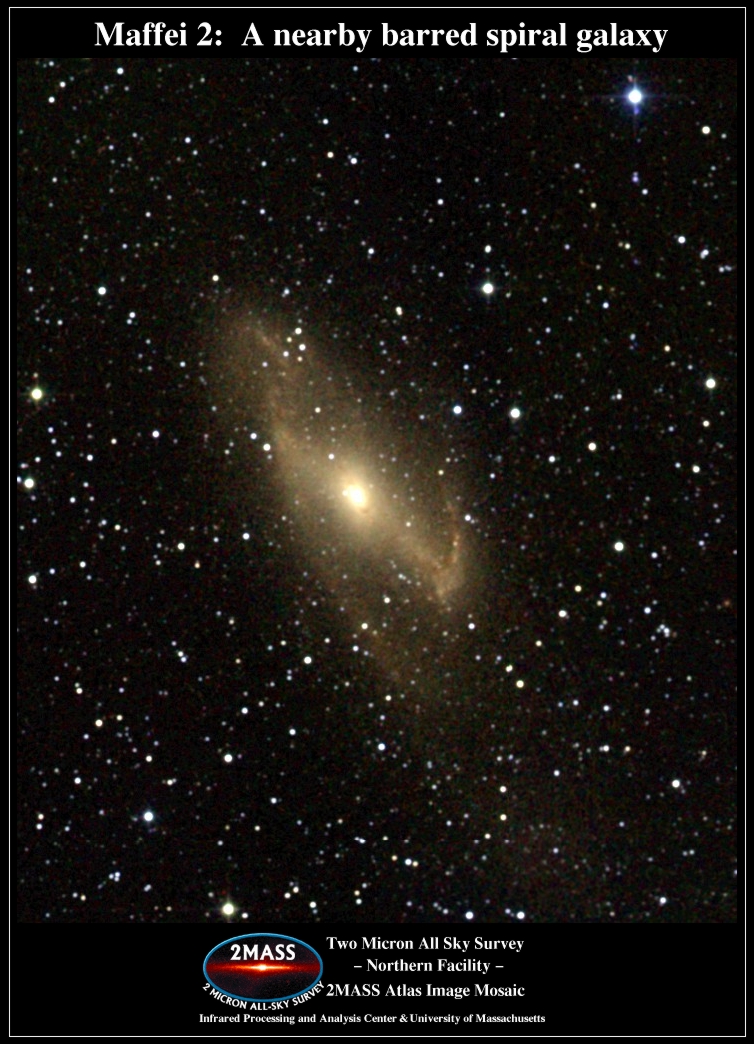
Anonymous Coward writes "Researchers using Japan's Subaru telescope in Hawaii have discovered a galaxy 12.9 billion light-years from Earth -- the most distant found to date. The latest finding extends the distance of the known farthest galaxies from Earth by about 3 million light-years." Toward the other end of the scale, JamesD_UK writes "Astronomers at the 2Mass project appear to have found the closest galaxy to the milky way yet, overtaking the Sagittarius dwarf galaxy. The galaxy is only 25,000 light years away and is being torn appart in a collision with the milky way. More information on the The Two Micron All Sky Survey is available here." -
Renewed Gravity Research Could Soon Yield Results
t482 writes "Dr. Michelle Thaller has a nice article describing the current thoughts on gravity. Why is it so weak? Detecting gravity waves has turned into a bit of a cottage industry. "We are close," says MIT physicist Rainer Weiss, a pioneer in gravity wave research for more than 30 years. "I think sometime in the next two or three years we will see something."" -
Single-atom Laser Built at Caltech
hweimer writes "A research group at Caltech has successfully constructed a laser consisting of only one caesium atom. The emitted light is very weak but highly ordered, so such a device may be used to control a quantum computer. More on this can be found at PhysicsWeb." -
Single-atom Laser Built at Caltech
hweimer writes "A research group at Caltech has successfully constructed a laser consisting of only one caesium atom. The emitted light is very weak but highly ordered, so such a device may be used to control a quantum computer. More on this can be found at PhysicsWeb." -
Desert Robot Race Update, With Video
An anonymous reader writes "Several teams have moved forward with their bid to run the Barstow-Vegas Desert Robot Race (For those not familiar check out http://www.darpa.mil/grandchallenge ). As of today 55 teams are registered, some of the most interesting are Cal Tech, AI Magic, and the Red Team out of Carnegie Mellon. Also fishing around the Red Team site, there is a pretty nifty video." -
Data From Infrared Telescope Exceeds Expectations
Uosdwis writes "It's just Day 10 for the Space Infrared Telescope Facility, and it is producing data! This is only a calibration image, but look at this data set. "We're extremely pleased, because these first images have exceeded our expectations," said Dr. Michael Werner. This data is from IRAC at the shorter wavelengths as the telescope is still cooling. The official press release here." -
Data From Infrared Telescope Exceeds Expectations
Uosdwis writes "It's just Day 10 for the Space Infrared Telescope Facility, and it is producing data! This is only a calibration image, but look at this data set. "We're extremely pleased, because these first images have exceeded our expectations," said Dr. Michael Werner. This data is from IRAC at the shorter wavelengths as the telescope is still cooling. The official press release here." -
Data From Infrared Telescope Exceeds Expectations
Uosdwis writes "It's just Day 10 for the Space Infrared Telescope Facility, and it is producing data! This is only a calibration image, but look at this data set. "We're extremely pleased, because these first images have exceeded our expectations," said Dr. Michael Werner. This data is from IRAC at the shorter wavelengths as the telescope is still cooling. The official press release here." -
Infrared Telescope Lifts Off
An anonymous reader writes "On its Delta 2 Heavy-Lift vehicle, the Space Infrared Telescope (SIRTF) successfully launched to its solar orbit at 1:35 AM (EDT). As a result of the expansion of the Universe, most of the optical and ultraviolet radiation emitted from stars, galaxies, and quasars since the beginning of time now lies in the infrared. How and when the first objects in the Universe formed will be learned in large part from this observatory's infrared observations." -
Last of the Great Observatories to Launch
jqpublic writes "The last in NASA's Great Observatory Program, the Space Infrared Telescope Facility (SIRTF), is set to launch in the wee hours on Monday. The launch can viewed live on NASA's Countdown web site. Interestingly, SIRTF will not be in Earth orbit, but will drift away from Earth by about 15 million kilometers per year. This allows the telescope to cool to very low temperatures (30K), which reduces dramatically the amount of cryogens it needs to carry." -
Last of the Great Observatories to Launch
jqpublic writes "The last in NASA's Great Observatory Program, the Space Infrared Telescope Facility (SIRTF), is set to launch in the wee hours on Monday. The launch can viewed live on NASA's Countdown web site. Interestingly, SIRTF will not be in Earth orbit, but will drift away from Earth by about 15 million kilometers per year. This allows the telescope to cool to very low temperatures (30K), which reduces dramatically the amount of cryogens it needs to carry." -
How Do Your Machines Talk to Each Other?
VonGuard asks: "I'd imagine this is a common scenario out there for Slashdot readers: I have multiple desktops, all sitting right next to each other and all running different OS's. Linux, Mac OS X and 9, Windows 98, and XP. The problem is, despite these machines being only inches arpart physically, in the digital world, they are miles apart. I have no single way to get them all to talk to each other. NFS is impossibly complex, Appletalk is unreliable thanks to netatalk, while PCMacLan, and Samba make me feel like I'm giving into the Empire. Isn't there a simpler way to get files from one of these machines to the other? Right now, I use webservers and write little HTML files that link to the files on each machine. Isn't there a better way to do this?" Is there really a network sharing standard that works across a number of operating systems aside from Samba? Truth be told, Samba "works-for-me", so that's what I us. However, when it comes to simple file copying, sometimes a simple scp is all I need. What protocols do you use in networks that consist of 3 or more operating systems? -
Widespread Use of Hydrogen May Hurt Ozone Layer
Saeger writes "The AP has a story about a CalTech study which has found that the Hydrogen Economy may deplete the ozone layer by 'as much as 8 percent' on the assumption that '10 percent to 20 percent of the hydrogen would leak from pipelines, storage facilities, processing plants and fuel cells in cars and at power plants.'" CalTech's press release has more information. -
Falling to Earth's Core in a Big Blob of Iron
Colin Douglas Howell writes "Um...wow. I found this idea via the BBC, (see also the Nature article), but it's really worth reading the annotated paper on the subject. (Gotta love the title.) Basically, you drill a hole in the crust, blast a big crack in it, inject a huge mass of molten iron with a little probe floating inside (made out of material which won't melt or dissolve in the iron), and let the iron mass sink to the core by gravity, carrying the probe with it. (The initial crack grows downward as the iron sinks.) As the probe falls, it sends data back using seismic signals that can be picked up with a gravitational wave observatory like LIGO, but coupled to the ground. Of course, there are enormous problems with the whole thing, but it's still cool to read about. To me, the idea is even neater because it was dreamed up by Dave Stevenson, one of my old professors (and one of the best professors I've ever had). I hope he doesn't mind being Slashdotted. :-)" -
Falling to Earth's Core in a Big Blob of Iron
Colin Douglas Howell writes "Um...wow. I found this idea via the BBC, (see also the Nature article), but it's really worth reading the annotated paper on the subject. (Gotta love the title.) Basically, you drill a hole in the crust, blast a big crack in it, inject a huge mass of molten iron with a little probe floating inside (made out of material which won't melt or dissolve in the iron), and let the iron mass sink to the core by gravity, carrying the probe with it. (The initial crack grows downward as the iron sinks.) As the probe falls, it sends data back using seismic signals that can be picked up with a gravitational wave observatory like LIGO, but coupled to the ground. Of course, there are enormous problems with the whole thing, but it's still cool to read about. To me, the idea is even neater because it was dreamed up by Dave Stevenson, one of my old professors (and one of the best professors I've ever had). I hope he doesn't mind being Slashdotted. :-)" -
Falling to Earth's Core in a Big Blob of Iron
Colin Douglas Howell writes "Um...wow. I found this idea via the BBC, (see also the Nature article), but it's really worth reading the annotated paper on the subject. (Gotta love the title.) Basically, you drill a hole in the crust, blast a big crack in it, inject a huge mass of molten iron with a little probe floating inside (made out of material which won't melt or dissolve in the iron), and let the iron mass sink to the core by gravity, carrying the probe with it. (The initial crack grows downward as the iron sinks.) As the probe falls, it sends data back using seismic signals that can be picked up with a gravitational wave observatory like LIGO, but coupled to the ground. Of course, there are enormous problems with the whole thing, but it's still cool to read about. To me, the idea is even neater because it was dreamed up by Dave Stevenson, one of my old professors (and one of the best professors I've ever had). I hope he doesn't mind being Slashdotted. :-)" -
Digital Darwin
An anonymous reader writes "Using genetic algorithms to breed strings of computer code graphically, this week's Nature magazine describes results from Caltech and Michigan State. Their program is Avida. While they mainly mimic mutation, not genetic cross-over [or inheritance (thus wiping away much memory of initial conditions)], their simulations show how a short-term backward step in survival strategies can generate innovative advances. It is not unlike running a maze which necessarily involves testing alot of dead-ends, and thus shares the graphical look of Conway's classic Game of Life." Here's a National Geographic story about this as well, or see their press release. -
Machine Learning and MP3s
dan moore writes "Students at Caltech and Harvard have developed a system that analyzes playlists and learns people's listening patterns. It then channels its knowledge into generating streams of music that the people themselves would like to listen to. Intuitive, accurate, and finally someone has done it. Check out the website to get one of the available plugins. Another interesting approach to digital music." -
Fourth and Final 'Great Observatory' To Launch Soon
Uosdwis writes "The New York Times (FRYYY) has an article about SIRTF, the fourth and last 'Great Observatory'. It is a Space based Infra Red Telescope Facility which will extend the work of The Hubble telescope, The Compton Gamma Ray telescope and The Chandra X-Ray telescope. SIRTF is quite an amazing project using new ideas such as an Earth Trailing starting from an L1 orbit, and cooling only the intruments. Saved tax payers over $1 billion in redesigns. Check it out!" -
2MASS Updates with 5 Million Pictures
B.E.M. writes "Science Daily mentions that the previously reported Two-Micron All Space Survey has updated again, this time with a total of 5 million pictures in its gallery." -
8.6 GB Internet?
prostoalex writes "Caltech computer scientists announced the protocol, capable of delivering 8,609 Mbps over the Internet, using 10 simultaneous flows of data. The research project was conducted in partnership with CERN, DataTAG, StarLight, Cisco, and Level 3. The practical applications, according to the press release, is ability 'to download a full-length DVD movie in less than five seconds'. There is a number of papers and scientific publications available." -
8.6 GB Internet?
prostoalex writes "Caltech computer scientists announced the protocol, capable of delivering 8,609 Mbps over the Internet, using 10 simultaneous flows of data. The research project was conducted in partnership with CERN, DataTAG, StarLight, Cisco, and Level 3. The practical applications, according to the press release, is ability 'to download a full-length DVD movie in less than five seconds'. There is a number of papers and scientific publications available." -
8.6 GB Internet?
prostoalex writes "Caltech computer scientists announced the protocol, capable of delivering 8,609 Mbps over the Internet, using 10 simultaneous flows of data. The research project was conducted in partnership with CERN, DataTAG, StarLight, Cisco, and Level 3. The practical applications, according to the press release, is ability 'to download a full-length DVD movie in less than five seconds'. There is a number of papers and scientific publications available." -
Interplanetary Superhighway
rotenberry writes "The current issue of Caltech's Engineering and Science magizine contains the article "Next Exit 0.5 Million Kilometers - A Caltech/JPL collaboration explores the 'Interplanetary Superhighway.'" which describes "...the Interplanetary Superhighway - 'a vast network of winding tunnels in space' that connects the sun, the planets, their moons, and a host of other destinations as well. But unlike the wormholes beloved of science-fiction writers, these things are real. In fact, they are already being used." However, it takes a very long time to get there." -
Snowflake Photos
lanzz writes "Beautiful photos don't always come from telescopes and distant stars - my desktop already has a snow crystal close-up photo." -
Pennsylvania Court Forces ISPs to Block Porn Sites
jkastner writes "Salon is reporting that Pennsylvania is forcing ISPs to block web sites that have child porn. While we can all agree that child porn is bad, this sort of approach starts us down a slipperly slope. If one site slips through, does that make the ISP liable? In addition, the court ordered blocking may prevent access to legitimate sites that are hosted on the same server." -
Caltech Researchers Find Longevity-Linked Mutation
CBNobi writes "A study headed by researchers at CalTech have found a genetic mutation occuring in mitochondrial DNA that may signify longevity. The researchers found that the particular mutation occurred in 17% of centenarians, but only 3.7% of younger individuals. They also found the mutations in identical twins, which is a possible sign of inheritance. Researchers believe the mutation controls factors in DNA replication. The report information is available in a press release by CalTech, and the research abstract is also available." -
Turing Test Competition At CalTech
Charles Dodgeson writes "The Turing Tournament at Cal Tech wants to know if you can program an emulator that will play games like a human, or if can you write detector that can correctly sort the wetware from the software. Before you get too excited, the "games" are very limited things. But there is a $10,000 prize for the winner. You can read the gory details." -
Turing Test Competition At CalTech
Charles Dodgeson writes "The Turing Tournament at Cal Tech wants to know if you can program an emulator that will play games like a human, or if can you write detector that can correctly sort the wetware from the software. Before you get too excited, the "games" are very limited things. But there is a $10,000 prize for the winner. You can read the gory details." -
Turing Test Competition At CalTech
Charles Dodgeson writes "The Turing Tournament at Cal Tech wants to know if you can program an emulator that will play games like a human, or if can you write detector that can correctly sort the wetware from the software. Before you get too excited, the "games" are very limited things. But there is a $10,000 prize for the winner. You can read the gory details." -
Bioinformatics in The Economist
Erich Schwarz writes "Bioinformatics has gone from being an esoteric sub-field to being a business. The Economist gives a useful overview, while warning 'Bioinformatics is not for the faint of heart...'" -
Gravity Waves Online Course
bgitac writes "CalTech has provided an online course on gravity waves by Kip Thorne. The course is described as "an introduction to all major aspects of gravitational waves." Prerequisites for this course are an understanding of classical mechanics. Weekly exercises and solutions as well as DVD quality videos of lectures are provided. The first couple lectures actually seem to be somewhat comprehendable!" -
New Alloy Stronger Than Fe And Ti
SoCalChris writes "According to this article on MSNBC.com, researchers at CalTech have discovered a new alloy that is stronger than steel and titanium, can be cast in a mold like plastic, and sharpened like glass. The first plans for the new alloy are to be used in golf clubs, baseball bats, skis, and cell phone covers." -
Napster Execs Resign, Company Appears to Teeter
renard writes: "The NYT is reporting that five top executives at Napster, including founder Shawn Fanning and CEO Konrad Hilbers, resigned yesterday. This occurs in the wake of their Board's rejection of the latest buyout offer from Bertelsmann AG - as Hilbers says, `I am convinced that not pursuing the offer is a mistake.' Could this be the end for the upstart MP3 indexing service that changed everything?" -
Planet-Hunting Observatory Being Assembled
Default.cfg writes: "The telescope system for NASA's Space Infrared Telescope Facility arrived February 20 at Lockheed Martin Space Systems Co., Sunnyvale, Calif., where it will be integrated with the spacecraft. The system, called the cryogenic telescope assembly, contains the telescope, liquid helium cooling tank and three science instruments. It was shipped on February 19 from Ball Aerospace & Technologies Corp., Boulder, Colo., where it was built. The Space Infrared Telescope Facility, scheduled to launch on January 9, 2003, will study the early universe and hunt for planet-forming regions in dust disks around nearby stars. It will also detect objects by looking for the heat they emit in the infrared portion of the electromagnetic spectrum. The Space Infrared Telescope Facility is the fourth and final mission under NASA's Great Observatories Program, which includes the Hubble Space Telescope, the Compton Gamma Ray Observatory and the Chandra Advanced X-ray Observatory. The observatory is also the first new mission of NASA's Origins Program, which will study the formation of galaxies, stars, planets and life, and seek to answer the questions: Where did we come from? Are we alone?" -
Planet-Hunting Observatory Being Assembled
Default.cfg writes: "The telescope system for NASA's Space Infrared Telescope Facility arrived February 20 at Lockheed Martin Space Systems Co., Sunnyvale, Calif., where it will be integrated with the spacecraft. The system, called the cryogenic telescope assembly, contains the telescope, liquid helium cooling tank and three science instruments. It was shipped on February 19 from Ball Aerospace & Technologies Corp., Boulder, Colo., where it was built. The Space Infrared Telescope Facility, scheduled to launch on January 9, 2003, will study the early universe and hunt for planet-forming regions in dust disks around nearby stars. It will also detect objects by looking for the heat they emit in the infrared portion of the electromagnetic spectrum. The Space Infrared Telescope Facility is the fourth and final mission under NASA's Great Observatories Program, which includes the Hubble Space Telescope, the Compton Gamma Ray Observatory and the Chandra Advanced X-ray Observatory. The observatory is also the first new mission of NASA's Origins Program, which will study the formation of galaxies, stars, planets and life, and seek to answer the questions: Where did we come from? Are we alone?" -
Space Pictures From Near and Far
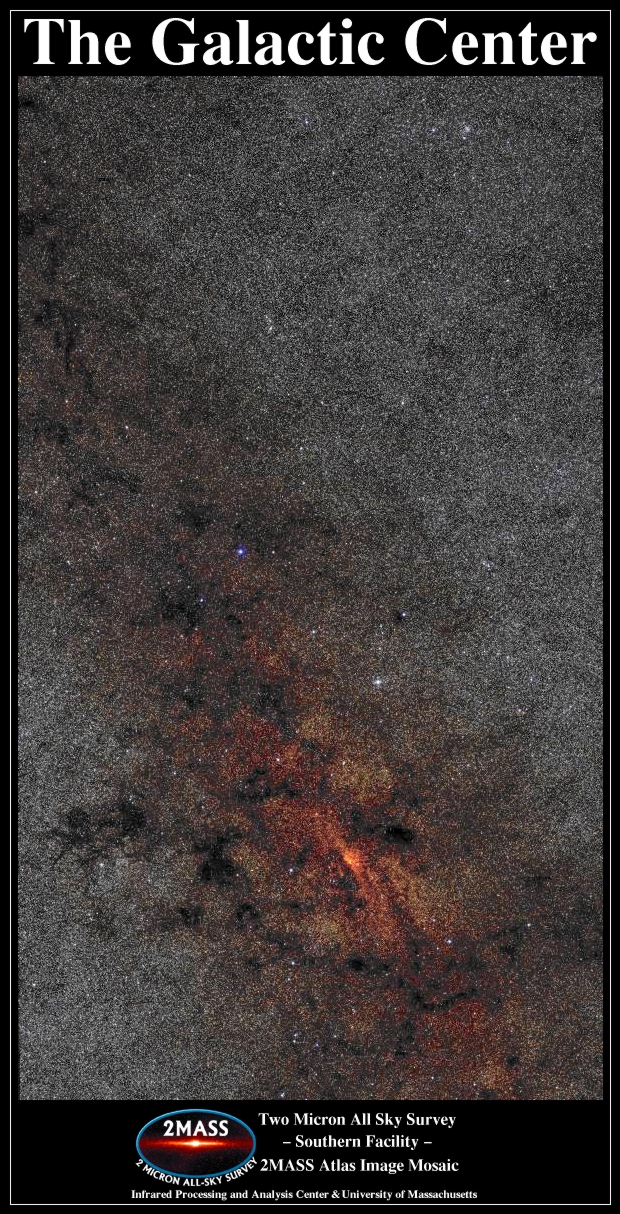
Buran writes: "The BBC News has a fine story about the how our galaxy looks from the outside according to the 2-Micron All-Sky Survey (2MASS). The article describes the shape of our galaxy (a barred spiral; all those books showing concept paintings of a regular spiral galaxy will be out of date now) and how the survey was done (near-infrared measurements of 500 million carbon stars). For the first time, we can see the center of our own Milky Way. All our worldly troubles seem so small..." That takes care of the big picture; Chris McKinstry has submitted news of much closer but just as exciting shots of Saturn -- read below for more on those.mindpixel writes: "I was very excited when I saw this amazing shot of Saturn come up on the control room monitors of the VLT in November, and I'm even more excited that as of today the image is finally public. It is possibly the sharpest view of Saturn's ring system ever achieved from a ground-based observatory. All of us here at the observatory are quite proud of it, especially the NAOS-CONICA team."
-
Space Pictures From Near and Far
Buran writes: "The BBC News has a fine story about the how our galaxy looks from the outside according to the 2-Micron All-Sky Survey (2MASS). The article describes the shape of our galaxy (a barred spiral; all those books showing concept paintings of a regular spiral galaxy will be out of date now) and how the survey was done (near-infrared measurements of 500 million carbon stars). For the first time, we can see the center of our own Milky Way. All our worldly troubles seem so small..." That takes care of the big picture; Chris McKinstry has submitted news of much closer but just as exciting shots of Saturn -- read below for more on those.mindpixel writes: "I was very excited when I saw this amazing shot of Saturn come up on the control room monitors of the VLT in November, and I'm even more excited that as of today the image is finally public. It is possibly the sharpest view of Saturn's ring system ever achieved from a ground-based observatory. All of us here at the observatory are quite proud of it, especially the NAOS-CONICA team."
-
Space Pictures From Near and Far
Buran writes: "The BBC News has a fine story about the how our galaxy looks from the outside according to the 2-Micron All-Sky Survey (2MASS). The article describes the shape of our galaxy (a barred spiral; all those books showing concept paintings of a regular spiral galaxy will be out of date now) and how the survey was done (near-infrared measurements of 500 million carbon stars). For the first time, we can see the center of our own Milky Way. All our worldly troubles seem so small..." That takes care of the big picture; Chris McKinstry has submitted news of much closer but just as exciting shots of Saturn -- read below for more on those.mindpixel writes: "I was very excited when I saw this amazing shot of Saturn come up on the control room monitors of the VLT in November, and I'm even more excited that as of today the image is finally public. It is possibly the sharpest view of Saturn's ring system ever achieved from a ground-based observatory. All of us here at the observatory are quite proud of it, especially the NAOS-CONICA team."