Slashdot Mirror
Domain: canberra.edu.au
Stories and comments across the archive that link to canberra.edu.au.
Comments · 15
-
Re:Critical thinking
I'm glad I'm not the only one who checked.
It's actually a Bachelor of Arts, in something called "Computer Studies", which I'm guessing is now called Bachelor of Arts/Bachelor of Information Technology. Or he may have gotten a vanilla IT degree, but either way, he does not have a CS degree nor an engineering degree.
The guy sounds like a charlatan. He's undoubtedly intelligent, but his list of accomplishments does not include actually inventing or creating anything, and all his "research" is fluff.
He obviously sees himself as some kind of guru, which may seem a little racistly on the nose, but he has no problem going there.
-
Re:Replace Microsoft?
I know people who grew up in Eastern Europe. They had home computers, mostly C64s and the like imported at vast expense from the West. Apparently in Russia a few people had cloned machines, mostly from designs from Sinclair in the UK.
On the other hand I met someone who worked in a chip factory in East Germany. Everyone knew what they were doing was very far behind the west. In fact there was a joke that the first 1Mhz processor in the Eastern Bloc would fly in on a cruise missile.
This page reckons that the Soviet Block was 10-12 years behind the West at chip production.
http://www.cpushack.net/soviet-cpus.html
There were also CoCom restrictions on selling technology. You can see how this worked with this example
http://www.canberra.edu.au/~scott/C=Hacking/C-Hacking13/os.html
Bootstrapping was the first major problem. How do you start a new computer and debug its OS if don't have an OS on the computer? From earlier systems I already had a small monitor program - directly burned into an EPROM - able to load binaries through a serial line. Getting the MMU (74ls610) was the second problem, because it was on the CoCom list, and it was not allowed to export to eastern countries. (Although I don't live in an eastern country, this posed some difficulties...)
So if you were an Eastern Block engineer you'd have to get someone to buy this MMU on the black market somehow which cost precious hard currency. Or you could get some local factory to make a clone. Obviously either are harder than buying it from a mailorder shop.
My guess is that the Cubans set up a front company and buy PCs somewhere in the West and then probably pirate the software.
-
Re:Off topic, but I have to mention it
Ok, just because I'm strange I had to go and figure it out.
A C64, according to this guy runs at about 320 flops.
So, it would take that C64 600*10^9 / 320 = 1,875,000,000 seconds. That's 59.46 years.
Wiki says there were 30 million C64 units ever made.
So that would be 1,875,000,000 seconds / 30,000,000 = 62.5 seconds.
It would take every single C64 ever made about a minute to make up the difference.
Wow.
Crap I'm old. =)
-
Re:progress?
Quick hyperbolic examples:
This screenshot is an example of Microsoft Word and its 16x16 buttons. Although most people can recognise the page icon for New, floppy disk icon (with the flap the wrong way round, too!) for Save, there are inexplicable little things like a set of tools, a clipboard with a tick on it, and a padlock. I could guess at what some of these mean, but without seeing the tooltip I couldn't be sure. It's a shame most applications have adopted this way of doing things.
Iconifying said commands is bad because it's hard to deduce said icon's meaning (little clipboard with a tick in it, for example).
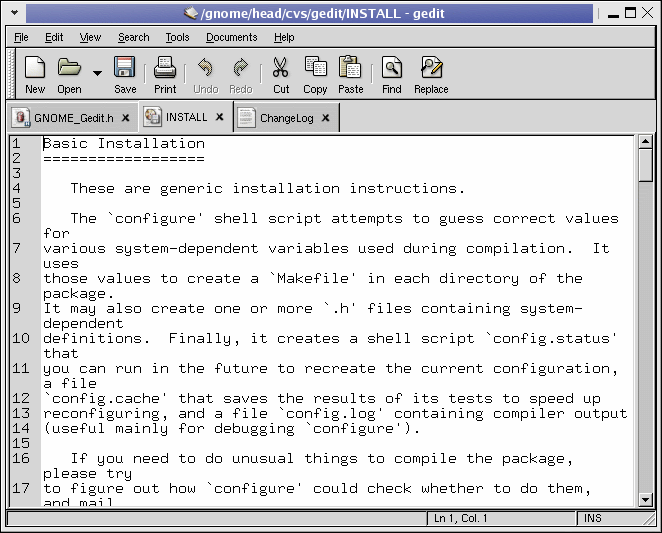
For a better way, see the iWork applications (I can't find screenshots, though), which store most commands in menus, or GTK applications such as this one (I know gedit isn't as complex as Office, I'm just showing the toolkit). The save button has both a floppy disk icon and "Save" under it, if you weren't sure. Spellcheck has "Spellcheck" written under it. And you can change these things (globally) under Menus and Toolbars in Preferences. -
Re:So far off base it's silly...
See kernal with reference to Commodore kernal. No "sic" required, since it appears to be correct.
Sony sued Connectix for copying the bios to the playstation, even though they reverse engineered it. (Sony lost I think.) Most Playstation emulators tell you to download a copy of the bios by finding it online somewhere. Sure doesn't sound above board, does it? If it were legal, wouldn't the emulator authors just package it with their software? Apple 2 emulators also require you to find a file necessary to emulate an Apple 2 computer. Why not include it if it's so obviously legal? -
IANU
Y'know, XINU is not Unix. In fact, Gnu's not Unix either. And Linus is not Unix savvy, appearances to the contrary.
Sigh, sorry about that. At least I understand the jokes now. -
Sorry, you're 19 years too late.
Douglas Comer started a company named Mt Xinu (read it backwards) that put out a Unix-like OS a long, long time ago . It was a companion to the book Operating System Design: The Xinu Approach, published my Prentice Hall in 1984.
Xinu Home Page -
Re:and in the great unix namespace...After Mac OS XI, they should go with... Mac OS XInu unIX.
Memories from Xinu days make me think that such a name for another OS would upset Dr.Comer.
Or they can steal a little bit of Apple history and go with: Mac OS XIa aIX.
In this case it's IBM who'd get upset. Were you thinking of another Apple OS?
-
What is this Xinu?
Why would you want to build a cult around Xinu? Oh, sure, if you've been forced to use it for an Operating Systems course and the implementation used was a dodgy port from VMS to Solaris running on a handful of headless Sparc5 stations that went down faster than (insert vile thought here), you might just take up prayer to space aliens as a pastime.
On a serious note, good for Google! It'll be interesting to see what the fallout is on this. The Co$ is very litigious and the DMCA needs to be tested (and struck down) in court. Not going to happen, I know... just a pipe dream. -
some of the funnier / most interesting quotes
for those that can't be bothered reading the pdf, ie. most of
-
Re:Hmmm...>> Java but there aren't the development tools to allow things like dynamically discovering self-documenting services on the network.
Perhaps you are posting without knowing the opposition? Have you not heard of JINI? I quote:
- Jini[tm] network technology provides a simple infrastructure for delivering services in a network and for creating spontaneous interaction between programs that use these services regardless of their hardware/software implementation. Any kind of network made up of services (applications, databases, servers, devices, information systems, mobile appliances, storage, printers, etc.) and clients (requesters of services) of those services can be easily assembled, disassembled, and maintained on the network using Jini Technology.Services can be added or removed from the network, and new clients can find existing services - all without administration.
I am not sure what issue you have with installing the Java Plugin (since I have it working on every machine here). Perhaps it is your system?
Does it matter if Microsoft ports
But enough about justified Microsoft Bashing. I am not denying that people will get
-
Re:Hmmm...>> Java but there aren't the development tools to allow things like dynamically discovering self-documenting services on the network.
Perhaps you are posting without knowing the opposition? Have you not heard of JINI? I quote:
- Jini[tm] network technology provides a simple infrastructure for delivering services in a network and for creating spontaneous interaction between programs that use these services regardless of their hardware/software implementation. Any kind of network made up of services (applications, databases, servers, devices, information systems, mobile appliances, storage, printers, etc.) and clients (requesters of services) of those services can be easily assembled, disassembled, and maintained on the network using Jini Technology.Services can be added or removed from the network, and new clients can find existing services - all without administration.
I am not sure what issue you have with installing the Java Plugin (since I have it working on every machine here). Perhaps it is your system?
Does it matter if Microsoft ports
But enough about justified Microsoft Bashing. I am not denying that people will get
-
.net, .com and .org added in "the mid-1990s"?!?What drugs is this author smoking? I was reading the Wired Article and ran into this little nugget of "information":
The Domain Name System has not seen the introduction of new generic top-level domains since the mid-1990s when dot-net, dot-com and dot-org were added.
Maybe they entered the mainstream consciousness in the mid-1990s, but they were around a decade earlier! RFC 920 (dated October 1984) defined
Since then, a number of country code top-level domains (ccTLDs) have been added --
Created in the mid-1990s, indeed. Try a little fact-checking next time. (I personally remember using sites such as "ftp.sun.com" and "uunet.uu.net" in 1987.) -
QNX over ratedOnce you remove VM and paging from an OS, things get much simpler, ergo QNX. It is very straight forward to write a QNX like OS. The problem with stories like this is that they forget to mention that QNX is a toy compared to the big kids on the block--Solaris, Linux, etc.
One free example of a mature non-toy QNX-like OS is Doug Comer's XINU. One big advantage XINU. has over QNX is that it is free. Another is that XINU is well documented in text books. Another advantage is that XINU has one of the best implementations of TCP/IP available (thoroughly documented in several text books). Another is that XINU works with the many dozens of Russ Nelson's GNU Crynwr packet drivers. If you are looking for something QNX-like but free, chose XINU.
-
QNX over ratedOnce you remove VM and paging from an OS, things get much simpler, ergo QNX. It is very straight forward to write a QNX like OS. The problem with stories like this is that they forget to mention that QNX is a toy compared to the big kids on the block--Solaris, Linux, etc.
One free example of a mature non-toy QNX-like OS is Doug Comer's XINU. One big advantage XINU. has over QNX is that it is free. Another is that XINU is well documented in text books. Another advantage is that XINU has one of the best implementations of TCP/IP available (thoroughly documented in several text books). Another is that XINU works with the many dozens of Russ Nelson's GNU Crynwr packet drivers. If you are looking for something QNX-like but free, chose XINU.