Slashdot Mirror
Domain: centauri-dreams.org
Stories and comments across the archive that link to centauri-dreams.org.
Comments · 29
-
Re:Wow.
Yes. This is an awesomely well informed (and informing) site. You want seriously advanced, hard core astronomical science, with an eye on practical applications in the ~100 year range, this is the place to watch.
-
Re:fp
It's a religious viewpoint fueled by memories of colonizing North America, conveniently overlooking dozens of engineering impossibilities, and a religious foundation of sci-fi ideologies that are very attractive to a large percentage of Asperger's programmer types. They are also very often misanthropic, depressed doomsday cultists.
You'll rarely hear about colonizing Mars from real engineers, they know it's not possible. But from programmers? They think all technology just consists of sitting on your ass and typing at a keyboard:
#include warpdrive.h
#include 3d-printer-replicator.hThey vastly oversimplify the complexity of space, reduce dangers, and invent all kinds of fantasy scenarios to justify their beliefs, aka a religion.
www.distancetomars.com
http://physics.ucsd.edu/do-the...
http://physics.ucsd.edu/do-the...
http://www.centauri-dreams.org...
http://www.economist.com/blogs...
http://www.thespacereview.com/...
http://www.theatlantic.com/tec... -
Re:Only 40 years??
100T? That seems much higher than other estimates:
-
Galantai Scale focuses on human survivability
Galantai proposes an alternative to the Kardashev scale that focuses on survival of the species. The short version is that if we can survive the destruction of the planet we are at one level, survive solar system destruction at least another level up, without detailing the kinds of events that would make multiple star systems unlivable - there are levels above that. These are links to the Galantai scale stuff: http://www.centauri-dreams.org... http://mono.eik.bme.hu/~galant...
-
I think the problem
is that most people seem unable to grasp the distances involved. Even people who should know better. It's amazing to me the amount of people sitting comfortably at their desks surrounded by everything they need and describe the most fantastic fact-free unrealistic scenarios.
http://www.distancetomars.com/
http://www.centauri-dreams.org...
http://physics.ucsd.edu/do-the...It's over, folks, the Space Age's corpse will be on display for all worshipers, and it aint' going anywhere.
-
FOCAL Mission
Kinda surprised he'd write an entire article about what a great telescope gravity makes for and not mention the FOCAL proposal. If you had a probe sufficiently distant from the sun opposite Alpha Centari and there was a city full of little aliens there, you'd be able to see the cars move around in the streets. Not that this will ever happen or that humanity are capable of such projects - we clearly are not. But it's still a nice idea.
-
Re:interstellar surveilance
There's little doubt that if it was done it would be an amazing technology. One proposal around the idea is FOCAL.
-
Paul Glister blogged about this today
His take on such matters is generally well informed and interesting.
-
Re:Maybe they're not stars....
A few interesting thoughts on that idea here. Put a lampshade on your star basically.
-
a competing hypothesis
A competing hypothesis tries to show a correlation between mass extinctions and the times when our solar system is farthest to the "north" of the galactic disk. I've always found that hypothesis tantalizing and somehow compelling even though it cannot explain the KT event. Presumably there can be more than one cause of mass extinctions.
-
Sounds like a good delivery platform for FOCAL
The FOCAL mission might benefit from this kind of tech, seeing as it involves getting a telescope 550AUs out from the Sun and using the sun as a lens.
-
Thermal force
It's thermal recall force from heat generated by components on Pioneer.
Right. and the headline is a little misleading, it's a "new" explanation only if you weren't following; since it was announced in late 2010. The "anomaly" is solved.
Popular Science article about Toth and Turyshev's work here: http://www.popsci.com/pioneeranomaly
More detailed calculations supporting the explanation:
Phys Rev Letters paper by Toth and Turyshev here: http://prl.aps.org/abstract/PRL/v108/i24/e241101
ArXIV paper confirming the work with more details: http://arxiv.org/abs/1103.5222v1JPL press release: http://www.jpl.nasa.gov/news/news.php?release=2012-209&cid=release_2012-209&msource=12209
Centauri Dreams article: http://www.centauri-dreams.org/?p=23720Still, it's a nice article to read about how the work is done.
-
Re:Pointless?
Another one who thinks SETI listens for radio leakage. It doesn't. Let's just leave it at that since you obviously didn't feel the subject is even worthy of a brief google.
Also google for METI while you're at it. Whenever your conclusion seems to be that you are far more intelligent than a large group of scientists it may be time to check your premises. It is far more likely that you are the one who is ignorant or stupid.
-
Re:Drake equation
-
Re:I believe alien life exists in the universe
The FOCAL Misson could theoretically resolve exoplanets featuers of up to 1km. It works by sending a telescope 550 astronomical units out, and use the suns gravity field as one huge lens. With current technology it could be doable, though (very) expensive.
-
Re:Imagine what a 1.4M km telescope could see!
Claudio Maccone's proposal to use the Sun as a giant gravitational lens (FOCAL) is pretty astounding. All you gotta do is send your satellite out to about 550 AU (easy peasy eh?) - I think I recall reading that if you were to train it on a planet in the Alpha Centauri system you'd be able to resolve cars in the street assuming there are cars and streets there (bound to be). Not easy to steer though, you'd need to know well in advance what you were aiming it at. One nice thing is that the focal length goes to infinity, so even if you're shooting further out (say 1000AU +) you're still able to get a great picture.
-
Re:Solar System Bukakke
No need of a supernova, and no one has ever suggested that as a mechanism. There is the possibility of directed panspermia if you're into sci-fi, or just rocks flying free from their solar systems.
http://www.centauri-dreams.org/?p=188All you need is a lot of material, to have decent odds.
One meteor speed listed there is 300km/s - at that speed, it would take 4000 years to get to Alpha Centauri. If life can survive reasonably well for 30,000 years, that gets to quite a few stars nearby. You just need a lot of ejecta.
Universe is a messy place, and our earth's history has involved a lot of stuff banging about. I don't see why the theory should be rejected out of hand.
-
Not a 100 year project
The 100 year starship project is supposed to study what it will take to sustain private sector investment into a long range program of building a starship.
http://www.100yss.org/about.html
It is not itself a 100 year project to build a starship, or a 100 year project to figure out how to sustain investment...
Also, if you're interested in interstellar research, check out Centauri Dreams:
-
Re:Let those words run by your ears...
What about this
http://www.centauri-dreams.org/?p=1275
As we move into the realm of ChipSats, Peck has my full attention. Take the ChipSat to its logical conclusion and you can envision thousands of tiny spacecraft slung out from the Solar System at ten percent of lightspeed to make the journey to the Centauri stars. "When these small craft arrive," says Peck (I'm quoting from Larry's story again), "they might send back a single, simple signal; one bit of information confirming or denying some scientific principle, such as is there a blue-green planet, for example."
Michio Kaku suggested "emailing" DNA samples to a spacestation built by nanobots that were sent out at 0.1c to a nearby star. There the colonists would be assembled. Of course to make the process work you'd need to email their mental state too which requires some non trivial discoveries to get working. But the fact we could send nanonprobes at 0.1c seems pretty damn impressive to me.
How cool is that?
-
Re:Early adopter problem
The main problem with going on the first journey is that you are bound to picked up on the way there by a faster ship sent years later, crewed by people more advanced than yourself.
This is the premise of A.E. Van Vogt's story "Far Centaurus", which I learned about via Barnard’s Star and the ‘Wait Equation’, an article/blogpost on the same topic on the Tau Zero Foundation site.
-
Re:Er, what's the point again?
-
Re:Venus and Mars
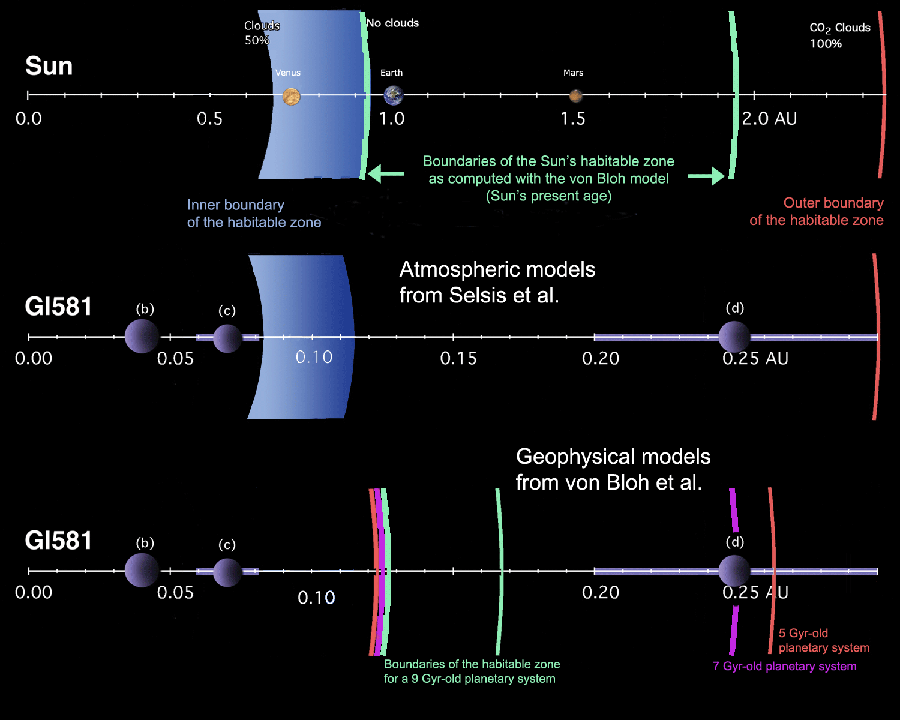
Habzone boundary computations are fuzzy when one takes things like clouds and stellar variability into account. Selsis et al calculate an inner boundary (for present-day Sol) at between 0.7 and 0.9 AU (Venus is at ~0.72 AU), and an outer boundary between 1.7 and 2.4 AU (Mars is at 1.4-1.7 AU). W. von Bloh et al define the habzone in terms of the range in which Earth-like photosynthesis can take place, which is narrower.
Article here, better image here. (The Gl581 diagrams do not show the recently announced f and g planets.)
-
it was known its a planet actually
I think the uncertainty wasn't whether its indeed a planet, but whether its gravitationally bound to that star. http://www.centauri-dreams.org/?p=13192
-
Better Articles!
Oh for fuck's sake why do we keep linking to Inhabitat for news on space missions? The Ikaros project is, indeed, a newsworthy and exciting piece of nerd information. However, linking to a stupid environmental blog that holds informational gems like:
"Solar sails offer the best hope for deep space exploration because they eliminate the need to carry fuel." (Hint: No, they don't. They don't do that at all. You need maneuvering thrusters to align your spacecraft before deployment. You need a power source to provide electricity to power your control motors when you get too far away from the sun. Saying solar sails eliminate the need to carry fuel is like saying that a spoiler eliminates the need for a gas tank on a car because it improves gas mileage. That is a completely asinine statement.)
And:
"spacecraft — unlike airplanes — don’t have to contend with drag," (Also untrue. Depending on what orbit/space environment you are in, you may still have to contend with the drag of Earth's atmosphere. If you are deploying in LEO, this could induce a significant moment on your spacecraft. Also, thank you for pointing out the difference between aircraft and spacecraft...that was really weighing on my mind while reading about a spacecraft mission that is proof-of-concepting a new technology).
And:
"Of course, aliens aren’t the only reason to want to travel through space without carrying rocket fuel. NASA is also working with solar sails to develop ultra-efficient spacecrafts. " (Aliens and ultra-efficient spacecrafts eh? That's your high-quality independent journalism right there? Give me a break this kind of stupid babbling about a very important mission does nothing but patronize the spacecraft industry and the folks who worked on this particular bird).
Let me give you a hint Inhabitat readers, if you want to track the progress of an impressive space mission, try going to a news site that actually is focused on space. Maybe you should check out: Centauri Dreams or one of JAXA's own website's regarding the hardwork and impressive design that went into designing this mission. Perhaps you should read and link to some articles that actually contain interesting, relevant, tech-centric discussions of the mission rather than your latest, retarded, three paragraph, juvenile blog whose most interesting mission detail: "....allowing it to launch the
-
Re:Misleading
Did anyone else read "flagship technology" and picture a ship with solar sails? Well, if you did, you'll be disappointed.
You mean like the one that Japan launched yesterday?
http://www.planetary.org/blog/article/00002503/
http://www.centauri-dreams.org/?p=12588 -
Re:High resolution images possible in near future?
A telescope at the Sun's gravity focus.
http://www.centauri-dreams.org/?p=785
(the comments contain some interesting information as well.The resolving power is a bit of slippery subject, because gravity microlensing doesn't work quite like a regular refractive lens. According the the comments, you can basically see anything, no matter how far away (subject to caveats when you start getting insanely far away) as if it were in close orbit around the sun. So the resolution you can obtain really depends on what kind of telescope you put out at the gravity focus. One of the commenters calculated that if we put Hubble out there we could see things about the size of Mercury, at ANY distance. The light collecting ability is also enormous.
There are some problems though. First, you have to get out there. Farther than anything we've ever sent. Also, 550 AU (about 20 Pluto distances) probably won't work, because then the light you're collecting has to skim the surface of the sun. Better would be to go out to about 1000 AU (about 1/200th of the way to Alpha Centauri) so that you're not trying to see through the thick parts of the sun's atmosphere.
Once you get there, you have to be able to accurately record smeared out images while staring into the sun.
Finally, you can really only look at one thing. If you want to look in a different direction, you have to move the probe a LONG way. These would probably be single purpose missions, which means you'd basically have to know exactly what you wanted to look at before you sent out the probe.
We use microlensing caused by other objects all the time though. There's even a project to look for extrasolar planets that happen to be revealed by microlensing events.
-
Put the telescope 550 AU out
...at the sun's gravitational focus. You'd be able to resolve a planet halfway across the galaxy.
First link I pulled from Google (but there are several others): http://www.centauri-dreams.org/?p=176
-
Re:I for one welcome our
Imagine you get to 99% of the speed of light. You launch a ship. It would hardly be impossible for 25 years to go by and we have another physics revolution, where we understand how to go faster than light (or at least appear to) and to build a ship that arrives at the destination years before the first ship does.
As happens in the AE Van Vogt short, Far Centaurus . It's about three men's experiences of suspended animation on the first journey to a nearby star system with inhabitable planets.
The thing is, it takes them so long to get there that by the time they arrive, Earth has already fully colonised the planets (now named after the travellers) and can flit between stars like crossing the street. In fact society has developed so much that the travellers can't adapt and end up heading back into space. Not Van Vogt's best, but certainly interesting.
-
Interstellar propulsion FAQ
The author Paul Glister's blog @ Centauri Dreams keeps tabs on new propulsion technologies ++ space geek topics in general.
One technology, Mini-Magnetospheric Plasma Propulsion (M2P2) comes complete with a 7 meg flying coffee can flash demo.
Glister's book, Centauri Dreams, gives me some hope that science and discovery will drive NASA again.