Slashdot Mirror
Domain: cityrating.com
Stories and comments across the archive that link to cityrating.com.
Comments · 31
-
Re:smug retribution
Take out the "Gun control City" violence and see what the rates are, which is explicitly stated in my post.
Or put it another way, Wyoming has a very low crime rate, with a very high gun ownership rate. Correlation doesn't equate to causation.
http://www.cityrating.com/crime-statistics/wyoming/#.UmqW0XdGat8
-
Re:Next thing you know...
I think the problem is that it's turning SF into a "bedroom community" for employers far to the south rather than having the workers live *and* work in the city (thus they are spending less time and money in the city. When I worked in SF during the first dot-com boom, my coworkers and I all went out to lunch at local restaurants and met after work at local bars. The worker that leaves the city at 7am on a bus, and them comes home at 7pm to be dropped off in his neighborhood is probably not spending as much time going out and supporting local businesses. Further, the added influx of SF residents are driving up rents, so even those that *do* work in SF find it difficult and expensive to find a place to live. Oh, and the city receives no payroll tax for those employees, so not only does the city earn less tax revenue due to reduced spending by these workers, but they receive no payroll tax either.
Rather than subsidizing bus travel to make it more attractive to live in SF and work 40 miles south, it would be nice to see the Peninsula cities and tech companies work on making it more attractive for their employees to live closer to work. It's no fun to live next to an office park that becomes a big unwalkable, bike unfriendly concrete wasteland after working hours.
So let me get this straight. These people are commuting out of the city they live in to go to work on company supplied buses and this is causing the city to loose money? It would be no different if they drove themselves to work. These people may be even less likely to live in the city if they had to drive themselves everyday. In which case the city would get nothing from them. As it is, the city is collecting property and local taxes from these people. They probably also do most of their shopping in the city, so the local businesses are making money and the city is getting sales taxes. It''s my understanding that most of these tech places also have their own food services and such, so I fail to see how the city is losing much from the lunch crowd either.
Now if you want to see the reverse of this, come to D.C. Damn near everyone who works in the city lives along the beltway in Virginia or Maryland. So the city gets all of the lunch crowd people. Then they go home and spend their money where they live and pay their taxes there too. Those areas are very well off for the most part. DC itself is broke. If it wasn't for the federal government propping it up it would be an even bigger hell hole than is already is. The 2010 violent crime rate> was 207% higher than the national average. Sanfrancisco was 73% higher. So no, Getting people to move away is not going to do anything for the city. Just look at Detroit.
Your remark about driving the property values up I agree with, but that seems to be happening most places.
-
Re:Next thing you know...
I think the problem is that it's turning SF into a "bedroom community" for employers far to the south rather than having the workers live *and* work in the city (thus they are spending less time and money in the city. When I worked in SF during the first dot-com boom, my coworkers and I all went out to lunch at local restaurants and met after work at local bars. The worker that leaves the city at 7am on a bus, and them comes home at 7pm to be dropped off in his neighborhood is probably not spending as much time going out and supporting local businesses. Further, the added influx of SF residents are driving up rents, so even those that *do* work in SF find it difficult and expensive to find a place to live. Oh, and the city receives no payroll tax for those employees, so not only does the city earn less tax revenue due to reduced spending by these workers, but they receive no payroll tax either.
Rather than subsidizing bus travel to make it more attractive to live in SF and work 40 miles south, it would be nice to see the Peninsula cities and tech companies work on making it more attractive for their employees to live closer to work. It's no fun to live next to an office park that becomes a big unwalkable, bike unfriendly concrete wasteland after working hours.
So let me get this straight. These people are commuting out of the city they live in to go to work on company supplied buses and this is causing the city to loose money? It would be no different if they drove themselves to work. These people may be even less likely to live in the city if they had to drive themselves everyday. In which case the city would get nothing from them. As it is, the city is collecting property and local taxes from these people. They probably also do most of their shopping in the city, so the local businesses are making money and the city is getting sales taxes. It''s my understanding that most of these tech places also have their own food services and such, so I fail to see how the city is losing much from the lunch crowd either.
Now if you want to see the reverse of this, come to D.C. Damn near everyone who works in the city lives along the beltway in Virginia or Maryland. So the city gets all of the lunch crowd people. Then they go home and spend their money where they live and pay their taxes there too. Those areas are very well off for the most part. DC itself is broke. If it wasn't for the federal government propping it up it would be an even bigger hell hole than is already is. The 2010 violent crime rate> was 207% higher than the national average. Sanfrancisco was 73% higher. So no, Getting people to move away is not going to do anything for the city. Just look at Detroit.
Your remark about driving the property values up I agree with, but that seems to be happening most places.
-
Re:Blame game
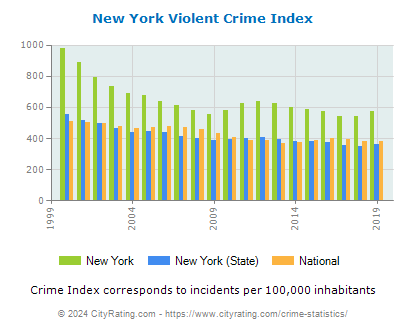
Nice job ignoring the violent crime chart.
-
Re:Blame game
Yes, it's such a crime ridden shithole... I'm not really a fan of NYC (I like to visit every once in a while but I could never imagine living there) but really, it hasn't been crime ridden since the 1980's.
-
Re:Willing to bet..
I'm curious what your conclusions were... mine were inconclusive based on an admittedly limited sampling:
http://www.cityrating.com/crime-statistics/colorado/
Aurora: In 2009 the city violent crime rate in Aurora was higher than the violent crime rate in Colorado by 39.22%.
Colorado Springs: In 2009 the city violent crime rate in Colorado Springs was higher than the violent crime rate in Colorado by 45.04%.
Denver: In 2009 the city violent crime rate in Denver was higher than the violent crime rate in Colorado by 70.98%.It seems like other factors might be at play here.
-
Re:What a shitbag...
http://gunowners.org/sk0802.htm
Well if gunowners.org says it it has to be the unbiased truth!
Actually, ironically, the page you linked says very little about anything that you have said. England, United Kingdom, UK... these turn up nowhere in the document. Neither does any of the other items you mentioned. Quite an interesting source there.
But hell, Vermont allows guns and is really safe so I guess you win.
Washington D.C. [. .
Wait, wait! Let me try to guess another one. Those were all commie liberal states, so let's head down to Texas. Houston is their biggest city so I'm going to guess Houston. Yessss! I'm good at this! It's almost like the majority of major urban populations have higher and often significantly higher than national average violent crime rates. I also note that your cherry-picking of which areas support your argument ignored New York, which has strict gun control laws and average or below-average crime rates pretty much across the board. Strange, that.
And while we're here, "one of the very reasons for this is actually the strict gun control laws" is nothing but a beyond-terrible non sequitor. If you want people to believe it you're going to have to do far better than that.
What people don't realize, or don't care to acknowledge, is that criminals don't care if they're breaking the law. Which is exactly why they're "Criminals".
I am actually inclined to agree in terms of violent criminals. However, it is worth pointing out that "criminal" includes everything from a misdemeanor assault charge during a bar fight to a DUI to a rapist to a murderer. In other words, far too broad to paint everybody with the same brush. The idea that every criminal is willing to step up from dealing pot or burglary to murder is a stetch.
If even a small percentage of relatively small-time criminals is scared by the possibility of their sentence exploding just for having a gun in their hoodie while they commit some other low-brow crime, that's a small percentage of people who can't accidentally (our out of fear) shoot and kill somebody.
Criminals want to take the path of least resistance; they're not going to break into a house KNOWING that it could very well be their last, when easier undefended targets are nearby.
That's not exactly a roaring argument in favor of guns. "Path of least resistance" is a relative term, and you're giving the criminals too much credit. Will I rob your house knowing you have a gun when I can rob your neighbor instead? Of course not. Will I rob your house not knowing if you have a gun or not? How, exactly, do you think most robberies are taking place? Posing as a door-to-door gun salesman and only hitting the houses that say "no thanks, I already have enough weapons?" They're not researching these things beyond, at best, "when do they leave for the day?" They're looking for targets of opportunity.
Even if you happen to achieve your goal of arming the entire populace, do you really believe most criminals are going to go "well, shit. I guess that's the end of my life of crime. I'd better turn my life around?" Even if you fully buy into the "path of least resistance" argument, all you're doing is creating more resistance all around. Most will still commit their crimes (and most, quite frankly, will still get away with them for all the same reasons they do right now) they'll just be doing it with a higher risk of getting shot for it than when they woke up the day before in reality instead of magical gun land. Nobody having a gun won't help. Everybody having a
-
Re:Done!
How about the high violent crime rate? The fact that people don't stop at lights out of fear? Those are most definitely not wrong. Its better to let robbers have their victims kneel at the corner of the street and be executed than to have a surveillance system.
What people feel is wrong about the surveillance system is the potential for abuse - and their is tons of it, but we don't live in a world where people go down the street holding hands while skipping and singing songs. The very reason people fear surveillance is its potential for abuse by the same villains that walk the street.
Did it ever occur that if surveillance was open and all video was available to all people that it may actually prove beneficial? Openness doesn't need to stop at software. Public areas being truly public may have more benefits than you may think. Perhaps if you could record your own actions through the day, it could counter any interruption or hacking with the grid. There is a lot of room for abuse, but also a lot of room for securing the safety of thousands of people. -
Re:Chemtrails?
After posting I remembered a relevant anecdote...
I used to live in the mountains, ~80 miles from Phoenix. On this particular day I looked up and noticed multiple jets in the sky, which were presumably headed to/from Los Angeles. All were at cruising altitudes. Some jets were laying contrails that rapidly dispersed and disappeared, while other contrails "hung around" and dispersed like chemtrail proponents said.
I guess the main thing is "who do you trust"? I figure this wouldn't be the first classified program ever to be undertaken...
P.S. Phoenix's humidity is very low for most the year. It spikes when it rains, then goes back down. According to this chart, average afternoon humidity only varies by 21% throughout the entire year.
-
Re:What about the presumption of innocence?
http://www.cityrating.com/citycrime.asp?city=El+Paso&state=TX
aggravated assault 1.26 times the national average. the report you linked also showed a 5% increase in assault.
So I'm not sure I would define it as an extremely safe city.
My impression came from talking to someone who lived there. Which is pertinent to this discussion because it may actually reflect what the people in Arizona felt prior to supporting this law.
I was there when a trip into Juarez was no concern. Go shopping during the day and go to the race track at night. That does not appear to be the sentiment now.
Along the topic of border issues a bomb went off in Nuevo Laredo also earlier this month.
There is a freaking war going on over there.
But if we allow this to be ignored and just say it is an over the border problem and tell people on the border to suck it up. Then we may end up with the same type of legislation here in Texas. -
Re:wow...just wow
Correlation (number of guns compared to number of gun deaths) does not equal causation.
Nowhere in that article did I see a mention of the fact that the states listed as having high gun death rates are also states with high poverty rates, high racial tension, etc which also correlate neatly to gun crimes. Nowhere in that article did I see a mention of the OTHER side of the coin, either - that many areas with more gun owners have lower crime rates than the national average. See Kennesaw, Georgia as one example... whereas its oft-cited opponent Morton Grove is a suburb of Chicago where the crime rates look like this.
So according to my own correlations, crime rates are clearly higher in areas where gun ownership is restricted. And clearly, those people who carry guns must all know how to use them, and have practiced with them, etc. I too can argue without any real facts about the personalities and abilities of gun owners and the probable results of guns on a plane... but the flu virus is not a gun and can't be stopped with one so why the hell is this post even relevant? -
Re:wow...just wow
Correlation (number of guns compared to number of gun deaths) does not equal causation.
Nowhere in that article did I see a mention of the fact that the states listed as having high gun death rates are also states with high poverty rates, high racial tension, etc which also correlate neatly to gun crimes. Nowhere in that article did I see a mention of the OTHER side of the coin, either - that many areas with more gun owners have lower crime rates than the national average. See Kennesaw, Georgia as one example... whereas its oft-cited opponent Morton Grove is a suburb of Chicago where the crime rates look like this.
So according to my own correlations, crime rates are clearly higher in areas where gun ownership is restricted. And clearly, those people who carry guns must all know how to use them, and have practiced with them, etc. I too can argue without any real facts about the personalities and abilities of gun owners and the probable results of guns on a plane... but the flu virus is not a gun and can't be stopped with one so why the hell is this post even relevant? -
Re:Lol... netherlandsHahaha! The Netherlands!
The Netherlands has a maritime climate, with cool summers and mild winters. The average temperature is 2C (36F) in January and 19C (66F) in July, with an annual average of about 10C (50F). Clouds generally appear every day, and in the winter months fog often abounds, while rainfall occurs frequently. Average annual rainfall is about 76.5 cm (30 in). The mild, damp climate is ideal for dairying and livestock raising, but the limited sunshine restricts the growing of food crops.
Yeah, 11 hot days in July. Well, I suppose there is a good reason not to build your data center in Dallas 28 days in July above 90F.
-
Re:One theory of dark matter eh?
Anchorage is a bad example, but it's not really too far off during the winter months. Juneau is much closer, but you could also compare Valdez, Whittier, Cordova, possibly Kodiak, or any other town in Southeast/Southcentral Alaska.
Also compare any town of equal latitude in Canada, to demonstrate the warming effect of the Pacific current. Whitehorse, in the Yukon, is more northerly, but I can't think of any other settlement of note in that area.
I'll thank you kindly to form your links correctly in the future.
-
Re:Okay so the info is out there...
http://www.cityrating.com/costOfLiving/city.asp?state=OH&city=Toledo $250,000 is a good deal of money in Toledo.
-
Western Australia is hotter than Texas.
Texas is a state. Western Australia is a state. You can't compare a country to a state as you are doing comparing Texas to Australia.
Lets look at Western Australia (a smallish state population wise in as much as texas is population wise compared to California, NY etc etc) and look at the results:
The capital city of Perth (capital of Western Australia with approx 1.5 Million) is hotter than either Dallas or Houston.
Perth:http://www.australiatravelsearch.com.au/trc/climate.html Dallas: http://www.cityrating.com/citytemperature.asp?City=Dallas+-+Fort+Worth [cityrating.com] Houston: http://www.cityrating.com/citytemperature.asp?City=Houston [cityrating.com] -
Western Australia is hotter than Texas.
Texas is a state. Western Australia is a state. You can't compare a country to a state as you are doing comparing Texas to Australia.
Lets look at Western Australia (a smallish state population wise in as much as texas is population wise compared to California, NY etc etc) and look at the results:
The capital city of Perth (capital of Western Australia with approx 1.5 Million) is hotter than either Dallas or Houston.
Perth:http://www.australiatravelsearch.com.au/trc/climate.html Dallas: http://www.cityrating.com/citytemperature.asp?City=Dallas+-+Fort+Worth [cityrating.com] Houston: http://www.cityrating.com/citytemperature.asp?City=Houston [cityrating.com] -
Re:Wind Energy for Air Conditioners?
Just a small mention that Perth, The capital of Western Australia, is hotter than Dallas and Houston . Also Marble bar in Western Australia holds the world record for the number of days above 35C. So I really don't think texas is hotter than WA any more than the phrase 'bigger than texas' holds true against WA.
references:
Perth:http://www.australiatravelsearch.com.au/trc/climate.html
Dallas: http://www.cityrating.com/citytemperature.asp?City=Dallas+-+Fort+Worth
Houston: http://www.cityrating.com/citytemperature.asp?City=Houston
Of course, with as shitty 'karma' as mine no one will read this but you you, but as a proud West Australian I felt it necessary to note -
Re:Wind Energy for Air Conditioners?
Just a small mention that Perth, The capital of Western Australia, is hotter than Dallas and Houston . Also Marble bar in Western Australia holds the world record for the number of days above 35C. So I really don't think texas is hotter than WA any more than the phrase 'bigger than texas' holds true against WA.
references:
Perth:http://www.australiatravelsearch.com.au/trc/climate.html
Dallas: http://www.cityrating.com/citytemperature.asp?City=Dallas+-+Fort+Worth
Houston: http://www.cityrating.com/citytemperature.asp?City=Houston
Of course, with as shitty 'karma' as mine no one will read this but you you, but as a proud West Australian I felt it necessary to note -
Re:4 hours commuting a day...
I would rather live in a nice neighborhood on the outskirts of a city with everything I need (except work) a short walk away.
Lancaster is not that safe (though the rates a little lower than Philly for the same year). If you cut the bad parts of Philly out (which I do, though a job at a university would make that impossible), you are left with a nice city. I am sure Lancaster or any oher city is similar. But as a remarkably segregated city (on all levels, not just race), it is very easy to avoid the bad parts. It's not like New York or DC where from one block to the next it goes nice to dangerous.
Of course the quality of life is a pure value judgment and I don't mean to imply otherwise vs a small town (which as a Delawarean I find hard to call 55,000 as including). -
Re:The Pennsylvania case is overNew Jersey is generally considered the armpit of the country for several reasons, some of which include the large amount of chemical industries located within the state, the seemingly endless amount of concrete that covers the state, drivers who are always near the top in worst in the nation and the general overall blahness of the state. To get from point A to point B generally requires you go on either a toll road or some other concrete highway. Back roads are very few and far between.
Consider this: Camden is ranked second only to Detroit, MI in overall crime rate yet Camden has 1/10 of the population that Detroit does. You can do a comparison of crime rates for Detroit, Camden and Newark. These statistics are from 2003 but have only gotten worse since then. -
Re:The Pennsylvania case is overNew Jersey is generally considered the armpit of the country for several reasons, some of which include the large amount of chemical industries located within the state, the seemingly endless amount of concrete that covers the state, drivers who are always near the top in worst in the nation and the general overall blahness of the state. To get from point A to point B generally requires you go on either a toll road or some other concrete highway. Back roads are very few and far between.
Consider this: Camden is ranked second only to Detroit, MI in overall crime rate yet Camden has 1/10 of the population that Detroit does. You can do a comparison of crime rates for Detroit, Camden and Newark. These statistics are from 2003 but have only gotten worse since then. -
Re:The Pennsylvania case is overNew Jersey is generally considered the armpit of the country for several reasons, some of which include the large amount of chemical industries located within the state, the seemingly endless amount of concrete that covers the state, drivers who are always near the top in worst in the nation and the general overall blahness of the state. To get from point A to point B generally requires you go on either a toll road or some other concrete highway. Back roads are very few and far between.
Consider this: Camden is ranked second only to Detroit, MI in overall crime rate yet Camden has 1/10 of the population that Detroit does. You can do a comparison of crime rates for Detroit, Camden and Newark. These statistics are from 2003 but have only gotten worse since then. -
Re:I notice he didn't mention...
besides, in large urban centers and suburban areas Gun Control LOWERS crime rates, not increases them.
You mean like in Washington D.C.?
Or maybe you mean Chicago
Both cities have what is considered to be fairly draconian gun control laws by US standards. Both have violent crime rates well in excess of the national average. -
Re:Even if not guilty
Actually, in this area I don't know that 100K is all that bad, especially considering that houses usually go for 500K+, though a lot of areas of Oakland are considerably cheaper. Oakland is a sore spot in the Bay Area with a high crime rate compared to most other areas. There are many areas of Oakland where I and most people I know will avoid because it just isn't safe. Oakland also has a fairly high homicide rate. See c
rime.asp?city=Oakland&state=CA</a> for some statistics. The murder rate is 3.5 times the national average. The city I live in, about 25 miles south is 0.13 times the national average for murder. Berkeley, which is right next store to Oakland is 0.75 times the national average, and Alameda who also borders Oakland has had zero murders, with a population of 74K people. San Jose, a city with about twice the population of Oakland is 0.42 times the national average. Now there are a number of really nice and expensive parts of Oakland, where the murder rate is a lot lower, such as in the Oakland hills, which just indicates how bad that 3.5 times average is. There are areas of Oakland where you just don't want to go.
I hope that she is found alive and that if not that Hans Reiser had nothing to do with it. I also don't have a lot of confidence in the Oakland police department. -
Toronto huh?
Toronto
GPS coordinates:
N43.641922,W79.387668
average conditions http://www.bbc.co.uk/weather/world/city_guides/res ults.shtml?tt=TT000900
Baltimore
GPS Coordinates:
39.1573N, 76.7227W
http://www.cityrating.com/citytemperature.asp?City =Baltimore
can't imagine WHY that might work in toronoto, and not for the NSA -
Re:Ignoring the Facts: defining "authoritarian"
Speaking of ignoring the facts... where did you get that "statistic" about large cities in Texas? Houston has nearly double the national average violent crime rate:
http://www.cityrating.com/citycrime.asp?city=Houst on&state=TX
Same for Dallas - 1.80x national average. For those who don't remember their history, Dallas is where the "Amber" of "Amber Alert" fame was kidnapped and murdered.
I'm not saying gun control laws reduce crime, but I am saying there is ample evidence that lack of gun control does not reduce crime either. But thanks for proving the point of TFA -
Or
"where extraordinary levels of physical violence are the accepted norm, "
Guess you haven't been to Irvington, NJ where knowing the native language won't do you much good.
http://www.cityrating.com/citycrime.asp?city=Irvin gton&state=NJ
-
Re:HOWTO: give science a bad name.
-
Re:HOWTO: give science a bad name.
-
Quit trying to freeze us out!I think this is a lousy idea.
Where I lived, a return to the long-term global average temperature (about 5C warmer than now) would be great. It might turn North Africa into a greenbelt again, too, just like it used to be. That would really help with the famines there! I know change is rough on everyone, but the poor dirt farmers would be a lot better off with an extra growing season. I really think that global warming is just too good to be true.
How much CO2 did Mt. St. Helens vent last eruption? How does that compare to the CO2 from power generation? This link claims that human CO2 inputs are at least an order of magnitude smaller than the natural output of CO2, and that that tips the balance towards increasing CO2 levels.
I really don't believe that idea, but just in case there is something to it, I say: go burn something. I'm sick of shivering!