Slashdot Mirror
Domain: collegeboard.com
Stories and comments across the archive that link to collegeboard.com.
Stories · 21
-
College Board Mainstreams AP Computer Science (collegeboard.org)
New submitter Pollux writes: In the Fall of 2016, the College Board will begin a new course titled "AP Computer Science Principles," designed to "introduce students to the central ideas of computer science, instilling the ideas and practices of computational thinking and inviting students to understand how computing changes the world." This course will not replace the existing "AP Computer Science A" course, but has been added, "To appeal to a broader audience, including those often underrepresented in computing." A short list of differences between the two courses notes that instructors can choose a language of their choice. The curriculum framework directs the focus of instruction away from programming as a skill and towards programming as an activity, "enabling problem solving, human expression, and creation of knowledge (PDF)." -
Justified: Visual Basic Over Python For an Intro To Programming
theodp writes ICT/Computing teacher Ben Gristwood justifies his choice of Visual Basic as a programming language (as a gateway to other languages), sharing an email he sent to a parent who suggested VB was not as 'useful' as Python. "I understand the popularity at the moment of the Python," Gristwood wrote, "however this language is also based on the C language. When it comes to more complex constructs Python cannot do them and I would be forced to rely on C (which is incredibly complex for a junior developer) VB acts as the transition between the two and introduces the concepts without the difficult conventions required. Students in Python are not required to do things such as declare variables, which is something that is required for GCSE and A-Level exams." Since AP Computer Science debuted in 1984, it has transitioned from Pascal to C++ to Java. For the new AP Computer Science Principles course, which will debut in 2016, the College Board is leaving the choice of programming language(s) up to the teachers. So, if it was your call, what would be your choice for the Best Programming Language for High School? -
Despite Push From Tech Giants, AP CS Exam Counts Don't Budge Much In Most States
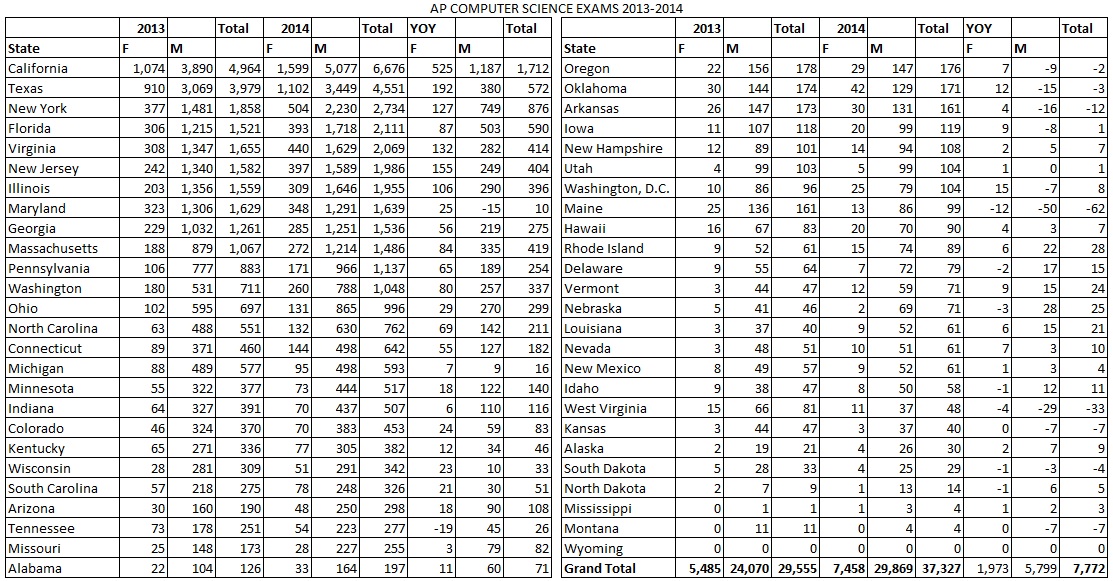
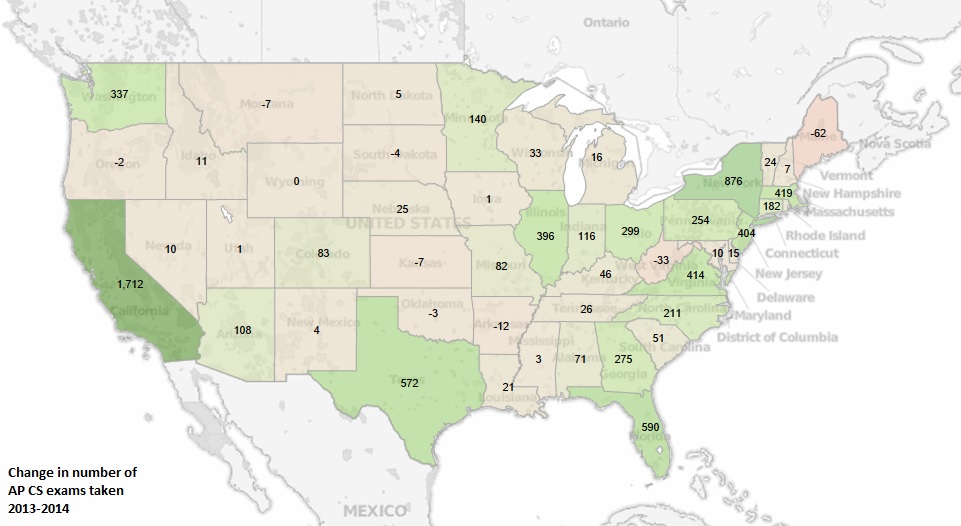
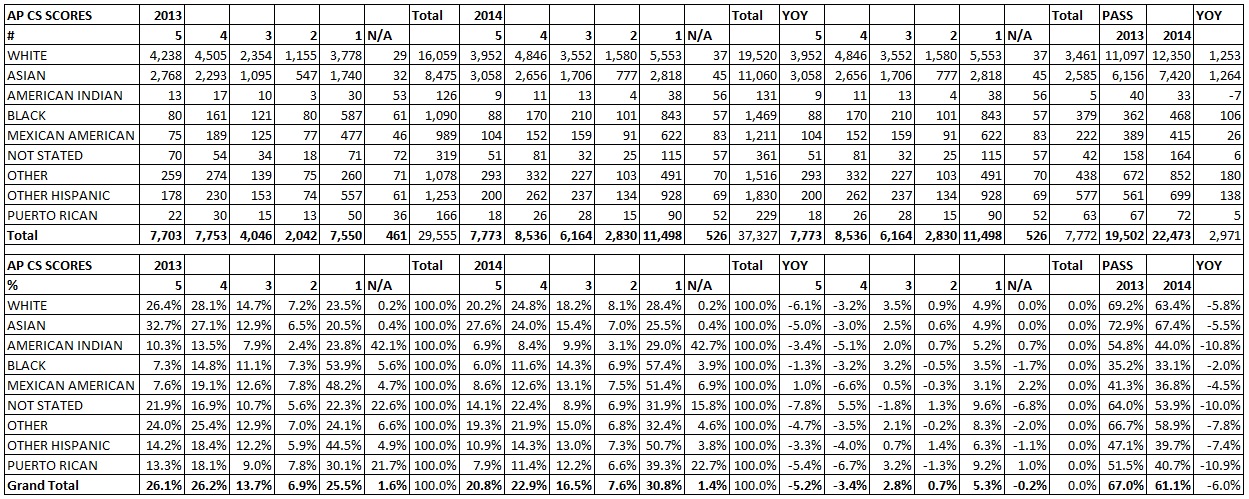
theodp (442580) writes "Well, the College Board has posted the 2014 AP Computer Science Test scores. So, before the press rushes out another set of Not-One-Girl-In-Wyoming-Took-an-AP-CS-Exam stories, let's point out that no Wyoming students of either gender took an AP CS exam again in 2014 (.xlsx). At the overall level, the final numbers have changed somewhat (back-of-the-Excel-envelope calculations, no warranty expressed or implied!), but tell pretty much the same story as the preliminary figures — the number of overall AP CS test takers increased, while pass rates decreased despite efforts to cherry pick students with a high likelihood of success. What is kind of surprising is how little the test numbers budged for most states — only 8 states managed to add more than 100 girls to the AP CS test taker rolls — despite the PR push by the tech giants, including Microsoft, Google, and, Facebook. Also worth noting are some big percentage decreases at the top end of the score segments (5 and 4), and still-way-too-wide gaps that exist between the score distributions of the College Board's various ethnic segments (more back of the envelope calcs). If there's a Data Scientist in the house, AP CS exam figures grabbed from the College Board's Excel 2013 and 2014 worksheets can be found here (Google Sheets) together with the (unwalkedthrough) VBA code that was used to collect it. Post your insight (and code/data fixes) in the comments!" -
Statistics Losing Ground To CS, Losing Image Among Students
theodp (442580) writes Unless some things change, UC Davis Prof. Norman Matloff worries that the Statistician could be added to the endangered species list. "The American Statistical Association (ASA) leadership, and many in Statistics academia," writes Matloff, "have been undergoing a period of angst the last few years, They worry that the field of Statistics is headed for a future of reduced national influence and importance, with the feeling that: [1] The field is to a large extent being usurped by other disciplines, notably Computer Science (CS). [2] Efforts to make the field attractive to students have largely been unsuccessful."
Matloff, who has a foot in both the Statistics and CS camps, but says, "The problem is not that CS people are doing Statistics, but rather that they are doing it poorly. Generally the quality of CS work in Stat is weak. It is not a problem of quality of the researchers themselves; indeed, many of them are very highly talented. Instead, there are a number of systemic reasons for this, structural problems with the CS research 'business model'." So, can Statistics be made more attractive to students? "Here is something that actually can be fixed reasonably simply," suggests no-fan-of-TI-83-pocket-calculators-as-a-computational-vehicle Matloff. "If I had my druthers, I would simply ban AP Stat, and actually, I am one of those people who would do away with the entire AP program. Obviously, there are too many deeply entrenched interests for this to happen, but one thing that can be done for AP Stat is to switch its computational vehicle to R." -
Chicago Mayor Praises Google For Buying Kids Microsoft Surfaces
theodp (442580) writes "Google earned kudos from Chicago Mayor Rahm Emanuel this week for teaming up with Staples to fund the projects of 367 of the city's 22,519 public school teachers on "begfunding" site DonorsChoose.org. "Everything that you asked for...every project that the teachers put on to help their students learn, exceed and excel here in the city of Chicago, you now have fully funded," Mayor Emanuel said. "Chicago's hardworking public school teachers are doing all that they can-and more-to support their students, but they need more help," said Rob Biederman, head of Chicago Public Affairs at Google. "We jumped at the chance to join with DonorsChoose.org and Staples to make Chicago's local classroom wishes come true." So what kind of dreams did Google make possible? Ironically, a look at Google Chicago's Giving Page shows that the biggest project funded by Google was to outfit a classroom with 32 Microsoft Surface RT tablets for $12,531, or about 6.5% of the $190,091 Google award. Other big ticket projects funded by Google included $5,931 for a personal home biodiesel kit and $5,552 for a marimba (in the middle of the spectrum was $748 for "Mindfulness Education"). In addition to similar "flash-funding" projects in Atlanta (paper towels!) and the Bay Area, Google and DonorsChoose have also teamed up this year to reward teachers with $400,000 for recruiting girls to learn to code (part of Google's $50 million Made With Code initiative) and an unknown amount for AP STEM teachers who passed Google muster (part of Google's $5 million AP STEM Access grant)." -
AP Computer Science Test Takers Up 8,000; Pass Rate Down 6.8%
theodp (442580) writes "Code.org reports that preliminary data on students who took the Advanced Placement (AP) Computer Science Exam in 2014 show an increase of 8,276 students over 2013 and represent what the College Board called "the first real indication of progress in AP CS enrollment for women and underserved minorities in years." Girls made up 20% of the 39,393 total test takers, compared to 18.7% of the 31,117 test takers in 2013. Black or African American students saw their share increase by 0.19%, from 3.56% to 3.75% (low, but good enough to crush Twitter). Code.org credits the increased enrollment to its celebrity-studded CS promo film starring Bill Gates and Mark Zuckerberg ("I even made a personal bet (reflected in my contractual commitment to Code.org donors) that our video could help improve the seemingly immovable diversity numbers in computer science," Code.org founder Hadi Partovi notes). However, some of the increase is likely attributable to the other efforts of Code.org's donors. Microsoft ramped up its TEALS AP CS program in 2013-2014, and — more significantly — Google helped boost AP CS study not only through its CS4HS program, but also by funding the College Board's AP STEM Access program, which offered $5 million to schools and teachers to encourage minority and female students to enroll in AP STEM courses. This summer, explains the College Board, "All AP STEM teachers in the participating schools (not just the new AP STEM teachers), who increase diversity in their class, receive a [$100] DonorsChoose.org gift card for each student in the course who receives a 3, 4, or 5 on the AP Exam." The bad news for AP CS teachers anticipating Google "Excellence Funding" bounties (for increasing course enrollment and completion "by at least five underrepresented students") is that AP CS pass rates decreased to 60.8% in 2014 (from 67.6% in 2013), according to Total Registration. Using these figures and a back-of-the-envelope calculation, while enrollment saw a 26.6% increase over last year, the total number of students passing increased by 13.9%." -
AP Computer Science Test Takers Up 8,000; Pass Rate Down 6.8%
theodp (442580) writes "Code.org reports that preliminary data on students who took the Advanced Placement (AP) Computer Science Exam in 2014 show an increase of 8,276 students over 2013 and represent what the College Board called "the first real indication of progress in AP CS enrollment for women and underserved minorities in years." Girls made up 20% of the 39,393 total test takers, compared to 18.7% of the 31,117 test takers in 2013. Black or African American students saw their share increase by 0.19%, from 3.56% to 3.75% (low, but good enough to crush Twitter). Code.org credits the increased enrollment to its celebrity-studded CS promo film starring Bill Gates and Mark Zuckerberg ("I even made a personal bet (reflected in my contractual commitment to Code.org donors) that our video could help improve the seemingly immovable diversity numbers in computer science," Code.org founder Hadi Partovi notes). However, some of the increase is likely attributable to the other efforts of Code.org's donors. Microsoft ramped up its TEALS AP CS program in 2013-2014, and — more significantly — Google helped boost AP CS study not only through its CS4HS program, but also by funding the College Board's AP STEM Access program, which offered $5 million to schools and teachers to encourage minority and female students to enroll in AP STEM courses. This summer, explains the College Board, "All AP STEM teachers in the participating schools (not just the new AP STEM teachers), who increase diversity in their class, receive a [$100] DonorsChoose.org gift card for each student in the course who receives a 3, 4, or 5 on the AP Exam." The bad news for AP CS teachers anticipating Google "Excellence Funding" bounties (for increasing course enrollment and completion "by at least five underrepresented students") is that AP CS pass rates decreased to 60.8% in 2014 (from 67.6% in 2013), according to Total Registration. Using these figures and a back-of-the-envelope calculation, while enrollment saw a 26.6% increase over last year, the total number of students passing increased by 13.9%." -
Does Google Have Too Much Influence Over K-12 CS Education?
theodp writes:Google recently announced Global Impact Awards for Computer Science, part of the company's $50 million investment to get girls to code. But Google's influence over K-12 CS education doesn't stop there. The Sun-Times reports that Chicago Public School (CPS) teachers are participating in a summer professional development program hosted by Google as part of the district's efforts to "saturate" schools with CS within 3 years: "The launch of CS4All [Computer Science for All], in partnership with Code.org and supported by Google, starts this fall in 60 CPS schools to try to bridge the digital divide and prepare students." And in two weeks, the Computer Science Teachers Association [CSTA] and Google will be presenting the National Computer Science Principles Education Summit. "Attendees at this event have been selected through a rigorous application process that will result in more than 70 educators and administrators working together to strategize about getting this new Advanced Placement course implemented in schools across the country," explains CSTA. The ACM, NSF, Google, CSTA, Microsoft, and NCWIT worked together in the past "to provide a wide range of information and guidance that would inform and shape CS education efforts," according to the University of Chicago, which notes it's now conducting a follow-up NSF-funded study — Barriers and Supports to Implementing Computer Science — that's advised by CPS, CSTA, and Code.org. -
Average HS Student Given Little Chance of AP CS Success
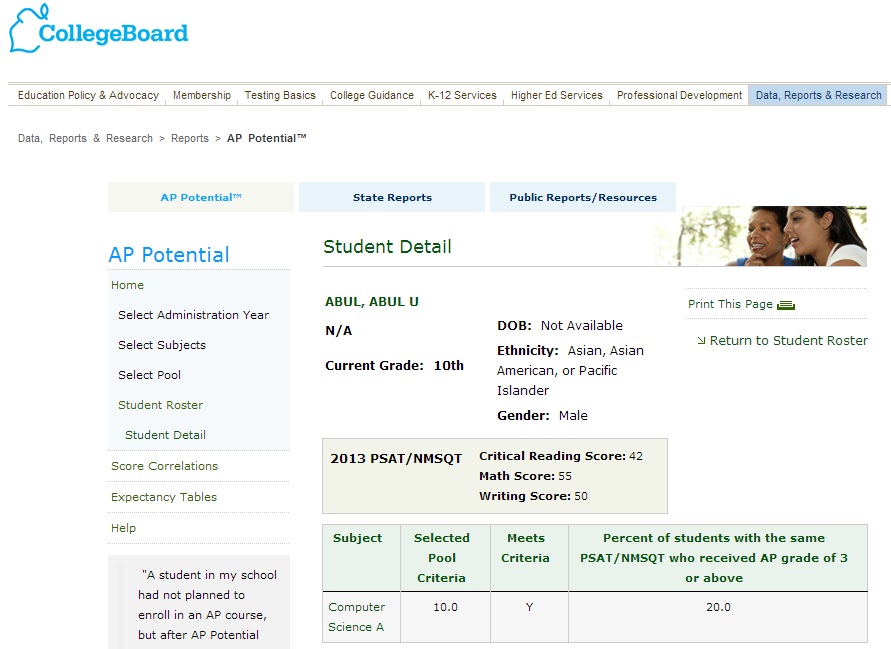
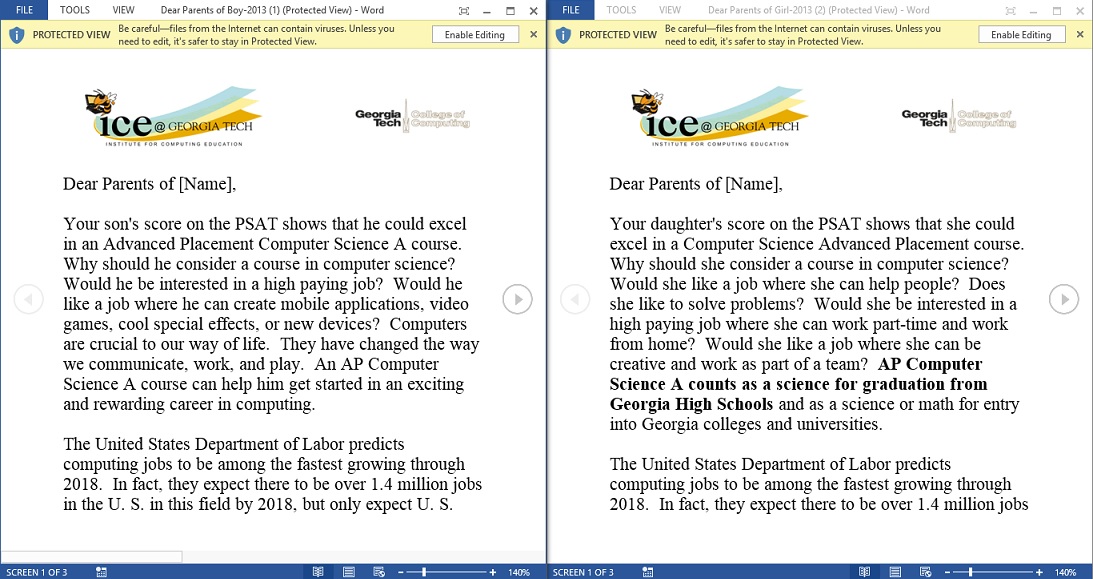
theodp (442580) writes AP Computer Science is taught in just 10% of our high schools," lamented The White House last December as President Obama kicked off CSEdWeek. "China teaches all of its students one year of computer science." And the U.S. Dept. of Education has made the AP CS exam its Poster Child for inequity in education (citing a viral-but-misinterpreted study). But ignored in all the hand-wringing over low AP CS enrollment is one huge barrier to the goal of AP-CS-for-all: College Board materials indicate that the average 11th grader's combined PSAT/NMSQT score of 96 in reading and math gives him/her only a 20%-30% probability of getting a score of '3' on the AP CS exam (a score '4' or '5' may be required for college credit). The College Board suggests schools tap a pool of students with a "60-100% likelihood of scoring 3 or higher", so it's probably no surprise that CS teachers are advised to turn to the College Board's AP Potential tool to identify students who are likely to succeed (sample Student Detail for an "average" kid) and send their parents recruitment letters — Georgia Tech even offers some gender-specific examples — to help fill class rosters. -
Average HS Student Given Little Chance of AP CS Success
theodp (442580) writes AP Computer Science is taught in just 10% of our high schools," lamented The White House last December as President Obama kicked off CSEdWeek. "China teaches all of its students one year of computer science." And the U.S. Dept. of Education has made the AP CS exam its Poster Child for inequity in education (citing a viral-but-misinterpreted study). But ignored in all the hand-wringing over low AP CS enrollment is one huge barrier to the goal of AP-CS-for-all: College Board materials indicate that the average 11th grader's combined PSAT/NMSQT score of 96 in reading and math gives him/her only a 20%-30% probability of getting a score of '3' on the AP CS exam (a score '4' or '5' may be required for college credit). The College Board suggests schools tap a pool of students with a "60-100% likelihood of scoring 3 or higher", so it's probably no surprise that CS teachers are advised to turn to the College Board's AP Potential tool to identify students who are likely to succeed (sample Student Detail for an "average" kid) and send their parents recruitment letters — Georgia Tech even offers some gender-specific examples — to help fill class rosters. -
Average HS Student Given Little Chance of AP CS Success
theodp (442580) writes AP Computer Science is taught in just 10% of our high schools," lamented The White House last December as President Obama kicked off CSEdWeek. "China teaches all of its students one year of computer science." And the U.S. Dept. of Education has made the AP CS exam its Poster Child for inequity in education (citing a viral-but-misinterpreted study). But ignored in all the hand-wringing over low AP CS enrollment is one huge barrier to the goal of AP-CS-for-all: College Board materials indicate that the average 11th grader's combined PSAT/NMSQT score of 96 in reading and math gives him/her only a 20%-30% probability of getting a score of '3' on the AP CS exam (a score '4' or '5' may be required for college credit). The College Board suggests schools tap a pool of students with a "60-100% likelihood of scoring 3 or higher", so it's probably no surprise that CS teachers are advised to turn to the College Board's AP Potential tool to identify students who are likely to succeed (sample Student Detail for an "average" kid) and send their parents recruitment letters — Georgia Tech even offers some gender-specific examples — to help fill class rosters. -
Average HS Student Given Little Chance of AP CS Success
theodp (442580) writes AP Computer Science is taught in just 10% of our high schools," lamented The White House last December as President Obama kicked off CSEdWeek. "China teaches all of its students one year of computer science." And the U.S. Dept. of Education has made the AP CS exam its Poster Child for inequity in education (citing a viral-but-misinterpreted study). But ignored in all the hand-wringing over low AP CS enrollment is one huge barrier to the goal of AP-CS-for-all: College Board materials indicate that the average 11th grader's combined PSAT/NMSQT score of 96 in reading and math gives him/her only a 20%-30% probability of getting a score of '3' on the AP CS exam (a score '4' or '5' may be required for college credit). The College Board suggests schools tap a pool of students with a "60-100% likelihood of scoring 3 or higher", so it's probably no surprise that CS teachers are advised to turn to the College Board's AP Potential tool to identify students who are likely to succeed (sample Student Detail for an "average" kid) and send their parents recruitment letters — Georgia Tech even offers some gender-specific examples — to help fill class rosters. -
The Whole Story Behind Low AP CS Exam Stats
theodp writes "At first glance, the headline in The Salt Lake Tribune — Very Few Utah Girls, Minorities Take Computer Science AP Tests — appears to be pretty alarming. As does the headline No Girls, Blacks, or Hispanics Take AP Computer Science Exam in Some States over at Education Week. Not One Girl Took The AP Computer Science Test In Some States warns a Business Insider headline. And so on and so on and so on. So how could one quibble with tech-giant backed Code.org's decision to pay teachers a $250 "Female Student Bonus", or Google's declaration that 'the ultimate goal of CS First is to provide proven teaching materials, screencasts, and curricula for after-school programs that will ignite the interest and confidence of underrepresented minorities and girls in CS,' right? But the thing is, CollegeBoard AP CS exam records indicate that no Wyoming students at all took an AP CS exam (xls) in 2013, and only a total of 103 Utah students (xls) had reported scores. Let's not forget about the girls and underrepresented minorities, but since AP CS Exam Stats are being spun as a measure of CS education participation (pdf) and equity, let's not forget that pretty much everyone has been underrepresented if we look at the big AP CS picture. If only 29,555 AP CS scores were reported (xls) in 2013 for a HS population of about 16 million students, shouldn't the goal at this stage of the game really be CS education for all?" -
The Whole Story Behind Low AP CS Exam Stats
theodp writes "At first glance, the headline in The Salt Lake Tribune — Very Few Utah Girls, Minorities Take Computer Science AP Tests — appears to be pretty alarming. As does the headline No Girls, Blacks, or Hispanics Take AP Computer Science Exam in Some States over at Education Week. Not One Girl Took The AP Computer Science Test In Some States warns a Business Insider headline. And so on and so on and so on. So how could one quibble with tech-giant backed Code.org's decision to pay teachers a $250 "Female Student Bonus", or Google's declaration that 'the ultimate goal of CS First is to provide proven teaching materials, screencasts, and curricula for after-school programs that will ignite the interest and confidence of underrepresented minorities and girls in CS,' right? But the thing is, CollegeBoard AP CS exam records indicate that no Wyoming students at all took an AP CS exam (xls) in 2013, and only a total of 103 Utah students (xls) had reported scores. Let's not forget about the girls and underrepresented minorities, but since AP CS Exam Stats are being spun as a measure of CS education participation (pdf) and equity, let's not forget that pretty much everyone has been underrepresented if we look at the big AP CS picture. If only 29,555 AP CS scores were reported (xls) in 2013 for a HS population of about 16 million students, shouldn't the goal at this stage of the game really be CS education for all?" -
The Whole Story Behind Low AP CS Exam Stats
theodp writes "At first glance, the headline in The Salt Lake Tribune — Very Few Utah Girls, Minorities Take Computer Science AP Tests — appears to be pretty alarming. As does the headline No Girls, Blacks, or Hispanics Take AP Computer Science Exam in Some States over at Education Week. Not One Girl Took The AP Computer Science Test In Some States warns a Business Insider headline. And so on and so on and so on. So how could one quibble with tech-giant backed Code.org's decision to pay teachers a $250 "Female Student Bonus", or Google's declaration that 'the ultimate goal of CS First is to provide proven teaching materials, screencasts, and curricula for after-school programs that will ignite the interest and confidence of underrepresented minorities and girls in CS,' right? But the thing is, CollegeBoard AP CS exam records indicate that no Wyoming students at all took an AP CS exam (xls) in 2013, and only a total of 103 Utah students (xls) had reported scores. Let's not forget about the girls and underrepresented minorities, but since AP CS Exam Stats are being spun as a measure of CS education participation (pdf) and equity, let's not forget that pretty much everyone has been underrepresented if we look at the big AP CS picture. If only 29,555 AP CS scores were reported (xls) in 2013 for a HS population of about 16 million students, shouldn't the goal at this stage of the game really be CS education for all?" -
College Board Kills AP Computer Science AB
jhealy1024 writes "The College Board recently announced it will be getting rid of the Advanced Placement Computer Science AB examination after May 2009. The 'A'-level exam will continue to be offered, though there is no word yet on what will become of the AB-level material (e.g., if it will be merged into A or just dropped). Many teachers of AP CS are upset about the move, as it seems the decision was made without consulting members of the CS teaching community. As one teacher put it: 'this is like telling the football coach next year is the last year you have a varsity team.'" -
First Java AP Computer Science Exam Complete
BlindSpy writes "Yesterday, Tuesday May 4th, high-school students all over the U.S. took the first-ever Advanced Placement Computer Science College Board exam based on Java. The exam is given as an opportunity for high-school students to earn college credit in programming. The test is based on whichever language colleges are looking for, which signifies a significant step for Java. In past years, the exam has been based on C++ (1 year) and Pascal (around 10 years)." If you took the exam, what were your impressions? -
College Board AP CompSci Exam Will Be In Java
orangesquid writes: "Looks like the College Board has changed the tune for their AP Computer Science test: in a few years, it will be in Java. Eep!" From the announcement linked to in there: "In October 2000, the AP Computer Science Development Committee made a formal request to the College Board that the AP Computer Science curriculum be revised to include object orientation and to use Java as the delivery language for the AP Computer Science Examinations, beginning with the 2003-2004 academic year. The request was approved by the College Board in November 2000." -
College Board AP CompSci Exam Will Be In Java
orangesquid writes: "Looks like the College Board has changed the tune for their AP Computer Science test: in a few years, it will be in Java. Eep!" From the announcement linked to in there: "In October 2000, the AP Computer Science Development Committee made a formal request to the College Board that the AP Computer Science curriculum be revised to include object orientation and to use Java as the delivery language for the AP Computer Science Examinations, beginning with the 2003-2004 academic year. The request was approved by the College Board in November 2000." -
College Board AP CompSci Exam Will Be In Java
orangesquid writes: "Looks like the College Board has changed the tune for their AP Computer Science test: in a few years, it will be in Java. Eep!" From the announcement linked to in there: "In October 2000, the AP Computer Science Development Committee made a formal request to the College Board that the AP Computer Science curriculum be revised to include object orientation and to use Java as the delivery language for the AP Computer Science Examinations, beginning with the 2003-2004 academic year. The request was approved by the College Board in November 2000." -
College Board AP CompSci Exam Will Be In Java
orangesquid writes: "Looks like the College Board has changed the tune for their AP Computer Science test: in a few years, it will be in Java. Eep!" From the announcement linked to in there: "In October 2000, the AP Computer Science Development Committee made a formal request to the College Board that the AP Computer Science curriculum be revised to include object orientation and to use Java as the delivery language for the AP Computer Science Examinations, beginning with the 2003-2004 academic year. The request was approved by the College Board in November 2000."