 Slashdot Mirror
Average HS Student Given Little Chance of AP CS Success
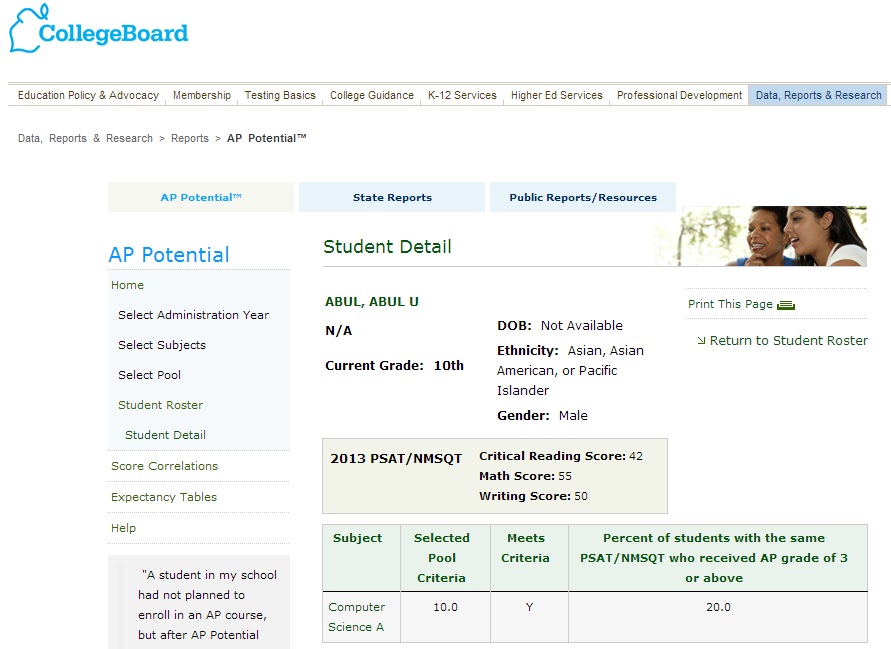
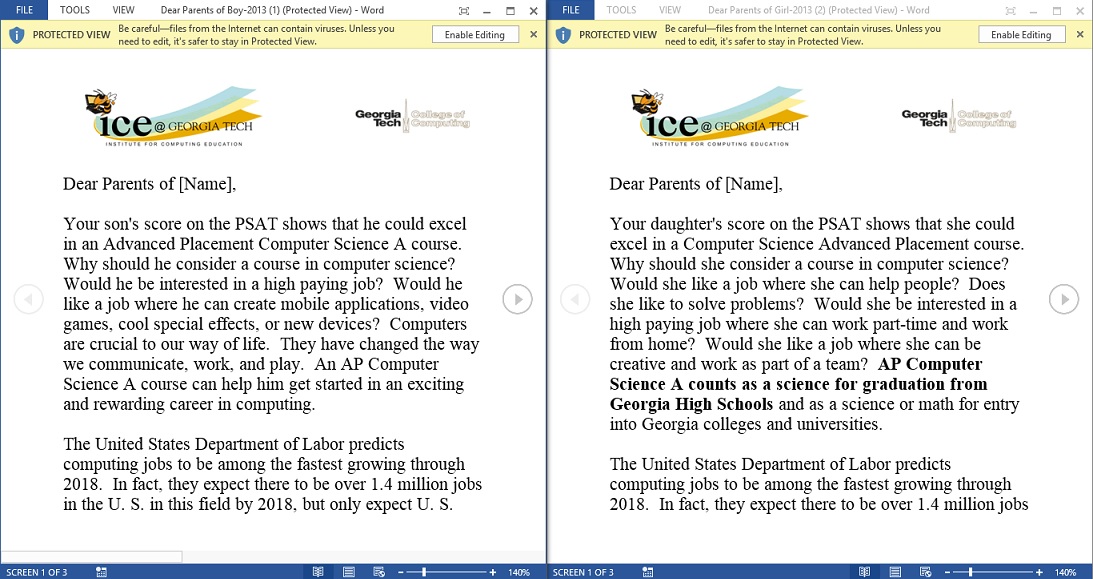
theodp (442580) writes AP Computer Science is taught in just 10% of our high schools," lamented The White House last December as President Obama kicked off CSEdWeek. "China teaches all of its students one year of computer science." And the U.S. Dept. of Education has made the AP CS exam its Poster Child for inequity in education (citing a viral-but-misinterpreted study). But ignored in all the hand-wringing over low AP CS enrollment is one huge barrier to the goal of AP-CS-for-all: College Board materials indicate that the average 11th grader's combined PSAT/NMSQT score of 96 in reading and math gives him/her only a 20%-30% probability of getting a score of '3' on the AP CS exam (a score '4' or '5' may be required for college credit). The College Board suggests schools tap a pool of students with a "60-100% likelihood of scoring 3 or higher", so it's probably no surprise that CS teachers are advised to turn to the College Board's AP Potential tool to identify students who are likely to succeed (sample Student Detail for an "average" kid) and send their parents recruitment letters — Georgia Tech even offers some gender-specific examples — to help fill class rosters.
Average SD article containing TM unclear ABR in TI
So you're suggesting that a K-12 focus on self-esteem doesn't result in outstanding academic ability?
This just in: difficult things are hard, and most people can't do them.
-Styopa
They keep mentioning AP but its not actually written anywhere what this abbreviation stands for.
+1 WTF too many TLAs.
Well, when US schools put emphasis and financial focus on sports, something has to be cut or ignored. I live in Texas, and have seen middle schools with larger stadiums than what I had at my high school in Michigan. Sadly, throwing more money at the problem won't solve it, because it's too ingrained in our culture.
It's OK AS. TM ABR in TI would be "AVG(HSS) good AP CS Success%"
College Board materials indicate that the average 11th grader's...
The "average" 11th grader isn't going to be taking AP classes. There is a reason they call it ADVANCED placement. It's supposed to be hard. It's supposed to be for the top end of the bell curve.
Average HeadShot Student Given Little Chance of ArmorPiecing CounterStrike Success
I took AP Computer Science in 10th grade, scored a 2 on it. I had some friends who were passionate about programming (doing it outside of High School like myself in C++) who ended changing their career choice just off of that test score, who also got 2s. On one hand, yes the AP class was great in that I got good practice every other day in C++ with a pretty good teacher there to ask questions, but the test itself I found very one sided for the folks who were great test takers. Just because I scored a 2, doesn't reflect the teacher's ability to convey how to do a linked list nor does it really reflect a student's abilities.
The emphasis in High School today shouldn't be "well Johnny you probably won't score a 3 so don't bother taking AP CS", but "Johnny we see you're really passionate about programming, why don't you take AP CS?"
They should integrate programming with math classes. They should start students using Mathematica or Sage as early as possible. Programming math problems would teach both math and programming. Students would see programming as a problem solving tool, and not just another burden of something else to learn. If they integrated programming into math classes they wouldn't have to worry about adding programming classes to their curriculum. They could also integrate programming into other classes like science, or even English.
If students are capable of handling AP math, they should be able to handle AP CS--since the way most CS college programs are run, they're basically the same thing.
SJW's don't eliminate discrimination. They just expropriate it for themselves.
I believe two things should be just as important as swimming lessons for kids: coding and judo. Judo because it challenges them physically, improves their confidence and helps them recognize conflicts. Coding because it helps their creativity and computer literacy. In a perfect world, everyone eventually learns how to automate their tasks (or at least to some degree). My two cents though.
Does anyone know exactly what is taught in a CS AP class? I'm sure a lot of people would love to be in a "AP CS" class, but the cold, hard reality is that CS can be very different than what many people thing. Just learning JavaScript to make a hip HTML 5 website, while entertaining to some, is not Computer Science. But teach Lisp/Scheme to the students to learn the value of S-Expressions, or algorithm development will help lead others down the road of Computer Science. Just Building A WebSite != Computer Science.
There's not a thing wrong with being average. By its very definition,and including those slightly above or below the mean, it describes the bulk of our human resources.
Identifying and lifting the gifted out of the noise is always a noble project.
Happiness in intelligent people is the rarest thing I know.
Ernest Hemingway
I do not know why anyone with any sense would worry about low enrollment in CS. A significant number of people do not get Math, and if you do not get Math becoming a programmer is just stupid. CS is a niche subject, worry about how those few in it perform, not filling up classrooms.
Troll is not a replacement for I disagree.
And we wonder why females have little interest in CS? The male version talks about gaming and creating toys, while the female version sounds like they want to target non-mathphobic social workers.
All the female programmers I know (yeah yeah, n=3, anecdata sucks) got into it for the same reasons as their male counterparts - The love of ripping into the metaphorical guts of a computer and bending it to their will. The love of gaming, whether or not it satisfies the current BS about "strong female protagonists". The pure joy of losing countless hours in the trance-like state we enter in a really good coding session.
Then again, they all self-describe as "Tom-boys", so I see it as entirely plausible that those women currently in CS simply fall into the small minority that do like the same things as male geeks. Even if that holds true, however, I find it fairly disturbing that anyone would seriously try to promote a CS degree by offering it in pink.
Even though there was a bit of a gap between the two schools' programs, 30 years ago you could get an introduction to programming and CS concepts in both of them. It seems like we've been back-sliding since then.
I'm trying to teach myself to set people on fire with my mind... Is it hot in here?
Waaaayyy back in the mid-90's, I took the AP CS test my junior year of HS. The test was scheduled right after I took the AP US History test in the AM (I rocked that test with a 5 and passed out of 2 semesters of history for it) and as my brain was fried, I staggered into the principal's conference room to take the AP CS test with another dozen or so kids from my class.
I completely bombed the test (a 2)... my brain was so scorched from the history exam that morning I couldn't make heads or proverbial tails of the essay questions. I got a 2, and I'm glad I did. Why? Because that was when the test was still being administered in Pascal, and by the time I got to college, my school had shifted over to C++ as their main "teaching language". It's no fun taking an advanced CS class when all your assignments take extra time while you give yourself a crash course in C-style syntax everybody else is taking for granted.
That said, despite the fact I flunked the test, my actual high school CS class was excellent. It meant that when I had to re-take intro-to-CS in college all I had to do was learn new syntax for the concepts I already knew; the overlap of the theory was pretty complete.
On another note, why would we expect the average high-schooler to pass a college-level CS exam? It's a hard test, just like it's supposed to be. And it's a subject that many students, no matter their other virtues, don't have much aptitude in. (I'd be interested to know what this one year in "Computer Science" that all Chinese kids are given actually consists of...)
All that said... yes, waaayyyy more than 10% of our high schools need to be offering the class. Every high school surely contains some students with both the aptitude and desire to take such a class.
I suppose that explains why a loser on another thread was telling me that single bit operations are faster than if you operate on whatever size the processor handles internally (eg. 8bit, 16bit, 32bit and now 64bit). Everyone in my high school maths class knew better than that in the 1980s before we even got a chance to get near a keyboard.
Lurking behind this is the Silicon Valley's crony capitalism that's be throwing large sums at the Democratic party and expecting something in return. Glutting the market with programmers offers those companies a way to slash those currently high salaries.
All those jobs will be going to H-1B visa owners.
When Fascism comes to America, it will call itself Anti-Fascism, and tell you to give up your guns.
AP tests are made to get you college credit, but many CS programs won't accept AP credit to fulfill requirements in CS. So there's not a lot of point for a student wanting to become a CS major to take the AP CS test.
Also note it is (or was, it's been a while) possible to take the AP test without taking the AP class.
Throughout my entire educational career, I was a slacker. I got decent grades (if not straight A's) without studying, paying much attention in class, or doing homework. I have a natural aptitude for the humanities and the sciences, and am adequate in math. (Better with applied vs. theoretical math.)
My one exception was foreign languages; I have absolutely no ability whatsoever in foreign languages. In American, I can speed-read, and have reasonable facility with writing. In any other language, it mattered not at all how much I studied, practiced, or did my homework, I was horrible, even by the low standards of an American high-school foreign language class. French, Latin, even American Sign Language as an adult, and I was hopeless. I got barely passing grades in French and Latin out of pity more than anything else.
Some difficult things are simply difficult for some people, and no amount of hard work is going to fix that. Throwing students against subjects they are unable to master is a waste of resource and is discouraging for both the student and teacher. I'm not saying students shouldn't be challenged; just that the idea that "hard work" will magically enable a student to master any subject is toxic.
I already commented on this thread, or else I"d give you a +1 Insightful.
I wasn't complaining that after two years of language instruction, I was not fluent in a language. I was stating that even compared the low bar set by the standards of the class, I was horrible, even in relation to my peers, who were being taught in the same way and came from the same background.
You'll get no argument from me that waiting until high-school to teach foreign language, and then doing so in typical lecture classes, isn't very effective. But that's not what my post was addressing.
There may be something to this. The principal advantage of the AP credit I earned before college was that I was able to avoid some of the required courses outside my major. Though, I certainly would have taken an AP course in my area of interest had my school offered it, because I would likely score and grade well and that would have helped my GPA if nothing else.
Think of all the unlearning that would get in the way of me actually being a decent programmer.
Peace, or Not?
Yep, I thought Armor Piercing CS (gas) round might be useful for getting the crew to bail out so you can capture the tank and use it afterward.
In all seriousness, would anyone like to provide a glossary?
CS I can guess, but AP??
Does it have to much theory and lacking in real skills that are more use fully in the over all IT field?
This is a good point.
If all you are after is a bit of paper. Do not bother with the AP classes.
All of my AP classes transferred but did not get me credit hours. What that meant was I was just simply taking harder classes earlier. I still had to take enough hours to graduate. Which mean I was taking a few 'fluff' classes as I had maxed out on the bachelors for CS. I found my fluff classes intensely dull. Which mean I was wasting money to just get my hours.
I took the AP classes for the same reason. I had maxed out on the normal curve. Instead of heading home at noon I would hang around a couple hours extra to get more free study. Thinking I could use them in college.
Advanced Placement (aka 'grade inflation').
Faster! Faster! Faster would be better!
However, I reckon the real issue is that CS at university cares less about what you did at high school. They want Calculus/Further Mathematcs and Physics for sure, and having Chemistry is a help. It is rare than a college cares about AP CS other than in a token way. All this has the effect of making CS in high schools a complete and utter waste of time, for the student and for the school, which is why CS in high school will (unless things change) always have a wave of enthusiasm sinking back into a slough of "why did we even care?"
Think of it this way, if you go to university wanting to major in X (be it Art, Music, Languages, Sciences, Mathematics etc, anything but CS), they check that you've done X in high school. CS doesn't want X, they want Y and Z. So, the failing to have a proper CS program in high schools that would properly prepare students for CS (and for that matter Engineering and to a degree the Natural Sciences) is that the universities cannot or will not agree to what constitutes a proper preparation for CS.
What makes it worse is the likes of Google, Microsoft etc plump down money for these "feel good, everyone can/should code" initiatives. The kids, their families etc get all excited and then it hits them like a brick - the universities do not care.
I believe if the universities got their act together, or were presented with a solid CS program that fed into their undergraduate core on much more than a "Whee! We can now write functions!" (which is all AP CS provides) then things would get real and be of actual practical good to all. I know there's the smarts for this in high schools, and I know if universities got over themselves they'd be able to as a team come up with something great.
Many good software engineers I know did the same. I passed throught the educational system before a lot of this material was distilled into coursework. With all the public resources out there now- half the MOOCs are on CS topics- its even easier for a motivated person to learn things than when I did. I wish people would stop whining about education.
Advanced Placement is not just grade inflation.
Scoring high enough on an Advanced Placement test will give the student college credit for that course, allowing it (and its tuition) to be skipped.
When I took AP CS in highschool, they were just switching to C++. We actually hard two years of courses and AP was the second year. I pushed to skip the first class (which was basic at the time) and after taking the final was able to.
The school didn't even normally give the exam. After some parental rage, they finely setup so I could take the exam (just me). 45 minutes of test taking earned me a 5/5. Though since all the changes in the exam at the time my college just gave credit for an elective instead of saving from taking a course.
Now we learn from them?
The older ones amongst us might still remember how Japan was all the craze. Everything in your company had to be done the Japanese way. You had books and whole seminars dedicated to how the Japanese did stuff. Fully ignoring (just like this does) that there just might be a hint of a cultural difference that makes the systems fully incompatible.
Then the Japanese economy collapsed because, as we found out, it was all just a huge bubble they inflated for years. At first their economic growth was real. Well, duh! After WW2 their industry was in ruins. Growth rates in the two digit percentage are a given if you go from NOTHING to something. At least it's heaps easier than having two digit growth rates if you are already near the ceiling of what's possible.
Now the same shit again with China. Oh, China has an economic growth! We have to copy China! No, we don't you idiots! China has an economic boom because not only they had jack shit before but also because we let them. That's what makes China's economy grow by leaps and bounds. Going the Chinese way could only cripple our economy (actually, since we're already on the path, it does. Look around yourself and tell me that we're really so much better off than we were a decade ago). Why? Because we already have a living standard the Chinese may only dream of, and we don't have a USA that we can sell our cheap crap to.
Fuck, people, you can't simply copy another country and pretend it will work! Sure as hell it doesn't for economy, why the heck should it for education?
We used to have a Bill of Rights. Now, with the rights gone, all we have left is the bill.
AP is "advanced placement", and the average student should not pass. That would make it meaningless.
An average HS student has little chance of getting AP chemistry, physics, calculus, english, etc. Even AP gym if that were a thing. Average HS students are.. Average.
Advanced Placement classes are those that finish with a nationally established examination. Upon passing these exams students can claim college-level credit. This allows them to start college with higher level courses and possible graduate a semester or two earlier (if they have enough AP credits), thus saving them a lot of money.
How is this 'grade inflation'? It's taking college courses while in high school - if anything your sacrificing your gpa compared to those who take regular (aka easier) high-school courses.
And to think, all I got from this was 'do not let your neices go to Georgia Tech' - seriously they think all wemon want to work from home and part time?
Man from Portland, glad we have half our society out here actually respected.
allowing it (and its tuition) to be skipped
LOL, oh you're serious, let me laugh harder. If you think skipped courses due to AP credits reduce the number of hours needed to graduate at the vast, vast majority of schools you're mistaken. No, it will just let you skip an intro course and fill the hours requirement for your major for something a little less dull.
There are 4 boxes to use in the defense of liberty: soap, ballot, jury, ammo. Use in that order. Starting now.
When I took AP courses they were certainly not grade inflation, and were actually fairly difficult. I had college history courses which were actually far easier than my high school AP US and European History courses.
Then again, I went to a well funded public school in a fairly high-middle class school district. Our Track 1 English classes were on-par with what I had in College, so I don't even want to think about how horrific our AP English classes were.
Though they were still splitting us up by learning speed and putting the smarter, faster learners in higher track classes. Pretty sure that would get them sued now-days.
In my case I had 6 AP credits with a score of 4 or 5 (including CS), the college said "choose two". They were also kind enough to clarify that classes that could be tested out of also counted towards this limit.
I could see not taking it for courses in your major, but they seemed not to want students skipping anything if they could prevent it. I suppose they wanted to make money from the classes, but not accepting them makes the entire AP thing a waste of time.
I'm a signature virus. Please copy me to your signature so I can replicate.
Hate to break it to many modern "CS" grads, but you're probably not learning Computer Science. Unless at least 33% of your major classes were around algorithms, computational analysis for differential equations, compiler theory, artificial intelligence, etc you were in a software engineering degree program and they didn't want to admit it. Not that this is a bad thing. People just need to stop calling it Computer Science, if you're not studying the theoretical.
But that's the thing... 100 years from now, there will simply be no such thing as Computer Science. All of its components will simply merge back with the disciplines they came from ( or belong in ) .. Math, Stats, Physics, Business, Art/Design, Chemistry, Biology, etc.
I find it somewhat silly that the Whitehouse is promoting CS... that time has come and gone. There are plenty of good CS sourced jobs our there.... hundreds of thousands, but the thing is.. the good jobs...the ones that advance the nation, are already being filled by quality people who had the motivation themselves. The middle of the road and low end jobs are the ones that programs like this will likely feed. Will we really have a huge call for all this 2 year programming degrees you see out there? Infinite sysadmins and C sharp programmers?
Massive visualization, Big Data, and Cloud services despite all of their bullsh*t that gets tossed around in the media, will indeed have a great impact on our future... removing a metric crap ton of low end Administrator jobs. SQL DB admin for an office that has 2 database servers? Gone. Widows admin for an office pool of 30 people? gone. Linux admin for small web hosting business? gone. Support team for Laptops/Desktops in the workplace at all? significantly reduced.
Makes me wonder how much the pushers of these degree programs and resulting workforce have thought about this.
I teach a section of AP Computer Science, so I'm getting a kick out of these replies...
To people who don't have any programming experience coming in to the course, the class is a real bear. One of the big issues from the early days of the exam was the push-and-pull between high school instructors and college professors over just what an AP computer science student should proficiently be able to do.
The professors won, and began to dominate the content choices of the course and the exam. Of course, they were full of shit when they did so, and found that people who passed the course weren't usually well prepared for additional CS courses unless they had additional experience outside of APCS. This means that APCS wasn't the predictor it should have been. So there's been all kinds of fun content changes over the years. (I'm not talking about the language change from Pascal to C++ to Java; the material on the exam will be changing about 20% for just the coming year, for example, and I'm making sure I'm at an AP seminar this summer so I can properly prepare.)
As trite as it sounds, part of the challenge is funding. In Texas, where I teach, AP Computer Science is funded with the usual tax dollars, where "business programming", which is too often VB-oriented, is funded at a higher level, making it a more attractive course if you're going to teach programming. Districts and high schools are financially disincentivized from offering this course, and lesser resources are generally available.
Want to teach Microsoft Office? Here, have a brand new lab. Then have a new one three years later. Want APCS? We're sure we can scrounge up something for you. And then they wonder why no one teaches AP Computer Science. Don't get me wrong; I actually think there's a lot of value to be gained out of a properly taught Office course with proper content. But the imbalance is too great.
About 5 years ago, I was asked to go to a meeting of all of the AP teachers of the East region of Houston ISD, in order the share information and resources. (This was back when they grouped schools by geographic regions.) I really didn't want to go, but our counselor convinced me that it was important. So many if not most of the AP teachers are sitting there on gym bleachers. And we're told to meet our cohorts and talk amongst ourselves. And all of these signs go up for the different courses -- US History, Spanish, etc. And I'm sitting there at Computer Science. Then I look to my left, look to my right. And I realized that I'm the only one.
And that's what it's like to be an AP Computer Science teacher.
"You're never ready, just less unprepared."
There's AP and there's Honors... Both have the same material. But AP requires a test. Do you really think that High School kids want to take another test? Besides, even if you take the test, there is no guarantee that the College will accept it - They may give you credits but most likely will require you to take the course anyhow. So.. the article basically means nothing and was written by someone who neither understand education or the tech industry.
They are not taking college courses in high school. The student is not going to a local college and taking the course there. They are taking a "college like" course in high school. The two are not the same, not even close. High Schools like to say AP courses are the real thing but they are not. College professors laugh at you when you tell them you took a AP class.
That whenever Obama talks about anything like this, what he means is "We don't spend enough money on black urban gang members. Also my base wants me to focus on women and LGBTQ and how we can tilt the scales more in their favor at the expense of anyone else."
Many high schools give higher grade points to course designated as AP, IB, etc. For example an A in an AP course might be worth 5 grade points instead of usual 4. Similarly a B in an AP course might yield 4, and so forth. That was the case at the high schools where I taught.
Scoring a 4 or 5 on the AP test does not automatically result in receiving college credit for a course. Each college has its own policies regarding what scores are acceptable to receive course credit, fees for petitioning for course credit, the actual course(s) for which credit will be given (which may vary based on the score), and how the credit will appear on the transcript.
Russians and Asians put much more emphasis on teaching mathematics to their kids. And I say mathematics, not "math" which sounds a lot like "meth," with all associated consequences. Mathematics is the language of science, and there is no computer science without knowing how to speak in scientific language.
some college force you to take PE classes at full price and that price is LOT MORE then a good 2 year health club membership for just 1 class.
AP used to let skip classes not so much in the days of guaranteed student loans.
LOL, oh you're serious, let me laugh harder. If you think skipped courses due to AP credits reduce the number of hours needed to graduate at the vast, vast majority of schools you're mistaken. No, it will just let you skip an intro course and fill the hours requirement for your major for something a little less dull.
False.
Heck, it's even on the official AP exam website:
You can save money and get a head start on your degree when you enter college with credit youâ(TM)ve already earned through AP.
But if you're not convinced, let's look at some of the top schools in the U.S., and what they will do for a person with AP credit. Harvard says the following:
Students may be allowed to use an AP exam score (or appropriate international credential) to meet certain requirements (foreign language, introductory departmental course, etc.).
Students with a full yearâ(TM)s worth of advanced workâ"documented by AP exams, an IB diploma, or certain other international credentialsâ"may be eligible to petition for Advanced Standing. The College grants four Harvard full-course credits, the equivalent of a year of study, to those students who activate Advanced Standing.
In other words, you not only can pass out of a number of requirements, but you can also skip an entire year of college... at one of the top colleges in the U.S.
Even MIT, which is notorious for having one of the most restrictive AP policies in the U.S., will still give you credit for and let you pass out of the first semester of calculus or physics (both required of all MIT graduates) with sufficient AP scores. And you'll get unrestricted credit that can count toward miscellaneous electives you need for your degree or whatever for some other AP tests (e.g., humanities).
Bottom line: At the "vast, vast majority of schools," many AP courses WILL reduce the number of credits you need for graduation, as well as allowing you to skip intro classes.
You're right that many schools will still require you to take something else within your major to fulfill a minimum set of required credit hours. But you'll often still be able to use miscellaneous AP credits toward random electives.
Seriously -- do at least a minimum of research before you show your ignorance while wrongly making fun of somebody.
You don't understand: in America everyone is above average.
Only in Lake Wobegon.
Obama kicked off CSEdWeek. "China teaches all of its students one year of computer science."
Really? Even the children who are working for pennies an hour making spark plugs in a dirt floored factory? Somehow I question that.
I graduated from college in 3 years due to AP exams (took 10 and received credit on 8, placement only for one). Collectively, they saved me about $30,000 in tuition, room, and board. This was from a small liberal arts school.
IT needs more of an trades / apprenticeship model to learning.
at some schools there is to much theory and big skill gaps in the areas covering more of the day to day skills. Yes some theory is good but parts of it are not really that useful vs learning more hands on skills in the field.
Trying to put IT work, networking both WAN and LAN, hardware work, cableing, codeing, QA, research, and others all into CS is bad as some areas need to have there own track and some are very hands with skills that you need to do in an real setting to learn them.
IT has a lot of on going ongoing education but it's time frame is an poor fit for the older College system time tables.
Internships are to hit and miss Apprenticeships are more of formal and last for an extended period of time and have more applicable skills
Yeah, shoot a round and hope they aren't wearing gas masks, you probably won't get a second shot, or use a conventional plasma round and eliminate the threat. (tank killing rounds have a shaped charge that actually jets a superheated metal (plasma) into the interior of the tank.
Cheap storage VM.
There is a school in Harlem that offers stunning success to low income kids and the way they do it is allowing the kids to visit their homes on Sundays only.
I am having a very hard time locating the school you describe. Searches through Google lead nowhere,
Funny mine said "GREAT now I can teach something useful since you have a baseline" and graduating with double majors in CS and NeuroPych in 4 years instead of 5 1/2 didn't hurt me either. But yes they just "laugh" ...or you're an idiot. I know where I'd put my bet
CS is "hard". It is like learning a science, language or math. Yes you can get a crash course in it like learning a language from an audio book, but the skilled people usually have had years of exposure and (Self) instruction. You won't leave learning mathematics to the last year of high school as preparation for a Degree in the subject.
I would argue the mental challenges and understanding to "get" programming is just as large as calculus.
My experience of UK school and degree level programming courses is that since programming wasn't a core course throughout school (age 5+) it was only the self taught computer programming enthusiasts ("nerds") who stood a chance of scoring highly on high school or degree level programming courses. This became very evident at (Physics Degree) level where I participated as a student and later as a TA on the computational physics compulsory core courses. You had people with little/no previous experience who struggled to grasp the concept of variables, arrays, IF statement, and FOR loops and the other extreme with people who could complement the course work in 50% of the allotted time and were using operator overloads and pointers with free abandon.
Solutions: Teach computer programming as a core course throughout school. Just like English (writing) use it as a "tool" in every subject, such as MATH, Science. Bring back home computers with BASIC (or any other language) as the turn on prompt to stimulate curiosity and accessibility form an early age (bundle a quick basic with windows would be a great start).
1. It's a waste of resources to put every student through an AP CS class. As the article notes, most won't get anything out of it. Moreover, most have no interest.
2. While AP CS is only offered in 10% of schools, you have to remember there's some self-selection going on with respect to which school a student attends. The sort of students interested in CS and likely to benefit from an AP CS class will seek out a school where it's actually offered.
3. While students and their parents have some agency with respect to what school they attend, they don't have complete agency so some students will undoubtedly fall through the cracks. I mention self-selection only to point out that the # of students falling through the cracks is likely less than the "only 10% of schools offer AP CS" statistic would suggest.
Not every engineering school is like that though. At Purdue for most math and science AP credits they still require you to take their own placement test during an orientation weekend. They flat out tell you during the physics one that maybe one kid a year will actually score high enough to opt out of the first physics class......so good luck. I got no credit for my AP CS class because they just didnt consider it equivalent to anything in their first year engineering curriculum, maybe if I would have been going as a CS major and not CmpE it may have bought me something
I clicked on this article just because I hoped this comment would be there.
Thank you
For a second there I thought I was reading SAP's community forums again
I have been in IT since the mid 90's. I have never met a person that was good at it that was not interested in it in a hobby form as well. I've met many people that have been to the trade schools, they have certifications and/or have degrees and they were no better (and sometime worse) than the person who did it "on their own".
If someone is not truly interested in CS, forcing them into it is not going to yield great results. I understand giving people the opportunity to try it might spark some interest but those with an interest are probably already doing it on their own and would probably have no problem making it through any class you could offer.
You went to public school, didn't you?
My university gave me the equivalent of 2 years of credits (officially starting me as a junior) for the 6 AP tests I passed.
But my BS still took 4 years.
The real reason there isn't in AP computer science in schools is simple.
Think about most teachers you knew in HS. They probably taught multiple classes, and probably taught at least one main class (a general math, science, history, or language course).
So, you want to add a new computer science class to the curriculum.
Well, you can't hire a programmer or a CS degree holder, for the most part. They make too much money to work part-time.
You can't hire them full time... you only need them for 2 or 3 classes, and the rest of the general classes are handled. Maybe they'll pick up a study hall and a special projects course... but they also get paid less for those courses/periods too.
And you can't find a "normal" teacher that also knows computer science.
I suspect this problem will get easier once we start getting more CS retirees... I would imagine part-time teaching would be an attractive option for side income.
Due to the AP exams I took, I was able to proficiency out of Freshman Rhetoric/Intro Writing course, as well as three credit hours each of Social Sciences and the Humanities. These were granted as credits counting towards my degree. Of course, this was back in '78, too, so things might have changed.
That is all.
Hey all,
I have a very relevant experience about this:
8 years ago, when I was a self-taught computer programmer in high school one teacher recognized my talent -- too bad she wasn't the AP CS teacher. She gave me free CS text books (stolen from the school of course) to read on my own time even though I wasn't a formal student. When she gave me AP CS past exams and she saw that I was actually able to complete them at the 4 or 5 level, she lobbied in the school to get my name on the list to take the exam, even though I wasn't enrolled in the AP CS course.
What happened was, that after a few weeks battle, I was denied to take the exam, because the AP CS instructor feared I may endanger her statistics if I did not do well on the exam (even though I had demonstrated that I could do well on the exam).
Long story short, I am a college drop out now who makes fine enough money doing full-time software development and systems administration. Maybe if I were allowed to take the AP CS exam in high school I wouldn't have dropped out of college.
Oh well. That's our education system at work: we do not care about teaching students, we only care about proving how many students we have taught.
My university gave me the equivalent of 2 years of credits (officially starting me as a junior) for the 6 AP tests I passed. But my BS still took 4 years.
What kind of college only requires three classes per year? My understanding (as someone who has received college credit for AP tests and subsequently graduated) is that a single AP test takes the place of a single class - usually three or four credit hours. You were a junior with only 24 credit hours to your name?
At Purdue for most math and science AP credits they still require you to take their own placement test during an orientation weekend.
Actually, if you read the MIT link, you'll note that MIT does precisely that for Chemistry and Biology credit, for example. If true, this souinds EXACTLY like one of the very schools I mentioned.
They flat out tell you during the physics one that maybe one kid a year will actually score high enough to opt out of the first physics class......so good luck.
Well, this link and this one both clearly state that getting a 5 on the physics C tests (as well as various scores on other science and math tests) will get you credit for various classes, including in the School of Engineering.
Now -- it's possible either (1) things have changed there since you were in school, or (2) you had to take some special version of physics or whatever in the engineering curriculum that was more advanced than they'd give you AP credit for -- but according to Purdue's own website, they DO give credit for AP classes in science and engineering with high enough scores.
I got no credit for my AP CS class because they just didnt consider it equivalent to anything in their first year engineering curriculum, maybe if I would have been going as a CS major and not CmpE it may have bought me something
Which is part of the point I made -- I agreed with the GP that sometimes you have to make a substitution in your major area. However, if you have AP credits in various things (say, AP European History or something), you should often be able to apply them toward requirements outside your major or elective credits, which could potentially save you time and/or money toward your overall degree.
Being able to get AP credit that counts towards requirements and graduation SOMETIMES != Being able to get AP credit ALWAYS. The GP was arguing for NEVER. I was saying SOMETIMES. You say "not ALWAYS." We don't disagree.
Do you speak english?
I know practices vary a lot at different schools. This was at the University of Utah in 1992, and each test gave me a different number of credit hours. I don't remember the numbers, but the least I got for a test was 6 credit hours (most were much more), and no class was more than 5, so every test gave me more than a single class of credit.
In the US the average student will have very little chance of any kind of success. In the US many advanced students with great degrees will stand little chance of success. In the US most adults will hang on by the skin of their teeth. Now excuse me. I have to rush out a grab a ghetto, street hustler and teach him to cook french fries for minimum wage instead of that $200 per hour he makes on the corner hustling dope or stolen guns.
No, it will just let you skip an intro course and fill the hours requirement for your major for something a little less dull.
I took enough courses in the community college I went to that I had 3/4 of the bachelor degree credits when I transferred to the big university. They still required me to take two full years of classes, and I wound up taking classes like "African Politics" and "Cobol" just to get the credits. And "Linguistics". Not "less dull".
I'm fascinated by an article that claims that average students aren't getting AP. "Average" and "Advanced" are kinda orthogonal concepts.
i went to WPI (primarily because they had the best financial aid package-grants/scholarship money-which is odd considering how damn expensive the place was, even back then), with the following AP scores:
BC Calc: 5
Biology 5
Euro History 5
US History 5
Chemistry 4
English Lit 4
German 3
French 3
Physics C 3
i think there was one other one, don't remember... yeah, was sort of a nerd, and 17 years later it matters not one bit. anyway, all i got for that was the ability to skip to Calc 4, and get "credit" (but not credit hours, just "must take such and such class" checkmark) for 3 math classes, and both a chem and bio class. i was also allowed to take a placement test to jump ahead (with no credit of any sort) in German. i did all that, but in retrospect it was a poor idea. would have been better off with the easier intro classes. skipping ahead just got me to a point where i could try to complete a EE/math double-major and find that the advanced math classes were at the same time as the advanced EE classes, so pick one...
anyway, typical or not, at WPI, good AP scores didn't actually reduce the number of classes i needed to take for graduation. i was afforded a bit more flexibility though, since i no longer needed 3 of those classes to be calculus, and 1 to be chemistry. still had to take 6 German classes, 2 physics, and the usual set of math classes beyond calc (linear algebra, diff eq, probability/statistics, etc).
as with most things in life, others' experiences may be dramatically different...
When I took AP CS they had an AB & A exam. A 4-5 on the AB was typically required for college credit, not incredibly difficult if you knew what you were doing. The year after they removed the AB and just had an A...when will they just give this credit out for free?
correlation-causality conclusion. Several decades ago, some education "experts" in the US were looking for ways to raise grades among poorer inner-city kids and they did some studies that found that kids with high "self-esteem" had higher grades. They wrote papers and gave lectures and spread their new-found insights with their peers in the "edu-crat" establishment, and drove a shift in American education: Books were re-written, teaching plans re-drawn, and curriculums mutated all in the name of "raising self esteem" for the kids in order to raise their grades. This has reached its pinnacle with the idiotic "Common Core" where kids actually get better grades for approaching a math problem "properly" than they get if they arrive at the right answer by the "wrong" method!!!
Now American kids have the highest "self-esteem" on the planet, but they suck at math. The education establishment still cannot admit what a few outsiders have started to point out: That they've completely screwed several generations of kids in the name of a false ideology driven by a logical fallacy that any intelligent person would have spotted (but with the "intelligensia" completely missed because they had a social agenda). The simple fallacy was this: High self-esteem does indeed correlate with good grades, but the high self-esteem does not CAUSE the good grades... earning good grades causes kids to have high self-esteem.
The problem with the education professionals is that they are so corrupt and evil. Every year that they delay reforms and corrective actions, another wave of kids graduates and goes out into the world ill-prepared and they will never get the benefit of any "fixes" the educrats might implement "some day". Every year that the unions keep their tenure, keep their crazy "work rules", protect their child molesting members (keeping them on the payroll but in places like the infamous "rubber room" in NYC) refuse to change their methods, or schedules etc (for the benefit of the adults and their union power) is another year that they graduate another slice of society who deserved better.
He's mostly right in practice. If you take an entire semester worth of AP credits and graduate early, then you save money. However, most schools have a full-time rate that applies for any amount of credit hours over twelve. Going from 21 hours down to 13 your freshman year isn't going to save you anything. Going from 21 to 5 will save money by allowing you to register as a part-time student, but that my effect room and board arrangements. Trying to graduate a semester early is a possibility, but some classes are very difficult to take in the other semester from the one their "supposed" to be taken in, plus you'll have to make up the remained of the credits that you didn't AP out of to add up to an entire semester. If you only took one AP, that's almost the same work as just doing a four year degree in three and a half, so the savings is mostly attributed to your hard work, not the AP.
I took AP calc when I was in high school and I got a four an the exam. I just took it again in college for the easy A, that was a bigger benefit for me than skipping it since it wouldn't have saved any money. An A thrown into my GPA was worth more to me than a few hours of down time in the middle of the day.
That word does not mean what you think it does.
30 years ago, computer science courses were a graduation requirement at my high school (in the midwestern u.s.).... the same high school, an ordinary public one not a tech-centric or charter school, also taught college level math and science courses for dual credit to juniors and seniors. the cs requirement remains to this day, and so do the college courses, now augmented by english, literature, psychology, sociology, and history courses.
In practice, skipping a year via AP may make college much harder. Ie, you skip first half year of calculus and immediately start as a freshmen taking classes that are very much more difficult and rigorous than anything in high school, whereas the normal first year classes are usually geared as ramp-up classes. I know it's been awhile, but the students I knew in college who tested out of earlier classes were the most stressed and overworked.
As for credits, most engineering or science students where I went had many more units than required for graduation merely from taking standard courses, there was no need for filler. Even more, some programs it was routine for students to petition to exceed the maximum number of allowed credits for students otherwise they could not have met all the graduation requirements for the major (this was a college system university, so lower division and non-major requirements varied).
The "average eleventh grader" can't write three consecutive sentences of of grammatical English let alone pass any AP test. Actually, the average eleventh grader is not going to go to college, although if you leave out Joe Average, Jill Average is likely to enroll in some sort of post-secondary education.
Some mornings it's hardly worth chewing through the restraints to get out of bed.
I vaguely remember International Baccalaureate CompSci classes were spinning up when I was leaving high school. Did those stick? Are they measurably harder or more focused than AP CS?
http://www.ibo.org/diploma/cur...
https://www.ibo.org/myib/digit...
Holy shit, after reading these comments I feel incredibly lucky.
I graduated HS in 2000, and to make a quick comparison to what I'm reading here:
- I took AP Calc, AP Physics, and AP Comp Sci but my (public) HS offered lots of other AP courses.
- The teachers were made available (my AP Physics class had 8 students - again, in a public school) and they all taught the material instead of the test.
- My AP Comp Science teacher actually knew the material and cared about his students. We had new(ish) computers and a Linux (or Unix - I didn't know the difference at the time) box to log in to.
For taking these 3 exams I got a semester's worth of credits when I went to college. Those 20 credits put me far enough ahead to take classes towards - and eventually earn - a dual degree.
These programs do pay off. I'm glad I had teachers who cared enough to fight for the students, and an administration who listened. To all of the AP teachers out there, thank you for doing what you do. Especially you, Mr Baciewicz.
- "Nobody came out that night, not one was ever seen. But Old Man Stauf is waiting there, crazy sick and mean!"
I agree that the test itself was largely language-independent. But the two years of CS I took to get to that point certainly were not. Nor were the some of the follow-on cources in college-level CS.
Why is any of this a surprise? Do we expect children coming up in the system to be interested in writing code when that job function has been outsourced at every opportunity (or the cheap labor insourced via H1B/L1 visa)?
There was a time when children were taught to sew and mend clothes as well; however, when that industry went global those skills became (or at least were considered to be) obsolete. It may well be the case that programming and software development become similarly obsolete (or less valued). In the age of `disposable tech people` it would seem that, from a practical perspective, students might be better off learning other skills that might keep them more gainfully and more permanently employed.
allowing it (and its tuition) to be skipped
LOL, oh you're serious, let me laugh harder. If you think skipped courses due to AP credits reduce the number of hours needed to graduate at the vast, vast majority of schools you're mistaken. No, it will just let you skip an intro course and fill the hours requirement for your major for something a little less dull.
When I went to college orientation (about 15 years ago), while all of the other incoming freshmen were taking placement exams, I was listening to the school's pitch to the parents. Why? Because I had to take absolutely 0 placement exams.
Based on my AP test scores I skipped:
2 quarters of Chemistry (both required for my major, meaning I did not have to take any chemistry at college) - AP Chemistry 5
2 quarters of Calculus (going straight into the 3rd of the 4 quarter Calculus cycle required for my major) - AP Calculus BC 5
1 quarter of English (required for my major, I had to take 1 English composition course) - AP English 4
1 quarter of Physics (required for my major, I had to take 1 additional Physics course) AP Physics - 4
2 quarters of American Social Studies (required for a General Elective category for my major) - AP US History 5, AP US Government 4
Essentially, these credits saved 2 quarters of real college work toward my degree.
I also received in addition to the above:
5 credit hours Math (the "intro" class to prep you for the calculus series)
15 credit hours Spanish - AP Spanish 3 (I didn't even take the AP class, just the test)
10 credit hours low-level Comp Sci - AP Computer Science AB 5
These additional credits meant that, following my 1st quarter at college, I had enough earned credits to be considered a Junior as far as class rank went, which was nice for having advantages for priority in class enrollment, football season ticket, dorm selection, etc.
Oh, and by the way, this was for an Electrical Engineering degree.
The AP CS classes are available for free online we don't need them taught locally anymore.
Advanced Placement (aka 'grade inflation').
You should see the inflation going on in honors, regular, and remedial classes.
I suggested we add an eighth, maybe even a ninth class to school. Most schools are somewhere between 7:30 am and 3:30 pm. Some start earlier, some start later. However, think what an extra hour would do?
Benefits
1. It would give the students another class to take.
2. It would keep latchkey kids out of trouble and off the streets for one more hour while their parents get home.
3. Some kids don't get breakfast or dinner. Since they are at school earlier and later, they could server breakfast and dinner. This will give the poor kids better food and kids who are well fed perform better in school on average than kids who aren't. It is hard to concentrate on school work with a hungry stomach.
4. A peer tutor hour could happen. This would be extremely beneficial in student grading. It has been demonstrated that teaching something is one of the best ways to learn a subject more deeply and permanently. The good students will get better themselves as they help raise up the struggling students.
Problems:
1. Money. If teachers work to teach an extra class or two, they also have more to grade, etc. So teachers salaries would need to be raised and a few more teachers hired.
2. Too much homework for the kids.
3. Sports players need that time.
Solutions:
a. Add one hour as a peer hour where top peers tutor lower peers in a library-like setting. Make this hour required for kids whose do not have supervision until they get home. Not required if the student has a stay-at-home-parent.
b. Make another class an "in class" only course. Where there is no homework. Many skill are beneficial to learn in one hour a day blocks with little or no homework. Typing, cooking, reading practice, Physical Ed, etc...
c. This hour may pay for itself as the amount of crime between 3pm and 5pm is rather high, and would decrease significantly, so lower juvenile court costs, etc...these costs will eventually be reallocated.
d. Making the sports team puts you in a "class" for that sports team from 3pm to 5pm.
With one or two extra classes, an intro to Computer Science course that has limited homework but is more of an in class training, can be mandatory for all. Then the AP Computer Science class would be the next logical course and those who took the intro would likely take the next course.
Anecdotal example:
My son graduated high school with plenty of AP credits and plenty of University credits (the University of Minnesota operates a program for mathematically talented young people to learn lots of college-level math), so he had slightly over half the credits needed to graduate when he was accepted. At this point, he was considering mechanical or electrical engineering, switching to computer science (specializing in software engineering) after his first serious programming class.
The big initial benefit was that he got good registration priority, as students with more credits register before students with fewer. He also had the advantage of knowing more about math and engineering than most other students. After one summer class, he's going to graduate after three and a half years, which is nice for my savings.
One issue is that his major courses have to be strung out over a period of time, at least if he's respecting prerequisites. Another is that, while they satisfied some requirements, they didn't satisfy all: his AP physics was considered insufficient for an engineering student, so he took another physics class.
From his and my point of view, it was well worth doing (although he probably would have graduated high school with more honors if he'd gone for easier classes, he wanted the harder stuff), but the tangible benefits in getting a BS are limited.
"When you have eliminated the unacceptable, whatever is left, however improbable, must be the truthiness" - Holmes
Only kids who have been doing programming on their own outside of any laughable school computer courses is likely to do well enough to have AP-level skills.
Corporations are running Pyramid scandals in the name of Capitalism
Casteism
There are radio ads playing in TN about how high school sports makes better students, citizens, etc. The only way I can see that it makes better students is by motivating the dead shits that are on the teams to want to at least make a D in their classes. High school sports are also a big thing in the midwest, southern, and western states in my experience, especially in small towns where it and other school activities are practically the only live entertainment that people don't have to drive to "the big city" to watch.