Slashdot Mirror
Domain: columbia.edu
Stories and comments across the archive that link to columbia.edu.
Comments · 1,401
-
Re:Simple solution?
reintroduce the faster immigration system you used to have for PhD graduates.
Did you know that your government is in fact doing the opposite? If you get any kind of education from a US university on the standard J1 visa, and any of your funding was from the US government or your home government (almost always the case), then you are required to return to your home country for at least 2 years before you can apply for a visa to the US. This requirement remains even for people who get married to US citizens.
-
Re:Dude!
It is by no means guaranteed that the sea level rise will be limited to 1 meter per century, even for this century. The IPCC predictions are conservative, don't include melting ice cap contributions, and assume that we would be more aggressively cutting emissions by now. From a paper on the subject:
"Rahmstorf (2007) made an important contribution to the sea level discussion by pointing out that even a linear relation between global temperature and the rate of sea level rise, calibrated with 20th century data, implies a 21st sea level rise of about a meter, given expected global warming for BAU greenhouse gas emissions. Vermeer and Rahmstorf (2009) extended Rahmstorf's semi-empirical approach by adding a rapid response term, projecting sea level rise by 2100 of 0.75-1.9 m for the full range of IPCC climate scenarios. Grinsted et al. (2010) fit a 4- parameter linear response equation to temperature and sea level data for the past 2000 years, projecting a sea level rise of 0.9-1.3 m by 2100 for a middle IPCC scenario (A1B). These projections are typically a factor of 3-4 larger than the IPCC (2007) estimates, and thus they altered perceptions about the potential magnitude of human-caused sea level change.
Alley (2010) reviewed projections of sea level rise by 2100, showing several clustered around 1 m and one outlier at 5 m, all of which he approximated as linear. The 5 m estimate is what Hansen (2007) suggested was possible, given the assumption of a typical IPCC's BAU climate forcing scenario. Alley's graph is comforting, making the suggestion of a possible 5 m sea level rise seem to be an improbable outlier, because, in addition to disagreeing with all other projections, a half-meter sea level rise in the next 10 years is preposterous.
However, the fundamental issue is linearity versus non-linearity. Hansen (2005, 2007) argues that amplifying feedbacks make ice sheet disintegration necessarily highly non-linear. In a non-linear problem, the most relevant number for projecting sea level rise is the doubling time for the rate of mass loss. Hansen (2007) suggested that a 10-year doubling time was plausible, pointing out that such a doubling time from a base of 1 mm per year ice sheet contribution to sea level in the decade 2005-2015 would lead to a cumulative 5 m sea level rise by 2095."
Additional caveats and quid quo pros follow in the paper, but it's safe to say that there's a bunch of scientists who would not bet much money on at most a meter of rise in this century.
-
Re: Learn OpenCL
-
Re:"Liberty-Minded"?
You're wrong. Simply wrong.
The harms begin with the individual injury - someone being discriminated against for non-work-related reasons.
They move towards the society because they aggregate. One person gets away with discriminating against women ("Why should I hire her, she'll just get pregnant") or any other class, and others follow suit. This is commonly used today by employers who discriminate against women in terms of wages, trying to blame the women ("well they took X years off for pregnancy" or "well they didn't push as hard as men for promotion") when in fact as we have seen from evidence such as the Lily Ledbetter case, the reality is systematic discrimination and attempts to hide the evidence.
So you are simply, unequivocally, 100% wrong. The level of harm is both individual and aggregate.
-
Re:Yeah...
I am the brain, your thinking organ. Thou shalt not read the DailyMail except purely for entertainment value. Read Hansen's original text, which is much more nuanced, and speaks of a remote possibility under the assumption that we burn all fossil fuels.
-
Re:Would most people be better off undiagnosed?
Back in the olden days when they still repaired computer boards rather then simply throwing them out, the way they figured out which chip needed to be replaced was by using electrical equipment to test circuits. It took forever even back then, with much simpler circuits, but if you had the right tools you could still do it today.
I'm quite aware of that because when I was studying in university I was also working as a tech, repairing IBM/360 [alike] video terminals, like this and like this - though marginally newer.
I must tell you, there is nothing you can do, regardless of how many tools and test equipment you pile up, unless you have the detailed schematics of everything in that box, and placement diagrams of all components. And even then you would be completely baffled now and then; for example, when you have a multiple component failure.
I'm glad that medication helps you and others. Computers sometimes can also be medicated like that. I have a box that, until recently, was crashing randomly when it is cold. Keeping it running 24/7 prevented the crashes. (In the end, it was the HDD that was the cause.)
-
Re:No warrant ? No problem !
I was going to say, "If the Taliban and Al Qaeda were just saying bad things about the US, they wouldn't be on the business end of the drones."
However, the case of Anwar al-Awlaki gave me pause. He was a fellow saying bad things about the US. However, he inspired multiple mass casualty Al Qaeda terrorists and recruited for them, so he was killed.
Seditious speech in the US has only limted protections.
See also Hate speech and incitements to violence. They're not totally protected in the US either, from what I understand.
-
Prior Art: MMUSIC
The IETF MMUSIC (Multiparty Multimedia Session Control) Working Group started working on Session Protocols in 1993.
Initial Internet drafts for a Session Invitation Protocol and a Simple Conference Invitation Protocol were prepared in 1996, and merged to a single first draft of SIP by December 1996 (slide 10), with further drafts (2-12) leading up to the publication of RFC 2543 in March of 1999 (slides 11-13, ibid.).
I don't see anything that says BT had a hand in anything to do with SIP up to 1996. More than half the patents BT claims (Exhibit C) were filed after RFC 2543 was published.
I hope this information is a useful starting point for some SIP vendor. -
Re:...not only Higgs "coincidence"
There are solutions to this conundrum: Supersymmetry makes all the corrections to the Higgs mass cancel precisely (above some energy scale) and Large Extra Dimensions lowers the scale where gravity becomes important considerably.
I thought that LHC and other recent experiments have gotten close to entirely ruling out most Supersymmetry theories.
-
Re:"Towards the northern hemisphere"
Sorry, but the unprovable mays that you present are equally as likely as donkeys flying out of my ass.
Well there is evidence of increasing desertification. Now do you have evidence that donkeys are likely to fly out of your arse or is that just uninformed speculation.
-
Re:... another low?
A classic 36 bit computer:
http://www.columbia.edu/kermit/dec20.html -
And before 1980...
PUB desk-top publishing of journal articles in early 1970s.
TVEDIT CRT text editing in 1960s.
PUFFT, "The Purdue University Fast Fortran Translator", Saul Rosen et al, CACM 8(11):661-666 (Nov 1965). Fast Fortran compiler and runtime for IBM 7090/7094 (32K 36-bit words of RAM)
SOAP for IBM 650 Symbolic Optimizing Asembly Program, 1955.
Art Samuel's checkers programs 1950s The first self-learning program; alpha-beta search.
-
Re:Kuwait?
Coverage on the English Al-Jazeerah is of no value. They usually just follow / copy other English media.
Right, that's why they report stories that a lot of the American media won't even touch, and report the same story from a different perspective. That's why they've won the Columbia Journalism Award.
Some examples of what you're missing if you ignore them:
- They covered the Egyptian revolution very very different viewpoint from, say, the New York Times. If you read only American press, you'd think that Mohammed Morsi was a dictator. If you read or watch Al-Jazeera English, you'd know that he was the duly elected winner of a hotly contested election.
- They exposed the details of a negotiation session between Israel and Fatah over who was going to own what in the West Bank, including actual video. The editorial aftermath was highly critical of both sides.
- They've reported on the effects of US drone strikes beyond the typical "US officials say that 15 militants were killed in a drone strike in Pakistan today." -
Re:No, the question is: what happened
The sun isn't getting hotter. Water vapor isn't light enough to escape Earth's gravity well in any appreciable quantity. Plate tectonics are driven by convection currents in the Earth's mantel, not the oceans, and if anything the (extremely unlikely) ceasing of tectonic activity would decrease CO2 emissions.
=Smidge= -
Re:Just another way to bash someone's success
If you knew anything about psychopathy, you would know that it's simply not possible for normal people to think like a psychopath. For example, it's simply not possible for them to feel remorse. The wiring just doesn't exist in their brain. While normal people can occasionally do bad things, they are hardly the same people.
The psychological studies are't science. It may become one some day -- going far beyond the scientific ground work developed by the likes of William James and others; until then, it's diluted with the politics of social engineering. There's too many sociopaths involved in this field using their position to advance their personal beliefs and professional careers -- by giving support to the group-think fashionable for the times. Once someone is accurately or inaccurately officially labeled anything by the psychological community, it'll be a problem for the rest of their life.
Richard Feyman's thoughts about psychiatrists and psychologists are classic examples of a definitive answer (imho) explaining what is wrong about their field of work and the standards they use to form conclusions.
Who are the witch doctors? Psychoanalysts and psychiatrists, of course. If you look at all the complicated ideas that they have developed in an infinitesimal amount of time, if you compare to any other of the sciences how long it takes to get one idea after another, if you consider all the structures and inventions and complicated things, the ids and the egos, the tensions and the forces, and the pushes and tthe pulls, i tell you they can't all be there. It's too much for one brain or a few brains to have cooked up in such a short time. However, I remind you if you're in the tribe, there's nobody else to go to.
That was from a published lecture series titled, "The Meaning of It All'. There's an unverified story members of the psychology department at the University of Washington in Seattle stood up in "solidarity" and walked out. He has elaborated about how psychology can be bad science on several ocassions, most notably in his discussions about Cargo Cult Science. Feyman was not one known for his diplomacy.
-
Re:Disruption
In about 30 seconds with Google, I found:
- an entire book on the subject
- Greenpeace, for whatever their word is worth, claiming that the Koch brothers have donated over $61 million to the cause of denying global warming.
- a 2007 article from Newsweek about it.I could keep going, but the point is that this is a demonstrably incorrect counterargument (or the pro-global warming folks have some sort of massive conspiracy that they've been able to keep going for a couple of decades).
-
Go Ask Alice?
-
Re:Haven't read TFA
Luckily, now there's an economic crisis, so we're starting incinerating plants over here in italy too.
We're not starting, we have more than 50 incineration plants. The incinerator in Brescia has been burning trash and warming homes since 1998. It even won the WTERT industry award in 2006.
Why don't you get your facts straight before commenting?
-
Re:Pro death == pro stupid
I have never seen a good study of the actual proved innocent after death penalty administered, but I imagine the numbers will be very low.
The Colombia University Law School has done a study, which suggests the error rates are high: http://www2.law.columbia.edu/instructionalservices/liebman/liebman_final.pdf
For those interested in additional details, the appendices to that report (mostly tables of data and lists of cases) are in a separate document, viewable here.
-
Re:Pro death == pro stupidI have never seen a good study of the actual proved innocent after death penalty administered, but I imagine the numbers will be very low.
The Colombia University Law School has done a study, which suggests the error rates are high: http://www2.law.columbia.edu/instructionalservices/liebman/liebman_final.pdf
-
See Peter Woit / Not Even Wrong
Peter had a pretty good first glance reaction to the paper: http://www.math.columbia.edu/~woit/wordpress/?p=5104
I haven't seen any good discussions of the actual math content of the paper yet though.
-
Re:Not Published = Trash
Let me get this right - you are declaring an entire field of science worthless by fiat as your argument as to why the politically inconvenient situation of global warming should be ignored?
No, of course the field of science is not worthless. Feynman did point out that some fields of science do have difficulties following good principles, however.
But that was not my point. My point was that saying a report was put on the desk of President Johnson proves nothing, and furthermore saying that the science is settled shows an incredible ignorance, perhaps willful, about AGW. There is a LOT we don't know.Are you some sort of cargo cult loser that loves the fruits of technology,
Interesting you mention cargo cults. You should read Feynman's take on the topic, I have no doubt you will enjoy it. Because he is a good writer.
-
Re:My immediate response was
Unfortunately, no. Many intelligent young students are already going into high-energy theory and string theory (the primary recipients of this prize). In fact, there are far more students than jobs. I'm a recent PhD from a top physics (and particularly string theory) school. My classmates in string and high energy theory who recently applied for postdocs applied to 100 in order to receive 1 job offer; none of their jobs were in the U.S. These are not permanent jobs; they are usually 2 or 3 year positions, paying $40,000 or so. At the end of this time, you may then enter the lottery for the (literally) one string theory faculty job per year (see http://www.math.columbia.edu/~woit/wordpress/?p=4701 for job statistics). This is what causes students to leave to go to Wall Street, and piping in more money to the already-established best of the best of the field will not change this.
The purpose of this award seems to be to raise the profile of so-called "fundamental" theoretical physics; perhaps it will cause more funding to be directed in that direction, which might be good. More likely, it will simply encourage more optimistic, talented students to step into the meat grinder of a particularly depressed job market, making it even worse, and eventually redirecting another generation's best minds into Wall Street.
I'm not saying don't celebrate physics (I love physics, and am continuing in the field, though on a much more applied topic, where there is more funding) - but there is already enough hype for string theory, and it burns out enough students already.
Yes but how will that solve any problem in society in specific? It might help for weapons development, as physics helped create the nuclear bomb. It might help create the internet but it also creates the surveillance the NSA uses. Once again I see none of the scientists actually trying to figure out how to explain to regular people what benefit this can have on their lives and their quality of life.
Will we have better video games? A faster internet? A more secure internet? A more secure society? Focus on what people actually care about to market your research.
-
Re:For fuck's sake, not string theory!
I apologize for (indirectly) criticizing inflation. I guess my anger blinded me to the fact that Alan Guth was among the winners, precisely for his work in inflation.
But as for SUSY, I disagree with you. To completely rule out a theory is very very hard (a "definitive" test of Bell's inequalities is still not done even today, and some more exotic models of hidden variables will never be ruled out). I think the experimental community agrees that "reasonable" SUSY has already been ruled out. See what Résonaances has to say about it. Tommaso Dorigo is already collecting bets on the failure of the LHC to deviate from the Standard Model. Peter Woit is, as usual, full of skepticism.
The particular link you sent me was written before the Higgs announcement, and even it admits that a 125 GeV Higgs creates serious problems for SUSY.
So, yes, I am of the strong opinion that SUSY -- as we know it -- is dead. Perhaps some of its offspring can survive and get some experimental evidence, perhaps something completely new will replace it. I don't know. But SUSY is no more.
-
For fuck's sake, not string theory!
I'm a physicist. As far as I know, the only one who has done real work in physics is Alexei Kitaev, for his amazing contributions for quantum computing. The rest work on either untestable ideas (string theory), or testable ideas who have been shown to be wrong (supersymmetry). I guess that's what you get from a guy who knows nothing about physics but saw something about string theory on the TV and found it cool. Nature has a more or less balanced report; for a more inflamatory one, I recommend Peter Woit's blog.
-
Re:My immediate response was
Unfortunately, no. Many intelligent young students are already going into high-energy theory and string theory (the primary recipients of this prize). In fact, there are far more students than jobs. I'm a recent PhD from a top physics (and particularly string theory) school. My classmates in string and high energy theory who recently applied for postdocs applied to 100 in order to receive 1 job offer; none of their jobs were in the U.S. These are not permanent jobs; they are usually 2 or 3 year positions, paying $40,000 or so. At the end of this time, you may then enter the lottery for the (literally) one string theory faculty job per year (see http://www.math.columbia.edu/~woit/wordpress/?p=4701 for job statistics). This is what causes students to leave to go to Wall Street, and piping in more money to the already-established best of the best of the field will not change this.
The purpose of this award seems to be to raise the profile of so-called "fundamental" theoretical physics; perhaps it will cause more funding to be directed in that direction, which might be good. More likely, it will simply encourage more optimistic, talented students to step into the meat grinder of a particularly depressed job market, making it even worse, and eventually redirecting another generation's best minds into Wall Street.
I'm not saying don't celebrate physics (I love physics, and am continuing in the field, though on a much more applied topic, where there is more funding) - but there is already enough hype for string theory, and it burns out enough students already.
-
IBM Interpreter
Takes me back to my old Air Force days as a computer operator. Had to run decks through the 558 twice, replacing the wiring panel, to interpret all 80 columns.
http://www.columbia.edu/cu/computinghistory/interpreter.html -
CFC114
One thing that is not immediately obvious is that the primary greenhouse gas from the Nuclear industry is not Carbon Dioxide but Chlorinated Fluro-Carbons (CFC114) a greenhouse gas 20,000 times more potent than C02. Whilst it's equivalent effect is slightly over 8 megatons of C02 (a conservative estimate per year since the bans on CFC began) more potent is the destruction this compound causes to the ozone layer and it's eventual effect on Phytoplankton which creates more breathable oxygen than the Amazon.
whilst the focus is on the negation of C02 it's important to recognise the systemic effect in the environment of the industrial compounds used to produce the fuel in the first place. Here are some quick quotes and links to understand Phytoplankton's role and susceptibility to ozone depletion;
Or of course you could just go straight to UNITED NATIONS ENVIRONMENTAL PROGRAMME: Environmental effects of ozone depletion: 1998 Assessment. Sure it's over 10 years old, but that's roughly an extra 450,000 kilograms of CFC114 per year from enrichment operating, I don't imaging it's got any better.
-
Re:Wikipedia
It's all explained in the published papers. Nothing nefarious about it.
To quote Skeptical Science:
Does the divergence problem mean we cannot rely on tree-ring growth as a proxy for temperature in the past? Briffa 1998 shows that tree-ring width and density show close agreement with temperature back to 1880. To examine earlier periods, one study split a network of tree sites into northern and southern groups (Cook 2004). While the northern group showed significant divergence after the 1960s, the southern group was consistent with recent warming trends.
This is a general trend with the divergence problem - trees from high northern latitudes show divergence while low latitude trees show little to no divergence. Before the 1960s, the northern and southern trees tracked each other reasonably well back to the Medieval Warm Period. This suggests the current divergence problem is unique over the past thousand years and restricted to recent decades.
-
Re:Yes, Cleared of Wrongdoing"
Which part did you disagree with, that "good scientists welcome opposition" or that "they love it when someone tries to poke holes in their theories?"
I'm not alone in saying this, Richard Feynman said the same thing. -
Re:How stupid they think hackers are?
Here, read this paper if you think ASLR on 32bit architectures is worth much of anything....
I'll give you a hint from the Abstract
We conclude that, on 32-bit architectures, the only benet of PaX-like address-space randomization is a small slowdown in worm propagation speed. -
Re:The simplest explanation
Sometimes decades of peer-reviewed research is wrong.
There are clues to when it might go wrong. When it does, there was always some kind of questionable scientific behavior going on, like not double-checking experiments, etc. (Some of those are discussed here).
Usually it happens in fields that are harder to check, for example, neurology, where you can't dissect living people's brains to test your theory, or economics, where it's impossibly to set up a double-blind experiment of economies to see exactly how your tax cut/stimulus will affect things. In the case of the sun, it's just hard to get up close to and look at. Hard to collect good data of what's going on.
But where you can collect good data, it's rare that there are mistakes. Every high school physics class has verified the acceleration of falling objects, that's not likely to be overturned any time soon. -
Re:For the last f**king time...Equal-time standards never applied to newspapers. Newspapers don't have strict decency standards, except what they give themselves (or you've never seen a porn newspaper?).
But that's besides the point, the point is that if someone owns a printing press, they have far more representation in speech than someone not having representation, and we, as a people, are ok with that.We needn't lower ourselves to browbeating -- we are obviously both intelligent enough to discuss this matter on its merit.
It's not actually clear to me you are. I question the intelligence of anyone who takes "corporate personhood" too seriously, and doesn't understand that it's a legal fiction. The supreme court doesn't actually consider corporations to be people, nor do they have all the rights of citizens, since they aren't people.
Furthermore, and more importantly, it's not clear to me you are following Richard Feynman's excellent advice, that you need to attack your own ideas, especially the ones you like, more than anyone else. You need to find all the potential holes in them. This is the hallmark of wisdom. -
human languageRemarks of Professor Eben Moglen. AALS Mini-Workshop on the Internet and Legal Scholarship. o. New Orleans, Louisiana, January 5, 1995.
Believing that any linguistically rich environment for interaction between people and computers will be commercially unpopular, the designers of operating systems want u s to live in an infant's world. They show you pretty pictures, and in order to communicate you point at the appropriate picture and grunt.
The most important accomplishment of humanity is language, it is the single most important invention. Without language we would not have culture or technology. But here we are, trying to eliminate language from computer and replacing it with hieroglyphs and symbols.
The only problem with the CLI is the illiteracy fostered by Windows and the still prevailing inconvenience of the DOS like command prompt. Some people think that if there is no GUI for a problem, there is no solution at all. Most people do not even know that you can actually tell a computer what to do instead of clicking on abstract symbols. We humans tell other humans all the time what to do. We left runes and hieroglyphs and symbols millenia ego, but if you tell people you can actually tell a computer what to do they will not known what you mean.
What is so difficult to tell the computer to "find . MyFile" or "whereis firefox" or to "reboot", or to print the current "date"? Or to "sleep 5m && reboot"? or to "wget http://some.server/some.file && poweroff"?
If you tell me, you have to remember the commands, then I have news for you: humans are very good in remember commands (aka words). We remember at least 10,000 words for everyday usage and if you speak multiple languages, that number can go pretty high. So why do you think the CLI is only for "geeks" and a regular user should not use the CLI at all? Is it because you think of "regular" users are stupid and can't learn anything? I watched flight travel agents and McDonalds workers use the CLI all the time. Or is it more that the dominant operating system on desktops have a horrible command line interface?
-
Re:Thoughts as a former Creationist.
So, these seismometers - they can send a signal to the alleged core, and it will bounce back in such a way that we can be certain the core is X miles deep, Y miles in diameter, and made up of Z?
Yes, pretty much. Except that the signals are either earthquakes or nukes.
Really? Sounds cool! Got a link?
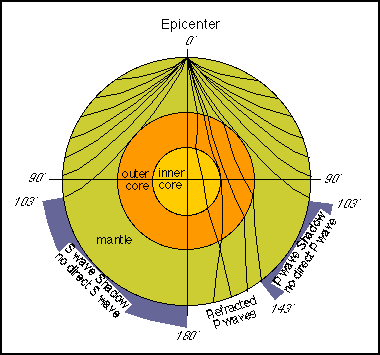
Vacuum, gasses, liquids, and solids reveal different properties in how sound waves pass through them (with vacuum revealed by not transmitting sound at all of course). Sound waves can also be focused to create images, like the way dolphins can see with sonar. Where building a suitable lens is impractical you can use multiple sound sources and/or multiple listening points as a virtual lens to compute an image. Here's a good link explaining a 1998 confirmation of a solid inner core below the molten mantle and molten outer core: Earthquake Provides Proof That Earth's Innermost Core Is Solid.
Another link is: Evidence for Internal Earth Structure and Composition. That one gives more explanation on how seismic waves are used to see the inner earth, but mainly I'm linking it for this image which illustrates how seismic stations at different points on earth see seismic waves passing through different parts of the earth. Seismic stations at the bottom of the image see seismic waves which reveal the inner and outer core. Note that it takes something like a half hour or more for waves from an earthquake to arrive at the opposite side of the planet. Different kinds of waves travel at different speeds and arrive several minutes apart, with the difference in timing between different kinds of waves providing rich additional information of the composition of the earth along various paths. Different kinds of waves can be analyzed separately to compute images of different aspects of the inner earth.
-
-
Re:Thoughts as a former Creationist.
So, these seismometers - they can send a signal to the alleged core, and it will bounce back in such a way that we can be certain the core is X miles deep, Y miles in diameter, and made up of Z?
Yes, pretty much. Except that the signals are either earthquakes or nukes.
Really? Sounds cool! Got a link?
Vacuum, gasses, liquids, and solids reveal different properties in how sound waves pass through them (with vacuum revealed by not transmitting sound at all of course). Sound waves can also be focused to create images, like the way dolphins can see with sonar. Where building a suitable lens is impractical you can use multiple sound sources and/or multiple listening points as a virtual lens to compute an image. Here's a good link explaining a 1998 confirmation of a solid inner core below the molten mantle and molten outer core: Earthquake Provides Proof That Earth's Innermost Core Is Solid.
Another link is: Evidence for Internal Earth Structure and Composition. That one gives more explanation on how seismic waves are used to see the inner earth, but mainly I'm linking it for this image which illustrates how seismic stations at different points on earth see seismic waves passing through different parts of the earth. Seismic stations at the bottom of the image see seismic waves which reveal the inner and outer core. Note that it takes something like a half hour or more for waves from an earthquake to arrive at the opposite side of the planet. Different kinds of waves travel at different speeds and arrive several minutes apart, with the difference in timing between different kinds of waves providing rich additional information of the composition of the earth along various paths. Different kinds of waves can be analyzed separately to compute images of different aspects of the inner earth.
-
-
Re:I hate these articles and this subject.
All that you ask for there has been done. Here are some of relevant links:
http://eesc.columbia.edu/courses/ees/climate/labs/radiation2/index.html
http://sos.noaa.gov/datasets/Atmosphere/ceres.html
http://en.wikipedia.org/wiki/Earth's_radiation_balance -
Re:hmm
There is no anthropogenic hypothesis. That argument is a red herring and a perfect example of a tragedy of the commons. Just because your actions alone do not influence climate, that does not mean it is inconceivable for the collective efforts of humanity to influence climate. The Northern Atlantic cod fishery collapse is a contemporary example of the phenomenon. But to address your question:
The Earth has well known indicated and inferred reserves of coal, gas, and oil. They are not currently part of the short term carbon cycle. As we oxidise these reserves, we add a known quantity of carbon to the atmosphere. The concentration of carbon dioxide in the atmosphere has been measured over several decades, and has been increasing. If the carbon dioxide stays in the atmosphere, the Earth has to warm (physics). Up to this point, I have been stating facts that you--personally--can verify in your kitchen; the hypothesizing begins here:
1. Is there a mechanism that can offset the heating or buffer the carbon dioxide?
2. Is there a mechanism that can remove the excess carbon dioxide from the atmosphere?The falsifiable, hypothetical answer to those two questions is "no". Our best understanding of climate does not offer any obvious short term carbon sinks or heat sinks. If you want to put a time-scale on it, the Ocean could potentially buffer the atmospheric increase in carbon dioxide on the order of maybe 1000 years. Unless another buffer exists, significant consequences should manifest in the next 50-100 years.
-
Re:What's up with the trolls?
The "event" was intended to be symbolic. It's too bad that hardly anyone bothers to interpret "the event" in a broader context, so as to be able to better understand the complex nature of the world in which we live.
The U.S. president at the time, ol' what's-his-name, told us the best we could do as a nation was to carry on and go shopping.
Paul Pillar's book, Intelligence and U.S. Foreign Policy, will inform you as to the ridiculous nature of his decisions subsequent to that suggestion. And if you need to be reminded about the rest of his tenure, then you're probably not going to pay attention to this post anyway.
Focusing on this news item as if it has any significance, other than hubristic tivia, is a ridiculous waste of time. So, it's perfect for
-
Re:Greenland history
Yeah. Remember what we said about realclimate.org? That article is by a guy talking about his boss. Do you think he's going to say how bad the predictions are?
If you look at the graph you linked to, the green line means we add a lot of CO2 to the atmosphere, the blue line means we add a little CO2 to the atmosphere, and the purple line means we stop adding CO2 to the atmosphere entirely by the year 2000. The reality is we added more CO2 than the blue line, but less than the green line. So if the model were accurate, temperature should track between the two.
If you look at updated data in that first diagram, you can see that the land-sea temperatures are below scenario C, ie below what he estimated if we stopped emitted CO2 completely. The satellite temperature reading is off from between A and B by nearly half a degree. If I were trying to be misleading, I could say he was off by 100%.
Our other dataset, the land-only dataset, can be seen updated here, but even that is off by 30% or so. It's not clear why the land data is diverging from the other two records. -
Re:Anthropogenic = bad
"Nearly two-thirds of urban settlements with more than 5 million inhabitants are at least partially in the 0 to 10 meter low elevation coastal zones" (source: http://www.earth.columbia.edu/news/2007/story03-29-07.php )
If you happen to live at altitude and don't care about most of the world, you can sit back and enjoy it. I think you'll find the economic impact of flooding low-altitude cities hits you pretty hard though.
-
Re:Science versus economics versus politics
I doubt there are really too many numbers. For instance you could pick just one weather station and show the annual averages over a 30 year period. That would give you only 30 numbers.
Perfect example. The trend will be much smaller than the random year-to-year variation at a single weather station over 30 years. If you do see a trend, it may be due to global warming, it might be random chance, or it might be because they built a parking lot next door a few years ago. To see a clear signal, you need to take the average of every weather station on Earth, and you need to account for the spatial distribution of stations, changes in the landscape near the stations, and a host of other factors.
The changes are too subtle to see at a single weather station, but that doesn't mean they're not real or important.
Also if the data is "publicly available" then how about a link?
http://iridl.ldeo.columbia.edu/
That ought to satisfy your curiosity for a few centuries.Admittedly even if I found the temperature data to be convincing. Even if the warming trend seemed conclusive. I would hesitate to jump to the conclusion that combustion was the cause of it. That really is a very difficult thing to demonstrate. Because the 'experiment' lacks a control. If climate scientist can figure out a way around that problem it would certainly help to sell the idea of AGW to rational skeptics.
We have figured out several ways. The important ones are:
* The spatial pattern of warming (in particular, stratospheric cooling) matches predicted greenhouse gas changes, but does not match other natural processes.
* Computer climate models of 20th century climate reproduce what actually happened in the 20th century only if human greenhouse gas emissions are included, and not otherwise.
* 20th century climate change appears to exceed all natural changes in the past 1000 years, implying that a human process is at work. (This data is too uncertain to prove the point on its own, but it does corroborate.)Combine these arguments that natural changes cannot explain the current warming with a demonstration that what humans have done is *sufficient* to cause the observed changes (confirming that we do emit enough CO2, and it is powerful enough to cause the right amount of warming), and you've got a pretty solid argument.
I appreciate your description of yourself as a "rational skeptic", because rational skeptics are willing to listen. It sounds like you believe what you do because you've mostly seen the press releases, and not the actual arguments the scientists behind them are making. I'd encourage you to read the "Attribution" section of the IPCC Working Group 1's "Summary for Policymakers" and Technical Summary. The Wikipedia article on attribution of climate change is also (currently) very good. Many of the objections you make have been made within the scientific community over the years, and eventually addressed with new data.
-
Re:Remember folks weather isn't climate, unless it
My understanding of the science (some of this is recent) goes like this on this point. If you look at "paleoclimate", what you get is that the last time it was as warm as it is projected to get, the sea level was meters higher. http://www.cmar.csiro.au/sealevel/sl_proj_longer.html That is, the temperature may be predicted by models, but the melting is predicted by "history". What history lacks is a record of how fast things melt during rapid change, because past change was not as rapid as what is currently observed and predicted.
At the fast-melt end, there's this: http://www.giss.nasa.gov/research/briefs/hansen_15/ I followed the links and attempted to understand them, but did not to my satisfaction. One paper notes that we seem to be observing accelerating melt rates (but it is too soon to tell for sure). The other paper ( http://www.columbia.edu/~jeh1/mailings/2011/20110118_MilankovicPaper.pdf ) is harder to understand. One issue is the difference in methods of estimating old temperatures; ocean sediment cores give one result, ice cores give another. If you believe ice cores, we have a couple of degrees C before we hit the icecaps-melt temperature; if you believe the ocean cores, we have a few tenths of degree C (i.e., we're essentially there now). Hansen also discusses much faster icecap disintegration, but I have not followed the reference chain all the way back to the papers that reached those conclusions (it appears to be based on more paleoclimate studies, and some inferences from the rate of temperature change then versus now).
And I've been trying to make sense of the Hansen predictions, because at the high end, they suggest rates as fast as 5 centimeters per year, occurring sometime later in this century, which I think counts as alarming.
-
Just getting old
Old guys love to jaw about the weather. Be sure to read this one when you write: http://www.columbia.edu/~jeh1/mailings/2012/20120105_PerceptionsAndDice.pdf
-
Re:No volcanos
...the moon has none, as long as we've been observing it.
Don't be so sure.
The Moon has shallow (non-tidal) Moonquakes. No one knows much about their causes.
No other solar system body (except, of course, for the Earth) has had any seismological data at all. (One of the Viking landers had a working seismometer; it was totally swamped by wind vibrations; at most it may have detected the grand total of one Marsquake, but that's not clear.)
-
TLP, baby
The Moon has Transient Lunar Phenomena - lights and other features that come and go. These have
been observed enough, over a long enough time, and are correlated enough with recent lunar features to make me think they are real.So to me, the real questions is, are these LRO features correlated with the TLP locations ?
-
Re:So...
Which, like most things you read on the Heartland Institute funded WattUpWithThat blog, isn't true.
http://www.columbia.edu/~jeh1/mailings/2012/20120130_CowardsPart2.pdf
-
Re:So...
You mean like this:
It would be if it were actually true. But it's not.
http://www.columbia.edu/~jeh1/mailings/2012/20120130_CowardsPart2.pdf
-
Re:1 Degree Change, sure, but what's the StDev?
This is a good question. A recent paper by Hansen, Sato, and Ruedy addresses exactly this point. It shows that while the mean temperature is rising the standard deviation is widening: http://www.columbia.edu/~jeh1/mailings/2012/20120105_PerceptionsAndDice.pdf. A result of this is the emergence of a category of summertime extremely hot outliers, more than three standard deviations () warmer than climatology. This hot extreme, which covered much less than 1% of Earth's surface in the period of climatology, now typically covers about 10% of the land area.
-
Re:How "An Inconvenient Truth" can it get
Might be a good deal faster than that, but it will be decades before we know.
See http://www.giss.nasa.gov/research/briefs/hansen_15/
Or http://www.columbia.edu/~jeh1/mailings/2011/20110118_MilankovicPaper.pdf (skip to "summary discussion", 7c: "Paleoclimate records include cases in which sea level rose several meters per century, even though known natural positive forcings are much smaller than the human-made forcing. This implies that ice sheet disintegration can be a highly nonlinear process.")
Hansen proposes to fit an exponential curve with 10-year doubling, but initially you can't tell the difference between exponential and quadratic, and the possible mechanisms for rapid sea level rise and not entirely known (as in, can glaciers really move that fast?). He bases his argument on "best data from the paleoclimate says several meters per century happened in the past, and temperatures not far from where we are now".
The paper in which the fast paleoclimate sea level rise is studied: http://www.planetwork.net/climate/Hansen2007.pdf
One question I don't see an answer to (yet) is whether the fastest rise occurred earlier in the glacial melt -- i.e., when ice sheets all over the northern hemisphere were melting, not just Greenland. But (apparently) Antarctica has plenty of potential.