Slashdot Mirror
Domain: cotf.edu
Stories and comments across the archive that link to cotf.edu.
Comments · 14
-
Re:Last Resort
but I am not convinced about the need of an AV on each desktop, laptop etc.
There are several papers out there describing malware spreading in corporate networks (full disclaimer: I wrote one of them). I'll give you a hint towards why you want AV on each and every machine: Because once your perimeter has been penetrated, the worst-case scenario for a well-crafted malware to infect your entire corporate network is measured in seconds. Give it the usual caveats because the worst-case scenario rarely happens in the real world, but even if you give it two orders of magnitude - can you contain an actively spreading infection in a few minutes?
So, what's going to be cheaper (in a corporate context, everything boils down to money in the end)? The moderate cost of keeping AV installed and updated on all machines, or the cost of rebuilding the entire windows network - servers, clients, notebooks, everything? Oh, after taking down everything and putting the network into quarantine to make sure no infected devices remain? Do you even know how to do that or will you have to figure it out while doing it? How much downtime are we talking about here? Days or weeks? If you said anything with "hours", you are kidding yourself big time.
Do the usual math: Sum up the best-, worst- and likely-scenario costs, multiply by a rough guess of chance of it happening per year and compare that to doing the usual AV routine. Oh, and don't forget to ask the CTO, CIO or CEO if he's willign to sign off on that risk. I'm very sure you'll have a signature on your AV purchase form long before you're halfway through the list of direct impacts for the other scenario.
Because that's the other ugly truth about corporations: Someone has to make the decision, and the bigger your company is, the more risk-averse it usually is. Most importantly, human and also manager (for those of you who don't include PHBs in the "human" category) minds are famously bad at estimating unlikely, but dramatic risks, especially in regards to more probable but smaller risks.(*)
So you will almost always get a moderate expense to prevent an unlikely, but catastrophic signed off easier than getting someone to sign off on the risk. If you have formal sign-off procedures. Just ignoring the risk by not doing something about it happens frequently and is a lot easier than accepting the risk, and totally not the same thing.(*) Which is one reason why many more people are afraid of flying than of driving, even though the chance to die in a car crash is about 1:6000 while the chance to die in a plane crash is about 1:1000000 (both per year, source).
-
MAGMA software info and some ideas
Here are some links I found to papers describing the software used.
FWIW I am also intrigued about what is happening at this planet. I could imagine:
- tremendous storms at the twilight zone, perhaps mixing in elements from the cold side, or maybe just spreading ash worldwide?
- With the solar winds above and heat from below, it might be like a fluidized bed reactor with all kinds of things being created - all kinds of compounds. Falling gems indeed!
- Solar wind buffeting the silica and other things in the atmosphere, could perhaps create spongy material, aerogels, glassy wings that whirl toward ground like maple seeds.
- life possible? Maybe somewhere in the world..Okay. Use of the MAGMA software is described briefly in Fractional Vaporization of Hot Earth-like Exoplanets and a description of the algorithms and data used in the program are provided in
L. Schaefer and B. Fegley. A Thermodynamic Model of High Temperature Lava Vaporization on Io, Icarus, 169, 216-241.Note that according to the abstract of Schaefer and Fegley's Vaporization of High Temperature Magmas on Io "Galileo NIMS observations indicate magmas with temperatures of 1700-2100K on Io. Vaporization of rock-forming oxides should occur at such temperatures. "
Also Exploring the Environment of Volcanoes gives for Earth: 2000 degrees C: Iron-Rich Rock (i.e. still rock even while under tremendous pressure 500 miles underground), and 5000 degrees C: liquid iron
(2900 miles underground).You may also be interested in Heavy Metal Frost on Venus
and an overview of some of their research here.There is another program called CONDOR that Fegley and Lodders made, which is described on their site. (See condor2.html for algorithm info.) This program is for gaseous atmospheres.
-
Re:Ten billion hectares is a LOT ...
First off, the article says 1 billion hectares, not 10 billion. That does make your 10,000,000 km^2 number correct, though.
Let's run some numbers.
According to http://en.wikipedia.org/wiki/Agriculture, wheat production for 2004 was 627 milion metric tons. Wheat yields seem to be in the 50-150 bushel per acre range (see http://www.cotf.edu/ete/modules/climate/GCremote5.html and http://wiki.answers.com/Q/What_is_the_average_yield_of_wheat_per_acre). A bushel of wheat is generally taken to be 60 pounds (see http://extension.missouri.edu/publications/DisplayPub.aspx?P=G4020).
So per acre we get (50-150)*60/(2.2*1000) == 1.4-4.2 tons.
Given the 627 million ton production figure, that comes out to somewhere between 150 million and 450 million acres devoted to wheat cultivation. An acre is about 4047 square meters, so that gives us somewhere between 600,000 and 1,800,000 square kilometers devoted to wheat cultivation right now.
Borlaug's work raised yields by a factor of 3 or so, right? Therefore without his work achieving similar wheat production would have required an additional 1,200,000 to 3,600,000 square kilometers (120 million to 360 million hectares) devoted to wheat cultivation.
Similar methods have been applied to other cereal crops, of course. From the same Wikipedia article on Agriculture, maize production is 721 million metric tons. World-average yields are in the 4 tons per hectare range (http://www.fao.org/docrep/004/ad452e/ad452e0m.htm). That gives about 180 million hectares. Again, assuming yields rose 3x or so due to Borlaug's work that would have meant 360 million additional hectares of maize.
We haven't even looked at rice (which has total worldwide production similar to wheat and maize) or barley (about 4x less) yet.
These are all ballpark numbers of course, but 1 billion hectares isn't sounding all that implausible to me based on the above.
-
Re:Damn globe
I'd say more like Global Cooling. Stratospheric volcanic clouds are more likely to reflect sunlight back into space, thus are more likely to cause cooling than contribute significantly to greenhouse effect. See http://www.cotf.edu/ete/modules/volcanoes/vclimate.html
-
Re:Sure...
If you'd look past the first line you'd see a link addressing the claim, which would be reasonable for someone with no access to the internet or a good library. If you had an attention span longer than a sugared-up moth with ADHD you'd see that. Wait don't stop reading yet! There's more!
The prevailing scientific opinion tells us that the current global warming trend is almost certainly caused in large part by humans (yes I realize that's a golden opportunity for GW denier humor, I'd reword it if I could). For this to be wrong, many of the theories and models in use in climate science would have to be very wrong, which would raise the question of why they've been working so well for everything else the whole time. Don't let the stupid political freakshow distract you from the real issues.
Some graphs you'll have a hard time explaining with whatever natural phenomenon you blame global warming on:
http://www.cotf.edu/ete/images/modules/climate/Figure10.gif
http://en.wikipedia.org/wiki/Image:2000_Year_Temperature_Comparison.png
http://en.wikipedia.org/wiki/Image:Radiative-forcings.svgPlease, leave this to people who know what they're talking about.
-
Re:So now we have the
http://www.cotf.edu/ete/modules/climate/GCremote3.html
I'm tending to think though that the '5 degree' was projected future warming, in Fahrenheit for the next 100 years of human global weather change.
if 80% of the ice on Kilimanjaro melts from 1 degree of change, imagine what 5 degrees is going to do! -
Re:I can't believe it's come to this...
Still though, that's a 1 in 11,000 (I think?) chance of dying by terrorist in 30 years. Just at thought.
If the numbers at http://www.cotf.edu/ete/modules/volcanoes/vrisk.html are even remotely accurate, it's significantly more likely you'll die of cancer, in a car crash, of heart failure or be murdered in the next year.
The only reason terrorism gets so much publicity is that successful attacks are apparently random and kill a large number of people simultaneously. -
Re:200 yearswarmest year in roughly 200 years
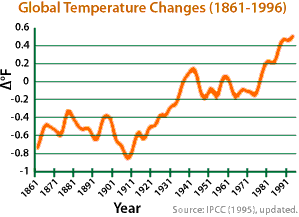
Where did you get that? Not from the original article I think. It is saying that 2005 could be the warmest year since direct temperature measurements began to be made world wide approx. 130 years ago. This doesn't automatically mean we missed warmer years shortly before then.Here's a link to a graph of the temperature trends the above article is refering to: http://www.cotf.edu/ete/images/modules/climate/GC
c limate1PICT3.gif -
Re:Super volcanoes exist.
whoops.. messed up my links. Guess I should use preview. Here are the ones I wanted to throw in..
I was reading about volcanoes a couple months back when Mount St Helens http://vulcan.wr.usgs.gov/News/framework.htmlcame back to life and thats what I learned of Yellowstones history and how absolutelly massive it is.
Here's an image http://www.cotf.edu/ete/modules/volcanoes/vyelupli ftmap.html marking the rise in Yellowstone's surface over the past year. -
Re:The only way to motivate
Perhaps then this will convince you.
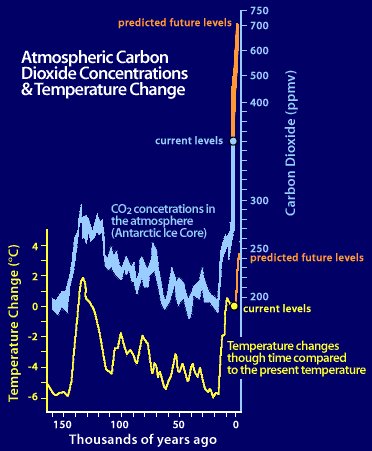
The point of that article, and expecially the excellent graph in it, is that we've pushed atmospheric CO2 levels far above what they've ever gone to in recent geological history. That, and the mean global temperature is being pushed above even their highest estimates of its natural fluctuations. Worse yet, this is all happening in the equivalent of a geological microsecond.
I think if you look at the sizes of the different schools of thought on this, you'll find that the number of scientists who think we're screwing ourselves outnumbers those who think it's a natural phenomenon by about 10:1.
-
Everything I know...I learned in thermodynamics class:
- We will never consume all the oil in the ground; if we tried, we'd be dead from global warming before we managed to burn it all.
- Electricity and hydrogen are not energy sources, they are energy currencies (or carriers).
- Electricity and hydrogen are complementary:
- Electricity can be transmitted over distance efficiently, can be used by data processing equipment, can be converted to physical work (motors). Electricity can be converted into hydrogen (with a conversion cost).
- Hydrogen can be stored (eg: for use in airplanes). Hydrogen can be converted into electricity (with a conversion cost).
- Fuel cells don't require hydrogen; you can use any fuel in a fuel cell.
- What makes fuel cells great is they are not limited by the Carnot cycle. Internal combustion engines are heat engines. All heat engines have an efficiency upper bound converting energy into work. Fuel cells are not limited by the carnot cycle and therefore have higher theoretical maximum efficiency.
- Nuclear is an energy source - one of the only energy sources not involving the carbon cycle.
- Nuclear is expensive.
- Clean, non-nuclear energy sources (wind, solar, tidal, etc) collectively cannot provide enough energy to satisfy our needs, making nuclear an eventuality, not an option.
-
Re:Great...
You're kidding, right?
Carbon cycle
Hint: Plants take in CO2. -
Re:Why 'Kahn is so great
Thats perfectly possible, assuming you are in a powered craft. Its only not possible if you are in a free-fall (non-powered) orbit.
Hold on. Do me a favour. Take a look at this site.
Then can you tell me if you think using your 23rd Century space drive to hover over the south pole meets this definition of "orbit"?
Or you can use this definition . or this one , or this one , or this one , or this one .
-
Technology? What about intelligence in general?
Who says that intelligence is the ultimate goal in evolution? Intelligence could be just another evolution dead end just like the dinosaurs. (Remember, the dinosaur s where successful, it took major catastrophic event to end their reign)
Technology/science has helped us to live "better" lives since we are more productive. But are are our lifes better. I've heard theories that hunter/gatherer/early farmers "worked" few hours a day, and where are we now? 8hrs+ workdays, stress, no time with our families (remember, families used to work together, the elderly taught the younger).
Maybe this is the reason we haven't heard from other life forms, intelligence is a dead end from evolution point of view, but it's early and I havent got my caffeine fix yet, so I'm just rambling...
J.
crap! slashdot is f*cking up my href's! (yes, I did use preview)