Slashdot Mirror
Domain: craigslist.org
Stories and comments across the archive that link to craigslist.org.
Stories · 24
-
Craigslist Personals, Some Subreddits Disappear After FOSTA Passage (arstechnica.com)
An anonymous reader quotes a report from Ars Technica: In the wake of this week's passage of the Allow States and Victims to Fight Online Sex Trafficking Act (FOSTA) bill in both houses of Congress on Wednesday, Craigslist has removed its "Personals" section entirely, and Reddit has removed some related subreddits, likely out of fear of future lawsuits. FOSTA, which awaits the signature of President Donald Trump before becoming law, removes some portions of Section 230 of the Communications Decency Act. The landmark 1996 law shields website operators that host third-party content (such as commenters, for example) from civil liability. The new bill is aimed squarely at Backpage, a notorious website that continues to allow prostitution advertisements and has been under federal scrutiny for years. In a bizarre turn of events, the Department of Justice also warned the House in February 2018 that the bill "raises a serious constitutional concern," as it would apply retroactively -- a seeming violation of the Constitution's ex post facto clause. Congress passed it anyway. The Electronic Frontier Foundation wrote in a blog post: "It's easy to see the impact that this ramp-up in liability will have on online speech: facing the risk of ruinous litigation, online platforms will have little choice but to become much more restrictive in what sorts of discussion -- and what sorts of users -- they allow, censoring innocent people in the process." -
Interview With A Craigslist Scammer (infoworld.com)
snydeq writes: Ever wonder what motivates people who swindle others on Craigslist? Roger Grimes did, so he set up a fake Harley Davidson ad on Craigslist and requested an interview with each scammer who replied to the ad. One agreed, and the man's answers shed light on the inner world of Craigslist scamming: "If you mean how often I make money from Craigslist, it depends on the day or week. Many weeks I make nothing. Some weeks I can get five people sending me money. But I respond to a lot of ads to get one email back. I'm not only doing Craigslist -- there are many similar places. I haven't counted, but many. It takes many emails to get paid. That's what I mean. Some weeks I lose money. It's harder than most people think. But I don't have to go into a place at a certain time and deal with bosses and customers. I can make my own time." Grimes asked the scammer a number of questions ranging from "How do you know when you have a good victim?" to "What country do you originate from?" and everything in-between. He ended the interview asking the scammer for any words of advice for readers. The scammer responded: "It's getting harder for business people like me to be successful, but if they [the victims] follow the rules it would be very hard for me to be successful. That's one of the surprises. My friends and I thought we would not be successful for so long, especially with how Craigslist is different now. But there is always someone looking to sell something who doesn't know the game." -
The Best Parking Apps You've Never Heard Of and Why You Haven't
Bennett Haselton writes "If you read no further, use either the BestParking or ParkMe app to search all nearby parking garages for the cheapest spot, based on the time you're arriving and leaving. I'm interested in the question of why so few people know about these apps, how is it that they've been partially crowded out by other 'parking apps' that are much less useful, and why our marketplace for ideas and intellectual properly is still so inefficient." Read below to see what Bennett has to say.I casually asked a couple of my friends in Seattle -- where street parking is often unavailable, and parking garages vary widely in price -- if they'd ever heard of an app that would let them find the cheapest available parking garage, based on the time they wanted to enter and the time they planned on leaving. (Street parking is usually cheaper if you can find it, but the app would be useful for times that you can't find any.) Most of my friends said that they'd never heard of such an app, but they'd definitely use one if it existed. I also looked up parking apps on Google but the small subset that I randomly tried out, didn't do what I needed. So I thought about writing a "Somebody-with-more-time-than-me-should-go-and-do-this-thing" article, similar to the ride-swapping piece, when one of my friends casually mentioned the BestParking app.
Well, I tried it and it worked. (Lest I be accused of undue favoritism, ParkMe does the same thing just as well, although I didn't find it until later.) In both apps, you bring up a map centered on your current location, or scroll the map to where you plan on looking for parking later. You enter the time that you'll be entering and leaving, and the app shows a map with each parking garage represented by an icon showing the dollar amount that it will cost to park for that time. Without these apps, comparing rates is an annoyingly complex process to do by hand, in a crowded city like Seattle with many garages with different rates (and different times when their "evening rates" kick in -- usually 5 PM, but ranging from 4 to 7 PM), but the apps factor all of that in to give you the cheapest garage for the given time range. You can tap the individual garage icons for more information (if you plan on returning by 11 PM but you're not sure, you'd probably prefer a 24-hour garage instead of one that locks up at midnight). Also, if you're sitting at your computer and you already know the neighborhood where you'll be parking later, you can do the same search on each of their websites. (Although if you are on your phone, please don't do this from a moving car, duh. In Seattle there are plenty of 3-minute spots where you can pull over and do a search.)
So, I've been quite happy with both apps -- but I thought it was interesting that almost none of my friends had ever heard of them. I threw a quick survey up on Amazon's Mechanical Turk website, which I've used before for crowdsourced surveys and other experiments. I polled 50 people, offering them 25 cents apiece to answer these questions:
Would you use these apps? Section A: Parking garage app
Suppose a website and/or smartphone app existed where you could specify a neighborhood of a city, and enter a start and end time for when you wanted to park, and the app would automatically find the cheapest parking garage for that time range (assuming its too hard to find street parking).
1. Are you aware of any such apps/websites that already exist? If yes, whats the name of the app? (No need to do a web search -- only answer "Yes" if you already know of such an app or website.)
2. Would you use such an app/website if it existed? (Or, if youre aware of such an app that already exists, do you use it?)
Yes/No Section B: Spare room rental app
Suppose a website and/or smartphone app existed where you could list a room in your house as a temporary rental, and visitors to your city could rent it out for a single night, or more.
3. Are you aware of any such apps/websites that already exist? If yes, whats the name of the app? (No need to do a web search -- only answer "Yes" if you already know of such an app or website.)
4. Would you use such an app/website if it existed? (Or, if youre aware of such an app that already exists, do you use it?)
Yes/No
The second section, about a spare room rental app, was thrown in as a control in the experiment -- I knew the answer to that question (AirBnB), and I thought a large portion of the survey-takers would too, so I wanted to make sure they weren't just filling out the survey with blow-off answers to get the 25 cents as fast as possible.
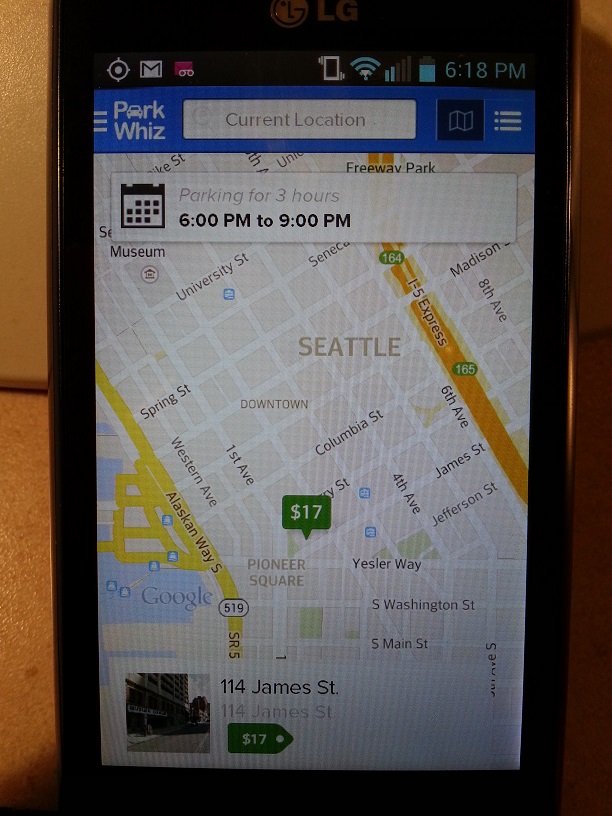
Of the 50 people who filled out the survey, 14 of them said they had heard of using AirBnB, Couchsurfing, or Craigslist for the purpose of renting out a room or finding one to rent (almost all of them mentioned AirBnB specifically). But of the same 50 respondents, only two of them mentioned any parking apps that they had heard of, and only one of them mentioned one of the two that I'd found which actually worked. (The other person mentioned an app called ParkWhiz, which, when I tested it out, only displayed one $17 parking garage in a neighborhood where I know of several $5 garages, which BestParking and ParkMe did list correctly.)
This seems to confirm the anecdotal evidence from my survey of my Seattle friends -- there is a great deficiency in awareness of these apps, relative to how useful people would find them if they knew about them.
So how is it that people are finding -- or not finding -- these apps? In a Google search for "parking app", the first result was an ad for ParkWhiz. BestParking and ParkMe did show up in the results, but so did another one called Parker, as well as a Mashable article by Kate Freeman listing "7 City Parking Apps to Save You Time, Money and Gas". Of the apps listed in the article, the only city-specific one that worked in Seattle (PrimoSpot) has been discontinued, and of the non-city-specific ones, only Parker is still around. (The article doesn't even mention BestParking or ParkMe, although I don't know if they existed when it was written.) Finally, a friend in my survey told me about an app called Parkopedia, which has over 100,000 downloads on Google Play (the same as BestParking, and more than ParkMe).
So even if it did occur to you to look for a parking-garage-finding app, the problem is that if you randomly picked one of the five most popular parking apps (BestParking, Parker, ParkMe, Parkopedia, and ParkWhiz), you might accidentally pick one of the three out of five that is a fail:
-
ParkWhiz, as noted above, only showed one $17 garage in a neighborhood full of other, cheaper garages.
-
Both ParkMe and Parkopedia display their results as a map with an icon marking each parking garage -- but with no price information. Simply having a map of parking garage locations isn't too useful, since you could get that by searching Google Maps for "parking" anyway. In both apps, you can click on parking garage icons to bring up a window showing their rates, but in Parker most of the listed garages just said "Contact facility for current rates". Parkopedia did usually display the rates for different garages -- but it's a pain to click on each of a dozen parking garage icons looking for the cheapest one. A typical area of downtown Seattle will have one garage where you can park for $5 for the evening, surrounded by garages where parking costs $10 or more, but Parkopedia doesn't make it easy to find it. And neither app lets you specify a start and end time for your parking so that you can find the cheapest garage for that time range.
So it seems odd that according to the Google Play store, Parkopedia has more downloads than ParkMe (100,000+ vs 50,000+), even though ParkMe seems a lot more useful. Meanwhile ParkWhiz, the one that found only one overpriced parking garage in a neighborhood full of cheaper ones, has fewer downloads but a slightly higher star rating in the app store than ParkMe. Of course in my parking-app survey of friends and Mechanical Turk users, the far-and-a-way winner was simply not knowing that any of these apps existed at all.
And here's why it matters to you even if you ride a granola-powered bike to work: I think this is a confirming instance of what I've been arguing for years, that the marketplace for ideas, inventions, and intellectual property is far less efficient than most people think it is. Every day a huge amount of human capital is squandered by people trying to jostle their competitors out of Google search results, or even just trying to raise the capital to advertise their products to people who would find them extremely useful, but will never find out about it if the venture capitalists don't come through with the money to advertise it. All of that is time and effort that could have instead gone towards making the products better.
I've suggested an algorithm based on "random-sample voting" as an antidote to some of these market inefficiencies, such as stopping people from buying votes on Digg, promoting the best ideas on Obama's "We The People" petition website, or even deciding whether J.K. Rowling is the world's greatest author or just lucky. Basically, in each scenario, the competing entities -- whether apps, or songs, or ideas for improving U.S. government policy -- would be rated by a sufficiently large random sample of qualified raters. ("Qualified raters" might mean economists in the case of the White House policy-petition website, or it might mean music consumers in the case of an algorithm to find the best new songs.) Each entity would receive an average rating from those raters, and then the entities with the highest average rating would be the ones promoted to the widest audience (at the top of Google search results, for example). It sounds deceptively simple, but it's far less amenable to "gaming the system", because you can't rope in your friends to vote for your app, or pay voters to rate you highly on Digg. The only way to win in this system is to make your song, idea, or app, the best that it can be -- which means your human capital is being channeled productively, instead of being wasted hiring an SEO company to try and knock your competition out of the top spot on Google.
If competition between parking apps worked this way, then all the current users of Parker, ParkWhiz and Parkopedia, would switch to BestParking and ParkMe, saving themselves a lot of hassle in the process, and those second-rate apps would have never even gotten on the ground unless they got their act together and implemented the same features. More broadly, if competition in the marketplace of ideas worked this way, then there wouldn't be so many users who really wish they could have an app like this, without realizing that the apps exist!
One striking thing about looking at a map of downtown parking garages, is how wildly the rates vary from each other, with $15 garages situated right next to the $5 ones. In theory, in a competitive marketplace, such rates should stabilize around a single price, for goods that are roughly comparable. But the $10 lots do still manage to get some customers who don't know any better, because it's just not practical to criss-cross a grid of several dozen city blocks looking for the cheapest garage. BestParking and ParkMe help people deal with this inefficient marketplace. So it's ironic that they're being held back by a marketplace for ideas that operates just as inefficiently in its own way.
-
-
Study Calls Craigslist 'a Cesspool of Crime'
Bala4361 writes "Classifieds site Craigslist has been linked with 330 crimes, 12 murders and 105 robberies or assaults in the United States last year due to anonymous interactions on the site, says a new study. The report calls Craigslist 'a cesspool of crime,' citing murders, rapes, robberies, assault and rental rip-offs as some of the examples." Among the many Reefer Madness-style quotable stretchers from the originating consultancy: "The unfortunate fact is that Craigslist has become almost synonymous with crime." Update: 02/25 17:05 GMT by S : Craigslist has posted a response. -
Craigslist Fires Back Over Adult Services Accusations
Craigslist has fired back at South Carolina Attorney General Henry McMaster in an open letter defending the company's policies and procedures surrounding the much debated "adult services." Stating not only the measures that have been taken to minimize illegal behavior, CEO Jim Buckmaster suggests that Craigslist is doing much better at minimizing questionable ads than other major competitors like Yahoo!, Google, and others. "Mr McMaster, I strongly recommend you reconsider and retract your remarks, and positively affirm that you have no intention of launching criminal investigations aimed at any of these upstanding companies, because in truth none of them are deserving of such treatment. [...] We're willing to accept our share of criticism, but wrongfully accusing craigslist of criminal misconduct is simply beyond the pale. We would very much appreciate an apology at your very earliest convenience. As I'm sure would all of the other fine companies whose executives you've called out as criminals." -
Internet Based Political "Meta-Party" For Massachusetts
sophiachou writes "The Free Government Party, a non-profit, open source political 'meta-party' focused on providing citizens with more direct control of Congress through online polling and user-drafted bills, seems to be looking for a candidate to endorse for US Representative of Massachusetts' 8th Congressional District. If you're from the Boston area, you might have seen this already on Craigslist. The chosen candidate will be bound by contract to vote in Congress only as do his or her constituents online. However, they don't seem to be going for direct democracy. To make voting convenient, you can select advisers to cast your votes for you, unless you do so yourself. Supposedly, interviews for the candidate position are already underway. Anyone from MA's 8th Congressional District on Slashdot already apply?" -
Command Line Life Partner Wanted
emj writes "Craiglist offers an interesting approach to finding a life partner , summmary: "There is a sad truth to the world today. I am part of a dying breed of people known as "shell users." ... Because there are fewer and fewer of us, I must help keep our lineage alive. I am looking for someone to help me do this. I need a woman (obviously) who is willing to raise a child with me in the method of Unix."." -
Newmark Denies Craigslist Is Killing Newspapers
Ian Lamont writes "Computerworld has an interview with Craig Newmark about the history of Craigslist and it's growth over the years (it's now expanding into foreign-language markets — it recently created several Spanish sites in Spanish cities). He also disputes the notion that Craigslist is responsible for dismantling newspapers' revenue models. Rather, he blames niche-classified sites like autotrader.com and Monster as well as newspapers' unrealistic profit expectations in the new media world: 'Newspapers are going after 10% to 30% profit margins for their businesses and that hurts them more than anything. A lot of things are happening on the Internet that never happened before because the Internet is a vehicle for everyone. The mass media is no longer only for the powerful, and that's a huge change for the entire newspaper and news industry." -
Hiring (Superstar) Programmers
Ross Turk wrote, "We've been looking for senior engineers to work on SourceForge.net for a while now, and it's been a lot more difficult than it was a few years ago. Has the tech market improved so much that working on a prominent website is no longer enough to attract the best talent? Is everyone else running into the same problems, or is it just here in the Valley and other high-tech corridors?" This is a question that I've seen coming in a lot; the economy has not picked up everywhere — so how are other people handling this? Going outside the traditional Valley/Route 128 corridors? Outsourcing? And how do you find people — beyond just using job boards? (Full disclosure: That's our job board thingie, as you probably have figured out.) Or do job boards alone work? Some people have been swearing up and down that CraigsList works — and there's always something to be said for nepotism. -
VoIP Numbers Stations were Social Experiment
IO ERROR writes "The mysterious phone number stations appearing on Craigslist for the last three months, which resembled their shortwave radio cousins, and which Slashdot reported on in June, were an experiment devised by security researcher Strom Carlson and a group of Los Angeles hackers to determine if encrypted messages could be passed using unwitting third parties to foil traffic analysis by hostile intelligence agencies. Carlson and the hackers presented their findings at DEFCON earlier today and gave away CDs with "Make your own Mein Fraulein station" kits and posted one final number station for people to try to decrypt." -
WSJ on CraigsList and Zen of Classified Ads
prostoalex writes "Wall Street Journal profiles one of the Valley's most mysterious and secretive Web companies. A leader in online classifieds space and by some measures one of Web's top sites, CraigsList is ostensibly anti-ad and anti-self-promotion. From the article: "One industry analyst has estimated that Craigslist could generate 20 times that $25 million just by posting a couple of ads on each of its pages. If the estimate is to be believed, that's half a billion dollars a year being left on the table. What kind of company turns up its nose at $500 million?"" -
A Recipe for Newspaper Survival in the Internet Age
I've spent seven years working as a writer and editor for Slashdot's parent company. During this time I've been to at least a dozen mainstream journalists' and editors' conferences where the most-asked question was, "How do we adapt to the Internet?" You'd think, with all the smart people working for newspapers, that by now most of them would have figured out how to use the Internet effectively enough that it would produce a significant percentage of their profits. But they haven't. In this essay I will tell you why they've failed to adapt, and what they must do if they want to survive in a world where the Internet dominates the news business. I'm going to use the Bradenton Herald as an example, not because it's a bad newspaper but because I live in the middle of its circulation area. The Herald is a typical Knight Ridder small-city newspaper in every way except one: it serves Manatee County, an area with a fast-growing population where most new residents are old enough that they grew up reading newspapers every day. Despite these favorable factors, the Herald's circulation has declined by 3.5% in the last year. Of course, newspaper circulation declines are now normal rather than exceptional. Other newspapers have done far worse, with the San Francisco Chronicle recording a 16.4% drop in the last six months alone.
Readership vs. Circulation
Much of the Chron's circulation decrease was because it stopped giving away free papers. The Boston Globe also stopped a giveaway program and suffered a circulation decline as a result, although only about half as big a loss as the Chron's, but the Globe's marketing people have said that only half of the loss came from stopping the giveaways, and blamed the rest of it on the usual suspects, notably TV and the Internet.
These figures only measure paper newspaper circulation. They don't include Web readership, which generally seems to be trending (slowly) upwards on newspaper Web sites. Circulation figures can also be misleading because they only measure the total number of newspapers distributed, not the kind of people who read them. And readership quality can often be more important, in a business sense, than quantity. This is especially true for those newspapers (namely, just about all of them) that rely on advertising for the bulk of their income.
By definition, anyone who reads a newspaper online at home can afford a computer and an Internet connection, which means they aren't at the very bottom of the economic pile. Online readers are also likely to be more open to new experiences, products, and services than those who don't feel they need to use the Internet -- which by some estimates may be as many as half of all households within the Herald's circulation area, which has a higher percentage of retirees than all but a few other U.S. counties.
Journalism professor Douglas Fisher and media executive Alan Mutter have both talked about intentional circulation losses on their blogs. In his post, Fisher says, "The industry evolves to the point of small, expensive print publications and most of the 'mass' news on the Web somehow. Then, as we evolve toward paid content online will come issues such as whether a certain amount of 'base' information should be free for every person -- sort of like a public utility of information (perhaps presented as a social utility necessary in a functioning democratic society)."
Meanwhile, when newspapers talk about readership vs. circulation, they're typically trying to estimate how many people read each copy of their print product (pdf download) rather than come up with a total picture of their publication's readership, including its online presence. This is a mistake. Instead of treating their Web sites like unwelcome stepchildren, newspapers should turn them into their primary method of news delivery -- and teach their reporters, editors, and ad sales people how to work effectively with this new -- to them -- medium.
Slashdot Lessons
1. No matter how much I or any other reporter or editor may know about a subject, some of the readers know more. What's more, if you give those readers an easy way to contribute their knowledge to a story, they will.
Imagine a newspaper with a space for comments below each story on its Web site. This Slashdot story has comments directly attached to it, not tucked away from public view the way the Bradenton Herald's site hides reader comments on Bulletin Boards that aren't directly connected to any of the paper's articles or editorials. To make matters worse, the Herald's Bulletin Boards require a separate login to post. Even if you're a logged-in reader you must put in your username and password again to use them.
As a result of these posting barriers, you hardly see any reader comments on the Herald's site, and what few there are seem to come from a small group that posts over and over. Even the Herald's single (hard to find) blog, maintained by token hip-dude entertainment reporter Wade Tatangelo, draws so few daily comments that you could count them on the fingers of one hand -- and usually have four or five fingers left over.
By contrast, the Washington Post's Web site has two blogs, Achenblog and The Debate, prominently displayed on the Opinions page that almost always draw 100+ comments per post.
A truly Web-hip newspaper would not only allow but encourage reader comments on all of its stories, not just on a blog or two. With thousands of readers as fact-checkers, mistakes would rarely go uncorrected for long, and if there was any perceived bias in a controversial article, reader comments would make sure the other side got heard. Even better, a reader who witnessed an event the paper covered would be able to add his or her account of it to the reporter's, which would give other readers a richer and deeper view of it.
2. Not all readers know what they're talking about.
While some readers know more about any given topic than a professional journalist writing about it, most don't. Some, indeed, post anything about anything, including misleading or false information. This is why Slashdot has a moderation system, and why all newspaper Web sites need to have moderation systems in place before they allow reader posts attached directly to stories. Slashdot's, which is built into the code that runs the whole site, is probably too complicated for most newspapers, but everyone (including newspaper publishers) is free to download, use, and modify it. For those who don't want to use the code behind Slashdot, there are many other free (and proprietary) content management programs available that have similar -- and often simpler and less geeky -- moderation features built into them.
3. No matter what you do, some readers will post malicious and/or obscene comments
Slashdot removes posts only in response to Cease and Desist orders or legitimate copyright infringement complaints. We find that malicious or obscene posts are usually moderated into oblivion almost immediately, because our readers -- hundreds of whom have moderation power at any given moment -- have a sharp eye for stupid stuff.
A mainstream newspaper might choose to remove blatantly disgusting posts, which would take some staff time. There would also -- inevitably -- be second-guessing and complaints, including whines from readers who believed their posts were removed because they didn't follow the [fill in political party here] line, not because they used offensive language.
Moderation never makes everyone happy. Someone will always feel the rules are too loose, while someone else will believe they're too tight. And moderates -- I mean moderators -- will always get flak from ____-wingers who think they're biased. But these problems shouldn't stop grown-up newspaper people from soliciting and publishing readers' posts. They should already be accustomed to bias accusations.
4. What if readers post comments that advertisers don't like?
This is a problem, and one to which some newspapers are extremely sensitive --not just over readers' comments but sometimes over their own reporters' stories. A 1999 Washington Monthly article had some examples of how newspapers sometimes cater to advertisers instead of their readers. Allowing readers to comment on stories, and allowing them to post anything they want (other than obscenities, blatant hate speech, and personal attacks) increases readers' faith in the newspaper, which makes it a more effective advertising medium in the long run because some of that trust will rub off on advertisers that support it.
The Business Side of a Newspaper Web Site
Slashdot, like almost all other Web, broadcast, and print media outlets, depends on ad revenue for most of its income. For the first few years of its existence as a commercial entity, major advertisers were afraid to buy ads on Slashdot or other free-wheeling, community-driven sites. They worried that every time they touted a product, all the customers they'd ever irritated would post bad things about them. It's impossible to run a company of any scale without having at least a few dissatisfied customers, no matter how good your products and services are, so this was not an unjustified fear.
Luckily for Slashdot (and our parent company), many companies have learned that they are going to get criticized online whether they like it or not, so at the very worst, running ads on pages where they get slammed gives them a chance to tell their side of the story.
Keyword-based ad placement helps them do this. Imagine making software that's often knocked for its security vulnerabilities, while competing software is available that costs little or nothing and doesn't share your product's problems. You'd want to run a Get the FUD (Fear, Uncertainty, and Doubt) campaign on every Web page where the competing product was being discussed so that you could tell people who are (obviously) interested in the competing product how awful it is, and why they should buy yours instead.
On a local newspaper Web site, a developer intent on replacing pristine wilderness along a scenic river with ugly condominium towers in the face of opposition from local citizens' groups could run a keyword-targeted campaign explaining why their buildings would be better than a swampy, mosquito-ridden riverfront. They could stress the fact that they would reduce the population of turtles, spiders, alligators, shore birds, frogs, and other annoying wildlife, and that runoff from their chemically-fertilized landscaping would help keep local fish populations down by contributing to red tide, thereby reducing the number of smelly fishermen infesting the area.
Other, more sensible, businesses would use the same tactic -- keyword ad placement -- to sponsor discussions in a positive way. An obvious example here in Florida would be resort property owners linking ads to tourism-related stories and the discussions attached to them. With geotargeting becoming common on the Web, ads aimed at visitors could be visible to all of a Florida newspaper's online readers, while ads for a local business would only be shown to local residents -- unless the local advertiser was canny enough to realize that Florida has many thousands of seasonal residents, and that reaching these snowbirds through the local newspaper's Web site before they come South is a great way to get a leg up on competitors.
Some other ways to exploit the Web that newspapers don't seem to do well:
- Print-them-yourself coupons. This is lots cheaper than putting coupons in a print newspaper. Many newspapers boast that today's paper contains $___ worth of coupon savings. Why don't more papers make this boast about their online editions? TV stations could do this on their sites, too. This would be an entirely new source of revenue for them, since there is no way to put a coupon in a TV spot.
- Online ad circulars, similar to the paper ones that pack print newspapers on Sundays and holidays. The print ones are expensive to produce and deliver, especially in color. Online circulars would be far less costly.
- Selling sponsorships for community calendars and other "public interest" sections that should be on every newspaper's Web site -- but often aren't or are produced in too scattered a manner to be useful for readers. C'mon, newspaper (and local TV) people! A well-organized, database-driven events calendar is easy to produce. If you don't have one (and sponsors for it), you should.
- Sponsored, "free to individuals and small businesses," local classifieds. craigslist and eBay are busily taking the classified ad market away from newspapers, with Google getting ready to help them with this effort. The Poynter Institute's Steve Outing suggests that the best way to beat back this threat is to "Turn newspaper classifieds into an active and interactive community, instead of just static, dull listings. A cold-hearted newspaper classifieds database could well be smothered by Google classifieds. A local-focused interactive community may be less vulnerable."
I believe the future of not only classified ads but of local news gathering and distribution is the "local-focused interactive community." According to this article, craigslist founder Craig Newmark agrees with me. So do plenty of other Web entrepreneurs and venture capitalists who are busily building and financing "community" sites.
Local newspapers should have dominated all of this interactivity from the beginning. They had the name recognition and -- through their print editions -- the promotional muscle to make their Web sites into unassailable community hubs. But they didn't, and now they're reduced to playing catch-up.
If the Sarasota Herald-Tribune had followed through on its plans to incorporate reader-written blogs into its site, Suncoastblog.com probably wouldn't exist. This group blog is an admittedly lame effort, barely begun, put together by several people in this area (including me) who thought it would be nice to have a local site that might eventually cover events and places that don't make their way into the local papers. We know the Herald-Tribune, whose circulation area overlaps the Bradenton Herald's, had thought about hosting reader blogs at one point, because they asked readers to submit blog ideas several months ago. I submitted one and never heard back.
I also submitted a local computer business column concept to the Herald. I came up with it because the Herald has a Sunday business page it calls "Digital Manatee," on which I have never seen anything other than out-of-town wire service material even though there is more than enough local computer and Internet business activity to fill a weekly column, and enough local computer and computer service vendors to surround that column with profitable advertising.
The Herald's editor didn't respond to my proposal. I've written three computer-oriented books, and thousands of articles that have run online and in print all over the world, but I am apparently not worth even a polite turndown from my local paper's editor. No problem. A week later I was having lunch with a couple of local entrepreneur buddies. I told them what had happened. They suggested an online computer business magazine instead of a Herald column, and offered to finance it on the spot, out of their pockets.
I don't have time to start a new publication. But I am in a position to help someone else start one, and to write a story or two for it now and then. Financing's in place. So is a domain name. So at some point the Herald and Herald-Tribune may have (yet) another niche publication competing with them. It won't be a big competitor, but its ad revenue will come from lucrative business-to-business accounts you'd think a local newspaper would be eager to lock up with a weekly (or more frequent) column for local computer-using business people.
This doesn't mean the Herald has a bad editor or that another small paper would have reacted differently. I use this anecdote only to point out that it is now easier to start an online publication than for even a highly-qualified outsider to get his or her work into a local paper. Is it any wonder that local blogs and other online niche publications are springing up like mad? And as a corollary, is it any wonder that newspaper circulation and influence continues to decline?
Newspapers need to open up more to the communities around them. They need to stop confining their interaction with readers to advisory board meetings and questionnaires, and allow readers' stories, opinions, and thoughts to become an integral part of the newspaper itself. They should not allow readers to alter the newspaper's own words, as the Los Angeles Times did back in June with their laughable wikitorial experiment. Moderated comments are a much better way to give readers a voice. So are journals that allow (logged-in) readers the same level of freedom they'd have with their own blogs, but also give them the cachet of being published on a "major brand" Web site.
'Local' is the Key Word
The Herald, Herald-Tribune, and many other (if not most) local newspapers seem to think that they are still their readers' primary source of national and international news, just as they were 20 years ago. So that's what fills their front pages most of the time, with local and regional news stuck in a "B" or "C" section.
Welcome to the Internet age, local newspaper (and TV) people. I can and do get my national and international news from the New York Times, The Washington Post, BBC, Al Jazeera, Fox News, CNN, and other online media that cover faraway events better and faster than you ever will. I turn to you for local news. You tell me more about last week's home invasion robbery on 11th Street East than they ever will.
It's time for local newspapers to become truly local; to feature local news on the front pages of both their Web sites and print editions, with only a few out-of-the-area stories up front, augmented by an above-the-fold story list that tells readers where to find national and international news on their inside pages.
Add readers' stories and comments to the mix and you suddenly have a local online community, not just a newspaper. This will not take work away from professional reporters, photographers, and editors, who will still be the foundation of local news-gathering. In fact, increased interaction with local community members will probably give them more work than ever, because they will find themselves inundated with news tips and story suggestions they never would have found on their own. Some of these story ideas will be dreck and some will be invaluable. It will be up to the newspaper's editors to find the (rare) nuggets in the huge pile of dross they will need to sort through every day, and up to the newspaper's reporters to follow up on them.
One important thing a community-oriented, Web-based newspaper must do is credit readers for their story leads unless they specifically request anonymity. Another good idea is to pay readers who submit news stories that are written well enough that they can run with only routine editing and fact-checking. Those readers are, in effect, doing a reporter's work, and they should get some sort of compensation for it. Some may even turn into stringers capable of covering government meetings and other events when staff reporters aren't available, and a few of those stringers eventually ought to become staff members. After all, if a newspaper is going to be about, by, and for its local community, shouldn't that community be its primary recruiting ground?
Newspapers Will Not Die
Some newspapers (and newspaper chains) will probably not survive the shift from news-as-monologue to news-as-dialog. Most will, although those that wait too long to adjust will have much of their audience, influence, and ad revenue taken away by more agile competitors.
The smartest newspapers will follow my survival recipe or come up with their own way to become an integral part of their community instead of a building full of people who have been sprinkled with Secret Journalism Powder that makes them better and smarter than their readers. These newspapers will not only survive, but prosper. They may even become the prime outlets for bloggers in their communities, which will increase their readership and ad revenue. Extreme ____-wing bloggers won't want their words associated with the hated Mainstream Media, but most others will be happy to have a widely-read, influential outlet for their work.
Eventually, I expect print newspapers to become "snapshots" of their Web editions taken at 1 a.m. or another arbitrary time, poured into page templates and massaged a little by layout people, then sent to the printing presses, a pattern that has potential for significant production cost reductions if handled adroitly. From that point on, their paper editions will be distributed the same way newspapers are now.
Senior citizens and others who can't afford (or don't want) computers are and will continue to be a viable market. So will commuters who use public transportation. Then there are those -- a substantial part of the population -- who simply prefer reading words and looking at pictures on paper to seeing them on a screen. They will still want physical newspapers, even if they are not as up-to-date or as complete as what they'd get on the Web.
However it is delivered, text will not go away anytime soon. For a fast reader, it is the most efficient way to take in large quantities of information. Most people speak at a rate of between 130 and 200 words per minute. Most college students, according to a Virginia Tech student guide, can read non-technical material at 250 to 300 words per minute, and can increase that reading speed significantly with a little thought and practice. Listening to a city council meeting at 150 words per minute takes much longer than reading a meeting transcript at two, three, four or ten times that speed. Now have a skilled reporter -- whether a staff member, paid contributor or volunteer -- write an intelligent summary of that meeting, and even an average reader can learn what happened there in a few minutes instead of slogging through a two hour audio or video recording.
The Web version of that summary can be posted without waiting for the printing presses and delivery trucks to roll, and can have audio or video snippets embedded in it, but there is no reason not to make the text portion of it available on paper for those who prefer it in that form, unless the paper's editors decide so few people are interested in a city council meeting that it doesn't deserve a spot in the print version -- and tracking page readership on the Web version of the paper before the paper edition goes to press should give those editors a good idea of what they should and shouldn't put on paper.
Printed newspapers will have a significant following for many years to come. They may or may not become "expensive," as Professor Fisher predicts, but they will likely become smaller than they are now, and subscription sales efforts will probably be targeted more closely at groups unlikely to have Internet connections, especially senior citizens.
On the Web side, it's likely that newspapers will end up keeping most of their content free, with specialty sections (and posting privileges) reserved for logged-in users. Whether they'll be able to charge for some or all of their Web content is questionable. I paid $50 for a year's subscription to the NYT's Times Select program, and I don't think it's a good enough value that I'll renew my subscription when it runs out. I would be more likely to pay if I lived in New York and that subscription, in addition to what it gives me now, offered access to additional features like complete transcripts of government meetings. Indeed, I would happily pay at least $30 per year to the Bradenton Herald for a well-organized Web edition that gave me what I now get in the paper edition, plus government meeting transcripts and other useful subscriber-only features.
But if I paid for an online subscription to the Herald, I'd probably drop my subscription to the paper edition. I'd still be the same person, with the same interests, earning power and spending habits. The only thing that would change about me, from the newspaper's perspective, would be my news delivery preference.
The challenge for local newspapers that beef up their Web editions at the expense of their paper versions won't be to keep (or add) readers, but to teach advertisers that the Web, not paper, is the best way to reach their most lucrative potential customers.
This may not be easy, but it will be a lot easier than explaining to advertisers why they should keep spending money in a newspaper that has fewer readers, and less influence, every year. -
Craigslist to Beam Ads into Space (for Free)
rdarden writes "According to a press release issues yesterday, Craigslist will be broadcasting 10,000 ads into space later this year. CEO Jim Buckmaster won an eBay auction offered by Deep Space Communications Network, a Cape Canaveral, Florida company. According to an article at Technewsworld.com, they may have already received permission from 10,000 ad submitters." -
How Do You Manage Your Job-Search Info?
bilsaysthis writes "Finding job postings, tips for effective resume writing and social networking tools to overcome the 'who you know' problem are generally available these days, but what about keeping track of all the information (jobs applied for, people contacted, follow ups, etc)? After looking I found people using all sorts of informal means (text files, spreadsheets, email folders, bookmarks) but nothing very organized or focused specifically on the tasks. What do you use?" -
Craig and his List
Schlemphfer writes "The San Francisco Chronicle has published a long interview with Craig Newmark of Craigslist. The interview covers topics like running a business with a moral compass, hiring people while finding leadership to grow a website, and last week's eBay purchase of 25% of the site." -
Ebay Buys Into Craiglist
unboring writes "The news out today morning is that eBay has bought a minority stake in Craigslist. Here's Craig's take on the whole issue. For those unaware of Craigslist, it was launched by Craig Newmark in 1995 in San Francisco, and is an online network of classified ads and forums aimed at people looking to find an apartment rental, meet friends or trade goods. For those unaware of eBay, get out from under that rock! Google news stories for your convenience here. So will Craigslist now become more corporate/evil? Personally, I've benefited a lot from Craigslist classifieds and I hope it doesn't lose its attitude." -
Sony Endorsing Open Graphics Format For PS3
News for nerds writes "At the tech talk as part of the forthcoming SIGGRAPH 2004 conference on August 11th, an open graphics file format for the interactive 3D [videogame] industry called COLLADA will be unveiled by Sony Computer Entertainment. COLLADA is supported by major 3D toolchain companies including Alias, Criterion, Discreet, Emdigo, Novodex, Softimage and Vicarious Visions. If you combine this with the recent news that Sony has joined Khronos Group to support OpenGL/ES, OpenMAX, OpenVG and OpenML, it seems evident that Sony is quietly fighting back against the loudly trumpeted Microsoft XNA (/. coverage) with its plan of an open game development platform." -
Anti-Spam Bill Killed In California
Craig Newmark (craigslist) writes "In California, we had a pretty good antispam bill proposed by Sen. Debra Bowen, which was killed yesterday. A pro-spammer bill, backed by the big media sites including Microsoft, passed through committee. Here's a quick round up. We're considering a big feedback campaign, based on conversation with staffers on what works for them, since they want to hear from constituents, as opposed to spam. More to come ..." -
Meeting Locals over the Internet?
tjjuggle asks: "Why is so hard to do local communication on the internet? Suppose I want to find a group of random people to play soccer with tomorrow. Given that I live in a town of 50,000+ people, many of whom are online, there should be a way. For major metropolitan regions, Craigslist.org fills this gap, but it is no use to those of us who live outside of the San Francisco Bay Area. Has anyone developed a service like Craigslist which can be used throughout the country? I imagine a site that, given a zipcode, it could then tell you which users are signed up who live within 10-20miles of you. Does anyone know of other local communication mechanisms?" Even now, one of the best ways for local communications remains Instant Messaging, but you usually have to meet the person, first. Are there other community-oriented websites out there that can assist users in meeting other users who live nearby? -
Five PVR Users Allowed To Join Replay Court Fight
hachete writes with this snippet from the Mercury News: " 'A federal judge in Los Angeles agreed to allow consumers to join the legal battle between Hollywood and the makers of the ReplayTV 4000 digital video recorder to defend their uses of the device.'" The five customers chosen to add some insight include craigslist founder Craig Newmark. -
ReplayTV Users Sue Hollywood
Seth Schoen writes "A group of ReplayTV 4000 users, led by Craigslist creator Craig Newmark, today sued a group of entertainment companies to establish that plaintiffs' use of the ReplayTV (including skipping commercials) is not illegal. The defendants are the same entertainment companies which have sued ReplayTV. Here the end users of the product are getting involved to defend the legitimacy of their activity in the face of allegations that skipping commercials is "theft". The plaintiffs are represented by Ira Rothken and EFF. The case is Newmark v. Turner, in the Central District of California (at Los Angeles). (Some people are calling it Craig v. Hollywood.)" -
ReplayTV Users Sue Hollywood
Seth Schoen writes "A group of ReplayTV 4000 users, led by Craigslist creator Craig Newmark, today sued a group of entertainment companies to establish that plaintiffs' use of the ReplayTV (including skipping commercials) is not illegal. The defendants are the same entertainment companies which have sued ReplayTV. Here the end users of the product are getting involved to defend the legitimacy of their activity in the face of allegations that skipping commercials is "theft". The plaintiffs are represented by Ira Rothken and EFF. The case is Newmark v. Turner, in the Central District of California (at Los Angeles). (Some people are calling it Craig v. Hollywood.)" -
EFF Seeks Wise Words And Party Goers
liquide writes "The DMCA affects every American, indeed, every human on the planet. The problem is that the average person doesn't realize this. EFF wants the input of our supporters to come up with slogans that will raise the mainstream consciousness to the destructive effects of the DMCA and inspire us all to continue the fight for free expression. Put on your thinking caps, summon the creative muse and submit ideas for slogans and 'soundbytes' to help us fight the DMCA. If your idea is chosen, you will win your choice of vintage EFF T-shirts. Send your entry to slogan@eff.org. Thanks for your help." And Seth Schoen writes: "The EFF, Linux Journal, and Free Dmitry activists are pleased to present a combination going-away and birthday party for Dmitry Sklyarov. (According to Reuters, today is Dmitry's 27th birthday.) The party is Wednesday evening in San Francisco. (LJ article, Craigslist post.)" -
Slashback: Protest, Similarities, Orbit
Slashback items tonight on India's satellite launch, a bi-coastal EFF-organized protest (yes, will involve leaving your cubicle, basement, silo, remote farm, etc.), Apple not falling far from the tree, and the death of Indrema. Read on below :)Show your truuuuueee colors ... h0mee writes: "Howdy! This has already been posted on slashdot, but we still need more volunteers showing up at the protests. This protest is being organized by the EFF against federally mandated censorware in schools and libraries. The protests are occuring on this friday in the SF Bay Area and the NYC areas. I'd like to remind slashdot readers on the completely cynical side that even small groups of protestors showing up will have big impacts, as the FCC will be caught completely off guard by hordes of angry geeks showing up- this protest can make a difference! Please check out the EFF's protest page on this for more info for coordination and ridesharing, or this rant on craigslist for SF bay locals. Show your geek pride, and help us distribute Clue to the FCC!"
Hey, stop looking at me! And no feeling, either! In response to CmdrTaco's recent post about Apple moving yet again to block the makers of Apple-reminscent themes, WillAdams writes:h "The response, and the original letter are up at http://www.macthemes.org.
They'd like a lawyer..."
Sounds fair. Soon lawyers defending Open Source will take over as the heros of the software world. "Didn't there used to be programmers, too, dad?"
Up in the air, Junior Birdman w00ly_mammoth writes: "After an aborted attempt, India has launched a satellite rocket. Signals from it were picked up in Canada. The Geo-synchronous Satellite Launch Vehicle, or GSLV-D1, is capable of giving the nation communication and military capabilities, according to western analysts. The US has been concerned about this development for a while. This could also rattle the aerospace industry, since it marks an entry into the lucrative satellite launch market."
(Invent your own aphorism involving ashes, phoenixes and plant life.) impaler writes: "Games Mania has a story with three people's views on the death of indrema. They interview Mark Collins (author of Linux Game Programming), Clinton Ebadi (me / that lamer that does nothing useful), and Steve Baker (of TuxKart fame). All three offer different opinions on why indrema went down."
Speaking of games, ryants writes: "OpenGL.org is reporting that NVidia's GeForce3 meets or beats the functionality available in DX8 via OpenGL extensions. This bodes well for Linux gaming." Take your grains of salt, head out back, and play some TuxKart;)