Slashdot Mirror
Domain: digitalmusicnews.com
Stories and comments across the archive that link to digitalmusicnews.com.
Comments · 35
-
Re:The local artist is obsolete
This is it exactly. Services like itunes and spotify, as well as sites like youtube and facebook have leveled the playing field for artists. People are finding music by artists that they would never discover on the radio or at the record store. My son in law has a band, and they are really good. But there is no way that a major label will pick them up. He told me last night they might have a spot on spotify.
I wish your son luck. He may have a better shot on spotify if he's willing to fork out ‘playlist payola’: "The only problem is that the biggest playlists on Spotify aren’t organic, they’re bought-and-sold like radio playlists of old. Which means it’s nearly impossible to get discovered with great music alone (just like before)." - https://www.digitalmusicnews.c...
P.S. you should post your son's band page. Can't hurt.
-
Re:Who took over piracy?
If you only consider Kodi, probably yes. But that's not a proxy for piracy as a whole, and not even the most popular way to download movies without paying, despite what the article claims. Bittorrent might be smaller now than 5 years ago, but it's still pretty big, surely larger than Kodi, Netflix, or Hulu. Most importantly, remember that most Netflix users either close the account at the end of the trial period, or pay for only a month and download everything they want.
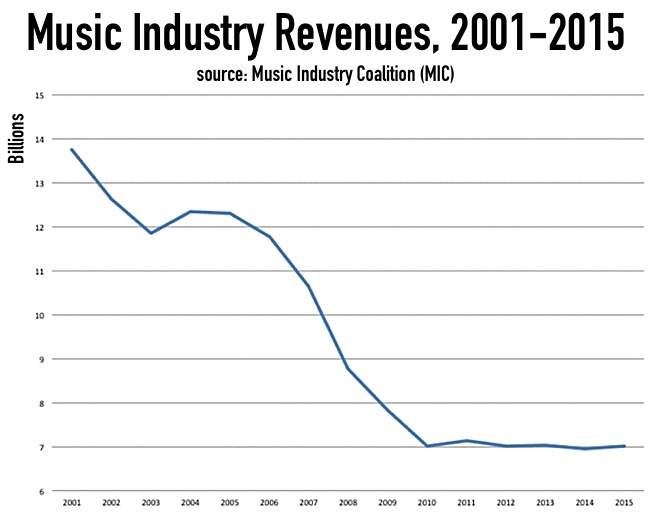
I don't have specific data about the movie/TV industry, but I guess we can get a vague idea on the impact of piracy from the music industry, that also offers several legal and (apparently) popular alternatives, and that still has a long way to go to recover the annual revenues of the '90s:
https://www.digitalmusicnews.c...As you can see, for how many dumb people pay Apple/Google/Spotify, the bottom line is that piracy still wins.
-
Re:Artist cut
Average per-stream payout: $0.004891
-
Re:The way they talk about pirates
I was curious as to exactly what "a lot more money" might add up to. It doesn't appear to be much,unless just under five grand USD in five months for a million-plus plays is considered a lot in the country in which you live. If you're a big act with, say, 20 tracks that get this kind of attention, that's great, but unfortunately small bands just aren't going to make a real living off this arrangement. Touring and performing is still where it's at for the relative unknowns.
You're correct in that at least the possible exposure to a wider audience is now there, though, and that is certainly a good thing. -
Re:Apples and oranges
Another is a video service where people might occasionally go listen to a song,
I was sure you were wrong, so I went to get some stats to back me up, it looks like you are correct.
"Music Is Just 4.3% of YouTube Traffic" http://www.digitalmusicnews.co... -
Re:Yeah, as music artists know, not so fun is it?
Even the biggest artists make most of their money from touring, merchandising, and product endorsements,
In Asia, where large scale commercial piracy is a fact of life, music artists only make money from non-album sales.This, so much. Unless he is a big name with a sweet record deal, the average musician doesn't really earn much from his record sales.
Every contract is different, but the average high-end royalty deal with a record company will pay musicians $1 for every $10 retail album sale. And it can be a lot worse than that; a low-end royalty deal only pays 30 cents per album sale -- amazingly small for a CD purchase, especially considering that bands may have to divide that among several members.
Some musicians have already adapted with the times to seek income alternatives. And apparently some if not most of these income streams are far more lucrative than royalties.
-
Re:Innovative
It is actually possible to sign up on Spotify without a Facebook account if you are in Germany and some other countries: http://www.digitalmusicnews.com/permalink/2012/120904spotify
-
Re:The enemy among us.
It is a bit inconvenient to listen to a live band while driving a car.
It's inconvenient to have to drive to a music store as well if you can download music while sitting at your PC.
BUT the recording industry DID do what they did with the band's permission. And they also provided a product.
Megaupload had cooperations with several bands, i.e. they did have permission (e.g. Busta Rhymes.
And an online locker service is also a product. -
Re:algorithms, third-party sources, or complaints.
What do you think the whole MegaVideo take down was all about? (Hint.)
-
Re:Yes
Here's one blog about it. But it's not a big deal. I don't know of tech billionaire that isn't an asshole.
Jobs biggest talent was in being the second mouse. You know the saying the "The early bird gets the worm, but the second mouse gets the cheese." He would let another company do the inventing, build the new product, take the risks. Then if the product failed, Steve would know why and build a product with fewer flaws and capture the market. If the earlier product didn't fail Steve would build one incrementally better and use the reality distortion field to capture the market. Either way, nobody knows the earlier product existed.
The tech editor for Scientific American wrote a column for the February issue. It was supposed to be about products that fail or succeed some of which are predicted in fiction. Every "successful" product he listed was from Apple. Every failure was from competitors. Examples of failures were the Zune and the IBM PC. The point seemed to be that the iPad was destined for success because there were pad newspaper readers in sci fi and the iPad was obviously the first pad computer and nobody has ever built a pad style device specifically for reading.
-
Re:MegaUpload bust was highly successful
Market innovation, Megaupload wasn't busted because of piracy, they were busted because they wanted to go legit by offering artists a distribution platform with 90% profit *for the artists*. Some sources:
http://techcrunch.com/2012/01/24/was-megaupload-targeted-because-of-its-upcoming-megabox-digital-jukebox-service/
http://cgarmstrong.me/post/16405025252/megaupload
http://www.digitalmusicnews.com/permalink/2012/120123busta
http://www.deltaworld.org/technology/Megaupload-had-planned-to-pay-artists-to-create-a-new-online-music-service/
http://duckduckgo.com/?q=megaupload+artists+90%25&t=lm -
Real reason Megaupload got ki-boshed?
-
Re:If you want CD-quality audio, buy CDs
I agree with you in principle, except that the post I replied to referenced the date when CDs first came out. Still, 1992 seems a little late; I remember CDs becoming popular in the late 80s (albeit for higher-end stereo equipment, not in portable form). But sales grew steadily over the late 80s. http://www.digitalmusicnews.com/stories/021711disruption
-
statistic wrong & retracted
Certainly you understand that statistics and expressed opinions have nothing to do with constitutional rights. They're free to make estimates and inferences all they want.
Sure. Of course, I'd like it if the statistics were vaguely accurate before people go writing whole articles on them. I mean, I read that LimeWire was installed on over a third of the world's PCs and boggled at the sheer impossibility of that statistic and went looking to find what it REALLY is.
Oh, look. There's a clarification posted here from December 17 which reads:
Clarifications, Corrections
In our recent report covering LimeWire installation levels, we inadvertently noted that LimeWire was found on one-third of all PCs, instead of one-third of all PCs with at least one P2P application installed. The overall installation level is 17.8%, and the data is treated properly within the report.
I'd say that 17.8% still seems stupidly high for LimeWire, but whatever. Essentially the Ars article used an obviously wrong statistic from an article that was corrected over a week ago and then added to that the assumption that having a specific piece of software on your computer means you are using it in violation of intellectual property laws.
In other words, if I were the author, I'd be really really embarrassed right now because that was one crappy piece of writing. -
Some Commentaries on the Amazon EMI Deal
Here are a couple of commentaries from MP3 Newswire and Digital Music News on the deal. Needless to say, while no-DRM is certainly a step in the right direction they seem to agree that pricing also plays a big part in this picture. Amazon to Sell Full EMI Digital Catalog Without DRM http://www.mp3newswire.net/stories/7002/emi-amazo
n .html Resnikoff's Parting Shot: Amazon's Game http://digitalmusicnews.com/stories/051607parting/ view -
Re:So the question is...
Apple then decided to charge extra for the convenience, by coupling it with a higher bitrate.
According to this, EMI demanded $5 million up front from Apple to cover the cost of all the 'lost' sales that would surely result from piracy of the DRM-free files. I'd hazard a guess that might have something to do with the price-per-track increase, too. -
Reality check
It's not just the iPod, viruses on shipped hardware seem to be getting more common. For example see below. Can't give other documented articles, but remember similar cases this past year. Anyone? The swipe at Microsoft sounds a lot like Jobs, looks like his personality has infected the company too. But Apple could win this by instating new controls over subcontractors and making a PR campaign in which they force them to use Macs or otherwise emphasize steps they've taken to minimize infection from Microsoft-based hardware.
Quote from article:
Earlier, McDonald's and Coca-Cola faced a similar problem in Japan during an MP3 player giveaway, though the events are unconnected. The iPod virus only affects Windows machines, and does not alter the behavior of the portable device itself or Mac operating systems. -
Digital Music News' - Resinkoff on Apple
http://www.digitalmusicnews.com/Digital Music News
Paul Resinkoff has a very good commentary on Apple's negotiations.
Snip:
Looking through the business lens of Apple, any other result would be foolish. Apple is ultra-protective of its consumer, and that approach has resulted in rich dividends. The major labels, on the other hand, have a highly contentious and acrimonious relationship with many music fans and artists. Sure, generalizations can be dangerous, though the characterizations are not too far off. And why would Apple want to take cues from the labels, who have alienated a large number of buyers while stumbling in the digital transition? Jobs feels strongly that a uniform price point is the path towards customer satisfaction, and nothing is going to disrupt the sacred iPod+iTunes cow. Certainly not the labels, especially following waves of consumer adulation and affirmation for the Apple digital strategy.
I read this guys site on a regular basis. Always a good source of interesting news and commentary on Digital Music...as for my take. In the end, until then Labels stop acting like they are the reason music exists and become more of a service for artists they will continue thier slow death spiral. The music and artists will always be there so will the fans. Do we really need a label to make that connection anymore? $.99 dowloads across the board is perfect in my books. And an advantage for the independant artist and small labels that service them. Higher percentage of that $.99 goes directly to the artist. That is why the labels want special treatment. To differentiate themselves from independents. Why would an established artist release to a major and get $.02 of that $0.99 as opposed to $.72? That is the real danger labels see in the future, that they will be become a disadvantage to the artist. Though right now major labels still have huge marketing budgets and "star" making power.
But that is changing.
Watch...I will connect you directly with artists from SE Wisconsin, all on or soon to be on iTunes, no major label needed and this alone will generate a few sales for the following bands:
Soul Amp (mine) http://soul-amp.com/
The Dammitheads http://ourdamnwebsite.com/
Hayward Williams http://haywardwilliams.com/
Hayward is not on iTunes yet but is slated to be soon. -
I think you're missing the most important part!
The RIAA is not a law enforcement agency. As pointed out in this other comment, the "evidence" is simply screenshots of Kazaa showing the user's shares. Two screenshots is enough evidence to file a suit against somebody? A fucking screenshot is evidence in a trial??
If I were the defendant I'd file a counter-suit that the RIAA headquarters is sharing some of my copyright music, then fabricate hundreds of screenshots allegedly "demonstrating" these copyright violations. Hell, I might as well make it kiddie porn! Then I could get the RIAA executives sent to jail for breaking criminal law instead of tort law.
As a wise person once said, a witty screenshot proves nothing. Well, something like that. What is America coming to? -
I think you're missing the most important part!
The RIAA is not a law enforcement agency. As pointed out in this other comment, the "evidence" is simply screenshots of Kazaa showing the user's shares. Two screenshots is enough evidence to file a suit against somebody? A fucking screenshot is evidence in a trial??
If I were the defendant I'd file a counter-suit that the RIAA headquarters is sharing some of my copyright music, then fabricate hundreds of screenshots allegedly "demonstrating" these copyright violations. Hell, I might as well make it kiddie porn! Then I could get the RIAA executives sent to jail for breaking criminal law instead of tort law.
As a wise person once said, a witty screenshot proves nothing. Well, something like that. What is America coming to? -
Re:Poster didn't RTFA at all...Thank you! You're absolutely right, no one is reading the article! There are comments with +5 mod who aren't even getting their facts straight. From the Digital Music article:
Were the courts to accept this misguided view of copyright law, it could mean that anyone who has had a shared files folder, even for a moment, that contained copyrighted files in it, would be guilty of copyright infringement, even though the copies in the folder were legally obtained, and even though no illegal copies had ever been made of them. [emphasis added]
-
Calm down, you schmucks.
Most of the posters here so far have been flying off the handle over nothing.
One of the links in the story post tells us that the cases is Elektra v. Barker. While we don't yet seem to have the argument referenced there in front of us, we do have the original complaint from about mid-2005, here, thanks to one of the few people that's posted here whilst keeping there wits about them.
Basically RIAA is merely saying that Barker ran Kazaa, and was sharing some music with it. They're suing her for having done so.
Copyright does include an exclusive right of distribution (17 USC 106(3)) which has frequently been held to cover serving files. And just to preempt some people who will surely latch on to that, note that there are many different rights within copyright, and this is but one of them. Making copies of files, which necessarily happens when you download, is also covered under copyright, and can be infringing as well.
Obviously the RIAA is not saying -- as many people here assume -- that putting any file on a server is illegal. That's beyond even them. What they are saying is that where the files are copyrighted, and the copyright holder hasn't authorized it, and there's no applicable exception in copyright that would permit it, then it's illegal. Certainly as a civil offense, and possibly also as a criminal offense. (Compare 17 USC 501 with 506 and 18 USC 2319)
So if Alice writes a book and puts it on the Internet for anyone to download, that's fine. If she puts a public domain book on the Internet for people to download, that's fine too. But when she puts up Bob's book, without permission, she's got some trouble.
So far this seems to be an amazingly boring case. And, if the facts are as RIAA says, it's probably open-and-shut in their favor. Like it or lump it, copyright suits are generally pretty simple.
So what could be interesting about this? Well, and I'm just guessing here, since I have not seen anything recent about this from the plaintiff, I suspect that the plaintiff said that making the files available to be shared via Kazaa was unlawful distribution, even if no one ever downloaded the files.
This runs contrary to another case, where the court held that an offer to distribute (which is what placing a file in a share is) is not actual distribution, and that only the latter is unlawful. So RIAA or another plaintiff has to catch a defendant actually serving the file to someone. I would not expect that it matters who it is served to. If the copyright holder were to download it themselves, in order to gather evidence, that would probably suffice. (And before someone claims entrapment, let me remind you that that only applies where one is coerced into doing something that one would not have otherwise done. If you were going to share the file with anyone who requested to download it, then the fact that you did so with the wrong person is bad luck for you, but won't get you off the hook)
If the plaintiff never d/l'ed the file, then this also raises the question of whether the files were actually copies of the music in question, or if they were just labeled that way. Given that the plaintiff appears to have the file listings in hand, they'll probably win this. In a civil suit, which this is, the standard of proof is a preponderance of the evidence. It is not the beyond a reasonable doubt standard reserved for criminal suits. In this case, reasonable doubts as to the facts will not save the defendant; instead whatever is felt to be most likely, even if only by a hair's breadth, is considered the truth. In my experience, when someone (other than RIAA et al) puts up a file claiming to be an mp3 of a song, it usually is.
All told, it seems like a humdrum case that is not worth getting worked up about (unless you think P2P of this sort should be legal, in which case lots of cases are worth getting worked up about). There -
Calm down, you schmucks.
Most of the posters here so far have been flying off the handle over nothing.
One of the links in the story post tells us that the cases is Elektra v. Barker. While we don't yet seem to have the argument referenced there in front of us, we do have the original complaint from about mid-2005, here, thanks to one of the few people that's posted here whilst keeping there wits about them.
Basically RIAA is merely saying that Barker ran Kazaa, and was sharing some music with it. They're suing her for having done so.
Copyright does include an exclusive right of distribution (17 USC 106(3)) which has frequently been held to cover serving files. And just to preempt some people who will surely latch on to that, note that there are many different rights within copyright, and this is but one of them. Making copies of files, which necessarily happens when you download, is also covered under copyright, and can be infringing as well.
Obviously the RIAA is not saying -- as many people here assume -- that putting any file on a server is illegal. That's beyond even them. What they are saying is that where the files are copyrighted, and the copyright holder hasn't authorized it, and there's no applicable exception in copyright that would permit it, then it's illegal. Certainly as a civil offense, and possibly also as a criminal offense. (Compare 17 USC 501 with 506 and 18 USC 2319)
So if Alice writes a book and puts it on the Internet for anyone to download, that's fine. If she puts a public domain book on the Internet for people to download, that's fine too. But when she puts up Bob's book, without permission, she's got some trouble.
So far this seems to be an amazingly boring case. And, if the facts are as RIAA says, it's probably open-and-shut in their favor. Like it or lump it, copyright suits are generally pretty simple.
So what could be interesting about this? Well, and I'm just guessing here, since I have not seen anything recent about this from the plaintiff, I suspect that the plaintiff said that making the files available to be shared via Kazaa was unlawful distribution, even if no one ever downloaded the files.
This runs contrary to another case, where the court held that an offer to distribute (which is what placing a file in a share is) is not actual distribution, and that only the latter is unlawful. So RIAA or another plaintiff has to catch a defendant actually serving the file to someone. I would not expect that it matters who it is served to. If the copyright holder were to download it themselves, in order to gather evidence, that would probably suffice. (And before someone claims entrapment, let me remind you that that only applies where one is coerced into doing something that one would not have otherwise done. If you were going to share the file with anyone who requested to download it, then the fact that you did so with the wrong person is bad luck for you, but won't get you off the hook)
If the plaintiff never d/l'ed the file, then this also raises the question of whether the files were actually copies of the music in question, or if they were just labeled that way. Given that the plaintiff appears to have the file listings in hand, they'll probably win this. In a civil suit, which this is, the standard of proof is a preponderance of the evidence. It is not the beyond a reasonable doubt standard reserved for criminal suits. In this case, reasonable doubts as to the facts will not save the defendant; instead whatever is felt to be most likely, even if only by a hair's breadth, is considered the truth. In my experience, when someone (other than RIAA et al) puts up a file claiming to be an mp3 of a song, it usually is.
All told, it seems like a humdrum case that is not worth getting worked up about (unless you think P2P of this sort should be legal, in which case lots of cases are worth getting worked up about). There -
Re:First Amendment
Couldn't that be applied here to give us the right to put files up for sharing on our computers if the material isn't copyrighted?
The summary is misleading. Clicking the
Given that, it will still be interesting to see how the courts view the RIAA's arguments. It seems like a huge stretch in interpretation of copyright law, but IANAL. -
RTFA
OMG WTF TEH RIAA SAYS SHARING ANY FILE IS ILLEGAL!!!1!
The entire "article" (blog posting) that started this ruckus says
"In opposition papers served yesterday in Elektra v. Barker in Manhattan federal court, the RIAA has argued that merely making files "available for distribution" is in and of itself a copyright violation.
Were the courts to accept this misguided view of copyright law, it could mean that anyone who has had a shared files folder, even for a moment, that contained copyrighted files in it, would be guilty of copyright infringement, even though the copies in the folder were legally obtained, and even though no illegal copies had ever been made of them.
I am one of the attorneys for Ms. Barker." (emphasis mine)
The RIAA is not claiming that sharing, for example, a file placed in the public domain is illegal, the RIAA is claiming that if you make a copyrighted file available, you are violating the law. (Even if the file is never actually downloaded.) Ordinarily, you have to prove that infringement (ie, downloading by an unauthorized party) has actually occurred. The RIAA is claiming that creating the opportunity for infringement is sufficient. -
Info
The case in question is Elektra v. Barker, and here's some of the legal docs and stuff.
Complaint
Exhibit A
Exhibit B, Part 1
Exhibit B, Part 2 -
Info
The case in question is Elektra v. Barker, and here's some of the legal docs and stuff.
Complaint
Exhibit A
Exhibit B, Part 1
Exhibit B, Part 2 -
Info
The case in question is Elektra v. Barker, and here's some of the legal docs and stuff.
Complaint
Exhibit A
Exhibit B, Part 1
Exhibit B, Part 2 -
Info
The case in question is Elektra v. Barker, and here's some of the legal docs and stuff.
Complaint
Exhibit A
Exhibit B, Part 1
Exhibit B, Part 2 -
Link to comments from Defense Attorney
http://www.digitalmusicnews.com/blog/211/
The defense attorney comments on the case a little ways down. -
Re:She still LOST!
The mother's attorney was defending her pro-bono, but she was still responsible for court costs.
The attorney says, in a comment to this blog post, that unofficially, part of the reason for this was likely to avoid setting up a cottage industry where attorneys defend the targets of unfounded RIAA lawsuits either pro-bono or at a reduced rate, but then when the RIAA loses, claim the court costs and/or attorney's fees that are awarded by federal statute to the prevailing party.
Not that I see why that would be a problem. -
Comment on Attorney fees by defending attorney
The attorney in this case made some interesting comments on this site (posted earlier in this thread):
"Although my comments in this regard are speculative, I am reading between the lines. I have had several other similar cases in front of the same judge. Off the record, my read is that the judge was silently applauding my efforts (pro bono) to defend the innocent, but was not going to let me turn this into a cottage industry to make thousands in legal fees. " -
Re:Pop(up) music article... WATCH OUT FOR THE POPU
The article links to this article with all the same content (sans the pointless opinions of the author).
http://www.digitalmusicnews.com/blog/211 -
Re:Defendant still lost in a way...
http://www.digitalmusicnews.com/blog/211
This is a more comprehensive report on that case. -
Not really 88 cents per track...
I find it rather amusing that according to this website, Wal-Mart's 88 cents per track price point "...will be minimized by sales taxes that apply to customers that have a Wal-Mart in their state."
Another reason, among many, to keep using the iTunes Music Store. 50 million downloads and counting.