Slashdot Mirror
Domain: dropbox.com
Stories and comments across the archive that link to dropbox.com.
Stories · 38
-
How India's Single Time Zone Is Hurting Its People (bbc.com)
"The BBC reports on the detrimental effects of all of India being in one time zone since British Colonial rule," writes Slashdot reader dryriver. From the report: India stretches 3,000km (1,864 miles) from east to west, spanning roughly 30 degrees longitude. This corresponds with a two-hour difference in mean solar times -- the passage of time based on the position of the sun in the sky. The U.S. equivalent would be New York and Utah sharing one time zone. Except that in this case, it also affects more than a billion people -- hundreds of millions of whom live in poverty. The school day starts at more or less the same time everywhere in India but children go to bed later and have reduced sleep in areas where the sun sets later. An hour's delay in sunset time reduces children's sleep by 30 minutes. Using data from the India Time Survey and the national Demographic and Health Survey, [Cornell University Economist] Maulik Jagnani found that school-going children exposed to later sunsets get fewer years of education, and are less likely to complete primary and middle school. He found evidence that suggested that sunset-induced sleep deprivation is more pronounced among the poor, especially in periods when households face severe financial constraints. "This might be because sleep environments among poor households are associated with noise, heat, mosquitoes, overcrowding, and overall uncomfortable physical conditions. The poor may lack the financial resources to invest in sleep-inducing goods like window shades, separate rooms, indoor beds and adjust their sleep schedules," he told me. -
Dropbox Open Sources DivANS: a Compression Algorithm In Rust Compiled To WASM (dropbox.com)
Slashdot reader danielrh writes: DivANS is a new compression algorithm developed at Dropbox that can be denser than Brotli, 7zip or zstd at the cost of compression and decompression speed. The code uses some of the new vector intrinsics in Rust and is multithreaded. It has a demo running in the browser.
One of the new ideas is that it has an Intermediate Representation, like a compiler, and that lets developers mashup different compression algorithms and build compression optimizers that run over the IR. The project is looking for community involvement and experimentation. -
Indiana Is Purging Voters Using Software That's 99 Percent Inaccurate, Lawsuit Alleges (thedailybeast.com)
An anonymous reader quotes a report from The Daily Beast: More than 99 percent of voter fraud identified by a GOP-backed program is false, a study by Harvard, Yale, and Microsoft researchers found. Now Indiana is using the faulty program to de-register voters without warning. In July, Indiana rolled out a new law allowing county officials to purge voter registrations on the spot, based on information from a dubious database aimed at preventing voter fraud. That database, the Interstate Voter Registration Crosscheck Program, identifies people in different states who share the same name and birthdate. Crosscheck has long been criticized as using vague criteria that disproportionately target people of color. Now Indiana voters who share a name and birthdate with another American can have their registrations removed without warning -- a system ripe for abuse, a new lawsuit claims. Crosscheck's premise is simple. The program aims to crack down on people "double voting" in multiple states, by listing people who share a first name, last name, and birthdate.
Indiana has used Crosscheck for years. But until July, the state had a series of checks on the program. If Crosscheck found that an Indiana resident's name and birthdate matched that of a person in another state, Indiana law used to require officials to ask that person to confirm their address, or wait until that person went two general election cycles without voting, before the person's name was purged from Indiana voter rolls. Under the state's new law, officials can scrub a voter from the rolls immediately. That's a problem for Indiana residents, particularly people of color, a Friday lawsuit from Common Cause and the American Civil Liberties Union argues. -
A New Sampling Algorithm Could Eliminate Sensor Saturation (scitechdaily.com)
Baron_Yam shared an article from Science Daily: Researchers from MIT and the Technical University of Munich have developed a new technique that could lead to cameras that can handle light of any intensity, and audio that doesn't skip or pop. Virtually any modern information-capture device -- such as a camera, audio recorder, or telephone -- has an analog-to-digital converter in it, a circuit that converts the fluctuating voltages of analog signals into strings of ones and zeroes. Almost all commercial analog-to-digital converters (ADCs), however, have voltage limits. If an incoming signal exceeds that limit, the ADC either cuts it off or flatlines at the maximum voltage. This phenomenon is familiar as the pops and skips of a "clipped" audio signal or as "saturation" in digital images -- when, for instance, a sky that looks blue to the naked eye shows up on-camera as a sheet of white.
Last week, at the International Conference on Sampling Theory and Applications, researchers from MIT and the Technical University of Munich presented a technique that they call unlimited sampling, which can accurately digitize signals whose voltage peaks are far beyond an ADC's voltage limit. The consequence could be cameras that capture all the gradations of color visible to the human eye, audio that doesn't skip, and medical and environmental sensors that can handle both long periods of low activity and the sudden signal spikes that are often the events of interest.
One of the paper's author's explains that "The idea is very simple. If you have a number that is too big to store in your computer memory, you can take the modulo of the number." -
PayPal Sues Pandora Over 'Patently Unlawful' Logo (billboard.com)
PayPal has filed a trademark infringement lawsuit against Pandora, arguing that the company's minimalist logo "dilutes the distinctiveness" of its own branding. "Element by element and in overall impression, the similarities between the logos are striking, obvious, and patently unlawful," the lawsuit alleges. Billboard reports: In October 2016, Pandora announced it was redesigning its logo from a thin, serifed "P" into the chunky, sans serifed "P" that it is today. The color scheme was also changed from midnight blue to a softer shade of blue. By comparison, PayPal's logo, active since 2014, also features a minimalist-looking "P" in a sans serif font and sporting a blue color palette. PayPal's mark actually consists of two overlapping and slanted "Ps," whereas Pandora keeps it to one. Both P's lack a hole. It is because of these similarities that PayPal believes customers of both companies are unable to distinguish the two, and that many are complaining about inadvertently opening Pandora instead of PayPal on their smartphones. The lawsuit includes various screen grabs, primarily from Twitter, of people noting the similarities. PayPal's lawsuit also points out Pandora's current struggles as a brand, saying that since it is primarily an ad-supported service, it "has no obvious path to profitability," especially given "overwhelming competition" from the likes of Spotify and Apple Music. The suit alleges that Pandora purposely "latched itself on to the increasingly popular" PayPal logo look-and-feel as part of its efforts to reverse its fortunes. -
DJI Proposes New Electronic 'License Plate' For Drones (digitaltrends.com)
linuxwrangler writes: Chinese drone maker DJI proposed that drones be required to transmit a unique identifier to assist law enforcement to identify operators where necessary. Anyone with an appropriate receiver could receive the ID number, but the database linking the ID with the registered owner would only be available to government agencies. DJI likens this to a license plate on a car and offers it as a solution to a congressional mandate that the FAA develop methods to remotely identify drone operators. "The best solution is usually the simplest," DJI wrote in a white paper on the topic, which can be downloaded at this link. "The focus of the primary method for remote identification should be on a way for anyone concerned about a drone flight in close proximity to report an identifier number to the authorities, who would then have the tools to investigate the complaint without infringing on operator privacy. [...] No other technology is subject to mandatory industry-wide tracking and recording of its use, and we strongly urge against making UAS the first such technology. The case for such an Orwellian model has not been made. A networked system provides more information than needed, to people who don't require it, and exposes confidential business information in the process." -
Dropbox Kills Public Folders, Users Rebel (ndtv.com)
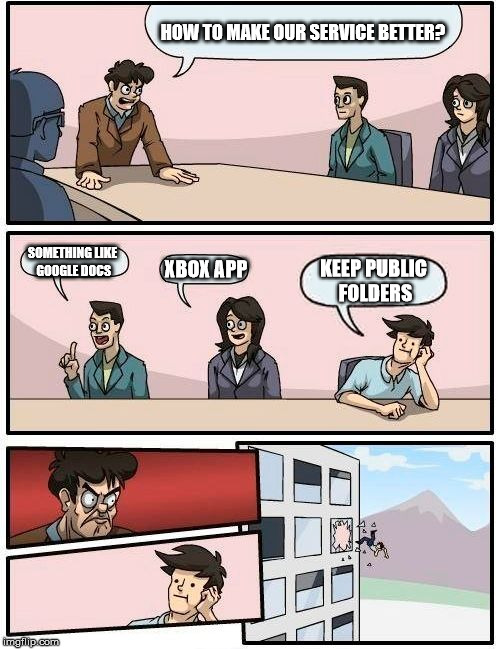
New submitter rkagerer writes: Dropbox unleashed a tidal wave of user backlash yesterday when it announced plans to eradicate its Public folder feature in 2017. Criticism from users whose links will break surfaced on Reddit, HackerNews and its own forums. Overnight, customers up-voted a feature request to reverse the decision, skyrocketing it to a "Top 10" position on the company's tracker. joemck explains: "There are countless users who have been using the public folder to post images and files in blogs and forums. These aren't just worthless jokes and memes that nobody will miss if you flip the switch and break all of them. These are often valuable resources that users have created and entrusted to you to retain and keep online." One user even created a comic strip for the occasion, with another concerned the URL he registered with the Coast Guard containing potentially lifesaving information will go dark. Although the feature was deprecated in 2012, it remained in place for existing users. The company provides an alternative sharing method, but some users claim it's not as convenient and doesn't provide direct links. According to the announcement, free accounts have until March 15 to update their links, while the lights will go out for paid accounts on September 1. UPDATE 12/17/16: Slashdot reader rkagerer notes, "Dropbox quietly killed the feature request after this story hit the front page, but the original content can still be found interleaved in the forum discussion." -
Older Workers Are Better At Adapting To New Technology, Study Finds (cio.com)
"Don't let the millennial buzz fool you. Older workers handle and adapt to new systems better than younger people," writes CIO magazine. Slashdot reader itwbennett writes: A survey by London-based market research firm Ipsos Mori, sponsored by Dropbox, found that older workers are less likely to find using technology in the workplace stressful and experience less trouble working with multiple devices than the younger cohort.
Millennials "are used to using tech in their personal lives that's pretty darn good," suggests one Dropbox executive, "and that raises the expectations of what tech can be in their professional lives... So younger people will feel frustration at tools that are not up to snuff." Out of 4,000 information workers who were surveyed in the U.S. and Europe, 37% of the 18-34-year-old group reported trouble with multiple devices, compared to just 13% of respondents over 55. -
Dropbox Open Sources New Lossless Middle-Out Image Compression Algorithm (dropbox.com)
Dropbox announced on Thursday that it is releasing its image compression algorithm dubbed Lepton under an Apache open-source license on GitHub. Lepton, the company writes, can both compress and decompress files, and for the latter, it can work while streaming. Lepton offers a 22% savings reductions for existing JPEG images, and preserves the original file bit-for-bit perfectly. It compresses JPEG files at a rate of 5MB/s and decodes them back to the original bit at 15MB/s. The company says it has used Lepton to encode 16 billion images saved to Dropbox, and continues to utilize the technology to recode its older images. You can find more technical details here. -
Dropbox Open Sources New Lossless Middle-Out Image Compression Algorithm (dropbox.com)
Dropbox announced on Thursday that it is releasing its image compression algorithm dubbed Lepton under an Apache open-source license on GitHub. Lepton, the company writes, can both compress and decompress files, and for the latter, it can work while streaming. Lepton offers a 22% savings reductions for existing JPEG images, and preserves the original file bit-for-bit perfectly. It compresses JPEG files at a rate of 5MB/s and decodes them back to the original bit at 15MB/s. The company says it has used Lepton to encode 16 billion images saved to Dropbox, and continues to utilize the technology to recode its older images. You can find more technical details here. -
Dropbox Moves Users' Data Off Amazon S3 to Its Own Infrastructure
Reader Richard_at_work writes: Dropbox today announced that it has been working on a "top secret" project called Magic Pocket for the past two and a half years to get data of more than 500 million users from Amazon S3 to its own custom-built infrastructure. The company says that it has migrated over 90% of its users' data so far. Dropbox's relationship with AWS isn't completely over, however, as they will continue to use AWS for specific regional data stores where there is a requirement. -
John Romero Creates New Doom Level (gamasutra.com)
jones_supa writes: Legendary game developer John Romero took to Twitter to spread the word that he has made a comeback to the world of Doom by designing an all new level. Romero's return to the game that jumpstarted his career in game development is a fun little Friday surprise for developers, especially Doom enthusiasts, some of whom are thanked in the readme file accompanying the level. The new level, E1M8B (ZIP), is described simply as "My Boss level replacement for e1m8...22 years later." E1M8 is, incidentally, the final level of Doom's first episode, Knee-Deep in the Dead. -
Privacy Advocates Leave In Protest Over U.S. Facial Recognition Code of Conduct
Taco Cowboy writes: Nine privacy advocates involved in the Commerce Department process for developing a voluntary code of conduct for the use of facial recognition technology withdrew in protest over technology industry lobbyists' overwhelming influence on the process. "At a base minimum, people should be able to walk down a public street without fear that companies they've never heard of are tracking their every movement — and identifying them by name — using facial recognition technology," the privacy advocates wrote in a joint statement. "Unfortunately, we have been unable to obtain agreement even with that basic, specific premise." The Commerce Department, through its National Telecommunications and Information Administration, brought together "representatives from technology companies, trade groups, consumer groups, academic institutions and other organizations" early last year "to kick off an effort to craft privacy safeguards for the commercial use of facial recognition technology."
The goal was "to develop a voluntary, enforceable code of conduct that specifies how the Consumer Privacy Bill of Rights applies to facial recognition technology in the commercial context." But after a dozen meetings, the most recent of which was last week, all nine privacy advocates who have participated in the entire process concluded that they were thoroughly outgunned. "This should be a wake-up call to Americans: Industry lobbyists are choking off Washington's ability to protect consumer privacy," Alvaro Bedoya, executive director of the Center on Privacy & Technology at Georgetown Law, said in a statement. "People simply do not expect companies they've never heard of to secretly track them using this powerful technology. Despite all of this, industry associations have pushed for a world where companies can use facial recognition on you whenever they want — no matter what you say. This position is well outside the mainstream." -
Dropbox Moves Accounts Outside North America To Ireland
monkeyzoo writes: Similar to a previous announcement by Twitter, Dropbox has changed its Terms of Service for users outside of North America (USA/Canada/Mexico) such that services will now be provided out of Ireland. Will other companies follow this trend and leave the USA (and the jurisdiction of the NSA)? Note, the announcement states that North American users are not able to opt into the Irish Terms of Service. -
Dropbox Wasn't Hacked, Says Leaked Credentials Are From Unrelated Services
An anonymous reader writes Dropbox has denied that they have been hacked, and that the login credentials leaked by an unknown individual on Pastebin are those of Dropbox users. "Your stuff is safe. The usernames and passwords referenced in these articles were stolen from unrelated services, not Dropbox. Attackers then used these stolen credentials to try to log in to sites across the internet, including Dropbox," Anton Mityagin from the Dropbox security department noted in a post. -
Leaked Docs Offer Win 8 Tip: FinFisher Spyware Can't Tap Skype's Metro App
mask.of.sanity (1228908) writes "A string of documents detailing the operations and effectiveness of the FinFisher suite of surveillance platforms appears to have been leaked. The documents, some dated 4 April this year, detail the anti-virus detection rates of the FinFisher spyware which German based Gamma Group sold to governments and law enforcement agencies. The dump also reveals Windows 8 users should opt for the Metro version of Skype rather than the desktop client because it cannot be tapped by FinFisher." -
Single European Copyright Title On the Horizon
presroi (657709) writes "It has been 13 years after the last harmonization effort of copyright within the European Union and this period might soon be over. After the election of a new European Parliament in May this year, Jean-Claude Juncker has been nominated to become the new President of the European Commission. He has named a unified copyright his top priority, a statement repeated today at a hearing before the Greens/EFA group in the European parliament (transcript of the question by MEP Julia Reda and his answer in German, Video recording). These statements are coinciding with the upcoming release of a report by the General Directorate in charge of copyright, of which an advanced draft has been already leaked to the internet. The report analyzes four possible policy options, one of which is the introduction of a Single EU Copyright title." -
Dropbox and Box Leaked Shared Private Files Through Google
judgecorp writes: "People using shared storage providers such as Box and Dropbox are leaking data, a competitor has discovered. Links to shared files leak out when those links are accidentally put into the Google search box, or if users click links from within the documents. Dropbox competitor Intralinks stumbled across mortgage applications and bank statements while checking Google Analytics data for a Google Adwords campaign. Graham Cluley explains the problem in detail and suggests answers: for Dropbox users, it means upgrading to the Business version, which lets you restrict access to shared document links." Dropbox has posted an official response and disabled access to previously shared links. Box made a vague statement about their awareness of the issue. -
Commenters To Dropbox CEO: Houston, We Have a Problem
theodp (442580) writes "On Friday, Dropbox CEO Drew Houston sought to quell the uproar over the appointment of former Secretary of State Condoleezza Rice to the company's board of directors, promising in a blog post that Rice's appointment won't change its stance on privacy. More interesting than Houston's brief blog post on the method-behind-its-Condi-madness (which Dave Winer perhaps better explained a day earlier) is the firestorm in the ever-growing hundreds of comments that follow. So will Dropbox be swayed by the anti-Condi crowd ("If you do not eliminate Rice from your board you lose my business") or stand its ground, heartened by pro-Condi comments ("Good on ya, DB. You have my continued business and even greater admiration")? One imagines that Bush White House experience has left Condi pretty thick-skinned, and IPO riches are presumably on the horizon, but is falling on her "resignation sword" — a la Brendan Eich — out of the question for Condi?" -
Heat Waves In Australia Are Getting More Frequent, and Hotter
vikingpower writes "In a landmark report on bushfires and climate change (PDF), the Australian Climate Council concludes that heat waves in Australia, as driven by climate change, are becoming more frequent — and that they get hotter. 'It is crucial that communities, emergency services, health services and other authorities prepare for the increasing severity and frequency of extreme fire conditions,' says the Council in the report. Sarah Perkins, one of the report's co-authors, was interviewed by The Guardian Australia. '"While we can't blame climate change for any one event, we can certainly see its fingerprint. This is another link in the chain." Perkins said her latest work had analyzed heatwave trends up to 2013. She said the trend "just gets worse – it's a bit scary really."' In 2009, the United Nations World Meteorological Organization signaled that a Southeast Australian heatwave was the hottest in 100 years." -
4 Tips For Your New Laptop
Bennett Haselton writes with four big tips for anyone blessed by the holiday buying frenzy with a new laptop; in particular, these are tips to pass on to non-techie relatives and others who are unlikely to put (say) "Install a Free operating system" at the very top of the list: Here's Bennett's advice, in short: (1) If you don't want to pay for an anti-virus program, at least install a free one. (2) Save files to a folder that is automatically mirrored to the cloud, for effortless backups. (3) Create a non-administrator guest account, in case a friend needs to borrow the computer. (4) Be aware of your computer's System Restore option as a way of fixing mysterious problems that arose recently." Read on for the expanded version; worth keeping in mind before your next friends-and-family tech support call. > If you or a friend -- especially a non-techie friend -- received a laptop for Christmas, these are my favorite low-cost high-benefit tips that anyone can follow. They apply to any operating system, although I'm writing from a Windows-centric point of view.Yes, a lot of this will be obvious stuff to techies, but I've found that if a human asks a techie "I just got a new laptop, can you give me any advice?", the answer frequently will (a) not cover these crucial bases, and/or (b) include a lot of unhelpful stuff to impress the listener. The following is a baseline for what I think a useful answer should consist of. (And if you're the techie, you may want to walk the laptop owner through following these directions, since I'm not actually spelling out what icons you have to click on, etc.)
(1) If you don't want to pay for an anti-virus program, at least install a free one.
Your PC probably came with a trial version of an anti-virus program that will stop working after a month unless you upgrade to the paid version. Of course you can do that if you want. Especially if you ever think you might want phone tech support for your anti-virus software, I expect it's better for a product that you've paid money for.
On the other hand, I know people who thought that if they didn't want to pay for the upgrade to their PC's default anti-virus program, their only option was to let it expire and let their computer run unprotected. If you don't want to pay for a non-free program, install a free one -- Wikipedia has a list of 15 different free or freemium anti-virus products for Windows. PC Magazine gave their "Editor's Choice" award for best free Windows anti-virus to Malwarebytes Anti-Malware 1.70 in 2013 and AVG Anti-Virus Free in 2012, so either of those will work.
(Yes, I know you guys know this. But pass the word on to your Mom or kid brother with the new laptop.)
(2) Save files to a folder that is automatically mirrored to the cloud, for effortless backups.
The era in which everybody talks about backing up, but nobody actually does it, should have ended completely in 2013. Old-style backups, even the incredibly easy options, still mostly required you stop what you were doing for a minute, connect to a remote server or connect a piece of hardware to your computer, and twiddle your thumbs while waiting for some copy process to execute. So nobody bothered.
With cloud-mirrored folders, there's no excuse any more. I found out about Dropbox by asking a mailing list, "I would really like it if there were an online backup service that let me open and close files from a local folder so that there was no delay, but as soon as I made any changes, would automatically be queued to be backed up over the network to a remote host," and my listmates said, "That already exists." Windows 8 comes with the similar SkyDrive service already built in.
You can read a detailed comparison of Dropbox vs. SkyDrive vs. Google Drive, but the key point is to use one of them to mirror one of your local folders to the cloud, and get into the habit of saving stuff to that folder. Obviously this may not apply to you if you have something special going on (if you're creating large multimedia files that won't fit within the several-gigabyte limit imposed by these services, or if your privacy concerns are great enough that you don't want to back up files online), but it's good enough for most people. The horror stories about people saving months or years of writing, and then losing it all in a hard drive crash, should never happen to anyone again.
(3) Create a non-administrator guest account, in case a friend needs to borrow the computer.
Some of my friends and relatives have no problem telling people, "No, I don't care if you need to check the weather, you can't touch my computer!" But if you can't resist the urge to be helpful if someone needs to borrow your laptop for a few minutes, then eventually one of those people will mess it up somehow -- either by installing a game, or visiting a website that installed malware on your computer, or just changing a system setting that you can't figure out how to change back.
When the day comes when someone needs to borrow your computer, you may be too rushed or might not know how to create an unprivileged non-administrator account that they can log in under. So go ahead and do it when your computer is brand new, while the thought is still fresh in your mind. Then if people who borrow your computer sign in under that account, in almost all cases, nothing that they do while logged in should interfere with your user experience when you log them off and log back in as yourself.
That's not a completely secure solution to stop someone from accessing private files on your computer. (There are many pages describing how to boot up a Windows machine from a Linux CD, in order to access files on the computer -- they are usually described as "disaster recovery" options, but they can also be used to access files on a PC without the password.) However, it will stop most casual users from messing up your computer while they borrow it.
(4) Be aware of your computer's System Restore option as a way of fixing mysterious problems that arose recently.
I say "be aware" because, unlike the other three tips, this may not ever be something that you have to actually do. However, intermediate-level computer users just need to understand what it means: to restore your computer's settings and installed programs to a recently saved snapshot, while leaving your saved files untouched. This means if your computer has started acting funny in the last couple of days, you may be able to fix the problem by restoring to a snapshot that was saved before the problems started.
Intermediate users sometimes confuse this with either (a) restoring files from backup, or (b) doing a system recovery (which generally refers to restoring your computer to the state in which it left the factory). So if you're the techie doing the explaining, make sure they understand the difference. (A system recovery will often fix problems, too, but then of course you'll have to re-install all your software; a system restore is more convenient since it only undoes the most recent system changes.)
So these are the first four things I would tell people who were the recipient of a new laptop. What would you tell them?
-
Toyota's Killer Firmware
New submitter Smerta writes "On Thursday, a jury verdict found Toyota's ECU firmware defective, holding it responsible for a crash in which a passenger was killed and the driver injured. What's significant about this is that it's the first time a jury heard about software defects uncovered by a plaintiff's expert witnesses. A summary of the defects discussed at trial is interesting reading, as well the transcript of court testimony. 'Although Toyota had performed a stack analysis, Barr concluded the automaker had completely botched it. Toyota missed some of the calls made via pointer, missed stack usage by library and assembly functions (about 350 in total), and missed RTOS use during task switching. They also failed to perform run-time stack monitoring.' Anyone wonder what the impact will be on self-driving cars?" -
Interviews: Guido van Rossum Answers Your Questions
Last week you had a chance to ask Guido van Rossum, Python's BDFL (Benevolent Dictator For Life), about all things Python and his move to Dropbox. Guido wasted no time answering your questions and you'll find his responses below. From Google to Dropbox
by nurhussein
Hi, What prompted the move from Google to Dropbox? What did you do at Google, and what are you going to do at Dropbox?
Guido: After seven years at Google I was just ready for some change in environment, and then the Dropbox offer came along. At a high level, my job hasn't changed much: I still
- spend 50% of my time on whatever I want to do for Python in my BDFL role
- am a regular engineer in the organization (not a manager or even TL)
- do a lot of code reviews, architecture and design work
- handle a lot of email
- do a lot of actual coding for my job, in Python
The specifics differ of course. I really did only two things at Google: the first two years I worked on one of the first online code review tools Mondrian, which itself was never open-sourced but begat Rietveld, which did, and is used amongst others, by the Python, Go and Chromium communities. After that I joined Google App Engine where I did a lot of different things, almost all of them in Python. My last big project there was a new Python database API, NDB.
I've been at Dropbox for 7 months and my main project has been the design of the Dropbox Datastore API . It's ironic but not my fault that this also uses the "datastore" moniker -- there's little overlap between Dropbox Datastores and the Google App Engine Datastore.
What's even more ironic is that even though I did much of the design, and wrote two prototypes in Python, the SDKs we released last month only support Java, Objective-C and JavaScript. But I am working on a fix, this interview is just slowing me down. :-)
Why did Python avoid some common "OO" idioms?
by i_ate_god
Interfaces, abstract classes, private members, etc... Why did python avoid all this?
Guido: I can think of two reasons: (a) you don't really need them, and (b) they are hard to do if you have no compile-time type checking. Python started out as a skunkworks project (not endorsed or encouraged by management but not actively prevented), and I wanted results quickly. This led me to remove features that weren't actually needed or urgent; it also led me to do all type checking at run time, which gave me natural constraints on what features Python could support. I also had no religious OO ax to grind -- I just wanted an easy language, and it became OO more or less by accident.
In modern Python there are rough equivalents for all of these, but they don't necessarily work all that well, or they cause a lot of execution overhead, so they are often avoided, but they have their uses and their fans.
functional programming
by ebno-10db
Some people claim that Python is, at least partly, a functional language. You disagree, as do I. Simply having a few map and filter type functions does not make for a functional language. As I understand it those functions were added to the libraries by a homesick Lisper, and that several times you've been tempted to eliminate them. In general it seems you're not a fan of functional programming, at least for Python.
Question: do you feel that the functional programming approach is not very useful in general, or simply that it's not appropriate for Python? It would be nice to hear your reasons either way.
Guido: I'm not a fan of religiously taking some idea to the extreme, and I try to be pragmatic in my design choices (but not *too* pragmatic, see the start of this sentence :-). I value readability and usefulness for real code. There are some places where map() and filter() make sense, and for other places Python has list comprehensions. I ended up hating reduce() because it was almost exclusively used (a) to implement sum(), or (b) to write unreadable code. So we added builtin sum() at the same time we demoted reduce() from a builtin to something in functools (which is a dumping ground for stuff I don't really care about :-).
If I think of functional programming, I mostly think of languages that have incredibly powerful compilers, like Haskell. For such a compiler, the functional paradigm is useful because it opens up a vast array of possible transformations, including parallelization. But Python's compiler has no idea what your code means, and that's useful too. So, mostly I don't think it makes much sense to try to add "functional" primitives to Python, because the reason those primitives work well in functional languages don't apply to Python, and they make the code pretty unreadable for people who aren't used to functional languages (which means most programmers).
I also don't think that the current crop of functional languages is ready for mainstream. Admittedly I don't know much about the field besides Haskell, but any language *less* popular than Haskell surely has very little practical value, and I haven't heard of functional languages *more* popular than Haskell. As for Haskell, I think it's a great proving ground for all sorts of ideas about compiler technology, but I think its "purity" will always remain in the way of adoption. Having to come to grips with Monads just isn't worth it for most people.
(A similar comment applies to Scala. It may be the best you can do trying to combine functional and OO paradigms in one language, but the result isn't all that easy to use unless you're really smart.)
Multi-line lambdas
by NeverWorker1
One of the most common complaints about Python is the limitations of its lambdas, namely being one line only without the ability to do assignments. Obviously, Python's whitespace treatment is a major part of that (and, IIRC, I've read comments from you to that effect). I've spent quite a bit of time thinking about possible syntax for a multi-line lambda, and the best I've come up with is trying to shoehorn some unused (or little used) symbol into a C-style curly brace, but that's messy at best. Is there a better way, and do you see this functionality ever being added?
Guido: Really? I almost never hear that complaint except from people who submit questions to Slashdot interviews. :-)
There is indeed a better way, and that is using the 'def' keyword to define a regular function in a local scope. The defined function object becomes a local variable that has exactly the same semantics as a lambda except that it is bound to a local variable, and it doesn't have any of the syntactic constraints. For example, there is *no* semantic difference between
def make_adder(n):
__def adder(x):
____return x + n
__return adder
and this equivalent using lambda:
def make_adder(n):
__return lambda x: x + n
(except that when you introspect the lambda asking for its name, it will say '' instead of 'adder').
Andrew Koenig once pointed out to me that there's one pattern where lambdas are really much more convenient, and that is if you have a long list or dict (perhaps some kind of switching definition) containing lots of lambdas, since if you wanted to do that without lambda you'd end up first having to define lots of little functions, giving them all names, and then referencing them all by name from inside the list or dict. But in that pattern the lambdas are usually simple enough to be lambdas, and if you have a few exceptions, using 'def' before starting the list or dict is a fine compromise.
PyPy
by Btrot69
Do you see PyPy as the future? Or do you remain unconvinced, and -- if so -- why ?
Guido: I'm still unconvinced, for two reasons: (a) they don't support Python 3 (well) yet, and (b) there are lots of extension modules (both third party and in the standard library) that they don't support well. But I hope they'll fix those issues. I think it's competition from projects like PyPy, Jython and IronPython that keeps the CPython project honest and on its toes.
Python in the browser ?
by Btrot69
Over the years, there have been several attempts to create a sandboxed version of python that will safely run in a web browser.Mostly this was because of problems with Javascript. Now that Javascript works -- and we have nice things like CoffeeScript -- is it time to give up on python in the browser ?
Guido: I gave up on it in 1995, so yes. And please don't try to compile Python to JavaScript. The semantics are so different that you end up writing most of a Python runtime in JavaScript, which slows things down too much. (CoffeScript's strength is that it is designed to map cleanly to JavaScript, and the two are now co-evolving to make the mapping even cleaner.)
Python 3
by MetalliQaZ
How do you feel about the current state of the migration to Python 3 (Py3k)? From a user perspective it seems that the conversion of popular libraries has lagged far behind, which has impeded the transition. In my professional capacity, nearly every single system I use lacks an installed 3.x interpreter. In fact, 2.7 is a rarity. I'd like to get your thoughts.
Guido: Curious where you work. I agree that Python 3 migration will still take a long time, but if your systems don't come with Python 2.7 they must be pretty ancient! When I left Google they were about done with the internal transition to Python 2.7 (having successfully migrated from 2.4 to 2.6 over the past few years) and here at Dropbox both the client and the server are using Python 2.7. Both companies are already thinking about Python 3 too.
Back to Python 3 migration, I am actually pretty optimistic. Lots of popular libraries have a working port or are working on one. (The Python Software Foundation also occasionally funds projects to port libraries that are widely used but don't have enough of a community to do a port.) It will take a long time, but I see a lot of progress, and in a few years I expect most new code will be written in Python 3. Totally eradicating Python 2 usage will probably take much longer, but then again, Windows XP isn't quite dead yet either. :-)
Key question for any language designer
by dkleinsc
Have the prospects of Python in any way improved since you grew a beard? To what degree does language success correlate to beard length?
Guido: It is absolutely essential. Just look at Perl's fate -- Larry Wall is just too clean-shaven. :-) -
Dropbox Wants To Replace Your Hard Disk
Barence writes "Dropbox has kicked off its first developer conference with the stated goal of replacing the hard disk. 'We are replacing the hard drive,' said Dropbox CEO Drew Houston. 'I don't mean that you're going to unscrew your MacBook and find a Dropbox inside, but the spiritual successor to the hard drive is what we're launching.' The new Dropbox Platform includes tools for developers that will allow them to use Dropbox to sync app data between devices. The company's new APIs will also make it easier for app developers to include plugins that save to Dropbox, or choose files stored in the service for use within apps." -
Dropbox Acquires Mailbox
Dropbox announced today that it is acquiring Mailbox, an iOS email client designed to take better advantage of a touch interface. The app launched last month, and the Mailbox team says they're already delivering more than 60 million emails daily. Demand for the service continues to grow, so they were exploring their options to expand. They said, "We can’t wait to put Mailbox in the hands of everyone who wants it. This means not only continuing to scale the service, but also including support for more email providers and mobile devices. Add to that a host of new features and we’ve got a LOT of work to do, certainly more than our current team of 14 can handle. We need to grow and we need to grow thoughtfully, with top-notch people who share our goals and values. Enter Dropbox, the team from San Francisco who helps over 100M people bring their photos, docs, and videos with them anywhere. They’re a profoundly talented bunch who build great tools that make work frictionless, and Mailbox fits Dropbox’s mission like a glove. Plus, they’ve got a ton of experience scaling services and are experts at handling people’s data with care. In short, Dropbox is our kind of company." -
Cox Comm. Injects Code Into Web Traffic To Announce Email Outage
An anonymous reader writes "Cox Communications appears to be injecting JavaScript and HTML into subscribers' traffic, as part of their effort to announce an email service outage. Pictures showing the popup." -
NCTC Gets Vast Powers To Spy On U.S. Citizens
interval1066 writes "In a breathtaking new move by (another) little-known national security agency, the personal information of all U.S. citizens will be available for casual perusal. The 'National Counterterrorism Center' (I've never heard of this org) may now 'examine the government files of U.S. citizens for possible criminal behavior, even if there is no reason to suspect them.' This is different from past bureaucratic practice (never mind due process) in that a government agency not in the list of agencies approved to to certain things without due process may completely bypass due process and store (for up to 5 years) these records, the organization doesn't need a warrant, or have any kind of oversight of any kind. They will be sifting through these records looking for 'counter-insurgency activity,' supposedly with an eye to prevention. If this doesn't wake you up and chill you to your very bone, not too sure there is anything that will anyway." -
Python Creator Guido van Rossum Leaves Google For Dropbox
New submitter mrvan writes "Guido van Rossum, the proclaimed Python Benevolent Dictator For Life, has left Google to work for Dropbox. In their announcement, Dropbox says they relied heavily on Python from the beginning, citing a mix of simplicity, flexibility, and elegance, and are excited to have GvR on the team. While this is, without a doubt, good news for Dropbox, the big question is what this will mean for Python (and for Google)." -
"New Statesman" Pirates Its Own Magazine
WebMink writes "Knowing that its explosive special edition on China this week will be blocked by censorship, UK political magazine 'New Statesmen' has taken the unusual step of posting its own torrents of the PDF of the Mandarin edition on the magazine. Looking at the content of the issue they are probably right to expect censorship — there's an article from the former newspaper editor Cheng Yizhong about media censorship, and Ai Weiwei interviews a member of the '50 cent party' — a commenter paid half a dollar every time he derails an online debate in China. 'Essentially, these people are paid internet trolls; their job is to stop any meaningful discussion online about the government.'" Specifically, the magazine has made available this issue as a PDF and also as a torrent (magnet link). -
Mass Production of 450mm Wafers Bumped Back Again: 2018
Taco Cowboy writes with news on the slipping schedules in the move toward both larger wafers and 3D integrated circuits in the semiconductor fab world. From the articles: "TSMC ... said it planned to start mass-producing next-generation 450mm wafers using advanced 10-nanometer technology in 2018. The advanced 10-nanometer chips could first be used in mobile devices and other consumer electronics, like game consoles, that demand high-performance and low power consumption. The plan was included in the latest technology roadmap unveiled by TSMC about one year after the chipmaker attributed its delay in making 450mm wafers, originally scheduled in 2015, to semiconductor equipment suppliers' postponement in developing advanced equipment for manufacturing amid the industrial slump. Chipmakers can get 2.5 times more chips from a 450mm wafer than from a 300mm wafer ... The industry's gradual migration toward 3D ICs with through-silicon vias (TSV) is unlikely to happen until 2015 or 2016, according to sources at semiconductor companies. Volume production of 3D ICs was previously estimated to take place in 2014. Leading foundries and backend assembly and test service companies have all devoted much of their R&D efforts to TSV development, and are making progress. The major players are believed to be capable of supporting 3D ICs by 2014, but the emerging technology going into commercial production may not take place until around the 2015-16 timeframe." Probably one of the most interesting presentations at HOPE9, "Indistinguishable From Magic: Manufacturing Modern Computer Chips," covered modern semiconductor fabrication and why these things are cool. If you're interested in more background (what do all of those TLAs mean?), check out the slides / audio (or attached video of the presentation from YouTube). -
Dropbox Confirms Email Addresses Were Pilfered
bigvibes writes "A couple of weeks ago Dropbox hired some outside experts to investigate why a bunch of users were getting spam at e-mail addresses used only for Dropbox storage accounts. The results of the investigation are in, and it turns out a Dropbox employee's account was hacked, allowing access to user e-mail addresses." This particular employee had a list of user emails stored in their Dropbox. To prevent future incidents, Dropbox is moving toward two-factor authentication. -
Animated Presentations Using SVG
Inspired by work on work on non-traditional presentations in KDE's Karbon (part of Calligra), Aditya Bhatt set out to create a purely client-side tool for creating animated presentations in the browser. Based upon svg-edit and using Sozi, the initial results are pretty cool. His weblog post documents the process — the choice of SVG versus html5's canvas, Javascript instead of SMIL, etc. highlighting the challenges faced even today with different browsers offering wildly different levels of support for each web technology. The sourcecode for Awwation can be had over at Github. -
New Frog Species Found In NYC
interval1066 writes "Ars Technica reports that a paper by biologists Catherine E. Newmana, Jeremy A. Feinbergb, Leslie J. Risslerc, Joanna Burgerb, and H. Bradley Shaffer, in Molecular Phylogenetics and Evolution (abstract of paywalled article), describes a new subspecies of leopard frog has been found living exclusively in New York City. The researchers describe in the paper that the new frog has a distinctive croak, quite different from the two existing species of leopard frogs on the East Coast. The new frog is also stand-offish and tends to impotently honk its horn when stuck in traffic." -
LibreOffice 3.5 Released
First time accepted submitter wrldwzrd89 writes "The Document Foundation, the team behind the free and open-source office suite called LibreOffice, has released their latest and greatest version. As is typical with major releases of LibreOffice, there are significant new features making their debut in this version. The component with the biggest upgrade is Calc, which now has support for up to 10,000 sheets per workbook among its new features. Also noteworthy among the new features is support for importing Microsoft Visio files in Impress and Draw. The full feature list is available in a PDF hosted on Dropbox; LibreOffice itself can be downloaded here." -
Dropbox Founder Wants To Build the Next Google
ColdWetDog writes "The Dropbox file storage and synchronization service has managed to attract 50 million users and $250 million in venture capital. The founder of Dropbox, Drew Houston, says he is determined to build the next Google or Apple, not to sell out to them. Even for a guy whose paper valuation is around $600 million, it seems like the best he could hope for is another Facebook-level company — file storage isn't that sexy. I wish him luck in his bid to remain independent. I'd rather see Dropbox remain fairly agnostic with regard to other Internet services." -
Dropbox Releases Revised TOS
vanstinator writes "Today Dropbox has released a revised Terms of Service agreement due to the controversy caused by their recent update. This new version clarifies their position on data ownership and makes it very clear that you, and only you, have a right to your data. This is welcome news to any serious Dropbox user." On the downside, though, NorbMan writes that a company called FilesAnywhere.com is "suing Dropbox, Inc. for trademark infringement. The complaint alleges that FilesAnywhere has been using the term 'DROPBOX' since 2004 as part of its service, and that Dropbox, Inc. has also closely duplicated one of its logo designs." -
Dropbox TOS Includes Broad Copyright License
mrtwice99 writes "Dropbox recently updated their TOS, Privacy Policy, and Security Overview. Included in the TOS is the following statement: 'By submitting your stuff to the Services, you grant us (and those we work with to provide the Services) worldwide, non-exclusive, royalty-free, sublicenseable rights to use, copy, distribute, prepare derivative works (such as translations or format conversions) of, perform, or publicly display that stuff to the extent we think it necessary for the Service.' I think Dropbox is a great service, but what is the significance of granting them such broad usage rights?" Elsewhere in the same Terms of Service, which are a few notches above the norm in both brevity and readability, Dropbox says both "Dropbox respects others’ intellectual property and asks that you do too," and "You retain ownership to your stuff." -
Dropbox TOS Includes Broad Copyright License
mrtwice99 writes "Dropbox recently updated their TOS, Privacy Policy, and Security Overview. Included in the TOS is the following statement: 'By submitting your stuff to the Services, you grant us (and those we work with to provide the Services) worldwide, non-exclusive, royalty-free, sublicenseable rights to use, copy, distribute, prepare derivative works (such as translations or format conversions) of, perform, or publicly display that stuff to the extent we think it necessary for the Service.' I think Dropbox is a great service, but what is the significance of granting them such broad usage rights?" Elsewhere in the same Terms of Service, which are a few notches above the norm in both brevity and readability, Dropbox says both "Dropbox respects others’ intellectual property and asks that you do too," and "You retain ownership to your stuff."