Slashdot Mirror
Domain: drroyspencer.com
Stories and comments across the archive that link to drroyspencer.com.
Comments · 186
-
Re:Urban heat?
Not for this report. See chapter 4 for where the data was collected. It was individual stations. A grand total of 32 stations - located in towns - across both the NWT and Nunavut. That is for an area of 3.1 million km^2 - a bit more than Western Europe as a whole (Germany through Ireland, not including Scandinavia).
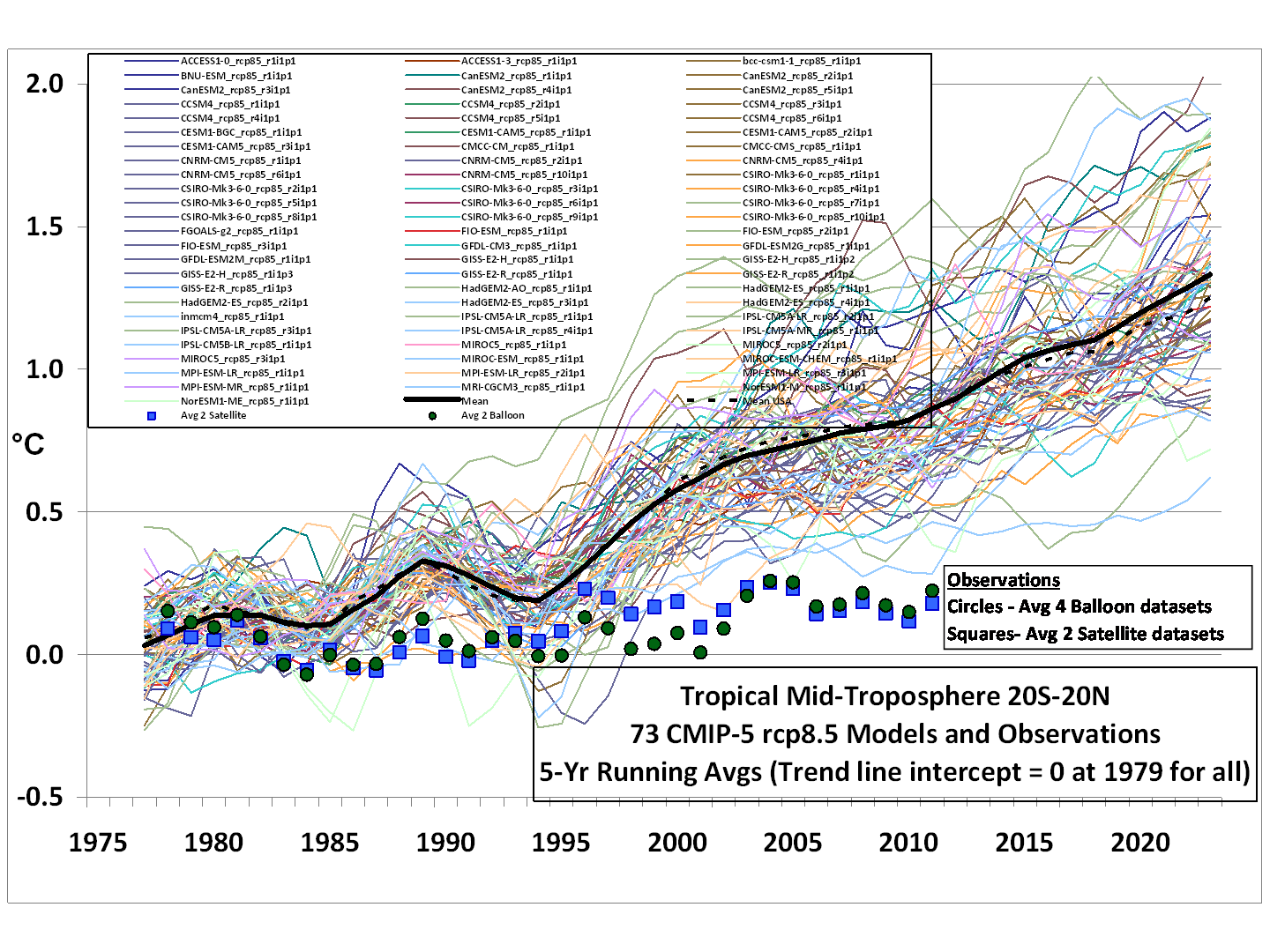
As far as satellite data, it shows the predictions are all pretty much wrong, and lends evidence to the sensitivity of CO2 being about half the value as used in modeling.
-
Re:B..b..but...
BTW, according to NOAA satellites, 2019 was the 14th hottest year and 2018 was the 23rd hottest year.
http://www.drroyspencer.com/la...
Personally, I think the satellite data set is better - it is harder to mess with, avoids the problems of only measuring near humans, and measures more of the system in question.
But again, none of this really says anything about proving CO2 based AGW.
-
Re:That's a lot of people involved
Good predictive science is about making the best extrapolations you can with the data and theory you have. Yes, you can be wrong, and you always need to be prepared for that. But that doesn't mean it isn't important to try to predict.
Good predictive science is also about going back and reworking your premises when your predictions don't match reality. However, in the face of increasing deviation from observed temperatures, the IPCC and others in the AGW community continue to double down on their basic premise, their models, and their predictions. And so we see "final chance" deadlines issued... and reissued... and reissued... as the deadlines pass without the apocalyptic predictions coming to pass -- but global warming is still a crisis, and you have to believe the latest doom-and-gloom prognostications. And now that I've set up the lightning rod for the "just another denier" attacks...
-
Re: Nobody knows anything
How as CO2-driven climate change been tested true? After all, 95% of all models are wrong in that they do not measure actual data. They do not test true at all. As Einstein said, "If I were wrong, then one [author] would have been enough!"; the fact that data does not agree with theory/model means the theory/model is wrong. As Richard Feynman elegantly states: if your theory/model disagrees with experiment - it's wrong.
-
Re:Nothing stays the same
I'm sure you say the same thing about politicians, too! Unless you have a law degree and a decade or more of experience, you have NO RIGHT to criticize any politician. Logic and reason be damned, it's all about the degrees a person has achieved. Einstein was spot-on when he responded to the 100 authors opposed to him; it would only take one to prove him wrong, there is no "strength in numbers".
And as far as climate science goes, 95% of the models say that the data is wrong; however, as Richard Feynman so succinctly stated, if your theory (guess) disagrees with experiments/data - your theory is wrong. And in this case, the theories are pretty much wrong - at least 95% of them.
-
Re: It's Called Science
We can control how we deal with the effects even if we can't control the effects. Ie, put in earthquake codes for new buildings even if you can't prevent earthquakes.
Fully agree! You can work to mitigate the damage from the event. But if prevailing wisdom was that sacrificing virgins would stop earthquakes, yet we don't know what really causes earthquakes, should be up our sacrifice rate?
But we know that human activity is indeed contributing to the climate, no one with a brain should be denying that, the disagreement should only be over how much we are affecting it. Which means that limiting greenhouse gases is a good idea even if it is only a small contributor to the overall warming.
Yes, how much. Is 2% more going to be catastrophic? Do we know that more CO2 will actually increase the temperature? Because that is what the models assume but the models don't track reality, probably because the IPCC and the models don't have a clue about how to accurately model the effects of clouds. Maybe CO2 doesn't drive the temperature change we're seeing, meaning focusing on it is wasted effort. That would also explain why we see the same temperature changes in the late 1800s and late 1900s, even though the rate of change and magnitude of CO2 in the atmosphere was radically different.
-
Re:So what? So the claim was wrong!
The Dr. himself. NASA Exceptional Scientific Achievement Medal winner, and "Dr. Spencer’s research has been entirely supported by U.S. government agencies: NASA, NOAA, and DOE. He has never been asked by any oil company to perform any kind of service. Not even Exxon-Mobil." Or the word of #random guy on
PS: you prove my case; you don't like his conclusions, so you slander the man, and ignore his NASA data (not models - DATA) which shows that the IPCC models do not agree with reality. And then you choose the models over reality.
-
Re:So what? So the claim was wrong!
The Dr. himself. NASA Exceptional Scientific Achievement Medal winner, and "Dr. Spencer’s research has been entirely supported by U.S. government agencies: NASA, NOAA, and DOE. He has never been asked by any oil company to perform any kind of service. Not even Exxon-Mobil." Or the word of #random guy on
PS: you prove my case; you don't like his conclusions, so you slander the man, and ignore his NASA data (not models - DATA) which shows that the IPCC models do not agree with reality. And then you choose the models over reality.
-
Re:More energy and water vapor in atmosphere
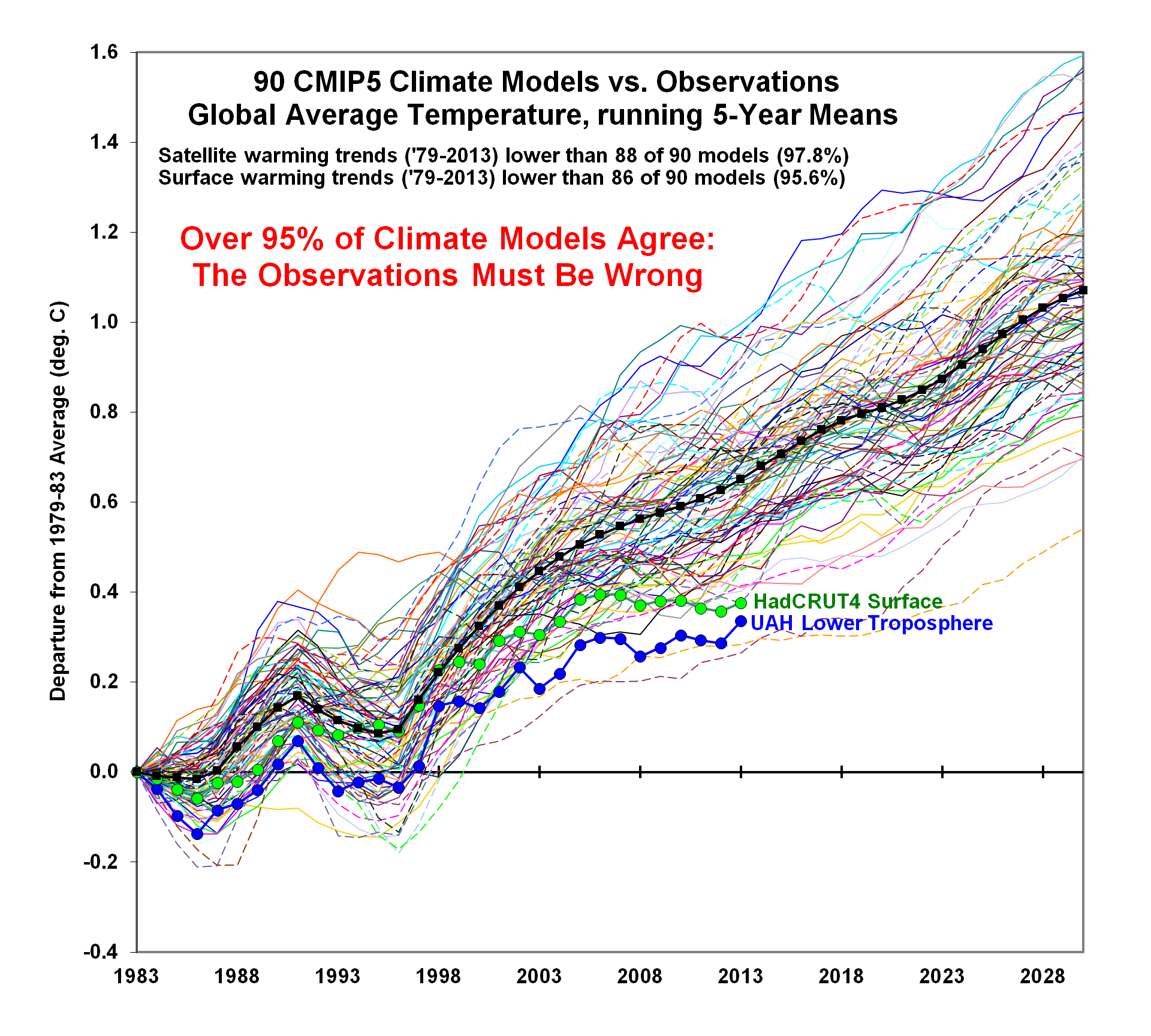
As Dr. Roy Spencer said, 95% of climate models agree the observations must be wrong. When data and models disagree - it shouldn't be the data that's tossed aside...
-
Re:More energy and water vapor in atmosphere
As Dr. Roy Spencer said, 95% of climate models agree the observations must be wrong. When data and models disagree - it shouldn't be the data that's tossed aside...
-
Re:It's Called Science
The issue is that the models do NOT agree with the data, and that becomes problematic because the future catastrophes that are predicted (and used as justification for the latest and greatest round of taxation/regulation) rely upon the models, not the data.
So if the data doesn't show anything scary (in fact, we've had the exact same climate change in 1895 to 1943 as we saw in 1957 to 2005), then why the concern? Because the faulty models say their should be a concern. But since the models don't match reality - which do we believe? Data or models? Like the GP - I'll take the empirical evidence, thank you (and in fact, I'll take the unadulterated data that is tweaked to show a heating trend when there was, per the original data, a cooling trend).
-
Re:Stop lying
You are wrong. The models do not match the data. So which do you believe - the satellite and radiosonde data or the models?
Or maybe you like HadCRUT 4 instead, even though it is riddled with errors?
Or the ERSST data that's been edited to create a rise where there originally wasn't one?
Which set of data, for which model, do you think is valid? Let's run that model from, say, 1980 until now and see how accurate it is.
-
Re:Stop lying
If models can fit the facts, then the models are effective. Climate models absolutely do fit the facts.
No they do not. If the models don't fit, then admit you're a twit, and from this debate, you must go and quit (apologies to Johnny Cochran).
-
Re:Stop lying
Which climate models would that be? Because without constant, nearly-annual re-jiggering of the models, we'd see that 95% of the models are flat-out wrong. But hey, now that output of the models is actually defined by the IPCC as constituting half the current climate (yes, models are half of the current climate - not the actual data, real-world empirical measurements - models), then models can never be wrong, can they?
-
Re: Getting sick of climate change hyperbole
See that link a few posts up in this thread? No? Here it is again. This is all 90 of the IPCC models graphed versus actual data. Not just one or a few models - ALL of them. And you see pretty much ALL OF THEM (well, 88 of 90) overestimate the warming. It's not just a model - it's pretty much all of them.
-
Re: Al Gore isn't somebody you go to for science
Looking at the satellite data from your link, it is pretty clear all the models, on average, heavily over-estimate the warming as the measured data lives in the very bottom of the tolerance range (thankfully it's a REALLY WIDE range so they can still claim "we're accurate!"). The averages seem to run about 0.4 deg C too hot - and if you look at the satellite data, it shows a big spike in 1998, and we're just now getting back up to that level again (meaning the 15 year pause was real - even though it wasn't in any of the models).
Looking at a plot of the average of each model versus actual measurements shows the same thing - most models overestimate warming, but only by having wide tolerance windows (on the order of the base estimation itself) can they claim "accurate".
-
Re: Al Gore isn't somebody you go to for science
-
Re:It ignores - what is not happening?
Appeals to the masses didn't stop Einstein and he was correct in his rebuttal. And even your contention of 95% is actually false as the original "study" was highly flawed in methodology, to such an extent it should never be heard from again.
Currently we see models increasingly diverging from measured data, and the biggest suspect is the value used for climate sensitivity to CO2. Most models assume 3 deg C, but research shows it to be about half that.
Oh, and if you'd actually look at those linked pages, you'll finds lots of links to real published data, peer reviewed and everything.
-
Re:It ignores - what is not happening?
More and more research is showing that the estimate of the climate sensitivity to CO2 is quickly falling, making the projections based upon a much higher sensitivity value less and less accurate. Most of the IPCC models assume 3 deg C for a doubling of CO2, but research since 2012 basically supports a value about half that. And it would explain why there is a divergence between models and measurements.
-
Re:I'll take this one!
Those same models (page 34) show that it may, in fact, never actually become ice-free, and that is assuming that the climate sensitivity to CO2 is at least 3 deg C/doubling. And there is data to suggest it's actually down around 1.5 deg C/doubling of CO2. Meaning - we'd never have an ice-free summer.
-
Re:I'll take this one!
The issue is that the models in the IPCC assume over twice (on average) the climate sensitivity. It's closer to about 1.3 deg C to 1.5 deg C for a doubling of CO2, rather than the average of 3 deg C. And here's the kicker - we don't know if that's even correct, because we don't know how much warming is natural. Does that mean there is ZERO human-induced warming? Nope. But it also means we really don't know how much of an impact we are having.
W = N + H. You want to keep W under some magic number (it used to be 3, then 2, now it is 1.5). You think you can control H. You do not know what N is. Solve for H. THAT is the issue.
-
Re:Getting sick of climate change hyperbole
Which IPCC projection or model has been correct? So far, 95% of the models have been wrong - and have significantly overstated the heating impact of CO2. Claims based on bad models should be properly discounted...
-
First thing - how accurate in the past?
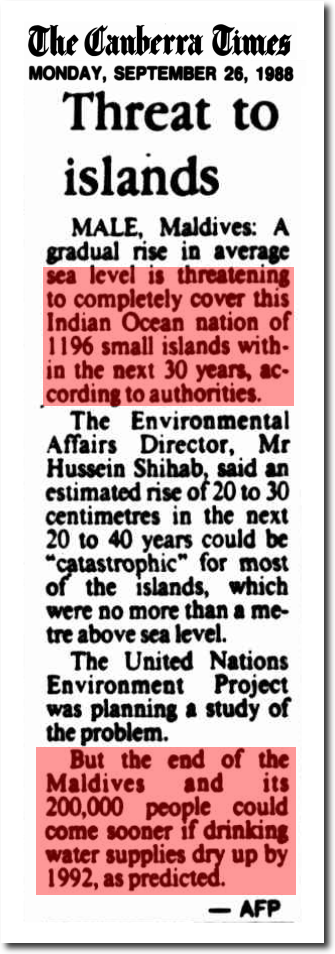
Thirty years ago we were told the Maldives were going to disappear by now, from Climate Change and sea level rise. In fact, the Maldives Cabinet met underwater to highlight their plight. However, they obviously are still there considering they just expanded their airport.
So before we consider the claims from a given set of models projecting sometime in the future, let's look at the accuracy of their previous claims. If they weren't very accurate (as we're seeing with this and 95% of the models in the IPCC), then we should ask for further justification why we should believe their models this time.
-
Re:More 'climate change' bullshit
Temperatures were pretty flat from ~1979 to the big El Nino in 1998.
Learn what surface temperature is, and some statistics. Your assertion is nonsense.
-
Re:More 'climate change' bullshit
Temperatures were pretty flat from ~1979 to the big El Nino in 1998. Then flat again until the big El Nino in 2016. And we're talking about a few tenths of a deg C for the record, where the data accuracy itself is 0.2 deg C wide (+/- 0.1 deg C accurate). If it was driven by CO2 and its re-radiative effect, wouldn't you expect to see a much more consistent rise in temperature over that time-span rather than flat periods with a big step function?
-
Re:so much worring over so little
Suppose methane, or water vapor in the air tripled next year. It's just as impossible - and it would be infinitely worse - than your assumption. CO2 increases are much, much slower, highly variable, and strongly influenced by natural processes as well.
-
Re: Climate change
The problem is that the data doesn't match the models, and it's those models that say it is supposed to be 2 deg C warmer. The data doesn't support the models' claims. Science says that when data and theory/model conflict, the theory/model is wrong.
Additionally, the theory is that a warming world should have more and stronger hurricanes, yet the trendline since 1992 is down and this year is forecast to be lower still. More data and theory conflicting...
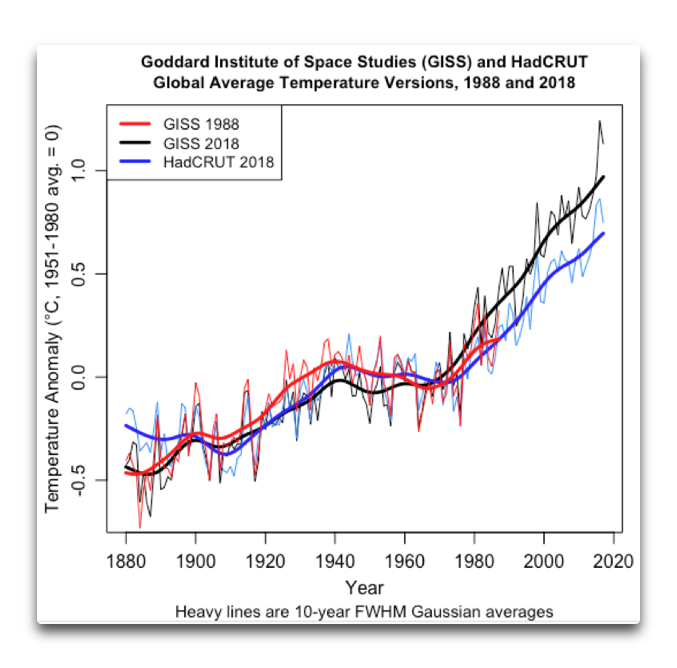
Furthermore, look at the GISS temperature record from 1988 and from 2018. You'll see that it's been adjusted to eliminate the peak in 1940, and the cooling from 1940 to 1970. When you can adjust away the past, then you can dictate the present. But it's not quite honest now, is it?
Lastly, look at HadCRUT4 from 1895 to 1943, and then again from 1957 to 2005. They are essentially the same - yet the former (1895 to 1943) is supposed to be not affected by the sudden rise in CO2. If we had the same type of climate change with and without the impact of CO2, then what does that say about the impact of CO2?
-
Re:Move along nothing to see here...
The decline was until the mid 1970s, it didn't stop in the 1940s.
I suppose all those dead people magically sprang back to life, and all the shattered industry magically repaired itself at the end of the war too? And that's just one factor that you blithely ignored because it was inconvenient.
Additionally, there was that massive heating (worldwide, might I add) that happened in the 1930s.
What massive heating in the 1930s?
And the pause is "eliminated" by inclusion of bad satellite data, which the folks who run the satellite system itself (Dr. Roy Spencer and others) say you shouldn't do. Drop the bad data, and we have a pause - even as CO2 continued to increase.
That post is about an article "Sensitivity of satellite derived tropospheric temperature trends to the diurnal cycle adjustment" which most people would realize is about the troposphere warm spot, and not about the actual temperature record. Do you bother to read or understand things before you link to them or is this just you desperately grasping at any straw to reaffirm you preconceived notions?
Maybe you should do some actual research and come up with something actually coherent before you start playing this mind-numbingly stupid game of whataboutisms? Cherry-picking random facts and claiming they disprove something because you don't understand, is just illustrating that you don't understand.
-
Re:Move along nothing to see here...
The decline was until the mid 1970s, it didn't stop in the 1940s. Additionally, there was that massive heating (worldwide, might I add) that happened in the 1930s. And the pause is "eliminated" by inclusion of bad satellite data, which the folks who run the satellite system itself (Dr. Roy Spencer and others) say you shouldn't do. Drop the bad data, and we have a pause - even as CO2 continued to increase.
-
Re:Move along nothing to see here...
Then you didn't look at his model. It matches the temperature record quite well (better than most of the IPCC as Dr. Roy Spencer has shown), and is based on the PDO. In other words, it is the PDO (and to a lesser extent the AMO) that drive the climate, not CO2.
-
Re:Proof that CO2 does not cause warming
Perhaps that's why the models don't match the data, and run quite a bit hotter than actual data.
Actually climate models match the observations pretty well. Dr. Spencer needs to update his graph. Also, I'm curious how the model runs and the observations can all start from the same zero point in 1983. At the very least there should be a discrepancy between the HADCRUT and UAH starting points. So he shifted everything to start at the zero point in 1983 which is a pretty unscientific thing to do.
-
Re:Proof that CO2 does not cause warming
Those graphs all over-estimate climate sensitivity by a factor of 2 or 3; recent peer-reviewed data points to 1.3 to 1.6 deg K for doubling of CO2, not the 3+ deg K as used by all the IPCC models. Perhaps that's why the models don't match the data, and run quite a bit hotter than actual data.
-
Re: Anti-LGBT ??
True, but what that means is that other folks should always be looking for other theories that might better fit the data. Unfortunately, most of the folks on the other side seem to think that "unsettled" means "I can ignore this because it is inconvenient," which is not the same thing.
No, not at all. That's the strawman constructed and attacked. Go check out Watts Up With That, and you'll find 99.9% of the posters acknowledge some warming, but are skeptical that it is all man-made and it all comes from CO2. Rather, the appearance of trends as I linked tend to show a high likelihood that much of the warming is natural. So perhaps we need to re-think our priorities and budgetary allocations based upon data, rather than models that simply do not match the real world.
The problem is that their alternative explanations only fit the data over a very short period of time [skepticalscience.com], geologically speaking. These theories have been debunked repeatedly by trivial comparison with the actual data.
Actually, no. Not a single IPCC model accounts for the rise of temperature from 1890 to 1940, then the plunge from 1945 to 1975, let alone the general pause in the 2000s. However, there are models that correlate nicely with the past and also have predicted - more reliably than the IPCC models - the current 2000s. They come from geologists, though, not from climatologists. In fact, looking at past inter-glacial periods, we see a continual cyclic pattern of ever-increasing temperatures until the entire system "flips" into deep cooling. In other words - what we see today, is not unprecedented.
That said, there's a lot we don't know. It is possible (nay, almost certain) that we will eventually hit an equilibrium point at which more plants are growing, and the temperature change levels off.
When it levels off, that's when it starts falling. A few hundred million years says that's the way it happens. Typically glaciated over most of the Northern hemisphere, with occasional blips of warmth - like we have now.
The big unanswered questions are how many major cities will be underwater when it does, whether we will have enough arable land to feed the earth's population as temperatures and rain patterns shift, and whether the cost of reducing our greehouse gas emissions exceeds the cost of dealing with the effects of climate change over the long term. And *that* is where there is a lot of room for speculation, debate, etc.
Sea levels historically happened 4X faster than now, food production is skyrocketing, and there still isn't any real effect from increasing CO2.
Rather than sweat over something that has NOT been shown to be a cause of disaster (CO2 increases driving climate change), I fully agree with Bjorn Lomborg that we should look to spend our money on real, defined, understood problems.
-
Re:Human Caused Global Warming?
CO2 will increase heat in the atmosphere; that's not a question at all. Basic physics and such. However, most AGW models set the feedback sensitivity for a doubling of CO2 at 3K, when in actually seems to be about 1.1 K. That would also explain why most AGW models run hotter than measurements and need to be constantly "retuned" to fit the past (and continue to fail predicting the future).
-
Re:Human Caused Global Warming?
Citation Required. The data record seems to say otherwise, with greater, faster changes happening in the past. And if you look at the longer term data you'll see that it's also happened back in the 1890s-1940s as well.
-
Re:Human Caused Global Warming?
See this paper, specifically figures 4 through 6. Look at the time from ~1890 to ~1940 - it's about the same level of change as we've seen from ~1970 to today (both about 50 year periods).
You can also check this graph and see we have had periods of much greater - and more rapid - temperature increses AND decreases, back in 1986-1988, 1997-1999, and 2009-2011.
-
Re: The world is not a static system
These climate scientists show that 97% of all IPCC models vastly overestimate actual measured temperatures as recorded from balloons and satellite.
-
Re:Junk Science
I love your post. Zero facts, zero logic, but somehow I'm the "moronic denier". Since you clearly failed debate (or never had to take it), here's a tip: when a side reverts to name calling and logical fallacies (Ad hominem https://en.wikipedia.org/wiki/... and appeal to majority https://en.wikipedia.org/wiki/...), that in it'self is a flat out lie ( https://www.skepticalscience.c... ) they typically have a very weak position.
And no, the AGW scientists have been caught a number of times falsely manipulating the numbers (FACT)
https://science.house.gov/news...
http://www.dailymail.co.uk/sci...
http://www.foxnews.com/science...The AGW "scientists" mathematical models have been wildly inaccurate: http://www.drroyspencer.com/wp... (how you can look at that graph and not doubt the quality of their predictions is beyond me) but still you want to treat them like a hard science... Good luck with that.
I have facts and evidence, you have blind faith in "scientists" who are out to make a buck vis a vi federal grant money. Get back to me when you have more facts and less name calling...
As you said, thanks for playing.
-
Re: Won't work, we're kinda fucked.
and we how that levels aren't going up and down radically over centuries
Assuming that 'how' is a typo for 'know', no we don't. If global warming actually is serious it would be easier to transition away from carbon over much less than a century.
Is it serious now? Not really. January 2018 was 0.26 degrees C warmer than the average for 1979 to 2018. 0.26 degrees C is not a large number.
http://www.drroyspencer.com/la...
Actually regardless of global warming I think we'll see a transition away from carbon intensive fuels. E.g. the UK and US have both seen their carbon emissions drop as they move from coal to gas for power generation.
UK
https://www.newscientist.com/a...
The UK's carbon dioxide emissions have fallen to their lowest level since the 19th century as coal use continues to plummet, analysis suggests.
Emissions of the major greenhouse gas fell almost 6 per cent year-on-year in 2016, after the use of coal for electricity more than halved to record lows, according to the Carbon Brief website, which reports on climate science and energy policy.
The assessment suggests carbon emissions in 2016 were around 381 million tonnes, putting the UK's carbon pollution at its lowest level - apart from during coal mining disputes in the 1920s - since 1894.
Carbon emissions in 2016 are around 36 per cent below the reference year of 1990, against which legal targets to cut climate pollution are measured.
US
https://www.eia.gov/environmen...
Energy-related carbon dioxide (CO2) emissions decreased by 89 million metric tons (MMmt), from 5,259 MMmt in 2015 to 5,170 MMmt in 2016. Although real gross domestic product (GDP) increased 1.5% over that period, other factors contributing to energy-related CO2 emissions more than offset the growth in GDP, leading to a 1.7% decline in energy-related CO2.
These factors include the following:
* A decline in the carbon intensity of the energy supply (CO2/British thermal units [Btu]) of 1.7%
* A 1.4% decline in energy intensity (Btu/GDP)Combining these two factors, the overall carbon intensity of the economy (CO2/GDP) declined by 3.1%.
Emissions have declined in 6 out of the past 10 years, and energyârelated CO2 emissions in 2016 were 823 MMmt (14%) below 2005 levels.
Of course it's worth pointing out that environmentalists have opposed fracking. Are global emissions going to go into decline anytime soon? Probably not, because of China. But in the US, UK and developed world they're already falling. And over centuries it's pretty much certain that new technologies - nuclear and renewable - will produce energy is less carbon intensive ways. In fact as the UK and US example shows it's already possible to produce energy in less carbon intensive ways.
-
Re:Read Karl Popper
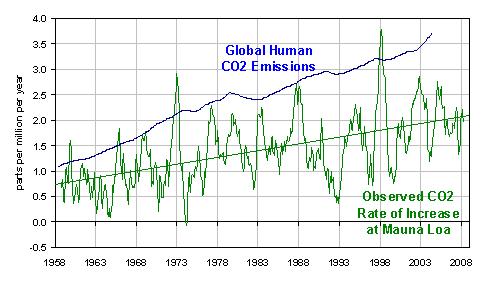
has slight variations that correspond quite well with the variations in CO2 emissions
Care to crunch the data on that? Doesn't look nearly as close a fit as I think you're imagining:
https://static.skepticalscienc...
https://upload.wikimedia.org/w...
Here's one that seems to have them side by side:
http://www.drroyspencer.com/wp...
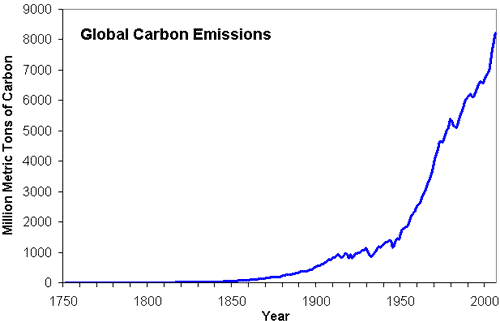
Now, I'd love to see the data, but there seems to be nearly zero correlation, even though the slopes are similar. I can't look at that graph and see any obvious tight correlation. You can see the rate of increase (rather than the total c02 in the atmosphere) being used as a metric - and there's a bunch of variation in that rate of increase that doesn't look at all like human emissions.
As far as temperature goes there is natural variability and some human factors that produce noise in the temperature record that is much greater than the year to year increase in forcing.
Which begs the question - maybe natural variability produces more noise than any proposed human effect
-
Re:Climate Models
The data plotted is bad, it's all been adjusted quite heavily. Thankfully, we have a satellite record covering most of that same time period, and it has NOT been constantly massaged, homogenized, extrapolated, and fitted. And it shows terrible correlation with the models.
-
Re:The sleeping elephant in the room
What data is there to push the anthropomorphic global climate change concept? Actual real data, not output from models. Because the actual data shows sea level changes incredibly linear for the last ~150 years, the actual warming being a lot less than the models predict, and the modeled sensitivity of climate to CO2 levels being a factor of 2 to 3 too high
There is no data to push an anthropomorphic climate change concept.
Definition of anthropomorphic
1 : described or thought of as having a human form or human attributes
anthropomorphic deities
stories involving anthropomorphic animals2 : ascribing human characteristics to nonhuman things
anthropomorphic supernaturalism
anthropomorphic beliefs about natureThe word you want is anthropogenic.
Definition of anthropogenic
: of, relating to, or resulting from the influence of human beings on nature
anthropogenic pollutantsRegarding sea level changes being linear for the last ~150 years here is a statistician's analysis of that. It doesn't appear linear to me.
-
Re:The sleeping elephant in the room
What data is there to push the anthropomorphic global climate change concept? Actual real data, not output from models. Because the actual data shows sea level changes incredibly linear for the last ~150 years, the actual warming being a lot less than the models predict, and the modeled sensitivity of climate to CO2 levels being a factor of 2 to 3 too high
-
Re:Models are open source and publicly available
And yet the models don't match reality. Sure, the code is impeccable, the statistics are perfect - but the coefficients for feedback may be wrong and we're probably missing dozens, if not hundreds, of other feedback loops to include. When models and reality disagree - who do you trust?
Actually, turns out that for the most part, it is Dr. Spencer who doesn't match reality. Spencer is pretty good at cherry picking data, but it isn't just that his data doesn't match the models-- it doesn't match the data measured by people other than him.
He sure gets a lot of press, though.
By the way, can you link perhaps to some data that isn't four years old? Most of what he says here is already shown to be wrong. I'm sure he has new cherry-picked data to show now, since the cherry-picked data he has here is now so obsolete.
-
Re:Models are open source and publicly available
And yet the models don't match reality. Sure, the code is impeccable, the statistics are perfect - but the coefficients for feedback may be wrong and we're probably missing dozens, if not hundreds, of other feedback loops to include. When models and reality disagree - who do you trust?
-
Re:How Were All of the Last Predictions?
I saw that thread. You're lying. The other poster said that the models don't match reality and thus we need to focus on getting the models right first, before trying to act on any conclusions one makes from the models. If you know your model is wrong - provably so - then why would you trust the conclusions from the model? Talk about a moron, you dumbshit...
-
Re:Another thing they don't tell you about the mod
Here you go. It was in my original post. Just take a look at the data, look at what the models predict. The data shows about 0.3 deg C increase in temperature. The mean of the models is over twice that. Many are pushing 3 to 4 times the actual measurements.
-
Re:Another thing they don't tell you about the mod
I don't think you know what you are saying. Only two of the models are more conservative than the actual measurements - the other 88 are over the measurements, and most by a factor of 3 or more.
-
Another thing they don't tell you about the models
Dr. Roy Spencer, funded solely by Government grants (not "Big Oil"), lays out the actual data and shows that 95% of all climate models agree that actual measured data is wrong. The models, basically, do not model actually all that well. Puts a bit of a damper on the whole "models assume we have negative carbon output!" kind of thing, doesn't it?
-
Another thing they don't tell you about the models
Dr. Roy Spencer, funded solely by Government grants (not "Big Oil"), lays out the actual data and shows that 95% of all climate models agree that actual measured data is wrong. The models, basically, do not model actually all that well. Puts a bit of a damper on the whole "models assume we have negative carbon output!" kind of thing, doesn't it?