Slashdot Mirror
Domain: drroyspencer.com
Stories and comments across the archive that link to drroyspencer.com.
Comments · 186
-
Re:The data shows...
Actually, not so much. Here's a plot with a longer baseline:
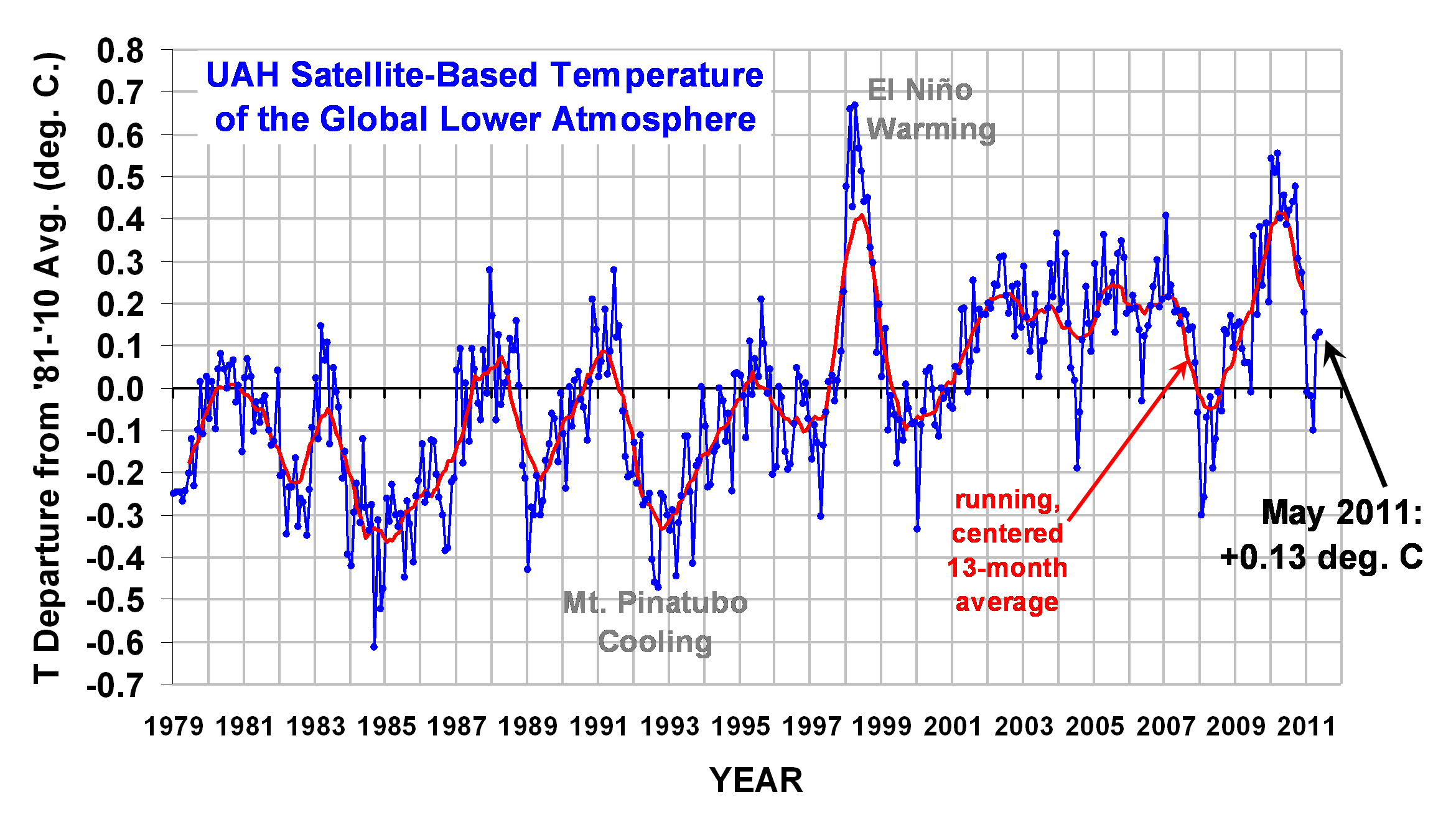
UAH Satellite Temperatures for Lower Atmosphere
It clearly shows 2010 as cooler than 1998, a significant cold snap in 2008, and that 2011 dipped below the baseline in the beginning of the year.
I'm personally quite sure that Earth's tropospheric heat content is driven more by albedo and solar effects (not necessarily just insolation) than by an increase in a weak trace greenhouse gas (CO2). There is very likely a negative feedback from water vapor (rather than positive as portrayed in the climate models) for one thing. Clouds have very high albedo, and were likely the mechanism for cooling when CO2 was at high levels in the paleoclimate. There's no reason to think the same effect isn't happening today.
The cooling during the Maunder and Dalton minimums was quite significant, and if the Sun follows through as NASA now predicts I expect we'll see fairly sharp and noticeable global cooling over the next 3-4 decades. This will not be a full-scale "Ice Age", but instead a "Little Ice Age" similar to previous solar Grand Minima. That should give us time to really understand the impact of increasing CO2, and to develop effective technologies to deal with it. Regardless of anything else, there should be a large investment in (possibly thorium based) nuclear power generation.
The future of the human race is dim if the approach is to try to throttle down technology and progress in the name of "sustainability" - that will simply kill the first world nations, and ensure the dominance of China and other bad actors as time passes.
-
Re:College bull
None of those models matches up against our observations, however. AGW may assert that the climate is changing (as it always does), but weather patterns are not becoming more extreme, despite changes in CO2 and temperature (whatever their cause). See the real data:
http://www.drroyspencer.com/2011/05/todays-tornado-outlook-high-risk-of-global-warming-hype/
-
Re:Climate Change Deniers
I believe that is the cause because it's bleeding obvious, and so well accepted that it is part of the definition of seasons.
Again, your rhetoric failed. You were trying to compare a tautological definition to competing hypotheses with Occam's razor. The fact that you didn't express yourself well isn't my fault.
I know! And then to complete the analogy, you would have said "Well, we can't be certain. It was once the province of California and the borders have changed over time, and/and/and" Priceless!
Again, your comprehension here is lacking. I did not take your poorly phrased statement as a simple assertion of a tautological definition (since that was incongruous with the idea of comparing it to competing hypotheses, and I assumed that you *meant* what you said). To interpret my response to the poorly worded statement you made as if I understood that you were talking about a tautological definition is a mistake.
Would we notice the equivalent of 56,000 nuclear bombs/hour leaking from Mt. St. Helens?
You're drunk now, aren't you?
As the temperature of a black body increases, the emission of infrared radiation back into space increases with the fourth power of its absolute temperature. This keeps the gain under 1.
You're still not making sense. You want to assert that the climate of the earth cannot have runaway cooling or warming because...you think it acts like a blackbody? Isn't the whole GHG argument that the earth does *not* behave the way we would calculate a perfect blackbody would act?
How can you conclude that CO2 is not the primary driver of the current warming without knowing the basics of climate science?
I do know the basics (and quite a few of the advanced features) of climate science, which is why I conclude that CO2 is not the primary driver of any warming in history. You seem to be missing some very basic understandings though.
Oh dear. I've confused you with a double negative.
I understand - you're not very good at being clear...let me restate for you:
"it still begs the question, what is the *relative* strength of CO2 to other forcings?"
"Yes, another good question. One to which there is a clear answer."
Okay, what is the clear answer? How, for example, do you compare the relative strength of CO2 to the specifics of cloud formation? Here are a few more thorough indications that the answer you believe is not the truth:
http://wattsupwiththat.com/2011/06/02/earth-itself-is-telling-us-there’s-nothing-to-worry-about-in-doubled-or-even-quadrupled-atmospheric-co2/
http://www.drroyspencer.com/research-articles/satellite-and-climate-model-evidence/
If the CO2 is released as a result of warming then it's a feedback. If it is released as the result of burning fossil fuels then it is not a feedback. Duh!
Again, you're making a special pleading that the *source* of CO2 will somehow determine its effect. This is clearly false. A molecule of CO2 does not know or care about its origin before it decides to absorb or radiate energy.
-
Re:Climate Change Deniers
You do not need to go through those convolutions to determine whether there has been polar amplification. We can just take direct measurements.
There are specific values for polar amplification that are predicted by the AGW hypothesis. Simply because polar amplification *exists at all*, does not mean that it matches the prediction by the AGW hypothesis.
"To create the polar amplification profile illustrated in the above figures in the GCMs, there had to be a doubling of CO2 or a 2% increase in solar irradiance. Neither happened in the last 3 to 4 decades, so what created the polar amplification profile? Real Climate provides the answer. El Nino events."
Then you have failed to account for why natural disasters are rising faster than earthquakes.
I don't accept that as proven.
See: http://www.drroyspencer.com/2011/05/the-tornado-pacific-decadal-oscillation-connection/
Why do you keep invoking mysterious forces that are not necessary to explain any known phenomenon?
Why do you insist that any known phenomenon can simply be explained in toto by CO2 levels, without wondering what other influences are out there? Just because we can choose to explain average global temperature levels with CO2, does not mean that our explanation is *correct*.
It could just as easily be unicorns
And isn't that the problem? If you have a set of theories that do not provide any sort of falsification (unicorns or CO2 driven climate change), you're not doing science.
You think that we know the effects of CO2 by measuring CO2 and measuring temperature and attributing any correlation to CO2. You are wrong.
No, you are wrong.
http://www.drroyspencer.com/2009/07/how-do-climate-models-work/
"So, climate modelers simply assume that there are no natural long-term changes in clouds, water vapor, etc. But they do not realize that in the process they will necessarily come to the conclusion that the climate system is very sensitive (feedbacks are positive). As a result, they program climate models so that they are sensitive enough to produce the warming in the last 50 years with increasing carbon dioxide concentrations. They then point to this as ‘proof’ that the CO2 caused the warming, but this is simply reasoning in a circle."
Ever heard of Occam's razor? You keep trying to invoke unknown forces that are not necessary to explain any known phenomenon.
I do understand Occam's razor, and I think given the two choices, "average global temperature changes are primarily driven by CO2" and "average global temperature changes are primarily caused by a complex array of natural forces we have not yet entirely identified", the simpler one is the "natural forces" hypothesis. In order to believe that climate change is primarily driven by CO2, we must buy into a large number of special pleadings to explain both past and present climate changes that were lagged by CO2 levels. By admitting our ignorance of "natural forces", we arrive at the simpler explanation, even if it is not as intellectually satisfying.
There are other cycles that dwarf CO2 such as ENSO but are dwarfed by these "seasons". But none of these cycles will drive a trend. The trend is driven by CO2.
I think you need to be more specific. I think what you're *trying* to say is that none of the identified cycles will drive a trend on a period that is exactly the same as it's cycle length. Take your simple sine wave, and if you choose end points carefully, you can generate whatever trend you want.
Now, to assume that a period like say, 30 years, is sufficient
-
Re:Climate Change Deniers
You do not need to go through those convolutions to determine whether there has been polar amplification. We can just take direct measurements.
There are specific values for polar amplification that are predicted by the AGW hypothesis. Simply because polar amplification *exists at all*, does not mean that it matches the prediction by the AGW hypothesis.
"To create the polar amplification profile illustrated in the above figures in the GCMs, there had to be a doubling of CO2 or a 2% increase in solar irradiance. Neither happened in the last 3 to 4 decades, so what created the polar amplification profile? Real Climate provides the answer. El Nino events."
Then you have failed to account for why natural disasters are rising faster than earthquakes.
I don't accept that as proven.
See: http://www.drroyspencer.com/2011/05/the-tornado-pacific-decadal-oscillation-connection/
Why do you keep invoking mysterious forces that are not necessary to explain any known phenomenon?
Why do you insist that any known phenomenon can simply be explained in toto by CO2 levels, without wondering what other influences are out there? Just because we can choose to explain average global temperature levels with CO2, does not mean that our explanation is *correct*.
It could just as easily be unicorns
And isn't that the problem? If you have a set of theories that do not provide any sort of falsification (unicorns or CO2 driven climate change), you're not doing science.
You think that we know the effects of CO2 by measuring CO2 and measuring temperature and attributing any correlation to CO2. You are wrong.
No, you are wrong.
http://www.drroyspencer.com/2009/07/how-do-climate-models-work/
"So, climate modelers simply assume that there are no natural long-term changes in clouds, water vapor, etc. But they do not realize that in the process they will necessarily come to the conclusion that the climate system is very sensitive (feedbacks are positive). As a result, they program climate models so that they are sensitive enough to produce the warming in the last 50 years with increasing carbon dioxide concentrations. They then point to this as ‘proof’ that the CO2 caused the warming, but this is simply reasoning in a circle."
Ever heard of Occam's razor? You keep trying to invoke unknown forces that are not necessary to explain any known phenomenon.
I do understand Occam's razor, and I think given the two choices, "average global temperature changes are primarily driven by CO2" and "average global temperature changes are primarily caused by a complex array of natural forces we have not yet entirely identified", the simpler one is the "natural forces" hypothesis. In order to believe that climate change is primarily driven by CO2, we must buy into a large number of special pleadings to explain both past and present climate changes that were lagged by CO2 levels. By admitting our ignorance of "natural forces", we arrive at the simpler explanation, even if it is not as intellectually satisfying.
There are other cycles that dwarf CO2 such as ENSO but are dwarfed by these "seasons". But none of these cycles will drive a trend. The trend is driven by CO2.
I think you need to be more specific. I think what you're *trying* to say is that none of the identified cycles will drive a trend on a period that is exactly the same as it's cycle length. Take your simple sine wave, and if you choose end points carefully, you can generate whatever trend you want.
Now, to assume that a period like say, 30 years, is sufficient
-
Re:Climate Change Deniers
The problem I have is that the "fingerprint" analogy isn't scientific. We often hear the phrase "is consistent with" when it comes to AGW, but that's a cop out.
No, that is science. A consequence of warming due to CO2 is polar amplification. This was stated well before any warming due to CO2 was observed. Once we started to see the warming we check for the fingerprints. If we saw amplification near the equator we would have concluded that increased solar radiation is suspect. This is not what was found. You have to follow the facts. Working the other way around will not lead you to the truth.
Sounds like our detection rate of floods and cyclones has improved faster than our detection rate of earthquakes. See: (a link to WUWT)
Your statement that flood detection is increasing and your link that states we are detecting less floods is contradictory.
The question is, by how much, and how does that compare to other drivers (such as the ocean).
The answer is not unknown! There is uncertainty regarding sensitivity to those forcings, but even that is within a limited range.
We have a concrete example here of water warming air. Why can't that also be true on a global scale?
When both water and air are warming, you need to look for a reason that is neither the water or the air. This is not a case of energy moving around, but of energy being added.
you can posit tidal forces, undersea volcanoes, and even incoming solar energy not blocked by clouds or other atmospheric molecules.
Except that none of these are sufficient.
However, the existence of unknown forcings (which is nearly guaranteed), means that any explanation for current observations without that knowledge is flawed.
Perhaps there are unknown forcings, but not certainly, and certainly not at a level where they make any kind of measurable contribution. Otherwise we would need them to explain observations.
My assertion is that temperature is not always increasing even though atmospheric CO2 is. When *not* every year and *not* every decade is warmer over the 20th century, even though CO2 *is* constantly increasing, it represents a falsification of the idea that CO2 drives temperature increases.
Surely you are aware that CO2 is not the only driver of climate. You have demonstrated that knowledge. Why are you playing dumb with this last sentence?
You're going in the wrong direction -> I'm looking for a CAGW believer, who upon examination of observational data, recognized that they were wrong
If the data showed something different, then every scientific society would change their tune. As it stands, the data shows warming due to GHG, and every scientific society concludes GHG. What data do you have they they are not privy to?
What you have here is an apocalyptic vision of global cooling replaced by an apocalyptic vision of global warming.
It is hardly apocalyptic to conclude that someday within the next few thousand years we will likely leave the current interglacial. You have predicted the same. I would not accuse you of being alarmist.
Look again at Spencer:
http://www.drroyspencer.com/latest-global-temperatures/
How does that graph assert 2010 was the warmest year ever? 1998 looks at least
Four points: 1) Satellite data exaggerates El Nino/La Nina. 1998 was a super El Nino. Even given that.. 2) Spencer has stated that 2010 is tied with 1998 and... 3) the trends are similar between Spencer's reconstruction and the others. Given all this... 4) Spencer believes that the other reconstructions are robust. Do you, or do you still cling to the conspiracy theories of manipulated data?
-
Re:Climate Change Deniers
The facts are that diurnal temperature differential is decreasing, but severe weather events are increasing.
http://www.drroyspencer.com/2011/05/the-tornado-pacific-decadal-oscillation-connection/
"There are 2 main reasons why stronger tornadoes are usually associated with unseasonably cool conditions, and why there has been a decrease in strong tornadoes during a period of average warming:
1) The missing ingredient for tornado formation is not a lack of warm moist air, but a lack of synoptic (large) scale wind shear.
2) At least until recently, the positive phase of the Pacific Decadal Oscillation (PDO) which has predominated since the late 1970’s has suppressed strong tornado activity."
-
Re:Climate Change Deniers
while water vapor is necessary for thunderstorms, extreme weather events, including those without precipitation, such as tornadoes, are driven by pressure and temperature differentials.
Two points to consider: 1) We haven't eliminated the diurnal temperature differential but we have increased water vapour which does feed storms. 2) It is possible to eliminate the diurnal temperature differential and still have spacial differentials - and we have increased water vapour which does feed storms.
You are taking a curious position. When faced with facts that are in conflict with your theory, you chose to change the facts rather than your theory. The facts are that diurnal temperature differential is decreasing, but severe weather events are increasing. You seem to think that this system is too complex to understand, but you know for sure that these facts must be wrong because they don't align with your understanding. I'm not trying to be confrontational here but you may want to step back and think this one through. It doesn't seem like your method of inquiry will direct you towards the truth.
why would we assume that the atmosphere is driving ocean temperatures, rather than the other way around?
1) Because we are increasing the temperature of the atmosphere 2) Because equilibrium is required in the system 3) What do you propose is increasing the temperature of the ocean surface? The energy needs to come from somewhere. This is a very significant amount of energy - the equivalent of the energy released by about 56,000 nukes every hour. You are not proposing free energy are you?
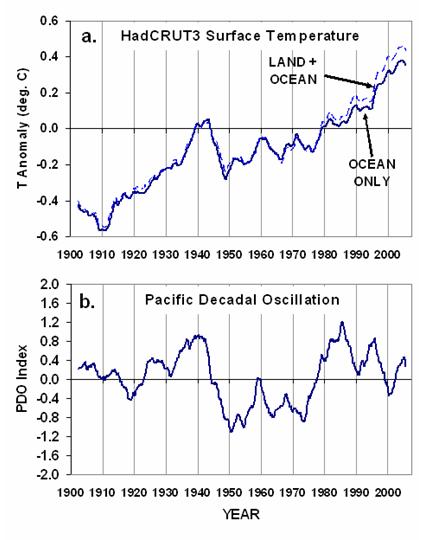
As examples, see PDO, ENSO, ADO, etc.
This is an exchange of heat between atmosphere and ocean or northern and southern hemisphere. How do you propose that an exchange of heat between different parts of the system will add heat to the system?
Why would we assume that a trend of 30 years or more eliminates any trends caused by natural variables?
Well, it will eliminate ENSO and solar cycle, it will not eliminate Milankovitch cycles
The logarithmic rate will always limit any linear progression
No, you could have an accelerated input which dwarfs the logarithmic rate. You need to count all GHG, and you need to count feedbacks (including the release of methane (a GHG) from the arctic).
I believe your point is "the temperature is increasing *and* it's because of human produced CO2".
No, go back through the history. You stated that the temperature is not increasing. I stated that it must be because we just had the hottest year in the hottest decade. You stated that this only shows that the temperature is increasing. I stated that yes, that's what I said.
And on the scale that matters to me and my neighbors, we have been seeing dropping temperatures.
So which is it? Do you agree that the temperature has been rising (as you stated in the previous quote, or that temperature is not rising, as you stated in this quote?
They can adjust their global average temperature to whatever they want
Please, no more of this crazy conspiracy talk. Here is the temperature reconstructions from Spencer: http://www.drroyspencer.com/latest-global-temperatures/
here is the analysis by Richard Mueller and the BEST team (funded by oil interests no less!): http://berkeleyearth.org/Resources/Muller_Testimony_31_March_2011
Here is the analysis by Anthony Watts: http://wattsupwiththat.com/2011/05/11/the-long-awaited-surfacestations-paper/#more-39705
Three vehement skeptics wh
-
Re:Climate Change Deniers
Water vapour feeds storms. Try a quick google search of that last sentence for more info.
Let me restate - while water vapor is necessary for thunderstorms, extreme weather events, including those without precipitation, such as tornadoes, are driven by pressure and temperature differentials. Reducing those differentials should lead to milder weather, not more extreme weather.
http://www.drroyspencer.com/2011/05/todays-tornado-outlook-high-risk-of-global-warming-hype/
You have nailed it. We have significantly raised the ocean surface temperature.
Properly stated, ocean surface temperature has always changed:
http://www.nodc.noaa.gov/OC5/3M_HEAT_CONTENT/heat_content55-07.png
And even dropped in the presence of ever higher CO2 concentrations. That all being said, why would we assume that the atmosphere is driving ocean temperatures, rather than the other way around? The heat content of the ocean outweighing the heat content of the entire atmosphere by over 4000:1 seems to be an indication that if were were to look for *causes*, they would be oceanic rather than atmospheric. As examples, see PDO, ENSO, ADO, etc.
The other natural variables create wibbles and wobbles that dwarf any trend of less than 30 years.
Why would we assume that a trend of 30 years or more eliminates any trends caused by natural variables?
We clearly haven't hit any upper limit, and accelerated output of GHG as well as feedbacks are clearly more than making up for the logarithmic rate.
I'm not sure how you can say that. The logarithmic rate will always limit any linear progression (which, if you look at atmospheric CO2 levels, is what we've been experiencing). Only a geometric progression (and a steep one at that), would "make up" for the logarithmic rate.
That the temperature is increasing. I was making the exact same point.
I'm not sure you are. I believe your point is "the temperature is increasing *and* it's because of human produced CO2". On any given time scale, understanding that climate naturally changes, I could agree with the first one (and it's corollary "the temperature is decreasing").
Put another way, it seems that the presence of a "hottest year ever" indicates to you that it must be so because of artificial influences on the climate, rather than just a statistical artifact that we see during points of warming throughout earth's history. Because the "hottest year ever" is necessary for the CAGW hypothesis to be correct, it is subject to a great deal of data massaging - but let's not mistake *necessary* for *sufficient*.
As you have noted previously we should be expecting the temperatures to be dropping.
And on the scale that matters to me and my neighbors, we have been seeing dropping temperatures. While granted, regional temperatures can buck the trend of any artificial "global average temperature", it also brings up the distinct possibility that the "hottest year ever" is simply a statistical artifact, and a politically motivated one at that.
They can adjust their global average temperature to whatever they want, but they can't stop it from being colder all across the US, and other places around the world where people actually live and experience the weather. I wouldn't go so far as to say we can definitively detect a global average trend one way or the other -> the whole sensor station network for global temperatures is woefully lacking for any sort of confidence.
I will only note that skeptics Richard Mueller, Roy Spencer, and Anthony Watts have all performed independent validation of the temperature
-
Re:Climate Change Deniers
The glaciation/deglaciation cycles of the ice age are natural variability due mostly to Milankovitch cycles which operate on scales of thousands of years and can be ignored for the purposes of this discussion.
I'm not sure if that's necessarily true - if you take a look at the cycles of ice age, they have some pretty steep curves in them that could certainly skew measurements, even if you're only taking a look at 30 years. Furthermore, I'll bet you anything that you can find 30 year periods, before the dawn of mankind going up, going down, and staying the same - simply assuming that in 30 years you get to "cancel out" natural variability just isn't supportable. Now, 30 years may be a useful benchmark in some cases, but it's certainly not any sort of guarantee that you're not seeing a statistical artifact.
Pray tell, what are some of these hundreds upon hundreds of assumptions?
How about the assumption that you can extrapolate the temperature for 1200sq mi on a single measuring station. Or the assumption that CO2 amplifies its effect through water vapor. Or the assumption that UHI is negligible.
As far as defining exactly what the current climate is, it is the statistical accumulation of daily weather observations. You can't get away from statistics in climate science.
This is certainly true, and probably why you'll never be able to determine causality here, *certainly* not based on a single driver (our giant flaming ball of gas we call Sol excepted, of course).
Huh?! There has not been cooling for the last 15 years, just warming that is slightly short of the statistical significance test. How will you feel in 5 years when a new record for the warmest year is set (probably in 2012)?
Ah, I misunderstood you -> you won't be satisfied with a lull, but only with declining temperatures. Fair enough. That being said, the whole "warmest year" thing is really a red herring -> you've been arguing about using 30 years to cancel out natural variability, and what's good for the goose is good for the gander. Either a single year can be seen as significant, or you require 30 years to smooth things out. You don't get to play both sides of that
Let me say again, there has been no lack of warming, especially when you take into account the total energy in the whole system. That includes the atmosphere, the oceans, the land surface and the cryosphere (ice).
You're kidding me, right? Here's oceans for you:
http://www.drroyspencer.com/2010/10/bottom-falling-out-of-global-ocean-surface-temperatures/
Humanity will survive but I'll bet that half of Florida will be underwater by 2200.
I highly doubt it, but as you point out, neither of us will be there to see it.
None of the things in your list are directly caused by global warming (except maybe high temperatures) but there is a piece of global warming in them that modifies their effects (although it's tenuous at best for earthquakes, tsunami's and volcanoes).
Increases and decreases in average global temperature have exactly zero predictable effect on weather patterns. "Average global temperature" is an artifact that cannot be said, with any sort of certainty, to have any sort of specific modification on any sort of weather.
We hear that global warming will cause droughts and floods, but we can't predict where or when. What is certain is that in the past there have also been droughts and floods (as severe or more severe than any ever experienced by mankind) during periods that the global average temperature was cooler, and when the global average temperature was warmer.
Any assertion of a relationship betwe
-
Re:It's amusing
Some challenges are just ignored; "Show me one peer-reviewed paper that has ruled out natural, internal climate cycles as the cause of most of the recent warming in the thermometer record." Roy W. Spencer, Ph. D
-
Re:Who modded this liar up?
You mean this NOAA?
NOAA’s sea ice extent blunder
http://wattsupwiththat.com/2010/09/15/noaas-sea-ice-extent-blunder/
And just so you don't think I am just anti-NOAA, here they are being vindicated in some of their data:
http://www.drroyspencer.com/2009/08/spurious-sst-warming-revisited/
And here is NASA's GISS with an error:
http://sites.google.com/site/globalwarmingquestions/giss
My point? You can't rely on ANY one source, and you need to allow for data "correction" from errors both intentional and accidental. But when the errors are "outed" not by the people that claim to be the "authorities" but only when they are caught, credibility is lost.
And as far as the climate vs weather thing goes, unfortunately there were some that used the warming weather of the 90s as proof of their climate theories, thus further eroding their credibility if they try to play the "climate isn't weather" card now. -
Re:Clearly a sign of AGW
Yes, we have, and those do not support claims that arctic ice is in some sort of rapid unprecedented decline.
The peer-reviewed studies profoundly disagree with you.
On the contrary, we have photos of an "ice free north pole" from the last century.
1) One location != arctic sea ice extent.
2) Weather != climate
3) In the past several million years, the North Pole has not been exposed due to large-scale melting, although it has been exposed periodically due to fractures in the ice. It still has not, although it's getting closer every year.You seem to forget about the PDO, the AMO, the AO etc. Those seem to (e.g. correlate well) with multi-decadal variations.
According to peer-review, they are much smaller than the climate signal. For example, here's PDO vs. temperature. In recent decades, it's totally overwhelmed by the AGW signal.
-
Relax and keep posting.
Slashdot has gotten to the point where you can't even refer to the people that devote their lives to the study of climatology across the world without being called a Troll. And the real awesome thing is that I see people who haven't even read the report in question being moderated up up up up.
You are being far too negative about slashdot. In fact slashdot has a readership/moderatorship with a far higher level of science and technical education than most online fora. No really!
So here's a little experiment for you. Wait for 24 hrs while the moderation does a global timezone sweep, then come back and browse at a threshold of 4. You may be pleasantly surprised. The Dunning-Kruger filter works pretty well actually. Even the posts opposing scientific orthodoxy tend to be of the more considered sceptical variety as opposed to the outright denialist ones. And when considering truly sceptical arguments, let's not forget this isn't "settled science". Well OK some if it is. [in which AGW "sceptic" and intelligent designer Roy Spencer's intellectual chickens come home to roost.]
You are not wasting your time.
-
Re:Not temperature - density
Spencer thinks it more likely 1 degree is more likely,
The slope of 3.66 Watts per sq. meter per degree corresponds to weakly negative net feedback. If this corresponded to the feedback operating in response to increasing carbon dioxide concentrations, then doubling of atmosphere CO2 (2XCO2) would cause only 1 deg. C of warming. This is below the 1.5 deg. C lower limit the IPCC is 90% sure the climate sensitivity will not be below. Revisiting the Pinatubo Eruption as a Test of Climate Sensitivity
even the IPCC is 90% sure the climate sensitivity will not be below 1.5 deg. C.
-
Re:Svetz - Fetch me a Turtle...
Thanks for the link to the article which I read. Learned it is not Limbaugh's but Roy Spencer, PhD's, theory. http://www.drroyspencer.com/about/
-
Re:We All Wish
The heat capacity of the atmosphere and earth's surface is so low, that it varies drastically within a few hours every day. Bodies of water, on the other hand, hold about 100x as much heat per unit volume. I have been debating global warming for a damn long time, and NOBODY has ever had a damn thing to say about the real global heat content (including oceans), just debating bullshit air temperatures, which account for almost nothing compared to ocean temps.
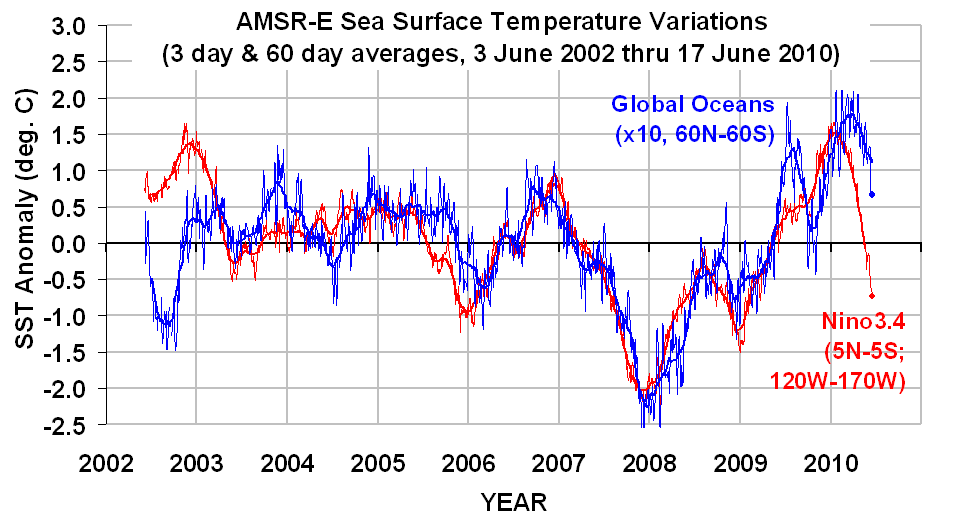
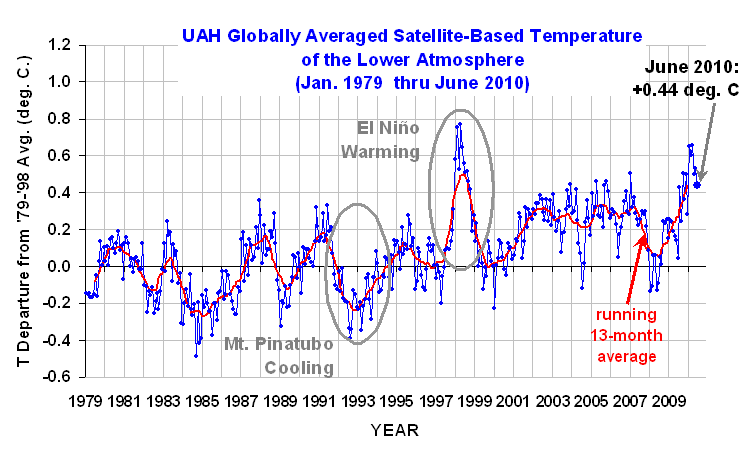
Actually the 3 day average sea surface temperature anomaly for 3 - 15 June 2010 is about -0.75C, 60 day average is about +0.6. Air temps measured by satellite are at +0.44 and are still trending downward.
-
Re:We All Wish
The heat capacity of the atmosphere and earth's surface is so low, that it varies drastically within a few hours every day. Bodies of water, on the other hand, hold about 100x as much heat per unit volume. I have been debating global warming for a damn long time, and NOBODY has ever had a damn thing to say about the real global heat content (including oceans), just debating bullshit air temperatures, which account for almost nothing compared to ocean temps.
Actually the 3 day average sea surface temperature anomaly for 3 - 15 June 2010 is about -0.75C, 60 day average is about +0.6. Air temps measured by satellite are at +0.44 and are still trending downward.
-
Re:Hard predictions?
No, once again, these models are not statistical models; they are causal models based upon the known physics.
[snip]
So far, nobody has been able to come up with any model that is consistent with this body of data and does not predict substantial temperature increases due to the CO2 that humans are adding to the atmosphere.
Wow, have your cake and eat it too -> they're not statistical models, but they're somehow "consistent with this body of data"?
So what's your definition of "substantial", and what's your prediction of maximum temperature increase (saturation point)?
Even the most cursory examination of the equation should give you a clue: What is the volume of a planet's atmosphere? Why isn't there a term for gravity? How can a planet that radiates energy to space be regarded as a perfectly insulated box? One can, of course, build models that deal with these complexities, but it takes work and computation, not simply parroting an equation out of a textbook with no real notion of its meaning.
For volume, we take a representative sample at a given altitude (say 1m^3), so that remains a constant. So you've essentially got a relationship between pressure, the amount of gas and the temperature. Unless you're saying that we can somehow violate this relationship by saying we can increase the temperature without either increasing the pressure or reducing the amount of gas, you're missing the point.
We're looking for a sanity check here, and although you can add in those terms of gravity and radiation, they still fix a range bounded in general by PV = nRT.
Where do you suppose that the energy that is absorbed by those clouds goes? Just magically vanishes?
Some of it radiates down, some of it radiates up. At the boundaries of the atmosphere, the radiation out escapes, and you have the whole "hot air rises" convection routine that transports heat from the high pressure surface to the lower pressure outer atmosphere. None of it gets magically stuck in the lower atmosphere to cause a "runaway" greenhouse effect.
The paper describes the development of a method for deriving surface temperature based upon radiance. A worthwhile thing to do, but not at all what we are talking about.
It's what I was talking about. If you're interested in the troposphere, I'm assuming you mean this:
http://www.drroyspencer.com/2010/01/how-the-uah-global-temperatures-are-produced/
Dr. Spencer also writes some other interesting stuff here:
http://www.drroyspencer.com/2010/01/clouds-dominate-co2-as-a-climate-driver-since-2000/
The IPCC report certainly discusses the concept of a runaway greenhouse--it just doesn't predict it. Which you'd know if you'd actually read it
Sigh. So tell me tgibbs, exactly what does the IPCC *predict*? Apparently I can't just read it plainly and assume that their citations actually mean what they say they mean -> do you have the IPCC-guide-to-what-they-really-predict-and-what-they're-just-"mentioning"-for-entertainment-purposes?
And I'll admit, I haven't read every appendix, but I'll bet you a nickel I've read more of it than you have
Very much like the creationists who are full of bogus arguments against "darwinism," but have never even read Darwin, much less a modern textbook in evolutionary biology.
The lady doth protest too much. Remember, the creationists are in the same camp as the warmists, attributing any gaps in knowledge to a higher power.
-
Re:Hard predictions?
No, once again, these models are not statistical models; they are causal models based upon the known physics.
[snip]
So far, nobody has been able to come up with any model that is consistent with this body of data and does not predict substantial temperature increases due to the CO2 that humans are adding to the atmosphere.
Wow, have your cake and eat it too -> they're not statistical models, but they're somehow "consistent with this body of data"?
So what's your definition of "substantial", and what's your prediction of maximum temperature increase (saturation point)?
Even the most cursory examination of the equation should give you a clue: What is the volume of a planet's atmosphere? Why isn't there a term for gravity? How can a planet that radiates energy to space be regarded as a perfectly insulated box? One can, of course, build models that deal with these complexities, but it takes work and computation, not simply parroting an equation out of a textbook with no real notion of its meaning.
For volume, we take a representative sample at a given altitude (say 1m^3), so that remains a constant. So you've essentially got a relationship between pressure, the amount of gas and the temperature. Unless you're saying that we can somehow violate this relationship by saying we can increase the temperature without either increasing the pressure or reducing the amount of gas, you're missing the point.
We're looking for a sanity check here, and although you can add in those terms of gravity and radiation, they still fix a range bounded in general by PV = nRT.
Where do you suppose that the energy that is absorbed by those clouds goes? Just magically vanishes?
Some of it radiates down, some of it radiates up. At the boundaries of the atmosphere, the radiation out escapes, and you have the whole "hot air rises" convection routine that transports heat from the high pressure surface to the lower pressure outer atmosphere. None of it gets magically stuck in the lower atmosphere to cause a "runaway" greenhouse effect.
The paper describes the development of a method for deriving surface temperature based upon radiance. A worthwhile thing to do, but not at all what we are talking about.
It's what I was talking about. If you're interested in the troposphere, I'm assuming you mean this:
http://www.drroyspencer.com/2010/01/how-the-uah-global-temperatures-are-produced/
Dr. Spencer also writes some other interesting stuff here:
http://www.drroyspencer.com/2010/01/clouds-dominate-co2-as-a-climate-driver-since-2000/
The IPCC report certainly discusses the concept of a runaway greenhouse--it just doesn't predict it. Which you'd know if you'd actually read it
Sigh. So tell me tgibbs, exactly what does the IPCC *predict*? Apparently I can't just read it plainly and assume that their citations actually mean what they say they mean -> do you have the IPCC-guide-to-what-they-really-predict-and-what-they're-just-"mentioning"-for-entertainment-purposes?
And I'll admit, I haven't read every appendix, but I'll bet you a nickel I've read more of it than you have
Very much like the creationists who are full of bogus arguments against "darwinism," but have never even read Darwin, much less a modern textbook in evolutionary biology.
The lady doth protest too much. Remember, the creationists are in the same camp as the warmists, attributing any gaps in knowledge to a higher power.
-
Re:Scary MWP
But if climate is really as unstable as a global MWP would indicate, then all bets are off, and perturbation of climate is far more dangerous than climate scientists currently believe.
The planet seems to have a temperature range that acts as a strange attractor,
The global-average lower tropospheric temperature continues warm: +0.50 deg. C for April, 2010, although it is 0.15 deg. C cooler than last month. The linear trend since 1979 is now +0.14 deg. C per decade. APRIL 2010 UAH Global Temperature Update: +0.50 deg. C
The MWP wasn't much when viewed in perspective of many cycles on different periods that sometime interfere constructively or destructively with each other; even today the warming that caused all of the concern is reversing. Heading into a cool period lasting for 30 years or so wouldn't surprise me, Ocean energy is down, no reason to get stupid on either side of the debate, the data just doesn't support a catastrophe right now.
-
Re:Who are the denailists?
Listen, you can either drop everything and study your ass off for the better part of a decade to get a PhD in atmospheric science, or listen to the people who have them.
Indeed you should.
-
Re:Absence of Evidence
You're wrong in saying "no, just no". Yes, CO2 does act that way; however, a doubling of CO2 would produce only 1 degree C of warming solely on the basis you described. The IPCC claims several degrees of warming. The difference between the simple CO2 only calculation and the IPCC claim stems from the latters incorporation of feedback effects.
That is, they argue CO2 causes changes in the hydrological cycle. This means a change in humidity and cloud cover. Ipso facto, the climate sensitivity from a doubling of CO2 is more than would be suggested by a simple black-body radiation calculation.
This is not just a small part of their argument. Its a significant factor, and yet while black-body radiation is a universally accepted idea; the magnitude (and sign!) of the feedback effects is poorly understood.
Thus my remark was dead-on accurate. You might want to review this from Dr Roy Spencer, one the scientists who does satellite based temperature monitoring.
-
Re:Cue the teabaggers.
One day is all we need to erase years of data.
Any data that was erased was done accidentally or thinking there was a non-existent backup, and it happened over a considerable length of time. More of it was corrupted by computer programs that were written by post-grads that sort of knew how to program that were riddled with logic errors and hard-coded results. Right now if anybody really wants to know what's going it would be easier to start over from scratch than it would be to fix the mess they have now. Dr.Spencer at the University of Alabama is basicaly doing that now using the Aqua satellite AMSU window channels and “dirty-window” channels and comparing that data to NOAA-merged International Surface Hourly (ISH) dataset.
-
Re:I love the double standards
Water vapor precipitates out on a short cycle, especially when carried via weather patterns — and, with cloud formation, even has your vaunted negative feedback cycle (in isolation, at least). The cycle for removing CO2 is much longer and much more involved.
That's true, but there's still a lot more water vapor in the atmosphere doing a lot more to warm the planet than CO2. While it precipitates out, it also evaporates a lot into the atmosphere. And with respect to clouds, most models are not using them as a negative feedback.
Here [nasa.gov], knock yourself out. Plenty more where that came from.
Yes, the climate models have generally been available. It's more on the side of estimating current and past temperatures where the sharing has been especially lacking. This is important in order to judge if what's happening is really extraordinary or just another century in the life of the earth.
I know enough about science in general to be able to judge the approach, results, limitations, and (yes) politics outside my particular bailiwick (astrophysics, should you be curious. Credentials available upon request).
Perhaps, but IMHO you haven't shown it here. Credentials are a lot less interesting than the arguments presented. I don't have a background in "climate science", but I do in math, statistics and computer simulation. And I really don't find the evidence for anthropogenic climate change convincing.
-
Re:I Don't Think This Was Well Thought OutFirst google hit for 'global temperature january 2010' gives these pages:
http://www.drroyspencer.com/2010/02/january-2010-uah-global-temperature-update-0-72-deg-c/
http://www.drroyspencer.com/latest-global-temperatures/
It's a personal page, but seems to be using NASA temperature readings.
-
Re:I Don't Think This Was Well Thought OutFirst google hit for 'global temperature january 2010' gives these pages:
http://www.drroyspencer.com/2010/02/january-2010-uah-global-temperature-update-0-72-deg-c/
http://www.drroyspencer.com/latest-global-temperatures/
It's a personal page, but seems to be using NASA temperature readings.
-
Re:Climate change is a security threat
While the large amount of year-to-year variability in global temperatures seen in the above plot makes it difficult to provide meaningful statements about long-term temperature trends in the context of global warming, the running 25-month average suggests there has been no net warming in the last 11 years or so. December 2009 UAH Global Temperature Update +0.28 Deg. C
One would think that Roy Spencer has enough stature to be considered a serious scientist, you might find this piece interesting, Global Warming as a Natural Response to Cloud Changes Associated with the Pacific Decadal Oscillation (PDO)
-
Re:Climate change is a security threat
While the large amount of year-to-year variability in global temperatures seen in the above plot makes it difficult to provide meaningful statements about long-term temperature trends in the context of global warming, the running 25-month average suggests there has been no net warming in the last 11 years or so. December 2009 UAH Global Temperature Update +0.28 Deg. C
One would think that Roy Spencer has enough stature to be considered a serious scientist, you might find this piece interesting, Global Warming as a Natural Response to Cloud Changes Associated with the Pacific Decadal Oscillation (PDO)
-
Re:Climate change is a security threat
While the large amount of year-to-year variability in global temperatures seen in the above plot makes it difficult to provide meaningful statements about long-term temperature trends in the context of global warming, the running 25-month average suggests there has been no net warming in the last 11 years or so. December 2009 UAH Global Temperature Update +0.28 Deg. C
One would think that Roy Spencer has enough stature to be considered a serious scientist, you might find this piece interesting, Global Warming as a Natural Response to Cloud Changes Associated with the Pacific Decadal Oscillation (PDO)
-
Re:simple theory
-
Re:How long has this been going on?
--There are too many instances of "we can't think of any other reason, so this must be man-made global warming", or "we have never seen this before, and we don't know what's causing it, but we're certain it's human emissions". I'm sorry, but you're just ruining your credibility as a scientist when stating you don't understand it, then in the same sentence claim to be an authority able to state the cause.--
They can think of other reason it's just they have proof by this reason:
http://www.drroyspencer.com/2009/01/increasing-atmospheric-co2-manmade%E2%80%A6or-natural/
Man made CO2 has more Carbon 13 in it (I thought we all knew this by now). The years can be told by things like tree rings for instance. That's how they know dip do, I can't figure out how you have so many supporters, especially from
-
Re:This sort of thing would make anyone suspicious
On ocean cycles: You realize that global temperature controls ocean cycles, right? So you're agreeing with me?
Or so you assume. That is a case where you may be confusing cause and effect:
-
Re:Did anybody read his paper?
Secondly, he also states that global temperatures have fallen for the last 11 years. I really would like to see his work. This article (http://earthtrends.wri.org/updates/node/83), reported in the September 26 issue of Proceedings of the National Academy of Sciences, shows global temperatures rising for the last 30 years.
Hmm... is it possible for temperatures to decline in the last 11 years but rise in the past 30. Uh. Yes. The trend since 1998 is decidedly down. What does that mean? Well that's a more complex question, but your broad brush covers it up.
I suggest reading the following to get a taste of the counter-argument to the EPA's finding:
These all address concerns about the lack of underlying science--not the political/economics issues.
-
Re:Pffft! Who are you going to believe?
how about the NASA PhD's who say the earth is already cooling again and CO2 concentrations lag 6 months behind temperature change, indicating the temperature change is causing the rise in CO2, not the other way around?
or the veritable explosion of dissenting climate scientists?
Go ahead, believe a self promoting politician
from http://www.drroyspencer.com/
"The Central Question of Causation
I believe that the interpretation of the Vostok ice core record of temperature and CO2 variations has the same problem that the interpretation of warming and CO2 increase in the last century has: CAUSATION. In both cases, Hansenâ(TM)s (and othersâ(TM)) inference of high climate sensitivity (which would translate into lots of future manmade warming) depends critically on there not being another mechanism causing most of the temperature variations. If most of the warming in the last 100 years was due to CO2, then that (arguably) implies a moderately sensitive climate. If it caused the temperature variations in the ice core record, it implies a catastrophically sensitive climate.
But the implicit assumption that science knows what the forcings were of past climate change even 50 years ago, let alone 100,000 years ago, strikes me as hubris. In contrast to the âoeconsensus viewâ of the IPCC that only âoeexternalâ forcing events like volcanoes, changes in solar output, and human pollution can cause climate change, forcing of temperature change can also be generated internally. I believe this largely explains what we have seen for climate variability on all time scales. A change in atmospheric and oceanic circulation patterns could easily accomplish this with a small change in low cloud cover over the ocean. In simple terms, global warming might well be mostly the result of a natural cycle."
which coupled with this article, is pretty convincing.
http://news.nationalgeographic.com/news/2007/02/070228-mars-warming.html
Since this is a cause which has nothing to do with man, and is also cyclical it's breaks most of the "theories" of man made climate change.
Inconvenient truth? How about convenient mass stupidity? Al Gore has played ya'll and it went like this:1. cause hysteria
2. create environmental companies
3. profit!The results of a survey of climate scientists, conducted by the US Senate Committee on the Environment & Public Works revealed that less than half of climate scientists believe that the climate change has primarily anthropogenic cause any more and that number is shrinking very quickly.
"
Israel: Dr. Nathan Paldor, Professor of Dynamical Meteorology and Physical Oceanography at the Hebrew University of Jerusalem has authored almost 70 peer-reviewed studies and won several awards. âoeFirst, temperature changes, as well as rates of temperature changes (both increase and decrease) of magnitudes similar to that reported by IPCC to have occurred since the Industrial revolution (about 0.8C in 150 years or even 0.4C in the last 35 years) have occurred in Earth's climatic history. There's nothing special about the recent rise!âRussia: Russian scientist Dr. Oleg Sorochtin of the Institute of Oceanology at the Russian Academy of Sciences has authored more than 300 studies, nine books, and a 2006 paper titled âoeThe Evolution and the Prediction of Global Climate Changes on Earth.â âoeEven if the concentration of âgreenhouse gasesâ(TM) d
-
Re:Rocket science?
The Earth is getting warmer and our ice is melting, and that's not in dispute. If the warming trend continues, all of the ice will melt eventually, this is dictated by physics.
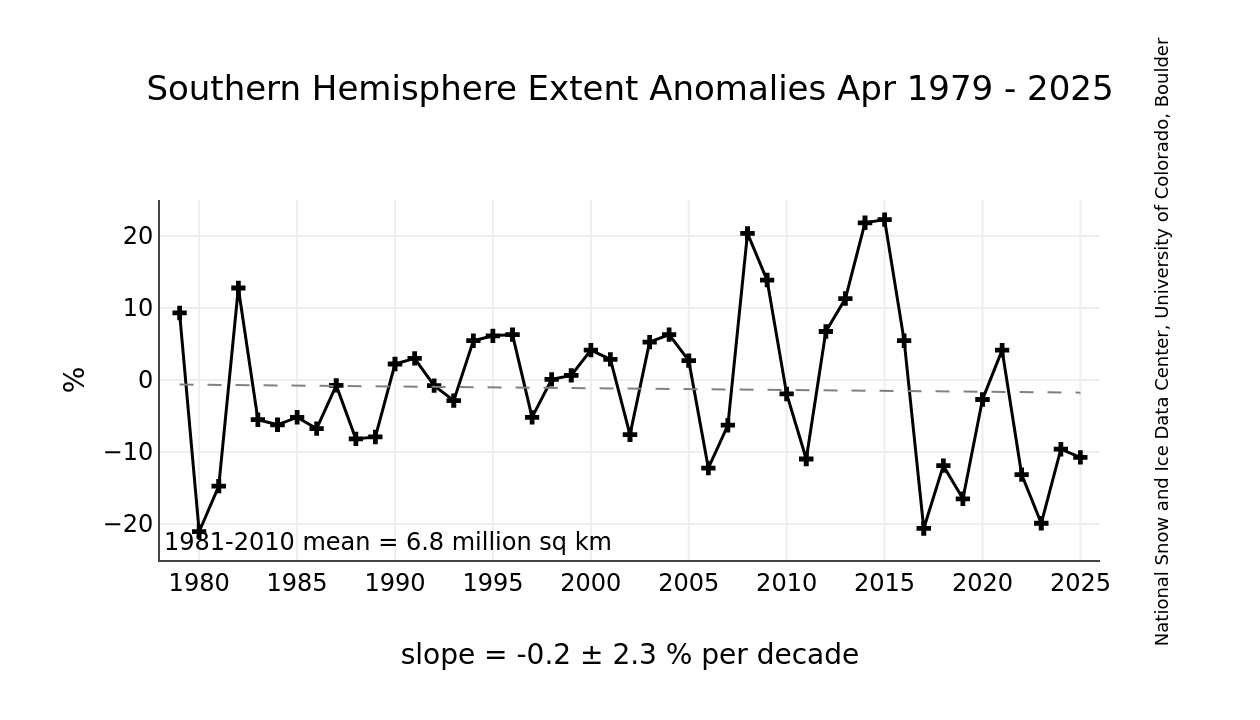
Wrong about the physics: Whether all the ice melts is not dictated by the derivative of temperature. Wrong about the facts: polar ice-extent is neutral despite the warming. Southern Extent is increasing.
Your implication of overwhelming political bias in climate science is simply contrary to the facts. The fact that these researchers seem to have been biased is not relevant to the science as a whole.
GP did not mention political bias. He said "bias". This "bias" has been well documented by MIT Climate Scientist Richard Lindzen and Roger Pielke, Jr. of the University of Colorado.
The "think tanks" who criticize climate science don't do any actual science. They cherry pick data from scientific papers, and attempt to refute CO2 vs warming trends with typical logical fallacies, but they do no research, make no predictions, and advance no falsifiable claims.
Huh? Lindzen and his students have put forward the IR-Iris theory that suggests negative-feedbacks dominate. Roy Spencer of the University of Alabama wrote a paper explaining the systemic error in the climate models used to predict the IPCC's 2C/century.
There are many more.