Slashdot Mirror
Domain: erols.com
Stories and comments across the archive that link to erols.com.
Comments · 265
-
Dictator list not much use
The Dictator list linked by Tackhead
We are missing some very friendly people like Robert Mugabe of Zimbabwe who regularly throws his political opponents in jail where they often simply die.
We are also missing other prime tourist destinations like the very aptly named "Democratic Republic of the Congo" which was name thusly after a very bloody coup and continues to have thousands of its citizens massacred every year.
Oh, but I forget these countries don't have OIL^H^H^H WMD so their problems don't really count. -
Re:i wonder..> People don't die when you attack windmills. I'd peg the deaths due to the invasion of Iraq no lower than 25,000. Mass murder, in fact.
So you're saying that considering Saddam's lifetime score of over 2,000,000 over 20-odd years, (100,000 a year) or about 8,000 a month, and about three months since the end of major combat operations, we reached the breakeven point in terms of death.
And that, statistically, every month from this day forward, 8,000 people will live who might otherwise have died under Saddam Hussein.
(Given the 50,000 bonus points scored during the months in 1991-1992 after we chose to leave him in power, my off-the-cuff figure of 8,000 lives saved per month of Saddam being out of power is just about right, actually!)
Source: Planet Earth's High Score List, sorted by dictator: H: Saddam Hussein
-
Letter from Miss Moffet Humpkins to Pastor Ben
Lately, kind sir, I have been quite perturbed by certain events that have been proliferating in our society. Was it not so long ago, that in more civilized times, children respected and obeyed their parents, under the threat of a firm thrashing if their impudence and audacity got out of hand? But oh, kind father, the trials that parents today must suffer! Not just the other day, whist I was dining upon a fresh garden salad, my daughter, of not even 6 years old, insisted upon uprooting most unrest in requesting I purchase for her a milky-way bar! I quickly remarked to the impudent creature that one of our many servants would be more than willing to carriage her to the local general store; but no! she insisted that I -personally- drive the buggy to make the purchase! Oh wise man of God, what is a poor woman to do in these hard times! Before you can open your Moses-lovin' mouth Pastor, I have proposed a final solution to the problem of "youthful indiscretion"- Prison Labor!
Before you bring up cries of protest from your liberalism-saturated mind, hear me out! Our disrespectful children will learn the true meaning of honor and sacrifice while they're hard at work pounding license plates and assembling adding machines! Honestly, what better way is there to whip our children into shape? Scare them with threats of the boogey-man? Psh-haw! Just look at the wondrous effects prison labor had on the Dell kid! Not only will prison labor harden our children into obedient automatons, it will show them the reality they will have to face if they follow their current paths and become criminals!
Thank you for your attention kind Minister, and God-Bless! -
IMPORTANT! PLEASE DISSEMINATE WIDELY!(This is an excerpt from my research notes on the vile Lego cult. I wanted to get these out before they had a chance to silence me. Please, please, please, don't let your friends or family succumb to the temptations of Lego. The life that you save may be your own.)
Sad cases of compulsive behaviour, such as Eric who has dragged his unsuspecting sister, Dorothy into the despicable cult.The cult recently opened one of their "temples" in California (of course). They have many local churches.
Like the Scientologists who have their "e-meter", these lego freaks have their or psuedo-technological props. They even have an mystic Oracle that you can ask questions on the internet. And just like the leader of the Scientologists, their leaders aspire to be JRR Tolkien. Not only that, these foul fiends have the temerity to rewrite the Bible.
And they are Holocaust revisionists, too boot
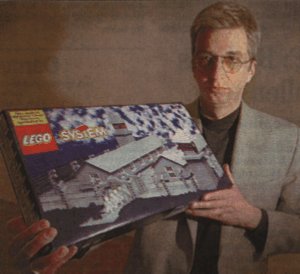
- Exhibit A - one of their foul leaders proudly displays their trumped up "evidence"
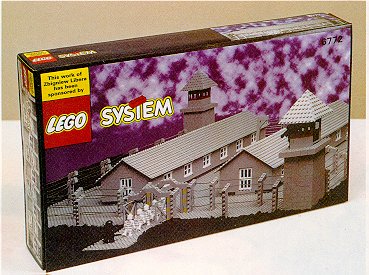
- Exhibit B
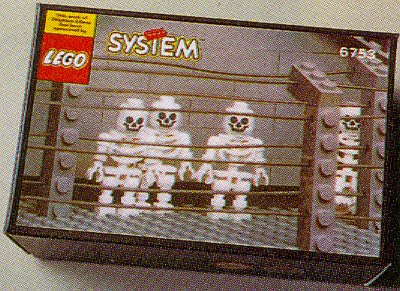
- Exhibit C
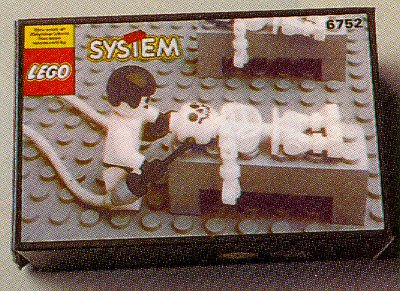
- Exhibit D
- Exhibit E
- Exhibit F
They worship strange, vile gods. And are building machines to take over the world.
-
IMPORTANT! PLEASE DISSEMINATE WIDELY!(This is an excerpt from my research notes on the vile Lego cult. I wanted to get these out before they had a chance to silence me. Please, please, please, don't let your friends or family succumb to the temptations of Lego. The life that you save may be your own.)
Sad cases of compulsive behaviour, such as Eric who has dragged his unsuspecting sister, Dorothy into the despicable cult.The cult recently opened one of their "temples" in California (of course). They have many local churches.
Like the Scientologists who have their "e-meter", these lego freaks have their or psuedo-technological props. They even have an mystic Oracle that you can ask questions on the internet. And just like the leader of the Scientologists, their leaders aspire to be JRR Tolkien. Not only that, these foul fiends have the temerity to rewrite the Bible.
And they are Holocaust revisionists, too boot
- Exhibit A - one of their foul leaders proudly displays their trumped up "evidence"
- Exhibit B
- Exhibit C
- Exhibit D
- Exhibit E
- Exhibit F
They worship strange, vile gods. And are building machines to take over the world.
-
IMPORTANT! PLEASE DISSEMINATE WIDELY!(This is an excerpt from my research notes on the vile Lego cult. I wanted to get these out before they had a chance to silence me. Please, please, please, don't let your friends or family succumb to the temptations of Lego. The life that you save may be your own.)
Sad cases of compulsive behaviour, such as Eric who has dragged his unsuspecting sister, Dorothy into the despicable cult.The cult recently opened one of their "temples" in California (of course). They have many local churches.
Like the Scientologists who have their "e-meter", these lego freaks have their or psuedo-technological props. They even have an mystic Oracle that you can ask questions on the internet. And just like the leader of the Scientologists, their leaders aspire to be JRR Tolkien. Not only that, these foul fiends have the temerity to rewrite the Bible.
And they are Holocaust revisionists, too boot
- Exhibit A - one of their foul leaders proudly displays their trumped up "evidence"
- Exhibit B
- Exhibit C
- Exhibit D
- Exhibit E
- Exhibit F
They worship strange, vile gods. And are building machines to take over the world.
-
IMPORTANT! PLEASE DISSEMINATE WIDELY!(This is an excerpt from my research notes on the vile Lego cult. I wanted to get these out before they had a chance to silence me. Please, please, please, don't let your friends or family succumb to the temptations of Lego. The life that you save may be your own.)
Sad cases of compulsive behaviour, such as Eric who has dragged his unsuspecting sister, Dorothy into the despicable cult.The cult recently opened one of their "temples" in California (of course). They have many local churches.
Like the Scientologists who have their "e-meter", these lego freaks have their or psuedo-technological props. They even have an mystic Oracle that you can ask questions on the internet. And just like the leader of the Scientologists, their leaders aspire to be JRR Tolkien. Not only that, these foul fiends have the temerity to rewrite the Bible.
And they are Holocaust revisionists, too boot
- Exhibit A - one of their foul leaders proudly displays their trumped up "evidence"
- Exhibit B
- Exhibit C
- Exhibit D
- Exhibit E
- Exhibit F
They worship strange, vile gods. And are building machines to take over the world.
-
IMPORTANT! PLEASE DISSEMINATE WIDELY!(This is an excerpt from my research notes on the vile Lego cult. I wanted to get these out before they had a chance to silence me. Please, please, please, don't let your friends or family succumb to the temptations of Lego. The life that you save may be your own.)
Sad cases of compulsive behaviour, such as Eric who has dragged his unsuspecting sister, Dorothy into the despicable cult.The cult recently opened one of their "temples" in California (of course). They have many local churches.
Like the Scientologists who have their "e-meter", these lego freaks have their or psuedo-technological props. They even have an mystic Oracle that you can ask questions on the internet. And just like the leader of the Scientologists, their leaders aspire to be JRR Tolkien. Not only that, these foul fiends have the temerity to rewrite the Bible.
And they are Holocaust revisionists, too boot
- Exhibit A - one of their foul leaders proudly displays their trumped up "evidence"
- Exhibit B
- Exhibit C
- Exhibit D
- Exhibit E
- Exhibit F
They worship strange, vile gods. And are building machines to take over the world.
-
IMPORTANT! PLEASE DISSEMINATE WIDELY!(This is an excerpt from my research notes on the vile Lego cult. I wanted to get these out before they had a chance to silence me. Please, please, please, don't let your friends or family succumb to the temptations of Lego. The life that you save may be your own.)
Sad cases of compulsive behaviour, such as Eric who has dragged his unsuspecting sister, Dorothy into the despicable cult.The cult recently opened one of their "temples" in California (of course). They have many local churches.
Like the Scientologists who have their "e-meter", these lego freaks have their or psuedo-technological props. They even have an mystic Oracle that you can ask questions on the internet. And just like the leader of the Scientologists, their leaders aspire to be JRR Tolkien. Not only that, these foul fiends have the temerity to rewrite the Bible.
And they are Holocaust revisionists, too boot
- Exhibit A - one of their foul leaders proudly displays their trumped up "evidence"
- Exhibit B
- Exhibit C
- Exhibit D
- Exhibit E
- Exhibit F
They worship strange, vile gods. And are building machines to take over the world.
-
IMPORTANT! PLEASE DISSEMINATE WIDELY!(This is an excerpt from my research notes on the vile Lego cult. I wanted to get these out before they had a chance to silence me. Please, please, please, don't let your friends or family succumb to the temptations of Lego. The life that you save may be your own.)
Sad cases of compulsive behaviour, such as Eric who has dragged his unsuspecting sister, Dorothy into the despicable cult.The cult recently opened one of their "temples" in California (of course). They have many local churches.
Like the Scientologists who have their "e-meter", these lego freaks have their or psuedo-technological props. They even have an mystic Oracle that you can ask questions on the internet. And just like the leader of the Scientologists, their leaders aspire to be JRR Tolkien. Not only that, these foul fiends have the temerity to rewrite the Bible.
And they are Holocaust revisionists, too boot
- Exhibit A - one of their foul leaders proudly displays their trumped up "evidence"
- Exhibit B
- Exhibit C
- Exhibit D
- Exhibit E
- Exhibit F
They worship strange, vile gods. And are building machines to take over the world.
-
Re:Craftmanship versus sofistication?
I agree with your point in general but evolved warriors are having increasing success in Corewars of late and similar strides can be expected in Gridwars.
For example a recent Redcoder Frenzy round was won by this warrior Wild Equilibria by Dave Hillis.
No, it's not pretty.
Even more impressive an evolved "paper" (self-replicating warrior) made the premier 94nop hill this year albeit with the help of a human coded quickscan.
There's more info re evolving to be had at the Wiki. -
Re:You said it!
America sure as hell invaded Russia with the British and Japanese and the Russian and later the soviets never forgot it.
Right. I can just picture Gorbachev
Nearly 1000 American marines were slaughtered by the red army in Vladivostok.
Best numbers I can find are 275 lost from all causes (including disease, etc.). Anything else you would like to make up?
-
It depends
GPS accuracy is somewhat consistent among manufacturers, and is generally more accurate the more you pay for the equipment. However, there is always a margin for error. For example, Wilson's GPS Accuracy page states that vertical accuracy depends on "latitude (errors for vertical accuracy rapidly increase with latitudes greater than 65 degrees), receiver/antenna, local geometry/multipath and satellite geometry (VDOP)"
The real question is are the Nottingham group using high grade and control tested equipment and have they properly accounted for discrepency. Stating that Scotland is rising two millimeters a year is quite the claim. -
Re:where ?I think God made this vast universe as a gigantic theatre for us to perform
Yes, and we are thoroughly enjoying the play written by your sadistic puppetmaster.
we certainly can't give life to something dead
Yet. Once people were dying of diseases that can be easily cured today. A stopped heart can be restarted, a damaged heart can be replaced. In near future we can grow new replacement organs. All this has required a lot of research. No thanks to religions. I don't see any reason why the creation of a sentient human being would be beyond our capabilities.
as much as you cant prove the opposite
Your logic sucks. You can't prove a negative. You can, however, prove positive. Yet no-one has been able to prove god. Extraordinary claims require extraordinary proof.
-
Java Server Side NTLM HTTP Auth Made Easy
If you're running a 2.3 servlet container, drop in the jCIFS NTLM HTTP Authentication Filter. It's available here:
http://jcifs.samba.org/
but the latest jar is here (website a little broken):
http://users.erols.com/mballen/jcifs/
All you need to set is the domainController init parameter. There's also a base servlet for pre 2.3 containers that don't support filters.
Also take a look at the Davenport project which permits IE users (and I suspect Mozilla users now) the ability to browse the entire WAN using the negotiated NTLM pawssword hashes as a WebDAV folder or using plain HTML. Again, uses jCIFS. -
Re:Hysteria.> No, because I can [count]
So count. Rack 'em up.
You're still going to be hard pressed to beat Mao's 40M and Stalin's 30M non-WW2 score (guesstimates vary from 15M to 50M).
If you wanna give Stalin points for WW2, give him another 10M. (Give Hitler 15M, Tojo 15M. The Allies barely crack 2M.)
(If you wanna pick and choose client states, there's even a handy Alphabetical Index of high scorers. Go nuts
-
Re:Hysteria.> No, because I can [count]
So count. Rack 'em up.
You're still going to be hard pressed to beat Mao's 40M and Stalin's 30M non-WW2 score (guesstimates vary from 15M to 50M).
If you wanna give Stalin points for WW2, give him another 10M. (Give Hitler 15M, Tojo 15M. The Allies barely crack 2M.)
(If you wanna pick and choose client states, there's even a handy Alphabetical Index of high scorers. Go nuts
-
Re:This thing is gonna be HOT
As others have noted, if you currently have your CPU at 48 C, the new CPU probably will stay within spec using your existing cooling setup.
But depending on which CPU core your XP 1900+ has, the new CPU may not even be much hotter.
An XP 1900+ with a Palomino core dissipates about 60.7 Watts typical, 68 Watts max.
An XP 3000+ with a Barton core dissipates about 58.4 Watts typical, 74.3 Watts max. I should expect the new Athlon will be only slightly hotter than the Barton 3000+.
Oh by the way, the Thermal Design Power for a Pentium 4 at 3000 is 81.8 Watts. If we figure typical will be under 75% of that number, the typical heat dissipation of a Pentium 4 at 3000 will be similar to the AMD at 3000, and the worst-case slightly hotter.
These numbers from:
http://users.erols.com/chare/elec.htm
steveha -
Single Digit Superpowers Are Going Fast
A Google search for "eighth superpower" returned zero hits, so I hereby declare myself the eighth superpower. First through Seventh already had hits. I didn't check 9 so there may be no single digit superpowers left! Ha!
What is my superpower? I make people puke over the network. Hey... whaddya expect, I mean, by the time you get to 8th all the cool stuff like teleportation and x-ray vision is taken. At least I got single digit though. I pity the foo who has to settle for 135th superpower.
Oh, BTW, negative superpowers are evil.
-
Who is hottest?
they are already running waay too hot.
Actually, AMD processors are cooler than the equivalently-performing Pentium 4 chips.
Athlon XP 3000+ max heat: 74.3W
Athlon XP 3000+ typical: 58.4W
Athlon XP 3000+ temperature limit: 85C
Pentium 4 3.06 GHz theoretical max heat: 109.0W
Pentium 4 3.06 GHz thermal design power: 81.8W
Pentium 4 3.06 GHz temperature limit: 69C
What Intel calls "thermal design power" is sort of similar to what AMD calls the "typical" number. It's 75% of the theoretical max temp, so the theoretical max temp for the Pentium 4 would be 109.0W. But the P4's clock throttling would keep it from hitting that theoretical max temp.
My source for all this:
http://users.erols.com/chare/elec.htm
Note also that since your power supply isn't 100% efficient, and since the power supply has to produce one Watt for each Watt your system dissipates, that a complete system with a Pentium 4 will dissipate over twice the difference of just the CPUs. In other words, for our example, the Pentium 4 dissipates about 23W more, so the Pentium 4 complete system will dissipate even more than 46W compared to the Athlon XP system. I'm not sure how efficient a typical power supply is, but if we assume 66% efficiency, the total for the Pentium 4 complete system would be about 58W more than the Athlon XP system.
steveha
-
BUNK: Smalltalk not OO, didn't invent GUI
The greatest invention of Smalltalk is hype: co-opting and taking credit for other people's inventions.
Simula 67 was the first object-oriented language, and all practical/successful OO languages follow from it: C++, Java, C#, Eiffel, etc. But even Smalltalk experts mistakenly believe that Smalltalk invented OO. Smalltalk isn't even OO as we know it.
Similarly, the mouse was invented by Doug Englebart (movie evidence - ) along with the idea of the word processor and many other things we take for granted now. And the GUI was invented by Ivan Sutherland in Sketchpad: pop-up menus, drag and drop, etc (used a light pen). -
Re:Computer virii - THAT WORD does NOT EXISTWhat's the Plural of `Virus'? What's the Plural of `Virus'? The plural of virus is neither viri nor virii, nor even vira nor virora. It is quite simply viruses, irrespective of context. Here's why.
Sections in this document:
- English Inflections [slashdot.org]
- Classical Inflections [slashdot.org] and References [slashdot.org]
- Journey Into the Fourth Declension [slashdot.org] (new)
- Other Latin Resources [slashdot.org]
- ASM News [slashdot.org]
- ASM News Update [slashdot.org] (new)
- Footnotes [slashdot.org]
Etymology: a. L. virus slimy liquid, poison, offensive odour or taste. Hence also Fr., Sp., Pg. virus.
Other sources that support viruses include Birchfield (n Fowler1 Venom, such as is emitted by a poisonous animal. Also fig.
2 Path. a A morbid principle or poisonous substance produced in the body as the result of some disease, esp. one capable of being introduced into other persons or animals by inoculations or otherwise and of developing the same disease in them. Now superseded by the next sense.
b Pl. viruses. An infectious organism that is usu. submicroscopic, can multiply only inside certain living host cells (in many cases causing disease) and is now understood to be a non-cellular structure lacking any intrinsic metabolism and usually comprising a DNA or RNA core inside a protein coat (see also quot. 1977). [ Formerly referred to as filterable viruses, their first distinguishing characteristic being the ability to pass through filters that retained bacteria. ]
The simple answer is that there wasn't one. The longer answer follows.
Writers who, searching for a fancy plural to virus, incorrectly write *viri are doubtless blindly applying an overreaching -us => -i rule. This mis-inflects many words. For example, status and hiatus only change the length of the final vowel; genus goes to genera; corpus goes to corpora. Others are even worse if this rule is mis-applied, like syllabus, caucus, octopus, mandamus, and rebus.
Anyway, Latin already had a word viri, but it was the nominative plural not of virus (slime, poison, or venom), but of vir (man), which as it turns out is also a 2nd declension noun. I do not believe that writers of English who write viri are intentionally speaking of men. And although there actually is a viri form for virus, it's the genitive singular[1] [slashdot.org], not the nominative plural. And we certainly don't grab for genitive singulars for the plurals when we've started out with a nominative. Such hanky panky would certainly get you talked about, and probably your hand slapped as well.
This apparently invariant use of virus as a genitive singular may also imply that it's 4th declension, as some scholars [slashdot.org] believe.
Those confused souls who write *virii are tacitly positing the existence of the non-word *virius, and declining it as though it were like filius. It's true that l/r are both linguals that sometimes get interchanged, and that f/v are just a change in voicing[2] [slashdot.org], but that's just reaching. *Virii is still completely silly, so don't do that; otherwise, everyone will know you're just a blathering script kiddie.
The crucial problem here is that, classically speaking, there appears to be no recorded use of virus in the plural. It was a 2nd declension noun ending in -us, which is rather common, but it was also a neuter, which is rather rare. I could only come up with three such 2nd declension neuters: virus [tufts.edu] (some poison), pelagus [tufts.edu] (the sea, usually poetically), and vulgus [tufts.edu] (the crowd). None appear to admit plurals. Perhaps this is because they are mass nouns, not count nouns. [3] [slashdot.org]
One citation below wonders whether these -us 2nd declension neuters might have inflected -us => -ora, the way the 3rd declension's neuter plurals for tempus and corpus do. There's really not any support for that notion--that I could find at least. If so, that would end up producing *virora. Most other citations think that these plurals just never happened at all, or that if they did, they didn't jump declensions. Perhaps they were invariant as they oddly are for the vocative and accusative cases. In any event, *virora does not fit comfortably in the mouth of an English speaker, which is a good reason to avoid it.[4] [slashdot.org]
Another theory holds that virus, if it was a 2nd declension neuter, must go to *vira in the plural as do its -um neuter brethren in the 2nd declension. However, that assumes that it works like a -um form, not as a -us form does. And it really seems to do neither. If it were a -us form (again, as a 2nd declension nominative), then its vocative would have to be *vire; but it's really only virus. You also expect an accusative form *viros, but that too is missing; it's still just virus in the accusative. And if it were a -um form, then its vocative would have to be *virum. But it's not--here again, it's only virus. (Vocative examples of virus are not particularly common. Apparently the Romans seldom addressed their slime in a personal fashion.
So what we have here is something of a mixed or invariant declension. Trying to find a plural for something that didn't take a plural (possibly because it was not a count but a mass noun), or at least, one for which no plural is classically attested, is a fruitless endeavour. Best to stick with English and use viruses. Journey Into the Fourth Declension Some scholars, includining Gavin Betts, believe that virus pertained not to the second declension, but to the fourth one. Here is an example or two that support[5] [slashdot.org] Betts and dispute the 2nd declension theory. The first is classical, from Ammianus [geocities.com]:
qui ut coluber copia virus exuberans natorum
That seems to be using virus as a genitive, which contradicts the assertion that it's 2nd declension, which would have lead to viri, and supports the 4th declension position. This was brought to my attention by Andreas Waschbuesch [mailto], who went on to write:Just another note: You must not forget that Ammian's native tongue was Greek, not Latin - so it's (very hypothetical!) possible he understood virus as a so called accusativus respectus and copia as adverbial expression. (A more common phenomenon in Greek.) exuberare was combined that way with lucrum and there was a tendency to use non-transitive verbs in a (active) transitive way - like anhelare or spumare in late antiquity's Latin as well. (The pseudo-Ciceronian Rhetorica ad Herennium's fourth book is an outstanding exception with its usage of anhelans et spumans in the passage about the denarratio and the following example IF one dates it to 80 a.Chr.n.
This recent letter [slashdot.org] also supports the fourth declension point of view. Of course, even if virus really turns out to have been in the fourth declension, we'll still have vulgus, pelagus, and cetus as irregular -us neuters in the second declension. Let's blame it all on the Greeks. ReferencesHere's what other sources have to say about this matter:
alt.usage.english FAQ [ccp14.ac.uk] Not all Latin words ending in -us had plurals in -i. Apparatus, cantus, coitus, hiatus, impetus, Jesus, nexus, plexus, prospectus, and status were 4th declension in Latin, and had plurals in -us with a long `u'. Corpus, genus, and opus were 3rd declension, with plurals corpora, genera, and opera. Virus is not attested in the plural in Latin, and is of a rare form (2nd declension neuter in -us) that makes it debatable what the Latin plural would have been; the only plural in English is viruses. Omnibus and rebus were not nominative nouns in Latin. Ignoramus was not a noun in Latin.
[...] classical plurals [...] [ilhawaii.net] What is the plural of virus? This neuter in Latin lacked a plural; it would presumably [disputable -tchrist ] have been virora like corpora, the plural of neuter corpus. (Like corpora, virora would be stressed on its initial syllable. As indicated earlier, *corpi would be as outlandish--as far beyond the pale--as *rhinoceri and *octopi.)
Latin had several declensions containing neuter, feminine, and masculine words ending in -us; the plurals are different in each one. Incidentally, the singular of mores (pronounced `moh-rehs') is mos, with the same change of `s' to `r' between vowels heard in corpus : corpora and in genus : genera.
Allen and Greenough [tufts.edu] The authors at the cited reference point out the follwoing:
Many Greek nouns retain their original gender: as, arctus (F.), the Polar Bear; methodus (F.), method.
Whether this leading would lead to ?vire, however, is unclear, since virus does not appear to be of Greek extraction.a. The following in -us are Neuter; their accusative (as with all neuters) is the same as the nominative: pelagus, sea; virus, poison; vulgus (rarely M.), the crowd. They are not found in the plural, except pelagus, which has a rare nominative and accusative plural pelage.
NOTE.--The nominative plural neuter cete, sea monsters, occurs; the nominative singular cetus occurs in Vitruvius.
Latin inflections [erols.com] And for those who just can't get enough, try this. It is a bunch of inflection tables, more complete than I've seen elsewhere. For a good time, figure out the nominative plural of venus is. Hint: it's not veni. ASM News Apparently this question is `in the air'. The following is from the June 1999 issue of ASM News by the American Society for Microbiology, sent it by Jim Sandoz.
Numerous Latin words have been taken over into the modern scientific vocabulary, most without difficulty. The Latin word virus, however, presents a minor but interesting problem, if one wishes to express a phrase such as Index of Viruses in its Latin form. By analogy with other nouns, one would expect the normal Latin equivalent to be Index Virorum. The difficulty stems from the fact that the Latin noun virus is defective, i.e. does not have a full set of case--forms, singular and plural. The Roman grammarian Priscian (fl. 500 A.D.) states that some claim the word is indeclinable (i.e., has only one form for all the cases in the singular); others, apparently more accurately, that it is declined in the singular according to the second declension neuter and cite two passages from the poet Lucretius in substantiation. All of the ancient grammarians are in agreement, however, that the word is used in the singular only, which indeed appears to be true, for no plural forms are attested in extant Latin works.
In antiquity the word virus had not yet acquired, of course, its current scientific meaning; rather it denoted something like toxicity, venom, a poisonous, deleterious, or unpleasant agent or principle, or poison in the abstract or general sense. (The first meaning given for this word, a slimy liquid, slime, in the most widely used Latin-English dictionaries is inaccurate; the error has been corrected in the more recent Oxford Latin Dictionary.) Nouns denoting entities that are countable pluralize (book, books); nouns denoting noncountable entities do not (except under special circumstances) pluralize (air, mood, valor). The term virus in antiquity appears to have belonged to the latter category, hence the nonexistence of plural forms.
When the word was taken over into modern languages and acquired its current scientific meaning, it changed categories and denoted a countable entity. The modern languages which have adopted the word each pluralize it in their own fashion (e.g., Eng. viruses, Germ. Viren; French and Italian do not distinguish in form between singular and plural, virus). But what to do in neo-Latin, which normally is subject to the rules and constraints of classical Latin?
W. T. Steam in his manual on botanical Latin (Botanical Latin, Newton Abbey, 2nd ed., 1973) gives what would be the normal plural forms of such a second declension neuter noun: nominative vira, genitive virorum, without, however, indicating his authority for those forms. It may be observed that in Latin as in other languages when the plural of noncountable nouns does occur, it generally denotes various kinds of the entity (e.g., wine, honey, oil). Steam may have applied this principle to virus in order to meet the requirements of modern scientific terminology. If Latin had continued to be the common international language of scholars and scientists at the time that viruses were first identified, it appears likely that it would have generated the forms adduced by Steam.
Robert J. Smutny
ASM News Update The following letter recently appeared in ASM News, from Ton E. van den Bogaard. (Formatting added.)
On the Presence of a Plural of the Latin Noun "Virus"
Other Latin Resources One textbook I'd like to recommend Gavin Betts's Teach Yourself Latin, which you can look up on Amazon [amazon.com] if you'd like. No, I don't believe in kickbacks.With interest I read the contribution `On the Absence of a Plural of the Latin Noun ``Virus''' in the June 1999 ASM News, p. 388, by Robert J. Smutny. However, according to my Latin grammar, one of the very few books of my gymnasium (high school) days that is still up to date, the plural of the noun virus in Latin is, like the plural nowadays used for virus in Romance languages (e.g., Italian and French), also virus. The Latin noun virus does not belong to the second declension group but, like the noun fructus, meaning fruit or piece of fruit, belongs to a group of Latin words that is declined according to the fourth declension. Hence, two pieces of fruit is in Latin duo fructus and two viruses would be duo virus. According to the fourth declension the plural genitive of virus in Latin is viruum and therefore an Index of Viruses is in Latin an Index Viruum. Virorum is the plural genitive of the Latin noun vir (second declension) meaning man or husband. Consequently an Index Virorum would indicate a list of husbands or men.
Moreover, because the noun virus belongs to the fourth declension group the study of viruses should have been called virulogy and people practicing that science virulogists. My former professor in virology at veterinary school consequently called himself a virulogist and he lectured virulogy. I am afraid that these words have become extinct since he died.
It is important to realize that Latin and Greek derived expressions in biomedical English have been coined by scientists for convenience and not by scholars based on classical grammar. The old Romans might have said to these scientists modulating their language: ``Ut desint vires, tamen est laudanda voluntas,'' which means freely translated: ``Despite your lack of knowledge, still appreciated.''
Ton E. van den Bogaard
University Maastricht, the NetherlandsHere are some Web resources: The Perseus Project [tufts.edu] Read Caesar, Catullus, Cicero, Hirtius, Horace, Livy, Ovid, Plautus, Servius, and Vergil, plus quite a bit of other useful material. For example, you can look up virus [tufts.edu] for a definition and forms, or find its citations [tufts.edu] in literature. Here's one by Vergil [tufts.edu].
Latin Textbook: Wheelock's Latin (HTML) [cuhk.edu.hk] Wonderful on-line course notes designed as a study aid for those without formal grammar/linguistics training. Note that `the entire zip archive' he advertises isn't really complete, and so I used these commands to pull in and view the whole thing locally: % cd
t in/ % netscapen The Classics Page [patriot.net] Innumerable links, including some to on-line interactive exercises and to various dictionaries.
Transcriptio Nuntiorum Hebdomadalis [www.yle.fi] Read your daily news--in Latin! Also contains sound files for the radio version whence it was transcribed. I'm sure glad that we now write FAQ instead of interrogata usitatissima.
De Meditatione [rr.com] Various Latin snippets and sound clips. Footnotes [1] One examble of an invariant genitive form of virus is attested in Ammianus [geocities.com], which reads: qui ut coluber copia virus exuberans natorum. See the original for details. [2] Well, in English; in Latin it probably wasn't, as their `v' was likely more akin to the intervocalic `v' in today's Spanish, a sound with no equivalent in English but which is often perceived as a `w'. To be even more technical, an English `v' is a voiced labial-dental fricative. An intervocalic Spanish `v' (or `b') such as in aves, is a voiced bilabial fricative, usually represented in IPA as a lower-case Greek beta. [3] Some budding Romance philologist should go research a possible connection between the neuter conceptual nouns versus the gendered discrete ones in asturianu [asturies.org], the only extant Romance tongue with anything aproximating neuter nouns [asturies.org] (I'm not counting the nominalized adjectives of Spanish such as lo difcil, since these aren't really nouns the way the so-called nomes de xneru neutru (de materia) are in asturianu.) a [4] The word virora actually appears to exist, but as some sort of South American tree. [5] Yes, I hated this sentence, too. It takes the singular verb "is" because the singular "an example" is the closer of the two elements in the disjunction, but likewise, "support" should be in the plural because the closer thing to it is now "two", which is obviously nonsingular. I think only a rewrite would be tolerable. Silly rules.
Sections in this document:
- English Inflections [slashdot.org]
- Classical Inflections [slashdot.org] and References [slashdot.org]
- Other Latin Resources [slashdot.org]
- ASM News [slashdot.org]
- Footnotes [slashdot.org]
O tempora, o mores! Senatus haec intellegit. consul videt; hic tamen vivit. Vivit? immo vero etiam in senatum venit, fit publici consilii particeps, notat et designat oculis ad caedem unum quemque nostrum.
Cicero [utexas.edu], Oratio in Catilinam Prima [utexas.edu], 2
piss@fuck.com [mailto] -
Re:Legal Issues?I doubt it...
It's a link to an artist's creation of various Holocaust concentration camp buildings as Lego kits. With the Lego logo. Lego knew about it and allowed it to go through, although they were careful to distance themselves from it.
I doubt anything anyone has done is more controversial than that...
-
Re:No it was Tesla...Marconi is a Marketerand others are veiled in secrecy by the U.S. government
Ooo... you mean Zero Point Energy is real, and the Gubbermint is covering it up to keep the OilPigs in power?!
Seriously though, there's no Tesla conspiracy unless you want to believe in one. Anything he invented couldn't be so advanced as to have not been independently rediscovered in the many decades since.
--
-
the plural of virus is viruses, GOBBLES is a FOOLWhat's the Plural of `Virus'? What's the Plural of `Virus'? The plural of virus is neither viri nor virii, nor even vira nor virora. It is quite simply viruses, irrespective of context. Here's why.
Sections in this document:
- English Inflections
- Classical Inflections and References
- Journey Into the Fourth Declension (new)
- Other Latin Resources
- ASM News
- ASM News Update (new)
- Footnotes
Etymology: a. L. virus slimy liquid, poison, offensive odour or taste. Hence also Fr., Sp., Pg. virus.
Other sources that support viruses include Birchfield (n Fowler1 Venom, such as is emitted by a poisonous animal. Also fig.
2 Path. a A morbid principle or poisonous substance produced in the body as the result of some disease, esp. one capable of being introduced into other persons or animals by inoculations or otherwise and of developing the same disease in them. Now superseded by the next sense.
b Pl. viruses. An infectious organism that is usu. submicroscopic, can multiply only inside certain living host cells (in many cases causing disease) and is now understood to be a non-cellular structure lacking any intrinsic metabolism and usually comprising a DNA or RNA core inside a protein coat (see also quot. 1977). [ Formerly referred to as filterable viruses, their first distinguishing characteristic being the ability to pass through filters that retained bacteria. ]
The simple answer is that there wasn't one. The longer answer follows.
Writers who, searching for a fancy plural to virus, incorrectly write *viri are doubtless blindly applying an overreaching -us => -i rule. This mis-inflects many words. For example, status and hiatus only change the length of the final vowel; genus goes to genera; corpus goes to corpora. Others are even worse if this rule is mis-applied, like syllabus, caucus, octopus, mandamus, and rebus.
Anyway, Latin already had a word viri, but it was the nominative plural not of virus (slime, poison, or venom), but of vir (man), which as it turns out is also a 2nd declension noun. I do not believe that writers of English who write viri are intentionally speaking of men. And although there actually is a viri form for virus, it's the genitive singular[1], not the nominative plural. And we certainly don't grab for genitive singulars for the plurals when we've started out with a nominative. Such hanky panky would certainly get you talked about, and probably your hand slapped as well.
This apparently invariant use of virus as a genitive singular may also imply that it's 4th declension, as some scholars believe.
Those confused souls who write *virii are tacitly positing the existence of the non-word *virius, and declining it as though it were like filius. It's true that l/r are both linguals that sometimes get interchanged, and that f/v are just a change in voicing[2], but that's just reaching. *Virii is still completely silly, so don't do that; otherwise, everyone will know you're just a blathering script kiddie.
The crucial problem here is that, classically speaking, there appears to be no recorded use of virus in the plural. It was a 2nd declension noun ending in -us, which is rather common, but it was also a neuter, which is rather rare. I could only come up with three such 2nd declension neuters: virus (some poison), pelagus (the sea, usually poetically), and vulgus (the crowd). None appear to admit plurals. Perhaps this is because they are mass nouns, not count nouns. [3]
One citation below wonders whether these -us 2nd declension neuters might have inflected -us => -ora, the way the 3rd declension's neuter plurals for tempus and corpus do. There's really not any support for that notion--that I could find at least. If so, that would end up producing *virora. Most other citations think that these plurals just never happened at all, or that if they did, they didn't jump declensions. Perhaps they were invariant as they oddly are for the vocative and accusative cases. In any event, *virora does not fit comfortably in the mouth of an English speaker, which is a good reason to avoid it.[4]
Another theory holds that virus, if it was a 2nd declension neuter, must go to *vira in the plural as do its -um neuter brethren in the 2nd declension. However, that assumes that it works like a -um form, not as a -us form does. And it really seems to do neither. If it were a -us form (again, as a 2nd declension nominative), then its vocative would have to be *vire; but it's really only virus. You also expect an accusative form *viros, but that too is missing; it's still just virus in the accusative. And if it were a -um form, then its vocative would have to be *virum. But it's not--here again, it's only virus. (Vocative examples of virus are not particularly common. Apparently the Romans seldom addressed their slime in a personal fashion.
So what we have here is something of a mixed or invariant declension. Trying to find a plural for something that didn't take a plural (possibly because it was not a count but a mass noun), or at least, one for which no plural is classically attested, is a fruitless endeavour. Best to stick with English and use viruses. Journey Into the Fourth Declension Some scholars, includining Gavin Betts, believe that virus pertained not to the second declension, but to the fourth one. Here is an example or two that support[5] Betts and dispute the 2nd declension theory. The first is classical, from Ammianus:
qui ut coluber copia virus exuberans natorum
That seems to be using virus as a genitive, which contradicts the assertion that it's 2nd declension, which would have lead to viri, and supports the 4th declension position. This was brought to my attention by Andreas Waschbuesch, who went on to write:Just another note: You must not forget that Ammian's native tongue was Greek, not Latin - so it's (very hypothetical!) possible he understood virus as a so called accusativus respectus and copia as adverbial expression. (A more common phenomenon in Greek.) exuberare was combined that way with lucrum and there was a tendency to use non-transitive verbs in a (active) transitive way - like anhelare or spumare in late antiquity's Latin as well. (The pseudo-Ciceronian Rhetorica ad Herennium's fourth book is an outstanding exception with its usage of anhelans et spumans in the passage about the denarratio and the following example IF one dates it to 80 a.Chr.n.
This recent letter also supports the fourth declension point of view. Of course, even if virus really turns out to have been in the fourth declension, we'll still have vulgus, pelagus, and cetus as irregular -us neuters in the second declension. Let's blame it all on the Greeks. ReferencesHere's what other sources have to say about this matter:
alt.usage.english FAQ Not all Latin words ending in -us had plurals in -i. Apparatus, cantus, coitus, hiatus, impetus, Jesus, nexus, plexus, prospectus, and status were 4th declension in Latin, and had plurals in -us with a long `u'. Corpus, genus, and opus were 3rd declension, with plurals corpora, genera, and opera. Virus is not attested in the plural in Latin, and is of a rare form (2nd declension neuter in -us) that makes it debatable what the Latin plural would have been; the only plural in English is viruses. Omnibus and rebus were not nominative nouns in Latin. Ignoramus was not a noun in Latin.
[...] classical plurals [...] What is the plural of virus? This neuter in Latin lacked a plural; it would presumably [disputable -tchrist ] have been virora like corpora, the plural of neuter corpus. (Like corpora, virora would be stressed on its initial syllable. As indicated earlier, *corpi would be as outlandish--as far beyond the pale--as *rhinoceri and *octopi.)
Latin had several declensions containing neuter, feminine, and masculine words ending in -us; the plurals are different in each one. Incidentally, the singular of mores (pronounced `moh-rehs') is mos, with the same change of `s' to `r' between vowels heard in corpus : corpora and in genus : genera.
Allen and Greenough The authors at the cited reference point out the follwoing:
Many Greek nouns retain their original gender: as, arctus (F.), the Polar Bear; methodus (F.), method.
Whether this leading would lead to ?vire, however, is unclear, since virus does not appear to be of Greek extraction.a. The following in -us are Neuter; their accusative (as with all neuters) is the same as the nominative: pelagus, sea; virus, poison; vulgus (rarely M.), the crowd. They are not found in the plural, except pelagus, which has a rare nominative and accusative plural pelage.
NOTE.--The nominative plural neuter cete, sea monsters, occurs; the nominative singular cetus occurs in Vitruvius.
Latin inflections And for those who just can't get enough, try this. It is a bunch of inflection tables, more complete than I've seen elsewhere. For a good time, figure out the nominative plural of venus is. Hint: it's not veni. ASM News Apparently this question is `in the air'. The following is from the June 1999 issue of ASM News by the American Society for Microbiology, sent it by Jim Sandoz.
Numerous Latin words have been taken over into the modern scientific vocabulary, most without difficulty. The Latin word virus, however, presents a minor but interesting problem, if one wishes to express a phrase such as Index of Viruses in its Latin form. By analogy with other nouns, one would expect the normal Latin equivalent to be Index Virorum. The difficulty stems from the fact that the Latin noun virus is defective, i.e. does not have a full set of case--forms, singular and plural. The Roman grammarian Priscian (fl. 500 A.D.) states that some claim the word is indeclinable (i.e., has only one form for all the cases in the singular); others, apparently more accurately, that it is declined in the singular according to the second declension neuter and cite two passages from the poet Lucretius in substantiation. All of the ancient grammarians are in agreement, however, that the word is used in the singular only, which indeed appears to be true, for no plural forms are attested in extant Latin works.
In antiquity the word virus had not yet acquired, of course, its current scientific meaning; rather it denoted something like toxicity, venom, a poisonous, deleterious, or unpleasant agent or principle, or poison in the abstract or general sense. (The first meaning given for this word, a slimy liquid, slime, in the most widely used Latin-English dictionaries is inaccurate; the error has been corrected in the more recent Oxford Latin Dictionary.) Nouns denoting entities that are countable pluralize (book, books); nouns denoting noncountable entities do not (except under special circumstances) pluralize (air, mood, valor). The term virus in antiquity appears to have belonged to the latter category, hence the nonexistence of plural forms.
When the word was taken over into modern languages and acquired its current scientific meaning, it changed categories and denoted a countable entity. The modern languages which have adopted the word each pluralize it in their own fashion (e.g., Eng. viruses, Germ. Viren; French and Italian do not distinguish in form between singular and plural, virus). But what to do in neo-Latin, which normally is subject to the rules and constraints of classical Latin?
W. T. Steam in his manual on botanical Latin (Botanical Latin, Newton Abbey, 2nd ed., 1973) gives what would be the normal plural forms of such a second declension neuter noun: nominative vira, genitive virorum, without, however, indicating his authority for those forms. It may be observed that in Latin as in other languages when the plural of noncountable nouns does occur, it generally denotes various kinds of the entity (e.g., wine, honey, oil). Steam may have applied this principle to virus in order to meet the requirements of modern scientific terminology. If Latin had continued to be the common international language of scholars and scientists at the time that viruses were first identified, it appears likely that it would have generated the forms adduced by Steam.
Robert J. Smutny
ASM News Update The following letter recently appeared in ASM News, from Ton E. van den Bogaard. (Formatting added.)
On the Presence of a Plural of the Latin Noun "Virus"
Other Latin Resources One textbook I'd like to recommend Gavin Betts's Teach Yourself Latin, which you can look up on Amazon if you'd like. No, I don't believe in kickbacks.With interest I read the contribution `On the Absence of a Plural of the Latin Noun ``Virus''' in the June 1999 ASM News, p. 388, by Robert J. Smutny. However, according to my Latin grammar, one of the very few books of my gymnasium (high school) days that is still up to date, the plural of the noun virus in Latin is, like the plural nowadays used for virus in Romance languages (e.g., Italian and French), also virus. The Latin noun virus does not belong to the second declension group but, like the noun fructus, meaning fruit or piece of fruit, belongs to a group of Latin words that is declined according to the fourth declension. Hence, two pieces of fruit is in Latin duo fructus and two viruses would be duo virus. According to the fourth declension the plural genitive of virus in Latin is viruum and therefore an Index of Viruses is in Latin an Index Viruum. Virorum is the plural genitive of the Latin noun vir (second declension) meaning man or husband. Consequently an Index Virorum would indicate a list of husbands or men.
Moreover, because the noun virus belongs to the fourth declension group the study of viruses should have been called virulogy and people practicing that science virulogists. My former professor in virology at veterinary school consequently called himself a virulogist and he lectured virulogy. I am afraid that these words have become extinct since he died.
It is important to realize that Latin and Greek derived expressions in biomedical English have been coined by scientists for convenience and not by scholars based on classical grammar. The old Romans might have said to these scientists modulating their language: ``Ut desint vires, tamen est laudanda voluntas,'' which means freely translated: ``Despite your lack of knowledge, still appreciated.''
Ton E. van den Bogaard
University Maastricht, the NetherlandsHere are some Web resources: The Perseus Project Read Caesar, Catullus, Cicero, Hirtius, Horace, Livy, Ovid, Plautus, Servius, and Vergil, plus quite a bit of other useful material. For example, you can look up virus for a definition and forms, or find its citations in literature. Here's one by Vergil.
Latin Textbook: Wheelock's Latin (HTML) Wonderful on-line course notes designed as a study aid for those without formal grammar/linguistics training. Note that `the entire zip archive' he advertises isn't really complete, and so I used these commands to pull in and view the whole thing locally: % cd
t in/ % netscapen The Classics Page Innumerable links, including some to on-line interactive exercises and to various dictionaries.
Transcriptio Nuntiorum Hebdomadalis Read your daily news--in Latin! Also contains sound files for the radio version whence it was transcribed. I'm sure glad that we now write FAQ instead of interrogata usitatissima.
De Meditatione Various Latin snippets and sound clips. Footnotes [1] One examble of an invariant genitive form of virus is attested in Ammianus, which reads: qui ut coluber copia virus exuberans natorum. See the original for details. [2] Well, in English; in Latin it probably wasn't, as their `v' was likely more akin to the intervocalic `v' in today's Spanish, a sound with no equivalent in English but which is often perceived as a `w'. To be even more technical, an English `v' is a voiced labial-dental fricative. An intervocalic Spanish `v' (or `b') such as in aves, is a voiced bilabial fricative, usually represented in IPA as a lower-case Greek beta. [3] Some budding Romance philologist should go research a possible connection between the neuter conceptual nouns versus the gendered discrete ones in asturianu , the only extant Romance tongue with anything aproximating neuter nouns (I'm not counting the nominalized adjectives of Spanish such as lo difcil, since these aren't really nouns the way the so-called nomes de xneru neutru (de materia) are in asturianu.) a [4] The word virora actually appears to exist, but as some sort of South American tree. [5] Yes, I hated this sentence, too. It takes the singular verb "is" because the singular "an example" is the closer of the two elements in the disjunction, but likewise, "support" should be in the plural because the closer thing to it is now "two", which is obviously nonsingular. I think only a rewrite would be tolerable. Silly rules.
Sections in this document:
O tempora, o mores! Senatus haec intellegit. consul videt; hic tamen vivit. Vivit? immo vero etiam in senatum venit, fit publici consilii particeps, notat et designat oculis ad caedem unum quemque nostrum.
piss@fuck.com Last update: Wed Nov 17 09:20:10 MST 1969 -
Re:This should happen...
I'm sure we'll see faster P4s, but every 10% increase in speed will be paid for with a 15% higher power requirement. AMD is going to have exactly the same problem. To get significant gains, the complexity of the x86 needs to be trimmed way back, so much that it's likely easier to just start from scratch.
They already did start from scratch, but the Itanium uses almost twice the power of a Xeon at 130W!(Did you mean complexity of the ISA itself or the chip?)
-
Re:This is news?
Warning: Some ideologies on the Net are smaller than they appear.
Yes, and the myth that it is a "well-respected theory within the scientific community" is one of them.
There has been a great deal of misinformation, propaganda and flat-out Junk Science on this issue disseminated in the last decade or so -- including statements from so-called "scientific societies" that turn out to contain nothing more than cosmetologists, psychologists, gynecologists, et. al.
The FACTS remain that there is NO scientific consensus on the issue, regardless Al Gore's unsubstantiated claims in his Earth in the Balance polemic. The only reliable data on the subject, a Gallup Poll, shows that the majority of climatologists do not believe that global warming is human-caused.
You are correct that information on Global Warming is easy to find, such as here, here, here and here among others too numerous to list.
Sorry to burst your bubble, but "global warming" isn't real.
-
Lego Death Camp
Don't forget the lego nazi concentration camp sets by the Polish artist Zbigniew Libera :
http://users.erols.com/kennrice/lego-kz.htm
- LEGO-KZ1.JPG (16k) - Polish artist Zbigniew Libera holding one of his kits.
- LEGO-KZ2.JPG (22k) - All seven kits.
- LEGO-KZ3.JPG (40k) - Main compound (from Harpers July 1997).
- LEGO-KZ4.JPG (60k) - Four skeletons behind the fence (from Harpers July 1997).
- LEGO-KZ5.JPG (57k) - Shock treatment (from Harpers July 1997).
- LEGO-KZ6.JPG (59k) - Guard and skeleton (from Harpers July 1997).
-
Lego Death Camp
Don't forget the lego nazi concentration camp sets by the Polish artist Zbigniew Libera :
http://users.erols.com/kennrice/lego-kz.htm
- LEGO-KZ1.JPG (16k) - Polish artist Zbigniew Libera holding one of his kits.
- LEGO-KZ2.JPG (22k) - All seven kits.
- LEGO-KZ3.JPG (40k) - Main compound (from Harpers July 1997).
- LEGO-KZ4.JPG (60k) - Four skeletons behind the fence (from Harpers July 1997).
- LEGO-KZ5.JPG (57k) - Shock treatment (from Harpers July 1997).
- LEGO-KZ6.JPG (59k) - Guard and skeleton (from Harpers July 1997).
-
Lego Death Camp
Don't forget the lego nazi concentration camp sets by the Polish artist Zbigniew Libera :
http://users.erols.com/kennrice/lego-kz.htm
- LEGO-KZ1.JPG (16k) - Polish artist Zbigniew Libera holding one of his kits.
- LEGO-KZ2.JPG (22k) - All seven kits.
- LEGO-KZ3.JPG (40k) - Main compound (from Harpers July 1997).
- LEGO-KZ4.JPG (60k) - Four skeletons behind the fence (from Harpers July 1997).
- LEGO-KZ5.JPG (57k) - Shock treatment (from Harpers July 1997).
- LEGO-KZ6.JPG (59k) - Guard and skeleton (from Harpers July 1997).
-
Lego Death Camp
Don't forget the lego nazi concentration camp sets by the Polish artist Zbigniew Libera :
http://users.erols.com/kennrice/lego-kz.htm
- LEGO-KZ1.JPG (16k) - Polish artist Zbigniew Libera holding one of his kits.
- LEGO-KZ2.JPG (22k) - All seven kits.
- LEGO-KZ3.JPG (40k) - Main compound (from Harpers July 1997).
- LEGO-KZ4.JPG (60k) - Four skeletons behind the fence (from Harpers July 1997).
- LEGO-KZ5.JPG (57k) - Shock treatment (from Harpers July 1997).
- LEGO-KZ6.JPG (59k) - Guard and skeleton (from Harpers July 1997).
-
Lego Death Camp
Don't forget the lego nazi concentration camp sets by the Polish artist Zbigniew Libera :
http://users.erols.com/kennrice/lego-kz.htm
- LEGO-KZ1.JPG (16k) - Polish artist Zbigniew Libera holding one of his kits.
- LEGO-KZ2.JPG (22k) - All seven kits.
- LEGO-KZ3.JPG (40k) - Main compound (from Harpers July 1997).
- LEGO-KZ4.JPG (60k) - Four skeletons behind the fence (from Harpers July 1997).
- LEGO-KZ5.JPG (57k) - Shock treatment (from Harpers July 1997).
- LEGO-KZ6.JPG (59k) - Guard and skeleton (from Harpers July 1997).
-
Lego Death Camp
Don't forget the lego nazi concentration camp sets by the Polish artist Zbigniew Libera :
http://users.erols.com/kennrice/lego-kz.htm
- LEGO-KZ1.JPG (16k) - Polish artist Zbigniew Libera holding one of his kits.
- LEGO-KZ2.JPG (22k) - All seven kits.
- LEGO-KZ3.JPG (40k) - Main compound (from Harpers July 1997).
- LEGO-KZ4.JPG (60k) - Four skeletons behind the fence (from Harpers July 1997).
- LEGO-KZ5.JPG (57k) - Shock treatment (from Harpers July 1997).
- LEGO-KZ6.JPG (59k) - Guard and skeleton (from Harpers July 1997).
-
Lego Death Camp
Don't forget the lego nazi concentration camp sets by the Polish artist Zbigniew Libera :
http://users.erols.com/kennrice/lego-kz.htm
- LEGO-KZ1.JPG (16k) - Polish artist Zbigniew Libera holding one of his kits.
- LEGO-KZ2.JPG (22k) - All seven kits.
- LEGO-KZ3.JPG (40k) - Main compound (from Harpers July 1997).
- LEGO-KZ4.JPG (60k) - Four skeletons behind the fence (from Harpers July 1997).
- LEGO-KZ5.JPG (57k) - Shock treatment (from Harpers July 1997).
- LEGO-KZ6.JPG (59k) - Guard and skeleton (from Harpers July 1997).
-
Re:what about this site?Polish artist Zbigniew Libera's Holocaust Lego kits are amazingly subversive pieces of contemporary art. I love them and I would not hesitate to get those kits if they were available. They are much more compelling than Legodeath. Legodeath seems almost amateurish in comparison. With the Holocaust Lego, Libera not only constructed Lego scenes but created Lego box packaging for fictional Lego Holocaust sets. Brilliant.
Imagine: Mommy, can I get another gas chamber for my concentration camp?
First you're shocked by the subject matter (whoa...).
Then perhaps sickened a little (oh that's just wrong!).
Finally facinated by the idea (where can I get one of these kits?). -
At the expense of killing the levity...Normally I don't think I'd mention something like the following in a story like this one, but I came across it almost immediately before finding this article on slashdot, and found my timing in learning of both almost simultaneously (without one actually leading to the other) pretty bizarre. I'll share it here since although it's not amusing in the way "Legodeath" is, it's certainly interesting and worthy of notice/discussion:
Apparently a while back an artist, with the unknowing assistance of the LEGO Company itself, created a mock series of LEGO Holocaust sets. The story is quite interesting, and the sets are easily the most disturbing LEGO creations I've ever seen...
-
what about this site?
-
Re:Cool, but some links...
the understanding and exploration of space is one of the most important goals humans should have if they wish to survive longer 500 million years or so.
Besides the simple fact that there are a hell of alot of problems down here deserving more immediate attention that the 'understanding and exploration of space', I think this begs the response of why, why exactly should we wish for our species and civilization to survive another 500 million years, or even another million? We're just coming out of what was almost certainly the most brutal single century in all of human history. The first couple years of this century suggest that it's not going to be that much of an improvement in the long run; this feels suspiciously like the calm before the storm.
For all the immense technological progress we've made, even for all the liberal and democratic reforms that have occured, how much has really changed? Outside of fat & happy North America and Western Europe, the condition of the majority of human beings here on earth is still one of misery, exploitation, oppression and death - and incidentally alot of our own prosperity and peace over here relies rather intimately on this unseen suffering of nameless, faceless others. The same old timeless story... Indeed, history has only one consistent thread of continuity running through it - suffering and savagery imposed by human upon human. Eventually something has got to give; blind human greed and ambition on the part of a few is eventually going to make it all explode all over again. We simply don't seem to learn a goddamn thing that really counts. It's a cliche to say that "history repeats itself", but everybody accepts that this is more or less true... yet we keep on bumbling our way through each repetition, only seeing as far as the ends of our noses, not being able to recognize our collective insanity for what it us until its too late.
Who cares about 500 million years from now? Leave it to a geek to stare off into the stars and think about a far-off distant future that will never come, while maintaining a complete political apathy or extreme naivete in the present. Personally I think assuming that humanity will still be around a thousand years from now is a bit of a dodgy gamble... 500 million is simply impossible. How about if we address problems that actually matter first, and worry about space just as soon as we've rid ourselves of the nasty habit of exploiting, deceiving, and outright slaughtering one another en masse?
Frankly, anybody who doesn't realize how fragile our pretenses of being an advanced and enlightened civilization are, richly deserves the massive shock they're going to get when the shit hits the fan yet again. Yes, even here in Fortress America, eventually the days of ignorant bliss will end. Eventually scores of people will die once again.. and to be perfectly honest I hope that the vast majority of the middle classes expire... because I don't think I could stomach reading the flood of self-important navel-gazing 'oh, if only we had known in those halcyon days how fragile a balance it all was' memoirs the survivors would inevitably write. It's all been said before, and we should have bloody well learnt the lessons there long ago. -
What about Windex?
-
Re:Interested but skepticalSeems to focus way too much time on conspiracy stuff and unlikely energy source ideas...
Zero Point Energy may be unlikely, but it's not impossible either. Real science is actually flirting in this area... (but the conspiracy theorists have more fun with it
--
-
Re:What keeps me on windows?First off, I'm not arguing where their ideas / peices of source code come from, I'm only saying that they almost never take something without making significant changes to it (and these are generally very self serving, ie. make it work the way we want it to and the users want it to)
Why do you differentiate between "we" and "users" in your statement?
I would appreciate it if you would provide an example, because I am at a loss for one. In the examples I provided, Microsoft did not change the way the user interacts with the programs. Many of the changes that Microsoft makes to software is not to improve functionality, but to break compatibility (i.e., make the code proprietary).
This entire thread is entitled "What's keeping you on Windows?" From reading the comments below, it seems that quality is a major player here.
Quality has nothing to do with the fact that Microsoft is "leveraging" other people's work.
Wow! I never knew that Microsoft was started around 1954! Because you do know that Linux is just another Unix [www.cnam.fr] (ohhhhh, gonna get flamed for that one) varient,
You should be flamed, because Linux is not a UNIX variant. Linux is POSIX-compliant, and all POSIX-compliant OSes can interchange software (after recompiling). Coincidentally, most versions of UNIX are also POSIX-compliant. However, it is possible to make any OS POSIX-compliant (including Microsoft Windows). That doesn't mean those OSes are variations of UNIX. None of the code in Linux came from UNIX. Linux was written from scratch.
"Linux is not Unix! Unix is a proprietary OS, and its code can only be licensed by large companies. Linux is close to Unix in terms of architecture, because the same concepts were used to design both OS's. Linux is POSIX* compatible, so it is able to run the same software as the other Unix variants (HP-UX from Hewlett-Packard, AIX from IBM or Solaris from Sun for example); you just have to recompile your source code on a Linux machine."
and Unix was first created in 1969 by Ken Thompson.... Or maybe you did'nt know that and you really did think all this started in 1995......
Actually, Linus began working on his OS in 1991:
Date: 25 Aug 91 20:57:08 GMT
Organization: University of Helsinki"Hello everybody out there using minix - I'm doing a (free) operating system (just a hobby, won't be big and professional like gnu) for 386(486) AT clones. This has been brewing since april, and is starting to get ready. I'd like any feedback on things people like/dislike in minix, as my OS resembles it somewhat (same physical layout of the file-system (due to practical reasons) among other things). I've currently ported bash(1.08) and gcc(1.40), and things seem to work....
"PS. Yes - it's free of any minix code, and it has a multi-threaded fs."
I wouldn't take such a shitty tone, but you're attacking my intelligence and creditability here and I don't take that so very lightly.
I am not intending to attack you personally, but I am sensitive to the mis-portrayal of the computer industry by certain political segments. My own sister, who otherwise knew virtually nothing about computers, dogmatically asserted to me that the only reason that Microsoft was being sued was its competitors were jealous. The reason she took that position is her conservative leadership told her these things, and she believed them. This is the same line that Rush Limbaugh and Libertarian commentators take-- and it's all political hysteria, spread by people who don't know and usually don't care about the accuracy of their statements.
-
Stop the madness!(This is an excerpt from my research notes on the vile Lego cult. I wanted to get these out before they had a chance to silence me. Please, please, please, don't let your friends or family succumb to the temptations of Lego. The life that you save may be your own.)
Sad cases of compulsive behaviour, such as Eric who has dragged his unsuspecting sister, Dorothy into the despicable cult.The cult recently opened one of their "temples" in California (of course). They have many local churches.
Like the Scientologists who have their "e-meter", these lego freaks have their or psuedo-technological props. They even have an mystic Oracle that you can ask questions on the internet. And just like the leader of the Scientologists, their leaders aspire to be JRR Tolkien. Not only that, these foul fiends have the temerity to rewrite the Bible.
And they are Holocaust revisionists, too boot
- Exhibit A - one of their foul leaders proudly displays their trumped up "evidence"
- Exhibit B
- Exhibit C
- Exhibit D
- Exhibit E
- Exhibit F
They worship strange, vile gods. And are building machines to take over the world.
-
Stop the madness!(This is an excerpt from my research notes on the vile Lego cult. I wanted to get these out before they had a chance to silence me. Please, please, please, don't let your friends or family succumb to the temptations of Lego. The life that you save may be your own.)
Sad cases of compulsive behaviour, such as Eric who has dragged his unsuspecting sister, Dorothy into the despicable cult.The cult recently opened one of their "temples" in California (of course). They have many local churches.
Like the Scientologists who have their "e-meter", these lego freaks have their or psuedo-technological props. They even have an mystic Oracle that you can ask questions on the internet. And just like the leader of the Scientologists, their leaders aspire to be JRR Tolkien. Not only that, these foul fiends have the temerity to rewrite the Bible.
And they are Holocaust revisionists, too boot
- Exhibit A - one of their foul leaders proudly displays their trumped up "evidence"
- Exhibit B
- Exhibit C
- Exhibit D
- Exhibit E
- Exhibit F
They worship strange, vile gods. And are building machines to take over the world.
-
Stop the madness!(This is an excerpt from my research notes on the vile Lego cult. I wanted to get these out before they had a chance to silence me. Please, please, please, don't let your friends or family succumb to the temptations of Lego. The life that you save may be your own.)
Sad cases of compulsive behaviour, such as Eric who has dragged his unsuspecting sister, Dorothy into the despicable cult.The cult recently opened one of their "temples" in California (of course). They have many local churches.
Like the Scientologists who have their "e-meter", these lego freaks have their or psuedo-technological props. They even have an mystic Oracle that you can ask questions on the internet. And just like the leader of the Scientologists, their leaders aspire to be JRR Tolkien. Not only that, these foul fiends have the temerity to rewrite the Bible.
And they are Holocaust revisionists, too boot
- Exhibit A - one of their foul leaders proudly displays their trumped up "evidence"
- Exhibit B
- Exhibit C
- Exhibit D
- Exhibit E
- Exhibit F
They worship strange, vile gods. And are building machines to take over the world.
-
Stop the madness!(This is an excerpt from my research notes on the vile Lego cult. I wanted to get these out before they had a chance to silence me. Please, please, please, don't let your friends or family succumb to the temptations of Lego. The life that you save may be your own.)
Sad cases of compulsive behaviour, such as Eric who has dragged his unsuspecting sister, Dorothy into the despicable cult.The cult recently opened one of their "temples" in California (of course). They have many local churches.
Like the Scientologists who have their "e-meter", these lego freaks have their or psuedo-technological props. They even have an mystic Oracle that you can ask questions on the internet. And just like the leader of the Scientologists, their leaders aspire to be JRR Tolkien. Not only that, these foul fiends have the temerity to rewrite the Bible.
And they are Holocaust revisionists, too boot
- Exhibit A - one of their foul leaders proudly displays their trumped up "evidence"
- Exhibit B
- Exhibit C
- Exhibit D
- Exhibit E
- Exhibit F
They worship strange, vile gods. And are building machines to take over the world.
-
Stop the madness!(This is an excerpt from my research notes on the vile Lego cult. I wanted to get these out before they had a chance to silence me. Please, please, please, don't let your friends or family succumb to the temptations of Lego. The life that you save may be your own.)
Sad cases of compulsive behaviour, such as Eric who has dragged his unsuspecting sister, Dorothy into the despicable cult.The cult recently opened one of their "temples" in California (of course). They have many local churches.
Like the Scientologists who have their "e-meter", these lego freaks have their or psuedo-technological props. They even have an mystic Oracle that you can ask questions on the internet. And just like the leader of the Scientologists, their leaders aspire to be JRR Tolkien. Not only that, these foul fiends have the temerity to rewrite the Bible.
And they are Holocaust revisionists, too boot
- Exhibit A - one of their foul leaders proudly displays their trumped up "evidence"
- Exhibit B
- Exhibit C
- Exhibit D
- Exhibit E
- Exhibit F
They worship strange, vile gods. And are building machines to take over the world.
-
Stop the madness!(This is an excerpt from my research notes on the vile Lego cult. I wanted to get these out before they had a chance to silence me. Please, please, please, don't let your friends or family succumb to the temptations of Lego. The life that you save may be your own.)
Sad cases of compulsive behaviour, such as Eric who has dragged his unsuspecting sister, Dorothy into the despicable cult.The cult recently opened one of their "temples" in California (of course). They have many local churches.
Like the Scientologists who have their "e-meter", these lego freaks have their or psuedo-technological props. They even have an mystic Oracle that you can ask questions on the internet. And just like the leader of the Scientologists, their leaders aspire to be JRR Tolkien. Not only that, these foul fiends have the temerity to rewrite the Bible.
And they are Holocaust revisionists, too boot
- Exhibit A - one of their foul leaders proudly displays their trumped up "evidence"
- Exhibit B
- Exhibit C
- Exhibit D
- Exhibit E
- Exhibit F
They worship strange, vile gods. And are building machines to take over the world.
-
Stop the madness!(This is an excerpt from my research notes on the vile Lego cult. I wanted to get these out before they had a chance to silence me. Please, please, please, don't let your friends or family succumb to the temptations of Lego. The life that you save may be your own.)
Sad cases of compulsive behaviour, such as Eric who has dragged his unsuspecting sister, Dorothy into the despicable cult.The cult recently opened one of their "temples" in California (of course). They have many local churches.
Like the Scientologists who have their "e-meter", these lego freaks have their or psuedo-technological props. They even have an mystic Oracle that you can ask questions on the internet. And just like the leader of the Scientologists, their leaders aspire to be JRR Tolkien. Not only that, these foul fiends have the temerity to rewrite the Bible.
And they are Holocaust revisionists, too boot
- Exhibit A - one of their foul leaders proudly displays their trumped up "evidence"
- Exhibit B
- Exhibit C
- Exhibit D
- Exhibit E
- Exhibit F
They worship strange, vile gods. And are building machines to take over the world.
-
Virii the word _does not exis_t. Read why. tsarkonWhat's the Plural of `Virus'? What's the Plural of `Virus'? The plural of virus is neither viri nor virii, nor even vira nor virora. It is quite simply viruses, irrespective of context. Here's why.
Sections in this document:
- English Inflections
- Classical Inflections and References
- Journey Into the Fourth Declension (new)
- Other Latin Resources
- ASM News
- ASM News Update (new)
- Footnotes
Etymology: a. L. virus slimy liquid, poison, offensive odour or taste. Hence also Fr., Sp., Pg. virus.
Other sources that support viruses include Birchfield (n Fowler1 Venom, such as is emitted by a poisonous animal. Also fig.
2 Path. a A morbid principle or poisonous substance produced in the body as the result of some disease, esp. one capable of being introduced into other persons or animals by inoculations or otherwise and of developing the same disease in them. Now superseded by the next sense.
b Pl. viruses. An infectious organism that is usu. submicroscopic, can multiply only inside certain living host cells (in many cases causing disease) and is now understood to be a non-cellular structure lacking any intrinsic metabolism and usually comprising a DNA or RNA core inside a protein coat (see also quot. 1977). [ Formerly referred to as filterable viruses, their first distinguishing characteristic being the ability to pass through filters that retained bacteria. ]
The simple answer is that there wasn't one. The longer answer follows.
Writers who, searching for a fancy plural to virus, incorrectly write *viri are doubtless blindly applying an overreaching -us => -i rule. This mis-inflects many words. For example, status and hiatus only change the length of the final vowel; genus goes to genera; corpus goes to corpora. Others are even worse if this rule is mis-applied, like syllabus, caucus, octopus, mandamus, and rebus.
Anyway, Latin already had a word viri, but it was the nominative plural not of virus (slime, poison, or venom), but of vir (man), which as it turns out is also a 2nd declension noun. I do not believe that writers of English who write viri are intentionally speaking of men. And although there actually is a viri form for virus, it's the genitive singular[1], not the nominative plural. And we certainly don't grab for genitive singulars for the plurals when we've started out with a nominative. Such hanky panky would certainly get you talked about, and probably your hand slapped as well.
This apparently invariant use of virus as a genitive singular may also imply that it's 4th declension, as some scholars believe.
Those confused souls who write *virii are tacitly positing the existence of the non-word *virius, and declining it as though it were like filius. It's true that l/r are both linguals that sometimes get interchanged, and that f/v are just a change in voicing[2], but that's just reaching. *Virii is still completely silly, so don't do that; otherwise, everyone will know you're just a blathering script kiddie.
The crucial problem here is that, classically speaking, there appears to be no recorded use of virus in the plural. It was a 2nd declension noun ending in -us, which is rather common, but it was also a neuter, which is rather rare. I could only come up with three such 2nd declension neuters: virus (some poison), pelagus (the sea, usually poetically), and vulgus (the crowd). None appear to admit plurals. Perhaps this is because they are mass nouns, not count nouns. [3]
One citation below wonders whether these -us 2nd declension neuters might have inflected -us => -ora, the way the 3rd declension's neuter plurals for tempus and corpus do. There's really not any support for that notion--that I could find at least. If so, that would end up producing *virora. Most other citations think that these plurals just never happened at all, or that if they did, they didn't jump declensions. Perhaps they were invariant as they oddly are for the vocative and accusative cases. In any event, *virora does not fit comfortably in the mouth of an English speaker, which is a good reason to avoid it.[4]
Another theory holds that virus, if it was a 2nd declension neuter, must go to *vira in the plural as do its -um neuter brethren in the 2nd declension. However, that assumes that it works like a -um form, not as a -us form does. And it really seems to do neither. If it were a -us form (again, as a 2nd declension nominative), then its vocative would have to be *vire; but it's really only virus. You also expect an accusative form *viros, but that too is missing; it's still just virus in the accusative. And if it were a -um form, then its vocative would have to be *virum. But it's not--here again, it's only virus. (Vocative examples of virus are not particularly common. Apparently the Romans seldom addressed their slime in a personal fashion.
So what we have here is something of a mixed or invariant declension. Trying to find a plural for something that didn't take a plural (possibly because it was not a count but a mass noun), or at least, one for which no plural is classically attested, is a fruitless endeavour. Best to stick with English and use viruses. Journey Into the Fourth Declension Some scholars, includining Gavin Betts, believe that virus pertained not to the second declension, but to the fourth one. Here is an example or two that support[5] Betts and dispute the 2nd declension theory. The first is classical, from Ammianus:
qui ut coluber copia virus exuberans natorum
That seems to be using virus as a genitive, which contradicts the assertion that it's 2nd declension, which would have lead to viri, and supports the 4th declension position. This was brought to my attention by Andreas Waschbuesch, who went on to write:Just another note: You must not forget that Ammian's native tongue was Greek, not Latin - so it's (very hypothetical!) possible he understood virus as a so called accusativus respectus and copia as adverbial expression. (A more common phenomenon in Greek.) exuberare was combined that way with lucrum and there was a tendency to use non-transitive verbs in a (active) transitive way - like anhelare or spumare in late antiquity's Latin as well. (The pseudo-Ciceronian Rhetorica ad Herennium's fourth book is an outstanding exception with its usage of anhelans et spumans in the passage about the denarratio and the following example IF one dates it to 80 a.Chr.n.
This recent letter also supports the fourth declension point of view. Of course, even if virus really turns out to have been in the fourth declension, we'll still have vulgus, pelagus, and cetus as irregular -us neuters in the second declension. Let's blame it all on the Greeks. ReferencesHere's what other sources have to say about this matter:
alt.usage.english FAQ Not all Latin words ending in -us had plurals in -i. Apparatus, cantus, coitus, hiatus, impetus, Jesus, nexus, plexus, prospectus, and status were 4th declension in Latin, and had plurals in -us with a long `u'. Corpus, genus, and opus were 3rd declension, with plurals corpora, genera, and opera. Virus is not attested in the plural in Latin, and is of a rare form (2nd declension neuter in -us) that makes it debatable what the Latin plural would have been; the only plural in English is viruses. Omnibus and rebus were not nominative nouns in Latin. Ignoramus was not a noun in Latin.
[...] classical plurals [...] What is the plural of virus? This neuter in Latin lacked a plural; it would presumably [disputable -tchrist ] have been virora like corpora, the plural of neuter corpus. (Like corpora, virora would be stressed on its initial syllable. As indicated earlier, *corpi would be as outlandish--as far beyond the pale--as *rhinoceri and *octopi.)
Latin had several declensions containing neuter, feminine, and masculine words ending in -us; the plurals are different in each one. Incidentally, the singular of mores (pronounced `moh-rehs') is mos, with the same change of `s' to `r' between vowels heard in corpus : corpora and in genus : genera.
Allen and Greenough The authors at the cited reference point out the follwoing:
Many Greek nouns retain their original gender: as, arctus (F.), the Polar Bear; methodus (F.), method.
Whether this leading would lead to ?vire, however, is unclear, since virus does not appear to be of Greek extraction.a. The following in -us are Neuter; their accusative (as with all neuters) is the same as the nominative: pelagus, sea; virus, poison; vulgus (rarely M.), the crowd. They are not found in the plural, except pelagus, which has a rare nominative and accusative plural pelage.
NOTE.--The nominative plural neuter cete, sea monsters, occurs; the nominative singular cetus occurs in Vitruvius.
Latin inflections And for those who just can't get enough, try this. It is a bunch of inflection tables, more complete than I've seen elsewhere. For a good time, figure out the nominative plural of venus is. Hint: it's not veni. ASM News Apparently this question is `in the air'. The following is from the June 1999 issue of ASM News by the American Society for Microbiology, sent it by Jim Sandoz.
Numerous Latin words have been taken over into the modern scientific vocabulary, most without difficulty. The Latin word virus, however, presents a minor but interesting problem, if one wishes to express a phrase such as Index of Viruses in its Latin form. By analogy with other nouns, one would expect the normal Latin equivalent to be Index Virorum. The difficulty stems from the fact that the Latin noun virus is defective, i.e. does not have a full set of case--forms, singular and plural. The Roman grammarian Priscian (fl. 500 A.D.) states that some claim the word is indeclinable (i.e., has only one form for all the cases in the singular); others, apparently more accurately, that it is declined in the singular according to the second declension neuter and cite two passages from the poet Lucretius in substantiation. All of the ancient grammarians are in agreement, however, that the word is used in the singular only, which indeed appears to be true, for no plural forms are attested in extant Latin works.
In antiquity the word virus had not yet acquired, of course, its current scientific meaning; rather it denoted something like toxicity, venom, a poisonous, deleterious, or unpleasant agent or principle, or poison in the abstract or general sense. (The first meaning given for this word, a slimy liquid, slime, in the most widely used Latin-English dictionaries is inaccurate; the error has been corrected in the more recent Oxford Latin Dictionary.) Nouns denoting entities that are countable pluralize (book, books); nouns denoting noncountable entities do not (except under special circumstances) pluralize (air, mood, valor). The term virus in antiquity appears to have belonged to the latter category, hence the nonexistence of plural forms.
When the word was taken over into modern languages and acquired its current scientific meaning, it changed categories and denoted a countable entity. The modern languages which have adopted the word each pluralize it in their own fashion (e.g., Eng. viruses, Germ. Viren; French and Italian do not distinguish in form between singular and plural, virus). But what to do in neo-Latin, which normally is subject to the rules and constraints of classical Latin?
W. T. Steam in his manual on botanical Latin (Botanical Latin, Newton Abbey, 2nd ed., 1973) gives what would be the normal plural forms of such a second declension neuter noun: nominative vira, genitive virorum, without, however, indicating his authority for those forms. It may be observed that in Latin as in other languages when the plural of noncountable nouns does occur, it generally denotes various kinds of the entity (e.g., wine, honey, oil). Steam may have applied this principle to virus in order to meet the requirements of modern scientific terminology. If Latin had continued to be the common international language of scholars and scientists at the time that viruses were first identified, it appears likely that it would have generated the forms adduced by Steam.
Robert J. Smutny
ASM News Update The following letter recently appeared in ASM News, from Ton E. van den Bogaard. (Formatting added.)
On the Presence of a Plural of the Latin Noun "Virus"
Other Latin Resources One textbook I'd like to recommend Gavin Betts's Teach Yourself Latin, which you can look up on Amazon if you'd like. No, I don't believe in kickbacks.With interest I read the contribution `On the Absence of a Plural of the Latin Noun ``Virus''' in the June 1999 ASM News, p. 388, by Robert J. Smutny. However, according to my Latin grammar, one of the very few books of my gymnasium (high school) days that is still up to date, the plural of the noun virus in Latin is, like the plural nowadays used for virus in Romance languages (e.g., Italian and French), also virus. The Latin noun virus does not belong to the second declension group but, like the noun fructus, meaning fruit or piece of fruit, belongs to a group of Latin words that is declined according to the fourth declension. Hence, two pieces of fruit is in Latin duo fructus and two viruses would be duo virus. According to the fourth declension the plural genitive of virus in Latin is viruum and therefore an Index of Viruses is in Latin an Index Viruum. Virorum is the plural genitive of the Latin noun vir (second declension) meaning man or husband. Consequently an Index Virorum would indicate a list of husbands or men.
Moreover, because the noun virus belongs to the fourth declension group the study of viruses should have been called virulogy and people practicing that science virulogists. My former professor in virology at veterinary school consequently called himself a virulogist and he lectured virulogy. I am afraid that these words have become extinct since he died.
It is important to realize that Latin and Greek derived expressions in biomedical English have been coined by scientists for convenience and not by scholars based on classical grammar. The old Romans might have said to these scientists modulating their language: ``Ut desint vires, tamen est laudanda voluntas,'' which means freely translated: ``Despite your lack of knowledge, still appreciated.''
Ton E. van den Bogaard
University Maastricht, the NetherlandsHere are some Web resources: The Perseus Project Read Caesar, Catullus, Cicero, Hirtius, Horace, Livy, Ovid, Plautus, Servius, and Vergil, plus quite a bit of other useful material. For example, you can look up virus for a definition and forms, or find its citations in literature. Here's one by Vergil.
Latin Textbook: Wheelock's Latin (HTML) Wonderful on-line course notes designed as a study aid for those without formal grammar/linguistics training. Note that `the entire zip archive' he advertises isn't really complete, and so I used these commands to pull in and view the whole thing locally: % cd
t in/ % netscapen The Classics Page Innumerable links, including some to on-line interactive exercises and to various dictionaries.
Transcriptio Nuntiorum Hebdomadalis Read your daily news--in Latin! Also contains sound files for the radio version whence it was transcribed. I'm sure glad that we now write FAQ instead of interrogata usitatissima.
De Meditatione Various Latin snippets and sound clips. Footnotes [1] One examble of an invariant genitive form of virus is attested in Ammianus, which reads: qui ut coluber copia virus exuberans natorum. See the original for details. [2] Well, in English; in Latin it probably wasn't, as their `v' was likely more akin to the intervocalic `v' in today's Spanish, a sound with no equivalent in English but which is often perceived as a `w'. To be even more technical, an English `v' is a voiced labial-dental fricative. An intervocalic Spanish `v' (or `b') such as in aves, is a voiced bilabial fricative, usually represented in IPA as a lower-case Greek beta. [3] Some budding Romance philologist should go research a possible connection between the neuter conceptual nouns versus the gendered discrete ones in asturianu , the only extant Romance tongue with anything aproximating neuter nouns (I'm not counting the nominalized adjectives of Spanish such as lo difcil, since these aren't really nouns the way the so-called nomes de xneru neutru (de materia) are in asturianu.) a [4] The word virora actually appears to exist, but as some sort of South American tree. [5] Yes, I hated this sentence, too. It takes the singular verb "is" because the singular "an example" is the closer of the two elements in the disjunction, but likewise, "support" should be in the plural because the closer thing to it is now "two", which is obviously nonsingular. I think only a rewrite would be tolerable. Silly rules.
Sections in this document:
O tempora, o mores! Senatus haec intellegit. consul videt; hic tamen vivit. Vivit? immo vero etiam in senatum venit, fit publici consilii particeps, notat et designat oculis ad caedem unum quemque nostrum.
piss@fuck.com Last update: Wed Nov 17 09:20:10 MST 1969 -
Re:It's still around
Minix/x86 will run on the HP-200LX Palmtop (See here.), but GNU/Linux ix86 won't. Very cool little computer, but you must run Minix or DOS.
I'll take Minix any day.