Slashdot Mirror
Domain: esa.int
Stories and comments across the archive that link to esa.int.
Stories · 342
-
ESA's Experimental Wingless Space Plane IXV Ready For a Test Flight
hypnosec writes The European Space Agency has revealed its preparedness for the launch of its experimental "space plane" dubbed Intermediate eXperimental Vehicle (IXV). ESA's car-sized, wingless vessel is being tested for re-entry and could build a platform on which design of future reusable spacecraft are based. IXV will be launched on Vega flight VV04 at 13:00 GMT (14:00 CET) for a suborbital flight to test technologies and critical systems for Europe's future automated reentry systems from Kourou, French Guiana, 11 February 2015. -
ESA: No Conclusive Evidence of Big Bang Gravitational Waves
hypnosec writes: The European Space Agency has made a joint analysis of data gathered by the ground-based BICEP2 and Keck Array experiments and its own Planck satellite to try to verify previous reports of BICEP2's primordial gravitational wave detection. However, the ESA was unable to find evidence of primordial gravitational waves, and they think the earlier report was simply based on an outdated model that didn't take interstellar dust into account.
"The Milky Way is pervaded by a mixture of gas and dust shining at similar frequencies to those of the CMB, and this foreground emission affects the observation of the most ancient cosmic light. Very careful analysis is needed to separate the foreground emission from the cosmic background. Critically, interstellar dust also emits polarized light, thus affecting the CMB polarization as well. ... The BICEP2 team had chosen a field where they believed dust emission would be low, and thus interpreted the signal as likely to be cosmological. However, as soon as Planck’s maps of the polarized emission from Galactic dust were released (PDF), it was clear that this foreground contribution could be much higher than previously expected." -
ESA: No Conclusive Evidence of Big Bang Gravitational Waves
hypnosec writes: The European Space Agency has made a joint analysis of data gathered by the ground-based BICEP2 and Keck Array experiments and its own Planck satellite to try to verify previous reports of BICEP2's primordial gravitational wave detection. However, the ESA was unable to find evidence of primordial gravitational waves, and they think the earlier report was simply based on an outdated model that didn't take interstellar dust into account.
"The Milky Way is pervaded by a mixture of gas and dust shining at similar frequencies to those of the CMB, and this foreground emission affects the observation of the most ancient cosmic light. Very careful analysis is needed to separate the foreground emission from the cosmic background. Critically, interstellar dust also emits polarized light, thus affecting the CMB polarization as well. ... The BICEP2 team had chosen a field where they believed dust emission would be low, and thus interpreted the signal as likely to be cosmological. However, as soon as Planck’s maps of the polarized emission from Galactic dust were released (PDF), it was clear that this foreground contribution could be much higher than previously expected." -
Europe and China Will Team Up For a Robotic Space Mission
Taco Cowboy writes with this excerpt from Space.com: On Monday (Jan. 19), the Chinese Academy of Sciences (CAS) and the European Space Agency (ESA) issued a call for proposals for a robotic space mission that the two organizations will develop jointly. "The goal of the present Call is to define a scientific space mission to be implemented by ESA and CAS as a cooperative endeavor between the European and Chinese scientific communities," ESA officials wrote in a statement Monday. "The mission selected as an outcome of the present Joint Call will follow a collaborative approach through all the phases: study, definition, implementation, operations and scientific exploitation." The call envisions a low-budget mission, saying that ESA and CAS are each prepared to contribute about 53 million euros (U.S. $61.5 million at current exchange rates). The spacecraft must weigh less than 661 lbs. (300 kilograms) at launch and be designed to operate for at least two to three years, ESA officials wrote in the call for proposals. All proposals are due by March 16, and the peer-review process will start in April. Mission selection is expected to occur in late 2015, followed by six years of development, with a launch in 2021. -
Slashdot Asks: The Beanies Return; Who Deserves Recognition for 2014?
It's been a long time since Slashdot has awarded the Beanies -- nearly 15 years, in fact. But there's no time like the present, especially since tomorrow edges on the new year, and in early 2015 we'd like to offer a Beanie once again, to recognize and honor your favorite person, people (or project; keep reading) of the past year. Rather than a fine-grained list of categories like in 2000, though, this time around we're keeping it simple: we can always complicate things later, if warranted. So, please nominate below whoever you think most deserves kudos for the last twelve months. Is it ...- Edward Snowden, for the impact his leaks (though they began in 2013) have continued to make? (Or William Binney, for similar reasons?)
- Nobel Peace Prize winner Malala Yousafzay, who fought a difficult battle for children's right to an education?
- Telescope popularizer John Dobson, who died earlier this year at the age of 98, after bringing space a little more down to earth for many thousands of people?
- May-Britt Moser, her husband Edvard Moser, and John O'Keefe for their discoveries about how the brain navigates through the world?
- Eben Upton, whose little educational hardware project has bloomed into millions and millions of cheap, hackable Linux computers?
- How about Maryam Mirazkhani, the first woman to become a Fields medalist?
- Theo de Raadt, who stepped in with replacement project LibreSSL soon after cracks appeared in OpenSSL, and who's been helming the OpenBSD project since 1995?
- The ESA team that landed a probe on a comet, or the ISRO engineers who managed to send a probe to Mars on a shoestring budget?
- Anita Sarkeesian, for helping draw attention to undue harassment faced by women in the video game world?
- Someone relatively quiet or obscure who's nonetheless made the world better through some kind of interesting innovation or contribution?
Read on below to see how you can take part, and then nominate your favorite in the comments below.
A few guidelines to make this work:- Please use the title of your post well; in the form "Name: Description of why they're deserving." (Example: "Harold Ramis: Goodbye, and thanks for all the laughs.") That way, your title can help organize the discussion, and will be easy to scan for. (That's how we'll look to credit the first one to suggest a candidate, as well.)
- Speaking of which: please scan the other suggestions first; if you find there one you'd like to argue for or against, better to do it there, rather than start a new thread.
- Please name an actual person, or a specific group of people, so we can send your choice -- or a representative, as appropriate -- some kind of token (to wit, a beanie). But be as creative as you want: the names listed above are just starting points.
- Explain why your choice deserves to be lauded, with links and words; underrated heroes are welcome. If there's a relevant Slashdot story to link to, so much the better, but it's no requirement. Make it clear why your favorite deserves recognition for 2014, even if it's for contributions that started longer ago. Feel free to nominate yourself, but the same guidelines apply.
- Accentuate the positive. We figure beanies sent to Keith Alexander, John Brennan, or Kim Jong Un won't get worn very often. Maybe there can be some anti-Beanies down the road, but for now, name the good guys, of whatever variety.
- You need not be logged in to take part -- anonymous entries are welcome. However, because of comment thresholds, among other reasons, logged in comments may carry more weight.
We'll winnow down the suggestions below into a short list for further consideration -- and perhaps toss in a few more options to boot -- and aim to come up with a deserving new Beanie recipient (possibly more than one) before the first new moon of 2015.
Submit away. -
ESA Carries Out Asteroid Impact Drill
Zothecula writes: If there were any dinosaurs around, they could tell you that an asteroid impact can ruin your whole day. But if we did learn that one was actually going to strike the Earth in a month, what would the authorities do? To find out, the European Space Agency held its first ever mock asteroid drill to work on solutions and identify problems in how to handle such a catastrophe. -
Philae May Have Grazed Crater Rim
An anonymous reader writes: The European Space Agency is gradually sorting through the data collected during the brief window Philae was alive and transmitting on the surface of a comet. Analysis of that data has provided another interesting clue about what happened to the probe as it bounced across the comet's surface. According to results from the on-board magnetometer, immediately after the first touchdown, the lander's spin rate increased somewhat. It continued to spin for about 36 minutes until another event dramatically changed its spin rate. This suggests it collided with something, because there was no corresponding vertical deceleration to indicate it had landed once more. Scientists think Philae likely grazed the rim of a crater with one of its landing legs. 65 minutes later, it landed again, and bounced to its final resting place just a few minutes later. The ESA's article has some interesting graphs showing how the data changed as the lander progressed through these different events. -
Extreme Shrimp May Hold Clues To Alien Life On Europa
HughPickens.com writes: Scientists at NASA's Jet Propulsion Laboratory are studying a mysterious ecosystem at one of the world's deepest undersea hydrothermal vents to get clues about what life could be like on other planetary bodies, such as Jupiter's icy moon Europa, which has a subsurface ocean. At the vents, tiny shrimp are piled on top of each other, layer upon layer, crawling on rock chimneys that spew hot water. "You go along the ocean bottom and there's nothing, effectively," says Max Coleman. "And then suddenly we get these hydrothermal vents and a massive ecosystem. It's just literally teeming with life." Bacteria, inside the shrimps' mouths and in specially evolved gill covers, produce organic matter that feed the crustaceans. The particular bacteria in the vents are able to survive in extreme environments because of chemosynthesis, a process that works in the absence of sunlight and involves organisms getting energy from chemical reactions. In this case, the bacteria use hydrogen sulfide, a chemical abundant at the vents, to make organic matter. The temperatures at the vents can climb up to a scorching 842 degrees Fahrenheit (450 degrees Celsius), but waters just an inch away are cool enough to support the shrimp. The shrimp are blind, but have thermal receptors in the backs of their heads.
According to the exobiologists, these mysterious shrimps and its symbiotic bacterium may hold clues "about what life could be like on other planetary bodies." It's life that may be similar—at the basic level—to what could be lurking in the oceans of Europa, deep under the icy crust of the Jupiter moon. According to Emma Versteegh "whether an animal like this could exist on Europa heavily depends on the actual amount of energy that's released there, through hydrothermal vents." Nobody is seriously planning a landing mission on Europa yet. But the European Space Agency aims to launch its JUpiter ICy moons Explorer mission (JUICE) to make the first thickness measurements of Europa's icy crust starting in 2030 and NASA also has begun planning a Europa Clipper mission that would study the icy moon while doing flybys in a Jupiter orbit. -
Philae's Batteries Have Drained; Comet Lander Sleeps
astroengine (1577233) writes "In the final hours, Philae's science team hurried to squeeze as much science out of the small lander as possible. But the deep sleep was inevitable, Rosetta's lander has slipped into hibernation after running its batteries dry. This may be the end of Philae's short and trailblazing mission on the surface of Comet 67P, but a huge amount of data — including data from a drilling operation that, apparently, was carried out despite concerns that Philae wasn't positioned correctly — was streamed to Rosetta mission control. "Prior to falling silent, the lander was able to transmit all science data gathered during the First Science Sequence," said Stephan Ulamec, Philae Lander Manager. "This machine performed magnificently under tough conditions, and we can be fully proud of the incredible scientific success Philae has delivered."" -
Comet Probe Philae Unanchored But Stable — And Sending Back Images
An anonymous reader writes with an update to the successful landing of the ESA's comet probe Philae, which (as mentioned yesterday) had problems attaching to the surface of the comet's Rosetta: "BBC now reports that Philae is stable on the surface. Although no source claims so, we can all imagine a faint humming of 'Still Alive' coming from the probe." Not just stable, but sending pictures while it can. From the article: The probe left Rosetta with 60-plus hours of battery life, and will need at some point to charge up with its solar panels. But early reports indicate that in its present position, the robot is receiving only one-and-a-half hours of sunlight during every 12-hour rotation of the comet. This will not be enough to sustain operations. As a consequence, controllers here are discussing using one of Philae's deployable instruments to try to launch the probe upwards and away to a better location. But this would be a last-resort option. New submitter Thanshin notes that the persistent Philae bounced a few times, and actually performed 3 landings, at 15:33, 17:26 & 17:33 UTC.Thanshin adds links to a handful of relevant Twitter feeds, if you want to follow in something close to real time: Philae2014; esa_rosetta; and Philae_MUPUS (MUlti PUrpose Sensor One). -
Philae Lands Successfully On Comet
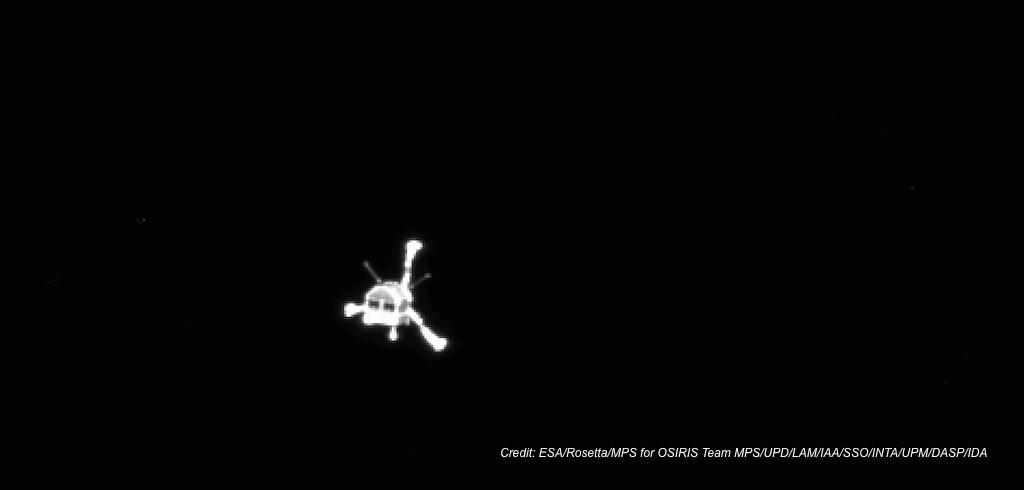
The European Space Agency has confirmed that the Philae probe has successfully landed on the comet 67P/Churyumov–Gerasimenko and established contact with headquarters. The harpoons have deployed and reeled in the slack, and the landing gear has retracted. (Edit: They're now saying the harpoons didn't fire after all.) There are no photos from the surface yet, but the Rosetta probe snapped this picture of Philae after initial separation, and Philae took this picture of Rosetta. Emily Lakdawalla has a timeline of the operation (cached). She notes that there was a problem with the gas thruster mounted on top of the lander. The purpose of the thruster was to keep the lander on the comet after landing, since there was a very real possibility that it could bounce off. (The comet's local gravity is only about 10^-3 m/s^2.) The pins that were supposed to puncture the wax seal on the jet were unable to do so for reasons unknown. Still, the jet did not seem to be necessary. The official ESA Rosetta site will be continually updating as more data comes back. -
Rosetta's Philae Probe To Land On Comet Tomorrow
An anonymous reader writes: After more than 10 years travelling, the Rosetta mission will take its next, momentous step by landing the Philae probe on comet 67P/Churyumov-Gerasimenko tomorrow. How f!@#$%ing cool is that?! Follow the landing live using the webcast, blog, or Twitter feed. (Keep in mind there's a 28-minute delay due to the time it takes the radio signals to reach Earth). Here's the scheduling info: "For the primary landing scenario, targeting Site J, Rosetta will release Philae at 08:35 GMT/09:35 CET at a distance of 22.5 km from the center of the comet, landing about seven hours later. The one-way signal travel time between Rosetta and Earth on 12 November is 28 minutes 20 seconds, meaning that confirmation of the landing will arrive at Earth ground stations at around 16:00 GMT/17:00 CET. If a decision is made to use the backup Site C, separation will occur at 13:04 GMT/14:04 CET, 12.5 km from the center of the comet. Landing will occur about four hours later, with confirmation on Earth at around 17:30 GMT/18:30 CET. The timings are subject to uncertainties of several minutes." -
Rosetta's Philae Probe To Land On Comet Tomorrow
An anonymous reader writes: After more than 10 years travelling, the Rosetta mission will take its next, momentous step by landing the Philae probe on comet 67P/Churyumov-Gerasimenko tomorrow. How f!@#$%ing cool is that?! Follow the landing live using the webcast, blog, or Twitter feed. (Keep in mind there's a 28-minute delay due to the time it takes the radio signals to reach Earth). Here's the scheduling info: "For the primary landing scenario, targeting Site J, Rosetta will release Philae at 08:35 GMT/09:35 CET at a distance of 22.5 km from the center of the comet, landing about seven hours later. The one-way signal travel time between Rosetta and Earth on 12 November is 28 minutes 20 seconds, meaning that confirmation of the landing will arrive at Earth ground stations at around 16:00 GMT/17:00 CET. If a decision is made to use the backup Site C, separation will occur at 13:04 GMT/14:04 CET, 12.5 km from the center of the comet. Landing will occur about four hours later, with confirmation on Earth at around 17:30 GMT/18:30 CET. The timings are subject to uncertainties of several minutes." -
Rosetta's Philae Probe To Land On Comet Tomorrow
An anonymous reader writes: After more than 10 years travelling, the Rosetta mission will take its next, momentous step by landing the Philae probe on comet 67P/Churyumov-Gerasimenko tomorrow. How f!@#$%ing cool is that?! Follow the landing live using the webcast, blog, or Twitter feed. (Keep in mind there's a 28-minute delay due to the time it takes the radio signals to reach Earth). Here's the scheduling info: "For the primary landing scenario, targeting Site J, Rosetta will release Philae at 08:35 GMT/09:35 CET at a distance of 22.5 km from the center of the comet, landing about seven hours later. The one-way signal travel time between Rosetta and Earth on 12 November is 28 minutes 20 seconds, meaning that confirmation of the landing will arrive at Earth ground stations at around 16:00 GMT/17:00 CET. If a decision is made to use the backup Site C, separation will occur at 13:04 GMT/14:04 CET, 12.5 km from the center of the comet. Landing will occur about four hours later, with confirmation on Earth at around 17:30 GMT/18:30 CET. The timings are subject to uncertainties of several minutes." -
Rosetta Takes Stunning Self-Portrait 10 Miles From Comet's Surface
astroengine writes: At a distance of only 10 miles from comet 67P/Churyumov-Gerasimenko's surface, the European Rosetta mission has captured yet another dazzling self portrait with the dark comet lurking in the background. But the orbiter couldn't have snapped this picture without the help of a little friend — the attached Philae lander that is currently undergoing preparations for its historic comet surface landing in November. -
Antarctic Ice Loss Big Enough To Cause Measurable Shift In Earth's Gravity
An anonymous reader writes: Contrary to what we were sometimes taught in high school physics, the Earth's gravity is not constant. It actually shows slight variations on different parts of the Earth's surface, and the variations correlate with the density of the material on that surface. The European Space Agency has been measuring gravity for four years, mapping these variations and recording the changes those variations have undergone. Its data indicates "a significant decrease [in gravity] in the region of Antarctica where land ice is melting fastest. Further analysis is, of course, planned so that the whole of Antarctica can be taken into account and "the clearest picture yet of the pace of global warming" can be determined on that continent. -
2 Galileo Satellites Launched To Wrong Orbit
As reported by the BBC, two satellites meant to form part of the EU's Galileo global positioning network have been launched into a wrong, lower orbit, and it is unclear whether they can be salvaged. NASASpaceFlight.com has a more detailed account of the launch, which says [D]espite the Arianespace webcast noting no issue with the launch, it was later admitted the satellites were lofted into the wrong orbit. “Following the announcement made by Arianespace on the anomalies of the orbit injection of the Galileo satellites, the teams of industries and agencies involved in the early operations of the satellites are investigating the potential implications on the mission,” noted a short statement, many hours after the event. It is unlikely the satellites can be eased into their correct orbit, even with a large extension to their transit time. However, ESA are not classing the satellites as lost at this time. “Both satellites have been acquired and are safely controlled and operated from ESOC, ESA’s Operations Centre in Darmstadt, Germany,” the Agency added. Over the course of the next "year or so," an additional 24 satellites are slated to complete the Galileo constellation, to be launched by a mixed slate of Ariane and Soyuz rockets. -
Rosetta Achieves Orbit Around Comet
schwit1 (797399) writes with an update on the European Space Agency's comet-exploring craft Rosetta: "Rosetta has successfully achieved orbit around Comet 67P/C-G and has transmitted its first close up images. More information here (1) and here (2) about the rendezvous and what science the mission scientists plan to do as they orbit the comet." As pointed out earlier by reader Taco Cowboy, this is the fruit of a 10-year mission. Reuters points out The mission performs several historical firsts, including the first time a spacecraft orbits a comet rather than just whizzing past to snap some fly-by pictures, and the first time a probe has landed on a comet. ... There is little flexibility in Rosetta's schedule this year. The comet is still hurtling toward the inner Solar System at almost 55,000 km per hour, and the closer it gets to the sun the more active it will become, emitting gases that can make it difficult to predict the trajectory of Rosetta and its probe. -
Rosetta Achieves Orbit Around Comet
schwit1 (797399) writes with an update on the European Space Agency's comet-exploring craft Rosetta: "Rosetta has successfully achieved orbit around Comet 67P/C-G and has transmitted its first close up images. More information here (1) and here (2) about the rendezvous and what science the mission scientists plan to do as they orbit the comet." As pointed out earlier by reader Taco Cowboy, this is the fruit of a 10-year mission. Reuters points out The mission performs several historical firsts, including the first time a spacecraft orbits a comet rather than just whizzing past to snap some fly-by pictures, and the first time a probe has landed on a comet. ... There is little flexibility in Rosetta's schedule this year. The comet is still hurtling toward the inner Solar System at almost 55,000 km per hour, and the closer it gets to the sun the more active it will become, emitting gases that can make it difficult to predict the trajectory of Rosetta and its probe. -
Rosetta Achieves Orbit Around Comet
schwit1 (797399) writes with an update on the European Space Agency's comet-exploring craft Rosetta: "Rosetta has successfully achieved orbit around Comet 67P/C-G and has transmitted its first close up images. More information here (1) and here (2) about the rendezvous and what science the mission scientists plan to do as they orbit the comet." As pointed out earlier by reader Taco Cowboy, this is the fruit of a 10-year mission. Reuters points out The mission performs several historical firsts, including the first time a spacecraft orbits a comet rather than just whizzing past to snap some fly-by pictures, and the first time a probe has landed on a comet. ... There is little flexibility in Rosetta's schedule this year. The comet is still hurtling toward the inner Solar System at almost 55,000 km per hour, and the closer it gets to the sun the more active it will become, emitting gases that can make it difficult to predict the trajectory of Rosetta and its probe. -
Rosetta Achieves Orbit Around Comet
schwit1 (797399) writes with an update on the European Space Agency's comet-exploring craft Rosetta: "Rosetta has successfully achieved orbit around Comet 67P/C-G and has transmitted its first close up images. More information here (1) and here (2) about the rendezvous and what science the mission scientists plan to do as they orbit the comet." As pointed out earlier by reader Taco Cowboy, this is the fruit of a 10-year mission. Reuters points out The mission performs several historical firsts, including the first time a spacecraft orbits a comet rather than just whizzing past to snap some fly-by pictures, and the first time a probe has landed on a comet. ... There is little flexibility in Rosetta's schedule this year. The comet is still hurtling toward the inner Solar System at almost 55,000 km per hour, and the closer it gets to the sun the more active it will become, emitting gases that can make it difficult to predict the trajectory of Rosetta and its probe. -
Rosetta Achieves Orbit Around Comet
schwit1 (797399) writes with an update on the European Space Agency's comet-exploring craft Rosetta: "Rosetta has successfully achieved orbit around Comet 67P/C-G and has transmitted its first close up images. More information here (1) and here (2) about the rendezvous and what science the mission scientists plan to do as they orbit the comet." As pointed out earlier by reader Taco Cowboy, this is the fruit of a 10-year mission. Reuters points out The mission performs several historical firsts, including the first time a spacecraft orbits a comet rather than just whizzing past to snap some fly-by pictures, and the first time a probe has landed on a comet. ... There is little flexibility in Rosetta's schedule this year. The comet is still hurtling toward the inner Solar System at almost 55,000 km per hour, and the closer it gets to the sun the more active it will become, emitting gases that can make it difficult to predict the trajectory of Rosetta and its probe. -
Satellite Swarm Spots North Pole Drift
An anonymous reader writes "A report from the European Space Agency shows the first collection of high-resolution results from the agency's three-satellite Swarm. The report illustrates the latest changes in the Earth's magnetic field and shows the movement of the magnetic North Pole. "Launched in November 2013, ESA's Swarm mission consists of three 9-meter satellites orbiting the planet at altitudes of 300-530 km (186-330 miles). Their goal is to monitor Earth's dynamic magnetic field, observing its changes over a period of four years. The data gathered by the Swarm satellites will help scientists better understand how our magnetic field works, how it's influenced by solar activity, and why large parts of it are found to be weakening."" -
ESA Taking Applications for Summer of Code in Space
phyr writes: "ESA Summer of Code in Space (SOCIS) is a program run by the European Space Agency. It aims at offering student developers stipends to write code for various space-related open source software projects. Through SOCIS, accepted student applicants are paired with a mentor or mentors from the participating projects, thus gaining exposure to real-world software development scenarios. In turn, the participating projects are able to more easily identify and bring in new developers. Applicants must be attending a European or Canadian university and will receive 4000 Euros for supporting one of the accepted open source projects. Applicants have until May 15th to submit their proposals and resumes. I'm particularly interested to have exceptional proposals for the NEST project." -
ESA Taking Applications for Summer of Code in Space
phyr writes: "ESA Summer of Code in Space (SOCIS) is a program run by the European Space Agency. It aims at offering student developers stipends to write code for various space-related open source software projects. Through SOCIS, accepted student applicants are paired with a mentor or mentors from the participating projects, thus gaining exposure to real-world software development scenarios. In turn, the participating projects are able to more easily identify and bring in new developers. Applicants must be attending a European or Canadian university and will receive 4000 Euros for supporting one of the accepted open source projects. Applicants have until May 15th to submit their proposals and resumes. I'm particularly interested to have exceptional proposals for the NEST project." -
Software Upgrade At 655 Million Kilometers
An anonymous reader writes "The Rosetta probe was launched in 2004 with a mission that required incredible planning and precision: land on a comet. After a decade in space, the probe woke from hibernation in January. Now, Rosetta has spotted its target. 'Rosetta is currently around 5 million kilometers from the comet, and at this distance it is still too far away to resolve – its light is seen in less than a pixel and required a series of 60–300 second exposures taken with the wide-angle and narrow-angle camera. The data then traveled 37 minutes through space to reach Earth, with the download taking about an hour per image.' Now it's time to upgrade the probe's software. Since it's currently 655,000,000 kilometers from Earth, the operation needs to be flawless. 'When MIDAS is first powered up, it boots into "kernel mode" – the kernel manages a very robust set of basic operations for communicating with the spacecraft and the ground and for managing the more complex main program. From kernel mode we can upload patches to the main software, verify the current contents, or even load an entirely new version.' The Rosetta blog is continually being updated with progress on the mission, and the Planetary Society has more information as well. The probe will arrive at the comet in August, and will attempt landing in November." -
Software Upgrade At 655 Million Kilometers
An anonymous reader writes "The Rosetta probe was launched in 2004 with a mission that required incredible planning and precision: land on a comet. After a decade in space, the probe woke from hibernation in January. Now, Rosetta has spotted its target. 'Rosetta is currently around 5 million kilometers from the comet, and at this distance it is still too far away to resolve – its light is seen in less than a pixel and required a series of 60–300 second exposures taken with the wide-angle and narrow-angle camera. The data then traveled 37 minutes through space to reach Earth, with the download taking about an hour per image.' Now it's time to upgrade the probe's software. Since it's currently 655,000,000 kilometers from Earth, the operation needs to be flawless. 'When MIDAS is first powered up, it boots into "kernel mode" – the kernel manages a very robust set of basic operations for communicating with the spacecraft and the ground and for managing the more complex main program. From kernel mode we can upload patches to the main software, verify the current contents, or even load an entirely new version.' The Rosetta blog is continually being updated with progress on the mission, and the Planetary Society has more information as well. The probe will arrive at the comet in August, and will attempt landing in November." -
Software Upgrade At 655 Million Kilometers
An anonymous reader writes "The Rosetta probe was launched in 2004 with a mission that required incredible planning and precision: land on a comet. After a decade in space, the probe woke from hibernation in January. Now, Rosetta has spotted its target. 'Rosetta is currently around 5 million kilometers from the comet, and at this distance it is still too far away to resolve – its light is seen in less than a pixel and required a series of 60–300 second exposures taken with the wide-angle and narrow-angle camera. The data then traveled 37 minutes through space to reach Earth, with the download taking about an hour per image.' Now it's time to upgrade the probe's software. Since it's currently 655,000,000 kilometers from Earth, the operation needs to be flawless. 'When MIDAS is first powered up, it boots into "kernel mode" – the kernel manages a very robust set of basic operations for communicating with the spacecraft and the ground and for managing the more complex main program. From kernel mode we can upload patches to the main software, verify the current contents, or even load an entirely new version.' The Rosetta blog is continually being updated with progress on the mission, and the Planetary Society has more information as well. The probe will arrive at the comet in August, and will attempt landing in November." -
How An Astronaut Nearly Drowned During a Space Walk
Hugh Pickens DOT Com writes "About 44 minutes into a 6.5-hour spacewalk last July, Italian astronaut Luca Parmitano noted that water was building up inside his helmet – the second consecutive spacewalk during which he reported the problem. As Parmitano worked his way back to the air lock, water covered his eyes, filled his ears, disrupted communications, and eventually began to enter his nose, making it difficult for him to breathe. 'I know that if the water does overwhelm me I can always open the helmet,' wrote Parmitano about making it to the airlock. 'I'll probably lose consciousness, but in any case that would be better than drowning inside the helmet.' Later, when crew mates removed his helmet, they found that it contained at least 1.5 quarts of water. In a 122-page report released Wednesday, a mishap investigation board identified a range of causes for the near-tragedy, including organizational causes that carried echoes of accident reports that followed the loss of the shuttles Challenger and Columbia and their crews in 1986 and 2003. Engineers traced the leak to a fan-and-pump assembly that is part of a system that extracts moisture from the air inside the suit and returns it to the suit's water-based cooling system. Contaminants clogged holes that would have carried the water to the cooling system after it was extracted from the air. The water backed up and flowed into the suit's air-circulation system, which sent it into Parmitano's helmet (PDF).
The specific cause of the contamination is still under investigation but investigators also identified deeper causes, one of which involved what some accident-investigation specialists have dubbed the 'normalization of deviance' – small malfunctions that appear so often that eventually they are accepted as normal. In this case, small water leaks had been observed in space-suit helmets for years, despite the knowledge that the water could form a film on the inside of a helmet, fogging the visor or reacting with antifogging chemicals on the visor in ways that irritate eyes. NASA officials are not planning on resuming non-urgent spacewalks before addressing all 16 of the highest priority suggestions from the Mishap Investigation Board. 'I think it's a tribute to the agency that we're not hiding this stuff, that we're actually out trying to describe these things, and to describe where we can get better,' says William Gerstenmaier, associate administrator for NASA's Human Exploration and Operations Mission Directorate. 'I think that's how we prevent Columbias and Challengers.'" -
European Space Agency Picks Plato Planet-hunting Mission
kc123 writes "A telescope to find worlds around other stars has been selected for launch by the European Space Agency's Science Policy Committee. Known as Plato (Planetary Transits and Oscillations of stars), the mission should launch on a Soyuz rocket in 2024. The Plato space telescope will prepare the way for scientists searching for alien life by locating the first genuinely Earth-like exoplanets orbiting nearby stars. It will break new ground in astronomy by using a "bug eye" array of 34 individual telescopes. The intention is for this array to sweep about half the sky, to investigate some of its brightest and nearest stars." -
Water Plume Detected At Dwarf Planet Ceres
astroengine writes "Astronomers analyzing data from the now defunct Herschel infrared space observatory have made a huge discovery deep inside the asteroid belt. Dwarf planet Ceres, the largest body in the region, is generating plumes of water vapor. 'This is the first time water vapor has been unequivocally detected on Ceres or any other object in the asteroid belt and provides proof that Ceres has an icy surface and an atmosphere,' said Michael Küppers of the European Space Agency in Spain and lead author of a paper published today (Jan. 22) in the journal Nature." -
Rosetta Probe Awakens, Prepares To Chase Comet
sciencehabit writes "The European comet-chasing probe Rosetta is up and running again today after it successfully roused itself from a 2½-year sleep and signaled anxious controllers on the ground. The spacecraft had been put into hibernation during the most distant part of its 10-year journey in pursuit of comet 67 P/Churyumov-Gerasimenko because sunlight was too dim to keep its solar-powered systems running. Dozing in a slow stabilizing spin, Rosetta could not receive signals from the ground, so there was a risk that some problem might prevent it from responding to its preset alarm call at 10:00 GMT. Even then, there were many processes to go through before news reached Earth: The spacecraft's heaters would need to warm up its systems, its startrackers get a fix, boosters halt the spin, solar arrays turn towards the sun, and, finally, its communications antenna would need to point at Earth. It was not till 18:18 GMT that the signal was picked up by NASA's ground stations at Goldstone, California, and Canberra in Australia, and transmitted to the European Space Agency's (ESA's) control center at Darmstadt in Germany." -
Comet-Chasing Probe Wakes Up On Monday
Hugh Pickens DOT Com writes "Jason Major reports that after nearly a decade of soaring through the inner solar system, flying past Mars and Earth several times and even briefly visiting a couple of asteroids for a gravity assist, the European Space Agency's comet-chasing spacecraft, Rosetta, is due to 'wake up' on January 20 after 957 days of hibernation. The probe is awakening to prepare for its upcoming and highly-anticipated rendezvous with comet 67P/Churyumov-Gerasimenko in August. The spacecraft was designed to be put in hibernation for the coldest part of the journey that took it close to the orbit of Jupiter, because even with massive solar panels the size of a basketball court, Rosetta would not have enough power to complete its mission without this energy-saving strategy. Once Rosetta enters orbit around the comet — the first time a spacecraft has ever done so — it will map its surface and, three months later in November, deploy the 220-lb (100-kg) Philae lander that will intimately investigate the surface of the nucleus using a suite of advanced science instruments. 'It's the first time we've made a rendezvous with a comet — that's never been done before — and it's going to be the first time we've escorted a comet past its closest approach to the Sun,' says ESA project scientist Matt Taylor." -
Mars Express Orbiter Buzzes Martian Moon Phobos
astroengine writes "On Sunday, at 5:17 p.m. GMT (12:17 p.m. EST), Europe's Mars Express orbiter successfully completed a daring low-pass of Mars' largest moon Phobos. In an effort to precisely measure the gravitational field of the moon, the 10 year-old mission was sent on a trajectory that took it only 45 kilometers (28 miles) from the dusty surface, the closest any spacecraft has ever come to the natural satellite." -
ESA's Long-Term Plan To Investigate the Invisible Universe
xiox writes "The European Space Agency (ESA) have decided that its next two large astronomy missions (costing 2bn Euros) will be to study two aspects of the "invisible universe". The first will be a very large X-ray telescope to be launched in 2028. It will study the physics of the hottest and largest structures in the universe, investigating how they formed and evolved. It will also investigate how black holes grow and affect the universe. The second mission, launched in 2034, will be an observatory capable to measure gravitation waves, the stretches and compressions in space-time caused by massive moving systems, such as merging pairs of black holes. Although the final designs are not yet chosen, the two proposed observatories Athena and eLISA are likely choices. BBC News has more information." -
Galileo Navigation System Gets Go-Ahead From EU Parliament
An anonymous reader writes "Plans to start up the EU's first global satellite navigation system (GNSS) built under civilian control, entirely independent of other navigation systems and yet interoperable with them, were approved by MEPs on Wednesday. Both parts of this global system — Galileo and EGNOS — will offer citizens a European alternative to America's GPS or Russia's Glonass signals. The Galileo system could be used in areas such as road safety, fee collection, traffic and parking management, fleet management, emergency call, goods tracking and tracing, online booking, safety of shipping, digital tachographs, animal transport, agricultural planning and environmental protection to drive growth and make citizens' lives easier." -
Galileo Navigation System Gets Go-Ahead From EU Parliament
An anonymous reader writes "Plans to start up the EU's first global satellite navigation system (GNSS) built under civilian control, entirely independent of other navigation systems and yet interoperable with them, were approved by MEPs on Wednesday. Both parts of this global system — Galileo and EGNOS — will offer citizens a European alternative to America's GPS or Russia's Glonass signals. The Galileo system could be used in areas such as road safety, fee collection, traffic and parking management, fleet management, emergency call, goods tracking and tracing, online booking, safety of shipping, digital tachographs, animal transport, agricultural planning and environmental protection to drive growth and make citizens' lives easier." -
GOCE Satellite Is Falling To Earth But Nobody Knows Where It Will Land
Virtucon writes "The Gravity field and steady-state Ocean Circulation Explorer or GOCE Satellite is expected to fall to Earth this weekend. It weighs over a ton and unfortunately the Scientists don't exactly know where it will land. You can track it here. It should re-enter sometime between Sunday night and Monday morning. Makr Hopkins, chair of the National Society's Executive Committee said: 'The satellite is one of the few satellites in a Polar Orbit. Consequently, it could land almost anywhere.' The GOCE mission was to create an accurate gravity map of the Earth." -
GOCE Satellite Is Falling To Earth But Nobody Knows Where It Will Land
Virtucon writes "The Gravity field and steady-state Ocean Circulation Explorer or GOCE Satellite is expected to fall to Earth this weekend. It weighs over a ton and unfortunately the Scientists don't exactly know where it will land. You can track it here. It should re-enter sometime between Sunday night and Monday morning. Makr Hopkins, chair of the National Society's Executive Committee said: 'The satellite is one of the few satellites in a Polar Orbit. Consequently, it could land almost anywhere.' The GOCE mission was to create an accurate gravity map of the Earth." -
ESA Begins Mars Rover Tests In Chile
Zothecula writes "The Atacama desert in Chile is so dry that parts of it are utterly devoid of life down to bacteria. That and its sandy, rock-strewn terrain makes it so similar to Mars that it's a perfect spot for ESA to trial its Sample Acquisition Field Experiment with a Rover (SAFER), which this week is carrying out tests related to navigation, remote control and the use of scientific instruments. The agency's goal is the latest in a series of tests to develop technologies and gain practical experience in anticipation of ESA's launch of the ExoMars rover to the Red Planet in 2018." -
NASA and ESA To Demonstrate Earth-Moon Laser Communication
cylonlover writes with this news bite about a cool new ground to space laser communication system from NASA and ESA: "Space communications have relied on radio since the first Sputnik in 1957. It's a mature, reliable technology, but it's reaching its limits. The amount of data sent has increased exponentially for decades and NASA expects the trend to continue. The current communications systems are reaching their limits, so NASA and ESA are going beyond radio as a solution. As part of this effort, ESA has finished tests of part of a new communications system, in preparations for a demonstration in October in which it will receive a laser data download from a NASA lunar orbiter." -
Evolution of AI Interplanetary Trajectories Reaches Human-Competitive Levels
New submitter LFSim writes "It's not the Turing test just yet, but in one more domain, AI is becoming increasingly competitive with humans. This time around, it's in interplanetary trajectory optimization. From the European Space Agency comes the news that researchers from its Advanced Concepts Team have recently won the Gold 'Humies' award for their use of Evolutionary Algorithms to design a spacecraft's trajectory for exploring the Galilean moons of Jupiter (Io, Europa, Ganymede and Callisto). The problem addressed in the awarded article (PDF) was put forward by NASA/JPL in the latest edition of the Global Trajectory Optimization Competition. The team from ESA was able to automatically evolve a solution that outperforms all the entries submitted to the competition by human experts from across the world. Interestingly, as noted in the presentation to the award's jury (PDF), the team conducted their work on top of open-source tools (PaGMO / PyGMO and PyKEP)." -
Evolution of AI Interplanetary Trajectories Reaches Human-Competitive Levels
New submitter LFSim writes "It's not the Turing test just yet, but in one more domain, AI is becoming increasingly competitive with humans. This time around, it's in interplanetary trajectory optimization. From the European Space Agency comes the news that researchers from its Advanced Concepts Team have recently won the Gold 'Humies' award for their use of Evolutionary Algorithms to design a spacecraft's trajectory for exploring the Galilean moons of Jupiter (Io, Europa, Ganymede and Callisto). The problem addressed in the awarded article (PDF) was put forward by NASA/JPL in the latest edition of the Global Trajectory Optimization Competition. The team from ESA was able to automatically evolve a solution that outperforms all the entries submitted to the competition by human experts from across the world. Interestingly, as noted in the presentation to the award's jury (PDF), the team conducted their work on top of open-source tools (PaGMO / PyGMO and PyKEP)." -
Evolution of AI Interplanetary Trajectories Reaches Human-Competitive Levels
New submitter LFSim writes "It's not the Turing test just yet, but in one more domain, AI is becoming increasingly competitive with humans. This time around, it's in interplanetary trajectory optimization. From the European Space Agency comes the news that researchers from its Advanced Concepts Team have recently won the Gold 'Humies' award for their use of Evolutionary Algorithms to design a spacecraft's trajectory for exploring the Galilean moons of Jupiter (Io, Europa, Ganymede and Callisto). The problem addressed in the awarded article (PDF) was put forward by NASA/JPL in the latest edition of the Global Trajectory Optimization Competition. The team from ESA was able to automatically evolve a solution that outperforms all the entries submitted to the competition by human experts from across the world. Interestingly, as noted in the presentation to the award's jury (PDF), the team conducted their work on top of open-source tools (PaGMO / PyGMO and PyKEP)." -
ESA Launches the 2013 Edition of the Summer of Code In Space (SOCIS)
First time accepted submitter Maxime Perrotin writes "Following the successful past two editions of SOCIS, the European Space Agency is pleased to announce the launch of the 2013 edition of its Summer of Code in Space. The project is now open for mentoring organizations to submit project proposals until the 20th of June. Projects have to be open-source/free software; students who participate can get up to 4000€ if the project is achieved." -
Violent Galactic Clash May Solve Cosmic Mystery
astroengine writes "The mother of all cosmic collisions has been spotted between two galaxies containing a total of 400 billion stars, igniting the birth of 2,000 new stars per year! This incredible event was first spotted by the recently-retired Herschel infrared space observatory (abstract), a mission managed by the European Space Agency. This violent discovery isn't just awesome to look at, it could also help explain how massive, red elliptical galaxies evolved in the early universe." -
Helium Depleted, Herschel Space Telescope Mission Ends
AmiMoJo writes "The billion-euro Herschel observatory has run out of the liquid helium needed to keep its instruments and detectors at their ultra-low functioning temperature. This equipment has now warmed, meaning the telescope cannot see the sky. Its 3.5m mirror and three state-of-the-art instruments made it the most powerful observatory of its kind ever put in space, but astronomers always knew the helium store onboard would be a time-limiting factor." Reader etash points to a collection of some infrared imagery that Herschel collected. -
Helium Depleted, Herschel Space Telescope Mission Ends
AmiMoJo writes "The billion-euro Herschel observatory has run out of the liquid helium needed to keep its instruments and detectors at their ultra-low functioning temperature. This equipment has now warmed, meaning the telescope cannot see the sky. Its 3.5m mirror and three state-of-the-art instruments made it the most powerful observatory of its kind ever put in space, but astronomers always knew the helium store onboard would be a time-limiting factor." Reader etash points to a collection of some infrared imagery that Herschel collected. -
Space Junk 'Cleaning' Missions Urgently Needed
Following a conference on space debris, the European Space Agency has warned that the amount of space junk floating around in orbit is a problem that needs to be dealt with 'urgently.' They are calling for a number of test missions to examine different methods of controlling or removing the debris. "Our understanding of the growing space debris problem can be compared with our understanding of the need to address Earth’s changing climate some 20 years ago," said Heiner Klinkrad, head of the agency's Space Debris office. A couple years ago we discussed an idea for de-orbiting space junk by hitting it with a laser to change its momentum. An Australian company has now received funding from NASA and the Australian government to try just that. "We've been developing tracking systems using lasers for some years, so we can actually track very small objects with a laser rangefinder to very high accuracy. ... If you allow that velocity to change over a period of perhaps 24 hours, then you can get actually a 100-meter shift in the location of an object to deflect it from colliding with another space debris object." Other plans are in development as well, and there currently exists an international guideline saying that new hardware must de-orbit and burn up in the atmosphere after 25 years of operation — but compliance is lagging. Meanwhile, collision events are becoming more common (PDF), and experts worry about the safety of the International Space Station and important satellites. "Their direct costs and the costs of losing them will by far exceed the cost of remedial activities." -
ESA Seeks Software Innovators For Orbiting Laboratory
First time accepted submitter Dario Izzo writes "The European Space Agency is giving the opportunity to try innovative software algorithms on board of one of its planned orbiting platform. The core architecture includes processors of unprecedented power (for space platforms) and it is fully reconfigurable even down to the operating system and firmware levels. Peripherals include cameras, GPS and attitude control. The full technical specifications are available via the European Space Agency web pages."