Slashdot Mirror
Domain: esa.int
Stories and comments across the archive that link to esa.int.
Comments · 950
-
Re:Use the Carl Sagan Scale
No.
From a 2004 estimate article:
http://www.esa.int/esaSC/SEM75BS1VED_index_0.htmlAstronomers estimate there are about 100 thousand million stars in the Milky Way alone. Outside that, there are millions upon millions of other galaxies also!
Hipparcos mapped millions of stars in our galaxy...With this simple calculation you get something like 10to the 22nd to 10 to the 24th stars in the Universe. This is only a rough number, as obviously not all galaxies are the same, just like on a beach the depth of sand will not be the same in different places.
That's about 1,000,000,000,000,000,000,000,000 stars in the universe, which is (I think) called 1 billion trillion?
-
Re:Your ignorance is astounding.
First, it was mostly a flick towards "fuck yeah, America!" AC; IMHO adequate, considering the X-37 and how excellent the main engine of Atlas V is...
Yes, excellent. You give it slightly too little credit. There's a lot more to it than price (though "price per excellence" in an item of such type is also telling) - most importantly, this particular engine was made specifically for Atlas family of rockets; not used by any other.
It's also the highest performance liquid propellant engine in service (apart from "doubled" version of...itself), with very efficient cycle made possible by advanced metallurgy (that nobody elsewhere chose to take at), not cheapness; overall design choices (say, channel wall design instead of tube wall design of combustion chamber; or ablative nozzles) perhaps hitting closer to sweet spots. Other examples could be "the most reliable
For some reason this particular field is one where Russians are damn good.
-
Landspeed record for disabled cars?
This seems rather low, and certainly not a record. Unless they compete in a "differently abled" class?
The Nuna 2 solar powered car that won the World Solar Challenge in 2003 had the following stats for the race:
Total race time: 31 hr 5 mins.
Average speed: 97,02 Km/h
Topspeed: 130 km/h
Top speed they had during Adante tour in 2004: 145 km/h
Link: http://www.esa.int/esaCP/SEMCCBZO4HD_Benefits_2.htmlSee also http://en.wikipedia.org/wiki/Nuna_5 for the stats of the Nuna 5.
Theoretical max speed: 175 km/h
Keep in mind that this was done by a (Dutch) university team as well.
Considering the fact that the sunswift team wants to compete in the WSC as well - I think they either need to get up to 188 km/h, or throw in the towel. Or perhaps I'm missing something but I did RTA and nothing suggests they really set a new speedrecord, except their own propaganda.
-
Re:Like riding a firecracker
And yet almost nothing uses it as pure first stage, not when the costs are most important (commercial launches; well, except small launches using surplus / paid for ex-Soviet ICBMs) - at best, they are used in tandem with liquid fueled rocket, typically LOH fueled one. But much more rarely with kerosene fueled ones - and if you look at thrust/mass/specific impulse ratios, it's quite apparent that kerosene rocket sits nicely between solid and LOH. Seems both of them miss the ideal spot, to which kerosene is much nearer.
The lowest costs per kg are apparently offered by Zenit - simple, pure liquid (kerosene...) design. "The most reliable
-
Re:Like riding a firecracker
Both first launch of Scud and entering service were actually slightly before Redstone.
But the best success story of such type is probably the R-7 rocket family. R-7 Semyorka, the first operational ICBM. It also launched Sputnik. And Yuri Gagarin. Launches Soyuz and Progress spacecraft to this day, together with many other payloads (according to ESA it is "the most reliable
Also purely liquid (though here it's kerosene and liquid oxygen)
-
Re:Oops
Repurposing and shared-mission SIGINT satellites for scientific use is as old as space flight itself.
And it goes much further than that. R-7 family of rockets is probably the most striking example - a rocket which launched the first satellite and first human in space; which launches to this day Soyuz & Progress spacecraft and many other payloads.
It was also the first operational ICBM, R-7 Semyorka (not a very good ICBM, not very practical - but turned out to be a fabulous launcher, the most reliable and most frequently used launch vehicle in the world, and that's coming from, basically, its competitor)
-
Re:antihydrogen
Yes, and such annihilations of electrons+positrons produce characteristic bursts of gamma radiation with energy 511 keV when both particles have relatively low energy. The energy of each photon (two are always emitted; gotta conserve energy and momentum!) is equivalent to the rest mass of an electron * c^2.
Proton/anti-proton annihilation results in a gamma ray of energy 938 MeV.
-
On a related note
Just found this animation of the 1986 Giotto fly-by through the tail of Halley. (QuickTime required.) Very cool. Apparently Giotto's still out there and going strong, took a detour through another comet some years later, still does the occasional fly-by near Earth and can be reactivated if there's anything worth looking at. Not bad for a probe that they weren't expecting to survive the Halley encounter.
-
Re:Wow, a whole $1 million?
Oh, is NASA also going to do a Mars 500-type experiment, just like the Russians, Europeans and Chinese are doing right now?
-
Re:solutions from the article
ESA has one nice analysis here
No, if early enough it doesn't require a very big mass at all, or some particularly asteroid-shattering impact (one other interesting, even if probably not particularly useful, method in the link above: centrifugal fragmentation; considering many asteroids seem to be barely held together rubble piles...)
-
Re:Have $100 million?
Heck, it is launched by a rocket from R-7 lineage. A family which carried all Soviet and Russian manned missions to date, starting with Yuri Gagarin. Which launched Sputnik. And was the first operational ICBM (not very practical in its first role; but...sort of competing space agency says it is "The most reliable
-
Re:Respect
The "space race" was some of the best work humankind has ever done, for all the worst reasons.
That's true on a much more fundamental level than you put.
In the case of Russians, for example:
Which rocket put Sputnik into orbit? One from R-7 lineage.
Which rocket put Yuri Gagarin into orbit? One from R-7 lineage.
Which rockets put Soyuz and Progress spacecraft, and many other payloads into orbit?What was the first operational ICBM? R-7 Semyorka.
-
Dumbed-down GTOC
Although I work in the Space Industry I am not a Rocket Scientist but it is my understanding that this is *not* a purely computer solvable problem and is explained on the GTOC website: http://www.esa.int/gsp/ACT/mad/op/GTOC/indexII.htm
-
Nothing new
The article unfortunately contains almost no information, except for the fact that ESA wants to do formation flying and is developing some testbed. This is not news, since ESA has been studying missions involving satellites flying in close formation for more than 10 years: for example the Darwin mission, which would have flown some telescopes at a few hundred meters to do optical aperture synthesis for detecting extra-solar planets (mission appears to be shelved right now) and XEUS which is a 'standard' 100 meter long x-ray telescope, but instead of physically connecting lens and focal plain it consists of 2 spacecraft that are virtually connected by a system that measures the mutual positions.
I had the pleasure of getting a tour on the JPL campus a few years ago, which to me seemed like a place where they build nothing else than super-cool over-engineered testbeds just for fun. I probably saw some early version of this testbed. They had a large hall with a smooth floor over which the 'satellites' could slide on air-bearings (3 degrees of freedom), on which a vertical piston was mounted (1 DOF) and finally an over-sized ball-air-bearing for the remaining 2 tilt DOFs. This provides a platform that can move freely in all degrees of freedom, which would carry a satellite-simulator consisting of small air-jets and a shitload of sensors to do the 'formation flying'. Very impressive, even if it was not operational at the time. If ESA would be starting now with their testbed, they would trail NASA by at least 5 years. Lets hope they have been doing something in the meantime.
-
Nothing new
The article unfortunately contains almost no information, except for the fact that ESA wants to do formation flying and is developing some testbed. This is not news, since ESA has been studying missions involving satellites flying in close formation for more than 10 years: for example the Darwin mission, which would have flown some telescopes at a few hundred meters to do optical aperture synthesis for detecting extra-solar planets (mission appears to be shelved right now) and XEUS which is a 'standard' 100 meter long x-ray telescope, but instead of physically connecting lens and focal plain it consists of 2 spacecraft that are virtually connected by a system that measures the mutual positions.
I had the pleasure of getting a tour on the JPL campus a few years ago, which to me seemed like a place where they build nothing else than super-cool over-engineered testbeds just for fun. I probably saw some early version of this testbed. They had a large hall with a smooth floor over which the 'satellites' could slide on air-bearings (3 degrees of freedom), on which a vertical piston was mounted (1 DOF) and finally an over-sized ball-air-bearing for the remaining 2 tilt DOFs. This provides a platform that can move freely in all degrees of freedom, which would carry a satellite-simulator consisting of small air-jets and a shitload of sensors to do the 'formation flying'. Very impressive, even if it was not operational at the time. If ESA would be starting now with their testbed, they would trail NASA by at least 5 years. Lets hope they have been doing something in the meantime.
-
Re:More please!!!
Well, if the precision needed surpasses practical approaches possible to us, that's moderately close to fundamental, as far as seing it soon goes... Or perhaps, at the least, you'd probably need zero drag spacecraft; while doing it with a large part containing mirrors plus including all the "portholes" for incoming and outgoing (to the hub) light...fun.
There are certainly good reasons why one ESA mission was put on hold (without managing to determine if what they want to do, with only 3 spacecraft, is technically feasible), or that one NASA interferometer, one spacecraft relying on rigid frame, needed a decade of technical feasibility studies (again, rigid), and still probably won't launch for another decade...
And none of the two above can give actual "pretty pictures" (about which the initial post was), merely finally resolve the dot of a terrestrial planet (more or less). We should see Pluto-like images (those before New Horizons; and not the best out of those, too) in our lifetimes, I guess; anything more - better don't count on it too much. -
Re:Proven delivery system
The idiot just looked up the number of launches of "Soyuz" (without any scary additions to the name like "-U" or "-FG" for example) rocket, the first variant which was named like that (after the vehicle it started carrying back then) - really, all just R7 variants (though for the longest time also direct derivatives of the first Soyuz one)
What he did is especially ironic considering that the rocket flew over 1700 times, and according to ESA (for whom it is a very succesfull competition) is "the most reliable means of space travel" and "the most frequently used launch vehicle in the world."
-
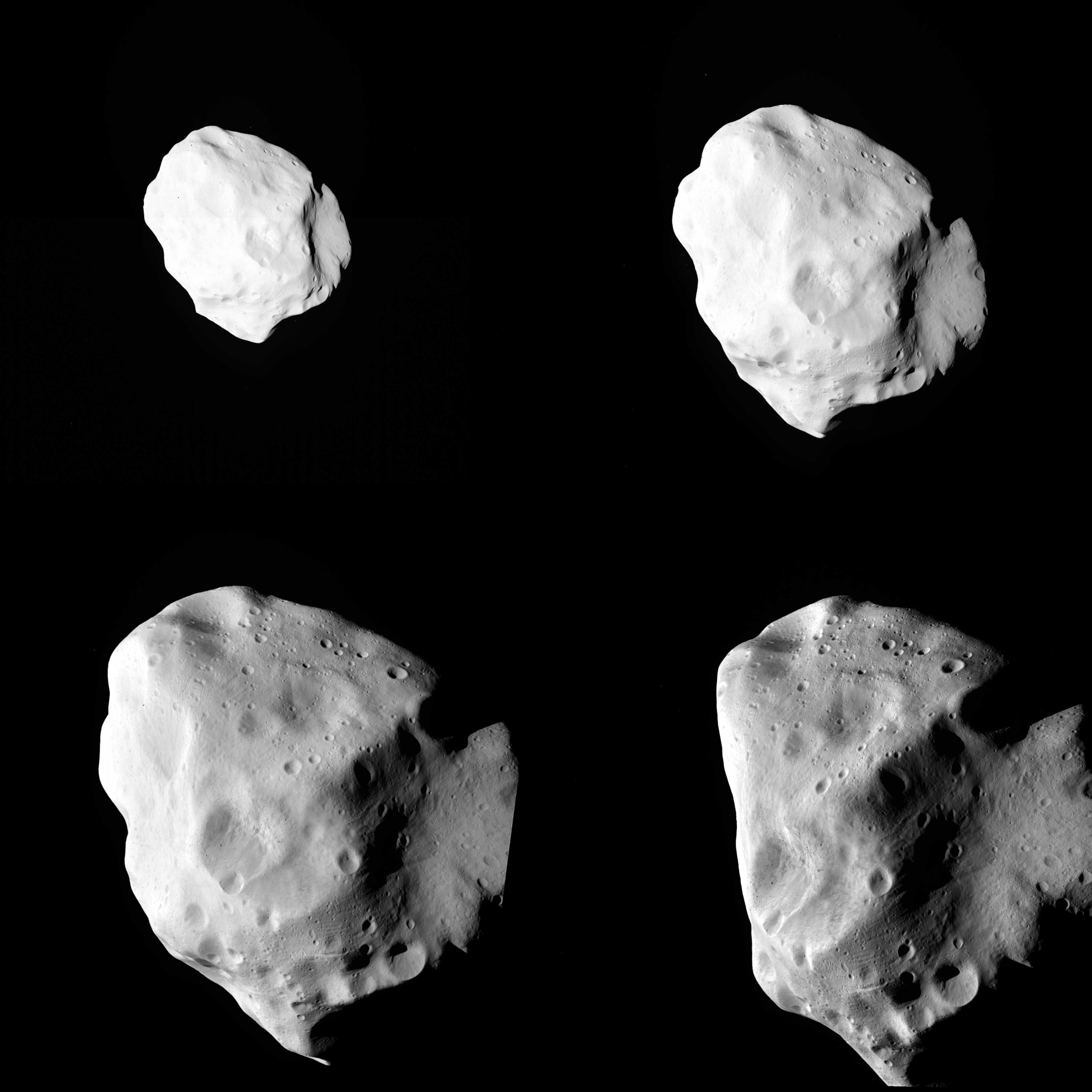
Strange Shadows
Can someone explain the seemingly strange shadows on the bottom-right image in this montage?
The shadows on the craters in the upper part of the image seem to suggest that the source of illumination is toward the middle-left off of the image, but the craters on the bottom of the image seem to be illuminated from the top of the image.
The only thing I can think of is that there's quite a bit more curvature in that image than is apparent.
Ideas?
-
Re:Find project you like or use
-
Re:Find project you like or use
-
Re:Where's a 1920x1200pxl Image?
GOCE is a mission from theEuropean Space Agency: get the images on an ESA site, not on the BBC:
http://earth.esa.int/object/index.cfm?fobjectid=7029
and more precisely, this specific image is on slide 7 (rescalable
-
Re:Where's a 1920x1200pxl Image?
GOCE is a mission from theEuropean Space Agency: get the images on an ESA site, not on the BBC:
http://earth.esa.int/object/index.cfm?fobjectid=7029
and more precisely, this specific image is on slide 7 (rescalable
-
Interpreting gravity maps
There is a fascinating deep area in the Indian ocean (-100M) and a high area near Iceland (+80M), proving conclusively that our world is not homogeneous in terms of density (or practically any other measure). Does anyone know whether these anomalies correspond to known geographic phenomena? Deposits of heavy metals perhaps, or hotspots where the mantle is thinner? I know little about geodetic stuff, but I'm curious about the reasons for wrinkles in the data set."
Something that is maybe not so clear from the discussion in TOA, this is an accelerometer mission, and thus reveals a high pass filtering (AKA high-harmonic geoid signatures) of the gravity field. I am not sure if the geoid map in the BBC article is entirely from GOCE data, or if it has other data filling in the low spatial frequencies - it looks pretty similar to older geoid maps.
You might want to read this paper, which points out that
"The interpretation of GOCE geoid and gravity anomaly maps in terms of structure and dynamics of the Earth is
neither simple nor straightforward."You can see things like typography, sea-mounts (modern gravity data is very good at detecting these), mountain ranges (these are like icebergs, made of lighter material with deep roots, and so are typically actually geoid lows), subduction zones, etc. Since what's going on may be determined by mass / density changes in the deep mantle, figuring out what the observed structures mean can be tough.
However, the scientific interest in these gravity data largely centers around changes in gravity, and many of these are more straightforward. Among the signatures of interest are ocean current changes (might change the dynamic sea level by 10 cm), ice formation and melting (for example, of the Greenland ice sheet), and the global water balance on land (if it rains, it changes the mass loading of the ground, and thus the geoid). Data such as these, and the data from GRACE, are becoming more and more important in the study of global geodynamics. The literally show what's happening on the ground, in basically real time.
-
Summary overly crude...
This document is not a " This is what NASA is going to do" sort of thing; It is a top-level, national guideline towards spacerelated ( and by related, I mean everything even vaguely connected ) business. Even school teaching programs. And if the USA can get data from satellites for climate change. This is a set of soft guidelines, without any realistic impact. For that impact, we need way, way more technical and financial reports.
For such a thing we will have to wait till congress looks at budget proposals, and some real life testing. constellation is still doing some tests, but everyone knows that the Ares 1 will never launch a single human to orbit. Officially - and even this document changes nothing about that - it is still going on.
And please, dont attach too much meaning to rumors of a new "space race". The chinese have a launch rate of one mission every 2 years. They are currrently way below 1965 level of experience from the USA. Instead, look at the slow but significant progress:
ESA getting Soyuz acces: http://www.esa.int/SPECIALS/Launchers_Home/SEMXN619Y8G_0.html
Russia upgrading its production facilities to build a 5th soyuz ( notably the upgrading of its thermal room so that 2 soyuz heatshields at the same time can be fitted to the spacecrafts: http://www.federalspace.ru/main.php?id=2&nid=9719&lang=en
While its nothing flashy and I think there should be more money into spaceflight, spaceX and orbital and the likes are really going for it. Talk in the article about "losing the space race" is overly simplistic, certainly with an ISS that'll be around till atleast 2020, and very possibly 2030. It is international, dont forget that.
also, a rumor; ATK ( they manufacture the shuttle srbms) have finally caved in it seems, and are willing to build the old 4 segment boosters instead of continueing to lobby for a 5 segment version. Great news; they finally might get something moving now... -
ESA equivalents ?
Would any of these ESA programs provide the same data: Earth Explorers at a glance ?
-
Re:Russian Style
Restraint is an option anytime, anywhere...
But it seems it doesn't just "happen", people snapping suddenly.
http://www.esa.int/esaHS/ESAGO90VMOC_astronauts_0.html
http://www.nasa.gov/centers/johnson/pdf/163533main_ISS_Med_CL.pdfNow they seem to be determining how to combat the effects in a bit more isolated place.
-
Should've mentioned ...
... the blog's in Russian. In Russia blogs translate you, etc. etc. ESA has a mission diary available though, written by Diego Urbina and Romain Charles.
-
Re:Abiogenic Petroleum
Apparently it was Saturn's moon, Titan, that was observed to have hundreds of times more hydrocarbons than all the known oil and natural gas reserves on earth:
http://www.esa.int/esaSC/SEMCSUUHJCF_index_0.html
Strange, considering the dearth of biological life forms there.
-
"full" science results
"The first scientific results" ESA
Nothing "first" at BBC.
Many references to "first", none to "full" Herschel mission blog
I might be the only one who got confused by word "full" which I understood that some scientific results has been already produced.
Could the word "full" be more related to this?
-
Photo of water on mars.
The ESA already has a picture of water ice in a martian crater. Maybe they are talking about different types of craters in different regions, but this photo clearly shows that it is possible.
http://www.esa.int/SPECIALS/Mars_Express/SEMGKA808BE_0.html
-molo
-
Bluff
Broadcast very loudly that we are here and very technological.
Aliens that need to find new plannets will avoid us because
1) They believe our bluff that we are very advanced and can protect us.
2) Realized that we are not so advanced but that we probably have destroy or planet through pollution and/or wars. And if it not yet done, it would be by the time they arrive.
So they will go to the next star that do not broadcast their position and have planets.
We know which stars have planets so that's not the difficult part.We already knows hundredth of planets and by 2020 (release of the GAIA catalog) we will knows thousands more.
http://gaia.esa.int/ -
Anal?
ESA even compiled an informative animation.
Good grief! It looks like Iceland is anally violating Europe!
-
Re:Starting to get ridiculous...
There is satellite imagery however. Both NASA and ESA traces the ash cloud based on satellite data, ESA even compiled an informative animation.
-
Re:They are wrongSo tell me how much funding does your community get compared to the NASA gravy train? NASA looks likely to get at least $10 billion over the next five years just to run Earth-oriented science missions (it's roughly $27 billion total for all space science over that time period). Even mentioning "cubesats" (not to mention your considerable harping about lack of funding) indicates to me that you are likely sucking hind teat and not in my target group, people who get money for space science projects and then squander it.
Ever heard of the DMSP and LANL satellites?
No, I hadn't heard of them, but these are DoD projects. It's no surprise to me that they're using the same, relatively commonsense approach that they use for the rest of the DoD realm in space. They have their act together and have always been more savvy economically than NASA.
Even in NASA, they occasionally do economically smart stuff like reuse of important systems (Mars Exploration Rovers used a modification of the Pathfinder mission's entry system). But a glance at NASA and the ESA's space science missions indicates a bunch of high development cost missions (the ESA seems to have a better approach, I like the looks of Cross-Section, PLATO, and LISA, for example, due to their use of multiple spacecraft, the only comparable NASA mission is the ILN, a proposed communication network for the Moon, everything else is more or less a gamble on a single spacecraft).So unless you are an actual expert in space science and instrument design, I would be very careful about who you insult.
I won't be careful, but your concern is noted.
Finally, perhaps you should look through some of the videos on Youtube of Apollo astronauts working on the Moon. My favorite is the "orange soil" clips from Apollo 17. This is a series of clips that show two astronauts (Eugene Cernan and Harrison Schmitt) looking around some volcanic activity (a fumarole, I believe). Schmitt (IIRC) sees some orange soil and collects it. That soil turns out to be titanium rich and probably one of the bigger finds of the mission. I gather it is now thought to be a last remnant of some ancient volcanic activity. Since that phase of activity is a common means of ore genesis on Earth, it also gives us an idea of where to look for possible elements that concentrate in that sort of formation (for example, I toured a mine in New Mexico where beryllium, lithium, and tantalum had been concentrated considerably by a similar process on Earth).
When I looked through the video, I thought to myself, what would it take to duplicate the efforts of these two men with unmanned systems? First, they're riding in a rover, which I believe they drove around for 36 km (and the rover had a range of almost 100 km in theory). Second, they spotted an interesting science target as they were tooling around. Schmitt quickly took several samples, each in its own numbered bag. The speed with which they did these activities is worth noting. The rover moves 12 km/hr, roughly, and the decision to check out the orange soil was made on the spot. The clips I mention are collectively somewhere around 35 minutes in length. I doubt we're capable of repeating that feat (it's arguble, of course, whether you'd want to) on the Moon now with current unmanned technology, though it's more likely to be in place by the time humans fly back to the Moon.
Now consider a much more remote location like Mars or the surface of a Jovian moon or asteroid. Teleoperations no longer works very well. Operations which could take minutes on the Moon, now take far longer. The current unmanned space science theory is that we'll develop AI sop -
Re:Scale Down Constellation for LEO
Forget the moon, that is just going into another gravity well. it is not a "stepping stone" to mars, the asteroids, or the other planets.
I disagree, building a moon base would be a significant stepping stone. There is lots and lots of research that still needs to be done for meaningful long-distance space exploration. For example:
- The Russians and ESA are for example working on the Mars 500 project to see what happens if a group of cosmo-, taiko- and (euro-?) -nauts are locked up in a tin can together for 500 days. Where is the NASA equivalent of that? Is it not exciting enough because no big rockets are involved since the tin can is somewhere near Moscow? Long-distance travel means making sure the explorers are not at each others' throat.
- For both colonization and long-distance exploration missions, you need a life-support system that is robust, repairable, and produces very little waste and waste heat. A moon base would be excellent to test it because, unlike the Mars 500 tin-can, the vacuum outside is real and the micrometeorites, radiation levels etc. are real. I believe there's a really important lesson to be shown to the world, that building a sustainable mini-ecosystem is *hard*. And, that if you fuck up the one you're currently using, the only one we know works for generations, you're *fucked*.
- Manufacturing and autonomous manufacturing. I don't care how hard it is, I think Robert Zubrin is spot-on about its importance for missions to the moon and mars. He talks about a fuel factory here, to be run for 10 months in preparation to the manned mission, but even nicer would be a solar-cell driven factory for crude, low-energy, amorphous silicon solar cells, or maybe even some kind of very slow separator using mass spectrometry that over a period of years collects tiny amounts of pure boron, phosphorus, etc.
The versions made this century don't have to be self-replicating
-
Already exists\being developed.
Unfortunately, as with most, this idea is not new:
A google search for "satellite early warning tsunami":
http://www.google.com/search?client=opera&rls=en&q=satellite+early+warning+tsunami&sourceid=opera&ie=utf-8&oe=utf-8&safe=active
Comes up with the following results:
http://ec.europa.eu/world/tsunami/other-measures/early_warning.htm
http://www.drgeorgepc.com/TsunamiRWarningSystem.html
http://www.esa.int/esapub/bulletin/bulletin124/bul124h_martin_neira.pdf
I'm not picking apart your idea. Just you googleing (How the hell do you spell Googleing? Googling?) skills, I guess.
And, didn't I see a
- Zotdogg -
Wait, is it? Isn't it? Fucking hell...
I'm reasonably sure this isn't an April Fools. See story from the horse's mouth, dated 31st March.
If it is an April Fools joke then the joke is ultimately on them. That something like this could be considered absurd would only highlight how incredibly pathetic space programmes have been for the last 30 years.
-
Re:Shiny and beautiful...
You'll find much more complete information here. http://www.esa.int/esaSC/SEMZ6GSVYVE_index_0.html Unfortunately Discovery is the web site that turns science into an infomercial complete with annoying ads.
-
*SA
ESA = European Space Agency
http://www.esa.int/CSA = Canadian Space Agency
http://www.asc-csa.gc.ca/eng/default.aspJAXA = Japan Aerospace Exploration Agency
(ooops)
http://www.jaxa.jp/ -
Re:Cape. Which Cape?
Europe has recently built a space port in Guyana. Which is only a few degrees north of the equator. Mind you, scientifically speaking the equator is the best place to launch spacecraft from.
http://www.esa.int/esaMI/Launchers_Europe_s_Spaceport/index.html
SpaceX has a launch pad on Omlek Island which is near the equator as well:
http://maps.google.com/maps?q=9.048167,167.743083&ie=UTF8&ll=9.102097,168.046875&spn=128.203692,316.054688&z=2 -
Link
Phobos flyby blog:
http://webservices.esa.int/blog/blog/7Better than the linked article.
-
Re:Where's the fucking hi-res pictures?
Sorry to be blunt, but I don't visit Slashdot to get redirected to some shitty ad-plastered website with half-assed copy/pasted information. Was it really so hard for the submitter to give this a proper non-misleading title, and a link to the actual ESA press release? Is there a way to get kdawson fired? He seems to pull this shit a lot.
I'm going to guess it's because the linked article had that nice photo to look at. You know, the extreme close up photo that was the whole point of the article submission. Not that official information like the link you suggested isn't nice.
-
Re:I've actually thought about this...
It's of massive value in astronomy. And it's exactly whatsuperconducting image sensors do.
-
Where's the fucking hi-res pictures?
Sorry to be blunt, but I don't visit Slashdot to get redirected to some shitty ad-plastered website with half-assed copy/pasted information.
Was it really so hard for the submitter to give this a proper non-misleading title, and a link to the actual ESA press release?
Is there a way to get kdawson fired? He seems to pull this shit a lot. -
Original Phobos pics from ESA
-
shameless plug to ISS videos
ESA just launched a new website for hosting videos - check it out
http://multimedia.esa.int/content/search?SearchText=iss&SearchButton=Go
http://multimedia.esa.int/content/search?SearchText=mars&SearchButton=Go
-
shameless plug to ISS videos
ESA just launched a new website for hosting videos - check it out
http://multimedia.esa.int/content/search?SearchText=iss&SearchButton=Go
http://multimedia.esa.int/content/search?SearchText=mars&SearchButton=Go
-
What I think we need to do
If you want to find a needle in a haystack you need a needle finder (metal detector). Almost all of the existing radio telescopes have too narrow a field of view and/or too long a integration time. What we need is "An L-Band All-Sky Astronomical Surveillance System" as per the Ohio Argus (http://argus.naapo.org/). 5(?) of them would cover the whole sky. Each sees ~100 degree's of sky. They would need to be located in space to cut down the large amount ground thermal noise and perhaps use superconducting antennas.. e.g. http://www.esa.int/esaLP/ESAQGA2VMOC_LPsmos_0.html but pointing out into space (it is at this very moment as apart of its calibration). It needs to be able to spot 10 millisecond transients and have a real-time bandwidth of ~20 MHz (i.e. a real time 20 MHz of spectrum display with 0.1 hz of resolution for each image pixel in the sky). It initially would have a low sensitivity and would be upgraded over time with more antennas and more advanced digital processing (needed to cross correlate all the antennas for all angles) The technology to attempt this type of device has only recently come available (40nm and under FPGAs/GPUs). What if "Argus sees a brief, narrowband pulse at 1420.8807 MHz near NGC 752" (http://argus.naapo.org/~rchilders/) was actually coming from the sky. The chances of any radio telescope being pointed at exactly the right spot an being able to see 1400Jy). What if that pulse is only sent once every 5 months? What if there where other pulses outside of the Argus's 60khz bandwidth? I believe that any SETI beacon ("look here with a bigger telescope") would be a large phased array cycling though a large target list and sending a short burst of pulses on a number of special frequencies.
-
Re:ISO country code
The International domain
-
Re:ESA Mars Webcam
There's a similar thing going on for some time on ESA Mars Express mission, where public is invited to participate in obtaining, processing, etc. of images taken with a camera that was meant originally to observe Beagle separation.
http://www.esa.int/esaMI/VMC/index.html
That's all well and good but I'll take 30 cm/px over an image comparable to what we get from a good telescope on Earth.