Slashdot Mirror
Domain: euanmearns.com
Stories and comments across the archive that link to euanmearns.com.
Comments · 33
-
Re:Bags under lakes
Here's a review of the project you are thinking of and another way of doing underwater compressed air storage. I was looking for this project to post before I came across your message. There's a diagram showing how the system in Toronto works. Unfortunately there's no detailed numbers on how efficient or competitive it is.
They are storing the heat captured during compressing to heat up the air when they decompress the air.
-
Re: Alas, it won't get past the anti-nuke hysteric
The APR-1400 actually runs at 600K. Read for yourself here: http://euanmearns.com/an-overv...
I got my APR (advanced pressurized reactor) confused with my ACR (advanced CANDU/Canadian reactor). There's many variants of both the APR and ACR, and there's a an ACR design that has an output temperature "high enough" for whatever uses you propose. Your original complaint was that we'd run out of bodies of water to cool these "inadequately hot", or whatever, nuclear reactors. We simply will not, both because there is a lot of water out there and we have designs right now that get as hot as any solar or coal plant.
Never once have I said that nuclear power plants have a technical problem doing load-following. The problem is entirely economical.
Yes, I noticed that. And I replied that you are just speculating. I have Bill Gates' word against yours that this can be done economically. I believe Bill Gates.
-
Re: Alas, it won't get past the anti-nuke hysteric
The APR-1400 reactor runs at 890K, so what are you talking about?
The APR-1400 actually runs at 600K. Read for yourself here: http://euanmearns.com/an-overv...
Perhaps you are referring to the temperature of the fuel? If so, that is irrelevant, the relevant temperature is that of the steam that you can draw power from. APR-1400 is around 4000MW thermal to get 1400MW electricity, so the rule of thumb of having to cool away twice as much heat as you get electricity applies. Again, this is pitiful compared to fossil plants or even concentrated solar thermal (not that concentrated solar thermal is ever going anywhere for electricity purposes).
The articles on the DOE web site say that this MCFR can load follow, provide process heat and electrical generation, and more so I'm inclined to believe them.
Never once have I said that nuclear power plants have a technical problem doing load-following. The problem is entirely economical.
-
Re:I expect they'll be as successful as electric c
In the longer-term, floating solar swarms can be installed along trade routes currently followed by container ships, and used to recharge them in mid-journey. Larger and larger percentages of motive power can be supplied to hybrid ships over time, until they are finally using their ICEs only for emergencies or in inclement weather.
You really ought to read Entropy, Energy and Order in the Universe. Large and complex systems harvesting diffuse energy flows are just not thermodynamically attractive.
-
Re:After 99 percent of the damage is caused
We've known about this for centuries, and still waste money on fake solutions like overpriced nuclear power (which doesn't work well when the water heats up a lot), when the solutions even Edison knew about, wind and solar, are far far cheaper than any of the fossil fuels that are creating the problem.
Right, we should bring back cheap nuclear power, as it was before the anti-nuclear lunacy took hold. If not for their efforts to drive up prices using lawsuits, excessive regulations, and any other dirty tactics available, fossil fuels would be history by now. Thanks for that. It's ironic that the anti-nuclear "greens" are now using the problem that they caused as justification for a completely unworkable "solution". Advocating an ideology that excludes the largest reliable zero-carbon energy source exposes their fraud.
Here are your "cheap" renewables. Even if they actually were economical, they only provide for electricity, not heating, industry, and transportation, which are a much larger part of the problem.
-
Re:If the powers preaching climate change
If it really is that cheap, please explain this. Also, why is electricity so expensive in Germany and other renewable heavy locations? Wind and solar are only "cheaper" with lavish subsidies and mandates, while ignoring the balancing costs they impose on the grid with their intermittent energy flows. Batteries are not included, and gas turbines need to be kept spinning, ready to pick up the slack.
-
Re:Why is this necessary?
Germany pays subsidies for wind and solar only to export the electricity at low prices so it's not a complete loss. Not only low prices but negative, as in paying people to take it so the grid remains stable. They are bankrupting themselves.
http://fortune.com/2017/03/14/...
https://www.technologyreview.c...
http://euanmearns.com/getting-...
http://www.windpowermonthly.co...Denmark imports electricity at 30 euro/MWh and exports at 20 euro/MWh. Germany does better with imports at 30 euro/MWh and exports at 27 euro/MWh. If Germany keeps shutting down reliable nuclear and replacing it with unreliable wind and solar the net export is likely to disappear, the price difference is most definitely going to spread, and this will cost Germany money. Perhaps Germany will remain a net exporter of electricity but they will have to pay their neighbors to take it.
These "environmentalists" like to talk about things being sustainable. This is not sustainable.
-
Re:Scotland's homes don't use much electricity
According to this chart about Scotland specifically:
~79% natural gas
~12% electricity
~7% oil
~2% other (likely wood and/or coal)
-
Re:intermittencyAw, foo. Looks like Slashdot logged me out, so my comment got posted anonymously.
That's why Germany and Denmark, which have the highest wind+solar energy investments, have such affordable electricity. Oh, wait...
http://www.euanmearns.com/wp-content/uploads/2015/08/europeelectricprice.png
In Germany, where they now get 20% of their electricity from wind & solar, the extraordinarily high cost has driven the price of electricity there up to three times what I pay here in North Carolina. (Well, it also doesn't help that Merkel is shutting down their perfectly good nuclear plants.)
The truth is that the intermittency problem with wind and solar is so severe that when you get more than a few percent tied into the grid it actually has negative value. It is only "crony capitalism" (government mandates, tax incentives, etc.) which make wind & solar competitive with coal and gas except in very special circumstances.
Diverting resources to wind and solar boondoggles impoverishes people, not just in West Virginia, where huge numbers of them are now out of work, but also everywhere that it inflates the cost of energy. It causes people living "on the edge" to sometimes have to choose between eating and staying warm.
Either choice can be deadly. In Europe, where there have been enormous price hikes for energy because of "renewables" scams, "energy poverty" is killing tens of thousands of mostly-elderly people:
What's more, most of the energy used to PRODUCE solar panels, and much of the energy used to produce wind turbines, comes from soot-belching, coal-fired power plants in China, and most of the energy REPLACED BY these devices would have been produced in clean power plants with state-of-the-art "scrubbers" in North America, Europe & Australia.
So, Chinese workers get emphysema, American workers get to collect unemployment (until it runs out), and American & European environmentalists get to feel self-righteous.
Such a deal.
-
intermittency
That's why Germany and Denmark, which have the highest wind+solar energy investments, have such affordable electricity. Oh, wait...
http://www.euanmearns.com/wp-content/uploads/2015/08/europeelectricprice.png
In Germany, where they now get 20% of their electricity from wind & solar, the extraordinarily high cost has driven the price of electricity there up to three times what I pay here in North Carolina. (Well, it also doesn't help that Merkel is shutting down their perfectly good nuclear plants.)
The truth is that the intermittency problem with wind and solar is so severe that when you get more than a few percent tied into the grid it actually has negative value. It is only "crony capitalism" (government mandates, tax incentives, etc.) which make wind & solar competitive with coal and gas except in very special circumstances.
Diverting resources to wind and solar boondoggles impoverishes people, not just in West Virginia, where huge numbers of them are now out of work, but also everywhere that it inflates the cost of energy. It causes people living "on the edge" to sometimes have to choose between eating and staying warm.
Either choice can be deadly. In Europe, where there have been enormous price hikes for energy because of "renewables" scams, "energy poverty" is killing tens of thousands of mostly-elderly people:
What's more, most of the energy used to PRODUCE solar panels, and much of the energy used to produce wind turbines, comes from soot-belching, coal-fired power plants in China, and most of the energy REPLACED BY these devices would have been produced in clean power plants with state-of-the-art "scrubbers" in North America, Europe & Australia.
So, Chinese workers get emphysema, American workers get to collect unemployment (until it runs out), and American & European environmentalists get to feel self-righteous.
Such a deal.
-
Re:A Red is Wind Blowing
-
Anyone wonder where such numbers come from?
Mortality from Diesel Car Pollution in the UK attempts to provide an answer.
-
Re:The scientists are talking, who is listening?
Tidal is still intermittent, and can't be relied upon to fill in the gaps of other intermittent sources. Read more about tidal.
-
Re:That won't prove commercially viable power
-
Re:hypocrits
Solar is "cheap", if you don't count the enormous subsidies or storage necessary to make it useful. It may look attractive by $/W peak output, but intermittent power is nearly useless, and only available a small fraction of the time. Developing countries don't have a working grid in place to fill in the gaps of unreliable wind and solar, so they choose fossil fuels instead which can produce energy on demand, every day.
If renewables were genuinely economical, advocates wouldn't have to resort to reporting record days or hours. Nor would it be necessary to funnel funds from the poor to build out capacity.
-
Assessment of 100% renewables studies
-
HMS Prince of Wales to be Propelled by WoodPellets
HMS Prince of Wales to be Propelled by Wood Pellets
This is brilliant, and could pass for a genuine article by those accustomed to green thinking.
-
Re:God Save the Queen
Scotland's reckless push for renewables is also growing dependence on energy imports from England. For details of the ever worsening situation, see Energy Matters articles tagged scotland. EU energy policy is insane, and at least the exit will free England to make better choices.
-
Re:Total Capacity
They're playing some tricks with the numbers to get capacity factors close to 0.3, which is physically impossible unless all your PV panels are super-high efficiency and track the sun. But this isn't the sort of thing you can just cover up. It's trivial to calculate the actual capacity factor for PV solar:
- Installed peak capacity at the end of 2014 and 2015 was 18,173 MW and 25,459 MW respectively. So figure average capacity for 2015 was (25459 + 18173)/2 = 21,816 MW.
- PV solar generation for 2015 was 23,232 GWh.
- There are 8766 hours in a year (factoring in leap years).
- (23232 GWh) / (21.816 GW * 8766 hours) = 0.121 capacity factor.
Yeah sure, there's a conspiracy to cover up the real numbers. Or, you know, you might have botched your calculations. You took the solar output from large utilities only and divided it by the total solar capacity including distributed generation.
Solar capacity factors of >25% are relatively easy in the sun belt and can go as high as 36% with tracking and a high panel-to-inverter ratio (Lawrence Berkely study, 2014 figures).
-
Re:Total CapacityThey're playing some tricks with the numbers to get capacity factors close to 0.3, which is physically impossible unless all your PV panels are super-high efficiency and track the sun. But this isn't the sort of thing you can just cover up. It's trivial to calculate the actual capacity factor for PV solar:
- Installed peak capacity at the end of 2014 and 2015 was 18,173 MW and 25,459 MW respectively. So figure average capacity for 2015 was (25459 + 18173)/2 = 21,816 MW.
- PV solar generation for 2015 was 23,232 GWh.
- There are 8766 hours in a year (factoring in leap years).
- (23232 GWh) / (21.816 GW * 8766 hours) = 0.121 capacity factor.
So that 9.5 GW of solar capacity is only generating about 1.15 GW of power on average. If you add the 2 GW of distributed solar (rooftop panels) it works out to 1.39 GW average generation.
Natural gas is a bit of a wild card, since it (and hydro) is typically used to follow peaking demand. That is, you don't run them full tilt. They top off power generation to match demand. But its (and hydro's) capacity factor is historically around 0.40. So NG's 8 GW translates into 3.2 GW of average generation. Hydro's 0.3 GW translates into 0.12 GW of average generation.
Wind's capacity factor is about 0.25. So its 6.8 GW capacity works out to 1.7 GW of average generation.
Nuclear's capacity factor is about 0.9. So the lone new nuclear plant at 1.1 GW capacity translates into 1 GW of average generation.
So in terms of actual power generation:- Gas = 3.2 GW
- Wind = 1.7 GW
- PV solar = 1.15 GW (or 1.39 GW)
- Nuclear = 1.0 GW
- Hydro = 0.12 GW
-
Re:MAD - and some of you will be
Everywhere is "at sea" by some definition, and that is the one you must to use to support your claim. Otherwise, have a look at the experiences of the United Kingdom and Australia for a dose of reality. Perhaps a few days without heat in the dead of winter would correct your propensity for lying.
All over the world, there are extended periods where wind generates zero power. Even if you have a super-grid on the scale of the world, there is just as much guarantee that the wind isn't blowing somewhere. For this reason, and the fact that prime locations are chosen first, the marginal effectiveness of wind and solar is reduced at larger scales. The inescapable fact, is that wind and solar need massive overbuild, interconnection, and storage on a scale that is completely impractical. Clearly you have not done or even looked at the math.
-
Re:Not just Southern Spain
Taking matters into our own hands is a nice thought, but solar+battery are not happening on any meaningful scale. Such installations rely heavily on subsidies and absent far better battery technology than we have, will always depend on the grid. However, the grid can't support more than a small fraction of solar, as California is learning now.
The problem we face is that most "greens" have lost sight of the goal, which should be maximizing reduction of emissions. Instead, they are busy waging a war on nuclear, on behalf of fossil fuel interests. They measure success by "capacity" and renewable installation rate, while ignoring emissions, which are steady or increasing. Prematurely closing nuclear plants in places like Germany and California has essentially wiped away any potential benefit of their renewables, because they are inevitably replaced by fossil fuels. Every time. The only real change is substantially increased retail electricity rates.
The recent lawsuit against zero emission credits in New York is quite telling. ZEC are an attempt to recognize the value of clean energy from nuclear, which is unfairly disadvantaged by generous renewable incentives which exclude nuclear, and temporarily low gas prices thanks to the glut of supply. The ZEC hedges against the inevitable rebound in gas pricing and its volatility, ultimately saving consumers money and ensuring that retail electricity prices will not skyrocket.
This lawsuit demonstrates their real intention. Note that renewable-only incentives have encountered no resistance, because they lock in gas and coal backup indefinitely. With nuclear out of the way it will allow them to make the most of their renewable partnership and drive up fossil energy prices. That would be acceptable if the hybrid fossil/renewable system could economically reduce emissions, but that has yet to happen even once.
-
Re:Sounds good
Deny this. (Warning: contains actual grid data for California.) Success should be measured by reducing emissions, and renewables everywhere (excepting hydro) have a long history of failure by that metric. California is a model of something, but not an effective path to decarbonization.
When it is cost effective to disconnect from the grid without subsidies, then feel free to claim that solar works.
-
Re:Except at night.
All this talk about how a given solar panel's output being cheaper than coal always avoids the extra infrastructure needed to bridge that cloud-period gap.
Always? Nope. There's plenty of discussion of grid management, but then you'd know that if you bothered to be part of any discussions of say, Solar Thermal power generation, that it can operate as a heat bank itself.
Of course, as anybody with a hospital or medical refrigeration system knows, or running a water company, you have to have backups anyway, because SOMETIMES the local plant goes offline. Even the grid itself has to compensate. Sometimes it does it poorly, as folks who suffered the Northeast Blackout found out.
And if you're a nuclear plant, if you don't have a place to dump power, you're likely going to emergency shut down.
But hey, maybe next time you can back off the hyperbole? Always is a high bar, and easy to disprove. They don't avoid it. It's faced head-on.
I know you'd like to believe otherwise, because then you can just smirk and walk off in some sense of superiority, but it's really just empty arrogance.
-
Re:Here is a nuclear free plan for Germany
LMAO, what a joke! Over 50% of Germany's power is supposed to come from wind? What happens when the wind isn't blowing for a week? Everyone just stops using electricity? Or does the plan have fossil fuel backup generators? Here's a nice graphic summary of wind power generation in Europe: http://www.euanmearns.com/wp-c... Note how in a two month period, there are more days that produced less than 15,000MW than there are days that produced over 30,000MW. That's a HUGE variance in output, and you're going to need backup generation online and running to keep the power grid stable.
-
Re:That's exactly right
But you know what, it's all mind bogglingly vast. 3-4 terawatts of dams is mind-bogglingly vast. 3-4 terawatts of wind turbines is mind-bogglingly vast. 3-4 terawatts of solar panels and the factories to churn them out is mind-bogglingly vast.
This is what people don't seem to get. They compare Fukushima to a single wind turbine failure and proclaim wind is safer. Um no, Fukushima's generation capacity was equivalent to about 7,000-10,000 wind turbines. And on a global aggregate, the number of deaths caused by wind turbines per MWh of energy generated far exceeds the number of deaths caused by nuclear, Fukushima and Chernobyl included. Nuclear is safer, its deaths are just more exotic radiation deaths which, like an airliner crash, happen all at once and grab headlines, not mundane falls by maintenance workers which don't even make the local news.
The global installed PV capacity is about 200 GW. But that's just peak generating capacity. Once you factor in night, weather, angle of the sun, maintenance, PV solar only has a capacity factor of about 0.125. So that 200 GW of capacity only generates 200*0.125 = 25 GW on average throughout the year. Fukushima Daiichi I had a capacity of 4.7 GW, and nuclear's capacity factor worldwide is about 0.9. So its average generation had it remained operational would've been 4.2 GW. In other words the combined power generation of every PV solar installation in the world is slightly less than just 6 Fukushima-sized power plants.
That's the huge difference in scale we're talking about when comparing these technologies. How many people died installing and maintaining all those PV installations throughout the world? If it's more than 1/6th what Fukushima killed, then PV solar in regular operation kills more people than half-century-old nuclear technology on its worst day. -
Re:NASA ignoring satellite measurements...
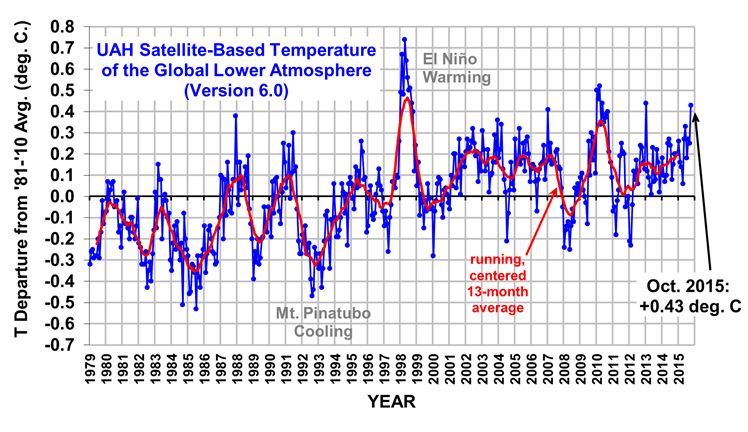
That's amazing! Especially, given the complete lack of correlation with the satellite datasets:
The satellite datasets directly integrate temperature over almost the entire globe, with no interpolation and no revisionist "adjustments". They use laboratory grade instruments, and are frequently calibrated against balloon soundings. And no, there is nothing magic as far as detecting temperature trends gained by measuring at ground level only.
It's beyond ironic that NASA is trumpeting ground-based measurements while ignoring better data gathered from space.
And the first satelite was launched when?
Ohhh certainly not in the late 1800's.
Certainly. However, since the last adjustments, the surface datasets of record have been diverging from the satellite measurements:
The Diverging Surface Thermometer and Satellite Temperature Records
The Diverging Surface Thermometer and Satellite Temperature Records AgainInteresting that this is taking place going into another big climate conference complete with demands for "climate justice", and also while we're on the eve of a solar Grand Minimum...
A quote from that last linked article:
Scientists at the Climate and Environmental Physics and Oeschger Centre for Climate Change Research at the University of Berne in Switzerland have recently backed up theories that support the sun's importance in determining the climate on Earth. A paper published last year by the American Meteorological Society contradicts claims by IPCC scientists that the sun couldn't be responsible for major shifts in climate. Judith Curry, chair of the School of Earth and Atmospheric Sciences at the Georgia Institute of Technology, rejected IPCC assertions that solar variations don't matter. Among the many studies and authorities she cited was the National Research Council's recent report "The Effects of Solar Variability on Earth's Climate".
Other researchers and organisations are also predicting global cooling - the Russian Academy of Science, the Astronomical Institute of the Slovak Academy of Scientists, the Institute of Terrestrial Magnetism Russia, Victor Manuel Velesco Herrera at the National University of Mexico, the Bulgarian Institute of Astronomy, Dr Tim Patterson at Carleton University in Canada, Drs Lin Zhen at Nanjing University in China, just to name a few.
-
Re:NASA ignoring satellite measurements...
That's amazing! Especially, given the complete lack of correlation with the satellite datasets:
The satellite datasets directly integrate temperature over almost the entire globe, with no interpolation and no revisionist "adjustments". They use laboratory grade instruments, and are frequently calibrated against balloon soundings. And no, there is nothing magic as far as detecting temperature trends gained by measuring at ground level only.
It's beyond ironic that NASA is trumpeting ground-based measurements while ignoring better data gathered from space.
And the first satelite was launched when?
Ohhh certainly not in the late 1800's.
Certainly. However, since the last adjustments, the surface datasets of record have been diverging from the satellite measurements:
The Diverging Surface Thermometer and Satellite Temperature Records
The Diverging Surface Thermometer and Satellite Temperature Records AgainInteresting that this is taking place going into another big climate conference complete with demands for "climate justice", and also while we're on the eve of a solar Grand Minimum...
A quote from that last linked article:
Scientists at the Climate and Environmental Physics and Oeschger Centre for Climate Change Research at the University of Berne in Switzerland have recently backed up theories that support the sun's importance in determining the climate on Earth. A paper published last year by the American Meteorological Society contradicts claims by IPCC scientists that the sun couldn't be responsible for major shifts in climate. Judith Curry, chair of the School of Earth and Atmospheric Sciences at the Georgia Institute of Technology, rejected IPCC assertions that solar variations don't matter. Among the many studies and authorities she cited was the National Research Council's recent report "The Effects of Solar Variability on Earth's Climate".
Other researchers and organisations are also predicting global cooling - the Russian Academy of Science, the Astronomical Institute of the Slovak Academy of Scientists, the Institute of Terrestrial Magnetism Russia, Victor Manuel Velesco Herrera at the National University of Mexico, the Bulgarian Institute of Astronomy, Dr Tim Patterson at Carleton University in Canada, Drs Lin Zhen at Nanjing University in China, just to name a few.
-
Re:Wind energy is such shit
That is a reasonable argument, but consider that a nuclear plant is closer to 8 acres per GW, and that is 1GW 95% of the time, not some pitiful fraction of renewable nameplate capacity. Together, these factors give nuclear a footprint many thousands of times less than renewables. Please, let us not pave the world to harvest the sparse energy of wind and the sun, when there are better alternatives.
Once one considers the resources that wind and solar require, including land, materials, and the fossil fuels to produce them, the only reasonable conclusion is that they are an environmental travesty. Beyond the thousands of tons of concrete, steel, and rare earths required for each unit, there are vast expanses of land which must be razed to make way for access roads and power transmission infrastructure out to the middle of nowhere. (Which will be poorly utilized because of the low capacity factor, and not economically viable.) One can appreciate how fruitless and ludicrous this exercise is with only a bit of math, or by objectively viewing the results of the "progress" to date. See The Renewables Future – A Summary of Findings.
-
Re:Obligatoriness Extraordinaire
And, you fail to also read well documented fact that German solar capacity factor is less than 10% overall, equivalent of about 2.4 full sun hours. http://euanmearns.com/german-p...
That source makes a simple but fatal mistake (and probably on purpose): it divides total energy production over the year by the the installed capacity at the end of the year for an energy source with growing installed capacity.
-
Re:Obligatoriness Extraordinaire
No, you have proven you didn't understand solar insolation vs daylight hours, even though I clearly gave you a link that explained it at high school level.
And, you fail to also read well documented fact that German solar capacity factor is less than 10% overall, equivalent of about 2.4 full sun hours.
http://euanmearns.com/german-p...
Your ignorance is intentional. -
Re:The pot calling the kettle black
Need ANOTHER source?
http://euanmearns.com/german-p...
REAL DATA AGAIN! German PV capacity factor = 9.5%, which you would get from 0.095 x 24 hrs/day = 2.28 hr/day full load production. This data come from Prof. Bruno Burger of the Fraunhofer Institute for Solar Energy Systems, the same source YOU referred me to.
Again, I never claimed 3.5 hrs/day, I just gave that to you from a solar industry site to be kind, even though I was quite skeptical. It turns out I was absolutely right. And now have show you another source that is in line with my ORIGINAL statement that it was around 2.5 hrs/day.
At this point, you'll either have to realize you made an error, or place your head in the sand. Its your choice. -
Re:Thanks for pointing out the "briefly" part.
Record levels? Not even close. Not even half: http://euanmearns.com/energiew...
If they had kept nuclear the picture would be even rosier. Hopefully other countries will take a more pragmatic approach, but it is amazing what they have accomplished even while shutting down nuclear.