Slashdot Mirror
Domain: ex-astris-scientia.org
Stories and comments across the archive that link to ex-astris-scientia.org.
Comments · 18
-
Re:another editor fail
I've always wanted a job that involved no physical labor and no mental labor and no oversight of performance.
Too bad others felt the same way, as we're getting exactly that. I've never wanted such a job. The job I've always wanted is the one where I'm in flow for six hours at a stretch (at least once per day), there are more feedback loops than you can shake a stick at, mainly anchored in equally competent peers who likewise wouldn't have it any other way.
NASA, during the Apollo program, had many pockets of competence where The Right Stuff stretched as far as the eye could see.
9 Project Management Lessons Learned from the Apollo 11 Moon Landing
Delegating to people who don't have experience with a certain task may seem counterintuitive, but it was something Apollo project managers actively encouraged — in fact, the average age of the entire Operations team was just 26, most fresh out of college. NASA gave someone a problem and the freedom to run with it, and the results speak for themselves.
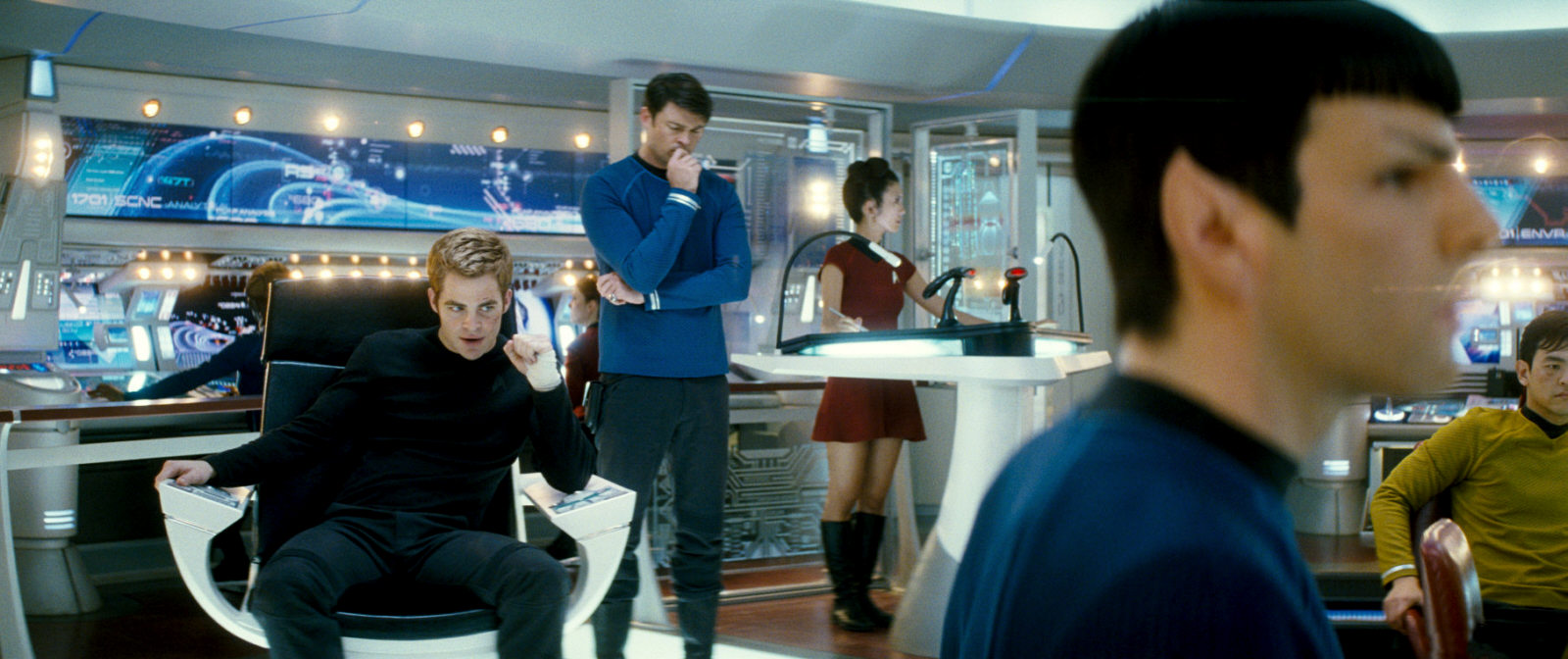
Yes, parts of NASA on the ground basically looked like this.
Imagine the caliber of people you need to hire by default to make this strategy viable.
Gerald Weinberg's second rule of acquisition:
(2) No matter how it looks at first, it's always a people problem.
Moral of the story: hire only those who dream for the stars, the kind of stars where Easy Street has no name.
-
Re:No
No, there was no currency in the future:
Yes, there was. Food and shelter were provided to all, but luxuries were earned. Scotty bought a boat. Benjaman Sisko's father worked in his own restaurant. In the DC Comics story “The Final Voyage“, Spock’s back pay was stated to be around 611,700 credits when his five-year mission ended.
And more: http://en.memory-alpha.wikia.c...
There was also no serious show of religion (among the main cast anyway) until DS9.
Wrong: http://www.ex-astris-scientia....
And individual rights (aside from property rights) have nothing to do with communism vs. capitalism.
Hahaha! Seriously, capitalism is a purely economic system, communism is a bizarre blueprint for an entire society from goatee-universe.
-
Re:Please ruin it like you did Star Trek
It also wasn't startrek. It was, well, a generic action flick with no particular consistency with itself, nevermind the old canon.
this does a decent job describing a lot of it.
http://www.ex-astris-scientia.org/inconsistencies/inconsistencies-trekxi.htmIn fact, all they'd have to do is tweak a few things and it would be a great star trek parody. As far as 'serious' scifi goes, it's awful.
-
Re:There it is
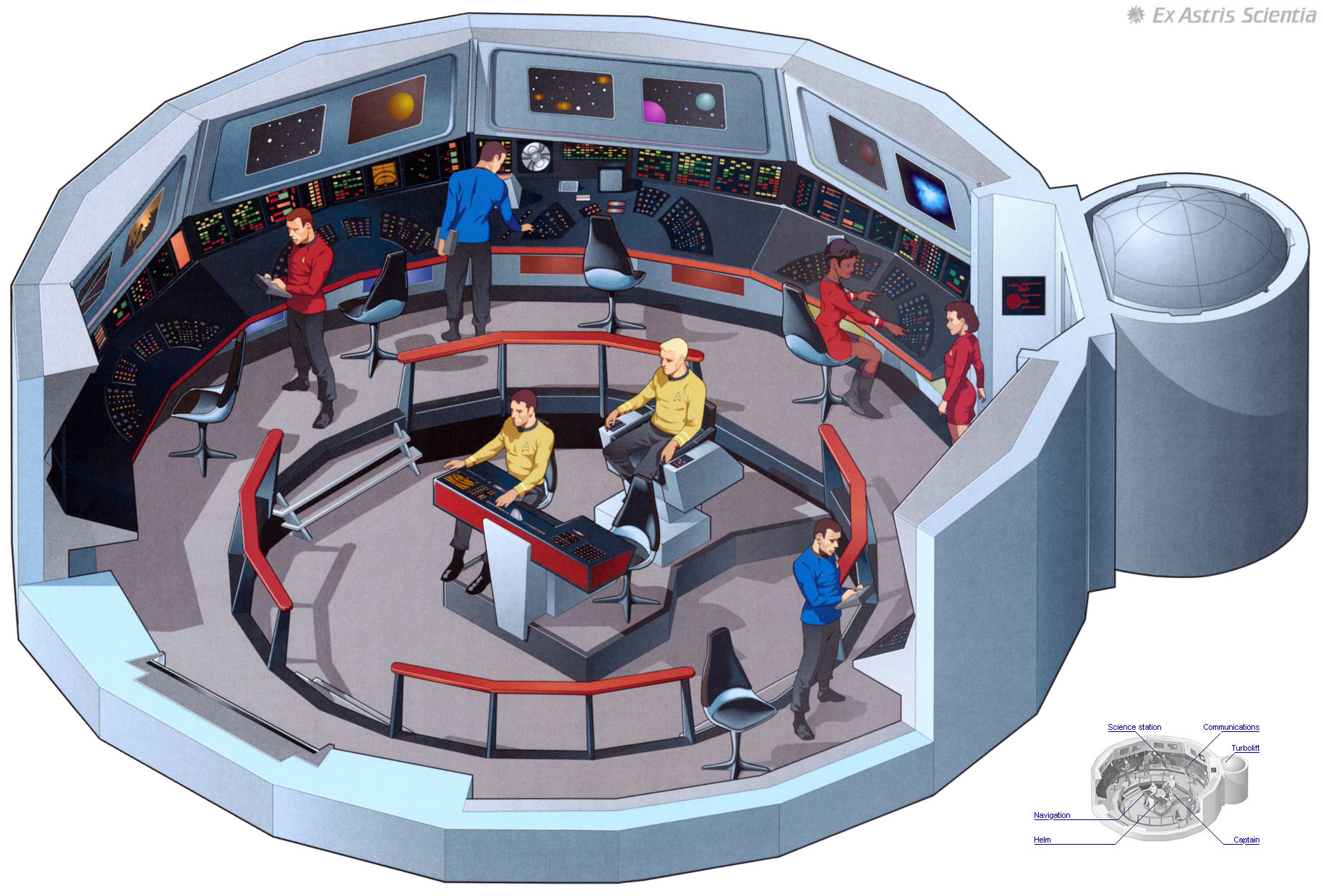
Hi! Star Trek apologist here. It's worth noting that the original Star Trek bridge was designed for this sort of thing, a real time communications/command/control center. It's not that magical that one would want to duplicate the task with something that was designed to work the way they want things to work.
But if you look at the "Information Dominance Center", you can see violation of the Star Trek design right away. For example, The Chair is not positioned so that the commander can see every one at once and it has a ridiculous metal shell behind it creating a giant blind spot behind it. And it's built into a line of work desks, so that you can't easily walk around to behind The Chair.
The room is a monster too - it's over 10k square feet (roughly 100 sq meters). That weakens the case for having a Star Trek layout.
A Star Trek bridge (image may differ somewhat from the USS Enterprise bridge) had a very compact layout, the commander could see everyone, and it was easy for the commander to get up and walk to any workstation on the bridge. Spock discovers something "curious" and Kirk is outta that chair like lightning right beside him. Mr. IDC commander would have to walk/run around that maze in order to get to anything "interesting" which isn't in front of him or on the screen.
What I think is remarkable here is how the IDC takes the design elements of the Star Trek bridge and screws them up. -
Re:Odd question.
ST2009 really isn't very Star Trekky.
The problem is it manages to get the cool story flashy elements right but doesn't have much time to spare for the Utopia Sci-Fi world Roddenberry created. For example the whole point of the movie is that Kirk is the best man to run the Enterprise even tho he hasn't technically graduated college yet, because he's Kirk. His innate Kirkness is much more important to his command of the Enterprise then anything he may have learned serving as a Junior officer.
In other words ST2009 is a set in a universe where talent doesn't need to be trained. It exists, and if you dont happen to have it (ie: you aren't Kirk)there's nothing you can do to succeed (ie: deserve the Enterprise).
Most instructive is Abram's insistance that his Enterprise be bigger then Battlestar Galactica:
http://www.ex-astris-scientia.org/articles/new_enterprise_comment.htm#size
Abrams is more interested in having a bigger ship then Battlestar Galactica then learning what the words "Heavy Cruiser" mean. -
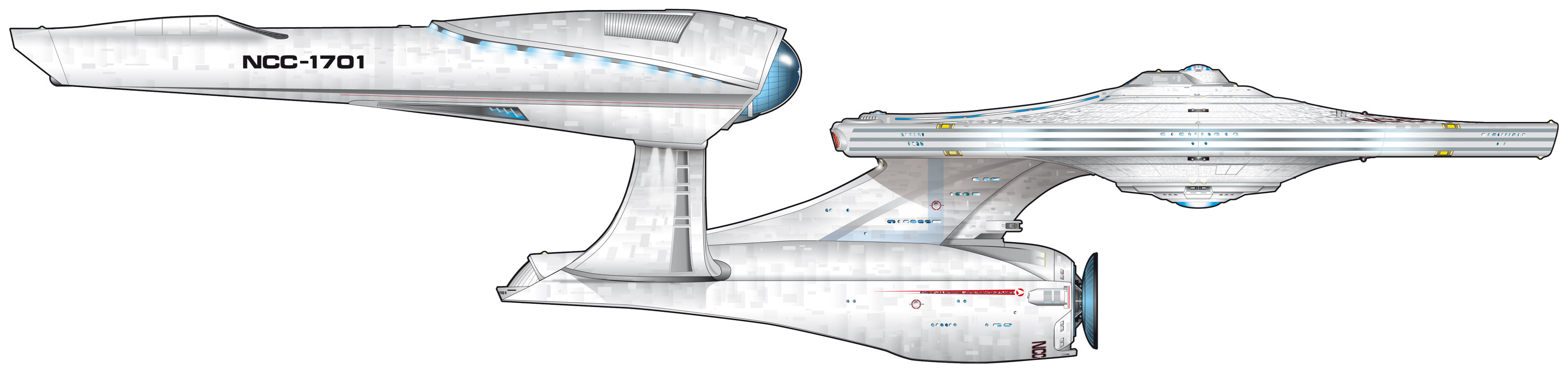
Re:Trailer Story FAILI looked at the picture of the Enterprise, the curves remind me of a 50's car. Less concern for functionality than for looking stylish.
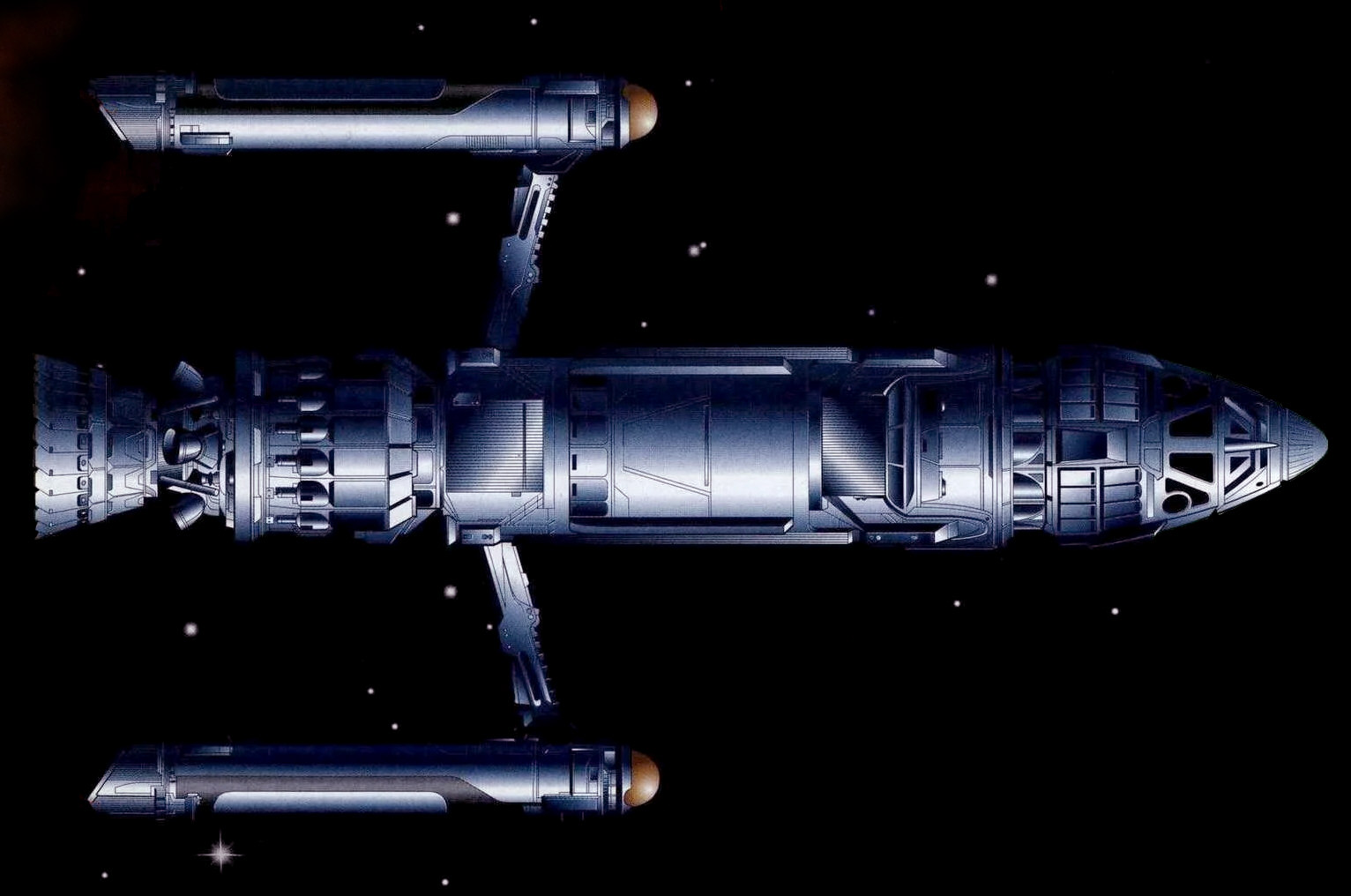
and like any proper 50's car it has tail fins: constitution-reinmagined
-
Re:Best captain
old-man belly
Eh? Haven't you seen "Captain's Holiday"? We get to see most of Patrick Stewart's bare torso throughout most of the episode, and he was fit.
He's pretty hot in bondage in Chain of Command (II) as well.
Ahh, here we go. Check it out. He has awesome legs, and the girl! (Captain's Holiday).
Frakes, by comparison, was always basically a jelly-belly. -
Re:Well, maybe...
Actually, from what I understand, the make-up guy screwed up. In the original series, you have dark and swarthy Klingons with beards and arched eyebrows and you have the more clean-cut Klingons.
Actually, here's a pretty entertaining link. -
Ultimate Star Trek Resource
Some misguided trekkies would send you to Memory Alpha, but that place is strictly bush league. If you want the best in Treknology, all the way down to fictional elements and even elementary particles, you've gotta head to Ex Astris Scientia. When I found this place, it blew my freaking mind.
Engage! -
Starfleet IT
One of the things that fascinated me about Star Trek: The Next Generation was the attention to detail in set design. I'm aware that Michael Okuda was responsible for a lot of the design work, like the LCARS interfaces for example (also referred to as "Okudagrams"). There was just an underlying subtle feel of logic and innovation behind it all that appealed to the computer nerd in me.
The touch screen interface standard was one; touch screens are an ideal graphical user interface because you don't need an indirect input device to manipulate the interface. I've actually read somewhere that NASA considers it to be a useful idea for manned space missions because it allows a user to access a whole range of controls with a simple touch screen, saving on space and weight when compared to the equivalent in physical controls. The PADDs were also a novel concept, resembling current PDAs and tablet computers. The LCARS interfaces also had recurring elements, like a round one I've read was nicknamed the "spinner", that looked like a control for 2D or 3D manipulation, kind of like arrow keys on a keyboard.
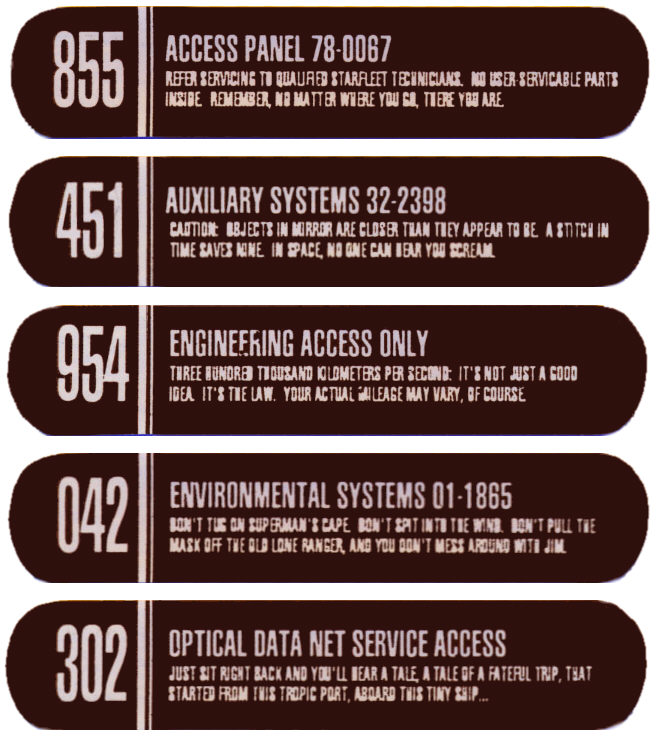
I also noticed that everything - devices, bulkheads, panels, containers, etc - all had the same kind of labels on them. They seemed like a standardised system for doing things like handling inventory, like barcodes. And there was a consistency across the board, the way they were also used as signs on doors and also appeared as LCARS interface elements. I've noticed that they've used them in the Star Trek: Enterprise series as well. (I've also read that they sometimes had jokes on them visible only to the cast during filming.)
Since you were working on the set, you must have had a lot of exposure to what went on behind the scenes with regards to the design process. And as a self-confessed geek, you must have had some interest in that part of the production. Was there an actual working concept behind LCARS as a real graphical user interface? What can you say about the fictional LCARS that would be applicable to real operating systems and graphical user interfaces? And what about those labels- were they based on a realistic system of organisation and management? What kind of concepts were the set designs based on, and how much detail did they get into regarding those concepts? I was just wondering how much of it all was just aesthetic and how much of it was based on real logic.
-
Re:Guys got an error or two...
Which comes out to roughly 5 IPv6 addresses for every atom in every human body in the entire world! (Source, look for the string "28".)
-
Re:yea but
Here's a mirror for those who try and access
-
Re:Are they trying to...
That said, Voyager had one thing going for it: if I was going to take any ship in the Trek canon, it would be the Voyager. Of all the ships on the show, that one is the closest to indestructible...
And just think of all the things you could do if you had infinite shuttlecraft at your disposal... -
Re:This will cost us more than it saves...
NASA seems unwilling to risk an enormously expensive, essentially irreplaceable spacecraft and the lives of another bunch of astronauts in order to get a display piece back for the Smithsonian.
Astronauts know the risks of what they are doing, and I bet plenty would volunteer for a Hubble retrieval mission.
As for the shuttles, they're nearing end-of-life, and we only really need one of 'em to go in the Smithsonian.
As for the cost of the mission, It's 6 of one, 1/2 dozen of the other. Send up an expensive spacecraft, or let another one burn up on re-entry. Either way, it's my tax dollars.
I say, go for it. The Hubble will look great next to The Phoenix, when that gets added to the collection in 60 years or so. -
Re:Turkey?
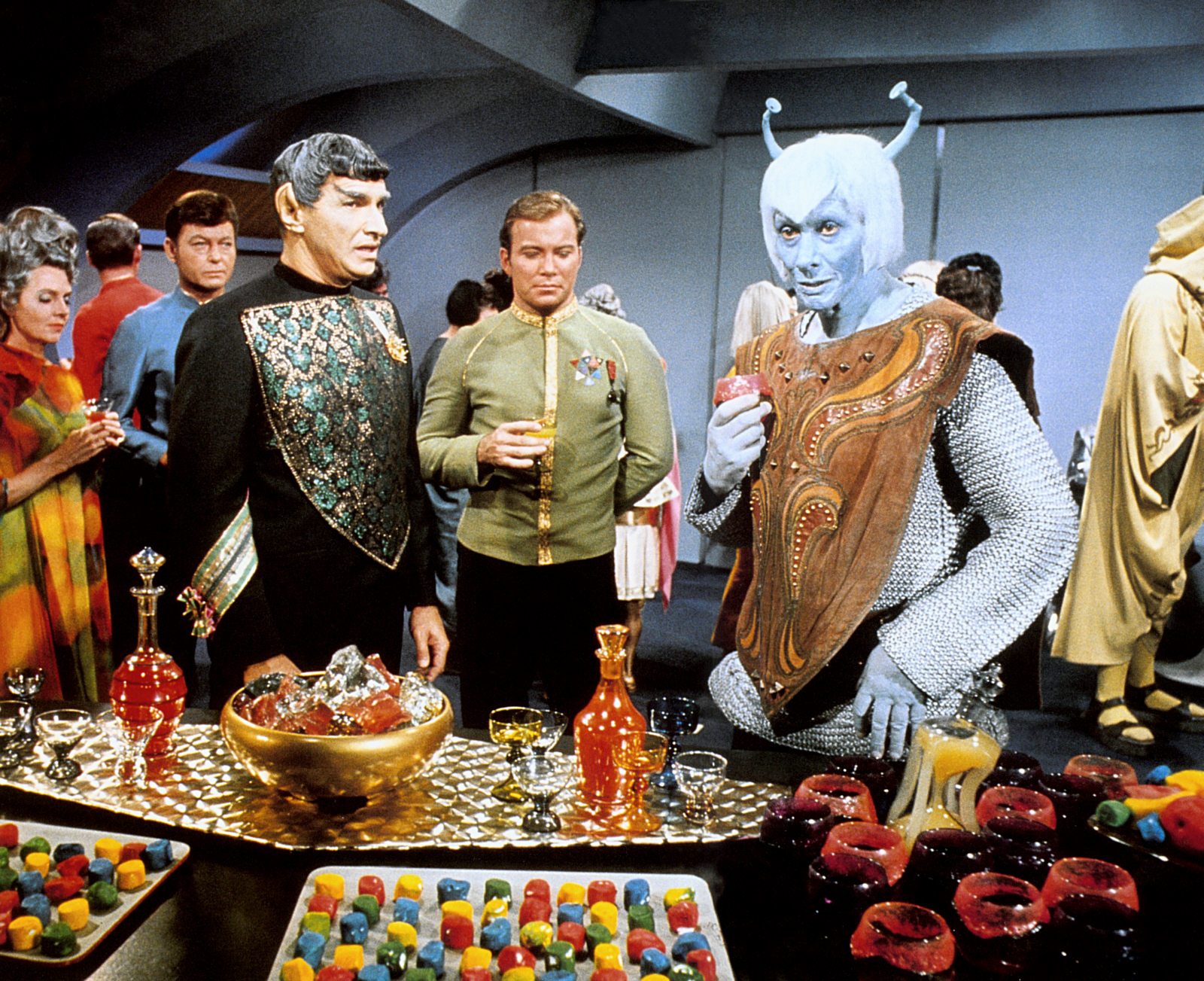
It surely can't be as bad as those brightly-coloured "food cubes" that Captain Kirk and his crew used to eat (such as in Journey to Babel ).
On the other hand, in Charlie X, I seem to recall Kirk ordering the galley to make a fake Thanksgiving turkey out of meatloaf. And real food was seen on occasion, emerging from those little slots in the rec room.
Star Trek notwithstanding, I've always been kinda fond of that freeze-dried "space icecream". As for pastes - great for practicality (and very futuristic-sounding), but I think the astronauts would quickly get bored of mush-in-a-tube. Real food is probably better for morale, not to mention their health.
Yep, I hate to bring up bodily functions, but if you just ate blended mush and no fibre, you'd probably get constipated pretty darn quick. Plus, in addition to morale, sitting down to eat like other co-workers is probably good for the crew's mental health.... hey, waitasec, I think I just figured out why those little grey men like to anal-probe people
-
Re:Thoughts on Starship Scale Diagrams
I don't know about all of the ships, but the Trek ones came from this site, which is probably why there's "so many" of them.
-
Another site
The site Ex Astris Scientia concentrates on measuring and comparing Star Trek ships, but it's still an impressive effort.
-
great answers, sorta...If only Willam Shatner had provided such in-depth, technical answers to questions about the physics of warp travel. He could have even quoted from the FAQ just like Brian!
I was a little disappointed by the answers that just reiterated the TCPA FAQ, but then again if I didn't know much about it, that's probably what I'd do, too. For example:
The crypto-processor and key storage are provided by the Trusted Platform Module (TPM). A TCPA enabled system will have a TPM on the motherboard. This TPM can be disabled, as per TCPA specification, if the user wants to opt-out.
Unless the operating system is designed to refuse to run uness TCPA is enabled.