Slashdot Mirror
Domain: favbrowser.com
Stories and comments across the archive that link to favbrowser.com.
Comments · 20
-
"Good job" doing what? In whose interest?
Google Chrome is said to have made it easy for an extension to do total snooping on the user's browsing, and many of them do so. Chrome includes a module that activates microphones and transmits audio to its servers, and Chrome contains a key logger that sends Google every URL typed in, one key at a time. Google Chrome does a good job securing access to a user's data without telling the user what's really going on or giving the user a chance to stop the behavior they likely don't agree with.
Google Chrome is proprietary software. Nobody but Google has permission to study what Chrome does, alter Chrome, or distribute a modified Chrome. This is also how Google can get away with malware, hardly surprising behavior for a known international spy. As the GNU Project rightly points out:
Power corrupts; the proprietary program's developer is tempted to design the program to mistreat its users. (Software whose functioning mistreats the user is called malware.) Of course, the developer usually does not do this out of malice, but rather to profit more at the users' expense. That does not make it any less nasty or more legitimate.
Yielding to that temptation has become ever more frequent; nowadays it is standard practice. Modern proprietary software is typically a way to be had.
The New York Times called Google Chrome "secure" but didn't explain how they arrived at that conclusion. Regardless of what they meant by that claim, it's hard to see how any of the above behavior or whatever else Google can get away with via proprietary malware could reasonably be called 'secure'. Any feature Chrome offers has to be considered in the context of being implemented in proprietary software which by its nature imposes a power over its users.
Firefox was never proprietary; users could always inspect Firefox, edit out the portions of Firefox they didn't want to run or redistribute, edit any other part they wished, and distribute the rest (even if under another name with another logo), and Firefox derivatives have done just that many times. There's good reason Tor Browser, for instance, derives from Firefox. Free software (software that respect's a user's rights and community by allowing users to run, inspect, share, and modify the program) provides verifiable security; one need not guess or blindly trust a proprietor to do right by them. Firefox's technical achievements or detriments are thus a matter of spending time developing Firefox. This is a practical example of how you're better off with less technically capable free software than more technically capable proprietary software; we can make Firefox better in a technical sense but we can't make proprietary software free.
-
Credit where credit is due
No doubt, credit where credit is due and my hats off to MS in their browsers efficiency, however, it still doesn't change the fact that Microsoft's browser will always be seen as inferior like IE. I guess (sadly) the same as many people see Firefox as always bloated and inefficient compared to Chrome.
MS will no doubt use this to their advantage in ads as much as possible, but I don't think it will change the browser war - until perhaps they (like Google) also spend billions in advertising Edge all over the world in train stations to newspapers to billboards... all over the world!
But good news for the rest of us, hopefully it will force competition and hopefully get (especially) Mozilla to create a more efficient browser!
-
Re:Google seems to be avoiding the real problem
Read it and weep motherfucker!
-
Another iCab?
I liked iCab. As a Web developer. It had some good page analysis tools. I even paid for it, way back when.
-
VP9 vs. H.264
VP9 is still a work in progress, so no hard numbers as yet. One of its goals is to achieve 50% better quality with the same bitrate compared to VP8. Another goal is to provide a better encoding efficiency than H.265 which has the same approach on achieving a better quality around 50% compared to H.264.
Google actually did a direct comparison between VP9 and H.264 on a sample file at its recent I/O event and showed off a 63% reduction in file size. As for the quality, see the pic for yourself.
As for the licensing issue, Google cut a deal with the MPEG-LA consortium that controls H.264 to licence their patents for VP8 and VP9. So there is low possibility of any user of VP9 of being bogged down by patent lawsuits.
Why should you care? Unlike H.265, VP9 is free for commercial use . If your use is non-profit, there is no difference between the two.
-
Re:If AMD Dies...
"1. - You don't have to be competitive if you have managed to obtain a monopoly... "
Er, try and keep up with the conversation. You've just instigated a circular argument. The point was that these monopolies were obtained precisely by outcompeting the competition. Intel just produces better chips than AMD, there's no ifs, no buts, they're just too far ahead of AMD, and it's not to do with being a monopoly because they're not yet, it's simply that they've done a better job than AMD.
Microsoft was the same, the only reason it got a monopoly in the first place was by just producing a product more people wanted. Linux was too young as to be irrelevant at the time, and everything else (OS/2 lol) was second rate.
"2 - You obviously don't remember the days when Netscape was the best browser out there."
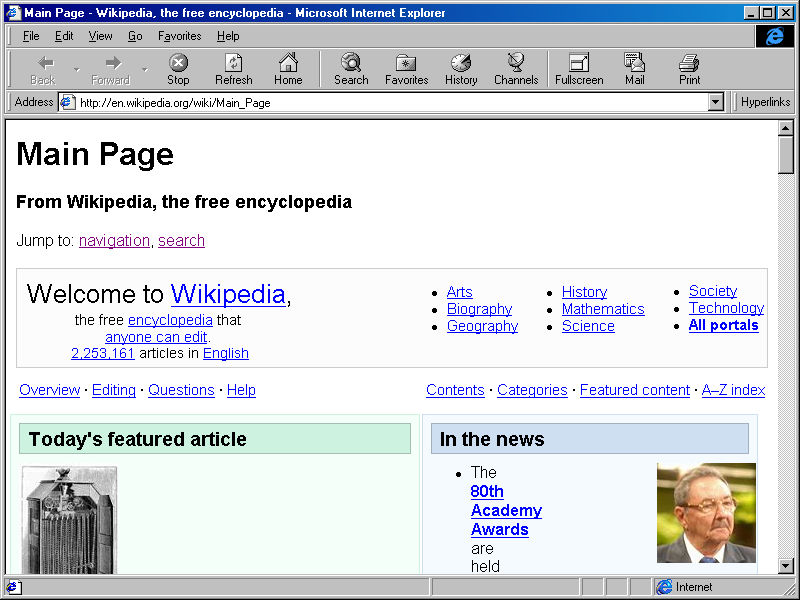
That's because it was never true. Netscape was a truly second rate browser compared to IE. People were using IE over Netscape not because of bundling, but because IE was just that much nicer to use. Even the basics like Netscape's UI was fucking horrible (http://www.supportcave.com/images/netscape4.bmp vs. http://www.favbrowser.com/wp-content/uploads/2010/08/internetexplorer4.png for example), and that's before you get into the technical fails of actually browsing with it.
I just did a random search, and found this old article for example, look at the comments, look at people's sentiment towards Netscape in reply to a neutral story about it:
http://www.geek.com/articles/news/navigator-475-out-now-20000821/
This isn't to say Netscape didn't have it's fans, particularly in the anti-MS crowd (read: Stallman's crowd), but IE was just so much more user-friendly to the general public, and that's ultimately what mattered.
-
IE auto-update
If this is true http://www.favbrowser.com/internet-explorer-will-auto-update-itself/ then the internet may be a happier place, and IE 6 and 7 a thing of the past... Let us hope!
-
Dropping Leopard was the last straw.
Mozilla's decision to drop MacOS X leopard, an operating system younger than Windows Vista and XP is infuriating. There are a lot Mac users out there who don't want to pay $29.99 just to run an up-to date browser. This is even worse than Microsoft dropping IE9 support for XP.
Firefox probably evaded a lot of criticism back when it was the only serious competitor to IE (when Opera was adware, Safari Mac only and Chrome is only from 2008), but now there are plenty of good browsers out there it is time for Firefox to pull itself together. They get $100 million a year in Google dollars yet they piss it away on stupid gimmicks like stealing your status bar which dates back from early web browsers (Even IE 9 has one) and other UI changes such as stealing the forward button.
The memory and speed issues are contentious but Microsoft does serious testing on IE to make sure its browser is good enough.
I am really mad at Firefox for messing up after being the good browser for several years. Firefox needs to be forked by competent developers to undo the brain damage that has happened in 2011. I want Firefox to be good again, don't make me flee to Chrome/IE permanently.
-
Re:Who paid?
Citation please? Actually don't bother, because the statement is impossible to support with any amount of evidence.
2008: http://www.favbrowser.com/firefox-browser-with-the-most-disclosed-vulnerabilities/
2009: http://tech.blorge.com/Structure:%20/2009/11/09/firefox-leads-in-browser-vulnerabilities/
2009: http://www.computerworld.com/s/article/9140582/Firefox_flaws_account_for_44_of_all_browser_bugs
You can also query Secunia for vulnerabilities. With the new version number scheme and ultra-fast previous versions retirement (where you are left vulnerable if you don't upgrade immediately), you'll have to grok the numbers somewhat. Basically count the *unique* CVEs affecting all FF versions since -say FF3.5. Do the same for IE8&9. You will not like the result.
Firefox is the only major browser that openly reports vulnerabilities so of course it is going to have the highest publicly countable number.
BS. All the major vendors are obligated to report vulnerabilities through Mitre. All browser vulnerabilities are assigned unique CVEs.
And even if you had an accurate count of known vulnerabilities from the other vendors, known vulnerabilities hardly equates to total vulnerabilities, even less so when every vulnerability is counted as equal to every other one.
If you consider a set of browsers which must be assumes to receive an equal amount of scrutiny (IE,FF,Chrome), if one browser year after year comes out with most vulnerabilities, surely that does say something about code quality.
-
The End Game For Mozilla?Mozilla's only significant source of funding is the add-click.
According to the statement, a whopping 97% of Mozilla's income comes from the search deals. Unfortunately, [the] company did not disclose the percentage of searches it sends to each search provider.
Mozilla's 2009 Financial Statement [Nov 19, 2010]
The Corporation has a contract with a search engine provider which expires November 2011. Aproximately 86% and 91% of royalty revenue for 2009 and 2008, respectively was derived from this contract.
Mozilla Foundation and Susidiaries: Consolidated Financial Statements : Notes: Note 9: Concentration of Risk [August 23, 2010]
When your only source of funding is the "add-supported" browser, the Windows OS is the air you breathe and the water you drink.
You cannot survive without it.Windows 88%
OSX 6%
iOS 3%
Linux 1%
Android 1%Operating System Market Share [August 5, 2011] [Rounded] [Global]
Desktop: 95%
Mobile vs Desktop [July 10 to July 11] [Rounded] [Global]
Windows XP 50%
Win 7 28%
Vista 15%
OSX 6%
Linux 1%
Other 1%Top 5 Operating Systems [July 10 to July 11] [Rounded] [Global]
Windows is a commercial, proprietary and closed source OS. That is in many ways extraordinarly open to the user, the recreational programmer and the professional developer.
I have over 200 programs on this Win 7 system. I am not bound to any single repository or app store. I am not hectored by RMS. Steve Jobs or Bill Gates when I install a program which they would not approve.
Microsoft began with the stand-alone PC for the school, the home and small business. It began with the user. It began with a market.
The producer Samuel Goldwyn is usually credited for the line "If you've got a message, send a telegram."
Good advice for anyone whose Grand Design is about to collide head-on with a world that is skeptical, pragmatic and more than a little weary of those Who Think They Know What Is Best For Me.
-
Re:And 64-bit Will Be Updated When?
Honest question: Why use an x64 browser?
Speed, for one thing. For Windows, here is one benchmark that shows the rather significant difference. When on javascript heavy sites, having a 64-bit browser sure helps.
For Linux, there are other considerations, like not having to install the whole 32-bit compatibility layer and libraries at all. Fedora, for example, won't install 32-bit support unless you explicitly tell it to. Being 64-bit only saves a lot of memory compared to being dual-stack.
For example, we still put 32-bit Office on our x64 desktops for plug-in and other compatibility.
The speed difference for large spreadsheets can be stupendous, in favour of 64-bit. Or running a text analysis on a book-sized document. I've ran 64-bit Office 2010 for quite a while, and haven't run into a single problem yet (well, 64-bit problem that is -- Office itself is another issue).
-
Re:Reduce FireFox ram usage
-
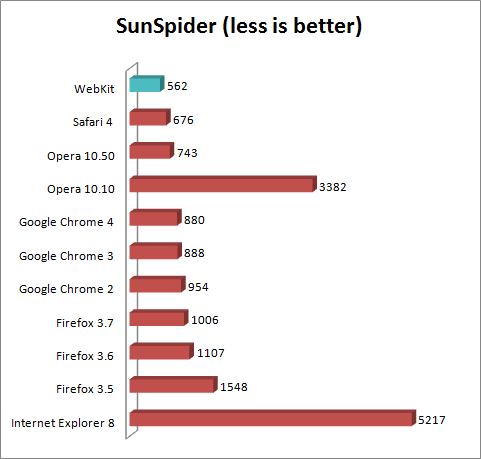
Re:The only question I have isI love all of these FF is so slow stories. It has actually gotten faster and faster with each release, but the damn websites just keep piling on the Javascript. The FF4 should be as fast as any other browser out there (eg, Chrome), but until the webmasters decide to start playing nice with the amount of Flash/JS/etc they add, the browsers are going to be losing ground.
Here's one graph showing FF3.5 vs FF3.6, with 3.6 being the faster. And in a test I did at one point, I found that 3.5 was roughly twice as fast as 3.0.
-
Re:Am I the only one?
I'm not smoking anything. I'm just describing my personal experience, as well as that of various people who've sat down and meaured this. See for example:
http://cybernetnews.com/browser-comparison-internet-explorer-firefox-chrome-safari-opera/ (search for "memory usage tests" in the page).
http://www.favbrowser.com/browser-memory-ram-usage-firefox-35-rc-safari-4-opera-10-beta-google-chrome-30-dev/ (ignore the Chrome bit, because they were adding up memory used by processes that actually have some memory mappings shared)
http://lifehacker.com/5457242/browser-speed-tests-firefox-36-chrome-4-opera-105-and-extensions (seach for "memory use, no extensions" and "Memory use with extensions") as well as the other tests lifehacker has done (e.g. follow the "last batch of browser tests" from that page)
So you tell me, what am I smoking and how did I get the rest of the world to smoke it too?
-
Re:BSD
Actually if you try the 64bit Windows version of Firefox it is actually much faster. If you would like some benchmarks here you go. Lower on the page is Ubuntu benchmarks which are also pretty much faster across the board. Now I'm not a browser designer so I can't tell you why, but running the same plugins FF uses slightly less memory and performs roughly 30% (IMHO) faster running native x64 VS x86. The only thing holding me back from dropping x86 Firefox is lack of flash.
-
Re:Good
Actually it doesn't. in fact I have found (in my own personal experience) that FF64 running on XP64 uses less resources that FF32, with both running the same extensions. If you would like to see some benchmarks that someone was nice enough to put up here you go. These were made when Firefox was at 3.0.x but I have found that if anything FF64 has just gotten better, whereas FF32 seems to have gotten a little slower, at least in my experience.
So why not give it a try if you are running 64bit Windows? It is free and will only take a little bit of your time. If you are gonna use it long term I would suggest using the same version number as the 32bit you have installed, otherwise you'll get a tiny nag about "upgrading" when you go from the smaller number to the bigger. But since they seem to update the 64bit version pretty quickly it really isn't hard to keep them synced. If you have 64bit it really is a nice experience, and as you can see from the benchmarks the 64bits does help with the speed.
-
it should
It needs that extra battery life, considering it's also the slowest browser.
-
Re:Serious question
Well I can tell you that using Firefox X64 on XP X64 the browser is snappier and more responsive and loads pages quicker as well. And here is a link with benchmarks, just to show you that it isn't just my personal opinion. Now if Adobe will only release an X64 Windows flash I would be a happy camper. And before anybody says Linux, Linux just won't cut it for me as I have too much unsupported hardware, not to mention apps and games. It is easier just to load Firefox 32 when I want to see the occasional flash video than it is to deal with the headaches I have with Linux.
-
Re:ARE YOU LISTENING, MICROSOFT?
Uhhh...I am running XP X64, and like you read the horror stories. Guess what? They're bullshit and I couldn't be a happier little camper. I'm thinking of buying the Win7 Home just to have to play with, but I'll be sticking with XP X64. Everything is smooth as butter, even my old games work, hell everything works. The only problem I ran into was the cheapo Best Buy EasyTV capture card I have doesn't have drivers. Big whoop as I can buy a compatible one pretty damned cheap. But most importantly even my 9 year old disc catalog software purrs like a kitten after I dropped a single
If you don't care for Vista/Win7 I would give XP x64 a try. I'm sure you can find a copy somewhere to give it a test drive and see if your hardware is supported, and if it is Newegg can sell you a nice system builders like I got. According to Process Explorer I am barely using 600Mb out of 4Gb with all the bling, lots of tabs in Firefox X64 and Comodo Internet Security going, and more importantly I have full use of the 4Gb and can max out my board at 32Gb without Windows saying a word. With my XP32 dual boot I barely have 3Gb even with PAE thanks to the 1Gb graphics card eating up some of the addresses.
So give it a try, you'll like it. I'll probably pick up one of those $50 copies of Win7 Home just to play with, but I've been advising my customers to stay away from Win7 until SP1 at the least, preferably SP2. They nearly all have new XP machines and simply don't need Win7. Neither do I, but what can I say? I like to play with OSes. But for the foreseeable future I'll be sticking with XP x64. It works, it doesn't bug the shit out of me like Vista did, and it doesn't go running home to mommy every ten minutes to tattle. Tell me Win7 users, does Win7 call home all the damned time like Vista did? Because that irritated the hell out of me.
-
Re:The answer is...
What is wrong with XP x64? It is built on server 2K3 and solid as a rock, even my ten year old disc cataloging software works thanks to WoW, and according to process Explorere i'm only running 602Mb of RAM with 9 Windows on Firefox X64 with Comodo Internet Security Suite replacing that awful Windows Firewall. Oh, and as a side note XP32 viruses don't work in X64 from what I've been told. Not that I have actually seen a virus on my own computers in a decade, but it is still nice to know.
And if it is some kind of lame joke I just checked my post and I didn't actually put "XP X6" but "XP X64" which is the common name for the OS. But after trying Vista32 and 64 XP X64 just blows them away. At $49 I would have picked up a copy of Win7 Home Premium to play with, but $199? Not a chance in hell.