Slashdot Mirror
Domain: flickr.com
Stories and comments across the archive that link to flickr.com.
Comments · 3,631
-
Re:What about ...
This is wrong. It is there in the hardware, but Apple has chosen not to interface with that functionality, so yes, it is crippled. Go read some of the back stories on modmyi.com. If you have a jailbroken iPhone.
Using apple keyboard -
http://www.modmyi.com/index.php?pageid=home&news_page=2
video showing iphone to iphone gaming
http://www.flickr.com/photos/56083335@N00/3288725388/
Now, like the man said, its crippled. -
Re:Definitely low light performance
The thing is that those features already exist in the DSLR systems - the exception being dynamic range (how it handles brightness/contrast.) If you're able to articulate the problems with whatever camera you purchased so clearly, I bet you'd have a lot of fun with a DSLR - even a cheap one - and you'd figure out how to use it well pretty quickly. Over time many of those features will be added to the point-and-shoot cameras, but will never quite match them both for marketing and technological reasons (there is a reason DSLRs go up in size as they go up in capability).
The funny thing about dynamic range is that negative film was not that much better, and slide film was actually worse, than the average DSLR sensors. The analog nature of film made over-exposure less ugly, though, and that actually is an important part of the iconic, pleasant look of black and white film. On that front - making the fall-off to over- and under-exposure more smooth and pleasant - there is much room for improvement with digital.
Consider this - silhouettes, an ubiquitous art technique now, became as popular as it did because of photography's limitations.
My point is that photography has never been about capturing exactly what the eye sees - our eyes make so many automatic, instantaneous adjustments - even when looking at a still image - that technology that mimics what we can perceive is quite far off. One has to work around the limitations of the medium, and the best will find ways to use the limitations to their advantage (e.g. silhouettes).
If you're not already familiar with the technique, look up some High Dynamic Range (HDR) images here - http://www.flickr.com/search/?q=hdr&w=all This is a technique designed to mimic what the eye can see. If you browse through some of those photos, what you'll see is mostly hideous - people have really overdone it and the results are neither natural looking or photographically pleasing. You may see a few tastefully done images, and that is something I'm sure camera makers are working on - to use a similar technique in-camera to fake higher dynamic range in a tasteful, natural way.
Most recent Canon DSLRs actually have something like this that's supposed to retain more detail in the highlights - I don't use it on my 40D as it doesn't really do a whole lot. But the idea is there - just needs a lot of improvement.
Photographers have long been altering the capabilities of the medium, be it film or digital. For example, graduated neutral density filters placed in front of the lens that limit light throughput over only part of the image are widely used in landscape photography, where often the sky is much brighter than the subject and thus needs to be darkened with the filter in order for the film or sensor to capture everything.
I am surprised that camera makers haven't figured out the severe limitations of point-and-shoot cameras - such as you've described - are actually noticed by average consumers (which I don't think you are by the way). Cameras with the features you describe should be mostly possible with today's technology, and would sell well if they were appropriately marketed, but no one is making them because it's easier to sell cameras based on the number of megapixels. Sigma and Leica have cameras that almost fit the bill, but they are expensive and lacking in many ways.
There is clearly a lack of motivation to make the cheaper cameras better, though - the cheapest DSLRs sell like hotcakes and many choose them over the best point-and-shoots because the quality difference is very apparent. This means more money for the camera manufacturer, so what's their incentive to make those people want to buy the cheaper point-and-shoots instead, when it probably costs more money to develop features for the smaller cameras?
-
Re:Maybe not.
People eventually gave up buying computers based on nothing but processor speed.
As technology advances, certain aspects of it exceed any typical expectations from humans. The most desired feature will also be the most developed and advanced at the fastest rate (if possible) because better sells more for this feature more so than for others.
So the most desirable features will be the first to cross the diminishing returns threshold in terms of what people want out of it.
High end digital photographers are a lot more technically savvy (at least in terms of cameras) than high end computer purchasers tend to be. Consumer grade cameras may continue to sell better because of more megapixels for a while, but so-called "prosumer" and pro-level cameras aren't going to be able to push that much longer.
Indeed, a larger sensor means a larger file (by a wide margin) when shooting RAW, and a lot of pros and semi pros are almost put off by larger sensors since these are slower to work with and of course eat more disk space (and pro and semi pro will only shoot RAW). Unlike computer enthusiasts, camera enthusiasts are not looking for an excuse to buy bigger hard drives and a faster computer; their normal hardware is expensive enough as it is.
Personally I'm both a camera enthusiast and a computer enthusiast, and I have a few month old Mac Pro 8-core, 8gb RAM, plus a 30" cinema display, plus a 17" Macbook Pro amongst other various gadgets. That's a reasonably high end setup in general, but I own more in camera hardware than I do in computers and gadgets (there are camera bodies alone which cost more than my computer + monitor).
With all that, 12 megapixels are all the file size and disk i/o + cpu time for managing photos that I am interested in. I care way the heck more about ISO noise performance. I have one of the highest rated low-noise camera bodies that exists, and I still can't stand to dial it above ISO 400.
My next camera body, MP count beyond 12 won't matter to me, low light performance, color accuracy, and frames per second - these things are what count to me. Also, "HD Video" which seems to be all the rage in new bodies - give me a break. I couldn't care less.
-
Re:16 Megapixels is point of diminishing returns
It depends on what you want to do with the lens, but you don't generally need to spend $600 for a good lens (if you do stuff like bird or sports photography all bets are off). Even with crop sensors, 50mm prime lenses are still really cheap (altho I find that focal length a bit awkward). You can buy a new auto-focus 50mm/1.8 Nikon prime for about $100, and take excellent pictures with that. You could buy a used 28mm/2.8 (the nifty one that focuses to about 7 inches) for about $200. But you lose auto focus, vignetting, distortion, and corner softness. Tough, I know.
The one thing you really gain with the Canon is that because of the distance between the lens and sensor, you can more easily adapt different lenses (such as older screw mount stuff, old Nikon kit, etc). You forgo all the electronic crap, but the results are still very usable.
Something you gain with Nikon is compatibility with older Nikon lenses. While Canon designed a new and wholly incompatible lens mount system in '87 with the advent of auto focus, Nikon did not. Pretty much any Nikon lens from 1977 on work with pretty much any Nikon camera. Older Nikon lenses require a bit of fiddling, but can usually be adapted for about $25 (not so with Canon).
http://www.flickr.com/groups/nikkor-on-canon/ -
I wish I had more megapixles when . . .
I took this picture corndog is SFW
-
Re:Gahh!
This is magical thinking
Is it really, O oracle of Photography?
Check out the whiskers on this horse. Click "all sizes" above the sample image, then "Original", let it load, and look at the pixel level detail on his chin, for instance.
Being cynical and all pompous is really fun, and I feel you there, but the objective facts don't support your position. 15 mp is perfectly usable.
-
Re:Maybe not.
Just as a tip, I have found that the 50D's noise drops *dramatically* if you expose for +1 Ev (RAW) and then in post, pull back -1 to -1.5 Ev. There are lots more bits of resolution available in the stops as you move to the right (each stop has twice as many levels as the darker one to its left), and this gives the camera a one stop noise advantage over the way Canon hands it to us.
Canon seems to think we need a full stop of headroom in dynamic range over the brightest spot in the image being taken... that's simply not the case unless you're going to be compositing something brighter into the image. Seriously, try it. That +1 Ev will push noise down to an amazing degree, especially at ISO 3200 and below, where the 50D's banding issues don't rear their ugly little heads.
Of course, you can do the same with your 40D, and get even better results there, too.
This picture was shot at +1 Ev, ISO 100, with the 50D, and then recovered by pulling -1 Ev, effectively using the sensor 1 stop to the right. Check out the original size version ("All Sizes" button over the sample image) and look for noise in the shadows, or the sky (both the 40D and 50D are notorious for noise in blue skies... blue channel in the sensor is a weak link.)
Just be careful with your metering. If the camera isn't allowed to meter the brightest object in the portion of the scene you want to capture, you're going to clip the highlights and they will be unrecoverable.
-
Re:Compression
The statement that 12 mega pixels is enough for general use has an information theoretic interpretation. namely for the standard lens fields of view and typical range of distance to target that there is no added information in having finer resolution. Or at least the amount of information useful to humans is diminshing.
But we're not even close to such a thing. Not by orders of magnitude. Information useful to humans extends down to the limits resolvable by light and beyond into x-rays and so on. Also, as far as "color" goes, into infrared and ultraviolet. That's why whole classes of microscopes and telescopes and long lenses and macro lenses exist; that information is useful and interesting. And there's no reason whatsoever to limit a camera to see what the unaided human eye could see -- that's just silly.
Look at the macro lens market; a good macro lens and a high resolution camera and you pretty much have a microscope, albeit only a moderate one. Check out this little bugger from my salt aquarium, he's only about 50 thousandths of an inch across. The reason we can see him so well is because of the sensor resolution being high and the lens being nothing at all like the "normal" human FOV/resolution.
-
Re:Maybe not.
You need to print pretty large or crop pretty aggressively to get a significant benefit from extra pixels.
Sometimes, yes, you do. But there's no problem or waste associated with this, and the extra magnification you get with small sensels and good enough glass to resolve to them results in a perfectly usable and quantifiable benefit; resolution. The term "pixel peeper" is a silly one coined by people who can only imagine using the full result of the camera. There's nothing wrong with using the full result, but there's nothing wrong with using a cropped region, either.
For instance, this image of the Orion nebula of mine, taken with a 50D, is a crop that you can't really get much past; I took it at f/2.8 and 200mm, using ISO 6400 and multiple stacked exposures of one second duration. It is only 416 pixels square -- not large at all -- and a lower resolution sensor than the 15mp one in the 50D would have resulted in an even smaller usable crop.
Getting closer - that is, using a longer lens - is problematic, for several reasons. First, as lenses get longer in the same approximate price range, they get slower, so I'd lose my f/2.8 option pretty quickly, or else end up spending a *lot* more for the lens. Secondly, exposure time is limited, as the stars move, or else again, I end up spending more money on a tracking mount (or time building a barnyard door or other homebrew tracker.)
As it stands, the 15 mp of the 50D is directly useful to me in that it gets me a more detailed, closer, image than I would get with, for instance, the 40D, which is 10 mp. I like that.
Basically, any situation where you can't really get any closer to the thing you want to shoot, and you're not filling the frame with the subject, higher resolution sensors help by giving you more detail; you can either use that detail directly, as I do for the nebula shot I linked above, or you can opt to average regions and reduce the noise if the number of pixels really seems to be too many to you, or the noise level seems to demand such treatment.
As with most photography issues, for every person you can find who uses a camera one way, there's someone else who uses it another. Various kinds of noise, spatial resolution, color depth, speed... these are all trade offs with any given sensor technology, and I honestly think there's plenty of room left for manufacturers to push any one at the expense of the others. Olympus wants to go for low noise, I'm all for it -- there's going to be a lot of people who want that above all - but I'm not giving up my 50D's resolution (or my investment in Canon mount lenses) to get it. Plus, it's always entertaining to see what comes next in any one camera's product line. I don't think Canon, the manufacturer of my camera, is likely to be out of places to go quite yet. I'm hoping for a "60D" model that is still 15mp, but lower noise and/or goes beyond the current pushed ISO 12800 limit. If they pull that off, I'll buy.
I'm not sure if I'd buy to go past 15 mp... I've got some good lenses, and 15 mp is really quite a challenge to use well. Plus diffraction blurring affects higher density sensors ability to achieve per pixel sharpness; 15 mp already strongly compromises (via diffraction effects) shots taken at f/11, going past 15 mp is just going to make deeper DOF shots less able to take advantage of the higher densities.
-
Gorgeous launch
I'm in Florida and was able to walk into the street to see the launch. Absolutely gorgeous. It happened at sunset so the plume was colored just like clouds would be during a sunset - white, yellow, pink, and orange. Here's a pic of how it looked (not shot by me, but that's how it looked where I was. Search Flickr for STS 119 for more.) Also, it was a perfectly clear day and you could easily see the boosters for a long time after separation. Thanks for the great show NASA, and good luck spacemen!
-
Re:Sarcastic or not?
If you look at picture of the connector kindly linked by "ottawanker", you can see the two signal cable paths remain entire inside the grounded outer.
Considering how much of the cable must be exposed at other points in the system, I would guess a centimetre or two of exposed signal cable would introduce significant quality loss, but then I'm not paying $1000 for headphones.
http://www.flickr.com/photos/the-jude/3254384356/sizes/l/in/photostream/
-
Re:Sarcastic or not?
-
Re:how is this useful?
If you take a look at his flickr photostream, you can see its just a small rubber finger that functions as a small USB flash drive and nerd attractor.
-
Re:how is this useful?
You can see some better pictures on his flickr stream. It looks like he has several fingers he can put on at different times. Also, it appears to be a slot in one of the fingers where he can stash some flash cards. I am not sure you'd really be typing very well with such a finger, it might just be easier to learn to type just using your other fingers. The pinky already takes care of a ton of the keys geeks use [{]}\|=+-_/?'" so adding in a couple more wouldn't be too bad I would think.
-
Re:Golly
Um, it'll be a bit difficult for the terrorists to get to a Trident missile system, let alone fire it.
Not if they're the Terror Bears! </Obscure TMNT RPG Reference>
-
Re:Sixth Sense
-
Re:Good times
Explosives + Old Hardware = Good Times!
Another good variation:
Firearms + Old Hardware = Good Times!
I took the platter out of that and still have it sitting by my desk, really interesting how it deforms.
-
Not her again!
-
Re:"Also revealed are MI6's London offices"
Sorry, but the UK has never been that big on keeping their secret nuclear bunkers very secret: http://www.flickr.com/photos/mimram/122464288/
-
Re:parent and grandparent poster both don't get it
Observe. This is how it's done: http://www.flickr.com/photos/clintjcl/3253972437/.
Cleanup your goddamn house. -
parent and grandparent poster both don't get itDVI-to-HDMI cable from computer to TV: $15
Not needing a separate room to use your computer: Priceless (and helps heat bills if you have zoned heat).
Not needing to purchase, maintain, pay electricity for, and replace a separate dedicated player: Priceless.
Double clicking a file you just (legally) downloaded and watching it in 1080p even though you don't have HDCP: Priceless.
[note: when I say Priceless, I'm joking. I know there's a measurable price to all of these things. Buy a Kill-A-Watt unit and measure for yourself.]
Slashdot at 52 inches diagonal: Priceless.
COmputer Desktop able to display 400 randomly generated photos from your collection changing every 2 minutes: Priceless.
Observe. This is how it's done: http://www.flickr.com/photos/clintjcl/3253972437/.
Additional cost past tv and computer most of us already own: $15.
-
Re:Casimir Force
You mean like Cathy Raymond?
-
Re:The article doesn't seem to answer a basic ques
Well, that's pretty amazing, considering that Nokia only claims 4 hours.
If you've got bluetooth and wifi enabled and in use the battery goes a lot faster. If you're sitting there refreshing the screen occasionally it lasts much, much longer.
Jeez, what is this silly obsession with backlighting?
What's this silly obsession with nitpicking use cases you obviously aren't a party to? 90% of the time I read it's in bed a night. So it's more of a mandatory requisite for me than a "silly obsession".
all these devices had simple monochrome displays that were perfectly readable without a backlight under normal lighting conditions. Which, oddly enough, is where you mostly use them.
No, I mostly read in bed, at night. And judging by the sheer volume of "kindle compatible" booklights for sale, I'm not alone.
And WTF cares about "even lighting"?
Apparently a significant portion of the market given that Sony attempted to bolt this feature onto their eInk displays. And the reason I mentioned this was Sony had tried it and someone posted the pictures here on the last kindle story. And the results were extremely uneven lighting leading to being blinded at the edges and straining to read in the middle. And burning a nice after image into your retinas if you use it in the dark (you know, where you need a booklight).
As for night vision, do you really have time to read when you're on special ops?
I can only assume that since I'm only reading on special ops that you only read between 11:30 am and 12:30pm in the middle of death valley on cloudless days. When I first started reading with white text on black background is that when I put the device down to sleep I could still see a very strong afterimage of lines with my eyes closed. For several minutes. I figured this was bad for my eyes, so changed to red on black. The problem went away completely.
-
Re:And then...
Yes, the last mile tends to be the most expensive segment of any conventional resident broadband scheme in this country, because of our infrastructure's unhealthy dependence on unsustainable, top-down approaches. Why does every wired home need a twisted pair and associated telephone pole forest when ad-hoc wireless schemes like mesh node wifi could suffice for perhaps 80-90% of people affected?
Federally subsidized DSL, should it ever come about, would indeed increase broadband access in direly underserved markets like the inner cities and rural communities. But it would be expensive (we'd just be using taxpayer $$$ to further build out the top-down systems described above), it would most certainly not be competitive or innovative, and the actual details of its implementation would still be left to the very same telco monopolies we gripe about now.
Wireless technologies like mesh node wifi, WiMax, possibly even White Space, whenever that appears, could readily serve urban and suburban markets. We already use churches, post offices, school, etc as neighborhood polling places, why not also as uplinks for the local wireless broadband presence? It also need not be gov't mediated. Imagine running these wireless presences as neighborhood co-ops, similar to the century-old tradition of agricultural co-ops, or even wireless kibbutzes.
And for rural communities, why not approaches like the Tribal Digital Village?
http://www.sctdv.net/
http://mediaresearchhub.ssrc.org/southern-california-tribal-digital-village/institution_view
http://pactlab-dev.spcomm.uiuc.edu/home/archives/visualizations/tribal_digital_village_antenna_tower.html
http://www.flickr.com/photos/communitytechnology/sets/72157594313899663/
This is a local community wireless network serving a tribal community in the mountains of Southern California, using community wifi technology and high-speed backhauls to the uplink on the coast. -
Andrew Kneebone
Here is a picture of the smoke and the cloud formations it formed. http://www.flickr.com/photos/andrewkneebone/3261316889/ and here http://www.flickr.com/photos/andrewkneebone/3261313629/
-
Andrew Kneebone
Here is a picture of the smoke and the cloud formations it formed. http://www.flickr.com/photos/andrewkneebone/3261316889/ and here http://www.flickr.com/photos/andrewkneebone/3261313629/
-
Re:160k could hire them a good designer (or ten)
Actually "the whole Iwo Jima" thing was an unscripted spontaneous moment in war that was captured by a photograph (that won a pulitzer), from which statues were made. So, to say or imply that it was designed by a comittee would be entirely false, and wildly escapes the parameters that the idiom was meant to describe. Espically if you are aware of the video
I think that most people identifies a truism from their own personal experience, and this would be one case. Who hasn't been associated with a committee or group of people that get mired in their decision process (evidently besides you)? That said, every truism like anything else might have it's exception. The first thing that pop's into my mind is the Draper's guild who managed to get a Rembrandt of themselves painted, even though they were the ones that probably commissioned it!
Don't mean to get pedantic, but you asked for it.
-
when you see it, you'll shit bricks?
is this one of those
http://farm3.static.flickr.com/2352/2263155065_40878c77d5_o.jpg
situations?
or more like 'Virgin Mary' toast where you have to imagine what you should see and then your brain lies to you and it appears? -
Re:This is just stupid...
But, you can change the radio in your Ford.
You can't removed MSIE
I don't disagree that it's useful to have a browser available when I work on a freshly installed machine. MSIE is available, so I can download Firefox. But, it would be nice to be able to uninstall MSIE afterward.
For Linux, yes we have a browser. Well, many browsers. When I installed the workstation I'm on right now, I did an "everything" install. That came with Epiphany, Konqueror, Firefox, SeaMonkey, Links, Lynx. I then added Opera. For giggles, I added MSIE with IEs4Linux, so I have MSIE 5, 5.5, 6, and 7. That gives me two things that Windows users can't do. I have multiple versions of MSIE (you can't do that in Windows), AND I can remove it at any time I so decide. Actually, I can remove every single web browser at any time, without harming my system. The only "harm" will be that I can't browse to Slashdot.
-
Re:xbox live has terrible terms of service
Please tell me this is your Xbox Live avatar.
-
I got some photos of Lulin a few days ago
I got a picture of Comet Lulin early Saturday morning.
It's not nearly so impressive as Holmes was last year - but it certainly moves impressively fast. When I was taking test shots to check focus, I saw the comet visibly moved relative to the stars in 15 seconds. Holmes wasn't nearly that fast. I made an animation showing its motion relative to the stars over a period of 20 minutes.
-
I got some photos of Lulin a few days ago
I got a picture of Comet Lulin early Saturday morning.
It's not nearly so impressive as Holmes was last year - but it certainly moves impressively fast. When I was taking test shots to check focus, I saw the comet visibly moved relative to the stars in 15 seconds. Holmes wasn't nearly that fast. I made an animation showing its motion relative to the stars over a period of 20 minutes.
-
Re:Expert naval tactics
I remember when I was still learning bicycle. My brother taught me to always look on both sides for incoming four-wheelers before a crossing.
Several days later I was cycling with one of his friends when, near a crossing, he comments, "You are still learning this thing, aren't you?"
On a serious note, traffic in Delhi, for most parts, is much better. I remember a guy who came to Varanasi some 15 years ago to visit his sister, and insisted to drive Maruti 800 by himself. Poor guy ended up killing every one by drowning in Durga Kund. His wife and his baby daughter survived because they were buying something in temple, and hence, were not in the car.
There is only one rule of traffic - there are no rules.
-
Here's Free Trade For You.
Is this what we want all of America to be? I don't think Americans should think so.
http://farm4.static.flickr.com/3086/2375928618_8f579450f2.jpg?v=0
http://www.wsws.org/images/n25-fire-480cap.jpg
http://farm2.static.flickr.com/1011/1138545413_4870e4c2b2.jpg?v=1193596229
http://www.abandonedbutnotforgotten.com/Abandoned%20Factory,%20Luckey%20OH/IMG_2774.JPG
http://www.boatnerd.com/news/newpictures03/2003-11-d-03-mission.jpg
http://hadesarrow.com/blog/wp-content/uploads/2009/01/cle_3.jpg
http://img.photobucket.com/albums/v348/troubledxdreams/IMG_3244.jpg
http://flickr.com/photos/11135669@N07/1132803997
Yep, free trade is working great. The evidence is there for everyone to see!
Looks like you've got a winner of a plan there.
Retard.
Kick the foreign occupiers companies out.
-
Here's Free Trade For You.
Is this what we want all of America to be? I don't think Americans should think so.
http://farm4.static.flickr.com/3086/2375928618_8f579450f2.jpg?v=0
http://www.wsws.org/images/n25-fire-480cap.jpg
http://farm2.static.flickr.com/1011/1138545413_4870e4c2b2.jpg?v=1193596229
http://www.abandonedbutnotforgotten.com/Abandoned%20Factory,%20Luckey%20OH/IMG_2774.JPG
http://www.boatnerd.com/news/newpictures03/2003-11-d-03-mission.jpg
http://hadesarrow.com/blog/wp-content/uploads/2009/01/cle_3.jpg
http://img.photobucket.com/albums/v348/troubledxdreams/IMG_3244.jpg
http://flickr.com/photos/11135669@N07/1132803997
Yep, free trade is working great. The evidence is there for everyone to see!
Looks like you've got a winner of a plan there.
Retard.
Kick the foreign occupiers companies out.
-
Here's Free Trade For You.
Is this what we want all of America to be? I don't think Americans should think so.
http://farm4.static.flickr.com/3086/2375928618_8f579450f2.jpg?v=0
http://www.wsws.org/images/n25-fire-480cap.jpg
http://farm2.static.flickr.com/1011/1138545413_4870e4c2b2.jpg?v=1193596229
http://www.abandonedbutnotforgotten.com/Abandoned%20Factory,%20Luckey%20OH/IMG_2774.JPG
http://www.boatnerd.com/news/newpictures03/2003-11-d-03-mission.jpg
http://hadesarrow.com/blog/wp-content/uploads/2009/01/cle_3.jpg
http://img.photobucket.com/albums/v348/troubledxdreams/IMG_3244.jpg
http://flickr.com/photos/11135669@N07/1132803997
Yep, free trade is working great. The evidence is there for everyone to see!
Looks like you've got a winner of a plan there.
Retard.
Kick the foreign occupiers companies out.
-
Re:After bootstrapping...
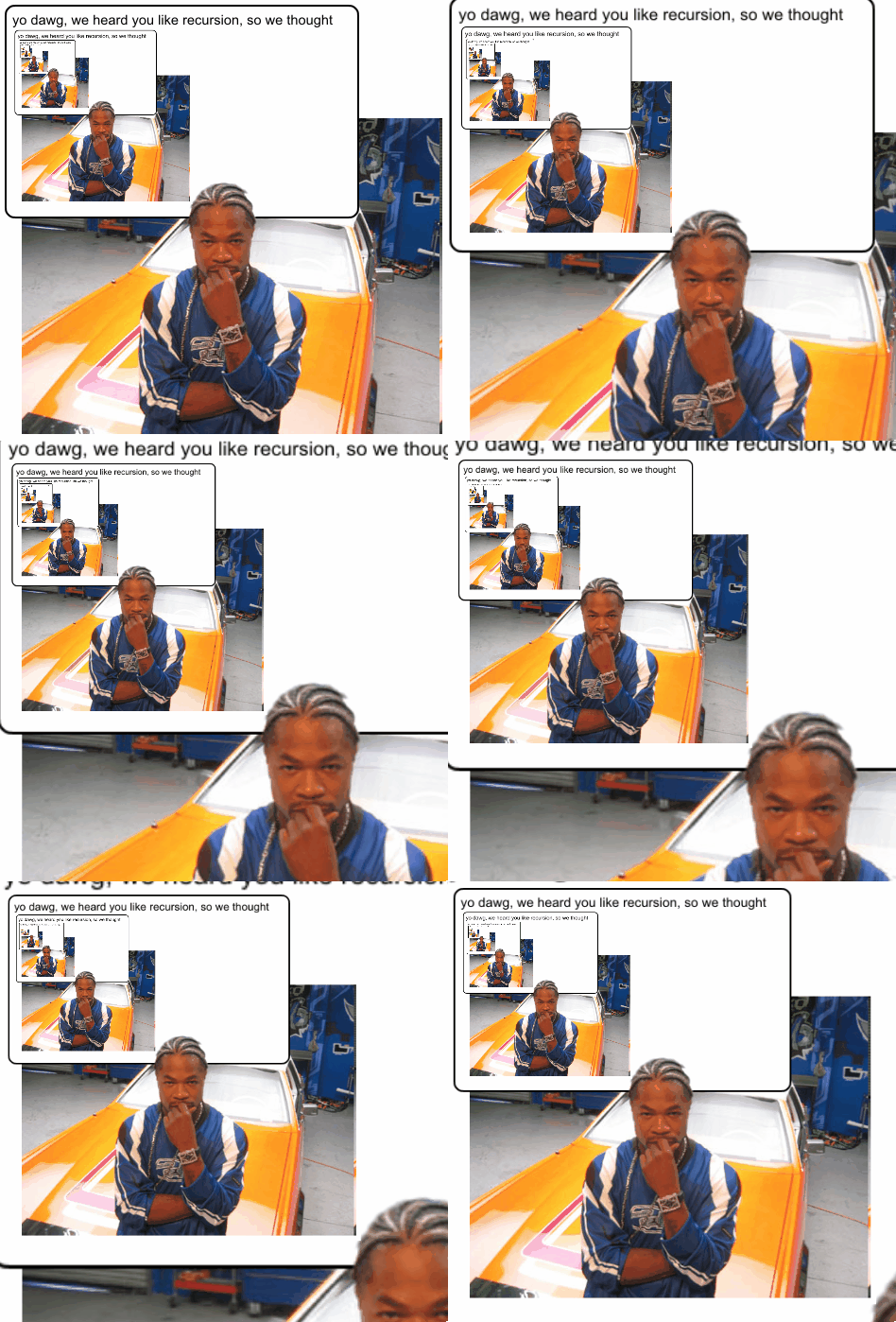
Yo dawg, I heard you like recursion...
http://farm4.static.flickr.com/3098/3122878080_d5c9e8538c_o.gif
-
Re:You want some ideas?
hmmm this dropped out
Firefox taught the quick brown fox to jump, thus inventing typing tutorials
Firefox comes to your aid, not 'in a CD case'
Firefox rules! 32 to be exact Explorers are crusty old men in the wilderness. -
Re:That's just a bit premature...
If you want such things to exist, they need to be socialized... Media companies are propaganda machines.
I'm amazed you can say such things with a straight face. However bad private media companies may be, as propagandists they pale in comparison to governments. And the worst instances of "private" propaganda just happen to align with the interests of the governments under which those companies operate, by some strange coincidence.
And you wish to socialize them further? -
Redmond, start your photocopiers
Ballmer want to take a peek under the apple hood to see if there's someting left to snatch and patent. After that he'll license it back to Apple. Redmond wants to start the photocopiers once more. http://www.flickr.com/photos/emeidi/43356340/ Maybe it's time for MS start innovating.
-
Re:huh?
Apple does not claim Podcast and Podcast cannot be Trademarked based on a previous decision by the PTO.
http://www.flickr.com/photos/theglobalgeekpodcast/309396084/sizes/l/
-
Astrometry.net and Comet Lulin
I use them all the time; just shot comet Lulin, they did a great job of exact location:
-
Re:roadkill
If you leave the door to your home open and come home to find that someone is photographing your things
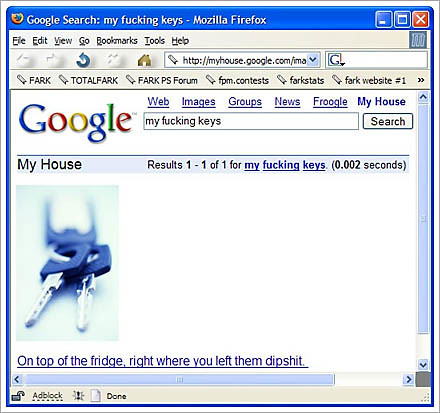
The next product from Google Labs! It's like Google search for your PC, it's Google House View (beta). Can't remember what your bathroom floor looks like, can't see it from the sofa, and you're too lazy to stand up? Google can help!
-
Interoperability is the problem
The reason something like Facebook works is that they can design a database schema to facilitate a complete experience that just kind of... works.... Across mini-feeds, status walls, applications, etc.
Doing that in a way that's completely decentralized requires standardization on interfaces and data that would be hard to do for a couple of reasons:
- Agreeing on the architecture; how many "really" RESTful interfaces are out there? Netflix has a great one, but Flickr doesn't.
- What's the syntax? JSON, XML, YAML,
- How about a data model? Will people want to go beyond syntax into being able to do queries like what SPARQL gives you?But beyond the technological hurdles, there's the business angle. Social media isn't exactly rolling in revenue, it's rolling in VC funding at best. Why interoperate when can try to claim a monopoly position? Or aim to be the defacto standard?
So, in the end, I woudn't say we're moving backwards
-
Even before that...
The ancient egyptians
http://www.flickr.com/photos/hdonat/2422108343/
had their engineering problems too.
As soon as we humans invented technology, we humans began screwing it up.
-
Re:Pretty Pictures with Little to No Functionality
The Kunsthaus in Bregenz by Peter Zumthor hosted an exhibition where trenches from World War One were recreated: http://www.flickr.com/photos/coffeemoon/3180793744/ nad http://architecturephoto.net/jp/Zumthor02-thumb.jpg
The plan form is fairly simple, and a dead load like soil which is unchanging is fairly easy to design for. http://www.kunsthaus-bregenz.at/zumtor/plan3.gif (lives loads are the ones that cause real problems).
The theory behind vertical farms is fairly well exercised at this stage, and architects as well as engineers have been having a go for ages: the Dutch firm MVRDV designed "pig cities" to provide pigs with more room in farms while reducing overall farm footprint, as the Netherlands is the largest producer of Pork in Europe.
The vertical farm project has been running for some time now, and the section looks fairly credible, basically like a stack of greenhouses with a central light source, although some of them include dishes to get light inside through fibre optics (iirc). The theory is sound, and it's buildable, but maybe just not in city centres.
-
Re:Current users?
-
idea is redundant
-
With each decision...
They simply need to ask themselves: Is this good for the company?
-
Re:Seems like the correct procedure
Man, I hope the My Little Pony forum troll is safe