Slashdot Mirror
Domain: fsdn.com
Stories and comments across the archive that link to fsdn.com.
Stories · 67
-
Review: The Martian
I was both pleased and disappointed, as always, when I heard that a book I enjoyed was being made into a movie. Andy Weir's The Martian was the best new book I'd read in years. It was written for nerds, by a nerd — by somebody with an obvious love for NASA, science, and spaceflight. How could it possibly be condensed into the format of a Hollywood blockbuster? Well, director Ridley Scott and screenwriter Drew Goddard figured out how. The Martian is an excellent film, well worth watching. Read on for my review (very minor spoilers only), and feel free to share your own in the comments.Let's briefly discuss the book, first. If you haven't read it, I recommend doing so. In short: near-future astronaut Mark Watney gets stranded on the surface of Mars, and must figure out how to stay alive using only the limited resources at hand. This is hard science fiction. Weir meticulously researched all the problems facing Watney, without giving him magically advanced technology to defeat them.
The story is largely told through Watney's journal updates, which read remarkably like following a brilliant engineer's blog while he solves fascinating problems. Weir also infuses Watney with dry humor and an unwillingness to be told that the right way is wrong. For being so dense with science and engineering, the book manages to have a rapid pace.
Fortunately, that pace made the transition to film a bit easier, as did the book's narrative form. Watney's thought processes tend to be spoken, rather than a typical internal monologue, and this keeps it more conversational and brief. In the novel, when Watney has to "do the math" — for example to figure out the hydrogen levels in his living space — you follow along as he actually does the math, then as he develops a procedure to safely lower those levels. The movie tackles this complex scene by making him discover the problem right when it begins, with a small amount of hydrogen igniting dramatically. It keeps the science and the problem-solving, but conveys it quickly and moves on.
That's the real triumph of this movie's creators — they accelerate the plot while maintaining the book's love and respect for science and for thoughtful engineering. They embellish for interesting visuals, like the martian wind, and for dramatic license. But they never go over the top. It's... refreshing, to say the least.
One thing the film does even better than the book is bringing intensity to particular scenes. It's one thing to read Watney's account of how he dealt with an emergency in past tense — it's another to see it as it's happening. The first scene of Watney alone on Mars is incredibly tense and visceral.
This is largely due to Matt Damon's performance as Watney (and to Ridley Scott, for enabling that performance). Damon does a great job coming off not as a movie superhero, but as a funny, capable guy you might run into at your local makerspace. The other roles in the film are well cast and performed, too. Jeff Daniels as the director of NASA is the closest the movie gets to having a 'bad guy.'
He's the one who tends to raise the practical and ethical questions surrounding Watney's predicament. How many resources should be allocated to helping a single man? What will be the cost to future missions if they don't? They're impossible questions to answer, but they deserved to be brought up and debated.
One of the big reasons to see this film is for its cinematography. If you're a space buff, you'll really enjoy the long, lingering shots of the Martian surface. The graphic artists really deserve commendation. They make the landscape look both desolate and fascinating. They had lots of source material to work with from all the rovers and orbiters we've sent to Mars, and they used it to fill each scene with incredible detail. Look carefully and you'll see one of Mars's lumpy moons in the background of a shot on the surface, or a dust storm slowly flowing across a vast mesa when looking down from orbit.
The Martian, much like Apollo 13 twenty years ago, inspires us to cheer on our civilization's brightest scientists and engineers to solve hideously complex problems. NASA has been falling all over itself to help promote the film, and for good reason. I think the reception of this film will show support is still there from the general public to go and do really challenging missions. The Martian the best movie I've seen all year, and I highly recommend it.
-
Review: The Martian
I was both pleased and disappointed, as always, when I heard that a book I enjoyed was being made into a movie. Andy Weir's The Martian was the best new book I'd read in years. It was written for nerds, by a nerd — by somebody with an obvious love for NASA, science, and spaceflight. How could it possibly be condensed into the format of a Hollywood blockbuster? Well, director Ridley Scott and screenwriter Drew Goddard figured out how. The Martian is an excellent film, well worth watching. Read on for my review (very minor spoilers only), and feel free to share your own in the comments.Let's briefly discuss the book, first. If you haven't read it, I recommend doing so. In short: near-future astronaut Mark Watney gets stranded on the surface of Mars, and must figure out how to stay alive using only the limited resources at hand. This is hard science fiction. Weir meticulously researched all the problems facing Watney, without giving him magically advanced technology to defeat them.
The story is largely told through Watney's journal updates, which read remarkably like following a brilliant engineer's blog while he solves fascinating problems. Weir also infuses Watney with dry humor and an unwillingness to be told that the right way is wrong. For being so dense with science and engineering, the book manages to have a rapid pace.
Fortunately, that pace made the transition to film a bit easier, as did the book's narrative form. Watney's thought processes tend to be spoken, rather than a typical internal monologue, and this keeps it more conversational and brief. In the novel, when Watney has to "do the math" — for example to figure out the hydrogen levels in his living space — you follow along as he actually does the math, then as he develops a procedure to safely lower those levels. The movie tackles this complex scene by making him discover the problem right when it begins, with a small amount of hydrogen igniting dramatically. It keeps the science and the problem-solving, but conveys it quickly and moves on.
That's the real triumph of this movie's creators — they accelerate the plot while maintaining the book's love and respect for science and for thoughtful engineering. They embellish for interesting visuals, like the martian wind, and for dramatic license. But they never go over the top. It's... refreshing, to say the least.
One thing the film does even better than the book is bringing intensity to particular scenes. It's one thing to read Watney's account of how he dealt with an emergency in past tense — it's another to see it as it's happening. The first scene of Watney alone on Mars is incredibly tense and visceral.
This is largely due to Matt Damon's performance as Watney (and to Ridley Scott, for enabling that performance). Damon does a great job coming off not as a movie superhero, but as a funny, capable guy you might run into at your local makerspace. The other roles in the film are well cast and performed, too. Jeff Daniels as the director of NASA is the closest the movie gets to having a 'bad guy.'
He's the one who tends to raise the practical and ethical questions surrounding Watney's predicament. How many resources should be allocated to helping a single man? What will be the cost to future missions if they don't? They're impossible questions to answer, but they deserved to be brought up and debated.
One of the big reasons to see this film is for its cinematography. If you're a space buff, you'll really enjoy the long, lingering shots of the Martian surface. The graphic artists really deserve commendation. They make the landscape look both desolate and fascinating. They had lots of source material to work with from all the rovers and orbiters we've sent to Mars, and they used it to fill each scene with incredible detail. Look carefully and you'll see one of Mars's lumpy moons in the background of a shot on the surface, or a dust storm slowly flowing across a vast mesa when looking down from orbit.
The Martian, much like Apollo 13 twenty years ago, inspires us to cheer on our civilization's brightest scientists and engineers to solve hideously complex problems. NASA has been falling all over itself to help promote the film, and for good reason. I think the reception of this film will show support is still there from the general public to go and do really challenging missions. The Martian the best movie I've seen all year, and I highly recommend it.
-
Review: The Martian
I was both pleased and disappointed, as always, when I heard that a book I enjoyed was being made into a movie. Andy Weir's The Martian was the best new book I'd read in years. It was written for nerds, by a nerd — by somebody with an obvious love for NASA, science, and spaceflight. How could it possibly be condensed into the format of a Hollywood blockbuster? Well, director Ridley Scott and screenwriter Drew Goddard figured out how. The Martian is an excellent film, well worth watching. Read on for my review (very minor spoilers only), and feel free to share your own in the comments.Let's briefly discuss the book, first. If you haven't read it, I recommend doing so. In short: near-future astronaut Mark Watney gets stranded on the surface of Mars, and must figure out how to stay alive using only the limited resources at hand. This is hard science fiction. Weir meticulously researched all the problems facing Watney, without giving him magically advanced technology to defeat them.
The story is largely told through Watney's journal updates, which read remarkably like following a brilliant engineer's blog while he solves fascinating problems. Weir also infuses Watney with dry humor and an unwillingness to be told that the right way is wrong. For being so dense with science and engineering, the book manages to have a rapid pace.
Fortunately, that pace made the transition to film a bit easier, as did the book's narrative form. Watney's thought processes tend to be spoken, rather than a typical internal monologue, and this keeps it more conversational and brief. In the novel, when Watney has to "do the math" — for example to figure out the hydrogen levels in his living space — you follow along as he actually does the math, then as he develops a procedure to safely lower those levels. The movie tackles this complex scene by making him discover the problem right when it begins, with a small amount of hydrogen igniting dramatically. It keeps the science and the problem-solving, but conveys it quickly and moves on.
That's the real triumph of this movie's creators — they accelerate the plot while maintaining the book's love and respect for science and for thoughtful engineering. They embellish for interesting visuals, like the martian wind, and for dramatic license. But they never go over the top. It's... refreshing, to say the least.
One thing the film does even better than the book is bringing intensity to particular scenes. It's one thing to read Watney's account of how he dealt with an emergency in past tense — it's another to see it as it's happening. The first scene of Watney alone on Mars is incredibly tense and visceral.
This is largely due to Matt Damon's performance as Watney (and to Ridley Scott, for enabling that performance). Damon does a great job coming off not as a movie superhero, but as a funny, capable guy you might run into at your local makerspace. The other roles in the film are well cast and performed, too. Jeff Daniels as the director of NASA is the closest the movie gets to having a 'bad guy.'
He's the one who tends to raise the practical and ethical questions surrounding Watney's predicament. How many resources should be allocated to helping a single man? What will be the cost to future missions if they don't? They're impossible questions to answer, but they deserved to be brought up and debated.
One of the big reasons to see this film is for its cinematography. If you're a space buff, you'll really enjoy the long, lingering shots of the Martian surface. The graphic artists really deserve commendation. They make the landscape look both desolate and fascinating. They had lots of source material to work with from all the rovers and orbiters we've sent to Mars, and they used it to fill each scene with incredible detail. Look carefully and you'll see one of Mars's lumpy moons in the background of a shot on the surface, or a dust storm slowly flowing across a vast mesa when looking down from orbit.
The Martian, much like Apollo 13 twenty years ago, inspires us to cheer on our civilization's brightest scientists and engineers to solve hideously complex problems. NASA has been falling all over itself to help promote the film, and for good reason. I think the reception of this film will show support is still there from the general public to go and do really challenging missions. The Martian the best movie I've seen all year, and I highly recommend it.
-
Three Low-Tech Hacks for Phones and Tablets
Bennett Haselton writes "Here are three hacks that I adopted in the last few weeks, each of which solved a minor problem that I had lived with for so long that I no longer thought of it as a problem — until a solution came along, which was like a small weight off my shoulders. None of these hacks will help impress anyone with your technical prowess; I'm just putting them here because they made my life easier." Read on for the rest of Bennett's thoughts. 1. Fully charged spare batteries for your smartphoneOK, now before everyone starts shouting "DUH!", I can tell you that I was at a conference right before New Year's, and every day from about 11 a.m. onward, I heard people saying that their phones were about to die, that they would either about to drop off the grid or would have to spend the next half-hour shackled to an outlet via their phone charger, etc. I never once heard anyone mentioning swapping in a spare phone battery, and according to my own survey of my friends, none of them have ever tried it either. But that conference was my first trip after ordering two spare batteries for my Stratosphere from Verizon ($10 each), and it was also the first trip where I never had to waste a second thinking about how to stretch out the phone's battery life or how much time I had left. Just swap in the second battery at around 3 PM, and then swap in the third one at around 10 PM, if there was still anything worth staying out for.
You could instead get "extended life" batteries for certain models of phones as well, but they cost much more than the standard batteries, and some users report that they make the phone noticeably heavier and bulkier. There are also portable phone chargers — which charge themselves from wall outlets, and then carry a charge that can be used to re-charge the phone through the micro-USB connection — but of course they're bigger and heavier than spare batteries, and you have to leave the phone connected to it while the phone is recharging. I didn't see the need for either of those products after picking up two regular spare batteries.
The most inconvenient part of the process was recharging the multiple batteries at the end of the day — since I didn't have a standalone battery charger, I could only recharge the batteries by charging them in the phone itself, swapping each one out after it had spent an hour charging (if I stayed awake that long). To that end, it would be convenient if more phone manufacturers would make battery-only chargers, so that at the end of the day you could plug your depleted spare batteries into their own re-charger at the same time that you're using the normal phone charger to charge the battery currently in the phone, then go to sleep and let everything charge up overnight. There standalone chargers for some phone batteries, like the Blackberry, but they're in the minority. (Meanwhile, iPhones do not have user-serviceable batteries at all; when the battery dies and becomes non-rechargeable, you're supposed to take it to an Apple repair center to be replaced.)
It seems odd to me that phone manufacturers spend millions of dollars figuring out how to extend the battery life of their phones, and here's a solution that works for almost everyone who has a zippered pocket for spare batteries (and a phone other than an iPhone). But I didn't think of it for years, nobody else that I've talked to ever thought of it either, phone manufacturers don't steer people toward this option, and most of them don't make standalone chargers that would make the process easier. Well, now you know.
2. Hacked furniture to hold a tablet PC above your bed
For years I'd occasionally watched movies on my laptop in bed, and I always felt bit of a strain on my back or neck while sitting up and leaning against a pillow, but eventually the movie would distract me if it was any good at all. Then a week ago, in an act laden with heavy-handed but unintentional symbolism, I dumped all of the books out of one of my bookshelves to make it easier to watch TV without getting out of bed:
The protruding shelf is attached to the bookcase with a pair of metal clamps, and then weighed down with some heavy books to counterbalance the weight of the tablet. (You want the clamps tight enough that the shelf can't move at all, relative to the bookcase.) The tablet holder, a Zuwit 360 Degree tablet stand, is attached to the end of the shelf using its own built-in clamp, and then bent into a downward arc to hold the tablet.
In case you're wondering why I didn't just clamp the tablet holder to a nightstand next to the bed, the answer is that none of the tablet holders I looked at had a flexible gooseneck that would extend far enough. (Remember, the gooseneck doesn't just have to reach from the edge of the bed to above your head; it has to arch up and then bend downward to hold the tablet from above, all while giving you enough slack to reposition the tablet in the air if you want to.) I assume there's a practical upper limit on how long the manufacturers want the gooseneck to be; if it's too long, then when it's extended sideways it could bend under its own weight plus the weight of whatever it's holding. Hence the shelf extending out over the mattress.
To make this work, you need a gooseneck tablet holder like the Zuwit that specifically has short teeth protruding over the edge of whatever it's holding, to grip it so that it won't fall when the tablet is held upside-down. (I'd originally tried this with a BESTEK tablet holder, but the tablet gripper didn't have teeth coming down in front of the screen, so the tablet would occasionally fall out and land on my head.)
It was a bit of work to put together, but I've never felt rested in a more comfortable position while watching a 2-hour movie. All cheaper than installing a flatscreen in your ceiling, and better, actually, since you can reach up and rotate the tablet whenever you change position.
But as a proof-of-concept only, this is a pretty ugly piece of furniture, and while I'm able to get in and out of bed easily without hitting the protruding shelf, it gets more complicated if you're ever have "company." In my case, there's enough space behind the bookcase that I can tilt it backward, moving the protruding shelf and the tablet holder so that they're no longer over the bed. This solves the problem of how to get it out of the way, but not the fact that it's still a pretty ugly conversation piece. You can un-clamp the protruding shelf from the bookcase and hide it away, but you're still left with a bulky, empty bookcase oddly perched at the end of your bed, and that's too much of a pain to lift and move some place every time you want to assemble the tablet holder or disassemble it when you have company coming over. I want to take another go at it using a shelf attached to a stack of milk cartons — which would be even uglier, but much lighter and easier to disassemble and move out of the way.
Speaking of milk cartons and ideas that make my chiropractor happy:
3. Hacked furniture to hold a tablet in front of an exercise machine
So that's what I did with the BESTEK tablet holder that didn't work for holding the tablet upside-down in bed; it works perfectly well attached to a stack of milk cartons, where the tablet only has to be held sideways. Again, ugly. But again, easy to disassemble and hide if I know company's coming over.
Of course there's a space on the elliptical trainer (underneath the control panel) for holding books, tablets, and other reading/viewing material, but it requires you to crane your neck downward to focus on that space, and I always felt uncomfortable looking in that direction for more than a few minutes while exercising. The obvious idea was to hold up the tablet by attaching the gooseneck tablet holder to the control panel of the elliptical itself, but (a) the body around the control panel is mostly hollow plastic, which has too much "give" for the clamp to attach to it securely; (b) if the tablet is attached to the machine directly, then it jiggles while the machine is moving, making it hard to watch the screen; and (c) the gooseneck still doesn't reach far enough to hold the tablet higher than eye level, which is best for your posture if you're looking at it while exercising.
Hence, the tower of milk cartons. Now when I first went to the local Container Store and was told that a stack of five milk cartons would cost $60, I assumed I was being subjected to the usual downtown Bellevue yuppie price-gouging that also gave us $500 "minimalist" bookshelves available in the same store, but, no, that is actually what non-stolen milk crates actually cost. (They're so easy to walk off with, and useful as "modular furniture," that the International Dairy Foods Association as launched a campaign to get people to stop stealing them.) With a bit of experimenting, you can find the right height for the gooseneck tablet holder, and position the tablet so that it's far enough from your face for comfortable viewing, while still close enough that you can touch the screen. (The stack of books in the topmost crate keeps it from tipping over from the weight of the tablet.)
Of course if you work out on an elliptical at a gym, it's a bit less convenient to carry a stack of milk crates in with you. Maybe a tablet accessories company should come out with a portable, collapsible tripod that rests securely on the ground while extending upward to provide a thick, flat surface about 5 feet above the floor — where a gooseneck tablet holder could be clamped onto the flat surface and then hold the tablet itself in front of the user's face at the right altitude.
Then if you start watching a movie on the tablet while working out and you don't make it all the way through, you can finish the movie on the tablet while it's suspended above your head in bed. Gives you something to do while swapping out the batteries in your phone and waiting for them to recharge.
-
Three Low-Tech Hacks for Phones and Tablets
Bennett Haselton writes "Here are three hacks that I adopted in the last few weeks, each of which solved a minor problem that I had lived with for so long that I no longer thought of it as a problem — until a solution came along, which was like a small weight off my shoulders. None of these hacks will help impress anyone with your technical prowess; I'm just putting them here because they made my life easier." Read on for the rest of Bennett's thoughts. 1. Fully charged spare batteries for your smartphoneOK, now before everyone starts shouting "DUH!", I can tell you that I was at a conference right before New Year's, and every day from about 11 a.m. onward, I heard people saying that their phones were about to die, that they would either about to drop off the grid or would have to spend the next half-hour shackled to an outlet via their phone charger, etc. I never once heard anyone mentioning swapping in a spare phone battery, and according to my own survey of my friends, none of them have ever tried it either. But that conference was my first trip after ordering two spare batteries for my Stratosphere from Verizon ($10 each), and it was also the first trip where I never had to waste a second thinking about how to stretch out the phone's battery life or how much time I had left. Just swap in the second battery at around 3 PM, and then swap in the third one at around 10 PM, if there was still anything worth staying out for.
You could instead get "extended life" batteries for certain models of phones as well, but they cost much more than the standard batteries, and some users report that they make the phone noticeably heavier and bulkier. There are also portable phone chargers — which charge themselves from wall outlets, and then carry a charge that can be used to re-charge the phone through the micro-USB connection — but of course they're bigger and heavier than spare batteries, and you have to leave the phone connected to it while the phone is recharging. I didn't see the need for either of those products after picking up two regular spare batteries.
The most inconvenient part of the process was recharging the multiple batteries at the end of the day — since I didn't have a standalone battery charger, I could only recharge the batteries by charging them in the phone itself, swapping each one out after it had spent an hour charging (if I stayed awake that long). To that end, it would be convenient if more phone manufacturers would make battery-only chargers, so that at the end of the day you could plug your depleted spare batteries into their own re-charger at the same time that you're using the normal phone charger to charge the battery currently in the phone, then go to sleep and let everything charge up overnight. There standalone chargers for some phone batteries, like the Blackberry, but they're in the minority. (Meanwhile, iPhones do not have user-serviceable batteries at all; when the battery dies and becomes non-rechargeable, you're supposed to take it to an Apple repair center to be replaced.)
It seems odd to me that phone manufacturers spend millions of dollars figuring out how to extend the battery life of their phones, and here's a solution that works for almost everyone who has a zippered pocket for spare batteries (and a phone other than an iPhone). But I didn't think of it for years, nobody else that I've talked to ever thought of it either, phone manufacturers don't steer people toward this option, and most of them don't make standalone chargers that would make the process easier. Well, now you know.
2. Hacked furniture to hold a tablet PC above your bed
For years I'd occasionally watched movies on my laptop in bed, and I always felt bit of a strain on my back or neck while sitting up and leaning against a pillow, but eventually the movie would distract me if it was any good at all. Then a week ago, in an act laden with heavy-handed but unintentional symbolism, I dumped all of the books out of one of my bookshelves to make it easier to watch TV without getting out of bed:
The protruding shelf is attached to the bookcase with a pair of metal clamps, and then weighed down with some heavy books to counterbalance the weight of the tablet. (You want the clamps tight enough that the shelf can't move at all, relative to the bookcase.) The tablet holder, a Zuwit 360 Degree tablet stand, is attached to the end of the shelf using its own built-in clamp, and then bent into a downward arc to hold the tablet.
In case you're wondering why I didn't just clamp the tablet holder to a nightstand next to the bed, the answer is that none of the tablet holders I looked at had a flexible gooseneck that would extend far enough. (Remember, the gooseneck doesn't just have to reach from the edge of the bed to above your head; it has to arch up and then bend downward to hold the tablet from above, all while giving you enough slack to reposition the tablet in the air if you want to.) I assume there's a practical upper limit on how long the manufacturers want the gooseneck to be; if it's too long, then when it's extended sideways it could bend under its own weight plus the weight of whatever it's holding. Hence the shelf extending out over the mattress.
To make this work, you need a gooseneck tablet holder like the Zuwit that specifically has short teeth protruding over the edge of whatever it's holding, to grip it so that it won't fall when the tablet is held upside-down. (I'd originally tried this with a BESTEK tablet holder, but the tablet gripper didn't have teeth coming down in front of the screen, so the tablet would occasionally fall out and land on my head.)
It was a bit of work to put together, but I've never felt rested in a more comfortable position while watching a 2-hour movie. All cheaper than installing a flatscreen in your ceiling, and better, actually, since you can reach up and rotate the tablet whenever you change position.
But as a proof-of-concept only, this is a pretty ugly piece of furniture, and while I'm able to get in and out of bed easily without hitting the protruding shelf, it gets more complicated if you're ever have "company." In my case, there's enough space behind the bookcase that I can tilt it backward, moving the protruding shelf and the tablet holder so that they're no longer over the bed. This solves the problem of how to get it out of the way, but not the fact that it's still a pretty ugly conversation piece. You can un-clamp the protruding shelf from the bookcase and hide it away, but you're still left with a bulky, empty bookcase oddly perched at the end of your bed, and that's too much of a pain to lift and move some place every time you want to assemble the tablet holder or disassemble it when you have company coming over. I want to take another go at it using a shelf attached to a stack of milk cartons — which would be even uglier, but much lighter and easier to disassemble and move out of the way.
Speaking of milk cartons and ideas that make my chiropractor happy:
3. Hacked furniture to hold a tablet in front of an exercise machine
So that's what I did with the BESTEK tablet holder that didn't work for holding the tablet upside-down in bed; it works perfectly well attached to a stack of milk cartons, where the tablet only has to be held sideways. Again, ugly. But again, easy to disassemble and hide if I know company's coming over.
Of course there's a space on the elliptical trainer (underneath the control panel) for holding books, tablets, and other reading/viewing material, but it requires you to crane your neck downward to focus on that space, and I always felt uncomfortable looking in that direction for more than a few minutes while exercising. The obvious idea was to hold up the tablet by attaching the gooseneck tablet holder to the control panel of the elliptical itself, but (a) the body around the control panel is mostly hollow plastic, which has too much "give" for the clamp to attach to it securely; (b) if the tablet is attached to the machine directly, then it jiggles while the machine is moving, making it hard to watch the screen; and (c) the gooseneck still doesn't reach far enough to hold the tablet higher than eye level, which is best for your posture if you're looking at it while exercising.
Hence, the tower of milk cartons. Now when I first went to the local Container Store and was told that a stack of five milk cartons would cost $60, I assumed I was being subjected to the usual downtown Bellevue yuppie price-gouging that also gave us $500 "minimalist" bookshelves available in the same store, but, no, that is actually what non-stolen milk crates actually cost. (They're so easy to walk off with, and useful as "modular furniture," that the International Dairy Foods Association as launched a campaign to get people to stop stealing them.) With a bit of experimenting, you can find the right height for the gooseneck tablet holder, and position the tablet so that it's far enough from your face for comfortable viewing, while still close enough that you can touch the screen. (The stack of books in the topmost crate keeps it from tipping over from the weight of the tablet.)
Of course if you work out on an elliptical at a gym, it's a bit less convenient to carry a stack of milk crates in with you. Maybe a tablet accessories company should come out with a portable, collapsible tripod that rests securely on the ground while extending upward to provide a thick, flat surface about 5 feet above the floor — where a gooseneck tablet holder could be clamped onto the flat surface and then hold the tablet itself in front of the user's face at the right altitude.
Then if you start watching a movie on the tablet while working out and you don't make it all the way through, you can finish the movie on the tablet while it's suspended above your head in bed. Gives you something to do while swapping out the batteries in your phone and waiting for them to recharge.
-
Diablo 3 Hands-On
At this year's Blizzcon, we got to try out a section of Diablo 3 that was pulled directly from the single-player storyline and playable with all classes. A large number of skills and abilities were playable, and the skill rune system has been implemented, a feature that was lacking for last year's demo build. We also got to spend some time trying out the newly announced PvP system — Battle Arenas. Read on for a walk-through of Diablo 3 as we've seen it so far. In short: it's shaping up to be an excellent game, and a worthy successor to Diablo 2. Read on for more.The demo started me off at with a level 9 character and dropped me into a dungeon, offering up two objectives: fight my way through and, as a bonus, find and destroy a particular boss. From the start, it had a very familiar feel. I took a few steps down the hall and got rushed by a group of monsters, which I quickly mowed down by mashing the buttons on my mouse. It's Diablo, alright. Here I paused to actually read my abilities and see how the UI worked. If you've followed along with the game's development at all, you're probably aware of the fact that the Diablo 2 potion belt is gone. The 1-5 keys are now used to activate skills displayed on an action bar at the bottom of the screen. The right and left mouse buttons also activate skills (ostensibly the most-used ones), and pressing tab will swap back and forth between two skills bound to the right mouse button. Subtract one of those slots for health potions and you've got seven easily-accessible skills.
Skills:
Of course, I didn't get that many to start; instead, they're doled out as a character levels up, increasing the complexity of combat slowly but steadily. Blizzard has done away with the talent-trees of old, so picking skills is a lot tougher. Instead, every few levels a new skill slot unlocks, and you get to pick an actual activated ability that you'll immediately start using to kill monsters. On the levels in between the unlocks, you can power up one of your existing skills. All of the passive, math-y talents that were prevalent in Diablo 2 are dealt with through a different system, called Traits. Traits are a wide variety of passive bonuses that you get to spend points in every couple levels — things like boosting a particular stat, or increasing the amount of gold monsters drop. They're pretty straight-forward — not that exciting, but a nice, consistent way to make your character stronger in some way.
As it happens, attaining level 10 unlocks a skill slot (the fourth), so after spending a little time wading through the demonic hordes inhabiting the dungeon, I leveled up and tried to make a decision. It was pretty difficult to choose. There are a lot of fun-sounding or powerful-sounding skills, and you're just not able to get all of them. One of Blizzard's mantras of late has been about having the player make meaningful decisions, and this certainly qualified. They've stated in the past that some form of respec will be added to the game. They haven't ironed out the details, but they don't want it to be trivial. If I hadn't had a limited amount of time, I would have spent quite a while pondering which skill to take. It would have been nice to have some sort of preview, or a minute-long grace period to swap to something else. But it definitely created a feeling that there were more good options I'd be able to get in later levels.
I'll get to the individual classes and their skills in a moment, but one more feature that needs to be introduced is the Skill Rune system. This is a concept Blizzard has been playing with for a while, and last year it was in the midst of a redesign, so we didn't get to try it out. It works like this: each skill in your spellbook has one slot to which you can add a Skill Rune. The Rune then modifies how the skill works. It's somewhat similar to gem sockets in items. There are five different colors of runes, and each color will modify the skill in a different way. Runes have seven ranks, which modify how powerful the effect is. One example they talked about was the Wizard skill Magic Missile. Unaltered, it's just what it sounds like — launching an arcane projectile at a monster. With a rank 1 Indigo rune, the skill shoots an extra missile. With a rank 7 Indigo rune, it shoots seven extra missiles. I'll be blunt: Skill Runes are pretty awesome.
Classes:
The first class I tried out was the Witch Doctor. It's a caster class with voodoo- and necromancer-style magic. My main ranged attack was Poison Dart, which did some damage over time to monsters I hit. Adding a rune, it changed to a fire dart, which did more up-front damage at the expense of the DoT. I also had a skill that summoned pets to help me fight -- up to three Zombie Dogs at one time. They were actually powerful enough that I eventually let them die so I would have more to do. Runes affected them differently — one rune gave them a chance to drop a health orb when they died. Others modified how they did damage. The AI was pretty smart about having them attack the groups I wanted them to, and not go charging off on their own.
The skill I chose when I hit level 10 was Firebats. It functions similarly to the Inferno spell in Diablo 2, only instead of projecting a cone of flame in front of me, it projected a cone of flaming bats. The first Skill Rune I looked at extended the spell's range, trading off damage to do so. That was a bit underwhelming, since I already had ranged attacks, so I went with a different rune that turned the cone into a whirlwind of flaming bats that surrounded me. Another rune added a life-drain effect. It was tempting, but the whirlwind looked too cool to pass up. Finally, the skill that sold me on the Skill Rune system was Zombie Charger, a spell that summoned a zombie, who would shamble a few steps forward and then spray poison in the immediate vicinity. It was a solid, short-range attack. Fortunately, I lucked into a rune that modified the spell to summon a group of zombie bears that charged forward and trampled whatever was in their path. The buddy I was playing with happened to get a rune at the same time that made his Wizard's basic lightning spell change into a massive, conical spray of electricity, and we couldn't help but laugh as we used our new-found power to demolish groups of monsters.
The next class I tried was the recently revealed Demon Hunter. The class mixes ranges weapons with gadgets and dark magic for its offensive power. It bears similarities to both the Amazon and the Assassin from Diablo 2, but feels distinctly different to play. My main nuke, when I started out, was called Entangling Shot. It would do some damage and slow the monsters it hit, and then chain to other nearby monsters. Using Entangling Shot, it was quite easy to control entire groups of monsters. This was supplemented by a skill called Bola Shot, which would send a glowing bola out to wrap itself around the neck of a monster, exploding a few seconds later. It supplemented the slow effect of Entangling Shot nicely; by alternating between the two skills, I could drop big damage while keeping anything from reaching me. The Demon Hunter also had Vault, a movement skill that makes you leap forward through the shadows. It's a good way to get range — perhaps too good.
When I reached level 10, there were some interesting choices for new skills — a Fan of Knives provided area-of-effect damage in a circle around the Demon Hunter; Molten Arrow sends a blast of fire through monsters; Multi-Shot sends a conical rain of arrows that looks more like something out of 300 than the equivalent Amazon skill in Diablo 2. But I ended up choosing Grenades. The Demon Hunter tosses three grenades at the feet of her target, and they explode for huge damage. The cool thing about this skill is that you can bounce the grenades off walls, so you can blow up things around corners or in the back of a group that's rushing you. Unfortunately, I didn't get to try any runes with these skills. Overall, the Demon Hunter felt a lot more dynamic and... percussive than an Amazon.
I got a chance to tinker around with the Barbarian as well. This class uses a different resource system — fury is generated by certain attacks, and is then spent on other (generally more powerful) attacks. It certainly played differently than the range classes. Wading into groups and Cleaving away was standard operating procedure. I enjoyed this class less than the others, mainly due to the fact that fury generation seemed fairly slow, and my skills weren't that focused on damage. One ability, Revenge, was reactive, only becoming available occasionally during a pitched battle. At level 10, I picked up a skill that made him leap into a group of enemies, dealing damage when he landed. The trouble was that I didn't feel like I really had a go-to attack. I'd guess that this would be solved by different skill selection, but obviously the demo build had its limits.
Story, Lore, Art:
The story is handled in two ways: Lore tomes and quests. The tomes are actual loot objects that drop at certain places in the zone. When you pick them up, a voice-over starts that explains a bit about whatever is going on. It comes with a handy little UI box that lets you pause, play, or cancel the recording. The quests we saw were mostly linear. As mentioned earlier, the goal during the fire dungeon was to simply fight our way through, killing a particular boss on the way. Once we got out, we stepped outside into a new zone, and there was a quest available immediately to help the quest-giver track somebody down and take him out. Successfully doing so turned the quest-giver into a vendor for magical weapons.
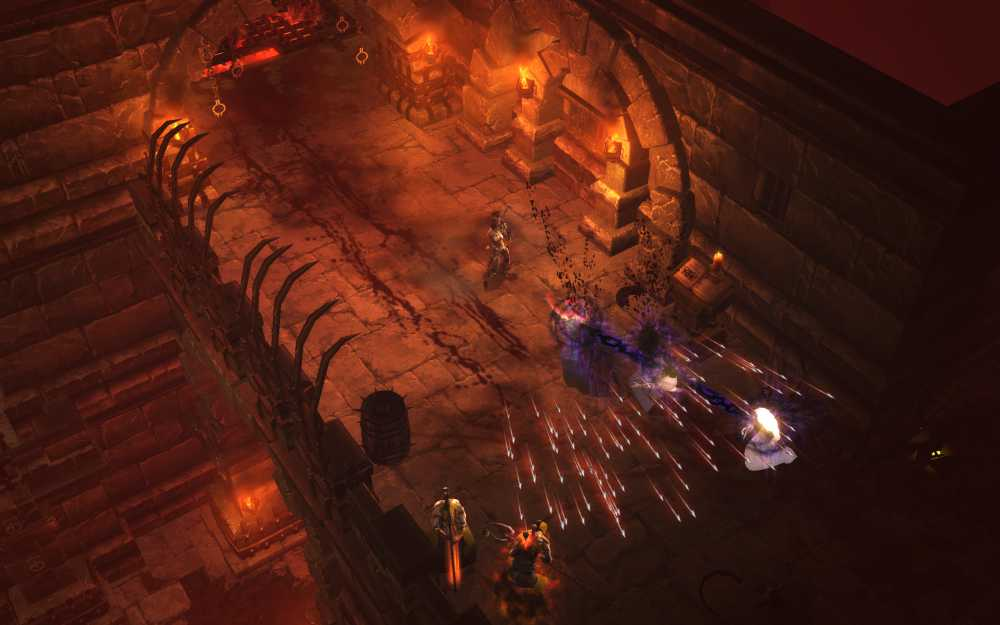
This outdoor area was short, but led to another dungeon, this time an eerie-looking jail-tomb combination. Another new quest sent us searching through many small cells in an effort to free the souls of the innocently imprisoned. It was a fairly big dungeon, but the quest objectives were easy to find — when you got close to them, there was a glowing circle on the ground that made them easy to see. Once done with that, to escape the prison you needed a key that dropped from the zone's boss. A helpful marker on the map pointed out where he was — the convergence of four high walkways, with deep pits below. As we reached the center, undead began swarming up the sides of the walkways out of the darkness below, surrounding and trapping us in place for when the boss popped out and started attacking. After defeating him and reaching the end of the zone, we got to see the end of the quest — a brief, brutal coda to the story we'd seen so far.
A brief word about the art. Diablo 3 is a visually dense game. There are a lot of things competing for your attention. Player skills get a bit of a priority, since that's what provides a feeling of interaction with the world, but there's always something cool to look at — monsters' spells, death animations, destructible objects that break apart violently, traps in the dungeon, and even just the scenery around you. The outdoor level we saw reminded me briefly of the art controversy that happened when Blizzard first showed off some of its level design. It's a cloudy, rainy environment, not terribly dark, but the colors are muted. When you first see it, it's less visually stimulating than the fiery dungeon you came out of, but soon you'll notice the rain, the billowing mist, the occasional lightning flash that makes colors suddenly pop out at you, and it just works.
PvP Battle Arenas:
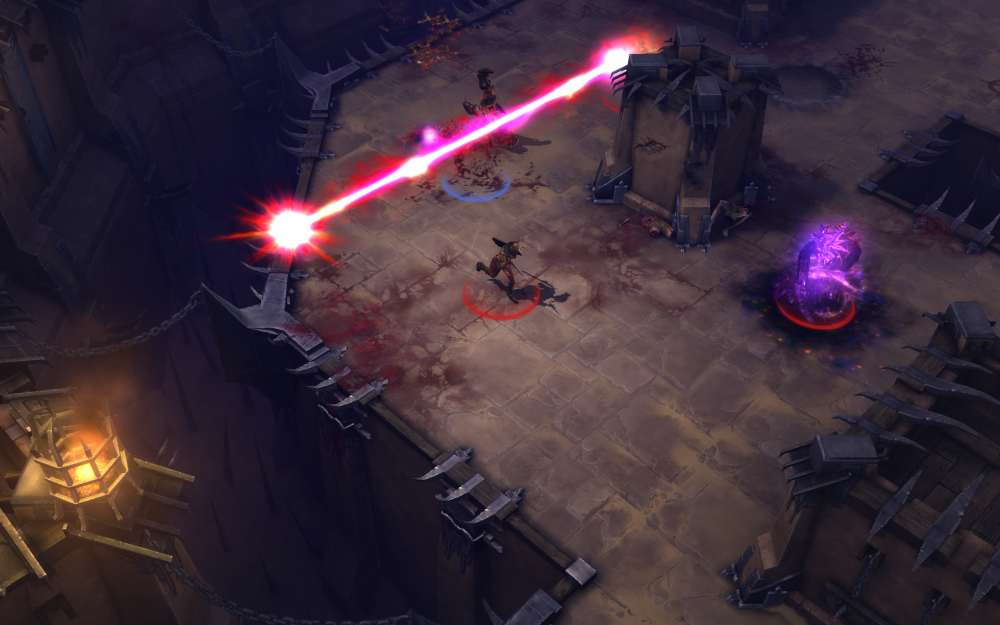
I also got a chance to try out the new PvP arenas. I started off with doing some 2v2 as a Witch Doctor. The arena was roughly square-shaped, and small — perhaps a bit over two screen-widths wide. There are pillars placed around the map in ways that World of Warcraft PvPers will be familiar with. You can use them to break line-of-sight and gain a brief respite from a Wizard's Death-Star-inspired laser, or other attacks. Health orbs are sprinkled around the map, spawning periodically to let you regain some of your HP. As a Witch Doctor, I could send my Zombie Dogs off to harass my opponents, detonating them remotely to cause more substantial damage, supplementing them with firebombs and a damage-over-time spell.
The teamwork aspect of the fight made itself obvious immediately; at first I didn't pay attention to what my partner was doing, not recognizing when he was running away, and our two opponents turned and destroyed me. Once we started attacking and retreating in unison, letting my Zombie Dogs and his Hydras occupy key spots on the battlefield, we were able to keep the opposing Barbarian off of us long enough to deal with the other team individually.
Later, I did some 1v1 — a Wizard mirror match, which was a ton of fun. In addition to the aforementioned laser and Hydra spell, Wizards had Teleport (which is on a cooldown), Meteor, a damage absorption shield, and Slow Time, which drops a giant bubble around the Wizard, slowing any projectiles or enemies that are inside. With just these tools, we had some pretty complex, strategic fights for a couple of beginners. Dropping Hydras at strategic positions could cover a retreat or apply some damage on an opponent who ducked behind a pillar. Getting up close and using Slow Time gave an opportunity to drop a Meteor, which took several seconds to land but did massive damage. Even better, I'd pretend to retreat, and when he teleported to keep up with me, a Slow Time field or a Meteor would be there waiting for him. Out in the open, we traded laser barrages, but those never lasted long. The damage shield was on a cooldown, but combined with the health orbs it led to some surprisingly long matches that swung back and forth as we each grabbed temporary advantage. It was a lot of fun.
Misc. Tidbits:
A few neat but minor things caught my attention as I was playing through the game. We didn't get to see the crafting system, but we did have the ability to essentially disenchant items on the fly, which provide crafting materials. You do this by taking up to six items at a time from your inventory and dropping them in your cube, which breaks them apart. The UI is polished — there's not a lot of clicking involved — so it's a nice way to keep free space without ducking back to town every few minutes. The Talisman system is also convenient in that regard; it takes stat runes out of the inventory and puts them in their own storage space. Being able to see monster health bars is another quality-of-life change, as is the ability to resurrect your fallen teammates if you can get to them quickly enough (only works in PvE). The demo wasn't very difficult, but we didn't get to choose the difficulty setting, and I presume Blizzard didn't want people to spend their brief window of time making corpse runs.
Despite the new features and the major changes from a year ago, Diablo 3 really feels like a game, now. It seems like Blizzard has settled on most of the major decisions and is just ironing out the wrinkles while building the actual game content. Some systems, like Traits, still need some work, and it was hard to care about the items that dropped for a character we only got to play briefly. But I saw a lot of Blizzcon attendees finish their 15-minute play period and immediately get back in the 30-minute line. The PvP was entertaining, and hopefully Battle.net can provide good match-making while allowing small groups of friends to log on and battle each other whenever they feel like it. I usually try not to waste energy looking forward to a game that's still a ways off, but Blizzard's making it difficult.
-
Diablo 3 Hands-On
At this year's Blizzcon, we got to try out a section of Diablo 3 that was pulled directly from the single-player storyline and playable with all classes. A large number of skills and abilities were playable, and the skill rune system has been implemented, a feature that was lacking for last year's demo build. We also got to spend some time trying out the newly announced PvP system — Battle Arenas. Read on for a walk-through of Diablo 3 as we've seen it so far. In short: it's shaping up to be an excellent game, and a worthy successor to Diablo 2. Read on for more.The demo started me off at with a level 9 character and dropped me into a dungeon, offering up two objectives: fight my way through and, as a bonus, find and destroy a particular boss. From the start, it had a very familiar feel. I took a few steps down the hall and got rushed by a group of monsters, which I quickly mowed down by mashing the buttons on my mouse. It's Diablo, alright. Here I paused to actually read my abilities and see how the UI worked. If you've followed along with the game's development at all, you're probably aware of the fact that the Diablo 2 potion belt is gone. The 1-5 keys are now used to activate skills displayed on an action bar at the bottom of the screen. The right and left mouse buttons also activate skills (ostensibly the most-used ones), and pressing tab will swap back and forth between two skills bound to the right mouse button. Subtract one of those slots for health potions and you've got seven easily-accessible skills.
Skills:
Of course, I didn't get that many to start; instead, they're doled out as a character levels up, increasing the complexity of combat slowly but steadily. Blizzard has done away with the talent-trees of old, so picking skills is a lot tougher. Instead, every few levels a new skill slot unlocks, and you get to pick an actual activated ability that you'll immediately start using to kill monsters. On the levels in between the unlocks, you can power up one of your existing skills. All of the passive, math-y talents that were prevalent in Diablo 2 are dealt with through a different system, called Traits. Traits are a wide variety of passive bonuses that you get to spend points in every couple levels — things like boosting a particular stat, or increasing the amount of gold monsters drop. They're pretty straight-forward — not that exciting, but a nice, consistent way to make your character stronger in some way.
As it happens, attaining level 10 unlocks a skill slot (the fourth), so after spending a little time wading through the demonic hordes inhabiting the dungeon, I leveled up and tried to make a decision. It was pretty difficult to choose. There are a lot of fun-sounding or powerful-sounding skills, and you're just not able to get all of them. One of Blizzard's mantras of late has been about having the player make meaningful decisions, and this certainly qualified. They've stated in the past that some form of respec will be added to the game. They haven't ironed out the details, but they don't want it to be trivial. If I hadn't had a limited amount of time, I would have spent quite a while pondering which skill to take. It would have been nice to have some sort of preview, or a minute-long grace period to swap to something else. But it definitely created a feeling that there were more good options I'd be able to get in later levels.
I'll get to the individual classes and their skills in a moment, but one more feature that needs to be introduced is the Skill Rune system. This is a concept Blizzard has been playing with for a while, and last year it was in the midst of a redesign, so we didn't get to try it out. It works like this: each skill in your spellbook has one slot to which you can add a Skill Rune. The Rune then modifies how the skill works. It's somewhat similar to gem sockets in items. There are five different colors of runes, and each color will modify the skill in a different way. Runes have seven ranks, which modify how powerful the effect is. One example they talked about was the Wizard skill Magic Missile. Unaltered, it's just what it sounds like — launching an arcane projectile at a monster. With a rank 1 Indigo rune, the skill shoots an extra missile. With a rank 7 Indigo rune, it shoots seven extra missiles. I'll be blunt: Skill Runes are pretty awesome.
Classes:
The first class I tried out was the Witch Doctor. It's a caster class with voodoo- and necromancer-style magic. My main ranged attack was Poison Dart, which did some damage over time to monsters I hit. Adding a rune, it changed to a fire dart, which did more up-front damage at the expense of the DoT. I also had a skill that summoned pets to help me fight -- up to three Zombie Dogs at one time. They were actually powerful enough that I eventually let them die so I would have more to do. Runes affected them differently — one rune gave them a chance to drop a health orb when they died. Others modified how they did damage. The AI was pretty smart about having them attack the groups I wanted them to, and not go charging off on their own.
The skill I chose when I hit level 10 was Firebats. It functions similarly to the Inferno spell in Diablo 2, only instead of projecting a cone of flame in front of me, it projected a cone of flaming bats. The first Skill Rune I looked at extended the spell's range, trading off damage to do so. That was a bit underwhelming, since I already had ranged attacks, so I went with a different rune that turned the cone into a whirlwind of flaming bats that surrounded me. Another rune added a life-drain effect. It was tempting, but the whirlwind looked too cool to pass up. Finally, the skill that sold me on the Skill Rune system was Zombie Charger, a spell that summoned a zombie, who would shamble a few steps forward and then spray poison in the immediate vicinity. It was a solid, short-range attack. Fortunately, I lucked into a rune that modified the spell to summon a group of zombie bears that charged forward and trampled whatever was in their path. The buddy I was playing with happened to get a rune at the same time that made his Wizard's basic lightning spell change into a massive, conical spray of electricity, and we couldn't help but laugh as we used our new-found power to demolish groups of monsters.
The next class I tried was the recently revealed Demon Hunter. The class mixes ranges weapons with gadgets and dark magic for its offensive power. It bears similarities to both the Amazon and the Assassin from Diablo 2, but feels distinctly different to play. My main nuke, when I started out, was called Entangling Shot. It would do some damage and slow the monsters it hit, and then chain to other nearby monsters. Using Entangling Shot, it was quite easy to control entire groups of monsters. This was supplemented by a skill called Bola Shot, which would send a glowing bola out to wrap itself around the neck of a monster, exploding a few seconds later. It supplemented the slow effect of Entangling Shot nicely; by alternating between the two skills, I could drop big damage while keeping anything from reaching me. The Demon Hunter also had Vault, a movement skill that makes you leap forward through the shadows. It's a good way to get range — perhaps too good.
When I reached level 10, there were some interesting choices for new skills — a Fan of Knives provided area-of-effect damage in a circle around the Demon Hunter; Molten Arrow sends a blast of fire through monsters; Multi-Shot sends a conical rain of arrows that looks more like something out of 300 than the equivalent Amazon skill in Diablo 2. But I ended up choosing Grenades. The Demon Hunter tosses three grenades at the feet of her target, and they explode for huge damage. The cool thing about this skill is that you can bounce the grenades off walls, so you can blow up things around corners or in the back of a group that's rushing you. Unfortunately, I didn't get to try any runes with these skills. Overall, the Demon Hunter felt a lot more dynamic and... percussive than an Amazon.
I got a chance to tinker around with the Barbarian as well. This class uses a different resource system — fury is generated by certain attacks, and is then spent on other (generally more powerful) attacks. It certainly played differently than the range classes. Wading into groups and Cleaving away was standard operating procedure. I enjoyed this class less than the others, mainly due to the fact that fury generation seemed fairly slow, and my skills weren't that focused on damage. One ability, Revenge, was reactive, only becoming available occasionally during a pitched battle. At level 10, I picked up a skill that made him leap into a group of enemies, dealing damage when he landed. The trouble was that I didn't feel like I really had a go-to attack. I'd guess that this would be solved by different skill selection, but obviously the demo build had its limits.
Story, Lore, Art:
The story is handled in two ways: Lore tomes and quests. The tomes are actual loot objects that drop at certain places in the zone. When you pick them up, a voice-over starts that explains a bit about whatever is going on. It comes with a handy little UI box that lets you pause, play, or cancel the recording. The quests we saw were mostly linear. As mentioned earlier, the goal during the fire dungeon was to simply fight our way through, killing a particular boss on the way. Once we got out, we stepped outside into a new zone, and there was a quest available immediately to help the quest-giver track somebody down and take him out. Successfully doing so turned the quest-giver into a vendor for magical weapons.
This outdoor area was short, but led to another dungeon, this time an eerie-looking jail-tomb combination. Another new quest sent us searching through many small cells in an effort to free the souls of the innocently imprisoned. It was a fairly big dungeon, but the quest objectives were easy to find — when you got close to them, there was a glowing circle on the ground that made them easy to see. Once done with that, to escape the prison you needed a key that dropped from the zone's boss. A helpful marker on the map pointed out where he was — the convergence of four high walkways, with deep pits below. As we reached the center, undead began swarming up the sides of the walkways out of the darkness below, surrounding and trapping us in place for when the boss popped out and started attacking. After defeating him and reaching the end of the zone, we got to see the end of the quest — a brief, brutal coda to the story we'd seen so far.
A brief word about the art. Diablo 3 is a visually dense game. There are a lot of things competing for your attention. Player skills get a bit of a priority, since that's what provides a feeling of interaction with the world, but there's always something cool to look at — monsters' spells, death animations, destructible objects that break apart violently, traps in the dungeon, and even just the scenery around you. The outdoor level we saw reminded me briefly of the art controversy that happened when Blizzard first showed off some of its level design. It's a cloudy, rainy environment, not terribly dark, but the colors are muted. When you first see it, it's less visually stimulating than the fiery dungeon you came out of, but soon you'll notice the rain, the billowing mist, the occasional lightning flash that makes colors suddenly pop out at you, and it just works.
PvP Battle Arenas:
I also got a chance to try out the new PvP arenas. I started off with doing some 2v2 as a Witch Doctor. The arena was roughly square-shaped, and small — perhaps a bit over two screen-widths wide. There are pillars placed around the map in ways that World of Warcraft PvPers will be familiar with. You can use them to break line-of-sight and gain a brief respite from a Wizard's Death-Star-inspired laser, or other attacks. Health orbs are sprinkled around the map, spawning periodically to let you regain some of your HP. As a Witch Doctor, I could send my Zombie Dogs off to harass my opponents, detonating them remotely to cause more substantial damage, supplementing them with firebombs and a damage-over-time spell.
The teamwork aspect of the fight made itself obvious immediately; at first I didn't pay attention to what my partner was doing, not recognizing when he was running away, and our two opponents turned and destroyed me. Once we started attacking and retreating in unison, letting my Zombie Dogs and his Hydras occupy key spots on the battlefield, we were able to keep the opposing Barbarian off of us long enough to deal with the other team individually.
Later, I did some 1v1 — a Wizard mirror match, which was a ton of fun. In addition to the aforementioned laser and Hydra spell, Wizards had Teleport (which is on a cooldown), Meteor, a damage absorption shield, and Slow Time, which drops a giant bubble around the Wizard, slowing any projectiles or enemies that are inside. With just these tools, we had some pretty complex, strategic fights for a couple of beginners. Dropping Hydras at strategic positions could cover a retreat or apply some damage on an opponent who ducked behind a pillar. Getting up close and using Slow Time gave an opportunity to drop a Meteor, which took several seconds to land but did massive damage. Even better, I'd pretend to retreat, and when he teleported to keep up with me, a Slow Time field or a Meteor would be there waiting for him. Out in the open, we traded laser barrages, but those never lasted long. The damage shield was on a cooldown, but combined with the health orbs it led to some surprisingly long matches that swung back and forth as we each grabbed temporary advantage. It was a lot of fun.
Misc. Tidbits:
A few neat but minor things caught my attention as I was playing through the game. We didn't get to see the crafting system, but we did have the ability to essentially disenchant items on the fly, which provide crafting materials. You do this by taking up to six items at a time from your inventory and dropping them in your cube, which breaks them apart. The UI is polished — there's not a lot of clicking involved — so it's a nice way to keep free space without ducking back to town every few minutes. The Talisman system is also convenient in that regard; it takes stat runes out of the inventory and puts them in their own storage space. Being able to see monster health bars is another quality-of-life change, as is the ability to resurrect your fallen teammates if you can get to them quickly enough (only works in PvE). The demo wasn't very difficult, but we didn't get to choose the difficulty setting, and I presume Blizzard didn't want people to spend their brief window of time making corpse runs.
Despite the new features and the major changes from a year ago, Diablo 3 really feels like a game, now. It seems like Blizzard has settled on most of the major decisions and is just ironing out the wrinkles while building the actual game content. Some systems, like Traits, still need some work, and it was hard to care about the items that dropped for a character we only got to play briefly. But I saw a lot of Blizzcon attendees finish their 15-minute play period and immediately get back in the 30-minute line. The PvP was entertaining, and hopefully Battle.net can provide good match-making while allowing small groups of friends to log on and battle each other whenever they feel like it. I usually try not to waste energy looking forward to a game that's still a ways off, but Blizzard's making it difficult.
-
Diablo 3 Hands-On
At this year's Blizzcon, we got to try out a section of Diablo 3 that was pulled directly from the single-player storyline and playable with all classes. A large number of skills and abilities were playable, and the skill rune system has been implemented, a feature that was lacking for last year's demo build. We also got to spend some time trying out the newly announced PvP system — Battle Arenas. Read on for a walk-through of Diablo 3 as we've seen it so far. In short: it's shaping up to be an excellent game, and a worthy successor to Diablo 2. Read on for more.The demo started me off at with a level 9 character and dropped me into a dungeon, offering up two objectives: fight my way through and, as a bonus, find and destroy a particular boss. From the start, it had a very familiar feel. I took a few steps down the hall and got rushed by a group of monsters, which I quickly mowed down by mashing the buttons on my mouse. It's Diablo, alright. Here I paused to actually read my abilities and see how the UI worked. If you've followed along with the game's development at all, you're probably aware of the fact that the Diablo 2 potion belt is gone. The 1-5 keys are now used to activate skills displayed on an action bar at the bottom of the screen. The right and left mouse buttons also activate skills (ostensibly the most-used ones), and pressing tab will swap back and forth between two skills bound to the right mouse button. Subtract one of those slots for health potions and you've got seven easily-accessible skills.
Skills:
Of course, I didn't get that many to start; instead, they're doled out as a character levels up, increasing the complexity of combat slowly but steadily. Blizzard has done away with the talent-trees of old, so picking skills is a lot tougher. Instead, every few levels a new skill slot unlocks, and you get to pick an actual activated ability that you'll immediately start using to kill monsters. On the levels in between the unlocks, you can power up one of your existing skills. All of the passive, math-y talents that were prevalent in Diablo 2 are dealt with through a different system, called Traits. Traits are a wide variety of passive bonuses that you get to spend points in every couple levels — things like boosting a particular stat, or increasing the amount of gold monsters drop. They're pretty straight-forward — not that exciting, but a nice, consistent way to make your character stronger in some way.
As it happens, attaining level 10 unlocks a skill slot (the fourth), so after spending a little time wading through the demonic hordes inhabiting the dungeon, I leveled up and tried to make a decision. It was pretty difficult to choose. There are a lot of fun-sounding or powerful-sounding skills, and you're just not able to get all of them. One of Blizzard's mantras of late has been about having the player make meaningful decisions, and this certainly qualified. They've stated in the past that some form of respec will be added to the game. They haven't ironed out the details, but they don't want it to be trivial. If I hadn't had a limited amount of time, I would have spent quite a while pondering which skill to take. It would have been nice to have some sort of preview, or a minute-long grace period to swap to something else. But it definitely created a feeling that there were more good options I'd be able to get in later levels.
I'll get to the individual classes and their skills in a moment, but one more feature that needs to be introduced is the Skill Rune system. This is a concept Blizzard has been playing with for a while, and last year it was in the midst of a redesign, so we didn't get to try it out. It works like this: each skill in your spellbook has one slot to which you can add a Skill Rune. The Rune then modifies how the skill works. It's somewhat similar to gem sockets in items. There are five different colors of runes, and each color will modify the skill in a different way. Runes have seven ranks, which modify how powerful the effect is. One example they talked about was the Wizard skill Magic Missile. Unaltered, it's just what it sounds like — launching an arcane projectile at a monster. With a rank 1 Indigo rune, the skill shoots an extra missile. With a rank 7 Indigo rune, it shoots seven extra missiles. I'll be blunt: Skill Runes are pretty awesome.
Classes:
The first class I tried out was the Witch Doctor. It's a caster class with voodoo- and necromancer-style magic. My main ranged attack was Poison Dart, which did some damage over time to monsters I hit. Adding a rune, it changed to a fire dart, which did more up-front damage at the expense of the DoT. I also had a skill that summoned pets to help me fight -- up to three Zombie Dogs at one time. They were actually powerful enough that I eventually let them die so I would have more to do. Runes affected them differently — one rune gave them a chance to drop a health orb when they died. Others modified how they did damage. The AI was pretty smart about having them attack the groups I wanted them to, and not go charging off on their own.
The skill I chose when I hit level 10 was Firebats. It functions similarly to the Inferno spell in Diablo 2, only instead of projecting a cone of flame in front of me, it projected a cone of flaming bats. The first Skill Rune I looked at extended the spell's range, trading off damage to do so. That was a bit underwhelming, since I already had ranged attacks, so I went with a different rune that turned the cone into a whirlwind of flaming bats that surrounded me. Another rune added a life-drain effect. It was tempting, but the whirlwind looked too cool to pass up. Finally, the skill that sold me on the Skill Rune system was Zombie Charger, a spell that summoned a zombie, who would shamble a few steps forward and then spray poison in the immediate vicinity. It was a solid, short-range attack. Fortunately, I lucked into a rune that modified the spell to summon a group of zombie bears that charged forward and trampled whatever was in their path. The buddy I was playing with happened to get a rune at the same time that made his Wizard's basic lightning spell change into a massive, conical spray of electricity, and we couldn't help but laugh as we used our new-found power to demolish groups of monsters.
The next class I tried was the recently revealed Demon Hunter. The class mixes ranges weapons with gadgets and dark magic for its offensive power. It bears similarities to both the Amazon and the Assassin from Diablo 2, but feels distinctly different to play. My main nuke, when I started out, was called Entangling Shot. It would do some damage and slow the monsters it hit, and then chain to other nearby monsters. Using Entangling Shot, it was quite easy to control entire groups of monsters. This was supplemented by a skill called Bola Shot, which would send a glowing bola out to wrap itself around the neck of a monster, exploding a few seconds later. It supplemented the slow effect of Entangling Shot nicely; by alternating between the two skills, I could drop big damage while keeping anything from reaching me. The Demon Hunter also had Vault, a movement skill that makes you leap forward through the shadows. It's a good way to get range — perhaps too good.
When I reached level 10, there were some interesting choices for new skills — a Fan of Knives provided area-of-effect damage in a circle around the Demon Hunter; Molten Arrow sends a blast of fire through monsters; Multi-Shot sends a conical rain of arrows that looks more like something out of 300 than the equivalent Amazon skill in Diablo 2. But I ended up choosing Grenades. The Demon Hunter tosses three grenades at the feet of her target, and they explode for huge damage. The cool thing about this skill is that you can bounce the grenades off walls, so you can blow up things around corners or in the back of a group that's rushing you. Unfortunately, I didn't get to try any runes with these skills. Overall, the Demon Hunter felt a lot more dynamic and... percussive than an Amazon.
I got a chance to tinker around with the Barbarian as well. This class uses a different resource system — fury is generated by certain attacks, and is then spent on other (generally more powerful) attacks. It certainly played differently than the range classes. Wading into groups and Cleaving away was standard operating procedure. I enjoyed this class less than the others, mainly due to the fact that fury generation seemed fairly slow, and my skills weren't that focused on damage. One ability, Revenge, was reactive, only becoming available occasionally during a pitched battle. At level 10, I picked up a skill that made him leap into a group of enemies, dealing damage when he landed. The trouble was that I didn't feel like I really had a go-to attack. I'd guess that this would be solved by different skill selection, but obviously the demo build had its limits.
Story, Lore, Art:
The story is handled in two ways: Lore tomes and quests. The tomes are actual loot objects that drop at certain places in the zone. When you pick them up, a voice-over starts that explains a bit about whatever is going on. It comes with a handy little UI box that lets you pause, play, or cancel the recording. The quests we saw were mostly linear. As mentioned earlier, the goal during the fire dungeon was to simply fight our way through, killing a particular boss on the way. Once we got out, we stepped outside into a new zone, and there was a quest available immediately to help the quest-giver track somebody down and take him out. Successfully doing so turned the quest-giver into a vendor for magical weapons.
This outdoor area was short, but led to another dungeon, this time an eerie-looking jail-tomb combination. Another new quest sent us searching through many small cells in an effort to free the souls of the innocently imprisoned. It was a fairly big dungeon, but the quest objectives were easy to find — when you got close to them, there was a glowing circle on the ground that made them easy to see. Once done with that, to escape the prison you needed a key that dropped from the zone's boss. A helpful marker on the map pointed out where he was — the convergence of four high walkways, with deep pits below. As we reached the center, undead began swarming up the sides of the walkways out of the darkness below, surrounding and trapping us in place for when the boss popped out and started attacking. After defeating him and reaching the end of the zone, we got to see the end of the quest — a brief, brutal coda to the story we'd seen so far.
A brief word about the art. Diablo 3 is a visually dense game. There are a lot of things competing for your attention. Player skills get a bit of a priority, since that's what provides a feeling of interaction with the world, but there's always something cool to look at — monsters' spells, death animations, destructible objects that break apart violently, traps in the dungeon, and even just the scenery around you. The outdoor level we saw reminded me briefly of the art controversy that happened when Blizzard first showed off some of its level design. It's a cloudy, rainy environment, not terribly dark, but the colors are muted. When you first see it, it's less visually stimulating than the fiery dungeon you came out of, but soon you'll notice the rain, the billowing mist, the occasional lightning flash that makes colors suddenly pop out at you, and it just works.
PvP Battle Arenas:
I also got a chance to try out the new PvP arenas. I started off with doing some 2v2 as a Witch Doctor. The arena was roughly square-shaped, and small — perhaps a bit over two screen-widths wide. There are pillars placed around the map in ways that World of Warcraft PvPers will be familiar with. You can use them to break line-of-sight and gain a brief respite from a Wizard's Death-Star-inspired laser, or other attacks. Health orbs are sprinkled around the map, spawning periodically to let you regain some of your HP. As a Witch Doctor, I could send my Zombie Dogs off to harass my opponents, detonating them remotely to cause more substantial damage, supplementing them with firebombs and a damage-over-time spell.
The teamwork aspect of the fight made itself obvious immediately; at first I didn't pay attention to what my partner was doing, not recognizing when he was running away, and our two opponents turned and destroyed me. Once we started attacking and retreating in unison, letting my Zombie Dogs and his Hydras occupy key spots on the battlefield, we were able to keep the opposing Barbarian off of us long enough to deal with the other team individually.
Later, I did some 1v1 — a Wizard mirror match, which was a ton of fun. In addition to the aforementioned laser and Hydra spell, Wizards had Teleport (which is on a cooldown), Meteor, a damage absorption shield, and Slow Time, which drops a giant bubble around the Wizard, slowing any projectiles or enemies that are inside. With just these tools, we had some pretty complex, strategic fights for a couple of beginners. Dropping Hydras at strategic positions could cover a retreat or apply some damage on an opponent who ducked behind a pillar. Getting up close and using Slow Time gave an opportunity to drop a Meteor, which took several seconds to land but did massive damage. Even better, I'd pretend to retreat, and when he teleported to keep up with me, a Slow Time field or a Meteor would be there waiting for him. Out in the open, we traded laser barrages, but those never lasted long. The damage shield was on a cooldown, but combined with the health orbs it led to some surprisingly long matches that swung back and forth as we each grabbed temporary advantage. It was a lot of fun.
Misc. Tidbits:
A few neat but minor things caught my attention as I was playing through the game. We didn't get to see the crafting system, but we did have the ability to essentially disenchant items on the fly, which provide crafting materials. You do this by taking up to six items at a time from your inventory and dropping them in your cube, which breaks them apart. The UI is polished — there's not a lot of clicking involved — so it's a nice way to keep free space without ducking back to town every few minutes. The Talisman system is also convenient in that regard; it takes stat runes out of the inventory and puts them in their own storage space. Being able to see monster health bars is another quality-of-life change, as is the ability to resurrect your fallen teammates if you can get to them quickly enough (only works in PvE). The demo wasn't very difficult, but we didn't get to choose the difficulty setting, and I presume Blizzard didn't want people to spend their brief window of time making corpse runs.
Despite the new features and the major changes from a year ago, Diablo 3 really feels like a game, now. It seems like Blizzard has settled on most of the major decisions and is just ironing out the wrinkles while building the actual game content. Some systems, like Traits, still need some work, and it was hard to care about the items that dropped for a character we only got to play briefly. But I saw a lot of Blizzcon attendees finish their 15-minute play period and immediately get back in the 30-minute line. The PvP was entertaining, and hopefully Battle.net can provide good match-making while allowing small groups of friends to log on and battle each other whenever they feel like it. I usually try not to waste energy looking forward to a game that's still a ways off, but Blizzard's making it difficult.
-
Diablo 3 Hands-On
At this year's Blizzcon, we got to try out a section of Diablo 3 that was pulled directly from the single-player storyline and playable with all classes. A large number of skills and abilities were playable, and the skill rune system has been implemented, a feature that was lacking for last year's demo build. We also got to spend some time trying out the newly announced PvP system — Battle Arenas. Read on for a walk-through of Diablo 3 as we've seen it so far. In short: it's shaping up to be an excellent game, and a worthy successor to Diablo 2. Read on for more.The demo started me off at with a level 9 character and dropped me into a dungeon, offering up two objectives: fight my way through and, as a bonus, find and destroy a particular boss. From the start, it had a very familiar feel. I took a few steps down the hall and got rushed by a group of monsters, which I quickly mowed down by mashing the buttons on my mouse. It's Diablo, alright. Here I paused to actually read my abilities and see how the UI worked. If you've followed along with the game's development at all, you're probably aware of the fact that the Diablo 2 potion belt is gone. The 1-5 keys are now used to activate skills displayed on an action bar at the bottom of the screen. The right and left mouse buttons also activate skills (ostensibly the most-used ones), and pressing tab will swap back and forth between two skills bound to the right mouse button. Subtract one of those slots for health potions and you've got seven easily-accessible skills.
Skills:
Of course, I didn't get that many to start; instead, they're doled out as a character levels up, increasing the complexity of combat slowly but steadily. Blizzard has done away with the talent-trees of old, so picking skills is a lot tougher. Instead, every few levels a new skill slot unlocks, and you get to pick an actual activated ability that you'll immediately start using to kill monsters. On the levels in between the unlocks, you can power up one of your existing skills. All of the passive, math-y talents that were prevalent in Diablo 2 are dealt with through a different system, called Traits. Traits are a wide variety of passive bonuses that you get to spend points in every couple levels — things like boosting a particular stat, or increasing the amount of gold monsters drop. They're pretty straight-forward — not that exciting, but a nice, consistent way to make your character stronger in some way.
As it happens, attaining level 10 unlocks a skill slot (the fourth), so after spending a little time wading through the demonic hordes inhabiting the dungeon, I leveled up and tried to make a decision. It was pretty difficult to choose. There are a lot of fun-sounding or powerful-sounding skills, and you're just not able to get all of them. One of Blizzard's mantras of late has been about having the player make meaningful decisions, and this certainly qualified. They've stated in the past that some form of respec will be added to the game. They haven't ironed out the details, but they don't want it to be trivial. If I hadn't had a limited amount of time, I would have spent quite a while pondering which skill to take. It would have been nice to have some sort of preview, or a minute-long grace period to swap to something else. But it definitely created a feeling that there were more good options I'd be able to get in later levels.
I'll get to the individual classes and their skills in a moment, but one more feature that needs to be introduced is the Skill Rune system. This is a concept Blizzard has been playing with for a while, and last year it was in the midst of a redesign, so we didn't get to try it out. It works like this: each skill in your spellbook has one slot to which you can add a Skill Rune. The Rune then modifies how the skill works. It's somewhat similar to gem sockets in items. There are five different colors of runes, and each color will modify the skill in a different way. Runes have seven ranks, which modify how powerful the effect is. One example they talked about was the Wizard skill Magic Missile. Unaltered, it's just what it sounds like — launching an arcane projectile at a monster. With a rank 1 Indigo rune, the skill shoots an extra missile. With a rank 7 Indigo rune, it shoots seven extra missiles. I'll be blunt: Skill Runes are pretty awesome.
Classes:
The first class I tried out was the Witch Doctor. It's a caster class with voodoo- and necromancer-style magic. My main ranged attack was Poison Dart, which did some damage over time to monsters I hit. Adding a rune, it changed to a fire dart, which did more up-front damage at the expense of the DoT. I also had a skill that summoned pets to help me fight -- up to three Zombie Dogs at one time. They were actually powerful enough that I eventually let them die so I would have more to do. Runes affected them differently — one rune gave them a chance to drop a health orb when they died. Others modified how they did damage. The AI was pretty smart about having them attack the groups I wanted them to, and not go charging off on their own.
The skill I chose when I hit level 10 was Firebats. It functions similarly to the Inferno spell in Diablo 2, only instead of projecting a cone of flame in front of me, it projected a cone of flaming bats. The first Skill Rune I looked at extended the spell's range, trading off damage to do so. That was a bit underwhelming, since I already had ranged attacks, so I went with a different rune that turned the cone into a whirlwind of flaming bats that surrounded me. Another rune added a life-drain effect. It was tempting, but the whirlwind looked too cool to pass up. Finally, the skill that sold me on the Skill Rune system was Zombie Charger, a spell that summoned a zombie, who would shamble a few steps forward and then spray poison in the immediate vicinity. It was a solid, short-range attack. Fortunately, I lucked into a rune that modified the spell to summon a group of zombie bears that charged forward and trampled whatever was in their path. The buddy I was playing with happened to get a rune at the same time that made his Wizard's basic lightning spell change into a massive, conical spray of electricity, and we couldn't help but laugh as we used our new-found power to demolish groups of monsters.
The next class I tried was the recently revealed Demon Hunter. The class mixes ranges weapons with gadgets and dark magic for its offensive power. It bears similarities to both the Amazon and the Assassin from Diablo 2, but feels distinctly different to play. My main nuke, when I started out, was called Entangling Shot. It would do some damage and slow the monsters it hit, and then chain to other nearby monsters. Using Entangling Shot, it was quite easy to control entire groups of monsters. This was supplemented by a skill called Bola Shot, which would send a glowing bola out to wrap itself around the neck of a monster, exploding a few seconds later. It supplemented the slow effect of Entangling Shot nicely; by alternating between the two skills, I could drop big damage while keeping anything from reaching me. The Demon Hunter also had Vault, a movement skill that makes you leap forward through the shadows. It's a good way to get range — perhaps too good.
When I reached level 10, there were some interesting choices for new skills — a Fan of Knives provided area-of-effect damage in a circle around the Demon Hunter; Molten Arrow sends a blast of fire through monsters; Multi-Shot sends a conical rain of arrows that looks more like something out of 300 than the equivalent Amazon skill in Diablo 2. But I ended up choosing Grenades. The Demon Hunter tosses three grenades at the feet of her target, and they explode for huge damage. The cool thing about this skill is that you can bounce the grenades off walls, so you can blow up things around corners or in the back of a group that's rushing you. Unfortunately, I didn't get to try any runes with these skills. Overall, the Demon Hunter felt a lot more dynamic and... percussive than an Amazon.
I got a chance to tinker around with the Barbarian as well. This class uses a different resource system — fury is generated by certain attacks, and is then spent on other (generally more powerful) attacks. It certainly played differently than the range classes. Wading into groups and Cleaving away was standard operating procedure. I enjoyed this class less than the others, mainly due to the fact that fury generation seemed fairly slow, and my skills weren't that focused on damage. One ability, Revenge, was reactive, only becoming available occasionally during a pitched battle. At level 10, I picked up a skill that made him leap into a group of enemies, dealing damage when he landed. The trouble was that I didn't feel like I really had a go-to attack. I'd guess that this would be solved by different skill selection, but obviously the demo build had its limits.
Story, Lore, Art:
The story is handled in two ways: Lore tomes and quests. The tomes are actual loot objects that drop at certain places in the zone. When you pick them up, a voice-over starts that explains a bit about whatever is going on. It comes with a handy little UI box that lets you pause, play, or cancel the recording. The quests we saw were mostly linear. As mentioned earlier, the goal during the fire dungeon was to simply fight our way through, killing a particular boss on the way. Once we got out, we stepped outside into a new zone, and there was a quest available immediately to help the quest-giver track somebody down and take him out. Successfully doing so turned the quest-giver into a vendor for magical weapons.
This outdoor area was short, but led to another dungeon, this time an eerie-looking jail-tomb combination. Another new quest sent us searching through many small cells in an effort to free the souls of the innocently imprisoned. It was a fairly big dungeon, but the quest objectives were easy to find — when you got close to them, there was a glowing circle on the ground that made them easy to see. Once done with that, to escape the prison you needed a key that dropped from the zone's boss. A helpful marker on the map pointed out where he was — the convergence of four high walkways, with deep pits below. As we reached the center, undead began swarming up the sides of the walkways out of the darkness below, surrounding and trapping us in place for when the boss popped out and started attacking. After defeating him and reaching the end of the zone, we got to see the end of the quest — a brief, brutal coda to the story we'd seen so far.
A brief word about the art. Diablo 3 is a visually dense game. There are a lot of things competing for your attention. Player skills get a bit of a priority, since that's what provides a feeling of interaction with the world, but there's always something cool to look at — monsters' spells, death animations, destructible objects that break apart violently, traps in the dungeon, and even just the scenery around you. The outdoor level we saw reminded me briefly of the art controversy that happened when Blizzard first showed off some of its level design. It's a cloudy, rainy environment, not terribly dark, but the colors are muted. When you first see it, it's less visually stimulating than the fiery dungeon you came out of, but soon you'll notice the rain, the billowing mist, the occasional lightning flash that makes colors suddenly pop out at you, and it just works.
PvP Battle Arenas:
I also got a chance to try out the new PvP arenas. I started off with doing some 2v2 as a Witch Doctor. The arena was roughly square-shaped, and small — perhaps a bit over two screen-widths wide. There are pillars placed around the map in ways that World of Warcraft PvPers will be familiar with. You can use them to break line-of-sight and gain a brief respite from a Wizard's Death-Star-inspired laser, or other attacks. Health orbs are sprinkled around the map, spawning periodically to let you regain some of your HP. As a Witch Doctor, I could send my Zombie Dogs off to harass my opponents, detonating them remotely to cause more substantial damage, supplementing them with firebombs and a damage-over-time spell.
The teamwork aspect of the fight made itself obvious immediately; at first I didn't pay attention to what my partner was doing, not recognizing when he was running away, and our two opponents turned and destroyed me. Once we started attacking and retreating in unison, letting my Zombie Dogs and his Hydras occupy key spots on the battlefield, we were able to keep the opposing Barbarian off of us long enough to deal with the other team individually.
Later, I did some 1v1 — a Wizard mirror match, which was a ton of fun. In addition to the aforementioned laser and Hydra spell, Wizards had Teleport (which is on a cooldown), Meteor, a damage absorption shield, and Slow Time, which drops a giant bubble around the Wizard, slowing any projectiles or enemies that are inside. With just these tools, we had some pretty complex, strategic fights for a couple of beginners. Dropping Hydras at strategic positions could cover a retreat or apply some damage on an opponent who ducked behind a pillar. Getting up close and using Slow Time gave an opportunity to drop a Meteor, which took several seconds to land but did massive damage. Even better, I'd pretend to retreat, and when he teleported to keep up with me, a Slow Time field or a Meteor would be there waiting for him. Out in the open, we traded laser barrages, but those never lasted long. The damage shield was on a cooldown, but combined with the health orbs it led to some surprisingly long matches that swung back and forth as we each grabbed temporary advantage. It was a lot of fun.
Misc. Tidbits:
A few neat but minor things caught my attention as I was playing through the game. We didn't get to see the crafting system, but we did have the ability to essentially disenchant items on the fly, which provide crafting materials. You do this by taking up to six items at a time from your inventory and dropping them in your cube, which breaks them apart. The UI is polished — there's not a lot of clicking involved — so it's a nice way to keep free space without ducking back to town every few minutes. The Talisman system is also convenient in that regard; it takes stat runes out of the inventory and puts them in their own storage space. Being able to see monster health bars is another quality-of-life change, as is the ability to resurrect your fallen teammates if you can get to them quickly enough (only works in PvE). The demo wasn't very difficult, but we didn't get to choose the difficulty setting, and I presume Blizzard didn't want people to spend their brief window of time making corpse runs.
Despite the new features and the major changes from a year ago, Diablo 3 really feels like a game, now. It seems like Blizzard has settled on most of the major decisions and is just ironing out the wrinkles while building the actual game content. Some systems, like Traits, still need some work, and it was hard to care about the items that dropped for a character we only got to play briefly. But I saw a lot of Blizzcon attendees finish their 15-minute play period and immediately get back in the 30-minute line. The PvP was entertaining, and hopefully Battle.net can provide good match-making while allowing small groups of friends to log on and battle each other whenever they feel like it. I usually try not to waste energy looking forward to a game that's still a ways off, but Blizzard's making it difficult.
-
Diablo 3 Hands-On
At this year's Blizzcon, we got to try out a section of Diablo 3 that was pulled directly from the single-player storyline and playable with all classes. A large number of skills and abilities were playable, and the skill rune system has been implemented, a feature that was lacking for last year's demo build. We also got to spend some time trying out the newly announced PvP system — Battle Arenas. Read on for a walk-through of Diablo 3 as we've seen it so far. In short: it's shaping up to be an excellent game, and a worthy successor to Diablo 2. Read on for more.The demo started me off at with a level 9 character and dropped me into a dungeon, offering up two objectives: fight my way through and, as a bonus, find and destroy a particular boss. From the start, it had a very familiar feel. I took a few steps down the hall and got rushed by a group of monsters, which I quickly mowed down by mashing the buttons on my mouse. It's Diablo, alright. Here I paused to actually read my abilities and see how the UI worked. If you've followed along with the game's development at all, you're probably aware of the fact that the Diablo 2 potion belt is gone. The 1-5 keys are now used to activate skills displayed on an action bar at the bottom of the screen. The right and left mouse buttons also activate skills (ostensibly the most-used ones), and pressing tab will swap back and forth between two skills bound to the right mouse button. Subtract one of those slots for health potions and you've got seven easily-accessible skills.
Skills:
Of course, I didn't get that many to start; instead, they're doled out as a character levels up, increasing the complexity of combat slowly but steadily. Blizzard has done away with the talent-trees of old, so picking skills is a lot tougher. Instead, every few levels a new skill slot unlocks, and you get to pick an actual activated ability that you'll immediately start using to kill monsters. On the levels in between the unlocks, you can power up one of your existing skills. All of the passive, math-y talents that were prevalent in Diablo 2 are dealt with through a different system, called Traits. Traits are a wide variety of passive bonuses that you get to spend points in every couple levels — things like boosting a particular stat, or increasing the amount of gold monsters drop. They're pretty straight-forward — not that exciting, but a nice, consistent way to make your character stronger in some way.
As it happens, attaining level 10 unlocks a skill slot (the fourth), so after spending a little time wading through the demonic hordes inhabiting the dungeon, I leveled up and tried to make a decision. It was pretty difficult to choose. There are a lot of fun-sounding or powerful-sounding skills, and you're just not able to get all of them. One of Blizzard's mantras of late has been about having the player make meaningful decisions, and this certainly qualified. They've stated in the past that some form of respec will be added to the game. They haven't ironed out the details, but they don't want it to be trivial. If I hadn't had a limited amount of time, I would have spent quite a while pondering which skill to take. It would have been nice to have some sort of preview, or a minute-long grace period to swap to something else. But it definitely created a feeling that there were more good options I'd be able to get in later levels.
I'll get to the individual classes and their skills in a moment, but one more feature that needs to be introduced is the Skill Rune system. This is a concept Blizzard has been playing with for a while, and last year it was in the midst of a redesign, so we didn't get to try it out. It works like this: each skill in your spellbook has one slot to which you can add a Skill Rune. The Rune then modifies how the skill works. It's somewhat similar to gem sockets in items. There are five different colors of runes, and each color will modify the skill in a different way. Runes have seven ranks, which modify how powerful the effect is. One example they talked about was the Wizard skill Magic Missile. Unaltered, it's just what it sounds like — launching an arcane projectile at a monster. With a rank 1 Indigo rune, the skill shoots an extra missile. With a rank 7 Indigo rune, it shoots seven extra missiles. I'll be blunt: Skill Runes are pretty awesome.
Classes:
The first class I tried out was the Witch Doctor. It's a caster class with voodoo- and necromancer-style magic. My main ranged attack was Poison Dart, which did some damage over time to monsters I hit. Adding a rune, it changed to a fire dart, which did more up-front damage at the expense of the DoT. I also had a skill that summoned pets to help me fight -- up to three Zombie Dogs at one time. They were actually powerful enough that I eventually let them die so I would have more to do. Runes affected them differently — one rune gave them a chance to drop a health orb when they died. Others modified how they did damage. The AI was pretty smart about having them attack the groups I wanted them to, and not go charging off on their own.
The skill I chose when I hit level 10 was Firebats. It functions similarly to the Inferno spell in Diablo 2, only instead of projecting a cone of flame in front of me, it projected a cone of flaming bats. The first Skill Rune I looked at extended the spell's range, trading off damage to do so. That was a bit underwhelming, since I already had ranged attacks, so I went with a different rune that turned the cone into a whirlwind of flaming bats that surrounded me. Another rune added a life-drain effect. It was tempting, but the whirlwind looked too cool to pass up. Finally, the skill that sold me on the Skill Rune system was Zombie Charger, a spell that summoned a zombie, who would shamble a few steps forward and then spray poison in the immediate vicinity. It was a solid, short-range attack. Fortunately, I lucked into a rune that modified the spell to summon a group of zombie bears that charged forward and trampled whatever was in their path. The buddy I was playing with happened to get a rune at the same time that made his Wizard's basic lightning spell change into a massive, conical spray of electricity, and we couldn't help but laugh as we used our new-found power to demolish groups of monsters.
The next class I tried was the recently revealed Demon Hunter. The class mixes ranges weapons with gadgets and dark magic for its offensive power. It bears similarities to both the Amazon and the Assassin from Diablo 2, but feels distinctly different to play. My main nuke, when I started out, was called Entangling Shot. It would do some damage and slow the monsters it hit, and then chain to other nearby monsters. Using Entangling Shot, it was quite easy to control entire groups of monsters. This was supplemented by a skill called Bola Shot, which would send a glowing bola out to wrap itself around the neck of a monster, exploding a few seconds later. It supplemented the slow effect of Entangling Shot nicely; by alternating between the two skills, I could drop big damage while keeping anything from reaching me. The Demon Hunter also had Vault, a movement skill that makes you leap forward through the shadows. It's a good way to get range — perhaps too good.
When I reached level 10, there were some interesting choices for new skills — a Fan of Knives provided area-of-effect damage in a circle around the Demon Hunter; Molten Arrow sends a blast of fire through monsters; Multi-Shot sends a conical rain of arrows that looks more like something out of 300 than the equivalent Amazon skill in Diablo 2. But I ended up choosing Grenades. The Demon Hunter tosses three grenades at the feet of her target, and they explode for huge damage. The cool thing about this skill is that you can bounce the grenades off walls, so you can blow up things around corners or in the back of a group that's rushing you. Unfortunately, I didn't get to try any runes with these skills. Overall, the Demon Hunter felt a lot more dynamic and... percussive than an Amazon.
I got a chance to tinker around with the Barbarian as well. This class uses a different resource system — fury is generated by certain attacks, and is then spent on other (generally more powerful) attacks. It certainly played differently than the range classes. Wading into groups and Cleaving away was standard operating procedure. I enjoyed this class less than the others, mainly due to the fact that fury generation seemed fairly slow, and my skills weren't that focused on damage. One ability, Revenge, was reactive, only becoming available occasionally during a pitched battle. At level 10, I picked up a skill that made him leap into a group of enemies, dealing damage when he landed. The trouble was that I didn't feel like I really had a go-to attack. I'd guess that this would be solved by different skill selection, but obviously the demo build had its limits.
Story, Lore, Art:
The story is handled in two ways: Lore tomes and quests. The tomes are actual loot objects that drop at certain places in the zone. When you pick them up, a voice-over starts that explains a bit about whatever is going on. It comes with a handy little UI box that lets you pause, play, or cancel the recording. The quests we saw were mostly linear. As mentioned earlier, the goal during the fire dungeon was to simply fight our way through, killing a particular boss on the way. Once we got out, we stepped outside into a new zone, and there was a quest available immediately to help the quest-giver track somebody down and take him out. Successfully doing so turned the quest-giver into a vendor for magical weapons.
This outdoor area was short, but led to another dungeon, this time an eerie-looking jail-tomb combination. Another new quest sent us searching through many small cells in an effort to free the souls of the innocently imprisoned. It was a fairly big dungeon, but the quest objectives were easy to find — when you got close to them, there was a glowing circle on the ground that made them easy to see. Once done with that, to escape the prison you needed a key that dropped from the zone's boss. A helpful marker on the map pointed out where he was — the convergence of four high walkways, with deep pits below. As we reached the center, undead began swarming up the sides of the walkways out of the darkness below, surrounding and trapping us in place for when the boss popped out and started attacking. After defeating him and reaching the end of the zone, we got to see the end of the quest — a brief, brutal coda to the story we'd seen so far.
A brief word about the art. Diablo 3 is a visually dense game. There are a lot of things competing for your attention. Player skills get a bit of a priority, since that's what provides a feeling of interaction with the world, but there's always something cool to look at — monsters' spells, death animations, destructible objects that break apart violently, traps in the dungeon, and even just the scenery around you. The outdoor level we saw reminded me briefly of the art controversy that happened when Blizzard first showed off some of its level design. It's a cloudy, rainy environment, not terribly dark, but the colors are muted. When you first see it, it's less visually stimulating than the fiery dungeon you came out of, but soon you'll notice the rain, the billowing mist, the occasional lightning flash that makes colors suddenly pop out at you, and it just works.
PvP Battle Arenas:
I also got a chance to try out the new PvP arenas. I started off with doing some 2v2 as a Witch Doctor. The arena was roughly square-shaped, and small — perhaps a bit over two screen-widths wide. There are pillars placed around the map in ways that World of Warcraft PvPers will be familiar with. You can use them to break line-of-sight and gain a brief respite from a Wizard's Death-Star-inspired laser, or other attacks. Health orbs are sprinkled around the map, spawning periodically to let you regain some of your HP. As a Witch Doctor, I could send my Zombie Dogs off to harass my opponents, detonating them remotely to cause more substantial damage, supplementing them with firebombs and a damage-over-time spell.
The teamwork aspect of the fight made itself obvious immediately; at first I didn't pay attention to what my partner was doing, not recognizing when he was running away, and our two opponents turned and destroyed me. Once we started attacking and retreating in unison, letting my Zombie Dogs and his Hydras occupy key spots on the battlefield, we were able to keep the opposing Barbarian off of us long enough to deal with the other team individually.
Later, I did some 1v1 — a Wizard mirror match, which was a ton of fun. In addition to the aforementioned laser and Hydra spell, Wizards had Teleport (which is on a cooldown), Meteor, a damage absorption shield, and Slow Time, which drops a giant bubble around the Wizard, slowing any projectiles or enemies that are inside. With just these tools, we had some pretty complex, strategic fights for a couple of beginners. Dropping Hydras at strategic positions could cover a retreat or apply some damage on an opponent who ducked behind a pillar. Getting up close and using Slow Time gave an opportunity to drop a Meteor, which took several seconds to land but did massive damage. Even better, I'd pretend to retreat, and when he teleported to keep up with me, a Slow Time field or a Meteor would be there waiting for him. Out in the open, we traded laser barrages, but those never lasted long. The damage shield was on a cooldown, but combined with the health orbs it led to some surprisingly long matches that swung back and forth as we each grabbed temporary advantage. It was a lot of fun.
Misc. Tidbits:
A few neat but minor things caught my attention as I was playing through the game. We didn't get to see the crafting system, but we did have the ability to essentially disenchant items on the fly, which provide crafting materials. You do this by taking up to six items at a time from your inventory and dropping them in your cube, which breaks them apart. The UI is polished — there's not a lot of clicking involved — so it's a nice way to keep free space without ducking back to town every few minutes. The Talisman system is also convenient in that regard; it takes stat runes out of the inventory and puts them in their own storage space. Being able to see monster health bars is another quality-of-life change, as is the ability to resurrect your fallen teammates if you can get to them quickly enough (only works in PvE). The demo wasn't very difficult, but we didn't get to choose the difficulty setting, and I presume Blizzard didn't want people to spend their brief window of time making corpse runs.
Despite the new features and the major changes from a year ago, Diablo 3 really feels like a game, now. It seems like Blizzard has settled on most of the major decisions and is just ironing out the wrinkles while building the actual game content. Some systems, like Traits, still need some work, and it was hard to care about the items that dropped for a character we only got to play briefly. But I saw a lot of Blizzcon attendees finish their 15-minute play period and immediately get back in the 30-minute line. The PvP was entertaining, and hopefully Battle.net can provide good match-making while allowing small groups of friends to log on and battle each other whenever they feel like it. I usually try not to waste energy looking forward to a game that's still a ways off, but Blizzard's making it difficult.
-
Diablo 3 Hands-On
At this year's Blizzcon, we got to try out a section of Diablo 3 that was pulled directly from the single-player storyline and playable with all classes. A large number of skills and abilities were playable, and the skill rune system has been implemented, a feature that was lacking for last year's demo build. We also got to spend some time trying out the newly announced PvP system — Battle Arenas. Read on for a walk-through of Diablo 3 as we've seen it so far. In short: it's shaping up to be an excellent game, and a worthy successor to Diablo 2. Read on for more.The demo started me off at with a level 9 character and dropped me into a dungeon, offering up two objectives: fight my way through and, as a bonus, find and destroy a particular boss. From the start, it had a very familiar feel. I took a few steps down the hall and got rushed by a group of monsters, which I quickly mowed down by mashing the buttons on my mouse. It's Diablo, alright. Here I paused to actually read my abilities and see how the UI worked. If you've followed along with the game's development at all, you're probably aware of the fact that the Diablo 2 potion belt is gone. The 1-5 keys are now used to activate skills displayed on an action bar at the bottom of the screen. The right and left mouse buttons also activate skills (ostensibly the most-used ones), and pressing tab will swap back and forth between two skills bound to the right mouse button. Subtract one of those slots for health potions and you've got seven easily-accessible skills.
Skills:
Of course, I didn't get that many to start; instead, they're doled out as a character levels up, increasing the complexity of combat slowly but steadily. Blizzard has done away with the talent-trees of old, so picking skills is a lot tougher. Instead, every few levels a new skill slot unlocks, and you get to pick an actual activated ability that you'll immediately start using to kill monsters. On the levels in between the unlocks, you can power up one of your existing skills. All of the passive, math-y talents that were prevalent in Diablo 2 are dealt with through a different system, called Traits. Traits are a wide variety of passive bonuses that you get to spend points in every couple levels — things like boosting a particular stat, or increasing the amount of gold monsters drop. They're pretty straight-forward — not that exciting, but a nice, consistent way to make your character stronger in some way.
As it happens, attaining level 10 unlocks a skill slot (the fourth), so after spending a little time wading through the demonic hordes inhabiting the dungeon, I leveled up and tried to make a decision. It was pretty difficult to choose. There are a lot of fun-sounding or powerful-sounding skills, and you're just not able to get all of them. One of Blizzard's mantras of late has been about having the player make meaningful decisions, and this certainly qualified. They've stated in the past that some form of respec will be added to the game. They haven't ironed out the details, but they don't want it to be trivial. If I hadn't had a limited amount of time, I would have spent quite a while pondering which skill to take. It would have been nice to have some sort of preview, or a minute-long grace period to swap to something else. But it definitely created a feeling that there were more good options I'd be able to get in later levels.
I'll get to the individual classes and their skills in a moment, but one more feature that needs to be introduced is the Skill Rune system. This is a concept Blizzard has been playing with for a while, and last year it was in the midst of a redesign, so we didn't get to try it out. It works like this: each skill in your spellbook has one slot to which you can add a Skill Rune. The Rune then modifies how the skill works. It's somewhat similar to gem sockets in items. There are five different colors of runes, and each color will modify the skill in a different way. Runes have seven ranks, which modify how powerful the effect is. One example they talked about was the Wizard skill Magic Missile. Unaltered, it's just what it sounds like — launching an arcane projectile at a monster. With a rank 1 Indigo rune, the skill shoots an extra missile. With a rank 7 Indigo rune, it shoots seven extra missiles. I'll be blunt: Skill Runes are pretty awesome.
Classes:
The first class I tried out was the Witch Doctor. It's a caster class with voodoo- and necromancer-style magic. My main ranged attack was Poison Dart, which did some damage over time to monsters I hit. Adding a rune, it changed to a fire dart, which did more up-front damage at the expense of the DoT. I also had a skill that summoned pets to help me fight -- up to three Zombie Dogs at one time. They were actually powerful enough that I eventually let them die so I would have more to do. Runes affected them differently — one rune gave them a chance to drop a health orb when they died. Others modified how they did damage. The AI was pretty smart about having them attack the groups I wanted them to, and not go charging off on their own.
The skill I chose when I hit level 10 was Firebats. It functions similarly to the Inferno spell in Diablo 2, only instead of projecting a cone of flame in front of me, it projected a cone of flaming bats. The first Skill Rune I looked at extended the spell's range, trading off damage to do so. That was a bit underwhelming, since I already had ranged attacks, so I went with a different rune that turned the cone into a whirlwind of flaming bats that surrounded me. Another rune added a life-drain effect. It was tempting, but the whirlwind looked too cool to pass up. Finally, the skill that sold me on the Skill Rune system was Zombie Charger, a spell that summoned a zombie, who would shamble a few steps forward and then spray poison in the immediate vicinity. It was a solid, short-range attack. Fortunately, I lucked into a rune that modified the spell to summon a group of zombie bears that charged forward and trampled whatever was in their path. The buddy I was playing with happened to get a rune at the same time that made his Wizard's basic lightning spell change into a massive, conical spray of electricity, and we couldn't help but laugh as we used our new-found power to demolish groups of monsters.
The next class I tried was the recently revealed Demon Hunter. The class mixes ranges weapons with gadgets and dark magic for its offensive power. It bears similarities to both the Amazon and the Assassin from Diablo 2, but feels distinctly different to play. My main nuke, when I started out, was called Entangling Shot. It would do some damage and slow the monsters it hit, and then chain to other nearby monsters. Using Entangling Shot, it was quite easy to control entire groups of monsters. This was supplemented by a skill called Bola Shot, which would send a glowing bola out to wrap itself around the neck of a monster, exploding a few seconds later. It supplemented the slow effect of Entangling Shot nicely; by alternating between the two skills, I could drop big damage while keeping anything from reaching me. The Demon Hunter also had Vault, a movement skill that makes you leap forward through the shadows. It's a good way to get range — perhaps too good.
When I reached level 10, there were some interesting choices for new skills — a Fan of Knives provided area-of-effect damage in a circle around the Demon Hunter; Molten Arrow sends a blast of fire through monsters; Multi-Shot sends a conical rain of arrows that looks more like something out of 300 than the equivalent Amazon skill in Diablo 2. But I ended up choosing Grenades. The Demon Hunter tosses three grenades at the feet of her target, and they explode for huge damage. The cool thing about this skill is that you can bounce the grenades off walls, so you can blow up things around corners or in the back of a group that's rushing you. Unfortunately, I didn't get to try any runes with these skills. Overall, the Demon Hunter felt a lot more dynamic and... percussive than an Amazon.
I got a chance to tinker around with the Barbarian as well. This class uses a different resource system — fury is generated by certain attacks, and is then spent on other (generally more powerful) attacks. It certainly played differently than the range classes. Wading into groups and Cleaving away was standard operating procedure. I enjoyed this class less than the others, mainly due to the fact that fury generation seemed fairly slow, and my skills weren't that focused on damage. One ability, Revenge, was reactive, only becoming available occasionally during a pitched battle. At level 10, I picked up a skill that made him leap into a group of enemies, dealing damage when he landed. The trouble was that I didn't feel like I really had a go-to attack. I'd guess that this would be solved by different skill selection, but obviously the demo build had its limits.
Story, Lore, Art:
The story is handled in two ways: Lore tomes and quests. The tomes are actual loot objects that drop at certain places in the zone. When you pick them up, a voice-over starts that explains a bit about whatever is going on. It comes with a handy little UI box that lets you pause, play, or cancel the recording. The quests we saw were mostly linear. As mentioned earlier, the goal during the fire dungeon was to simply fight our way through, killing a particular boss on the way. Once we got out, we stepped outside into a new zone, and there was a quest available immediately to help the quest-giver track somebody down and take him out. Successfully doing so turned the quest-giver into a vendor for magical weapons.
This outdoor area was short, but led to another dungeon, this time an eerie-looking jail-tomb combination. Another new quest sent us searching through many small cells in an effort to free the souls of the innocently imprisoned. It was a fairly big dungeon, but the quest objectives were easy to find — when you got close to them, there was a glowing circle on the ground that made them easy to see. Once done with that, to escape the prison you needed a key that dropped from the zone's boss. A helpful marker on the map pointed out where he was — the convergence of four high walkways, with deep pits below. As we reached the center, undead began swarming up the sides of the walkways out of the darkness below, surrounding and trapping us in place for when the boss popped out and started attacking. After defeating him and reaching the end of the zone, we got to see the end of the quest — a brief, brutal coda to the story we'd seen so far.
A brief word about the art. Diablo 3 is a visually dense game. There are a lot of things competing for your attention. Player skills get a bit of a priority, since that's what provides a feeling of interaction with the world, but there's always something cool to look at — monsters' spells, death animations, destructible objects that break apart violently, traps in the dungeon, and even just the scenery around you. The outdoor level we saw reminded me briefly of the art controversy that happened when Blizzard first showed off some of its level design. It's a cloudy, rainy environment, not terribly dark, but the colors are muted. When you first see it, it's less visually stimulating than the fiery dungeon you came out of, but soon you'll notice the rain, the billowing mist, the occasional lightning flash that makes colors suddenly pop out at you, and it just works.
PvP Battle Arenas:
I also got a chance to try out the new PvP arenas. I started off with doing some 2v2 as a Witch Doctor. The arena was roughly square-shaped, and small — perhaps a bit over two screen-widths wide. There are pillars placed around the map in ways that World of Warcraft PvPers will be familiar with. You can use them to break line-of-sight and gain a brief respite from a Wizard's Death-Star-inspired laser, or other attacks. Health orbs are sprinkled around the map, spawning periodically to let you regain some of your HP. As a Witch Doctor, I could send my Zombie Dogs off to harass my opponents, detonating them remotely to cause more substantial damage, supplementing them with firebombs and a damage-over-time spell.
The teamwork aspect of the fight made itself obvious immediately; at first I didn't pay attention to what my partner was doing, not recognizing when he was running away, and our two opponents turned and destroyed me. Once we started attacking and retreating in unison, letting my Zombie Dogs and his Hydras occupy key spots on the battlefield, we were able to keep the opposing Barbarian off of us long enough to deal with the other team individually.
Later, I did some 1v1 — a Wizard mirror match, which was a ton of fun. In addition to the aforementioned laser and Hydra spell, Wizards had Teleport (which is on a cooldown), Meteor, a damage absorption shield, and Slow Time, which drops a giant bubble around the Wizard, slowing any projectiles or enemies that are inside. With just these tools, we had some pretty complex, strategic fights for a couple of beginners. Dropping Hydras at strategic positions could cover a retreat or apply some damage on an opponent who ducked behind a pillar. Getting up close and using Slow Time gave an opportunity to drop a Meteor, which took several seconds to land but did massive damage. Even better, I'd pretend to retreat, and when he teleported to keep up with me, a Slow Time field or a Meteor would be there waiting for him. Out in the open, we traded laser barrages, but those never lasted long. The damage shield was on a cooldown, but combined with the health orbs it led to some surprisingly long matches that swung back and forth as we each grabbed temporary advantage. It was a lot of fun.
Misc. Tidbits:
A few neat but minor things caught my attention as I was playing through the game. We didn't get to see the crafting system, but we did have the ability to essentially disenchant items on the fly, which provide crafting materials. You do this by taking up to six items at a time from your inventory and dropping them in your cube, which breaks them apart. The UI is polished — there's not a lot of clicking involved — so it's a nice way to keep free space without ducking back to town every few minutes. The Talisman system is also convenient in that regard; it takes stat runes out of the inventory and puts them in their own storage space. Being able to see monster health bars is another quality-of-life change, as is the ability to resurrect your fallen teammates if you can get to them quickly enough (only works in PvE). The demo wasn't very difficult, but we didn't get to choose the difficulty setting, and I presume Blizzard didn't want people to spend their brief window of time making corpse runs.
Despite the new features and the major changes from a year ago, Diablo 3 really feels like a game, now. It seems like Blizzard has settled on most of the major decisions and is just ironing out the wrinkles while building the actual game content. Some systems, like Traits, still need some work, and it was hard to care about the items that dropped for a character we only got to play briefly. But I saw a lot of Blizzcon attendees finish their 15-minute play period and immediately get back in the 30-minute line. The PvP was entertaining, and hopefully Battle.net can provide good match-making while allowing small groups of friends to log on and battle each other whenever they feel like it. I usually try not to waste energy looking forward to a game that's still a ways off, but Blizzard's making it difficult.
-
Greg 'Ghostcrawler' Street, Lead Systems Designer For World of Warcraft
As World of Warcraft prepares for the launch of its third expansion, Cataclysm, on December 7th, the design team is busily trying to finish all the new high level content, the destruction and rebuilding of Azeroth, and major changes to many of the game's systems and classes. At Blizzcon we spoke with Greg Street (a.k.a. Ghostcrawler), Lead Systems Designer for WoW, about Blizzard's goals for this expansion, the problems they're trying to solve, reasoning for the creation of a few new features, and why they aren't willing to simply throw more people at complicated projects. Read on for our discussion about World of Warcraft: Cataclysm.Slashdot: With the previous expansions, it seems like one of the goals has been to make things more inclusive for raiders. Do think you've reached the end of the road in that regard? Are there still goals for the future?
Greg Street: We've got a lot of players into raiding now. I don't encounter too many players these days who say, "I want to raid but I'm not sure how," or "It's too hard." Particularly, the raids underneath Wintergrasp and soon Tol'Barad are super-easy for any group to just pick up and go do quickly. So I think we're doing a good job of being inclusive there. I think we need to, perhaps, pay a little more attention to the super-hardcore guys who felt a little neglected at times in Wrath of the Lich King.
Slashdot: These days the design team is working on solving social and psychological problems perhaps more than technical problems. What types of those are you working on now?
Greg Street: Something that has come up a lot is that cross-server battlegrounds and then the dungeon finder going cross server has eroded the sense of community within a server. It used to be, "I knew these guys," or "He was the best mage on the server," or things like that. It's much harder to identify that now. And another thing is the ability to hop from server to server so easily now. One of the things we're doing to work against that, a little bit — Tol'Barad will be like Wintergrasp, in that it's just your server, so hopefully you can get to know people a little better there. And then the big push we're making for guilds in Cataclysm. You're going to have achievements, and [you'll be able to] level your guild. It's something you can work together with your closest friends to try to accomplish.
Slashdot: Do you think that will supplement the permanence of guilds, making it easier for people to keep their guilds going?
Greg Street: I think the guild itself will mean something, and people will be reluctant to give up a guild they worked really hard on. I mean, it won't be impossible — we're not trying to fetter people too much.
Slashdot: For Cataclysm you're increasing health pools significantly, not to mention all the other numbers. Is mudflation becoming an issue for you?
Greg Street: We're pretty confident that the curve we have overall can keep going almost indefinitely. The numbers are solid in most cases. We used to have a problem where, say, critical strike rating can't go up any higher, because it's at 60 or 70 percent. The way combat ratings work now, I don't think we're in danger of the combat systems collapsing on themselves because of the numbers. I think we are at risk for them becoming hard to manage. Once players are saying, "I have 17,000,000 health," and everything just has so many zeroes on it, at that point we'll have to do something. I don't know if it's just lopping three zeroes off of everything, or what. I think the human brain loses the ability to parse numbers once they get beyond a certain size.
Slashdot: For heroic dungeons, are you trying to copy what you did in Wrath of the Lich King? How are those evolving?
Greg Street: I think the heroic dungeons will feel a little more like Burning Crusade. Hopefully it will be the best of Lich King and Burning Crusade. Part of what people remember about the Burning Crusade heroic dungeons was the "17 pulls of trash in between bosses," or something like that. Hopefully we can get through that a little quicker, but still have the bosses as a challenge, something players have to learn. We think that the encounters are a failure if players can go through a boss fight, and then when we ask them, "What was that boss doing? What was special that you had to do in that fight," and they say, "Well I didn't notice anything." Then we know that they're just overpowering it instead of having to learn the encounter.
Slashdot: You mentioned in the panel on Friday that a lot of that information — boss abilities, loot lists — are going to be integrated into the game. Where do you draw the line at what's OK to have in the game and what players can be expected to go on a website and look up?
Greg Street: I think the game needs to provide players the information they need to play the game. It's fine if they are trying to improve their damage-per-second (DPS) by one extra percent by visiting a fan site or a news site. It's very frustrating with boss abilities, to use that particular example... we've all been in dungeons where the leader says something like, "He's going to do some kind of fire thing, I think it's called.. Flame..something? I don't remember, but you'll recognize it when you see it." And everybody else asks, "What?"
I think in that example, the game is just hiding information from players that they need to function. Now, you can definitely take that too far. We could get to the point where there are mods that say, "Stand here! OK, now press this button. Now stand over here." And at some point, they're playing Dragon's Lair, or something, instead of having to do a real boss encounter.
Slashdot: Speaking of mods, Cataclysm is introducing some welcome changes to the UI. How do you decide what players need to look at and what you want to integrate with the base UI?
Greg Street: That's really tough, because we want World of Warcraft to be moddable, and we support the community — both the developers who make those mods and the players who use them. We try to look at when the players are saying something is essential. We made a system to manage gear because players were telling us, "I can't play without this mod, now. This mod is so important that you guys just need to offer this functionality." We did the same thing with the big raid frames. Too many players were telling us, "Your raid frames are just not at all functional. No reasonable person is going to do a World of Warcraft raid with the standard raid frames. We won't replace everything. The QuestHelper brand of mods are something else we looked at and said, "We just need to do more here. Clearly, players are asking for it."
Slashdot: Are there any UI elements that are on your radar right now, that you're thinking about revamping?
Greg Street: I think we could do a lot more with the Auction House UI. I think our mobile and cell phone Auction House is probably superior to our in-game version at this point. And there are some mods that have done a great job -- we don't want to automate that whole experience too much, but providing the information and storing it, I think we could do better at. We'd love, someday, to do a better version of Recount, or some of the damage meters. Now, when I say better — our version sucks, which is just the combat log you have to somehow have to keep track of. Players really like to know: "What was my DPS? What could I do better this time? What were my sources of damage?" We'd love to just build something like that into the game.
Slashdot: Yesterday's Live Raid was very cool. (Blizzard invited a well-known guild to participate in set of custom raid encounters. They spawned groups of bosses that were originally designed to be dealt with on their own and had the guild fight them in groups of four at a time. At the end, the main villain of the new expansion flew in, annihilated the raid, and then began nuking one of the game world's capital cities. Longer description, YouTube video.)
Greg Street: I'm glad it worked. That was scary.
Slashdot: Has there been any discussion on getting those events out to more players?
Greg Street: That would be very cool. They require a lot of overhead and testing. One of the things people in the audience couldn't appreciate was how our encounter designer up there was changing things on the fly. He was herding bosses, in some cases killing them, and respawning things, trying to keep it all working. Obviously we can't have a human running that stuff from behind the scenes. We'd have to make sure it's cool enough. But I love this idea that Orgrimmar is being attacked and you have to defend it.
Slashdot: Azeroth is getting a complete redesign. How long have you wanted to do that?
Greg Street: Oh, forever. A really big moment was when the programmers put in a way for the level designers to make cliffs that look like real cliffs. We did that in Howling Fjord, [a starting zone in Wrath of the Lich King]. And that was huge. Up until them, all the cliffs looked like — they would call it a scoop of mashed potatoes. It's kind of this rounded blob that doesn't exist in nature. So once they could make these very sheer cliffs, they said, "OK, we've got to go fix everything, now!" Because we couldn't do this before.
Enough things like that had piled up. Originally, for Cataclysm, we thought of hitting five or six zones that were either never very good — like, say, Hinterlands — or just hadn't stood the test of time well and needed some updating. But by the time we were done, it was hard to make Darkshore look awesome, but leave Felwood looking crappy. So we ended up just doing everything.
Slashdot: That seems like a lot of work.
Greg Street: It was a stupid amount of work.
Slashdot: Compared to the last two expansions, it seems like Cataclysm contains an expansion of similar size, plus all of that revamped content.
Greg Street: That's totally true. Probably, if we had more business sense, we'd have broken it into two expansions.
Slashdot: One of the Diablo 3 team's big reveals was the PvP Battle Arenas, which are clearly similar to World of Warcraft's PvP arenas. Are we going to see more integration for the WoW arenas with Battle.net?
Greg Street: We'll have to see. The big focus for Cataclysm, as far as PvP goes, is the rated battleground system. I think too much attention had turned to arenas, and it was defining PvP for a while. For a lot of people, Warcraft was about the war; it was about the Horde or the Alliance fighting over resources, not three gnomes chasing each other around an arena. We're still supporting arenas. We like them, and there's a lot of players that like them too. We'll just have to see how much rated battlegrounds take off. There are a lot of things we can do to improve the e-sports portion of World of Warcraft.
Slashdot: With Wrath of the Lich King, you tended to schedule major content patches several months apart. Do you have a similar plan for Cataclysm?
Greg Street: Yeah. We would like to get patches out as soon as we can, because players are just voracious for content. I think there's a sense that we finished Ulduar too soon. The 3.1 patch, we could have left on a little longer — 3.2 came out a little too quickly. Whereas the final patch, 3.3, has been going on almost a year. That's too long for players to have to deal with the same content over and over. Ideally, we could get patches out every four to six months. Or, eventually we may scale them down to make them smaller but come out more often. It's definitely something we're looking at. We'd love to be able to get faster at doing that.
Slashdot: Some of the quests and dialog in the beta contain content that's a bit edgier than what we normally see in WoW. Will those things make it to live servers. Are you trying to broaden the age groups the game is designed for?
Greg Street: That's one of the fun things — we do it a lot in quest design and then item naming, too — pop culture references here and there. That's something where the Warcraft world doesn't take itself too seriously. There are some really dark, epic moments too, but then there are places we can cut loose a bit. We know players appreciate it, because the remember it and they mention that kind of stuff. You can take it too far, I think. We've had people playing the game for six years, and it's hard to offer them things they haven't seen before. So, in that sense, we do try to be a little edgier.
Slashdot: Are there any systems in Cataclysm that you'd say have improved greatly over Wrath of the Lich King?
Greg Street: Many things. I really like the new end-game point system, both for PvE and PvP. I has the advantages of the Lich King system without being so confusing and having all these vendors, and down-converting badges, and all that. I think we're really happy with the way Glyphs have ended up in Cataclysm. The original promise of Glyphs is closer to what we're able to deliver now. Seeing that awesome new UI, with the list of glyphs that you can just apply whenever you want, we're really happy with that.
Slashdot: One of your goals seems to be separating the fun choices from the math choices in building your character. Are you where you want to be with that, right now?
Greg Street: I would give us a B+ on that. I think we can still do a lot better. We're at the early stages, still, of that revamp. There are some talent decisions in trees that I think are awesome, and there are some other places where it still doesn't feel great. It feels like the obvious choice is to get this one, and this one's the trap. "Don't take this dumb talent over here." There are fewer of those, for sure, but there are still some, and we eventually need to polish all of those, too.
Slashdot: What's the solution to that? Is it adding more talents? Swapping out the bad ones you have?
Greg Street: It's more of the latter, but sometimes a new talent is the answer, too. We just have to really ask: "We thought this was going to be a compelling choice; did it end up as a compelling choice?" "If it didn't, was it because the numbers were wrong, or was it because the encounters we put players into [made it wrong]?" To use a very contrived example: if there's a talent that makes you take less magic damage, and there's not a lot of magic damage being thrown around, that talent's not going to be exciting.
A lot of our survivability talents are based around the premise that healer mana is going to matter a little bit more, so you're going to care a little bit more about trying to keep yourself alive. If everything works out well at the end of a fight, people might post the damage-taken meter, and say, "Dude, this rogue, he took a lot of damage. He was a mana hog for us." If that doesn't happen, then all those utility talents look dumb, because you don't need them, and you could have gotten something else.
Slashdot: Can you talk a bit about why the Path of the Titans system was scrapped?
Greg Street: There are two parts to that. One is that Cataclysm was an unbelievably ambitious project, and we kept adding more and more to it. I mentioned the original glyph version, and at a panel earlier I mentioned the barbershop as feature that were cool, but we could have done a lot more with them. We want to try to limit that in the future. We didn't want to release Paths and then in 5.0 be like, "OK, now we're going to fix the Path system!" We'd rather just do it right the first time.
At the same time, it was tied into a lot of other features, like Archaeology and Glyphs. Those grew a lot on their own. We realized that we were using the promise of Paths to fix up the Glyph system, when what we wanted to do was just make that system actually cool. But we love the idea of some type of end-game progression that isn't item-focused, and I think we'll return to that in the future, sometime when we can get it right.
Slashdot: We're seeing some interesting new mechanics in Cataclysm — for example, the blind dragon, which relies on hearing and makes you moderate the noise your character makes. How much of that is thinking of a fun concept and going from there, versus trying to think of a brand new, innovative concept and trying to make it fun?
Greg Street: We honestly spend a lot of time on innovation. Players are kind of merciless — "Yeah, that was a fun fight, but we've done it before," or, "This is just like that other guy." So we really try to push the envelope there on things players haven't seen before, new systems. We'll have encounter designers say, "I was playing Final Fantasy last night, and it had a boss that did this, and I think we could make that work for a boss in World of Warcraft with these tweaks."
Slashdot: A lot of players, when they hear you talk about how you didn't have time to make a feature good, their question is, "Well, why can't you just go out and hire more people?"
Greg Street: Yeah. The mythical man-month.
Slashdot: Can you explain why you don't find that to be a viable solution?
Greg Street: The other example that gets used a lot is: if it takes a woman nine months to have a baby, then if you have two women, it'd only take four and a half! Our development process is hugely based on iteration and communication. It's more important — for, say, class design and item design — it's more important for me to have a small team that's totally in sync than to have a large team and have no idea what anyone else is working on. We would end up with Hunter talents working one way, the Priest would work a different way, and it wouldn't feel polished. It wouldn't feel good to players. Often, when we say, "We didn't have time," players say, "You shipped it before it was ready." That's not the way we look at it.
The way we look at it is: we are extremely critical of our own designs. We have very long lists of things we want to fix in the game. Some of these things have been around forever, and some of the things are new that we just added recently. If we waited until we addressed every single one of those things, we would never ship anything. It would be years and years before games came out, and that's just not realistic. That's not what players want; they're not going to wait six years for a new expansion. So, instead, we do what we can and we keep other things on the back burner. We've got Paths — this great idea. A dance studio — we're going to do it some day. Just not yet. We're saving it for the right time.
-
Greg 'Ghostcrawler' Street, Lead Systems Designer For World of Warcraft
As World of Warcraft prepares for the launch of its third expansion, Cataclysm, on December 7th, the design team is busily trying to finish all the new high level content, the destruction and rebuilding of Azeroth, and major changes to many of the game's systems and classes. At Blizzcon we spoke with Greg Street (a.k.a. Ghostcrawler), Lead Systems Designer for WoW, about Blizzard's goals for this expansion, the problems they're trying to solve, reasoning for the creation of a few new features, and why they aren't willing to simply throw more people at complicated projects. Read on for our discussion about World of Warcraft: Cataclysm.Slashdot: With the previous expansions, it seems like one of the goals has been to make things more inclusive for raiders. Do think you've reached the end of the road in that regard? Are there still goals for the future?
Greg Street: We've got a lot of players into raiding now. I don't encounter too many players these days who say, "I want to raid but I'm not sure how," or "It's too hard." Particularly, the raids underneath Wintergrasp and soon Tol'Barad are super-easy for any group to just pick up and go do quickly. So I think we're doing a good job of being inclusive there. I think we need to, perhaps, pay a little more attention to the super-hardcore guys who felt a little neglected at times in Wrath of the Lich King.
Slashdot: These days the design team is working on solving social and psychological problems perhaps more than technical problems. What types of those are you working on now?
Greg Street: Something that has come up a lot is that cross-server battlegrounds and then the dungeon finder going cross server has eroded the sense of community within a server. It used to be, "I knew these guys," or "He was the best mage on the server," or things like that. It's much harder to identify that now. And another thing is the ability to hop from server to server so easily now. One of the things we're doing to work against that, a little bit — Tol'Barad will be like Wintergrasp, in that it's just your server, so hopefully you can get to know people a little better there. And then the big push we're making for guilds in Cataclysm. You're going to have achievements, and [you'll be able to] level your guild. It's something you can work together with your closest friends to try to accomplish.
Slashdot: Do you think that will supplement the permanence of guilds, making it easier for people to keep their guilds going?
Greg Street: I think the guild itself will mean something, and people will be reluctant to give up a guild they worked really hard on. I mean, it won't be impossible — we're not trying to fetter people too much.
Slashdot: For Cataclysm you're increasing health pools significantly, not to mention all the other numbers. Is mudflation becoming an issue for you?
Greg Street: We're pretty confident that the curve we have overall can keep going almost indefinitely. The numbers are solid in most cases. We used to have a problem where, say, critical strike rating can't go up any higher, because it's at 60 or 70 percent. The way combat ratings work now, I don't think we're in danger of the combat systems collapsing on themselves because of the numbers. I think we are at risk for them becoming hard to manage. Once players are saying, "I have 17,000,000 health," and everything just has so many zeroes on it, at that point we'll have to do something. I don't know if it's just lopping three zeroes off of everything, or what. I think the human brain loses the ability to parse numbers once they get beyond a certain size.
Slashdot: For heroic dungeons, are you trying to copy what you did in Wrath of the Lich King? How are those evolving?
Greg Street: I think the heroic dungeons will feel a little more like Burning Crusade. Hopefully it will be the best of Lich King and Burning Crusade. Part of what people remember about the Burning Crusade heroic dungeons was the "17 pulls of trash in between bosses," or something like that. Hopefully we can get through that a little quicker, but still have the bosses as a challenge, something players have to learn. We think that the encounters are a failure if players can go through a boss fight, and then when we ask them, "What was that boss doing? What was special that you had to do in that fight," and they say, "Well I didn't notice anything." Then we know that they're just overpowering it instead of having to learn the encounter.
Slashdot: You mentioned in the panel on Friday that a lot of that information — boss abilities, loot lists — are going to be integrated into the game. Where do you draw the line at what's OK to have in the game and what players can be expected to go on a website and look up?
Greg Street: I think the game needs to provide players the information they need to play the game. It's fine if they are trying to improve their damage-per-second (DPS) by one extra percent by visiting a fan site or a news site. It's very frustrating with boss abilities, to use that particular example... we've all been in dungeons where the leader says something like, "He's going to do some kind of fire thing, I think it's called.. Flame..something? I don't remember, but you'll recognize it when you see it." And everybody else asks, "What?"
I think in that example, the game is just hiding information from players that they need to function. Now, you can definitely take that too far. We could get to the point where there are mods that say, "Stand here! OK, now press this button. Now stand over here." And at some point, they're playing Dragon's Lair, or something, instead of having to do a real boss encounter.
Slashdot: Speaking of mods, Cataclysm is introducing some welcome changes to the UI. How do you decide what players need to look at and what you want to integrate with the base UI?
Greg Street: That's really tough, because we want World of Warcraft to be moddable, and we support the community — both the developers who make those mods and the players who use them. We try to look at when the players are saying something is essential. We made a system to manage gear because players were telling us, "I can't play without this mod, now. This mod is so important that you guys just need to offer this functionality." We did the same thing with the big raid frames. Too many players were telling us, "Your raid frames are just not at all functional. No reasonable person is going to do a World of Warcraft raid with the standard raid frames. We won't replace everything. The QuestHelper brand of mods are something else we looked at and said, "We just need to do more here. Clearly, players are asking for it."
Slashdot: Are there any UI elements that are on your radar right now, that you're thinking about revamping?
Greg Street: I think we could do a lot more with the Auction House UI. I think our mobile and cell phone Auction House is probably superior to our in-game version at this point. And there are some mods that have done a great job -- we don't want to automate that whole experience too much, but providing the information and storing it, I think we could do better at. We'd love, someday, to do a better version of Recount, or some of the damage meters. Now, when I say better — our version sucks, which is just the combat log you have to somehow have to keep track of. Players really like to know: "What was my DPS? What could I do better this time? What were my sources of damage?" We'd love to just build something like that into the game.
Slashdot: Yesterday's Live Raid was very cool. (Blizzard invited a well-known guild to participate in set of custom raid encounters. They spawned groups of bosses that were originally designed to be dealt with on their own and had the guild fight them in groups of four at a time. At the end, the main villain of the new expansion flew in, annihilated the raid, and then began nuking one of the game world's capital cities. Longer description, YouTube video.)
Greg Street: I'm glad it worked. That was scary.
Slashdot: Has there been any discussion on getting those events out to more players?
Greg Street: That would be very cool. They require a lot of overhead and testing. One of the things people in the audience couldn't appreciate was how our encounter designer up there was changing things on the fly. He was herding bosses, in some cases killing them, and respawning things, trying to keep it all working. Obviously we can't have a human running that stuff from behind the scenes. We'd have to make sure it's cool enough. But I love this idea that Orgrimmar is being attacked and you have to defend it.
Slashdot: Azeroth is getting a complete redesign. How long have you wanted to do that?
Greg Street: Oh, forever. A really big moment was when the programmers put in a way for the level designers to make cliffs that look like real cliffs. We did that in Howling Fjord, [a starting zone in Wrath of the Lich King]. And that was huge. Up until them, all the cliffs looked like — they would call it a scoop of mashed potatoes. It's kind of this rounded blob that doesn't exist in nature. So once they could make these very sheer cliffs, they said, "OK, we've got to go fix everything, now!" Because we couldn't do this before.
Enough things like that had piled up. Originally, for Cataclysm, we thought of hitting five or six zones that were either never very good — like, say, Hinterlands — or just hadn't stood the test of time well and needed some updating. But by the time we were done, it was hard to make Darkshore look awesome, but leave Felwood looking crappy. So we ended up just doing everything.
Slashdot: That seems like a lot of work.
Greg Street: It was a stupid amount of work.
Slashdot: Compared to the last two expansions, it seems like Cataclysm contains an expansion of similar size, plus all of that revamped content.
Greg Street: That's totally true. Probably, if we had more business sense, we'd have broken it into two expansions.
Slashdot: One of the Diablo 3 team's big reveals was the PvP Battle Arenas, which are clearly similar to World of Warcraft's PvP arenas. Are we going to see more integration for the WoW arenas with Battle.net?
Greg Street: We'll have to see. The big focus for Cataclysm, as far as PvP goes, is the rated battleground system. I think too much attention had turned to arenas, and it was defining PvP for a while. For a lot of people, Warcraft was about the war; it was about the Horde or the Alliance fighting over resources, not three gnomes chasing each other around an arena. We're still supporting arenas. We like them, and there's a lot of players that like them too. We'll just have to see how much rated battlegrounds take off. There are a lot of things we can do to improve the e-sports portion of World of Warcraft.
Slashdot: With Wrath of the Lich King, you tended to schedule major content patches several months apart. Do you have a similar plan for Cataclysm?
Greg Street: Yeah. We would like to get patches out as soon as we can, because players are just voracious for content. I think there's a sense that we finished Ulduar too soon. The 3.1 patch, we could have left on a little longer — 3.2 came out a little too quickly. Whereas the final patch, 3.3, has been going on almost a year. That's too long for players to have to deal with the same content over and over. Ideally, we could get patches out every four to six months. Or, eventually we may scale them down to make them smaller but come out more often. It's definitely something we're looking at. We'd love to be able to get faster at doing that.
Slashdot: Some of the quests and dialog in the beta contain content that's a bit edgier than what we normally see in WoW. Will those things make it to live servers. Are you trying to broaden the age groups the game is designed for?
Greg Street: That's one of the fun things — we do it a lot in quest design and then item naming, too — pop culture references here and there. That's something where the Warcraft world doesn't take itself too seriously. There are some really dark, epic moments too, but then there are places we can cut loose a bit. We know players appreciate it, because the remember it and they mention that kind of stuff. You can take it too far, I think. We've had people playing the game for six years, and it's hard to offer them things they haven't seen before. So, in that sense, we do try to be a little edgier.
Slashdot: Are there any systems in Cataclysm that you'd say have improved greatly over Wrath of the Lich King?
Greg Street: Many things. I really like the new end-game point system, both for PvE and PvP. I has the advantages of the Lich King system without being so confusing and having all these vendors, and down-converting badges, and all that. I think we're really happy with the way Glyphs have ended up in Cataclysm. The original promise of Glyphs is closer to what we're able to deliver now. Seeing that awesome new UI, with the list of glyphs that you can just apply whenever you want, we're really happy with that.
Slashdot: One of your goals seems to be separating the fun choices from the math choices in building your character. Are you where you want to be with that, right now?
Greg Street: I would give us a B+ on that. I think we can still do a lot better. We're at the early stages, still, of that revamp. There are some talent decisions in trees that I think are awesome, and there are some other places where it still doesn't feel great. It feels like the obvious choice is to get this one, and this one's the trap. "Don't take this dumb talent over here." There are fewer of those, for sure, but there are still some, and we eventually need to polish all of those, too.
Slashdot: What's the solution to that? Is it adding more talents? Swapping out the bad ones you have?
Greg Street: It's more of the latter, but sometimes a new talent is the answer, too. We just have to really ask: "We thought this was going to be a compelling choice; did it end up as a compelling choice?" "If it didn't, was it because the numbers were wrong, or was it because the encounters we put players into [made it wrong]?" To use a very contrived example: if there's a talent that makes you take less magic damage, and there's not a lot of magic damage being thrown around, that talent's not going to be exciting.
A lot of our survivability talents are based around the premise that healer mana is going to matter a little bit more, so you're going to care a little bit more about trying to keep yourself alive. If everything works out well at the end of a fight, people might post the damage-taken meter, and say, "Dude, this rogue, he took a lot of damage. He was a mana hog for us." If that doesn't happen, then all those utility talents look dumb, because you don't need them, and you could have gotten something else.
Slashdot: Can you talk a bit about why the Path of the Titans system was scrapped?
Greg Street: There are two parts to that. One is that Cataclysm was an unbelievably ambitious project, and we kept adding more and more to it. I mentioned the original glyph version, and at a panel earlier I mentioned the barbershop as feature that were cool, but we could have done a lot more with them. We want to try to limit that in the future. We didn't want to release Paths and then in 5.0 be like, "OK, now we're going to fix the Path system!" We'd rather just do it right the first time.
At the same time, it was tied into a lot of other features, like Archaeology and Glyphs. Those grew a lot on their own. We realized that we were using the promise of Paths to fix up the Glyph system, when what we wanted to do was just make that system actually cool. But we love the idea of some type of end-game progression that isn't item-focused, and I think we'll return to that in the future, sometime when we can get it right.
Slashdot: We're seeing some interesting new mechanics in Cataclysm — for example, the blind dragon, which relies on hearing and makes you moderate the noise your character makes. How much of that is thinking of a fun concept and going from there, versus trying to think of a brand new, innovative concept and trying to make it fun?
Greg Street: We honestly spend a lot of time on innovation. Players are kind of merciless — "Yeah, that was a fun fight, but we've done it before," or, "This is just like that other guy." So we really try to push the envelope there on things players haven't seen before, new systems. We'll have encounter designers say, "I was playing Final Fantasy last night, and it had a boss that did this, and I think we could make that work for a boss in World of Warcraft with these tweaks."
Slashdot: A lot of players, when they hear you talk about how you didn't have time to make a feature good, their question is, "Well, why can't you just go out and hire more people?"
Greg Street: Yeah. The mythical man-month.
Slashdot: Can you explain why you don't find that to be a viable solution?
Greg Street: The other example that gets used a lot is: if it takes a woman nine months to have a baby, then if you have two women, it'd only take four and a half! Our development process is hugely based on iteration and communication. It's more important — for, say, class design and item design — it's more important for me to have a small team that's totally in sync than to have a large team and have no idea what anyone else is working on. We would end up with Hunter talents working one way, the Priest would work a different way, and it wouldn't feel polished. It wouldn't feel good to players. Often, when we say, "We didn't have time," players say, "You shipped it before it was ready." That's not the way we look at it.
The way we look at it is: we are extremely critical of our own designs. We have very long lists of things we want to fix in the game. Some of these things have been around forever, and some of the things are new that we just added recently. If we waited until we addressed every single one of those things, we would never ship anything. It would be years and years before games came out, and that's just not realistic. That's not what players want; they're not going to wait six years for a new expansion. So, instead, we do what we can and we keep other things on the back burner. We've got Paths — this great idea. A dance studio — we're going to do it some day. Just not yet. We're saving it for the right time.
-
Greg 'Ghostcrawler' Street, Lead Systems Designer For World of Warcraft
As World of Warcraft prepares for the launch of its third expansion, Cataclysm, on December 7th, the design team is busily trying to finish all the new high level content, the destruction and rebuilding of Azeroth, and major changes to many of the game's systems and classes. At Blizzcon we spoke with Greg Street (a.k.a. Ghostcrawler), Lead Systems Designer for WoW, about Blizzard's goals for this expansion, the problems they're trying to solve, reasoning for the creation of a few new features, and why they aren't willing to simply throw more people at complicated projects. Read on for our discussion about World of Warcraft: Cataclysm.Slashdot: With the previous expansions, it seems like one of the goals has been to make things more inclusive for raiders. Do think you've reached the end of the road in that regard? Are there still goals for the future?
Greg Street: We've got a lot of players into raiding now. I don't encounter too many players these days who say, "I want to raid but I'm not sure how," or "It's too hard." Particularly, the raids underneath Wintergrasp and soon Tol'Barad are super-easy for any group to just pick up and go do quickly. So I think we're doing a good job of being inclusive there. I think we need to, perhaps, pay a little more attention to the super-hardcore guys who felt a little neglected at times in Wrath of the Lich King.
Slashdot: These days the design team is working on solving social and psychological problems perhaps more than technical problems. What types of those are you working on now?
Greg Street: Something that has come up a lot is that cross-server battlegrounds and then the dungeon finder going cross server has eroded the sense of community within a server. It used to be, "I knew these guys," or "He was the best mage on the server," or things like that. It's much harder to identify that now. And another thing is the ability to hop from server to server so easily now. One of the things we're doing to work against that, a little bit — Tol'Barad will be like Wintergrasp, in that it's just your server, so hopefully you can get to know people a little better there. And then the big push we're making for guilds in Cataclysm. You're going to have achievements, and [you'll be able to] level your guild. It's something you can work together with your closest friends to try to accomplish.
Slashdot: Do you think that will supplement the permanence of guilds, making it easier for people to keep their guilds going?
Greg Street: I think the guild itself will mean something, and people will be reluctant to give up a guild they worked really hard on. I mean, it won't be impossible — we're not trying to fetter people too much.
Slashdot: For Cataclysm you're increasing health pools significantly, not to mention all the other numbers. Is mudflation becoming an issue for you?
Greg Street: We're pretty confident that the curve we have overall can keep going almost indefinitely. The numbers are solid in most cases. We used to have a problem where, say, critical strike rating can't go up any higher, because it's at 60 or 70 percent. The way combat ratings work now, I don't think we're in danger of the combat systems collapsing on themselves because of the numbers. I think we are at risk for them becoming hard to manage. Once players are saying, "I have 17,000,000 health," and everything just has so many zeroes on it, at that point we'll have to do something. I don't know if it's just lopping three zeroes off of everything, or what. I think the human brain loses the ability to parse numbers once they get beyond a certain size.
Slashdot: For heroic dungeons, are you trying to copy what you did in Wrath of the Lich King? How are those evolving?
Greg Street: I think the heroic dungeons will feel a little more like Burning Crusade. Hopefully it will be the best of Lich King and Burning Crusade. Part of what people remember about the Burning Crusade heroic dungeons was the "17 pulls of trash in between bosses," or something like that. Hopefully we can get through that a little quicker, but still have the bosses as a challenge, something players have to learn. We think that the encounters are a failure if players can go through a boss fight, and then when we ask them, "What was that boss doing? What was special that you had to do in that fight," and they say, "Well I didn't notice anything." Then we know that they're just overpowering it instead of having to learn the encounter.
Slashdot: You mentioned in the panel on Friday that a lot of that information — boss abilities, loot lists — are going to be integrated into the game. Where do you draw the line at what's OK to have in the game and what players can be expected to go on a website and look up?
Greg Street: I think the game needs to provide players the information they need to play the game. It's fine if they are trying to improve their damage-per-second (DPS) by one extra percent by visiting a fan site or a news site. It's very frustrating with boss abilities, to use that particular example... we've all been in dungeons where the leader says something like, "He's going to do some kind of fire thing, I think it's called.. Flame..something? I don't remember, but you'll recognize it when you see it." And everybody else asks, "What?"
I think in that example, the game is just hiding information from players that they need to function. Now, you can definitely take that too far. We could get to the point where there are mods that say, "Stand here! OK, now press this button. Now stand over here." And at some point, they're playing Dragon's Lair, or something, instead of having to do a real boss encounter.
Slashdot: Speaking of mods, Cataclysm is introducing some welcome changes to the UI. How do you decide what players need to look at and what you want to integrate with the base UI?
Greg Street: That's really tough, because we want World of Warcraft to be moddable, and we support the community — both the developers who make those mods and the players who use them. We try to look at when the players are saying something is essential. We made a system to manage gear because players were telling us, "I can't play without this mod, now. This mod is so important that you guys just need to offer this functionality." We did the same thing with the big raid frames. Too many players were telling us, "Your raid frames are just not at all functional. No reasonable person is going to do a World of Warcraft raid with the standard raid frames. We won't replace everything. The QuestHelper brand of mods are something else we looked at and said, "We just need to do more here. Clearly, players are asking for it."
Slashdot: Are there any UI elements that are on your radar right now, that you're thinking about revamping?
Greg Street: I think we could do a lot more with the Auction House UI. I think our mobile and cell phone Auction House is probably superior to our in-game version at this point. And there are some mods that have done a great job -- we don't want to automate that whole experience too much, but providing the information and storing it, I think we could do better at. We'd love, someday, to do a better version of Recount, or some of the damage meters. Now, when I say better — our version sucks, which is just the combat log you have to somehow have to keep track of. Players really like to know: "What was my DPS? What could I do better this time? What were my sources of damage?" We'd love to just build something like that into the game.
Slashdot: Yesterday's Live Raid was very cool. (Blizzard invited a well-known guild to participate in set of custom raid encounters. They spawned groups of bosses that were originally designed to be dealt with on their own and had the guild fight them in groups of four at a time. At the end, the main villain of the new expansion flew in, annihilated the raid, and then began nuking one of the game world's capital cities. Longer description, YouTube video.)
Greg Street: I'm glad it worked. That was scary.
Slashdot: Has there been any discussion on getting those events out to more players?
Greg Street: That would be very cool. They require a lot of overhead and testing. One of the things people in the audience couldn't appreciate was how our encounter designer up there was changing things on the fly. He was herding bosses, in some cases killing them, and respawning things, trying to keep it all working. Obviously we can't have a human running that stuff from behind the scenes. We'd have to make sure it's cool enough. But I love this idea that Orgrimmar is being attacked and you have to defend it.
Slashdot: Azeroth is getting a complete redesign. How long have you wanted to do that?
Greg Street: Oh, forever. A really big moment was when the programmers put in a way for the level designers to make cliffs that look like real cliffs. We did that in Howling Fjord, [a starting zone in Wrath of the Lich King]. And that was huge. Up until them, all the cliffs looked like — they would call it a scoop of mashed potatoes. It's kind of this rounded blob that doesn't exist in nature. So once they could make these very sheer cliffs, they said, "OK, we've got to go fix everything, now!" Because we couldn't do this before.
Enough things like that had piled up. Originally, for Cataclysm, we thought of hitting five or six zones that were either never very good — like, say, Hinterlands — or just hadn't stood the test of time well and needed some updating. But by the time we were done, it was hard to make Darkshore look awesome, but leave Felwood looking crappy. So we ended up just doing everything.
Slashdot: That seems like a lot of work.
Greg Street: It was a stupid amount of work.
Slashdot: Compared to the last two expansions, it seems like Cataclysm contains an expansion of similar size, plus all of that revamped content.
Greg Street: That's totally true. Probably, if we had more business sense, we'd have broken it into two expansions.
Slashdot: One of the Diablo 3 team's big reveals was the PvP Battle Arenas, which are clearly similar to World of Warcraft's PvP arenas. Are we going to see more integration for the WoW arenas with Battle.net?
Greg Street: We'll have to see. The big focus for Cataclysm, as far as PvP goes, is the rated battleground system. I think too much attention had turned to arenas, and it was defining PvP for a while. For a lot of people, Warcraft was about the war; it was about the Horde or the Alliance fighting over resources, not three gnomes chasing each other around an arena. We're still supporting arenas. We like them, and there's a lot of players that like them too. We'll just have to see how much rated battlegrounds take off. There are a lot of things we can do to improve the e-sports portion of World of Warcraft.
Slashdot: With Wrath of the Lich King, you tended to schedule major content patches several months apart. Do you have a similar plan for Cataclysm?
Greg Street: Yeah. We would like to get patches out as soon as we can, because players are just voracious for content. I think there's a sense that we finished Ulduar too soon. The 3.1 patch, we could have left on a little longer — 3.2 came out a little too quickly. Whereas the final patch, 3.3, has been going on almost a year. That's too long for players to have to deal with the same content over and over. Ideally, we could get patches out every four to six months. Or, eventually we may scale them down to make them smaller but come out more often. It's definitely something we're looking at. We'd love to be able to get faster at doing that.
Slashdot: Some of the quests and dialog in the beta contain content that's a bit edgier than what we normally see in WoW. Will those things make it to live servers. Are you trying to broaden the age groups the game is designed for?
Greg Street: That's one of the fun things — we do it a lot in quest design and then item naming, too — pop culture references here and there. That's something where the Warcraft world doesn't take itself too seriously. There are some really dark, epic moments too, but then there are places we can cut loose a bit. We know players appreciate it, because the remember it and they mention that kind of stuff. You can take it too far, I think. We've had people playing the game for six years, and it's hard to offer them things they haven't seen before. So, in that sense, we do try to be a little edgier.
Slashdot: Are there any systems in Cataclysm that you'd say have improved greatly over Wrath of the Lich King?
Greg Street: Many things. I really like the new end-game point system, both for PvE and PvP. I has the advantages of the Lich King system without being so confusing and having all these vendors, and down-converting badges, and all that. I think we're really happy with the way Glyphs have ended up in Cataclysm. The original promise of Glyphs is closer to what we're able to deliver now. Seeing that awesome new UI, with the list of glyphs that you can just apply whenever you want, we're really happy with that.
Slashdot: One of your goals seems to be separating the fun choices from the math choices in building your character. Are you where you want to be with that, right now?
Greg Street: I would give us a B+ on that. I think we can still do a lot better. We're at the early stages, still, of that revamp. There are some talent decisions in trees that I think are awesome, and there are some other places where it still doesn't feel great. It feels like the obvious choice is to get this one, and this one's the trap. "Don't take this dumb talent over here." There are fewer of those, for sure, but there are still some, and we eventually need to polish all of those, too.
Slashdot: What's the solution to that? Is it adding more talents? Swapping out the bad ones you have?
Greg Street: It's more of the latter, but sometimes a new talent is the answer, too. We just have to really ask: "We thought this was going to be a compelling choice; did it end up as a compelling choice?" "If it didn't, was it because the numbers were wrong, or was it because the encounters we put players into [made it wrong]?" To use a very contrived example: if there's a talent that makes you take less magic damage, and there's not a lot of magic damage being thrown around, that talent's not going to be exciting.
A lot of our survivability talents are based around the premise that healer mana is going to matter a little bit more, so you're going to care a little bit more about trying to keep yourself alive. If everything works out well at the end of a fight, people might post the damage-taken meter, and say, "Dude, this rogue, he took a lot of damage. He was a mana hog for us." If that doesn't happen, then all those utility talents look dumb, because you don't need them, and you could have gotten something else.
Slashdot: Can you talk a bit about why the Path of the Titans system was scrapped?
Greg Street: There are two parts to that. One is that Cataclysm was an unbelievably ambitious project, and we kept adding more and more to it. I mentioned the original glyph version, and at a panel earlier I mentioned the barbershop as feature that were cool, but we could have done a lot more with them. We want to try to limit that in the future. We didn't want to release Paths and then in 5.0 be like, "OK, now we're going to fix the Path system!" We'd rather just do it right the first time.
At the same time, it was tied into a lot of other features, like Archaeology and Glyphs. Those grew a lot on their own. We realized that we were using the promise of Paths to fix up the Glyph system, when what we wanted to do was just make that system actually cool. But we love the idea of some type of end-game progression that isn't item-focused, and I think we'll return to that in the future, sometime when we can get it right.
Slashdot: We're seeing some interesting new mechanics in Cataclysm — for example, the blind dragon, which relies on hearing and makes you moderate the noise your character makes. How much of that is thinking of a fun concept and going from there, versus trying to think of a brand new, innovative concept and trying to make it fun?
Greg Street: We honestly spend a lot of time on innovation. Players are kind of merciless — "Yeah, that was a fun fight, but we've done it before," or, "This is just like that other guy." So we really try to push the envelope there on things players haven't seen before, new systems. We'll have encounter designers say, "I was playing Final Fantasy last night, and it had a boss that did this, and I think we could make that work for a boss in World of Warcraft with these tweaks."
Slashdot: A lot of players, when they hear you talk about how you didn't have time to make a feature good, their question is, "Well, why can't you just go out and hire more people?"
Greg Street: Yeah. The mythical man-month.
Slashdot: Can you explain why you don't find that to be a viable solution?
Greg Street: The other example that gets used a lot is: if it takes a woman nine months to have a baby, then if you have two women, it'd only take four and a half! Our development process is hugely based on iteration and communication. It's more important — for, say, class design and item design — it's more important for me to have a small team that's totally in sync than to have a large team and have no idea what anyone else is working on. We would end up with Hunter talents working one way, the Priest would work a different way, and it wouldn't feel polished. It wouldn't feel good to players. Often, when we say, "We didn't have time," players say, "You shipped it before it was ready." That's not the way we look at it.
The way we look at it is: we are extremely critical of our own designs. We have very long lists of things we want to fix in the game. Some of these things have been around forever, and some of the things are new that we just added recently. If we waited until we addressed every single one of those things, we would never ship anything. It would be years and years before games came out, and that's just not realistic. That's not what players want; they're not going to wait six years for a new expansion. So, instead, we do what we can and we keep other things on the back burner. We've got Paths — this great idea. A dance studio — we're going to do it some day. Just not yet. We're saving it for the right time.
-
Greg 'Ghostcrawler' Street, Lead Systems Designer For World of Warcraft
As World of Warcraft prepares for the launch of its third expansion, Cataclysm, on December 7th, the design team is busily trying to finish all the new high level content, the destruction and rebuilding of Azeroth, and major changes to many of the game's systems and classes. At Blizzcon we spoke with Greg Street (a.k.a. Ghostcrawler), Lead Systems Designer for WoW, about Blizzard's goals for this expansion, the problems they're trying to solve, reasoning for the creation of a few new features, and why they aren't willing to simply throw more people at complicated projects. Read on for our discussion about World of Warcraft: Cataclysm.Slashdot: With the previous expansions, it seems like one of the goals has been to make things more inclusive for raiders. Do think you've reached the end of the road in that regard? Are there still goals for the future?
Greg Street: We've got a lot of players into raiding now. I don't encounter too many players these days who say, "I want to raid but I'm not sure how," or "It's too hard." Particularly, the raids underneath Wintergrasp and soon Tol'Barad are super-easy for any group to just pick up and go do quickly. So I think we're doing a good job of being inclusive there. I think we need to, perhaps, pay a little more attention to the super-hardcore guys who felt a little neglected at times in Wrath of the Lich King.
Slashdot: These days the design team is working on solving social and psychological problems perhaps more than technical problems. What types of those are you working on now?
Greg Street: Something that has come up a lot is that cross-server battlegrounds and then the dungeon finder going cross server has eroded the sense of community within a server. It used to be, "I knew these guys," or "He was the best mage on the server," or things like that. It's much harder to identify that now. And another thing is the ability to hop from server to server so easily now. One of the things we're doing to work against that, a little bit — Tol'Barad will be like Wintergrasp, in that it's just your server, so hopefully you can get to know people a little better there. And then the big push we're making for guilds in Cataclysm. You're going to have achievements, and [you'll be able to] level your guild. It's something you can work together with your closest friends to try to accomplish.
Slashdot: Do you think that will supplement the permanence of guilds, making it easier for people to keep their guilds going?
Greg Street: I think the guild itself will mean something, and people will be reluctant to give up a guild they worked really hard on. I mean, it won't be impossible — we're not trying to fetter people too much.
Slashdot: For Cataclysm you're increasing health pools significantly, not to mention all the other numbers. Is mudflation becoming an issue for you?
Greg Street: We're pretty confident that the curve we have overall can keep going almost indefinitely. The numbers are solid in most cases. We used to have a problem where, say, critical strike rating can't go up any higher, because it's at 60 or 70 percent. The way combat ratings work now, I don't think we're in danger of the combat systems collapsing on themselves because of the numbers. I think we are at risk for them becoming hard to manage. Once players are saying, "I have 17,000,000 health," and everything just has so many zeroes on it, at that point we'll have to do something. I don't know if it's just lopping three zeroes off of everything, or what. I think the human brain loses the ability to parse numbers once they get beyond a certain size.
Slashdot: For heroic dungeons, are you trying to copy what you did in Wrath of the Lich King? How are those evolving?
Greg Street: I think the heroic dungeons will feel a little more like Burning Crusade. Hopefully it will be the best of Lich King and Burning Crusade. Part of what people remember about the Burning Crusade heroic dungeons was the "17 pulls of trash in between bosses," or something like that. Hopefully we can get through that a little quicker, but still have the bosses as a challenge, something players have to learn. We think that the encounters are a failure if players can go through a boss fight, and then when we ask them, "What was that boss doing? What was special that you had to do in that fight," and they say, "Well I didn't notice anything." Then we know that they're just overpowering it instead of having to learn the encounter.
Slashdot: You mentioned in the panel on Friday that a lot of that information — boss abilities, loot lists — are going to be integrated into the game. Where do you draw the line at what's OK to have in the game and what players can be expected to go on a website and look up?
Greg Street: I think the game needs to provide players the information they need to play the game. It's fine if they are trying to improve their damage-per-second (DPS) by one extra percent by visiting a fan site or a news site. It's very frustrating with boss abilities, to use that particular example... we've all been in dungeons where the leader says something like, "He's going to do some kind of fire thing, I think it's called.. Flame..something? I don't remember, but you'll recognize it when you see it." And everybody else asks, "What?"
I think in that example, the game is just hiding information from players that they need to function. Now, you can definitely take that too far. We could get to the point where there are mods that say, "Stand here! OK, now press this button. Now stand over here." And at some point, they're playing Dragon's Lair, or something, instead of having to do a real boss encounter.
Slashdot: Speaking of mods, Cataclysm is introducing some welcome changes to the UI. How do you decide what players need to look at and what you want to integrate with the base UI?
Greg Street: That's really tough, because we want World of Warcraft to be moddable, and we support the community — both the developers who make those mods and the players who use them. We try to look at when the players are saying something is essential. We made a system to manage gear because players were telling us, "I can't play without this mod, now. This mod is so important that you guys just need to offer this functionality." We did the same thing with the big raid frames. Too many players were telling us, "Your raid frames are just not at all functional. No reasonable person is going to do a World of Warcraft raid with the standard raid frames. We won't replace everything. The QuestHelper brand of mods are something else we looked at and said, "We just need to do more here. Clearly, players are asking for it."
Slashdot: Are there any UI elements that are on your radar right now, that you're thinking about revamping?
Greg Street: I think we could do a lot more with the Auction House UI. I think our mobile and cell phone Auction House is probably superior to our in-game version at this point. And there are some mods that have done a great job -- we don't want to automate that whole experience too much, but providing the information and storing it, I think we could do better at. We'd love, someday, to do a better version of Recount, or some of the damage meters. Now, when I say better — our version sucks, which is just the combat log you have to somehow have to keep track of. Players really like to know: "What was my DPS? What could I do better this time? What were my sources of damage?" We'd love to just build something like that into the game.
Slashdot: Yesterday's Live Raid was very cool. (Blizzard invited a well-known guild to participate in set of custom raid encounters. They spawned groups of bosses that were originally designed to be dealt with on their own and had the guild fight them in groups of four at a time. At the end, the main villain of the new expansion flew in, annihilated the raid, and then began nuking one of the game world's capital cities. Longer description, YouTube video.)
Greg Street: I'm glad it worked. That was scary.
Slashdot: Has there been any discussion on getting those events out to more players?
Greg Street: That would be very cool. They require a lot of overhead and testing. One of the things people in the audience couldn't appreciate was how our encounter designer up there was changing things on the fly. He was herding bosses, in some cases killing them, and respawning things, trying to keep it all working. Obviously we can't have a human running that stuff from behind the scenes. We'd have to make sure it's cool enough. But I love this idea that Orgrimmar is being attacked and you have to defend it.
Slashdot: Azeroth is getting a complete redesign. How long have you wanted to do that?
Greg Street: Oh, forever. A really big moment was when the programmers put in a way for the level designers to make cliffs that look like real cliffs. We did that in Howling Fjord, [a starting zone in Wrath of the Lich King]. And that was huge. Up until them, all the cliffs looked like — they would call it a scoop of mashed potatoes. It's kind of this rounded blob that doesn't exist in nature. So once they could make these very sheer cliffs, they said, "OK, we've got to go fix everything, now!" Because we couldn't do this before.
Enough things like that had piled up. Originally, for Cataclysm, we thought of hitting five or six zones that were either never very good — like, say, Hinterlands — or just hadn't stood the test of time well and needed some updating. But by the time we were done, it was hard to make Darkshore look awesome, but leave Felwood looking crappy. So we ended up just doing everything.
Slashdot: That seems like a lot of work.
Greg Street: It was a stupid amount of work.
Slashdot: Compared to the last two expansions, it seems like Cataclysm contains an expansion of similar size, plus all of that revamped content.
Greg Street: That's totally true. Probably, if we had more business sense, we'd have broken it into two expansions.
Slashdot: One of the Diablo 3 team's big reveals was the PvP Battle Arenas, which are clearly similar to World of Warcraft's PvP arenas. Are we going to see more integration for the WoW arenas with Battle.net?
Greg Street: We'll have to see. The big focus for Cataclysm, as far as PvP goes, is the rated battleground system. I think too much attention had turned to arenas, and it was defining PvP for a while. For a lot of people, Warcraft was about the war; it was about the Horde or the Alliance fighting over resources, not three gnomes chasing each other around an arena. We're still supporting arenas. We like them, and there's a lot of players that like them too. We'll just have to see how much rated battlegrounds take off. There are a lot of things we can do to improve the e-sports portion of World of Warcraft.
Slashdot: With Wrath of the Lich King, you tended to schedule major content patches several months apart. Do you have a similar plan for Cataclysm?
Greg Street: Yeah. We would like to get patches out as soon as we can, because players are just voracious for content. I think there's a sense that we finished Ulduar too soon. The 3.1 patch, we could have left on a little longer — 3.2 came out a little too quickly. Whereas the final patch, 3.3, has been going on almost a year. That's too long for players to have to deal with the same content over and over. Ideally, we could get patches out every four to six months. Or, eventually we may scale them down to make them smaller but come out more often. It's definitely something we're looking at. We'd love to be able to get faster at doing that.
Slashdot: Some of the quests and dialog in the beta contain content that's a bit edgier than what we normally see in WoW. Will those things make it to live servers. Are you trying to broaden the age groups the game is designed for?
Greg Street: That's one of the fun things — we do it a lot in quest design and then item naming, too — pop culture references here and there. That's something where the Warcraft world doesn't take itself too seriously. There are some really dark, epic moments too, but then there are places we can cut loose a bit. We know players appreciate it, because the remember it and they mention that kind of stuff. You can take it too far, I think. We've had people playing the game for six years, and it's hard to offer them things they haven't seen before. So, in that sense, we do try to be a little edgier.
Slashdot: Are there any systems in Cataclysm that you'd say have improved greatly over Wrath of the Lich King?
Greg Street: Many things. I really like the new end-game point system, both for PvE and PvP. I has the advantages of the Lich King system without being so confusing and having all these vendors, and down-converting badges, and all that. I think we're really happy with the way Glyphs have ended up in Cataclysm. The original promise of Glyphs is closer to what we're able to deliver now. Seeing that awesome new UI, with the list of glyphs that you can just apply whenever you want, we're really happy with that.
Slashdot: One of your goals seems to be separating the fun choices from the math choices in building your character. Are you where you want to be with that, right now?
Greg Street: I would give us a B+ on that. I think we can still do a lot better. We're at the early stages, still, of that revamp. There are some talent decisions in trees that I think are awesome, and there are some other places where it still doesn't feel great. It feels like the obvious choice is to get this one, and this one's the trap. "Don't take this dumb talent over here." There are fewer of those, for sure, but there are still some, and we eventually need to polish all of those, too.
Slashdot: What's the solution to that? Is it adding more talents? Swapping out the bad ones you have?
Greg Street: It's more of the latter, but sometimes a new talent is the answer, too. We just have to really ask: "We thought this was going to be a compelling choice; did it end up as a compelling choice?" "If it didn't, was it because the numbers were wrong, or was it because the encounters we put players into [made it wrong]?" To use a very contrived example: if there's a talent that makes you take less magic damage, and there's not a lot of magic damage being thrown around, that talent's not going to be exciting.
A lot of our survivability talents are based around the premise that healer mana is going to matter a little bit more, so you're going to care a little bit more about trying to keep yourself alive. If everything works out well at the end of a fight, people might post the damage-taken meter, and say, "Dude, this rogue, he took a lot of damage. He was a mana hog for us." If that doesn't happen, then all those utility talents look dumb, because you don't need them, and you could have gotten something else.
Slashdot: Can you talk a bit about why the Path of the Titans system was scrapped?
Greg Street: There are two parts to that. One is that Cataclysm was an unbelievably ambitious project, and we kept adding more and more to it. I mentioned the original glyph version, and at a panel earlier I mentioned the barbershop as feature that were cool, but we could have done a lot more with them. We want to try to limit that in the future. We didn't want to release Paths and then in 5.0 be like, "OK, now we're going to fix the Path system!" We'd rather just do it right the first time.
At the same time, it was tied into a lot of other features, like Archaeology and Glyphs. Those grew a lot on their own. We realized that we were using the promise of Paths to fix up the Glyph system, when what we wanted to do was just make that system actually cool. But we love the idea of some type of end-game progression that isn't item-focused, and I think we'll return to that in the future, sometime when we can get it right.
Slashdot: We're seeing some interesting new mechanics in Cataclysm — for example, the blind dragon, which relies on hearing and makes you moderate the noise your character makes. How much of that is thinking of a fun concept and going from there, versus trying to think of a brand new, innovative concept and trying to make it fun?
Greg Street: We honestly spend a lot of time on innovation. Players are kind of merciless — "Yeah, that was a fun fight, but we've done it before," or, "This is just like that other guy." So we really try to push the envelope there on things players haven't seen before, new systems. We'll have encounter designers say, "I was playing Final Fantasy last night, and it had a boss that did this, and I think we could make that work for a boss in World of Warcraft with these tweaks."
Slashdot: A lot of players, when they hear you talk about how you didn't have time to make a feature good, their question is, "Well, why can't you just go out and hire more people?"
Greg Street: Yeah. The mythical man-month.
Slashdot: Can you explain why you don't find that to be a viable solution?
Greg Street: The other example that gets used a lot is: if it takes a woman nine months to have a baby, then if you have two women, it'd only take four and a half! Our development process is hugely based on iteration and communication. It's more important — for, say, class design and item design — it's more important for me to have a small team that's totally in sync than to have a large team and have no idea what anyone else is working on. We would end up with Hunter talents working one way, the Priest would work a different way, and it wouldn't feel polished. It wouldn't feel good to players. Often, when we say, "We didn't have time," players say, "You shipped it before it was ready." That's not the way we look at it.
The way we look at it is: we are extremely critical of our own designs. We have very long lists of things we want to fix in the game. Some of these things have been around forever, and some of the things are new that we just added recently. If we waited until we addressed every single one of those things, we would never ship anything. It would be years and years before games came out, and that's just not realistic. That's not what players want; they're not going to wait six years for a new expansion. So, instead, we do what we can and we keep other things on the back burner. We've got Paths — this great idea. A dance studio — we're going to do it some day. Just not yet. We're saving it for the right time.
-
Greg 'Ghostcrawler' Street, Lead Systems Designer For World of Warcraft
As World of Warcraft prepares for the launch of its third expansion, Cataclysm, on December 7th, the design team is busily trying to finish all the new high level content, the destruction and rebuilding of Azeroth, and major changes to many of the game's systems and classes. At Blizzcon we spoke with Greg Street (a.k.a. Ghostcrawler), Lead Systems Designer for WoW, about Blizzard's goals for this expansion, the problems they're trying to solve, reasoning for the creation of a few new features, and why they aren't willing to simply throw more people at complicated projects. Read on for our discussion about World of Warcraft: Cataclysm.Slashdot: With the previous expansions, it seems like one of the goals has been to make things more inclusive for raiders. Do think you've reached the end of the road in that regard? Are there still goals for the future?
Greg Street: We've got a lot of players into raiding now. I don't encounter too many players these days who say, "I want to raid but I'm not sure how," or "It's too hard." Particularly, the raids underneath Wintergrasp and soon Tol'Barad are super-easy for any group to just pick up and go do quickly. So I think we're doing a good job of being inclusive there. I think we need to, perhaps, pay a little more attention to the super-hardcore guys who felt a little neglected at times in Wrath of the Lich King.
Slashdot: These days the design team is working on solving social and psychological problems perhaps more than technical problems. What types of those are you working on now?
Greg Street: Something that has come up a lot is that cross-server battlegrounds and then the dungeon finder going cross server has eroded the sense of community within a server. It used to be, "I knew these guys," or "He was the best mage on the server," or things like that. It's much harder to identify that now. And another thing is the ability to hop from server to server so easily now. One of the things we're doing to work against that, a little bit — Tol'Barad will be like Wintergrasp, in that it's just your server, so hopefully you can get to know people a little better there. And then the big push we're making for guilds in Cataclysm. You're going to have achievements, and [you'll be able to] level your guild. It's something you can work together with your closest friends to try to accomplish.
Slashdot: Do you think that will supplement the permanence of guilds, making it easier for people to keep their guilds going?
Greg Street: I think the guild itself will mean something, and people will be reluctant to give up a guild they worked really hard on. I mean, it won't be impossible — we're not trying to fetter people too much.
Slashdot: For Cataclysm you're increasing health pools significantly, not to mention all the other numbers. Is mudflation becoming an issue for you?
Greg Street: We're pretty confident that the curve we have overall can keep going almost indefinitely. The numbers are solid in most cases. We used to have a problem where, say, critical strike rating can't go up any higher, because it's at 60 or 70 percent. The way combat ratings work now, I don't think we're in danger of the combat systems collapsing on themselves because of the numbers. I think we are at risk for them becoming hard to manage. Once players are saying, "I have 17,000,000 health," and everything just has so many zeroes on it, at that point we'll have to do something. I don't know if it's just lopping three zeroes off of everything, or what. I think the human brain loses the ability to parse numbers once they get beyond a certain size.
Slashdot: For heroic dungeons, are you trying to copy what you did in Wrath of the Lich King? How are those evolving?
Greg Street: I think the heroic dungeons will feel a little more like Burning Crusade. Hopefully it will be the best of Lich King and Burning Crusade. Part of what people remember about the Burning Crusade heroic dungeons was the "17 pulls of trash in between bosses," or something like that. Hopefully we can get through that a little quicker, but still have the bosses as a challenge, something players have to learn. We think that the encounters are a failure if players can go through a boss fight, and then when we ask them, "What was that boss doing? What was special that you had to do in that fight," and they say, "Well I didn't notice anything." Then we know that they're just overpowering it instead of having to learn the encounter.
Slashdot: You mentioned in the panel on Friday that a lot of that information — boss abilities, loot lists — are going to be integrated into the game. Where do you draw the line at what's OK to have in the game and what players can be expected to go on a website and look up?
Greg Street: I think the game needs to provide players the information they need to play the game. It's fine if they are trying to improve their damage-per-second (DPS) by one extra percent by visiting a fan site or a news site. It's very frustrating with boss abilities, to use that particular example... we've all been in dungeons where the leader says something like, "He's going to do some kind of fire thing, I think it's called.. Flame..something? I don't remember, but you'll recognize it when you see it." And everybody else asks, "What?"
I think in that example, the game is just hiding information from players that they need to function. Now, you can definitely take that too far. We could get to the point where there are mods that say, "Stand here! OK, now press this button. Now stand over here." And at some point, they're playing Dragon's Lair, or something, instead of having to do a real boss encounter.
Slashdot: Speaking of mods, Cataclysm is introducing some welcome changes to the UI. How do you decide what players need to look at and what you want to integrate with the base UI?
Greg Street: That's really tough, because we want World of Warcraft to be moddable, and we support the community — both the developers who make those mods and the players who use them. We try to look at when the players are saying something is essential. We made a system to manage gear because players were telling us, "I can't play without this mod, now. This mod is so important that you guys just need to offer this functionality." We did the same thing with the big raid frames. Too many players were telling us, "Your raid frames are just not at all functional. No reasonable person is going to do a World of Warcraft raid with the standard raid frames. We won't replace everything. The QuestHelper brand of mods are something else we looked at and said, "We just need to do more here. Clearly, players are asking for it."
Slashdot: Are there any UI elements that are on your radar right now, that you're thinking about revamping?
Greg Street: I think we could do a lot more with the Auction House UI. I think our mobile and cell phone Auction House is probably superior to our in-game version at this point. And there are some mods that have done a great job -- we don't want to automate that whole experience too much, but providing the information and storing it, I think we could do better at. We'd love, someday, to do a better version of Recount, or some of the damage meters. Now, when I say better — our version sucks, which is just the combat log you have to somehow have to keep track of. Players really like to know: "What was my DPS? What could I do better this time? What were my sources of damage?" We'd love to just build something like that into the game.
Slashdot: Yesterday's Live Raid was very cool. (Blizzard invited a well-known guild to participate in set of custom raid encounters. They spawned groups of bosses that were originally designed to be dealt with on their own and had the guild fight them in groups of four at a time. At the end, the main villain of the new expansion flew in, annihilated the raid, and then began nuking one of the game world's capital cities. Longer description, YouTube video.)
Greg Street: I'm glad it worked. That was scary.
Slashdot: Has there been any discussion on getting those events out to more players?
Greg Street: That would be very cool. They require a lot of overhead and testing. One of the things people in the audience couldn't appreciate was how our encounter designer up there was changing things on the fly. He was herding bosses, in some cases killing them, and respawning things, trying to keep it all working. Obviously we can't have a human running that stuff from behind the scenes. We'd have to make sure it's cool enough. But I love this idea that Orgrimmar is being attacked and you have to defend it.
Slashdot: Azeroth is getting a complete redesign. How long have you wanted to do that?
Greg Street: Oh, forever. A really big moment was when the programmers put in a way for the level designers to make cliffs that look like real cliffs. We did that in Howling Fjord, [a starting zone in Wrath of the Lich King]. And that was huge. Up until them, all the cliffs looked like — they would call it a scoop of mashed potatoes. It's kind of this rounded blob that doesn't exist in nature. So once they could make these very sheer cliffs, they said, "OK, we've got to go fix everything, now!" Because we couldn't do this before.
Enough things like that had piled up. Originally, for Cataclysm, we thought of hitting five or six zones that were either never very good — like, say, Hinterlands — or just hadn't stood the test of time well and needed some updating. But by the time we were done, it was hard to make Darkshore look awesome, but leave Felwood looking crappy. So we ended up just doing everything.
Slashdot: That seems like a lot of work.
Greg Street: It was a stupid amount of work.
Slashdot: Compared to the last two expansions, it seems like Cataclysm contains an expansion of similar size, plus all of that revamped content.
Greg Street: That's totally true. Probably, if we had more business sense, we'd have broken it into two expansions.
Slashdot: One of the Diablo 3 team's big reveals was the PvP Battle Arenas, which are clearly similar to World of Warcraft's PvP arenas. Are we going to see more integration for the WoW arenas with Battle.net?
Greg Street: We'll have to see. The big focus for Cataclysm, as far as PvP goes, is the rated battleground system. I think too much attention had turned to arenas, and it was defining PvP for a while. For a lot of people, Warcraft was about the war; it was about the Horde or the Alliance fighting over resources, not three gnomes chasing each other around an arena. We're still supporting arenas. We like them, and there's a lot of players that like them too. We'll just have to see how much rated battlegrounds take off. There are a lot of things we can do to improve the e-sports portion of World of Warcraft.
Slashdot: With Wrath of the Lich King, you tended to schedule major content patches several months apart. Do you have a similar plan for Cataclysm?
Greg Street: Yeah. We would like to get patches out as soon as we can, because players are just voracious for content. I think there's a sense that we finished Ulduar too soon. The 3.1 patch, we could have left on a little longer — 3.2 came out a little too quickly. Whereas the final patch, 3.3, has been going on almost a year. That's too long for players to have to deal with the same content over and over. Ideally, we could get patches out every four to six months. Or, eventually we may scale them down to make them smaller but come out more often. It's definitely something we're looking at. We'd love to be able to get faster at doing that.
Slashdot: Some of the quests and dialog in the beta contain content that's a bit edgier than what we normally see in WoW. Will those things make it to live servers. Are you trying to broaden the age groups the game is designed for?
Greg Street: That's one of the fun things — we do it a lot in quest design and then item naming, too — pop culture references here and there. That's something where the Warcraft world doesn't take itself too seriously. There are some really dark, epic moments too, but then there are places we can cut loose a bit. We know players appreciate it, because the remember it and they mention that kind of stuff. You can take it too far, I think. We've had people playing the game for six years, and it's hard to offer them things they haven't seen before. So, in that sense, we do try to be a little edgier.
Slashdot: Are there any systems in Cataclysm that you'd say have improved greatly over Wrath of the Lich King?
Greg Street: Many things. I really like the new end-game point system, both for PvE and PvP. I has the advantages of the Lich King system without being so confusing and having all these vendors, and down-converting badges, and all that. I think we're really happy with the way Glyphs have ended up in Cataclysm. The original promise of Glyphs is closer to what we're able to deliver now. Seeing that awesome new UI, with the list of glyphs that you can just apply whenever you want, we're really happy with that.
Slashdot: One of your goals seems to be separating the fun choices from the math choices in building your character. Are you where you want to be with that, right now?
Greg Street: I would give us a B+ on that. I think we can still do a lot better. We're at the early stages, still, of that revamp. There are some talent decisions in trees that I think are awesome, and there are some other places where it still doesn't feel great. It feels like the obvious choice is to get this one, and this one's the trap. "Don't take this dumb talent over here." There are fewer of those, for sure, but there are still some, and we eventually need to polish all of those, too.
Slashdot: What's the solution to that? Is it adding more talents? Swapping out the bad ones you have?
Greg Street: It's more of the latter, but sometimes a new talent is the answer, too. We just have to really ask: "We thought this was going to be a compelling choice; did it end up as a compelling choice?" "If it didn't, was it because the numbers were wrong, or was it because the encounters we put players into [made it wrong]?" To use a very contrived example: if there's a talent that makes you take less magic damage, and there's not a lot of magic damage being thrown around, that talent's not going to be exciting.
A lot of our survivability talents are based around the premise that healer mana is going to matter a little bit more, so you're going to care a little bit more about trying to keep yourself alive. If everything works out well at the end of a fight, people might post the damage-taken meter, and say, "Dude, this rogue, he took a lot of damage. He was a mana hog for us." If that doesn't happen, then all those utility talents look dumb, because you don't need them, and you could have gotten something else.
Slashdot: Can you talk a bit about why the Path of the Titans system was scrapped?
Greg Street: There are two parts to that. One is that Cataclysm was an unbelievably ambitious project, and we kept adding more and more to it. I mentioned the original glyph version, and at a panel earlier I mentioned the barbershop as feature that were cool, but we could have done a lot more with them. We want to try to limit that in the future. We didn't want to release Paths and then in 5.0 be like, "OK, now we're going to fix the Path system!" We'd rather just do it right the first time.
At the same time, it was tied into a lot of other features, like Archaeology and Glyphs. Those grew a lot on their own. We realized that we were using the promise of Paths to fix up the Glyph system, when what we wanted to do was just make that system actually cool. But we love the idea of some type of end-game progression that isn't item-focused, and I think we'll return to that in the future, sometime when we can get it right.
Slashdot: We're seeing some interesting new mechanics in Cataclysm — for example, the blind dragon, which relies on hearing and makes you moderate the noise your character makes. How much of that is thinking of a fun concept and going from there, versus trying to think of a brand new, innovative concept and trying to make it fun?
Greg Street: We honestly spend a lot of time on innovation. Players are kind of merciless — "Yeah, that was a fun fight, but we've done it before," or, "This is just like that other guy." So we really try to push the envelope there on things players haven't seen before, new systems. We'll have encounter designers say, "I was playing Final Fantasy last night, and it had a boss that did this, and I think we could make that work for a boss in World of Warcraft with these tweaks."
Slashdot: A lot of players, when they hear you talk about how you didn't have time to make a feature good, their question is, "Well, why can't you just go out and hire more people?"
Greg Street: Yeah. The mythical man-month.
Slashdot: Can you explain why you don't find that to be a viable solution?
Greg Street: The other example that gets used a lot is: if it takes a woman nine months to have a baby, then if you have two women, it'd only take four and a half! Our development process is hugely based on iteration and communication. It's more important — for, say, class design and item design — it's more important for me to have a small team that's totally in sync than to have a large team and have no idea what anyone else is working on. We would end up with Hunter talents working one way, the Priest would work a different way, and it wouldn't feel polished. It wouldn't feel good to players. Often, when we say, "We didn't have time," players say, "You shipped it before it was ready." That's not the way we look at it.
The way we look at it is: we are extremely critical of our own designs. We have very long lists of things we want to fix in the game. Some of these things have been around forever, and some of the things are new that we just added recently. If we waited until we addressed every single one of those things, we would never ship anything. It would be years and years before games came out, and that's just not realistic. That's not what players want; they're not going to wait six years for a new expansion. So, instead, we do what we can and we keep other things on the back burner. We've got Paths — this great idea. A dance studio — we're going to do it some day. Just not yet. We're saving it for the right time.
-
Alan Dabiri, Lead Software Engineer For StarCraft 2
The StarCraft 2 team spent most of Blizzcon talking about the map editor and custom games. We spoke with Alan Dabiri, a Lead Software Engineer for Wings of Liberty who worked on the user interface and helped out on the game's integration with Battle.net. He provided some more details about plans for making the map editor more approachable, the coming updates for Battle.net (including chat channels), and a bit about the development of Heart of the Swarm, the Zerg-themed expansion being worked on now. Read on for our conversation about StarCraft 2.Slashdot: Can you tell us how development has been split up now that you're maintaining Wings of Liberty, starting on Heart of the Swarm, and providing updates through Battle.net?
Alan Dabiri: Since we did just ship Wings of Liberty, obviously we want to support that product and focus on issues we need to correct. Balance is always a focus we want to make sure we get right. We are kind of split right now in terms of our work. We're supporting the game, we've released a few patches, we have more coming, and at the same time we've got people working on Heart of the Swarm. Now is really a good time when the designers and the artists are jamming on all the design ideas for it, and the programmers can hit up any bugs we missed, things we can improve. We've added features in patches, and we're adding more coming up here. It is a bit of a balancing act, but it's one that we're used to, just because we've supported our games well after their initial launch.
Slashdot: Can you talk a bit about the upcoming 1.2 patch?
Alan Dabiri: 1.2 is our next feature patch. We've got a few things going in. Probably one that people have been asking for a lot and they'll be excited to hear about is chat channels. We've also added customizable hot-key support. We shipped with a few different profiles you could pick from, but now we've actually implemented an interface where people can completely configure the hotkeys and set them up the way they want. We're going to have more balance stuff as well, and that's dependent on the feedback we get with our most recent patches, although things have been looking pretty good in that department.
Another thing from the Battle.net competitive side is that we're adding a couple of new leagues. I don't know if both of them are going to get into 1.2, but I believe the first one, Masters, will be going in. Right now the Diamond league is a top league, and it's a pretty wide range. You get people who [barely] meet the cut all the way to the top. The Masters league is a desire to split up that top a little bit and make it the top couple percent of those people. Then, we're eventually going to come along with the Grandmasters League, and that is going to be the top 200 people, and literally it's by invitation. These are really the cream of the crop, on the level of the pro-gamers.
Slashdot: Are you working to publicize or promote these leagues so that the average player can more easily view them?
Alan Dabiri: Yeah, that's another thing that's coming along. There are already these tournaments going on, right? One thing we want to do is to start showcasing replays from these games, so people can watch and say, "Oh, there's that awesome match between FruitDealer and whoever." So, we're going to start putting them right on the front [page]. There's basically a news carousel where you get the latest news, and we're going to start throwing games on there where you literally click on that and it will launch the replay. So we're going to start showcasing those top-level games.
Slashdot: A lot of your focus for this Blizzcon has been the map editor, the custom games, and the new tools. Is it one of your goals to encourage map makers to think of themselves as software developers in their own right?
Alan Dabiri: Yeah, absolutely. Here's the thing. We're making StarCraft 2, right? So we're bound by some stuff, like lore, etc. These guys -- the sky's the limit. And they've got such creativity, such imagination, that we just want to give them tools to make stuff, and let them do whatever they want. So one thing that's nice, when you say software developers or software engineers -- with the editor, you don't need a programming background or anything like that. We've made it in a way that while it is a very involved tool with a lot of complexity to it, you can get someone who's not a programmer making these maps. So that's the cool thing about it. We absolutely want to encourage that, because from our previous games, people do amazing stuff. We go on Battle.net and we look at these custom game lists, and we get blown away. We're not even sure how they did half this stuff.
Slashdot: Have you thought about releasing some sort of guide or tutorial for map making?
Alan Dabiri: Yeah. We realize that there's quite a bit of knowledge that has to be built up, and we are working on some documentation, some tutorials. I don't know the timelines for all those rolling out, and at what level, but I know we were at one point talking about having a dedicated website, almost like a Wiki, where we would post all this information. We've already got a forum for this, and we've had people responding to those posts. But we want to take even a more active role than that, where people can start asking questions and we can answer and everyone can benefit from the answers. We don't want people just floundering around. We'd like to help them out any way we can.
Slashdot: At one of the panels, it was mentioned that you'd be releasing some new tools. Will those be released incrementally, or can we expect them alongside Heart of the Swarm?
Alan Dabiri: The four maps we've show here? These are 100% made in the editor. Anyone outside can make these right now. So, using the editor, you kind of have every tool you need. The one thing they're missing right now is being able to generate the art assets, because we have specific file formats for our models and textures and whatnot. And so, just like we did with Warcraft 3 -- shortly after we shipped, we released our exporter for Macs, and stuff like that -- we're going to do the same here, too. We're working on our tools. We don't have a timeline yet on when we'll be able to get them out, but we want to get them out as soon as possible.
The funny thing is that some guys have reverse-engineered our formats, and they're already putting assets into the game! But they're missing the bells and whistles. There are a lot of features in the engine. So we're like to get that out to help them. Another thing we've been talking about -- in our campaign, if you're seen our in-game cinematics, you've got these awesome-looking characters talking to each other, and they have facial animation. They're lip-syncing. We want to get that out to the end user too. So, literally, they can make their own movies in the engine. [They can have] a mini-campaign they've created, and use our story-mode space to make their guys talk as well. I'm super excited to see what happens when that gets out.
Slashdot: We saw how the Outbreak mission in the single-player campaign inspired the Left 2 Die custom game. Will we see the reverse happen? (Outbreak was a mission in which zombies rose and swarmed your base at night. The onslaught abated when the sun rose, and you had a brief window to rebuild and go on the offensive before you had to bunker in again. The Left 2 Die custom game expands on that concept and makes it a co-op fight.)
Alan Dabiri: I would say that it already has happened. Some of the maps in our campaign were kind of inspired by concepts from Warcraft 3 maps. If you've played through the campaign, you know it's not the same as the multiplayer game. Every mission has a unique twist on it, and some of those twists have come from either mods that we've made or other styles we've played in different game, and then also new stuff we've come up with.
Bob Colyaco: Specifically, the prison-break mission, where you play as Tosh — that's very DotA-like.
Alan Dabiri: I think that's definitely going to happen some more, too. That's the cool thing about the campaign space: we can play around. Multiplayer, we've got to make sure that it's balanced — we can't really screw around with just going crazy. On the campaign side, we still want it balanced, but we can flex our muscles a little more, and really play around with cool game types.
Slashdot: Is it getting tougher to come up with new twists for the campaign?
Alan Dabiri: I don't know. There are a lot of ideas out there. There are a lot of ideas that were brought up for Wings of Liberty that we didn't have a chance to get to. So, I don't think we'll run out of ideas soon.
Slashdot: Dustin Browder had mentioned that one of the downsides to splitting StarCraft 2 into three campaigns was making, for example, Zerg fans wait for a the Zerg campaign. Are you feeling the pressure to step it up for them in Heart of the Swarm?
Alan Dabiri: Well, since it is a Zerg-focused campaign, you're going to see a lot more spaces in the Zerg world and the characters of the Zerg, so it's definitely going to be a cool thing for Zerg players. But, definitely, for the Zerg campaign and then the Protoss campaign, the guys who play those races are going to be excited about what we have in store for them.
Slashdot: Now that you've had some time to see people play Wings of Liberty, and you've had some time to reflect on it, is there anything that made you think, "We did this well, but we can see a better way to do it for Heart of the Swarm?"
Alan Dabiri: Absolutely. Yeah. There are tons of things. We have these lists of everything want to do, and obviously there's just not enough time in the world. We try to get in as much as we can, but we acknowledge that there are certain areas where we think, "You know what, this is cool, it works in Wings of Liberty, but there's so much more we can do with this." Back at the office before Blizzcon we were talking about replays, and how we want to really expand that area. Everyone loves replays. They like watching their own games, pro games. We want to add a ton of features to flesh out that concept. On Battle.net, there are a lot of things we want to add. The custom game interface, chat channels that we didn't get in for shipping the game but now we're adding. And the game itself; the user interface, the units, the composition -- everything is fair game, and we're always trying to improve.
Slashdot: How will the multiplayer be affected by the launch of the subsequent games?
Alan Dabiri: Since we do have the split of the campaign versus the multiplayer side, we can go crazy on the campaign side without affecting the multiplayer side. But at the same time, if you look at our previous RTS expansions, we have pretty full-featured expansions in the sense that — we don't just ship a new campaign and that's it. We touch a lot of the units, we add new units, we come up with new game mechanics, new tile sets, all that stuff. I think the multiplayer space is open for change and will have change to it. Right now, in fact, we're asking ourselves, "what are the areas where there's maybe something missing from the multiplayer side?" Maybe the composition of units that exist on one side. "What hole is there that we might want to fill?" It's kind of like what happened with Brood War. Brood War identified areas where [we decided] we could add some cool units and make it better. I think we'll do the same for our expansions.
Slashdot: You mentioned earlier the constant need for balance updates. Can you take us through the internal process for identifying and fixing a balance issue?
Alan Dabiri: There are a lot of different ways we get feedback. It comes both from external sources and internally. We've got several balance designers on our team who are, literally, pro-level players. They're top-ranked on the ladder. So, they have an insight into how these things work. But, at the same time, we also view games that are played on the ladder from other top level players. We view replays, we get feedback from pro-gamers, and we get feedback from lower-level players, who maybe aren't so good. That, combined with direct community feedback from forums and other types of communications, we take all that, and the final piece we mix together is the real hard stats. We collect a ton of stats. We know who's winning, we know the race matchup, we know what units you're making. We have all this.
So we can take all this info and provide it to the designers. With all of it taken as a whole, we can sit down and make some intelligent decisions. You know, it's real easy when a guy on the forums goes and says, "Oh, Terran is this," or "Zerg is that," but we're not going to just change the whole race based off of one guy. But when you have all this info, now you can make an informed decision. I think we have a real advantage.. because, to be honest, we didn't have a lot of these things earlier on for StarCraft 1. We'd play the game ourselves and listen to what people were saying outside, and hope that we're doing the right thing. We've got a lot of hard data now that we can lean back on.
Slashdot: Have you thought about cutting out parts of that data that are relevant to a particular debate and working that up into a visualization for the community?
Bob Colyaco: We've done that already, to a degree. If you go to StarCraft2.com, Dustin [Browder] wrote a post showing the win percentages and ratios, compared against regions and compared against leagues. So, for example, Diamond-level PvZ or Gold-level TvT.
Alan Dabiri: Yeah, we've actually provided a lot of data already, and we plan on doing more. Even in Warcraft 3, we had a web page that broke down game matchups, what maps people liked to play on the most. So, I think we have plans to also add that stuff. It's just cool information for the end user. They want to kind of geek out on that. And it helps the debates also, because a lot of times on the forums they'll argue one way or the other, but they don't have really hard stats. They just got done playing against Protoss, and they got beat, so suddenly Protoss is the most overpowered race there is.
Slashdot: Have you heard about the StarCraft AI competition?
Alan Dabiri: I did, yeah! That was really cool. We were excited to see that. The funny things is, with StarCraft 2, we've actually built a system where now they can do that in the game. I know with that [competition], they kind of had to work around the game. So it'll be really cool to see what they do with StarCraft 2, because you can actually make your own AI in a map, using the scripting language, and do different takes on build orders and what the AI does defeat other types of players.
Slashdot: What would you, personally, consider the most underrated aspect of Wings of Liberty?
Alan Dabiri: I think everyone knows we have a full, epic campaign, and everyone has seen those and played those. And everyone knows that for RTS games the multiplayer side is huge — e-sports or just playing with your friends. I think this custom angle that we're pushing at Blizzcon now -- while we had that in Warcraft 3, and we had a bunch of maps, DotA being the most popular one — I think we're really seeing an explosion there, and still a lot of people don't realize it's a feature of StarCraft 2. And now, with Battle.net the way it is, it's so easy to get these maps. You don't have to trade them or find them in other ways, they're all just up there. And we're also going to improve that mechanism so it's even easier.
But, I think this custom game aspect is really cool because it makes it so there are infinite games within this game. You can play the single-player and multiplayer of StarCraft 2, which are both super fun, but now you have another thing that just goes forever. Myself, I love going and just jumping into a map I've never heard of and saying, "Wow. There's so much imagination here. We would never have thought to make something like that." I think that's one area people will play more and more. There are people who are open to the two different sides I've already talked about, but [custom games] are something where we can get even more players in.
Slashdot: Is that served by the large size of the community?
Alan Dabiri: Definitely. Without a lot of people creating these maps and playing them, it's not going to go anywhere. It's going to fall away. But the Battle.net community, the Blizzard community is enormous. We have that momentum, we have that group of people. Literally, every day there are maps on there I've never seen. So, these guys are just coming out with maps, and the awesome ones rise to the top. And obviously there's always going to be the ones that aren't so great. With our community, and how passionate they are -- they were making maps during the beta, before you could even publish maps to Battle.net. I think that's awesome.
Slashdot: Going back to the e-sport aspect, what's your goal for a brand new player loading up StarCraft 2 and looking over the multiplayer? Are you trying to nudge them gently into participating in e-sports?
Alan Dabiri: No, I don't think that's our initial goal. That's one of the cool things about how the matchmaking system works on Battle.net now. You will converge into your comfortable zone. So, if you're playing StarCraft 2 and you're not that great of a player — after those first few placement matches, you will actually be playing against people of your equivalent level, and you'll find really fun games. You are going to go back and forth. You are going to win some and you're going to lose some. I think that's what's cool. We also have other angles; if you don't want to play against other players to start with, because maybe you're nervous and don't want to jump right in, we have co-operative play, where you play with other players against the computer. It's a really cool way to practice strategies.
This came from StarCraft and Warcraft 3, where a lot of players were making these "comp-stomp" games, which were you and a bunch of other guys against a computer. So, we thought, "Hey, you know what, this is a cool thing, a lot of people like to do it, so let's build it into the system." So, the intention when you come to the multiplayer side is to have a fun experience, to have a fun game. And this applies to all levels; you can be horrible at games or horrible at RTS games and still have a fun experience in StarCraft 2. But, at the same time, we cater all the way up to the top, where you've got these extremely high level players, who are just out of control. I watch them play and I'm amazed. The matching system works beautifully where everyone will go to a fun experience.
Slashdot: I know you don't want to say anything about release dates. But can you give us a feel for how much work needs to be done yet on Heart of the Swarm?
Alan Dabiri: Sure. I'll give you an example. For our previous RTS games, it took about a year for expansions to come out. The difference between StarCraft 2 and Warcraft 3 is that we're going to have a whole new campaign, and the campaign is going to be on the same level as with Wings of Liberty. Meaning the quality level, and [it'll be] enormous. So, obviously it's going to take a little more time than what we've previously done. But it's not going to take as long as the original game took. We were building the engine, we were building the infrastructure, so it's definitely going to be in a shorter time frame than that. But we do want to put a lot of features into the expansion. Historically, we've always done this. Our expansions have had tons of things -- it's not just a couple new maps. And we'll continue to do that.
-
Alan Dabiri, Lead Software Engineer For StarCraft 2
The StarCraft 2 team spent most of Blizzcon talking about the map editor and custom games. We spoke with Alan Dabiri, a Lead Software Engineer for Wings of Liberty who worked on the user interface and helped out on the game's integration with Battle.net. He provided some more details about plans for making the map editor more approachable, the coming updates for Battle.net (including chat channels), and a bit about the development of Heart of the Swarm, the Zerg-themed expansion being worked on now. Read on for our conversation about StarCraft 2.Slashdot: Can you tell us how development has been split up now that you're maintaining Wings of Liberty, starting on Heart of the Swarm, and providing updates through Battle.net?
Alan Dabiri: Since we did just ship Wings of Liberty, obviously we want to support that product and focus on issues we need to correct. Balance is always a focus we want to make sure we get right. We are kind of split right now in terms of our work. We're supporting the game, we've released a few patches, we have more coming, and at the same time we've got people working on Heart of the Swarm. Now is really a good time when the designers and the artists are jamming on all the design ideas for it, and the programmers can hit up any bugs we missed, things we can improve. We've added features in patches, and we're adding more coming up here. It is a bit of a balancing act, but it's one that we're used to, just because we've supported our games well after their initial launch.
Slashdot: Can you talk a bit about the upcoming 1.2 patch?
Alan Dabiri: 1.2 is our next feature patch. We've got a few things going in. Probably one that people have been asking for a lot and they'll be excited to hear about is chat channels. We've also added customizable hot-key support. We shipped with a few different profiles you could pick from, but now we've actually implemented an interface where people can completely configure the hotkeys and set them up the way they want. We're going to have more balance stuff as well, and that's dependent on the feedback we get with our most recent patches, although things have been looking pretty good in that department.
Another thing from the Battle.net competitive side is that we're adding a couple of new leagues. I don't know if both of them are going to get into 1.2, but I believe the first one, Masters, will be going in. Right now the Diamond league is a top league, and it's a pretty wide range. You get people who [barely] meet the cut all the way to the top. The Masters league is a desire to split up that top a little bit and make it the top couple percent of those people. Then, we're eventually going to come along with the Grandmasters League, and that is going to be the top 200 people, and literally it's by invitation. These are really the cream of the crop, on the level of the pro-gamers.
Slashdot: Are you working to publicize or promote these leagues so that the average player can more easily view them?
Alan Dabiri: Yeah, that's another thing that's coming along. There are already these tournaments going on, right? One thing we want to do is to start showcasing replays from these games, so people can watch and say, "Oh, there's that awesome match between FruitDealer and whoever." So, we're going to start putting them right on the front [page]. There's basically a news carousel where you get the latest news, and we're going to start throwing games on there where you literally click on that and it will launch the replay. So we're going to start showcasing those top-level games.
Slashdot: A lot of your focus for this Blizzcon has been the map editor, the custom games, and the new tools. Is it one of your goals to encourage map makers to think of themselves as software developers in their own right?
Alan Dabiri: Yeah, absolutely. Here's the thing. We're making StarCraft 2, right? So we're bound by some stuff, like lore, etc. These guys -- the sky's the limit. And they've got such creativity, such imagination, that we just want to give them tools to make stuff, and let them do whatever they want. So one thing that's nice, when you say software developers or software engineers -- with the editor, you don't need a programming background or anything like that. We've made it in a way that while it is a very involved tool with a lot of complexity to it, you can get someone who's not a programmer making these maps. So that's the cool thing about it. We absolutely want to encourage that, because from our previous games, people do amazing stuff. We go on Battle.net and we look at these custom game lists, and we get blown away. We're not even sure how they did half this stuff.
Slashdot: Have you thought about releasing some sort of guide or tutorial for map making?
Alan Dabiri: Yeah. We realize that there's quite a bit of knowledge that has to be built up, and we are working on some documentation, some tutorials. I don't know the timelines for all those rolling out, and at what level, but I know we were at one point talking about having a dedicated website, almost like a Wiki, where we would post all this information. We've already got a forum for this, and we've had people responding to those posts. But we want to take even a more active role than that, where people can start asking questions and we can answer and everyone can benefit from the answers. We don't want people just floundering around. We'd like to help them out any way we can.
Slashdot: At one of the panels, it was mentioned that you'd be releasing some new tools. Will those be released incrementally, or can we expect them alongside Heart of the Swarm?
Alan Dabiri: The four maps we've show here? These are 100% made in the editor. Anyone outside can make these right now. So, using the editor, you kind of have every tool you need. The one thing they're missing right now is being able to generate the art assets, because we have specific file formats for our models and textures and whatnot. And so, just like we did with Warcraft 3 -- shortly after we shipped, we released our exporter for Macs, and stuff like that -- we're going to do the same here, too. We're working on our tools. We don't have a timeline yet on when we'll be able to get them out, but we want to get them out as soon as possible.
The funny thing is that some guys have reverse-engineered our formats, and they're already putting assets into the game! But they're missing the bells and whistles. There are a lot of features in the engine. So we're like to get that out to help them. Another thing we've been talking about -- in our campaign, if you're seen our in-game cinematics, you've got these awesome-looking characters talking to each other, and they have facial animation. They're lip-syncing. We want to get that out to the end user too. So, literally, they can make their own movies in the engine. [They can have] a mini-campaign they've created, and use our story-mode space to make their guys talk as well. I'm super excited to see what happens when that gets out.
Slashdot: We saw how the Outbreak mission in the single-player campaign inspired the Left 2 Die custom game. Will we see the reverse happen? (Outbreak was a mission in which zombies rose and swarmed your base at night. The onslaught abated when the sun rose, and you had a brief window to rebuild and go on the offensive before you had to bunker in again. The Left 2 Die custom game expands on that concept and makes it a co-op fight.)
Alan Dabiri: I would say that it already has happened. Some of the maps in our campaign were kind of inspired by concepts from Warcraft 3 maps. If you've played through the campaign, you know it's not the same as the multiplayer game. Every mission has a unique twist on it, and some of those twists have come from either mods that we've made or other styles we've played in different game, and then also new stuff we've come up with.
Bob Colyaco: Specifically, the prison-break mission, where you play as Tosh — that's very DotA-like.
Alan Dabiri: I think that's definitely going to happen some more, too. That's the cool thing about the campaign space: we can play around. Multiplayer, we've got to make sure that it's balanced — we can't really screw around with just going crazy. On the campaign side, we still want it balanced, but we can flex our muscles a little more, and really play around with cool game types.
Slashdot: Is it getting tougher to come up with new twists for the campaign?
Alan Dabiri: I don't know. There are a lot of ideas out there. There are a lot of ideas that were brought up for Wings of Liberty that we didn't have a chance to get to. So, I don't think we'll run out of ideas soon.
Slashdot: Dustin Browder had mentioned that one of the downsides to splitting StarCraft 2 into three campaigns was making, for example, Zerg fans wait for a the Zerg campaign. Are you feeling the pressure to step it up for them in Heart of the Swarm?
Alan Dabiri: Well, since it is a Zerg-focused campaign, you're going to see a lot more spaces in the Zerg world and the characters of the Zerg, so it's definitely going to be a cool thing for Zerg players. But, definitely, for the Zerg campaign and then the Protoss campaign, the guys who play those races are going to be excited about what we have in store for them.
Slashdot: Now that you've had some time to see people play Wings of Liberty, and you've had some time to reflect on it, is there anything that made you think, "We did this well, but we can see a better way to do it for Heart of the Swarm?"
Alan Dabiri: Absolutely. Yeah. There are tons of things. We have these lists of everything want to do, and obviously there's just not enough time in the world. We try to get in as much as we can, but we acknowledge that there are certain areas where we think, "You know what, this is cool, it works in Wings of Liberty, but there's so much more we can do with this." Back at the office before Blizzcon we were talking about replays, and how we want to really expand that area. Everyone loves replays. They like watching their own games, pro games. We want to add a ton of features to flesh out that concept. On Battle.net, there are a lot of things we want to add. The custom game interface, chat channels that we didn't get in for shipping the game but now we're adding. And the game itself; the user interface, the units, the composition -- everything is fair game, and we're always trying to improve.
Slashdot: How will the multiplayer be affected by the launch of the subsequent games?
Alan Dabiri: Since we do have the split of the campaign versus the multiplayer side, we can go crazy on the campaign side without affecting the multiplayer side. But at the same time, if you look at our previous RTS expansions, we have pretty full-featured expansions in the sense that — we don't just ship a new campaign and that's it. We touch a lot of the units, we add new units, we come up with new game mechanics, new tile sets, all that stuff. I think the multiplayer space is open for change and will have change to it. Right now, in fact, we're asking ourselves, "what are the areas where there's maybe something missing from the multiplayer side?" Maybe the composition of units that exist on one side. "What hole is there that we might want to fill?" It's kind of like what happened with Brood War. Brood War identified areas where [we decided] we could add some cool units and make it better. I think we'll do the same for our expansions.
Slashdot: You mentioned earlier the constant need for balance updates. Can you take us through the internal process for identifying and fixing a balance issue?
Alan Dabiri: There are a lot of different ways we get feedback. It comes both from external sources and internally. We've got several balance designers on our team who are, literally, pro-level players. They're top-ranked on the ladder. So, they have an insight into how these things work. But, at the same time, we also view games that are played on the ladder from other top level players. We view replays, we get feedback from pro-gamers, and we get feedback from lower-level players, who maybe aren't so good. That, combined with direct community feedback from forums and other types of communications, we take all that, and the final piece we mix together is the real hard stats. We collect a ton of stats. We know who's winning, we know the race matchup, we know what units you're making. We have all this.
So we can take all this info and provide it to the designers. With all of it taken as a whole, we can sit down and make some intelligent decisions. You know, it's real easy when a guy on the forums goes and says, "Oh, Terran is this," or "Zerg is that," but we're not going to just change the whole race based off of one guy. But when you have all this info, now you can make an informed decision. I think we have a real advantage.. because, to be honest, we didn't have a lot of these things earlier on for StarCraft 1. We'd play the game ourselves and listen to what people were saying outside, and hope that we're doing the right thing. We've got a lot of hard data now that we can lean back on.
Slashdot: Have you thought about cutting out parts of that data that are relevant to a particular debate and working that up into a visualization for the community?
Bob Colyaco: We've done that already, to a degree. If you go to StarCraft2.com, Dustin [Browder] wrote a post showing the win percentages and ratios, compared against regions and compared against leagues. So, for example, Diamond-level PvZ or Gold-level TvT.
Alan Dabiri: Yeah, we've actually provided a lot of data already, and we plan on doing more. Even in Warcraft 3, we had a web page that broke down game matchups, what maps people liked to play on the most. So, I think we have plans to also add that stuff. It's just cool information for the end user. They want to kind of geek out on that. And it helps the debates also, because a lot of times on the forums they'll argue one way or the other, but they don't have really hard stats. They just got done playing against Protoss, and they got beat, so suddenly Protoss is the most overpowered race there is.
Slashdot: Have you heard about the StarCraft AI competition?
Alan Dabiri: I did, yeah! That was really cool. We were excited to see that. The funny things is, with StarCraft 2, we've actually built a system where now they can do that in the game. I know with that [competition], they kind of had to work around the game. So it'll be really cool to see what they do with StarCraft 2, because you can actually make your own AI in a map, using the scripting language, and do different takes on build orders and what the AI does defeat other types of players.
Slashdot: What would you, personally, consider the most underrated aspect of Wings of Liberty?
Alan Dabiri: I think everyone knows we have a full, epic campaign, and everyone has seen those and played those. And everyone knows that for RTS games the multiplayer side is huge — e-sports or just playing with your friends. I think this custom angle that we're pushing at Blizzcon now -- while we had that in Warcraft 3, and we had a bunch of maps, DotA being the most popular one — I think we're really seeing an explosion there, and still a lot of people don't realize it's a feature of StarCraft 2. And now, with Battle.net the way it is, it's so easy to get these maps. You don't have to trade them or find them in other ways, they're all just up there. And we're also going to improve that mechanism so it's even easier.
But, I think this custom game aspect is really cool because it makes it so there are infinite games within this game. You can play the single-player and multiplayer of StarCraft 2, which are both super fun, but now you have another thing that just goes forever. Myself, I love going and just jumping into a map I've never heard of and saying, "Wow. There's so much imagination here. We would never have thought to make something like that." I think that's one area people will play more and more. There are people who are open to the two different sides I've already talked about, but [custom games] are something where we can get even more players in.
Slashdot: Is that served by the large size of the community?
Alan Dabiri: Definitely. Without a lot of people creating these maps and playing them, it's not going to go anywhere. It's going to fall away. But the Battle.net community, the Blizzard community is enormous. We have that momentum, we have that group of people. Literally, every day there are maps on there I've never seen. So, these guys are just coming out with maps, and the awesome ones rise to the top. And obviously there's always going to be the ones that aren't so great. With our community, and how passionate they are -- they were making maps during the beta, before you could even publish maps to Battle.net. I think that's awesome.
Slashdot: Going back to the e-sport aspect, what's your goal for a brand new player loading up StarCraft 2 and looking over the multiplayer? Are you trying to nudge them gently into participating in e-sports?
Alan Dabiri: No, I don't think that's our initial goal. That's one of the cool things about how the matchmaking system works on Battle.net now. You will converge into your comfortable zone. So, if you're playing StarCraft 2 and you're not that great of a player — after those first few placement matches, you will actually be playing against people of your equivalent level, and you'll find really fun games. You are going to go back and forth. You are going to win some and you're going to lose some. I think that's what's cool. We also have other angles; if you don't want to play against other players to start with, because maybe you're nervous and don't want to jump right in, we have co-operative play, where you play with other players against the computer. It's a really cool way to practice strategies.
This came from StarCraft and Warcraft 3, where a lot of players were making these "comp-stomp" games, which were you and a bunch of other guys against a computer. So, we thought, "Hey, you know what, this is a cool thing, a lot of people like to do it, so let's build it into the system." So, the intention when you come to the multiplayer side is to have a fun experience, to have a fun game. And this applies to all levels; you can be horrible at games or horrible at RTS games and still have a fun experience in StarCraft 2. But, at the same time, we cater all the way up to the top, where you've got these extremely high level players, who are just out of control. I watch them play and I'm amazed. The matching system works beautifully where everyone will go to a fun experience.
Slashdot: I know you don't want to say anything about release dates. But can you give us a feel for how much work needs to be done yet on Heart of the Swarm?
Alan Dabiri: Sure. I'll give you an example. For our previous RTS games, it took about a year for expansions to come out. The difference between StarCraft 2 and Warcraft 3 is that we're going to have a whole new campaign, and the campaign is going to be on the same level as with Wings of Liberty. Meaning the quality level, and [it'll be] enormous. So, obviously it's going to take a little more time than what we've previously done. But it's not going to take as long as the original game took. We were building the engine, we were building the infrastructure, so it's definitely going to be in a shorter time frame than that. But we do want to put a lot of features into the expansion. Historically, we've always done this. Our expansions have had tons of things -- it's not just a couple new maps. And we'll continue to do that.
-
Alan Dabiri, Lead Software Engineer For StarCraft 2
The StarCraft 2 team spent most of Blizzcon talking about the map editor and custom games. We spoke with Alan Dabiri, a Lead Software Engineer for Wings of Liberty who worked on the user interface and helped out on the game's integration with Battle.net. He provided some more details about plans for making the map editor more approachable, the coming updates for Battle.net (including chat channels), and a bit about the development of Heart of the Swarm, the Zerg-themed expansion being worked on now. Read on for our conversation about StarCraft 2.Slashdot: Can you tell us how development has been split up now that you're maintaining Wings of Liberty, starting on Heart of the Swarm, and providing updates through Battle.net?
Alan Dabiri: Since we did just ship Wings of Liberty, obviously we want to support that product and focus on issues we need to correct. Balance is always a focus we want to make sure we get right. We are kind of split right now in terms of our work. We're supporting the game, we've released a few patches, we have more coming, and at the same time we've got people working on Heart of the Swarm. Now is really a good time when the designers and the artists are jamming on all the design ideas for it, and the programmers can hit up any bugs we missed, things we can improve. We've added features in patches, and we're adding more coming up here. It is a bit of a balancing act, but it's one that we're used to, just because we've supported our games well after their initial launch.
Slashdot: Can you talk a bit about the upcoming 1.2 patch?
Alan Dabiri: 1.2 is our next feature patch. We've got a few things going in. Probably one that people have been asking for a lot and they'll be excited to hear about is chat channels. We've also added customizable hot-key support. We shipped with a few different profiles you could pick from, but now we've actually implemented an interface where people can completely configure the hotkeys and set them up the way they want. We're going to have more balance stuff as well, and that's dependent on the feedback we get with our most recent patches, although things have been looking pretty good in that department.
Another thing from the Battle.net competitive side is that we're adding a couple of new leagues. I don't know if both of them are going to get into 1.2, but I believe the first one, Masters, will be going in. Right now the Diamond league is a top league, and it's a pretty wide range. You get people who [barely] meet the cut all the way to the top. The Masters league is a desire to split up that top a little bit and make it the top couple percent of those people. Then, we're eventually going to come along with the Grandmasters League, and that is going to be the top 200 people, and literally it's by invitation. These are really the cream of the crop, on the level of the pro-gamers.
Slashdot: Are you working to publicize or promote these leagues so that the average player can more easily view them?
Alan Dabiri: Yeah, that's another thing that's coming along. There are already these tournaments going on, right? One thing we want to do is to start showcasing replays from these games, so people can watch and say, "Oh, there's that awesome match between FruitDealer and whoever." So, we're going to start putting them right on the front [page]. There's basically a news carousel where you get the latest news, and we're going to start throwing games on there where you literally click on that and it will launch the replay. So we're going to start showcasing those top-level games.
Slashdot: A lot of your focus for this Blizzcon has been the map editor, the custom games, and the new tools. Is it one of your goals to encourage map makers to think of themselves as software developers in their own right?
Alan Dabiri: Yeah, absolutely. Here's the thing. We're making StarCraft 2, right? So we're bound by some stuff, like lore, etc. These guys -- the sky's the limit. And they've got such creativity, such imagination, that we just want to give them tools to make stuff, and let them do whatever they want. So one thing that's nice, when you say software developers or software engineers -- with the editor, you don't need a programming background or anything like that. We've made it in a way that while it is a very involved tool with a lot of complexity to it, you can get someone who's not a programmer making these maps. So that's the cool thing about it. We absolutely want to encourage that, because from our previous games, people do amazing stuff. We go on Battle.net and we look at these custom game lists, and we get blown away. We're not even sure how they did half this stuff.
Slashdot: Have you thought about releasing some sort of guide or tutorial for map making?
Alan Dabiri: Yeah. We realize that there's quite a bit of knowledge that has to be built up, and we are working on some documentation, some tutorials. I don't know the timelines for all those rolling out, and at what level, but I know we were at one point talking about having a dedicated website, almost like a Wiki, where we would post all this information. We've already got a forum for this, and we've had people responding to those posts. But we want to take even a more active role than that, where people can start asking questions and we can answer and everyone can benefit from the answers. We don't want people just floundering around. We'd like to help them out any way we can.
Slashdot: At one of the panels, it was mentioned that you'd be releasing some new tools. Will those be released incrementally, or can we expect them alongside Heart of the Swarm?
Alan Dabiri: The four maps we've show here? These are 100% made in the editor. Anyone outside can make these right now. So, using the editor, you kind of have every tool you need. The one thing they're missing right now is being able to generate the art assets, because we have specific file formats for our models and textures and whatnot. And so, just like we did with Warcraft 3 -- shortly after we shipped, we released our exporter for Macs, and stuff like that -- we're going to do the same here, too. We're working on our tools. We don't have a timeline yet on when we'll be able to get them out, but we want to get them out as soon as possible.
The funny thing is that some guys have reverse-engineered our formats, and they're already putting assets into the game! But they're missing the bells and whistles. There are a lot of features in the engine. So we're like to get that out to help them. Another thing we've been talking about -- in our campaign, if you're seen our in-game cinematics, you've got these awesome-looking characters talking to each other, and they have facial animation. They're lip-syncing. We want to get that out to the end user too. So, literally, they can make their own movies in the engine. [They can have] a mini-campaign they've created, and use our story-mode space to make their guys talk as well. I'm super excited to see what happens when that gets out.
Slashdot: We saw how the Outbreak mission in the single-player campaign inspired the Left 2 Die custom game. Will we see the reverse happen? (Outbreak was a mission in which zombies rose and swarmed your base at night. The onslaught abated when the sun rose, and you had a brief window to rebuild and go on the offensive before you had to bunker in again. The Left 2 Die custom game expands on that concept and makes it a co-op fight.)
Alan Dabiri: I would say that it already has happened. Some of the maps in our campaign were kind of inspired by concepts from Warcraft 3 maps. If you've played through the campaign, you know it's not the same as the multiplayer game. Every mission has a unique twist on it, and some of those twists have come from either mods that we've made or other styles we've played in different game, and then also new stuff we've come up with.
Bob Colyaco: Specifically, the prison-break mission, where you play as Tosh — that's very DotA-like.
Alan Dabiri: I think that's definitely going to happen some more, too. That's the cool thing about the campaign space: we can play around. Multiplayer, we've got to make sure that it's balanced — we can't really screw around with just going crazy. On the campaign side, we still want it balanced, but we can flex our muscles a little more, and really play around with cool game types.
Slashdot: Is it getting tougher to come up with new twists for the campaign?
Alan Dabiri: I don't know. There are a lot of ideas out there. There are a lot of ideas that were brought up for Wings of Liberty that we didn't have a chance to get to. So, I don't think we'll run out of ideas soon.
Slashdot: Dustin Browder had mentioned that one of the downsides to splitting StarCraft 2 into three campaigns was making, for example, Zerg fans wait for a the Zerg campaign. Are you feeling the pressure to step it up for them in Heart of the Swarm?
Alan Dabiri: Well, since it is a Zerg-focused campaign, you're going to see a lot more spaces in the Zerg world and the characters of the Zerg, so it's definitely going to be a cool thing for Zerg players. But, definitely, for the Zerg campaign and then the Protoss campaign, the guys who play those races are going to be excited about what we have in store for them.
Slashdot: Now that you've had some time to see people play Wings of Liberty, and you've had some time to reflect on it, is there anything that made you think, "We did this well, but we can see a better way to do it for Heart of the Swarm?"
Alan Dabiri: Absolutely. Yeah. There are tons of things. We have these lists of everything want to do, and obviously there's just not enough time in the world. We try to get in as much as we can, but we acknowledge that there are certain areas where we think, "You know what, this is cool, it works in Wings of Liberty, but there's so much more we can do with this." Back at the office before Blizzcon we were talking about replays, and how we want to really expand that area. Everyone loves replays. They like watching their own games, pro games. We want to add a ton of features to flesh out that concept. On Battle.net, there are a lot of things we want to add. The custom game interface, chat channels that we didn't get in for shipping the game but now we're adding. And the game itself; the user interface, the units, the composition -- everything is fair game, and we're always trying to improve.
Slashdot: How will the multiplayer be affected by the launch of the subsequent games?
Alan Dabiri: Since we do have the split of the campaign versus the multiplayer side, we can go crazy on the campaign side without affecting the multiplayer side. But at the same time, if you look at our previous RTS expansions, we have pretty full-featured expansions in the sense that — we don't just ship a new campaign and that's it. We touch a lot of the units, we add new units, we come up with new game mechanics, new tile sets, all that stuff. I think the multiplayer space is open for change and will have change to it. Right now, in fact, we're asking ourselves, "what are the areas where there's maybe something missing from the multiplayer side?" Maybe the composition of units that exist on one side. "What hole is there that we might want to fill?" It's kind of like what happened with Brood War. Brood War identified areas where [we decided] we could add some cool units and make it better. I think we'll do the same for our expansions.
Slashdot: You mentioned earlier the constant need for balance updates. Can you take us through the internal process for identifying and fixing a balance issue?
Alan Dabiri: There are a lot of different ways we get feedback. It comes both from external sources and internally. We've got several balance designers on our team who are, literally, pro-level players. They're top-ranked on the ladder. So, they have an insight into how these things work. But, at the same time, we also view games that are played on the ladder from other top level players. We view replays, we get feedback from pro-gamers, and we get feedback from lower-level players, who maybe aren't so good. That, combined with direct community feedback from forums and other types of communications, we take all that, and the final piece we mix together is the real hard stats. We collect a ton of stats. We know who's winning, we know the race matchup, we know what units you're making. We have all this.
So we can take all this info and provide it to the designers. With all of it taken as a whole, we can sit down and make some intelligent decisions. You know, it's real easy when a guy on the forums goes and says, "Oh, Terran is this," or "Zerg is that," but we're not going to just change the whole race based off of one guy. But when you have all this info, now you can make an informed decision. I think we have a real advantage.. because, to be honest, we didn't have a lot of these things earlier on for StarCraft 1. We'd play the game ourselves and listen to what people were saying outside, and hope that we're doing the right thing. We've got a lot of hard data now that we can lean back on.
Slashdot: Have you thought about cutting out parts of that data that are relevant to a particular debate and working that up into a visualization for the community?
Bob Colyaco: We've done that already, to a degree. If you go to StarCraft2.com, Dustin [Browder] wrote a post showing the win percentages and ratios, compared against regions and compared against leagues. So, for example, Diamond-level PvZ or Gold-level TvT.
Alan Dabiri: Yeah, we've actually provided a lot of data already, and we plan on doing more. Even in Warcraft 3, we had a web page that broke down game matchups, what maps people liked to play on the most. So, I think we have plans to also add that stuff. It's just cool information for the end user. They want to kind of geek out on that. And it helps the debates also, because a lot of times on the forums they'll argue one way or the other, but they don't have really hard stats. They just got done playing against Protoss, and they got beat, so suddenly Protoss is the most overpowered race there is.
Slashdot: Have you heard about the StarCraft AI competition?
Alan Dabiri: I did, yeah! That was really cool. We were excited to see that. The funny things is, with StarCraft 2, we've actually built a system where now they can do that in the game. I know with that [competition], they kind of had to work around the game. So it'll be really cool to see what they do with StarCraft 2, because you can actually make your own AI in a map, using the scripting language, and do different takes on build orders and what the AI does defeat other types of players.
Slashdot: What would you, personally, consider the most underrated aspect of Wings of Liberty?
Alan Dabiri: I think everyone knows we have a full, epic campaign, and everyone has seen those and played those. And everyone knows that for RTS games the multiplayer side is huge — e-sports or just playing with your friends. I think this custom angle that we're pushing at Blizzcon now -- while we had that in Warcraft 3, and we had a bunch of maps, DotA being the most popular one — I think we're really seeing an explosion there, and still a lot of people don't realize it's a feature of StarCraft 2. And now, with Battle.net the way it is, it's so easy to get these maps. You don't have to trade them or find them in other ways, they're all just up there. And we're also going to improve that mechanism so it's even easier.
But, I think this custom game aspect is really cool because it makes it so there are infinite games within this game. You can play the single-player and multiplayer of StarCraft 2, which are both super fun, but now you have another thing that just goes forever. Myself, I love going and just jumping into a map I've never heard of and saying, "Wow. There's so much imagination here. We would never have thought to make something like that." I think that's one area people will play more and more. There are people who are open to the two different sides I've already talked about, but [custom games] are something where we can get even more players in.
Slashdot: Is that served by the large size of the community?
Alan Dabiri: Definitely. Without a lot of people creating these maps and playing them, it's not going to go anywhere. It's going to fall away. But the Battle.net community, the Blizzard community is enormous. We have that momentum, we have that group of people. Literally, every day there are maps on there I've never seen. So, these guys are just coming out with maps, and the awesome ones rise to the top. And obviously there's always going to be the ones that aren't so great. With our community, and how passionate they are -- they were making maps during the beta, before you could even publish maps to Battle.net. I think that's awesome.
Slashdot: Going back to the e-sport aspect, what's your goal for a brand new player loading up StarCraft 2 and looking over the multiplayer? Are you trying to nudge them gently into participating in e-sports?
Alan Dabiri: No, I don't think that's our initial goal. That's one of the cool things about how the matchmaking system works on Battle.net now. You will converge into your comfortable zone. So, if you're playing StarCraft 2 and you're not that great of a player — after those first few placement matches, you will actually be playing against people of your equivalent level, and you'll find really fun games. You are going to go back and forth. You are going to win some and you're going to lose some. I think that's what's cool. We also have other angles; if you don't want to play against other players to start with, because maybe you're nervous and don't want to jump right in, we have co-operative play, where you play with other players against the computer. It's a really cool way to practice strategies.
This came from StarCraft and Warcraft 3, where a lot of players were making these "comp-stomp" games, which were you and a bunch of other guys against a computer. So, we thought, "Hey, you know what, this is a cool thing, a lot of people like to do it, so let's build it into the system." So, the intention when you come to the multiplayer side is to have a fun experience, to have a fun game. And this applies to all levels; you can be horrible at games or horrible at RTS games and still have a fun experience in StarCraft 2. But, at the same time, we cater all the way up to the top, where you've got these extremely high level players, who are just out of control. I watch them play and I'm amazed. The matching system works beautifully where everyone will go to a fun experience.
Slashdot: I know you don't want to say anything about release dates. But can you give us a feel for how much work needs to be done yet on Heart of the Swarm?
Alan Dabiri: Sure. I'll give you an example. For our previous RTS games, it took about a year for expansions to come out. The difference between StarCraft 2 and Warcraft 3 is that we're going to have a whole new campaign, and the campaign is going to be on the same level as with Wings of Liberty. Meaning the quality level, and [it'll be] enormous. So, obviously it's going to take a little more time than what we've previously done. But it's not going to take as long as the original game took. We were building the engine, we were building the infrastructure, so it's definitely going to be in a shorter time frame than that. But we do want to put a lot of features into the expansion. Historically, we've always done this. Our expansions have had tons of things -- it's not just a couple new maps. And we'll continue to do that.
-
Alan Dabiri, Lead Software Engineer For StarCraft 2
The StarCraft 2 team spent most of Blizzcon talking about the map editor and custom games. We spoke with Alan Dabiri, a Lead Software Engineer for Wings of Liberty who worked on the user interface and helped out on the game's integration with Battle.net. He provided some more details about plans for making the map editor more approachable, the coming updates for Battle.net (including chat channels), and a bit about the development of Heart of the Swarm, the Zerg-themed expansion being worked on now. Read on for our conversation about StarCraft 2.Slashdot: Can you tell us how development has been split up now that you're maintaining Wings of Liberty, starting on Heart of the Swarm, and providing updates through Battle.net?
Alan Dabiri: Since we did just ship Wings of Liberty, obviously we want to support that product and focus on issues we need to correct. Balance is always a focus we want to make sure we get right. We are kind of split right now in terms of our work. We're supporting the game, we've released a few patches, we have more coming, and at the same time we've got people working on Heart of the Swarm. Now is really a good time when the designers and the artists are jamming on all the design ideas for it, and the programmers can hit up any bugs we missed, things we can improve. We've added features in patches, and we're adding more coming up here. It is a bit of a balancing act, but it's one that we're used to, just because we've supported our games well after their initial launch.
Slashdot: Can you talk a bit about the upcoming 1.2 patch?
Alan Dabiri: 1.2 is our next feature patch. We've got a few things going in. Probably one that people have been asking for a lot and they'll be excited to hear about is chat channels. We've also added customizable hot-key support. We shipped with a few different profiles you could pick from, but now we've actually implemented an interface where people can completely configure the hotkeys and set them up the way they want. We're going to have more balance stuff as well, and that's dependent on the feedback we get with our most recent patches, although things have been looking pretty good in that department.
Another thing from the Battle.net competitive side is that we're adding a couple of new leagues. I don't know if both of them are going to get into 1.2, but I believe the first one, Masters, will be going in. Right now the Diamond league is a top league, and it's a pretty wide range. You get people who [barely] meet the cut all the way to the top. The Masters league is a desire to split up that top a little bit and make it the top couple percent of those people. Then, we're eventually going to come along with the Grandmasters League, and that is going to be the top 200 people, and literally it's by invitation. These are really the cream of the crop, on the level of the pro-gamers.
Slashdot: Are you working to publicize or promote these leagues so that the average player can more easily view them?
Alan Dabiri: Yeah, that's another thing that's coming along. There are already these tournaments going on, right? One thing we want to do is to start showcasing replays from these games, so people can watch and say, "Oh, there's that awesome match between FruitDealer and whoever." So, we're going to start putting them right on the front [page]. There's basically a news carousel where you get the latest news, and we're going to start throwing games on there where you literally click on that and it will launch the replay. So we're going to start showcasing those top-level games.
Slashdot: A lot of your focus for this Blizzcon has been the map editor, the custom games, and the new tools. Is it one of your goals to encourage map makers to think of themselves as software developers in their own right?
Alan Dabiri: Yeah, absolutely. Here's the thing. We're making StarCraft 2, right? So we're bound by some stuff, like lore, etc. These guys -- the sky's the limit. And they've got such creativity, such imagination, that we just want to give them tools to make stuff, and let them do whatever they want. So one thing that's nice, when you say software developers or software engineers -- with the editor, you don't need a programming background or anything like that. We've made it in a way that while it is a very involved tool with a lot of complexity to it, you can get someone who's not a programmer making these maps. So that's the cool thing about it. We absolutely want to encourage that, because from our previous games, people do amazing stuff. We go on Battle.net and we look at these custom game lists, and we get blown away. We're not even sure how they did half this stuff.
Slashdot: Have you thought about releasing some sort of guide or tutorial for map making?
Alan Dabiri: Yeah. We realize that there's quite a bit of knowledge that has to be built up, and we are working on some documentation, some tutorials. I don't know the timelines for all those rolling out, and at what level, but I know we were at one point talking about having a dedicated website, almost like a Wiki, where we would post all this information. We've already got a forum for this, and we've had people responding to those posts. But we want to take even a more active role than that, where people can start asking questions and we can answer and everyone can benefit from the answers. We don't want people just floundering around. We'd like to help them out any way we can.
Slashdot: At one of the panels, it was mentioned that you'd be releasing some new tools. Will those be released incrementally, or can we expect them alongside Heart of the Swarm?
Alan Dabiri: The four maps we've show here? These are 100% made in the editor. Anyone outside can make these right now. So, using the editor, you kind of have every tool you need. The one thing they're missing right now is being able to generate the art assets, because we have specific file formats for our models and textures and whatnot. And so, just like we did with Warcraft 3 -- shortly after we shipped, we released our exporter for Macs, and stuff like that -- we're going to do the same here, too. We're working on our tools. We don't have a timeline yet on when we'll be able to get them out, but we want to get them out as soon as possible.
The funny thing is that some guys have reverse-engineered our formats, and they're already putting assets into the game! But they're missing the bells and whistles. There are a lot of features in the engine. So we're like to get that out to help them. Another thing we've been talking about -- in our campaign, if you're seen our in-game cinematics, you've got these awesome-looking characters talking to each other, and they have facial animation. They're lip-syncing. We want to get that out to the end user too. So, literally, they can make their own movies in the engine. [They can have] a mini-campaign they've created, and use our story-mode space to make their guys talk as well. I'm super excited to see what happens when that gets out.
Slashdot: We saw how the Outbreak mission in the single-player campaign inspired the Left 2 Die custom game. Will we see the reverse happen? (Outbreak was a mission in which zombies rose and swarmed your base at night. The onslaught abated when the sun rose, and you had a brief window to rebuild and go on the offensive before you had to bunker in again. The Left 2 Die custom game expands on that concept and makes it a co-op fight.)
Alan Dabiri: I would say that it already has happened. Some of the maps in our campaign were kind of inspired by concepts from Warcraft 3 maps. If you've played through the campaign, you know it's not the same as the multiplayer game. Every mission has a unique twist on it, and some of those twists have come from either mods that we've made or other styles we've played in different game, and then also new stuff we've come up with.
Bob Colyaco: Specifically, the prison-break mission, where you play as Tosh — that's very DotA-like.
Alan Dabiri: I think that's definitely going to happen some more, too. That's the cool thing about the campaign space: we can play around. Multiplayer, we've got to make sure that it's balanced — we can't really screw around with just going crazy. On the campaign side, we still want it balanced, but we can flex our muscles a little more, and really play around with cool game types.
Slashdot: Is it getting tougher to come up with new twists for the campaign?
Alan Dabiri: I don't know. There are a lot of ideas out there. There are a lot of ideas that were brought up for Wings of Liberty that we didn't have a chance to get to. So, I don't think we'll run out of ideas soon.
Slashdot: Dustin Browder had mentioned that one of the downsides to splitting StarCraft 2 into three campaigns was making, for example, Zerg fans wait for a the Zerg campaign. Are you feeling the pressure to step it up for them in Heart of the Swarm?
Alan Dabiri: Well, since it is a Zerg-focused campaign, you're going to see a lot more spaces in the Zerg world and the characters of the Zerg, so it's definitely going to be a cool thing for Zerg players. But, definitely, for the Zerg campaign and then the Protoss campaign, the guys who play those races are going to be excited about what we have in store for them.
Slashdot: Now that you've had some time to see people play Wings of Liberty, and you've had some time to reflect on it, is there anything that made you think, "We did this well, but we can see a better way to do it for Heart of the Swarm?"
Alan Dabiri: Absolutely. Yeah. There are tons of things. We have these lists of everything want to do, and obviously there's just not enough time in the world. We try to get in as much as we can, but we acknowledge that there are certain areas where we think, "You know what, this is cool, it works in Wings of Liberty, but there's so much more we can do with this." Back at the office before Blizzcon we were talking about replays, and how we want to really expand that area. Everyone loves replays. They like watching their own games, pro games. We want to add a ton of features to flesh out that concept. On Battle.net, there are a lot of things we want to add. The custom game interface, chat channels that we didn't get in for shipping the game but now we're adding. And the game itself; the user interface, the units, the composition -- everything is fair game, and we're always trying to improve.
Slashdot: How will the multiplayer be affected by the launch of the subsequent games?
Alan Dabiri: Since we do have the split of the campaign versus the multiplayer side, we can go crazy on the campaign side without affecting the multiplayer side. But at the same time, if you look at our previous RTS expansions, we have pretty full-featured expansions in the sense that — we don't just ship a new campaign and that's it. We touch a lot of the units, we add new units, we come up with new game mechanics, new tile sets, all that stuff. I think the multiplayer space is open for change and will have change to it. Right now, in fact, we're asking ourselves, "what are the areas where there's maybe something missing from the multiplayer side?" Maybe the composition of units that exist on one side. "What hole is there that we might want to fill?" It's kind of like what happened with Brood War. Brood War identified areas where [we decided] we could add some cool units and make it better. I think we'll do the same for our expansions.
Slashdot: You mentioned earlier the constant need for balance updates. Can you take us through the internal process for identifying and fixing a balance issue?
Alan Dabiri: There are a lot of different ways we get feedback. It comes both from external sources and internally. We've got several balance designers on our team who are, literally, pro-level players. They're top-ranked on the ladder. So, they have an insight into how these things work. But, at the same time, we also view games that are played on the ladder from other top level players. We view replays, we get feedback from pro-gamers, and we get feedback from lower-level players, who maybe aren't so good. That, combined with direct community feedback from forums and other types of communications, we take all that, and the final piece we mix together is the real hard stats. We collect a ton of stats. We know who's winning, we know the race matchup, we know what units you're making. We have all this.
So we can take all this info and provide it to the designers. With all of it taken as a whole, we can sit down and make some intelligent decisions. You know, it's real easy when a guy on the forums goes and says, "Oh, Terran is this," or "Zerg is that," but we're not going to just change the whole race based off of one guy. But when you have all this info, now you can make an informed decision. I think we have a real advantage.. because, to be honest, we didn't have a lot of these things earlier on for StarCraft 1. We'd play the game ourselves and listen to what people were saying outside, and hope that we're doing the right thing. We've got a lot of hard data now that we can lean back on.
Slashdot: Have you thought about cutting out parts of that data that are relevant to a particular debate and working that up into a visualization for the community?
Bob Colyaco: We've done that already, to a degree. If you go to StarCraft2.com, Dustin [Browder] wrote a post showing the win percentages and ratios, compared against regions and compared against leagues. So, for example, Diamond-level PvZ or Gold-level TvT.
Alan Dabiri: Yeah, we've actually provided a lot of data already, and we plan on doing more. Even in Warcraft 3, we had a web page that broke down game matchups, what maps people liked to play on the most. So, I think we have plans to also add that stuff. It's just cool information for the end user. They want to kind of geek out on that. And it helps the debates also, because a lot of times on the forums they'll argue one way or the other, but they don't have really hard stats. They just got done playing against Protoss, and they got beat, so suddenly Protoss is the most overpowered race there is.
Slashdot: Have you heard about the StarCraft AI competition?
Alan Dabiri: I did, yeah! That was really cool. We were excited to see that. The funny things is, with StarCraft 2, we've actually built a system where now they can do that in the game. I know with that [competition], they kind of had to work around the game. So it'll be really cool to see what they do with StarCraft 2, because you can actually make your own AI in a map, using the scripting language, and do different takes on build orders and what the AI does defeat other types of players.
Slashdot: What would you, personally, consider the most underrated aspect of Wings of Liberty?
Alan Dabiri: I think everyone knows we have a full, epic campaign, and everyone has seen those and played those. And everyone knows that for RTS games the multiplayer side is huge — e-sports or just playing with your friends. I think this custom angle that we're pushing at Blizzcon now -- while we had that in Warcraft 3, and we had a bunch of maps, DotA being the most popular one — I think we're really seeing an explosion there, and still a lot of people don't realize it's a feature of StarCraft 2. And now, with Battle.net the way it is, it's so easy to get these maps. You don't have to trade them or find them in other ways, they're all just up there. And we're also going to improve that mechanism so it's even easier.
But, I think this custom game aspect is really cool because it makes it so there are infinite games within this game. You can play the single-player and multiplayer of StarCraft 2, which are both super fun, but now you have another thing that just goes forever. Myself, I love going and just jumping into a map I've never heard of and saying, "Wow. There's so much imagination here. We would never have thought to make something like that." I think that's one area people will play more and more. There are people who are open to the two different sides I've already talked about, but [custom games] are something where we can get even more players in.
Slashdot: Is that served by the large size of the community?
Alan Dabiri: Definitely. Without a lot of people creating these maps and playing them, it's not going to go anywhere. It's going to fall away. But the Battle.net community, the Blizzard community is enormous. We have that momentum, we have that group of people. Literally, every day there are maps on there I've never seen. So, these guys are just coming out with maps, and the awesome ones rise to the top. And obviously there's always going to be the ones that aren't so great. With our community, and how passionate they are -- they were making maps during the beta, before you could even publish maps to Battle.net. I think that's awesome.
Slashdot: Going back to the e-sport aspect, what's your goal for a brand new player loading up StarCraft 2 and looking over the multiplayer? Are you trying to nudge them gently into participating in e-sports?
Alan Dabiri: No, I don't think that's our initial goal. That's one of the cool things about how the matchmaking system works on Battle.net now. You will converge into your comfortable zone. So, if you're playing StarCraft 2 and you're not that great of a player — after those first few placement matches, you will actually be playing against people of your equivalent level, and you'll find really fun games. You are going to go back and forth. You are going to win some and you're going to lose some. I think that's what's cool. We also have other angles; if you don't want to play against other players to start with, because maybe you're nervous and don't want to jump right in, we have co-operative play, where you play with other players against the computer. It's a really cool way to practice strategies.
This came from StarCraft and Warcraft 3, where a lot of players were making these "comp-stomp" games, which were you and a bunch of other guys against a computer. So, we thought, "Hey, you know what, this is a cool thing, a lot of people like to do it, so let's build it into the system." So, the intention when you come to the multiplayer side is to have a fun experience, to have a fun game. And this applies to all levels; you can be horrible at games or horrible at RTS games and still have a fun experience in StarCraft 2. But, at the same time, we cater all the way up to the top, where you've got these extremely high level players, who are just out of control. I watch them play and I'm amazed. The matching system works beautifully where everyone will go to a fun experience.
Slashdot: I know you don't want to say anything about release dates. But can you give us a feel for how much work needs to be done yet on Heart of the Swarm?
Alan Dabiri: Sure. I'll give you an example. For our previous RTS games, it took about a year for expansions to come out. The difference between StarCraft 2 and Warcraft 3 is that we're going to have a whole new campaign, and the campaign is going to be on the same level as with Wings of Liberty. Meaning the quality level, and [it'll be] enormous. So, obviously it's going to take a little more time than what we've previously done. But it's not going to take as long as the original game took. We were building the engine, we were building the infrastructure, so it's definitely going to be in a shorter time frame than that. But we do want to put a lot of features into the expansion. Historically, we've always done this. Our expansions have had tons of things -- it's not just a couple new maps. And we'll continue to do that.
-
Alan Dabiri, Lead Software Engineer For StarCraft 2
The StarCraft 2 team spent most of Blizzcon talking about the map editor and custom games. We spoke with Alan Dabiri, a Lead Software Engineer for Wings of Liberty who worked on the user interface and helped out on the game's integration with Battle.net. He provided some more details about plans for making the map editor more approachable, the coming updates for Battle.net (including chat channels), and a bit about the development of Heart of the Swarm, the Zerg-themed expansion being worked on now. Read on for our conversation about StarCraft 2.Slashdot: Can you tell us how development has been split up now that you're maintaining Wings of Liberty, starting on Heart of the Swarm, and providing updates through Battle.net?
Alan Dabiri: Since we did just ship Wings of Liberty, obviously we want to support that product and focus on issues we need to correct. Balance is always a focus we want to make sure we get right. We are kind of split right now in terms of our work. We're supporting the game, we've released a few patches, we have more coming, and at the same time we've got people working on Heart of the Swarm. Now is really a good time when the designers and the artists are jamming on all the design ideas for it, and the programmers can hit up any bugs we missed, things we can improve. We've added features in patches, and we're adding more coming up here. It is a bit of a balancing act, but it's one that we're used to, just because we've supported our games well after their initial launch.
Slashdot: Can you talk a bit about the upcoming 1.2 patch?
Alan Dabiri: 1.2 is our next feature patch. We've got a few things going in. Probably one that people have been asking for a lot and they'll be excited to hear about is chat channels. We've also added customizable hot-key support. We shipped with a few different profiles you could pick from, but now we've actually implemented an interface where people can completely configure the hotkeys and set them up the way they want. We're going to have more balance stuff as well, and that's dependent on the feedback we get with our most recent patches, although things have been looking pretty good in that department.
Another thing from the Battle.net competitive side is that we're adding a couple of new leagues. I don't know if both of them are going to get into 1.2, but I believe the first one, Masters, will be going in. Right now the Diamond league is a top league, and it's a pretty wide range. You get people who [barely] meet the cut all the way to the top. The Masters league is a desire to split up that top a little bit and make it the top couple percent of those people. Then, we're eventually going to come along with the Grandmasters League, and that is going to be the top 200 people, and literally it's by invitation. These are really the cream of the crop, on the level of the pro-gamers.
Slashdot: Are you working to publicize or promote these leagues so that the average player can more easily view them?
Alan Dabiri: Yeah, that's another thing that's coming along. There are already these tournaments going on, right? One thing we want to do is to start showcasing replays from these games, so people can watch and say, "Oh, there's that awesome match between FruitDealer and whoever." So, we're going to start putting them right on the front [page]. There's basically a news carousel where you get the latest news, and we're going to start throwing games on there where you literally click on that and it will launch the replay. So we're going to start showcasing those top-level games.
Slashdot: A lot of your focus for this Blizzcon has been the map editor, the custom games, and the new tools. Is it one of your goals to encourage map makers to think of themselves as software developers in their own right?
Alan Dabiri: Yeah, absolutely. Here's the thing. We're making StarCraft 2, right? So we're bound by some stuff, like lore, etc. These guys -- the sky's the limit. And they've got such creativity, such imagination, that we just want to give them tools to make stuff, and let them do whatever they want. So one thing that's nice, when you say software developers or software engineers -- with the editor, you don't need a programming background or anything like that. We've made it in a way that while it is a very involved tool with a lot of complexity to it, you can get someone who's not a programmer making these maps. So that's the cool thing about it. We absolutely want to encourage that, because from our previous games, people do amazing stuff. We go on Battle.net and we look at these custom game lists, and we get blown away. We're not even sure how they did half this stuff.
Slashdot: Have you thought about releasing some sort of guide or tutorial for map making?
Alan Dabiri: Yeah. We realize that there's quite a bit of knowledge that has to be built up, and we are working on some documentation, some tutorials. I don't know the timelines for all those rolling out, and at what level, but I know we were at one point talking about having a dedicated website, almost like a Wiki, where we would post all this information. We've already got a forum for this, and we've had people responding to those posts. But we want to take even a more active role than that, where people can start asking questions and we can answer and everyone can benefit from the answers. We don't want people just floundering around. We'd like to help them out any way we can.
Slashdot: At one of the panels, it was mentioned that you'd be releasing some new tools. Will those be released incrementally, or can we expect them alongside Heart of the Swarm?
Alan Dabiri: The four maps we've show here? These are 100% made in the editor. Anyone outside can make these right now. So, using the editor, you kind of have every tool you need. The one thing they're missing right now is being able to generate the art assets, because we have specific file formats for our models and textures and whatnot. And so, just like we did with Warcraft 3 -- shortly after we shipped, we released our exporter for Macs, and stuff like that -- we're going to do the same here, too. We're working on our tools. We don't have a timeline yet on when we'll be able to get them out, but we want to get them out as soon as possible.
The funny thing is that some guys have reverse-engineered our formats, and they're already putting assets into the game! But they're missing the bells and whistles. There are a lot of features in the engine. So we're like to get that out to help them. Another thing we've been talking about -- in our campaign, if you're seen our in-game cinematics, you've got these awesome-looking characters talking to each other, and they have facial animation. They're lip-syncing. We want to get that out to the end user too. So, literally, they can make their own movies in the engine. [They can have] a mini-campaign they've created, and use our story-mode space to make their guys talk as well. I'm super excited to see what happens when that gets out.
Slashdot: We saw how the Outbreak mission in the single-player campaign inspired the Left 2 Die custom game. Will we see the reverse happen? (Outbreak was a mission in which zombies rose and swarmed your base at night. The onslaught abated when the sun rose, and you had a brief window to rebuild and go on the offensive before you had to bunker in again. The Left 2 Die custom game expands on that concept and makes it a co-op fight.)
Alan Dabiri: I would say that it already has happened. Some of the maps in our campaign were kind of inspired by concepts from Warcraft 3 maps. If you've played through the campaign, you know it's not the same as the multiplayer game. Every mission has a unique twist on it, and some of those twists have come from either mods that we've made or other styles we've played in different game, and then also new stuff we've come up with.
Bob Colyaco: Specifically, the prison-break mission, where you play as Tosh — that's very DotA-like.
Alan Dabiri: I think that's definitely going to happen some more, too. That's the cool thing about the campaign space: we can play around. Multiplayer, we've got to make sure that it's balanced — we can't really screw around with just going crazy. On the campaign side, we still want it balanced, but we can flex our muscles a little more, and really play around with cool game types.
Slashdot: Is it getting tougher to come up with new twists for the campaign?
Alan Dabiri: I don't know. There are a lot of ideas out there. There are a lot of ideas that were brought up for Wings of Liberty that we didn't have a chance to get to. So, I don't think we'll run out of ideas soon.
Slashdot: Dustin Browder had mentioned that one of the downsides to splitting StarCraft 2 into three campaigns was making, for example, Zerg fans wait for a the Zerg campaign. Are you feeling the pressure to step it up for them in Heart of the Swarm?
Alan Dabiri: Well, since it is a Zerg-focused campaign, you're going to see a lot more spaces in the Zerg world and the characters of the Zerg, so it's definitely going to be a cool thing for Zerg players. But, definitely, for the Zerg campaign and then the Protoss campaign, the guys who play those races are going to be excited about what we have in store for them.
Slashdot: Now that you've had some time to see people play Wings of Liberty, and you've had some time to reflect on it, is there anything that made you think, "We did this well, but we can see a better way to do it for Heart of the Swarm?"
Alan Dabiri: Absolutely. Yeah. There are tons of things. We have these lists of everything want to do, and obviously there's just not enough time in the world. We try to get in as much as we can, but we acknowledge that there are certain areas where we think, "You know what, this is cool, it works in Wings of Liberty, but there's so much more we can do with this." Back at the office before Blizzcon we were talking about replays, and how we want to really expand that area. Everyone loves replays. They like watching their own games, pro games. We want to add a ton of features to flesh out that concept. On Battle.net, there are a lot of things we want to add. The custom game interface, chat channels that we didn't get in for shipping the game but now we're adding. And the game itself; the user interface, the units, the composition -- everything is fair game, and we're always trying to improve.
Slashdot: How will the multiplayer be affected by the launch of the subsequent games?
Alan Dabiri: Since we do have the split of the campaign versus the multiplayer side, we can go crazy on the campaign side without affecting the multiplayer side. But at the same time, if you look at our previous RTS expansions, we have pretty full-featured expansions in the sense that — we don't just ship a new campaign and that's it. We touch a lot of the units, we add new units, we come up with new game mechanics, new tile sets, all that stuff. I think the multiplayer space is open for change and will have change to it. Right now, in fact, we're asking ourselves, "what are the areas where there's maybe something missing from the multiplayer side?" Maybe the composition of units that exist on one side. "What hole is there that we might want to fill?" It's kind of like what happened with Brood War. Brood War identified areas where [we decided] we could add some cool units and make it better. I think we'll do the same for our expansions.
Slashdot: You mentioned earlier the constant need for balance updates. Can you take us through the internal process for identifying and fixing a balance issue?
Alan Dabiri: There are a lot of different ways we get feedback. It comes both from external sources and internally. We've got several balance designers on our team who are, literally, pro-level players. They're top-ranked on the ladder. So, they have an insight into how these things work. But, at the same time, we also view games that are played on the ladder from other top level players. We view replays, we get feedback from pro-gamers, and we get feedback from lower-level players, who maybe aren't so good. That, combined with direct community feedback from forums and other types of communications, we take all that, and the final piece we mix together is the real hard stats. We collect a ton of stats. We know who's winning, we know the race matchup, we know what units you're making. We have all this.
So we can take all this info and provide it to the designers. With all of it taken as a whole, we can sit down and make some intelligent decisions. You know, it's real easy when a guy on the forums goes and says, "Oh, Terran is this," or "Zerg is that," but we're not going to just change the whole race based off of one guy. But when you have all this info, now you can make an informed decision. I think we have a real advantage.. because, to be honest, we didn't have a lot of these things earlier on for StarCraft 1. We'd play the game ourselves and listen to what people were saying outside, and hope that we're doing the right thing. We've got a lot of hard data now that we can lean back on.
Slashdot: Have you thought about cutting out parts of that data that are relevant to a particular debate and working that up into a visualization for the community?
Bob Colyaco: We've done that already, to a degree. If you go to StarCraft2.com, Dustin [Browder] wrote a post showing the win percentages and ratios, compared against regions and compared against leagues. So, for example, Diamond-level PvZ or Gold-level TvT.
Alan Dabiri: Yeah, we've actually provided a lot of data already, and we plan on doing more. Even in Warcraft 3, we had a web page that broke down game matchups, what maps people liked to play on the most. So, I think we have plans to also add that stuff. It's just cool information for the end user. They want to kind of geek out on that. And it helps the debates also, because a lot of times on the forums they'll argue one way or the other, but they don't have really hard stats. They just got done playing against Protoss, and they got beat, so suddenly Protoss is the most overpowered race there is.
Slashdot: Have you heard about the StarCraft AI competition?
Alan Dabiri: I did, yeah! That was really cool. We were excited to see that. The funny things is, with StarCraft 2, we've actually built a system where now they can do that in the game. I know with that [competition], they kind of had to work around the game. So it'll be really cool to see what they do with StarCraft 2, because you can actually make your own AI in a map, using the scripting language, and do different takes on build orders and what the AI does defeat other types of players.
Slashdot: What would you, personally, consider the most underrated aspect of Wings of Liberty?
Alan Dabiri: I think everyone knows we have a full, epic campaign, and everyone has seen those and played those. And everyone knows that for RTS games the multiplayer side is huge — e-sports or just playing with your friends. I think this custom angle that we're pushing at Blizzcon now -- while we had that in Warcraft 3, and we had a bunch of maps, DotA being the most popular one — I think we're really seeing an explosion there, and still a lot of people don't realize it's a feature of StarCraft 2. And now, with Battle.net the way it is, it's so easy to get these maps. You don't have to trade them or find them in other ways, they're all just up there. And we're also going to improve that mechanism so it's even easier.
But, I think this custom game aspect is really cool because it makes it so there are infinite games within this game. You can play the single-player and multiplayer of StarCraft 2, which are both super fun, but now you have another thing that just goes forever. Myself, I love going and just jumping into a map I've never heard of and saying, "Wow. There's so much imagination here. We would never have thought to make something like that." I think that's one area people will play more and more. There are people who are open to the two different sides I've already talked about, but [custom games] are something where we can get even more players in.
Slashdot: Is that served by the large size of the community?
Alan Dabiri: Definitely. Without a lot of people creating these maps and playing them, it's not going to go anywhere. It's going to fall away. But the Battle.net community, the Blizzard community is enormous. We have that momentum, we have that group of people. Literally, every day there are maps on there I've never seen. So, these guys are just coming out with maps, and the awesome ones rise to the top. And obviously there's always going to be the ones that aren't so great. With our community, and how passionate they are -- they were making maps during the beta, before you could even publish maps to Battle.net. I think that's awesome.
Slashdot: Going back to the e-sport aspect, what's your goal for a brand new player loading up StarCraft 2 and looking over the multiplayer? Are you trying to nudge them gently into participating in e-sports?
Alan Dabiri: No, I don't think that's our initial goal. That's one of the cool things about how the matchmaking system works on Battle.net now. You will converge into your comfortable zone. So, if you're playing StarCraft 2 and you're not that great of a player — after those first few placement matches, you will actually be playing against people of your equivalent level, and you'll find really fun games. You are going to go back and forth. You are going to win some and you're going to lose some. I think that's what's cool. We also have other angles; if you don't want to play against other players to start with, because maybe you're nervous and don't want to jump right in, we have co-operative play, where you play with other players against the computer. It's a really cool way to practice strategies.
This came from StarCraft and Warcraft 3, where a lot of players were making these "comp-stomp" games, which were you and a bunch of other guys against a computer. So, we thought, "Hey, you know what, this is a cool thing, a lot of people like to do it, so let's build it into the system." So, the intention when you come to the multiplayer side is to have a fun experience, to have a fun game. And this applies to all levels; you can be horrible at games or horrible at RTS games and still have a fun experience in StarCraft 2. But, at the same time, we cater all the way up to the top, where you've got these extremely high level players, who are just out of control. I watch them play and I'm amazed. The matching system works beautifully where everyone will go to a fun experience.
Slashdot: I know you don't want to say anything about release dates. But can you give us a feel for how much work needs to be done yet on Heart of the Swarm?
Alan Dabiri: Sure. I'll give you an example. For our previous RTS games, it took about a year for expansions to come out. The difference between StarCraft 2 and Warcraft 3 is that we're going to have a whole new campaign, and the campaign is going to be on the same level as with Wings of Liberty. Meaning the quality level, and [it'll be] enormous. So, obviously it's going to take a little more time than what we've previously done. But it's not going to take as long as the original game took. We were building the engine, we were building the infrastructure, so it's definitely going to be in a shorter time frame than that. But we do want to put a lot of features into the expansion. Historically, we've always done this. Our expansions have had tons of things -- it's not just a couple new maps. And we'll continue to do that.
-
Julian Love, Lead Technical Artist for Diablo 3
At Blizzcon this past weekend, we got a chance to speak with Julian Love, lead technical artist for Diablo 3. We discussed skill runes — items that modify the form and function of your character's spells and abilities — as well as the newly announced PvP Battle Arenas, the Demon Hunter class (and why it took so long to create), the future beta test and the importance of getting the game in front of players to collect feedback. Read on for our discussion about Diablo 3.Slashdot: Could you explain your role on the Diablo 3 team?
Julian Love: A lot of people don’t know what a lead technical artist does, or even a technical artist. So, the easiest way to understand it is: all the things that your player does in the game, all the skills that they have, have visuals attached to them, usually done with special effects. That’s really the focus of what my team does that you can see in-game. We are very tightly coupled with the design team to help them visualize and even come up with a lot of the player skills – what they are and what they do.
Slashdot: One thing I noticed while playing the demo was that the skill runes modify the art on the abilities quite a bit. That seems like a lot of work.
Julian Love: You bet. It is a lot of work, and it wasn’t our original intention to do that, because we were thinking, “That’s a lot of skills.. .and that’s a lot of runes..how is that even going to be possible?” So, initially we thought, “Well, we’ll just do some things that aren’t so visual.” But, what we found was that they felt kind of broken. We noticed that the players would pick up the game and the places where we had done those kinds of graphical changes, they would play those skills over every other one that didn’t do it. It was clear that if we’re going to have this system, we’re going to have to commit to making graphical changes on everything, so you don’t have this case where people are shying away from a skill simply because it felt unsatisfying.
Slashdot: How much extra work is that for you in the art department?
Julian Love: I can tell you it’s at least five times as much extra work. Sometimes it’s more, sometimes it’s less. What we’re really shooting for is enough graphical change that the skill doesn’t feel broken and that it contributes strongly to the feel of customizing your character. That’s the other key that we hit on. This is a way for us to bring another level of customization to characters that I don’t think people necessarily think about. The tendency is to think about things like “How come I can’t change his skin color,” or “how come I can’t give him tattoos?” And in our game, your character is this big (holds fingers a few inches apart). It’s not very large on screen. So, those kinds of things don’t have a lot of utility or value. Your character is covered in armor, what good is a tattoo?
But your skills are big and powerful and cover a lot of the screen, so being able to customize those is something that will really have a lot of impact for player customization. So, for that we looked up and just said we’re going to have to commit. We’re going to have to find ways to do it. Sometimes it’ll be a little easier, and sometimes, in the case of things like Hydra, where we’re literally making different hydras, or in the case of, say, Plague of Toads, where we’re making totally different kinds of toads, those are going to be a little harder. But, it’s going to be worth it as long as it’s fun.
Slashdot: Yeah. I was playing a Witch Doctor, and I used the spell that summons a zombie for you, and I got a rune that turned it into a swarm of bears. We got a real kick out of that.
Julian Love: Yeah! Zombie Bears! It’s kind of funny, that’s one of the skills that came up – the way we work is that we sit down and throw a lot of crazy ideas out, and sometimes it’s a little scary, throwing an idea that you think “I’m not sure how the group will react. This is kind of wacky.” And I remember sitting in the group and they were saying, “What are we going to do? We need something else.” And I said, “I’m not even sure why this works, but I’m just going to say it: Zombie Bears!” And everybody went, “Yes!” And that was it. Look at the way to it feels to play that skill in the game – it just sounds fun, right?
Slashdot: Definitely. Now that you can modify these skills so heavily, it seems like you can go through the game as, say, a Wizard, and play it one way, and then play it through again as a Wizard and have a completely different experience.
Julian Love: Absolutely. The character customization is one part of it, but another really important part is replayability. The fact that you can go back and re-explore your class, explore other classes. As limited as Diablo 2 was compared to Diablo 3, you still have people playing it ten years later. You have a hundred thousand people online sometimes, playing Diablo 2. So, replayability is a big, important factor, and skill runes definitely contribute to that by providing so many more build possibilities for people to keep exploring.
Slashdot: Regarding the new PvP system, are there going to more game types than just small teams facing off?
Julian Love: We don’t have any plans right now that we’re announcing for different types of games. It’s an idea we’re a fan of. We think that there are some things we might be able to do with it, but right now we’re primarily focused on bringing Battle Arenas to the game.
Slashdot: How has that affected the way you’re implementing PvP in the rest of the game.
Julian Love: The only place we’re actually implementing PvP is in the Battle Arena structure. That’s a key point. By bringing PvP out of the PvE game and giving it its own space, we’re providing a more structured and fun PvP experience. We can do things there that were much harder to deliver, like team play. It was really hard to do meaningful team play in Diablo 2. Not that some players didn’t find a way to impart that structure. It’s just a lot easier when it’s already there. Especially when you start to bring in Battle.net and being able to do much fairer matches. Really, if you think about the Diablo 2 experience, it’s much more about ganking people who are unsuspecting. People didn’t fight each other unless they thought they could win. It really wasn’t what I would call fun for everyone.
But by bringing it out and giving it its own space, you have a better chance of injecting that fun into the PvP experience. Now, at the same time, we’re really improving what most people consider the PvE experience, especially for those people who weren’t interested in being ganked unfairly. Nobody liked to take a waypoint into a zone and show up dead, and have no idea what happened, only to find out that somebody killed them before they loaded. When you do enough of that, you start chasing people out of those games, and eventually out of Diablo 2 itself. That’s not something we want to provide.
Slashdot: When a new player logs into Diablo 3 and sees the PvP options, what is your goal for what they’re encouraged to try.
Julian Love: Our goal is first to communicate that it’s going to be a fun experience. We’ve done it as short, cycled rounds, and one of the reasons we’ve done that is so when you do die –because if you engage in PvP, you’re going to get killed, right? – but nobody likes to stand around dead for too long, watching all their buddies have fun. So, shortening the rounds gives you a chance to come back and get some revenge before the rounds are up. A part of the reasoning behind that is to make sure people are having fun; to get over the intimidation factor with PvP. “Oh, I don’t want to do it, I don’t want to die!” Well, you die in PvE, right? We want to communicate that this is easy, engaging, and can really be a lot of fun.
Slashdot: Is that where you’re going with skill-matching over Battle.net, to make sure beginners play against beginners?
Julian Love: We’ll have a system very similar to how StarCraft works in terms of trying to match people up fairly. Part of the reason is to avoid people saying, “I’m going to go get my level 80.” “Well, I’m going to go get my level 90.” That kind of thing happened in Diablo 2 where people would just one-up each other to the point where it was a fair fight, at which point everybody left because nobody wants to do that. It’s a lot more fun when everybody is playing together and they are much more on the same level.
Slashdot: It was mentioned at the panel that there would be things like achievements and vanity rewards for PvP. Is that something that will carry over to the PvE game as well?
Julian Love: There will be achievements and vanity rewards for sure in the PvE game. I don’t think we have any plans for how much or what those things are. It’s still a work in progress.
Slashdot: Is there going to be a beta test?
Julian Love: There will be a closed beta. We don’t have an announcement about when that will be. I don’t think we have any specific announcements yet about what you’re going to be able to do in the closed beta.
Slashdot: Is that something you’re more hesitant to put in front of players? Would you rather keep things under wraps?
Julian Love: No, no. Well, there are some things we have to keep under wraps. Story. Diablo 3 is going to be a lot about story. It’s going to have a much deeper story, a much more compelling story, a story you’re much more engaged in. Obviously, there are whole parts of the story we don’t want to reveal. So we’re going to want to be careful about exposing the story to everybody and spoiling the experience. But at the same time, putting the game in front of people and getting feedback is a core part how we go about making games. That’s why there’s a playable build here at Blizzcon. So that we can get it in front of people and find out what works. In fact I was just down on the show floor earlier today, watching people play the game, and I noticed a number of things that made me say, “You know what, we’re got to go back to the office and tweak that!” There’s a few things that aren’t quite right. And the things I’ve noticed today? You know, I’ve been watching this game played at the office for the last year, and the things I saw today aren’t things I’ve seen before. So, there's huge value in having people outside of the office play the game.
Slashdot: Can you give us an example of one of those situations?
Julian Love: I saw a case where somebody hadn’t quite figured out how to get their skills on the left and right mouse button. It was just one person, but I think there’s something to that – people running around without using their skills. I think we’re going to take a look at that. We never really stop iterating on the UI for the game, and I think there’s something more we can do to get it just perfect. So that we don’t have what I would maybe call “fail cases.” We want to make sure that everybody would get it.
Slashdot: So far we’ve seen some very constrained dungeons – a tomb, a fiery dungeon – are we going to see more of the wide-open spaces that were common in Diablo 3?
Julian Love: Absolutely. Last Blizzcon we primarily showed an outdoor, open-space area – the desert – and this year there was a desire to give players something a little bit different. At the same time, we wanted to deliver something that was in line with the development process for the game, and not something that was pulled out and built separately for the show. Even last year’s [build], that’s still content we’re using for the game, but there was more putting it together for the show. This year, we really just wanted to take some section of the game, exactly as it is, put it in front of everybody, and see how it works.
Slashdot: Characters. From a fan perspective, it seems like a very long time between the announcements of, say, the Wizard, the Monk, and the Demon Hunter. Can you explain the timeline of what goes into developing these classes?
Julian Love: We don’t have a fixed timeline. But here’s what happens: We always start out with some really basic goals for a class. How they’re supposed to feel, broad parameters, how they feel thematically, and how they should feel gameplay-wise. For instance, with the Demon Hunter, we wanted a ranged class. But we wrestled with it, early on, about what the thematics would be. And by that I mean the beginning of the Diablo 3 project. That’s how far back the Demon Hunter goes. But we decided at some point to just put it on ice, and that’s a thing we do often. Sometimes you can just work your piece of clay to the point where you don’t know what it’s supposed to be anymore. So the best thing you can do is not to cut it, but to put it on ice for a while. Let it sit, let it percolate. It gives us the space to come back later.
Then, suddenly, it might make a lot more sense. You get this moment of clarity for the class. This has happened to just about every class in some way, shape, or form. Early on with the Barbarian, we had the same kind of thing happen, where we were really trying to push the physicality to the point where we were ignoring ways we could make him more crazy. There was this moment, after getting some space from it, where we were said it was alright to start giving him some of this god-power, through the Ancients. We did the same thing with the Demon Hunter. “You know what would really make this ranged class work is if we underscore the thematic elements going on in the storyline with the incoming demon invasion.” It let us create this bounty hunter-type class with a really dark, gothic vibe, which really suits our world well. It gave us a new feel, a character we didn’t have at that point. It filled the need for a ranged class, giving them the pistol crossbows to shake things up. We thought, “You know what, that just all works.” So what was a struggle before suddenly becomes crystal clear. And that takes time!
-
Julian Love, Lead Technical Artist for Diablo 3
At Blizzcon this past weekend, we got a chance to speak with Julian Love, lead technical artist for Diablo 3. We discussed skill runes — items that modify the form and function of your character's spells and abilities — as well as the newly announced PvP Battle Arenas, the Demon Hunter class (and why it took so long to create), the future beta test and the importance of getting the game in front of players to collect feedback. Read on for our discussion about Diablo 3.Slashdot: Could you explain your role on the Diablo 3 team?
Julian Love: A lot of people don’t know what a lead technical artist does, or even a technical artist. So, the easiest way to understand it is: all the things that your player does in the game, all the skills that they have, have visuals attached to them, usually done with special effects. That’s really the focus of what my team does that you can see in-game. We are very tightly coupled with the design team to help them visualize and even come up with a lot of the player skills – what they are and what they do.
Slashdot: One thing I noticed while playing the demo was that the skill runes modify the art on the abilities quite a bit. That seems like a lot of work.
Julian Love: You bet. It is a lot of work, and it wasn’t our original intention to do that, because we were thinking, “That’s a lot of skills.. .and that’s a lot of runes..how is that even going to be possible?” So, initially we thought, “Well, we’ll just do some things that aren’t so visual.” But, what we found was that they felt kind of broken. We noticed that the players would pick up the game and the places where we had done those kinds of graphical changes, they would play those skills over every other one that didn’t do it. It was clear that if we’re going to have this system, we’re going to have to commit to making graphical changes on everything, so you don’t have this case where people are shying away from a skill simply because it felt unsatisfying.
Slashdot: How much extra work is that for you in the art department?
Julian Love: I can tell you it’s at least five times as much extra work. Sometimes it’s more, sometimes it’s less. What we’re really shooting for is enough graphical change that the skill doesn’t feel broken and that it contributes strongly to the feel of customizing your character. That’s the other key that we hit on. This is a way for us to bring another level of customization to characters that I don’t think people necessarily think about. The tendency is to think about things like “How come I can’t change his skin color,” or “how come I can’t give him tattoos?” And in our game, your character is this big (holds fingers a few inches apart). It’s not very large on screen. So, those kinds of things don’t have a lot of utility or value. Your character is covered in armor, what good is a tattoo?
But your skills are big and powerful and cover a lot of the screen, so being able to customize those is something that will really have a lot of impact for player customization. So, for that we looked up and just said we’re going to have to commit. We’re going to have to find ways to do it. Sometimes it’ll be a little easier, and sometimes, in the case of things like Hydra, where we’re literally making different hydras, or in the case of, say, Plague of Toads, where we’re making totally different kinds of toads, those are going to be a little harder. But, it’s going to be worth it as long as it’s fun.
Slashdot: Yeah. I was playing a Witch Doctor, and I used the spell that summons a zombie for you, and I got a rune that turned it into a swarm of bears. We got a real kick out of that.
Julian Love: Yeah! Zombie Bears! It’s kind of funny, that’s one of the skills that came up – the way we work is that we sit down and throw a lot of crazy ideas out, and sometimes it’s a little scary, throwing an idea that you think “I’m not sure how the group will react. This is kind of wacky.” And I remember sitting in the group and they were saying, “What are we going to do? We need something else.” And I said, “I’m not even sure why this works, but I’m just going to say it: Zombie Bears!” And everybody went, “Yes!” And that was it. Look at the way to it feels to play that skill in the game – it just sounds fun, right?
Slashdot: Definitely. Now that you can modify these skills so heavily, it seems like you can go through the game as, say, a Wizard, and play it one way, and then play it through again as a Wizard and have a completely different experience.
Julian Love: Absolutely. The character customization is one part of it, but another really important part is replayability. The fact that you can go back and re-explore your class, explore other classes. As limited as Diablo 2 was compared to Diablo 3, you still have people playing it ten years later. You have a hundred thousand people online sometimes, playing Diablo 2. So, replayability is a big, important factor, and skill runes definitely contribute to that by providing so many more build possibilities for people to keep exploring.
Slashdot: Regarding the new PvP system, are there going to more game types than just small teams facing off?
Julian Love: We don’t have any plans right now that we’re announcing for different types of games. It’s an idea we’re a fan of. We think that there are some things we might be able to do with it, but right now we’re primarily focused on bringing Battle Arenas to the game.
Slashdot: How has that affected the way you’re implementing PvP in the rest of the game.
Julian Love: The only place we’re actually implementing PvP is in the Battle Arena structure. That’s a key point. By bringing PvP out of the PvE game and giving it its own space, we’re providing a more structured and fun PvP experience. We can do things there that were much harder to deliver, like team play. It was really hard to do meaningful team play in Diablo 2. Not that some players didn’t find a way to impart that structure. It’s just a lot easier when it’s already there. Especially when you start to bring in Battle.net and being able to do much fairer matches. Really, if you think about the Diablo 2 experience, it’s much more about ganking people who are unsuspecting. People didn’t fight each other unless they thought they could win. It really wasn’t what I would call fun for everyone.
But by bringing it out and giving it its own space, you have a better chance of injecting that fun into the PvP experience. Now, at the same time, we’re really improving what most people consider the PvE experience, especially for those people who weren’t interested in being ganked unfairly. Nobody liked to take a waypoint into a zone and show up dead, and have no idea what happened, only to find out that somebody killed them before they loaded. When you do enough of that, you start chasing people out of those games, and eventually out of Diablo 2 itself. That’s not something we want to provide.
Slashdot: When a new player logs into Diablo 3 and sees the PvP options, what is your goal for what they’re encouraged to try.
Julian Love: Our goal is first to communicate that it’s going to be a fun experience. We’ve done it as short, cycled rounds, and one of the reasons we’ve done that is so when you do die –because if you engage in PvP, you’re going to get killed, right? – but nobody likes to stand around dead for too long, watching all their buddies have fun. So, shortening the rounds gives you a chance to come back and get some revenge before the rounds are up. A part of the reasoning behind that is to make sure people are having fun; to get over the intimidation factor with PvP. “Oh, I don’t want to do it, I don’t want to die!” Well, you die in PvE, right? We want to communicate that this is easy, engaging, and can really be a lot of fun.
Slashdot: Is that where you’re going with skill-matching over Battle.net, to make sure beginners play against beginners?
Julian Love: We’ll have a system very similar to how StarCraft works in terms of trying to match people up fairly. Part of the reason is to avoid people saying, “I’m going to go get my level 80.” “Well, I’m going to go get my level 90.” That kind of thing happened in Diablo 2 where people would just one-up each other to the point where it was a fair fight, at which point everybody left because nobody wants to do that. It’s a lot more fun when everybody is playing together and they are much more on the same level.
Slashdot: It was mentioned at the panel that there would be things like achievements and vanity rewards for PvP. Is that something that will carry over to the PvE game as well?
Julian Love: There will be achievements and vanity rewards for sure in the PvE game. I don’t think we have any plans for how much or what those things are. It’s still a work in progress.
Slashdot: Is there going to be a beta test?
Julian Love: There will be a closed beta. We don’t have an announcement about when that will be. I don’t think we have any specific announcements yet about what you’re going to be able to do in the closed beta.
Slashdot: Is that something you’re more hesitant to put in front of players? Would you rather keep things under wraps?
Julian Love: No, no. Well, there are some things we have to keep under wraps. Story. Diablo 3 is going to be a lot about story. It’s going to have a much deeper story, a much more compelling story, a story you’re much more engaged in. Obviously, there are whole parts of the story we don’t want to reveal. So we’re going to want to be careful about exposing the story to everybody and spoiling the experience. But at the same time, putting the game in front of people and getting feedback is a core part how we go about making games. That’s why there’s a playable build here at Blizzcon. So that we can get it in front of people and find out what works. In fact I was just down on the show floor earlier today, watching people play the game, and I noticed a number of things that made me say, “You know what, we’re got to go back to the office and tweak that!” There’s a few things that aren’t quite right. And the things I’ve noticed today? You know, I’ve been watching this game played at the office for the last year, and the things I saw today aren’t things I’ve seen before. So, there's huge value in having people outside of the office play the game.
Slashdot: Can you give us an example of one of those situations?
Julian Love: I saw a case where somebody hadn’t quite figured out how to get their skills on the left and right mouse button. It was just one person, but I think there’s something to that – people running around without using their skills. I think we’re going to take a look at that. We never really stop iterating on the UI for the game, and I think there’s something more we can do to get it just perfect. So that we don’t have what I would maybe call “fail cases.” We want to make sure that everybody would get it.
Slashdot: So far we’ve seen some very constrained dungeons – a tomb, a fiery dungeon – are we going to see more of the wide-open spaces that were common in Diablo 3?
Julian Love: Absolutely. Last Blizzcon we primarily showed an outdoor, open-space area – the desert – and this year there was a desire to give players something a little bit different. At the same time, we wanted to deliver something that was in line with the development process for the game, and not something that was pulled out and built separately for the show. Even last year’s [build], that’s still content we’re using for the game, but there was more putting it together for the show. This year, we really just wanted to take some section of the game, exactly as it is, put it in front of everybody, and see how it works.
Slashdot: Characters. From a fan perspective, it seems like a very long time between the announcements of, say, the Wizard, the Monk, and the Demon Hunter. Can you explain the timeline of what goes into developing these classes?
Julian Love: We don’t have a fixed timeline. But here’s what happens: We always start out with some really basic goals for a class. How they’re supposed to feel, broad parameters, how they feel thematically, and how they should feel gameplay-wise. For instance, with the Demon Hunter, we wanted a ranged class. But we wrestled with it, early on, about what the thematics would be. And by that I mean the beginning of the Diablo 3 project. That’s how far back the Demon Hunter goes. But we decided at some point to just put it on ice, and that’s a thing we do often. Sometimes you can just work your piece of clay to the point where you don’t know what it’s supposed to be anymore. So the best thing you can do is not to cut it, but to put it on ice for a while. Let it sit, let it percolate. It gives us the space to come back later.
Then, suddenly, it might make a lot more sense. You get this moment of clarity for the class. This has happened to just about every class in some way, shape, or form. Early on with the Barbarian, we had the same kind of thing happen, where we were really trying to push the physicality to the point where we were ignoring ways we could make him more crazy. There was this moment, after getting some space from it, where we were said it was alright to start giving him some of this god-power, through the Ancients. We did the same thing with the Demon Hunter. “You know what would really make this ranged class work is if we underscore the thematic elements going on in the storyline with the incoming demon invasion.” It let us create this bounty hunter-type class with a really dark, gothic vibe, which really suits our world well. It gave us a new feel, a character we didn’t have at that point. It filled the need for a ranged class, giving them the pistol crossbows to shake things up. We thought, “You know what, that just all works.” So what was a struggle before suddenly becomes crystal clear. And that takes time!
-
Julian Love, Lead Technical Artist for Diablo 3
At Blizzcon this past weekend, we got a chance to speak with Julian Love, lead technical artist for Diablo 3. We discussed skill runes — items that modify the form and function of your character's spells and abilities — as well as the newly announced PvP Battle Arenas, the Demon Hunter class (and why it took so long to create), the future beta test and the importance of getting the game in front of players to collect feedback. Read on for our discussion about Diablo 3.Slashdot: Could you explain your role on the Diablo 3 team?
Julian Love: A lot of people don’t know what a lead technical artist does, or even a technical artist. So, the easiest way to understand it is: all the things that your player does in the game, all the skills that they have, have visuals attached to them, usually done with special effects. That’s really the focus of what my team does that you can see in-game. We are very tightly coupled with the design team to help them visualize and even come up with a lot of the player skills – what they are and what they do.
Slashdot: One thing I noticed while playing the demo was that the skill runes modify the art on the abilities quite a bit. That seems like a lot of work.
Julian Love: You bet. It is a lot of work, and it wasn’t our original intention to do that, because we were thinking, “That’s a lot of skills.. .and that’s a lot of runes..how is that even going to be possible?” So, initially we thought, “Well, we’ll just do some things that aren’t so visual.” But, what we found was that they felt kind of broken. We noticed that the players would pick up the game and the places where we had done those kinds of graphical changes, they would play those skills over every other one that didn’t do it. It was clear that if we’re going to have this system, we’re going to have to commit to making graphical changes on everything, so you don’t have this case where people are shying away from a skill simply because it felt unsatisfying.
Slashdot: How much extra work is that for you in the art department?
Julian Love: I can tell you it’s at least five times as much extra work. Sometimes it’s more, sometimes it’s less. What we’re really shooting for is enough graphical change that the skill doesn’t feel broken and that it contributes strongly to the feel of customizing your character. That’s the other key that we hit on. This is a way for us to bring another level of customization to characters that I don’t think people necessarily think about. The tendency is to think about things like “How come I can’t change his skin color,” or “how come I can’t give him tattoos?” And in our game, your character is this big (holds fingers a few inches apart). It’s not very large on screen. So, those kinds of things don’t have a lot of utility or value. Your character is covered in armor, what good is a tattoo?
But your skills are big and powerful and cover a lot of the screen, so being able to customize those is something that will really have a lot of impact for player customization. So, for that we looked up and just said we’re going to have to commit. We’re going to have to find ways to do it. Sometimes it’ll be a little easier, and sometimes, in the case of things like Hydra, where we’re literally making different hydras, or in the case of, say, Plague of Toads, where we’re making totally different kinds of toads, those are going to be a little harder. But, it’s going to be worth it as long as it’s fun.
Slashdot: Yeah. I was playing a Witch Doctor, and I used the spell that summons a zombie for you, and I got a rune that turned it into a swarm of bears. We got a real kick out of that.
Julian Love: Yeah! Zombie Bears! It’s kind of funny, that’s one of the skills that came up – the way we work is that we sit down and throw a lot of crazy ideas out, and sometimes it’s a little scary, throwing an idea that you think “I’m not sure how the group will react. This is kind of wacky.” And I remember sitting in the group and they were saying, “What are we going to do? We need something else.” And I said, “I’m not even sure why this works, but I’m just going to say it: Zombie Bears!” And everybody went, “Yes!” And that was it. Look at the way to it feels to play that skill in the game – it just sounds fun, right?
Slashdot: Definitely. Now that you can modify these skills so heavily, it seems like you can go through the game as, say, a Wizard, and play it one way, and then play it through again as a Wizard and have a completely different experience.
Julian Love: Absolutely. The character customization is one part of it, but another really important part is replayability. The fact that you can go back and re-explore your class, explore other classes. As limited as Diablo 2 was compared to Diablo 3, you still have people playing it ten years later. You have a hundred thousand people online sometimes, playing Diablo 2. So, replayability is a big, important factor, and skill runes definitely contribute to that by providing so many more build possibilities for people to keep exploring.
Slashdot: Regarding the new PvP system, are there going to more game types than just small teams facing off?
Julian Love: We don’t have any plans right now that we’re announcing for different types of games. It’s an idea we’re a fan of. We think that there are some things we might be able to do with it, but right now we’re primarily focused on bringing Battle Arenas to the game.
Slashdot: How has that affected the way you’re implementing PvP in the rest of the game.
Julian Love: The only place we’re actually implementing PvP is in the Battle Arena structure. That’s a key point. By bringing PvP out of the PvE game and giving it its own space, we’re providing a more structured and fun PvP experience. We can do things there that were much harder to deliver, like team play. It was really hard to do meaningful team play in Diablo 2. Not that some players didn’t find a way to impart that structure. It’s just a lot easier when it’s already there. Especially when you start to bring in Battle.net and being able to do much fairer matches. Really, if you think about the Diablo 2 experience, it’s much more about ganking people who are unsuspecting. People didn’t fight each other unless they thought they could win. It really wasn’t what I would call fun for everyone.
But by bringing it out and giving it its own space, you have a better chance of injecting that fun into the PvP experience. Now, at the same time, we’re really improving what most people consider the PvE experience, especially for those people who weren’t interested in being ganked unfairly. Nobody liked to take a waypoint into a zone and show up dead, and have no idea what happened, only to find out that somebody killed them before they loaded. When you do enough of that, you start chasing people out of those games, and eventually out of Diablo 2 itself. That’s not something we want to provide.
Slashdot: When a new player logs into Diablo 3 and sees the PvP options, what is your goal for what they’re encouraged to try.
Julian Love: Our goal is first to communicate that it’s going to be a fun experience. We’ve done it as short, cycled rounds, and one of the reasons we’ve done that is so when you do die –because if you engage in PvP, you’re going to get killed, right? – but nobody likes to stand around dead for too long, watching all their buddies have fun. So, shortening the rounds gives you a chance to come back and get some revenge before the rounds are up. A part of the reasoning behind that is to make sure people are having fun; to get over the intimidation factor with PvP. “Oh, I don’t want to do it, I don’t want to die!” Well, you die in PvE, right? We want to communicate that this is easy, engaging, and can really be a lot of fun.
Slashdot: Is that where you’re going with skill-matching over Battle.net, to make sure beginners play against beginners?
Julian Love: We’ll have a system very similar to how StarCraft works in terms of trying to match people up fairly. Part of the reason is to avoid people saying, “I’m going to go get my level 80.” “Well, I’m going to go get my level 90.” That kind of thing happened in Diablo 2 where people would just one-up each other to the point where it was a fair fight, at which point everybody left because nobody wants to do that. It’s a lot more fun when everybody is playing together and they are much more on the same level.
Slashdot: It was mentioned at the panel that there would be things like achievements and vanity rewards for PvP. Is that something that will carry over to the PvE game as well?
Julian Love: There will be achievements and vanity rewards for sure in the PvE game. I don’t think we have any plans for how much or what those things are. It’s still a work in progress.
Slashdot: Is there going to be a beta test?
Julian Love: There will be a closed beta. We don’t have an announcement about when that will be. I don’t think we have any specific announcements yet about what you’re going to be able to do in the closed beta.
Slashdot: Is that something you’re more hesitant to put in front of players? Would you rather keep things under wraps?
Julian Love: No, no. Well, there are some things we have to keep under wraps. Story. Diablo 3 is going to be a lot about story. It’s going to have a much deeper story, a much more compelling story, a story you’re much more engaged in. Obviously, there are whole parts of the story we don’t want to reveal. So we’re going to want to be careful about exposing the story to everybody and spoiling the experience. But at the same time, putting the game in front of people and getting feedback is a core part how we go about making games. That’s why there’s a playable build here at Blizzcon. So that we can get it in front of people and find out what works. In fact I was just down on the show floor earlier today, watching people play the game, and I noticed a number of things that made me say, “You know what, we’re got to go back to the office and tweak that!” There’s a few things that aren’t quite right. And the things I’ve noticed today? You know, I’ve been watching this game played at the office for the last year, and the things I saw today aren’t things I’ve seen before. So, there's huge value in having people outside of the office play the game.
Slashdot: Can you give us an example of one of those situations?
Julian Love: I saw a case where somebody hadn’t quite figured out how to get their skills on the left and right mouse button. It was just one person, but I think there’s something to that – people running around without using their skills. I think we’re going to take a look at that. We never really stop iterating on the UI for the game, and I think there’s something more we can do to get it just perfect. So that we don’t have what I would maybe call “fail cases.” We want to make sure that everybody would get it.
Slashdot: So far we’ve seen some very constrained dungeons – a tomb, a fiery dungeon – are we going to see more of the wide-open spaces that were common in Diablo 3?
Julian Love: Absolutely. Last Blizzcon we primarily showed an outdoor, open-space area – the desert – and this year there was a desire to give players something a little bit different. At the same time, we wanted to deliver something that was in line with the development process for the game, and not something that was pulled out and built separately for the show. Even last year’s [build], that’s still content we’re using for the game, but there was more putting it together for the show. This year, we really just wanted to take some section of the game, exactly as it is, put it in front of everybody, and see how it works.
Slashdot: Characters. From a fan perspective, it seems like a very long time between the announcements of, say, the Wizard, the Monk, and the Demon Hunter. Can you explain the timeline of what goes into developing these classes?
Julian Love: We don’t have a fixed timeline. But here’s what happens: We always start out with some really basic goals for a class. How they’re supposed to feel, broad parameters, how they feel thematically, and how they should feel gameplay-wise. For instance, with the Demon Hunter, we wanted a ranged class. But we wrestled with it, early on, about what the thematics would be. And by that I mean the beginning of the Diablo 3 project. That’s how far back the Demon Hunter goes. But we decided at some point to just put it on ice, and that’s a thing we do often. Sometimes you can just work your piece of clay to the point where you don’t know what it’s supposed to be anymore. So the best thing you can do is not to cut it, but to put it on ice for a while. Let it sit, let it percolate. It gives us the space to come back later.
Then, suddenly, it might make a lot more sense. You get this moment of clarity for the class. This has happened to just about every class in some way, shape, or form. Early on with the Barbarian, we had the same kind of thing happen, where we were really trying to push the physicality to the point where we were ignoring ways we could make him more crazy. There was this moment, after getting some space from it, where we were said it was alright to start giving him some of this god-power, through the Ancients. We did the same thing with the Demon Hunter. “You know what would really make this ranged class work is if we underscore the thematic elements going on in the storyline with the incoming demon invasion.” It let us create this bounty hunter-type class with a really dark, gothic vibe, which really suits our world well. It gave us a new feel, a character we didn’t have at that point. It filled the need for a ranged class, giving them the pistol crossbows to shake things up. We thought, “You know what, that just all works.” So what was a struggle before suddenly becomes crystal clear. And that takes time!
-
Blizzard Unveils Custom StarCraft 2 Game Types, Encourages Map Design
StarCraft 2 launched in July, and since most of the developers' efforts since then have gone into tweaking balance issues, fixing bugs and further developing Battle.net integration, the second part of the trilogy is still quite a ways off. So, in lieu of announcements about Heart of the Swarm, the devs are using Blizzcon to showcase the map-editing tools and encourage the community to get more involved with custom maps and game types. Using the map editor, they created internally four custom games for StarCraft 2, which they’ll soon be releasing over Battle.net for free alongside three fan creations that won a recent contest. Read on for more details.The first of the Blizzard-made maps is a humorous creation called Aiur Chef, an eight-player free-for-all in which players collect “ingredients” from around the map that are required for recipes, which each grant various rewards, such as points, items, and special powers. You compete against an opponent for a high score, and while you can’t kill each other, you are able to hinder the collection of ingredients through effects like stuns and slowing effects. Each of the three rounds has a “theme ingredient,” and you can see units running around carrying pots and drumsticks and rolling pins. There’s a new UI window showing which ingredients you have left to collect.
Another custom game, titled Left 2 Die, is based on one of the missions in the single-player campaign where players were swarmed by hordes of zombies every night, using daylight hours to rebuild and go on the offensive. Blizzard received enough positive feedback about that particular mission that they decided to go ahead and make a standalone version (tipping their hat to Valve's Left 4 Dead in the process). It's a co-op game, and as you mow down zombies you collect Zerg Biomass to buy upgrades for your army (upgrades that are shared, so you don’t have to worry about competing with your partner). There are new zombie units to contend with, inspired by those in Left 4 Dead, but adapted so they make sense in an RTS.
Next is a game called Starjeweled, which sections off half of the UI into Blizzard’s interpretation of the popular Bejeweled puzzle game. When you match a group of similar symbols, they disappear and grant you resources to spend on units, which then go out and try to attack an enemy base.
Perhaps the most notable of Blizzard's custom games is what they call Blizzard DOTA, based on the hugely popular Warcraft 3 mod Defense of the Ancients. In teams of five, players will control Heroes that can buy items, gain experience and level up, while the map constantly spawns waves of monsters from both bases. The heroes will be a collection of notable Blizzard characters from various games.
During the panel about the map tools, the Starcraft 2 team was very focused on introducing map makers to the basics of development. They talked about the necessity of making the first few minutes of a custom game easy to understand for new players, since getting massacred while being utterly confused is not an experience most players will want to repeat. They also encouraged map makers to take a more active role in soliciting and responding to feedback. Blizzard relies heavily on iteration, and they think the community would benefit from doing so as well.
Blizzard was insistent that the custom maps they will be releasing are part of an ongoing process to keep making new maps and custom games for players. One of their big goals for the immediate future is to keep demonstrating what their map editor is capable of and getting assets in the hands of players to facilitate building. To that end, the custom games they’re building will be unlocked, so the community will be able to look at the internals and modify whatever they see fit. (And speaking of security, they're working on better safeguards to keep people from copying others' maps, should the creators wish to keep them private.) Another reason they built the maps was to see in what areas the editing tools were lacking, so they could continue to add and streamline functionality.
-
Blizzard Unveils Custom StarCraft 2 Game Types, Encourages Map Design
StarCraft 2 launched in July, and since most of the developers' efforts since then have gone into tweaking balance issues, fixing bugs and further developing Battle.net integration, the second part of the trilogy is still quite a ways off. So, in lieu of announcements about Heart of the Swarm, the devs are using Blizzcon to showcase the map-editing tools and encourage the community to get more involved with custom maps and game types. Using the map editor, they created internally four custom games for StarCraft 2, which they’ll soon be releasing over Battle.net for free alongside three fan creations that won a recent contest. Read on for more details.The first of the Blizzard-made maps is a humorous creation called Aiur Chef, an eight-player free-for-all in which players collect “ingredients” from around the map that are required for recipes, which each grant various rewards, such as points, items, and special powers. You compete against an opponent for a high score, and while you can’t kill each other, you are able to hinder the collection of ingredients through effects like stuns and slowing effects. Each of the three rounds has a “theme ingredient,” and you can see units running around carrying pots and drumsticks and rolling pins. There’s a new UI window showing which ingredients you have left to collect.
Another custom game, titled Left 2 Die, is based on one of the missions in the single-player campaign where players were swarmed by hordes of zombies every night, using daylight hours to rebuild and go on the offensive. Blizzard received enough positive feedback about that particular mission that they decided to go ahead and make a standalone version (tipping their hat to Valve's Left 4 Dead in the process). It's a co-op game, and as you mow down zombies you collect Zerg Biomass to buy upgrades for your army (upgrades that are shared, so you don’t have to worry about competing with your partner). There are new zombie units to contend with, inspired by those in Left 4 Dead, but adapted so they make sense in an RTS.
Next is a game called Starjeweled, which sections off half of the UI into Blizzard’s interpretation of the popular Bejeweled puzzle game. When you match a group of similar symbols, they disappear and grant you resources to spend on units, which then go out and try to attack an enemy base.
Perhaps the most notable of Blizzard's custom games is what they call Blizzard DOTA, based on the hugely popular Warcraft 3 mod Defense of the Ancients. In teams of five, players will control Heroes that can buy items, gain experience and level up, while the map constantly spawns waves of monsters from both bases. The heroes will be a collection of notable Blizzard characters from various games.
During the panel about the map tools, the Starcraft 2 team was very focused on introducing map makers to the basics of development. They talked about the necessity of making the first few minutes of a custom game easy to understand for new players, since getting massacred while being utterly confused is not an experience most players will want to repeat. They also encouraged map makers to take a more active role in soliciting and responding to feedback. Blizzard relies heavily on iteration, and they think the community would benefit from doing so as well.
Blizzard was insistent that the custom maps they will be releasing are part of an ongoing process to keep making new maps and custom games for players. One of their big goals for the immediate future is to keep demonstrating what their map editor is capable of and getting assets in the hands of players to facilitate building. To that end, the custom games they’re building will be unlocked, so the community will be able to look at the internals and modify whatever they see fit. (And speaking of security, they're working on better safeguards to keep people from copying others' maps, should the creators wish to keep them private.) Another reason they built the maps was to see in what areas the editing tools were lacking, so they could continue to add and streamline functionality.
-
Blizzard Announces Final Diablo 3 Class, PvP Arena Battles
Blizzard kicked off Blizzcon 2010 today with the announcement of Diablo 3’s fifth and final class – the Demon Hunter. The class uses crossbows, bolas, traps, and other gadgets to rid the land of Diablo’s evil minions. Blizzard also unveiled a major new feature for Diablo 3 – PvP Arena Battles. Players can join solo or in groups to take on other players through the Battle.net matchmaking service. Read on for more about Diablo 3Blizzard chose Demon Hunter because it filled an archetype for conventional ranged weaponry that wasn't filled by the other classes they’ve already developed. They favored the idea of a character like a bounty hunter – not necessarily somebody with a noble, honorable soul. This led them to bring in various gadgets and traps in addition to ranged weapons, as well as shadow magic. She’s more knowledgeable about demons than anyone else, and she’s got a decidedly unheroic attitude.
Their early concepts for the class involved a woodland ranger design, but they weren’t satisfied with a typical swift and deadly stalker. As they tried to twist the concept to fit the Diablo world, they found it turning into a character like the assassin from Diablo 2, which they didn’t really want. After the Monk was announced last year, they picked some key traits for the ranged class that they wanted to stick with: Dark, Mysterious, Medieval. They toyed with the idea of making the Demon Hunter an actual demon, but decided that didn’t fit with the Diablo story. They also had trouble making demonic art concepts fit the sleek and agile archetype. They settled on a dark-armored human with dual crossbows.
Lead World Designer Leonard Boyarsky said the Demon Hunter is “the most diverse class.” They are recruited from all walks of life, bound together by their hatred for demons and an obsessive, overriding desire to keep fighting and killing demons until they’re all gone. “She’s not afraid to get her hands dirty.” She doesn’t just want to kill them, “she wants them to know the terror of being stalked,” and Demon Hunters know better than any other classes the true stakes of the conflict in Sanctuary.
The first skill they demonstrated for the new class was Bola Shot. The Demon Hunter throws a bola, which wraps itself around the target's neck — and then explodes. Next came Vault, a shadowy leap forward that will take the character through enemies. Spike Trap is a gadget the Demon Hunter throws to the ground, which then explodes in fire and shrapnel when a monster walks over it. Along those same lines, the class can throw grenades, which will bounce and ricochet off walls, giving players some interesting new tactics that weren't possible in Diablo 2.
Diablo 3’s skill system has seen a lot of work over the past year. The skill tree concepts reminiscent of World of Warcraft was felt to be unwieldy. The UI is now list-based, using two separate windows, which makes picking new skills and deciding between upgrades easier. Skills have also been supplemented by a new system called Traits. Traits are passive aspects of your character that improve one aspect of it.
For example, Barbarians get a Trait called Inner Rage, which reduces the amount of fury (their resource for using skills) lost and increases the amount gained from attacks. Wizards have one called Prismatic Cloak, which makes all of her armor spells stronger. Blizzard added Traits to give the classes another level of customization, and to separate the fun choices (skills) from the math choices. You can pick a particular theme for your character and select traits that fit the theme. Each class has about 30 traits, and you’ll be able to spend multiple points to make a trait stronger. “I want to spend points in Whirlwind, I don’t want to spend points in ‘more armor.’” The design for Traits isn’t finished yet – Jay Wilson said we’ll likely see more changes to its UI, the rate of accumulating trait points, and how many you get total.
They showed off some new skills for various classes – Barbarians get a spear attack that grabs an enemy at range and pulls them close. Meteor is coming back for the Wizard. Witch Doctors get a skill called Spirit Walk, which phases him out so he can walk around without detection for a brief time.
Another new feature they announced is Talisman. It’s a dedicated inventory for Charms that grows as you level up. No longer will you sit with half a backpack worth of charms, wondering if some minor bonus is worth not being able to pick up an extra piece of loot while you’re slaying monsters. Charms themselves are also becoming more focused on particular attributes.
Skill Runes didn’t get much play last year, since Blizzard was in the process of overhauling the system. The idea is that you use runes to modify how your skills work, similar to the way gems modify what your armor does. It’s essentially another way to customize your character. This arose out of the tendency for Diablo 2 players to divide class builds into things like “Spearazons” or “Zealadins.” The skill runes, affecting only active skills, now provide 97 billion different permutations. Per class.
There are five types of runes. Crimson, Indigo, Obsidian, Golden, and Alabaster. Each rune type loosely follows a particular theme, and each color has seven ranks. To demonstrate the rank system, they showed the Wizard skill Magic Missile. With a first rank Indigo rune, it shoots two missiles instead of one. With the seventh rank rune, it shoots seven extra missiles. Another example showed how the Barbarian can use the various runes to modify a skill that throws his weapon. Different runes make him throw different weapons, with different effects – more damage, stuns, confuses, etc. The Wizard’s Hydra can swap to different elements, or can shoot fire walls instead of bolts. The Witch Doctor has an ability that summons frogs to attack monsters. A Crimson rune makes them flaming frogs. Another rune turns the spell into a rain of toads, and another will turn the little frogs into one giant toad which eats and digests monsters.
Finally, they went into some details about Battle Arenas. Since dueling and PvP was so popular in Diablo 2, they wanted to support it much more in Diablo 3. It’s focused on team-based play. Since there are so many permutations for individual builds (and some are supposed to be better than others), they’re less worried about 1v1 balance than team balance — a philosophy similar to that for World of Warcraft arenas. Some player skills are designed specifically for PvP. Since the PvE game has a lot of skill focusing on monster control, and they didn't want PvP to be about taking away your ability to do things, they're designing class abilities to counter crowd control.
The arena matches will be played out with multiple rounds – best 3 out of 5 or best 2 out of 3. They’re also working on custom games, and making 1v1 dueling easy to do. There will be a skill-based ranking system, with titles, vanity rewards, achievements, and so forth for people who want to show off their PvP abilities.
-
Blizzard Announces Final Diablo 3 Class, PvP Arena Battles
Blizzard kicked off Blizzcon 2010 today with the announcement of Diablo 3’s fifth and final class – the Demon Hunter. The class uses crossbows, bolas, traps, and other gadgets to rid the land of Diablo’s evil minions. Blizzard also unveiled a major new feature for Diablo 3 – PvP Arena Battles. Players can join solo or in groups to take on other players through the Battle.net matchmaking service. Read on for more about Diablo 3Blizzard chose Demon Hunter because it filled an archetype for conventional ranged weaponry that wasn't filled by the other classes they’ve already developed. They favored the idea of a character like a bounty hunter – not necessarily somebody with a noble, honorable soul. This led them to bring in various gadgets and traps in addition to ranged weapons, as well as shadow magic. She’s more knowledgeable about demons than anyone else, and she’s got a decidedly unheroic attitude.
Their early concepts for the class involved a woodland ranger design, but they weren’t satisfied with a typical swift and deadly stalker. As they tried to twist the concept to fit the Diablo world, they found it turning into a character like the assassin from Diablo 2, which they didn’t really want. After the Monk was announced last year, they picked some key traits for the ranged class that they wanted to stick with: Dark, Mysterious, Medieval. They toyed with the idea of making the Demon Hunter an actual demon, but decided that didn’t fit with the Diablo story. They also had trouble making demonic art concepts fit the sleek and agile archetype. They settled on a dark-armored human with dual crossbows.
Lead World Designer Leonard Boyarsky said the Demon Hunter is “the most diverse class.” They are recruited from all walks of life, bound together by their hatred for demons and an obsessive, overriding desire to keep fighting and killing demons until they’re all gone. “She’s not afraid to get her hands dirty.” She doesn’t just want to kill them, “she wants them to know the terror of being stalked,” and Demon Hunters know better than any other classes the true stakes of the conflict in Sanctuary.
The first skill they demonstrated for the new class was Bola Shot. The Demon Hunter throws a bola, which wraps itself around the target's neck — and then explodes. Next came Vault, a shadowy leap forward that will take the character through enemies. Spike Trap is a gadget the Demon Hunter throws to the ground, which then explodes in fire and shrapnel when a monster walks over it. Along those same lines, the class can throw grenades, which will bounce and ricochet off walls, giving players some interesting new tactics that weren't possible in Diablo 2.
Diablo 3’s skill system has seen a lot of work over the past year. The skill tree concepts reminiscent of World of Warcraft was felt to be unwieldy. The UI is now list-based, using two separate windows, which makes picking new skills and deciding between upgrades easier. Skills have also been supplemented by a new system called Traits. Traits are passive aspects of your character that improve one aspect of it.
For example, Barbarians get a Trait called Inner Rage, which reduces the amount of fury (their resource for using skills) lost and increases the amount gained from attacks. Wizards have one called Prismatic Cloak, which makes all of her armor spells stronger. Blizzard added Traits to give the classes another level of customization, and to separate the fun choices (skills) from the math choices. You can pick a particular theme for your character and select traits that fit the theme. Each class has about 30 traits, and you’ll be able to spend multiple points to make a trait stronger. “I want to spend points in Whirlwind, I don’t want to spend points in ‘more armor.’” The design for Traits isn’t finished yet – Jay Wilson said we’ll likely see more changes to its UI, the rate of accumulating trait points, and how many you get total.
They showed off some new skills for various classes – Barbarians get a spear attack that grabs an enemy at range and pulls them close. Meteor is coming back for the Wizard. Witch Doctors get a skill called Spirit Walk, which phases him out so he can walk around without detection for a brief time.
Another new feature they announced is Talisman. It’s a dedicated inventory for Charms that grows as you level up. No longer will you sit with half a backpack worth of charms, wondering if some minor bonus is worth not being able to pick up an extra piece of loot while you’re slaying monsters. Charms themselves are also becoming more focused on particular attributes.
Skill Runes didn’t get much play last year, since Blizzard was in the process of overhauling the system. The idea is that you use runes to modify how your skills work, similar to the way gems modify what your armor does. It’s essentially another way to customize your character. This arose out of the tendency for Diablo 2 players to divide class builds into things like “Spearazons” or “Zealadins.” The skill runes, affecting only active skills, now provide 97 billion different permutations. Per class.
There are five types of runes. Crimson, Indigo, Obsidian, Golden, and Alabaster. Each rune type loosely follows a particular theme, and each color has seven ranks. To demonstrate the rank system, they showed the Wizard skill Magic Missile. With a first rank Indigo rune, it shoots two missiles instead of one. With the seventh rank rune, it shoots seven extra missiles. Another example showed how the Barbarian can use the various runes to modify a skill that throws his weapon. Different runes make him throw different weapons, with different effects – more damage, stuns, confuses, etc. The Wizard’s Hydra can swap to different elements, or can shoot fire walls instead of bolts. The Witch Doctor has an ability that summons frogs to attack monsters. A Crimson rune makes them flaming frogs. Another rune turns the spell into a rain of toads, and another will turn the little frogs into one giant toad which eats and digests monsters.
Finally, they went into some details about Battle Arenas. Since dueling and PvP was so popular in Diablo 2, they wanted to support it much more in Diablo 3. It’s focused on team-based play. Since there are so many permutations for individual builds (and some are supposed to be better than others), they’re less worried about 1v1 balance than team balance — a philosophy similar to that for World of Warcraft arenas. Some player skills are designed specifically for PvP. Since the PvE game has a lot of skill focusing on monster control, and they didn't want PvP to be about taking away your ability to do things, they're designing class abilities to counter crowd control.
The arena matches will be played out with multiple rounds – best 3 out of 5 or best 2 out of 3. They’re also working on custom games, and making 1v1 dueling easy to do. There will be a skill-based ranking system, with titles, vanity rewards, achievements, and so forth for people who want to show off their PvP abilities.
-
Review: Civilization V
Turn-based strategy is an underrepresented genre of video games. Perhaps it's because they aren't as flashy, or aren't as embedded in the public consciousness as the more popular types of games. Or maybe because it's so damn hard to build them right. The first Civilization game came out 19 years ago. (Feel old? Sorry.) Despite changes in design leadership over the years, Sid Meier and the Firaxis crew realized that they had a solid foundation, and poured their efforts into refining everything that worked, and revamping everything that didn't. Civilization V reflects not just a few years of direct development after the launch of Civ 4, but also nearly two decades of continually evolving game design. Read on for the rest of my thoughts.- Title: Civilization V
- Developer: Firaxis Games
- Publisher: 2K Games
- System: Windows
- Reviewer: Soulskill
- Score: 8/10
If you're new to the Civ series (or even if you just haven't played one in a while), be prepared for a serious information dump. Civ 5 tries to start you out small and easy, but such things are relative for games this complex. Even setting up a game can seem daunting, though default options and settings go a long way toward making sure your first game is a good one. There's also a tutorial that will walk you through basic situations, AI advisers that explain things and suggest goals, and even a search-able "Civilopedia" with detailed descriptions of abilities, characteristics, and historical significance.
But even with those resources, Civ 5 demands that you spend some time learning about the game before you can really enjoy it. You can get by on the AI recommendations for what you should build, but after a while it feels like you're just facilitating a game of bots vs bots. Once you get past the learning curve, a wealth of options open up before you. Understanding the "how" takes a little time, but lets you start working on "how best," which is a much broader and more difficult question, and the one from which arises the game's extreme depth. Explaining the decision-making process is almost as difficult as the process itself. What Firaxis did really well was make certain that your long-term goals are affected in some way by all of your short-term choices — your task is to solve the equivalent of the Fermi equation for getting the most out of your resources while not neglecting relations with the other empires.
At its heart, Civ 5 is about Cities. Everything else — units, buildings, diplomacy, war, resource gathering and expenditure — arises from that one constant. Once you establish a city, it will produce a variety of resources to be allocated as you direct. It will accumulate citizens, who harvest the land around them for gold, food, production capacity, strategic materials (like horses, so the Cavalry have something to ride), and luxuries (like spices, which tend to make people happier about the prospect of eating rotten onions and old shoes). Cities and citizens also produce culture and science, both of which Firaxis has quantified and made into currencies. As if that weren't enough, cities also slowly generate "Great" people, who have powerful one-time-use abilities, and citizens have a happiness rating, which strongly affects growth.
If that sounds like a lot of different resources, that's because it is — certainly, it gives you more to think about than a traditional gold-and-lumber resource system. But the real complexity comes from the way in which all the resources interact with each other. For example, say you want to get more scientific research out of your city. You can do so by spending a certain number of turns building a Library, which directly increases your research capabilities. However, another option is to build a Workshop, which will make it take less time to build a Library later, as well as other research-enhancing buildings like a Public School or a University, not to mention the dozens of buildings not relating to research. Another option is to strengthen your city's gold production, then use the gold to buy the Library outright. Similar indirect paths exist through virtually every other resource, and there's always the option of hitting your neighbor over the head and making off with his textbooks.
Your nation-building strategy arises out of the interaction between all of these smaller, simpler systems. On that scale, it works, and it's fun. Taken individually, some systems work better than others. Your cities produce Culture, which has two purposes: it makes your territory grow, and it allows you to adopt Social Policies. You can think of the Social Polices like a talent tree for your nation. After accumulating particular amounts of culture points, you spend it to slightly alter how your empire operates. While there are a lot of options to pick from, you actually make choices infrequently, and the policies themselves aren't particularly interesting. They certainly don't have enough of an effect to be discernible by an opponent. Similarly, your scientific research goes into a tech tree, and while there's a certain amount of room to pursue particular technologies before others, the penalty for doing so becomes excessive very quickly. On their own, these systems are not terribly interesting, but being part of a larger system does a lot to minimize their flaws.
Of course, all of these choices depend on having the right information, which in turn requires a UI capable of communicating everything you need to know without getting cluttered. Firaxis did a great job at this. Virtually everything you need is either a mouse-hover or a mouse-click away. Hovering over your resources explains their source and their purpose. Over land, it will show the resources the land offers. By clicking on a city you can see its buildings, choose what it produces, see what it produces and modify how it does so. Manipulating units is dead simple, with mouse-hovers detailing how long it takes them to do something, combat odds relative to an enemy unit, advantages and disadvantages from ranks and terrain, and more. You can zoom in and out on the primary map, and even pull back to a two-dimensional strategic view. A giant glowing button by the minimap is your go-to for making sure units have orders and cities are building something. Every turn, important events pop up as icons on the right side of your screen, and clicking on the icons takes you to wherever you need to look.
Unfortunately, the strength of the UI doesn't carry over to the other aspects of the game that aren't directly related to the gameplay. The menuing system is a bit clunky. Civ 5 is more demanding on hardware than you might expect for a strategy game. Tabbing out is more of a pain than it should be in 2010. And Firaxis, while your introductory cinematic is very pretty, I don't want to see it every time I start the game. Furthermore, I don't want it to take 30 seconds to stop playing after I hit Escape. There are also a few strange setting restrictions. Perhaps there's a good reason not to be able to change video settings in the middle of a game, but I can't think of any. Some of the gameplay settings need to be alterable as well — at least the cosmetic ones. Also, while their implementation of an autosave feature was excellent, manual saving during multiplayer games isn't ideal.
One of most heralded changes from previous Civ games is the switch from square tiles to hexagonal tiles. Having tried it out, I think it's definitely a fun and welcome choice, though its virtues may have been overstated. It gives units a more natural movement, and removes the awkwardness of corners. It also complements another notable change: the inability to stack multiple military units on a single tile. You can no longer pile up enormous armies in the same spot and, when the time is right, flood an enemy nation without a care for placement or attack order. It's definitely a coup for reintroducing tactics to wars between nations. Besieging an enemy city with equivalent forces becomes a delicate puzzle, where each unit needs to be positioned in the right spot to fight the proper opponent or be in range to lob projectiles at them. It also creates situations where troops or terrain can create bottlenecks, which can make a stronger army hesitant to advance on a weaker but well-placed army. Sun-tzu would be pleased. On top of that, cities actually have teeth this time around — they can shoot attackers from a couple tiles away, which adds another element to planning battles.
The other major change is the introduction of City-states. These are essentially miniature empires that never expand. You can have limited diplomatic interactions with them, gaining favor by providing luxury resources or killing somebody for them, or simply by bribing them with gold. Or you can invade their tiny territories and conquer them. I was on the fence about these to start — they take a fair investment of time and resources to befriend or conquer, and they're often in spots to which you would like to expand. But they add another level of complexity to diplomacy, and when you can run an errand for them, they'll supply you with troops and resources, and even interact on other levels, like helping you attack or defend. I think the default settings put too many city-states in the game, but once that number is lowered a bit by modifying settings, they're a lot more fun.
Civ 5's AI is good at some things, and it struggles at others. It does a decent job during battles, maneuvering troops and deciding when to attack in ways that are reasonably close to what a player would do. Diplomacy is hit-and-miss. You'll often have multiple opposing AIs perform the exact same action at the same time. Sometimes it's offers for cooperation or trade agreements. Sometimes it's threats and war. Occasionally it seems like the AI massively overestimates your military capacity, and tries to buy peace from you for much, much more than you would accept. Conversely, proposing a trade is often futile, as they tend to make much higher demands than are reasonable. In a game with several strong opponents, these events can balance out, but other times it will make the game impossible to win or impossible to lose. Oh, and Montezuma's still a jerk.
One of the nice characteristics of the Civilization franchise is that it's easy to see major improvements from one game to the next. Combat tactics, the UI, and diplomatic relations all got a much-needed overhaul, and dozens of little things make for much more streamlined gameplay, allowing you to focus on decision-making without getting bogged down in minutiae. That, combined with their tried-and-true blend of staggered, long-term goals interwoven with short-term objectives makes Civ 5 a great time-waster. I'll bet that most people who play it will fall into the "just one more turn" trap as though the game were hammering away at their dopamine receptors directly.
-
Review: Civilization V
Turn-based strategy is an underrepresented genre of video games. Perhaps it's because they aren't as flashy, or aren't as embedded in the public consciousness as the more popular types of games. Or maybe because it's so damn hard to build them right. The first Civilization game came out 19 years ago. (Feel old? Sorry.) Despite changes in design leadership over the years, Sid Meier and the Firaxis crew realized that they had a solid foundation, and poured their efforts into refining everything that worked, and revamping everything that didn't. Civilization V reflects not just a few years of direct development after the launch of Civ 4, but also nearly two decades of continually evolving game design. Read on for the rest of my thoughts.- Title: Civilization V
- Developer: Firaxis Games
- Publisher: 2K Games
- System: Windows
- Reviewer: Soulskill
- Score: 8/10
If you're new to the Civ series (or even if you just haven't played one in a while), be prepared for a serious information dump. Civ 5 tries to start you out small and easy, but such things are relative for games this complex. Even setting up a game can seem daunting, though default options and settings go a long way toward making sure your first game is a good one. There's also a tutorial that will walk you through basic situations, AI advisers that explain things and suggest goals, and even a search-able "Civilopedia" with detailed descriptions of abilities, characteristics, and historical significance.
But even with those resources, Civ 5 demands that you spend some time learning about the game before you can really enjoy it. You can get by on the AI recommendations for what you should build, but after a while it feels like you're just facilitating a game of bots vs bots. Once you get past the learning curve, a wealth of options open up before you. Understanding the "how" takes a little time, but lets you start working on "how best," which is a much broader and more difficult question, and the one from which arises the game's extreme depth. Explaining the decision-making process is almost as difficult as the process itself. What Firaxis did really well was make certain that your long-term goals are affected in some way by all of your short-term choices — your task is to solve the equivalent of the Fermi equation for getting the most out of your resources while not neglecting relations with the other empires.
At its heart, Civ 5 is about Cities. Everything else — units, buildings, diplomacy, war, resource gathering and expenditure — arises from that one constant. Once you establish a city, it will produce a variety of resources to be allocated as you direct. It will accumulate citizens, who harvest the land around them for gold, food, production capacity, strategic materials (like horses, so the Cavalry have something to ride), and luxuries (like spices, which tend to make people happier about the prospect of eating rotten onions and old shoes). Cities and citizens also produce culture and science, both of which Firaxis has quantified and made into currencies. As if that weren't enough, cities also slowly generate "Great" people, who have powerful one-time-use abilities, and citizens have a happiness rating, which strongly affects growth.
If that sounds like a lot of different resources, that's because it is — certainly, it gives you more to think about than a traditional gold-and-lumber resource system. But the real complexity comes from the way in which all the resources interact with each other. For example, say you want to get more scientific research out of your city. You can do so by spending a certain number of turns building a Library, which directly increases your research capabilities. However, another option is to build a Workshop, which will make it take less time to build a Library later, as well as other research-enhancing buildings like a Public School or a University, not to mention the dozens of buildings not relating to research. Another option is to strengthen your city's gold production, then use the gold to buy the Library outright. Similar indirect paths exist through virtually every other resource, and there's always the option of hitting your neighbor over the head and making off with his textbooks.
Your nation-building strategy arises out of the interaction between all of these smaller, simpler systems. On that scale, it works, and it's fun. Taken individually, some systems work better than others. Your cities produce Culture, which has two purposes: it makes your territory grow, and it allows you to adopt Social Policies. You can think of the Social Polices like a talent tree for your nation. After accumulating particular amounts of culture points, you spend it to slightly alter how your empire operates. While there are a lot of options to pick from, you actually make choices infrequently, and the policies themselves aren't particularly interesting. They certainly don't have enough of an effect to be discernible by an opponent. Similarly, your scientific research goes into a tech tree, and while there's a certain amount of room to pursue particular technologies before others, the penalty for doing so becomes excessive very quickly. On their own, these systems are not terribly interesting, but being part of a larger system does a lot to minimize their flaws.
Of course, all of these choices depend on having the right information, which in turn requires a UI capable of communicating everything you need to know without getting cluttered. Firaxis did a great job at this. Virtually everything you need is either a mouse-hover or a mouse-click away. Hovering over your resources explains their source and their purpose. Over land, it will show the resources the land offers. By clicking on a city you can see its buildings, choose what it produces, see what it produces and modify how it does so. Manipulating units is dead simple, with mouse-hovers detailing how long it takes them to do something, combat odds relative to an enemy unit, advantages and disadvantages from ranks and terrain, and more. You can zoom in and out on the primary map, and even pull back to a two-dimensional strategic view. A giant glowing button by the minimap is your go-to for making sure units have orders and cities are building something. Every turn, important events pop up as icons on the right side of your screen, and clicking on the icons takes you to wherever you need to look.
Unfortunately, the strength of the UI doesn't carry over to the other aspects of the game that aren't directly related to the gameplay. The menuing system is a bit clunky. Civ 5 is more demanding on hardware than you might expect for a strategy game. Tabbing out is more of a pain than it should be in 2010. And Firaxis, while your introductory cinematic is very pretty, I don't want to see it every time I start the game. Furthermore, I don't want it to take 30 seconds to stop playing after I hit Escape. There are also a few strange setting restrictions. Perhaps there's a good reason not to be able to change video settings in the middle of a game, but I can't think of any. Some of the gameplay settings need to be alterable as well — at least the cosmetic ones. Also, while their implementation of an autosave feature was excellent, manual saving during multiplayer games isn't ideal.
One of most heralded changes from previous Civ games is the switch from square tiles to hexagonal tiles. Having tried it out, I think it's definitely a fun and welcome choice, though its virtues may have been overstated. It gives units a more natural movement, and removes the awkwardness of corners. It also complements another notable change: the inability to stack multiple military units on a single tile. You can no longer pile up enormous armies in the same spot and, when the time is right, flood an enemy nation without a care for placement or attack order. It's definitely a coup for reintroducing tactics to wars between nations. Besieging an enemy city with equivalent forces becomes a delicate puzzle, where each unit needs to be positioned in the right spot to fight the proper opponent or be in range to lob projectiles at them. It also creates situations where troops or terrain can create bottlenecks, which can make a stronger army hesitant to advance on a weaker but well-placed army. Sun-tzu would be pleased. On top of that, cities actually have teeth this time around — they can shoot attackers from a couple tiles away, which adds another element to planning battles.
The other major change is the introduction of City-states. These are essentially miniature empires that never expand. You can have limited diplomatic interactions with them, gaining favor by providing luxury resources or killing somebody for them, or simply by bribing them with gold. Or you can invade their tiny territories and conquer them. I was on the fence about these to start — they take a fair investment of time and resources to befriend or conquer, and they're often in spots to which you would like to expand. But they add another level of complexity to diplomacy, and when you can run an errand for them, they'll supply you with troops and resources, and even interact on other levels, like helping you attack or defend. I think the default settings put too many city-states in the game, but once that number is lowered a bit by modifying settings, they're a lot more fun.
Civ 5's AI is good at some things, and it struggles at others. It does a decent job during battles, maneuvering troops and deciding when to attack in ways that are reasonably close to what a player would do. Diplomacy is hit-and-miss. You'll often have multiple opposing AIs perform the exact same action at the same time. Sometimes it's offers for cooperation or trade agreements. Sometimes it's threats and war. Occasionally it seems like the AI massively overestimates your military capacity, and tries to buy peace from you for much, much more than you would accept. Conversely, proposing a trade is often futile, as they tend to make much higher demands than are reasonable. In a game with several strong opponents, these events can balance out, but other times it will make the game impossible to win or impossible to lose. Oh, and Montezuma's still a jerk.
One of the nice characteristics of the Civilization franchise is that it's easy to see major improvements from one game to the next. Combat tactics, the UI, and diplomatic relations all got a much-needed overhaul, and dozens of little things make for much more streamlined gameplay, allowing you to focus on decision-making without getting bogged down in minutiae. That, combined with their tried-and-true blend of staggered, long-term goals interwoven with short-term objectives makes Civ 5 a great time-waster. I'll bet that most people who play it will fall into the "just one more turn" trap as though the game were hammering away at their dopamine receptors directly.
-
Review: Civilization V
Turn-based strategy is an underrepresented genre of video games. Perhaps it's because they aren't as flashy, or aren't as embedded in the public consciousness as the more popular types of games. Or maybe because it's so damn hard to build them right. The first Civilization game came out 19 years ago. (Feel old? Sorry.) Despite changes in design leadership over the years, Sid Meier and the Firaxis crew realized that they had a solid foundation, and poured their efforts into refining everything that worked, and revamping everything that didn't. Civilization V reflects not just a few years of direct development after the launch of Civ 4, but also nearly two decades of continually evolving game design. Read on for the rest of my thoughts.- Title: Civilization V
- Developer: Firaxis Games
- Publisher: 2K Games
- System: Windows
- Reviewer: Soulskill
- Score: 8/10
If you're new to the Civ series (or even if you just haven't played one in a while), be prepared for a serious information dump. Civ 5 tries to start you out small and easy, but such things are relative for games this complex. Even setting up a game can seem daunting, though default options and settings go a long way toward making sure your first game is a good one. There's also a tutorial that will walk you through basic situations, AI advisers that explain things and suggest goals, and even a search-able "Civilopedia" with detailed descriptions of abilities, characteristics, and historical significance.
But even with those resources, Civ 5 demands that you spend some time learning about the game before you can really enjoy it. You can get by on the AI recommendations for what you should build, but after a while it feels like you're just facilitating a game of bots vs bots. Once you get past the learning curve, a wealth of options open up before you. Understanding the "how" takes a little time, but lets you start working on "how best," which is a much broader and more difficult question, and the one from which arises the game's extreme depth. Explaining the decision-making process is almost as difficult as the process itself. What Firaxis did really well was make certain that your long-term goals are affected in some way by all of your short-term choices — your task is to solve the equivalent of the Fermi equation for getting the most out of your resources while not neglecting relations with the other empires.
At its heart, Civ 5 is about Cities. Everything else — units, buildings, diplomacy, war, resource gathering and expenditure — arises from that one constant. Once you establish a city, it will produce a variety of resources to be allocated as you direct. It will accumulate citizens, who harvest the land around them for gold, food, production capacity, strategic materials (like horses, so the Cavalry have something to ride), and luxuries (like spices, which tend to make people happier about the prospect of eating rotten onions and old shoes). Cities and citizens also produce culture and science, both of which Firaxis has quantified and made into currencies. As if that weren't enough, cities also slowly generate "Great" people, who have powerful one-time-use abilities, and citizens have a happiness rating, which strongly affects growth.
If that sounds like a lot of different resources, that's because it is — certainly, it gives you more to think about than a traditional gold-and-lumber resource system. But the real complexity comes from the way in which all the resources interact with each other. For example, say you want to get more scientific research out of your city. You can do so by spending a certain number of turns building a Library, which directly increases your research capabilities. However, another option is to build a Workshop, which will make it take less time to build a Library later, as well as other research-enhancing buildings like a Public School or a University, not to mention the dozens of buildings not relating to research. Another option is to strengthen your city's gold production, then use the gold to buy the Library outright. Similar indirect paths exist through virtually every other resource, and there's always the option of hitting your neighbor over the head and making off with his textbooks.
Your nation-building strategy arises out of the interaction between all of these smaller, simpler systems. On that scale, it works, and it's fun. Taken individually, some systems work better than others. Your cities produce Culture, which has two purposes: it makes your territory grow, and it allows you to adopt Social Policies. You can think of the Social Polices like a talent tree for your nation. After accumulating particular amounts of culture points, you spend it to slightly alter how your empire operates. While there are a lot of options to pick from, you actually make choices infrequently, and the policies themselves aren't particularly interesting. They certainly don't have enough of an effect to be discernible by an opponent. Similarly, your scientific research goes into a tech tree, and while there's a certain amount of room to pursue particular technologies before others, the penalty for doing so becomes excessive very quickly. On their own, these systems are not terribly interesting, but being part of a larger system does a lot to minimize their flaws.
Of course, all of these choices depend on having the right information, which in turn requires a UI capable of communicating everything you need to know without getting cluttered. Firaxis did a great job at this. Virtually everything you need is either a mouse-hover or a mouse-click away. Hovering over your resources explains their source and their purpose. Over land, it will show the resources the land offers. By clicking on a city you can see its buildings, choose what it produces, see what it produces and modify how it does so. Manipulating units is dead simple, with mouse-hovers detailing how long it takes them to do something, combat odds relative to an enemy unit, advantages and disadvantages from ranks and terrain, and more. You can zoom in and out on the primary map, and even pull back to a two-dimensional strategic view. A giant glowing button by the minimap is your go-to for making sure units have orders and cities are building something. Every turn, important events pop up as icons on the right side of your screen, and clicking on the icons takes you to wherever you need to look.
Unfortunately, the strength of the UI doesn't carry over to the other aspects of the game that aren't directly related to the gameplay. The menuing system is a bit clunky. Civ 5 is more demanding on hardware than you might expect for a strategy game. Tabbing out is more of a pain than it should be in 2010. And Firaxis, while your introductory cinematic is very pretty, I don't want to see it every time I start the game. Furthermore, I don't want it to take 30 seconds to stop playing after I hit Escape. There are also a few strange setting restrictions. Perhaps there's a good reason not to be able to change video settings in the middle of a game, but I can't think of any. Some of the gameplay settings need to be alterable as well — at least the cosmetic ones. Also, while their implementation of an autosave feature was excellent, manual saving during multiplayer games isn't ideal.
One of most heralded changes from previous Civ games is the switch from square tiles to hexagonal tiles. Having tried it out, I think it's definitely a fun and welcome choice, though its virtues may have been overstated. It gives units a more natural movement, and removes the awkwardness of corners. It also complements another notable change: the inability to stack multiple military units on a single tile. You can no longer pile up enormous armies in the same spot and, when the time is right, flood an enemy nation without a care for placement or attack order. It's definitely a coup for reintroducing tactics to wars between nations. Besieging an enemy city with equivalent forces becomes a delicate puzzle, where each unit needs to be positioned in the right spot to fight the proper opponent or be in range to lob projectiles at them. It also creates situations where troops or terrain can create bottlenecks, which can make a stronger army hesitant to advance on a weaker but well-placed army. Sun-tzu would be pleased. On top of that, cities actually have teeth this time around — they can shoot attackers from a couple tiles away, which adds another element to planning battles.
The other major change is the introduction of City-states. These are essentially miniature empires that never expand. You can have limited diplomatic interactions with them, gaining favor by providing luxury resources or killing somebody for them, or simply by bribing them with gold. Or you can invade their tiny territories and conquer them. I was on the fence about these to start — they take a fair investment of time and resources to befriend or conquer, and they're often in spots to which you would like to expand. But they add another level of complexity to diplomacy, and when you can run an errand for them, they'll supply you with troops and resources, and even interact on other levels, like helping you attack or defend. I think the default settings put too many city-states in the game, but once that number is lowered a bit by modifying settings, they're a lot more fun.
Civ 5's AI is good at some things, and it struggles at others. It does a decent job during battles, maneuvering troops and deciding when to attack in ways that are reasonably close to what a player would do. Diplomacy is hit-and-miss. You'll often have multiple opposing AIs perform the exact same action at the same time. Sometimes it's offers for cooperation or trade agreements. Sometimes it's threats and war. Occasionally it seems like the AI massively overestimates your military capacity, and tries to buy peace from you for much, much more than you would accept. Conversely, proposing a trade is often futile, as they tend to make much higher demands than are reasonable. In a game with several strong opponents, these events can balance out, but other times it will make the game impossible to win or impossible to lose. Oh, and Montezuma's still a jerk.
One of the nice characteristics of the Civilization franchise is that it's easy to see major improvements from one game to the next. Combat tactics, the UI, and diplomatic relations all got a much-needed overhaul, and dozens of little things make for much more streamlined gameplay, allowing you to focus on decision-making without getting bogged down in minutiae. That, combined with their tried-and-true blend of staggered, long-term goals interwoven with short-term objectives makes Civ 5 a great time-waster. I'll bet that most people who play it will fall into the "just one more turn" trap as though the game were hammering away at their dopamine receptors directly.
-
Review: Civilization V
Turn-based strategy is an underrepresented genre of video games. Perhaps it's because they aren't as flashy, or aren't as embedded in the public consciousness as the more popular types of games. Or maybe because it's so damn hard to build them right. The first Civilization game came out 19 years ago. (Feel old? Sorry.) Despite changes in design leadership over the years, Sid Meier and the Firaxis crew realized that they had a solid foundation, and poured their efforts into refining everything that worked, and revamping everything that didn't. Civilization V reflects not just a few years of direct development after the launch of Civ 4, but also nearly two decades of continually evolving game design. Read on for the rest of my thoughts.- Title: Civilization V
- Developer: Firaxis Games
- Publisher: 2K Games
- System: Windows
- Reviewer: Soulskill
- Score: 8/10
If you're new to the Civ series (or even if you just haven't played one in a while), be prepared for a serious information dump. Civ 5 tries to start you out small and easy, but such things are relative for games this complex. Even setting up a game can seem daunting, though default options and settings go a long way toward making sure your first game is a good one. There's also a tutorial that will walk you through basic situations, AI advisers that explain things and suggest goals, and even a search-able "Civilopedia" with detailed descriptions of abilities, characteristics, and historical significance.
But even with those resources, Civ 5 demands that you spend some time learning about the game before you can really enjoy it. You can get by on the AI recommendations for what you should build, but after a while it feels like you're just facilitating a game of bots vs bots. Once you get past the learning curve, a wealth of options open up before you. Understanding the "how" takes a little time, but lets you start working on "how best," which is a much broader and more difficult question, and the one from which arises the game's extreme depth. Explaining the decision-making process is almost as difficult as the process itself. What Firaxis did really well was make certain that your long-term goals are affected in some way by all of your short-term choices — your task is to solve the equivalent of the Fermi equation for getting the most out of your resources while not neglecting relations with the other empires.
At its heart, Civ 5 is about Cities. Everything else — units, buildings, diplomacy, war, resource gathering and expenditure — arises from that one constant. Once you establish a city, it will produce a variety of resources to be allocated as you direct. It will accumulate citizens, who harvest the land around them for gold, food, production capacity, strategic materials (like horses, so the Cavalry have something to ride), and luxuries (like spices, which tend to make people happier about the prospect of eating rotten onions and old shoes). Cities and citizens also produce culture and science, both of which Firaxis has quantified and made into currencies. As if that weren't enough, cities also slowly generate "Great" people, who have powerful one-time-use abilities, and citizens have a happiness rating, which strongly affects growth.
If that sounds like a lot of different resources, that's because it is — certainly, it gives you more to think about than a traditional gold-and-lumber resource system. But the real complexity comes from the way in which all the resources interact with each other. For example, say you want to get more scientific research out of your city. You can do so by spending a certain number of turns building a Library, which directly increases your research capabilities. However, another option is to build a Workshop, which will make it take less time to build a Library later, as well as other research-enhancing buildings like a Public School or a University, not to mention the dozens of buildings not relating to research. Another option is to strengthen your city's gold production, then use the gold to buy the Library outright. Similar indirect paths exist through virtually every other resource, and there's always the option of hitting your neighbor over the head and making off with his textbooks.
Your nation-building strategy arises out of the interaction between all of these smaller, simpler systems. On that scale, it works, and it's fun. Taken individually, some systems work better than others. Your cities produce Culture, which has two purposes: it makes your territory grow, and it allows you to adopt Social Policies. You can think of the Social Polices like a talent tree for your nation. After accumulating particular amounts of culture points, you spend it to slightly alter how your empire operates. While there are a lot of options to pick from, you actually make choices infrequently, and the policies themselves aren't particularly interesting. They certainly don't have enough of an effect to be discernible by an opponent. Similarly, your scientific research goes into a tech tree, and while there's a certain amount of room to pursue particular technologies before others, the penalty for doing so becomes excessive very quickly. On their own, these systems are not terribly interesting, but being part of a larger system does a lot to minimize their flaws.
Of course, all of these choices depend on having the right information, which in turn requires a UI capable of communicating everything you need to know without getting cluttered. Firaxis did a great job at this. Virtually everything you need is either a mouse-hover or a mouse-click away. Hovering over your resources explains their source and their purpose. Over land, it will show the resources the land offers. By clicking on a city you can see its buildings, choose what it produces, see what it produces and modify how it does so. Manipulating units is dead simple, with mouse-hovers detailing how long it takes them to do something, combat odds relative to an enemy unit, advantages and disadvantages from ranks and terrain, and more. You can zoom in and out on the primary map, and even pull back to a two-dimensional strategic view. A giant glowing button by the minimap is your go-to for making sure units have orders and cities are building something. Every turn, important events pop up as icons on the right side of your screen, and clicking on the icons takes you to wherever you need to look.
Unfortunately, the strength of the UI doesn't carry over to the other aspects of the game that aren't directly related to the gameplay. The menuing system is a bit clunky. Civ 5 is more demanding on hardware than you might expect for a strategy game. Tabbing out is more of a pain than it should be in 2010. And Firaxis, while your introductory cinematic is very pretty, I don't want to see it every time I start the game. Furthermore, I don't want it to take 30 seconds to stop playing after I hit Escape. There are also a few strange setting restrictions. Perhaps there's a good reason not to be able to change video settings in the middle of a game, but I can't think of any. Some of the gameplay settings need to be alterable as well — at least the cosmetic ones. Also, while their implementation of an autosave feature was excellent, manual saving during multiplayer games isn't ideal.
One of most heralded changes from previous Civ games is the switch from square tiles to hexagonal tiles. Having tried it out, I think it's definitely a fun and welcome choice, though its virtues may have been overstated. It gives units a more natural movement, and removes the awkwardness of corners. It also complements another notable change: the inability to stack multiple military units on a single tile. You can no longer pile up enormous armies in the same spot and, when the time is right, flood an enemy nation without a care for placement or attack order. It's definitely a coup for reintroducing tactics to wars between nations. Besieging an enemy city with equivalent forces becomes a delicate puzzle, where each unit needs to be positioned in the right spot to fight the proper opponent or be in range to lob projectiles at them. It also creates situations where troops or terrain can create bottlenecks, which can make a stronger army hesitant to advance on a weaker but well-placed army. Sun-tzu would be pleased. On top of that, cities actually have teeth this time around — they can shoot attackers from a couple tiles away, which adds another element to planning battles.
The other major change is the introduction of City-states. These are essentially miniature empires that never expand. You can have limited diplomatic interactions with them, gaining favor by providing luxury resources or killing somebody for them, or simply by bribing them with gold. Or you can invade their tiny territories and conquer them. I was on the fence about these to start — they take a fair investment of time and resources to befriend or conquer, and they're often in spots to which you would like to expand. But they add another level of complexity to diplomacy, and when you can run an errand for them, they'll supply you with troops and resources, and even interact on other levels, like helping you attack or defend. I think the default settings put too many city-states in the game, but once that number is lowered a bit by modifying settings, they're a lot more fun.
Civ 5's AI is good at some things, and it struggles at others. It does a decent job during battles, maneuvering troops and deciding when to attack in ways that are reasonably close to what a player would do. Diplomacy is hit-and-miss. You'll often have multiple opposing AIs perform the exact same action at the same time. Sometimes it's offers for cooperation or trade agreements. Sometimes it's threats and war. Occasionally it seems like the AI massively overestimates your military capacity, and tries to buy peace from you for much, much more than you would accept. Conversely, proposing a trade is often futile, as they tend to make much higher demands than are reasonable. In a game with several strong opponents, these events can balance out, but other times it will make the game impossible to win or impossible to lose. Oh, and Montezuma's still a jerk.
One of the nice characteristics of the Civilization franchise is that it's easy to see major improvements from one game to the next. Combat tactics, the UI, and diplomatic relations all got a much-needed overhaul, and dozens of little things make for much more streamlined gameplay, allowing you to focus on decision-making without getting bogged down in minutiae. That, combined with their tried-and-true blend of staggered, long-term goals interwoven with short-term objectives makes Civ 5 a great time-waster. I'll bet that most people who play it will fall into the "just one more turn" trap as though the game were hammering away at their dopamine receptors directly.
-
Review: Civilization V
Turn-based strategy is an underrepresented genre of video games. Perhaps it's because they aren't as flashy, or aren't as embedded in the public consciousness as the more popular types of games. Or maybe because it's so damn hard to build them right. The first Civilization game came out 19 years ago. (Feel old? Sorry.) Despite changes in design leadership over the years, Sid Meier and the Firaxis crew realized that they had a solid foundation, and poured their efforts into refining everything that worked, and revamping everything that didn't. Civilization V reflects not just a few years of direct development after the launch of Civ 4, but also nearly two decades of continually evolving game design. Read on for the rest of my thoughts.- Title: Civilization V
- Developer: Firaxis Games
- Publisher: 2K Games
- System: Windows
- Reviewer: Soulskill
- Score: 8/10
If you're new to the Civ series (or even if you just haven't played one in a while), be prepared for a serious information dump. Civ 5 tries to start you out small and easy, but such things are relative for games this complex. Even setting up a game can seem daunting, though default options and settings go a long way toward making sure your first game is a good one. There's also a tutorial that will walk you through basic situations, AI advisers that explain things and suggest goals, and even a search-able "Civilopedia" with detailed descriptions of abilities, characteristics, and historical significance.
But even with those resources, Civ 5 demands that you spend some time learning about the game before you can really enjoy it. You can get by on the AI recommendations for what you should build, but after a while it feels like you're just facilitating a game of bots vs bots. Once you get past the learning curve, a wealth of options open up before you. Understanding the "how" takes a little time, but lets you start working on "how best," which is a much broader and more difficult question, and the one from which arises the game's extreme depth. Explaining the decision-making process is almost as difficult as the process itself. What Firaxis did really well was make certain that your long-term goals are affected in some way by all of your short-term choices — your task is to solve the equivalent of the Fermi equation for getting the most out of your resources while not neglecting relations with the other empires.
At its heart, Civ 5 is about Cities. Everything else — units, buildings, diplomacy, war, resource gathering and expenditure — arises from that one constant. Once you establish a city, it will produce a variety of resources to be allocated as you direct. It will accumulate citizens, who harvest the land around them for gold, food, production capacity, strategic materials (like horses, so the Cavalry have something to ride), and luxuries (like spices, which tend to make people happier about the prospect of eating rotten onions and old shoes). Cities and citizens also produce culture and science, both of which Firaxis has quantified and made into currencies. As if that weren't enough, cities also slowly generate "Great" people, who have powerful one-time-use abilities, and citizens have a happiness rating, which strongly affects growth.
If that sounds like a lot of different resources, that's because it is — certainly, it gives you more to think about than a traditional gold-and-lumber resource system. But the real complexity comes from the way in which all the resources interact with each other. For example, say you want to get more scientific research out of your city. You can do so by spending a certain number of turns building a Library, which directly increases your research capabilities. However, another option is to build a Workshop, which will make it take less time to build a Library later, as well as other research-enhancing buildings like a Public School or a University, not to mention the dozens of buildings not relating to research. Another option is to strengthen your city's gold production, then use the gold to buy the Library outright. Similar indirect paths exist through virtually every other resource, and there's always the option of hitting your neighbor over the head and making off with his textbooks.
Your nation-building strategy arises out of the interaction between all of these smaller, simpler systems. On that scale, it works, and it's fun. Taken individually, some systems work better than others. Your cities produce Culture, which has two purposes: it makes your territory grow, and it allows you to adopt Social Policies. You can think of the Social Polices like a talent tree for your nation. After accumulating particular amounts of culture points, you spend it to slightly alter how your empire operates. While there are a lot of options to pick from, you actually make choices infrequently, and the policies themselves aren't particularly interesting. They certainly don't have enough of an effect to be discernible by an opponent. Similarly, your scientific research goes into a tech tree, and while there's a certain amount of room to pursue particular technologies before others, the penalty for doing so becomes excessive very quickly. On their own, these systems are not terribly interesting, but being part of a larger system does a lot to minimize their flaws.
Of course, all of these choices depend on having the right information, which in turn requires a UI capable of communicating everything you need to know without getting cluttered. Firaxis did a great job at this. Virtually everything you need is either a mouse-hover or a mouse-click away. Hovering over your resources explains their source and their purpose. Over land, it will show the resources the land offers. By clicking on a city you can see its buildings, choose what it produces, see what it produces and modify how it does so. Manipulating units is dead simple, with mouse-hovers detailing how long it takes them to do something, combat odds relative to an enemy unit, advantages and disadvantages from ranks and terrain, and more. You can zoom in and out on the primary map, and even pull back to a two-dimensional strategic view. A giant glowing button by the minimap is your go-to for making sure units have orders and cities are building something. Every turn, important events pop up as icons on the right side of your screen, and clicking on the icons takes you to wherever you need to look.
Unfortunately, the strength of the UI doesn't carry over to the other aspects of the game that aren't directly related to the gameplay. The menuing system is a bit clunky. Civ 5 is more demanding on hardware than you might expect for a strategy game. Tabbing out is more of a pain than it should be in 2010. And Firaxis, while your introductory cinematic is very pretty, I don't want to see it every time I start the game. Furthermore, I don't want it to take 30 seconds to stop playing after I hit Escape. There are also a few strange setting restrictions. Perhaps there's a good reason not to be able to change video settings in the middle of a game, but I can't think of any. Some of the gameplay settings need to be alterable as well — at least the cosmetic ones. Also, while their implementation of an autosave feature was excellent, manual saving during multiplayer games isn't ideal.
One of most heralded changes from previous Civ games is the switch from square tiles to hexagonal tiles. Having tried it out, I think it's definitely a fun and welcome choice, though its virtues may have been overstated. It gives units a more natural movement, and removes the awkwardness of corners. It also complements another notable change: the inability to stack multiple military units on a single tile. You can no longer pile up enormous armies in the same spot and, when the time is right, flood an enemy nation without a care for placement or attack order. It's definitely a coup for reintroducing tactics to wars between nations. Besieging an enemy city with equivalent forces becomes a delicate puzzle, where each unit needs to be positioned in the right spot to fight the proper opponent or be in range to lob projectiles at them. It also creates situations where troops or terrain can create bottlenecks, which can make a stronger army hesitant to advance on a weaker but well-placed army. Sun-tzu would be pleased. On top of that, cities actually have teeth this time around — they can shoot attackers from a couple tiles away, which adds another element to planning battles.
The other major change is the introduction of City-states. These are essentially miniature empires that never expand. You can have limited diplomatic interactions with them, gaining favor by providing luxury resources or killing somebody for them, or simply by bribing them with gold. Or you can invade their tiny territories and conquer them. I was on the fence about these to start — they take a fair investment of time and resources to befriend or conquer, and they're often in spots to which you would like to expand. But they add another level of complexity to diplomacy, and when you can run an errand for them, they'll supply you with troops and resources, and even interact on other levels, like helping you attack or defend. I think the default settings put too many city-states in the game, but once that number is lowered a bit by modifying settings, they're a lot more fun.
Civ 5's AI is good at some things, and it struggles at others. It does a decent job during battles, maneuvering troops and deciding when to attack in ways that are reasonably close to what a player would do. Diplomacy is hit-and-miss. You'll often have multiple opposing AIs perform the exact same action at the same time. Sometimes it's offers for cooperation or trade agreements. Sometimes it's threats and war. Occasionally it seems like the AI massively overestimates your military capacity, and tries to buy peace from you for much, much more than you would accept. Conversely, proposing a trade is often futile, as they tend to make much higher demands than are reasonable. In a game with several strong opponents, these events can balance out, but other times it will make the game impossible to win or impossible to lose. Oh, and Montezuma's still a jerk.
One of the nice characteristics of the Civilization franchise is that it's easy to see major improvements from one game to the next. Combat tactics, the UI, and diplomatic relations all got a much-needed overhaul, and dozens of little things make for much more streamlined gameplay, allowing you to focus on decision-making without getting bogged down in minutiae. That, combined with their tried-and-true blend of staggered, long-term goals interwoven with short-term objectives makes Civ 5 a great time-waster. I'll bet that most people who play it will fall into the "just one more turn" trap as though the game were hammering away at their dopamine receptors directly.
-
Review: Halo: Reach
The launch of Halo: Combat Evolved in 2001 vaulted Bungie to the top of the game development industry and helped provide a stable foundation for the success of the original Xbox. Nine years later, having completed a trilogy and a standalone expansion for the Halo universe, Bungie has returned to the IP one last time for a prequel called Halo: Reach. They clearly wanted to do right by the fans and the franchise with their final sendoff, and the effort they put into the game reflects that. Read on for the rest of my thoughts.- Title: Halo: Reach
- Developer: Bungie
- Publisher: Microsoft
- System: Xbox 360
- Reviewer: Soulskill
- Score: 8/10
The game gets its title from a planet named Reach, which is under siege by the Covenant a few weeks prior to the events in the first Halo game. Your character takes the role of new member to a team of soldiers who are trying, without much hope, to keep the planet from falling into enemy hands. If you play many shooters, it will be a familiar scenario, and Bungie doesn't spend much time crafting a detailed backstory or exploring character motivation. In that way the narrative shares the perspective of the characters — they're here to fight, and so are you.
This demeanor is maintained throughout the campaign, and it provides an odd contrast to other games in the genre. Most recent games try to set you or another character up as a tragic hero, using side-plots, sub-stories, and untimely deaths to provoke an emotional reaction. Halo: Reach handles this in a more detached, military way. When a character dies, the others acknowledge it with a moment of grief, but then move on, because they have a job to do. While I found it to be an interesting mind-set, I also never particularly cared about any of the characters, and never really got engaged in the story.
But, this is Halo; gameplay is paramount. The game engine was retooled and updated for Halo: Reach, and it shows. The feel of movement and combat is the best I've experienced on the Xbox 360. It's smooth and responsive, and it handles jumping, turning and aiming very well. As someone who typically prefers to play shooters on the PC, I was pleasantly surprised. The maps are consistently excellent as well. They maintain the Halo feel of being set on enormous backdrops, filling as much of the sky as they can manage with distant mountains, towering ships and structures, planets and moons. The layout of the fighting areas manages to avoid being constrictive while keeping you moving along the path necessary for the plot. Areas in which you fight typically have several different available routes, so that the direction you feel comfortable traveling while attacking or defending will take you where you need to go without having to double back. It's one of those subtle things about level design that's very often ignored, but does wonders for immersion when it isn't.
The AI isn't particularly good or particularly bad (unless your teammate is driving you around), and you'll quickly come to recognize enemy behavior patterns. The campaign combat gets a bit repetitive because of this, but Bungie planned ahead and created ways to spice it up. In addition to four standard difficulty levels, you can turn on "Skulls," a set of minor gameplay modifications that add challenge to the campaign. For example, one makes enemies toss more grenades, and faster. Another requires you to melee enemies to recharge your shields, and one makes enemies more lucky with events based on a random roll. You can also play the campaign cooperatively with other people, which is great if you have a couple of friends also playing the game. If you're the type to play a shooter's campaign once before retiring it to the shelf, this game probably isn't for you. But Bungie built in a lot of replayability. If you enjoy going through it multiple times, challenging yourself to do it the hard way, and playing through with buddies, there's a lot of potential entertainment to be had.
The available weaponry is a mixed bag. Modern shooters tend to have "superweapons" become available only infrequently, and with restrictions; limited ammo, slow movement speed, etc. In Halo: Reach they are perhaps too restricted, often with long wind-up times and a slow recharge. I found myself switching away or simply dropping those guns because they weren't much fun to use. By contrast, I found the pistol-type weapons to be the most satisfying to use, perhaps because they didn't inconveniently need a reload just as I brought down an enemy's shield. One thing Bungie definitely did right was the visual depiction of the projectiles shot out of the guns (bullets, plasma bolts, grenades, etc.). The bolts coming at you all have distinct colors and graphical effects that go along with distinct velocities and trajectories. Dodging enemy fire adds a lot of depth to the gameplay, and it's very easy to see what's being shot at you without having to focus on it.
Throughout the game you can ride in a variety of vehicles, and even perform multiple roles within the vehicles themselves. This suits co-op play very well, and solo play somewhat less. The guns on a tank or Warthog are big and satisfying to use. Driving takes some getting used to, using one analog stick for the throttle and the other for steering. If you're used to a game that uses one stick for both, it will feel awkward. There are a set of helicopter missions that fare better — once you're at an altitude you like, you can press a button to hold there, leaving you only 2-D movement to worry about while you aim, which isn't so different from ground fighting.
There are also a set of space missions, where you grab a fighter and fly around, trying to out-Star-Wars Covenant spacecraft. I was skeptical of their ability to pull this off, but the missions are a lot of fun. It's not tremendously complex; you've got lasers, which can knock down shields, and rockets to finish things off. The targeting system is generous, and you can evade enemy fire with rolls and flips. But the engine is just as smooth and responsive as it is for other forms of combat. It reminded me of playing old arcade space shooters. These missions are followed by the boarding of a ship that's had its atmosphere vented to space. As you trudge through hangars and corridors, shooting wildly at the waves of Covenant trying to block your progress, the familiar sound of gunfire is conspicuously absent, while your controller shakes softly in your hands. Its a nice touch.
If you played Halo 3 or ODST, you're probably familiar with Forge. It's the built-in map editor (or at least, map customizer) that lets you tweak items, vehicles, and objects while leaving the geography unchanged. You can't remove a cliff or make a hole in the ground, but you can move, add, and delete weapons, spawn points, buildings, ramps, giant rocks, Warthogs, and more. It's very simple to use; it'll be nice for groups who play on a regular basis to be able to easily change things about their typical maps, and there will certainly be a dedicated few (in fact, there already are) who create some really impressive levels in spite of the limitations. Spacious, mostly empty "Forge World" maps provide a relatively blank canvas for building something new or remaking something old. At the time of writing, one of the most popular maps has you jump your four-wheeler pointlessly but entertainingly through the air, and another is a pseudo-platformer.
The multiplayer experience is integral to the Halo games, and this one is no exception. There are about 40 different ways you can play this game with other people. We've come a long way from the days of "Deathmatch, Team Deathmatch, and CTF" being the multiplayer standard. You get about a dozen game archetypes to choose from, and each of those may have several different variations. For example, there are four kinds of CTF, a couple different racing modes, three "bomb your opponent's base" modes, and even two different ways to play King of the Hill. It would be really tough not to find a few gameplay modes you enjoy from this huge list, and the name on the box guarantees there will be enough players to keep finding matches. Halo: Reach also brings back Firefight, Bungie's version of the industry standard "get-swarmed-until-you-die" game. Even here there are seven different versions, including one in which you attack or defend particular objects, and another that gives you a rocket launcher and unlimited ammo.
Of course, with all these options, the matchmaking system needs to be up to the task of putting players in games they want to play. Like Halo 3, the system uses "playlists." You select from several groups of game types, and once enough players are found for a match, they vote on which particular map and mode they want to play. While this has the benefit of finding games very quickly, the downside is that if you really want to play a particular map or mode, you may get voted down and stuck with something else. A simple browser would have been great, if not particularly elegant. In addition to the skill-based matching, you can also tweak a few options that narrow down whom you want to play against: chatty vs. quiet, competitive vs. casual, prioritizing skill, or a good connection, and so on. It remains to be seen how many players will use this as intended, but it's a step in the right direction toward filtering out some of the players who rub you the wrong way.
Bungie has built a huge fan base over the past nine years. For many, Halo: Reach will be the last true Halo game, now that Microsoft is taking over development of the series. Knowing this, Bungie really went all out to make this a game that gave players everything they could ask for. It stumbled a bit in the storytelling and the weapon design, but the heart of the game is in the multiplayer, and there they provided such a wealth of game modes, preferences, customizations and settings that even the most hardcore players will have difficulty running out of new ways to play. It'll certainly be a tough act to follow for whoever Microsoft puts in charge of the next Halo game, and Bungie knows it.
-
Review: Halo: Reach
The launch of Halo: Combat Evolved in 2001 vaulted Bungie to the top of the game development industry and helped provide a stable foundation for the success of the original Xbox. Nine years later, having completed a trilogy and a standalone expansion for the Halo universe, Bungie has returned to the IP one last time for a prequel called Halo: Reach. They clearly wanted to do right by the fans and the franchise with their final sendoff, and the effort they put into the game reflects that. Read on for the rest of my thoughts.- Title: Halo: Reach
- Developer: Bungie
- Publisher: Microsoft
- System: Xbox 360
- Reviewer: Soulskill
- Score: 8/10
The game gets its title from a planet named Reach, which is under siege by the Covenant a few weeks prior to the events in the first Halo game. Your character takes the role of new member to a team of soldiers who are trying, without much hope, to keep the planet from falling into enemy hands. If you play many shooters, it will be a familiar scenario, and Bungie doesn't spend much time crafting a detailed backstory or exploring character motivation. In that way the narrative shares the perspective of the characters — they're here to fight, and so are you.
This demeanor is maintained throughout the campaign, and it provides an odd contrast to other games in the genre. Most recent games try to set you or another character up as a tragic hero, using side-plots, sub-stories, and untimely deaths to provoke an emotional reaction. Halo: Reach handles this in a more detached, military way. When a character dies, the others acknowledge it with a moment of grief, but then move on, because they have a job to do. While I found it to be an interesting mind-set, I also never particularly cared about any of the characters, and never really got engaged in the story.
But, this is Halo; gameplay is paramount. The game engine was retooled and updated for Halo: Reach, and it shows. The feel of movement and combat is the best I've experienced on the Xbox 360. It's smooth and responsive, and it handles jumping, turning and aiming very well. As someone who typically prefers to play shooters on the PC, I was pleasantly surprised. The maps are consistently excellent as well. They maintain the Halo feel of being set on enormous backdrops, filling as much of the sky as they can manage with distant mountains, towering ships and structures, planets and moons. The layout of the fighting areas manages to avoid being constrictive while keeping you moving along the path necessary for the plot. Areas in which you fight typically have several different available routes, so that the direction you feel comfortable traveling while attacking or defending will take you where you need to go without having to double back. It's one of those subtle things about level design that's very often ignored, but does wonders for immersion when it isn't.
The AI isn't particularly good or particularly bad (unless your teammate is driving you around), and you'll quickly come to recognize enemy behavior patterns. The campaign combat gets a bit repetitive because of this, but Bungie planned ahead and created ways to spice it up. In addition to four standard difficulty levels, you can turn on "Skulls," a set of minor gameplay modifications that add challenge to the campaign. For example, one makes enemies toss more grenades, and faster. Another requires you to melee enemies to recharge your shields, and one makes enemies more lucky with events based on a random roll. You can also play the campaign cooperatively with other people, which is great if you have a couple of friends also playing the game. If you're the type to play a shooter's campaign once before retiring it to the shelf, this game probably isn't for you. But Bungie built in a lot of replayability. If you enjoy going through it multiple times, challenging yourself to do it the hard way, and playing through with buddies, there's a lot of potential entertainment to be had.
The available weaponry is a mixed bag. Modern shooters tend to have "superweapons" become available only infrequently, and with restrictions; limited ammo, slow movement speed, etc. In Halo: Reach they are perhaps too restricted, often with long wind-up times and a slow recharge. I found myself switching away or simply dropping those guns because they weren't much fun to use. By contrast, I found the pistol-type weapons to be the most satisfying to use, perhaps because they didn't inconveniently need a reload just as I brought down an enemy's shield. One thing Bungie definitely did right was the visual depiction of the projectiles shot out of the guns (bullets, plasma bolts, grenades, etc.). The bolts coming at you all have distinct colors and graphical effects that go along with distinct velocities and trajectories. Dodging enemy fire adds a lot of depth to the gameplay, and it's very easy to see what's being shot at you without having to focus on it.
Throughout the game you can ride in a variety of vehicles, and even perform multiple roles within the vehicles themselves. This suits co-op play very well, and solo play somewhat less. The guns on a tank or Warthog are big and satisfying to use. Driving takes some getting used to, using one analog stick for the throttle and the other for steering. If you're used to a game that uses one stick for both, it will feel awkward. There are a set of helicopter missions that fare better — once you're at an altitude you like, you can press a button to hold there, leaving you only 2-D movement to worry about while you aim, which isn't so different from ground fighting.
There are also a set of space missions, where you grab a fighter and fly around, trying to out-Star-Wars Covenant spacecraft. I was skeptical of their ability to pull this off, but the missions are a lot of fun. It's not tremendously complex; you've got lasers, which can knock down shields, and rockets to finish things off. The targeting system is generous, and you can evade enemy fire with rolls and flips. But the engine is just as smooth and responsive as it is for other forms of combat. It reminded me of playing old arcade space shooters. These missions are followed by the boarding of a ship that's had its atmosphere vented to space. As you trudge through hangars and corridors, shooting wildly at the waves of Covenant trying to block your progress, the familiar sound of gunfire is conspicuously absent, while your controller shakes softly in your hands. Its a nice touch.
If you played Halo 3 or ODST, you're probably familiar with Forge. It's the built-in map editor (or at least, map customizer) that lets you tweak items, vehicles, and objects while leaving the geography unchanged. You can't remove a cliff or make a hole in the ground, but you can move, add, and delete weapons, spawn points, buildings, ramps, giant rocks, Warthogs, and more. It's very simple to use; it'll be nice for groups who play on a regular basis to be able to easily change things about their typical maps, and there will certainly be a dedicated few (in fact, there already are) who create some really impressive levels in spite of the limitations. Spacious, mostly empty "Forge World" maps provide a relatively blank canvas for building something new or remaking something old. At the time of writing, one of the most popular maps has you jump your four-wheeler pointlessly but entertainingly through the air, and another is a pseudo-platformer.
The multiplayer experience is integral to the Halo games, and this one is no exception. There are about 40 different ways you can play this game with other people. We've come a long way from the days of "Deathmatch, Team Deathmatch, and CTF" being the multiplayer standard. You get about a dozen game archetypes to choose from, and each of those may have several different variations. For example, there are four kinds of CTF, a couple different racing modes, three "bomb your opponent's base" modes, and even two different ways to play King of the Hill. It would be really tough not to find a few gameplay modes you enjoy from this huge list, and the name on the box guarantees there will be enough players to keep finding matches. Halo: Reach also brings back Firefight, Bungie's version of the industry standard "get-swarmed-until-you-die" game. Even here there are seven different versions, including one in which you attack or defend particular objects, and another that gives you a rocket launcher and unlimited ammo.
Of course, with all these options, the matchmaking system needs to be up to the task of putting players in games they want to play. Like Halo 3, the system uses "playlists." You select from several groups of game types, and once enough players are found for a match, they vote on which particular map and mode they want to play. While this has the benefit of finding games very quickly, the downside is that if you really want to play a particular map or mode, you may get voted down and stuck with something else. A simple browser would have been great, if not particularly elegant. In addition to the skill-based matching, you can also tweak a few options that narrow down whom you want to play against: chatty vs. quiet, competitive vs. casual, prioritizing skill, or a good connection, and so on. It remains to be seen how many players will use this as intended, but it's a step in the right direction toward filtering out some of the players who rub you the wrong way.
Bungie has built a huge fan base over the past nine years. For many, Halo: Reach will be the last true Halo game, now that Microsoft is taking over development of the series. Knowing this, Bungie really went all out to make this a game that gave players everything they could ask for. It stumbled a bit in the storytelling and the weapon design, but the heart of the game is in the multiplayer, and there they provided such a wealth of game modes, preferences, customizations and settings that even the most hardcore players will have difficulty running out of new ways to play. It'll certainly be a tough act to follow for whoever Microsoft puts in charge of the next Halo game, and Bungie knows it.
-
Review: Halo: Reach
The launch of Halo: Combat Evolved in 2001 vaulted Bungie to the top of the game development industry and helped provide a stable foundation for the success of the original Xbox. Nine years later, having completed a trilogy and a standalone expansion for the Halo universe, Bungie has returned to the IP one last time for a prequel called Halo: Reach. They clearly wanted to do right by the fans and the franchise with their final sendoff, and the effort they put into the game reflects that. Read on for the rest of my thoughts.- Title: Halo: Reach
- Developer: Bungie
- Publisher: Microsoft
- System: Xbox 360
- Reviewer: Soulskill
- Score: 8/10
The game gets its title from a planet named Reach, which is under siege by the Covenant a few weeks prior to the events in the first Halo game. Your character takes the role of new member to a team of soldiers who are trying, without much hope, to keep the planet from falling into enemy hands. If you play many shooters, it will be a familiar scenario, and Bungie doesn't spend much time crafting a detailed backstory or exploring character motivation. In that way the narrative shares the perspective of the characters — they're here to fight, and so are you.
This demeanor is maintained throughout the campaign, and it provides an odd contrast to other games in the genre. Most recent games try to set you or another character up as a tragic hero, using side-plots, sub-stories, and untimely deaths to provoke an emotional reaction. Halo: Reach handles this in a more detached, military way. When a character dies, the others acknowledge it with a moment of grief, but then move on, because they have a job to do. While I found it to be an interesting mind-set, I also never particularly cared about any of the characters, and never really got engaged in the story.
But, this is Halo; gameplay is paramount. The game engine was retooled and updated for Halo: Reach, and it shows. The feel of movement and combat is the best I've experienced on the Xbox 360. It's smooth and responsive, and it handles jumping, turning and aiming very well. As someone who typically prefers to play shooters on the PC, I was pleasantly surprised. The maps are consistently excellent as well. They maintain the Halo feel of being set on enormous backdrops, filling as much of the sky as they can manage with distant mountains, towering ships and structures, planets and moons. The layout of the fighting areas manages to avoid being constrictive while keeping you moving along the path necessary for the plot. Areas in which you fight typically have several different available routes, so that the direction you feel comfortable traveling while attacking or defending will take you where you need to go without having to double back. It's one of those subtle things about level design that's very often ignored, but does wonders for immersion when it isn't.
The AI isn't particularly good or particularly bad (unless your teammate is driving you around), and you'll quickly come to recognize enemy behavior patterns. The campaign combat gets a bit repetitive because of this, but Bungie planned ahead and created ways to spice it up. In addition to four standard difficulty levels, you can turn on "Skulls," a set of minor gameplay modifications that add challenge to the campaign. For example, one makes enemies toss more grenades, and faster. Another requires you to melee enemies to recharge your shields, and one makes enemies more lucky with events based on a random roll. You can also play the campaign cooperatively with other people, which is great if you have a couple of friends also playing the game. If you're the type to play a shooter's campaign once before retiring it to the shelf, this game probably isn't for you. But Bungie built in a lot of replayability. If you enjoy going through it multiple times, challenging yourself to do it the hard way, and playing through with buddies, there's a lot of potential entertainment to be had.
The available weaponry is a mixed bag. Modern shooters tend to have "superweapons" become available only infrequently, and with restrictions; limited ammo, slow movement speed, etc. In Halo: Reach they are perhaps too restricted, often with long wind-up times and a slow recharge. I found myself switching away or simply dropping those guns because they weren't much fun to use. By contrast, I found the pistol-type weapons to be the most satisfying to use, perhaps because they didn't inconveniently need a reload just as I brought down an enemy's shield. One thing Bungie definitely did right was the visual depiction of the projectiles shot out of the guns (bullets, plasma bolts, grenades, etc.). The bolts coming at you all have distinct colors and graphical effects that go along with distinct velocities and trajectories. Dodging enemy fire adds a lot of depth to the gameplay, and it's very easy to see what's being shot at you without having to focus on it.
Throughout the game you can ride in a variety of vehicles, and even perform multiple roles within the vehicles themselves. This suits co-op play very well, and solo play somewhat less. The guns on a tank or Warthog are big and satisfying to use. Driving takes some getting used to, using one analog stick for the throttle and the other for steering. If you're used to a game that uses one stick for both, it will feel awkward. There are a set of helicopter missions that fare better — once you're at an altitude you like, you can press a button to hold there, leaving you only 2-D movement to worry about while you aim, which isn't so different from ground fighting.
There are also a set of space missions, where you grab a fighter and fly around, trying to out-Star-Wars Covenant spacecraft. I was skeptical of their ability to pull this off, but the missions are a lot of fun. It's not tremendously complex; you've got lasers, which can knock down shields, and rockets to finish things off. The targeting system is generous, and you can evade enemy fire with rolls and flips. But the engine is just as smooth and responsive as it is for other forms of combat. It reminded me of playing old arcade space shooters. These missions are followed by the boarding of a ship that's had its atmosphere vented to space. As you trudge through hangars and corridors, shooting wildly at the waves of Covenant trying to block your progress, the familiar sound of gunfire is conspicuously absent, while your controller shakes softly in your hands. Its a nice touch.
If you played Halo 3 or ODST, you're probably familiar with Forge. It's the built-in map editor (or at least, map customizer) that lets you tweak items, vehicles, and objects while leaving the geography unchanged. You can't remove a cliff or make a hole in the ground, but you can move, add, and delete weapons, spawn points, buildings, ramps, giant rocks, Warthogs, and more. It's very simple to use; it'll be nice for groups who play on a regular basis to be able to easily change things about their typical maps, and there will certainly be a dedicated few (in fact, there already are) who create some really impressive levels in spite of the limitations. Spacious, mostly empty "Forge World" maps provide a relatively blank canvas for building something new or remaking something old. At the time of writing, one of the most popular maps has you jump your four-wheeler pointlessly but entertainingly through the air, and another is a pseudo-platformer.
The multiplayer experience is integral to the Halo games, and this one is no exception. There are about 40 different ways you can play this game with other people. We've come a long way from the days of "Deathmatch, Team Deathmatch, and CTF" being the multiplayer standard. You get about a dozen game archetypes to choose from, and each of those may have several different variations. For example, there are four kinds of CTF, a couple different racing modes, three "bomb your opponent's base" modes, and even two different ways to play King of the Hill. It would be really tough not to find a few gameplay modes you enjoy from this huge list, and the name on the box guarantees there will be enough players to keep finding matches. Halo: Reach also brings back Firefight, Bungie's version of the industry standard "get-swarmed-until-you-die" game. Even here there are seven different versions, including one in which you attack or defend particular objects, and another that gives you a rocket launcher and unlimited ammo.
Of course, with all these options, the matchmaking system needs to be up to the task of putting players in games they want to play. Like Halo 3, the system uses "playlists." You select from several groups of game types, and once enough players are found for a match, they vote on which particular map and mode they want to play. While this has the benefit of finding games very quickly, the downside is that if you really want to play a particular map or mode, you may get voted down and stuck with something else. A simple browser would have been great, if not particularly elegant. In addition to the skill-based matching, you can also tweak a few options that narrow down whom you want to play against: chatty vs. quiet, competitive vs. casual, prioritizing skill, or a good connection, and so on. It remains to be seen how many players will use this as intended, but it's a step in the right direction toward filtering out some of the players who rub you the wrong way.
Bungie has built a huge fan base over the past nine years. For many, Halo: Reach will be the last true Halo game, now that Microsoft is taking over development of the series. Knowing this, Bungie really went all out to make this a game that gave players everything they could ask for. It stumbled a bit in the storytelling and the weapon design, but the heart of the game is in the multiplayer, and there they provided such a wealth of game modes, preferences, customizations and settings that even the most hardcore players will have difficulty running out of new ways to play. It'll certainly be a tough act to follow for whoever Microsoft puts in charge of the next Halo game, and Bungie knows it.
-
Review: Halo: Reach
The launch of Halo: Combat Evolved in 2001 vaulted Bungie to the top of the game development industry and helped provide a stable foundation for the success of the original Xbox. Nine years later, having completed a trilogy and a standalone expansion for the Halo universe, Bungie has returned to the IP one last time for a prequel called Halo: Reach. They clearly wanted to do right by the fans and the franchise with their final sendoff, and the effort they put into the game reflects that. Read on for the rest of my thoughts.- Title: Halo: Reach
- Developer: Bungie
- Publisher: Microsoft
- System: Xbox 360
- Reviewer: Soulskill
- Score: 8/10
The game gets its title from a planet named Reach, which is under siege by the Covenant a few weeks prior to the events in the first Halo game. Your character takes the role of new member to a team of soldiers who are trying, without much hope, to keep the planet from falling into enemy hands. If you play many shooters, it will be a familiar scenario, and Bungie doesn't spend much time crafting a detailed backstory or exploring character motivation. In that way the narrative shares the perspective of the characters — they're here to fight, and so are you.
This demeanor is maintained throughout the campaign, and it provides an odd contrast to other games in the genre. Most recent games try to set you or another character up as a tragic hero, using side-plots, sub-stories, and untimely deaths to provoke an emotional reaction. Halo: Reach handles this in a more detached, military way. When a character dies, the others acknowledge it with a moment of grief, but then move on, because they have a job to do. While I found it to be an interesting mind-set, I also never particularly cared about any of the characters, and never really got engaged in the story.
But, this is Halo; gameplay is paramount. The game engine was retooled and updated for Halo: Reach, and it shows. The feel of movement and combat is the best I've experienced on the Xbox 360. It's smooth and responsive, and it handles jumping, turning and aiming very well. As someone who typically prefers to play shooters on the PC, I was pleasantly surprised. The maps are consistently excellent as well. They maintain the Halo feel of being set on enormous backdrops, filling as much of the sky as they can manage with distant mountains, towering ships and structures, planets and moons. The layout of the fighting areas manages to avoid being constrictive while keeping you moving along the path necessary for the plot. Areas in which you fight typically have several different available routes, so that the direction you feel comfortable traveling while attacking or defending will take you where you need to go without having to double back. It's one of those subtle things about level design that's very often ignored, but does wonders for immersion when it isn't.
The AI isn't particularly good or particularly bad (unless your teammate is driving you around), and you'll quickly come to recognize enemy behavior patterns. The campaign combat gets a bit repetitive because of this, but Bungie planned ahead and created ways to spice it up. In addition to four standard difficulty levels, you can turn on "Skulls," a set of minor gameplay modifications that add challenge to the campaign. For example, one makes enemies toss more grenades, and faster. Another requires you to melee enemies to recharge your shields, and one makes enemies more lucky with events based on a random roll. You can also play the campaign cooperatively with other people, which is great if you have a couple of friends also playing the game. If you're the type to play a shooter's campaign once before retiring it to the shelf, this game probably isn't for you. But Bungie built in a lot of replayability. If you enjoy going through it multiple times, challenging yourself to do it the hard way, and playing through with buddies, there's a lot of potential entertainment to be had.
The available weaponry is a mixed bag. Modern shooters tend to have "superweapons" become available only infrequently, and with restrictions; limited ammo, slow movement speed, etc. In Halo: Reach they are perhaps too restricted, often with long wind-up times and a slow recharge. I found myself switching away or simply dropping those guns because they weren't much fun to use. By contrast, I found the pistol-type weapons to be the most satisfying to use, perhaps because they didn't inconveniently need a reload just as I brought down an enemy's shield. One thing Bungie definitely did right was the visual depiction of the projectiles shot out of the guns (bullets, plasma bolts, grenades, etc.). The bolts coming at you all have distinct colors and graphical effects that go along with distinct velocities and trajectories. Dodging enemy fire adds a lot of depth to the gameplay, and it's very easy to see what's being shot at you without having to focus on it.
Throughout the game you can ride in a variety of vehicles, and even perform multiple roles within the vehicles themselves. This suits co-op play very well, and solo play somewhat less. The guns on a tank or Warthog are big and satisfying to use. Driving takes some getting used to, using one analog stick for the throttle and the other for steering. If you're used to a game that uses one stick for both, it will feel awkward. There are a set of helicopter missions that fare better — once you're at an altitude you like, you can press a button to hold there, leaving you only 2-D movement to worry about while you aim, which isn't so different from ground fighting.
There are also a set of space missions, where you grab a fighter and fly around, trying to out-Star-Wars Covenant spacecraft. I was skeptical of their ability to pull this off, but the missions are a lot of fun. It's not tremendously complex; you've got lasers, which can knock down shields, and rockets to finish things off. The targeting system is generous, and you can evade enemy fire with rolls and flips. But the engine is just as smooth and responsive as it is for other forms of combat. It reminded me of playing old arcade space shooters. These missions are followed by the boarding of a ship that's had its atmosphere vented to space. As you trudge through hangars and corridors, shooting wildly at the waves of Covenant trying to block your progress, the familiar sound of gunfire is conspicuously absent, while your controller shakes softly in your hands. Its a nice touch.
If you played Halo 3 or ODST, you're probably familiar with Forge. It's the built-in map editor (or at least, map customizer) that lets you tweak items, vehicles, and objects while leaving the geography unchanged. You can't remove a cliff or make a hole in the ground, but you can move, add, and delete weapons, spawn points, buildings, ramps, giant rocks, Warthogs, and more. It's very simple to use; it'll be nice for groups who play on a regular basis to be able to easily change things about their typical maps, and there will certainly be a dedicated few (in fact, there already are) who create some really impressive levels in spite of the limitations. Spacious, mostly empty "Forge World" maps provide a relatively blank canvas for building something new or remaking something old. At the time of writing, one of the most popular maps has you jump your four-wheeler pointlessly but entertainingly through the air, and another is a pseudo-platformer.
The multiplayer experience is integral to the Halo games, and this one is no exception. There are about 40 different ways you can play this game with other people. We've come a long way from the days of "Deathmatch, Team Deathmatch, and CTF" being the multiplayer standard. You get about a dozen game archetypes to choose from, and each of those may have several different variations. For example, there are four kinds of CTF, a couple different racing modes, three "bomb your opponent's base" modes, and even two different ways to play King of the Hill. It would be really tough not to find a few gameplay modes you enjoy from this huge list, and the name on the box guarantees there will be enough players to keep finding matches. Halo: Reach also brings back Firefight, Bungie's version of the industry standard "get-swarmed-until-you-die" game. Even here there are seven different versions, including one in which you attack or defend particular objects, and another that gives you a rocket launcher and unlimited ammo.
Of course, with all these options, the matchmaking system needs to be up to the task of putting players in games they want to play. Like Halo 3, the system uses "playlists." You select from several groups of game types, and once enough players are found for a match, they vote on which particular map and mode they want to play. While this has the benefit of finding games very quickly, the downside is that if you really want to play a particular map or mode, you may get voted down and stuck with something else. A simple browser would have been great, if not particularly elegant. In addition to the skill-based matching, you can also tweak a few options that narrow down whom you want to play against: chatty vs. quiet, competitive vs. casual, prioritizing skill, or a good connection, and so on. It remains to be seen how many players will use this as intended, but it's a step in the right direction toward filtering out some of the players who rub you the wrong way.
Bungie has built a huge fan base over the past nine years. For many, Halo: Reach will be the last true Halo game, now that Microsoft is taking over development of the series. Knowing this, Bungie really went all out to make this a game that gave players everything they could ask for. It stumbled a bit in the storytelling and the weapon design, but the heart of the game is in the multiplayer, and there they provided such a wealth of game modes, preferences, customizations and settings that even the most hardcore players will have difficulty running out of new ways to play. It'll certainly be a tough act to follow for whoever Microsoft puts in charge of the next Halo game, and Bungie knows it.
-
Review: Halo: Reach
The launch of Halo: Combat Evolved in 2001 vaulted Bungie to the top of the game development industry and helped provide a stable foundation for the success of the original Xbox. Nine years later, having completed a trilogy and a standalone expansion for the Halo universe, Bungie has returned to the IP one last time for a prequel called Halo: Reach. They clearly wanted to do right by the fans and the franchise with their final sendoff, and the effort they put into the game reflects that. Read on for the rest of my thoughts.- Title: Halo: Reach
- Developer: Bungie
- Publisher: Microsoft
- System: Xbox 360
- Reviewer: Soulskill
- Score: 8/10
The game gets its title from a planet named Reach, which is under siege by the Covenant a few weeks prior to the events in the first Halo game. Your character takes the role of new member to a team of soldiers who are trying, without much hope, to keep the planet from falling into enemy hands. If you play many shooters, it will be a familiar scenario, and Bungie doesn't spend much time crafting a detailed backstory or exploring character motivation. In that way the narrative shares the perspective of the characters — they're here to fight, and so are you.
This demeanor is maintained throughout the campaign, and it provides an odd contrast to other games in the genre. Most recent games try to set you or another character up as a tragic hero, using side-plots, sub-stories, and untimely deaths to provoke an emotional reaction. Halo: Reach handles this in a more detached, military way. When a character dies, the others acknowledge it with a moment of grief, but then move on, because they have a job to do. While I found it to be an interesting mind-set, I also never particularly cared about any of the characters, and never really got engaged in the story.
But, this is Halo; gameplay is paramount. The game engine was retooled and updated for Halo: Reach, and it shows. The feel of movement and combat is the best I've experienced on the Xbox 360. It's smooth and responsive, and it handles jumping, turning and aiming very well. As someone who typically prefers to play shooters on the PC, I was pleasantly surprised. The maps are consistently excellent as well. They maintain the Halo feel of being set on enormous backdrops, filling as much of the sky as they can manage with distant mountains, towering ships and structures, planets and moons. The layout of the fighting areas manages to avoid being constrictive while keeping you moving along the path necessary for the plot. Areas in which you fight typically have several different available routes, so that the direction you feel comfortable traveling while attacking or defending will take you where you need to go without having to double back. It's one of those subtle things about level design that's very often ignored, but does wonders for immersion when it isn't.
The AI isn't particularly good or particularly bad (unless your teammate is driving you around), and you'll quickly come to recognize enemy behavior patterns. The campaign combat gets a bit repetitive because of this, but Bungie planned ahead and created ways to spice it up. In addition to four standard difficulty levels, you can turn on "Skulls," a set of minor gameplay modifications that add challenge to the campaign. For example, one makes enemies toss more grenades, and faster. Another requires you to melee enemies to recharge your shields, and one makes enemies more lucky with events based on a random roll. You can also play the campaign cooperatively with other people, which is great if you have a couple of friends also playing the game. If you're the type to play a shooter's campaign once before retiring it to the shelf, this game probably isn't for you. But Bungie built in a lot of replayability. If you enjoy going through it multiple times, challenging yourself to do it the hard way, and playing through with buddies, there's a lot of potential entertainment to be had.
The available weaponry is a mixed bag. Modern shooters tend to have "superweapons" become available only infrequently, and with restrictions; limited ammo, slow movement speed, etc. In Halo: Reach they are perhaps too restricted, often with long wind-up times and a slow recharge. I found myself switching away or simply dropping those guns because they weren't much fun to use. By contrast, I found the pistol-type weapons to be the most satisfying to use, perhaps because they didn't inconveniently need a reload just as I brought down an enemy's shield. One thing Bungie definitely did right was the visual depiction of the projectiles shot out of the guns (bullets, plasma bolts, grenades, etc.). The bolts coming at you all have distinct colors and graphical effects that go along with distinct velocities and trajectories. Dodging enemy fire adds a lot of depth to the gameplay, and it's very easy to see what's being shot at you without having to focus on it.
Throughout the game you can ride in a variety of vehicles, and even perform multiple roles within the vehicles themselves. This suits co-op play very well, and solo play somewhat less. The guns on a tank or Warthog are big and satisfying to use. Driving takes some getting used to, using one analog stick for the throttle and the other for steering. If you're used to a game that uses one stick for both, it will feel awkward. There are a set of helicopter missions that fare better — once you're at an altitude you like, you can press a button to hold there, leaving you only 2-D movement to worry about while you aim, which isn't so different from ground fighting.
There are also a set of space missions, where you grab a fighter and fly around, trying to out-Star-Wars Covenant spacecraft. I was skeptical of their ability to pull this off, but the missions are a lot of fun. It's not tremendously complex; you've got lasers, which can knock down shields, and rockets to finish things off. The targeting system is generous, and you can evade enemy fire with rolls and flips. But the engine is just as smooth and responsive as it is for other forms of combat. It reminded me of playing old arcade space shooters. These missions are followed by the boarding of a ship that's had its atmosphere vented to space. As you trudge through hangars and corridors, shooting wildly at the waves of Covenant trying to block your progress, the familiar sound of gunfire is conspicuously absent, while your controller shakes softly in your hands. Its a nice touch.
If you played Halo 3 or ODST, you're probably familiar with Forge. It's the built-in map editor (or at least, map customizer) that lets you tweak items, vehicles, and objects while leaving the geography unchanged. You can't remove a cliff or make a hole in the ground, but you can move, add, and delete weapons, spawn points, buildings, ramps, giant rocks, Warthogs, and more. It's very simple to use; it'll be nice for groups who play on a regular basis to be able to easily change things about their typical maps, and there will certainly be a dedicated few (in fact, there already are) who create some really impressive levels in spite of the limitations. Spacious, mostly empty "Forge World" maps provide a relatively blank canvas for building something new or remaking something old. At the time of writing, one of the most popular maps has you jump your four-wheeler pointlessly but entertainingly through the air, and another is a pseudo-platformer.
The multiplayer experience is integral to the Halo games, and this one is no exception. There are about 40 different ways you can play this game with other people. We've come a long way from the days of "Deathmatch, Team Deathmatch, and CTF" being the multiplayer standard. You get about a dozen game archetypes to choose from, and each of those may have several different variations. For example, there are four kinds of CTF, a couple different racing modes, three "bomb your opponent's base" modes, and even two different ways to play King of the Hill. It would be really tough not to find a few gameplay modes you enjoy from this huge list, and the name on the box guarantees there will be enough players to keep finding matches. Halo: Reach also brings back Firefight, Bungie's version of the industry standard "get-swarmed-until-you-die" game. Even here there are seven different versions, including one in which you attack or defend particular objects, and another that gives you a rocket launcher and unlimited ammo.
Of course, with all these options, the matchmaking system needs to be up to the task of putting players in games they want to play. Like Halo 3, the system uses "playlists." You select from several groups of game types, and once enough players are found for a match, they vote on which particular map and mode they want to play. While this has the benefit of finding games very quickly, the downside is that if you really want to play a particular map or mode, you may get voted down and stuck with something else. A simple browser would have been great, if not particularly elegant. In addition to the skill-based matching, you can also tweak a few options that narrow down whom you want to play against: chatty vs. quiet, competitive vs. casual, prioritizing skill, or a good connection, and so on. It remains to be seen how many players will use this as intended, but it's a step in the right direction toward filtering out some of the players who rub you the wrong way.
Bungie has built a huge fan base over the past nine years. For many, Halo: Reach will be the last true Halo game, now that Microsoft is taking over development of the series. Knowing this, Bungie really went all out to make this a game that gave players everything they could ask for. It stumbled a bit in the storytelling and the weapon design, but the heart of the game is in the multiplayer, and there they provided such a wealth of game modes, preferences, customizations and settings that even the most hardcore players will have difficulty running out of new ways to play. It'll certainly be a tough act to follow for whoever Microsoft puts in charge of the next Halo game, and Bungie knows it.
-
Review: Red Dead Redemption
Western-themed shooters are not a particularly well-explored video game genre. When the first details of Red Dead Redemption began leaking out, there was skepticism that an open world in such a setting could rival the depth of the Grand Theft Auto series. One of Rockstar San Diego's biggest challenges was building a world that looked and felt like the cultural and historical image we have of the Wild West. It's a task with more constraints than in many similar games — futuristic sci-fi settings, stylized interpretations of modern places, or Tolkien-esque fantasy all allow nearly unbounded creativity — yet no less in scope. In Red Dead Redemption, Rockstar achieved this, building a world that is huge and unknown, yet still deeply familiar. Read on for the rest of my thoughts.- Title: Red Dead Redemption
- Developer: Rockstar San Diego
- Publisher: Rockstar Games
- System: PlayStation 3, Xbox 360
- Reviewer: Soulskill
- Score: 7/10
The look and feel of this game is by far its biggest strength. From the start, you're dropped into a setting that looks like a cross between an archetypal Western movie and what you would expect to see if you stepped into the wilderness of Texas. It's not that the graphics are perfect; they're good, but probably not the best you've seen on your console of choice. It's that the art direction was so consistent and detail-oriented that almost everything just looks right. What was also surprising to me was the variety of climates — everything from the dusty desert with tall, eroded rocks and scattered boulders, to the sparsely treed plains, to the snow-covered forest at the base of a mountain — each inhabited by an internally consistent set of fauna.
The towns, too, are very detailed and unique. Most are what you'd expect a frontier town to look like; shoddy construction, worn down signs, broken walls, horse hitches everywhere. Again, there's quite a variety; in the east you have the largest, richest town, with brick buildings and streets. Further west you've got heavily worn, grubby wooden buildings with built-up fronts. Across the border in Mexico, you have dirt roads winding through white stone walls and sculpted walkways. There are also quite a few scattered, smaller outputs, and the occasional isolated farm. Comparing the tiny bastions of civilization to the vast wilderness encompassing them lends a fascinating sense of how isolated this era's settlers really were.
That immersion is broken a bit by how many people you end up running into. The towns and farms have an appropriate number of NPCs wandering about, but the number of bad guys you run into during your travels must outnumber the normal folks 10:1. As you ride around the wilderness on your horse, you frequently come across other travelers, or NPCs that need help (or want to kill you), and it makes the game world seem much more populated than it could ever be in reality. It's a gameplay conceit, and I can't really fault them for it; a game world with a truly appropriate number of people would either be infeasibly huge (think Daggerfall) or so barren that you have almost nothing to do.
The game starts slowly, easing you into the various control schemes while introducing you to your character, John Marston, and the mission he's on. He's a former outlaw, trying to leave a life of crime behind, but forced to fight again by government men who want him to track down other criminals. But there's more to him than just gun-slinging, as the first set of missions clearly demonstrate. Red Dead Redemption is comprised partly of a variety of sub-games, and they're used both for furthering the plot and for providing an entertaining way to take a break from the story. You do things like driving cattle, catching and breaking new horses, and racing.
There are also more obvious games; you can find hands of poker and blackjack in most towns, as well as arm wrestling, horseshoes, and "Five Finger Fillet," a game where you tap buttons in a certain order and rhythm while Marston correspondingly drives a knife into the table around his splayed fingers. The sub-games are hit-and-miss as far as fun goes; if you enjoy the card games in real life, you'll probably enjoy a few hands in-game. You can even try to cheat at poker. The controls for horseshoes are annoying, and Five Finger Fillet is awfully easy. But the broad selection is what provides depth, here — everybody can probably find something they enjoy, at least for a little while.
One of the major skills the first missions try to teach you is how to control your horse, which you'll be riding for a big portion of the game. They did reasonably well with the button setup and the riding part of the engine — maneuvering the horse is a bit clumsy, but not much more than you'd expect it to be. As with most third-person shooters, you move with one analog stick and rotate your camera with the other. This works fine except when you want to maintain speed with your horse, which requires you to hold down another button. If you want to pan your camera around, you have to let go of the button, which makes your horse slow and stop. The horse can also be tough to move through tight spaces, or anywhere with lots of small obstacles — a little bit of pathing AI would have gone a long way here.
The next big thing to learn is how your weaponry works. You don't have a targeting crosshair while moving around normally. Instead, you hold down a button to aim your gun, which pops up a little dot showing where your bullets will go. There are three settings for aiming behavior: on Expert, your aim is entirely manual; on Normal, the dot will lock onto an enemy near the center of your screen, and track it for a few seconds; on Casual, it will lock onto whichever enemy is closest to the center of your screen, track them for a much longer time, and turn red when you've got a shot lined up. If you're on Normal or Casual, you'll be able to kill things very, very easily.
Combat in Red Dead Redemption is fairly simple. There is a basic cover system, and between that and the auto-aim, it's pretty hard to lose a fight. The enemy AI isn't very isn't very smart; they rarely move, they don't try to surround you or work around your cover, and they often fire round after round at you while you're safely behind a boulder. Most of the times I died were when I got into a fight I wasn't expecting. For example, as you ride around the game world, you occasionally come across random situations that need your attention. Sometimes it'll be a guy who wants help picking flowers, sometimes a stranded citizen will need a ride back to town, and sometimes a group of bandits will be hijacking a horse and carriage. Since you often can't tell what's going on until you ride up to them, you'll have times where three guys suddenly turn and start shooting you in the face, which is hard to recover from.
Mounted combat is a little less predictable. In addition to riding your horse, you'll have missions where you're driving a cart or a carriage, or riding on a train, and have to defend against hijackers. Since you don't have cover, it's a bit more hectic trying to shoot down everybody before you take lethal damage, and thus a bit more fun. Health and damage isn't tracked explicitly by the UI; instead, as you get shot, your screen starts to turn increasingly red and bloody. If you can avoid fire for a few seconds, the red will recede, and you'll heal back up. (Another gameplay conceit, since it's unlikely outlaws in the old west could shake off a few bullet wounds by hiding behind a rock for a few heartbeats.)
The guns themselves are mostly unremarkable. You get the standard pistols, rifles, and shotguns, which behave similarly with slight variations. You can punch people, which gets old very quickly, and use a knife. More interesting is the lasso, which you can use to subdue wild animals and people alike. Once you've caught a person, you can hogtie them and carry them around, or throw them on your horse. Subduing somebody without killing them is usually rewarded. Or, if you're feeling like a jerk, you can drag the person behind you on your horse. Or toss them on the train tracks like a true olde tyme villain. Lawmen tend to frown on that, though.
Infrequently, you'll get other toys to play with, but once the novelty wears off, they aren't much use. You can't use the dynamite to collapse walls or knock a train off the tracks. The throwing knives don't let you turn into the dude from Thief. The regular guns, on the other hand, have some fun uses. If you're squaring off with somebody, you can shoot the gun out of their hand. Pulling this off in duels impresses the spectators and boosts your fame. You also have an ability called Dead Eye, which you can activate to slow time to a crawl and paint a red X on multiple targets. When you pull the trigger, you shoot each X extremely quickly. It's an odd ability for a historical shooter. I can only suppose it's intended to give a quick-draw feel, but you can literally kill half a dozen targets in the time it takes them to draw their weapons. It seems excessive, especially when combat is already stacked in your favor.
The main story is divided up into missions you go on with particular NPCs. The individual missions themselves are fairly short, perhaps 15 minutes on average, part of which is travel time. When the Marshall wants your help taking down a gang, you actually get on your horse and ride to their hideout. It's a few minutes where you aren't doing anything, but the characters keep up a running dialogue during that time. You get details about the mission, information about Marston's past, and background about the other characters all while watching the pretty scenery, so it's not as boring as it may sound.
The main characters are well-written, and the voice acting is excellent. Marston's character is built as much from the tone of his voice as by his actions, and some of the supporting cast is extremely good at investing a great deal of emotion into a few short lines. Listening to the Marshall express skepticism over the government's motives, or hearing the snake-oil salesman work himself up to a new pitch almost makes you forget it's a video game. The animation work on the cut scenes is absolutely top-notch as well. The way shots are framed, the way the characters move, and in particular the way background characters and animals move seem incredibly natural and realistic — some of the best I've seen in any game.
By contrast, most of the other NPCs in the world might as well be fenceposts for all the conversation options they offer. They'll nod a greeting at you, swear at you if you shoot at them, and pick randomly from a selection of common phrases, but you can't meaningfully interact with the vast majority of them. Unless you want to kill them. The roads are flush with travelers, saloons are packed, and even the churches have a few visitors, but they're essentially just scenery. Add to that the uniformity of the parts of towns you interact with (i.e. every town has a general store, and they're all pretty much the same; ditto poker game, gunsmith, train station), and the immersion brought on by the fantastic visuals starts to fade.
Red Dead Redemption has a lot going for it. In addition to the story, there is great breadth of gameplay — there are a lot of different things you can go and do to pass the time, even if none of them are particularly deep in themselves. The gameplay elements also come together in strange and satisfying ways — you can scare somebody into starting a bar fight and then watch them get taken down by a deputy, or pull somebody off their horse, then ride over and knock off a poker game to get money to pay your bounty.
The story and characters are engaging, and if you're looking for a game where the fighting and strategy don't get in the way of a great old west adventure, then this is right up your alley. If you want complex combat mechanics, gameplay that's balanced and challenging, or more shooting and less storytelling, then you'll probably want to pass. All in all, Rockstar should be extremely proud of the world they created. With this game they've nicely demonstrated the viability of a western setting for this type of game.
-
Review: Red Dead Redemption
Western-themed shooters are not a particularly well-explored video game genre. When the first details of Red Dead Redemption began leaking out, there was skepticism that an open world in such a setting could rival the depth of the Grand Theft Auto series. One of Rockstar San Diego's biggest challenges was building a world that looked and felt like the cultural and historical image we have of the Wild West. It's a task with more constraints than in many similar games — futuristic sci-fi settings, stylized interpretations of modern places, or Tolkien-esque fantasy all allow nearly unbounded creativity — yet no less in scope. In Red Dead Redemption, Rockstar achieved this, building a world that is huge and unknown, yet still deeply familiar. Read on for the rest of my thoughts.- Title: Red Dead Redemption
- Developer: Rockstar San Diego
- Publisher: Rockstar Games
- System: PlayStation 3, Xbox 360
- Reviewer: Soulskill
- Score: 7/10
The look and feel of this game is by far its biggest strength. From the start, you're dropped into a setting that looks like a cross between an archetypal Western movie and what you would expect to see if you stepped into the wilderness of Texas. It's not that the graphics are perfect; they're good, but probably not the best you've seen on your console of choice. It's that the art direction was so consistent and detail-oriented that almost everything just looks right. What was also surprising to me was the variety of climates — everything from the dusty desert with tall, eroded rocks and scattered boulders, to the sparsely treed plains, to the snow-covered forest at the base of a mountain — each inhabited by an internally consistent set of fauna.
The towns, too, are very detailed and unique. Most are what you'd expect a frontier town to look like; shoddy construction, worn down signs, broken walls, horse hitches everywhere. Again, there's quite a variety; in the east you have the largest, richest town, with brick buildings and streets. Further west you've got heavily worn, grubby wooden buildings with built-up fronts. Across the border in Mexico, you have dirt roads winding through white stone walls and sculpted walkways. There are also quite a few scattered, smaller outputs, and the occasional isolated farm. Comparing the tiny bastions of civilization to the vast wilderness encompassing them lends a fascinating sense of how isolated this era's settlers really were.
That immersion is broken a bit by how many people you end up running into. The towns and farms have an appropriate number of NPCs wandering about, but the number of bad guys you run into during your travels must outnumber the normal folks 10:1. As you ride around the wilderness on your horse, you frequently come across other travelers, or NPCs that need help (or want to kill you), and it makes the game world seem much more populated than it could ever be in reality. It's a gameplay conceit, and I can't really fault them for it; a game world with a truly appropriate number of people would either be infeasibly huge (think Daggerfall) or so barren that you have almost nothing to do.
The game starts slowly, easing you into the various control schemes while introducing you to your character, John Marston, and the mission he's on. He's a former outlaw, trying to leave a life of crime behind, but forced to fight again by government men who want him to track down other criminals. But there's more to him than just gun-slinging, as the first set of missions clearly demonstrate. Red Dead Redemption is comprised partly of a variety of sub-games, and they're used both for furthering the plot and for providing an entertaining way to take a break from the story. You do things like driving cattle, catching and breaking new horses, and racing.
There are also more obvious games; you can find hands of poker and blackjack in most towns, as well as arm wrestling, horseshoes, and "Five Finger Fillet," a game where you tap buttons in a certain order and rhythm while Marston correspondingly drives a knife into the table around his splayed fingers. The sub-games are hit-and-miss as far as fun goes; if you enjoy the card games in real life, you'll probably enjoy a few hands in-game. You can even try to cheat at poker. The controls for horseshoes are annoying, and Five Finger Fillet is awfully easy. But the broad selection is what provides depth, here — everybody can probably find something they enjoy, at least for a little while.
One of the major skills the first missions try to teach you is how to control your horse, which you'll be riding for a big portion of the game. They did reasonably well with the button setup and the riding part of the engine — maneuvering the horse is a bit clumsy, but not much more than you'd expect it to be. As with most third-person shooters, you move with one analog stick and rotate your camera with the other. This works fine except when you want to maintain speed with your horse, which requires you to hold down another button. If you want to pan your camera around, you have to let go of the button, which makes your horse slow and stop. The horse can also be tough to move through tight spaces, or anywhere with lots of small obstacles — a little bit of pathing AI would have gone a long way here.
The next big thing to learn is how your weaponry works. You don't have a targeting crosshair while moving around normally. Instead, you hold down a button to aim your gun, which pops up a little dot showing where your bullets will go. There are three settings for aiming behavior: on Expert, your aim is entirely manual; on Normal, the dot will lock onto an enemy near the center of your screen, and track it for a few seconds; on Casual, it will lock onto whichever enemy is closest to the center of your screen, track them for a much longer time, and turn red when you've got a shot lined up. If you're on Normal or Casual, you'll be able to kill things very, very easily.
Combat in Red Dead Redemption is fairly simple. There is a basic cover system, and between that and the auto-aim, it's pretty hard to lose a fight. The enemy AI isn't very isn't very smart; they rarely move, they don't try to surround you or work around your cover, and they often fire round after round at you while you're safely behind a boulder. Most of the times I died were when I got into a fight I wasn't expecting. For example, as you ride around the game world, you occasionally come across random situations that need your attention. Sometimes it'll be a guy who wants help picking flowers, sometimes a stranded citizen will need a ride back to town, and sometimes a group of bandits will be hijacking a horse and carriage. Since you often can't tell what's going on until you ride up to them, you'll have times where three guys suddenly turn and start shooting you in the face, which is hard to recover from.
Mounted combat is a little less predictable. In addition to riding your horse, you'll have missions where you're driving a cart or a carriage, or riding on a train, and have to defend against hijackers. Since you don't have cover, it's a bit more hectic trying to shoot down everybody before you take lethal damage, and thus a bit more fun. Health and damage isn't tracked explicitly by the UI; instead, as you get shot, your screen starts to turn increasingly red and bloody. If you can avoid fire for a few seconds, the red will recede, and you'll heal back up. (Another gameplay conceit, since it's unlikely outlaws in the old west could shake off a few bullet wounds by hiding behind a rock for a few heartbeats.)
The guns themselves are mostly unremarkable. You get the standard pistols, rifles, and shotguns, which behave similarly with slight variations. You can punch people, which gets old very quickly, and use a knife. More interesting is the lasso, which you can use to subdue wild animals and people alike. Once you've caught a person, you can hogtie them and carry them around, or throw them on your horse. Subduing somebody without killing them is usually rewarded. Or, if you're feeling like a jerk, you can drag the person behind you on your horse. Or toss them on the train tracks like a true olde tyme villain. Lawmen tend to frown on that, though.
Infrequently, you'll get other toys to play with, but once the novelty wears off, they aren't much use. You can't use the dynamite to collapse walls or knock a train off the tracks. The throwing knives don't let you turn into the dude from Thief. The regular guns, on the other hand, have some fun uses. If you're squaring off with somebody, you can shoot the gun out of their hand. Pulling this off in duels impresses the spectators and boosts your fame. You also have an ability called Dead Eye, which you can activate to slow time to a crawl and paint a red X on multiple targets. When you pull the trigger, you shoot each X extremely quickly. It's an odd ability for a historical shooter. I can only suppose it's intended to give a quick-draw feel, but you can literally kill half a dozen targets in the time it takes them to draw their weapons. It seems excessive, especially when combat is already stacked in your favor.
The main story is divided up into missions you go on with particular NPCs. The individual missions themselves are fairly short, perhaps 15 minutes on average, part of which is travel time. When the Marshall wants your help taking down a gang, you actually get on your horse and ride to their hideout. It's a few minutes where you aren't doing anything, but the characters keep up a running dialogue during that time. You get details about the mission, information about Marston's past, and background about the other characters all while watching the pretty scenery, so it's not as boring as it may sound.
The main characters are well-written, and the voice acting is excellent. Marston's character is built as much from the tone of his voice as by his actions, and some of the supporting cast is extremely good at investing a great deal of emotion into a few short lines. Listening to the Marshall express skepticism over the government's motives, or hearing the snake-oil salesman work himself up to a new pitch almost makes you forget it's a video game. The animation work on the cut scenes is absolutely top-notch as well. The way shots are framed, the way the characters move, and in particular the way background characters and animals move seem incredibly natural and realistic — some of the best I've seen in any game.
By contrast, most of the other NPCs in the world might as well be fenceposts for all the conversation options they offer. They'll nod a greeting at you, swear at you if you shoot at them, and pick randomly from a selection of common phrases, but you can't meaningfully interact with the vast majority of them. Unless you want to kill them. The roads are flush with travelers, saloons are packed, and even the churches have a few visitors, but they're essentially just scenery. Add to that the uniformity of the parts of towns you interact with (i.e. every town has a general store, and they're all pretty much the same; ditto poker game, gunsmith, train station), and the immersion brought on by the fantastic visuals starts to fade.
Red Dead Redemption has a lot going for it. In addition to the story, there is great breadth of gameplay — there are a lot of different things you can go and do to pass the time, even if none of them are particularly deep in themselves. The gameplay elements also come together in strange and satisfying ways — you can scare somebody into starting a bar fight and then watch them get taken down by a deputy, or pull somebody off their horse, then ride over and knock off a poker game to get money to pay your bounty.
The story and characters are engaging, and if you're looking for a game where the fighting and strategy don't get in the way of a great old west adventure, then this is right up your alley. If you want complex combat mechanics, gameplay that's balanced and challenging, or more shooting and less storytelling, then you'll probably want to pass. All in all, Rockstar should be extremely proud of the world they created. With this game they've nicely demonstrated the viability of a western setting for this type of game.
-
Review: Red Dead Redemption
Western-themed shooters are not a particularly well-explored video game genre. When the first details of Red Dead Redemption began leaking out, there was skepticism that an open world in such a setting could rival the depth of the Grand Theft Auto series. One of Rockstar San Diego's biggest challenges was building a world that looked and felt like the cultural and historical image we have of the Wild West. It's a task with more constraints than in many similar games — futuristic sci-fi settings, stylized interpretations of modern places, or Tolkien-esque fantasy all allow nearly unbounded creativity — yet no less in scope. In Red Dead Redemption, Rockstar achieved this, building a world that is huge and unknown, yet still deeply familiar. Read on for the rest of my thoughts.- Title: Red Dead Redemption
- Developer: Rockstar San Diego
- Publisher: Rockstar Games
- System: PlayStation 3, Xbox 360
- Reviewer: Soulskill
- Score: 7/10
The look and feel of this game is by far its biggest strength. From the start, you're dropped into a setting that looks like a cross between an archetypal Western movie and what you would expect to see if you stepped into the wilderness of Texas. It's not that the graphics are perfect; they're good, but probably not the best you've seen on your console of choice. It's that the art direction was so consistent and detail-oriented that almost everything just looks right. What was also surprising to me was the variety of climates — everything from the dusty desert with tall, eroded rocks and scattered boulders, to the sparsely treed plains, to the snow-covered forest at the base of a mountain — each inhabited by an internally consistent set of fauna.
The towns, too, are very detailed and unique. Most are what you'd expect a frontier town to look like; shoddy construction, worn down signs, broken walls, horse hitches everywhere. Again, there's quite a variety; in the east you have the largest, richest town, with brick buildings and streets. Further west you've got heavily worn, grubby wooden buildings with built-up fronts. Across the border in Mexico, you have dirt roads winding through white stone walls and sculpted walkways. There are also quite a few scattered, smaller outputs, and the occasional isolated farm. Comparing the tiny bastions of civilization to the vast wilderness encompassing them lends a fascinating sense of how isolated this era's settlers really were.
That immersion is broken a bit by how many people you end up running into. The towns and farms have an appropriate number of NPCs wandering about, but the number of bad guys you run into during your travels must outnumber the normal folks 10:1. As you ride around the wilderness on your horse, you frequently come across other travelers, or NPCs that need help (or want to kill you), and it makes the game world seem much more populated than it could ever be in reality. It's a gameplay conceit, and I can't really fault them for it; a game world with a truly appropriate number of people would either be infeasibly huge (think Daggerfall) or so barren that you have almost nothing to do.
The game starts slowly, easing you into the various control schemes while introducing you to your character, John Marston, and the mission he's on. He's a former outlaw, trying to leave a life of crime behind, but forced to fight again by government men who want him to track down other criminals. But there's more to him than just gun-slinging, as the first set of missions clearly demonstrate. Red Dead Redemption is comprised partly of a variety of sub-games, and they're used both for furthering the plot and for providing an entertaining way to take a break from the story. You do things like driving cattle, catching and breaking new horses, and racing.
There are also more obvious games; you can find hands of poker and blackjack in most towns, as well as arm wrestling, horseshoes, and "Five Finger Fillet," a game where you tap buttons in a certain order and rhythm while Marston correspondingly drives a knife into the table around his splayed fingers. The sub-games are hit-and-miss as far as fun goes; if you enjoy the card games in real life, you'll probably enjoy a few hands in-game. You can even try to cheat at poker. The controls for horseshoes are annoying, and Five Finger Fillet is awfully easy. But the broad selection is what provides depth, here — everybody can probably find something they enjoy, at least for a little while.
One of the major skills the first missions try to teach you is how to control your horse, which you'll be riding for a big portion of the game. They did reasonably well with the button setup and the riding part of the engine — maneuvering the horse is a bit clumsy, but not much more than you'd expect it to be. As with most third-person shooters, you move with one analog stick and rotate your camera with the other. This works fine except when you want to maintain speed with your horse, which requires you to hold down another button. If you want to pan your camera around, you have to let go of the button, which makes your horse slow and stop. The horse can also be tough to move through tight spaces, or anywhere with lots of small obstacles — a little bit of pathing AI would have gone a long way here.
The next big thing to learn is how your weaponry works. You don't have a targeting crosshair while moving around normally. Instead, you hold down a button to aim your gun, which pops up a little dot showing where your bullets will go. There are three settings for aiming behavior: on Expert, your aim is entirely manual; on Normal, the dot will lock onto an enemy near the center of your screen, and track it for a few seconds; on Casual, it will lock onto whichever enemy is closest to the center of your screen, track them for a much longer time, and turn red when you've got a shot lined up. If you're on Normal or Casual, you'll be able to kill things very, very easily.
Combat in Red Dead Redemption is fairly simple. There is a basic cover system, and between that and the auto-aim, it's pretty hard to lose a fight. The enemy AI isn't very isn't very smart; they rarely move, they don't try to surround you or work around your cover, and they often fire round after round at you while you're safely behind a boulder. Most of the times I died were when I got into a fight I wasn't expecting. For example, as you ride around the game world, you occasionally come across random situations that need your attention. Sometimes it'll be a guy who wants help picking flowers, sometimes a stranded citizen will need a ride back to town, and sometimes a group of bandits will be hijacking a horse and carriage. Since you often can't tell what's going on until you ride up to them, you'll have times where three guys suddenly turn and start shooting you in the face, which is hard to recover from.
Mounted combat is a little less predictable. In addition to riding your horse, you'll have missions where you're driving a cart or a carriage, or riding on a train, and have to defend against hijackers. Since you don't have cover, it's a bit more hectic trying to shoot down everybody before you take lethal damage, and thus a bit more fun. Health and damage isn't tracked explicitly by the UI; instead, as you get shot, your screen starts to turn increasingly red and bloody. If you can avoid fire for a few seconds, the red will recede, and you'll heal back up. (Another gameplay conceit, since it's unlikely outlaws in the old west could shake off a few bullet wounds by hiding behind a rock for a few heartbeats.)
The guns themselves are mostly unremarkable. You get the standard pistols, rifles, and shotguns, which behave similarly with slight variations. You can punch people, which gets old very quickly, and use a knife. More interesting is the lasso, which you can use to subdue wild animals and people alike. Once you've caught a person, you can hogtie them and carry them around, or throw them on your horse. Subduing somebody without killing them is usually rewarded. Or, if you're feeling like a jerk, you can drag the person behind you on your horse. Or toss them on the train tracks like a true olde tyme villain. Lawmen tend to frown on that, though.
Infrequently, you'll get other toys to play with, but once the novelty wears off, they aren't much use. You can't use the dynamite to collapse walls or knock a train off the tracks. The throwing knives don't let you turn into the dude from Thief. The regular guns, on the other hand, have some fun uses. If you're squaring off with somebody, you can shoot the gun out of their hand. Pulling this off in duels impresses the spectators and boosts your fame. You also have an ability called Dead Eye, which you can activate to slow time to a crawl and paint a red X on multiple targets. When you pull the trigger, you shoot each X extremely quickly. It's an odd ability for a historical shooter. I can only suppose it's intended to give a quick-draw feel, but you can literally kill half a dozen targets in the time it takes them to draw their weapons. It seems excessive, especially when combat is already stacked in your favor.
The main story is divided up into missions you go on with particular NPCs. The individual missions themselves are fairly short, perhaps 15 minutes on average, part of which is travel time. When the Marshall wants your help taking down a gang, you actually get on your horse and ride to their hideout. It's a few minutes where you aren't doing anything, but the characters keep up a running dialogue during that time. You get details about the mission, information about Marston's past, and background about the other characters all while watching the pretty scenery, so it's not as boring as it may sound.
The main characters are well-written, and the voice acting is excellent. Marston's character is built as much from the tone of his voice as by his actions, and some of the supporting cast is extremely good at investing a great deal of emotion into a few short lines. Listening to the Marshall express skepticism over the government's motives, or hearing the snake-oil salesman work himself up to a new pitch almost makes you forget it's a video game. The animation work on the cut scenes is absolutely top-notch as well. The way shots are framed, the way the characters move, and in particular the way background characters and animals move seem incredibly natural and realistic — some of the best I've seen in any game.
By contrast, most of the other NPCs in the world might as well be fenceposts for all the conversation options they offer. They'll nod a greeting at you, swear at you if you shoot at them, and pick randomly from a selection of common phrases, but you can't meaningfully interact with the vast majority of them. Unless you want to kill them. The roads are flush with travelers, saloons are packed, and even the churches have a few visitors, but they're essentially just scenery. Add to that the uniformity of the parts of towns you interact with (i.e. every town has a general store, and they're all pretty much the same; ditto poker game, gunsmith, train station), and the immersion brought on by the fantastic visuals starts to fade.
Red Dead Redemption has a lot going for it. In addition to the story, there is great breadth of gameplay — there are a lot of different things you can go and do to pass the time, even if none of them are particularly deep in themselves. The gameplay elements also come together in strange and satisfying ways — you can scare somebody into starting a bar fight and then watch them get taken down by a deputy, or pull somebody off their horse, then ride over and knock off a poker game to get money to pay your bounty.
The story and characters are engaging, and if you're looking for a game where the fighting and strategy don't get in the way of a great old west adventure, then this is right up your alley. If you want complex combat mechanics, gameplay that's balanced and challenging, or more shooting and less storytelling, then you'll probably want to pass. All in all, Rockstar should be extremely proud of the world they created. With this game they've nicely demonstrated the viability of a western setting for this type of game.
-
Review: Red Dead Redemption
Western-themed shooters are not a particularly well-explored video game genre. When the first details of Red Dead Redemption began leaking out, there was skepticism that an open world in such a setting could rival the depth of the Grand Theft Auto series. One of Rockstar San Diego's biggest challenges was building a world that looked and felt like the cultural and historical image we have of the Wild West. It's a task with more constraints than in many similar games — futuristic sci-fi settings, stylized interpretations of modern places, or Tolkien-esque fantasy all allow nearly unbounded creativity — yet no less in scope. In Red Dead Redemption, Rockstar achieved this, building a world that is huge and unknown, yet still deeply familiar. Read on for the rest of my thoughts.- Title: Red Dead Redemption
- Developer: Rockstar San Diego
- Publisher: Rockstar Games
- System: PlayStation 3, Xbox 360
- Reviewer: Soulskill
- Score: 7/10
The look and feel of this game is by far its biggest strength. From the start, you're dropped into a setting that looks like a cross between an archetypal Western movie and what you would expect to see if you stepped into the wilderness of Texas. It's not that the graphics are perfect; they're good, but probably not the best you've seen on your console of choice. It's that the art direction was so consistent and detail-oriented that almost everything just looks right. What was also surprising to me was the variety of climates — everything from the dusty desert with tall, eroded rocks and scattered boulders, to the sparsely treed plains, to the snow-covered forest at the base of a mountain — each inhabited by an internally consistent set of fauna.
The towns, too, are very detailed and unique. Most are what you'd expect a frontier town to look like; shoddy construction, worn down signs, broken walls, horse hitches everywhere. Again, there's quite a variety; in the east you have the largest, richest town, with brick buildings and streets. Further west you've got heavily worn, grubby wooden buildings with built-up fronts. Across the border in Mexico, you have dirt roads winding through white stone walls and sculpted walkways. There are also quite a few scattered, smaller outputs, and the occasional isolated farm. Comparing the tiny bastions of civilization to the vast wilderness encompassing them lends a fascinating sense of how isolated this era's settlers really were.
That immersion is broken a bit by how many people you end up running into. The towns and farms have an appropriate number of NPCs wandering about, but the number of bad guys you run into during your travels must outnumber the normal folks 10:1. As you ride around the wilderness on your horse, you frequently come across other travelers, or NPCs that need help (or want to kill you), and it makes the game world seem much more populated than it could ever be in reality. It's a gameplay conceit, and I can't really fault them for it; a game world with a truly appropriate number of people would either be infeasibly huge (think Daggerfall) or so barren that you have almost nothing to do.
The game starts slowly, easing you into the various control schemes while introducing you to your character, John Marston, and the mission he's on. He's a former outlaw, trying to leave a life of crime behind, but forced to fight again by government men who want him to track down other criminals. But there's more to him than just gun-slinging, as the first set of missions clearly demonstrate. Red Dead Redemption is comprised partly of a variety of sub-games, and they're used both for furthering the plot and for providing an entertaining way to take a break from the story. You do things like driving cattle, catching and breaking new horses, and racing.
There are also more obvious games; you can find hands of poker and blackjack in most towns, as well as arm wrestling, horseshoes, and "Five Finger Fillet," a game where you tap buttons in a certain order and rhythm while Marston correspondingly drives a knife into the table around his splayed fingers. The sub-games are hit-and-miss as far as fun goes; if you enjoy the card games in real life, you'll probably enjoy a few hands in-game. You can even try to cheat at poker. The controls for horseshoes are annoying, and Five Finger Fillet is awfully easy. But the broad selection is what provides depth, here — everybody can probably find something they enjoy, at least for a little while.
One of the major skills the first missions try to teach you is how to control your horse, which you'll be riding for a big portion of the game. They did reasonably well with the button setup and the riding part of the engine — maneuvering the horse is a bit clumsy, but not much more than you'd expect it to be. As with most third-person shooters, you move with one analog stick and rotate your camera with the other. This works fine except when you want to maintain speed with your horse, which requires you to hold down another button. If you want to pan your camera around, you have to let go of the button, which makes your horse slow and stop. The horse can also be tough to move through tight spaces, or anywhere with lots of small obstacles — a little bit of pathing AI would have gone a long way here.
The next big thing to learn is how your weaponry works. You don't have a targeting crosshair while moving around normally. Instead, you hold down a button to aim your gun, which pops up a little dot showing where your bullets will go. There are three settings for aiming behavior: on Expert, your aim is entirely manual; on Normal, the dot will lock onto an enemy near the center of your screen, and track it for a few seconds; on Casual, it will lock onto whichever enemy is closest to the center of your screen, track them for a much longer time, and turn red when you've got a shot lined up. If you're on Normal or Casual, you'll be able to kill things very, very easily.
Combat in Red Dead Redemption is fairly simple. There is a basic cover system, and between that and the auto-aim, it's pretty hard to lose a fight. The enemy AI isn't very isn't very smart; they rarely move, they don't try to surround you or work around your cover, and they often fire round after round at you while you're safely behind a boulder. Most of the times I died were when I got into a fight I wasn't expecting. For example, as you ride around the game world, you occasionally come across random situations that need your attention. Sometimes it'll be a guy who wants help picking flowers, sometimes a stranded citizen will need a ride back to town, and sometimes a group of bandits will be hijacking a horse and carriage. Since you often can't tell what's going on until you ride up to them, you'll have times where three guys suddenly turn and start shooting you in the face, which is hard to recover from.
Mounted combat is a little less predictable. In addition to riding your horse, you'll have missions where you're driving a cart or a carriage, or riding on a train, and have to defend against hijackers. Since you don't have cover, it's a bit more hectic trying to shoot down everybody before you take lethal damage, and thus a bit more fun. Health and damage isn't tracked explicitly by the UI; instead, as you get shot, your screen starts to turn increasingly red and bloody. If you can avoid fire for a few seconds, the red will recede, and you'll heal back up. (Another gameplay conceit, since it's unlikely outlaws in the old west could shake off a few bullet wounds by hiding behind a rock for a few heartbeats.)
The guns themselves are mostly unremarkable. You get the standard pistols, rifles, and shotguns, which behave similarly with slight variations. You can punch people, which gets old very quickly, and use a knife. More interesting is the lasso, which you can use to subdue wild animals and people alike. Once you've caught a person, you can hogtie them and carry them around, or throw them on your horse. Subduing somebody without killing them is usually rewarded. Or, if you're feeling like a jerk, you can drag the person behind you on your horse. Or toss them on the train tracks like a true olde tyme villain. Lawmen tend to frown on that, though.
Infrequently, you'll get other toys to play with, but once the novelty wears off, they aren't much use. You can't use the dynamite to collapse walls or knock a train off the tracks. The throwing knives don't let you turn into the dude from Thief. The regular guns, on the other hand, have some fun uses. If you're squaring off with somebody, you can shoot the gun out of their hand. Pulling this off in duels impresses the spectators and boosts your fame. You also have an ability called Dead Eye, which you can activate to slow time to a crawl and paint a red X on multiple targets. When you pull the trigger, you shoot each X extremely quickly. It's an odd ability for a historical shooter. I can only suppose it's intended to give a quick-draw feel, but you can literally kill half a dozen targets in the time it takes them to draw their weapons. It seems excessive, especially when combat is already stacked in your favor.
The main story is divided up into missions you go on with particular NPCs. The individual missions themselves are fairly short, perhaps 15 minutes on average, part of which is travel time. When the Marshall wants your help taking down a gang, you actually get on your horse and ride to their hideout. It's a few minutes where you aren't doing anything, but the characters keep up a running dialogue during that time. You get details about the mission, information about Marston's past, and background about the other characters all while watching the pretty scenery, so it's not as boring as it may sound.
The main characters are well-written, and the voice acting is excellent. Marston's character is built as much from the tone of his voice as by his actions, and some of the supporting cast is extremely good at investing a great deal of emotion into a few short lines. Listening to the Marshall express skepticism over the government's motives, or hearing the snake-oil salesman work himself up to a new pitch almost makes you forget it's a video game. The animation work on the cut scenes is absolutely top-notch as well. The way shots are framed, the way the characters move, and in particular the way background characters and animals move seem incredibly natural and realistic — some of the best I've seen in any game.
By contrast, most of the other NPCs in the world might as well be fenceposts for all the conversation options they offer. They'll nod a greeting at you, swear at you if you shoot at them, and pick randomly from a selection of common phrases, but you can't meaningfully interact with the vast majority of them. Unless you want to kill them. The roads are flush with travelers, saloons are packed, and even the churches have a few visitors, but they're essentially just scenery. Add to that the uniformity of the parts of towns you interact with (i.e. every town has a general store, and they're all pretty much the same; ditto poker game, gunsmith, train station), and the immersion brought on by the fantastic visuals starts to fade.
Red Dead Redemption has a lot going for it. In addition to the story, there is great breadth of gameplay — there are a lot of different things you can go and do to pass the time, even if none of them are particularly deep in themselves. The gameplay elements also come together in strange and satisfying ways — you can scare somebody into starting a bar fight and then watch them get taken down by a deputy, or pull somebody off their horse, then ride over and knock off a poker game to get money to pay your bounty.
The story and characters are engaging, and if you're looking for a game where the fighting and strategy don't get in the way of a great old west adventure, then this is right up your alley. If you want complex combat mechanics, gameplay that's balanced and challenging, or more shooting and less storytelling, then you'll probably want to pass. All in all, Rockstar should be extremely proud of the world they created. With this game they've nicely demonstrated the viability of a western setting for this type of game.
-
Review: Red Dead Redemption
Western-themed shooters are not a particularly well-explored video game genre. When the first details of Red Dead Redemption began leaking out, there was skepticism that an open world in such a setting could rival the depth of the Grand Theft Auto series. One of Rockstar San Diego's biggest challenges was building a world that looked and felt like the cultural and historical image we have of the Wild West. It's a task with more constraints than in many similar games — futuristic sci-fi settings, stylized interpretations of modern places, or Tolkien-esque fantasy all allow nearly unbounded creativity — yet no less in scope. In Red Dead Redemption, Rockstar achieved this, building a world that is huge and unknown, yet still deeply familiar. Read on for the rest of my thoughts.- Title: Red Dead Redemption
- Developer: Rockstar San Diego
- Publisher: Rockstar Games
- System: PlayStation 3, Xbox 360
- Reviewer: Soulskill
- Score: 7/10
The look and feel of this game is by far its biggest strength. From the start, you're dropped into a setting that looks like a cross between an archetypal Western movie and what you would expect to see if you stepped into the wilderness of Texas. It's not that the graphics are perfect; they're good, but probably not the best you've seen on your console of choice. It's that the art direction was so consistent and detail-oriented that almost everything just looks right. What was also surprising to me was the variety of climates — everything from the dusty desert with tall, eroded rocks and scattered boulders, to the sparsely treed plains, to the snow-covered forest at the base of a mountain — each inhabited by an internally consistent set of fauna.
The towns, too, are very detailed and unique. Most are what you'd expect a frontier town to look like; shoddy construction, worn down signs, broken walls, horse hitches everywhere. Again, there's quite a variety; in the east you have the largest, richest town, with brick buildings and streets. Further west you've got heavily worn, grubby wooden buildings with built-up fronts. Across the border in Mexico, you have dirt roads winding through white stone walls and sculpted walkways. There are also quite a few scattered, smaller outputs, and the occasional isolated farm. Comparing the tiny bastions of civilization to the vast wilderness encompassing them lends a fascinating sense of how isolated this era's settlers really were.
That immersion is broken a bit by how many people you end up running into. The towns and farms have an appropriate number of NPCs wandering about, but the number of bad guys you run into during your travels must outnumber the normal folks 10:1. As you ride around the wilderness on your horse, you frequently come across other travelers, or NPCs that need help (or want to kill you), and it makes the game world seem much more populated than it could ever be in reality. It's a gameplay conceit, and I can't really fault them for it; a game world with a truly appropriate number of people would either be infeasibly huge (think Daggerfall) or so barren that you have almost nothing to do.
The game starts slowly, easing you into the various control schemes while introducing you to your character, John Marston, and the mission he's on. He's a former outlaw, trying to leave a life of crime behind, but forced to fight again by government men who want him to track down other criminals. But there's more to him than just gun-slinging, as the first set of missions clearly demonstrate. Red Dead Redemption is comprised partly of a variety of sub-games, and they're used both for furthering the plot and for providing an entertaining way to take a break from the story. You do things like driving cattle, catching and breaking new horses, and racing.
There are also more obvious games; you can find hands of poker and blackjack in most towns, as well as arm wrestling, horseshoes, and "Five Finger Fillet," a game where you tap buttons in a certain order and rhythm while Marston correspondingly drives a knife into the table around his splayed fingers. The sub-games are hit-and-miss as far as fun goes; if you enjoy the card games in real life, you'll probably enjoy a few hands in-game. You can even try to cheat at poker. The controls for horseshoes are annoying, and Five Finger Fillet is awfully easy. But the broad selection is what provides depth, here — everybody can probably find something they enjoy, at least for a little while.
One of the major skills the first missions try to teach you is how to control your horse, which you'll be riding for a big portion of the game. They did reasonably well with the button setup and the riding part of the engine — maneuvering the horse is a bit clumsy, but not much more than you'd expect it to be. As with most third-person shooters, you move with one analog stick and rotate your camera with the other. This works fine except when you want to maintain speed with your horse, which requires you to hold down another button. If you want to pan your camera around, you have to let go of the button, which makes your horse slow and stop. The horse can also be tough to move through tight spaces, or anywhere with lots of small obstacles — a little bit of pathing AI would have gone a long way here.
The next big thing to learn is how your weaponry works. You don't have a targeting crosshair while moving around normally. Instead, you hold down a button to aim your gun, which pops up a little dot showing where your bullets will go. There are three settings for aiming behavior: on Expert, your aim is entirely manual; on Normal, the dot will lock onto an enemy near the center of your screen, and track it for a few seconds; on Casual, it will lock onto whichever enemy is closest to the center of your screen, track them for a much longer time, and turn red when you've got a shot lined up. If you're on Normal or Casual, you'll be able to kill things very, very easily.
Combat in Red Dead Redemption is fairly simple. There is a basic cover system, and between that and the auto-aim, it's pretty hard to lose a fight. The enemy AI isn't very isn't very smart; they rarely move, they don't try to surround you or work around your cover, and they often fire round after round at you while you're safely behind a boulder. Most of the times I died were when I got into a fight I wasn't expecting. For example, as you ride around the game world, you occasionally come across random situations that need your attention. Sometimes it'll be a guy who wants help picking flowers, sometimes a stranded citizen will need a ride back to town, and sometimes a group of bandits will be hijacking a horse and carriage. Since you often can't tell what's going on until you ride up to them, you'll have times where three guys suddenly turn and start shooting you in the face, which is hard to recover from.
Mounted combat is a little less predictable. In addition to riding your horse, you'll have missions where you're driving a cart or a carriage, or riding on a train, and have to defend against hijackers. Since you don't have cover, it's a bit more hectic trying to shoot down everybody before you take lethal damage, and thus a bit more fun. Health and damage isn't tracked explicitly by the UI; instead, as you get shot, your screen starts to turn increasingly red and bloody. If you can avoid fire for a few seconds, the red will recede, and you'll heal back up. (Another gameplay conceit, since it's unlikely outlaws in the old west could shake off a few bullet wounds by hiding behind a rock for a few heartbeats.)
The guns themselves are mostly unremarkable. You get the standard pistols, rifles, and shotguns, which behave similarly with slight variations. You can punch people, which gets old very quickly, and use a knife. More interesting is the lasso, which you can use to subdue wild animals and people alike. Once you've caught a person, you can hogtie them and carry them around, or throw them on your horse. Subduing somebody without killing them is usually rewarded. Or, if you're feeling like a jerk, you can drag the person behind you on your horse. Or toss them on the train tracks like a true olde tyme villain. Lawmen tend to frown on that, though.
Infrequently, you'll get other toys to play with, but once the novelty wears off, they aren't much use. You can't use the dynamite to collapse walls or knock a train off the tracks. The throwing knives don't let you turn into the dude from Thief. The regular guns, on the other hand, have some fun uses. If you're squaring off with somebody, you can shoot the gun out of their hand. Pulling this off in duels impresses the spectators and boosts your fame. You also have an ability called Dead Eye, which you can activate to slow time to a crawl and paint a red X on multiple targets. When you pull the trigger, you shoot each X extremely quickly. It's an odd ability for a historical shooter. I can only suppose it's intended to give a quick-draw feel, but you can literally kill half a dozen targets in the time it takes them to draw their weapons. It seems excessive, especially when combat is already stacked in your favor.
The main story is divided up into missions you go on with particular NPCs. The individual missions themselves are fairly short, perhaps 15 minutes on average, part of which is travel time. When the Marshall wants your help taking down a gang, you actually get on your horse and ride to their hideout. It's a few minutes where you aren't doing anything, but the characters keep up a running dialogue during that time. You get details about the mission, information about Marston's past, and background about the other characters all while watching the pretty scenery, so it's not as boring as it may sound.
The main characters are well-written, and the voice acting is excellent. Marston's character is built as much from the tone of his voice as by his actions, and some of the supporting cast is extremely good at investing a great deal of emotion into a few short lines. Listening to the Marshall express skepticism over the government's motives, or hearing the snake-oil salesman work himself up to a new pitch almost makes you forget it's a video game. The animation work on the cut scenes is absolutely top-notch as well. The way shots are framed, the way the characters move, and in particular the way background characters and animals move seem incredibly natural and realistic — some of the best I've seen in any game.
By contrast, most of the other NPCs in the world might as well be fenceposts for all the conversation options they offer. They'll nod a greeting at you, swear at you if you shoot at them, and pick randomly from a selection of common phrases, but you can't meaningfully interact with the vast majority of them. Unless you want to kill them. The roads are flush with travelers, saloons are packed, and even the churches have a few visitors, but they're essentially just scenery. Add to that the uniformity of the parts of towns you interact with (i.e. every town has a general store, and they're all pretty much the same; ditto poker game, gunsmith, train station), and the immersion brought on by the fantastic visuals starts to fade.
Red Dead Redemption has a lot going for it. In addition to the story, there is great breadth of gameplay — there are a lot of different things you can go and do to pass the time, even if none of them are particularly deep in themselves. The gameplay elements also come together in strange and satisfying ways — you can scare somebody into starting a bar fight and then watch them get taken down by a deputy, or pull somebody off their horse, then ride over and knock off a poker game to get money to pay your bounty.
The story and characters are engaging, and if you're looking for a game where the fighting and strategy don't get in the way of a great old west adventure, then this is right up your alley. If you want complex combat mechanics, gameplay that's balanced and challenging, or more shooting and less storytelling, then you'll probably want to pass. All in all, Rockstar should be extremely proud of the world they created. With this game they've nicely demonstrated the viability of a western setting for this type of game.
-
Review: Red Dead Redemption
Western-themed shooters are not a particularly well-explored video game genre. When the first details of Red Dead Redemption began leaking out, there was skepticism that an open world in such a setting could rival the depth of the Grand Theft Auto series. One of Rockstar San Diego's biggest challenges was building a world that looked and felt like the cultural and historical image we have of the Wild West. It's a task with more constraints than in many similar games — futuristic sci-fi settings, stylized interpretations of modern places, or Tolkien-esque fantasy all allow nearly unbounded creativity — yet no less in scope. In Red Dead Redemption, Rockstar achieved this, building a world that is huge and unknown, yet still deeply familiar. Read on for the rest of my thoughts.- Title: Red Dead Redemption
- Developer: Rockstar San Diego
- Publisher: Rockstar Games
- System: PlayStation 3, Xbox 360
- Reviewer: Soulskill
- Score: 7/10
The look and feel of this game is by far its biggest strength. From the start, you're dropped into a setting that looks like a cross between an archetypal Western movie and what you would expect to see if you stepped into the wilderness of Texas. It's not that the graphics are perfect; they're good, but probably not the best you've seen on your console of choice. It's that the art direction was so consistent and detail-oriented that almost everything just looks right. What was also surprising to me was the variety of climates — everything from the dusty desert with tall, eroded rocks and scattered boulders, to the sparsely treed plains, to the snow-covered forest at the base of a mountain — each inhabited by an internally consistent set of fauna.
The towns, too, are very detailed and unique. Most are what you'd expect a frontier town to look like; shoddy construction, worn down signs, broken walls, horse hitches everywhere. Again, there's quite a variety; in the east you have the largest, richest town, with brick buildings and streets. Further west you've got heavily worn, grubby wooden buildings with built-up fronts. Across the border in Mexico, you have dirt roads winding through white stone walls and sculpted walkways. There are also quite a few scattered, smaller outputs, and the occasional isolated farm. Comparing the tiny bastions of civilization to the vast wilderness encompassing them lends a fascinating sense of how isolated this era's settlers really were.
That immersion is broken a bit by how many people you end up running into. The towns and farms have an appropriate number of NPCs wandering about, but the number of bad guys you run into during your travels must outnumber the normal folks 10:1. As you ride around the wilderness on your horse, you frequently come across other travelers, or NPCs that need help (or want to kill you), and it makes the game world seem much more populated than it could ever be in reality. It's a gameplay conceit, and I can't really fault them for it; a game world with a truly appropriate number of people would either be infeasibly huge (think Daggerfall) or so barren that you have almost nothing to do.
The game starts slowly, easing you into the various control schemes while introducing you to your character, John Marston, and the mission he's on. He's a former outlaw, trying to leave a life of crime behind, but forced to fight again by government men who want him to track down other criminals. But there's more to him than just gun-slinging, as the first set of missions clearly demonstrate. Red Dead Redemption is comprised partly of a variety of sub-games, and they're used both for furthering the plot and for providing an entertaining way to take a break from the story. You do things like driving cattle, catching and breaking new horses, and racing.
There are also more obvious games; you can find hands of poker and blackjack in most towns, as well as arm wrestling, horseshoes, and "Five Finger Fillet," a game where you tap buttons in a certain order and rhythm while Marston correspondingly drives a knife into the table around his splayed fingers. The sub-games are hit-and-miss as far as fun goes; if you enjoy the card games in real life, you'll probably enjoy a few hands in-game. You can even try to cheat at poker. The controls for horseshoes are annoying, and Five Finger Fillet is awfully easy. But the broad selection is what provides depth, here — everybody can probably find something they enjoy, at least for a little while.
One of the major skills the first missions try to teach you is how to control your horse, which you'll be riding for a big portion of the game. They did reasonably well with the button setup and the riding part of the engine — maneuvering the horse is a bit clumsy, but not much more than you'd expect it to be. As with most third-person shooters, you move with one analog stick and rotate your camera with the other. This works fine except when you want to maintain speed with your horse, which requires you to hold down another button. If you want to pan your camera around, you have to let go of the button, which makes your horse slow and stop. The horse can also be tough to move through tight spaces, or anywhere with lots of small obstacles — a little bit of pathing AI would have gone a long way here.
The next big thing to learn is how your weaponry works. You don't have a targeting crosshair while moving around normally. Instead, you hold down a button to aim your gun, which pops up a little dot showing where your bullets will go. There are three settings for aiming behavior: on Expert, your aim is entirely manual; on Normal, the dot will lock onto an enemy near the center of your screen, and track it for a few seconds; on Casual, it will lock onto whichever enemy is closest to the center of your screen, track them for a much longer time, and turn red when you've got a shot lined up. If you're on Normal or Casual, you'll be able to kill things very, very easily.
Combat in Red Dead Redemption is fairly simple. There is a basic cover system, and between that and the auto-aim, it's pretty hard to lose a fight. The enemy AI isn't very isn't very smart; they rarely move, they don't try to surround you or work around your cover, and they often fire round after round at you while you're safely behind a boulder. Most of the times I died were when I got into a fight I wasn't expecting. For example, as you ride around the game world, you occasionally come across random situations that need your attention. Sometimes it'll be a guy who wants help picking flowers, sometimes a stranded citizen will need a ride back to town, and sometimes a group of bandits will be hijacking a horse and carriage. Since you often can't tell what's going on until you ride up to them, you'll have times where three guys suddenly turn and start shooting you in the face, which is hard to recover from.
Mounted combat is a little less predictable. In addition to riding your horse, you'll have missions where you're driving a cart or a carriage, or riding on a train, and have to defend against hijackers. Since you don't have cover, it's a bit more hectic trying to shoot down everybody before you take lethal damage, and thus a bit more fun. Health and damage isn't tracked explicitly by the UI; instead, as you get shot, your screen starts to turn increasingly red and bloody. If you can avoid fire for a few seconds, the red will recede, and you'll heal back up. (Another gameplay conceit, since it's unlikely outlaws in the old west could shake off a few bullet wounds by hiding behind a rock for a few heartbeats.)
The guns themselves are mostly unremarkable. You get the standard pistols, rifles, and shotguns, which behave similarly with slight variations. You can punch people, which gets old very quickly, and use a knife. More interesting is the lasso, which you can use to subdue wild animals and people alike. Once you've caught a person, you can hogtie them and carry them around, or throw them on your horse. Subduing somebody without killing them is usually rewarded. Or, if you're feeling like a jerk, you can drag the person behind you on your horse. Or toss them on the train tracks like a true olde tyme villain. Lawmen tend to frown on that, though.
Infrequently, you'll get other toys to play with, but once the novelty wears off, they aren't much use. You can't use the dynamite to collapse walls or knock a train off the tracks. The throwing knives don't let you turn into the dude from Thief. The regular guns, on the other hand, have some fun uses. If you're squaring off with somebody, you can shoot the gun out of their hand. Pulling this off in duels impresses the spectators and boosts your fame. You also have an ability called Dead Eye, which you can activate to slow time to a crawl and paint a red X on multiple targets. When you pull the trigger, you shoot each X extremely quickly. It's an odd ability for a historical shooter. I can only suppose it's intended to give a quick-draw feel, but you can literally kill half a dozen targets in the time it takes them to draw their weapons. It seems excessive, especially when combat is already stacked in your favor.
The main story is divided up into missions you go on with particular NPCs. The individual missions themselves are fairly short, perhaps 15 minutes on average, part of which is travel time. When the Marshall wants your help taking down a gang, you actually get on your horse and ride to their hideout. It's a few minutes where you aren't doing anything, but the characters keep up a running dialogue during that time. You get details about the mission, information about Marston's past, and background about the other characters all while watching the pretty scenery, so it's not as boring as it may sound.
The main characters are well-written, and the voice acting is excellent. Marston's character is built as much from the tone of his voice as by his actions, and some of the supporting cast is extremely good at investing a great deal of emotion into a few short lines. Listening to the Marshall express skepticism over the government's motives, or hearing the snake-oil salesman work himself up to a new pitch almost makes you forget it's a video game. The animation work on the cut scenes is absolutely top-notch as well. The way shots are framed, the way the characters move, and in particular the way background characters and animals move seem incredibly natural and realistic — some of the best I've seen in any game.
By contrast, most of the other NPCs in the world might as well be fenceposts for all the conversation options they offer. They'll nod a greeting at you, swear at you if you shoot at them, and pick randomly from a selection of common phrases, but you can't meaningfully interact with the vast majority of them. Unless you want to kill them. The roads are flush with travelers, saloons are packed, and even the churches have a few visitors, but they're essentially just scenery. Add to that the uniformity of the parts of towns you interact with (i.e. every town has a general store, and they're all pretty much the same; ditto poker game, gunsmith, train station), and the immersion brought on by the fantastic visuals starts to fade.
Red Dead Redemption has a lot going for it. In addition to the story, there is great breadth of gameplay — there are a lot of different things you can go and do to pass the time, even if none of them are particularly deep in themselves. The gameplay elements also come together in strange and satisfying ways — you can scare somebody into starting a bar fight and then watch them get taken down by a deputy, or pull somebody off their horse, then ride over and knock off a poker game to get money to pay your bounty.
The story and characters are engaging, and if you're looking for a game where the fighting and strategy don't get in the way of a great old west adventure, then this is right up your alley. If you want complex combat mechanics, gameplay that's balanced and challenging, or more shooting and less storytelling, then you'll probably want to pass. All in all, Rockstar should be extremely proud of the world they created. With this game they've nicely demonstrated the viability of a western setting for this type of game.
-
Review: Mass Effect 2
Mass Effect debuted a little over two years ago to almost universal praise, getting high marks for the rich story, endless exploration options, and entertaining gameplay. Despite the game's success, BioWare listened closely to player feedback, promising to revamp the parts of the game that needed improvement while developing the sequel. They didn't hesitate to refine the elements they wanted to keep and do away with the ones they didn't. The result is a familiar, but much more streamlined experience. Rather than being a shooter with a great story added in, Mass Effect 2 a great story that often has you shoot things. Read on for the rest of my thoughts.- Title: Mass Effect 2
- Developer: BioWare
- Publisher: Electronic Arts
- System: Windows, Xbox 360
- Reviewer: Soulskill
- Score: 9/10
The Story
Mass Effect 2 starts off with a bang, immediately putting Commander Shepherd in rather significant peril and setting him to work with Cerberus, an organization of questionable morality that made a brief appearance in ME1. Shepherd often has reason to doubt Cerberus's trustworthiness and stated goals, but has little choice since they're the only ones who seem to be fighting the latest threat to humanity. The conflict between Shepherd and Cerberus's leader, the Illusive Man, is a plot thread that runs through the entire game, and you're given quite a bit of control over how trusting or defiant you want to be. After settling in aboard your ship, you're given a kick in the pants to begin recruiting a new team.
The storytelling in Mass Effect 2 can be divided into three discrete groups of quests — primary plot missions, squadmate missions, and side missions. When you go to recruit a member of your team, you'll do a mission that frees them from whatever they're currently involved with. Later on, each team member will pester you once to solve another problem of theirs, at which point they'll become loyal to you. In fact, after helping a few of them, you'll start anticipating when the next crewmate will come nag you for help. Fortunately, their missions are varied and interesting, and provide good background for the supporting cast. These stories are often quite personal, and in typical BioWare style, aren't afraid of setting up some complex moral dilemmas, which you can choose to solve in several different ways. Shepherd and his team deal with a broad spectrum of emotions, from compassion and regret to contempt and vengeance.
The side missions are minor plot lines you run into while exploring or doing more important things. Some are trivial, like finding a lost item or slapping somebody around; others have more depth, tasking you with determining guilt or innocence, making an arrangement with local criminals, or stumbling across characters you met in the first game. The main story itself follows up on events in ME1, and the scale is just as epic. The Paragon/Renegade system is back, but different. If you respond to an NPC in a typical "good guy" way, you'll gain Paragon points. If you're a jerk to them, you'll gain Renegade points. As you accrue enough of these points, dialog options open up that can allow you to persuade NPCs more strongly, either by appealing to their better nature or intimidating them. You no longer have to spend talent points on it.
Another nice change is the inclusion of quick-time events during cinematic scenes. Normally, I deplore QTEs, but BioWare did it right. At a potential turning point in the story, you'll get a flashing icon on your screen which will allow you to do something particularly good or particularly evil. The decision you're making isn't spelled out for you, but it's often obvious from the situation; for example, if a character you don't trust is inching toward a weapon and the red Renegade icon pops up, clicking it will make Shepherd end the conversation with a bullet. Similarly, the Paragon icon might pop up to give you the chance to stop a friend from doing something they'll regret. There's plenty of time to react to these, and no button mashing involved; it's just a simple way to move the story in the direction you prefer.
Of course, the success of the story rests on the characters, and the strength of the characters comes from voice acting, animation, and dialogue. The writing is very consistent; all of the major characters have distinct personalities and histories, and the different ways in which Shepherd can react to situations all come across as authentic. Some of your lines sound corny, but those are usually the ones that are supposed to sound corny. Far more often, you or your squadmates will sound like action heroes. The voice acting in Mass Effect 2 is excellent. BioWare has proven throughout the years that they take their dialogue seriously and do it well. What struck me was that the actors all sounded more confident in their readings, either through their own familiarity with the games or because BioWare got enough experience with the first game to provide clearer direction. Or both. In addition to the big name talent doing the main characters, there are also a surprising number of familiar voices doing smaller roles (was.. was that Worf?!).
What surprised me most was the quality of the animations. First of all, scenes are framed like you'd expect in a movie, and as any film buff will tell you, good framing makes a huge difference in how a story is viewed. Second, the characters are always doing something, even the ones that aren't talking; leaning against a desk, folding their arms, wincing or shaking their head. They aren't just static props. Third, the body movement and facial animations are quite good. Several times during the game, a character will react to something with only a facial expression, and not necessarily a simple one like shock. I think it's cool that video game characters look more like people than textured stick figures.
Gameplay
Combat in Mass Effect 2 is as simple or as complicated as you'd like to make it. Several of the old game mechanics have been cleaned up. You run around with a shield and a health bar, both of which quickly regenerate if you stop firing and stop getting shot for several seconds. This makes for very little downtime during fights. As you level you get talent points to spend on special abilities. Shepherd and each of your shipmates has a different set of skills — knockbacks, ammo specialties, the ability to hack mech enemies (one character makes a Unix reference) — and you get to choose which ones to level up. You can hotkey special abilities for Shepherd and your squadmates, and you can revive your allies if they fall in battle using medi-gel. Mass Effect 2 uses a cover system, and it's one of the more responsive systems I've played. Hitting your cover button by a corner will make you turn your back to it, and you can peek around with your gun to fire. Similarly, you can crouch behind a low barrier and fire over it. It's an intuitive system, and it almost always does exactly what you expect.
Unlike the first game, you don't have an inventory; just a selection of weapons and abilities. You can still upgrade your weapons and armor, but it's handled differently. As you move through various maps, you'll come across data pads, laptops, and dead foes that you can scan for upgrade information. Once you're back aboard your ship, you can spend resources to research any of these bits of information, and they'll do things like make your machine guns more powerful, or give you extra shielding against certain weapon types. It's much less of a pain to deal with than ME1's inventory. You can also easily control your squadmates, telling them where to go and which abilities to use on whom. The AI is reasonably smart; it can win a lot of fights by itself on the lower difficulties levels. Speaking of which — if you're fairly experienced with other shooters, you'll probably want to bump the difficulty up to the second highest setting in order to make fights interesting. On the other hand, if the fights are just part of the story for you, leaving it on Normal or Casual will let you go through the game with ease.
Ammo (sorry, heat sinks) is plentiful in this game. You'll never be in danger of running out, but you go through it quickly enough that you can't just rely on one weapon all the time. The loadout is pretty standard for a shooter; pistol, shotgun, machine gun and sniper rifle (with variations on each), and also a variety of "heavy weapons," which are fun, but you can only carry one at a time. I didn't find myself using the shotgun too often, but the other guns were fine. One complaint I have about the combat was the layout of the maps. It's always quite obvious when you're about to get ambushed; you'll round a corner and there will be a bunch of low obstacles on the ground, the perfect height for crouching behind. Any time it looks like you're ready to run the 100m hurdles, aliens are about to start shooting at you. The pacing of the combat, on the other hand, was good — another area that showed a director's touch. Individual missions are generally short — 15-30 minutes, perhaps — and the cinematics are interspersed with the combat such that you aren't doing either long enough to get bored.
The UI is well-refined; anything in the environment you need to interact with will be outlined, and extraneous information is kept to a minimum. Your abilities gray out when they're cooling down, and the icons fill in to show you how long is left on the timer. The relevant health bars are always apparent — yours, your team's, and your target's. Your aiming reticle shrinks if you stand still and fire from cover and expands if you continue firing or move around, but either way it's quite easy to see where your bullets are going. You can pause combat to switch weapons, activate abilities or order your squadmates around.
Throughout your missions you'll find bank vaults, doors, and computers that need to be "hacked" or "bypassed." Doing so brings up a short mini-game where you either connect circuits by matching the symbols on them (a la Memory) or match code segments from a scrolling list of lookalikes. These mini-games are cute the first couple times, but they never get harder or more complicated, so they get repetitious. Similarly, the mineral-gathering system is best in small doses. You gather mineral resources by flying your ship to different planets, scanning them, and launching probes. The trouble is that the scanning is done manually. You hold down a button and pass a relatively small scanning area over the entire planet. When you see readings, you press another button to fire a probe, which automatically gathers whatever it finds. Depending on how methodical you are, it can take a few minutes per planet. It's probably not annoying enough to stop the completionists, but anyone who dislikes "grindy" activities will probably get bored quickly.
This brings us to one of the major changes between ME1 and ME2: there's no Mako. BioWare apparently decided that the first game's ground vehicle was not worth keeping, so they excised it completely. Apparently some sort of vehicle will be added in future DLC, but details are sparse. If the Mako was one of your favorite parts of ME1, you may want to wait until that DLC comes out. If you didn't play ME1, you won't notice the lack. You can still find things on unexplored planets — you'll detect an "anomaly" when scanning for minerals, and a shuttle will drop you off, on foot, at the anomaly's location. The space ports and mission maps generally aren't big enough that you'd feel the need to drive around them. Or, if they are, they're sectioned off such that you don't need to traverse the entire area at one time.
Odds and Ends
The graphics are fantastic — exactly what you'd expect from a brand new BioWare game, and quite a step up from ME1. The humans look like real humans — fans of the TV show Chuck will immediately recognize one of your female squadmates — and the high level of detail makes the aliens look like something that could actually exist. While you'll pass through your fair share of typical shooter corridors and warehouses, you'll also see some extremely large and impressive environments. On one mission, you find an enormous crashed spaceship that's precariously balanced on the edge of a cliff. As you navigate the shattered vessel to recover some data, it wobbles and teeters, threatening to go over the edge as debris falls all around you. The audio is quite good as well. I find myself wishing I'd grabbed the version of the game that came with the OST. The sound effects are helpful and unobtrusive. You can glean a lot of information about what your squadmates are doing during a fight by just listening for them.
Another neat feature worth mentioning is that if you have a saved game from ME1, you can important your Shepherd into ME2, preserving a number of actions you took in the first game that will now affect how ME2 plays. It's a cool injection of continuity, and they'll be doing the same thing for ME3 in the future. You have a surprising amount of control over the how ME2 ends, so keep this in mind.
The game does have its annoyances. There was one bug I encountered frequently enough to alter my gameplay — walking near corners where textures meet on the ground will occasionally send Shepherd floating straight up in the air, unable to get down. It forces a reload, which sucks, but fortunately between the quick-save and the auto-save, I never lost more than a minute or two. I played the game on my PC, and while the controls were generally excellent, little effort was made to support things like Tab or the mousewheel, which can make menu navigation a small inconvenience.
Conclusion
Mass Effect 2 is not without its flaws, but those flaws are minor and vastly outweighed by its strengths. The story is top-notch, and meticulously plotted and paced to be fun and interesting from the intense introduction to the foreboding yet flexible ending. It's great to see that BioWare was willing to take feedback to heart and make significant changes regardless of ME1's success. While the sequel doesn't seem as novel and innovative as the first game, it instead demonstrates a great deal of refinement and polish. I'll be looking forward to Mass Effect 3.
-
Review: Mass Effect 2
Mass Effect debuted a little over two years ago to almost universal praise, getting high marks for the rich story, endless exploration options, and entertaining gameplay. Despite the game's success, BioWare listened closely to player feedback, promising to revamp the parts of the game that needed improvement while developing the sequel. They didn't hesitate to refine the elements they wanted to keep and do away with the ones they didn't. The result is a familiar, but much more streamlined experience. Rather than being a shooter with a great story added in, Mass Effect 2 a great story that often has you shoot things. Read on for the rest of my thoughts.- Title: Mass Effect 2
- Developer: BioWare
- Publisher: Electronic Arts
- System: Windows, Xbox 360
- Reviewer: Soulskill
- Score: 9/10
The Story
Mass Effect 2 starts off with a bang, immediately putting Commander Shepherd in rather significant peril and setting him to work with Cerberus, an organization of questionable morality that made a brief appearance in ME1. Shepherd often has reason to doubt Cerberus's trustworthiness and stated goals, but has little choice since they're the only ones who seem to be fighting the latest threat to humanity. The conflict between Shepherd and Cerberus's leader, the Illusive Man, is a plot thread that runs through the entire game, and you're given quite a bit of control over how trusting or defiant you want to be. After settling in aboard your ship, you're given a kick in the pants to begin recruiting a new team.
The storytelling in Mass Effect 2 can be divided into three discrete groups of quests — primary plot missions, squadmate missions, and side missions. When you go to recruit a member of your team, you'll do a mission that frees them from whatever they're currently involved with. Later on, each team member will pester you once to solve another problem of theirs, at which point they'll become loyal to you. In fact, after helping a few of them, you'll start anticipating when the next crewmate will come nag you for help. Fortunately, their missions are varied and interesting, and provide good background for the supporting cast. These stories are often quite personal, and in typical BioWare style, aren't afraid of setting up some complex moral dilemmas, which you can choose to solve in several different ways. Shepherd and his team deal with a broad spectrum of emotions, from compassion and regret to contempt and vengeance.
The side missions are minor plot lines you run into while exploring or doing more important things. Some are trivial, like finding a lost item or slapping somebody around; others have more depth, tasking you with determining guilt or innocence, making an arrangement with local criminals, or stumbling across characters you met in the first game. The main story itself follows up on events in ME1, and the scale is just as epic. The Paragon/Renegade system is back, but different. If you respond to an NPC in a typical "good guy" way, you'll gain Paragon points. If you're a jerk to them, you'll gain Renegade points. As you accrue enough of these points, dialog options open up that can allow you to persuade NPCs more strongly, either by appealing to their better nature or intimidating them. You no longer have to spend talent points on it.
Another nice change is the inclusion of quick-time events during cinematic scenes. Normally, I deplore QTEs, but BioWare did it right. At a potential turning point in the story, you'll get a flashing icon on your screen which will allow you to do something particularly good or particularly evil. The decision you're making isn't spelled out for you, but it's often obvious from the situation; for example, if a character you don't trust is inching toward a weapon and the red Renegade icon pops up, clicking it will make Shepherd end the conversation with a bullet. Similarly, the Paragon icon might pop up to give you the chance to stop a friend from doing something they'll regret. There's plenty of time to react to these, and no button mashing involved; it's just a simple way to move the story in the direction you prefer.
Of course, the success of the story rests on the characters, and the strength of the characters comes from voice acting, animation, and dialogue. The writing is very consistent; all of the major characters have distinct personalities and histories, and the different ways in which Shepherd can react to situations all come across as authentic. Some of your lines sound corny, but those are usually the ones that are supposed to sound corny. Far more often, you or your squadmates will sound like action heroes. The voice acting in Mass Effect 2 is excellent. BioWare has proven throughout the years that they take their dialogue seriously and do it well. What struck me was that the actors all sounded more confident in their readings, either through their own familiarity with the games or because BioWare got enough experience with the first game to provide clearer direction. Or both. In addition to the big name talent doing the main characters, there are also a surprising number of familiar voices doing smaller roles (was.. was that Worf?!).
What surprised me most was the quality of the animations. First of all, scenes are framed like you'd expect in a movie, and as any film buff will tell you, good framing makes a huge difference in how a story is viewed. Second, the characters are always doing something, even the ones that aren't talking; leaning against a desk, folding their arms, wincing or shaking their head. They aren't just static props. Third, the body movement and facial animations are quite good. Several times during the game, a character will react to something with only a facial expression, and not necessarily a simple one like shock. I think it's cool that video game characters look more like people than textured stick figures.
Gameplay
Combat in Mass Effect 2 is as simple or as complicated as you'd like to make it. Several of the old game mechanics have been cleaned up. You run around with a shield and a health bar, both of which quickly regenerate if you stop firing and stop getting shot for several seconds. This makes for very little downtime during fights. As you level you get talent points to spend on special abilities. Shepherd and each of your shipmates has a different set of skills — knockbacks, ammo specialties, the ability to hack mech enemies (one character makes a Unix reference) — and you get to choose which ones to level up. You can hotkey special abilities for Shepherd and your squadmates, and you can revive your allies if they fall in battle using medi-gel. Mass Effect 2 uses a cover system, and it's one of the more responsive systems I've played. Hitting your cover button by a corner will make you turn your back to it, and you can peek around with your gun to fire. Similarly, you can crouch behind a low barrier and fire over it. It's an intuitive system, and it almost always does exactly what you expect.
Unlike the first game, you don't have an inventory; just a selection of weapons and abilities. You can still upgrade your weapons and armor, but it's handled differently. As you move through various maps, you'll come across data pads, laptops, and dead foes that you can scan for upgrade information. Once you're back aboard your ship, you can spend resources to research any of these bits of information, and they'll do things like make your machine guns more powerful, or give you extra shielding against certain weapon types. It's much less of a pain to deal with than ME1's inventory. You can also easily control your squadmates, telling them where to go and which abilities to use on whom. The AI is reasonably smart; it can win a lot of fights by itself on the lower difficulties levels. Speaking of which — if you're fairly experienced with other shooters, you'll probably want to bump the difficulty up to the second highest setting in order to make fights interesting. On the other hand, if the fights are just part of the story for you, leaving it on Normal or Casual will let you go through the game with ease.
Ammo (sorry, heat sinks) is plentiful in this game. You'll never be in danger of running out, but you go through it quickly enough that you can't just rely on one weapon all the time. The loadout is pretty standard for a shooter; pistol, shotgun, machine gun and sniper rifle (with variations on each), and also a variety of "heavy weapons," which are fun, but you can only carry one at a time. I didn't find myself using the shotgun too often, but the other guns were fine. One complaint I have about the combat was the layout of the maps. It's always quite obvious when you're about to get ambushed; you'll round a corner and there will be a bunch of low obstacles on the ground, the perfect height for crouching behind. Any time it looks like you're ready to run the 100m hurdles, aliens are about to start shooting at you. The pacing of the combat, on the other hand, was good — another area that showed a director's touch. Individual missions are generally short — 15-30 minutes, perhaps — and the cinematics are interspersed with the combat such that you aren't doing either long enough to get bored.
The UI is well-refined; anything in the environment you need to interact with will be outlined, and extraneous information is kept to a minimum. Your abilities gray out when they're cooling down, and the icons fill in to show you how long is left on the timer. The relevant health bars are always apparent — yours, your team's, and your target's. Your aiming reticle shrinks if you stand still and fire from cover and expands if you continue firing or move around, but either way it's quite easy to see where your bullets are going. You can pause combat to switch weapons, activate abilities or order your squadmates around.
Throughout your missions you'll find bank vaults, doors, and computers that need to be "hacked" or "bypassed." Doing so brings up a short mini-game where you either connect circuits by matching the symbols on them (a la Memory) or match code segments from a scrolling list of lookalikes. These mini-games are cute the first couple times, but they never get harder or more complicated, so they get repetitious. Similarly, the mineral-gathering system is best in small doses. You gather mineral resources by flying your ship to different planets, scanning them, and launching probes. The trouble is that the scanning is done manually. You hold down a button and pass a relatively small scanning area over the entire planet. When you see readings, you press another button to fire a probe, which automatically gathers whatever it finds. Depending on how methodical you are, it can take a few minutes per planet. It's probably not annoying enough to stop the completionists, but anyone who dislikes "grindy" activities will probably get bored quickly.
This brings us to one of the major changes between ME1 and ME2: there's no Mako. BioWare apparently decided that the first game's ground vehicle was not worth keeping, so they excised it completely. Apparently some sort of vehicle will be added in future DLC, but details are sparse. If the Mako was one of your favorite parts of ME1, you may want to wait until that DLC comes out. If you didn't play ME1, you won't notice the lack. You can still find things on unexplored planets — you'll detect an "anomaly" when scanning for minerals, and a shuttle will drop you off, on foot, at the anomaly's location. The space ports and mission maps generally aren't big enough that you'd feel the need to drive around them. Or, if they are, they're sectioned off such that you don't need to traverse the entire area at one time.
Odds and Ends
The graphics are fantastic — exactly what you'd expect from a brand new BioWare game, and quite a step up from ME1. The humans look like real humans — fans of the TV show Chuck will immediately recognize one of your female squadmates — and the high level of detail makes the aliens look like something that could actually exist. While you'll pass through your fair share of typical shooter corridors and warehouses, you'll also see some extremely large and impressive environments. On one mission, you find an enormous crashed spaceship that's precariously balanced on the edge of a cliff. As you navigate the shattered vessel to recover some data, it wobbles and teeters, threatening to go over the edge as debris falls all around you. The audio is quite good as well. I find myself wishing I'd grabbed the version of the game that came with the OST. The sound effects are helpful and unobtrusive. You can glean a lot of information about what your squadmates are doing during a fight by just listening for them.
Another neat feature worth mentioning is that if you have a saved game from ME1, you can important your Shepherd into ME2, preserving a number of actions you took in the first game that will now affect how ME2 plays. It's a cool injection of continuity, and they'll be doing the same thing for ME3 in the future. You have a surprising amount of control over the how ME2 ends, so keep this in mind.
The game does have its annoyances. There was one bug I encountered frequently enough to alter my gameplay — walking near corners where textures meet on the ground will occasionally send Shepherd floating straight up in the air, unable to get down. It forces a reload, which sucks, but fortunately between the quick-save and the auto-save, I never lost more than a minute or two. I played the game on my PC, and while the controls were generally excellent, little effort was made to support things like Tab or the mousewheel, which can make menu navigation a small inconvenience.
Conclusion
Mass Effect 2 is not without its flaws, but those flaws are minor and vastly outweighed by its strengths. The story is top-notch, and meticulously plotted and paced to be fun and interesting from the intense introduction to the foreboding yet flexible ending. It's great to see that BioWare was willing to take feedback to heart and make significant changes regardless of ME1's success. While the sequel doesn't seem as novel and innovative as the first game, it instead demonstrates a great deal of refinement and polish. I'll be looking forward to Mass Effect 3.
-
Review: Mass Effect 2
Mass Effect debuted a little over two years ago to almost universal praise, getting high marks for the rich story, endless exploration options, and entertaining gameplay. Despite the game's success, BioWare listened closely to player feedback, promising to revamp the parts of the game that needed improvement while developing the sequel. They didn't hesitate to refine the elements they wanted to keep and do away with the ones they didn't. The result is a familiar, but much more streamlined experience. Rather than being a shooter with a great story added in, Mass Effect 2 a great story that often has you shoot things. Read on for the rest of my thoughts.- Title: Mass Effect 2
- Developer: BioWare
- Publisher: Electronic Arts
- System: Windows, Xbox 360
- Reviewer: Soulskill
- Score: 9/10
The Story
Mass Effect 2 starts off with a bang, immediately putting Commander Shepherd in rather significant peril and setting him to work with Cerberus, an organization of questionable morality that made a brief appearance in ME1. Shepherd often has reason to doubt Cerberus's trustworthiness and stated goals, but has little choice since they're the only ones who seem to be fighting the latest threat to humanity. The conflict between Shepherd and Cerberus's leader, the Illusive Man, is a plot thread that runs through the entire game, and you're given quite a bit of control over how trusting or defiant you want to be. After settling in aboard your ship, you're given a kick in the pants to begin recruiting a new team.
The storytelling in Mass Effect 2 can be divided into three discrete groups of quests — primary plot missions, squadmate missions, and side missions. When you go to recruit a member of your team, you'll do a mission that frees them from whatever they're currently involved with. Later on, each team member will pester you once to solve another problem of theirs, at which point they'll become loyal to you. In fact, after helping a few of them, you'll start anticipating when the next crewmate will come nag you for help. Fortunately, their missions are varied and interesting, and provide good background for the supporting cast. These stories are often quite personal, and in typical BioWare style, aren't afraid of setting up some complex moral dilemmas, which you can choose to solve in several different ways. Shepherd and his team deal with a broad spectrum of emotions, from compassion and regret to contempt and vengeance.
The side missions are minor plot lines you run into while exploring or doing more important things. Some are trivial, like finding a lost item or slapping somebody around; others have more depth, tasking you with determining guilt or innocence, making an arrangement with local criminals, or stumbling across characters you met in the first game. The main story itself follows up on events in ME1, and the scale is just as epic. The Paragon/Renegade system is back, but different. If you respond to an NPC in a typical "good guy" way, you'll gain Paragon points. If you're a jerk to them, you'll gain Renegade points. As you accrue enough of these points, dialog options open up that can allow you to persuade NPCs more strongly, either by appealing to their better nature or intimidating them. You no longer have to spend talent points on it.
Another nice change is the inclusion of quick-time events during cinematic scenes. Normally, I deplore QTEs, but BioWare did it right. At a potential turning point in the story, you'll get a flashing icon on your screen which will allow you to do something particularly good or particularly evil. The decision you're making isn't spelled out for you, but it's often obvious from the situation; for example, if a character you don't trust is inching toward a weapon and the red Renegade icon pops up, clicking it will make Shepherd end the conversation with a bullet. Similarly, the Paragon icon might pop up to give you the chance to stop a friend from doing something they'll regret. There's plenty of time to react to these, and no button mashing involved; it's just a simple way to move the story in the direction you prefer.
Of course, the success of the story rests on the characters, and the strength of the characters comes from voice acting, animation, and dialogue. The writing is very consistent; all of the major characters have distinct personalities and histories, and the different ways in which Shepherd can react to situations all come across as authentic. Some of your lines sound corny, but those are usually the ones that are supposed to sound corny. Far more often, you or your squadmates will sound like action heroes. The voice acting in Mass Effect 2 is excellent. BioWare has proven throughout the years that they take their dialogue seriously and do it well. What struck me was that the actors all sounded more confident in their readings, either through their own familiarity with the games or because BioWare got enough experience with the first game to provide clearer direction. Or both. In addition to the big name talent doing the main characters, there are also a surprising number of familiar voices doing smaller roles (was.. was that Worf?!).
What surprised me most was the quality of the animations. First of all, scenes are framed like you'd expect in a movie, and as any film buff will tell you, good framing makes a huge difference in how a story is viewed. Second, the characters are always doing something, even the ones that aren't talking; leaning against a desk, folding their arms, wincing or shaking their head. They aren't just static props. Third, the body movement and facial animations are quite good. Several times during the game, a character will react to something with only a facial expression, and not necessarily a simple one like shock. I think it's cool that video game characters look more like people than textured stick figures.
Gameplay
Combat in Mass Effect 2 is as simple or as complicated as you'd like to make it. Several of the old game mechanics have been cleaned up. You run around with a shield and a health bar, both of which quickly regenerate if you stop firing and stop getting shot for several seconds. This makes for very little downtime during fights. As you level you get talent points to spend on special abilities. Shepherd and each of your shipmates has a different set of skills — knockbacks, ammo specialties, the ability to hack mech enemies (one character makes a Unix reference) — and you get to choose which ones to level up. You can hotkey special abilities for Shepherd and your squadmates, and you can revive your allies if they fall in battle using medi-gel. Mass Effect 2 uses a cover system, and it's one of the more responsive systems I've played. Hitting your cover button by a corner will make you turn your back to it, and you can peek around with your gun to fire. Similarly, you can crouch behind a low barrier and fire over it. It's an intuitive system, and it almost always does exactly what you expect.
Unlike the first game, you don't have an inventory; just a selection of weapons and abilities. You can still upgrade your weapons and armor, but it's handled differently. As you move through various maps, you'll come across data pads, laptops, and dead foes that you can scan for upgrade information. Once you're back aboard your ship, you can spend resources to research any of these bits of information, and they'll do things like make your machine guns more powerful, or give you extra shielding against certain weapon types. It's much less of a pain to deal with than ME1's inventory. You can also easily control your squadmates, telling them where to go and which abilities to use on whom. The AI is reasonably smart; it can win a lot of fights by itself on the lower difficulties levels. Speaking of which — if you're fairly experienced with other shooters, you'll probably want to bump the difficulty up to the second highest setting in order to make fights interesting. On the other hand, if the fights are just part of the story for you, leaving it on Normal or Casual will let you go through the game with ease.
Ammo (sorry, heat sinks) is plentiful in this game. You'll never be in danger of running out, but you go through it quickly enough that you can't just rely on one weapon all the time. The loadout is pretty standard for a shooter; pistol, shotgun, machine gun and sniper rifle (with variations on each), and also a variety of "heavy weapons," which are fun, but you can only carry one at a time. I didn't find myself using the shotgun too often, but the other guns were fine. One complaint I have about the combat was the layout of the maps. It's always quite obvious when you're about to get ambushed; you'll round a corner and there will be a bunch of low obstacles on the ground, the perfect height for crouching behind. Any time it looks like you're ready to run the 100m hurdles, aliens are about to start shooting at you. The pacing of the combat, on the other hand, was good — another area that showed a director's touch. Individual missions are generally short — 15-30 minutes, perhaps — and the cinematics are interspersed with the combat such that you aren't doing either long enough to get bored.
The UI is well-refined; anything in the environment you need to interact with will be outlined, and extraneous information is kept to a minimum. Your abilities gray out when they're cooling down, and the icons fill in to show you how long is left on the timer. The relevant health bars are always apparent — yours, your team's, and your target's. Your aiming reticle shrinks if you stand still and fire from cover and expands if you continue firing or move around, but either way it's quite easy to see where your bullets are going. You can pause combat to switch weapons, activate abilities or order your squadmates around.
Throughout your missions you'll find bank vaults, doors, and computers that need to be "hacked" or "bypassed." Doing so brings up a short mini-game where you either connect circuits by matching the symbols on them (a la Memory) or match code segments from a scrolling list of lookalikes. These mini-games are cute the first couple times, but they never get harder or more complicated, so they get repetitious. Similarly, the mineral-gathering system is best in small doses. You gather mineral resources by flying your ship to different planets, scanning them, and launching probes. The trouble is that the scanning is done manually. You hold down a button and pass a relatively small scanning area over the entire planet. When you see readings, you press another button to fire a probe, which automatically gathers whatever it finds. Depending on how methodical you are, it can take a few minutes per planet. It's probably not annoying enough to stop the completionists, but anyone who dislikes "grindy" activities will probably get bored quickly.
This brings us to one of the major changes between ME1 and ME2: there's no Mako. BioWare apparently decided that the first game's ground vehicle was not worth keeping, so they excised it completely. Apparently some sort of vehicle will be added in future DLC, but details are sparse. If the Mako was one of your favorite parts of ME1, you may want to wait until that DLC comes out. If you didn't play ME1, you won't notice the lack. You can still find things on unexplored planets — you'll detect an "anomaly" when scanning for minerals, and a shuttle will drop you off, on foot, at the anomaly's location. The space ports and mission maps generally aren't big enough that you'd feel the need to drive around them. Or, if they are, they're sectioned off such that you don't need to traverse the entire area at one time.
Odds and Ends
The graphics are fantastic — exactly what you'd expect from a brand new BioWare game, and quite a step up from ME1. The humans look like real humans — fans of the TV show Chuck will immediately recognize one of your female squadmates — and the high level of detail makes the aliens look like something that could actually exist. While you'll pass through your fair share of typical shooter corridors and warehouses, you'll also see some extremely large and impressive environments. On one mission, you find an enormous crashed spaceship that's precariously balanced on the edge of a cliff. As you navigate the shattered vessel to recover some data, it wobbles and teeters, threatening to go over the edge as debris falls all around you. The audio is quite good as well. I find myself wishing I'd grabbed the version of the game that came with the OST. The sound effects are helpful and unobtrusive. You can glean a lot of information about what your squadmates are doing during a fight by just listening for them.
Another neat feature worth mentioning is that if you have a saved game from ME1, you can important your Shepherd into ME2, preserving a number of actions you took in the first game that will now affect how ME2 plays. It's a cool injection of continuity, and they'll be doing the same thing for ME3 in the future. You have a surprising amount of control over the how ME2 ends, so keep this in mind.
The game does have its annoyances. There was one bug I encountered frequently enough to alter my gameplay — walking near corners where textures meet on the ground will occasionally send Shepherd floating straight up in the air, unable to get down. It forces a reload, which sucks, but fortunately between the quick-save and the auto-save, I never lost more than a minute or two. I played the game on my PC, and while the controls were generally excellent, little effort was made to support things like Tab or the mousewheel, which can make menu navigation a small inconvenience.
Conclusion
Mass Effect 2 is not without its flaws, but those flaws are minor and vastly outweighed by its strengths. The story is top-notch, and meticulously plotted and paced to be fun and interesting from the intense introduction to the foreboding yet flexible ending. It's great to see that BioWare was willing to take feedback to heart and make significant changes regardless of ME1's success. While the sequel doesn't seem as novel and innovative as the first game, it instead demonstrates a great deal of refinement and polish. I'll be looking forward to Mass Effect 3.
-
Review: Mass Effect 2
Mass Effect debuted a little over two years ago to almost universal praise, getting high marks for the rich story, endless exploration options, and entertaining gameplay. Despite the game's success, BioWare listened closely to player feedback, promising to revamp the parts of the game that needed improvement while developing the sequel. They didn't hesitate to refine the elements they wanted to keep and do away with the ones they didn't. The result is a familiar, but much more streamlined experience. Rather than being a shooter with a great story added in, Mass Effect 2 a great story that often has you shoot things. Read on for the rest of my thoughts.- Title: Mass Effect 2
- Developer: BioWare
- Publisher: Electronic Arts
- System: Windows, Xbox 360
- Reviewer: Soulskill
- Score: 9/10
The Story
Mass Effect 2 starts off with a bang, immediately putting Commander Shepherd in rather significant peril and setting him to work with Cerberus, an organization of questionable morality that made a brief appearance in ME1. Shepherd often has reason to doubt Cerberus's trustworthiness and stated goals, but has little choice since they're the only ones who seem to be fighting the latest threat to humanity. The conflict between Shepherd and Cerberus's leader, the Illusive Man, is a plot thread that runs through the entire game, and you're given quite a bit of control over how trusting or defiant you want to be. After settling in aboard your ship, you're given a kick in the pants to begin recruiting a new team.
The storytelling in Mass Effect 2 can be divided into three discrete groups of quests — primary plot missions, squadmate missions, and side missions. When you go to recruit a member of your team, you'll do a mission that frees them from whatever they're currently involved with. Later on, each team member will pester you once to solve another problem of theirs, at which point they'll become loyal to you. In fact, after helping a few of them, you'll start anticipating when the next crewmate will come nag you for help. Fortunately, their missions are varied and interesting, and provide good background for the supporting cast. These stories are often quite personal, and in typical BioWare style, aren't afraid of setting up some complex moral dilemmas, which you can choose to solve in several different ways. Shepherd and his team deal with a broad spectrum of emotions, from compassion and regret to contempt and vengeance.
The side missions are minor plot lines you run into while exploring or doing more important things. Some are trivial, like finding a lost item or slapping somebody around; others have more depth, tasking you with determining guilt or innocence, making an arrangement with local criminals, or stumbling across characters you met in the first game. The main story itself follows up on events in ME1, and the scale is just as epic. The Paragon/Renegade system is back, but different. If you respond to an NPC in a typical "good guy" way, you'll gain Paragon points. If you're a jerk to them, you'll gain Renegade points. As you accrue enough of these points, dialog options open up that can allow you to persuade NPCs more strongly, either by appealing to their better nature or intimidating them. You no longer have to spend talent points on it.
Another nice change is the inclusion of quick-time events during cinematic scenes. Normally, I deplore QTEs, but BioWare did it right. At a potential turning point in the story, you'll get a flashing icon on your screen which will allow you to do something particularly good or particularly evil. The decision you're making isn't spelled out for you, but it's often obvious from the situation; for example, if a character you don't trust is inching toward a weapon and the red Renegade icon pops up, clicking it will make Shepherd end the conversation with a bullet. Similarly, the Paragon icon might pop up to give you the chance to stop a friend from doing something they'll regret. There's plenty of time to react to these, and no button mashing involved; it's just a simple way to move the story in the direction you prefer.
Of course, the success of the story rests on the characters, and the strength of the characters comes from voice acting, animation, and dialogue. The writing is very consistent; all of the major characters have distinct personalities and histories, and the different ways in which Shepherd can react to situations all come across as authentic. Some of your lines sound corny, but those are usually the ones that are supposed to sound corny. Far more often, you or your squadmates will sound like action heroes. The voice acting in Mass Effect 2 is excellent. BioWare has proven throughout the years that they take their dialogue seriously and do it well. What struck me was that the actors all sounded more confident in their readings, either through their own familiarity with the games or because BioWare got enough experience with the first game to provide clearer direction. Or both. In addition to the big name talent doing the main characters, there are also a surprising number of familiar voices doing smaller roles (was.. was that Worf?!).
What surprised me most was the quality of the animations. First of all, scenes are framed like you'd expect in a movie, and as any film buff will tell you, good framing makes a huge difference in how a story is viewed. Second, the characters are always doing something, even the ones that aren't talking; leaning against a desk, folding their arms, wincing or shaking their head. They aren't just static props. Third, the body movement and facial animations are quite good. Several times during the game, a character will react to something with only a facial expression, and not necessarily a simple one like shock. I think it's cool that video game characters look more like people than textured stick figures.
Gameplay
Combat in Mass Effect 2 is as simple or as complicated as you'd like to make it. Several of the old game mechanics have been cleaned up. You run around with a shield and a health bar, both of which quickly regenerate if you stop firing and stop getting shot for several seconds. This makes for very little downtime during fights. As you level you get talent points to spend on special abilities. Shepherd and each of your shipmates has a different set of skills — knockbacks, ammo specialties, the ability to hack mech enemies (one character makes a Unix reference) — and you get to choose which ones to level up. You can hotkey special abilities for Shepherd and your squadmates, and you can revive your allies if they fall in battle using medi-gel. Mass Effect 2 uses a cover system, and it's one of the more responsive systems I've played. Hitting your cover button by a corner will make you turn your back to it, and you can peek around with your gun to fire. Similarly, you can crouch behind a low barrier and fire over it. It's an intuitive system, and it almost always does exactly what you expect.
Unlike the first game, you don't have an inventory; just a selection of weapons and abilities. You can still upgrade your weapons and armor, but it's handled differently. As you move through various maps, you'll come across data pads, laptops, and dead foes that you can scan for upgrade information. Once you're back aboard your ship, you can spend resources to research any of these bits of information, and they'll do things like make your machine guns more powerful, or give you extra shielding against certain weapon types. It's much less of a pain to deal with than ME1's inventory. You can also easily control your squadmates, telling them where to go and which abilities to use on whom. The AI is reasonably smart; it can win a lot of fights by itself on the lower difficulties levels. Speaking of which — if you're fairly experienced with other shooters, you'll probably want to bump the difficulty up to the second highest setting in order to make fights interesting. On the other hand, if the fights are just part of the story for you, leaving it on Normal or Casual will let you go through the game with ease.
Ammo (sorry, heat sinks) is plentiful in this game. You'll never be in danger of running out, but you go through it quickly enough that you can't just rely on one weapon all the time. The loadout is pretty standard for a shooter; pistol, shotgun, machine gun and sniper rifle (with variations on each), and also a variety of "heavy weapons," which are fun, but you can only carry one at a time. I didn't find myself using the shotgun too often, but the other guns were fine. One complaint I have about the combat was the layout of the maps. It's always quite obvious when you're about to get ambushed; you'll round a corner and there will be a bunch of low obstacles on the ground, the perfect height for crouching behind. Any time it looks like you're ready to run the 100m hurdles, aliens are about to start shooting at you. The pacing of the combat, on the other hand, was good — another area that showed a director's touch. Individual missions are generally short — 15-30 minutes, perhaps — and the cinematics are interspersed with the combat such that you aren't doing either long enough to get bored.
The UI is well-refined; anything in the environment you need to interact with will be outlined, and extraneous information is kept to a minimum. Your abilities gray out when they're cooling down, and the icons fill in to show you how long is left on the timer. The relevant health bars are always apparent — yours, your team's, and your target's. Your aiming reticle shrinks if you stand still and fire from cover and expands if you continue firing or move around, but either way it's quite easy to see where your bullets are going. You can pause combat to switch weapons, activate abilities or order your squadmates around.
Throughout your missions you'll find bank vaults, doors, and computers that need to be "hacked" or "bypassed." Doing so brings up a short mini-game where you either connect circuits by matching the symbols on them (a la Memory) or match code segments from a scrolling list of lookalikes. These mini-games are cute the first couple times, but they never get harder or more complicated, so they get repetitious. Similarly, the mineral-gathering system is best in small doses. You gather mineral resources by flying your ship to different planets, scanning them, and launching probes. The trouble is that the scanning is done manually. You hold down a button and pass a relatively small scanning area over the entire planet. When you see readings, you press another button to fire a probe, which automatically gathers whatever it finds. Depending on how methodical you are, it can take a few minutes per planet. It's probably not annoying enough to stop the completionists, but anyone who dislikes "grindy" activities will probably get bored quickly.
This brings us to one of the major changes between ME1 and ME2: there's no Mako. BioWare apparently decided that the first game's ground vehicle was not worth keeping, so they excised it completely. Apparently some sort of vehicle will be added in future DLC, but details are sparse. If the Mako was one of your favorite parts of ME1, you may want to wait until that DLC comes out. If you didn't play ME1, you won't notice the lack. You can still find things on unexplored planets — you'll detect an "anomaly" when scanning for minerals, and a shuttle will drop you off, on foot, at the anomaly's location. The space ports and mission maps generally aren't big enough that you'd feel the need to drive around them. Or, if they are, they're sectioned off such that you don't need to traverse the entire area at one time.
Odds and Ends
The graphics are fantastic — exactly what you'd expect from a brand new BioWare game, and quite a step up from ME1. The humans look like real humans — fans of the TV show Chuck will immediately recognize one of your female squadmates — and the high level of detail makes the aliens look like something that could actually exist. While you'll pass through your fair share of typical shooter corridors and warehouses, you'll also see some extremely large and impressive environments. On one mission, you find an enormous crashed spaceship that's precariously balanced on the edge of a cliff. As you navigate the shattered vessel to recover some data, it wobbles and teeters, threatening to go over the edge as debris falls all around you. The audio is quite good as well. I find myself wishing I'd grabbed the version of the game that came with the OST. The sound effects are helpful and unobtrusive. You can glean a lot of information about what your squadmates are doing during a fight by just listening for them.
Another neat feature worth mentioning is that if you have a saved game from ME1, you can important your Shepherd into ME2, preserving a number of actions you took in the first game that will now affect how ME2 plays. It's a cool injection of continuity, and they'll be doing the same thing for ME3 in the future. You have a surprising amount of control over the how ME2 ends, so keep this in mind.
The game does have its annoyances. There was one bug I encountered frequently enough to alter my gameplay — walking near corners where textures meet on the ground will occasionally send Shepherd floating straight up in the air, unable to get down. It forces a reload, which sucks, but fortunately between the quick-save and the auto-save, I never lost more than a minute or two. I played the game on my PC, and while the controls were generally excellent, little effort was made to support things like Tab or the mousewheel, which can make menu navigation a small inconvenience.
Conclusion
Mass Effect 2 is not without its flaws, but those flaws are minor and vastly outweighed by its strengths. The story is top-notch, and meticulously plotted and paced to be fun and interesting from the intense introduction to the foreboding yet flexible ending. It's great to see that BioWare was willing to take feedback to heart and make significant changes regardless of ME1's success. While the sequel doesn't seem as novel and innovative as the first game, it instead demonstrates a great deal of refinement and polish. I'll be looking forward to Mass Effect 3.
-
Review: Mass Effect 2
Mass Effect debuted a little over two years ago to almost universal praise, getting high marks for the rich story, endless exploration options, and entertaining gameplay. Despite the game's success, BioWare listened closely to player feedback, promising to revamp the parts of the game that needed improvement while developing the sequel. They didn't hesitate to refine the elements they wanted to keep and do away with the ones they didn't. The result is a familiar, but much more streamlined experience. Rather than being a shooter with a great story added in, Mass Effect 2 a great story that often has you shoot things. Read on for the rest of my thoughts.- Title: Mass Effect 2
- Developer: BioWare
- Publisher: Electronic Arts
- System: Windows, Xbox 360
- Reviewer: Soulskill
- Score: 9/10
The Story
Mass Effect 2 starts off with a bang, immediately putting Commander Shepherd in rather significant peril and setting him to work with Cerberus, an organization of questionable morality that made a brief appearance in ME1. Shepherd often has reason to doubt Cerberus's trustworthiness and stated goals, but has little choice since they're the only ones who seem to be fighting the latest threat to humanity. The conflict between Shepherd and Cerberus's leader, the Illusive Man, is a plot thread that runs through the entire game, and you're given quite a bit of control over how trusting or defiant you want to be. After settling in aboard your ship, you're given a kick in the pants to begin recruiting a new team.
The storytelling in Mass Effect 2 can be divided into three discrete groups of quests — primary plot missions, squadmate missions, and side missions. When you go to recruit a member of your team, you'll do a mission that frees them from whatever they're currently involved with. Later on, each team member will pester you once to solve another problem of theirs, at which point they'll become loyal to you. In fact, after helping a few of them, you'll start anticipating when the next crewmate will come nag you for help. Fortunately, their missions are varied and interesting, and provide good background for the supporting cast. These stories are often quite personal, and in typical BioWare style, aren't afraid of setting up some complex moral dilemmas, which you can choose to solve in several different ways. Shepherd and his team deal with a broad spectrum of emotions, from compassion and regret to contempt and vengeance.
The side missions are minor plot lines you run into while exploring or doing more important things. Some are trivial, like finding a lost item or slapping somebody around; others have more depth, tasking you with determining guilt or innocence, making an arrangement with local criminals, or stumbling across characters you met in the first game. The main story itself follows up on events in ME1, and the scale is just as epic. The Paragon/Renegade system is back, but different. If you respond to an NPC in a typical "good guy" way, you'll gain Paragon points. If you're a jerk to them, you'll gain Renegade points. As you accrue enough of these points, dialog options open up that can allow you to persuade NPCs more strongly, either by appealing to their better nature or intimidating them. You no longer have to spend talent points on it.
Another nice change is the inclusion of quick-time events during cinematic scenes. Normally, I deplore QTEs, but BioWare did it right. At a potential turning point in the story, you'll get a flashing icon on your screen which will allow you to do something particularly good or particularly evil. The decision you're making isn't spelled out for you, but it's often obvious from the situation; for example, if a character you don't trust is inching toward a weapon and the red Renegade icon pops up, clicking it will make Shepherd end the conversation with a bullet. Similarly, the Paragon icon might pop up to give you the chance to stop a friend from doing something they'll regret. There's plenty of time to react to these, and no button mashing involved; it's just a simple way to move the story in the direction you prefer.
Of course, the success of the story rests on the characters, and the strength of the characters comes from voice acting, animation, and dialogue. The writing is very consistent; all of the major characters have distinct personalities and histories, and the different ways in which Shepherd can react to situations all come across as authentic. Some of your lines sound corny, but those are usually the ones that are supposed to sound corny. Far more often, you or your squadmates will sound like action heroes. The voice acting in Mass Effect 2 is excellent. BioWare has proven throughout the years that they take their dialogue seriously and do it well. What struck me was that the actors all sounded more confident in their readings, either through their own familiarity with the games or because BioWare got enough experience with the first game to provide clearer direction. Or both. In addition to the big name talent doing the main characters, there are also a surprising number of familiar voices doing smaller roles (was.. was that Worf?!).
What surprised me most was the quality of the animations. First of all, scenes are framed like you'd expect in a movie, and as any film buff will tell you, good framing makes a huge difference in how a story is viewed. Second, the characters are always doing something, even the ones that aren't talking; leaning against a desk, folding their arms, wincing or shaking their head. They aren't just static props. Third, the body movement and facial animations are quite good. Several times during the game, a character will react to something with only a facial expression, and not necessarily a simple one like shock. I think it's cool that video game characters look more like people than textured stick figures.
Gameplay
Combat in Mass Effect 2 is as simple or as complicated as you'd like to make it. Several of the old game mechanics have been cleaned up. You run around with a shield and a health bar, both of which quickly regenerate if you stop firing and stop getting shot for several seconds. This makes for very little downtime during fights. As you level you get talent points to spend on special abilities. Shepherd and each of your shipmates has a different set of skills — knockbacks, ammo specialties, the ability to hack mech enemies (one character makes a Unix reference) — and you get to choose which ones to level up. You can hotkey special abilities for Shepherd and your squadmates, and you can revive your allies if they fall in battle using medi-gel. Mass Effect 2 uses a cover system, and it's one of the more responsive systems I've played. Hitting your cover button by a corner will make you turn your back to it, and you can peek around with your gun to fire. Similarly, you can crouch behind a low barrier and fire over it. It's an intuitive system, and it almost always does exactly what you expect.
Unlike the first game, you don't have an inventory; just a selection of weapons and abilities. You can still upgrade your weapons and armor, but it's handled differently. As you move through various maps, you'll come across data pads, laptops, and dead foes that you can scan for upgrade information. Once you're back aboard your ship, you can spend resources to research any of these bits of information, and they'll do things like make your machine guns more powerful, or give you extra shielding against certain weapon types. It's much less of a pain to deal with than ME1's inventory. You can also easily control your squadmates, telling them where to go and which abilities to use on whom. The AI is reasonably smart; it can win a lot of fights by itself on the lower difficulties levels. Speaking of which — if you're fairly experienced with other shooters, you'll probably want to bump the difficulty up to the second highest setting in order to make fights interesting. On the other hand, if the fights are just part of the story for you, leaving it on Normal or Casual will let you go through the game with ease.
Ammo (sorry, heat sinks) is plentiful in this game. You'll never be in danger of running out, but you go through it quickly enough that you can't just rely on one weapon all the time. The loadout is pretty standard for a shooter; pistol, shotgun, machine gun and sniper rifle (with variations on each), and also a variety of "heavy weapons," which are fun, but you can only carry one at a time. I didn't find myself using the shotgun too often, but the other guns were fine. One complaint I have about the combat was the layout of the maps. It's always quite obvious when you're about to get ambushed; you'll round a corner and there will be a bunch of low obstacles on the ground, the perfect height for crouching behind. Any time it looks like you're ready to run the 100m hurdles, aliens are about to start shooting at you. The pacing of the combat, on the other hand, was good — another area that showed a director's touch. Individual missions are generally short — 15-30 minutes, perhaps — and the cinematics are interspersed with the combat such that you aren't doing either long enough to get bored.
The UI is well-refined; anything in the environment you need to interact with will be outlined, and extraneous information is kept to a minimum. Your abilities gray out when they're cooling down, and the icons fill in to show you how long is left on the timer. The relevant health bars are always apparent — yours, your team's, and your target's. Your aiming reticle shrinks if you stand still and fire from cover and expands if you continue firing or move around, but either way it's quite easy to see where your bullets are going. You can pause combat to switch weapons, activate abilities or order your squadmates around.
Throughout your missions you'll find bank vaults, doors, and computers that need to be "hacked" or "bypassed." Doing so brings up a short mini-game where you either connect circuits by matching the symbols on them (a la Memory) or match code segments from a scrolling list of lookalikes. These mini-games are cute the first couple times, but they never get harder or more complicated, so they get repetitious. Similarly, the mineral-gathering system is best in small doses. You gather mineral resources by flying your ship to different planets, scanning them, and launching probes. The trouble is that the scanning is done manually. You hold down a button and pass a relatively small scanning area over the entire planet. When you see readings, you press another button to fire a probe, which automatically gathers whatever it finds. Depending on how methodical you are, it can take a few minutes per planet. It's probably not annoying enough to stop the completionists, but anyone who dislikes "grindy" activities will probably get bored quickly.
This brings us to one of the major changes between ME1 and ME2: there's no Mako. BioWare apparently decided that the first game's ground vehicle was not worth keeping, so they excised it completely. Apparently some sort of vehicle will be added in future DLC, but details are sparse. If the Mako was one of your favorite parts of ME1, you may want to wait until that DLC comes out. If you didn't play ME1, you won't notice the lack. You can still find things on unexplored planets — you'll detect an "anomaly" when scanning for minerals, and a shuttle will drop you off, on foot, at the anomaly's location. The space ports and mission maps generally aren't big enough that you'd feel the need to drive around them. Or, if they are, they're sectioned off such that you don't need to traverse the entire area at one time.
Odds and Ends
The graphics are fantastic — exactly what you'd expect from a brand new BioWare game, and quite a step up from ME1. The humans look like real humans — fans of the TV show Chuck will immediately recognize one of your female squadmates — and the high level of detail makes the aliens look like something that could actually exist. While you'll pass through your fair share of typical shooter corridors and warehouses, you'll also see some extremely large and impressive environments. On one mission, you find an enormous crashed spaceship that's precariously balanced on the edge of a cliff. As you navigate the shattered vessel to recover some data, it wobbles and teeters, threatening to go over the edge as debris falls all around you. The audio is quite good as well. I find myself wishing I'd grabbed the version of the game that came with the OST. The sound effects are helpful and unobtrusive. You can glean a lot of information about what your squadmates are doing during a fight by just listening for them.
Another neat feature worth mentioning is that if you have a saved game from ME1, you can important your Shepherd into ME2, preserving a number of actions you took in the first game that will now affect how ME2 plays. It's a cool injection of continuity, and they'll be doing the same thing for ME3 in the future. You have a surprising amount of control over the how ME2 ends, so keep this in mind.
The game does have its annoyances. There was one bug I encountered frequently enough to alter my gameplay — walking near corners where textures meet on the ground will occasionally send Shepherd floating straight up in the air, unable to get down. It forces a reload, which sucks, but fortunately between the quick-save and the auto-save, I never lost more than a minute or two. I played the game on my PC, and while the controls were generally excellent, little effort was made to support things like Tab or the mousewheel, which can make menu navigation a small inconvenience.
Conclusion
Mass Effect 2 is not without its flaws, but those flaws are minor and vastly outweighed by its strengths. The story is top-notch, and meticulously plotted and paced to be fun and interesting from the intense introduction to the foreboding yet flexible ending. It's great to see that BioWare was willing to take feedback to heart and make significant changes regardless of ME1's success. While the sequel doesn't seem as novel and innovative as the first game, it instead demonstrates a great deal of refinement and polish. I'll be looking forward to Mass Effect 3.
-
Review: Eufloria
eldavojohn writes "Eufloria is a strategy game made by independent game company Dyson. I bought it on the Steam service this weekend for $20 and was impressed that it is a visually and aurally pleasing game. It's a real-time strategy game, but isn't a rehashed Civilization or Age of Empires — it employs a different kind of mechanic to conquer. Like a lot of games that rely on novel game mechanics (Braid & Spore come to mind), part of the game's experience relies on you learning as you progress through the 25 or so levels. They will definitely push you to utilize different strategies and tactics, so don't read this review if you're already planning to play this game, as it'll most likely be filled with spoilers about developing a strategy. I give the game an average 6 out of 10 and would like to say that with titles like Braid and Eufloria out there, 'independent' no longer equates to 'sucks.'" Read on for the rest of his thoughts.- Title: Eufloria
- Developers: Alex May, Rudolf Kremers
- Publisher: Omni Systems
- System: Windows
- Reviewer: eldavojohn
- Score: 6/10
The game's graphics and soundtrack are seemingly procedurally generated. If you find things like OS X and the Wii simple and aesthetically pleasing, then this game's for you. The very first thing I noticed was zooming. This game makes you feel as if you're staring at a petri dish, and you're capable of watching from 30,000 feet with little bugs flying around asteroids or you can zoom in and observe the battles the bugs are having. The music is very ambient and strangely soothing. Not only do your seedlings grow procedurally (depending on when you click the plant button) but the music seems to react to your movements and the commands sent to your guys. It's really an enjoyable experience that can make the hours melt away as you listen and enjoy the organic movement and music.
The gameplay is reminiscent to that of Risk ... except vastly simpler. The early levels basically run themselves, and it becomes increasingly complicated and more difficult. Multiple enemies, different kinds of weapons and decreased odds of winning slowly stack more and more against you. In this respect, patience is often a virtue as you grow more seedlings or wait for two enemies to attack each other, giving you a chance to win. Several times, however, my territory served as a battle area for the AI, destroying any chance I had. The early strategies being simple, I found myself employing a scout and move strategy to stay alive in later levels.
For what this game tries to be, it succeeds. The downsides of the game are more the additional features than a shortcoming in the design or the gameplay. As levels grew larger and more complex, I found myself staying at the highest possible view of my seedlings and conquered asteroids. It became a numbers game, with the strategy focusing on where to set up defense and where to set up offense. This becomes necessary to be aware of everything going on around you, but it reduces the graphics of the procedurally-generated trees and flights of your seedlings to blurry dots on the screen. While aiding you, it removes you from the things that make this game beautiful. An unfortunate side effect, for me.
Another flaw of the game is a pretty weak storyline. With trees and seedlings as your "actors," there's not a whole lot of human emotion and therefore the storyline (while containing a twist) seems weak and tacked on. Along with that, the game is short. You could squeeze perhaps 20 hours out of this game ... depending on how much patience you have. If you start doing bad at a level, you can always just start over and wait for the computer AI to slip up. The AI is not the best in this game. Several times the computer could have wiped me off the map ... but for some unknown, humanitarian reason chose not to. While that made it much easier for me, it sure destroyed my sense of accomplishment. All too often I got away with being very poorly defended.
The last complaint is a common one: no online mode. I imagine all my strategies would be revolutionized were I pitted against other players. When you play this game, you'll realize that it has a lot of player-versus-player potential, like the majority of RTS games rely on. And yet, there is no online or even LAN capabilities. Unfortunately, multi-player is not in the plans for Dyson's future.
Eufloria is a beautiful game and is priced reasonably. If you're an RTS fan, this game's for you. If you're a gamer who'd rather be planting bullets than trees, or a gamer who needs multi-player online play then this game isn't for you ... but it might be a nice break to steal away every now and then for a few moments of ambient music and procedurally-generated beauty.